On Crutches, Convalescing in Carolina: The Fight by Pocotaligo’s Wounded to Recover

Captain John Peter Shindel Gobin, Company C, 47th Pennsylvania Volunteers, shown here circa 1863, went on to become Lieutenant Governor of Pennsylvania after the war (public domain).

Still ruminating about the carnage that he and his fellow 47th Pennsylvania Volunteer Infantrymen had survived just weeks earlier during the Battle of Pocotaligo, C Company Captain John Peter Shindel Gobin sat down in his quarters at his regiment’s encampment in Beaufort, South Carolina in mid-November 1862 and began to pen an update to a letter that he had recently written to friends back home. Despite his belief that he had “nothing to write home about,” his letter proved to be an important historical artifact — a handwritten, dated and signed eyewitness account that detailed what happened to multiple Union Army soldiers who had been wounded in action at that 1862 battle in South Carolina.

Head Quarters Co. C 47 P.V.
Beaufort S.C. Nov. 13. 1862

Dear Friends

I have just learned that a mail leaves for the North tomorrow morning although I have nothing particular to write about, and there is no telling when you will get it, as I understand vessels from here are now quarantined ten days at New York. Still I suppose you will be anxious to hear from me.

I have not heard from Sergt. Haupt today. Yesterday he was still living and improving, and I now have hopes of his recovery. I was down on Saturday last and both nurses and doctor promised me to do everything in their power to save him. If money or attention can save him it must be done.

The rest of the wounded of my Company are doing very well. All will recover, I think, and lose no limbs, but how many will be unfit for service I cannot yet tell. Billington, Kiehl, Barlton [sic, “Bartlow”], Sergt. Haupt and Leffler are yet at Hilton Head. Billington is on crutches and attending to Haupt or helping. Barlton [sic, “Bartlow”] and Leffler are also on crutches. Kiehl is walking about, but his jaw is badly shattered. Corp S. Y. Haupt is on duty. Haas’ wound is healing up nicely. Corp. Finck is about on crutches. O’Rourke, Holman, Lothard, Rine [sic, “Rhine”], and Larkins are in camp, getting along finely. Those who were wounded in the body, face and legs all get along much better than Sergt. Haupt who was wounded in the foot. His jaws were tightly locked the last time I saw him.

The Yellow fever is pretty bad at the Head, and I do not like to send any body down. I am holding a Court Martial, and keep very busy. The fever creates no alarm whatever here. No cases at all have occurred save those brought from Hilton Head. We have had two frosts and all feel satisfied that will settle the fever. Some good men have fallen victims to it. Gen. Mitchell [sic, Major-General Ormsby Mitchel] is much regretted here.

Sixty of my men are on picket under Lieut. Oyster, Lieut. Rees [sic, “Reese”] having been on the sick list. However he is well again. The balance of the men are all getting along finely. Warren McEwen had been sick but is well again. My health is excellent. Spirits ditto. I suppose however by the looks of things I will be kept in Court Martials for a month longer, the trial list being very large. The men begin to look on me as a kind of executioner as it seems I must be upon every Court held in the Dep’t [Department of the South].

We are waiting patiently and anxiously for a mail, not having had any news from the North since the 24th of last month. Three weeks without news seems a terrible time, when you come to realize it.

I wrote home from the Head the last time I was down. Was my last received. Write soon and give me all the news. With love to all

I remain
Yours JPSG

What Ultimately Happened to the Men Identified in That Gobin Letter?

Captain Daniel Oyster, Company C, 47th Pennsylvania Volunteers, circa 1864 (public domain).

The “Rees” and “Oyster” mentioned by Captain J. P. S. Gobin were his immediate subordinates, First Lieutenant William Reese and Second Lieutenant Daniel Oyster, who both ended up surviving the war. Reese would later be accused of cowardice during the 1864 Red River Campaign but cleared of that false charge, while Oyster would rise through the regiment’s ranks to become captain of Company C before being wounded in two different battles of Sheridan’s 1864 Shenandoah Valley Campaign.

The “Billington” and “Barlow” who had sustained leg wounds were Privates Samuel Billington and John Bartlow. Although both ultimately recovered from those wounds, Private Billington would later be deemed unable to continue serving with the 47th Pennsylvania and would be honorably discharged on a surgeon’s certificate of disability on July 1, 1863, while Private Bartlow would go on to become a sergeant with the 47th’s C Company, effective September 1, 1864, only to be killed in action just over a month later, during the Battle of Cedar Creek, Virginia.

“Corp. Finck” was Corporal William F. Finck, who had also been wounded in the leg and who also subsequently recovered and returned to duty. Unlike Sergeant Bartlow, however, he would survive a second wound that he would later sustain during the Battle of Cedar Creek and would be promoted to the rank of sergeant on April 1, 1865.

“Haas” was Private Jeremiah Haas, who had been wounded in the breast and face. Known as “Jerry” to his friends and family, he also eventually recovered and returned to duty, but was then mortally wounded in action during the Battle of Sabine Cross Roads near Mansfield, Louisiana on April 8, 1864 and died “almost instantly,” according to a letter written by his Company C comrade, Henry Wharton.

The “Haupts” were Sergeant Peter Haupt and his brother, Private Samuel Y. Haupt. Sergeant Peter Haupt, whose foot and ankle had been wounded at Pocotaligo, later developed lockjaw and died after contracting tetanus from the lead in the canister shot that had struck him. His brother, Samuel, however, survived. Wounded in the face and chin, Samuel would later be cleared for active duty and then be promoted steadily up through the ranks to become a first sergeant.

“Holman” was Private Conrad P. Holman, who had also been wounded in the face and who also recovered and returned to duty, would later be captured by Confederate troops during the Battle of Pleasant Hill in Louisiana on April 9, 1864 and be held as a prisoner of war (POW) at Camp Ford near Tyler, Texas until he was released during a prisoner exchange on July 22 of that same year.

“Kiehl” was Private Theodore Kiehl, whose jaw had shattered when his mouth was struck by a rifle ball at Pocotaligo, also recovered and returned to active duty. Sadly, he would later be killed in action on the grounds of Cooley’s farm near Winchester, Virginia during the Battle of Cedar Creek in October 1864.

“Larkins” and “Leffler” were Privates Michael F. Larkin and Charles W. Lefler, who had sustained wounds to the hip and side and/or arm and stomach (Larkins) and leg (Lefler) at Pocotaligo. They also both recovered and returned to active duty. Unlike so many of their comrades, however, they both survived their respective tenures of service and were both honorably discharged.

“Lothard” was actually Charles L. Marshall — one of several “mystery men” of the 47th Pennsylvania Volunteer Infantry. A native of Virginia who had relocated to Luzerne County, Pennsylvania to work in a coal mine prior to the American Civil War, he had enlisted as a private with the 47th Pennsylvania under the assumed name of “Thomas Lothard.” Shot in the head and/or body at Pocotaligo, he would ultimately recover and return to active duty, only to be wounded again in his head (top), body (right side) and left shin left during the Battle of Sabine Cross Roads in Louisiana on April 8, 1864. Later mistakenly labeled as a deserter, his military records were subsequently clarified to reflect his honorable discharge on January 7, 1866, as well as his legal name and alias.

“Warren McEwen” was Private Warren C. McEwen, whose illness would later become so persistent that he would be honorably discharged on a surgeon’s certificate of disability on December 7, 1862.

“O’Rourke” and “Rine” were Privates Richard O’Rourke and James R. Rhine, who had also sustained wounds to the side (O’Rourke) and leg (Rhine) at Pocotaligo, and would also recover, return to active duty, serve out their respective terms of enlistment, and be honorably discharged.

Veteran Volunteers

Samuel Y. Haupt, Company C, 47th Pennsylvania Volunteers (circa 1863, public domain).

John Bartlow, William Finck, Samuel Haupt, Charles Marshall (as “Thomas Lothard”), Richard O’Rourke, and James Rhine were among multiple members of the 47th Pennsylvania Volunteer Infantry who would go on to be awarded the coveted title of “Veteran Volunteer” when they chose to re-enlist for additional tours of duty and helped to bring an end to one of the darkest times in America’s history.

Remember their names. Honor the sacrifices that they made.


Sources:

  1. Bates, Samuel P. History of Pennsylvania Volunteers, 1861-5, vol. 1. Harrisburg, Pennsylvania: B. Singerly, State Printer, 1869.
  2. Gobin, John Peter Shindel. Personal Letters, 1861-1865. Northumberland, Pennsylvania: Personal Collection of John Deppen.
  3. MacConkey, Alfred. “Tetanus: Its Prevention and Treatment by Means of Antitetanic Serum.” London, England: The British Medical Journal, vol. 2, no. 2806, October 10, 1914, pp. 609-614.
  4. Schmidt, Lewis G. A Civil War History of the 47th Regiment of Pennsylvania Veteran Volunteers. Allentown, Pennsylvania: Self-published, 1986.
  5. Wharton, Henry D. “Letters from the Sunbury Guards.” Sunbury, Pennsylvania: The Sunbury American, 1862.


Finding Your 47th Pennsylvanian: The Surprising Details in Pennsylvania’s Civil War-Era Muster Rolls

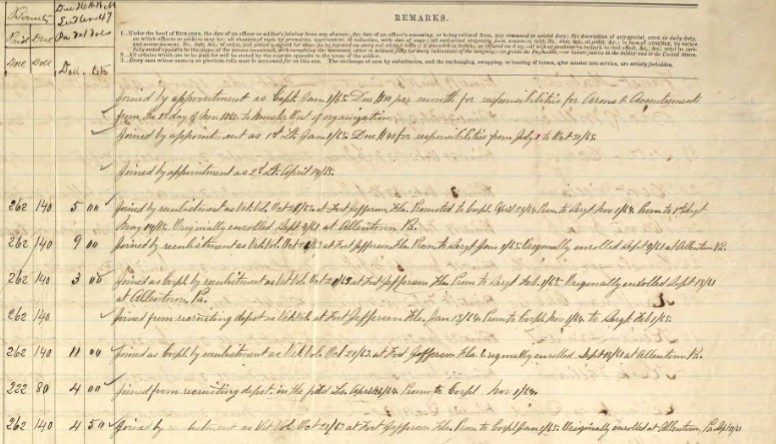
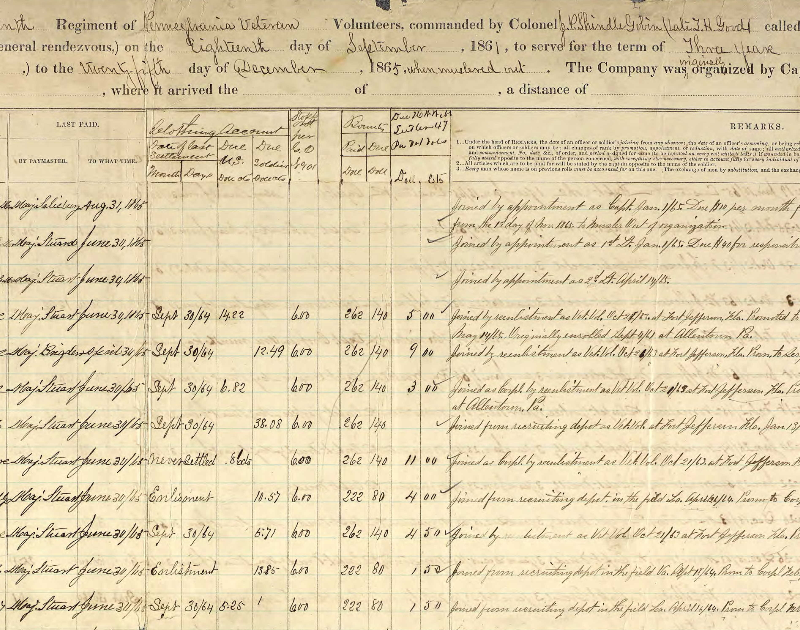
Excerpt of muster-out roll, Company G, 47th Pennsylvania Volunteer Infantry, December 25, 1865, page one (Pennsylvania Civil War Muster Rolls, Pennsylvania State Archives, public domain; click to enlarge).

The Commonwealth of Pennsylvania’s collection of Civil War-era muster rolls is another of the three major tools that beginning, medium and advanced researchers initially turn to for help in determining which Pennsylvania military unit(s) a soldier served with during the American Civil War. Unfortunately, it is also a resource that often does not receive the close attention from researchers that it should.

Those who have chosen to spend significant time looking through the individual documents contained in this collection have come to understand that, in addition to confirming the identity of a soldier’s regiment and company, as well as his rank(s) at enrollment and final discharge, Pennsylvania’s Civil War-era muster rolls are also useful for documenting when and where that soldier enrolled and mustered in for service and whether or not he had some change to his status while serving, such as a promotion, reduction in rank or charge of desertion — and possibly data which documented whether or not he was wounded or killed in battle and, if so, when and where.

Physically created as hard-copy index cards that were later preserved by the Pennsylvania State Archives in Harrisburg, Pennsylvania, as part of the “Civil War Muster Rolls and Related Records” group of documents from the Pennsylvania Department of Military and Veterans Affairs’ archives (Series RG:-019-ADJT-11, 1861-1866, 1906), this collection includes muster rolls from each of Pennsylvania’s volunteer infantry and volunteer militia regiments, emergency volunteer militia regiments that were formed during the summer of 1863 in response to the looming invasion of the commonwealth by the Confederate States Army, United States Colored Troops (USCT), United States Veteran Volunteer regiments and Hancock Veterans Corps, regiments of the Veterans Reserve Corps, and independent or other unattached units. Preserved on microfilm decades ago by the Commonwealth of Pennsylvania, a portion of this large collection has since been partially digitized and made available on the Ancestry.com website as “Pennsylvania, U.S., Civil War Muster Rolls, 1860-1869.”

* Note: Although Ancestry.com is a subscription-based genealogy service that generally requires users to pay for access to its records collections, the Commonwealth of Pennsylvania entered into a partnership with Ancestry.com several years ago “to digitize family history records in the State Archives and make them available online.” As part of that agreement, Ancestry.com created Ancestry.com Pennsylvania to provide free access to Pennsylvania residents to the Pennsylvania records it has digitized. If you reside in Pennsylvania and want to learn more about how you may obtain free access to those records, please contact the Pennsylvania State Archives for guidance. If you reside elsewhere, check with your local library to determine if it offers access to Ancestry.com as part of its service to library users.

What May Researchers Find with This Resource?

Excerpt from muster-out roll, Company G, 47th Pennsylvania Volunteer Infantry, December 25, 1865, showing soldiers’ promotions, status as Veteran Volunteers, etc. (Pennsylvania State Archives, public domain; click to enlarge).

According to personnel at the Pennsylvania State Archives, Pennsylvania’s Civil War Muster Rolls and Related Records collection includes:

“Alphabetical Rolls. The rolls are arranged alphabetically by the soldiers’ surnames. Entries usually give the name, rank, civilian occupation, and residence, the unit, regiment, company, and commanding officer, and the date and place where the roll was taken. Particulars about sickness or injury are also sometimes noted.

“Descriptive Lists of Deserters. Lists give the names, ages, places of birth, height, hair and eye color, civilian occupations, and ranks of deserters, the units, regiments, and companies to which they were assigned, and the dates and places from which they deserted.

“Muster-In Rolls. Entries usually list the name, age, rank, unit, regiment, and company of the soldier, the date and place where enrolled, the name of the person who mustered him in, the term of enlistment, the date of mustering in, and the name of commanding officer. Remarks concerning promotions and assignments are sometimes recorded.

“Muster-Out Rolls. The dated lists ordinarily give the soldier’s name, age, rank, unit, regiment, and company, the date, place, and person who mustered him in, the period of enlistment, and the name of the commanding officer. Particulars concerning pay earned, promotions, capture by the enemy and the like also regularly appear.

“Muster and Descriptive Rolls. Generally the rolls give the name, age, town or county and state or kingdom of birth, civilian occupation, complexion, height, eye and hair color, and rank, the unit, regiment, company and commanding officer, and the amount of money received for pay, bounties, and clothing. Rolls for assigned United States black troops are included in this group. Included throughout are such related materials as regimental accounts of action, and correspondence related to infractions of military procedures, correspondence from soldiers addressed to the governor expressing grievances or petitioning for promotion.

“The data found in the documents of this series were used to create the Civil War Veterans Card File, 1861-1866 (Series 19.12).”

Be Sure to Look for Data Regarding Soldiers’ Pay

Excerpt from muster-out roll for Company G, 47th Pennsylvania Volunteer Infantry, showing soldiers’ pay data, December 25, 1865 (Pennsylvania State Archives, public domain).

One of the most fascinating features found on the muster-out rolls for Pennsylvania volunteer soldiers is that many of the infantry unit clerks took the time to meticulously record the pay data for multiple members of their respective regiments. As a result, present-day researchers are often able to determine how much bounty pay a particular soldier was eligible for at the time of his enlistment — and how much of that promised pay he actually received, as well as how much money he still owed the United States government for his army uniform, rifle and ammunition at the time of his discharged from the military.

Another striking feature on the muster-out rolls is the “Last Paid” column, which corroborates the shocking fact that many Union Army soldiers were expected to perform their duties, even though they were not being paid regularly — a data point that also may help to shed light on why some soldiers’ families faced greater hardship than others (because some soldiers were able to send part of their pay home while others were not).

Caveat Regarding Ancestry.com’s Collection Related to the 47th Pennsylvania Volunteer Infantry

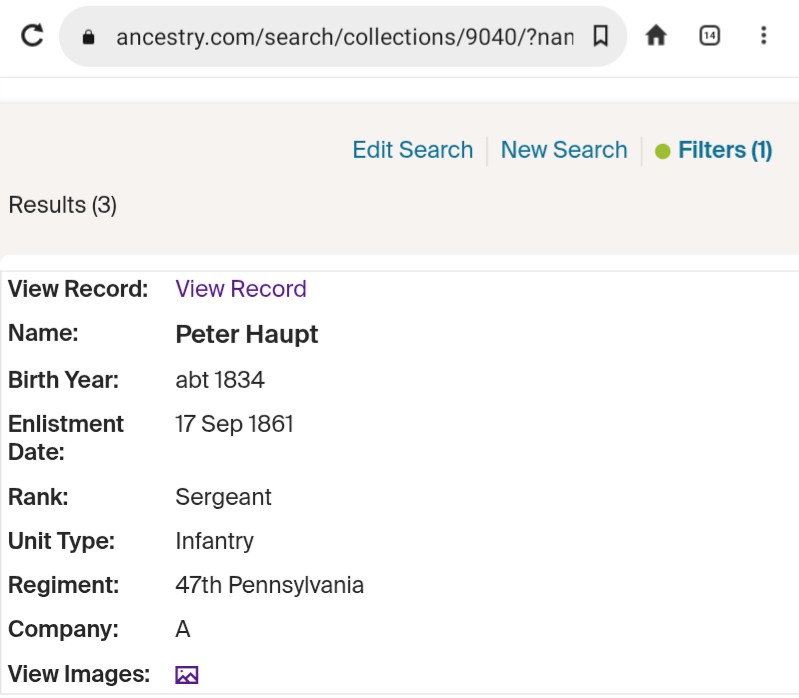
Screenshot of Ancestry.com’s record detail page for Peter Haupt, which incorrectly identifies him as a member of Company A, 47th Pennsylvania Volunteer Infantry, instead of Company C (fair use for illustration purpose, October 2025).

Although Ancestry.com’s collection of Pennsylvania Civil War-era muster rolls can be a useful tool for researchers, there is a significant problem with records related to the 47th Pennsylvania Volunteer Infantry that merits closer scrutiny — the inaccurate transcription of soldiers’ data. That scrutiny is needed because the muster rolls from the 47th Pennsylvania’s Company C were mixed together with the muster rolls from Company A when they were posted to Ancestry.com’s website, making it appear, when browsing through those rolls, that all of the soldiers listed on every single one of those incorrectly grouped muster rolls were all members of Company A, when they were not.

Complicating things further, the Ancestry.com personnel who were assigned to transcribe the data from each of those muster rolls and create Record Detail pages for each individual soldier that summarized each soldier’s data from the muster roll on which it appeared, apparently did not realize that the muster rolls from Companies A and C of the 47th Pennsylvania Volunteer Infantry had been mixed together. As a result, those transcribers incorrectly described every soldier from that improperly sorted muster roll group as a member of Company A, when they were not. (See attached image.)

So, when reviewing Ancestry.com’s collection of muster rolls, it is vitally important that researchers not take the transcribed data found on any of the Record Detail pages of 47th Pennsylvania muster rolls at face value. Instead, researchers should double check the data found on those muster rolls for the 47th Pennsylvania Volunteer Infantry against the data for individual soldiers published by Samuel P. Bates in his History of Pennsylvania Volunteers, 1861-5, volume 1, and should also then re-check that data against the information of individual soldiers that is contained in the Pennsylvania Civil War Veterans Index Card File, 1861-1866.

* Note: This is particularly important if you are a family historian who is hoping to identify the specific company in which your ancestor served. (And you will definitely want to know which company your ancestor served with because each company of the 47th Pennsylvania Volunteer Infantry was assigned to different duties in different locations at different times during the regiment’s service.)

Caveat Regarding “Deserters”

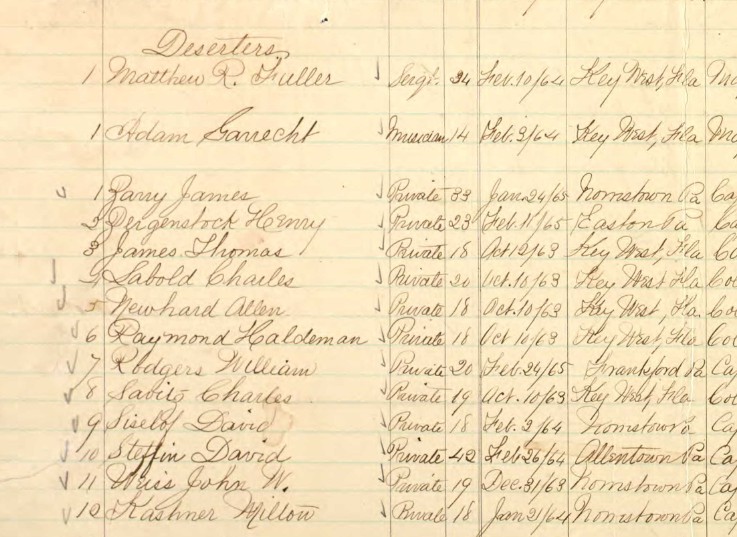
Private Milton P. Cashner, Company B, 47th Pennsylvania Volunteer Infantry, was incorrectly labeled as a deserter on this regimental muster roll from the American Civil War (Pennsylvania State Archives, public domain; click to enlarge).

If a muster roll entry for your ancestor noted that he was a deserter, it’s also important that you not take that label at face value, either, because that data may also be incorrect. Military records from the Civil War era contained a surprising number of errors, a fact that is understandable when considering what the average army clerk was expected to do — keep track of more than a thousand men, many of whom ended up becoming separated from their regiment and confined to Union Army hospitals after being wounded in battle. (Wounded too severely to identify themselves to army personnel, they were then often mis-identified by army hospital personnel and then also incorrectly labeled as “deserters” by their own regiments because they hadn’t shown up for post-battle roll calls.) So, it’s important to double and triple check the data for any ancestor who was labeled as a “deserter” because he might actually have been convalescing at a hospital and not absent without leave.

Honoring Our Ancestors 

One of the best ways to honor ancestors who fought to preserve America’s Union is to pass their stories along to future generations. No embellishment required. Their willingness to volunteer for military service and the bravery they displayed as they ran toward danger and certain death during one of America’s darkest times speaks for itself.

Our job, as students of American History, educators and family historians is to ensure that their stories are told as accurately and thoroughly as possible so that their valor and love of community and country are never forgotten.

Remember their names. Tell and re-tell their stories. Honor the sacrifices that they made.


Sources:

  1. “Ancestry Pennsylvania,” in “Agencies: Pennsylvania Historical and Museum Commission,” in “Pennsylvania State Archives.” Harrisburg, Pennsylvania: Commonwealth of Pennsylvania, retrieved online October 25, 2025.
  2. Civil War Muster Rolls and Related Records” (resource description). Harrisburg, Pennsylvania: Pennsylvania State Archives, retrieved online October 30, 2025.
  3. Pennsylvania,” in Collections. Lehi, Utah: Ancestry.com Operations, Inc., 2021 (retrieved online October 25, 2025).


Finding Your 47th Pennsylvanian: Using the Pennsylvania Civil War Veterans Card File, 1861-1866

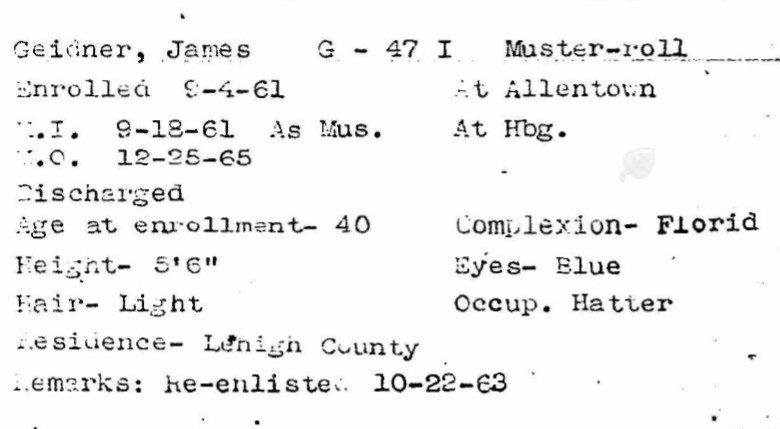
The index card of Field Musician James Geidner, Company G, 47th Pennsylvania Volunteer Infantry (Pennsylvania Civil War Veterans Card File, 1861-1866, courtesy of the Pennsylvania State Archives).

The Pennsylvania Civil War Veterans Index Card File, 1861-1866 is one of three resources that beginning, medium and advanced researchers frequently turn to for help in determining which Pennsylvania military unit(s) a soldier served with during the American Civil War. Physically housed at the Pennsylvania State Archives in Harrisburg, Pennsylvania, as part of the Pennsylvania Department of Military and Veterans Affairs’ archives (Series RG-019-ADJT-12), this collection of individual index cards was preserved on microfilm decades ago by the Commonwealth of Pennsylvania and then later digitized and made available, free of charge, on the State Archives’ website via a user-friendly portal, enabling researchers nationwide to search or browse, alphabetically, through each of the index cards that had been created for the majority of Pennsylvanians who had served with the Union Army (as well as the non-Pennsylvanians who had also served with Pennsylvania units). According to Pennsylvania State Archives personnel:

“These 3 x 5 cards were initially prepared to serve as an index to Samuel Penniman Bates’ History of Pennsylvania Volunteers, 1861-1865, (Harrisburg, 1869-1871). The Office of the Adjutant General later expanded the scope of the cards by transcribing onto them data found on the original documents. Among the information generally found are the soldiers’ names, military units, and ages at enrollment, the dates and places where enrolled, the dates and places where mustered in, and the dates of discharge. Physical descriptions (complexion, height, color of hair and eyes), residences, birthplaces, promotions and wounds also are sometimes included. The listing is not comprehensive.”

That last sentence is an important caveat because, while this index card system can be a helpful primary source for basic data about individual soldiers, it does not contain the name of every single Pennsylvanian who served with the Union Army during the Civil War. In addition, a significant number of the index cards contain errors (incorrect spellings of soldiers’ names, soldiers labeled as deserters when they had actually been honorably discharged or hospitalized to due battle wounds or illness, etc.).

* Note: Those faults are understandable, however, when considering that the index cards were based on data compiled by Samuel Bates for his History of Pennsylvania Volunteers, 1861-5a five-volume series of books that included rosters of soldiers for each Pennsylvania regiment that served during the American Civil War. The errors in Bates’ History are also understandable as you come to understand that Samuel Bates was assigned the task, during the mid-1860s, of summarizing thousands and thousands of muster rolls generated by Pennsylvania military units during the war — many of which were also filled with errors because the army clerks assigned to maintain those rolls were often unable to create accurate records as their regiments were being marched into battle or from one duty station to another.

Another more recent issue with this system is that its portal to the digitized index cards that was so easy to browse and search for free is now no longer available on the Pennsylvania State Archives’ website. The index cards are still available, however, to researchers who travel to Harrisburg to view the microfilmed version at the State Archives, as well as to online researchers via Ancestry.com as “Pennsylvania, U.S., Veterans Card Files, 1775-1948.” (Although Ancestry.com is a subscription-based genealogy service that generally requires users to pay for access to its records collections, the Commonwealth of Pennsylvania entered into a partnership with Ancestry.com several years ago “to digitize family history records in the State Archives and make them available online.” As part of that agreement, Ancestry.com created Ancestry.com Pennsylvania to provide free access to Pennsylvania residents to the Pennsylvania State Archives records it has digitized. If you reside in Pennsylvania and want to learn more about how you may obtain free access to those records, please contact the Pennsylvania State Archives for guidance. If you reside elsewhere, check with your local library to see if it offers access to Ancestry.com as part of its service to library users.)

Despite those issues, the Pennsylvania Civil War Veterans Index Card File, 1861-1866 remains a useful tool for finding your 47th Pennsylvanian because it may help you confirm your ancestor’s place of residence during the early 1860s and may also provide you with an approximate year of birth for him.

Additional Important Tips for Using This Resource

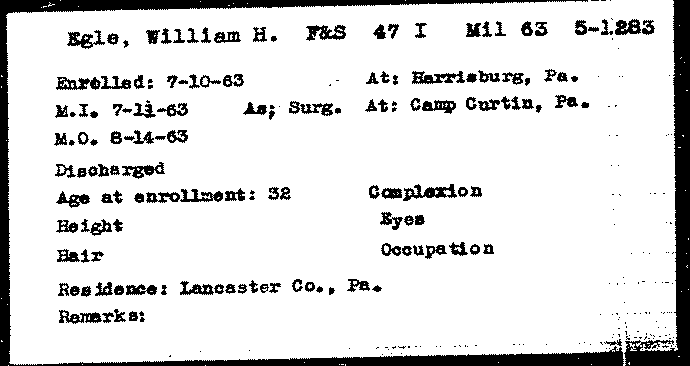
The index card of William H. Egle, M.D. shows that this soldier served with the 47th Pennsylvania Militia, Emergency of 1863 and not the 47th Pennsylvania Volunteer Infantry (Pennsylvania Civil War Veterans Card File, 1861-1866, courtesy of the Pennsylvania State Archives).

If you are able to find an index card for your ancestor in the Pennsylvania Civil War Veterans Index Card File, 1861-1866, pay particular attention to the top line of that card’s data. That data identifies the regiment number and company letter of his military unit. Then also look at the lines of data below. (Those lines of text note the start and dates of his service.) If you see dates of service indicating that your ancestor served between mid-April 1861 and the end of July 1861, you will realize that the regiment number in the top line was not “47.” This means that your ancestor performed what is known as “Three Months’ Service,” that he actually served with a different regiment during the first months of the war, and that he then may also have served with the 47th Pennsylvania Volunteer Infantry at a later date (because the 47th Pennsylvania Volunteer Infantry was not established until August 5, 1861). So, you’re one of those 47th Pennsylvania descendants who needs to look for two or more index cards in the Pennsylvania Civil War Veterans Index Card File, 1861-1866 — one for your ancestor’s “Three Month Service” and one for his service with the 47th Pennsylvania Volunteer Infantry (which was initially most likely a three-year term of enlistment, but may have been a one or two-year term, depending on how late he was enrolled for service).

HOWEVER, if you see dates of service indicating that your ancestor served at any point during 1863 — AND, if the top line indicates that his regiment was “47 I Mil 63” — this means that your ancestor DID NOT serve with the 47th Pennsylvania Volunteer Infantry. He served with the 47th Pennsylvania Militia, Emergency of 1863. (The soldiers who served with that militia group were also brave and honorable men, but they were part of a very different unit that had a very different mission. Learn more about that militia unit here.)

Regardless of whether or not your ancestor “performed Three Months’ Service” during the earliest part of the Civil War, if you see dates of service indicating that your ancestor served at any point between August 5, 1861 and early January 1866 — AND if the top line indicates that his regiment was “47 I” — then you can be reasonably confident that your ancestor actually did serve with the 47th Pennsylvania Volunteer Infantry (also known as the 47th Pennsylvania Volunteers or the 47th Pennsylvania Veteran Volunteers). So, you should make yourself a cup of coffee or tea, find a comfy chair, and spend some quality time exploring our website to learn more about the history-making 47th Pennsylvania Volunteer Infantry.

Best wishes for success with your research! Let us know what you learn about your ancestor!!


Sources:

  1. “Ancestry Pennsylvania,” in “Agencies: Pennsylvania Historical and Museum Commission,” in “Pennsylvania State Archives.” Harrisburg, Pennsylvania: Commonwealth of Pennsylvania, retrieved online October 25, 2025.
  2. Civil War Veterans Card File, 1861-1866” (resource description). Harrisburg, Pennsylvania: Pennsylvania State Archives, retrieved online October 25, 2025.
  3. Pennsylvania,” in Collections. Lehi, Utah: Ancestry.com Operations, Inc., 2021 (retrieved online October 25, 2025).


April 12th: This Date in 47th Pennsylvania Volunteer Infantry History

April 12th would prove to be an important date for the men who served with the 47th Pennsylvania Volunteer Infantry during the American Civil War and Reconstruction eras. This abridged timeline illustrates why:

1861

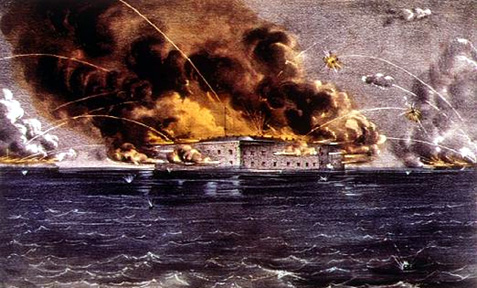
The bombardment of Fort Sumter 12-14 April 1861 (Currier & Ives, public domain).

At 4:30 a.m., on April 12, 1861, artillery batteries of the Confederate States Army open fire on United States Army troops stationed at Fort Sumter in Charleston, South Carolina. A long and disastrous period of civil war begins in America.

The majority of Pennsylvanians and residents of other states throughout America who will ultimately serve with the 47th Pennsylvania Volunteer Infantry are at home, asleep in their beds — or just rising and readying themselves for their work days on family farms, as canal boatmen, in iron foundries, silk mills, tanneries or tobacco factories, as quarrymen toiling away in the slate industry, or as miners tunneling deeper inside of the Earth in poorly-lighted coal mines, along with countless other blue collar laborers who are risking their own health and safety just to keep their families housed and fed.

The 47th Pennsylvania Volunteer Infantry isn’t even “a glimmer” in anyone’s eyes — yet. (It won’t be founded until August 5, 1861.)

1862

In 1862, The Gazette, one of two hometown newspapers read by the majority of men serving with the 47th Pennsylvania Volunteer Infantry’s C Company, carries the following news in its April 12th edition:

Jeff. Davis is becoming desperate. He has issued an extraordinary Message ordering the enrollment of all citizens of the Confederate States between the ages of 18 and 35, for military service, the residue of the fighting population, above 35 to form a fighting force.

Although that particular edition of the newspaper has not yet reached the 47th Pennsylvania Volunteers who are stationed in Florida, a warning about the Confederate Conscription Act’s pending passage has likely been telegraphed by the U.S. War Department to senior officers at the 47th Pennsylvania’s headquarters at Fort Taylor in Key West in order to prepare them for the increased threat they and their troops will face.

1864

On April 12, 1864, Captain Charles William Abbott, commanding officer of the 47th Pennsylvania Volunteer Infantry’s K Company, pens a brief report from his regiment’s camp at Grand Ecore, Louisiana to his superior officers in the United States Army of the Gulf, which partially documents the losses in soldiers and supplies sustained by his regiment during the Battle of Pleasant Hill, Louisiana on April 9, 1864. That report also contains details about the regiment’s movements during this phase of duty.

Sergeant John Gross Helfrich then describes this same battle in a letter to his parents on May 5th, in which he notes:

I have learned additional news of the late fight of our boys of the “Nineteenth Corps”…. The casualties of our boys amounted to a great deal more than at first reported. The Lt. Col. of our Forty-seventh Regt. is missing, and supposed he is wounded or perhaps killed. Lt. Swoyer is dead.

1865

In a letter that he is writing to the Sunbury American on April 12, 1865 from the 47th Pennsylvania Volunteer Infantry’s camp near Summit Point, Virginia, 47th Pennsylvanian Henry D. Wharton describes a celebration that took place following the surrender at Appomattox by Confederate General Robert E. Lee and his army on April 9, 1865:

Since yesterday a week we have been on the move, going as far as three miles beyond Winchester. There we halted for three days, waiting for the return or news from Torbett’s cavalry who had gone on a reconnoisance [sic] up to the valley. They returned, reporting they were as far up as Mt. Jackson, some sixty miles, and found nary an armed reb. The reason of our move was to be ready in case Lee moved against us, or to march on Lynchburg, if Lee reached that point, so that we could aid in surrounding him and [his] army, and with Sheridan and Mead capture the whole party. Grant’s gallant boys saved us that march and bagged the whole crowd. Last Sunday night our camp was aroused by the loud road of artillery. Hearing so much good news of late, I stuck to my blanket, not caring to get up, for I suspected a salute, which it really was for the ‘unconditional surrender of Lee.’ The boys got wild over the news, shouting till they were hoarse, the loud huzzas [sic, huzzahs] echoing through the Valley, songs of ‘rally round the flag,’ &c., were sung, and above the noise of the ‘cannons opening roar,’ and confusion of camp, could be heard ‘Hail Columbia’ and Yankee Doodle played by our band. Other bands took it up and soon the whole army let loose, making ‘confusion worse confounded.’

The next morning we packed up, struck tents, marched away, and now we are within a short distance of our old quarters. – The war is about played out, and peace is clearly seen through the bright cloud that has taken the place of those that darkened the sky for the last four years. The question now with us is whether the veterans after Old Abe has matters fixed to his satisfaction, will have to stay ‘till the expiration of the three years, or be discharged as per agreement, at the ‘end of the war.’ If we are not discharged when hostilities cease, great injustice will be done.

The members of Co. ‘C,’ wishing to do honor to Lieut. C. S. Beard, and show their appreciation of him as an officer and gentleman, presented him with a splendid sword, sash and belt. Lieut. Beard rose from the ranks, and as one of their number, the boys gave him this token of esteem.

A few nights ago, an aid [sic] on Gen. Torbett’s staff, with two more officers, attempted to pass a safe guard stationed at a house near Winchester. The guard halted the party, they rushed on, paying no attention to the challenge, when the sentinel charged bayonet, running the sharp steel through the abdomen of the aid [sic], wounding him so severely that he died in an hour. The guard did his duty as he was there for the protection of the inmates and their property, with instruction to let no one enter.

The boys are all well, and jubilant over the victories of Grant, and their own little Sheridan, and feel as though they would soon return to meet the loved ones at home, and receive a kind greeting from old friends….

1866

On April 12, 1866, members of the 47th Pennsylvania Veteran Volunteers who survived the American Civil War are three months into their post-war civilian lives. Many are back home in Pennsylvania, trying to regain some sense of their old selves with normal work and family routines. Others have already left their pre-war and war lives behind, choosing to migrate west in search of better opportunities — or a certain peace of mind they hope to find in knowing they will be far away from any decision-makers who might drag their communities and nation back down into another disastrous war in the future.


Sources:

  1. Abbott, Charles W. Report from Captain Charles W. Abbott, Captain, Company K, 47th Pennsylvania Volunteer Infantry, to Senior Officers of the U.S. Army of the Gulf’s XIX Corps (19th Corps), Grand Ecore, Louisiana, April 12, 1864. Nazareth, Pennsylvania: Personal Collection of Julian Burley.
  2. Agriculture and Rural Life,” in “Stories from PA History.” Harrisburg, Pennsylvania: Pennsylvania Historical and Museum Commission, 2023.
  3. Fort Sumter and Fort Moultrie National Park.” Washington, D.C.: National Park Foundation, retrieved online April 12, 2025.
  4. Harris, Howard and Perry K. Blatz. Keystone of Democracy: A History of Pennsylvania Workers. Harrisburg, Pennsylvania: Pennsylvania Historical and Museum Commission, 1999.
  5. Helfrich, John Gross. Letter to His Parents, May 5, 1864. Mesa, Arizona: Personal Collection of the Colin Cofield Family Archives.
  6. Miller, Randall M. and William A. Pencak. Pennsylvania: A History of the CommonwealthUniversity Park, Pennsylvania: The Pennsylvania State University Press, 2002.
  7. Mining Anthracite,” in “Stories from PA History.” Harrisburg, Pennsylvania: Pennsylvania Historical and Museum Commission, 2023.
  8. Montgomery, Morton L. Early Furnaces and Forges of Berks County, Pennsylvania, in The Pennsylvania Magazine of History and Biography, 1884. Philadelphia, Pennsylvania: Historical Society of Pennsylvania, 1884.
  9. News Regarding the Confederate States’ New Conscription Order. Sunbury, Pennsylvania: The Gazette, April 12, 1862.
  10. Palladino, Grace. Another Civil War: Labor, Capital, and the State in the Anthracite Regions of Pennsylvania, 1840-1868. New York, New York: Fordham University Press, March 30, 2006.
  11. Sacher, John M. Confederate Conscription and the Struggle for Southern Soldiers. Baton Rouge, Louisiana: LSU Press, 2021.
  12. The Industrial Age,” in “Stories from PA History: Science and Invention.” Harrisburg, Pennsylvania: Pennsylvania Historical and Museum Commission, 2023.
  13. The Pennsylvania Iron Industry: Furnace and Forge of America,” in “Stories from PA History.” Harrisburg, Pennsylvania: Pennsylvania Historical and Museum Commission, 2023.
  14. The Railroad in Pennsylvania,” in “Stories from PA History.” Harrisburg, Pennsylvania: Pennsylvania Historical and Museum Commission, 2023.
  15. Timeline of Labor History in Pennsylvania.” Pennsylvania: Pennsylvania Labor History Society, retrieved online April 12, 2025.


Women’s History Month: A Look Back at the Mothers, Wives, Widows, Daughters, and Granddaughters of the 47th Pennsylvania Volunteers

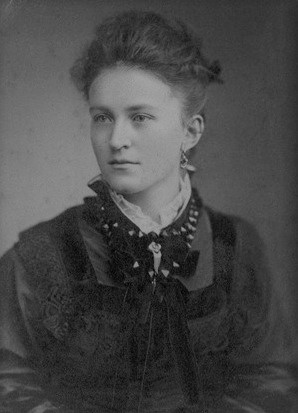
Leanna (Diehl) Hornbeck (1851-1934).

Leanna (Diehl) Hornbeck (1851-1934).

As Women’s History Month 2025 comes to a close, we take a look back at the mothers, wives, widows, daughters, and granddaughters of 47th Pennsylvania Volunteer Infantrymen who helped to preserve America’s Union and rebuild their shattered nation following the end of the American Civil War.

The backbones of their respective families, they not only kept the home fires burning while their husbands were engaged in combat far from their loving arms, they each left their own marks on the communities where they lived, and deserve to be remembered and celebrated for their own courage and resilience. Learn more about these remarkable women by watching our YouTube video, “Faces of the 47th: Wives, Widows and Daughters of the 47th Pennsylvania Volunteers,” and by reading the following biographies:

Remember their names. Be inspired by their strength. Honor the sacrifices they made for community and country.


Sources: 

  1. “Allen and Nona Albert’s Retirement a Loss to Long-Time Customers.” Tremont, Pennsylvania: The Press-Herald and The Pine Grove Herald, 12 February 1970.
  2. “Allentown Woman on the Roll of Honor: Gov. Brumbaugh Retires Mrs. Anna S. Leisenring, Factory Inspector, with Half Pay.” Reading, Pennsylvania: Reading Eagle, 20 January 1918.
  3. “Allentown Woman to Come to Reading to Inspect Bake Shops and Textile Establishments: Mrs. Annie Leisenring Is Lineal Descendant of Conrad Weiser, the Great Colonial Pioneer Who Lived Near Womelsdorf. Was First Appointed to Factory Inspection Service in 1893.” Reading, Pennsylvania: Reading Eagle, 20 May 1914.
  4. Baptismal, marriage, military, death, and burial records of the Snyder family. Pennsylvania, California, Florida, Louisiana, Nevada, Ohio, etc.: Snyder Family Archives, 1650-present and Historic Pennsylvania Church and Town Records (baptismal, marriage, death, and burial records of various churches across Pennsylvania). Harrisburg, Pennsylvania: Department of Health, Bureau of Vital Statistics, 1905-1956; and Philadelphia, Pennsylvania: Historical Society of Pennsylvania, 1776-1956.
  5. Beyerle, Emma; and Snyder, H. Corinne [sic, Corrine], Catharine R. and Lillian E., in U.S. Census (City of Reading, Fourteenth Ward, City of Reading, Berks County, Pennsylvania, 1930). Washington, D.C.: U.S. National Archives and Records Administration.
  6. Breneman, Christian K. and Margaret J., in U.S. Civil War Pension Index (application no.: 432815, certificate no.: 307318, filed by the widow from Pennsylvania on 7 July 1891). Washington, D.C.: U.S. National Archives and Records Administration.
  7. Breneman, Margaret A., Wm. L. Gardner, and Margaret J. Breneman; Victor L., Carrie I. Landis, Christian and Margaret J. Breneman, and R. M. Landis; Benj. C Breneman, Lena M. Rupley, Christian K. and Margaret J. Breneman, and Henry M. and Phoebe Rupley; Harry S. Breneman, Anna May Gebhard, C. K. and M. J. Breneman, and Jacob and Anna Gebhard, in Applications for Marriage Licenses. Harrisburg, Pennsylvania: Clerk of the Orphans’ Court of Dauphin County, Pennsylvania, 21 December 1897; 21 November 1906; 17 June 1911; and 3 October 1914.
  8. “Catharine Courtney, 89, Private Secretary” (obituary). Lancaster, Pennsylvania: Intelligencer Journal, 28 August 1995.
  9. Catharine S. Courtney, in “Clubs: York Woman Heads State Secretaries.” Lancaster, Pennsylvania: New Era, 23 April 1956.
  10. Chalkley John, in Portrait and Biographical Album of Whiteside County, Illinois, Containing Full-Page Portraits and Biographical Sketches of Prominent and Representative Citizens of the County, Together with the Portraits and Biographies of All the Governors of Illinois, and the Presidents of the United States. Chicago, Illinois: Chapman Brothers, 1863.
  11. Charles Magill and “Julian Ruston” [sic], in Certificate of Marriage. Camden, New Jersey: St. Paul’s Protestant Episcopal Church, 18 January 1887.
  12. Courtney, Charles F. and Catharine R., in Polk’s Lancaster City Directory, 1950. Boston, Massachusetts: R. L. Polk & Co., Inc., Publishers, 1950.
  13. Davis, William W. History of Whiteside County, Illinois from Its Earliest Settlement to 1908: Illustrated, with Biographical Sketches of Some Prominent Citizens of the County, vols. 1 and 2. Chicago, Illinois: Pioneer Publishing Co., 1908.
  14. “Death of a Highly Esteemed Citizen.” Allentown, Pennsylvania: The Allentown Democrat, 5 October 1898.
  15. Edwin Minnich, Juliann (Kuehner) Minnich, and George Minnich, in U.S. Civil War Widows’ Pension Files. Washington, D.C.: U.S. National Archives and Records Administration, 1865-1901.
  16. Explaining Trends in the Gender Wage Gap: A Report by The Council of Economic Advisors.” Washington, D.C.: The White House, June 1998.
  17. “Funeral of Mrs. Mary B. Moyer from Her Late Home on East Market Street,” in “Green Ridge Items.” Scranton, Pennsylvania: The Scranton Tribune, 9 December 1901.
  18. Fusselman, Daniel, Catherine, Celistia [sic, Salista], Catherine, John W. R., Caroline, Mary E., and Sarah, in U.S. Census (East Waterford, Tuscarora Township, Juniata County, Pennsylvania, 1860). Washington, D.C.: U.S. National Archives and Records Administration.
  19. Fusselman, Daniel (father), Kate, John, Caroline, Emna Sarah, Daniel (son), Amanda, Rosa, and Josiah, in U.S. Census (McCullochs Mills, Tuscarora Township, Juniata County, Pennsylvania, 1870). Washington, D.C.: U.S. National Archives and Records Administration.
  20. Fusselman, Daniel and Catharine, in U.S. Civil War Pension Files (application no.: 254530, certificate no.: 315939, filed from Pennsylvania by the veteran, 8 May 1878; application no.: 250052, certificate no.: 347812, filed by the veteran’s widow, 20 August 1879). Washington, D.C.: U.S. National Archives and Records Administration.
  21. Gordon, Elizabeth Putnam. Women Torch-Bearers: The Story of the Woman’s Christian Temperance Union. Evanston, Illinois: National Woman’s Christian Temperance Union Publishing House, 1924.
  22. Holland Farmer Passed Away Friday.” Abilene, Kansas: Abilene Daily Reflector, 29 August 1914.
  23. “John Family Papers, 1775-1951” (RG5/077). Swarthmore, Pennsylvania: Friends Historical Library of Swarthmore College.
  24. John, Clark E. History and Family Record of the “John” Family, 1683 to 1964: The Descendants of John Phillips and Ellen, His Wife, from Haverfordwest, Pembrokeshire, Wales. Salt Lake City, Utah: Genealogical Society of the Church of Latter Day Saints, 1967.
  25. John, Don D. and Helen Doup John. “Eliza John Diary from 1839 to 1863: An Historical and Genealogical Record of the Quakers in Northumberland County, Pennsylvania and What Befell Them,” in Historical Collections of the John Family in America, 1950. Louisville, Kentucky: J. D. John, Self-published, 1951.
  26. John, George D., Mary Alice John, Elida P. John, Sarah Hughes, and Sidney A. John, in Illinois Deaths and Stillbirths, 1916-1947 (database via Public Board of Health, Archives, Springfield, Illinois, Family History Library microfilm 1,614,419, 1,786,728 and 1,818,801; dates: 1928, 1937, 1938). Salt Lake City, Utah: Family History Library.
  27. Leanna D. Hornbeck, in Illinois Deaths and Stillbirths, 1916–1947. Salt Lake City, Utah: FamilySearch, 1934.
  28. Leanna D. Hornbeck, in U.S. Passport Applications (No. 5492 on Roll No. 184). Washington, D.C.: U.S. Department of State, Bureau of Citizenship and U.S. National Archives, 10 May 1913.
  29. Lecture Presentation by Annie E. Leisenring, in “Addresses and Discussions: Fourth Annual Welfare and Efficiency Conference, Pennsylvania Department of Labor and Industry, November 21, 22, 23, 1916.” Harrisburg, Pennsylvania: Monthly Bulletin of the Pennsylvania Department of Labor and Industry, William Stanley Ray, State Printer, March 1917.
  30. Leisenring, Annie, in U.S. Census of Union Veterans and Widows of the Civil War. Washington, D.C. and Pennsylvania: 1890.
  31. Leisenring, Annie E., in United States Veterans Administration Pension Payment Cards (Certificate No.: 240043). Washington, D.C.: U.S. National Archives and Records Administration, 1887-1920.
  32. Letter from Key West (from “W. D. C. R., Chaplain, Forty-seventh Regiment, P. V.”; dated 13 March 1862). Philadelphia, Pennsylvania: The Press, 31 March 1862, front page.
  33. Lewis, Jim. “Not Forgotten: She Was Both Pediatrician and Pioneer” (obituary of Sandra Rowan, MD, one of the children cared for by Lillie May Snyder). Reading, Pennsylvania: Reading Eagle, 16 July 2016.
  34. “Lillian Snyder, 92, Was Registered Nurse” (obituary of H. Corrine Snyder’s younger sister, Lillian Estelle Snyder). Lancaster, Pennsylvania: Intelligencer Journal, 9 June 2001.
  35. “Local Group Returns from Tour of Orient” (photo with article about the travels of Catharine R. (Snyder) Courtney and friends). Lancaster, Pennsylvania: Intelligencer Journal, 2 April 1963.
  36. “Many Attend Funeral of Stephen J. Moyer.” Scranton, Pennsylvania: The Scranton Tribune, 9 August 1915.
  37. Maurer, Russ. “Lavelle Telegraph Telephone Company Charted in 1908,” in “Memories of Russ Maurer.” Hegins, Pennsylvania: The Citizen-Standard, circa 1990s.
  38. “Minick, Julia A. (nee) Megill, Julia A.” [sic], in U.S. Civil War Pension General Index Cards, 1896. Washington, D.C.: U.S. National Archives and Records Administration.
  39. Minnich, Capt. Edwin G. and Mrs. Julia (Kuehner) Minnich (images and military paperwork). Pennsylvania: Personal Collection of Chris Sapp.
  40. “Miss Nona Snyder Is Married Today to Pine Grove Man” (article describing the wedding ceremony of Nona M. Snyder and Allen A. Albert). Lebanon, Pennsylvania: Lebanon Daily News, 23 September 1953.
  41. Mrs. Julia Magill, in “Prominent Army Nurses,” in “The National Association of Army Nurses of the Civil War.” Washington, D.C.: The Evening Times, Wednesday, October 8, 1902.
  42. “Mrs. Margaret J. Breneman” (obituary). Harrisburg, Pennsylvania: Harrisburg Telegraph, 20 March 1930.
  43. “Nona Albert” (obituary). Lebanon, Pennsylvania: The Daily News, 3 June 1960.
  44. Notice of Mrs. Henry Hornbeck’s Return from Chicago. Allentown, Pennsylvania: The Allentown Democrat, 23 September 1909.
  45. Occupational Outlook Handbook, 1959 Edition, pp. 239-249, in Bulletin No. 1255. Washington, D.C.: United States Department of Labor, 1959.
  46. Rodrock, William D. C. and Julia M. Rodrock, in U.S. Civil War Pension Index (application no.: 296549, certificate no.: 260499, filed by the veteran on 17 July 1879; application no.: 793449, certificate no.: 574458, filed by the veteran’s widow from New Jersey on 24 October 1903). Washington, D.C.: U.S. National Archives and Records Administration.
  47. “Shopping Nights Are Agreed Upon.” Allentown, Pennsylvania: The Allentown Leader, 17 December 1917.
  48. Smalser, Robert. Letter of Mary Barbara (Nyhart) Moyer to her husband, Stephen J. Moyer, and photographs of Stephen J. and Mary Moyer and their children. Seabeck, Washington: Personal Collection of Col. Bob Smalser (used with permission).
  49. Snyder, Catharine, John, Timothy, Lillie, and Salome, in A Directory of the Eleventh Census of the Population of Schuylkill County, Giving the Names and Ages of Males and Females, Published by Cities, Boroughs, Wards, Townships, Precincts or Towns, in Connection with a Business Directory of the Same for Advertising Purposes. Lebanon, Pennsylvania: E. A. Schartel, Publisher, 1891.
  50. Snyder, Catharine R. and Courtney, Charles F., in “Massachusetts Vital Records Index to Marriages” (documentation of the marriage of H. Corrine Snyder’s younger sister, Catharine, in Boston in 1947). Boston, Massachusetts: New England Historic Genealogical Society.
  51. Snyder, Catharine R. and Lillian, E., in The Boston Directory for the Year Commencing July 1, 1942 (Boston Massachusetts, 1942). Chicago, Illinois: R. L. Polk Publishers, 1942.
  52. Snyder, Corrine and Catharine, in Reading City Directory, 1926. Reading, Pennsylvania: Boyd’s City Directories.
  53. Snyder, Corrine, Lillian E. and Catharine R., in U.S. Census (City of Reading, Fourteenth Ward, Berks County, Pennsylvania, 1940). Washington, D.C.: U.S. National Archives and Records Administration.
  54. Snyder, H. Corrine, in U.S. Census (Allentown, Lehigh County, Pennsylvania, 1950). Washington, D.C.: U.S. National Archives and Records Administration.
  55. Snyder, John H., Minnie R., Timothy P. and Nona M., in U.S. Census (Butler Township, Schuylkill County, Pennsylvania, 1900). Washington, D.C.: U.S. National Archives and Records Administration.
  56. Snyder, John H., Minnie R., Timothy P., Nona M., H. Corrine, John S., Catharine R., and Lillian E., in U.S. Census (Lavelle, Northwest Butler Township, Schuylkill County, Pennsylvania, 1910). Washington, D.C.: U.S. National Archives and Records Administration.
  57. Snyder, John H., Minnie, Nona M., John S., and Willard E. in U.S. Census (Butler Township, Schuylkill County, Pennsylvania, 1930). Washington, D.C.: U.S. National Archives and Records Administration.
  58. Snyder, John H., Minnie R., Nona, Corrine, John S., Catharine R., Lillian E., Chester H., and Willard E. in U.S. Census (Butler Township, Schuylkill County, Pennsylvania, 1920). Washington, D.C.: U.S. National Archives and Records Administration.
  59. Snyder, Lillie May, in Gibson & Sanders Funeral Home Records (1956). Reading, Pennsylvania: Sanders Funeral Home, retrieved in 2011.
  60. Snyder, Miss Lillie (obituary and funeral notice). Reading, Pennsylvania: Reading Eagle, 16 and 18 May 1956.
  61. “Stephen J. Moyer,” in “Deaths.” Scranton, Pennsylvania: The Scranton Tribune, 6 August 1915.
  62. “Veterans Who Will Be at the G.A.R. Celebration Owe Their Lives to the Heroic Self-Sacrifice of These Wgomen Nurses.” Philadelphia, Pennsylvania: The Philadelphia Times, Sunday, 20 August 1899.
  63. “Violate Child Labor Law: One Employer Heavily Fined and Others to Be Arrested. Special to The Telegraph.” Harrisburg, Pennsylvania: Harrisburg Telegraph, 8 September 1911.
  64. Wattenberg, Ben. “FMC Program Segments 1900-1930: Infant and Maternal Mortality,” in “The First Measured Century.” Washington, D.C.: PBS, 2000 (retrieved online 14 February 2025).
  65. “W.C.T.U. Convention,” in “Frackville News.” Shenandoah, Pennsylvania: Evening Herald, 30 September 1950.
  66. “Will of Henry J. Hornbeck.” Allentown, Pennsylvania: The Allentown Democrat, 19 October 1898.


Honoring President George Washington, Fort Taylor, Key West, Florida (February 22, 1862)

Fort Taylor, Key West, Florida (Harper’s Weekly, 1864, public domain).

Letter from the Sunbury Guards
Camp Brannan. Key West, Fla., Feb. 27, 1862.

DEAR WILVERT:– Gen. Brannan and staff arrived here on Friday last, on the steamer Philadelphia. He made his first appearance, to us, on our parade ground, at dress parade, and seemed pleased at the improvement the men had made with their new arms, in the manual. After dress parade he rode passed [sic] the different streets of the regiment, and the enthusiastic cheers given him showed that he was liked, and that the men had perfect confidence in him.

Saturday last, the anniversary of the birth of “the Father of his Country,” WASHINGTON, was celebrated in a becoming manner. The whole Brigade was formed in Divisions, which made three sides of a square; the officers in the centre [sic]. A prayer was then offered to the Throne of Grace asking for success to our arms, that this wicked rebellion might be put down, and that we might hereafter celebrate the anniversary of Washington’s birthday in peace. The farewell ‘Address’ was then read….

Washington & Lincoln (Apotheosis), J. A. Arthur, 1865 (public domain).

When 47th Pennsylvania Volunteer Henry D. Wharton penned those words from his duty station at Fort Taylor in Key West on February 27, he was referring to the final public address given by the first President of the United States, GeorgeWashington, as he prepared to retire from his life of public service. Written on September 19, 1796, Washington’s insightful words reminded Wharton and his fellow Union Army soldiers what they were fighting to preserve.

Picture them as they stood there, attired in their blue uniforms, the American flag wafting gently in the breeze under the brilliant blue sky of a sunny, Florida day, as a senior officer solemnly read Washington’s final guidance to his beloved fellow Americans–guidance that remains relevant even now.

Washington’s Final Address (Excerpt)

Friends and Fellow Citizens:

The period for a new election of a citizen to administer the executive government of the United States being not far distant, and the time actually arrived when your thoughts must be employed in designating the person who is to be clothed with that important trust, it appears to me proper, especially as it may conduce to a more distinct expression of the public voice, that I should now apprise you of the resolution I have formed, to decline being considered among the number of those out of whom a choice is to be made.

I beg you, at the same time, to do me the justice to be assured that this resolution has not been taken without a strict regard to all the considerations appertaining to the relation which binds a dutiful citizen to his country; and that in withdrawing the tender of service, which silence in my situation might imply, I am influenced by no diminution of zeal for your future interest, no deficiency of grateful respect for your past kindness, but am supported by a full conviction that the step is compatible with both.

The acceptance of, and continuance hitherto in, the office to which your suffrages have twice called me have been a uniform sacrifice of inclination to the opinion of duty and to a deference for what appeared to be your desire. I constantly hoped that it would have been much earlier in my power, consistently with motives which I was not at liberty to disregard, to return to that retirement from which I had been reluctantly drawn….

The unity of government which constitutes you one people is also now dear to you. It is justly so, for it is a main pillar in the edifice of your real independence, the support of your tranquility at home, your peace abroad; of your safety; of your prosperity; of that very liberty which you so highly prize. But as it is easy to foresee that, from different causes and from different quarters, much pains will be taken, many artifices employed to weaken in your minds the conviction of this truth; as this is the point in your political fortress against which the batteries of internal and external enemies will be most constantly and actively (though often covertly and insidiously) directed, it is of infinite moment that you should properly estimate the immense value of your national union to your collective and individual happiness; that you should cherish a cordial, habitual, and immovable attachment to it; accustoming yourselves to think and speak of it as of the palladium of your political safety and prosperity; watching for its preservation with jealous anxiety; discountenancing whatever may suggest even a suspicion that it can in any event be abandoned; and indignantly frowning upon the first dawning of every attempt to alienate any portion of our country from the rest, or to enfeeble the sacred ties which now link together the various parts.

For this you have every inducement of sympathy and interest. Citizens, by birth or choice, of a common country, that country has a right to concentrate your affections. The name of American, which belongs to you in your national capacity, must always exalt the just pride of patriotism more than any appellation derived from local discriminations.

With slight shades of difference, you have the same religion, manners, habits, and political principles. You have in a common cause fought and triumphed together; the independence and liberty you possess are the work of joint counsels, and joint efforts of common dangers, sufferings, and successes.

But these considerations, however powerfully they address themselves to your sensibility, are greatly outweighed by those which apply more immediately to your interest. Here every portion of our country finds the most commanding motives for carefully guarding and preserving the union of the whole….

In contemplating the causes which may disturb our Union, it occurs as matter of serious concern that any ground should have been furnished for characterizing parties by geographical discriminations, Northern and Southern, Atlantic and Western; whence designing men may endeavor to excite a belief that there is a real difference of local interests and views.

One of the expedients of party to acquire influence within particular districts is to misrepresent the opinions and aims of other districts. You cannot shield yourselves too much against the jealousies and heartburnings which spring from these misrepresentations; they tend to render alien to each other those who ought to be bound together by fraternal affection….

To the efficacy and permanency of your Union, a government for the whole is indispensable. No alliance, however strict, between the parts can be an adequate substitute; they must inevitably experience the infractions and interruptions which all alliances in all times have experienced. Sensible of this momentous truth, you have improved upon your first essay, by the adoption of a constitution of government better calculated than your former for an intimate union, and for the efficacious management of your common concerns. This government, the offspring of our own choice, uninfluenced and unawed, adopted upon full investigation and mature deliberation, completely free in its principles, in the distribution of its powers, uniting security with energy, and containing within itself a provision for its own amendment, has a just claim to your confidence and your support. Respect for its authority, compliance with its laws, acquiescence in its measures, are duties enjoined by the fundamental maxims of true liberty. The basis of our political systems is the right of the people to make and to alter their constitutions of government. But the Constitution which at any time exists, till changed by an explicit and authentic act of the whole people, is sacredly obligatory upon all. The very idea of the power and the right of the people to establish government presupposes the duty of every individual to obey the established government.

All obstructions to the execution of the laws, all combinations and associations, under whatever plausible character, with the real design to direct, control, counteract, or awe the regular deliberation and action of the constituted authorities, are destructive of this fundamental principle, and of fatal tendency. They serve to organize faction, to give it an artificial and extraordinary force; to put, in the place of the delegated will of the nation the will of a party, often a small but artful and enterprising minority of the community; and, according to the alternate triumphs of different parties, to make the public administration the mirror of the ill-concerted and incongruous projects of faction, rather than the organ of consistent and wholesome plans digested by common counsels and modified by mutual interests.

However combinations or associations of the above description may now and then answer popular ends, they are likely, in the course of time and things, to become potent engines, by which cunning, ambitious, and unprincipled men will be enabled to subvert the power of the people and to usurp for themselves the reins of government, destroying afterwards the very engines which have lifted them to unjust dominion.

Towards the preservation of your government, and the permanency of your present happy state, it is requisite, not only that you steadily discountenance irregular oppositions to its acknowledged authority, but also that you resist with care the spirit of innovation upon its principles, however specious the pretexts. One method of assault may be to effect, in the forms of the Constitution, alterations which will impair the energy of the system, and thus to undermine what cannot be directly overthrown. In all the changes to which you may be invited, remember that time and habit are at least as necessary to fix the true character of governments as of other human institutions; that experience is the surest standard by which to test the real tendency of the existing constitution of a country; that facility in changes, upon the credit of mere hypothesis and opinion, exposes to perpetual change, from the endless variety of hypothesis and opinion; and remember, especially, that for the efficient management of your common interests, in a country so extensive as ours, a government of as much vigor as is consistent with the perfect security of liberty is indispensable. Liberty itself will find in such a government, with powers properly distributed and adjusted, its surest guardian. It is, indeed, little else than a name, where the government is too feeble to withstand the enterprises of faction, to confine each member of the society within the limits prescribed by the laws, and to maintain all in the secure and tranquil enjoyment of the rights of person and property.

I have already intimated to you the danger of parties in the State, with particular reference to the founding of them on geographical discriminations. Let me now take a more comprehensive view, and warn you in the most solemn manner against the baneful effects of the spirit of party generally.

This spirit, unfortunately, is inseparable from our nature, having its root in the strongest passions of the human mind. It exists under different shapes in all governments, more or less stifled, controlled, or repressed; but, in those of the popular form, it is seen in its greatest rankness, and is truly their worst enemy.

The alternate domination of one faction over another, sharpened by the spirit of revenge, natural to party dissension, which in different ages and countries has perpetrated the most horrid enormities, is itself a frightful despotism. But this leads at length to a more formal and permanent despotism. The disorders and miseries which result gradually incline the minds of men to seek security and repose in the absolute power of an individual; and sooner or later the chief of some prevailing faction, more able or more fortunate than his competitors, turns this disposition to the purposes of his own elevation, on the ruins of public liberty.

Without looking forward to an extremity of this kind (which nevertheless ought not to be entirely out of sight), the common and continual mischiefs of the spirit of party are sufficient to make it the interest and duty of a wise people to discourage and restrain it.

It serves always to distract the public councils and enfeeble the public administration. It agitates the community with ill-founded jealousies and false alarms, kindles the animosity of one part against another, foments occasionally riot and insurrection. It opens the door to foreign influence and corruption, which finds a facilitated access to the government itself through the channels of party passions. Thus the policy and the will of one country are subjected to the policy and will of another….

Against the insidious wiles of foreign influence (I conjure you to believe me, fellow-citizens) the jealousy of a free people ought to be constantly awake, since history and experience prove that foreign influence is one of the most baneful foes of republican government. But that jealousy to be useful must be impartial; else it becomes the instrument of the very influence to be avoided, instead of a defense against it. Excessive partiality for one foreign nation and excessive dislike of another cause those whom they actuate to see danger only on one side, and serve to veil and even second the arts of influence on the other. Real patriots who may resist the intrigues of the favorite are liable to become suspected and odious, while its tools and dupes usurp the applause and confidence of the people, to surrender their interests.

The great rule of conduct for us in regard to foreign nations is in extending our commercial relations, to have with them as little political connection as possible. So far as we have already formed engagements, let them be fulfilled with perfect good faith. Here let us stop. Europe has a set of primary interests which to us have none; or a very remote relation. Hence she must be engaged in frequent controversies, the causes of which are essentially foreign to our concerns. Hence, therefore, it must be unwise in us to implicate ourselves by artificial ties in the ordinary vicissitudes of her politics, or the ordinary combinations and collisions of her friendships or enmities.

Our detached and distant situation invites and enables us to pursue a different course. If we remain one people under an efficient government, the period is not far off when we may defy material injury from external annoyance; when we may take such an attitude as will cause the neutrality we may at any time resolve upon to be scrupulously respected; when belligerent nations, under the impossibility of making acquisitions upon us, will not lightly hazard the giving us provocation; when we may choose peace or war, as our interest, guided by justice, shall counsel.

Why forego the advantages of so peculiar a situation? Why quit our own to stand upon foreign ground? Why, by interweaving our destiny with that of any part of Europe, entangle our peace and prosperity in the toils of European ambition, rivalship, interest, humor or caprice?

It is our true policy to steer clear of permanent alliances with any portion of the foreign world; so far, I mean, as we are now at liberty to do it; for let me not be understood as capable of patronizing infidelity to existing engagements. I hold the maxim no less applicable to public than to private affairs, that honesty is always the best policy….

Harmony, liberal intercourse with all nations, are recommended by policy, hunanity, and interest. But even our commercial policy should hold an eual and impartial hand: neither seeking nor granting exclusive favors or preferences; consulting the natural course of things; diffusing and diversifying by gentle means the streams of commerce but forcing nothing; establishing with powers so disposed–in order to give to trade a stable course, to define the rights of our merchants, and to enable the government to support them, conventional rules of intercourse, the best that present circumstances and mutual opinion will permit … constantly keeping in view, that it is folly in one nation to look for disinterested favors from another….

Though in reviewing the incidents of my administration I am unconscious of intentional error, I am nevertheless too sensible of my defects not to think it probable that I have committed many errors. Whatever they may be, I beseech the Almighty to avert or mitigate the evils to which they may tend. I shall also carry with me the hope that my country will never cease to view them with indulgence….

The reading of Washington’s lengthy final address continued on. The full address is available online here. It is well worth reading–and re-reading, on an annual basis.


Sources:

  1. Farewell Address (1796).” Philadelphia, Pennsylvania: National Constitution Center, retrieved online February 17, 2025.
  2. George Washington’s Farewell Address.” Mount Vernon, Virginia: George Washington’s Mount Vernon, retrieved online February 17, 2025.
  3. Wharton, Henry. “Letter from the Sunbury Guards: Camp Brannan, Key West, Florida, February 27, 1862.” Sunbury, Pennsylvania: Sunbury American, 15 March 1862.


Music of the American Civil War Era

“The Songs of the War,” Homer Winslow (Harper’s Weekly, November 23, 1861, public domain; click image to enlarge).

“Music has done its share, and more than its share, in winning this war.” — Major-General Philip H. Sheridan


“The Civil War played an instrumental role in the development of an American national identity,” according to historians at the Smithsonian Institution in Washington, D.C. “Specifically for American folk music, the war inspired songwriting on both sides of the conflict, as amateurs and professionals wrote new, timely lyrics to old English, Scottish, and Irish ballads as well as original compositions.”

That new music, in turn, inspired one American artist, Winslow Homer, to capture the support he was witnessing and hearing for the United States government and its Union Army defenders during the mid-nineteenth century — support that was conveyed through the enthusiastic singing of pro-Union songs by soldiers, abolitionists and others who had dedicated themselves to the preservation of America’s Union and the eradication of the brutal practice of chattel slavery.

His sketch, “The Songs of the War,” which first appeared in print in the November 23, 1861 edition of Harper’s Weekly, featured seven of the most popular songs during the first year of the American Civil War: “The Bold Soldier Boy,” “Hail to the Chief,” “We’ll Be Free and Easy Still,” “Rogue’s March,” “Glory Hallelujah,” “The Girl I Left Behind Me,” and “Dixie.”

“The Bold Soldier Boy,” excerpt from the illustration, “The Songs of the War” (Winslow Homer, Harper’s Weekly, November 23, 1861, public domain).

“The Bold Soldier Boy” was an old folk song that had been arranged by multiple composers in different ways throughout the nineteenth century prior to Homer’s first hearing of it. The specific variant of the tune that sparked Homer’s imagination as he drew the scene in the upper left corner of “The Songs of the War” was most likely the version that had been arranged by S. Lover and William Dressler. Published by Wm. Hall & Son of New York in 1851, that variant was one of the selections that was included in book one of Dressler’s Scraps of Melody for Young Pianists.

According to Dressler’s obituary in the The Brooklyn Daily Eagle, William Dressler had created this arrangement shortly after his emigration to the United States. A native of Nottingham, England, he was a son of the “court flutist to the King of Saxony” and an 1847 graduate of the Cologne Conservatory of Music in Germany, and had become well-known across the United States as an “organist and professor of music.”

“Hail to the Chief,” excerpt from “The Songs of the War” (Winslow Homer, Harper’s Weekly, November 23, 1861).

“Hail to the Chief,” has since become familiar to generations of Americans as the triumphal tune performed by the United States Marine Band (“The President’s Own“) to herald the arrival of presidents of the United States at State of the Union addresses presented to the United States Congress, as well as other functions of the United States government. According to military music historian Jari Villaneuva, this particular piece of music “was already very popular when the Marine Band played it from a barge for the opening of the Chesapeake and Ohio Canal on July 4, 1828, in the presence of President John Quincy Adams.”

During the American Civil War, “Hail to the Chief” was frequently performed by the bands of state and federal military regiments to announce the arrival of Union Army generals at special events, including the often well-attended public ceremonies when generals reviewed their troops. On September 17, 1861, for example, the Lancaster Intelligencer noted that Major-General George B. McClellan was greeted with a performance of “Hail to the Chief” as he arrived with a group of dignitaries at the camp of the Seventy-Ninth New York Volunteer Infantry on September 10.

“We’ll Be Free and Easy Still,” excerpt from “The Songs of the War” (Winslow Homer, Harper’s Weekly, November 23, 1861, public domain).

With his scene, “We’ll Be Free and Easy Still,” Homer was referencing a song that had been promoted in broadside advertisements in London, England as far back as 1832. The song had been made popular thanks to its frequent performance in music halls across Great Britain during the 1840s.

According to historians at the U.S. Library of Congress, the melody was included as “Free and Easy,” in a medley of songs for cornet that was arranged by David L. Downing circa 1861 for concert band performance, and had been included in one of the manuscript books of the Manchester Cornet Band.

The source for the tune appears to have been the chorus of “‘Gay and Happy.’ Composed and sung by Miss Fanny Forrest (with unbounded applause) (Baltimore: Henry McCaffrey [1860])…. This version, or one similar to it, was almost certainly what Winslow Homer had in mind:

I’m the lad that’s free and easy,
Wheresoe’er I chance to be;
And I’ll do my best to please ye,
If you will but list to me.

Chorus.–So let the world jog along as it will,
I’ll be free and easy still….

“We’ll Be Free and Easy Still” had become so popular by the mid-nineteenth century, in fact, that composer Stephen Foster referenced it in his 1866 song, “The Song of All Songs.

“Rogue’s March,” excerpt from “The Songs of the War” (Winslow Homer, Harper’s Weekly, November 23, 1861, public domain).

Rogue’s March can be traced to an even earlier time — the mid-eighteenth century. It “was one of the most widespread and recognized melodies in martial repertory of the era,” according to Andrew Kuntz and Valerio Pelliccioni, creators of The Traditional Tune Archive. Also known as “Poor Old Robinson Crusoe,” this English march in G Major “was played in the British and American armies when military and civil offenders and other undesirable characters were drummed from camps and cantonments, sometimes with a halter about their necks, sometimes with the final disgrace of a farewell ritual kick from the regiment’s youngest drummer.” Also according to Kuntz and Pelliccioni:

[T]he actual ceremony consisted of as many drummers and fifers as possible (to make it the more impressive) [who] would parade the prisoner along the front of the regimental formation to this tune, and then to the entrance of the camp. The offender’s coat would be turned inside out as a sign of disgrace, and his hands were bound behind him…. The sentence would then be published in the local paper.

The fifers and drummers of the 47th Pennsylvania Volunteer Infantry were actually called upon to play the “Rogue’s March” during the punishment and dismissal of one of their regiment’s own while the 47th Pennsylvania Volunteers were preparing for the regiment’s departure for America’s Deep South. According to regimental historian Lewis Schmidt, the public shaming of Private James C. Robinson of the 47th Pennsylvania’s Company I began at 10 a.m. on Monday, January 27, 1862, at the United States Naval Academy in Annapolis, Maryland, where the regiment was briefly stationed.

The regiment was formed and instructed by Lt. Col. Alexander ‘that we were about drumming out a member who had behaved himself unlike a soldier.’ …. The prisoner, Pvt. James C. Robinson of Company I, was a 36 year old miner from Allentown who had been ‘disgracefully discharged’ by order of the War Department. Pvt. Robinson was marched out with martial music playing and a guard of nine men, two men on each side and five behind him at charge bayonets. The music then struck up with ‘Robinson Crusoe’ as the procession was marched up and down in front of the regiment, and Pvt. Robinson was marched out of the yard.

“Glory Hallelujah,” excerpt from “The Songs of the War” (Winslow Homer, Harper’s Weekly, November 23, 1861, public domain).

“Glory Hallelujah” was almost certainly a reference to the chorus verse of the “Battle Hymn of the Republic,” the song which quickly became an anthem for the Union Army after the lyrics were written by abolitionist and suffragist Julia Ward Howe during November 1861. Set to the melody (and partially derived from the lyrics) of “John Brown’s Body,” a song sung often by Union soldiers during the earliest months of the war, Howe’s “Battle Hymn” was published in The Atlantic Monthly in February 1862 and remains one of the most popular patriotic songs in the United States.

The chorus of “Glory Hallelujah” was also then employed by Mrs. M. A. Kidder in an arrangement for piano by Augustus Cull of “Brave McClellan Is Our Leader Now, or Glory Hallelujah!“, which was published by Horace Waters of New York in 1862.

“The Girl I Left Behind Me,” excerpt from “The Songs of War” (Winslow Homer, Harper’s Weekly, November 23, 1861, public domain).

Dating back to the 1700s, “The Girl I Left Behind Me” was derived from a popular Irish folk tune that reportedly served as the melody for multiple popular and military songs during the eighteenth and ninetenth centuries, according to Kuntz and Pelliccioni.

There are a few literary references to the song or melody. For example, “The Girl I Left Behind Me,” clearly a reference to the military use of the song, was the title of a chapter (XXX) in William Makepeace Thackeray’s Vanity Fair (1848)…. The English novelist Thomas Hardy, himself an accordianist and fiddler, mentioned the tune in scene notes to The Dynasts….

James Fenimore Cooper mentions the tune in his novel of the sea, The Pilot (1824)….

“The Girl I Left Behind Me” has a long and illustrious history in America…. [I]t appears in Riley’s Flute Melodies, published in several volumes in New York beginning in 1814…. The melody appears in Bruce and Emmett’s Drummers’ and Fifers’ Guide, published in 1862 to help codify and train the hordes of new musicians needed for service in the Union Army early in the American Civil War. Therein it is remarked: “This air and (drum) beat is generally played at the departure of the soldiers from one city (or camp) to another….

“Dixie,” excerpt from “The Songs of the War” (Winslow Homer, Harper’s Weekly, November 23, 1861, public domain).

The final song that Homer chose to include in his pro-Union music montage, “Dixie” (an anthem of the Confederacy), might seem to have been an odd choice on his part, were in not for the way in which he chose to illustrate it. In the foreground, a free Black man looks thoughtfully off into the distance as he sits atop a barrel labeled with the word, “Contraband,” while a still-enslaved Black man struggles to move a heavy bale of cotton in the background, his body buckling from the burden he shoulders. That image was Homer’s powerful way of reminding Harper’s Weekly readers that, although some progress had already been made in the fight against the brutal practice of chattel slavery in parts of the United States, that fight was not yet won in “Dixie,” where many who were still enslaved continued to suffer greatly.


Sources:

  1. Band Instruments,” in “Collection: Band Music from the Civil War Era.” Washington, D.C.: U.S. Library of Congress, retrieved online January 17, 2025.
  2. Band Music,” in “Collection: Band Music from the Civil War Era.” Washington, D.C.: U.S. Library of Congress, retrieved online January 17, 2025.
  3. Baxter, John. “Free and Easy,” in “Folk Song and Music Hall.” Self-published, John Baxter, retrieved online January 17, 2025.
  4. “Brave McClellan Is Our Leader Now, or Glory Hallelujah!”, in “New Music,” in “Local Items.” Brooklyn, New York: The Brooklyn Daily Times, 9 February 1862.
  5. Brave McClellan Is Our Leader Now, or Glory Hallelujah!”, in “Notated Music.” Washington, D.C.: U.S. Library of Congress, retrieved online January 17, 2025.
  6. Civil War Music: Dixie.” Washington, D.C.: American Battlefield Trust, retrieved online January 17, 2025.
  7. “Free and Easy,” in “A Concert for Brass Band Voice and Piano,” in “Band Music from the Civil War Era.” Washington, D.C.: U.S. Library of Congress, retrieved online January 17, 2025.
  8. Homer, Winslow. “The Songs of the Civil War.” New York, New York: Harper’s Weekly, November 23, 1861.
  9. Kuntz, Andrew and Valerio Pelliccioni. “Rogue’s March.” Wappingers Falls, New York and Basiano, Italy: The Traditional Tune Archive, November 14, 2024.
  10. Kuntz, Andrew and Valerio Pelliccioni. “The Girl I Left Behind Me.” Wappingers Falls, New York and Basiano, Italy: The Traditional Tune Archive, December 22, 2024.
  11. McCollum, Sean. “Battle Hymn of the Republic: The Story Behind the Song.” Washington, D.C.: The Kennedy Center, September 17, 2019.
  12. “Pennsylvanians at Washington” (performance of “Hail to the Chief” to honor Major-General George B. McClellan). Lancaster, Pennsylvania: Lancaster Intelligencer, September 17, 1861.
  13. Songs of the Civil War,” in “Smithsonian Folkways Recordings.” Washington, D.C.: Smithsonian Institution, retrieved online January 17, 2025.
  14. The Bold Soldier Boy,” in “Notated Music.” Washington, D.C.: U.S. Library of Congress, retrieved online January 17, 2025.
  15. “The Bold Soldier Boy,” in Scraps of Melody for Young Pianists, in “New Music.” Cleveland Ohio: Morning Daily True Democrat, December 25, 1861.
  16. The Civil War Bands,” in “Collection: Band Music from the Civil War Era.” Washington, D.C.: U.S. Library of Congress, retrieved online January 17, 2025.
  17. Thomas, Anne Elise. “Music of the Civil War.” Washington, D.C.: The Kennedy Center, retrieved online January 17, 2025.
  18. Thompson, Beth. in “The Song of All Songs,” in “Beth’s Notes: Supporting and Inspiring Music Educators.” Self-published: Beth Thompson, retrieved online January 17, 2025.
  19. Villanueva, Jari. “Hail to the Chief.” Catonsville, Maryland: TapsBugler, January 17, 2025.
  20. “William Dressler” (obituary). Brooklyn, New York: The Brooklyn Daily Eagle, July 3, 1914.


Through a War Correspondent’s Eyes: The Art of Winslow Homer

Winslow Homer, 1880 (public domain).

Winslow Homer (1836-1910) was a Boston native who became one of the most important artists in nineteenth-century America. Best known for his pastoral landscapes and seascapes, he was also a notable chronicler of the lives of average American Civil War-era soldiers.

Apprenticed to Boston lithographer J. H. Bufford during the mid-1850s, he subsequently turned down a job offer by Harper’s Weekly later that same decade to become a staff illustrator, choosing, instead, to make his living as a freelancer and founder of his own art studio in New York City.

American Civil War

“The Civil War Surgeon at Work in the Field,” Winslow Homer, 12 July 1862 (National Library of Medicine, public domain).

During the early 1860s, however, Winslow Homer was ultimately persuaded to serve as a war correspondent for Harper’s Weekly, leading him to create some of the most evocative illustrations of the American Civil War era.

In 1862, for example, he showed Americans what it was like to be “The Civil War Surgeon at Work in the Field” by sketching a group of Union Army surgeons and wounded soldiers and then turning that sketch into a powerful illustration for a July edition of Harper’s Weekly. In November of that same year, he documented “A Sharp-Shooter on Picket Duty,” perched high up in a tree in the Virginia countryside, protecting his fellow members of the Army of the Potomac.

“Thanksgiving in Camp” (Winslow Homer, Harper’s Weekly, 29 November 1862, public domain).

That same month, he also preserved, for all time, a Thanksgiving celebration of one pensive group of Union Army soldiers who were stationed far from the arms of loved ones.

Why Was His Work So Popular?

Homer’s work captured the hearts and minds of Harper’s Weekly readers for three simple reasons. He had a great eye and great instincts to match his great skills as an illustrator.

“Sleeping on Their Arms” (Winslow Homer, Harper’s Weekly, 21 May 1864, public domain).

According to a 2015 Yale News article about Homer by Amy Athey Mcdonald, “Artist-reporters” of the Civil War era “had to be more than merely good draftsmen. They had to be astute observers, have an instinct for story and drama, the ability to sketch quickly and accurately, and no small amount of daring, as they faced battles, injuries, starvation, and disease first hand.”

Post-War Life

After the Civil War ended, Winslow put a fair amount of distance between himself and the United States. In 1866, he traveled to France, where he spent ten months studying and honing his skills. According to the late H. Barbara Weinberg, a renowned American art scholar and former curator at The Metropolitan Museum of Art in New York City, “While there [was] little likelihood of influence from members of the French avante-garde” during this phase of Homer’s life, “Homer shared their subject interests, their fascination with serial imagery, and their desire to incorporate into their works outdoor light, flat and simple forms (reinforced by their appreciation of Japanese design principles), and free brushwork.”

Recognized as a master of oil painting in the United States by the 1870s (while still just in his thirties), he also began to explore his talent as a watercolor artist.

“The Cotton Pickers” (Winslow Homer, 1876, public domain).

And, he began to document the post-war lives of men and women who had been freed from chattel enslavement. Painted in oil in 1876, “The Cotton Pickers” illustrated the harsh reality of the Reconstruction era–that many Freedmen and Freedwomen were still engaged in the same backbreaking work that they had endured while enslaved before the war. According to author Carol Strickland, “Although the artist left scant record of his convictions about race, his paintings of Black people are unlike those of his contemporaries.”

“The Gulf Stream” (Winslow Homer, 1899, public domain).

When speaking to Strickland for a 2022 profile of Homer, Associate Professor Gwendolyn DuBois Shaw observed that “before Emancipation, artists had elicited sympathy for enslaved people by portraying them on the auction block, for example. But the market for such work evaporated after the 1860s…. Caricatures derived from minstrel shows appeared in paintings, but ‘it was really unusual for Homer to stake so much on Black subjects connected to Reconstruction.'” His work in this regard, however, was not only limited to the Reconstruction era; in later years, he depicted the struggles of the Black men, women and children that he met while visiting the Bahamas.

“The Life Line” (Winslow Homer, 1884, public domain).

But it was, perhaps, through his paintings of the sea that he became best known to a wider audience across America. According to Weinberg:

He enjoyed isolation and was inspired by privacy and silence to paint the great themes of his career: the struggle of people against the sea and the relationship of fragile, transient human life to the timelessness of nature.


Sources:

  1. McDonald, Amy Athey. “As Embedded Artist with the Union Army, Winslow Homer Captured Life at the Front of the Civil War.” New Haven, Connecticut: Yale News, 20 April 2015.
  2. Strickland, Carol. “Not Just Seascapes: Winslow Homer’s Rendering of Black Humanity.” Boston, Massachusetts: The Christian Science Monitor, 7 June 2022.
  3. “Thanksgiving in Camp (from ‘Harper’s Weekly,’ Vol. VII).” New York, New York: The Metropolitan Museum of Art, retrieved online 28 November 2024.
  4. “The Army of the Potomac — A Sharp-Shooter on Picket Duty (from ‘Harper’s Weekly,’ Vol. VII).” New York, New York: The Metropolitan Museum of Art, retrieved online 28 November 2024.
  5. Weinberg, H. Barbara. “Winslow Homer (1836-1910).” New York, New York: The Metropolitan Museum of Art, October 2004.


The Thanksgiving Messages of Pennsylvania’s Civil War-Era Governor, Andrew Gregg Curtin

Andrew Gregg Curtin, Governor, Commonwealth of Pennsylvania, circa 1860 (public domain).

Proclamation of a Day of Thanksgiving. – 1862.

Pennsylvania, ss.
(Signed) A. G. Curtin.

IN THE NAME AND BY the Authority of the Commonwealth of Pennsylvania, Andrew G. Curtin, Governor of the said Commonwealth.

A PROCLAMATION.

Whereas, It is a good thing to render thanks unto God for His Mercy and loving kindness:

Therefore, I, Andrew G. Curtin, Governor of the Commonwealth of Pennsylvania, do recommend that Thursday the 27th day of November next, be set apart by the people of this Commonwealth, as a day of solemn Prayer and Thanksgiving to the Almighty: – Giving Him thanks that He has been graciously pleased to protect our free institutions and Government, and to keep us from sickness and pestilence; and to cause the earth to bring forth her increase, so that our garners are choked with the harvest; and to look so favorably on the toil of His children, that industry has thriven among us and labor had its reward; and also that He hath delivered us from the hands of our enemies, and filled our officers and men in the field with a loyal and intrepid spirit and given them victory; and that He has poured out upon us (albeit unworthy) other great and manifold blessings:

Beseeching Him to help and govern us, in his steadfast fear and love, and to put into our minds good desires, so that by His continued help we may have a right judgement in all things:

And especially praying Him to give to Christian churches grace to hate the thing which is evil, and to utter the teachings of truth and righteousness, declaring openly the whole counsel of God:

And most heartily entreating Him to bestow upon our Civil Rulers, wisdom and earnestness in council and upon our military leaders zeal and vigor in action, that the fires of rebellion may be quenched, that we, being armed with His defense, may be preserved from all perils, and that hereafter our people living in peace and quietness, may, from generation to generation, reap the abundant fruits of His mercy; and with joy and thankfulness praise and magnify His holy name.

Given under my Hand and the Great Seal of the State at Harrisburg, this twentieth day of October in the year of our Lord, one thousand eight hundred and sixty two, and the Commonwealth, the eighty-seventh.

By the Governor:

Eli Slifer,
Secretary of the Commonwealth.


Thanksgiving Proclamation. – 1863.

Pennsylvania, ss.
(Signed) A. G. Curtin

IN THE NAME AND BY the Authority of the Commonwealth of Pennsylvania, Andrew G. Curtin, Governor of the said Commonwealth.

A PROCLAMATION.

Whereas, The President of the United States, by his proclamation, bearing, date on the third day of this month, has invited the citizens of the United States to set apart Thursday, the twenty-sixth day of November next, as a day of Thanksgiving and Prayer, now I, Andrew G. Curtin, Governor of the Commonwealth of Pennsylvania, do hereby recommend, that the people of Pennsylvania do set apart and observe the said day accordingly, and that they do especially return thanks to Almighty God, for the gathered harvests of the fruits of the earth;

For the prosperity with which He has blessed the Industry of our people;

For the general health and welfare which He has graciously bestowed upon them;

And for the crowning mercy by which the blood-thirsty and devastating enemy was driven from our soil by the valor of our brethren freemen of this and other States;

And that they do especially pray for the continuance of the blessings which have been heaped upon us by the Divine Hand;

And for the safety and welfare and success of our brethren in the field, that they may be strengthened to the overthrow and confusion of the rebels now in arms against our beloved country;

So that peace may be restored to all our borders, and the Constitution and laws of the land be everywhere within them re-established and sustained.

Given under my Hand and the Great Seal of the State at Harrisburg, this twenty-eighth day of October in the year of our Lord, one thousand eight hundred and sixty-three and of the Commonwealth, the eighty-eighth.

By the Governor:

Eli Slifer,
Secretary of the Commonwealth.


Thanksgiving Proclamation. – 1864.

Pennsylvania, ss.
(Signed) A. G. Curtin.

IN THE NAME AND BY the Authority of the Commonwealth of Pennsylvania, Andrew G. Curtin, Governor of the said Commonwealth.

A PROCLAMATION.

Whereas, It is the honored custom of Pennsylvania to set apart, on the recommendation of the Executive, a day for returning thanks to the Giver of all Good, the Shepherd and Bishop of our Souls: Now, therefore,

I, Andrew G. Curtin, Governor as aforesaid, do recommend that the people throughout the Commonwealth observe Thursday, the twenty-fourth day of November instant, as a day of Thanksgiving to Almighty God,

For the gathered fruits of the earth;

For the continuance of health;

For the prosperity of industry;

For the preservation of good order and tranquility throughout our borders;

For the victories which He has vouchsafed to us over armed traitors,

And for the manifold blessings which he has heaped upon us, unworthy.

And that they do, moreover, humbly beseech Him to renew and increase his merciful favor to us during the year to come, so that rebellion being overthrown, peace may be restored to our distracted country, and, in every State, with grateful and loving accord, the incense of Praise and Thanksgiving may be offered by all the people unto His Holy Name.

Given under my Hand and the Great Seal of the Commonwealth at Harrisburg, this second day of [L. S.] November in the year of our Lord one thousand eight hundred and sixty-four and of the Commonwealth, the eighty-ninth.

By the Governor:

Eli Slifer,
Secretary of the Commonwealth.


Proclamation By the Governor.
The 7th of December Appointed a State Thanksgiving Day.

PROCLAMATION.

With feelings of the most profound gratitude to Almighty God, I invite the good people of the Commonwealth to meet in their places of public worship, on Thursday, the seventh day of December next, and raise their hearts and voices in praise and thanksgiving to Him, not only for the manifest ordinary blessings which, during the past year, He has continued to heap upon us,

For abundant and gathered harvests;

For thriving industry;

For general health;

For domestic good order and government;

But also most expressly and fervently for His unequalled goodness in having so strengthened and guarded our people during the last four years that they have been able to crush to the earth the late wicked rebellion–to exterminate the system of human slavery, which caused it.

As we wrestled in prayer with Him in the dark time of our trouble, when our brothers and sons were staking life and limb for us on a bloody field, or suffering by torture or famine in the hells of Andersonville or the Libby, so now, when our supplications have been so marvellously [sic, marvelously] and graciously answered, let us not withhold from Him the homage of our thanksgiving.

Let us say to all, “Choose, ye, this day, whom he will serve, but for us and our house, we will serve the Lord.”

Great Seal of the Commonwealth of Pennsylvania (public domain).

Come, then, ye people whom He hath so helped and led; come, ye war-worn and mutilated men whom He hath spared to return to your dear homes, let us throng the gates of His temples; let us throw ourselves on the knees of our hearts with a wilful joy at the foot of His throne, and render aloud our praise and thanksgiving to Him, because He hath made the right to prevail; because He hath given us the victory; because he has cleansed our land from the stain of human slavery, and because He hath graciously shown forth in the eyes of all men the great truth that no government is so strong as a republic controlled under His guidance by an educated, moral and religious people.

By the Governor:

Eli Slifer,
Secretary of the Commonwealth.
Harrisburg, November 7, 1865.


Sources:

  1. Curtin, Andrew Gregg. Proclamation of a Day of Thanksgiving – 1862, in Pennsylvania Archives: Fourth Series, Vol. VIII: Papers of the Governors, 1858-1871, Samuel Hazard, John Blair Lynn, William Henry Egle, et. al., editors. Harrisburg, Pennsylvania: Wm. Stanley Ray, State Printer, 1902.
  2. “Thanksgiving Proclamation.” Reading, Pennsylvania: Gazette and Democrat, November 21, 1863.
  3. “In the Name and by the Authority of the Commonwealth of Pennsylvania, Andrew G. Curtin, Governor of Said Commonwealth: A Proclamation.” Harrisburg, Pennsylvania: Daily Telegraph, November 10, 1864.
  4. “Proclamation by the Governor.” Philadelphia, Pennsylvania: The American Presbyterian, November 10, 1865.


Through the Eyes of a Captain: The Sights, Sounds and Side Effects of the Battle of Pocotaligo, South Carolina

Captain John Peter Shindel Gobin, Company C, 47th Pennsylvania Volunteers, circa 1863 (public domain).

Five days after the Battle of Pocotaligo was waged on October 22, 1862 between Union and Confederate troops in South Carolina, Captain John Peter Shindel Gobin set pen to paper to document the events that had led up to and taken place that terrible day. His powerful account revealed a scale of carnage that shocked the readers of the November 15, 1862 edition of The Sunbury Gazette.

The commanding officer of the 47th Pennsylvania Volunteer Infantry’s color-bearer unit, Company C, Captain Gobin was a lawyer from Sunbury, Northumberland County who would later go on to command the entire regiment and, post-war, would be elected to the Pennsylvania State Senate and then as lieutenant governor of the Commonwealth of Pennsylvania. His account of this often overlooked American Civil War battle is one that merits the attention of historians because of the statistics and insights he shared with close friends.

Headquarters, Co. C, 47th Reg’t.,
Beaufort, S.C.,
Oct. 27, 1862

Dear Friends:–For the first time since our terrible engagement on the main land, I find time to write you an account of the affair. As my last informed you, during the St. John’s Expedition, I contracted the intermittent fever, and on my arrival here, was placed in the officers’ hospital.–Good nursing and an abundance of quinine, however, soon placed me on my feet, and on Monday, the 20th, I went to camp well, but still weak. On Tuesday morning our regiment received orders for six hundred men to embark on a Transport, with two days’ rations, at 1 o’clock P.M. I selected sixty men, and embarked. Our destination was unknown, although it was the general opinion that it was the Charleston and Savannah Railroad bridges. We steamed down the river, and were all advised by Gen. Brennan [sic, Brannan], who was on the boat with our regiment, to get as much sleep as possible. I sought my berth, and when I awoke next morning, found we were in the Broad River, opposite Mackay’s Point. A detachment of the 4th New Hampshire, sent on shore to capture the enemy’s pickets, having failed, we were ordered to disembark immediately. Eight Companies of our regiment, (the other two being on another Transport) were gotten [ready], and at once took up the line of march. After about three miles, we came in sight of the pickets, when we halted until joined by the 55th Pennsylvania, 6th Connecticut, and one section of the 1st U.S. Artillery. We were again ordered forward–a few of the enemy’s cavalry slowly retiring before us, until we reached a place known as Caston, where two pieces of artillery, supported by cavalry, were discovered in position in the road.–They fired two shells at us, which went wide.

While our artillery ran to the front and unlimbered, our regiment was ordered forward at double quick. The enemy however left after receiving one round from our artillery, which killed one of their men. We followed them closely for about two miles, when we found their battery of six pieces, posted in a strong position at the edge of a wood, supported by infantry and cavalry. They opened upon us immdiately, which was replied to by our artillery, posted in the road. This road ran through a sweet potato field, covered with vines and brush. Our regiment was thrown in mass and deployed on my company [Company C], which brought my right in the road. We were ordered to charge, and with a yell the men went in. We had scarcely taken a dozen steps before we were greeted with a shower of round shot and shell from the enemy’s artillery. A round shot stuck the ground fairly in front of me, covering me with sand, bounding to the right and killing the third man in the company to my right. It was followed by a shell, that gave us another shower of sand, and flew between the legs of Corporal Keefer, the man on my left, tearing his pantaloons, striking his file coverer, Billington, on the knee, and glancing and striking a man named Gensemer on Billington’s left, and bringing them to the ground, but fortunately failing to explode. Almost at the same instant Jeremiah Haas and Jno. Barlow were struck, the former in the face and breast by a piece of shell, the latter through the leg by a cannister shot. The shower we received here was terrific. Nothing daunted, on they rushed for the battery, but it was almost impossible to get through the weeds and vines. When within a hundred yards the enemy limbered up, and retreated through the woods. We followed as rapidly as possible, but we had scarcely entered the woods, when we were again greeted with a terrific storm of shell, grape and cannister from a new position, on the other side of the woods.

Samuel Y. Haupt, 47th Pennsylvania Volunteers (circa 1863, public domain).

Ordering my men to keep to the right of the road, we pushed forward through a wood almost impenetrable. We were at times obliged to crawl on our hands and knees.–In the meantime the enemy’s infantry opened upon us, and assisted in raking the woods. Sergeant Haupt [sic, Peter Haupt] here received his wound. When at length we pushed through, we found ourselves separated from the enemy by an impassable swamp, about one hundred yards in width. The only means of getting over was by a narrow causeway of about twelve feet in width. Seeing this, our regiment fell back to the edge of the woods, lay down and engaged the enemy’s infantry opposite us. In the meantime two howitzers from the Wabash, [that] had been placed in position in the rear of the woods, commenced shelling the enemy, whose artillery, was on the right of the road on the opposite side of the swamp. The latter replied, the shells of both parties passing over us. Our situation was extremely critical. Exposed to the cross-fire of the contending artillery and the infantry in the front, with the limbs and tops of trees falling on and around us, it was indeed a position I never want to be placed in again.–Here Peter Wolf while endeavoring, in company with Sergeant Brosious, Corp. S. Y. Haupt and Isaac Kembel, to pick off some artillerymen, received two balls and fell dead. I had him carried five miles and buried by the side of the road. Corp. S. Y. Haupt, had the stock of his rifle shattered by a rifle ball, that embedded itself.

In about twenty minutes the fire became too hot for them, and they again skedaddled just as Gen. Terry’s Brigade, 75th Pennsylvania, in advance, were ordered up to relieve us. They followed them up rapidly, until they arrived at Pocotaligo creek, over which the rebels crossed, and tore up the bridge, and ensconced themselves behind their breastworks and in their rifle pits.–We were again ordered forward, deployed to the right, and advanced to the bank of the creek, or marsh, which was fringed by woods. We lay a short time supporting the 7th Connecticut, when their ammunition became expended, and we took the front. Here occurred the most desperate fighting of the day. The enemy were reinforced by the 26th South Carolina, which came upon the breastworks with a rush. We gave them a volley that sent them staggering, but they formed in the rear of the first line, and the two poured into us one of the most scathing, withering fires ever endured. Added to it, their artillery commenced throwing grape and cannister amongst us, but we soon drove the artillerymen from their guns, and silenced them. The colors on the left of my company attracting a very heavy fire, I ordered the Sergeant to wrap them up.–This caused quite a yell among the Confederates, but we soon changed their tune.–We fired until our ammunition was nearly expended, when we ceased. This caused the enemy’s artillery to open upon us, while the musketry continued with redoubled energy. Eight men of my company fell at this last fight. We held our position, unsupported, until dark, when we were ordered to fall back. We did so and covered the retreat. We were the first regiment in the fight, and last out of it. Our men fought like veterans, and did fearful execution among the enemy. Our loss was very heavy, losing one hundred and twelve men out of six hundred. I detailed my entire company to carry their dead and wounded comrades to the boat, which I did not reach until 4 o’clock A.M., bringing with me the last man, Billington. In consequence of having no stretchers or ambulances, we were compelled to carry our wounded in blankets. They were, however, all taken good care of.

Although we did not succeed in burning the bridge, yet we were not defeated. We drove the enemy five miles, compelling him to leave a number of his dead and wounded on the field. We captured two caissons, and a number of prisoners, and were only prevented from capturing or scattering the whole force by the destruction of the bridge over Pocotaligo creek, and their immense reinforcements. I shall never forget the sound of those locomotive whistles in my life. Gen. Beauregard commanded the rebels.

My men fought as men accustomed to it all their life. Nothing could exceed their valor. In addition to the loss in my own company, of the color guard, composed of Corporals from other companies attached to it, all but two were struck. Every man seemed determined to win.

My loss is as follows:–Killed–PeterWolf, Sunbury, Pa.; George Harner [sic, Horner], Upper Mahanoy; Seth Deibert, Lehigh county.–Wounded, Sergeant Peter Haupt, Sunbury, Pa., cannister shot through foot; will save the foot; Corporal Samuel Y. Haupt, rifle shot on chin; will be ready for duty in a week. His rifle was struck with a piece of shell, and after shattered by rifle ball. Corporal William Finck, near Milton; rifle shot through leg–amputation not necessary; private S. H. Billington, Sunbury, struck on knee by shell; will save the leg; private John Bartlow, cannister shot through leg; will save the leg; private Jeremiah Haas, struck in face and breast by piece of shell; will soon be well; private Conrad Halman [sic, Holman], Juniata county, shot in face by rifle ball–teeth all gone; will recover; private Theodore Kiehl, struck in the mouth by a rifle ball; lower jaw shattered, but will recover; Charles Leffler [sic, Lefler], Lehigh county, rifle shot through leg–will recover without amputation; Michael Larkins [sic, Larkin], Lehigh county, wounded in side and hip in a hand to hand fight with a mounted officer; killed the officer and captured his horse; able to be about; Thomas Lothard, Pittston, Pa., grape shot through right side; will recover; Richard O’Rourke, Juniata county; rifle ball through right side, will recover; James R. Rine [sic, Rhine], Juniata county, struck on leg by round shot–not serious.

Killed ………… 3
Wounded …. 13
Total ……….. 16

This being over one-fourth of the number engaged, I think, is pretty heavy. However I think most of the wounded will be fit for duty again. They are all comfortable and well cared for. None of their wounds will, from present appearances, prove mortal. I will write again in a few days. With love to all, I remain

Yours, J. P. S. G. 

*Note: Captain Gobin’s assessment of his wounded men was, unfortunately, overly optimistic with respect to Sergeant Peter Haupt. While undergoing treatment at a Union Army hospital, Sergeant Haupt developed traumatic tetanus–a direct cause of the lead injected into his system by the cannister shot that had felled him. He subsequently died from tetanus a related lockjaw.


Sources: 

  1. “Army Correspondence.” Sunbury, Pennsylvania: The Sunbury Gazette, November 15, 1862.
  2. Haupt, Peter, in U.S. Registers of Deaths of Volunteer Soldiers, October 1862. Washington, D.C.: U.S. National Archives and Records Administration.