On Crutches, Convalescing in Carolina: The Fight by Pocotaligo’s Wounded to Recover

Captain John Peter Shindel Gobin, Company C, 47th Pennsylvania Volunteers, shown here circa 1863, went on to become Lieutenant Governor of Pennsylvania after the war (public domain).

Still ruminating about the carnage that he and his fellow 47th Pennsylvania Volunteer Infantrymen had survived just weeks earlier during the Battle of Pocotaligo, C Company Captain John Peter Shindel Gobin sat down in his quarters at his regiment’s encampment in Beaufort, South Carolina in mid-November 1862 and began to pen an update to a letter that he had recently written to friends back home. Despite his belief that he had “nothing to write home about,” his letter proved to be an important historical artifact — a handwritten, dated and signed eyewitness account that detailed what happened to multiple Union Army soldiers who had been wounded in action at that 1862 battle in South Carolina.

Head Quarters Co. C 47 P.V.
Beaufort S.C. Nov. 13. 1862

Dear Friends

I have just learned that a mail leaves for the North tomorrow morning although I have nothing particular to write about, and there is no telling when you will get it, as I understand vessels from here are now quarantined ten days at New York. Still I suppose you will be anxious to hear from me.

I have not heard from Sergt. Haupt today. Yesterday he was still living and improving, and I now have hopes of his recovery. I was down on Saturday last and both nurses and doctor promised me to do everything in their power to save him. If money or attention can save him it must be done.

The rest of the wounded of my Company are doing very well. All will recover, I think, and lose no limbs, but how many will be unfit for service I cannot yet tell. Billington, Kiehl, Barlton [sic, “Bartlow”], Sergt. Haupt and Leffler are yet at Hilton Head. Billington is on crutches and attending to Haupt or helping. Barlton [sic, “Bartlow”] and Leffler are also on crutches. Kiehl is walking about, but his jaw is badly shattered. Corp S. Y. Haupt is on duty. Haas’ wound is healing up nicely. Corp. Finck is about on crutches. O’Rourke, Holman, Lothard, Rine [sic, “Rhine”], and Larkins are in camp, getting along finely. Those who were wounded in the body, face and legs all get along much better than Sergt. Haupt who was wounded in the foot. His jaws were tightly locked the last time I saw him.

The Yellow fever is pretty bad at the Head, and I do not like to send any body down. I am holding a Court Martial, and keep very busy. The fever creates no alarm whatever here. No cases at all have occurred save those brought from Hilton Head. We have had two frosts and all feel satisfied that will settle the fever. Some good men have fallen victims to it. Gen. Mitchell [sic, Major-General Ormsby Mitchel] is much regretted here.

Sixty of my men are on picket under Lieut. Oyster, Lieut. Rees [sic, “Reese”] having been on the sick list. However he is well again. The balance of the men are all getting along finely. Warren McEwen had been sick but is well again. My health is excellent. Spirits ditto. I suppose however by the looks of things I will be kept in Court Martials for a month longer, the trial list being very large. The men begin to look on me as a kind of executioner as it seems I must be upon every Court held in the Dep’t [Department of the South].

We are waiting patiently and anxiously for a mail, not having had any news from the North since the 24th of last month. Three weeks without news seems a terrible time, when you come to realize it.

I wrote home from the Head the last time I was down. Was my last received. Write soon and give me all the news. With love to all

I remain
Yours JPSG

What Ultimately Happened to the Men Identified in That Gobin Letter?

Captain Daniel Oyster, Company C, 47th Pennsylvania Volunteers, circa 1864 (public domain).

The “Rees” and “Oyster” mentioned by Captain J. P. S. Gobin were his immediate subordinates, First Lieutenant William Reese and Second Lieutenant Daniel Oyster, who both ended up surviving the war. Reese would later be accused of cowardice during the 1864 Red River Campaign but cleared of that false charge, while Oyster would rise through the regiment’s ranks to become captain of Company C before being wounded in two different battles of Sheridan’s 1864 Shenandoah Valley Campaign.

The “Billington” and “Barlow” who had sustained leg wounds were Privates Samuel Billington and John Bartlow. Although both ultimately recovered from those wounds, Private Billington would later be deemed unable to continue serving with the 47th Pennsylvania and would be honorably discharged on a surgeon’s certificate of disability on July 1, 1863, while Private Bartlow would go on to become a sergeant with the 47th’s C Company, effective September 1, 1864, only to be killed in action just over a month later, during the Battle of Cedar Creek, Virginia.

“Corp. Finck” was Corporal William F. Finck, who had also been wounded in the leg and who also subsequently recovered and returned to duty. Unlike Sergeant Bartlow, however, he would survive a second wound that he would later sustain during the Battle of Cedar Creek and would be promoted to the rank of sergeant on April 1, 1865.

“Haas” was Private Jeremiah Haas, who had been wounded in the breast and face. Known as “Jerry” to his friends and family, he also eventually recovered and returned to duty, but was then mortally wounded in action during the Battle of Sabine Cross Roads near Mansfield, Louisiana on April 8, 1864 and died “almost instantly,” according to a letter written by his Company C comrade, Henry Wharton.

The “Haupts” were Sergeant Peter Haupt and his brother, Private Samuel Y. Haupt. Sergeant Peter Haupt, whose foot and ankle had been wounded at Pocotaligo, later developed lockjaw and died after contracting tetanus from the lead in the canister shot that had struck him. His brother, Samuel, however, survived. Wounded in the face and chin, Samuel would later be cleared for active duty and then be promoted steadily up through the ranks to become a first sergeant.

“Holman” was Private Conrad P. Holman, who had also been wounded in the face and who also recovered and returned to duty, would later be captured by Confederate troops during the Battle of Pleasant Hill in Louisiana on April 9, 1864 and be held as a prisoner of war (POW) at Camp Ford near Tyler, Texas until he was released during a prisoner exchange on July 22 of that same year.

“Kiehl” was Private Theodore Kiehl, whose jaw had shattered when his mouth was struck by a rifle ball at Pocotaligo, also recovered and returned to active duty. Sadly, he would later be killed in action on the grounds of Cooley’s farm near Winchester, Virginia during the Battle of Cedar Creek in October 1864.

“Larkins” and “Leffler” were Privates Michael F. Larkin and Charles W. Lefler, who had sustained wounds to the hip and side and/or arm and stomach (Larkins) and leg (Lefler) at Pocotaligo. They also both recovered and returned to active duty. Unlike so many of their comrades, however, they both survived their respective tenures of service and were both honorably discharged.

“Lothard” was actually Charles L. Marshall — one of several “mystery men” of the 47th Pennsylvania Volunteer Infantry. A native of Virginia who had relocated to Luzerne County, Pennsylvania to work in a coal mine prior to the American Civil War, he had enlisted as a private with the 47th Pennsylvania under the assumed name of “Thomas Lothard.” Shot in the head and/or body at Pocotaligo, he would ultimately recover and return to active duty, only to be wounded again in his head (top), body (right side) and left shin left during the Battle of Sabine Cross Roads in Louisiana on April 8, 1864. Later mistakenly labeled as a deserter, his military records were subsequently clarified to reflect his honorable discharge on January 7, 1866, as well as his legal name and alias.

“Warren McEwen” was Private Warren C. McEwen, whose illness would later become so persistent that he would be honorably discharged on a surgeon’s certificate of disability on December 7, 1862.

“O’Rourke” and “Rine” were Privates Richard O’Rourke and James R. Rhine, who had also sustained wounds to the side (O’Rourke) and leg (Rhine) at Pocotaligo, and would also recover, return to active duty, serve out their respective terms of enlistment, and be honorably discharged.

Veteran Volunteers

Samuel Y. Haupt, Company C, 47th Pennsylvania Volunteers (circa 1863, public domain).

John Bartlow, William Finck, Samuel Haupt, Charles Marshall (as “Thomas Lothard”), Richard O’Rourke, and James Rhine were among multiple members of the 47th Pennsylvania Volunteer Infantry who would go on to be awarded the coveted title of “Veteran Volunteer” when they chose to re-enlist for additional tours of duty and helped to bring an end to one of the darkest times in America’s history.

Remember their names. Honor the sacrifices that they made.


Sources:

  1. Bates, Samuel P. History of Pennsylvania Volunteers, 1861-5, vol. 1. Harrisburg, Pennsylvania: B. Singerly, State Printer, 1869.
  2. Gobin, John Peter Shindel. Personal Letters, 1861-1865. Northumberland, Pennsylvania: Personal Collection of John Deppen.
  3. MacConkey, Alfred. “Tetanus: Its Prevention and Treatment by Means of Antitetanic Serum.” London, England: The British Medical Journal, vol. 2, no. 2806, October 10, 1914, pp. 609-614.
  4. Schmidt, Lewis G. A Civil War History of the 47th Regiment of Pennsylvania Veteran Volunteers. Allentown, Pennsylvania: Self-published, 1986.
  5. Wharton, Henry D. “Letters from the Sunbury Guards.” Sunbury, Pennsylvania: The Sunbury American, 1862.


Finding Your 47th Pennsylvanian: Use “Bates’ History” — But With Caution

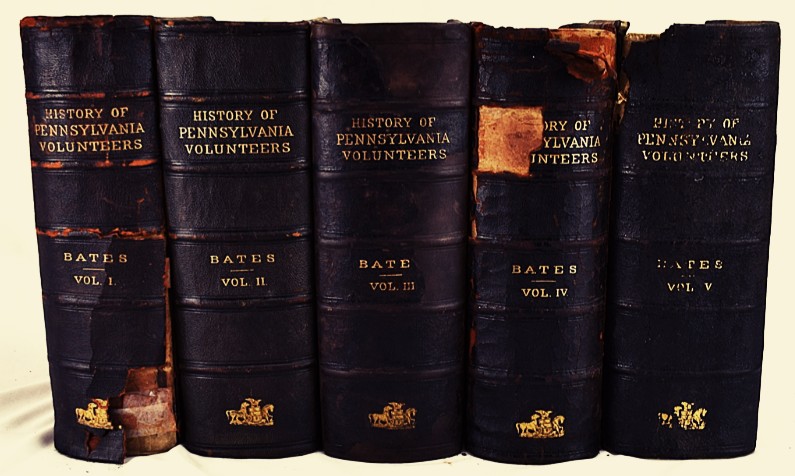
“History of Pennsylvania Volunteers, 1861-5,” Samuel P. Bates, 1869-1871 (public domain).

“So long as differences arise among nations, which cannot be settled by peaceful conference, and appeals are made to the arbitrament of the sword, the only safety that remains to the government is in the courage of its soldiery. In the late sanguinary struggle, the national unity was preserved, and the perpetuity of democratic institutions secured, by the men who bore the musket, and who led in the deadly conflict. Argument and moral sentiment were at fault, diplomacy was powerless, and courage proved the only peacemaker.

“In recognition of their services, and as a mark of the appreciation in which their valor is held, the Legislature of Pennsylvania authorized the preparation of a record of each of the military organizations in the field since 1861.” 

— Samuel P. Bates, “Preface,” History of Pennsylvania Volunteers, 1861-5


One of the first pieces of advice that archivists, librarians and professional genealogists will often give to descendants of Pennsylvania Volunteer Infantrymen when beginning their research of soldier-ancestors is to “Check Bates’ History,” which often results in descendants responding with, “What’s that?” and “Where Can I Find It?”

“Bates’ History” is, in fact, a five-volume series of books entitled, History of Pennsylvania Volunteers, 1861-5; Prepared in Compliance with Acts of the Legislature, that was researched, written and published during the mid-1860s through the early 1870s by Samuel Penniman Bates, an American educator and historian. Appointed in 1864 as state historian of the Commonwealth of Pennsylvania by Pennsylvania Governor Andrew Gregg Curtin, Bates was subsequently commissioned by the governor on June 1, 1866 to fulfill a legislative directive that “a military history of the organization of Pennsylvania volunteers and militia, who have been, or may be in the field” be researched, written and published for the public record. Bates was then given additional instructions by the Pennsylvania Legislature on April 17, 1867 “that the military history of the Pennsylvania volunteers … embrace an account of the organization, and services in the field, of each regiment, together with a roll giving the name, age, and residence of each officer and soldier, the date and term of enlistment, the promotions, the discharges, and casualties, and the places of burial of those who died in service.”

Thanks to that foresight by elected officials from Pennsylvania and Bates’ Herculean effort, generations of genealogists and academic historians have since visited historical societies and libraries across Pennsylvania and beyond to peruse increasingly worn copies of Bates’ books in order to learn more about the history of a specific regiment and confirm the names of that regiment’s leaders and rank and file members.

Access to Bates’ data was then made even easier by technological advancements in library science with the digitization of Bates’ books. As a result, family historians and other researchers no longer need to schlep to libraries to hunker down over their desired dusty tomes because Bates’ complete series has been accessible online, free of charge since 2012, thanks to HathiTrust, a collaborative effort between multiple academic institutions across the United States that is headquartered at the University of Michigan’s main campus in Ann Arbor. (“Go Blue!”)

This highly user-friendly format presented by HathiTrust allows users to not only read or browse each volume, but to also search for a specific soldier’s name by entering that name into the search textbox for the volume where that soldier’s name would most likely be located.

With respect to members of the 47th Pennsylvania Volunteer Infantry, that book would be Bates’ first volume. So, to find your 47th Pennsylvanian:

  1. Pull up volume one of Bates;
  2. Click on the downward-facing arrow of the black “Options” line near the top of the webpage you’re now seeing;
  3. Click on “Search in This Text”;
  4. Enter your ancestor’s name in that text box, between quotation marks, beginning with his last name, followed by a comma, one space, and his given name (example: “Clouser, Ephraim”); and
  5. Click the magnifying glass.

That search should pull up a new webpage that lists the page(s) in Bates’ first volume on which your ancestor’s name might appear — if your ancestor actually did serve with the 47th Pennsylvania Volunteer Infantry. Each of those items on that list will have an active link that will take you to the specific page in Bates’ first volume on which your ancestor is listed (or may take you to a page on which someone who had the same name as your ancestor is listed; so double check the data to be sure you’re looking at data for the correct soldier).

But if your search does not pull up a page(s) with your ancestor’s name, it may mean that your ancestor did not actually serve with the 47th Pennsylvania Volunteer Infantry — or that Bates spelled your ancestor’s name incorrectly.

Caveat Emptor

“Let the buyer beware” — or in this case “Caveat Scholaris” (“Let the student beware.”) While Bates History can be a helpful starting point for research regarding the 47th Pennsylvania Volunteer Infantry, each volume in the series contains significant errors — understandable when considering that Bates was tasked with summarizing the myriad number of muster rolls generated by hundreds of Pennsylvania military units that were staffed by more than three hundred and sixty thousand soldiers from Pennsylvania during the American Civil War. (And many of those original muster rolls were filled with errors because the Union Army clerks assigned to maintain those rolls simply could not create or update records when their regiments were being moved from one duty station to another as they marched into, or retreated from, battlefields scattered throughout three theaters of war that spread across multiple states in the Union and Confederacy.)

That being said, Bates left future generations of Pennsylvanians with a useful, detailed and reasonably accurate record of Pennsylvania’s role in the American Civil War. So, by all means, use Bates’ History to further your research; just don’t rely on it as your sole source of data.

As you go about finding your 47th Pennsylvanian, always double check the new data you find against the regiment’s original muster rolls and against other sources, such as the individual U.S. Civil War Pension file(s) for your ancestor and his parents, widow and/or children — records that are often chock full of new data and are maintained by the U.S. National Archives and Records Administration. (More information about those pension records is available online here.)


Sources:

  1. “A State History of Our Pennsylvania Regiments.” Philadelphia, Pennsylvania: The Daily Evening Telegraph, January 19, 1867.
  2. Bates, Samuel P. History of Pennsylvania Volunteers, 1861-5; Prepared in Compliance with Acts of the Legislature, volumes 1-5. Harrisburg, Pennsylvania: B. Singerly, State Printer, 1869-1871 (full text search and browse options available through HathiTrust, University of Michigan).
  3. Hodge, Ruth E. “Samuel Penniman Bates Papers, 1853-1895,” in “Guide to African American Resources at the Pennsylvania State Archives.” Harrisburg, Pennsylvania: Pennsylvania Historical and Museum Commission, 2000.
  4. Royer, Douglas L. Guide to Civil War Holdings of the Pennsylvania State Archives. Harrisburg, Pennsylvania: Pennsylvania State Archives, 2001.


Remembering the Red River Campaign Prisoners of War on National POW/MIA Recognition Day

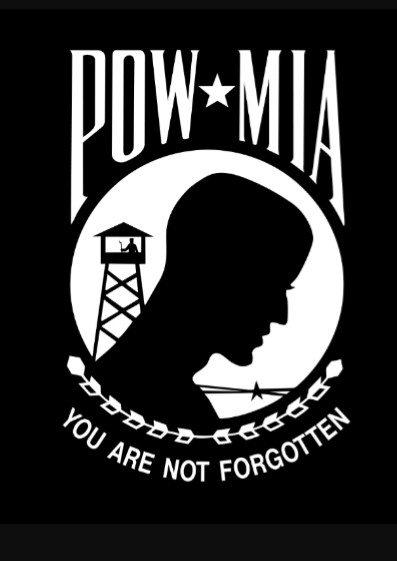
This POW/MIA Recognition Flag designed by Newt Heisley was formally recognized by U.S. House of Representatives Resolution No. 467 on September 21, 1990 (public domain).

During the Army of the United States’ 1864 Red River Campaign across Louisiana in the American Civil War, multiple members of the 47th Pennsylvania Volunteer Infantry were declared as “Missing in Action” (MIA) — largely due to the confusion caused by a series of engagements with the enemy in which Union soldiers were repeatedly required to retreat, regroup and resume the fight as they faced down wave after wave of Confederate troops attempting to outflank and perform end runs around the outer edges of Union Army lines.

Each time the cannon smoke began to clear from those battles, many of those MIA members of the 47th Pennsylvania Volunteer Infantry found their way back to the regiment, carrying word to senior officers of the 47th Pennsylvania Volunteers that members of the regiment had been captured by Confederate troops. By mid-May of 1864, it was clear that at least twenty-three 47th Pennsylvania Volunteers were being held as prisoners of war (POWs) by the Confederate States Army.

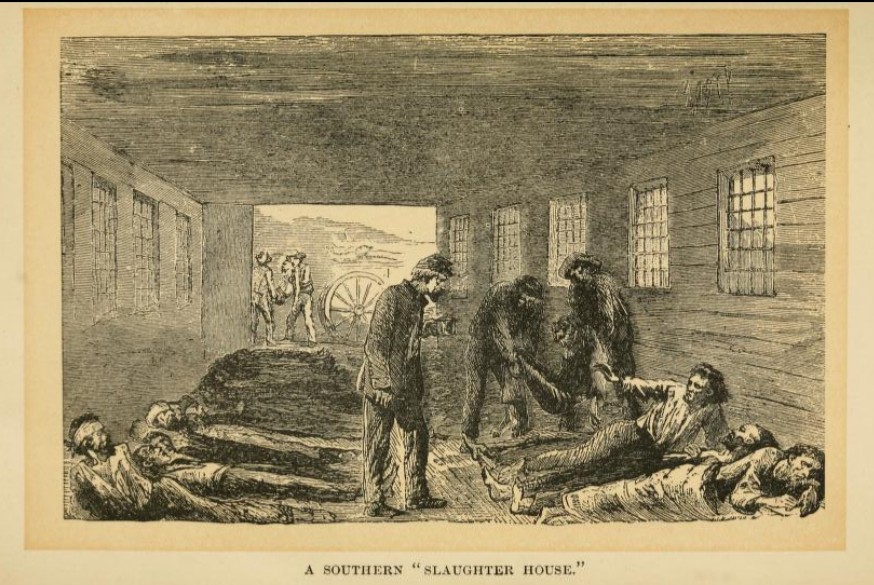
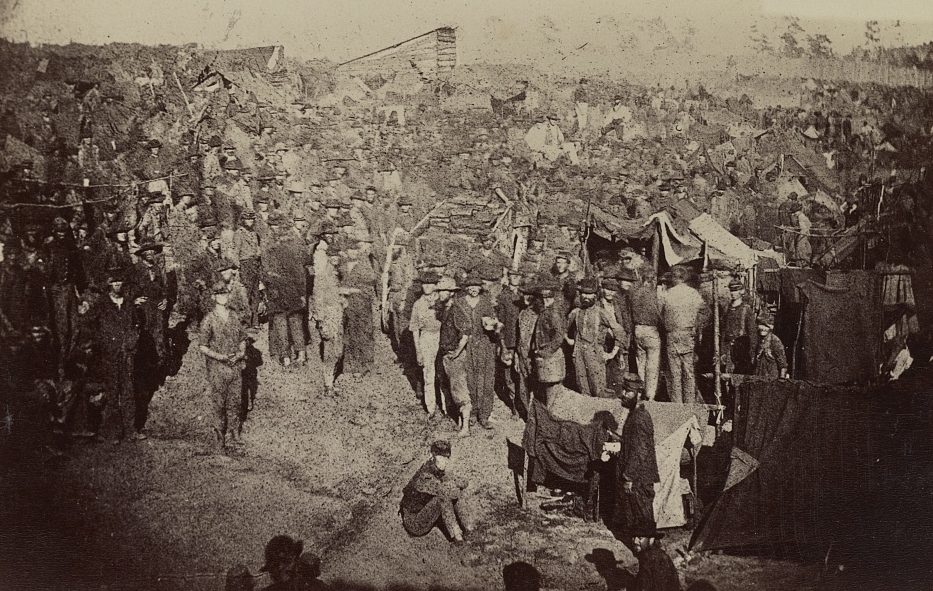
Regimental leaders would later learn that many of those men had been force marched roughly one hundred and fifty miles to Camp Ford, which was located outside of Tyler, Texas and would become the largest Confederate POW camp west of the Mississippi River by the summer of 1864. Once there, they were starved, given minimal to no medical care for any wounds they had sustained, exposed to extreme variations in temperature and weather, due to inadequate shelter, and sickened by dysentery and other diseases that were spread by living in the cramped, overcrowded conditions that became increasingly unsanitary, due to the placement of latrine facilities near water supplies meant for drinking or bathing. As their days dragged on, their treatment by Confederate soldiers grew more and more harsh. According to representatives of the Smith County Historical Society who have been working on documenting the history of Camp Ford:

On April 8th and 9th 1864 at the battles of Mansfield and Pleasant Hill, Louisiana, Confederate forces captured more than 2,000 Union soldiers, who were quickly marched to Tyler…. The existing stockade did not have sufficient area to house them, and an emergency enlargement was undertaken. Local slaves were again impressed, the north and east wall was dug up and the logs cut in half, and the top ten feet of the logs of the south and west walls were cut off. The resulting half logs gave sufficient timber to quadruple the area of the stockade, and it was expanded to about eleven acres.

With additional battles in Arkansas and Louisiana, the prison population had grown to around 5,000 by mid-June. Hard-pressed CS officials had no ability to provide shelter for the new prisoners, and their suffering was intense. The number of tools was inadequate, and many men could only dig holes in the ground for shelter. Rations were often insufficient and the death rate soared…. Of 316 total deaths at the camp, 232 occurred between July and November 1864….

At least three 47th Pennsylvania Volunteers are confirmed to have died while imprisoned at Camp Ford. Another member of the regiment was later removed from that prison and moved to Andersonville, the most notorious of all American Civil War POW camps. Two others died as POWs who were confined to a Confederate hospital.

In recognition of National POW/MIA Recognition Day, which is observed on the third Friday each September in the United States of America, we pay tribute to those twenty-three brave souls.

DeSoto and Sabine Parishes (Mansfield and Pleasant Hill, Louisiana)

Possibly wounded in action during the Battle of Pleasant Hill, Privates Solomon Powell and Jonathan Wantz of Company D were captured during that battle on April 9, 1864. Private Powell died either that same day or on June 7, 1864, while still being held by Confederate troops as a POW at Pleasant Hill. Private Wantz also died while still being held as a POW at Pleasant Hill; his death was reported as having occurred on June 17, 1864. Their exact burial locations remain unidentified.

Confederate Hospital (Shreveport, Louisiana)

G Company Private Joseph Clewell — who had only been a member of the 47th Pennsylvania since mid-November 1863, fell ill sometime after being captured by Confederate troops during one of the 47th Pennsylvania’s Red River Campaign engagements in the spring of 1864. Suffering from chronic diarrhea due to the poor water quality and unsanitary living conditions that he endured while being held as a POW, he was subsequently confined to the Confederate States Army Hospital No. 59 in Shreveport, Louisiana sometime in May or early June. Held at that hospital as a POW, his health continued to decline until he died there on June 18, 1864, according to the U.S. Army’s Registers of Deaths of Volunteer Soldiers. His exact burial location also remains unidentified.

This illustration presented a rosier view of life at Camp Ford, the largest Confederate Army prison camp west of the Mississippi River, than was the actual situation for the 47th Pennsylvania Volunteers confined there (Harper’s Weekly, March 4, 1865, public domain).

Camp Ford or Camp Groce (Texas)

The 47th Pennsylvania Volunteers confirmed to have been released from Camp Ford or Camp Groce in Texas during a series of prisoner exchanges between the Army of the United States and the Confederate States Army were:

  • Private Charles Frances Brown, Bugler of Company D and Regimental Band No. 2 (date of release: July 22, 1864; discharged after receiving medical treatment; re-enlisted with the 7th New York Volunteers in October 1864);
  • Private Charles Buss/Bress of Company D (fell ill with dysentery while confined as a POW at Camp Ford and developed chronic diarrhea and severe hemorrhoids — conditions that would plague him for the remainder of his life, date of release: July 22, 1864; received medical treatment and was honorably discharged from a Union Army medical facility in Philadelphia in May 1865);
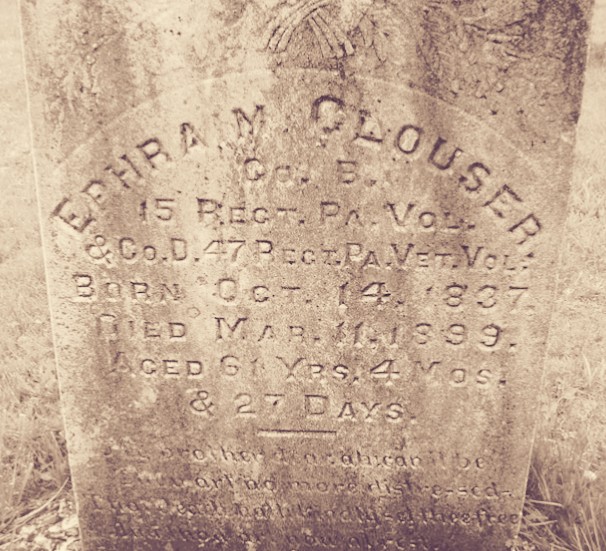
  • Private Ephraim Clouser of Company D (captured after being shot in the right knee, date of release: November 25, 1864; placed on Union Army sick rolls after being diagnosed as being too traumatized to remain on duty, he was transferred to the Union Army’s Jefferson Barracks Hospital in St. Louis, Missouri, then to a Union Army hospital in Cincinnati, Ohio and then to the Union Army’s general hospital in York, Pennsylvania, where he remained until the end of the war; still suffering from post-traumatic stress disorder (PTSD) after the war, he was declared by the Pennsylvania court system to be unable to care for himself, and was confined to the Harrisburg State Hospital for the remainder of his life);
  • Sergeant James Crownover of Company D (captured after being shot in the right shoulder, date of release: November 25, 1864; received medical treatment, recovered and returned to duty);
  • Private James Downs of Company D (date of release: July 22, 1864; received medical treatment and returned to duty; possibly suffering from post-traumatic stress disorder (PTSD), he fell from a window of the Brookville Memorial Home in Jefferson County, Pennsylvania in 1921);
  • Private Conrad P. Holman, of Company C (date of release: July 22, 1864; received medical treatment, recovered and returned to duty);
  • Corporal James Huff of Company E (captured after being wounded, date of release: August 29, 1864; received medical treatment, recovered and returned to duty; captured by Confederate troops during the Battle of Cedar Creek, Virginia on October 19, 1864, was transported and force marched to North Carolina, where he was held as a POW at the Salisbury Prison Camp until his death there from starvation and harsh treatment on March 5, 1865; he was subsequently buried somewhere on the POW camp grounds in an unmarked mass trench grave of Union soldiers);
  • Private John Lewis Jones of Company F (captured after being wounded, date of release: September 24, 1864; received medical treatment, recovered and returned to duty);
  • Private Edward Mathews of Company C (date of release: July 22, 1864; received medical treatment, recovered and returned to duty);
  • Private Adam Maul/Moll/Moul of Company C (captured on May 3, 1864, while away from his regiment’s encampment in Alexandria, Louisiana — possibly while assigned to duties related to the construction of Bailey’s Dam, date of release: July 22, 1864; received medical treatment, recovered and was assigned to detached duty at Hilton Head, South Carolina on January 3, 1865, but was reportedly not given discharge paperwork by his regiment; his exact burial location remains unidentified);
  • Private John W. McNew of Company C (captured after being wounded, date of release: July 22, 1864; received medical treatment, recovered and returned to duty);
  • Corporal John Garber Miller of Company D (date of release: July 22, 1864; received medical treatment, recovered and returned to duty);
  • Private Samuel W. Miller of Company C (date of release: July 22, 1864; received medical treatment, recovered and returned to duty);
  • Private John Wesley Smith of Company C (date of release: July 22, 1864; received medical treatment, recovered and returned to duty;
  • Private William J. Smith of Company D (date of release: July 22, 1864; received medical treatment, recovered and returned to duty; and
  • Private Benjamin F. Wieand/Weiand of Companies B and D (captured after being wounded; received medical treatment after his release from captivity and was honorably discharged on July 21, 1865.

The 47th Pennsylvania Volunteers confirmed to have died on the grounds of Camp Ford were:

  • Private Samuel M. Kern of Company D (date of death: June 12, 1864);
  • Private Frederick Smith of Company I (date of death: May 4, 1864); and
  • Private John Weiss, Company F (captured after being severely wounded, he was initially confined to Camp Ford, but was then transferred to a “Rebel hospital” for treatment of his wounds, according to regimental records; died at that Confederate hospital on July 15, 1864).

The burial locations of Privates Samuel Kern, Frederick Smith and John Weiss remain unidentified. (The Confederate hospital where Private John Weiss died may have been the Confederate Army Hospital No. 59 in Shreveport, Louisiana — the same Confederate hospital where G Company Private Joseph Clewell died on June 18, 1864.)

Issuing Rations at the Andersonville POW Camp, August 17, 1864 (view from Main Gate, U.S. Library of Congress, public domain).

Andersonville (Fort Sumter, Georgia)

According to an article in the April 12, 1911 edition of the Reading Eagle, Private Ben Zellner of the 47th Pennsylvania’s Company K had also begun his imprisonment as a POW at Camp Ford, but was later transported to Georgia, where he was confined to Andersonville, the most notorious Confederate prison camp of them all.

Benjamin Zellner, who was one of the youngest soldiers during the Civil War, was captured by the Confederates at Pleasant Hill, La., April 8, 1864. He was a member of Co. K, 47th Regiment, with Gen. Banks’ army on the Red River expedition. Comrade Zellner was wounded in a charge to the left of the lines and fell on the field. The Union forces being driven back, he, with a number of others was captured. After being kept at Pleasant Hill two weeks, they were removed to Mansfield, La., on a Saturday night and kept over night [sic] in the Court House until Sunday morning. Thence they were removed to Shreveport, La., and again kept in the Court House. From thence they were marched 110 miles to Unionville prison at Tyler, Tex…. The 47th was the only Penn’a Regiment to participate in the Red River campaign.

Although POW records from Camp Ford that are maintained by the Smith County Historical Society note that a “Ben Cellner” was released in that camp’s July 22, 1864 prisoner exchange with the Union Army, interviews by several different newspaper reporters of Zellner in his later life contradict those records. According to Zellner and the Reading Eagle, he had been transported to Camp Sumter near Anderson, Georgia sometime in May or June 1864:

In about a month [after arriving at Camp Ford in Texas, following their 8 April capture in Louisiana] 300 or 400 of the strongest were brought back to Shreveport and then transported down the Red River to an old station and marched four days, when they were taken by train to Andersonville….

At the time of Private Zellner’s internment, Andersonville was under the command of Henry Wirz, who would later be convicted of war crimes for his brutal treatment of Union prisoners. According to the September 21, 1864 edition of The Soldiers’ Journal:

Those Union prisoners recently released from Camp Sumter, at Andersonville, Ga., have made affidavit of the condition of the 35,000 prisoners confined there. The horrors of their imprisonment, plainly and unaffectedly narrated, have no parallel outside of Taeping or Malay annals. Twenty-five acres of human beings – so closely packed that locomotion is made obsolete, compelled to drink from sewers, and to eat raw meat like cannibals – are dwelling under vigilant espionage, hopeless, helpless, and Godless. Some are lunatic, and others have become desperately wicked; all are living, loathing, naked, starved fellow-men.

Reportedly held as a POW for six months and fourteen days, according to the March 26, 1915 edition of The Allentown Leader, Zellner was freed from captivity during a Union and Confederate army prisoner exchange in September 1864 (per a report in the April 12, 1911 edition of the Reading Eagle). The April 8, 1911 Allentown Leader noted that, after this prisoner exchange, which took place “along the James River,” he was then sent with a number of his fellow former POWs “to Washington, to Fortress Monroe, to New York and home.” Following a period of recovery, he then returned to service with his regiment just in time to participate in a key portion of Union Major-General Phillip Sheridan’s 1864 Shenandoah Valley Campaign.

Read their stories. Remember their names. Honor their individual sacrifices.


Sources:

  1. “47 Years Today Since Rebels Caught Him: This Is a Memorable Anniversary for Comrade Ben Zellner.” Allentown, Pennsylvania: The Allentown Leader, April 8, 1911.
  2. Allentown’s Youngest Civil War Veteran (profile of Private Ben Zellner). Reading, Pennsylvania: Reading Eagle, April 12, 1911.
  3. Bates, Samuel P. History of Pennsylvania Volunteers, 1861-5, vol. 1. Harrisburg, Pennsylvania: B. Singerly, State Printer, 1869.
  4. Camp Ford,” in “Texas Beyond History.” Austin, Texas: Texas Archaeological Research Laboratory, University of Texas at Austin, retrieved online January 24, 2025.
  5. Camp Ford Prison Records (47th Pennsylvania Volunteer Infantry, 1864). Tyler, Texas: Smith County Historical Society.
  6. “Camp Sumter,” in “Editorial Jottings.” Washington, D.C.: The Soldiers’ Journal, September 21, 1864.
  7. Civil War Muster Rolls (47th Pennsylvania Infantry). Harrisburg, Pennsylvania: Pennsylvania State Archives.
  8. Civil War Veterans’ Card File, 1861-1866 (47th Pennsylvania Infantry). Harrisburg, Pennsylvania: Pennsylvania State Archives.
  9. Gilbert, Randal B. A New Look at Camp Ford, Tyler, Texas: The Largest Confederate Prison Camp West of the Mississippi River, 3rd Edition. Tyler, Texas: The Smith County Historical Society, 2010.
  10. “His Glorious Record as a Soldier: Fought at Gettysburg, Red River and Shenandoah Valley and Besides Enduring the Horrors of Andersonville, Carries Bullet to This Day.” Allentown, Pennsylvania: The Allentown Leader, March 26, 1917.
  11. Horwitz, Tony. “Did Civil War Soldiers Have PTSD?“, in Smithsonian Magazine, January 2015. Washington, D.C.: Smithsonian Institution.
  12. Lawrence, F. Lee. “Camp Ford,” in “Hand Book of Texas.” Austin, Texas: Texas State Historical Association, retrieved online January 24, 2025.
  13. “Newport: Special Correspondence” (notice documenting Ephraim Clouser’s confinement for mental illness and later death at the asylum in Harrisburg, Pennsylvania). Harrisburg, Pennsylvania: Harrisburg Daily Independent, March 18, 1899.
  14. POW/MIA Recognition Day.” Indianapolis, Indiana: The American Legion National Headquarters, retrieved online September 19, 2025.
  15. Registers of Deaths of Volunteers. Washington, D.C.: U.S. National Archives and Records Administration, 1864-1865.
  16. Schmidt, Lewis. A Civil War History of the 47th Regiment of Pennsylvania Veteran Volunteers. Allentown, Pennsylvania: Self-published, 1986.
  17. Simmons, G. W. “Camp Ford, Texas” (sketch, Harper’s Weekly, March 4, 1865; retrieved June 9, 2015, via University of North Texas Libraries, The Portal to Texas History, crediting Star of the Republic Museum, Washington, Texas).
  18. Slattery, Joe. “Confederate Soldiers Who Died at the Confederate General Hospital in Shreveport, Louisiana,” in The Genie, vol. 37, no. 1 (First Quarter, 2003), p. 12. Shreveport, Louisiana: Ark-La-Tex Genealogical Association.
  19. “The Exchange of Prisoners; The Cartel Agreed Upon by Gen. Dix for the United States, and Gen. Hill for the Rebels,” in “Supplementary Articles.” New York, New York: The New York Times, October 6, 1862.
  20. Thoms, Alston V., principal investigator and editor, and David O. Brown, Patricia A. Clabaugh, J. Philip Dering, et. al., contributing authors. Uncovering Camp Ford: Archaeological Interpretations of a Confederate Prisoner-of-War Camp in East Texas. College Station, Texas: Center for Ecological Archaelogy, Department of Anthropology, Texas A & M University.
  21. Union Army Deaths in Shreveport 1864-1865.” Shreveport, Louisiana: Sons of Union Veterans, Brig. Gen. Joseph Bailey Camp No. 5, retrieved April 29, 2021.
  22. “Up in Perry” (notice of Ephraim Clouser’s arrest and sanity hearing). Harrisburg, Pennsylvania: Harrisburg Telegraph, September 22, 1892.
  23. Wharton, Henry D. Letters from the Sunbury Guards, 1861-1866. Sunbury, Pennsylvania: Sunbury American.


One Special September Day: Four 47th Pennsylvania Volunteers Shake Hands with President Abraham Lincoln in 1861 (part two)

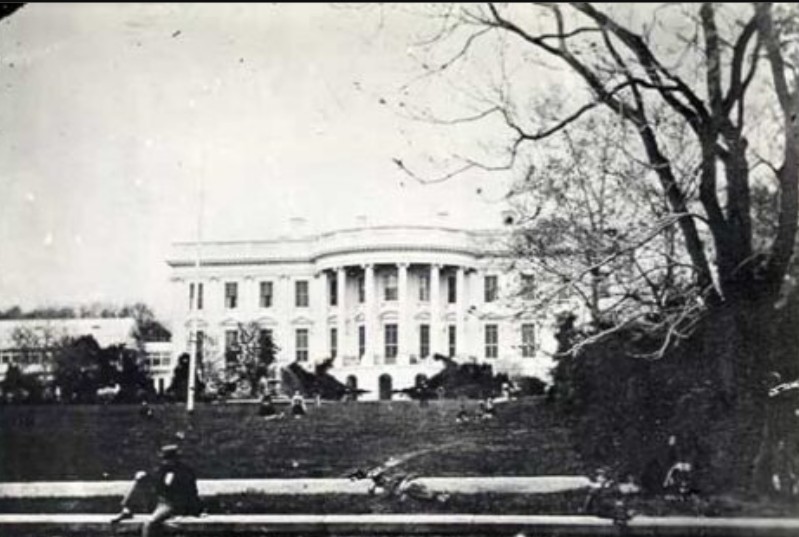
White House, Washington, D.C., 1861 (Matthew Brady, U.S. Library of Congress, public domain).

“There is another chapter to the story of how four young soldiers from Allentown, members of the Forty-Seventh Regiment, managed to see President Lincoln in 1861 after they had made two ineffectual efforts to see the great man. The young soldiers were Allen Wolf, William H. Smith, Jacob Worman, and George Hepler. They were members of Captain Mickley’s Company G and the pass which they had expired at 5 p.m. of that day.”

The Allentown Democrat, April 5, 1911


Their mission to shake the hand of President Abraham Lincoln accomplished, Private George Heppler, Drummer William N. Smith, Private Allen David Wolf, and Private Jacob Peter Worman, of the 47th Pennsylvania Volunteer Infantry, had a second mission to accomplish in late September of 1861 — to make it back to their regiment’s encampment, safely and quickly — because the pass that they had received from one of their superior officers was about to expire.

But their new mission would prove to be even more difficult than had their successful White House meeting with President Lincoln. According to The Allentown Democrat:

“It was growing late in the afternoon when the young soldiers left the White House and they made tracks for the camp. What followed can best be told in Mr. Wolf’s own words:

‘When we got to the point where our regiment had been encamped in the morning we saw nothing but strange faces. We asked for Company G, and were directed to a point. When we came there we found that during our absence the Forty-seventh had been ordered to move and a Wisconsin regiment was encamped there. We decided to return to the city [Washington, D.C.] and in due time fell into the hands of the patrol. We showed our pass and were sent to the headquarters of General McClellan. The general met us personally. We told him of our predicament and he told us that our regiment was now encamped in a different location. He directed us to cross the chain bridge. The general also informed us that a wagon train would go that way and that we should follow it. We did as he instructed us to do. What a march that was, however! It was raining all night and we were drenched to the skin by the time we reached our regiment. But we felt amply repaid. We had seen the greatest man in the country and had spoken to General McClellan.’

Chain Bridge across the Potomac above Georgetown looking toward Virginia, 1861 (The Illustrated London News, public domain).

The inability of the four 47th Pennsylvania Volunteers to locate their regiment’s camp is more easily understood when reading a letter penned on 29 September by Company C Musician Henry Wharton, in which he informed readers of the Sunbury American that the 47th Pennsylvania had changed camps three times in three days:

“On Friday last we left Camp Kalorama, and the same night encamped about one mile from the Chain Bridge on the opposite side of the Potomac from Washington. The next morning, Saturday, we were ordered to this Camp [Camp Advance near Fort Ethan Allen, Virginia], one and a half miles from the one we occupied the night previous. I should have mentioned that we halted on a high hill (on our march here) at the Chain Bridge, called Camp Lyon, but were immediately ordered on this side of the river. On the route from Kalorama we were for two hours exposed to the hardest rain I ever experienced. Whew, it was a whopper; but the fellows stood it well – not a murmur – and they waited in their wet clothes until nine o’clock at night for their supper. Our Camp adjoins that of the N.Y. 79th (Highlanders.)….

“We had not been in this Camp more than six hours before our boys were supplied with twenty rounds of ball and cartridge, and ordered to march and meet the enemy; they were out all night and got back to Camp at nine o’clock this morning, without having a fight. They are now in their tents taking a snooze preparatory to another march this morning…. I don’t know how long the boys will be gone, but the orders are to cook two days’ rations and take it with them in their haversacks….”

Despite that confusion, all four of the adventurous 47th Pennsylvania Volunteers eventually did manage to reconnect with their regiment at its encampment in Virginia. They then went on to follow President Lincoln’s directive to them: “Be good and above all obey your commander.”

Private Allen David Wolf, who was ultimately promoted up through the ranks to become Corporal Wolf, and Drummer William N. Smith both survived their initial three-year terms of enlistment and were both honorably discharged from the 47th Pennsylvania Volunteer Infantry’s encampment near Berryville, Virginia on September 18, 1864.

Private George Heppler, who was also ultimately promoted to the rank of corporal, and Private Worman, who was promoted to the rank of sergeant, served far longer — until the 47th was mustered out for the final time on Christmas Day in 1865.

All four witnessed both the worst and best of humanity and were forever changed by all that they had seen and heard as they fought to save their nation from disunion.


Sources:

  1. Bates, Samuel P. History of Pennsylvania Volunteers, 1861-5, vol. 1. Harrisburg, Pennsylvania: B. Singerly, State Printer, 1869.
  2. “Gleanings by the Way.” Allentown, Pennsylvania: The Allentown Democrat, April 4, 1911.
  3. “Gleanings By the Way.” Allentown, Pennsylvania: The Allentown Democrat, April 5, 1911.
  4. Wharton, Henry D. “Letters from the Sunbury Guards.” Sunbury, Pennsylvania: The Sunbury American, September 1861.


One Special September Day: Four 47th Pennsylvania Volunteers Shake Hands with President Abraham Lincoln in 1861 (part one)

Abraham Lincoln in New York City on Monday morning, February 27, 1860, several hours before he delivered his Cooper Union address (Matthew Brady, U.S. Library of Congress, public domain).

“In the eyes of the young men who went to the front during the dark days of the Civil War, the greatest man in the country was President Lincoln. It was every young soldier’s ambition to get the opportunity to see the great Lincoln, to shake him by the hand and to hear words fall from his lips. It was not an easy matter to have this ambition gratified. But comparatively few soldiers ever got within speaking distance of the great statesman. It was a physical impossibility for the president to see all those who wished to meet him and the attaches [sic] of the White House had to exercise great diplomacy with the eager throngs that haunted the executive mansion.”

— The Allentown Democrat, April 4, 1911


The vast majority of average Americans will never have the opportunity to shake the hand of a United States president. The schedules of modern office holders are too hectic and security protections are too tight to allow for such encounters on anything more than an infrequent basis — a reality that was true even for many U.S. citizens in the nineteenth century.

So, it is striking to learn that four young Pennsylvanians actually were able to shake President Abraham Lincoln’s hand on one very special day in late September 1861. All four were members of the 47th Pennsylvania Volunteer Infantry, which would go on to make history as the only regiment from the Commonwealth of Pennsylvania to participate in the Union’s Red River Campaign across Louisiana, and all four were members of that regiment’s G Company — a unit that would sustain heavy casualties as it fought valiantly in the Battle of Pocotaligo, South Carolina in 1862 and the Battle of Cedar Creek, Virginia in 1864.

Those memorable handshakes between President Lincoln and Private George Heppler, Drummer William N. Smith, Private Allen David Wolf, and Private Jacob Peter Worman, unfolded as follows, according to Wolf (who was interviewed by The Allentown Democrat in 1911):

“Our regiment went in 1861 from Harrisburg to Washington where we were encamped just outside the city limits. It was our dream to see Lincoln. Accordingly one day the four of us secured a pass to go into the city, but the time set for our return was 5 o’clock. We were all young fellows — I was seventeen years of age — and thrown into a new world. Everything seemed so wonderful to us and so different from Allentown. We were enjoying our holiday immensely, when some one suggested that we try to see President Lincoln. We had heard so much about this great man and when the matter was suggested we were all agreed.

“Let me tell you, however, that to start out to see the president and to actually see him in those days was [sic] two different things. Little did we dream of the difficulties that we would encounter. We started for the White House and arrived in due time. We got into the green room, where a negro servant met us and asked us our business. We told him that we were young soldiers from Pennsylvania and were very eager to see the president. The black man retired and returned a few moments later with the message that the president was very busy and could not see us at that time. We were disappointed, of course.

“We walked around the city for about an hour, but we were not satisfied. The disappointment over our failure to see the president weighed heavily on our minds. It was then that we determined to make another effort to have our ambition gratified and presented ourselves at the White House again. The negro servant recognized us and laughed when he saw us. We prevailed upon him to see the president and to find out whether we couldn’t see him. The negro again went up stairs and returned with the message that the president was still busy. We went away the second time disappointed.

“Again we walked about the city. Nothing seemed to interest us, however. We nursed our disappointment as best we could, but we simply could not rid ourselves of the desire to see the president. At four o’clock in the afternoon we determined to make a final effort. Again we ascended the White House steps and again we were met by our negro friend.He consented to intercede for us and went up stairs. A few moments later the president came down the stairway. We were standing at the bottom. There was a kindly, patient smile on his face. He greeted us cordially, shook each by the hand and said: ‘Boys, you are young soldiers. Be good and above all obey your commander.’ With that he retired. We were satisfied and went away brimful of happiness and patriotism.'”

What happened next for those four soldiers? Find out in part two of our look back at one of several encounters that members of the 47th Pennsylvania Volunteer Infantry had with President Abraham Lincoln during the American Civil War.


Sources:

  1. Bates, Samuel P. History of Pennsylvania Volunteers, 1861-5, vol. 1. Harrisburg, Pennsylvania: B. Singerly, State Printer, 1869.
  2. “Gleanings by the Way.” Allentown, Pennsylvania: The Allentown Democrat, April 4, 1911.
  3. “Gleanings By the Way.” Allentown, Pennsylvania: The Allentown Democrat, April 5, 1911.


A Tale of Two Swords: 47th Pennsylvania Officers Lauded by Citizens and Soldiers (Florida, 1863)

Captain Henry Durant Woodruff, commanding officer of Company D, 2nd Pennsylvania Volunteers, April-July 1861, and Company D, 47th Pennsylvania Volunteers, August 31, 1861-September 18, 1864 (public domain).

On Saturday, August 22, 1863, readers of The Sunbury American turned to page three of their favorite Northumberland County, Pennsylvania newspaper to find the latest “Letter from the Sunbury Guards,” one of the many field reports that would be sent during the American Civil War to the newspaper’s publisher and editor, Henry B. Masser and Emanuel Wilvert, by one of their former employees, Henry D. Wharton, a member of the 47th Pennsylvania Volunteer Infantry’s C Company. The letter from Henry that was published on that day in August provides important insights into what daily life was like for the 47th Pennsylvanians who were stationed at Fort Taylor in Key West, Florida in 1863 and also illustrates the positive rapport that the 47th Pennsylvania’s officers worked hard to build — not only with the regiment’s enlisted men, but with the civilians they encountered while serving the nation as members of an occupying military force in the nation’s Deep South.

Letter from the Sunbury Guards
Key West, Fla., July 30, 1863

Dear Wilvert: — One day last week, I was surprised at the confusion and loud cheering coming from Company D, usually a very quiet set of men. I crossed the Barracks ground to their quarters, when I learned the cause. The men had presented their Captain with a beautiful sword, sash and belt. The presentation was made in a neat speech by Private Baltozer, who in a few preliminary remarks thanked the Captain for his kindness to the members of Company D, and then said “receive this sword as a token of our estimation, and for your chivalrous spirits on the sanguine field, when the heavens glared with fire and the earth trembled ‘neath cannons roar. May it never rest in its scabbard until rebellion is crushed and traitorism is banished from the land, and peace spreads her white wings from the St. John’s to the sunny banks of the Rio Grande. That it may ever benefit you in the hour of peril, and that you may undauntingly use it as opportunity is afforded, is the ardent wish of the donors.” The presentation was unexpected to Captain Woodruff, who, modest man as he is, felt it keenly, so much so, that it was with difficulty he uttered the following reply:

“My companions in arms. — Your beautiful present is accepted with sincere satisfaction and heartfelt thanks. It affords the satisfaction that you still respect and have confidence in your commander; and he is thankful not only for the value of this gift; but, also for the rich token of your kind regard. And while I wear these arms and accoutrements, emblematical of my rank and office, may they never be worn unworthily or the noble donors have cause to blush for any ungallant act of the wearer. Two years have nearly elapsed since we have been associated as commander and commanded. Two years of privation and toil, and yet your love for the cause, and your ardor to serve your country has not abated.”

“When you entered upon this gigantic struggle, you were not prompted by large bribes and bounties, or intimidated by fear of being forced in service by fear of conscription, but, inspired by a noble patriotism, you cheerfully volunteered for the longest period known to the law. Your conduct thus far has been in accordance with the honorable principles which caused you to volunteer. No discipline too strict, no privations too great, no toil too hard, no trials too sore, but that your indomitable spirits have been able to accomplish, undergo and overcome. And now allow me to say to you that I am proud of the noble men who compose this company. I am proud of the honor you have this day conferred on your Captain. In looking forward, I have no fears for you in the future. Whatever you may be called on to do, in garrison, in the tented field, or on the ensanguined plain it will be bravely — it will be well done. Then, until rebels and traitors shall become extinct, or have grounded their arms, and acknowledged the supremacy of the Government and the law, let this ‘Our motto be, Give us death, or give us victory.'”

Colonel Tilghman H. Good, commanding officer, 47th Pennsylvania Volunteers (public domain image, circa 1863).

Wharton then continued his lengthy letter with a retelling of a second ceremony that took place on July 25, 1863:

On Saturday last, another sword presentation came off. This time Col. T. H. Good was the recipient, and the donors, the citizens. The sword is a magnificent one, and with the sash and belt, cost six hundred and ten dollars. At 4 o’clock P.M., the two companies stationed at the Barracks, were marched to the Fort, where, with the three other companies doing duty, we formed in line, and under command of the Colonel were moved through several streets, to the front of the Custom House. A fine stand was erected, on the piazza of the building seats were placed for the ladies, flags were stretched across the streets, and everything so arranged as to give it the appearance of a holiday. On the stand I noticed Rear Admiral Bailey and Capt. Templeton of the Navy, Gen. Woodbury and staff, Captains Hook and McFarland of the Army, besides Thomas J. Boynton, U.S. District Attorney for the Southern District of Florida. The articles were presented to Col. Good by Mr. Maloney, a lawyer of this city who complimented the Colonel on the fine bearing and appearance of his regiment. He spoke of the trials the citizens had under the military commander Col. Good relieved; of their being saved from banishment and separation of friends and all they held dear; of the wholesome administration of the Colonel, while in command of this Department, and in conclusion placed the sword in Col. Good’s hand, telling him if he used it as he used his own at Pocotaligo, the citizens would be satisfied, and have no fear of it ever being dishonored. The Colonel replied in a very short speech, saying, what he had done was by instructions by Head Quarters — thanked him for the present, and said as he then felt, he could assure the good people of Key West, that their present would never be dishonored through himself. As the Col. concluded, the Band of our regiment struck up the tune ‘Bully for You,’ which was received with cheer after cheer. Several speeches were made, among others, one by Mr. Boynton. He is a Missourian and received his appointment from the present administration. Although a southerner, he is Union all over. He said he hoped the cannon and sword would soon be made into plow shares and pruning hooks, but not until every rebel was on his knees willing to obey the laws and pay respect to the Star Spangled Banner. The Band then played several National airs, cheers were given for the Union, President Lincoln, Army and Navy, Gen. Woodbury, Admiral Baily, &c., when the meeting adjourned, and we were marched to our different quarters, well pleased with the proceedings, though I must say, completely worn out from fatigue and extreme heat.

According to Allentown’s Morning Call newspaper, the sword’s “hilt grip is a golden goddess Columbia, the female personification of the United States.”

Above her head on the pommel, a coiled snake seems ready to strike. On the crossguard a lion’s head roars defiance and Hercules slays the Nemean lion on the sword’s knuckle bow.

The blade is a riot of gilt allegorical figures. In tiny letters just above the hilt is the maker’s name and year: Collins and Company, Hartford, Connecticut, 1862. On the other side is the engraver, Ball Black & Company, New York.

In a subsequent description of the sword in 1915, The Morning Call noted that it had been engraved with the following tribute to Colonel Good:

“The Citizens of Key West, Florida, to Col. T. H. Good, 47th Penn Vols., in appreciation of his merit as a gentleman and a soldier, April, 1863.”

That sword would cost more than twenty-five hundred U.S. dollars were it crafted today. But its true value is priceless because it serves as a timeless reminder that effective leadership is possible — even in the darkest of times.


Sources:

  1. Bates, Samuel P. History of Pennsylvania Volunteers, 1861-5, vol. 1. Harrisburg, Pennsylvania: B. Singerly, State Printer, 1869.
  2. July 25” (1995 photograph of the sword presented to Colonel Tilghman H. Good by the citizens of Key West, Florida on July 25, 1863), in “Florida Keys History Center.” Key West, Florida: Key West Library, retrieved online August 16, 2025.
  3. Schmidt, Lewis G. A Civil War History of the 47th Regiment of Pennsylvania Veteran Volunteers. Allentown, Pennsylvania: Self-published, 1986.

  4. Sword Is a Reminder of Friendship Forged Amid War.” Allentown, Pennsylvania: The Morning Call, October 3, 2021.
  5. “Veterans of 47th Vols’ Meet in Reunion: Forty-third Annual Gathering Recalls Trying Days.” Allentown, Pennsylvania: The Morning Call, 23 October 1915.
  6. Wharton, Henry D. “Letter from the Sunbury Guards” (Key West, Florida, July 7, 1863). Sunbury, Pennsylvania: The Sunbury American, August 22, 1863.


Reconstruction and Diplomacy: The 47th Pennsylvania in Georgia (Summer 1865)

War-damaged houses in Savannah, Georgia, 1865 (Sam Cooley, U.S. Army, U.S. Library of Congress, public domain).

Stationed in Savannah, Georgia since June 7, 1865, the soldiers still serving with the 47th Pennsylvania Volunteer Infantry that first summer after the American Civil War were assigned to provost duties — as peacekeepers, public information specialists and public works officials, during what has since become known as the Presidential Reconstruction Era (1865-1867) of American History.

Commanded by Colonel John Peter Shindel Gobin, Lieutenant-Colonel Charles William Abbott and Major Levi Stuber, multiple members of the regiment were literally involved in the re-construction of small southern towns and larger cities, helping to shore up war-damaged structures that could be restored — and in tearing down others that were deemed too dangerous for civilians to leave standing.

John Young Shindel, M.D., assistant surgeon, 47th Pennsylvania Volunteers, 1865 (public domain).

It was hazardous work, according to John Young Shindel, M.D., an assistant regimental surgeon who had joined the medical staff of the 47th Pennsylvania earlier that same year. On Wednesday, June 18, 1865, he noted that:

10 o’clock wall fell in and buried 15 or 20 men. 6 or 7 were taken out some dead. Zellner Co. K badly hurt. Sent him to Hosp. Capt. Hoffman, Chief of Police, seriously hurt. In P.M. was with Capt. Hoffman.

The 47th Pennsylvanian mentioned by Dr. Young was Private Ben Zellner, who had survived repeated battle wounds and confinement as a prisoner of war (POW) at two Confederate States Army prison camps, only to nearly lose his life while assigned to police duty during peacetime. According to Private Zellner’s 1896 account of that 1865 accident, his jawbone had been broken during the wall’s collapse “and he sustained 11 scalp wounds”; as a result, he “lost the sight of his left eye and the hearing of his left ear.”

The 47th Pennsylvania Volunteer Infantry’s Regimental Band performed in concert for James Johnson, provincial governor of the State of Georgia, at the Pulaski Hotel in Savannah on June 30, 1865 (Pulaski Hotel, Savannah, Georgia, circa 1906, U.S. Library of Congress, public domain).

Meanwhile, other 47th Pennsylvania Volunteers were being transformed into diplomats. Officers and enlisted members of the regiment, for example, helped to facilitate a warm welcome for James Johnson, the provisional governor of Georgia, during his official visit to Savannah in early July. According to the Charleston Daily Courier, Governor Johnson (who had been appointed to his gubernatorial post by U.S. President Andrew Johnson (but was not related to the president), had been invited to Savannah by members of the city council “to address the citizens … at some suitable place.” In that invitation, council members also suggested that “military and naval commanders of the United States army and navy at this post and their respective staffs be respectfully invited to attend said meeting.” Johnson subsequently accepted the invitation and made the trip to Savannah in late June. The night of his arrival (June 30), “the fine band of the 47th Pennsylvania Regiment, Eugene Walter, Leader, serenaded the Governor at the Pulaski House.”

Several patriotic airs were played, and as soon as practicable the Governor appeared on one of the balconies, in response to repeated calls. He was loudly welcomed. He made no elaborate speech, but addressed the immense assembly substantially as follows:

“Fellow-Citizens — I thank you for the consideration, on your part, which has occasioned this demonstration. I know that you have called on me as the Provisional Governor of the State of Georgia, and in the discharge of the high duties now incumbent upon me, I promise you to act to the best of my ability. I know that you will not expect, on this occasion, any very full remarks. Hoping to meet you hereafter, and then to have an opportunity to explain my sentiments and position, I will bid you good night.”

This brief address was received with loud cheers by the crowd, and the band then played several other appropriate airs.

Joseph Eugene Walter, Regimental Band, 47th Pennsylvania Volunteers, circa 1861.

On July 1, the Savannah Republican newspaper published a more detailed description of that evening’s events:

Last evening, through the exertions of a few citizens, an impromptu call was made upon Gov. Johnson at the Pulaski by a delegation of loyal men, accompanied by the fine band of the 47th Pennsylvania Veteran Volunteers, now stationed in this city. The object of the call was simply to manifest the joy of the people at the return of a loyal civil magistrate, who, in a measure, holds the future destiny of Georgia in his hands, and to pay the Governor the compliment of a serenade. After the band had performed several appropriate pieces of music, loud calls and cheers were given for the Governor, who at length appeared, and in a few brief remarks thanked the assemblage for their demonstrations of respect, and informed them that, being wearied with traveling he begged to be excused from making any formal speech. Before bidding the crowd good night, the Governor informed them that it would be his pleasure to address the people tonight at the Theatre, where he would state his position and give his views on the state of the country. Upon retiring, the crowd applauded and cheered the Governor lustily, while Johnson square was ablaze with the discharge of fire works, the shooting of rockets, roman candles, and the illumination of blue lights, gave the scene a very brilliant appearance and made the vicinity of Savannah lively for one hour. At a late hour the crowd quietly dispersed to their homes, well pleased with the impromptu ovation to the Governor. Governor Johnson was afterwards introduced to a large number of army officers, each of whom expresses the wish that the day was near when bayonets would not be necessary to maintain order in Georgia. The Governor, who is a most unostentatious gentleman, spoke very encouragingly of the future, and shook hands with all who were introduced.

The thanks of our citizens are due Colonel Gobin, of the 47th Pennsylvania Volunteers, for the services of his excellent band, whose presence made the hasty reception a success. The Colonel has very kindly offered the use of his band for the meeting this evening at the theatre, and we may expect a brilliant gathering of the masses tonight at 8 o’clock.

James Johnson, provisional governor of the State of Georgia, 1865 (Lawton B. Evans, A History of Georgia for Use in Schools, 1898, public domain).

On Saturday evening (July 1), Governor Johnson fulfilled his promise. During a lengthy address, he spoke about cooperation and the rule of law, the true meaning of citizenship and the path forward following the nationwide eradication of chattel slavery. The crowd, which had been attentive throughout his speech, gave him a robust round of applause, and peacefully dispersed, according to subsequent newspaper reports. The festivities, which continued into the next week, also included a “Grand Review of the Garrison,” which was held in Savannah on Monday afternoon, July 3. According to the Savannah Republican:

The review of the entire garrison by Major General H. W. Birge, on Monday afternoon, was certainly one of the finest military pageants that we have witnessed since the departure of Gen. Sherman’s army. For perfection of military movements, neatness of appearance and true soldierly bearing on the part of privates as well as officers, won encomiums from the vast crowd of spectators who witnessed the review. We don’t blame Gen. Birge to feel proud of such a noble body of gallant men as he has the honor to command, and we are fortunate in having so excellent a command garrisoning our city.

The following composes the troops that participated in the review:

Brigadier General Joseph D. Fessenden, commanding 1st Division.

1st Brigade, 1st Division, Col. L. Peck commanding. — 90th New York, Lt. Col. Schamman; 173d New York, Lt. Col. Holbrook; 160th New York, Lt. Col. Blanchard; 47th Pennsylvania, Col. Gobin.

2d Brigade, Col. H. Day commanding. — 131st New York, Capt. Tilosting commanding; 128th New York, Capt. _____ ; 14th New Hampshire, Lt. Col. Mastern.

3d Brigade, 2d Division, Col. Graham commanding. — 22d Iowa, Lt. Col. _____ ; 24th Iowa, Lt. Col. Wright; 28th Iowa, Lt. Col. Wilson.

4th Brigade, Brevet Brig. Gen. E. P. Davis commanding. — 153d _____ , Lt. Col. Loughlin; 30th Maine, Col. Hubbard; 12th Connecticut, Lt. Col. Lewis; 26th Massachusetts, Lt. Col. Chapman; 75th New York, Lt. Col. York; 103rd U.S.C.T., Major Manning.

Civil conversation, community concerts and displays of kindness toward strangers were indeed replacing bayonets — becoming the most powerful tools ever wielded by the 47th Pennsylvania Volunteers as they helped to rescue their nation from disunion.


Sources:

  1. Bates, Samuel P. History of Pennsylvania Volunteers, 1865-1, vol. 1. Harrisburg, Pennsylvania: B. Singerly, State Printer, 1869.
  2. “Comrade Zellner’s Birthday” (includes description of Private Benjamin F. Zellner’s injury in 1865 while serving with the 47th Pennsylvania Volunteers during the Reconstruction Era). Allentown, Pennsylvania: The Allentown Leader, March 27, 1896.
  3. Evans, Lawton B. A History of Georgia for Use in Schools, p. 304. New York, New York: Universal Publishing Company, 1898.
  4. Foner, Eric. “Reconstruction.” Washington, D.C.: U.S. National Park Service, retrieved online July 1, 2025.
  5. Governor Johnson’s Patriotic Address: A Stirring Appeal to Georgians.” Savannah, Georgia: Savannah Republican, July 6, 2025.
  6. “House Divided: The Civil War Research Engine at Dickinson College.” Carlisle, Pennsylvania: Dickinson College, accessed July 1, 2025.
  7. James Johnson,” in New Georgia Encyclopedia. Atlanta, Georgia: Georgia Humanities, retrieved online July 1, 2025.
  8. “Savannah Intelligence.” Charleston, South Carolina: Charleston Daily Courier, July 4, 1865.
  9. “Serenade to Our New Governor: The Pulaski House and Johnson Square Radiant with Fireworks: Remarks of the Governor: Music and Pyrotechnics.” Savannah, Georgia: Savannah Republican, July 1, 1865.
  10. Shindel, John Young. Diary and Personal Letters, 1865-1866. Allentown, Pennsylvania: Personal Collection of Lewis Schmidt.
  11. Wharton, Henry D. Letters from the Sunbury Guards, 1865. Sunbury, Pennsylvania: Sunbury American, 1865-1866.
  12. “The Grand Review of the Garrison.” Savannah, Georgia: Savannah Republican, July 6, 1865.
  13. “The History of the Forty-Seventh Regt. P. V.” Allentown, Pennsylvania: The Lehigh Register, July 20, 1870.


Observing Pennsylvania German Day on June 28

This Pennsylvania German Flag, which was created by Peter V. Fritsch, was officially dedicated at the Allentown Court House in 1989 (public domain).

On June 29, 1976, the General Assembly of the Commonwealth of Pennsylvania enacted P. L. 458, No. 113, directing that Pennsylvania German Day be observed annually on June 28, across the great Keystone State:

Section 1. In recognition of the cultural, educational and historical contributions from their heritage to this Commonwealth, June 28 of each year is set aside to commemorate the Pennsylvania German, commonly known as Pennsylvania Dutch, and is hereby designated to be “Pennsylvania German Day.”

The Governor is authorized and requested to issue a proclamation each year calling upon the people of the Commonwealth to commemorate the contributions of the German people to the history and culture of the Commonwealth, and to approve that day with appropriate honors and ceremonies.

Section 2. This act shall take effect immediately.

Copy of the 1862 Taufschein of Mary Elisabeth Herman, daughter of Private William Herman, 47th Pennsylvania Volunteers (U.S. Civil War Widows’ and Orphans’ Pension Files, U.S. National Archives and Records Administration, public domain; click to enlarge).

That act carries special meaning for all who are involved with 47th Pennsylvania Volunteers: One Civil War Regiment’s Story because a significant portion of the men who served with the 47th Pennsylvania Volunteer Infantry during the American Civil War were men and boys of German heritage, including:

Read their stories. Remember their names. Honor the sacrifices they made for the United States of America and the world.


Sources: 

  1. Act No. 113 of 1976: Pennsylvania German Day — Observance.” Harrisburg, Pennsylvania: Pennsylvania General Assembly, June 29, 1976 (retrieved online June 28, 2025).
  2. Civil War Veterans’ Card File, 1861-1866 (47th Pennsylvania Infantry). Harrisburg, Pennsylvania: Pennsylvania State Archives.
  3. Moyer, Del-Louise. “John Daniel Eisenbrown: Fraktur Artist and Grave Monument Engraver.” Philadelphia, Pennsylvania: AlyssumArts, September 7, 2015.
  4. U.S. Civil War Pension Files. Washington, D.C.: U.S. National Archives and Records Administration.


Reconstruction and Provost Duties: The 47th Pennsylvania Heads for Georgia (Early to Late June 1865)

U.S. President Andrew Johnson, circa 1865 (Matthew Brady, U.S. Library of Congress, public domain).

With the American Civil War officially over, and the shock of his assassinated predecessor beginning to ease, U.S. President Andrew Johnson was now in charge of healing a divided, battered nation. According to historian Eric Foner, President Johnson “inaugurated the period of Presidential Reconstruction (1865-67) in May of 1865.”

Johnson offered a pardon to all southern Whites except Confederate leaders and wealthy planters (although most of these subsequently received individual pardons), restoring their political rights and all property except for slaves. He also outlined how new state governments would be created.

In order to facilitate the rebuilding of those new local and state governments, President Johnson also made the decision to station federal troops in key locations throughout the nation’s southern and western states. Among the federal troops ordered to assist with the operations were members of the 47th Pennsylvania Volunteer Infantry (who were known by this time as the 47th Pennsylvania Veteran Volunteers).

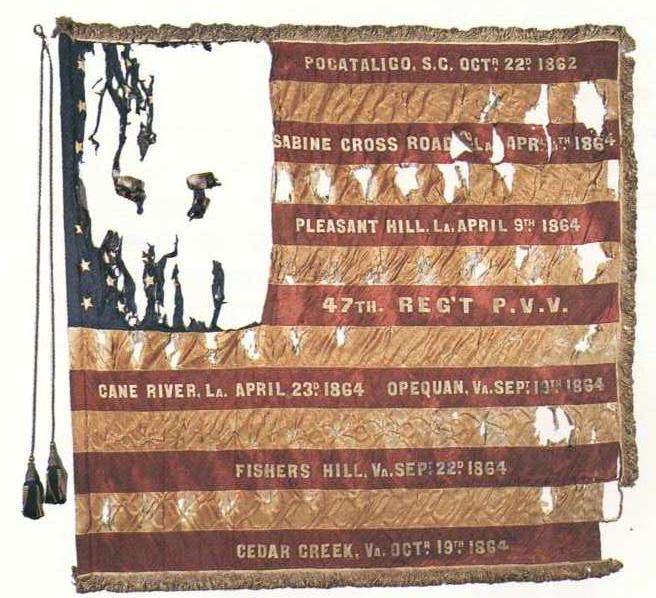
Second State Colors, 47th Pennsylvania Veteran Volunteers (presented to the regiment 7 March 1865).

A New Mission Begins

The Reconstruction Era for the 47th Pennsylvania Veteran Volunteers effectively began with the regiment’s departure for America’s Deep South on June 3, 1865, according to Assistant Regimental Surgeon John Young Shindel, M.D., who wrote these words on that day in history:

At about 10 o’clock, went on board the U.S.S. North Star…. Some of the Reg. went on Board the “Haze”. Dr. S. [and] Some on board the “Metis” from W. [Washington]. Started down the Potomac. Passed Mt. Vernon….

Reaching Fortress Monroe the next morning circa 11:00 a.m., the North Star continued south through the Atlantic Ocean and on to the waters off Cape Hatteras, North Carolina around 10:00 p.m. on June 4, according to Dr. Young. Suffering from seasickness the following day, he noted that his ship had already reached Cape Fear in North Carolina.

U.S.S. North Star, circa 1863 (Harper’s Weekly, January 10, 1863, public domain).

By Tuesday, June 6, the North Star had steamed to the mouth of the Savannah River, where it stopped, briefly, in order to allow a pilot to board. That pilot then moved the ship along the river, past Fort Pulaski, across the bar, and toward the harbor in the city of Savannah, Georgia, where it finally then dropped its anchor. The ship’s passengers were then directed to effect their transfer to smaller troop transports — the General Grant and the Oneita, according to Private Luther Horn of Company E. Those smaller steamers then took the 47th Pennsylvanians directly into the city. Upon their arrival at their designated landing spots at 4:00 a.m. the next morning (June 7), they disembarked, setting their feet on the soil of Georgia for the first time in the regiment’s history.

War-damaged houses in Savannah, Georgia, 1865 (Sam Cooley, U.S. Army, U.S. Library of Congress, public domain).

Using the next three hours to unload their equipment, they then lined up, by company, and stepped forward into their new mission at 7:30 a.m. Marching through the streets of Savannah, they headed one mile south, toward the city’s southern section, where they began erecting their Sibley tents.

* Note: Meanwhile, the steamships carrying the remaining 47th Pennsylvanians (the Metis and the Haze) were still en route. The Metis arrived later that day (June 7); the Haze arrived during the afternoon of June 8 with the members of Companies A, D, H, and I.

As the reunited 47th Pennsylvania Veteran Volunteers began settling in to their new routine, Regimental Orders, No. 67 directed members of Regimental Band No. 2 to practice between 9:00 and 10:00 every morning and perform every evening at 7:00 outside of the tent of the regiment’s commanding officer, Colonel John Peter Shindel Gobin.

On Friday, June 9, the entire regiment took part in a brigade parade. Five days later, Regimental Orders, No. 69 directed that “the first call for dress parade would be at 6 PM, and commanders were instructed to fall in their companies and drill them in the manual of arms until the second call at 6:30 PM,” according to regimental historian Lewis Schmidt. By mid-June the regiment was staffed by a total of eight hundred and sixty-three officers and enlisted men.

C Company’s Adam Maul and G Company’s Benjamin Neur, both privates, were subsequently detached to duties as clerks at the U.S. Department of the South’s headquarters. On June 21, Regimental Orders, No. 70 directed the captains of each company to “have their respective companies policed every morning and see that the tents and quarters of the men are properly ventilated and kept scrupulously clean, necessary for health,” adding that “one of the medical officers will inspect.”

Battling the elements once again, the 47th Pennsylvanians broke camp and relocated a short distance away — to drier ground — on Monday, June 26.

Confident in his regiment’s abilities to keep the peace, even as other Union Army regiments were receiving orders to depart from Georgia, leaving the 47th Pennsylvania with far less support, Colonel Gobin “requested permission from Maj. Wilkinson, AA Gen. of the District of Savannah, to turn in excess ordnance and ordnance stores” on June 27. The diplomacy phase of their new mission had begun.


Sources:

  1. Bates, Samuel P. History of Pennsylvania VolunteersVolunteers, 1861-5, vol. 1. Harrisburg, Pennsylvania: B. Singerly, State Printer, 1869.
  2. Civil War Muster Rolls (47th Pennsylvania Infantry). Harrisburg, Pennsylvania: Pennsylvania State Archives.
  3. Civil War Veterans’ Card File, 1861-1866 (47th Pennsylvania Infantry). Harrisburg, Pennsylvania: Pennsylvania State Archives.
  4. Foner, Eric. “Reconstruction.” Washington, D.C.: U.S. National Park Service, retrieved online June 3, 2025.
  5. “From Charleston and Savannah.” Pittsburgh, Pennsylvania: The Pittsburgh Daily Gazette, July 13, 1865.
  6. “From the South,” in “By Telegraph from Charleston.” Baraboo, Wisconsin: Baraboo Republic, July 19, 1865.
  7. “Savannah Intelligence.” Charleston, South Carolina: Charleston Daily Courier, July 4, 1865.
  8. Schmidt, Lewis. A Civil War History of the 47th Regiment of Pennsylvania Veteran Volunteers. Allentown, Pennsylvania: Self-published, 1986.

  9. Shindel, John Young. Diary and Personal Letters, 1865-1866. Allentown, Pennsylvania: Personal Collection of Lewis Schmidt.
  10. “The History of the Forty-Seventh Regt. P. V.” Allentown, Pennsylvania: The Lehigh Register, July 20, 1870.


Camp Brightwood, Washington, D.C.: Medical Issues and Personnel Changes (April-Early June 1865)

Spectators gather for the Grand Review of the Armies, 23-24 May 1865, beside the crepe-draped U.S. Capitol, flag at half-staff following the assassination of President Abraham Lincoln (U.S. Library of Congress, public domain).

Headquartered at Camp Brightwood in the Brightwood district of Washington, D.C.’s northwestern section since late April 1865, the 47th Pennsylvania Volunteers were attached to Dwight’s Division of the 2nd Brigade of the U.S. Department of Washington’s 22nd Corps. Their job was to prevent former Confederate States military troops and their sympathizers from reigniting the flames of civil war in the wake of U.S. President Abraham Lincoln’s assassination.

Multiple members of the regiment had only recently completed their detached duties as guards at the military prison where the key conspirators in their commander-in-chief’s murder were being held during their historic trial, and the regiment as a whole had just marched in the Union’s Grand Review of the National Armies on May 23.

Unidentified Union infantry regiment, Camp Brightwood, Washington, D.C., circa 1865 (public domain).

Now, as the majority of Union Army soldiers were being granted honorable discharges from the military, the 47th Pennsylvania Veteran Volunteers were hurriedly packing their belongings — but for transport to south, rather than back home. Meanwhile, as that frenzy of activity was unfolding, a “lucky few” of their comrades were being transferred to other federal military units, while others were receiving word that they would be honorably discharged via general orders that had been issued by the United States War Department — or by surgeons’ certificates of disability that had been approved by regimental or more senior ranking Union Army physicians.

Sergeant-Major William M. Hendricks, central regimental command, 47th Pennsylvania Volunteers, circa 1863 (public domain).

Among the more startling departures were those of First Lieutenant William M. Hendricks of Company C, Private William Kennedy of Company G, and Private Daniel Kochendarfer (alternate spellings: Kochenderfer, Kochendorfer) of Company H. First Lieutenant Hendricks had simply had his fill of military life and had resigned his commission on May 9, 1865 and Private Kennedy had died from phthisis at Mower General Hospital in Philadelphia, Pennsylvania on May 25, but Private Kochendarfer was ordered to remain behind for an entirely different reason — an arrest and conviction (the details of which remain murky to this day).

* Note: Having distinguished himself earlier in his career by nursing his sick and wounded comrades during their final moments of life in 1862, Private Daniel Kochendarfer was convicted during a court martial trial and sent to a federal military prison on June 1, 1865. He remained imprisoned there even as the 47th Pennsylvania Veteran Volunteer Infantry was mustering out for the final time on Christmas Day in 1865. Dishonorably discharged on March 7, 1866, he was never able to clear his name, despite petitioning the U.S. War Department for redress during the 1890s.

Medical Discharges

Other discharges that were issued to 47th Pennsylvanians at Camp Brightwood that spring were granted for entirely different reasons — physical or mental fitness for new duties that would require both brains and brawn. Among those deemed no longer fit to serve were:

  • Private George W. Lightfoot of Company G, who was transferred to Company I in the 24th Regiment of the U.S. Army’s Veteran Reserve Corps, which was also known as the “Invalid Corps” (April 25, 1865);
  • Private Joseph H. Schwab of Company F, who was honorably discharged on a surgeon’s certificate of disability (April 25, 1865);
  • Private William Leinberger of Company C, who was transferred to the 1st Battalion of the 21st Regiment of the Veteran Reserve Corps (April 28, 1865);
  • Private William M. Michael of Company C, who had been wounded in action during the Battle of Cedar Creek, Virginia on October 19, 1864 and was honorably discharged per General Orders, No. 77, issued by the Office of the U.S. Adjutant General (May 3, 1865);
  • Private William H. Guptill of Company G, who was honorably discharged on a surgeon’s certificate of disability (May 15, 1865);
  • Private Josiah D. Rabenold of Company B, who had been wounded in action during the Battle of Opequan, Virginia, also known as “Third Winchester,” on 19 September 1864, was treated by Union Army physicians and was honorably discharged (May 15, 1865);
  • Private Joseph Young of Company G, who had been hospitalized at a Union Army facility in Cumberland, Maryland and was honorably discharged on a surgeon’s certificate (May 17, 1865);
  • Private Charles Acher of Company K, who was honorably discharged on a surgeon’s certificate (May 19, 1865);
  • Private George P. Blain of Company C, who had been wounded in action during the Battle of Cedar Creek and was honorably discharged per General Orders, No. 77, issued by the Office of the U.S. Adjutant General (May 19, 1865);
  • Private Adam Lyddick of Company H, who had been severely wounded above the knee during the Battle of Cedar Creek, Virginia on October 19, 1864 and was honorably discharged on a surgeon’s certificate (May 19, 1865);
  • Private George Turpin of Company H, who had been hospitalized at the Union’s Mower General Hospital in Philadelphia (May 19, 1865);
  • Private Charles Buss of Company F, who had endured captivity as a prisoner of war (POW) at the Confederate Army’s prison camp near Tyler, Texas (Camp Ford) until his release on January 1, 1865 and was honorably discharged on a surgeon’s certificate (May 25, 1865);
  • Private Joel Michael of Company F was honorably discharged on a surgeon’s certificate (May 25, 1865);
  • Private Allen L. Kramer of Company B, who was wounded in action during the Battle of Creek, was treated at a Union Army General Hospital in Philadelphia and was honorably discharged on a surgeon’s certificate (May 26, 1865);
  • Private Charles F. Stuart of Company C, who had endured captivity as a POW at a Confederate Army prisoner of war camp until his release on 4 March 1865 and was honorably discharged (May 29, 1865);
  • Private Daniel S. Crawford of Company A, whose leg had been amputated to save his life after being wounded during the Battle of Cedar Creek and was honorably discharged on a surgeon’s certificate (May 31, 1865);
  • Private Michael Fitzgibbon of Company I, who was initially alleged to have deserted from Camp Brightwood, but had, in reality, been receiving treatment for malaria from Union Army physicians and was honorably discharged (May 31, 1865);
  • Private Lewis Brong of Company B, who had developed a chronic medical condition during Sheridan’s 1864 Shenandoah Valley Campaign and was honorably discharged per General Orders, No. 53, issued by the U.S. War Department (June 1, 1865);
  • Regimental Quartermaster Francis Z. Heebner, who had endured captivity as a POW at a Confederate Army officers’ prison in Richmond or Danville, Virginia until his release in late February 1865 and was honorably discharged (June 1, 1865);
  • Private Jenkin J. Richards of Company E, who had been hospitalized at the Union’s Fairfax Seminary Hospital in Fairfax, Virginia and was honorably discharged on a surgeon’s certificate (June 3, 1865);
  • Private Augustus Deitz/Dietzof Company H, who had been hospitalized in Washington, D.C. and was honorably discharged on a surgeon’s certificate (June 6, 1865); and
  • Private Andrew Mehaffie of Company D, who had also been wounded during the Battle of Cedar Creek and was also honorably discharged on a surgeon’s certificate (June 9, 1865).

Honorable Discharge by General Orders

Per General Orders, No. 53 or General Orders, No. 272, the more able-bodied 47th Pennsylvanians mustering out at Camp Brightwood were:

  • Private Richard Ambrum (Company G, June 1, 1865);
  • Private George W. Baltozer (Company D, June 14, 1865);
  • Private William H. Barber (Company K, June 1, 1865);
  • Sergeant Samuel H. Barnes (Company E, June 1, 1865);
  • Private Alfred Biege (Company F, June 1, 1865);
  • Private David K. Bills (Company A, June 1, 1865);
  • Private Tilghman Boger (Company K, June 1, 1865);
  • Private David Buskirk (Company G, May 26, 1865);
  • Private William Christ (Company F, June 1, 1865);
  • Private Michael Deibert (Company F, June 1, 1865);
  • Private George Diehl (Company B, May 23, 1865);
  • Private William Earhart (Company D, June 1, 1865);
  • Corporal William H. Eichman (Company E, June 1, 1865);
  • Private Milton A. Engleman (Company G, June 1, 1865);
  • Private George Felger (Company E, June 1, 1865);
  • Private Isaac Fleishhower (Company A, May 19, 1865);
  • Private William Fowler (Company E, June 1, 1865);
  • Private Charles H. Frey (Company E, June 1, 1865);
  • Musician and Private James A. Gaumer (Regimental Band No. 2 and Company G, June 1, 1865);
  • Private Solomon Gildner (Company A, June 1, 1865);
  • Private Benedict Glichler (Company K, May 19, 1865);
  • Sergeant John W. Glick (Company G, June 1, 1865);
  • Private Solomon Gross (Company I, June 2, 1865);
  • Private Emanuel Guera (Company H, June 19, 1865);
  • Private James Hall (Company H, June 1, 1865);
  • Privates Adam and Jacob Hammaker (Company H, June 1, 1865);
  • Private William George Harper (Company D, June 1, 1865);
  • Private William P. Heller (Company K, June 1, 1865);
  • Private Henry Henn (Company G, May 15, 1865);
  • Corporal George K. Hepler (Company C, June 1, 1865);
  • Privates Levinus and Solomon Hillegass (Company G, June 1, 1865);
  • Regimental Quartermaster Sergeant Henry J. Hornbeck (June 1, 1865);
  • Private Ananias Horting (Company H, June 1, 1865);
  • Private Daniel Houser (Company E, June 1, 1865);
  • Private Joseph Hausman (Company B, June 1, 1865);
  • Corporal Benjamin Huntzberger/Hunsberger (Company I, June 2, 1865);
  • Private Abraham F. Keim (Company D, May 23 or 28, 1865);
  • Musician Simon P. Kieffer (Company F, June 1, 1865);
  • Private Charles King (Company F, June 1, 1865);
  • Private David F. Knerr (Company I, June 1, 1865);
  • Corporal Daniel J. Kramer (Company I, June 1, 1865);
  • Private William H. Kramer (Company G, June 1, 1865);
  • Private John J. Lawall (Company I, June 1, 1865);
  • Private James Lay (Company H, June 1, 1865);
  • Private William Leiby (Company G, June 1, 1865);
  • Private George W. Levers (Company E, June 1, 1865);
  • Private John F. Liddick (aka John Liddick 2 and John Liddick 3 per Bates’ History of Pennsylvania Volunteers, Company H, June 1, 1865);
  • Private William H. Liddick (Company H, June 1, 1865);
  • Private James T. Lilly (Company F, May 31, 1865);
  • Private August Loeffelman (Company A, June 1, 1865);
  • Private George Malick (Company C, June 1, 1865);
  • Private Jesse Moyer (Company I, June 1, 1865);
  • Private Aamon Myers (Company D, June 1, 1865);
  • Private William Noll (Company K, June 1, 1865);
  • Private Thomas H. O’Donald (Company A, May 5, 1865);
  • Private Andrew J. Osmun (Company B, June 1, 1865);
  • Private Abraham Osterstock (Company A, May 5, 1865);
  • Private Jacob Paulus (Company A, June 1, 1865);
  • Private Washington A. Power (Company D, June 1, 1865);
  • Private Israel Reinhard (Company G, June 1, 1865);
  • Private Edward Remaly (Company F, June 1, 1865);
  • Corporal Allen J. Reinhard (Company B, June 1, 1865);
  • Private Henry Rinek (Company E, June 1, 1865);
  • Private Charles Rohrbacher (Company F, June 1, 1865);
  • Private Steven Schechterly (Company I, June 1, 1865);
  • Private Lewis Schmohl (Company A, June 1, 1865);
  • Private Joseph Benson Shaver (Company D, June 1, 1865);
  • Private Peter Shireman (Company F, June 1, 1865);
  • Private Franklin Sieger (Company B, June 1, 1865);
  • Private Samuel H. Smith (Company I, June 1, 1865);
  • Private John G. Snyder (Company F, June 1, 1865);
  • Private Erwin S. Stahler (Company G, June 1, 1865);
  • Private H. Stoutsaberger (Company H, June 1, 1865);
  • George Stroop (Captain, Company D, June 2, 1865);
  • Private Charles Stump (Company A, May 15, 1865);
  • Private George Sweger (Company H, June 1, 1865);
  • Private Samuel Transue, (Company E, June 1, 1865);
  • Private Israel Troxell (Company I, June 1, 1865);
  • Private Oliver Van Billiard (Company B, May 26, 1865);
  • Corporal Walter H. Van Dyke (Company F, June 1, 1865);
  • Corporal William M. Wallace (Company H, June 1, 1865);
  • Private Daniel H. Wannamaker/Wannermaker (Company I, June 1, 1865);
  • Private Cornelius Wenrich/Wenrick (Company C, June 6, 1865);
  • Corporal Solomon Wieder (Company G, June 1, 1865);
  • Private Andrew J. Williams (Company D, June 1, 1865);
  • Private Franklin H. Wilson (Company F, June 1, 1865);
  • and Private Daniel S. Zook (Company D, May 17, 1865).

Peacekeeping and Reconstruction

War-damaged houses in Savannah, Georgia, 1865 (Sam Cooley, U.S. Army, U.S. Library of Congress, public domain).

As spring gave way to summer, the new mission of the 47th Pennsylvania Veteran Volunteer Infantry would be to keep the peace across the United States of America’s Deep South while helping to rebuild shattered communities and restore local government operations during what has since become known as the Reconstruction Era. They arrived at their first new duty station (Savannah, Georgia) during the first week of June in 1865. Promotions during the Camp Brightwood and Reconstruction periods of duty were awarded to:

  • Adams, William (Company E): From corporal to sergeant, May 1865;
  • Brown, Amos T. (Company H): From private to corporal, June 2, 1865;
  • Bush, James M. (Company F): From private to corporal, April 25, 1865;
  • Clay, George W. (Company D): From second lieutenant to first lieutenant, June 2, 1865);
  • Cunningham, Robert (Company F): From private to corporal, June 2, 1865;
  • Dennis, Henry T. (Company G): From sergeant to first sergeant, May 14, 1865;
  • Eisenhard, John H. (Company B): From private to corporal, April 21, 1865;
  • Haltiman, William H. (Company I): From first sergeant to second lieutenant, May 27, 1865;
  • Hartzell, Israel Frank (Company I): From private to corporal, June 2, 1865;
  • Hettinger, Stephen (Company I): From private to corporal, June 2, 1865;
  • Hinckle, Willam H. (Company K): From private to corporal April 21, 1865;
  • Jacoby, Moses (Company E): From private to corporal, June 2, 1865;
  • Jones, John L. (Company F): From corporal to sergeant, June 2, 1865);
  • Kosier, George (Company D: From first lieutenant to captain, June 1, 1865);
  • Kuder, Owen (Company I): From private to corporal, June 2, 1865;
  • Lawall, Allen D. (Company I): From second to first lieutenant, May 30, 1865;
  • Lilly, Joseph M. (Company F): From corporal to sergeant, April 21, 1865;
  • Mayers, William H. (Company I, alternate surname spellings: Mayer, Meyers, Moyers; listed in Bates’ History of Pennsylvania Volunteers as “William H. Moyers I”): From sergeant to first sergeant, May 27, 1865;
  • Mink, Theodore (Company I): From first lieutenant to captain, May 22, 1865;
  • Moser, Owen (Company E): From private to corporal, May 27, 1865;
  • O’Brien, Martin (Company F): From private to corporal, April 25, 1865;
  • Rader, Reuben E. (Company A): From private to corporal, May 14, 1865;
  • Rockafellow, William (Company E): From corporal to sergeant, June 2, 1865;
  • Seneff, Henry (Company C): From private to corporal, April 22 1865;
  • Small, Charles H. (Company H): From company private to regimental quartermaster sergeant, June 2, 1865;
  • Stuber, Levi (Company I): From company captain to regimental major and third-in-command, May 22, 1865;
  • Walton, John F. (Company E): From private to corporal, May 1, 1865; and
  • Weise, Henry C. (Company H): From private to corporal, June 2, 1865.

Sadly, while all of those advancements in rank were occurring, Private Allen Faber of Company A, was fighting a battle that he was destined to lose. Still hospitalized for treatment of rheumatic carditis at the Union’s Harewood General Hospital in Washingon, D.C, he finally succumbed there to complications from his condition on June 7, 1865, and was subsequently interred with military honors at the Arlington National Cemetery in Arlington, Virginia.


Sources:

  1. Bates, Samuel P. History of Pennsylvania Volunteers, 1861-5, vol. 1. Harrisburg, Pennsylvania: B. Singerly, State Printer, 1869.
  2. Battleground National Cemetery: Battleround to Community — Brightwood Heritage Trail,” “Fort Stevens” and “Mayor Emery and the Union Army.” United States: Historical Marker Database, retrieved online May 20, 2025.
  3. “Battleground to Community: Brightwood Heritage Trail.” Washington, D.C.: Cultural Tourism DC, 2008.
  4. Civil War Muster Rolls (47th Pennsylvania Infantry). Harrisburg, Pennsylvania: Pennsylvania State Archives.
  5. Civil War Veterans’ Card File, 1861-1866 (47th Pennsylvania Infantry). Harrisburg, Pennsylvania: Pennsylvania State Archives.
  6. “Our Returned Prisoners: Names of 500 Released Officers Sent to Annapolis.” New York, New York: The New York Times, February 28, 1865.
  7. Schmidt, Lewis. A Civil War History of the 47th Regiment of Pennsylvania Veteran Volunteers. Allentown, Pennsylvania: Self-published, 1986.
  8. “The History of the Forty-Seventh Regt. P. V.” Allentown, Pennsylvania: The Lehigh Register, 20 July 1870.