The Lincoln Assassination: A Union Army Chaplain’s Angry, Heartsick Response

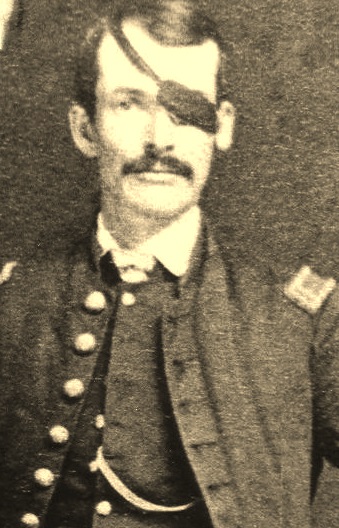
Rev. William DeWitt Clinton Rodrock, chaplain, 47th Pennsylvania Volunteers, Fort Jefferson, Dry Tortugas, Florida, 1863 (courtesy of Robert Champlin, used with permission).

In an April 30, 1865 report sent to Brigadier-General L. Thomas, the Adjutant General of the U.S. Army, the Rev. William DeWitt Clinton Rodrock, chaplain of the 47th Pennsylvania Volunteer Infantry, expressed his ire and grief regarding the recent assassination of President Abraham Lincoln:

“Sir.

The present month claims more than an ordinary place in our National history. In the very hour of general exultation and rejoicing for vouchsafed blessings and victories on our arms, promising speedy restoration of internal peace and return of prosperity and happiness, our great and good Chief Magistrate, Abraham Lincoln, was slain by the hand of foul conspiracy and vile assassination. For the first time the annals of the country have been stained by a political assassination! It is a crime against God, against the Nation, against humanity and against liberty, that has thus been perpetrated! It is the madness of Treason and murder! And the day that commemorates the Crucifixion of the Saviour of Man is henceforth made forever memorable by a new crime against the Law of God and Country.

But we must bow low, before the Almighty Hand that thus shows us the weakness and wickedness of man and the vanity of all human calculations!

May this fearful blow recall us all to our duties! We will draw near to the Altar of our country, also, as we approach the Altar of our God. We have great duties in this crisis. And the first is to forget selfishness and passion and party, and look to the salvation of the Country.

As to our lamented President, let us do justice to his memory! He dies in the hour of his country’s restored greatness, and in the full fruition of his own personal triumph. The assassin’s blow, will rank him in the memory of mankind among the martyrs of freedom.

The 19th inst. – the day set apart for the funeral of our late President, was duly observed with appropriate ceremonies for our Brigade. The Regiments present were the 47th Pa. V.V.’s, 8th Vermont, 12th Conn. and 153rd N.Y. It became my duty to officiate on the occasion, and it was one of the most solemn and impressive scenes I ever witnessed.” 

Rodrock then went on to report on the morale and health of his regiment, leaving the “solemn and impressive” gathering of soldiers to the reader’s imagination. What is known for certain is that the 47th Pennsylvania Volunteers were unable to participate in the President’s funeral parade, as many other Union troops did, because the 47th Pennsylvanians and their fellow brigade members were still on duty. Assigned to protect Washington, DC in the wake of Lincoln’s assassination, they grieved collectively during Rodrock’s brief memorial service and individually as battle-hardened soldiers when their respective schedules allowed time for rumination.

Over the next two weeks, one member of the 47th Pennsylvania would be given the honor of guarding the late President’s funeral train while others would be assigned to guard Mary Surratt and the other key conspirators in Lincoln’s assassination during the early days of their imprisonment.

To read more of Chaplain Rodrock’s reports, please see the Religion and Spirituality section of this website.

Faces of the 47th Project Honors History-Making Civil War Soldiers from Pennsylvania

First Lieutenant William Wallace Geety, Co. H, 47th Pennsylvania Volunteers, c. 1864-1865.

A tantalizing new video released by 47th Pennsylvania Volunteers: One Civil War Regiment’s Story just opened an important new portal to the 19th century for Civil War enthusiasts, teachers, students, and genealogists.

Faces of the 47th is part of a larger, ongoing initiative to document and raise public awareness about the 47th Regiment, Pennsylvania Volunteer Infantry – the only regiment from the Keystone State to fight in the Union’s 1864 Red River Campaign  across Louisiana. The video presents the photographic and illustrated images of more than two dozen men who fought with the all-volunteer unit between 1861 and 1865.

“Each one of these images holds the potential to help family history researchers feel closer to their Civil War-era ancestors while also enabling teachers, students and Civil War enthusiasts to deepen their connections to one of the most painful chapters in the American narrative,” explains Laurie Snyder, managing editor for the project. “By ‘putting faces to the names’ on military muster rolls, we’re bringing history to life while also paying tribute to those who fought to eradicate slavery and preserve our nation’s union.”

The photo digitization project received early support from Thomas MacEntee, founder of High-Definition Genealogy, via The Genealogy Fairy™ program, which enabled Snyder to locate and digitize photographs of key members of the regiment. Among the images preserved in this initial collection are the faces of a regimental chaplain, musicians, prisoners of war (POWs), military surgeons, and officers and enlisted men who were grievously wounded or killed in combat, as well as several men who became inventors, leading business executives and elected officials in and beyond Pennsylvania after the war.

George Dillwyn John (third from left; formerly, 47th Pennsylvania Volunteers), Grand Army of the Republic gathering, Will Robinson Post, Illinois, c. 1926.

“At the time I applied for the grant, there were hundreds of photographs tucked away in public libraries, historical societies, universities, and private family history collections from Maine to California and Michigan to Louisiana. Most had not yet been digitized and might have been lost for all time had Thomas MacEntee not provided the support he did when he did,” said Snyder. “More work still needs to be done, of course, because there are photos still not yet scanned, but the project took more than two dozen giant steps forward with just that one grant from Thomas. He’s a hero in my book.”

Other significant support for the project has been provided by the Burrowes and Wasserman families.

About the 47th Pennsylvania Volunteers

Joseph Eugene Walter, Regimental Band, 47th Pennsylvania Volunteers, c. 1861.

Recruited primarily at community gathering places in their respective home towns, the soldiers who served with the 47th Pennsylvania Volunteer Infantry were primarily men of German heritage whose families still spoke German or “Pennsylvania Dutch” more than a century after their ancestors emigrated from Germany in search of religious and political freedom. Still others were recent immigrants from Germany, Ireland and Cuba. Formerly enslaved black men who had been freed by the regiment from plantations in South Carolina and Louisiana were added to regimental rosters in 1862 and 1864.

In addition to fighting in the battles of Sabine Cross Roads/Mansfield, Pleasant Hill and Monett’s Ferry/Cane River during the Red River Campaign, the 47th Pennsylvania Volunteers also engaged in the defense of Washington, D.C. in 1861 and again in 1865, following the assassination of President Abraham Lincoln; the capture of Saint John’s Bluff, Florida and Battle of Pocotaligo, South Carolina (1862); the garrisoning of Forts Taylor and Jefferson in Key West and the Dry Tortugas, Florida (1863); Union Major-General Philip Sheridan’s tide-turning Shenandoah Valley Campaign (1864), including the battles of Berryville, Opequon, Fisher’s Hill, and Cedar Creek; and provost (military police) and Reconstruction duties in Savannah, Georgia and Charleston, South Carolina (1865). Most were finally released from duty when the regiment formally mustered out on Christmas Day in 1865.

Learn More and Support

To learn more about the 47th Pennsylvania Volunteers and lend your support to this historic initiative, visit the website of 47th Pennsylvania Volunteers: One Civil War Regiment’s Story, and follow the project on Facebook, Twitter, Tumblr, and YouTube.