Remembering the Red River Campaign Prisoners of War on National POW/MIA Recognition Day

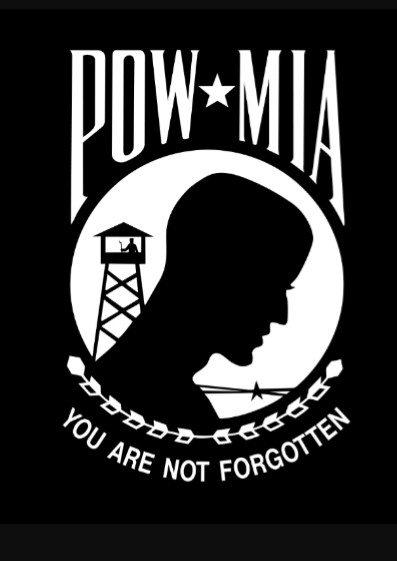
This POW/MIA Recognition Flag designed by Newt Heisley was formally recognized by U.S. House of Representatives Resolution No. 467 on September 21, 1990 (public domain).

During the Army of the United States’ 1864 Red River Campaign across Louisiana in the American Civil War, multiple members of the 47th Pennsylvania Volunteer Infantry were declared as “Missing in Action” (MIA) — largely due to the confusion caused by a series of engagements with the enemy in which Union soldiers were repeatedly required to retreat, regroup and resume the fight as they faced down wave after wave of Confederate troops attempting to outflank and perform end runs around the outer edges of Union Army lines.

Each time the cannon smoke began to clear from those battles, many of those MIA members of the 47th Pennsylvania Volunteer Infantry found their way back to the regiment, carrying word to senior officers of the 47th Pennsylvania Volunteers that members of the regiment had been captured by Confederate troops. By mid-May of 1864, it was clear that at least twenty-three 47th Pennsylvania Volunteers were being held as prisoners of war (POWs) by the Confederate States Army.

Regimental leaders would later learn that many of those men had been force marched roughly one hundred and fifty miles to Camp Ford, which was located outside of Tyler, Texas and would become the largest Confederate POW camp west of the Mississippi River by the summer of 1864. Once there, they were starved, given minimal to no medical care for any wounds they had sustained, exposed to extreme variations in temperature and weather, due to inadequate shelter, and sickened by dysentery and other diseases that were spread by living in the cramped, overcrowded conditions that became increasingly unsanitary, due to the placement of latrine facilities near water supplies meant for drinking or bathing. As their days dragged on, their treatment by Confederate soldiers grew more and more harsh. According to representatives of the Smith County Historical Society who have been working on documenting the history of Camp Ford:

On April 8th and 9th 1864 at the battles of Mansfield and Pleasant Hill, Louisiana, Confederate forces captured more than 2,000 Union soldiers, who were quickly marched to Tyler…. The existing stockade did not have sufficient area to house them, and an emergency enlargement was undertaken. Local slaves were again impressed, the north and east wall was dug up and the logs cut in half, and the top ten feet of the logs of the south and west walls were cut off. The resulting half logs gave sufficient timber to quadruple the area of the stockade, and it was expanded to about eleven acres.

With additional battles in Arkansas and Louisiana, the prison population had grown to around 5,000 by mid-June. Hard-pressed CS officials had no ability to provide shelter for the new prisoners, and their suffering was intense. The number of tools was inadequate, and many men could only dig holes in the ground for shelter. Rations were often insufficient and the death rate soared…. Of 316 total deaths at the camp, 232 occurred between July and November 1864….

At least three 47th Pennsylvania Volunteers are confirmed to have died while imprisoned at Camp Ford. Another member of the regiment was later removed from that prison and moved to Andersonville, the most notorious of all American Civil War POW camps. Two others died as POWs who were confined to a Confederate hospital.

In recognition of National POW/MIA Recognition Day, which is observed on the third Friday each September in the United States of America, we pay tribute to those twenty-three brave souls.

DeSoto and Sabine Parishes (Mansfield and Pleasant Hill, Louisiana)

Possibly wounded in action during the Battle of Pleasant Hill, Privates Solomon Powell and Jonathan Wantz of Company D were captured during that battle on April 9, 1864. Private Powell died either that same day or on June 7, 1864, while still being held by Confederate troops as a POW at Pleasant Hill. Private Wantz also died while still being held as a POW at Pleasant Hill; his death was reported as having occurred on June 17, 1864. Their exact burial locations remain unidentified.

Confederate Hospital (Shreveport, Louisiana)

G Company Private Joseph Clewell — who had only been a member of the 47th Pennsylvania since mid-November 1863, fell ill sometime after being captured by Confederate troops during one of the 47th Pennsylvania’s Red River Campaign engagements in the spring of 1864. Suffering from chronic diarrhea due to the poor water quality and unsanitary living conditions that he endured while being held as a POW, he was subsequently confined to the Confederate States Army Hospital No. 59 in Shreveport, Louisiana sometime in May or early June. Held at that hospital as a POW, his health continued to decline until he died there on June 18, 1864, according to the U.S. Army’s Registers of Deaths of Volunteer Soldiers. His exact burial location also remains unidentified.

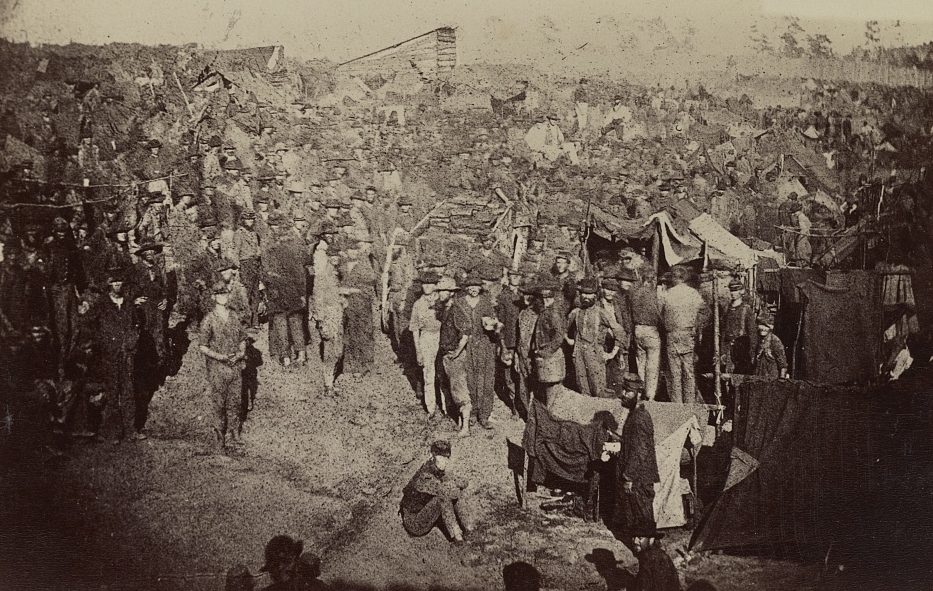
This illustration presented a rosier view of life at Camp Ford, the largest Confederate Army prison camp west of the Mississippi River, than was the actual situation for the 47th Pennsylvania Volunteers confined there (Harper’s Weekly, March 4, 1865, public domain).

Camp Ford or Camp Groce (Texas)

The 47th Pennsylvania Volunteers confirmed to have been released from Camp Ford or Camp Groce in Texas during a series of prisoner exchanges between the Army of the United States and the Confederate States Army were:

  • Private Charles Frances Brown, Bugler of Company D and Regimental Band No. 2 (date of release: July 22, 1864; discharged after receiving medical treatment; re-enlisted with the 7th New York Volunteers in October 1864);
  • Private Charles Buss/Bress of Company D (fell ill with dysentery while confined as a POW at Camp Ford and developed chronic diarrhea and severe hemorrhoids — conditions that would plague him for the remainder of his life, date of release: July 22, 1864; received medical treatment and was honorably discharged from a Union Army medical facility in Philadelphia in May 1865);
  • Private Ephraim Clouser of Company D (captured after being shot in the right knee, date of release: November 25, 1864; placed on Union Army sick rolls after being diagnosed as being too traumatized to remain on duty, he was transferred to the Union Army’s Jefferson Barracks Hospital in St. Louis, Missouri, then to a Union Army hospital in Cincinnati, Ohio and then to the Union Army’s general hospital in York, Pennsylvania, where he remained until the end of the war; still suffering from post-traumatic stress disorder (PTSD) after the war, he was declared by the Pennsylvania court system to be unable to care for himself, and was confined to the Harrisburg State Hospital for the remainder of his life);
  • Sergeant James Crownover of Company D (captured after being shot in the right shoulder, date of release: November 25, 1864; received medical treatment, recovered and returned to duty);
  • Private James Downs of Company D (date of release: July 22, 1864; received medical treatment and returned to duty; possibly suffering from post-traumatic stress disorder (PTSD), he fell from a window of the Brookville Memorial Home in Jefferson County, Pennsylvania in 1921);
  • Private Conrad P. Holman, of Company C (date of release: July 22, 1864; received medical treatment, recovered and returned to duty);
  • Corporal James Huff of Company E (captured after being wounded, date of release: August 29, 1864; received medical treatment, recovered and returned to duty; captured by Confederate troops during the Battle of Cedar Creek, Virginia on October 19, 1864, was transported and force marched to North Carolina, where he was held as a POW at the Salisbury Prison Camp until his death there from starvation and harsh treatment on March 5, 1865; he was subsequently buried somewhere on the POW camp grounds in an unmarked mass trench grave of Union soldiers);
  • Private John Lewis Jones of Company F (captured after being wounded, date of release: September 24, 1864; received medical treatment, recovered and returned to duty);
  • Private Edward Mathews of Company C (date of release: July 22, 1864; received medical treatment, recovered and returned to duty);
  • Private Adam Maul/Moll/Moul of Company C (captured on May 3, 1864, while away from his regiment’s encampment in Alexandria, Louisiana — possibly while assigned to duties related to the construction of Bailey’s Dam, date of release: July 22, 1864; received medical treatment, recovered and was assigned to detached duty at Hilton Head, South Carolina on January 3, 1865, but was reportedly not given discharge paperwork by his regiment; his exact burial location remains unidentified);
  • Private John W. McNew of Company C (captured after being wounded, date of release: July 22, 1864; received medical treatment, recovered and returned to duty);
  • Corporal John Garber Miller of Company D (date of release: July 22, 1864; received medical treatment, recovered and returned to duty);
  • Private Samuel W. Miller of Company C (date of release: July 22, 1864; received medical treatment, recovered and returned to duty);
  • Private John Wesley Smith of Company C (date of release: July 22, 1864; received medical treatment, recovered and returned to duty;
  • Private William J. Smith of Company D (date of release: July 22, 1864; received medical treatment, recovered and returned to duty; and
  • Private Benjamin F. Wieand/Weiand of Companies B and D (captured after being wounded; received medical treatment after his release from captivity and was honorably discharged on July 21, 1865.

The 47th Pennsylvania Volunteers confirmed to have died on the grounds of Camp Ford were:

  • Private Samuel M. Kern of Company D (date of death: June 12, 1864);
  • Private Frederick Smith of Company I (date of death: May 4, 1864); and
  • Private John Weiss, Company F (captured after being severely wounded, he was initially confined to Camp Ford, but was then transferred to a “Rebel hospital” for treatment of his wounds, according to regimental records; died at that Confederate hospital on July 15, 1864).

The burial locations of Privates Samuel Kern, Frederick Smith and John Weiss remain unidentified. (The Confederate hospital where Private John Weiss died may have been the Confederate Army Hospital No. 59 in Shreveport, Louisiana — the same Confederate hospital where G Company Private Joseph Clewell died on June 18, 1864.)

Issuing Rations at the Andersonville POW Camp, August 17, 1864 (view from Main Gate, U.S. Library of Congress, public domain).

Andersonville (Fort Sumter, Georgia)

According to an article in the April 12, 1911 edition of the Reading Eagle, Private Ben Zellner of the 47th Pennsylvania’s Company K had also begun his imprisonment as a POW at Camp Ford, but was later transported to Georgia, where he was confined to Andersonville, the most notorious Confederate prison camp of them all.

Benjamin Zellner, who was one of the youngest soldiers during the Civil War, was captured by the Confederates at Pleasant Hill, La., April 8, 1864. He was a member of Co. K, 47th Regiment, with Gen. Banks’ army on the Red River expedition. Comrade Zellner was wounded in a charge to the left of the lines and fell on the field. The Union forces being driven back, he, with a number of others was captured. After being kept at Pleasant Hill two weeks, they were removed to Mansfield, La., on a Saturday night and kept over night [sic] in the Court House until Sunday morning. Thence they were removed to Shreveport, La., and again kept in the Court House. From thence they were marched 110 miles to Unionville prison at Tyler, Tex…. The 47th was the only Penn’a Regiment to participate in the Red River campaign.

Although POW records from Camp Ford that are maintained by the Smith County Historical Society note that a “Ben Cellner” was released in that camp’s July 22, 1864 prisoner exchange with the Union Army, interviews by several different newspaper reporters of Zellner in his later life contradict those records. According to Zellner and the Reading Eagle, he had been transported to Camp Sumter near Anderson, Georgia sometime in May or June 1864:

In about a month [after arriving at Camp Ford in Texas, following their 8 April capture in Louisiana] 300 or 400 of the strongest were brought back to Shreveport and then transported down the Red River to an old station and marched four days, when they were taken by train to Andersonville….

At the time of Private Zellner’s internment, Andersonville was under the command of Henry Wirz, who would later be convicted of war crimes for his brutal treatment of Union prisoners. According to the September 21, 1864 edition of The Soldiers’ Journal:

Those Union prisoners recently released from Camp Sumter, at Andersonville, Ga., have made affidavit of the condition of the 35,000 prisoners confined there. The horrors of their imprisonment, plainly and unaffectedly narrated, have no parallel outside of Taeping or Malay annals. Twenty-five acres of human beings – so closely packed that locomotion is made obsolete, compelled to drink from sewers, and to eat raw meat like cannibals – are dwelling under vigilant espionage, hopeless, helpless, and Godless. Some are lunatic, and others have become desperately wicked; all are living, loathing, naked, starved fellow-men.

Reportedly held as a POW for six months and fourteen days, according to the March 26, 1915 edition of The Allentown Leader, Zellner was freed from captivity during a Union and Confederate army prisoner exchange in September 1864 (per a report in the April 12, 1911 edition of the Reading Eagle). The April 8, 1911 Allentown Leader noted that, after this prisoner exchange, which took place “along the James River,” he was then sent with a number of his fellow former POWs “to Washington, to Fortress Monroe, to New York and home.” Following a period of recovery, he then returned to service with his regiment just in time to participate in a key portion of Union Major-General Phillip Sheridan’s 1864 Shenandoah Valley Campaign.

Read their stories. Remember their names. Honor their individual sacrifices.


Sources:

  1. “47 Years Today Since Rebels Caught Him: This Is a Memorable Anniversary for Comrade Ben Zellner.” Allentown, Pennsylvania: The Allentown Leader, April 8, 1911.
  2. Allentown’s Youngest Civil War Veteran (profile of Private Ben Zellner). Reading, Pennsylvania: Reading Eagle, April 12, 1911.
  3. Bates, Samuel P. History of Pennsylvania Volunteers, 1861-5, vol. 1. Harrisburg, Pennsylvania: B. Singerly, State Printer, 1869.
  4. Camp Ford,” in “Texas Beyond History.” Austin, Texas: Texas Archaeological Research Laboratory, University of Texas at Austin, retrieved online January 24, 2025.
  5. Camp Ford Prison Records (47th Pennsylvania Volunteer Infantry, 1864). Tyler, Texas: Smith County Historical Society.
  6. “Camp Sumter,” in “Editorial Jottings.” Washington, D.C.: The Soldiers’ Journal, September 21, 1864.
  7. Civil War Muster Rolls (47th Pennsylvania Infantry). Harrisburg, Pennsylvania: Pennsylvania State Archives.
  8. Civil War Veterans’ Card File, 1861-1866 (47th Pennsylvania Infantry). Harrisburg, Pennsylvania: Pennsylvania State Archives.
  9. Gilbert, Randal B. A New Look at Camp Ford, Tyler, Texas: The Largest Confederate Prison Camp West of the Mississippi River, 3rd Edition. Tyler, Texas: The Smith County Historical Society, 2010.
  10. “His Glorious Record as a Soldier: Fought at Gettysburg, Red River and Shenandoah Valley and Besides Enduring the Horrors of Andersonville, Carries Bullet to This Day.” Allentown, Pennsylvania: The Allentown Leader, March 26, 1917.
  11. Horwitz, Tony. “Did Civil War Soldiers Have PTSD?“, in Smithsonian Magazine, January 2015. Washington, D.C.: Smithsonian Institution.
  12. Lawrence, F. Lee. “Camp Ford,” in “Hand Book of Texas.” Austin, Texas: Texas State Historical Association, retrieved online January 24, 2025.
  13. “Newport: Special Correspondence” (notice documenting Ephraim Clouser’s confinement for mental illness and later death at the asylum in Harrisburg, Pennsylvania). Harrisburg, Pennsylvania: Harrisburg Daily Independent, March 18, 1899.
  14. POW/MIA Recognition Day.” Indianapolis, Indiana: The American Legion National Headquarters, retrieved online September 19, 2025.
  15. Registers of Deaths of Volunteers. Washington, D.C.: U.S. National Archives and Records Administration, 1864-1865.
  16. Schmidt, Lewis. A Civil War History of the 47th Regiment of Pennsylvania Veteran Volunteers. Allentown, Pennsylvania: Self-published, 1986.
  17. Simmons, G. W. “Camp Ford, Texas” (sketch, Harper’s Weekly, March 4, 1865; retrieved June 9, 2015, via University of North Texas Libraries, The Portal to Texas History, crediting Star of the Republic Museum, Washington, Texas).
  18. Slattery, Joe. “Confederate Soldiers Who Died at the Confederate General Hospital in Shreveport, Louisiana,” in The Genie, vol. 37, no. 1 (First Quarter, 2003), p. 12. Shreveport, Louisiana: Ark-La-Tex Genealogical Association.
  19. “The Exchange of Prisoners; The Cartel Agreed Upon by Gen. Dix for the United States, and Gen. Hill for the Rebels,” in “Supplementary Articles.” New York, New York: The New York Times, October 6, 1862.
  20. Thoms, Alston V., principal investigator and editor, and David O. Brown, Patricia A. Clabaugh, J. Philip Dering, et. al., contributing authors. Uncovering Camp Ford: Archaeological Interpretations of a Confederate Prisoner-of-War Camp in East Texas. College Station, Texas: Center for Ecological Archaelogy, Department of Anthropology, Texas A & M University.
  21. Union Army Deaths in Shreveport 1864-1865.” Shreveport, Louisiana: Sons of Union Veterans, Brig. Gen. Joseph Bailey Camp No. 5, retrieved April 29, 2021.
  22. “Up in Perry” (notice of Ephraim Clouser’s arrest and sanity hearing). Harrisburg, Pennsylvania: Harrisburg Telegraph, September 22, 1892.
  23. Wharton, Henry D. Letters from the Sunbury Guards, 1861-1866. Sunbury, Pennsylvania: Sunbury American.


Reconstruction and Diplomacy: The 47th Pennsylvania in Georgia (Summer 1865)

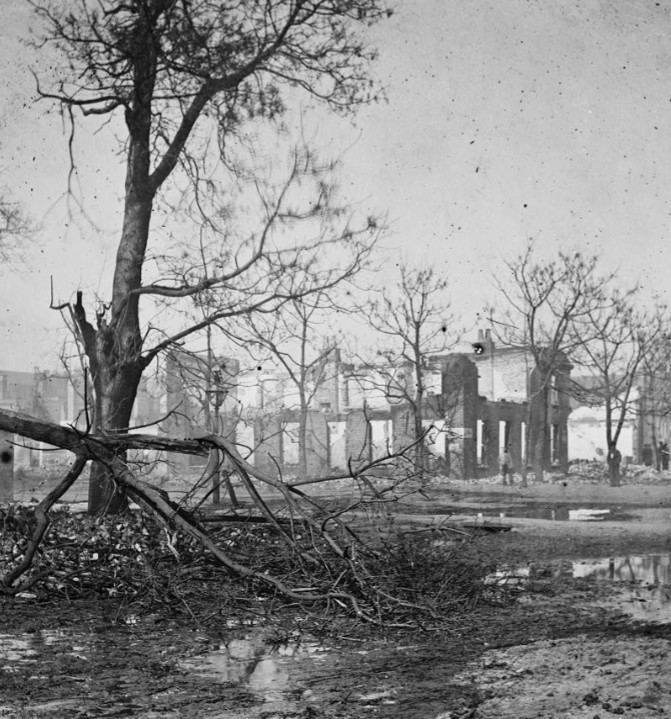
War-damaged houses in Savannah, Georgia, 1865 (Sam Cooley, U.S. Army, U.S. Library of Congress, public domain).

Stationed in Savannah, Georgia since June 7, 1865, the soldiers still serving with the 47th Pennsylvania Volunteer Infantry that first summer after the American Civil War were assigned to provost duties — as peacekeepers, public information specialists and public works officials, during what has since become known as the Presidential Reconstruction Era (1865-1867) of American History.

Commanded by Colonel John Peter Shindel Gobin, Lieutenant-Colonel Charles William Abbott and Major Levi Stuber, multiple members of the regiment were literally involved in the re-construction of small southern towns and larger cities, helping to shore up war-damaged structures that could be restored — and in tearing down others that were deemed too dangerous for civilians to leave standing.

John Young Shindel, M.D., assistant surgeon, 47th Pennsylvania Volunteers, 1865 (public domain).

It was hazardous work, according to John Young Shindel, M.D., an assistant regimental surgeon who had joined the medical staff of the 47th Pennsylvania earlier that same year. On Wednesday, June 18, 1865, he noted that:

10 o’clock wall fell in and buried 15 or 20 men. 6 or 7 were taken out some dead. Zellner Co. K badly hurt. Sent him to Hosp. Capt. Hoffman, Chief of Police, seriously hurt. In P.M. was with Capt. Hoffman.

The 47th Pennsylvanian mentioned by Dr. Young was Private Ben Zellner, who had survived repeated battle wounds and confinement as a prisoner of war (POW) at two Confederate States Army prison camps, only to nearly lose his life while assigned to police duty during peacetime. According to Private Zellner’s 1896 account of that 1865 accident, his jawbone had been broken during the wall’s collapse “and he sustained 11 scalp wounds”; as a result, he “lost the sight of his left eye and the hearing of his left ear.”

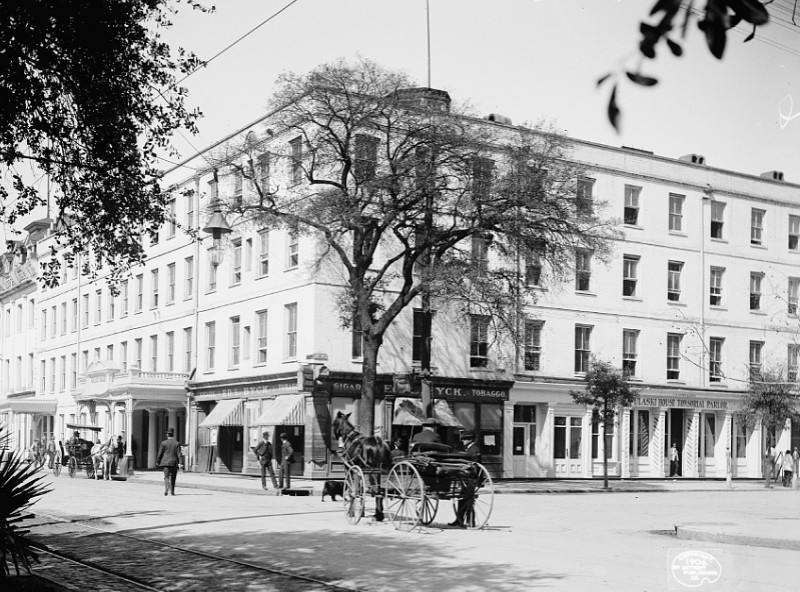
The 47th Pennsylvania Volunteer Infantry’s Regimental Band performed in concert for James Johnson, provincial governor of the State of Georgia, at the Pulaski Hotel in Savannah on June 30, 1865 (Pulaski Hotel, Savannah, Georgia, circa 1906, U.S. Library of Congress, public domain).

Meanwhile, other 47th Pennsylvania Volunteers were being transformed into diplomats. Officers and enlisted members of the regiment, for example, helped to facilitate a warm welcome for James Johnson, the provisional governor of Georgia, during his official visit to Savannah in early July. According to the Charleston Daily Courier, Governor Johnson (who had been appointed to his gubernatorial post by U.S. President Andrew Johnson (but was not related to the president), had been invited to Savannah by members of the city council “to address the citizens … at some suitable place.” In that invitation, council members also suggested that “military and naval commanders of the United States army and navy at this post and their respective staffs be respectfully invited to attend said meeting.” Johnson subsequently accepted the invitation and made the trip to Savannah in late June. The night of his arrival (June 30), “the fine band of the 47th Pennsylvania Regiment, Eugene Walter, Leader, serenaded the Governor at the Pulaski House.”

Several patriotic airs were played, and as soon as practicable the Governor appeared on one of the balconies, in response to repeated calls. He was loudly welcomed. He made no elaborate speech, but addressed the immense assembly substantially as follows:

“Fellow-Citizens — I thank you for the consideration, on your part, which has occasioned this demonstration. I know that you have called on me as the Provisional Governor of the State of Georgia, and in the discharge of the high duties now incumbent upon me, I promise you to act to the best of my ability. I know that you will not expect, on this occasion, any very full remarks. Hoping to meet you hereafter, and then to have an opportunity to explain my sentiments and position, I will bid you good night.”

This brief address was received with loud cheers by the crowd, and the band then played several other appropriate airs.

Joseph Eugene Walter, Regimental Band, 47th Pennsylvania Volunteers, circa 1861.

On July 1, the Savannah Republican newspaper published a more detailed description of that evening’s events:

Last evening, through the exertions of a few citizens, an impromptu call was made upon Gov. Johnson at the Pulaski by a delegation of loyal men, accompanied by the fine band of the 47th Pennsylvania Veteran Volunteers, now stationed in this city. The object of the call was simply to manifest the joy of the people at the return of a loyal civil magistrate, who, in a measure, holds the future destiny of Georgia in his hands, and to pay the Governor the compliment of a serenade. After the band had performed several appropriate pieces of music, loud calls and cheers were given for the Governor, who at length appeared, and in a few brief remarks thanked the assemblage for their demonstrations of respect, and informed them that, being wearied with traveling he begged to be excused from making any formal speech. Before bidding the crowd good night, the Governor informed them that it would be his pleasure to address the people tonight at the Theatre, where he would state his position and give his views on the state of the country. Upon retiring, the crowd applauded and cheered the Governor lustily, while Johnson square was ablaze with the discharge of fire works, the shooting of rockets, roman candles, and the illumination of blue lights, gave the scene a very brilliant appearance and made the vicinity of Savannah lively for one hour. At a late hour the crowd quietly dispersed to their homes, well pleased with the impromptu ovation to the Governor. Governor Johnson was afterwards introduced to a large number of army officers, each of whom expresses the wish that the day was near when bayonets would not be necessary to maintain order in Georgia. The Governor, who is a most unostentatious gentleman, spoke very encouragingly of the future, and shook hands with all who were introduced.

The thanks of our citizens are due Colonel Gobin, of the 47th Pennsylvania Volunteers, for the services of his excellent band, whose presence made the hasty reception a success. The Colonel has very kindly offered the use of his band for the meeting this evening at the theatre, and we may expect a brilliant gathering of the masses tonight at 8 o’clock.

James Johnson, provisional governor of the State of Georgia, 1865 (Lawton B. Evans, A History of Georgia for Use in Schools, 1898, public domain).

On Saturday evening (July 1), Governor Johnson fulfilled his promise. During a lengthy address, he spoke about cooperation and the rule of law, the true meaning of citizenship and the path forward following the nationwide eradication of chattel slavery. The crowd, which had been attentive throughout his speech, gave him a robust round of applause, and peacefully dispersed, according to subsequent newspaper reports. The festivities, which continued into the next week, also included a “Grand Review of the Garrison,” which was held in Savannah on Monday afternoon, July 3. According to the Savannah Republican:

The review of the entire garrison by Major General H. W. Birge, on Monday afternoon, was certainly one of the finest military pageants that we have witnessed since the departure of Gen. Sherman’s army. For perfection of military movements, neatness of appearance and true soldierly bearing on the part of privates as well as officers, won encomiums from the vast crowd of spectators who witnessed the review. We don’t blame Gen. Birge to feel proud of such a noble body of gallant men as he has the honor to command, and we are fortunate in having so excellent a command garrisoning our city.

The following composes the troops that participated in the review:

Brigadier General Joseph D. Fessenden, commanding 1st Division.

1st Brigade, 1st Division, Col. L. Peck commanding. — 90th New York, Lt. Col. Schamman; 173d New York, Lt. Col. Holbrook; 160th New York, Lt. Col. Blanchard; 47th Pennsylvania, Col. Gobin.

2d Brigade, Col. H. Day commanding. — 131st New York, Capt. Tilosting commanding; 128th New York, Capt. _____ ; 14th New Hampshire, Lt. Col. Mastern.

3d Brigade, 2d Division, Col. Graham commanding. — 22d Iowa, Lt. Col. _____ ; 24th Iowa, Lt. Col. Wright; 28th Iowa, Lt. Col. Wilson.

4th Brigade, Brevet Brig. Gen. E. P. Davis commanding. — 153d _____ , Lt. Col. Loughlin; 30th Maine, Col. Hubbard; 12th Connecticut, Lt. Col. Lewis; 26th Massachusetts, Lt. Col. Chapman; 75th New York, Lt. Col. York; 103rd U.S.C.T., Major Manning.

Civil conversation, community concerts and displays of kindness toward strangers were indeed replacing bayonets — becoming the most powerful tools ever wielded by the 47th Pennsylvania Volunteers as they helped to rescue their nation from disunion.


Sources:

  1. Bates, Samuel P. History of Pennsylvania Volunteers, 1865-1, vol. 1. Harrisburg, Pennsylvania: B. Singerly, State Printer, 1869.
  2. “Comrade Zellner’s Birthday” (includes description of Private Benjamin F. Zellner’s injury in 1865 while serving with the 47th Pennsylvania Volunteers during the Reconstruction Era). Allentown, Pennsylvania: The Allentown Leader, March 27, 1896.
  3. Evans, Lawton B. A History of Georgia for Use in Schools, p. 304. New York, New York: Universal Publishing Company, 1898.
  4. Foner, Eric. “Reconstruction.” Washington, D.C.: U.S. National Park Service, retrieved online July 1, 2025.
  5. Governor Johnson’s Patriotic Address: A Stirring Appeal to Georgians.” Savannah, Georgia: Savannah Republican, July 6, 2025.
  6. “House Divided: The Civil War Research Engine at Dickinson College.” Carlisle, Pennsylvania: Dickinson College, accessed July 1, 2025.
  7. James Johnson,” in New Georgia Encyclopedia. Atlanta, Georgia: Georgia Humanities, retrieved online July 1, 2025.
  8. “Savannah Intelligence.” Charleston, South Carolina: Charleston Daily Courier, July 4, 1865.
  9. “Serenade to Our New Governor: The Pulaski House and Johnson Square Radiant with Fireworks: Remarks of the Governor: Music and Pyrotechnics.” Savannah, Georgia: Savannah Republican, July 1, 1865.
  10. Shindel, John Young. Diary and Personal Letters, 1865-1866. Allentown, Pennsylvania: Personal Collection of Lewis Schmidt.
  11. Wharton, Henry D. Letters from the Sunbury Guards, 1865. Sunbury, Pennsylvania: Sunbury American, 1865-1866.
  12. “The Grand Review of the Garrison.” Savannah, Georgia: Savannah Republican, July 6, 1865.
  13. “The History of the Forty-Seventh Regt. P. V.” Allentown, Pennsylvania: The Lehigh Register, July 20, 1870.


Camp Brightwood, Washington, D.C. (Mid-April – June 2, 1865)

Unidentified Union infantry regiment, Camp Brightwood, Washington, D.C., circa 1865 (public domain; click to enlarge).

Marched closer to the nation’s capital in the wake of U.S. President Abraham Lincoln’s assassination in mid-April 1865, the 47th Pennsylvania Veteran Volunteers were directed to proceed to the Brightwood district in the northwestern section of Washington, D.C. and erect their Sibley tents at the Union Army duty station known as Camp Brightwood.

Their new job was to prevent Confederate States Army troops and their sympathizers from reigniting the flames of civil war that had just been stamped out weeks earlier.

According to historians at Cultural Tourism DC, Brightwood was “one of Washington, DC’s early communities and the site of the only Civil War battle to take place within the District of Columbia” — the Battle of Fort Stevens.

This crossroads community developed from the Seventh Street Turnpike, today’s Georgia Avenue, and Military Road. Its earliest days included a pre-Civil War settlement of free African Americans…. Eventually Brightwood boasted a popular race track, country estates, and sturdy suburban housing. In 1861 the area was known as Brighton, but once it was large enough to merit a U.S. Post Office, the name was changed to Brightwood to distinguish it from Brighton, Maryland.

Also, according to Cultural Tourism historians, Camp Brightwood was established on the grounds of “Emery Place, the summer estate of Matthew Gault Emery,” who had “made a fortune in stone-cutting, including the cornerstone for the Washington Monument,” which was laid in 1848.

During the Civil War (1861-1865), Captain Emery led the local militia. His hilltop became a signal station where soldiers used flags or torches to communicate with nearby Fort DeRussy or the distant Capitol. Soldiers of the 35th New York Volunteers created Camp Brightwood here. During the Battle of Fort Stevens in July 1864, Camp Brightwood was a transfer point for the wounded.

By late April of 1865, it was home to multiple Union Army regiments, including the 47th Pennsylvania Veteran Volunteers.

Guarding the Lincoln Assassination Conspirators

Washington Arsenal Penitentiary, Washington, D.C., 1865 (Joseph Hanshew, public domain; click to enlarge).

Sometime after their arrival at Camp Brightwood during that fateful spring of 1865, a group of 47th Pennsylvania Veteran Volunteers were given a new assignment — guard duty at the Washington Arsenal and its prison facility, where eight people were being held in connection with their involvement in the assassination of President Abraham Lincoln. They had been arrested between April 17 and 26.

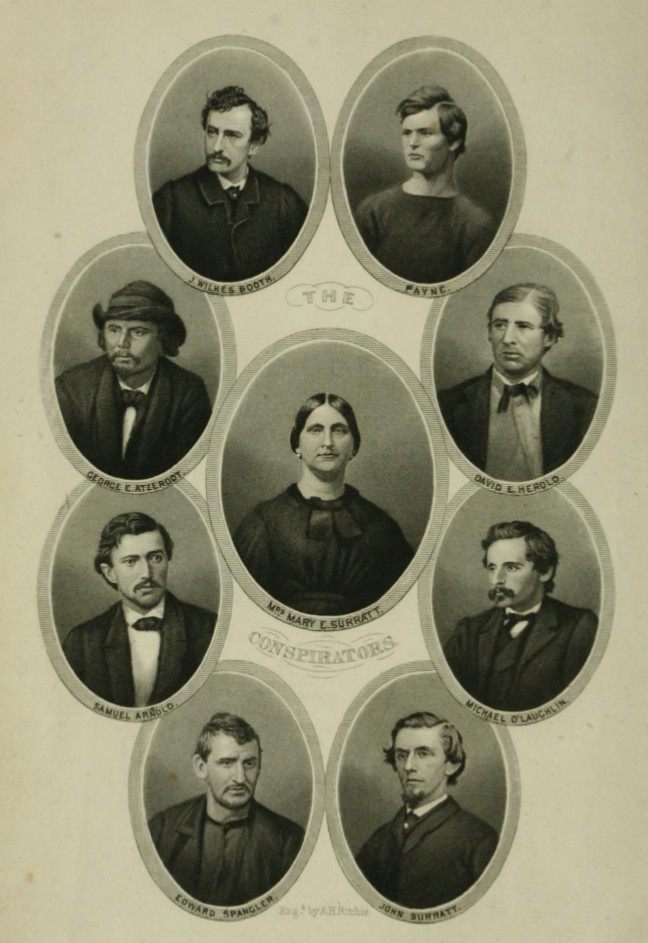
The key conspirators involved in President Abraham Lincoln’s assassination (Benn Pitman, The Assassination of President Lincoln and the Trial of the Conspirators,” 1865, U.S. Library of Congress, public domain).

While researchers for 47th Pennsylvania Volunteers: One Civil War Regiment’s Story have not yet determined the exact start date of the 47th Pennsylvania’s guard duties at the Washington Arsenal Penitentiary, they are now able to offer a better estimate — thanks to the work of Lincoln scholars Edward Steers, Jr. and Harold Holzer, who published documents written by Union Major-General John Frederick Hartranft, the Pennsylvanian appointed by U.S. President Andrew Johnson on May 1, 1865 “to command the military prison at the Washington Arsenal, where the U.S. government had just incarerated the seven men and one woman accused of complicity in the shooting.” Included in the Steers-Holzer compilation is a letter from Major-General Hartranft, governor and commander of the “Washington Arsenal Military Prison,” to Major-General Winfield S. Hancock, commanding officer of the United States Middle Military Division, which was dated May 11, 1865. Hartranft began by informing Hancock that “at 10:25 yesterday [May 10, 1865], Lt. Col. J. M. Clough, 18th N. H. reported with 450 muskets, for four days duty, relieving the 47th Pa. Vols.” He then went on to describe the duties performed by 18th New Hampshire Volunteers at the Washington Arsenal on May 10:

At 11:45, the prisoners on trial were taken into Court, in compliance with the orders of the same. At 1 P.M. the Court ordered the prisoners returned to their cells, which was done.

At 1:10 P.M. dinner was served to the prisoners in the usual manner.

At 1:30 in compliance with your orders Marshal McPhail was admitted to see the prisoner in 161 [Atzerodt], his hood having been previously removed; he remained with him until 2.35, immediately after which his hood was replaced and the door locked.

At 3:45 P.M. Mr. George L. Crawford in accordance with your instructions, was permitted to have an interview with prisoner in 209. I was present during the same, and heard all that was said. The conversation was in regard to the property of the prisoner in Philadelphia. At 4:25 the hood was replaced and the cell locked.

At 6 P.M. Supper was furnished the prisoners and at the same time Dr. Porter and myself made inspections of all the cells and prisoners.

At 6 P.M. in accordance with your instructions, Mr. Stone, counsel for Dr. Mudd, was permitted to visit his client. The interview took place in the presence of Lt. Col. McCall but not in his hearing.

At 6:35 the interview closed, and the door was again locked.

At 7 this A.M. breakfast was served to the prisoners in the usual manner. At 7:15, Dr. Porter and myself made Inspections of all the cells and prisoners.

I would respectfully recommend that the prisoner in 190 be removed to cell 165.

All passes admitting persons during the last 24 hours are here with enclosed.

As a result, researchers for the 47th Pennsylvania Volunteers’ project postulate that:

  1. As many as four hundred and fifty 47th Pennylvania Veteran Volunteer Infantrymen may have been stationed at the Washington Arsenal between May 6-10, 1865; and
  2. At least some of those 47th Pennsylvanians may very well have interacted with the key Lincoln assassination conspirators (Samuel Bland Arnold, George A. Atzerodt, David E. Herold, Dr. Samuel Alexander Mudd, Michael O’Laughlen, Lewis Thornton Powell/Lewis Payne, Edman Spangler/Ned Spangler, and Mary Elizabeth Surratt) — interactions which likely took place while those eight prisoners were confined at the Washington Arsenal prison; on the way to and from the courtroom, where they were being tried for conspiring to assassinate President Lincoln; inside that courtroom during trial proceedings; and possibly also at other sites related to their confinement and trial.

Although the duties performed between by 47th Pennsylvania Volunteers between May 6-9 would not have been exactly the same as those performed by the New Hampshire soldiers on May 10, they may very well have been similar — meaning that at least some 47th Pennsylvania Volunteers may have been involved in locking and unlocking the doors of the conspirators’ cells, escorting the conspirators into the courtroom of their military trial (which began on May 9, 1865), standing guard over the conspirators during their trial to prevent their escape, escorting them from the courtroom, and interacting with them in their cells by:

  • Bringing meals to them;
  • Removing and replacing the hoods that covered their heads so that they could interact with their lawyers and other visitors;
  • Verifying the legitimacy of passes held by would-be visitors and denying or granting access to those visitors as appropriate;
  • Escorting visitors to and from their cells; and
  • Monitoring their visits with anyone granted entry to their cells.

With their guard assignment completed by the morning of May 10, 1865, the 47th Pennsylvania Volunteers who were serving on detached duty at the Washington Arsenal were marched back to Camp Brightwood, where they would remain until their next assignment — participating in the Union’s Grand Review of the National Armies on May 23, 1865.

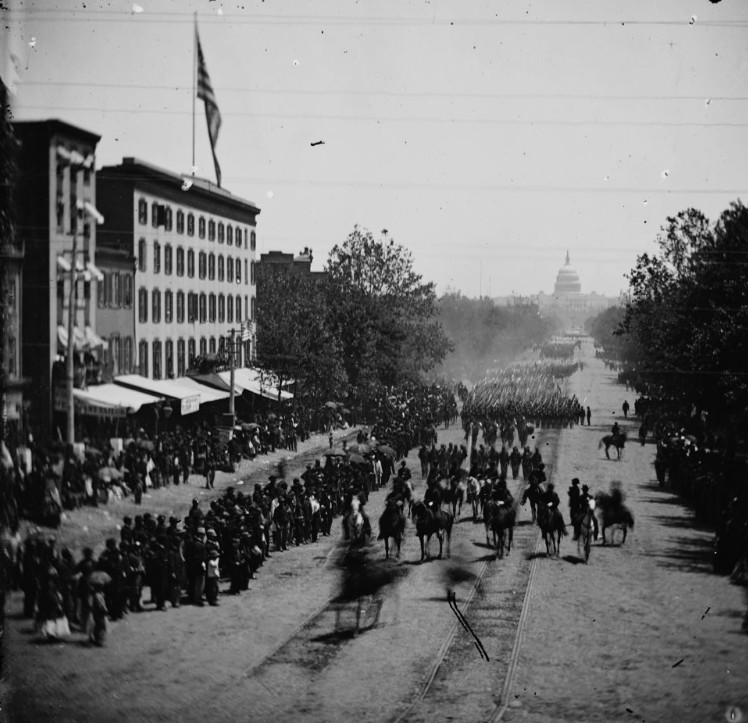
19th Corps, Army of the United States, Grand Review of the National Armies, Pennsylvania Avenue, Washington, D.C., May 23, 1865 (Matthew Brady, U.S. Library of Congress, public domain).

The Grandest of the Grand Reviews

The 47th Pennsylvania Veteran Volunteer Infantry was just one group of the more than one hundred and forty-five thousand Union military men who marched from Capitol Hill through the streets of Washington, D.C. during a two-day spectacle designed to celebrate the end of the American Civil War and heal Americans’ heartbreak in the wake of President Lincoln’s assassination. Held from May 23-24, 1865, it was a sight that had never been seen before — and one that would likely never be seen anywhere in the United States of America ever again. The first day’s parade alone lasted six hours.

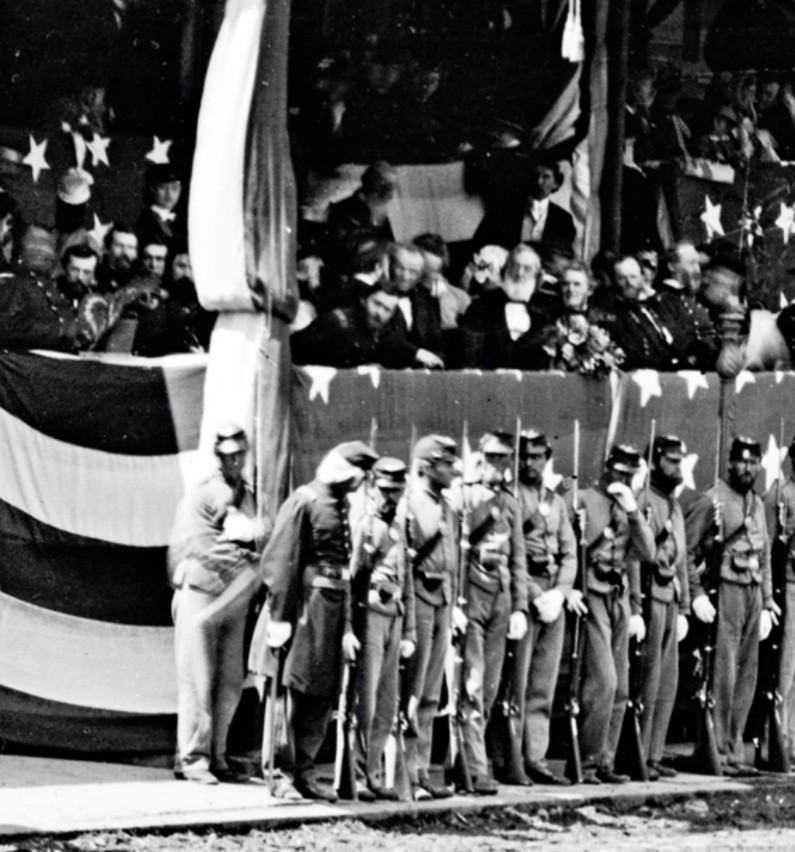
Lieutenant-General Ulysses S. Grant, leaning forward, President Andrew Johnson to his left, Grand Review of the National Armies, Washington, D.C., May 23, 1865 (U.S. Library of Congress, public domain).

According to The New York Times, the 47th Pennsylvanians were positioned behind the parade’s third division, as part of the Nineteenth Army Corps (XIX Corps) in Dwight’s Division. Marching with the precision for which they had become renowned, they passed in front of a review stand which sheltered U.S. President Andrew Johnson, Secretary of War Edwin M. Stanton and Lieutenant-General Ulysses S. Grant. The division directly behind the 47th Pennsylvanians in that day’s line of march included other officers and general staff of the Army of the United States and regiments commanded by American Civil War icon Brigadier-General Joshua L. Chamberlain, one of the most beloved heroes from the tide-turning Battle of Gettysburg.

Rev. William DeWitt Clinton Rodrock, chaplain, 47th Pennsylvania Volunteers (courtesy of Robert Champlin, used with permission).

Afterward, 47th Pennsylvania Chaplain William DeWitt Clinton Rodrock summed up the experience in a report penned at Camp Brightwood on May 31:

The wise king of the Scriptures speaks of a sorrow that pervades the human heart “in the midst of laughter.” The truthfulness of this Divine philosophy is a matter of daily experience. Our most joyous seasons are intermingled with a sadness that often challenges definition. Every garden has its sepulchre. Every draft of sweet has its ingredient of bitter. This fact has never been so fully realized as this month. With the mighty army of brave soldiers congregated and reviewed in Washington and the … expressions of deep regret that Abraham Lincoln is not here to have witnessed the great pageant of the 23rd and 24th inst. have been universal. Not the splendid victories which our brave soldiers have won — not the pleasing prospect that they are “homeward bound” — not the consolatory thought that the reins of government have fallen into the hands of so good a man as Andrew Johnson — have served to restrain these utterances of grief and sorrow. Had it been God’s will to spare Mr. Lincoln’s life, what an eclat his presence would have imparted to the mighty pageant.

But as He willed otherwise and “doeth all things well,” it is ours to learn the great lesson of the hour.

Rebuilding a Shattered Nation

Ruins of Charleston, South Carolina as seen from the Circular Church, 1865 (U.S. National Archives and Records Administration, public domain).

As the cheers of the Grand Review crowds faded, the 47th Pennsylvania Veteran Volunteers resumed life at Camp Brightwood, with many assuming that their days of wearing “Union Blue” were finally coming to an end. But that assumption proved to be an incorrect one when the 47th Pennsylvania Veteran Volunteers received word that they were being reassigned. Ordered to pack their belongings in late May 1865, they would be heading back to America’s Deep South — this time to assist with Reconstruction duties in Georgia and South Carolina, beginning the first week in June.


Sources:

  1. Assassination of President Abraham Lincoln.” Washington, D.C.: U.S. Library of Congress, retrieved online May 21, 2025.
  2. Bates, Samuel P. History of Pennsylvania Volunteers, 1861-5, vol. 1. Harrisburg, Pennsylvania: B. Singerly, State Printer, 1869.
  3. Battleground National Cemetery: Battleround to Community — Brightwood Heritage Trail,” “Fort Stevens” and “Mayor Emery and the Union Army.” United States: Historical Marker Database, retrieved online May 20, 2025.
  4. “Battleground to Community: Brightwood Heritage Trail.” Washington, D.C.: Cultural Tourism DC, 2008.
  5. “Grand Military Review: Streets Crowded with Spectators: Sherman Greeted with Deafening Cheers.” Pittsburgh, Pennsylvania: The Daily Post, May 25, 1865.
  6. Grant” (television mini-series). New York, New York: History Channel Education, 2020.
  7. “Our Heroes! The Grand Review at Washington. Honor to the Brave. Immense Outpouring of the People. The Troops Reviewed by Gen. Grant.” Harrisburg, Pennsylvania: Daily Telegraph, May 23, 1865.
  8. Pitman, Benn. The Assassination of President Abraham Lincoln and the Trial of the Conspirators. Cincinnati, Ohio and New York, New York: Moore, Wilstach & Boldwin, 1865.
  9. Reconstruction: An Overview.” Washington, D.C.: American Battlefield Trust, November 28, 2023.
  10. Review of the Armies; Propitious Weather and a Splendid Spectacle. Nearly a Hundred Thousand Veterans in the Lines.” New York, New York: The New York Times, May 24, 1865, front page.
  11. Rodrock, Rev. William D. C. Chaplain’s Reports (47th Pennsylvania Volunteer Infantry, 1865). Washington, D.C.: U.S. National Archives and Records Administration.
  12. Schmidt, Lewis. A Civil War History of the 47th Regiment of Pennsylvania Veteran Volunteers. Allentown, Pennsylvania: Self-published, 1986.
  13. “Serenade to General Grant” (performance for Lieutenant-General Ulysses S. Grant by the 47th Pennsylvania Veteran Volunteers’ Regimental Band), in “Washington.” Philadelphia, Pennsylvania: The Inquirer, May 22, 1865.
  14. Steers, Edward Jr. and Harold Holzer. The Lincoln Assassination Conspirators: Their Confinement and Execution, as Recorded in the Letterbook of John Frederick Hartranft. Baton Rouge, Louisiana, 2009.
  15. The Final March: Grand Review of the Armies.” Washington, D.C.: U.S. National Park Service, retrieved online May 20, 2025.
  16. “The Grand Review: A Grand Spectacle Witnessed.” Pittsburgh, Pennsylvania: The Daily Post, May 24, 1865.
  17. “The Grand Review: Immense Crowds in Washington: Fine Appearance of the Troops: Their Enthusiastic Reception.” Harrisburg, Pennsylvania: Pennsylvania Daily Telegraph, May 24, 1865; and West Chester, Pennsylvania: The Record, May 17, 1865.
  18. “The Grand Review: The City Crowded with Visitors: Order of Corps, Divisions, Brigades and Regiments.” Philadelphia, Pennsylvania: Daily Constitutional Union, May 23, 1865.
  19. “The History of the Forty-Seventh Regt. P. V.” Allentown, Pennsylvania: The Lehigh Register, 20 July 1870.
  20. The Lincoln Conspirators,” in “Ford’s Theatre.” Washington, D.C.: U.S. National Park Service, retrieved online May 21, 2025.


April 15th: A Date of Decision and Death for President Abraham Lincoln

This 1865 photograph of President Abraham Lincoln by Alexander Gardner is believed by historians to be the final photo taken of Lincoln (1865, U.S. Library of Congress, public domain).

There were multiple key moments in the life of the man who would become the sixteenth president of the United States of America. Some, like the deaths of his mother and sister, would dramatically alter the trajectory of his life; others, like his decision to embark upon a life of public service, would reshape the future of a nation.

But his actions on one particular date, during two entirely different years, did both.

So pivotal in history, that particular date’s annual arrival still stops average Americans in their tracks each year, prompting them to reflect on the legacy of that one man — and the question, “What if?”

That man was U.S. President Abraham Lincoln and that date is April 15.

Lincoln’s Call for Seventy-Five Thousand Volunteers (April 15, 1861)

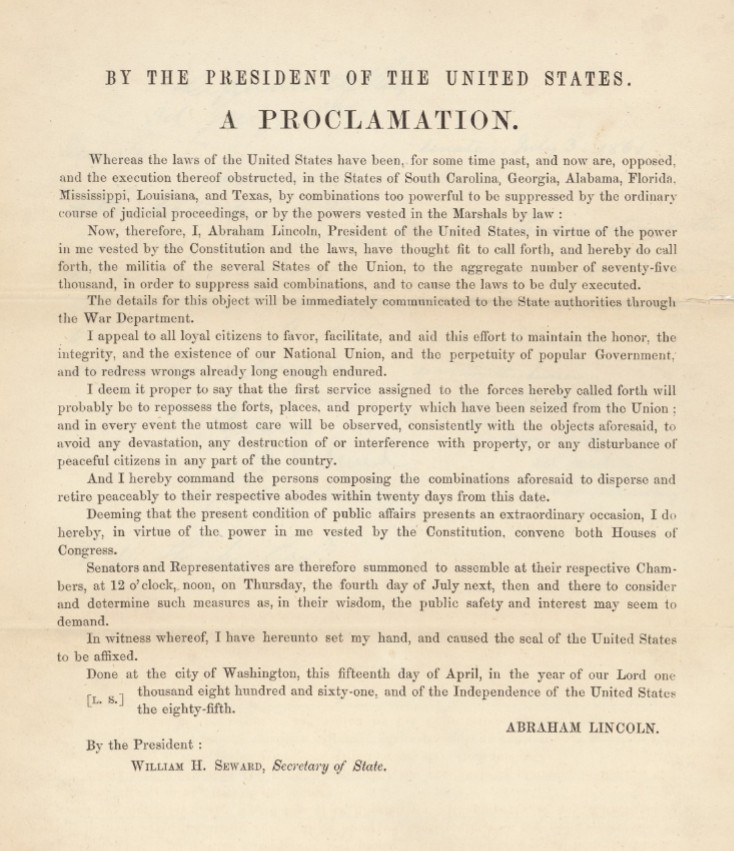
Proclamation issued by U.S. President Abraham Lincoln, calling for seventy-five thousand state militia troops to bring an end to the secession of, and insurrection by, eleven of fifteen southern slaveholding states, April 15, 1861 (U.S. National Archives and Records Administration, public domain; click to enlarge).

In response to the fall of Fort Sumter in Charleston, South Carolina to Confederate States troops on April 14, 1861, President Abraham Lincoln issued a proclamation in which he called for seventy-five thousand men across the United States to risk their lives to defend the nation’s capital and bring a swift end to the secession crisis and insurrection initiated by eleven of fifteen southern slave holding states. That proclamation, which was issued on April 15, 1861 read as follows:

By the President of the United States.

A Proclamation.

Whereas the laws of the United States have been, for some time past, and now are, opposed, and the execution thereof obstructed, in the States of South Carolina, Georgia, Alabama, Florida, Mississippi, Louisiana, and Texas, by combinations too powerful to be suppressed by the ordinary course of judicial proceedings, or by the powers vested in the Marshals by law:

Now, therefore, I, Abraham Lincoln, President of the United States, in virtue of the power in me vested by the Constitution and the laws, have thought fit to call forth, and hereby do call forth, the militia of the several States of the Union, to the aggregate number of seventy-five thousand, in order to suppress said combinations, and to cause the laws to be duly executed.

The details for this object will be immediately communicated to the State authorities through the War Department.

I appeal to all loyal citizens to favor, facilitate, and aid this effort to maintain the honor, the integrity, and the existence of our National Union, and the perpetuity of popular Government, and to redress wrongs already long enough endured.

I deem it proper to say that the first service assigned to the forces hereby called forth will probably be to repossess the forts, places, and property which have been seized from the Union; and in every event the utmost care will be observed, consistently with the objects aforesaid, to avoid any devastation, any destruction of or interference with property, or any disturbance of peaceful citizens in any part of the country.

And I hereby command the persons composing the combinations aforesaid to disperse and retire peaceably to their respective abodes within twenty days from this date.

Deeming that the present condition of public affairs presents an extraordinary occasion, I do hereby, in virtue of the power in me vested by the Constitution, convene both Houses of Congress.

Senators and Representatives are therefore summoned to assemble at their respective Chambers, at 12 o’clock, noon, on Thursday, the fourth day of July next, then and there to consider and determine such measures as, in their wisdom, the public safety and interest may seem to demand.

In witness whereof, I have hereunto set my hand, and caused the seal of the United States to be affixed.

Done at the city of Washington, this fifteenth day of April, in the year of our Lord one thousand eight hundred and sixty-one, and of the Independence of the United States the eighty-fifth.

Abraham Lincoln

By the President: William H. Seward, Secretary of State.

Four years later, on the exact same date, President Abraham would draw his last breath.

Lincoln’s Death from an Assassin’s Bullet (April 15, 1865)

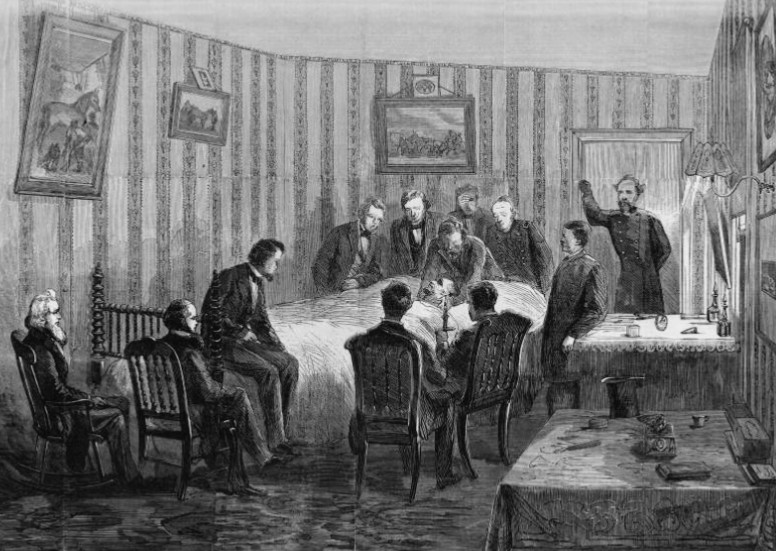
President Abraham Lincoln on his deathbed at the Petersen House in Washington, D.C., April 15, 1865 (Harper’s Weekly, 1865, public domain; click to enlarge).

Mortally wounded by a shot to his head, which was fired by an assassin and Confederate sympathizer while President Abraham Lincoln was watching a performance of the popular stage play, Our American Cousin, at Ford’s Theatre in Washington, D.C., on the evening of Good Friday, April 14, 1865, President Lincoln was initially examined on site in the presidential box, by fellow theatre attendee and physician Charles Leale, before being carried downstairs by Union Army soldiers and taken across Tenth Street — and into a room at the Petersen boarding house, where he was then gently lowered onto the bed of Willie Clark.

As additional physicians arrived and assessed the president’s condition, a decision was made to make him as comfortable as possible, when it was determined that he would likely not survive the night.

A remarkably strong man, even as he waged his toughest battle, President Lincoln managed to hang onto until the following morning, drawing his final ragged breath at 7:22 a.m. on April 15, 1865 — and leaving the work of national healing and Reconstruction in far less capable hands.

One hundred and sixty years later, Americans still wonder, “Would we be a better nation if Lincoln had survived?”


Sources:

  1. A Proclamation by the President of the United States, April 15, 1861.” Washington, D.C.: U.S. Capitol Visitor Center, retrieved online April 15, 2025.
  2. Abraham Lincoln’s Assassination,” in “History Channel: Civil War.” New York, New York: A&E Television Networks, February 27, 2025.
  3. Eric Foner: Reconstruction and the Constitution” (video). Chicago, Illinois: Chicago Humanities Festival, 2019.
  4. Lincoln’s Death,” in “Lincoln Assassination.” Washington, D.C.: Ford’s Theatre, retrieved online December 1, 2024.
  5. The Petersen House.” Washington, D.C.: U.S. National Park Service, December 1, 2024.


Black History Month: Ratification of the 15th Amendment to the United States Constitution (February 3, 1870)

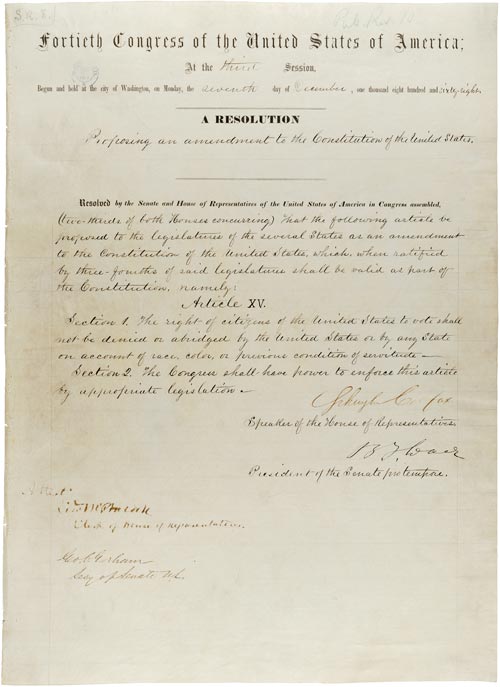
The 15th Amendment to the United States Constitution, which ensured voting access for all American male citizens, regardless of race, color or previous condition of servitude, was passed by the United States Congress on February 26, 1869 and ratified on February 3, 1870 (U.S. National Archives and Records Administration, public domain; click to enlarge).

Passed by the United States Congress on February 26, 1869, the 15th Amendment to the United States Constitution granted Voting Rights to African American men. That amendment was officially ratified on February 3, 1870.

Text of the 15th Amendment

Fortieth Congress of the United States of America;

At the third Session, Begun and held at the city of Washington, on Monday, the seventh day of December, one thousand eight hundred sixty-eight.

A RESOLUTION

Proposing an Amendment to the Constitution of the United States.

Resolved by the Senate and House of Representatives of the United States of America in Congress assembled, (two-thirds of both houses concurring) that the following article be proposed to the legislature of the several States as an amendment to the Constitution of the United States which, when ratified by three-fourths of said legislatures shall be valid as part of the Constitution, namely:

Article XV.

Section 1. The right of citizens of the United States to vote shall not be denied or abridged by the United States or by any State on account of race, color, or previous condition of servitude–

Section 2. The Congress shall have power to enforce this article by appropriate legislation.


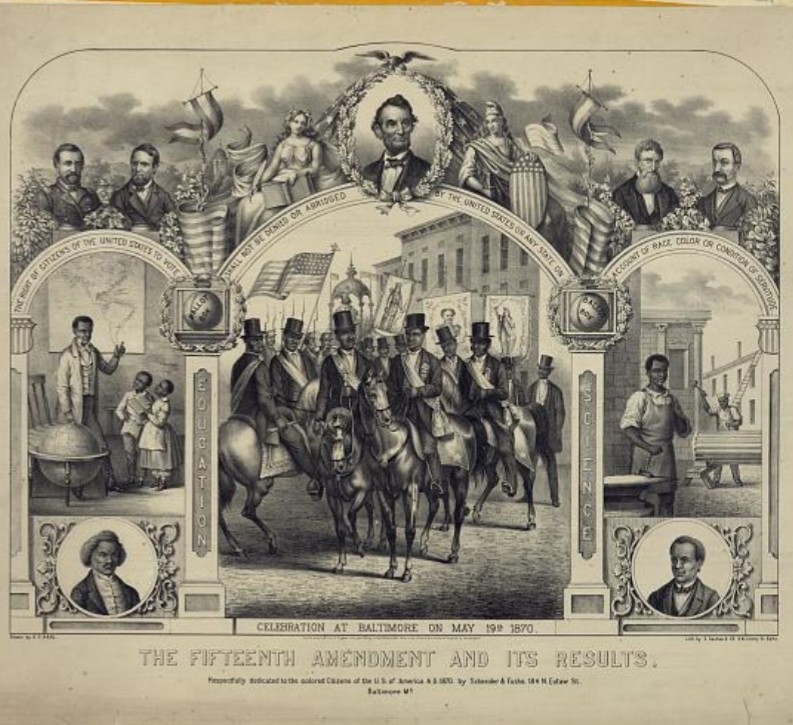
“The Fifteenth Amendment and Its Results” (G. F. Kahl for E. Sachse & Co., lithographer, circa 1870, U.S. Library of Congress, public domain; click to enlarge).


Sources:

  1. 15th Amendment to the United States Constitution: Voting Rights (1870),” in “Milestone Documents.” Washington, D.C.: U.S. National Archives and Records Administration, retrieved online February 3, 2025.
  2. The Fifteenth Amendment and Its Results.” Washington, D.C.: U.S. Library of Congress, retrieved online February 3, 2025.


Respect and Confidence: The Bond Between an Effective Commanding Officer and His Men

Unidentified Union Army artillerymen standing next to one of the fifteen-inch Rodman guns, which were installed on the third level of Fort Jefferson in the Dry Tortugas, Florida, beginning in 1862. These smoothbore Rodman weighed twenty-five tons, and was able to fire four hundred and fity-pound shells more than three miles (U.S. National Park Service, public domain).

July of 1863 was a very different experience for the 47th Pennsylvania Volunteers than it was for many other members of the Army of the United States. Divided roughly in half, in order to provide garrison coverage at two federal military installations in Florida that had been deemed critical to the federal government’s ability to turn the tide of the American Civil War in the Union’s favor, their regiment was not involved in the epic Battle of Gettysburg that unfolded over three days on the soil of their home state that month.

But their service to the nation still mattered. Split between Fort Taylor in Key West, Florida and Fort Jefferson in Florida’s remote Dry Tortugas, their collective job was not only to hamper efforts by the Confederate States of America to move troops and supplies throughout the Deep South, but also to prevent Great Britain and other European nations from interfering in the war.

As winter gave way to spring and summer, individual companies of the regiment continued to drill in the use of their respective fort artillery batteries and their own rifles and were also assigned to provost duties, functioning both as military police who ensured that soldiers behaved themselves and were punished when they did not, and as civil justice officials who upheld the nation’s rule of law to protect the local citizenry by arresting and prosecuting criminals, preventing the illegal sale of alcohol and other prohibited goods and carrying out the enforcement of multiple federal laws, including the nation’s newly adopted Lieber Code for the Armies of the United States and President Abraham Lincoln’s Emancipation Proclamation which freed the men, women and children who had been enslaved in their respective jurisdictions.

They were also still nursing their wounded bodies and souls as they came to terms with the deaths of their comrades and the emotional and physical injuries that they had sustained themselves during the bloody Battle of Pocotaligo, South Carolina on October 22, 1862.

Captain Henry Durant Woodruff, commanding officer of Company D, 47th Pennsylvania Volunteers (public domain).

It was in this spirit of reflection that a genuinely memorable event took place at Fort Taylor in Key West, Florida on July 16, 1863. That day, the members of the 47th Pennsylvania’s Company D “presented a magnificent sword, sash, and belt” to Captain Henry Durant Woodruff “at the US Barracks in Key West,” according to historian Lewis Schmidt.

The company was formed in front of their quarters at 8 AM, across the barracks ground from Company C, and Pvt. George W. Baltozer, a 24 year old teacher from Perry County, made the following remarks on behalf of the company:

‘The motives that assemble us on the present occasion are based on our mature confidence, the martial skill, the intrepid heroism, and the undaunted intrepidity of our leader in arms. It is manifestive of our consciousness of your noble ability to wield in the defence [sic] of the rights of our country, this glittering weapon, that we place it in your protective hand. Receive it, sir, as a token of our estimation of your promotion of our ease and comfort in quietude, and for your chivalrous spirit on the sanguine field, when the heavens glared with fire, and the earth trembled ‘neath cannons’ roar. May it never rest in its scabbard ’till rebellion is crushed and traitorism is banished from the land, and peace spread her white wings from the St. John’s to the sunny banks of the Rio Grande. May it ever bespeak in the heart of him that wields it, bravery, loyalty, heroism, and philanthropy. That it may ever benefit you in the hour of peril, and that you may undauntingly use it as opportunity is afforded, is the very ardent wish of your most obedient servants.'”

Also, according to Schmidt, Captain Woodruff responded to this touching tribute by presenting a surprisingly lengthy address to his men:

My companions in arms, your beautiful present is accepted with sincere satisfaction and heartfelt thanks. It affords the satisfaction that you still respect and have confidence in your commander, and he is thankful not only for the value of this noble gift, but for the rich token of your kind regard. And while I wear these arms and accoutrements, emblematical of my rank and office, may they never be worn unworthily, or the noble donors have cause to blush for the ungallant act of the wearer.

Two years have nearly elapsed since we have been associated as commander and commanded. Two years of privation and toil, yet your love for the cause and your ardor to serve your country has not abated.

When you entered upon this gigantic struggle, you were not prompted by large bribes or bounties, or intimidated by being forced in service by conscription. But inspired by a noble patriotism, you cheerfully volunteered for the longest period known to law.

Your conduct thus far has been in accordance with the honorable principles which caused you to volunteer. No discipline too strict, no privations too great, no toil too sore, but that your indomitable spirits have been able to accomplish, to undergo and overcome. And now allow me to say to you that I am proud of the noble men who compose this company; I am proud of your generous and gallant conduct; I am proud of your association; I am proud of the honor you have this day conferred upon your Captain.

In looking forward, I have no fears for you in the future, whatever you may be called on to do—in garrison—in the tented field, or on the sanguined plain, it will be bravely—it will be well done. Then until rebels and traitors shall become extinct, or have grounded their arms, and acknowledged the supremacy of the government and the law, let this our motto be: Give us death or give us liberty.

Later that year, multiple members of Company D would opt to re-enlist to finish the fight, serving valiantly until the leaders of the Rebellion finally surrendered in April 1865—and beyond—into the early months of the Reconstruction Era, until their regiment was finally mustered out at Charleston, South Carolina on Christmas Day in 1865.


Sources:

  1. Bates, Samuel P. History of Pennsylvania Volunteers, 1861-5, vol. 1. Harrisburg, Pennsylvania: B. Singerly, State Printer, 1869.
  2. Carnahan, Burrus. Global Impact: The Lincoln Administration and the Development of International Law.” Washington, D.C.: President Lincoln’s Cottage, May 9, 2016.
  3. Florida’s Role in the Civil War: ‘Supplier of the Confederacy.’” Tampa, Florida: Florida Center for Instructional Technology, College of Education, University of South Florida, retrieved online January 15, 2020.
  4. General Orders 100: The Lieber Code,” in “The Avalon Project: Documents in Law, History and Diplomacy.” New Haven, Connecticut: Lillian Goldman Law Library, Yale Law School, Yale University, retrieved online April 3, 2024.
  5. Gesley, Jenny. The ‘Lieber Code’—the First Modern Codification of the Laws of War,” in “In Custodia Legis: Law Librarians of Congress.” Washington, D.C.: U.S. Library of Congress, retrieved online April 3, 2024.
  6. History: Crops (Historic Florida Barge Canal Trail).” Historical Marker Database, retrieved online December 30, 2023.
  7. Lieber, Francis. Instructions for the Government of Armies of the United States in the Field. Washington, D.C.: Government Printing Office, 1898.
  8. Owsley, Frank Lawrence, and Harriet Fason Chappell. King Cotton Diplomacy: Foreign Relations of the Confederate States of America. Chicago, Illinois: University of Chicago Press, 1959.
  9. Preventing Diplomatic Recognition of the Confederacy, 1861–1865,” and The Alabama Claims, 1862–1872,” in “Milestones: 1861–1865.” Washington, D.C.: Office of the Historian, Foreign Service Institute, United States Department of State, retrieved online December 30, 2023.
  10. Schmidt, Lewis. A Civil War History of the 47th Regiment of Pennsylvania Veteran Volunteers. Allentown, Pennsylvania: Self-published, 1986.
  11. Wharton, Henry D. Letters from the Sunbury Guards. Sunbury, Pennsylvania, Sunbury American, 1861-1866.


The Lieber Code: President Abraham Lincoln Formalizes the Code of Conduct for the Union Army (April 24, 1863)


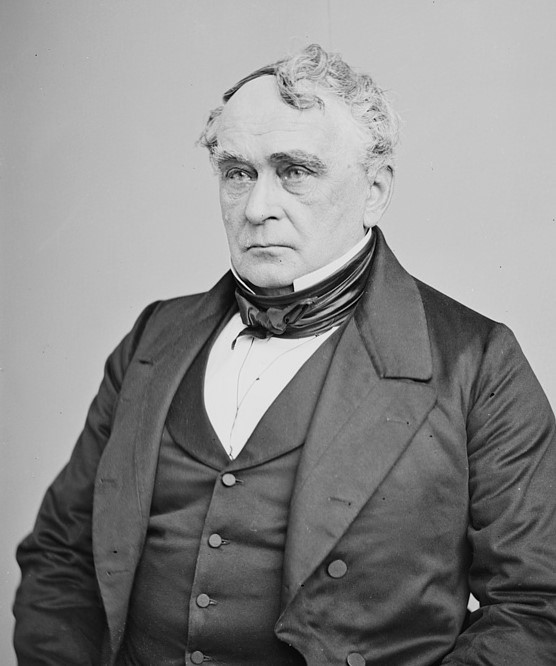
Professor Francis Lieber, circa 1860s (U.S. Library of Congress, public domain).

Issued by President Abraham Lincoln on April 24, 1863 as “General Orders, No. 100: Instructions for the Government of Armies of the United States in the Field,” the “Lieber Code” defined how regular and volunteer military personnel in service to the United States were expected to behave toward one another, toward civilians and toward those they considered to be the enemy—Confederate States government officials, sailors, soldiers, spies, and others supporting the Confederacy.

Those instructions were researched and drafted by Francis Lieber, a native of the Kingdom of Prussia who became a professor of American history and political science in South Carolina roughly a decade after arriving as an immigrant in the United States. Professor Lieber, who later joined the faculty of what is, today, Columbia University, also became known for his creation of the maxim, “Nullum jus sine officio, nullum officium sine jure” (translation: “No right without its duties, no duty without its rights”), which was inscribed on his personal stationery.

According to Jenny Gesley, Ph.D., a legal specialist at the United States Library of Congress, Professor Lieber “had been imprisoned as an ‘enemy of the state,’” while still a resident of Prussia “due to his liberal nationalist views and his opposition to Prussia’s political system.”

His book “On Civil Liberty and Self Government” (1853) was a bestseller and was eventually adopted as a standard college textbook. Even though he was widely known and respected in the academic community, he felt like an outsider in South Carolina, in particular because of his opposition to slavery. In 1857, he therefore accepted a position in the department of history and political science at Columbia College, the future Columbia University, and subsequently a position in Columbia Law School.

…. When the Civil War broke out in 1861, President Lincoln wanted to provide instructions to Union officers on the particularly complicated legal issues arising from non-international armed conflicts. Among these issues were whether to treat captured Confederate soldiers as traitors subject to the death penalty or as prisoners of war (POWs) and the treatment of fugitive or freed slaves…. Lieber and a committee of four generals were therefore asked to draw up a manual for Union soldiers….

By the time that the Lieber Code was finalized, it contained one hundred and fifty-seven provisions, including several that addressed “the treatment of fugitive and freed slaves that entered the Union territory.” According to Dr. Gesley:

Lieber took the view that international law did not distinguish between people based on color (Art. 58) and that the law of nature and nations has never acknowledged slavery (Art. 42). He therefore included provisions that held that fugitive slaves that escaped to the North became free (Arts. 42, 43) and that all soldiers no matter their skin color must be awarded POW status (Art.57).

The Lieber Code also spelled out how civilians and miliary prisoners of war (POWs) should be treated. The following were among the most enlightening provisions of this new code of conduct:

Article 15. Military necessity admits of all direct destruction of life or limb of armed enemies, and of other persons whose destruction is incidentally unavoidable in the armed contests of the war; it allows of the capturing of every armed enemy, and every enemy of importance to the hostile government, or of peculiar danger to the captor; it allows of all destruction of property, and obstruction of the ways and channels of traffic, travel, or communication, and of all withholding of sustenance or means of life from the enemy; of the appropriation of whatever an enemy’s country affords necessary for the subsistence and safety of the army, and of such deception as does not involve the breaking of good faith either positively pledged, regarding agreements entered into during the war, or supposed by the modern law of war to exist. Men who take up arms against one another in public war do not cease on this account to be moral beings, responsible to one another and to God.

Article 16. Military necessity does not admit of cruelty—that is, the infliction of suffering for the sake of suffering or for revenge, nor of maiming or wounding except in fight, nor of torture to extort confessions. It does not admit of the use of poison in any way, nor of the wanton devastation of a district. It admits of deception, but disclaims acts of perfidy; and, in general, military necessity does not include any act of hostility which makes the return to peace unnecessarily difficult.

Article 17 (no longer permitted under present-day international laws). War is not carried on by arms alone. It is lawful to starve the hostile belligerent, armed or unarmed, so that it leads to the speedier subjection of the enemy….

Article 21. The citizen or native of a hostile country is thus an enemy, as one of the constituents of the hostile state or nation, and as such is subjected to the hardships of the war.

Article 22. Nevertheless, as civilization has advanced during the last centuries, so has likewise steadily advanced, especially in war on land, the distinction between the private individual belonging to a hostile country and the hostile country itself, with its men in arms. The principle has been more and more acknowledged that the unarmed citizen is to be spared in person, property, and honor as much as the exigencies of war will admit.

Article 23. Private citizens are no longer murdered, enslaved, or carried off to distant parts, and the inoffensive individual is as little disturbed in his private relations as the commander of the hostile troops can afford to grant in the overruling demands of a vigorous war….

Article 26. Commanding generals may cause the magistrates and civil officers of the hostile country to take the oath of temporary allegiance or an oath of fidelity to their own victorious government or rulers, and they may expel everyone who declines to do so. But whether they do so or not, the people and their civil officers owe strict obedience to them as long as they hold sway over the district or country, at the peril of their lives….

Article 35. Commanding generals may cause the magistrates and civil officers of the hostile country to take the oath of temporary allegiance or an oath of fidelity to their own victorious government or rulers, and they may expel everyone who declines to do so. But whether they do so or not, the people and their civil officers owe strict obedience to them as long as they hold sway over the district or country, at the peril of their lives.

Article 36. If such works of art, libraries, collections, or instruments belonging to a hostile nation or government, can be removed without injury, the ruler of the conquering state or nation may order them to be seized and removed for the benefit of the said nation. The ultimate ownership is to be settled by the ensuing treaty of peace. In no case shall they be sold or given away, if captured by the armies of the United States, nor shall they ever be privately appropriated, or wantonly destroyed or injured.

Article 37. The United States acknowledge and protect, in hostile countries occupied by them, religion and morality; strictly private property; the persons of the inhabitants, especially those of women: and the sacredness of domestic relations. Offenses to the contrary shall be rigorously punished. This rule does not interfere with the right of the victorious invader to tax the people or their property, to levy forced loans, to billet soldiers, or to appropriate property, especially houses, lands, boats or ships, and churches, for temporary and military uses.

Article 38. Private property, unless forfeited by crimes or by offenses of the owner, can be seized only by way of military necessity, for the support or other benefit of the army or of the United States. If the owner has not fled, the commanding officer will cause receipts to be given, which may serve the spoliated owner to obtain indemnity….

Article 42.  Slavery, complicating and confounding the ideas of property, (that is of a thing,) and of personality, (that is of humanity,) exists according to municipal or local law only. The law of nature and nations has never acknowledged it. The digest of the Roman law enacts the early dictum of the pagan jurist, that “so far as the law of nature is concerned, all men are equal.” Fugitives escaping from a country in which they were slaves, villains, or serfs, into another country, have, for centuries past, been held free and acknowledged free by judicial decisions of European countries, even though the municipal law of the country in which the slave had taken refuge acknowledged slavery within its own dominions.

Article 43. Therefore, in a war between the United States and a belligerent which admits of slavery, if a person held in bondage by that belligerent be captured by or come as a fugitive under the protection of the military forces of the United States, such person is immediately entitled to the rights and privileges of a freeman. To return such person into slavery would amount to enslaving a free person, and neither the United States nor any officer under their authority can enslave any human being. Moreover, a person so made free by the law of war is under the shield of the law of nations, and the former owner or State can have, by the law of postliminy, no belligerent lien or claim of service.

Article 44. All wanton violence committed against persons in the invaded country, all destruction of property not commanded by the authorized officer, all robbery, all pillage or sacking, even after taking a place by main force, all rape, wounding, maiming, or killing of such inhabitants, are prohibited under the penalty of death, or such other severe punishment as may seem adequate for the gravity of the offense. A soldier, officer or private, in the act of committing such violence, and disobeying a superior ordering him to abstain from it, may be lawfully killed on the spot by such superior….

Article 47. Crimes punishable by all penal codes, such as arson, murder, maiming, assaults, highway robbery, theft, burglary, fraud, forgery, and rape, if committed by an American soldier in a hostile country against its inhabitants, are not only punishable as at home, but in all cases in which death is not inflicted, the severer punishment shall be preferred.

Article 48. Deserters from the American Army, having entered the service of the enemy, suffer death if they fall again into the hands of the United States, whether by capture, or being delivered up to the American Army; and if a deserter from the enemy, having taken service in the Army of the United States, is captured by the enemy, and punished by them with death or otherwise, it is not a breach against the law and usages of war, requiring redress or retaliation.

Article 49. A prisoner of war is a public enemy armed or attached to the hostile army for active aid, who has fallen into the hands of the captor, either fighting or wounded, on the field or in the hospital, by individual surrender or by capitulation. All soldiers, of whatever species of arms; all men who belong to the rising en masse of the hostile country; all those who are attached to the army for its efficiency and promote directly the object of the war, except such as are hereinafter provided for; all disabled men or officers on the field or elsewhere, if captured; all enemies who have thrown away their arms and ask for quarter, are prisoners of war, and as such exposed to the inconveniences as well as entitled to the privileges of a prisoner of war.

Article 50. Moreover, citizens who accompany an army for whatever purpose, such as sutlers, editors, or reporters of journals, or contractors, if captured, may be made prisoners of war, and be detained as such. The monarch and members of the hostile reigning family, male or female, the chief, and chief officers of the hostile government, its diplomatic agents, and all persons who are of particular and singular use and benefit to the hostile army or its government, are, if captured on belligerent ground, and if unprovided with a safe conduct granted by the captor’s government, prisoners of war.

Article 51. If the people of that portion of an invaded country which is not yet occupied by the enemy, or of the whole country, at the approach of a hostile army, rise, under a duly authorized levy en masse to resist the invader, they are now treated as public enemies, and, if captured, are prisoners of war.

Article 52. No belligerent has the right to declare that he will treat every captured man in arms of a levy en masse as a brigand or bandit. If, however, the people of a country, or any portion of the same, already occupied by an army, rise against it, they are violators of the laws of war, and are not entitled to their protection.

Article 53. The enemy’s chaplains, officers of the medical staff, apothecaries, hospital nurses and servants, if they fall into the hands of the American Army, are not prisoners of war, unless the commander has reasons to retain them. In this latter case; or if, at their own desire, they are allowed to remain with their captured companions, they are treated as prisoners of war, and may be exchanged if the commander sees fit….

Article 56. A prisoner of war is subject to no punishment for being a public enemy, nor is any revenge wreaked upon him by the intentional infliction of any suffering, or disgrace, by cruel imprisonment, want of food, by mutilation, death or any other barbarity.

Article 57. So soon as a man is armed by a sovereign government and takes the soldier’s oath of fidelity, he is a belligerent; his killing, wounding, or other warlike acts are not individual crimes or offenses. No belligerent has a right to declare that enemies of a certain class, color, or condition, when properly organized as soldiers, will not be treated by him as public enemies.

Article 58. The law of nations knows no distinction of color, and if an enemy of the United States should enslave and sell any captured persons of their army, it would be a case for the severest retaliation, if not redressed upon complaint. The United States cannot retaliate by enslavement; therefore death must be the retaliation for this crime against the law of nations.

Article 59. A prisoner of war remains answerable for his crimes committed against the captor’s army or people, committed before he was captured, and for which he has not been punished by his own authorities. All prisoners of war are liable to the infliction of retaliatory measures.

Article 60. It is against the usage of modern war to resolve, in hatred and revenge, to give no quarter. No body of troops has the right to declare that it will not give, and therefore will not expect, quarter; but a commander is permitted to direct his troops to give no quarter, in great straits, when his own salvation makes it impossible to cumber himself with prisoners.

Article 61. Troops that give no quarter have no right to kill enemies already disabled on the ground, or prisoners captured by other troops.

Article 62. All troops of the enemy known or discovered to give no quarter in general, or to any portion of the army, receive none.

Article 63. Troops who fight in the uniform of their enemies, without any plain, striking, and uniform mark of distinction of their own, can expect no quarter….

Article 65. The use of the enemy’s national standard, flag, or other emblem of nationality, for the purpose of deceiving the enemy in battle, is an act of perfidy by which they lose all claim to the protection of the laws of war….

Article 67. The law of nations allows every sovereign government to make war upon another sovereign state, and, therefore, admits of no rules or laws different from those of regular warfare, regarding the treatment of prisoners of war, although they may belong to the army of a government which the captor may consider as a wanton and unjust assailant.

Article 68. Modern wars are not internecine wars, in which the killing of the enemy is the object. The destruction of the enemy in modern war, and, indeed, modern war itself, are means to obtain that object of the belligerent which lies beyond the war. Unnecessary or revengeful destruction of life is not lawful.

Article 69. Outposts, sentinels, or pickets are not to be fired upon, except to drive them in, or when a positive order, special or general, has been issued to that effect.

Article 70. The use of poison in any manner, be it to poison wells, or food, or arms, is wholly excluded from modern warfare. He that uses it puts himself out of the pale of the law and usages of war.

Article 71. Whoever intentionally inflicts additional wounds on an enemy already wholly disabled, or kills such an enemy, or who orders or encourages soldiers to do so, shall suffer death, if duly convicted, whether he belongs to the Army of the United States, or is an enemy captured after having committed his misdeed.

Article 72. Money and other valuables on the person of a prisoner, such as watches or jewelry, as well as extra clothing, are regarded by the American Army as the private property of the prisoner, and the appropriation of such valuables or money is considered dishonorable, and is prohibited. Nevertheless, if large sums are found upon the persons of prisoners, or in their possession, they shall be taken from them, and the surplus, after providing for their own support, appropriated for the use of the army, under the direction of the commander, unless otherwise ordered by the government. Nor can prisoners claim, as private property, large sums found and captured in their train, although they have been placed in the private luggage of the prisoners.

Article 73. All officers, when captured, must surrender their side arms to the captor. They may be restored to the prisoner in marked cases, by the commander, to signalize admiration of his distinguished bravery or approbation of his humane treatment of prisoners before his capture. The captured officer to whom they may be restored can not wear them during captivity.

Article 74. A prisoner of war, being a public enemy, is the prisoner of the government, and not of the captor. No ransom can be paid by a prisoner of war to his individual captor or to any officer in command. The government alone releases captives, according to rules prescribed by itself.

Article 75. Prisoners of war are subject to confinement or imprisonment such as may be deemed necessary on account of safety, but they are to be subjected to no other intentional suffering or indignity. The confinement and mode of treating a prisoner may be varied during his captivity according to the demands of safety.

Article 76. Prisoners of war shall be fed upon plain and wholesome food whenever practicable, and treated with humanity. They may be required to work for the benefit of the captor’s government, according to their rank and condition.

Article 77. A prisoner of war who escapes may be shot, or otherwise killed in his flight; but neither death nor any other punishment shall be inflicted upon him simply for the attempt to escape, which the law of war does not consider a crime. Stricter means of security shall be used after an unsuccessful attempt at escape. If, however, a conspiracy is discovered, the purpose of which is a united or general escape, the conspirators may be rigorously punished, even with death; and capital punishment may also be inflicted upon prisoners of war discovered to have plotted rebellion against the authorities of the captors, whether in union with fellow prisoners or other persons.

Article 78. If prisoners of war, having given no pledge nor made any promise on their honor, forcibly or otherwise escape, and are captured again in battle after having rejoined their own army, they shall not be punished for their escape, but shall be treated as simple prisoners of war, although they will be subjected to stricter confinement.

Article 79. Every captured wounded enemy shall be medically treated, according to the ability of the medical staff.

Article 80. Honorable men, when captured, will abstain from giving to the enemy information concerning their own army, and the modern law of war permits no longer the use of any violence against prisoners in order to extort the desired information or to punish them for having given false information.

Article 81. Partisans are soldiers armed and wearing the uniform of their army, but belonging to a corps which acts detached from the main body for the purpose of making inroads into the territory occupied by the enemy. If captured, they are entitled to all the privileges of the prisoner of war.

Article 82. Men, or squads of men, who commit hostilities, whether by fighting, or inroads for destruction or plunder, or by raids of any kind, without commission, without being part and portion of the organized hostile army, and without sharing continuously in the war, but who do so with intermitting returns to their homes and avocations, or with the occasional assumption of the semblance of peaceful pursuits, divesting themselves of the character or appearance of soldiers—such men, or squads of men, are not public enemies, and, therefore, if captured, are not entitled to the privileges of prisoners of war, but shall be treated summarily as highway robbers or pirates.

Article 83. Scouts, or single soldiers, if disguised in the dress of the country or in the uniform of the army hostile to their own, employed in obtaining information, if found within or lurking about the lines of the captor, are treated as spies, and suffer death.

Article 84. Armed prowlers, by whatever names they may be called, or persons of the enemy’s territory, who steal within the lines of the hostile army for the purpose of robbing, killing, or of destroying bridges, roads or canals, or of robbing or destroying the mail, or of cutting the telegraph wires, are not entitled to the privileges of the prisoner of war.

Article 85. War-rebels are persons within an occupied territory who rise in arms against the occupying or conquering army, or against the authorities established by the same. If captured, they may suffer death, whether they rise singly, in small or large bands, and whether called upon to do so by their own, but expelled, government or not. They are not prisoners of war; nor are they if discovered and secured before their conspiracy has matured to an actual rising or armed violence….

Article 88. A spy is a person who secretly, in disguise or under false pretense, seeks information with the intention of communicating it to the enemy. The spy is punishable with death by hanging by the neck, whether or not he succeeds in obtaining the information or in conveying it to the enemy.

Article 89. If a citizen of the United States obtains information in a legitimate manner, and betrays it to the enemy, be he a military or civil officer, or a private citizen, he shall suffer death.

Article 90. A traitor under the law of war, or a war-traitor, is a person in a place or district under Martial Law who, unauthorized by the military commander, gives information of any kind to the enemy, or holds intercourse with him.

Article 91. The war-traitor is always severely punished. If his offense consists in betraying to the enemy anything concerning the condition, safety, operations, or plans of the troops holding or occupying the place or district, his punishment is death.

Article 92. If the citizen or subject of a country or place invaded or conquered gives information to his own government, from which he is separated by the hostile army, or to the army of his government, he is a war-traitor, and death is the penalty of his offense….

Article 94. No person having been forced by the enemy to serve as guide is punishable for having done so.

Article 95. If a citizen of a hostile and invaded district voluntarily serves as a guide to the enemy, or offers to do so, he is deemed a war-traitor, and shall suffer death.

Article 96. A citizen serving voluntarily as a guide against his own country commits treason, and will be dealt with according to the law of his country.

Article 97. Guides, when it is clearly proved that they have misled intentionally, may be put to death.

Article 98. An unauthorized or secret communication with the enemy is considered treasonable by the law of war. Foreign residents in an invaded or occupied territory, or foreign visitors in the same, can claim no immunity from this law. They may communicate with foreign parts, or with the inhabitants of the hostile country, so far as the military authority permits, but no further. Instant expulsion from the occupied territory would be the very least punishment for the infraction of this rule.

Article 99. A messenger carrying written dispatches or verbal messages from one portion of the army, or from a besieged place, to another portion of the same army, or its government, if armed, and in the uniform of his army, and if captured, while doing so, in the territory occupied by the enemy, is treated by the captor as a prisoner of war. If not in uniform, nor a soldier, the circumstances connected with his capture must determine the disposition that shall be made of him.

Article 100. A messenger or agent who attempts to steal through the territory occupied by the enemy, to further, in any manner, the interests of the enemy, if captured, is not entitled to the privileges of the prisoner of war, and may be dealt with according to the circumstances of the case.

Article 101. While deception in war is admitted as a just and necessary means of hostility, and is consistent with honorable warfare, the common law of war allows even capital punishment for clandestine or treacherous attempts to injure an enemy, because they are so dangerous, and it is difficult to guard against them.

Article 102. The law of war, like the criminal law regarding other offenses, makes no difference on account of the difference of sexes, concerning the spy, the war-traitor, or the war-rebel.

Article 103. Spies, war-traitors, and war-rebels are not exchanged according to the common law of war. The exchange of such persons would require a special cartel, authorized by the government, or, at a great distance from it, by the chief commander of the army in the field….

Article 105. Exchanges of prisoners take place—number for number—rank for rank wounded for wounded—with added condition for added condition—such, for instance, as not to serve for a certain period.

Article 106. In exchanging prisoners of war, such numbers of persons of inferior rank may be substituted as an equivalent for one of superior rank as may be agreed upon by cartel, which requires the sanction of the government, or of the commander of the army in the field.

Article 107. A prisoner of war is in honor bound truly to state to the captor his rank; and he is not to assume a lower rank than belongs to him, in order to cause a more advantageous exchange, nor a higher rank, for the purpose of obtaining better treatment. Offenses to the contrary have been justly punished by the commanders of released prisoners, and may be good cause for refusing to release such prisoners.

Article 108. The surplus number of prisoners of war remaining after an exchange has taken place is sometimes released either for the payment of a stipulated sum of money, or, in urgent cases, of provision, clothing, or other necessaries. Such arrangement, however, requires the sanction of the highest authority.

Article 109. The exchange of prisoners of war is an act of convenience to both belligerents. If no general cartel has been concluded, it cannot be demanded by either of them. No belligerent is obliged to exchange prisoners of war. A cartel is voidable as soon as either party has violated it.

Article 110. No exchange of prisoners shall be made except after complete capture, and after an accurate account of them, and a list of the captured officers, has been taken.

Article 111. The bearer of a flag of truce cannot insist upon being admitted. He must always be admitted with great caution. Unnecessary frequency is carefully to be avoided.

Article 112. If the bearer of a flag of truce offer himself during an engagement, he can be admitted as a very rare exception only. It is no breach of good faith to retain such flag of truce, if admitted during the engagement. Firing is not required to cease on the appearance of a flag of truce in battle.

Article 113. If the bearer of a flag of truce, presenting himself during an engagement, is killed or wounded, it furnishes no ground of complaint whatever.

Article 114. If it be discovered, and fairly proved, that a flag of truce has been abused for surreptitiously obtaining military knowledge, the bearer of the flag thus abusing his sacred character is deemed a spy. So sacred is the character of a flag of truce, and so necessary is its sacredness, that while its abuse is an especially heinous offense, great caution is requisite, on the other hand, in convicting the bearer of a flag of truce as a spy.

Article 115. It is customary to designate by certain flags (usually yellow) the hospitals in places which are shelled, so that the besieging enemy may avoid firing on them. The same has been done in battles, when hospitals are situated within the field of the engagement….

Article 119. Prisoners of war may be released from captivity by exchange, and, under certain circumstances, also by parole.

Article 120. The term Parole designates the pledge of individual good faith and honor to do, or to omit doing, certain acts after he who gives his parole shall have been dismissed, wholly or partially, from the power of the captor….

Article 122. The parole applies chiefly to prisoners of war whom the captor allows to return to their country, or to live in greater freedom within the captor’s country or territory, on conditions stated in the parole.

Article 123. Release of prisoners of war by exchange is the general rule; release by parole is the exception.

Article 124. Breaking the parole is punished with death when the person breaking the parole is captured again. Accurate lists, therefore, of the paroled persons must be kept by the belligerents.

Article 125. When paroles are given and received there must be an exchange of two written documents, in which the name and rank of the paroled individuals are accurately and truthfully stated.

Article 126. Commissioned officers only are allowed to give their parole, and they can give it only with the permission of their superior, as long as a superior in rank is within reach.

Article 127. No noncommissioned officer or private can give his parole except through an officer. Individual paroles not given through an officer are not only void, but subject the individuals giving them to the punishment of death as deserters. The only admissible exception is where individuals, properly separated from their commands, have suffered long confinement without the possibility of being paroled through an officer.

Article 128. No paroling on the battlefield; no paroling of entire bodies of troops after a battle; and no dismissal of large numbers of prisoners, with a general declaration that they are paroled, is permitted, or of any value.

Article 129. In capitulations for the surrender of strong places or fortified camps the commanding officer, in cases of urgent necessity, may agree that the troops under his command shall not fight again during the war, unless exchanged.

Article 130. The usual pledge given in the parole is not to serve during the existing war, unless exchanged. This pledge refers only to the active service in the field, against the paroling belligerent or his allies actively engaged in the same war. These cases of breaking the parole are patent acts, and can be visited with the punishment of death; but the pledge does not refer to internal service, such as recruiting or drilling the recruits, fortifying places not besieged, quelling civil commotions, fighting against belligerents unconnected with the paroling belligerents, or to civil or diplomatic service for which the paroled officer may be employed.

Article 131. If the government does not approve of the parole, the paroled officer must return into captivity, and should the enemy refuse to receive him, he is free of his parole.

Article 132. A belligerent government may declare, by a general order, whether it will allow paroling, and on what conditions it will allow it. Such order is communicated to the enemy.

Article 133. No prisoner of war can be forced by the hostile government to parole himself, and no government is obliged to parole prisoners of war, or to parole all captured officers, if it paroles any. As the pledging of the parole is an individual act, so is paroling, on the other hand, an act of choice on the part of the belligerent.

Article 134. The commander of an occupying army may require of the civil officers of the enemy, and of its citizens, any pledge he may consider necessary for the safety or security of his army, and upon their failure to give it he may arrest, confine, or detain them….

Article 144. So soon as a capitulation is signed, the capitulator has no right to demolish, destroy, or injure the works, arms, stores, or ammunition, in his possession, during the time which elapses between the signing and the execution of the capitulation, unless otherwise stipulated in the same….

Article 146. Prisoners taken in the act of breaking an armistice must be treated as prisoners of war, the officer alone being responsible who gives the order for such a violation of an armistice. The highest authority of the belligerent aggrieved may demand redress for the infraction of an armistice….

Article 148. The law of war does not allow proclaiming either an individual belonging to the hostile army, or a citizen, or a subject of the hostile government, an outlaw, who may be slain without trial by any captor, any more than the modern law of peace allows such intentional outlawry; on the contrary, it abhors such outrage. The sternest retaliation should follow the murder committed in consequence of such proclamation, made by whatever authority. Civilized nations look with horror upon offers of rewards for the assassination of enemies as relapses into barbarism.

Article 149. Insurrection is the rising of people in arms against their government, or a portion of it, or against one or more of its laws, or against an officer or officers of the government. It may be confined to mere armed resistance, or it may have greater ends in view.

Article 150. Civil war is war between two or more portions of a country or state, each contending for the mastery of the whole, and each claiming to be the legitimate government. The term is also sometimes applied to war of rebellion, when the rebellious provinces or portions of the state are contiguous to those containing the seat of government.

Article 151. The term rebellion is applied to an insurrection of large extent, and is usually a war between the legitimate government of a country and portions of provinces of the same who seek to throw off their allegiance to it and set up a government of their own….

Article 153. Treating captured rebels as prisoners of war, exchanging them, concluding of cartels, capitulations, or other warlike agreements with them; addressing officers of a rebel army by the rank they may have in the same; accepting flags of truce; or, on the other hand, proclaiming Martial Law in their territory, or levying war-taxes or forced loans, or doing any other act sanctioned or demanded by the law and usages of public war between sovereign belligerents, neither proves nor establishes an acknowledgment of the rebellious people, or of the government which they may have erected, as a public or sovereign power. Nor does the adoption of the rules of war toward rebels imply an engagement with them extending beyond the limits of these rules. It is victory in the field that ends the strife and settles the future relations between the contending parties.

Article 154. Treating, in the field, the rebellious enemy according to the law and usages of war has never prevented the legitimate government from trying the leaders of the rebellion or chief rebels for high treason, and from treating them accordingly, unless they are included in a general amnesty.

Article 155. All enemies in regular war are divided into two general classes—that is to say, into combatants and noncombatants, or unarmed citizens of the hostile government. The military commander of the legitimate government, in a war of rebellion, distinguishes between the loyal citizen in the revolted portion of the country and the disloyal citizen. The disloyal citizens may further be classified into those citizens known to sympathize with the rebellion without positively aiding it, and those who, without taking up arms, give positive aid and comfort to the rebellious enemy without being bodily forced thereto.

Article 156. Common justice and plain expediency require that the military commander protect the manifestly loyal citizens, in revolted territories, against the hardships of the war as much as the common misfortune of all war admits. The commander will throw the burden of the war, as much as lies within his power, on the disloyal citizens, of the revolted portion or province, subjecting them to a stricter police than the noncombatant enemies have to suffer in regular war; and if he deems it appropriate, or if his government demands of him that every citizen shall, by an oath of allegiance, or by some other manifest act, declare his fidelity to the legitimate government, he may expel, transfer, imprison, or fine the revolted citizens who refuse to pledge themselves anew as citizens obedient to the law and loyal to the government. Whether it is expedient to do so, and whether reliance can be placed upon such oaths, the commander or his government have the right to decide.

Article 157. Armed or unarmed resistance by citizens of the United States against the lawful movements of their troops is levying war against the United States, and is therefore treason.


Sources:

  1. A Maxim (letter to the editor explaining the origins of Francis Lieber’s maxim, “Nullum jus sine officio”), in The American Historical Record, vol. 1, no. 2 (February 1872), pp. 80-81. Philadelphia, Pennsylvania: Chase & Town Publishers, 1872.
  2. Carnahan, Burrus. Global Impact: The Lincoln Administration and the Development of International Law.” Washington, D.C.: President Lincoln’s Cottage, May 9, 2016.
  3. General Orders 100: The Lieber Code,” in “The Avalon Project: Documents in Law, History and Diplomacy.” New Haven, Connecticut: Lillian Goldman Law Library, Yale Law School, Yale University, retrieved online April 3, 2024.
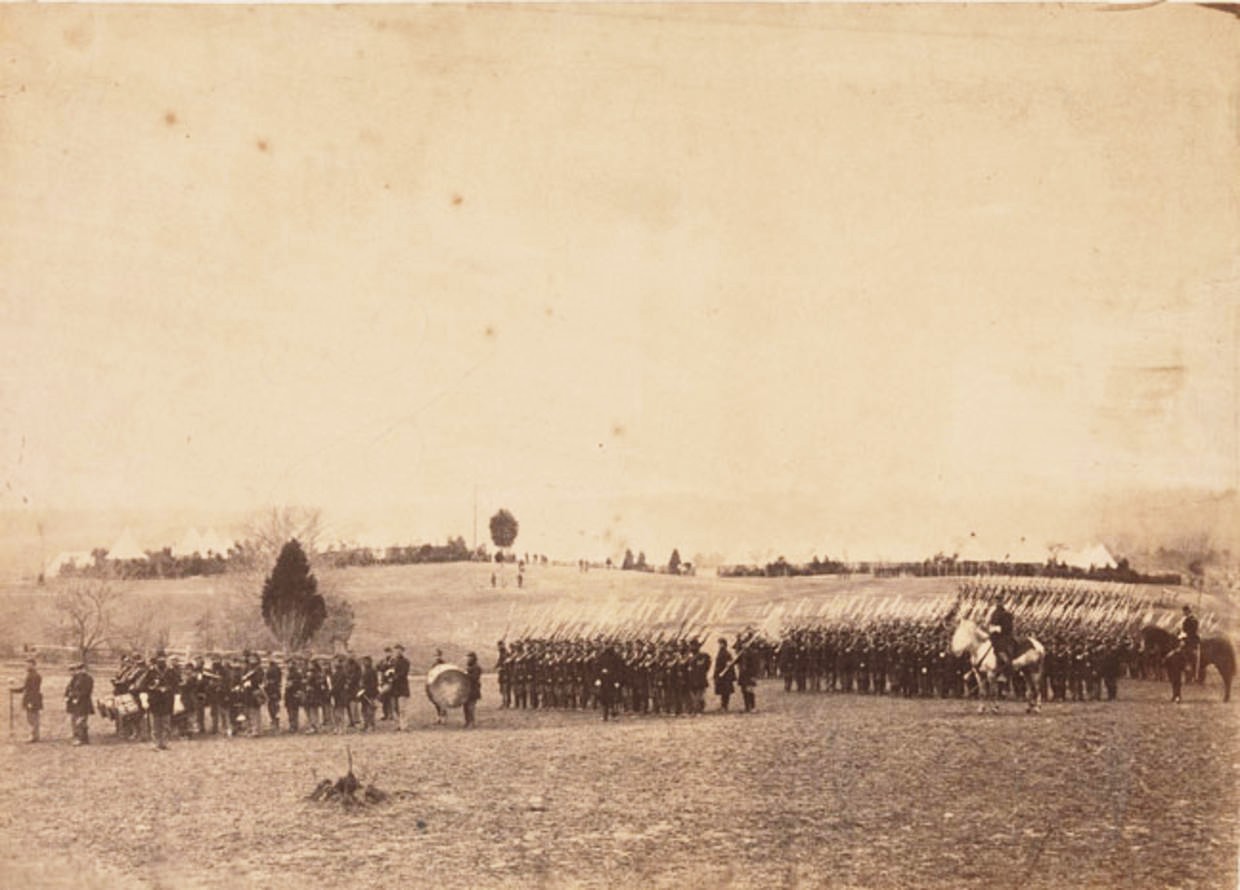
  4. Gesley, Jenny. The ‘Lieber Code’—the First Modern Codification of the Laws of War,” in “In Custodia Legis: Law Librarians of Congress.” Washington, D.C.: U.S. Library of Congress, retrieved online April 3, 2024.
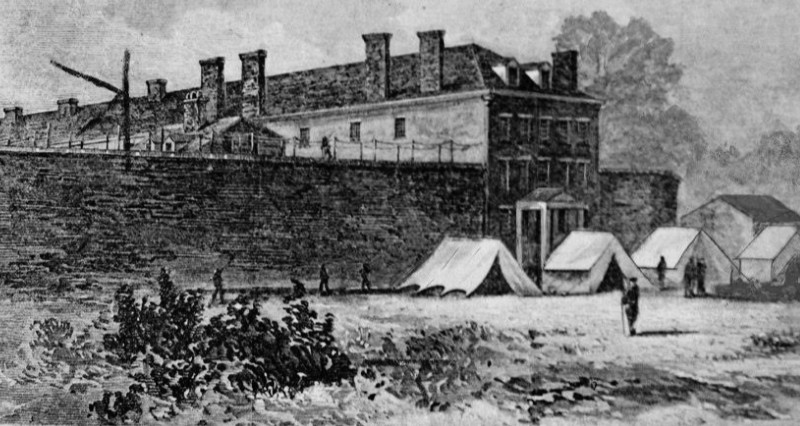
  5. Gilman, D. C.; Peck, H. T.; Colby, F. M., editors. “Lieber, Francis,” in New International Encyclopedia (first edition). New York, New York: Dodd, Mead, 1905.
  6. Lieber, Francis. Instructions for the Government of Armies of the United States in the Field. Washington, D.C.: Government Printing Office, 1898.
  7. The Laws of War: The Lieber Codes.” Andersonville, Georgia: Andersonville National Historic Site, U.S. National Park Service, retrieved online April 3, 2024.