Election Day 1864 — Lincoln or McClellan? How the 47th Pennsylvania Volunteers Voted

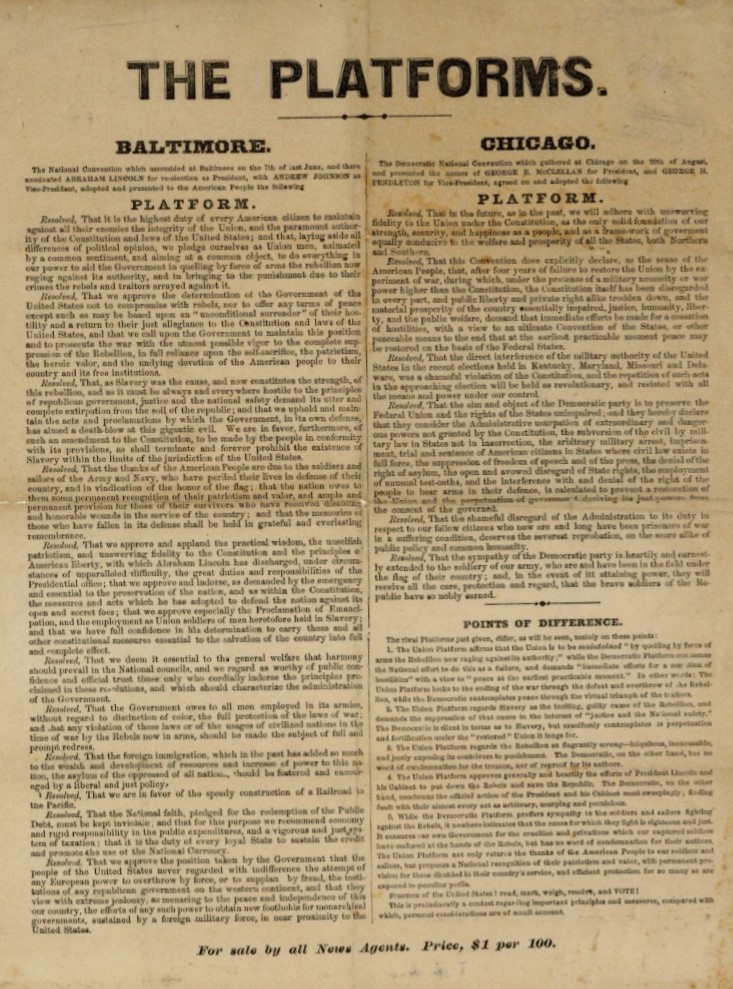
The platforms of the Union and Democratic parties, U.S. Presidential Election of 1864 (courtesy of the University of Illinois Urbana-Champaign; click to enlarge).

Even in the midst of a devastating civil war, Americans across the United States managed to come together to fulfill their civic responsibilities by voting on Election Day. Fathers and sons flocked to city and small town polling places while soldiers on active duty filled out ballot forms wherever they were stationed during the early to mid-1860s.

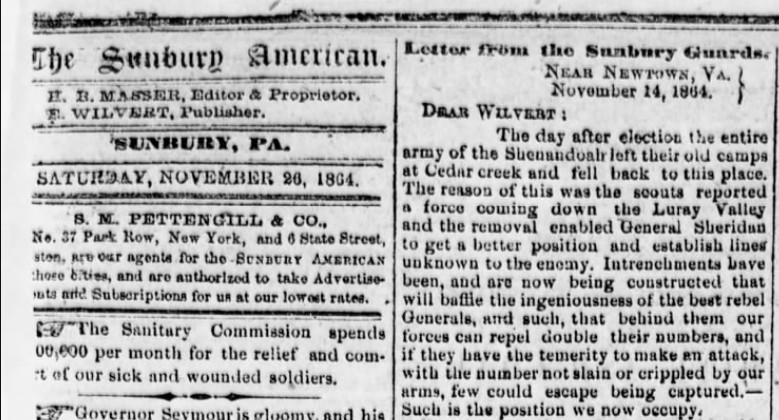
With respect to the Presidential Election of 1864, which was held in multiple states across America on November 8, 1864, that voting took place for members of the 47th Pennsylvania Volunteer Infantry at their encampment near Newtown, Virginia, according to a letter that was subsequently penned by 47th Pennsylvanian Henry D. Wharton to his hometown newspaper in Sunbury, Pennsylvania on November 14:

“The election passed off quietly and without any military interference, not the influence of officers used in controlling any man’s vote. In the regiments from the old Keystone, the companies were formed by the first Sergeant, when he stated to the men the object for which they were called to ‘fail to,’ and then they proceeded to the election of officers to hold the election – the boys having the whole control, none of the officers interfering in the least.”

Were the 47th Pennsylvania Volunteers pro-Lincoln or pro-McClellan?

Excerpt from Henry Wharton’s letter to his hometown newspaper, November 14, 1864 (The Sunbury American, November 14, 1864, public domain; click to enlarge).

Wharton reported that, after the votes from members of the regiment were counted, President Abraham Lincoln was the favored choice of most of the 47th Pennsylvania Volunteers. Lincoln had garnered one hundred and ninety-four votes to General George B. McClellan’s one hundred and twenty-one (a margin of seventy-three votes). Those votes, by individual company, were tallied as follows:

  • Company A: President Lincoln (ten); General McClellan (one)
  • Company B: President Lincoln (twenty-six); General McClellan (two)
  • Company C: President Lincoln (twenty-nine); General McClellan (thirteen)
  • Company D: President Lincoln (thirty-one); General McClellan (eleven)
  • Company E: President Lincoln (twenty-four); General McClellan (three)
  • Company F: President Lincoln (eighteen); General McClellan (sixteen)
  • Company G: President Lincoln (nine); General McClellan (thirteen)
  • Company H: President Lincoln (ten); General McClellan (twenty-four)
  • Company I: President Lincoln (nineteen); General McClellan (sixteen)
  • Company K: President Lincoln (eighteen); General McClellan (twenty)

But Wharton’s figures for the men from Company K were incorrect, according to historian Lewis Schmidt, who noted in his book, A Civil War History of the 47th Regiment of Pennsylvania Veteran Volunteers, that “Fifteen of the members [of Company K] voted for the Lincoln electors and seven for the McClellan electors” when they “voted on the battlefield of Cedar Creek, November 8, 1864.” The members of Company K who cast votes that day were: “David H. Fetherolf, Mathias Miller, John Keiser, Phaon Guth, James D. Weil, Daniel Strauss, Paul Strauss, George Sherer, Lewis G. Seip, Henry Hantz, Charles W. Abbott, George Kase, Charles Stoudt, William Schlicher, William F. Knerr, E. F. Benner, George Delp, Tilghman Boger, William H. Barber, William D. Schick, Frank Beisel, and David Semmel.”

Apathy or Attrition?

One of the first things that researchers notice when looking at those figures for the 1864 election is that the number of votes tendered by 47th Pennsylvania Volunteers that November day was lower than it should have been — shockingly so when considering that each company of the regiment had been staffed by roughly one hundred men when the 47th Pennsylvania left Camp Curtin and headed for Washington, D.C. three years earlier. The turnout of 47th Pennsylvanians was not a sign of voter apathy, however, but of a simple, ugly truth. The regiment had just recently lost the equivalent of nearly two full companies of men in combat. According to Wharton, “The battle at Cedar Creek thinned our ranks by which we lost many votes – this number and those away in hospitals would have increased the Union majority to three hundred.”

* Note: When Henry Wharton wrote the phrase “Union majority,” he was referring to the National Union Party, which had been established during the 1860s by prominent Republicans as a way to bring members of their party together with “War Democrats” and potential voters from border states to vote for President Lincoln and others who supported the Republican platform for eradicating chattel slavery and ending the nation’s secession crisis and civil war.

What Happened After That Election in 1864?

President Abraham Lincoln signing the Emancipation Proclamation in 1862 (W.E. Winner, painter, J. Serz, engraver, circa 1864; public domain, U.S. Library of Congress).

Successful in his bid for re-election, both in terms of the electoral college and popular vote, President Abraham Lincoln went on to deliver one of his most inspiring addresses to the nation, urging his fellow Americans “to bind up the nation’s wounds” and “do all which may achieve and cherish a just and lasting peace among ourselves and with all nations.” He then continued to shepherd his nation through one of its darkest times until the war was finally over.

Food for Thought

If Henry Wharton and his fellow soldiers could make it to the polls on Election Day after all they endured in battle, so can you. Please vote. Your voice does matter.


Sources:

  1. Political Party Timeline: 1836-1864,” in American Experience: Abraham and Mary Lincoln: A House Divided. Boston, Massachusetts: GBH Education for WGBH-TV (PBS), 2001.
  2. Schmidt, Lewis G. A Civil War History of the 47th Regiment of Pennsylvania Veteran Volunteers. Allentown, Pennsylvania: Self-published, 1986.
  3. The People’s Candidate: Lincoln’s Presidential Elections,” in “Illinois History & Lincoln Collections.” Urbana, Illinois: Main Library, University of Illinois Champaign-Urbana, retrieved online November 3, 2025.
  4. Transcript of Abraham Lincoln’s Second Inaugural Address (delivered Saturday March 4, 1865), in “UShistory.org.” Philadelphia, Pennsylvania: Independence Hall Association, retrieved online March 4, 2020 and November 3, 2025.
  5. Wharton, Henry D. “Letter from the Sunbury Guards, Near Newtown, VA, November 14, 1864.” Sunbury, Pennsylvania: The Sunbury American, November 26, 1864.

One Special September Day: Four 47th Pennsylvania Volunteers Shake Hands with President Abraham Lincoln in 1861 (part two)

White House, Washington, D.C., 1861 (Matthew Brady, U.S. Library of Congress, public domain).

“There is another chapter to the story of how four young soldiers from Allentown, members of the Forty-Seventh Regiment, managed to see President Lincoln in 1861 after they had made two ineffectual efforts to see the great man. The young soldiers were Allen Wolf, William H. Smith, Jacob Worman, and George Hepler. They were members of Captain Mickley’s Company G and the pass which they had expired at 5 p.m. of that day.”

The Allentown Democrat, April 5, 1911


Their mission to shake the hand of President Abraham Lincoln accomplished, Private George Heppler, Drummer William N. Smith, Private Allen David Wolf, and Private Jacob Peter Worman, of the 47th Pennsylvania Volunteer Infantry, had a second mission to accomplish in late September of 1861 — to make it back to their regiment’s encampment, safely and quickly — because the pass that they had received from one of their superior officers was about to expire.

But their new mission would prove to be even more difficult than had their successful White House meeting with President Lincoln. According to The Allentown Democrat:

“It was growing late in the afternoon when the young soldiers left the White House and they made tracks for the camp. What followed can best be told in Mr. Wolf’s own words:

‘When we got to the point where our regiment had been encamped in the morning we saw nothing but strange faces. We asked for Company G, and were directed to a point. When we came there we found that during our absence the Forty-seventh had been ordered to move and a Wisconsin regiment was encamped there. We decided to return to the city [Washington, D.C.] and in due time fell into the hands of the patrol. We showed our pass and were sent to the headquarters of General McClellan. The general met us personally. We told him of our predicament and he told us that our regiment was now encamped in a different location. He directed us to cross the chain bridge. The general also informed us that a wagon train would go that way and that we should follow it. We did as he instructed us to do. What a march that was, however! It was raining all night and we were drenched to the skin by the time we reached our regiment. But we felt amply repaid. We had seen the greatest man in the country and had spoken to General McClellan.’

Chain Bridge across the Potomac above Georgetown looking toward Virginia, 1861 (The Illustrated London News, public domain).

The inability of the four 47th Pennsylvania Volunteers to locate their regiment’s camp is more easily understood when reading a letter penned on 29 September by Company C Musician Henry Wharton, in which he informed readers of the Sunbury American that the 47th Pennsylvania had changed camps three times in three days:

“On Friday last we left Camp Kalorama, and the same night encamped about one mile from the Chain Bridge on the opposite side of the Potomac from Washington. The next morning, Saturday, we were ordered to this Camp [Camp Advance near Fort Ethan Allen, Virginia], one and a half miles from the one we occupied the night previous. I should have mentioned that we halted on a high hill (on our march here) at the Chain Bridge, called Camp Lyon, but were immediately ordered on this side of the river. On the route from Kalorama we were for two hours exposed to the hardest rain I ever experienced. Whew, it was a whopper; but the fellows stood it well – not a murmur – and they waited in their wet clothes until nine o’clock at night for their supper. Our Camp adjoins that of the N.Y. 79th (Highlanders.)….

“We had not been in this Camp more than six hours before our boys were supplied with twenty rounds of ball and cartridge, and ordered to march and meet the enemy; they were out all night and got back to Camp at nine o’clock this morning, without having a fight. They are now in their tents taking a snooze preparatory to another march this morning…. I don’t know how long the boys will be gone, but the orders are to cook two days’ rations and take it with them in their haversacks….”

Despite that confusion, all four of the adventurous 47th Pennsylvania Volunteers eventually did manage to reconnect with their regiment at its encampment in Virginia. They then went on to follow President Lincoln’s directive to them: “Be good and above all obey your commander.”

Private Allen David Wolf, who was ultimately promoted up through the ranks to become Corporal Wolf, and Drummer William N. Smith both survived their initial three-year terms of enlistment and were both honorably discharged from the 47th Pennsylvania Volunteer Infantry’s encampment near Berryville, Virginia on September 18, 1864.

Private George Heppler, who was also ultimately promoted to the rank of corporal, and Private Worman, who was promoted to the rank of sergeant, served far longer — until the 47th was mustered out for the final time on Christmas Day in 1865.

All four witnessed both the worst and best of humanity and were forever changed by all that they had seen and heard as they fought to save their nation from disunion.


Sources:

  1. Bates, Samuel P. History of Pennsylvania Volunteers, 1861-5, vol. 1. Harrisburg, Pennsylvania: B. Singerly, State Printer, 1869.
  2. “Gleanings by the Way.” Allentown, Pennsylvania: The Allentown Democrat, April 4, 1911.
  3. “Gleanings By the Way.” Allentown, Pennsylvania: The Allentown Democrat, April 5, 1911.
  4. Wharton, Henry D. “Letters from the Sunbury Guards.” Sunbury, Pennsylvania: The Sunbury American, September 1861.


Through a War Correspondent’s Eyes: The Art of Winslow Homer

Winslow Homer, 1880 (public domain).

Winslow Homer (1836-1910) was a Boston native who became one of the most important artists in nineteenth-century America. Best known for his pastoral landscapes and seascapes, he was also a notable chronicler of the lives of average American Civil War-era soldiers.

Apprenticed to Boston lithographer J. H. Bufford during the mid-1850s, he subsequently turned down a job offer by Harper’s Weekly later that same decade to become a staff illustrator, choosing, instead, to make his living as a freelancer and founder of his own art studio in New York City.

American Civil War

“The Civil War Surgeon at Work in the Field,” Winslow Homer, 12 July 1862 (National Library of Medicine, public domain).

During the early 1860s, however, Winslow Homer was ultimately persuaded to serve as a war correspondent for Harper’s Weekly, leading him to create some of the most evocative illustrations of the American Civil War era.

In 1862, for example, he showed Americans what it was like to be “The Civil War Surgeon at Work in the Field” by sketching a group of Union Army surgeons and wounded soldiers and then turning that sketch into a powerful illustration for a July edition of Harper’s Weekly. In November of that same year, he documented “A Sharp-Shooter on Picket Duty,” perched high up in a tree in the Virginia countryside, protecting his fellow members of the Army of the Potomac.

“Thanksgiving in Camp” (Winslow Homer, Harper’s Weekly, 29 November 1862, public domain).

That same month, he also preserved, for all time, a Thanksgiving celebration of one pensive group of Union Army soldiers who were stationed far from the arms of loved ones.

Why Was His Work So Popular?

Homer’s work captured the hearts and minds of Harper’s Weekly readers for three simple reasons. He had a great eye and great instincts to match his great skills as an illustrator.

“Sleeping on Their Arms” (Winslow Homer, Harper’s Weekly, 21 May 1864, public domain).

According to a 2015 Yale News article about Homer by Amy Athey Mcdonald, “Artist-reporters” of the Civil War era “had to be more than merely good draftsmen. They had to be astute observers, have an instinct for story and drama, the ability to sketch quickly and accurately, and no small amount of daring, as they faced battles, injuries, starvation, and disease first hand.”

Post-War Life

After the Civil War ended, Winslow put a fair amount of distance between himself and the United States. In 1866, he traveled to France, where he spent ten months studying and honing his skills. According to the late H. Barbara Weinberg, a renowned American art scholar and former curator at The Metropolitan Museum of Art in New York City, “While there [was] little likelihood of influence from members of the French avante-garde” during this phase of Homer’s life, “Homer shared their subject interests, their fascination with serial imagery, and their desire to incorporate into their works outdoor light, flat and simple forms (reinforced by their appreciation of Japanese design principles), and free brushwork.”

Recognized as a master of oil painting in the United States by the 1870s (while still just in his thirties), he also began to explore his talent as a watercolor artist.

“The Cotton Pickers” (Winslow Homer, 1876, public domain).

And, he began to document the post-war lives of men and women who had been freed from chattel enslavement. Painted in oil in 1876, “The Cotton Pickers” illustrated the harsh reality of the Reconstruction era–that many Freedmen and Freedwomen were still engaged in the same backbreaking work that they had endured while enslaved before the war. According to author Carol Strickland, “Although the artist left scant record of his convictions about race, his paintings of Black people are unlike those of his contemporaries.”

“The Gulf Stream” (Winslow Homer, 1899, public domain).

When speaking to Strickland for a 2022 profile of Homer, Associate Professor Gwendolyn DuBois Shaw observed that “before Emancipation, artists had elicited sympathy for enslaved people by portraying them on the auction block, for example. But the market for such work evaporated after the 1860s…. Caricatures derived from minstrel shows appeared in paintings, but ‘it was really unusual for Homer to stake so much on Black subjects connected to Reconstruction.'” His work in this regard, however, was not only limited to the Reconstruction era; in later years, he depicted the struggles of the Black men, women and children that he met while visiting the Bahamas.

“The Life Line” (Winslow Homer, 1884, public domain).

But it was, perhaps, through his paintings of the sea that he became best known to a wider audience across America. According to Weinberg:

He enjoyed isolation and was inspired by privacy and silence to paint the great themes of his career: the struggle of people against the sea and the relationship of fragile, transient human life to the timelessness of nature.


Sources:

  1. McDonald, Amy Athey. “As Embedded Artist with the Union Army, Winslow Homer Captured Life at the Front of the Civil War.” New Haven, Connecticut: Yale News, 20 April 2015.
  2. Strickland, Carol. “Not Just Seascapes: Winslow Homer’s Rendering of Black Humanity.” Boston, Massachusetts: The Christian Science Monitor, 7 June 2022.
  3. “Thanksgiving in Camp (from ‘Harper’s Weekly,’ Vol. VII).” New York, New York: The Metropolitan Museum of Art, retrieved online 28 November 2024.
  4. “The Army of the Potomac — A Sharp-Shooter on Picket Duty (from ‘Harper’s Weekly,’ Vol. VII).” New York, New York: The Metropolitan Museum of Art, retrieved online 28 November 2024.
  5. Weinberg, H. Barbara. “Winslow Homer (1836-1910).” New York, New York: The Metropolitan Museum of Art, October 2004.


Sheridan’s Ride: A Poem Commemorating the Battle of Cedar Creek, Virginia

Sheridan Rallying His Troops, Battle of Cedar Creek, Virginia, October 19, 1864 (U.S. Library of Congress, public domain).

Barely three weeks after the conclusion of the epic Battle of Cedar Creek in Virginia, a poem celebrating the valor displayed during the Union’s victory over the Confederacy that fateful October 19, 1864 began appearing in newspapers across the United States. Penned by Thomas Buchanan Read, Sheridan’s Ride was subsequently recited in public at community events nationwide and is presented here, in its entirety, in commemoration of the battle in which the 47th Pennsylvania Volunteer Infantry lost the equivalent of nearly two full companies of men in killed, wounded and missing in action, as well as soldiers who were captured by Rebel troops and dragged off to the Confederates’ notorious Andersonville and Salisbury prisoner camps.

Sheridan’s Ride

Up from the South at break of day,
Bringing to Winchester fresh dismay,
The affrighted air with a shudder bore,
Like a herald in haste to the chieftain’s door.
The terrible grumble and rumble and roar,
Telling the battle was on once more,
And Sheridan twenty miles away.

And wider still those billows of war
Thundered along the horizon’s bar,
And louder yet into Winchester rolled
The roar of that red sea uncontrolled,
Making the blood of the listener cold
As he thought of the stake in that fiery fray,
And Sheridan twenty miles away.

But there is a road from Winchester town,
A good, broad highway leading down;
And there, through the flush of the morning light,
A steed, as black as the steeds of night,
Was seen to pass as with eagle flight–
He stretched away with his utmost speed;
Hill rose and fell — but his heart was gay,
With Sheridan fifteen miles away.

Still sprung from those swift hoofs, thundering south,
The dust, like the smoke from the cannon’s mouth,
Or the trail of a comet sweeping faster and faster,
Foreboding to traitors the doom of disaster;
The heart of the steed and the heart of the master
Were beating like prisoners assaulting their walls,
Impatient to be where the battle-field calls;
Every nerve of the charger was strained to full play,
With Sheridan only ten miles away.

Under his spurning feet, the road,
Like an arrowy Alpine river flowed,
And the landscape sped away behind
Like an ocean flying before the wind;
And the steed, like a barque fed with furnace ire,
Swept on, with his wild eyes full of fire.
But lo! He is nearing his heart’s desire —
He is snuffing the smoke of the roaring fray,
With Sheridan only five miles away.

The first that the General saw were the groups
Of stragglers, and then the retreating troops;–
What was done — what to do — a glance told him both,
Then striking his spurs with a terrible oath,
He dashed down the line ‘mid a storm of huzzas,
And the wave of retreat checked its course there because
The sight of the master compelled it to pause,
With foam and with dust the black charger was gray;
By the flash of his eye, and his red nostrils’ play,
He seemed to the whole great army to say:
“I have brought you Sheridan all the way
From Winchester down to save the day!”

Hurrah, hurrah for Sheridan!
Hurrah, hurrah, for horse and man!
And when their statues are placed on high
Under the dome of the Union sky,
The American soldiers’ Temple of Fame,
There with the glorious General’s name
Be it said in letters both bold and bright:
“Here is the steed that saved the day
By carrying Sheridan into the fight,
From Winchester — twenty miles away!”


Sources:

  1. Sheridan’s Ride.” Philadelphia, Pennsylvania:  The Daily Evening Telegraph, November 9, 1864.
  2. “Sheridan’s Ride.” Cleveland, Ohio: The Evening Post, November 17, 1864.
  3. “Sheridan’s Ride.” Reading, Pennsylvania: The Daily Times, November 17, 1864.
  4. “Sheridan’s Ride.” Davenport, Iowa: The Democrat, November 25, 1864.
  5. “Sheridan’s Ride.” Brownsville, Nebraska Territory: Nebraska Advertiser, December 1, 1864.
  6. “Mr. Murdoch’s Readings.” Pittsburgh, Pennsylvania: Pittsburgh Gazette, December 6, 1864.
  7. “Tennyson Club Lectures.” Pittsburgh, Pennsylvania: The Post, December 6, 1864.
  8. “Entertainment.” Sacramento, California: The Sacramento Bee, December 17, 1864.


The Backbones of a Nation: The Laborers Who Enlisted with the 47th Pennsylvania Volunteer Infantry

“Labor Is Life” (U.S. Postal Service’s Labor Day Stamp, 1956, U.S. Library of Congress, public domain).

Bakers, blacksmiths, boatmen, butchers, carpenters, cabinetmakers, cigarmakers, coal miners, factory workers, farmers, gardeners, gold miners, iron workers, masons, quarry workers, teamsters, tombstone carvers. These were just a few of the diverse job titles held by the laborers who enlisted with the 47th Pennsylvania Volunteer Infantry during the American Civil War.

Many returned to their same occupations after the war ended while others found new pathways for their life journeys. Far too many were never able to return to the arms of their loved ones and still rest in marked or unmarked graves far from the Commonwealth of Pennsylvania.

In honor of Labor Day, 47th Pennsylvania Volunteers: One Civil War Regiment’s Story is proud to present this abridged list of blue-collar men and boys who served with the 47th Pennsylvania Volunteer Infantry between August 1861 and January 1866, as well as the names of two of the women associated with the regiment who made their own unforgettable marks on the world.

* Auchmuty, Samuel S. (First Lieutenant, Company D): A native of Duncannon, Perry County and veteran of the Mexican-American War who was employed as a carpenter during the early 1860s, Samuel Auchmuty responded to President Abraham Lincoln’s call for volunteers to defend the nation’s capital during the opening weeks of the American Civil War by enrolling as a first lieutenant with Company D of the newly-formed 47th Pennsylvania Volunteer Infantry on August 20, 1861; after completing his three-year term of enlistment, he was honorably discharged in September 1864 and returned home to Pennsylvania, where he resumed his work as a house carpenter and launched a successful contracting business that was responsible for building new business structures, churches, single-family homes, and schools, as well as renovating existing structures; he died in 1891, following a brief illness;
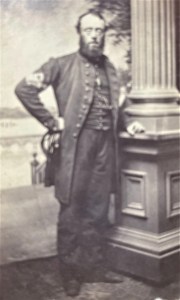
First Sergeant Christian S. Beard, circa 1863 (public domain).

* Beard, Christian Seiler (First Lieutenant, Company C): A twenty-seven-year-old, married carpenter residing in Williamsport, Lycoming County when President Abraham Lincoln called for seventy-five thousand volunteers to defend the nation’s capital, following the fall of Fort Sumter in mid-April 1865, Chistian S. Beard promptly enrolled for Civil War military service before that month was out as a private with Company D of the 11th Pennsylvania Volunteers; honorably discharged in July after completing his Three Months’ Service, he re-enlisted as a sergeant with Company C of the newly-formed 47th Pennsylvania Volunteers on August 19; after rising up through the ranks to become a first lieutenant, he was honorably discharged on Christmas Day, 1865, and returned home to his wife in Dauphin County, Pennsylvania, where he continued to work as a carpenter; after having several children with his wife, he was widowed by her; remarried in 1884, he relocated with his wife and children to Pittsburgh, where he continued to work as a carpenter; ailing with heart and kidney disease, he died there on November 16, 1911 and was interred at that city’s Highwood Cemetery;

* Burke, Thomas (Sergeant, Company I): A first-generation American, Thomas Burke was a twenty-year-old cabinetmaker residing in Allentown at the dawn of the American Civil War; after enrolling for military service on the day that the 47th Pennsylvania Volunteer Infantry was founded (August 5, 1861), he was officially mustered in as a private; from that point on, he continued to work his way up the ranks, receiving a promotion to corporal on September 19, 1864 and then to sergeant on July 11, 1865; honorably mustered out with his company in Charleston, South Carolina on December 25, 1865, he returned home to Lehigh County, where he married and began a family; sometime in early to mid-1871, he and his family migrated west to Iowa, settling in Anamosa, Jones County, where he was employed as a carpenter and contractor; he died at his home there on October 22, 1910 and was buried at that town’s Riverside Cemetery;

* Colvin, John Dorrance (Second Lieutenant, Company C): A native of Abington Township, Lackawanna County who was a farmer when he enlisted for Civil War military service on September 12, 1861, John D. Colvin transferred to the U.S. Army Signal Corps on October 13, 1863, and continued to serve with the Signal Corps for the duration of the war; employed as an engineer, post-war, he helped the Pacific Railroad to extend its service from Atchison, Kansas to Fort Kearney in Nebraska before returning home to Pennsylvania, where he married, began a family and resided with them in Olyphant and Carbondale before relocating with them to Parsons in Luzerne County, where he became a prominent civic leader and member of the school board; initially employed as a machinist, he went on to become superintendent of the Delaware & Hudson Coal company before taking a similar job with the Lehigh Valley Coal Company; the U.S. Postal Service’s postmaster of Parsons during the early 1890s, he died there on March 15, 1901 and was buried at the Hollenback Cemetery in Wilkes-Barre;

* Crownover, James (Sergeant, Company D): A twenty-three-year-old teamster residing in Blain, Perry County when he enrolled for Civil War military service on August 20, 1861, James Crownover rose up through the ranks of the 47th Pennsylvania from private to reach the rank of sergeant; wounded in the right shoulder and captured by Confederate troops during the Battle of Pleasant Hill, Louisiana on April 9, 1864, he was marched to Camp Ford, near Tyler, Texas, the largest Confederate prison camp west of the Mississippi River, where he was held as a prisoner of war (POW) until he was released during a prisoner exchange on November 25, 1864; during captivity, he was commissioned, but not mustered as a second lieutenant; given medical treatment before he was returned to active duty, he was honorably discharged with his regiment in Charleston, South Carolina on December 25, 1865; after returning home, he found work at a tannery near Blain, married, began a family and then relocated with them to East Huntingdon Township, Westmoreland County, where he worked as a teamster; relocating with them to Braddock in Allegheny County after the turn of the century, he worked at a local mill there; he died in Allegheny County on July 18, 1903 and was buried at the Monongahela Cemetery in Braddock Hills;

Jacob Daub, circa 1862-1865 (carte de visite, Cooley & Beckett Photographers, Savannah, Georgia and Beaufort and Hilton Head, South Carolina, public domain).

* Daub, Jacob and William J. (Drummer Boy, Company A): A German immigrant as a child, Jacob Daub emigrated with his parents and younger brother, William, circa 1852; after settling in Easton, Northampton County, Pennsylvania, where his father found work as a stone mason, Jacob grew up to become a cigarmaker, and also became the first of the two brothers to enlist in the American Civil War; after enrolling at the age of sixteen, he was classified as a field musician and assigned to Company A as its drummer boy; his nineteen-year-old brother, William, a carpenter by 1865, followed him into the war when he enlisted as a private with the same company in February of that year; after the war ended, both returned home to Northampton County, where they married, had children and went on to live long, full lives; William eventually died at the age of eighty in 1928, followed by Jacob, who passed away in 1936, roughly two months before his ninety-first birthday;

* Detweiler, Charles C. (Private, Company A): Berks County native Charles Detweiler enrolled for Civil War military service on September 16, 1862; a carpenter who later became a farmer, he served with Company A until he was severely injured in the Battle of Cedar Creek, Virginia, October 19, 1864, when he sustained a musket ball wound to the middle of his thigh; treated at a Union Army hospital in Virginia before being transported to the Union’s Mower General Hospital in Philadelphia, Pennsylvania, he learned that the musket ball had damaged his femur and femoral arteries; following his wound-related death at Mower on March 12, 1865, he was buried at the Fairview Cemetery in Kutztown, Berks County;

* Diaz, John (Private, Company I): An immigrant from Spain’s Canary Islands, John Diaz emigrated sometime between 1862 and 1865 and settled in Philadelphia, Pennsylvania, where he found work as a cigarmaker; on January 25, 1865, at the age of nineteen, he enlisted with the Union Army at a recruiting depot in Norristown, Montgomery County and served as a private with Company I of the 47th Pennsylvania Volunteer Infantry until it was mustered out on Christmas Day, 1865; following his return to Pennsylvania, he resumed work as a cigarmaker in Philadelphia, eventually launching his own cigarmaking firm, which became a family business as his sons became old enough to work for him; sometime between 1906 and 1910, he relocated with his wife and several of his children to Camden County, New Jersey, where he died on September 5, 1915;

James Downs (circa 1880s, public domain).

* Downs, James (Corporal, Company D): A twenty-three-year-old tanner residing in Blain, Perry County when he enrolled for Civil War military service on August 20, 1861, James Downs was captured by Confederate troops during the Battle of Pleasant Hill, Louisiana on April 9, 1864 and marched to Camp Ford, near Tyler, Texas, the largest Confederate prison camp west of the Mississippi River; held there as a prisoner of war (POW) until he was released during a prisoner exchange on July 22, 1864, he received medical treatment and was subsequently returned to active duty; following his honorable discharge with his regiment in Charleston, South Carolina, on December 25, 1865, he returned home, married, began a family and relocated with his family to Phillipsburg, New Jersey; suffering from heart and kidney disease, and possibly also from post-traumatic stress disorder, rather than “insane” as physicians at the Pennsylvania Memorial Home in Brookville, Jefferson County, Pennsylvania had diagnosed him, he fell from a window at that home and died at there on September 16, 1921; he was subsequently interred in the Veterans’ Circle of the Brookville Cemetery;

* Eagle, Augustus (Second Lieutenant, Company F): A German immigrant as a teenager, Augustus Eagle arrived in America on June 23, 1855, two years after his brother, Frederick Eagle, had emigrated and made a life for himself in Catasauqua, Lehigh County, Pennsylvania; both men married and began families there, with Fred employed as a laborer and Gus employed by the Crane Iron Works; when President Abraham Lincoln issued his call for volunteers to defend the nation’s capital during the opening weeks of the American Civil War, both men enrolled for military service on August 21, 1861 as privates with Company F of the 47th Pennsylvania Volunteer Infantry; in 1862, Fred fell ill and was honorably discharged on a surgeon’s certificate of disability, but Gus continued to serve, rising up through the regiment’s enlisted and officers’ ranks; commissioned as a second lieutenant, he was honorably discharged on September 11, 1864, upon completion of his three-year term of service; post-war, Fred became a successful baker with real estate and personal property valued at $4,200 (roughly $155,750 in 2023 dollars) and died in Catasauqua in 1885, while Gus owned a successful restaurant in Whitehall Township before operating the Fairview Hotel, which became a popular spot for political gatherings; after suffering a series of strokes in 1902, Gus died at his home on August 17 and was buried at the Fairview Cemetery in West Catasauqua;

* Eisenbraun, Alfred (Drummer Boy, Company B): A tobacco stripper and first-generation American from Allentown, Lehigh County, fifteen-year-old Alfred Eisenbraun became the second “man” from the 47th Pennsylvania to die when he succumbed to complications from typhoid fever at the Kalorama Eruptive Fever Hospital in Georgetown, District of Columbia on October 26, 1861; he still rests at the U.S. Soldiers’ and Airmen’s Home Cemetery in Washington, D.C.;

* Fink, Aaron (Corporal, Company B): A shoemaker and native of Salisbury Township, Lehigh County, Pennsylvania, Aaron Fink, grew up, began a family and established a successful small shoemaking business, first in Allentown and then in Mauch Chunk (now Jim Thorpe) in Carbon County; on August 20, 1861, he chose to respond to President Abraham Lincoln’s call for volunteers to help bring the American Civil War to a quick end when he enrolled for military service; shot in the right leg during the fighting at the Frampton Plantation during the Battle of Pocotaligo, South Carolina on October 22, 1862, he was treated at the Union Army’s hospital at Hilton Head, South Carolina, but died there from wound-related complications on November 5, 1862; initially buried near that hospital, his remains were later exhumed by Allentown undertaker Paul Balliet and returned to Pennsylvania for reinterment at that city’s Union-West End Cemetery;

* Fornwald, Reily M. (Corporal, Company G): Born in Heidelberg Township, Berks County, Reily Fornwald was raised there on his family’s farm near Stouchsberg; educated in his community’s common schools and then at Millersville State Normal School, he became a railroad worker before returning to farm life shortly before the dawn of the American Civil War; after enlisting for military service at the age of twenty on September 11, 1862, he was wounded in the head and groin by an exploding artillery shell during the Battle of Pocotaligo, South Carolina on October 22, 1862; stabilized on the battlefield before being transported to a field hospital for more advanced medical care, he spent four weeks recuperating before returning to active duty with his regiment; promoted to the rank of corporal on January 19, 1863, he continued to serve with his regiment until he was honorably discharged at Berryville, Virginia on September 18, 1864, upon expiration of his term of enlistment; after returning home, he spent four years operating a blast furnace for White & Ferguson in Robesonia, Berks County; he also married and began a family; sometime around 1870, he left that job to become an engine operator for Wright, Cook & Co. in Sheridan and then moved to a job as an engine operator for William M. Kauffman—a position he held for roughly a decade before securing employment as a shifting engineer with the Reading Railway Company at its yards in Reading; following his retirement in 1905, he and his wife settled in Robesonia, where he became involved in buying and selling real estate; following a severe fall in May 1925, during which he fractured a thigh bone, he died at the Homeopathic Hospital in Reading on June 1 and was buried at Robesonia’s Heidelberg Cemetery;
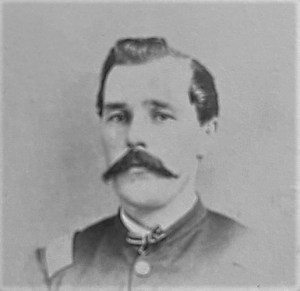
Captain Reuben Shatto Gardner, Company H, 47th Pennsylvania Volunteers, circa 1863 (public domain).

* Gardner, Reuben Shatto, John A. and Jacob S. R.: Natives of Perry County, Reuben Shatto Gardner and his brothers, John A. Gardner and Jacob S. R. Gardner, began their work lives as laborers; among the earliest responders to President Abraham Lincoln’s call to defend the nation’s capital, following the fall of Fort Sumter in mid-April 1861, Reuben was a twenty-five-year-old miller who resided in Newport, Perry County; after enlisting as a private with Company D of the 2nd Pennsylvania Volunteers on April 20, he was honorably mustered out after completing his term of service; he then re-upped for a three-year tour of duty, mustering in as a first sergeant with Company H of the newly-formed 47th Pennsylvania Volunteer Infantry; also enrolling with him that same day were his twenty-three-year-old and twenty-one-year-old brothers, John A. Gardner and Jacob S. R. Gardner; John officially mustered in at Camp Curtin in Harrisburg on September 18 (the day before Reuben arrived), while Jacob officially mustered in on September 19; both joined their brother’s company, entering at their respective ranks of corporal and private, but Jacob’s tenure was a short one; sickened by typhoid fever in late December 1861, he died at the 47th Pennsylvania’s regimental hospital at Camp Griffin, near Langley, Virginia on January 8, 1862; his remains were later returned to Perry County for burial at the Old Newport Cemetery; soldiering on, Reuben and John were transported with their regiment by ship to Fort Taylor in Key West, Florida and subsequently sent to South Carolina with their regiment and other Union troops; shot in the head and thigh during the Battle of Pocotaligo, South Carolina on October 22, 1862, Reuben was treated at the Union Army’s hospital at Hilton Head, South Carolina for an extended period of time, and then returned to active duty with his regiment; meanwhile, John was assigned with H Company and the men from Companies D, F and K to garrison Fort Jefferson in Florida’s Dry Tortugas; both brothers then continued to work their way up the regiment’s ranks, with John promoted to corporal on September 18, 1864 and Reuben ultimately commissioned as a captain and given  command of Company H on February 16, 1865; both then returned home after honorably mustering out with the regiment in Charleston, South Carolina on Christmas Day, 1865; sometime around 1866 or 1867, Reuben and his wife migrated west, first to Elk River Station in Sherburne County, Minnesota and then to Stillwater, Washington County, before settling in the city of Minneapolis; through it all, he worked as a miller; Reuben and his family then relocated farther west, arriving in King County, Washington after the Great Seattle Fire of 1889; initially employed in the restaurant industry, Reuben later found work as a railroad conductor before prospecting for gold with son Edward in the western United States and British Columbia, Canada during the 1890s Gold Rush; employed as a U.S. Post Office clerk in charge of the money order and registry departments in Seattle from 1898 to 1902, Reuben died in Seattle at the age of sixty-eight on September 25, 1903 and was interred at that city’s Lakeview Cemetery; meanwhile, his brother John, who had resumed work as a fireman with the Pennsylvania Railroad after returning from the war, was widowed by his wife in 1872; after remarrying and welcoming the births of more children, he was severely injured on October 9, 1873 while working as a fireman on the Pacific Express for the Pennsylvania Railroad; unable to continue working as a fireman due to his amputated hand, he worked briefly as a railroad call messenger before launching his own transfer business in Harrisburg; after he was widowed by his ailing second wife, John was severely injured in a second accident in 1894 while loading his delivery wagon; still operating his business after the turn of the century, he remarried on January 3, 1900, but was widowed by his third wife when she died during a surgical procedure in 1911; he subsequently closed his business and relocated to the home of his daughter in the city of Reading, Berks County; four years later, he fell on an icy sidewalk and became bedfast; aged eighty and ailing from arteriosclerosis and lung congestion, he died at her home on February 20, 1918 and was buried at Reading’s Charles Evans Cemetery;

* Gethers, Bristor (Under-Cook, Company F): Born into slavery in South Carolina circa 1829, Bristor Gethers was married “by slave custom at Georgetown, S.C.” on the Pringle plantation in Georgetown sometime around 1847 to “Rachael Richardson” (alternate spelling “Rachel”); a field hand at the dawn of the Civil War, he was freed from chattel enslavement in 1862 by Union Army troops; he then enlisted as an “Under-Cook” with Company F of the 47th Pennsylvania Volunteer Infantry in Beaufort, South Carolina on October 5, 1862, and traveled with the regiment until October 4, 1865, when he was honorably discharged in Charleston, South Carolina upon completion of his three-year term of enlistment; at that point, he returned to Beaufort and resumed life with his wife and their son, Peter; a farmer, Bristor was ultimately disabled by ailments that were directly attributable to his Union Army tenure; awarded a U.S. Civil War Soldiers’ Pension, he lived out his days with his wife on Horse Island, South Carolina, and died on Horse Island, South Carolina on June 24 or 25, 1894; he was then laid to rest at a graveyard on Parris Island on June 26 of that same year;

* Gilbert, Edwin (Captain, Company F): A native of Northampton County and a carpenter residing in Catasauqua, Lehigh County at the dawn of the American Civil War, Edwin Gilbert enrolled as a corporal on August 21, 1861; after rising up through his regiment’s officer ranks, he was ultimately commissioned as a captain and placed in charge of his company on New Year’s Day, 1865, and then mustered out with his company in Charleston, South Carolina of Christmas of that same year; resuming his life with his wife and children in Lehigh County after the war, he continued to work as a carpenter; after suffering a stroke in late December 1893, he died on January 2, 1894 and was buried at the Fairview Cemetery in West Catasauqua;
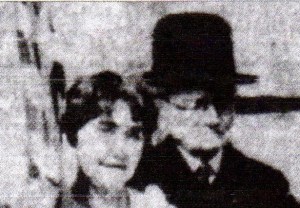
Mrs. Caroline Bost and Martin L. Guth celebrated the anniversary of President Abraham Lincoln’s birthday with fellow Grand Army of the Republic and ladies auxiliary members in February 1933 (public domain).

* Guth, Martin Luther (Corporal, Company K): A native of Lehigh County and son of a farmer, Martin L. Guth was a seventeen-year-old laborer and resident of Guthsville in Whitehall Township at the dawn of the American Civil War; after enrolling for military service on September 26, 1862, he was officially mustered in as a corporal; he continued to serve with his regiment until he was honorably mustered out on October 1, 1865, upon expiration of his term of service; at some point during that service, he broke his leg—an injury that did not heal properly and plagued him for the remainer of his life; after returning home to the Lehigh Valley, he found work again as a laborer; married in 1883, he became the father of four children, one of whom was born in New Mexico and another who was born in California; he had moved his family west in search of work in the mining industry; documented as a “prospector” or “miner” records created in Nevada during that period, he was also documented on voter registration rolls of Butte City in Glenn County, California in August 1892; by 1900, he was living separately from his wife, who was residing in Bandon, Coos County, Oregon with their two children while he was residing at the Veterans’ Home of California in Yount Township, Napa County, California; subsequently admitted to the Mountain Branch of the network of U.S. National Homes for Disabled Volunteer Soldiers in Johnson City, Tennessee on February 11, 1912, his disabilities included an old compound fracture of his right leg with chronic ulceration, defective vision (right eye), chronic bronchitis, and arteriosclerosis; discharged on December 12, 1920, he was admitted to the U.S. National Soldiers’ Home in Leavenworth, Kansas on July 30, 1912, but discharged on September 29, 1913; by 1920, he was living alone on Fruitvale Avenue in the city of Oakland, California, but was remaining active with his local chapter of the Grand Army of the Republic as he rose through the leadership ranks of chapter, state and national G.A.R. organizations; after a long, adventure-filled life, he died on October 11, 1935, at the age of ninety-one, at the veterans’ home in San Francisco and was interred at the San Francisco National Cemetery (also known as the Presidio Cemetery);

Lieutenant Charles A. Hackman, Company G, 47th Pennsylvania Volunteers, circa 1864 (public domain).

* Hackman, Charles Abraham and Martin Henry (First Lieutenant and Sergeant, Company G): Natives of Rittersville, Lehigh County, Charles and Martin Hackman began their work lives as apprentices, with Charles employed by a carpenter and Martin employed by master coachmaker Jacob Graffin; members of the local militia unit known as the Allen Rifles, they were among the earliest responders to President Abraham Lincoln’s call to defend the nation’s capital, following the fall of Fort Sumter in mid-April 1861; both enlisted as privates with Company I of the 1st Pennsylvania Volunteers on April 20 and were honorably mustered out in July after completing their service; Charles then re-upped for a three-year tour of duty, mustering in as a sergeant with Company G of the newly-formed 47th Pennsylvania Volunteer Infantry; he then spent most of his early service in Virginia; meanwhile, his younger brother, Martin H. Hackman, who was employed as a coach trimmer in Lehigh County, re-enlisted for his own second tour of duty, as a private with Charles’ company, on January 8, 1862; working their way up the ranks, Charles was commissioned as a first lieutenant on June 18, 1863, while Martin was promoted to sergeant on April 26, 1864; Charles was then breveted as a captain on November 30, 1864 after having mustered out on November 5; Martin was then honorably discharged on January 8, 1865; initially employed, post-war, with the Philadelphia & Reading Railroad’s train car facility in Reading, Berks County, Charles was promoted to car inspector at the company’s Philadelphia facility in December 1866; he subsequently married, but had no children and was widowed in 1904; remarried, he remained in Philadelphia until the early 1900s, when he relocated to Allentown; Martin, who worked as a bricklayer in Allentown, did have children after marrying, but he, too, was widowed; also remarried, he became a manager at a rolling mill; ailing with pneumonia in early 1917, Charles was eighty-six years old when he died in Allentown on January 17; he was buried at Allentown’s Union-West End Cemetery, while his brother Martin was buried at the Nisky Hill Cemetery in Bethlehem, following his death in Bethlehem from a cerebral hemorrhage on December 14, 1921;

* Junker, George (Captain, Company K): A German immigrant as a young adult, George Junker emigrated sometime around the early 1850s and settled in Allentown, Lehigh County, Pennsylvania, where he found employment as a marble worker and tombstone carver, and where he also joined the Allen Infantry, one of his adopted hometown’s three militia units; responding to U.S. President Abraham Lincoln’s call for volunteers to defend the nation’s capital during the opening weeks of the American Civil War, George enlisted with his fellow Allen Infantrymen, honorably completed his Three Months’ Service, and promptly began his own recruitment of men for an “all-German company” for the newly-formed 47th Pennsylvania Volunteer Infantry; commissioned as a captain with the 47th Pennsylvania, he was placed in charge of his men who became known as Company K; mortally wounded by a Confederate rifle shot during the Battle of Pocotaligo, South Carolina on October 22, 1862, he died from his wounds the next day at the Union Army’s division hospital at Hilton Head, South Carolina; his remains were returned to his family in Hazleton, Luzerne County for reburial at the Vine Street Cemetery;

* Kern, Samuel (Private, Company D): A native of Perry County who was employed as a farmer in Bloomfield, Perry County when he enrolled for Civil War military service on August 20, 1861, Samuel Kern was wounded and captured by Confederate troops during the Battle of Pleasant Hill, Louisiana on April 9, 1864; marched to Camp Ford, near Tyler, Texas, the largest Confederate prison camp west of the Mississippi River, he was held there as a prisoner of war (POW) until he died from harsh treatment on June 12, 1864; buried somewhere on the grounds of that prison camp, his grave remains unidentified;

* Kosier, George (Captain, Company D): A native of Perry County and twenty-four-year-old carpenter residing in that county’s community of New Bloomfield at the dawn of the American Civil War, George Kosier became one of the earliest men from his county to respond to President Abraham Lincoln’s call for to defend the nation’s capital, following the fall of Fort-Sumter in mid-April 1861, when he enrolled for military service on April 20 as a corporal with Company D of the 2nd Pennsylvania Volunteers; honorably discharged in July after completing his Three Months’ Service, he re-enlisted as a first sergeant with Company D of the newly-formed 47th Pennsylvania Volunteer Infantry; joining him were his younger brothers, Jesse and William S. Kosier, aged nineteen and twenty-three, who were enrolled as privates with the same company; all three subsequently re-enlisted with their company at Fort Taylor in Key West, Florida in 1863; sadly, Jesse fell ill with pleurisy and died at the Union Army’s Field Hospital in Sandy Hook, Maryland on August 1864; initially buried at a cemetery in Weverton, Maryland, his remains were later exhumed and reinterred at the Antietam National Cemetery in Sharpsburg, Maryland; both George and William continued to serve with the regiment, with George continuing his rise up the ranks; commissioned as a captain, he was given command of Company D in early June 1865; both brothers were then honorably discharged with their regiment on Christmas Day, 1865; post-war, both men married and began families; William died in Pennsylvania sometime around 1879, but George went on to live a long full life; after settling in Ogle County, Illinois, where he was employed as a carpenter, he relocated with his family to Wright County, Iowa, where he built bridges; he died in Chicago on December 3, 1920 and was buried at that city’s Rosehill Cemetery;
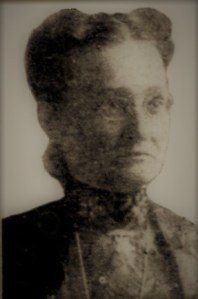
Anna (Weiser) Leisenring (1851-1942) , circa 1914 (public domain).

* Leisenring, Annie (Weiser): The wife of Thomas B. Leisenring (Captain, Company G), Annie Leisenring was employed by the Commonwealth of Pennsylvania as a factory inspector after the American Civil War; she became well known through newspaper accounts of her inspection visits and also became widely respected for her efforts to improve child labor laws statewide;

* Lowrey, Thomas (Corporal, Company E): An Irish immigrant as a young adult, Thomas Lowrey emigrated sometime around the late 1840s or early 1850s and settled in Northampton County, Pennsylvania, where he found work as a miner, married and began a family; responding to U.S. President Abraham Lincoln’s call for volunteers to defend the nation’s capital during the opening weeks of the American Civil War, Thomas enlisted with Company E of the 47th Pennsylvania on September 16, 1861; after completing his three-year term of enlistment, he was honorably discharged in September 1864 and returned home to Pennsylvania, where he resumed work as a coal miner near Shenandoah, Schuylkill County, and where he resided with his wife and children; after witnessing the dawn of a new century, he died in Shenandoah on January 11, 1906;
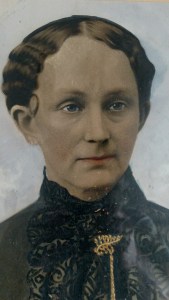
This image of Julia (Kuenher) Minnich, circa 1860s, is being presented here through the generosity of Chris Sapp and his family, and is being used with Mr. Sapp’s permission. This image may not be reproduced, repurposed, or shared with other websites without the permission of Chris Sapp.

* Magill, Julia Ann (Kuehner Minnich): Widowed and the mother of a young son at the time that her husband, B Company’s Captain Edwin G. Minnich, was killed in battle during the American Civil War, Julia Ann (Kuehner) Minnich became a Union Army nurse at Harewood Hospital in Washington, D.C. during the war in order to keep a roof over her son’s head; she then spent the remainder of her life battling the U.S. Pension Bureau to receive and keep both the U.S. Civil War Widow’s Pension and U.S. Civil War Nurse’s Pension that she was entitled to under federal law; forced to go on working into her later years by poverty, she finally found work as a cook at a hotel in South Bethlehem; she died sometime after 1906;

* Menner, Edward W. (Second Lieutenant, Company E): A first-generation American who was a native of Easton, Northampton County, Edward Menner was a sixteen-year-old carpenter when he enrolled for Civil War military service on August 25, 1861; working his way up from private to second lieutenant before he was honorably discharged with his regiment in Charleston, South Carolina on Christmas Day, 1865, he was wounded in the left shoulder during the Battle of Cedar Creek, Virginia on October 19, 1864; after returning home to the Lehigh Valley, he secured employment as a hooker with the Bethlehem Iron Company (later known as Bethlehem Steel) on March 15, 1866; he married, begam a family and continued to work in the iron industry for much of his life; he died in Bethlehem on April 25, 1913 and was buried at that city’s Nisky Hill Cemetery;

* Miller, John Garber (Sergeant, Company D): A native of Ironville, Blair County, John G. Miller was a twenty-one-year-old laborer living in Duncannon, Perry County when he enrolled for Civil War military service on August 20, 1861; captured by Confederate troops during the Battle of Pleasant Hill, Louisiana on April 9, 1864 and marched to Camp Ford, near Tyler, Texas, the largest Confederate prison camp west of the Mississippi River, he was held there as a prisoner of war (POW) until he was released during a prisoner exchange on July 22, 1864; returned to active duty with his regiment after receiving medical treatment, he continued to serve until he was honorably discharged with the regiment in Charleston, South Carolina on December 25, 1865; after returning home, he married, began a family and relocated with his family to Philipsburg, Centre County, Pennsylvania, where he was employed as a teamster; returning to Blair County with his family, he resided with them in Logan Township before relocating with them again to Coalport, Clearfield County; suffering from heart disease, he died in Coalport on February 16, 1921 and was interred at the Coalport Cemetery;
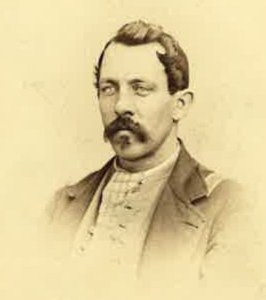
Captain Theodore Mink, Company I, 47th Pennsylvania Volunteers (circa 1870s-1880s, courtesy of Julian Burley; used with permission).

* Mink, Theodore (Captain, Company I): A native of Allentown, Lehigh County who was apprenticed as a coachmaker and then tried his hand as a whaler and blacksmith prior to the American Civil War, Thedore Mink became one of the “First Defenders” who responded to President Abraham Lincoln’s call for seventy-five thousand volunteers to defend the nation’s capital after the fall of Fort Sumter in mid-April 1861; after honorably completing his Three Months’ Service in July, he re-enlisted on August 5 as a sergeant with Company I of the newly-formed 47th Pennsylvania Volunteer Infantry; after steadily working his way up through the ranks, he was commissioned as a captain and placed in charge of his company on May 22, 1865; he continued to serve with his regiment until it was mustered out on Christmas Day, 1865; following his return to Pennsylvania, he was hired as a laborer with a circus troupe operated by Mike Lipman before finding longtime employment in advertising and then as head of the circus wardrobe for the Forepaugh Circus before he was promoted to management with the circus; felled by pneumonia during late 1889, he died in Philadelphia on January 7, 1890 and was interred in Allentown’s Union-West End Cemetery;

* Newman, Edward (Private, Company H): A German immigrant who left his homeland sometime around 1920, Edward Newman chose to settle in Allentown, Lehigh County, Pennsylvania, where he found work as a baker; after enlisting for Civil War military service in August 1862, he mustered in as a private with Company I of the 127th Pennsylvania Volunteers and fought in the Battle of Fredericksburg from December 11-15 of that year; honorably mustered out with his regiment in May 1863, he re-enlisted on October 23, 1863 for a second tour of duty—but as a private with a different regiment—Company H of the 47th Pennsylvania Volunteers; he continued to serve with the 47th Pennsylvania until he was officially mustered out in Charleston, South Carolina on Christmas Day, 1865, he returned to Pennsylvania’s Lehigh Valley, where he worked briefly as a baker; suffering from rheumatism that developed while the 47th Pennsylvania was stationed near Cedar Creek, Virginia during the fall of 1864, he was admitted to the network of U.S. Homes for Disabled Volunteer Soldiers at the Central Branch in Dayton, Montgomery County, Ohio on July 17, 1877; still unmarried and still living there in 1880, his health continued to decline; diagnosed with acute enteritis, he died there on January 22, 1886 and was buried at the Dayton National Cemetery;

Captain Daniel Oyster, Company C, 47th Pennsylvania Volunteers, circa 1864 (public domain).

* Oyster, Daniel (Captain, Company C): A native of Sunbury, Northumberland County who was employed as a machinist, Daniel Oyster became one of the earliest men from his county to respond to President Abraham Lincoln’s call to defend the nation’s capital, following the fall of Fort-Sumter in mid-April 1861, when he enrolled for Civil War military service on April 23 as a corporal with Company F of the 11th Pennsylvania Volunteers; honorably discharged in July after completing his Three Months’ Service, he re-enlisted as a first sergeant with Company C of the newly-formed 47th Pennsylvania Volunteers on August 19; his brother, John Oyster, subsequently followed him into the service, enrolling as a private with his company on November 20, 1863; after rising up through the ranks to become captain of his company, Daniel was shot in his left shoulder near Berryville, Virginia on September 5, 1864 and then shot in his right shoulder during the Battle of Cedar Creek on October 19; successfully treated by Union Army surgeons for both wounds, he was awarded a veteran’s furlough in order to continue his recuperation and returned home to Sunbury; he then returned to duty and was honorably discharged with his company on Christmas Day, 1865; post-discharge, he and his brother, John, returned home to Sunbury; Daniel continued to reside with their aging mother and was initially employed as a policeman, but was then forced by a war-related decline in his health to take less-taxing work as a railroad postal agent; his brother John, who was married, lived nearby and worked as a fireman, but died in Sunbury on April 20, 1899; employed as a bookkeeper after the turn of the century, Daniel never married and was ultimately admitted to the Southern Branch of the U.S. National Home for Disabled Volunteer Soldiers in Hampton, Virginia, where he died on August 5, 1922—exactly sixty-one years to the day after the 47th Pennsylvania Volunteer Infantry was founded; he was given a funeral with full military honors before being laid to rest in the officers’ section at the Arlington National Cemetery on August 11;

* Sauerwein, Thomas Franklin (First Sergeant, Company B): The son of a lock tender in Pennsylvania’s Lehigh Valley, Thomas Sauerwein was employed as a carpenter at the dawn of the American Civil War; following his enrollment for military service in Allentown, Lehigh County on August 20, 1861, he was officially mustered in as a private with Company B of the 47th Pennsylvania Volunteer Infantry; from that point on, he steadily worked his way up the ranks of the regiment, ultimately being promoted to first sergeant on New Year’s Day, 1865; following his honorable discharge with his company on Christmas Day of that same year, he returned home to the Lehigh Valley, where he found work as a carpenter, married and began a family; by 1880, he had moved his family west to Williamsport in Lycoming County, where he had found work as a machinist; employed as a leather roller with a tanning factory, he was promoted to a position as a leather finisher after the turn of the century, while his two sons worked as leather rollers in the same industry; he died in Williamsport on July 29, 1912 and was buried at the East Wildwood Cemetery in Loyalsock;

* Slayer, Joseph (Private, Company E; also known as “Dead Eye Dick” and “E. J. McMeeser”): A native of Philadelphia, Joseph Slayer was a nineteen-year-old miner residing in Willliams Township, Northampton County, Pennsylvania at the dawn of the American Civil War; after enrolling for military service in Easton, Northampton County on September 9, 1861, he was officially mustered in as a private with Company E of the 47th Pennsylvania Volunteers; he continued to serve with his company, re-enlisting as a private with Company E, under the name of Joseph Slayer, at Fort Jefferson in Florida’s Dry Tortugas on January 4, 1864; honorably mustered out with his company in Charleston, South Carolina on Christmas Day, 1865, he relocated to Zanesville, Ohio sometime after the war, where he joined the Grand Army of the Republic’s Hazlett Post No. 81; he may then have relocated briefly to St. Paul, Minnesota sometime around the 1870s or early 1880s, or may simply have had a child and grandchild living there, because newspaper reports of his death noted that he had been carrying a photograph of a toddler named Robert—a photo that had “To Grandpa” inscribed on it and indicated that the grandchild, Robert, was a resident of St. Paul in 1892; by the 1880s, Joseph had made it as far west as the Dakota Territory—but this was where his life’s journey took a strange twist; discarding the name he had used in the army (“Joseph Slayer”), he changed his name several times over the next several years, as if he were trying to shed his prior life and all of its associations; acquaintances he met in the southern part of the Dakota Territory during the early to mid-1880s knew him as “Dead Eye Dick” while others who met him after he had resettled in Bismarck, in the northern part of the Dakota Territory, knew him as “Eugene McMeeser” or “E. J. McMeeser” (alternate spelling: “McNeeser”); by the time that the federal government conducted its special census of Civil War veterans in June 1890, Joseph was so comfortable fusing parts of his old and new lives together that he was convincingly documented by an enumerator as “Eugene McMeeser,” a veteran who had served as a private with Company E of the 47th Pennsylvania Infantry from September 9, 1861 until January 11, 1866; in 1890, Joseph became a married man; documented as having rheumatism so severe that he was “at times confined at home,” he filed for a U.S. Civil War Pension from North Dakota on March 28, 1891—but he did so as “Joseph Slayer”—the name under which he had first enrolled for military service in Pennsylvania in 1861; ultimately awarded a pension—which would not have happened if federal officials had not been able to verify his identity and match it to his existing military service records, he was diagnosed with angina pectoris in 1904, but still managed to secure a U.S. patent for one of his inventions—a napkin holder; he died in Bismarck less than a month later, on January 12 or 13, 1905; found on the floor of his rented room, his death sparked a coroner’s inquest which revealed that he had been living under an assumed name; he was buried at Saint Mary’s Cemetery in Bismarck; the name “Joseph Slayer” was carved onto his military headstone;

* Snyder, Timothy (Corporal, Company C): A carpenter who was born in Rebuck, Northumberland County, Tim Snyder was employed as a carpenter and residing in the city of Sunbury in that county by the dawn of the American Civil War; after enlisting for military service as a private in August 1861, he was wounded twice in combat, once during the Battle of Pocotaligo, South Carolina (1862) and a second time, in the knee, during the Battle of Opequan, Virginia (1864), shortly after he had been promoted to the rank of corporal; he survived and returned to Pennsylvania, where he resumed work as a carpenter; after relocating to Schuylkill County, he settled in the community of Ashland; in 1870, he married Catharine Boyer and started a family with her; he continued to work as a carpenter in Schuylkill County until his untimely death in May 1889 and was laid to rest with military honors at the Brock Cemetery in Ashland; John Hartranft Snyder, his first son to survive infancy, grew up to become a co-founder of the Lavelle Telegraph and Telephone Company, while his second son to survive infancy, Timothy Grant Snyder, became a corporal in the United States Marine Corps during the Spanish-American War; stationed on the USS Buffalo as it visited Port Said, Egypt, he also served aboard Admiral George Dewey’s flagship, the USS Olympia, in 1899;
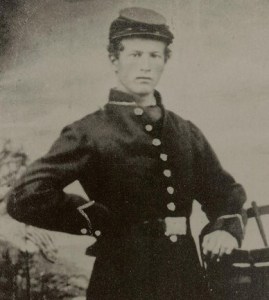
Drummer Boy William Williamson, 47th Pennsylvania Volunteers, Company A, circa 1863 (public domain).

* Williamson, William (Drummer, Company A): A farmer from Stockertown, Northampton County, William Williamson was documented by a mid-nineteenth-century federal census enumerator as an unmarried laborer who lived at the Easton home of Northampton County physician John Sandt, M.D.—an indication that William’s parents may have either died or were struggling so much financially during the 1850s and early 1860s that they had encouraged him to “leave the nest” and begin supporting himself, or had hired him out as an apprentice or indentured servant; like so many other young men from Northampton County, when President Abraham Lincoln issued his call for help to protect the nation’s capital from a likely invasion by Confederate States Army troops, he stepped forward, raised his hand, and stated the following:

I, William Williamson appointed a private in the Army of the United States, do solemnly swear, or affirm, that I will bear true allegiance to the United States of America, and that I will serve them honestly and faithfully against all their enemies or opposers whatsoever, and observe and obey the orders of the President of the United States, and the orders of the officers appointed over me, according to the rules and articles for the government of the Armies of the United States.

Later in life, William Williamson became a champion for an older woman who had been struggling to convince officials of the federal government that she was worthy enough to be awarded a U.S. Civil War Mother’s Pension, after her son had died in service to the nation as a Union Army soldier.

Post-war, William Williamson found work at a slate quarry, married, began a family in Belfast, Northampton County, and lived to witness the dawn of a new century. Following his death at the age of sixty in Plainfield Township on June 17, 1901, he was laid to rest at the Belfast Union Cemetery.


Sources:

  1. “A Badge from Admiral Dewey and Schuylkill County” (announcements of Timothy Grant Snyder’s service on Admiral Dewey’s flagship). Reading, Pennsylvania: Reading Eagle: October 3, 1899 and November 21, 1899.
  2. Baptismal, census, marriage, military, death, and burial records of the Snyder family. Pennsylvania, California, Florida, Louisiana, Massachusetts, Nevada, Ohio, etc.: Snyder Family Archives, 1650-present; and in Historic Pennsylvania Church and Town Records (baptismal, marriage, death and burial records of various churches across Pennsylvania). Philadelphia, Pennsylvania: Historical Society of Pennsylvania, 1776-1918.
  3. Bates, Samuel P. History of Pennsylvania Volunteers, 1861-5, vol. 1. Harrisburg, Pennsylvania: B. Singerly, State Printer, 1869.
  4. James Crownover, James Downs and Samuel Kern, et. al., in Camp Ford Prison Records. Tyler, Texas: The Smith County Historical Society, 1864.
  5. Civil War Muster Rolls, 1861-1866 (47th Pennsylvania Infantry). Harrisburg, Pennsylvania: Pennsylvania State Archives.
  6. Civil War Veterans’ Card File, 1861-1866 (47th Pennsylvania Infantry). Harrisburg, Pennsylvania: Pennsylvania State Archives.
  7. Registers of Deaths of Volunteers, U.S. Army; Admissions Ledgers, U.S. National Homes for Disabled Volunteer Soldiers; federal burial ledgers, and national cemetery interment control forms, 1861-1935. Washington, D.C.: U.S. Office of the Adjutant General (Record Group 94), U.S. National Archives and Records Administration.
  8. Schmidt, Lewis. A Civil War History of the 47th Regiment of Pennsylvania Veteran Volunteers. Allentown, Pennsylvania: Self-published, 1986.
  9. U.S. Census Records, 1830-1930. Washington, D.C.: U.S. National Archives and Records Administration.
  10. U.S. Civil War Pension Records, 1862-1935. Washington, D.C.: U.S. National Archives and Records Administration.
Research Update: Additional New Details Learned About Bristor Gethers, One of the Nine Formerly Enslaved Men Who Enlisted with the 47th Pennsylvania Volunteers

Page one of the U.S. Army’s Civil War enlistment paperwork for Bristor Gethers (mistakenly listed as “Presto Garris”), 47th Pennsylvania Volunteer Infantry, Company F, October 5, 1862 (U.S. National Archives and Records Administration, public domain; click to enlarge).

Fleeing the brutal experience of chattel slavery in Georgetown County, South Carolina, a thirty-three-year-old Black man was willing to enlist for military service in the fall of 1862 as an “undercook”—a designation within the United States Army that was first authorized by the U.S. War Department on September 28, 1863—in order to ensure his freedom in America’s Deep South during the American Civil War.

Arriving at a federal military recruiting depot in Union Army-occupied Beaufort, South Carolina, that man—Bristor Gethers—was certified as fit for duty by Dr. William Reiber, an assistant surgeon with the 47th Pennsylvania Volunteer Infantry, and was then accepted into that regiment on October 5, 1862 by Captain Henry Samuel Harte, a German immigrant who had been commissioned as the commanding officer of that regiment’s F Company.

The reason that officers of the 47th Pennsylvania Volunteer Infantry were able to enroll Bristor Gethers, along with three additional formerly enslaved men that fall (roughly three months before U.S. President Abraham Lincoln officially issued the nation’s Emancipation Proclamation), was because the U.S. Congress had previously passed the Militia Act of 1862 on July 17, 1862, which authorized state and federal military units in Union-held territories to recruit and enroll enslaved and free Black men to fill labor-related jobs.

According to section twelve of that legislation, starting on that date, President Lincoln was “authorized to receive into the service of the United States, for the purpose of constructing intrenchments, or performing camp service or any other labor, or any military or naval service for which they may be found competent, persons of African descent, and such persons shall be enrolled and organized under such regulations, not inconsistent with the Constitution and laws, as the President may prescribe” while the next three sections specified the following additional details of that military service:

SEC. 13. And be it further enacted, That when any man or boy of African descent, who by the laws of any State shall owe service or labor to any person who, during the present rebellion, has levied war or has borne arms against the United States, or adhered to their enemies by giving them aid and comfort, shall render any such service as is provided for in this act, he, his mother and his wife and children, shall forever thereafter be free, any law, usage, or custom whatsoever to the contrary notwithstanding: Provided, That the mother, wife and children of such man or boy of African descent shall not be made free by the operation of this act except where such mother, wife or children owe service or labor to some person who, during the present rebellion, has borne arms against the United States or adhered to their enemies by giving them aid and comfort.

SEC. 14. And be it further enacted, That the expenses incurred to carry this act into effect shall be paid out of the general appropriation for the army and volunteers.

SEC. 15. And be it further enacted, That all persons who have been or shall be hereafter enrolled in the service of the United States under this act shall receive the pay and rations now allowed by law to soldiers, according to their respective grades: Provided, That persons of African descent, who under this law shall be employed, shall receive ten dollars per month and one ration, three dollars of which monthly pay may be in clothing.

Seeking to add more teeth to its anti-slavery legislation, the U.S. Congress then also passed the Confiscation Act of 1862 that same day, proclaiming that “every person who shall hereafter commit the crime of treason against the United States, and shall be adjudged guilty thereof, shall suffer death, and all his slaves, if any, shall be declared and made free.”

General Orders No. 323 (enlistment and pay of undercooks of African descent), U.S. War Department and Office of the Adjutant General, September 28, 1863 (U.S. Library of Congress, public domain; click to enlarge).

By taking that important step toward securing what he hoped would be permanent freedom from the plantation enslavement he had endured in South Carolina for more than three decades, Bristor Gethers was, in reality, trading one form of backbreaking labor (slavery) for another that was only marginally better because he was entering military life as an “undercook”—a designation that placed him on the very bottom of the 47th Pennsylvania’s military rosters—beneath the names of soldiers who were listed at the rank of private or drummer boy.

His status clearly improved enough over time, though, that he was willing to stay with the 47th Pennsylvania Volunteer Infantry for nearly the entire duration of its service to the nation. Traveling with the 47th to Florida, where the regiment was stationed on garrison duty at Forts Taylor and Jefferson from late December 1862 through early February 1864, he likely participated side by side with the regiment’s white soldiers as they felled trees, built new roads and engaged in other similar tasks designed to strengthen the fortifications of those federal installations. It was during this same time that he would have learned from his commanding officer, Captain Harte, that President Abraham Lincoln had officially issued the Emancipation Proclamation on January 1, 1863 and that the U.S. War Department and Adjutant General’s Office had issued General Orders No. 323 on September 28th of that same year, which authorized all Union Army units “to cause to be enlisted for each cook [in each Union Army regiment] two under-cooks of African descent, who shall receive for their full compensation ten dollars per month and one ration per day” (three dollars of which could be issued to undercooks “in clothing,” rather than money).

Bristor Gethers was listed as a private on the final version of the Commonwealth of Pennsylvania’s “Registers of Volunteers, 1861-1865” for Company F of the 47th Pennsylvania Volunteer Infantry (Pennsylvania State Archives, public domain; click to enlarge and scroll down).

Promoted to the rank of Cook by the spring of 1863, according to regimental muster rolls, his duties were also likely expanded to include the job of caring for the regiment’s combat casualties by the spring and fall of 1864, when the 47th Pennsylvania was engaged in the Union’s 1864 Red River Campaign across Louisiana and the 1864 Shenandoah Valley Campaign across Virginia. In addition to rescuing and carrying wounded men from multiple fields of battle under fire as a stretcher bearer during this time, as many other undercooks in the Union Army were ordered to do, he may very well also have helped to dig the graves for his 47th Pennsylvania comrades who had been killed in action.

Apparently so well thought of by his superior officers, according to the regiment’s final muster-out ledgers, Bristor Gethers was ultimately accorded the rank of private—a hard-won title that, on paper in the present day, may seem as if it were a minor achievement.

It wasn’t. It was, in reality, historic.

About “Faces of the 47th: Freedmen of the 47th Pennsylvania Volunteer Infantry”

Faces of the 47th: Freedmen of the 47th Pennsylvania Volunteer Infantry is a special project of 47th Pennsylvania Volunteers: One Civil War Regiment’s Story, an educational program designed to teach children and adults about the history of the 47th Pennsylvania Veteran Volunteers, a Union Army regiment which served for nearly the entire duration of the American Civil War and became the only military unit from the Commonwealth of Pennsylvania to participate in the Union’s 1864 Red River Campaign across Louisiana.

This important initiative is dedicated to researching, documenting and presenting the life stories of nine formerly enslaved Black men who enlisted with the 47th Pennsylvania Volunteer Infantry during two of the regiment’s most eventful years of service to the nation—1862 and 1864. Largely forgotten for more than a century after honorably completing their historic military service, these nine men have been repeatedly overlooked by mainstream historians over the years as potentially important subjects for research and have also been an ongoing source of mystery and frustration to their descendants because the majority of their military service records have still not been digitized by state and national archives.

To learn more about the life of Bristor Gethers before, during and after the war, and to view his U.S. Civil War military and pension records, visit his profile on “Freedmen of the 47th Pennsylvania Volunteer Infantry.”


Sources:

  1. Berlin, Ira, Joseph P. Reidy, and Leslie S. Rowland. Freedom’s Soldiers: the Black Military Experience in the Civil War. Cambridge, United Kingdom: Cambridge University Press, 1998.
  2. Blight, David W. Frederick Douglass’ Civil War: Keeping Faith in Jubilee. Baton Rouge, Louisiana: Louisiana State University Press, 1989.
  3. Foner, Eric. The Fiery Trial: Abraham Lincoln and American Slavery. New York, New York: W.W. Norton, 2010.
  4. “Garris, Presto” [sic, “Gethers, Bristor”], in Civil War Veterans’ Card File, 1861-1866. Harrisburg, Pennsylvania: Pennsylvania State Archives.
  5. “Garris, Presto” [sic, “Gethers, Bristor”], in “Registers of Pennsylvania Volunteers, 1861-1865” (47th Regiment, Company F), in “Records of the Department of Military and Veterans’ Affairs” (RG-19). Harrisburg, Pennsylvania: Pennsylvania State Archives.
  6. “Garris, Presto” [sic, “Gethers, Bristor”], in U.S. Civil War Compiled Military Service Records, 1862-1865. Washington, D.C.: U.S. National Archives and Records Administration.
  7. “Garris, Presto” [sic, “Gethers, Bristor”], in U.S. Civil War General Pension Index (veteran’s pension application no.: 773063, certificate no.: 936435, filed from South Carolina, February 1, 1890; widow’s pension application no.: 598937, certificate no.: 447893, filed from South Carolina, July 27, 1894). Washington, D.C.: U.S. National Archives and Records Administration.
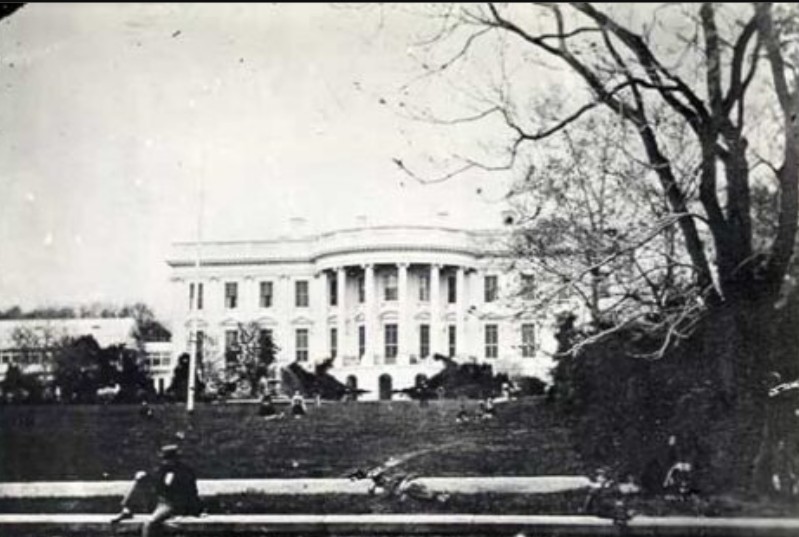
  8. “Garris, Presto” [sic, “Gethers, Bristor”], in U.S. Civil War Muster Rolls (47th Pennsylvania Volunteer Infantry, Company F), 1862-1865. Harrisburg, Pennsylvania: Pennsylvania State Archives.
  9. McPherson, James M. The Negro’s Civil War: How American Blacks Felt and Acted During the War for the Union. New York, New York: Ballantine Books, 1991.
  10. Oakes, James. The Radical and the Republican: Frederick Douglass, Abraham Lincoln, and the Triumph of Antislavery Politics. New York, New York: W. W. Norton & Co., 2007.
  11. Smith, John David. Black Soldiers in Blue: African American Troops in the Civil War Era. Chapel Hill, North Carolina: University of North Carolina, 2002.
  12. The Militia Act of 1862, in U.S. Statutes at Large, Treaties, and Proclamations of the United States of America, vol. 12, pp. 597-600: Boston, Massachusetts: Little, Brown and Company, 1863.
  13. The Confiscation Act.” New York, New York: The New York Times, July 15, 1862.
  14. The Confiscation Acts of 1861 and 1862.” Washington, D.C.: United States Senate, retrieved online January 14, 2024.


Sheridan’s 1864 Shenandoah Valley Campaign: Camp Fairview, Charlestown, West Virginia (December 20, 1864 – early April 1865)

Charlestown West Virginia, circa 1863 (public domain).

Encamped in early December 1864 with the United States Army of the Shenandoah at its winter quarters at Camp Russell, which was located just west of Stephens City (now Newtown) and south of Winchester, Virginia, the members of the 47th Pennsylvania Volunteer Infantry were learning that their stay at this Union Army complex was destined to be shorter than they had hoped. Ordered to prepare for yet another march, they were informed by their superiors that they were being reassigned yet again—this time to help fulfill the directive of Major-General Philip H. Sheridan that the Army of the Shenandoah search out and eliminate the ongoing threat posed by Confederate States Army guerrilla soldiers who had been attacking federal troops, railroad systems and supply lines throughout Virginia and West Virginia.

So, after packing up and saying goodbye to the new friends they’d made at Camp Russell, they began a new, thirty-mile march, five days before Christmas. Trudging north during a driving snowstorm on December 20, 1864, they finally reached Charlestown, West Virginia, where they quickly established their latest “new home” at Camp Fairview, which was situated roughly two miles outside of the village.

Per an 1870 edition of The Lehigh Register, while marching for Charlestown, the 47th Pennsylvania Volunteers made their way through Winchester and followed the Charlestown and Winchester Railroad line “until two o’clock the following morning” when they were forced to sleep on their arms “until daylight, the guide having lost his way.”

Initially using this camp as the regiment’s winter quarters, the 47th Pennsylvania Volunteers were soon “on constant active duty, guarding the railroad and constructing works for defense against the incursions of guerrillas. The regiment participated in a number of reconnoissances [sic] and skirmishes during the winter”—as the old year of 1864 became the New Year of 1865.

More specifically, by 1865, according to historians at the Pennsylvania State Archives, who had uncovered details about the 47th Pennsylvania’s time at Camp Fairview by reading the diaries of Jeremiah Siders of Company H, the 47th Pennsylvania Volunteers “were employed building blockhouses at all the railroad ‘posts’ (meaning loading stations).”

A Chaplain Expresses His Thoughts on the Ongoing War

Rev. William DeWitt Clinton Rodrock, chaplain, 47th Pennsylvania Volunteers, Fort Jefferson, Dry Tortugas, Florida, 1863 (courtesy of Robert Champlin, used with permission).

On New Year’s Eve in 1864, the Rev. William DeWitt Clinton Rodrock, the regimental chaplain of the 47th Pennsylvania Volunteer Infantry, penned the following words in a report to his superiors:

Camp, 47th Reg. Pa. Vet. Vol’s
Near Charlestown Va, Dec. 31st 1864

Brig. Gen’l L. Thomas,
Adj. Gen’l, U.S. Army

Sir.

I respectfully, beg leave to state that absence from the Reg. accounts for my failing to report for the previous month.

And in submitting my report for the present month it affords me great pleasure to state that the condition and morale of the Reg. is in every respect encouraging.

Of the large number of wounded in the terrible battle of Cedar Creek, Oct. 19th/64, comparatively few have died, probably fourteen, or even a less number will cover the entire loss, whilst nearly all the surviving ones, will be able to join our ranks.

No deaths have occurred in the Reg during the month, whilst few are sick in Hospital, and the health generally is good.

For some time past, the Reg. had been deficient in its quota of officers, but this deficiency is now being happily filled by suitable promotions from the ranks.

In the aggregate it now numbers 882 men. Of which 24 are officers.

In a moral and religious point of view, there is still a large margin for improvement and it is my earnest endeavor to devote all proper and available means for the spiritual welfare of the command.

Under its new organization and in the fourth year of its history, our Reg. has an encouraging future before it.

In conclusion, I may yet say that the review of our National life during the year that is about being numbered with the past, affords rare promise for the future. At no period in the history of our great contest for freedom and Unity has the prospect of returning peace, through honorable conflict, been so promising.

The efforts, the sacrifices, the patience of the loyal states and People are crowned, at last, with triumphs worthy of the holy cause of liberty.

Yet a little while, and we shall rejoice in a peace based on the everlasting foundations of Religion, Humanity, Nationality, and freedom.

For this defeat of traitors at home as well as of Rebels in arms and their sympathizers abroad, for this expression of stern and resolute purpose, for this unshrinking determination to make the last needed sacrifice, how can we be sufficiently grateful?

May the God of our fathers still smile upon us.

I have the honor, Gen’l, to remain,
Very Respectfully, Your Obed’t Serv’nt

W.D. C. Rodrock, Chap., 47th Reg. P.V.V.
2nd Brig. 1st Div. 19th A.C.

* Note: Chaplain Rodrock’s December 31, 1864 report to superiors had noticeable errors, including his significant underestimation of his regiment’s casualty figures during Sheridan’s 1864 Shenandoah Valley Campaign. During the Battle of Cedar Creek alone, more than one hundred and seventy-four members of the 47th Pennsylvania were declared killed, wounded, captured, or missing (forty killed in action, ninety-nine wounded in action, fifteen of whom later died, twenty-five captured, ten of whom later died while still being held as POWs or shortly after their release by CSA troops, nine missing, one unresolved). While he may not yet have had full casualty figures by the time he penned the report above, he would certainly have been able to at least obtain accurate figures regarding the number of men who had been killed and mortally wounded.

Page one of a report written by the Rev. William DeWitt Clinton Rodrock, 47th Pennsylvania Volunteer Infantry Regimental Chaplain, from Camp Fairview, West Virginia to his superiors, January 31, 1865 (U.S. Army, U.S. National Archives and Records Administration, public domain).

Exactly one month later, Rev. Rodrock was putting the final touches on his latest report:

Camp Fairview.
Two miles from Charlestown, Va
January 31st, 1865

Brig. Gen’l L. Thomas
Adj. Gen’l, U.S. Army

Sir.

I have the honor respectfully, to submit the following report for the present month.

Although God is not in men’s thoughts; his law being violated with impunity and his authority contemned “at will”; yet as a nation, our God is the Lord. The mind rest with pleasure on the abounding proof of this great fact. The history of the past, how full of it!

From the first planting of our Fathers on this soil, onward to this day, the true God has been claimed as ours. The foundations of our government were laid in the full and firm apprehension and acknowledgment of this fact. There is one scene recorded in our history which more than all others prove this; we have it commemorated in the engraving of the First Prayer in Congress.

There were the sages and patriots of our land – the representations of the whole country. They had reached a most critical point in their deliberations. They felt the need of higher wisdom than their own. They call in the minister of God, the servant of Jesus Christ; and there and then, in most affecting, service, our country – our whole country is laid at the foot of the Divine throne.

If ever there was heartfelt acknowledgment of a living and true God, and most hearty and sincere invocation of his favor, it was there. For themselves, for their living countrymen, for those to come after them, they cast their all on God, and bound themselves and all to him! Most touching and ever-memorable scene! Worthy the occasion and worthy of a great nation. In this spirit the Christian and the patriot, whether in civic or military life strive to labor, and should fire all hearts and nerve all arms in our present fiery struggle for universal freedom.

I am happy to report the favorable and healthy condition of the Reg. Our aggregate is 891. Of these 19 are transiently on the sick list. No deaths have occurred during the month.

We employ all available means for promoting the temporal and spiritual welfare of the command.

Having a large library of select books, I am prepared to meet the wants of the men in this direction.
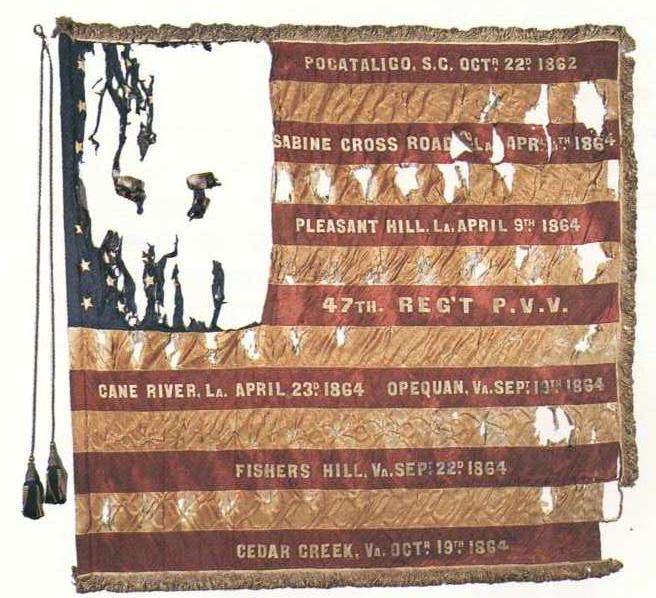
Besides I distribute several hundred religious papers among them every week. I am convinced, by experience, that this is one of the effectual and welcome means of gaining the attention of the mass of the men to religious truth, and keeping up the tie between them and the Church at home.

Ever striving to labor with an eye single to the glory of God and our country.

I have the honor,
Gen’l to remain
Your Obed’t Servant

W. D. C. Rodrock
Chaplain, 47th Reg. P.V.V.
2nd Brig. 1st Div. 19th Corps

Page one of a report written by the Rev. William DeWitt Clinton Rodrock, 47th Pennsylvania Volunteer Infantry Regimental Chaplain, from Camp Fairview, West Virginia to his superiors, February 28, 1865 (U.S. Army, U.S. National Archives and Records Administration, public domain).

While Rev. Rodrock’s next monthly report conveyed the following to his superiors:

Camp Fairview
Near Charlestown, Va
Feb. 28th 1865

Brig. Gen. L. Thomas
Adj. Gen’l U.S. Army

Sir.

I have the honor herewith, to present my report for the month of February.

That blessed peace whose type and emblem is our holy Gospel it is as yet not ours to enjoy. The stern alarums of war still resound in the ears of the nation. And as our victorious columns are marching on, they are sounding the death-knell of the so called Southern Confederacy.

In the strange system and series of paradoxes which make up human life, it often happens that the very disciples of “good will” and brotherly love must buckle on the harness of war. Such emphatically is the case in our present contest. Nor should it be otherwise.

Even our Saviour [sic] came not to bring peace, but a sword until the right should triumph and the sword be beat to a ploughshare. And as our present struggle involves on our side, all that is worthy living for and all that is worth dying for, it may very well fire all hearts and nerve all arms in its behalf.

The Flag which Hernando Cortes carried in that most extraordinary of expeditions in Mexico had for its device, flames of fire on a white and blue ground, with a red cross in the midst of the blaze, and the following words on the borders as a motto, ‘Amici, Crucem sequamur, et in hoc signo vincemur!’ Friends, let us follow the cross, and, trusting in that emblem we shall conquer!’

In these more enlightened times, with more intelligent soldiers, with a purer Church at our back, and with a holier cause, we will keep the motto of Cortes steadily before our eyes; and in personal as in national experience, we shall turn the war into a blessing to the country and to humanity.

It gives me great pleasure to report the improved condition and general good health of the Reg. A large influx of recruits has materially increased our numbers; making our present aggregate 954 men, including 35 commissioned officers.

The number of sick in the Reg. is 22; all of which are transient cases, and no deaths have occurred during the month.

Whilst in a moral and religious point of view there is still a wide margin for amendment and improvement; it is nevertheless gratifying to state that all practicable and available means are employed for the promotion of the spiritual and physical welfare of the command.

And in this connection, I desire to mention our indebtedness to the U.S. Christian Commission for furnishing us with a large supply of excellent reading matter and such delicacies as are highly useful for the Hospital.

That God is in this war of rebellion, that he has brought it upon us, that He over rules it, that its issues are in his hand, that he intends to teach us and the whole world some of the greatest and most sublime lessons ever taught in his providential dealings since the world began, is becoming more and more manifest.

To Him, we will ascribe all Honor and Glory, now and forever.

I have the honor, Gen’l, to remain
Respectfully, Your Obed’t Servant.

W. D. C. Rodrock,
Chaplain, 47th Reg. P.V.V.
2nd Brig. 1st Division, 19th A.C.

Page one of a report written by the Rev. William DeWitt Clinton Rodrock, 47th Pennsylvania Volunteer Infantry Regimental Chaplain, from Camp Fairview, West Virginia to his superiors, March 31, 1865 (U.S. Army, U.S. National Archives and Records Administration, public domain).

In his final report from Camp Fairview, Rev. Rodrock wrote:

Camp Fairview.
Near Charlestown, Va.
March 31st/65

Brig. Gen’l L. Thomas
Adj. Gen’l U.S. Army

Sir.
I have the honor herewith, to transmit my report for the present month.

Very Respectfully Yours,

W. D. C. Rodrock
Chapl’n, 47th Reg. P. Vols


Camp Fairview
Two Miles from Charlestown, Va.
March 5th/65

Brig. Gen’l L. Thomas
Adj. Gen., U.S. Army

Sir.

I hereby enclose my report for Feb. It having been returned from Brig. Hd. Qrts, to be forwarded direct. In accordance with Gen’l  Orders No 158, dated Apl. 13th 1864, I hitherto forwarded my reports through the “usual military channels”. Why I am now ordered to forward direct, is not clear to my mind. Would you have the kindness to forward me any orders issued since the one of the above date & bearing on the duties of Chaplains etc.

If any have been issued, I never recd [sic] them.

I have the honor, Gen’l
To remain, respectfully,
Your Obed’t Servant

W. D. C. Rodrock
Chap. 47th Reg. P.V.V.
2nd Brig. 1st Div. 19th Corps
Washington, D.C.


Camp Fairview, Va.
March 31st 1865

Brig. Gen’l L. Thomas
Adj. Gen’l, U.S. Army

Sir.

Amidst the general glory and success attending our arms on land and sea, it is my pleasant duty to report also the favorable and improved condition of our Reg. for the present month.

In a military sense it has greatly improved in efficiency and strength. By daily drill and a constant accession of recruits, these desirable objects have been attained. The entire strength of the Reg. rank and file is now 1019 men.

Its sanitary condition is all that can be desired. But 26 are on the sick list, and these are only transient cases. We have now our full number of Surgeons, – all efficient and faithful officers.

We have lost none by natural death. Two of our men were wounded by guerillas, while on duty at their Post. From the effects of which one died on the same day of the sad occurrence. He was buried yesterday with appropriate ceremonies. All honor to the heroic dead.

In a moral and religious point of view, we can never attain too great a proficiency. And in our Reg. like in all others, the vices incident to army life prevail to a considerable extent, whatever means may be employed for their restraint.

Still it affords me pleasure to state, that every possible facility is extended the men for moral and religious culture. Divine services are held whenever practicable, and a good supply of moral and religious reading matter, in the form of books and papers, is furnished to the command.

Glory be to the Father and to the Son, and to the Holy Ghost; as it was in the beginning, is now, and ever shall be, world without end.

I have the honor, Gen’l
To remain, Respectfully
Your Obed’t. Servant.

W. D. C. Rodrock
Chapl’n, 47th Reg. P.V. Vols

Another New Mission, Another March

“The capitulation and surrender of Robt. E. Lee and his army at Appomattox C.H., Va. to Lt. Gen. U.S. Grant. April 9th 1865” (Kurz & Allison, 16 September 1885, U.S. Library of Congress, public domain).

According to The Lehigh Register, as the end of March 1865 loomed, “The command was ordered to proceed up the valley to intercept the enemy’s troops, should any succeed in making their escape in that direction.”

By April 4, 1865, the 47th Pennsylvania Volunteers had made their way back to Winchester, Virginia and were headed for Kernstown. Five days later, they received word that General Robert E. Lee had surrendered the Confederate Army of Northern Virginia to Union General Ulysses S. Grant at Appomattox on April 9, 1865. The long war appeared to be over.

But it wasn’t. In a letter penned to the Sunbury American on April 12, 47th Pennsylvanian Henry Wharton described the celebration that took place following Lee’s surrender while also explaining to residents of his hometown that Union Army operations in Virginia were still continuing in order to ensure that the Confederate surrender would hold:

Letter from the Sunbury Guards.
CAMP NEAR SUMMIT POINT, Va.,
April 12, 1865

Since yesterday a week we have been on the move, going as far as three miles beyond Winchester. There we halted for three days, waiting for the return or news from Torbett’s cavalry who had gone on a reconnoisance [sic] up to the valley. They returned, reporting they were as far up as Mt. Jackson, some sixty miles, and found nary an armed reb. The reason of our move was to be ready in case Lee moved against us, or to march on Lynchburg, if Lee reached that point, so that we could aid in surrounding him and [his] army, and with Sheridan and Mead capture the whole party. Grant’s gallant boys saved us that march and bagged the whole crowd. Last Sunday night our camp was aroused by the loud road of artillery. Hearing so much good news of late, I stuck to my blanket, not caring to get up, for I suspected a salute, which it really was for the ‘unconditional surrender of Lee.’ The boys got wild over the news, shouting till they were hoarse, the loud huzzas [sic] echoing through the Valley, songs of ‘rally round the flag,’ &c., were sung, and above the noise of the ‘cannons opening roar,’ and confusion of camp, could be heard ‘Hail Columbia’ and Yankee Doodle played by our band. Other bands took it up and soon the whole army let loose, making ‘confusion worse confounded.’

The next morning we packed up, struck tents, marched away, and now we are within a short distance of our old quarters. – The war is about played out, and peace is clearly seen through the bright cloud that has taken the place of those that darkened the sky for the last four years. The question now with us is whether the veterans after Old Abe has matters fixed to his satisfaction, will have to stay ‘till the expiration of the three years, or be discharged as per agreement, at the ‘end of the war.’ If we are not discharged when hostilities cease, great injustice will be done.

The members of Co. ‘C,’ wishing to do honor to Lieut. C. S. Beard, and show their appreciation of him as an officer and gentleman, presented him with a splendid sword, sash and belt. Lieut. Beard rose from the ranks, and as one of their number, the boys gave him this token of esteem.

A few nights ago, an aid [sic] on Gen. Torbett’s staff, with two more officers, attempted to pass a safe guard stationed at a house near Winchester. The guard halted the party, they rushed on, paying no attention to the challenge, when the sentinel charged bayonet, running the sharp steel through the abdomen of the aid [sic], wounding him so severely that he died in an hour. The guard did his duty as he was there for the protection of the inmates and their property, with instruction to let no one enter.

The boys are all well, and jubilant over the victories of Grant, and their own little Sheridan, and feel as though they would soon return to meet the loved ones at home, and receive a kind greeting from old friends, and do you believe me to be

Yours Fraternally,
H. D. W.

Two days later, that fragile peace was shattered when a Confederate loyalist fired the bullet that ended the life of President Abraham Lincoln.


Sources:

  1. Camp Russell.” The Historical Marker Database, retrieved online December 27, 2023.
  2. Civil War, 1861-1865.” Stephens City, Virginia: Newtown History Center, retrieved online December 27, 2023.
  3. Diaries of Jeremiah Siders (Company H. 47th Pennsylvania Volunteer Infantry), in “Pennsylvania Military Museum Collections, 1856-1970” (MG 272). Harrisburg, Pennsylvania: Pennsylvania State Archives.
  4. Dyer, Frederick H. A Compendium of the War of the Rebellion, p. 1589. Des Moines, Iowa: The Dyer Publishing Company, 1908.
  5. Letters home from ”H.D.W.” and the “Sunbury Guards.” Sunbury, Pennsylvania: Sunbury American, 1864-1865.
  6. Noyalas, Jonathan. The Fight at Cedar Creek Was Over. So Why Couldn’t Union Troops Let Their Guard Down? Arlington, Virginia: HistoryNet, 27 February 2023.
  7. Reports and Other Correspondence of W. D. C. Rodrock, Chaplain, 47th Pennsylvania Volunteer Infantry (Record Group R29). Washington, D.C.: U.S. National Archives and Records Administration, 1864-1865.
  8. “The History of the Forty-Seventh Regt. P. V.” Allentown, Pennsylvania: The Lehigh Register, July 20, 1870.


Sheridan’s 1864 Shenandoah Valley Campaign: Camp Russell, Stephens City, Virginia (November 1864 – December 20, 1864)

General J. D. Fessenden’s headquarters, U.S. Army of the Shenandoah at Camp Russell near Stephens City (now Newtown) in Virginia (Lieutenant S. S. Davis, Frank Leslie’s Illustrated Newspaper, December 31, 1864, public domain; click to enlarge).

Erected in November 1864 on grounds that were adjacent to the Opequon Creek, just west of Stephens City (now Newtown) and south of Winchester, Virginia, by Union Army troops operating under the command of Major-General Philip H. Sheridan, Camp Russell was the site where the 47th Pennsylvania Volunteer Infantry was housed from November 1864 until December 20, 1864, while it was still attached to the United States Army of the Shenandoah.

Named after Brigadier-General David A. Russell, who had been killed in action on September 19, 1864 during the Battle of Opequan (also known as “Third Winchester”), which had unfolded just over two miles away during the earlier part of Sheridan’s 1864 Shenandoah Valley Campaign, Camp Russell was built using the lumber and bricks from a neighboring African American Methodist chapel that had been dismantled by Sheridan’s troops, according to historians at the Newtown History Center.

It quickly became a two-mile-long complex that consisted of separate encampments for each of the Army of the Shenandoah’s individual regiments, as well as a hospital system, and was protected by a roughly four-mile-long system of earthworks and trenches that had been installed on both sides of the Valley Pike (south of what, today, is the intersection of Interstate 81 and Virginia Route 37).

These earthworks and trenches were subsequently connected to the Carysbrooke Redoubt on the pike’s eastern side, which ensured that the southern end of Camp Russell was also well fortified (a critical planning component since the Confederate States Army troops of Lieutenant-General Jubal Early were positioned to the south during this point in time). In addition, Camp Russell was also heavily guarded around the clock by Union Army soldiers who were assigned to scouting duties and picket details.

During this same time, C Company soldier Henry Wharton penned a new letter to the Sunbury American, his hometown newspaper:

NEAR NEWTOWN, VA. 
November 14, 1864.

DEAR WILVERT:

The day after election the entire army of the Shenandoah left their old camps at Cedar creek and fell back to this place. The reason of this was the scouts reported a force coming down the Luray Valley and the removal enabled General Sheridan to get a better position and establish lines unknown to the enemy. Intrenchments [sic] have been, and are now being constructed that will baffle the ingeniousness of the best rebel Generals, and such, that behind them our forces can repel double their numbers, and if they have the temerity to make an attack, with the number not slain or crippled by our arms, few could escape being capture. – Such is the position we now occupy.

For the last three days a considerable number of the enemy’s cavalry have been bothering our pickets, with the purpose, no doubt, of finding out our position. Our Brigade, (the 2d) was sent out to give the Johnnies a chance for a fight, but on their arrival, the cavalry of Jefferson D. fell back out of range of our rifles. Since then our cavalry went out in several directions for the purpose of giving them fight or gobble them up, the latter if possible. Brigadier General Powell took the road to Front Royal, met the graybacks, whipped them, captured one hundred and sixty prisoners, two pieces of artillery, (all they had) their caissons, ammunition, ambulances, wagon train, and drove the balance ten miles from where they first met. Of the other cavalry we have had no report as yet, but from the fact that they are led by a man who knows not defeat, the daring General Custer, we can expect news that will cheer the hearts of all who are in favor of putting down the rebellion by force of arms.

The election passed off quietly and without any military interference, not the influence of officers used in controlling any man’s vote. In the regiments from the old Keystone, the companies were formed by the first Sergeant, when he stated to the men the object for which they were called to ‘fail to,’ and then they proceeded to the election of officers to hold the election – the boys having the whole control, none of the officers interfering in the least.

Wharton went on to report the numbers of the election results by company as follows:

  • Company A (ten votes for Abraham Lincoln, one vote for George McClellan);
  • Company B (twenty-six votes for Abraham Lincoln, two votes for George McClellan);
  • Company C (twenty-nine votes for Abraham Lincoln, fifteen votes for George McClellan);
  • Company D (thirty-one votes for Abraham Lincoln, eleven votes for George McClellan);
  • Company E (twenty-four votes for Abraham Lincoln, three votes for George McClellan);
  • Company F (eighteen votes for Abraham Lincoln, sixteen votes for George McClellan);
  • Company G (nine votes for Abraham Lincoln, thirteen votes for George McClellan);
  • Company H (ten votes for Abraham Lincoln, twenty-four votes for George McClellan);
  • Company I (nineteen votes for Abraham Lincoln, sixteen votes for George McClellan); and
  • Company K (eighteen votes for Abraham Lincoln, twenty votes for George McClellan).
  • Lincoln’s Majority: 73 votes.

According to Wharton, “The battle at Cedar Creek thinned our ranks by which we lost many votes—this number and those away in hospitals would have increased the Union majority to three hundred.”

* Note: To read more of Henry Wharton’s letters from 1864, click here.

A Time of Celebration and Sadness

As evidenced by several of the letters that were written by 47th Pennsylvanians during this phase of duty, life at Camp Russell was a time of both celebration and profound heartache. According to Professor Jonathan A. Noyalas, director of Shenandoah University’s McCormick Civil War Institute:

In celebrating Maj. Gen. Philip H. Sheridan’s triumph at the Battle of Cedar Creek on October 19, 1864, newspapers across the North enthusiastically conjectured that this latest in a series of spectacular Union successes would finally end military operations in the Shenandoah Valley…. On October 23, a correspondent for Iowa’s Muscatine Evening Journal concluded the same, proclaiming, ‘Sheridan’s victory at Cedar Creek makes the third he has gained during the present campaign in the Shenandoah Valley. This last defeat will, it is more than probable, end the campaign on the part of the enemy in that region.’
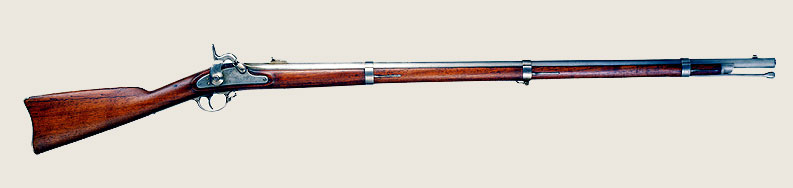
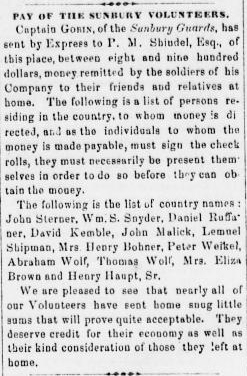
…. Yet in Sheridan’s army itself, the soldiers’ mood generally remained much more restrained, reflective, and somber. Veterans especially found it difficult to reconcile the joy of victory with the grief they felt….

Beyond such melancholy reflections, the army’s veterans also confronted the stark reality that Confederate Lt. Gen. Jubal Early likely wasn’t done yet….

In Cedar Creek’s immediate wake, continued harassment from Confederate partisans, irregulars, and bushwhackers only added to the uncertainty. Sheridan had been particularly annoyed by ‘guerrilla bands’ throughout the campaign [but] was confident these guerrillas could be curtailed by depriving them of potential manpower. On October 22, Sheridan ordered the arrest of every Confederate male civilian capable of bearing arms….

Significant Recognition for the 47th Pennsylvania’s Distinguished Service

Second State Colors, 47th Pennsylvania Veteran Volunteers, showing the battles for which the 47th Pennsylvania Volunteer Infantry was honored for its distinguished service to the United States during the American Civil War (presented to the regiment 7 March 1865).

One of the more uplifting moments in the history of the 47th Pennsylvania Volunteer Infantry occurred in late November 1864 when this regiment’s members were honored by a senior Union Army officer, Brevet Major-General William H. Emory, for their valiant service during the Union’s spring 1864 Red River Campaign across Louisiana.

GENERAL ORDERS, HDQRS. NINETEENTH ARMY CORPS, No. 12.
Camp Russell, November 22, 1864.

The following-named regiments are hereby authorized to inscribe upon their colors the names of the engagements set opposite their respective names in which they bore a distinguished part:

Thirteenth, Fifteenth, Twenty-ninth, and Thirtieth Maine Volunteers-Sabine Cross-Roads, Pleasant Hill, Cane River Crossing, La.; One hundred and fourteenth, One hundred and sixteenth, One hundred and fifty-third, One hundred and sixteenth, One hundred and sixty-second, One hundred and sixty-fifth, and One hundred and seventy-third New York Volunteers-Sabine Cross-Roads, Pleasant Hill, Cane River Crossing, La; Forty-seventh Pennsylvania Volunteers-Sabine Cross-Roads, Pleasant Hill, Cane River Crossing, La.; Thirty-eight Massachusetts, Thirteenth Connecticut, and One hundred and twenty-eight New York Volunteers-Cane River Crossing, La.

By command of Brevet Major-General Emory:
PETER FRENCH, Acting Assistant Adjutant-General.”

A War That Still Needed to Be Won

Charlestown West Virginia, circa 1863 (public domain).

Rested and somewhat healed, thanks to their stay at Camp Russell, the 47th Pennsylvania Volunteers were informed less than a month after being honored by Brigadier-General Emory that their stay at their new winter quarters was destined to be shorter than they had hoped. They were being reassigned yet again—this time to help fulfill Major-General Sheridan’s directive that the Army of the Shenandoah eliminate the continuing threat posed by Confederate guerrillas and their sympathizers.

And so, after packing up and saying goodbye to the new friends they’d made at Camp Russell, they began a new, thirty-mile march, five days before Christmas. Trudging north during a driving snowstorm, they finally reached Charlestown, West Virginia, where they quickly established their latest “new home” at Camp Fairview, and continued to soldier on.


Sources:

  1. Camp Russell.” The Historical Marker Database, retrieved online December 27, 2023.
  2. Civil War, 1861-1865.” Stephens City, Virginia: Newtown History Center, retrieved online December 27, 2023.
  3. General Orders, No. 12 (Issued by Brigadier-General William H. Emory, Camp Russell, Virginia, November 22, 1864), in The War of the Rebellion: Official Records of the Civil War: Chapter LV: “Operations in Northern Virginia, West Virginia, Maryland, and Pennsylvania: Correspondence.” Washington, D.C.: Government Printing Office, 1894.
  4. Noyalas, Jonathan . The Fight at Cedar Creek Was Over. So Why Couldn’t Union Troops Let Their Guard Down? Arlington, Virginia: HistoryNet, 27 February 2023.


Camp Griffin (also known as “Camp Big Chestnut”), Langley, Virginia

The Big Chestnut Tree, Camp Griffin, Langley, Virginia, 1861 (U.S. Library of Congress, public domain).

Located near Langley, Virginia, Camp Griffin was a key muster-in point for multiple Union Army units during the early years of the American Civil War. Originally named “Camp Big Chestnut” in recognition of the large chestnut tree that was one of the earliest defining features of the campground, it quickly became a major training base and staging area for multiple state volunteer infantry and artillery units that fought under the banner of the United States government.

During the fall of 1861, it was renamed as “Camp Griffin” to honor Captain Charles Griffin, who had distinguished himself in combat as the commanding officer of the United States Artillery’s 5th Regiment, Battery D (the “West Point Battery”) during the First Battle of Bull Run in July 1861. Griffin was then also later promoted to Brigadier-General of Volunteers on June 12, 1862.

The 47th Pennsylvania Volunteers at Camp Griffin

The Sibley tents of an unidentified Union Army regiment, Camp Griffin, Virginia, fall 1861 (U.S. Library of Congress, public domain; click to enlarge).

“Camp Big Chestnut” (later known as Camp Griffin) was the first “real home” of the 47th Pennsylvania Volunteer Infantry after its extended muster-in and basic training period at Camp Curtin in Harrisburg, Pennsylvania from August through mid-September 1861. Initially transported by rail to the Washington, D.C. area and stationed on the Kalorama Heights in the District of Columbia, the 47th Pennsylvania Volunteers were ordered to set up and tear down their camps multiple times during their earliest weeks on the job, moving from Camp Kalorama to Camp Lyon, Maryland on the Potomac River’s eastern shore during an intense, two-hour rainstorm, and then across the “Chain Bridge” into Virginia, where they briefly encamped before marching for Camp Advance near Falls Church the next day. During their brief stay there, they were situated close to Fort Ethan Allen and the headquarters of Brigadier-General William Farrar Smith (also known as “Baldy”).

Shortly after that, they were ordered to move yet again—this time, to “Camp Big Chestnut” near Langley, Virginia. They couldn’t have known it at the time, but it was here where they would spend the bulk of their assigned duties from the fall of 1861 through early January 1862.

It was from this point that they were sent out to perform picket duties and skirmish with Confederate troops that were stationed nearby, and it was here and near this camp that they continued to drill daily and participate in Grand Reviews with multiple other Union Army units to demonstrate their readiness for battle to the most senior of Union Army leaders like General George B. McClellan, commanding officer of the U.S. Army of the Potomac—and even to their commander-in-chief, President Abraham Lincoln.

It was also here that they also served as part of that Army of the Potomac (“Mr. Lincoln’s Army”), ensuring that no troops from the Confederate States Army were ever able to breach the Union’s defensive lines and enter Washington, D.C. Quite simply put, the 47th Pennsylvania Volunteer Infantry’s job was to defend the nation’s capital—a task which its members performed well and faithfully. No Rebel ever carried a Confederate flag into the U.S. Capitol Building or White House during its time on the job.

On October 11, the 47th Pennsylvania marched in a review of massed troops that was held near the camp. In his letter of  October 13 to the Sunbury American newspaper, Henry Wharton described their duties, as well as their new home:

The location of our camp is fine and the scenery would be splendid if the view was not obstructed by heavy thickets of pine and innumerable chesnut [sic] trees. The country around us is excellent for the Rebel scouts to display their bravery; that is, to lurk in the dense woods and pick off one of our unsuspecting pickets. Last night, however, they (the Rebels) calculated wide of their mark; some of the New York 33d boys were out on picket; some fourteen or fifteen shots were exchanged, when our side succeeded in bringing to the dust, (or rather mud,) an officer and two privates of the enemy’s mounted pickets. The officer was shot by a Lieutenant in Company H [?], of the 33d.

Our own boys have seen hard service since we have been on the ‘sacred soil.’ One day and night on picket, next day working on entrenchments at the Fort, (Ethan Allen.) another on guard, next on march and so on continually, but the hardest was on picket from last Thursday morning ‘till Saturday morning – all the time four miles from camp, and both of the nights the rain poured in torrents, so much so that their clothes were completely saturated with the rain. They stood it nobly – not one complaining; but from the size of their haversacks on their return, it is no wonder that they were satisfied and are so eager to go again tomorrow. I heard one of them say ‘there was such nice cabbage, sweet and Irish potatoes, turnips, &c., out where their duty called them, and then there was a likelihood of a Rebel sheep or young porker advancing over our lines and then he could take them as ‘contraband’ and have them for his own use.’ When they were out they saw about a dozen of the Rebel cavalry and would have had a bout with them, had it not been for…unlucky circumstance – one of the men caught the hammer of his rifle in the strap of his knapsack and caused his gun to fire; the Rebels heard the report and scampered in quick time….

In his own mid-October letter home, Captain John Peter Shindel Gobin, the commanding officer of C Company, reported that the right wing of the 47th Pennsylvania (companies A, C, D, F and I) was ordered to picket duty after the left-wing’s companies (B, G, K, E, and H) were forced to return to camp by Confederate troops:

I was ordered to take my company to Stewart’s house, drive the Rebels from it, and hold it at all hazards. It was about 3 o’clock in the morning, so waiting until it was just getting day, I marched 80 men up; but the Rebels had left after driving Capt. Kacy’s company [H] into the woods. I took possession of it, and stationed my men, and there we were for 24 hours with our hands on our rifles, and without closing an eye. I took ten men, and went out scouting within half a mile of the Rebels, but could not get a prisoner, and we did not dare fire on them first. Do not think I was rash, I merely obeyed orders, and had ten men with me who could whip a hundred; Brosius [sic, Brosious], Piers [sic, Pyers], Harp and McEwen were among the number. Every man in the company wanted to go. The Rebels did not attack us, and if they had they would have met with a warm reception, as I had my men posted in such a manner that I could have whipped a regiment. My men were all ready and anxious for a “fight.”

On Friday, October 22, the 47th engaged in a Divisional Review, described by historian Lewis Schmidt as “about 10,000 infantry, 1000 cavalry, and twenty pieces of artillery all in one big open field.” Four days later, Company B’s drummer boy, Alfred Eisenbraun, was dead—the second “man” from the regiment to die since the 47th Pennsylvania’s formation. (The first was another drummer boy, John Boulton Young of C Company, who was felled by smallpox at the Kalorama eruptive fever hospital in Georgetown on October 17.)

Of all of the dangerous foes the 47th Pennsylvania Volunteers would encounter during their stay at Camp Griffin, it seemed that disease would prove to be the most persistent—and deadliest. In subsequent letters home, Captain Gobin asked Sunbury residents to donate blankets for the Sunbury Guards (the men of Company C):

The government has supplied them with one blanket apiece, which, as the cold weather approaches, is not sufficient…. Some of my men have none, two of them, Theodore Kiehl and Robert McNeal, having given theirs to our lamented drummer boy when he was taken sick… Each can give at least one blanket, (no matter what color, although we would prefer dark,) and never miss it, while it would add to the comfort of the soldiers tenfold. Very frequently while on picket duty their overcoats and blankets are both saturated by the rain. They must then wait until they can dry them by the fire before they can take their rest.

In late October 1861, the men from Companies B, G and H woke at 3 a.m., according to Schmidt, assembled a day’s worth of rations, marched four miles from camp, and took over picket duties from the 49th New York:

Company B was stationed in the vicinity of a Mrs. Jackson’s house, with Capt. Kacy’s Company H on guard around the house. The men of Company B had erected a hut made of fence rails gathered around an oak tree, in front of which was the house and property, including a persimmon tree whose fruit supplied them with a snack. Behind the house was the woods were the Rebels had been fired on last Wednesday morning while they were chopping wood there.

Less than a month later, in his letter of 17 November, Henry Wharton revealed more details about life at Camp Griffin:

This morning our brigade was out for inspection; arms, accoutrements [sic], clothing, knapsacks, etc, all were out through a thorough examination, and if I must say it myself, our company stood best, A No. 1, for cleanliness. We have a new commander to our Brigade, Brigadier General Brannen [sic, Brannan], of the U.S. Army, and if looks are any criterion, I think he is a strict disciplinarian and one who will be as able to get his men out of danger as he is willing to lead them to battle….

The boys have plenty of work to do, such as piquet [sic] duty, standing guard, wood-chopping, police duty and day drill; but then they have the most substantial food; our rations consist of fresh beef (three times a week) pickled pork, pickled beef, smoked pork, fresh bread, daily, which is baked by our own bakers, the Quartermaster having procured portable ovens for that purpose, potatoes, split peas, beans, occasionally molasses and plenty of good coffee, so you see Uncle Sam supplies us plentifully….

A few nights ago our Company was out on piquet [sic, picket]; it was a terrible night, raining very hard the whole night, and what made it worse, the boys had to stand well to their work and dare not leave to look for shelter. Some of them consider they are well paid for their exposure, as they captured two ancient muskets belonging to Secessia. One of them is of English manufacture, and the other has the Virginia militia mark on it. They are both in a dilapidated condition, but the boys hold them in high estimation as they are trophies from the enemy, and besides they were taken from the house of Mrs. Stewart, sister to the rebel Jackson who assassinated the lamented Ellsworth at Alexandria. The honorable lady, Mrs. Stewart, is now a prisoner at Washington and her house is the headquarters of the command of the piquets [sic]….

Since the success of the secret expedition, we have all kinds of rumors in camp. One is that our Brigade will be sent to the relief of Gen. Sherman, in South Carolina. The boys all desire it and the news in the ‘Press’ is correct, that a large force is to be sent there, I think their wish will be gratified….

Springfield rifle, 1861 model (public domain).

On 20 November, the 47th Pennsylvania Volunteers marched in The Grand Review of the Army of the Potomac at Bailey’s Crossroads, Virginia. According to National Portrait Gallery historian James Barber:

For three hours some 70,000 polished troops marched passed the reviewing stand, where the president, members of his cabinet, and Washington dignitaries were in attendance. It was the largest military assemblage up to that time in North America. ‘The Grand Review went off splendidly,’ wrote McClellan that night in a letter to his wife, ‘not a mistake was made, not a hitch. I never saw so large a Review in Europe so well done—I was completely satisfied & delighted beyond expression.’

Among the 20,000 spectators to witness the Grand Review was the poet and social activist Julia Ward Howe of Boston, Massachusetts, who was visiting the Washington area with her husband, Dr. Samuel Gridley Howe.

After leaving the review, during the carriage ride back to Washington, she heard troops singing the song John Brown’s Body.’ A companion suggested that she should write new lyrics to the song, the melody of which lingered in her mind that night in her room at Willard’s Hotel in Washington. She awoke ‘in the gray of the morning twilight’ with the song still in her head and ‘the long lines of the desired poem began to twine themselves in my mind.’ She arose quickly and in the dimness of the early hour she began scribbling the verses on stationery ‘almost without looking at the paper.’

Her poem, The Battle Hymn of the Republic, was first published in The Atlantic Monthly in February 1862; the magazine paid her five dollars. Soon thereafter her verse was set to music and her inspirational song became a wartime favorite….

The November 30, 1861 edition of the Sunbury American carried the good news of pay sent home to loved ones by Sunbury’s boys in blue (public domain; click to enlarge).

The next day, according to Schmidt, the regiment participated in a morning divisional headquarters review overseen by the 47th Pennsylvania’s commanding officer, Colonel Tilghman H. Good, followed by brigade and division drills all afternoon. According to Schmidt, “each man was supplied with ten blank cartridges.” Afterward, “Gen. Smith requested Gen. Brannan to inform Col. Good that the 47th was the best regiment in the whole division.” As a reward—and in preparation for bigger things to come, Brannan obtained new Springfield rifles for every member of the 47th Pennsylvania.

As November came to a close, Captain Gobin helped a number of Sunbury Guardsmen to send a total of $900 from their collective pay back home to their families and friends in Pennsylvania. The editors of the Sunbury American subsequently announced the names of the family members and others who could expect to receive the sorely needed financial support from their boys in blue via a special notice in the newspaper’s November 30, 1861 edition.

Winter Quarters at Camp Griffin

Sketch of the 47th Pennsylvania Volunteers’ winter quarters at Camp Griffin, near Langley, Virginia, by Second Lieutenant William H. Wyker, Company E, December 1861 (public domain).

As fall deepened and progressed into winter, the 47th Pennsylvania Volunteer Infantry was ordered to batten down the hatches and establish its winter quarters—during a time when the guns on both sides of the war fell silent as snow blanketed Virginia, making it nearly impossible for Union and Confederate troops to march over the slippery, icy farm grounds around them—let alone drag their artillery into fighting positions in order to continue blasting away at one another.

It was simply too cold and too miserable to expend energy as combatants. But there were lighter moments as well.

Quartermaster James VanDyke procured a holiday surprise for the 47th Pennsylvania Volunteers (Sunbury American, December 21, 1861, public domain).

According to the December 21, 1861 edition of the Sunbury American, Regimental Quartermaster James Van Dyke, who was enjoying an approved furlough at home in Sunbury, Pennsylvania, was able to procure “various articles of comfort, for the inner as well as the outer man.” Upon his return to camp, many of the 47th Pennsylvanians of German heritage were pleasantly surprised to learn that the well-liked former sheriff of Sunbury had thoughtfully brought a sizable supply of sauerkraut with him. The German equivalent of “comfort food,” this favored treat warmed stomachs and lifted more than a few spirits that first cold winter away from loved ones.

Also, in a letter written sometime around Christmas 1861, Captain Gobin reported that Private John D. Colvin had been detailed to special duty with the signal corps in Washington, D.C. while Musician Henry D. Wharton, increasingly known to folks back home for his letters to the Sunbury American, had assumed additional responsibilities as a clerk who was assigned to the staff of Brigadier-General Brannan at Brigade Headquarters.

As fall fell away, the 47th Pennsylvania Volunteers continued to wait for better weather, hunkered down in their sturdier, winter quarters at Camp Griffin, remaining here until January 22, 1862, when the regiment was ordered to pack up and march for the railroad station at Falls Church. Transported from there by rail to Alexandria, they then sailed the Potomac via the steamship City of Richmond to the Washington Arsenal, where they were reequipped before being marched off for dinner and rest at the Soldiers’ Retreat in Washington, D.C. The next afternoon, they hopped cars on the Baltimore & Ohio Railroad, and headed for Annapolis, Maryland.

Arriving around 10 p.m., they were assigned quarters in barracks at the United States Naval Academy. They then spent that Friday through Monday (January 24-27, 1862) loading their equipment and other supplies onto the steamship Oriental, before sailing away at 4 p.m. that final afternoon. They were headed for America’s far warmer Deep South—and a very long time away from the arms of their loved ones and the comforts of home.

To learn more about the 47th Pennsylvania’s next phase of duty, read “Late Winter through Early Spring 1862 (Florida): Serving as Soldiers and Surrogates for Family.”


Sources:

  1. Bates, Samuel P. History of Pennsylvania Volunteers, 1861-5, vol 1. Harrisburg, Pennsylvania: B. Singerly, State Printer, 1869.
  2. Gobin, John Peter Shindel. Personal Letters, 1861-1865. Northumberland, Pennsylvania: Personal Collection of John Deppen.
  3. Lincoln and McClellan: An Army Ready for War.” Washington, D.C.: National Portrait Gallery, retrieved online December 1, 2023.
  4. Schmidt, Lewis G. A Civil War History of the 47th Regiment of Pennsylvania Veteran Volunteers. Allentown, Pennsylvania: Self-published, 1986.
  5. Wharton, Henry D. Letters from the Sunbury Guards. Sunbury, Pennsylvania: Sunbury American, 1861-1868.


Uniforms and Insignia of the 47th Pennsylvania Volunteer Infantry

Captain Richard A. Graeffe, Company A, 47th Pennsylvania Volunteers, circa 1862 (public domain).

Upon mustering in at Camp Curtin in Harrisburg, Pennsylvania in August and early September of 1861, the men who had enrolled for military service with the 47th Pennsylvania Volunteer Infantry were assigned to their respective companies and issued standardized uniforms—the same style of dark blue, wool uniforms that were worn by the regular officers or enlisted members of the U.S. Army. The uniform of Captain Richard Graeffe (pictured at right) shows the typical details of a company commander’s uniform with shoulder bars, hat and sword.

Initially equipped with Mississippi rifles, the 47th Pennsylvania Volunteers were then provided with basic training in light infantry tactics through mid-September. Presented with the regiment’s First State Color on September 20, 1861 by Pennsylvania Governor Andrew Curtin, they were subsequently marched to Harrisburg’s train station, and were transported to Washington, D.C., where they participated in the first of multiple duty assignments that would take them from the Eastern Theater of the American Civil War to the Western and Trans-Mississippi theaters between early 1862 and March of 1864 before being transported back to the Eastern Theater for the fateful and tide-turning Shenandoah Valley Campaign, which unfolded during the summer and fall of 1864.

Army of the United States, Corps Badges, 1865 (U.S. Library of Congress, public domain; click to enlarge).

Along the way, the 47th Pennsylvania Volunteer Infantry would be attached to the:

  • U.S. Army of the Potomac (“Mr. Lincoln’s Army”) in the Eastern Theater (1861);
  • U.S. Army’s Tenth Corps (X Corps) in the Western Theater (Occupying force duties and battles in Florida and South Carolina, early winter 1862 through early winter 1864);
  • U.S. Army’s Nineteenth Corps (XIX Corps) in the Trans-Mississippi Theater (Red River Campaign, spring and early summer 1864);
  • U.S. Army of the Shenandoah, Nineteenth Corps (XIX Corps) in the Eastern Theater (Battle of Cool Spring and Sheridan’s 1864 Shenandoah Valley Campaign, summer and fall 1864);
  • U.S. Army of the Shenandoah, Nineteenth Corps (XIX Corps) in the Eastern Theater (Defense of Washington, D.C., late winter 1864 through the immediate aftermath of the assassination of President Abraham Lincoln in 1865);
  • Selected units of the U.S. Army’s former Nineteenth Corps (XIX Corps (Reconstruction duties in Savannah, Georgia and Charleston, South Carolina, June through late December 1865); and
  • Camp Cadwalader (final discharge, early January 1866).
Each time that the 47th Pennsylvania Volunteers were attached to a different Union Army corps, they were issued specific insignia that were then sewn onto their uniforms. The chart pictured above shows the different insignia that were worn by the various Union corps’ members.