Finding Your 47th Pennsylvanian: The Surprising Details in Pennsylvania’s Civil War-Era Muster Rolls

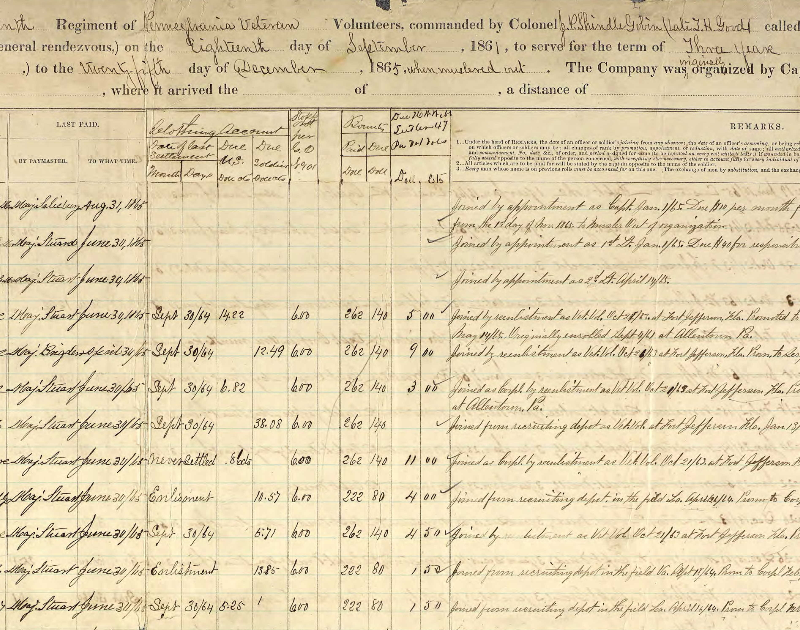
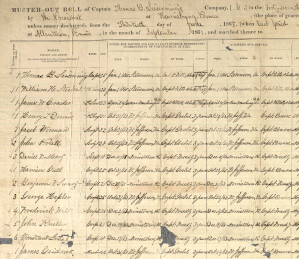
Excerpt of muster-out roll, Company G, 47th Pennsylvania Volunteer Infantry, December 25, 1865, page one (Pennsylvania Civil War Muster Rolls, Pennsylvania State Archives, public domain; click to enlarge).

The Commonwealth of Pennsylvania’s collection of Civil War-era muster rolls is another of the three major tools that beginning, medium and advanced researchers initially turn to for help in determining which Pennsylvania military unit(s) a soldier served with during the American Civil War. Unfortunately, it is also a resource that often does not receive the close attention from researchers that it should.

Those who have chosen to spend significant time looking through the individual documents contained in this collection have come to understand that, in addition to confirming the identity of a soldier’s regiment and company, as well as his rank(s) at enrollment and final discharge, Pennsylvania’s Civil War-era muster rolls are also useful for documenting when and where that soldier enrolled and mustered in for service and whether or not he had some change to his status while serving, such as a promotion, reduction in rank or charge of desertion — and possibly data which documented whether or not he was wounded or killed in battle and, if so, when and where.

Physically created as hard-copy index cards that were later preserved by the Pennsylvania State Archives in Harrisburg, Pennsylvania, as part of the “Civil War Muster Rolls and Related Records” group of documents from the Pennsylvania Department of Military and Veterans Affairs’ archives (Series RG:-019-ADJT-11, 1861-1866, 1906), this collection includes muster rolls from each of Pennsylvania’s volunteer infantry and volunteer militia regiments, emergency volunteer militia regiments that were formed during the summer of 1863 in response to the looming invasion of the commonwealth by the Confederate States Army, United States Colored Troops (USCT), United States Veteran Volunteer regiments and Hancock Veterans Corps, regiments of the Veterans Reserve Corps, and independent or other unattached units. Preserved on microfilm decades ago by the Commonwealth of Pennsylvania, a portion of this large collection has since been partially digitized and made available on the Ancestry.com website as “Pennsylvania, U.S., Civil War Muster Rolls, 1860-1869.”

* Note: Although Ancestry.com is a subscription-based genealogy service that generally requires users to pay for access to its records collections, the Commonwealth of Pennsylvania entered into a partnership with Ancestry.com several years ago “to digitize family history records in the State Archives and make them available online.” As part of that agreement, Ancestry.com created Ancestry.com Pennsylvania to provide free access to Pennsylvania residents to the Pennsylvania records it has digitized. If you reside in Pennsylvania and want to learn more about how you may obtain free access to those records, please contact the Pennsylvania State Archives for guidance. If you reside elsewhere, check with your local library to determine if it offers access to Ancestry.com as part of its service to library users.

What May Researchers Find with This Resource?
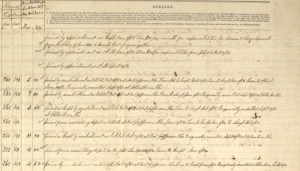
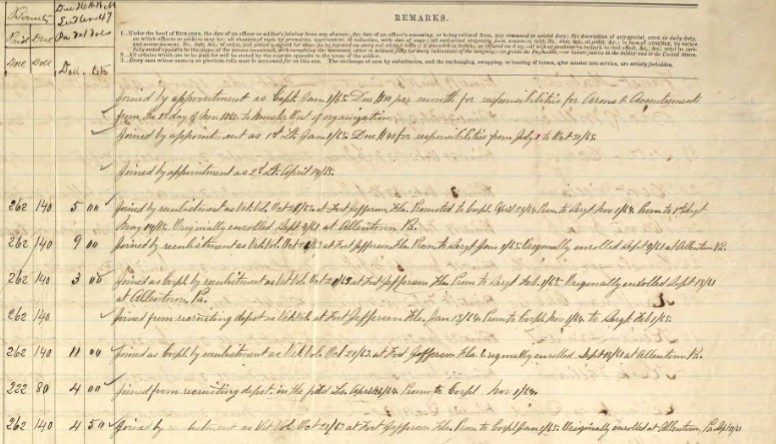
Excerpt from muster-out roll, Company G, 47th Pennsylvania Volunteer Infantry, December 25, 1865, showing soldiers’ promotions, status as Veteran Volunteers, etc. (Pennsylvania State Archives, public domain; click to enlarge).

According to personnel at the Pennsylvania State Archives, Pennsylvania’s Civil War Muster Rolls and Related Records collection includes:

“Alphabetical Rolls. The rolls are arranged alphabetically by the soldiers’ surnames. Entries usually give the name, rank, civilian occupation, and residence, the unit, regiment, company, and commanding officer, and the date and place where the roll was taken. Particulars about sickness or injury are also sometimes noted.

“Descriptive Lists of Deserters. Lists give the names, ages, places of birth, height, hair and eye color, civilian occupations, and ranks of deserters, the units, regiments, and companies to which they were assigned, and the dates and places from which they deserted.

“Muster-In Rolls. Entries usually list the name, age, rank, unit, regiment, and company of the soldier, the date and place where enrolled, the name of the person who mustered him in, the term of enlistment, the date of mustering in, and the name of commanding officer. Remarks concerning promotions and assignments are sometimes recorded.

“Muster-Out Rolls. The dated lists ordinarily give the soldier’s name, age, rank, unit, regiment, and company, the date, place, and person who mustered him in, the period of enlistment, and the name of the commanding officer. Particulars concerning pay earned, promotions, capture by the enemy and the like also regularly appear.

“Muster and Descriptive Rolls. Generally the rolls give the name, age, town or county and state or kingdom of birth, civilian occupation, complexion, height, eye and hair color, and rank, the unit, regiment, company and commanding officer, and the amount of money received for pay, bounties, and clothing. Rolls for assigned United States black troops are included in this group. Included throughout are such related materials as regimental accounts of action, and correspondence related to infractions of military procedures, correspondence from soldiers addressed to the governor expressing grievances or petitioning for promotion.

“The data found in the documents of this series were used to create the Civil War Veterans Card File, 1861-1866 (Series 19.12).”

Be Sure to Look for Data Regarding Soldiers’ Pay

Excerpt from muster-out roll for Company G, 47th Pennsylvania Volunteer Infantry, showing soldiers’ pay data, December 25, 1865 (Pennsylvania State Archives, public domain).

One of the most fascinating features found on the muster-out rolls for Pennsylvania volunteer soldiers is that many of the infantry unit clerks took the time to meticulously record the pay data for multiple members of their respective regiments. As a result, present-day researchers are often able to determine how much bounty pay a particular soldier was eligible for at the time of his enlistment — and how much of that promised pay he actually received, as well as how much money he still owed the United States government for his army uniform, rifle and ammunition at the time of his discharged from the military.

Another striking feature on the muster-out rolls is the “Last Paid” column, which corroborates the shocking fact that many Union Army soldiers were expected to perform their duties, even though they were not being paid regularly — a data point that also may help to shed light on why some soldiers’ families faced greater hardship than others (because some soldiers were able to send part of their pay home while others were not).

Caveat Regarding Ancestry.com’s Collection Related to the 47th Pennsylvania Volunteer Infantry
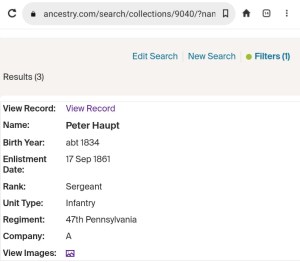
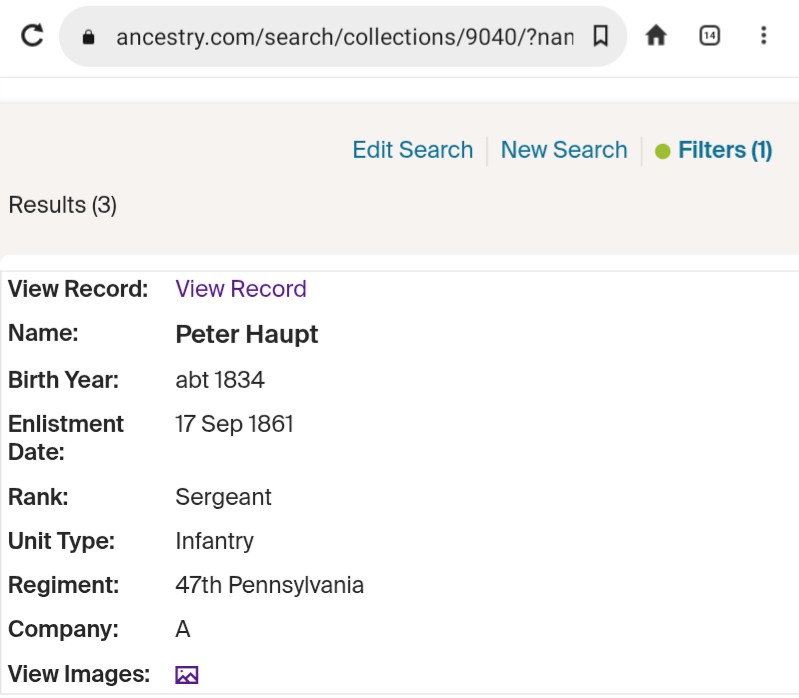
Screenshot of Ancestry.com’s record detail page for Peter Haupt, which incorrectly identifies him as a member of Company A, 47th Pennsylvania Volunteer Infantry, instead of Company C (fair use for illustration purpose, October 2025).

Although Ancestry.com’s collection of Pennsylvania Civil War-era muster rolls can be a useful tool for researchers, there is a significant problem with records related to the 47th Pennsylvania Volunteer Infantry that merits closer scrutiny — the inaccurate transcription of soldiers’ data. That scrutiny is needed because the muster rolls from the 47th Pennsylvania’s Company C were mixed together with the muster rolls from Company A when they were posted to Ancestry.com’s website, making it appear, when browsing through those rolls, that all of the soldiers listed on every single one of those incorrectly grouped muster rolls were all members of Company A, when they were not.

Complicating things further, the Ancestry.com personnel who were assigned to transcribe the data from each of those muster rolls and create Record Detail pages for each individual soldier that summarized each soldier’s data from the muster roll on which it appeared, apparently did not realize that the muster rolls from Companies A and C of the 47th Pennsylvania Volunteer Infantry had been mixed together. As a result, those transcribers incorrectly described every soldier from that improperly sorted muster roll group as a member of Company A, when they were not. (See attached image.)

So, when reviewing Ancestry.com’s collection of muster rolls, it is vitally important that researchers not take the transcribed data found on any of the Record Detail pages of 47th Pennsylvania muster rolls at face value. Instead, researchers should double check the data found on those muster rolls for the 47th Pennsylvania Volunteer Infantry against the data for individual soldiers published by Samuel P. Bates in his History of Pennsylvania Volunteers, 1861-5, volume 1, and should also then re-check that data against the information of individual soldiers that is contained in the Pennsylvania Civil War Veterans Index Card File, 1861-1866.

* Note: This is particularly important if you are a family historian who is hoping to identify the specific company in which your ancestor served. (And you will definitely want to know which company your ancestor served with because each company of the 47th Pennsylvania Volunteer Infantry was assigned to different duties in different locations at different times during the regiment’s service.)

Caveat Regarding “Deserters”
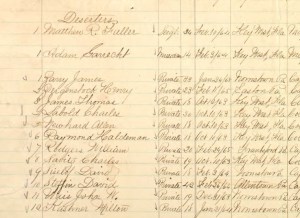
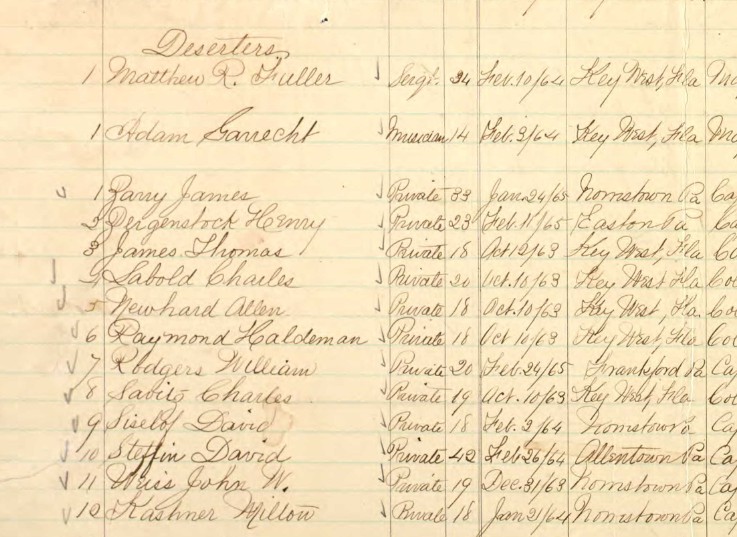
Private Milton P. Cashner, Company B, 47th Pennsylvania Volunteer Infantry, was incorrectly labeled as a deserter on this regimental muster roll from the American Civil War (Pennsylvania State Archives, public domain; click to enlarge).

If a muster roll entry for your ancestor noted that he was a deserter, it’s also important that you not take that label at face value, either, because that data may also be incorrect. Military records from the Civil War era contained a surprising number of errors, a fact that is understandable when considering what the average army clerk was expected to do — keep track of more than a thousand men, many of whom ended up becoming separated from their regiment and confined to Union Army hospitals after being wounded in battle. (Wounded too severely to identify themselves to army personnel, they were then often mis-identified by army hospital personnel and then also incorrectly labeled as “deserters” by their own regiments because they hadn’t shown up for post-battle roll calls.) So, it’s important to double and triple check the data for any ancestor who was labeled as a “deserter” because he might actually have been convalescing at a hospital and not absent without leave.

Honoring Our Ancestors 

One of the best ways to honor ancestors who fought to preserve America’s Union is to pass their stories along to future generations. No embellishment required. Their willingness to volunteer for military service and the bravery they displayed as they ran toward danger and certain death during one of America’s darkest times speaks for itself.

Our job, as students of American History, educators and family historians is to ensure that their stories are told as accurately and thoroughly as possible so that their valor and love of community and country are never forgotten.

Remember their names. Tell and re-tell their stories. Honor the sacrifices that they made.


Sources:

  1. “Ancestry Pennsylvania,” in “Agencies: Pennsylvania Historical and Museum Commission,” in “Pennsylvania State Archives.” Harrisburg, Pennsylvania: Commonwealth of Pennsylvania, retrieved online October 25, 2025.
  2. Civil War Muster Rolls and Related Records” (resource description). Harrisburg, Pennsylvania: Pennsylvania State Archives, retrieved online October 30, 2025.
  3. Pennsylvania,” in Collections. Lehi, Utah: Ancestry.com Operations, Inc., 2021 (retrieved online October 25, 2025).


Finding Your 47th Pennsylvanian: Using the Pennsylvania Civil War Veterans Card File, 1861-1866

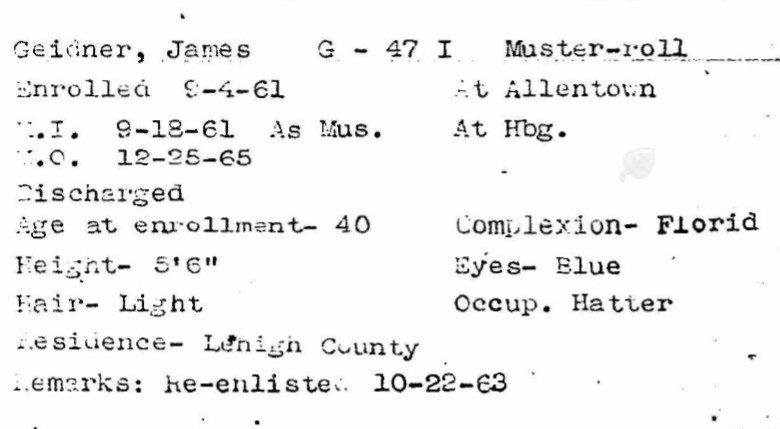
The index card of Field Musician James Geidner, Company G, 47th Pennsylvania Volunteer Infantry (Pennsylvania Civil War Veterans Card File, 1861-1866, courtesy of the Pennsylvania State Archives).

The Pennsylvania Civil War Veterans Index Card File, 1861-1866 is one of three resources that beginning, medium and advanced researchers frequently turn to for help in determining which Pennsylvania military unit(s) a soldier served with during the American Civil War. Physically housed at the Pennsylvania State Archives in Harrisburg, Pennsylvania, as part of the Pennsylvania Department of Military and Veterans Affairs’ archives (Series RG-019-ADJT-12), this collection of individual index cards was preserved on microfilm decades ago by the Commonwealth of Pennsylvania and then later digitized and made available, free of charge, on the State Archives’ website via a user-friendly portal, enabling researchers nationwide to search or browse, alphabetically, through each of the index cards that had been created for the majority of Pennsylvanians who had served with the Union Army (as well as the non-Pennsylvanians who had also served with Pennsylvania units). According to Pennsylvania State Archives personnel:

“These 3 x 5 cards were initially prepared to serve as an index to Samuel Penniman Bates’ History of Pennsylvania Volunteers, 1861-1865, (Harrisburg, 1869-1871). The Office of the Adjutant General later expanded the scope of the cards by transcribing onto them data found on the original documents. Among the information generally found are the soldiers’ names, military units, and ages at enrollment, the dates and places where enrolled, the dates and places where mustered in, and the dates of discharge. Physical descriptions (complexion, height, color of hair and eyes), residences, birthplaces, promotions and wounds also are sometimes included. The listing is not comprehensive.”

That last sentence is an important caveat because, while this index card system can be a helpful primary source for basic data about individual soldiers, it does not contain the name of every single Pennsylvanian who served with the Union Army during the Civil War. In addition, a significant number of the index cards contain errors (incorrect spellings of soldiers’ names, soldiers labeled as deserters when they had actually been honorably discharged or hospitalized to due battle wounds or illness, etc.).

* Note: Those faults are understandable, however, when considering that the index cards were based on data compiled by Samuel Bates for his History of Pennsylvania Volunteers, 1861-5a five-volume series of books that included rosters of soldiers for each Pennsylvania regiment that served during the American Civil War. The errors in Bates’ History are also understandable as you come to understand that Samuel Bates was assigned the task, during the mid-1860s, of summarizing thousands and thousands of muster rolls generated by Pennsylvania military units during the war — many of which were also filled with errors because the army clerks assigned to maintain those rolls were often unable to create accurate records as their regiments were being marched into battle or from one duty station to another.

Another more recent issue with this system is that its portal to the digitized index cards that was so easy to browse and search for free is now no longer available on the Pennsylvania State Archives’ website. The index cards are still available, however, to researchers who travel to Harrisburg to view the microfilmed version at the State Archives, as well as to online researchers via Ancestry.com as “Pennsylvania, U.S., Veterans Card Files, 1775-1948.” (Although Ancestry.com is a subscription-based genealogy service that generally requires users to pay for access to its records collections, the Commonwealth of Pennsylvania entered into a partnership with Ancestry.com several years ago “to digitize family history records in the State Archives and make them available online.” As part of that agreement, Ancestry.com created Ancestry.com Pennsylvania to provide free access to Pennsylvania residents to the Pennsylvania State Archives records it has digitized. If you reside in Pennsylvania and want to learn more about how you may obtain free access to those records, please contact the Pennsylvania State Archives for guidance. If you reside elsewhere, check with your local library to see if it offers access to Ancestry.com as part of its service to library users.)

Despite those issues, the Pennsylvania Civil War Veterans Index Card File, 1861-1866 remains a useful tool for finding your 47th Pennsylvanian because it may help you confirm your ancestor’s place of residence during the early 1860s and may also provide you with an approximate year of birth for him.

Additional Important Tips for Using This Resource

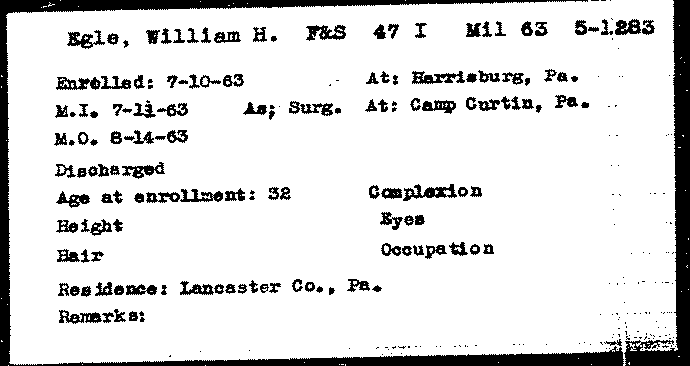
The index card of William H. Egle, M.D. shows that this soldier served with the 47th Pennsylvania Militia, Emergency of 1863 and not the 47th Pennsylvania Volunteer Infantry (Pennsylvania Civil War Veterans Card File, 1861-1866, courtesy of the Pennsylvania State Archives).

If you are able to find an index card for your ancestor in the Pennsylvania Civil War Veterans Index Card File, 1861-1866, pay particular attention to the top line of that card’s data. That data identifies the regiment number and company letter of his military unit. Then also look at the lines of data below. (Those lines of text note the start and dates of his service.) If you see dates of service indicating that your ancestor served between mid-April 1861 and the end of July 1861, you will realize that the regiment number in the top line was not “47.” This means that your ancestor performed what is known as “Three Months’ Service,” that he actually served with a different regiment during the first months of the war, and that he then may also have served with the 47th Pennsylvania Volunteer Infantry at a later date (because the 47th Pennsylvania Volunteer Infantry was not established until August 5, 1861). So, you’re one of those 47th Pennsylvania descendants who needs to look for two or more index cards in the Pennsylvania Civil War Veterans Index Card File, 1861-1866 — one for your ancestor’s “Three Month Service” and one for his service with the 47th Pennsylvania Volunteer Infantry (which was initially most likely a three-year term of enlistment, but may have been a one or two-year term, depending on how late he was enrolled for service).

HOWEVER, if you see dates of service indicating that your ancestor served at any point during 1863 — AND, if the top line indicates that his regiment was “47 I Mil 63” — this means that your ancestor DID NOT serve with the 47th Pennsylvania Volunteer Infantry. He served with the 47th Pennsylvania Militia, Emergency of 1863. (The soldiers who served with that militia group were also brave and honorable men, but they were part of a very different unit that had a very different mission. Learn more about that militia unit here.)

Regardless of whether or not your ancestor “performed Three Months’ Service” during the earliest part of the Civil War, if you see dates of service indicating that your ancestor served at any point between August 5, 1861 and early January 1866 — AND if the top line indicates that his regiment was “47 I” — then you can be reasonably confident that your ancestor actually did serve with the 47th Pennsylvania Volunteer Infantry (also known as the 47th Pennsylvania Volunteers or the 47th Pennsylvania Veteran Volunteers). So, you should make yourself a cup of coffee or tea, find a comfy chair, and spend some quality time exploring our website to learn more about the history-making 47th Pennsylvania Volunteer Infantry.

Best wishes for success with your research! Let us know what you learn about your ancestor!!


Sources:

  1. “Ancestry Pennsylvania,” in “Agencies: Pennsylvania Historical and Museum Commission,” in “Pennsylvania State Archives.” Harrisburg, Pennsylvania: Commonwealth of Pennsylvania, retrieved online October 25, 2025.
  2. Civil War Veterans Card File, 1861-1866” (resource description). Harrisburg, Pennsylvania: Pennsylvania State Archives, retrieved online October 25, 2025.
  3. Pennsylvania,” in Collections. Lehi, Utah: Ancestry.com Operations, Inc., 2021 (retrieved online October 25, 2025).


Finding Your 47th Pennsylvanian: Use “Bates’ History” — But With Caution

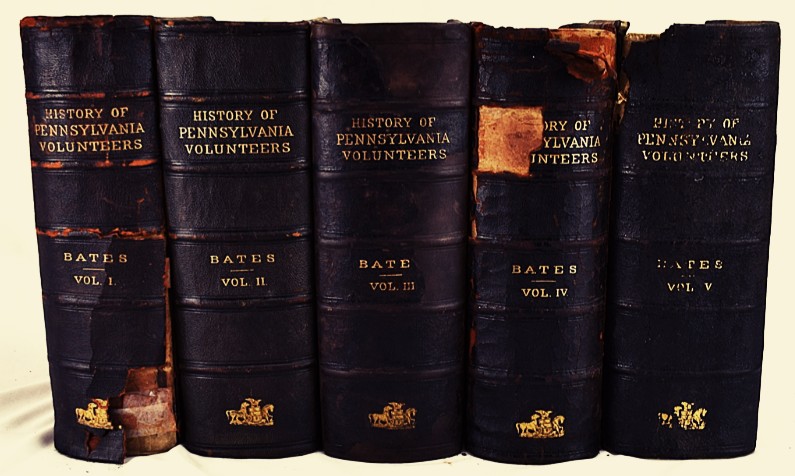
“History of Pennsylvania Volunteers, 1861-5,” Samuel P. Bates, 1869-1871 (public domain).

“So long as differences arise among nations, which cannot be settled by peaceful conference, and appeals are made to the arbitrament of the sword, the only safety that remains to the government is in the courage of its soldiery. In the late sanguinary struggle, the national unity was preserved, and the perpetuity of democratic institutions secured, by the men who bore the musket, and who led in the deadly conflict. Argument and moral sentiment were at fault, diplomacy was powerless, and courage proved the only peacemaker.

“In recognition of their services, and as a mark of the appreciation in which their valor is held, the Legislature of Pennsylvania authorized the preparation of a record of each of the military organizations in the field since 1861.” 

— Samuel P. Bates, “Preface,” History of Pennsylvania Volunteers, 1861-5


One of the first pieces of advice that archivists, librarians and professional genealogists will often give to descendants of Pennsylvania Volunteer Infantrymen when beginning their research of soldier-ancestors is to “Check Bates’ History,” which often results in descendants responding with, “What’s that?” and “Where Can I Find It?”

“Bates’ History” is, in fact, a five-volume series of books entitled, History of Pennsylvania Volunteers, 1861-5; Prepared in Compliance with Acts of the Legislature, that was researched, written and published during the mid-1860s through the early 1870s by Samuel Penniman Bates, an American educator and historian. Appointed in 1864 as state historian of the Commonwealth of Pennsylvania by Pennsylvania Governor Andrew Gregg Curtin, Bates was subsequently commissioned by the governor on June 1, 1866 to fulfill a legislative directive that “a military history of the organization of Pennsylvania volunteers and militia, who have been, or may be in the field” be researched, written and published for the public record. Bates was then given additional instructions by the Pennsylvania Legislature on April 17, 1867 “that the military history of the Pennsylvania volunteers … embrace an account of the organization, and services in the field, of each regiment, together with a roll giving the name, age, and residence of each officer and soldier, the date and term of enlistment, the promotions, the discharges, and casualties, and the places of burial of those who died in service.”

Thanks to that foresight by elected officials from Pennsylvania and Bates’ Herculean effort, generations of genealogists and academic historians have since visited historical societies and libraries across Pennsylvania and beyond to peruse increasingly worn copies of Bates’ books in order to learn more about the history of a specific regiment and confirm the names of that regiment’s leaders and rank and file members.

Access to Bates’ data was then made even easier by technological advancements in library science with the digitization of Bates’ books. As a result, family historians and other researchers no longer need to schlep to libraries to hunker down over their desired dusty tomes because Bates’ complete series has been accessible online, free of charge since 2012, thanks to HathiTrust, a collaborative effort between multiple academic institutions across the United States that is headquartered at the University of Michigan’s main campus in Ann Arbor. (“Go Blue!”)

This highly user-friendly format presented by HathiTrust allows users to not only read or browse each volume, but to also search for a specific soldier’s name by entering that name into the search textbox for the volume where that soldier’s name would most likely be located.

With respect to members of the 47th Pennsylvania Volunteer Infantry, that book would be Bates’ first volume. So, to find your 47th Pennsylvanian:

  1. Pull up volume one of Bates;
  2. Click on the downward-facing arrow of the black “Options” line near the top of the webpage you’re now seeing;
  3. Click on “Search in This Text”;
  4. Enter your ancestor’s name in that text box, between quotation marks, beginning with his last name, followed by a comma, one space, and his given name (example: “Clouser, Ephraim”); and
  5. Click the magnifying glass.

That search should pull up a new webpage that lists the page(s) in Bates’ first volume on which your ancestor’s name might appear — if your ancestor actually did serve with the 47th Pennsylvania Volunteer Infantry. Each of those items on that list will have an active link that will take you to the specific page in Bates’ first volume on which your ancestor is listed (or may take you to a page on which someone who had the same name as your ancestor is listed; so double check the data to be sure you’re looking at data for the correct soldier).

But if your search does not pull up a page(s) with your ancestor’s name, it may mean that your ancestor did not actually serve with the 47th Pennsylvania Volunteer Infantry — or that Bates spelled your ancestor’s name incorrectly.

Caveat Emptor

“Let the buyer beware” — or in this case “Caveat Scholaris” (“Let the student beware.”) While Bates History can be a helpful starting point for research regarding the 47th Pennsylvania Volunteer Infantry, each volume in the series contains significant errors — understandable when considering that Bates was tasked with summarizing the myriad number of muster rolls generated by hundreds of Pennsylvania military units that were staffed by more than three hundred and sixty thousand soldiers from Pennsylvania during the American Civil War. (And many of those original muster rolls were filled with errors because the Union Army clerks assigned to maintain those rolls simply could not create or update records when their regiments were being moved from one duty station to another as they marched into, or retreated from, battlefields scattered throughout three theaters of war that spread across multiple states in the Union and Confederacy.)

That being said, Bates left future generations of Pennsylvanians with a useful, detailed and reasonably accurate record of Pennsylvania’s role in the American Civil War. So, by all means, use Bates’ History to further your research; just don’t rely on it as your sole source of data.

As you go about finding your 47th Pennsylvanian, always double check the new data you find against the regiment’s original muster rolls and against other sources, such as the individual U.S. Civil War Pension file(s) for your ancestor and his parents, widow and/or children — records that are often chock full of new data and are maintained by the U.S. National Archives and Records Administration. (More information about those pension records is available online here.)


Sources:

  1. “A State History of Our Pennsylvania Regiments.” Philadelphia, Pennsylvania: The Daily Evening Telegraph, January 19, 1867.
  2. Bates, Samuel P. History of Pennsylvania Volunteers, 1861-5; Prepared in Compliance with Acts of the Legislature, volumes 1-5. Harrisburg, Pennsylvania: B. Singerly, State Printer, 1869-1871 (full text search and browse options available through HathiTrust, University of Michigan).
  3. Hodge, Ruth E. “Samuel Penniman Bates Papers, 1853-1895,” in “Guide to African American Resources at the Pennsylvania State Archives.” Harrisburg, Pennsylvania: Pennsylvania Historical and Museum Commission, 2000.
  4. Royer, Douglas L. Guide to Civil War Holdings of the Pennsylvania State Archives. Harrisburg, Pennsylvania: Pennsylvania State Archives, 2001.


Finding Your 47th Pennsylvanian: Begin Your Search Using Our Website

Each company history page on the 47th Pennsylvania Volunteers’ website includes a link to that company’s browsable roster of members. The search box allows researchers to search for soldiers’ names or historical data about the regiment using a single word or phrase (website screenshot, © Laurie Snyder, 2025).

Whether you’re confident or merely have a hunch that one of your ancestors served with the 47th Pennsylvania Volunteer Infantry during the American Civil War, one of the quickest ways to learn more about him is to use our website’s search and browse capabilities because we may have already done some of your research for you.

If you already know which unit of the 47th Pennsylvania your ancestor served in (field and staff officers, medical staff, regimental band, or a specific company — A, B, C, D, E, F, G, H, I, or K), start by looking for your ancestor’s name on that unit’s roster on our main website: 47thpennsylvaniavolunteers.com.

At a minimum, you will likely find your ancestor’s name and rank, as well as the dates of his muster-in and end of service. You may also find that your ancestor’s name has an active link that, when clicked on, will either take you to a full bio that we’ve already researched and published for him on our website, or will take you to a memorial for him on Find A Grave that may give you more data about him such as his birth and death dates and locations, the name and location of the cemetery where he is buried and, hopefully, the names of your ancestor’s parents, siblings, spouse, and children.

If you aren’t sure which unit your ancestor served in, however, you might want to try looking for his name by using our textbox search tool. First, search for him by placing his name between quotation marks — surname first, followed by a comma, single space and his given name (example: “Jumper, Amos”), and click your return key. That should pull up a new page that lists the company roster entry for him, as well as a list of other rosters on our website where his name might also appear (battle casualties, immigrants and first generation Americans, post-war westward migration, etc.).

If that doesn’t work, try searching for his name by using spelling variants (example: “Reinhard, Allen” instead of “Reinhart, Allen”). Or adjust your phrase so that you’re searching with your ancestor’s given name first and are searching with and without middle initials (example: “Tilghman Good” or “Tilghman H. Good”).

If you still don’t find your ancestor, don’t despair. You simply have a research puzzle that is just waiting to be solved.

It may be that your ancestor is a 47th Pennsylvania Volunteer Infantryman who isn’t yet listed on our rosters because we’re still searching for documentation that will confirm his membership with the regiment. (Or it may be that your ancestor served with an entirely different regiment altogether. The 47th Pennsylvania Militia, Emergency of 1863 has often been confused with the 47th Pennsylvania Volunteer Infantry, for example.)

In our next article, we’ll explore the next steps you might want to take as you go about “Finding Your 47th Pennsylvanian.”

Finding Your 47th Pennsylvanian

Whether you’re a history teacher, middle or high school student, university-level researcher, or descendant of a soldier who served with the 47th Pennsylvania Volunteer Infantry during the American Civil War, it may feel like an impossible task to learn more about the life of someone who lived and died more than a century ago.

But it may be much easier for you than you realize.

From finding and confirming a specific soldier’s identity to documenting when and where he served in the military (and what his duties might have been) — to identifying the names of a soldier’s family members from great-grandparents to great-grandchildren, there are multiple tools available that can help you begin and deepen your research. That’s why we’re launching a new feature on our website during Family History Month — a series of periodic “tips and tricks” articles that are designed to help you progress along the way in your journey from preliminary researcher to soldier’s biographer. Look for those articles over the next several months under the heading of “Finding Your 47th Pennsylvanian.”

Welcome to the hunt!

Peeling Onions: Researching and Writing the Biographies You Read at “47th Pennsylvania Volunteers: One Civil War Regiment’s Story”

“Life is like an onion; you peel it off one layer at a time and sometimes you weep.”

— Carl Sandburg


The lives of the men who served with the 47th Pennsylvania Volunteer Infantry during the American Civil War are like onions waiting to be peeled to our researchers at 47th Pennsylvania Volunteers: One Civil War Regiment’s Story.

Each time we decide to take on a new biography, we begin by carefully peeling away each layer of a soldier’s life to reveal the heart of each man, and, when we do, we often weep at what we have uncovered.

So many of the men who served with the 47th Pennsylvania Volunteer Infantry were just average Americans who gave the last full measure of devotion during the American Civil War to preserve our nation’s union—not just for themselves, but for future generations they would never meet.

We hope that perspective comes through each time you read one of the biographies we have created for this educational project, and that, after you do, you’ll not only continue to remember the names of the soldiers you’ve learned about, but that you’ll do all you can to honor the individual and collective sacrifices that they made during the American Civil War.

Each of us, today, owes each of them an enormous debt.