Battle of Sabine Cross Roads/Mansfield, Louisiana, April 8, 1864 — Casualties and POWs from the 47th Pennsylvania Volunteer Infantry

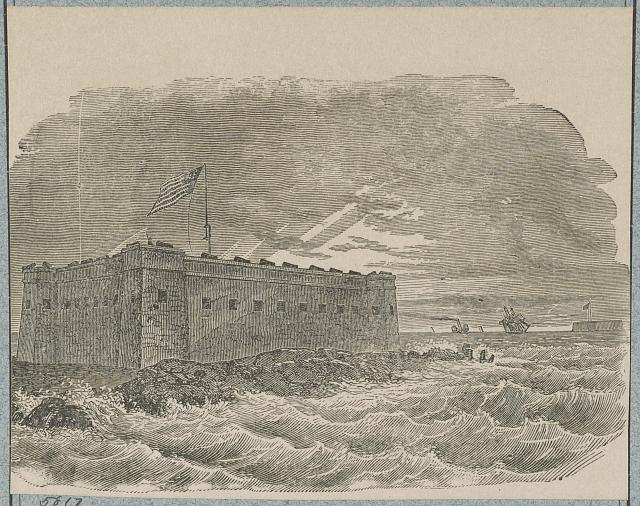
Battle of Sabine Cross Roads/Mansfield, Louisiana (Frank Leslie’s Illustrated Newspaper, 14 May 1864, public domain).

At 4 p.m. Louisiana time on April 8, 1864, during the American Civil War, the left flank of the Confederate States Army, which was commanded by Major-General Richard Taylor, slowly began an echelon formation attack on troops commanded by Union Major-General Nathaniel Banks, forcing the Union’s cavalry line to buckle. During the first fourteen minutes of the opening charge of this combat engagement, which later became known as the Battle of Sabine Cross Roads (by Union troops) and the Battle of Mansfield (by Confederate troops), eleven out of fourteen Confederate officers were killed in action.

Shortly thereafter, Banks’ left Union flank also collapsed, and Taylor’s troops continued forward, puncturing a secondary Union Army position three quarters of a mile behind the Union’s front line.

In response, Banks ordered Brigadier-General William Emory to move his 1st Division, 19th U.S. Army Corps to the front. Among Emory’s 5,859 men were nine New York regiments, three from Maine—and the 47th Pennsylvania Volunteer Infantry. Ninety minutes and seven miles of marching later, Emory’s men waited for the Confederates on the ridge above Chapman’s Bayou.

* Note: The 47th Pennsylvania Volunteers were positioned behind the 161st New York, 29th Maine, and other Union regiments at or near the farm of Joshua Chapman, about five miles southeast of Mansfield, Louisiana. The battles here were termed the “Peach Orchard” fight by Confederates and “Pleasant Grove” by 47th Pennsylvanians—a name attributed by several historians to the live oak trees in front of Chapman’s house. The fighting at the peach orchard was particularly brutal.

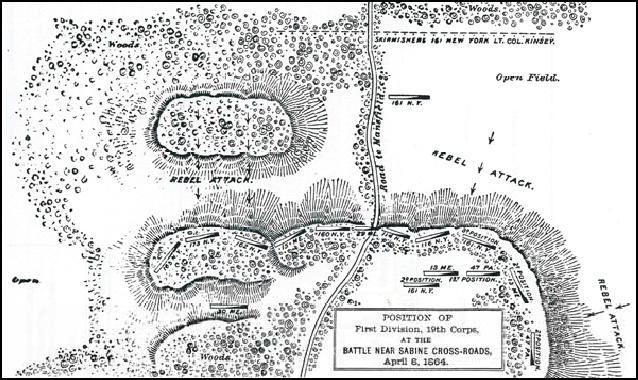
19th U.S. Army Map, Phase 3, Battle of Sabine Cross Roads/Mansfield (8 April 1864, public domain; click to enlarge).

Confederate troops next attacked the center of the Union line, causing the lines of the 161st New York Volunteers to buckle; the 29th Maine stood firm, however, and repulsed the enemy.

In response, Confederates from the 1st, 26th, 36th, and other Texas Cavalry units then attempted an end run on the Union’s right flank, but the 47th Pennsylvania Volunteers were ready for them. Initially positioned to the right of the 13th Maine Infantry, the 47th Pennsylvania and 13th Maine marched into the fray, pinwheeling to head off an attack by the cavalry group led by Confederate Brigadier-General Thomas Green, halting that flanking maneuver.

As darkness fell on April 8, 1864, the fighting gradually waned and then finally ceased as exhausted troops on both sides collapsed between the bodies of their dead comrades. Although the full scope of the carnage was not immediately evident, Union rosters were eventually updated, confirming that seventy-four men were dead, at least one hundred and sixty-one were wounded, and hundreds more were declared missing in action, including one hundred and eighty-eight soldiers from the 19th U.S. Army (to which the 47th Pennsylvania was attached). Some of these missing men (including men from the 47th Pennsylvania) were subsequently found and declared as wounded or dead; others (including 47th Pennsylvanians) ended up as prisoners of war (POWs), at Camp Ford, which was located near Tyler, Texas and was the largest Confederate prison located west of the Mississippi River.

Sadly, a significant number of 47th Pennsylvania Volunteers remain missing to this day, having been hastily interred somewhere on or near the Mansfield battlefield sites by fellow soldiers or local residents. (No remains were found during archaeological excavations of the area during the late twentieth and early twenty-first centuries, but one possible answer to the mystery surrounding the burial locations of these men was in provided in 1996 by L. P. Hecht, who reported in Echoes from the Letters of a Civil War Surgeon, that wild hogs had eaten the remains of at least some of the federal soldiers who had been left unburied.)

The abridged lists below partially document the members of the 47th Pennsylvania Volunteer Infantry who were declared as wounded in action, killed in action, missing in action, or captives of the Confederate States Army (POWs) after the Battle of Sabine Cross Roads/Mansfield:

Killed or Wounded in Action:

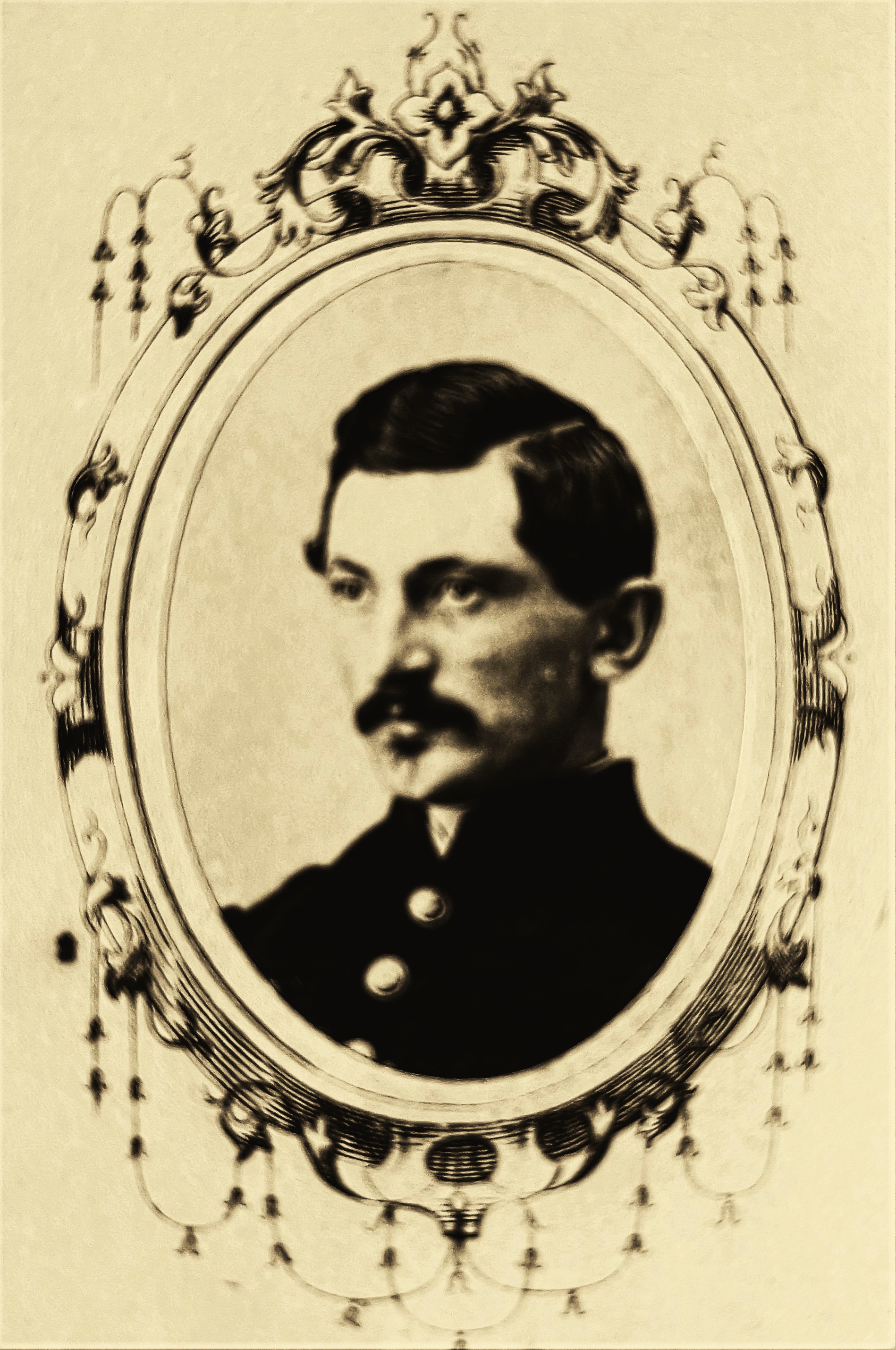
Second Lieutenant Alfred Swoyer, Company K, 47th Pennsylvania Volunteers, circa 1862 (public domain)

Barry, William: Private, Company H; killed in action during the Battle of Sabine Cross Roads/Mansfield, Louisiana on 8 April 1864.

Fries, John: Private, Company B: Wounded in action during the Battle of Sabine Cross Roads/Mansfield, Louisiana on 8 April 1864; recovered and returned to service with Company B; honorably mustered out from the 47th Pennsylvania on 29 June 1865.

Haas, Jeremiah: Private, Company C; survived breast and face wounds sustained during the Battle of Pocotaligo, South Carolina on 22 October 1862; killed in action during the Battle of Sabine Cross Roads/Mansfield, Louisiana on 8 April 1864.

Marshall, Charles L. (alias: Lothard, Thomas): Private, Company C; survived gunshot wound(s) to his head and/or body during the Battle of Pocotaligo, South Carolina on 22 October 1862; sustained additional gunshot wounds to the top of his head, the right side of his body and/or arm, and his left shin during the Battle of Sabine Cross Roads/Mansfield, Louisiana on 8 April 1864; recovered and returned to duty a second time; was honorably mustered out on 5 July 1865; lived out his later years at the U.S. National Soldiers’ Home in Marion, Indiana, and was interred at that Soldiers’ Home Cemetery following his death there.

McIntire, John (alternate spelling: McIntyre): Private, Company H; wounded in action during the Battle of Sabine Cross Roads/Mansfield, Louisiana on 8 April 1864; recovered and returned to duty with Company H; killed in action during the Battle of Cedar Creek, Virginia on 19 October 1864.

Nipple, Thomas: Private, Company C; wounded in the stomach during the Battle of Sabine Cross Roads/Mansfield, Louisiana on 8 April 1864; recovered and returned to duty with Company C; was honorably discharged on 25 December 1865.

Sanders, Francis (alternate spellings: Xander, Xandres): Corporal, Company B; wounded in action during the Battle of Sabine Cross Roads/Mansfield, Louisiana on 8 April 1864; died shortly after being carried to the rear by his brother; burial location unknown; his death was documented in the obituary of his widow, Henrietta Susan (Balliet) Sanders, in the 15 May 1916 edition of Allentown’s Morning Call newspaper, which reported that Francis Sanders “enlisted in the Forty-seventh regiment and saw service for two enlistments until the battle of Sabine Cross Roads, La., where he was wounded and carried to the rear by his brother. From that day to this not a word was heard from him and the supposition was that he died from his wounds….” That obituary also stated that Francis Sanders was likely interred in an unknown, unmarked grave.

Seip, Lewis H.: Private, Company B; wounded in the leg during the Battle of Sabine Cross Roads/Mansfield, Louisiana on 8 April 1864; recovered and returned to duty with Company B; was promoted to the rank of corporal on 19 September 1864; although reported as having been dishonorably discharged on 4 October 1865 in Samuel P. Bates’ History of Pennsylvania Volunteers, 1861-5, per other records, he mustered out with his regiment on 25 December 1865.

Swoyer, Alfred P.: Second Lieutenant, Company K; killed instantly after being struck by a minié ball in the right temple during the Battle of Sabine Cross Roads/Mansfield, Louisiana on 8 April 1884; burial location unknown.


Captured and Held as Prisoners of War (POW):

This image depicts life at Camp Ford, the largest Confederate Army prison camp west of the Mississippi River (Harper’s Weekly, 4 March 1865, public domain).

Firth, John Wesley (known as “Wesley”): Captured by Confederate forces during the Battle of Sabine Cross Roads/Mansfield, Louisiana on 8 April 1864; marched by Confederate States Army troops to Camp Ford, near Tyler, Texas, and held there as a prisoner of war (POW) until released during a prisoner exchange sometime between July and November 1864; recovered and returned to duty with Company C; was honorably discharged on 25 December 1865.

Holman, Conrad: Private, Company C; Survived being hit by a rifle ball to the face during the Battle of Pocotaligo, South Carolina on 22 October 1862, which destroyed all of his teeth; received medical treatment, recovered and returned to duty with Company C; was captured by Confederate forces during the Battle of Sabine Cross Roads/Mansfield on 8 April 1864 and marched to Camp Ford near Tyler, Texas; released during a prisoner exchange on 22 July 1864; recovered and returned to duty with Company C; honorably discharged on 18 September 1864.

Matthews, Edward: Private, Company C; captured by Confederate forces during the Battle of Sabine Cross Roads/Mansfield, Louisiana on 8 April 1864; held as prisoner of war (POW) at Camp Ford, near Tyler, Texas until being released as part of a prisoner exchange on 22 July 1864; recovered and returned to duty with Company C; honorably discharged on 1 October 1865.

Miller, Samuel W.: Private, Company C; captured by Confederate forces during the Battle of Sabine Cross Roads/Mansfield, Louisiana on 8 April 1864; held as prisoner of war (POW) at Camp Ford near Tyler, Texas until being released as part of a prisoner exchange on 22 July 1864; recovered and returned to duty with Company C; honorably discharged on 25 December 1865.


Sources:

  1. Bates, Samuel P. History of Pennsylvania Volunteers, 1861-5, vol. 1. Harrisburg, Pennsylvania: B. Singerly, State Printer, 1869.
  2. “Henrietta Sanders Dies in Her 90th Year” (obituary of Francis Sanders’ widow). Allentown, Pennsylvania: The Morning Call, 15 May 1916.
  3. Prisoner of War Records, Camp Ford and Camp Groce (47th Pennsylvania Volunteer Infantry). Tyler Texas: Smith County Historical Society, 2010.
  4. Schmidt, Lewis G. A Civil War History of the 47th Regiment of Pennsylvania Veteran Volunteers. Allentown, Pennsylvania: Self-published, 1986.


Occupation and Garrison Duties in Florida (March through June 1863)

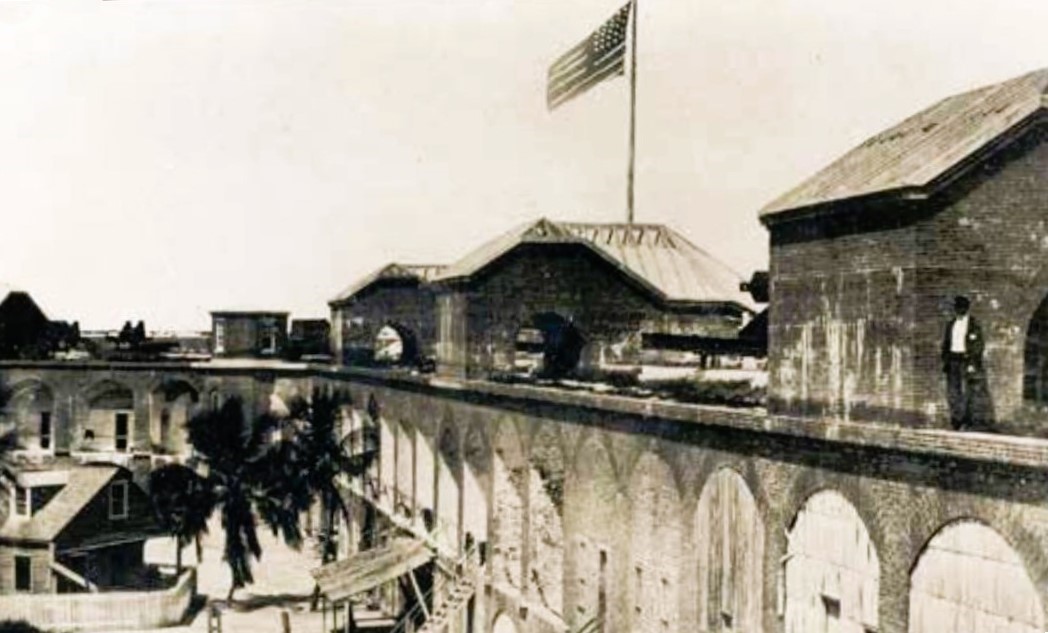
Second-tier casemates, lighthouse keeper’s house, sallyport, and lean-to structure, Fort Jefferson, Dry Tortugas, Florida, late 1860s (U.S. National Park Service and National Archives, public domain).

As March 1863 arrived and progressed, the 47th Pennsylvania Volunteers who were stationed at Fort Jefferson in Florida’s Dry Tortugas became more and more comfortable with their latest garrison assignment. Members of the regiment continued to drill regularly, undergo inspections, march in dress parades, and receive additional training in the use of the fort’s defensive artillery, much as they had done during their first months at the fort.

Their duties were made more palatable by good food and recreational activities. During the early days of that month, Company C’s Henry Wharton penned another letter to his hometown newspaper, the Sunbury American, in which he noted that the regiment’s normal rations that were supplied by the federal government were supplemented by “‘pot-pie’ three times a week; apple dumplings, with good milk, semi-occasionally, and for something to remind us of days past and gone, Sgt. Peirs [sic, Pyers,] serves us with apple pie and doughnuts made in a style that would do credit to more than one I know of, who is in the baking business.”

For fun and exercise, many members of the regiment spent time strolling the wooded areas and beaches around both Fort Jefferson and Fort Taylor (Key West), exploring and studying the exotic wonders of nature around them while collecting seashells and other treasures. In a letter penned to family and friends on March 1, Private Alfred Pretz of Company I recounted one such expedition, noting that he and Sergeant-Major William Hendricks had woken up “at an early hour and started off for the south beach [in Key West] before sunrise, or just about sunrise.”

We were going to hunt seashells. It was a splendid morning, clear, still, and warm enough to be pleasant. We soon reached the seashore and commenced picking up samples of the numerous varieties that abound in profusion. We found many small reptiles which we examined so that we did not get to the principal shell grounds before it was time to return in order to be with the mess at breakfast hour. On our way back, we passed through the woods, with which the key is covered. These are little more than bushes, being small trees averaging eight feet in height, growing closely together with thick undergrowth of a beautiful shrub, and then on the ground a low, broad leaved plant. I plucked specimens of their foliage for enclosure with this letter. The smooth, stout, narrow leaf is from the tree. The tiny leaf, with thorns on the branch, is the undergrowth, the third variety is the plant I speak of. The single flower and bud is of a deep orange color and grows on trees the size of the largest trees in the Key West woods. These flower trees (I know no other name for them) are planted around the houses of town. The other flower is of a crimson color and grows in chunks like the cactus…. We never have twilight here. As soon as the sun sets darkness sets in. At present however we have bright moonlight evenings. The weather is charming.

That same evening, Private Pretz played backgammon to occupy his remaining hours before lights out.
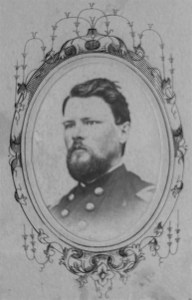
Lieutenant-Colonel George Warren Alexander, 47th Pennsylvania Volunteers, circa 1861 (public domain).

Around this same time, an alert was sounded one day at Fort Jefferson, causing members of the 47th Pennsylvania to scramble to positions across the fort in order to bolster the Union troops already standing guard. That action was ordered by the fort’s commanding officer, Lieutenant-Colonel George Warren Alexander, who had spotted a large number of unidentified ships on the horizon. According to Emily Holder, who had been living in a small house within the fort’s walls since 1860 with her husband, who had been assigned to serve as a medical officer for the fort’s engineers:

One day, early in the spring, Colonel Alexander, who was very watchful and always on the alert, was quite alarmed by seeing some twenty vessels hovering just in sight. Extra guard was mounted, the big guns were loaded and the men slept by them all night; but the vessels passed by without coming nearer.

On another day, she noted that “The Inspector-General, after returning to Beaufort, made rather an overturning in Key West which was under the command of Colonel Morgan of the Ninetieth New York, who had been rather playing the tyrant.”

He had perverted a very good order of General Hunter into one that ordered every person who had friends in the rebel service to leave Key West allowing them only fifty pounds of baggage apiece. They protested, plead with him, even threatened, for it would almost depopulate the town, but in vain.

Justice, however, was nearer than he suspected, for just as the vessel was to start with these people who were being set adrift, a steamer came in bringing Colonel Goode [sic, Good] of the Forty-Seventh Pennsylvania to relieve Colonel Morgan.

The people were almost crazy in their excitement. They took the soldiers’ knapsacks as they marched up the street and would have carried the men on their shoulders in their joy over Morgan’s defeat.

Colonel Goode [sic, Good] came to Tortugas a few days afterwards, and while there said he might send the remainder of the Regiment down to us—something very reassuring for the summer as they were acclimated and would be more likely to withstand any epidemic that might occur.

Meanwhile, disease continued to ravage the ranks of the regiment in March—particularly at Fort Jefferson, where a total of five hundred and sixty-eight Union Army soldiers were stationed. According to H Company Corporal John A. Gardner:

One thing appears a little strange with us here, and that is, there are some five or six in each company that get night blind and some of them can’t see very well through the day. We have a Sgt. by the name of Michael C. Lynch, that can’t see but very little at any time, and a couple more that can’t see at night. I do not know the cause of it, unless it is the white sand. It is very bright and it might be possible that the sand is the cause of it. Our Doctor himself don’t know the cause of it. Otherwise, we get along fat, ragged, and saucy.

* Note: Sergeant Michael Lynch, who had officially mustered in with the 47th Pennsylvania’s H Company on September 19, 1862, at the same rank that he held at Fort Jefferson in 1863, was confined to the post hospital at Fort Jefferson on March 22, 1863, due to nyctalopia (night blindness), which progressed to a stage that rendered him unfit for continued service with the regiment. His condition was described the next month in a letter penned in April by Captain James Kacy:

Sgt. Lynch, poor fellow, is worn out and nearly blind, and is to be sent home. Many of our men are so affected, and it takes a strong eye to stand the glare of the sun on this white sand.

Corporal Lynch was subsequently discharged on a surgeon’s certificate of disability on June 30 of that same year. Meanwhile, E Company Corporal Peter Lyner was also confined to the hospital that same day. Suffering from chronic diarrhea, he would be hospitalized three more times before the year was out.
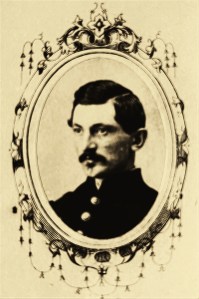
Jacob Henry Scheetz, M.D., assistant surgeon, 47th Pennsylvania Volunteers, circa 1863 (public domain).

By mid-to-late March 1863, it was clear that an epidemic of dysentery and chronic diarrhea had broken out at Fort Jefferson. Among those trying to bring comfort to the sick were Assistant Regimental Surgeon Jacob H. Scheetz, M.D., who continued to hold the position of post surgeon, and A Company Private Charles Detweiler, who had been assigned to nursing duties at Fort Jefferson’s hospital. Also readmitted for treatment during this time (on March 18) was G Company Private Joseph Hallmeier, who had developed complications related to the back wound he had sustained during the Battle of Pocotaligo on October 22, 1862. In addition, E Company Private Leonard Frankenfield had become so ill from the chronic diarrhea he had been suffering after contracting dysentery, that he, too, needed to be hospitalized—an admission that occurred on March 23.

On March 25, the schooner Nonpareil arrived at Fort Jefferson, bringing with it Colonel Good and his senior staff, Regimental Surgeon Elisha W. Baily, M.D., the regiment’s medical director, Regimental Quartermaster Francis Z. Heebner, and the 47th Pennsylvania’s Regimental Band for a short series of meetings and special events. They dined on bean soup, mush, pea soup, rice, vegetable soup, pies, coffee, and tea, and then returned to Fort Taylor four days later.
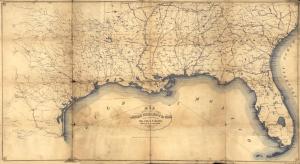
U.S. Army’s Department of the Gulf, 1864 map (U.S. Library of Congress, public domain; click to enlarge).

As the month of April wore on, more Union ships arrived, carrying supplies and more than one hundred men who were added to Fort Jefferson’s roster of prisoners. During this same period, the 47th Pennsylvania Volunteer Infantry was transferred from the command of Brigadier-General John Brannan in the U.S. Army’s Department of the South to the command of Major-General Nathaniel P. Banks in the Department of the Gulf—a change that would ultimately place the regiment in a position of making history in 1864 during the Union’s Red River Campaign across Louisiana.

On Sunday, April 12, 1863, the men from Company H carried out Order No. 31, which directed them to appear for inspection “with haversack and canteens” on a day when the temperature was high. The only members of the company who were excused were those who were hospitalized or assigned to hospital or guard duties.

Six days later, Corporal Albert prepared H Company’s kitchen for inspection, most likely with help from Thomas Haywood, a formerly enslaved Black man who had enlisted with the regiment in November 1862 while it was stationed in Beaufort, South Carolina. Haywood had been assigned to Company H, since that time, as an Under-Cook.”

Ailing with conjunctivitis, E Company Corporal Peter Lyner was hospitalized at Fort Jefferson on April 21, 1863—during a month that saw forty members of the 47th Pennsylvania and twenty-one prisoners admitted to the post’s hospital. Fourteen of those 47th Pennsylvanians were diagnosed with dysentery and/or chronic diarrhea, with single cases of typhoid fever, asthma, bronchitis, catarrh, conjunctivitis, phlegmon, and phthisis also documented.

On April 23, H Company Captain James Kacy issued Order No. 32:

The members of Company H shall each have his rifle taken apart immediately after breakfast tomorrow morning. The sock and barrel from the stock, the sock not to be taken apart, and the Captain will inspect at 8:30 AM on Saturday [April 25].
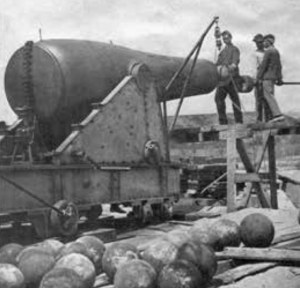
Unidentified Union Army artillerymen standing next to one of the fifteen-inch Rodman guns, which were installed on the third level of Fort Jefferson in the Dry Tortugas, Florida, beginning in 1862. These smoothbore Rodman weighed twenty-five tons, and was able to fire four hundred and fifty-pound shells more than three miles (U.S. National Park Service, public domain).

Around this same time, records show that the combined total strength of the 47th Pennsylvania (with its forces divided between Forts Taylor and Jefferson) was nine hundred and sixty-eight men—and that none of those men who were classified as enlisted had been paid for their service to the nation for a shocking eight months. The month of April ended with another inspection—and with the members of Companies F and K resuming their practice with the light and heavy artillery equipment at Fort Jefferson.

As the month of May arrived, inspections continued to be a regular part of the 47th Pennsylvanians’ Sunday schedules—even as temperatures in the shady spots of Fort Jefferson were reaching ninety-nine degrees by mid-afternoon. For sustenance, the men were fed either pork or beef for breakfast and supper, depending on the day’s menu, followed by bean soup for their evening meal (dinner) with meals often supplemented by eggs that had been collected by members of the regiment from birds’ nests scattered around the island. The total number of Union troops stationed here during this time was six hundred and sixty-six.

But, once again, disease reared its ugly head with forty-eight members of the 47th Pennsylvania and thirty-seven prisoners confined to the Fort Jefferson hospital—twenty-four of whom had dysentery and/or chronic diarrhea, seven who had bilious or intermittent fever, four who were diagnosed with general debility, three who were diagnosed with abscesses, two who were suffering with hernia issues, and one who had contracted cholera.
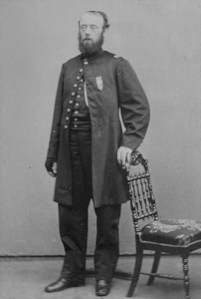
First Lieutenant Christian Seiler Beard, Company C, 47th Pennsylvania Volunteers, circa 1863 (public domain).

On May 2, this letter from Sergeant Christian Beard of the 47th Pennsylvania’s C Company, was published in the Sunbury Gazette:

My sentiments are the same as they were when I left home, and let come what will I am ever ready and willing to meet it as a soldier’s fate, and will not grumble, let my lot be ever so hard, for he that can’t suffer something for the good of his country is not worthy of the name of a freeman. Some men say they could not fight as well at present as they could last summer. Such men are traitors and cowards, for we are fighting in the same cause now that we were then, and I should rather suffer death than flinch or say one disrespectful word respecting the government. But at home there is something wrong, and you ought not allow it. Men like Purdy should not be permitted to discourage those men who are willing to do something for the good of the country.

Those papers are continually talking of the troops being so much demoralized, but such things are new to us here, and are really not the case: on the other hand, they are every day becoming better disciplined, and more efficient for the duty they have to perform if only the people at home would not discourage them. I have seen letters written by men not a thousand miles from your town that would make the face of a heathen blush wish shame and indignation. They tell us that we are fighting for nothing but to free n______ [racial epithet deleted], and that our government don’t do as they ought, and the President thinks more of a n_____ [racial epithet deleted] than of a white soldier; all such talk, and some even go as far as to say that a man who would fight for such a man as Lincoln or Hunter was no better than a n_____ [racial epithet deleted]. This talk is put forth with the evident intention of discouraging the men, but such pups don’t discourage me. I am just as willing to fight to-day as ever, and any man who is unwilling to fight for the cause as it now stands is not worth as much powder as would kill him. We don’t fear the rebels, and they can’t whip us; but those rebels at home, lurking in our rear, we have to fear more than the honorable foe in front, who openly stand out with gun in hand to receive us. While such things are permitted at home, we must not look for better success than we have had of late in Virginia. On the other hand, if every man, woman and child would support the Union—stand by her, and not a man give up while there is life, then we would not need to fight half so much. The rebels say that half of the people North are for them, and they expect to get help there ere long. No wonder they keep their heads out of water so long. It is the people at the North—it is their faults that so many of the soldiers have to die on the battle field. They will some day have to account for it in my opinion. There is but two sides, the one is for the Administration and the Union, the other is for the rebellion. He that disagrees with the heads of our government, and everything that us done by them, while they are doing the best they possibly can, is a rebel at heart and dare not deny it. The best thing would be to stop all newspapers, and not allow them to be sent to the army. Letters of a discouraging character should also be forbidden.

Hoping that you are well, I am yours, &c.,
C. S. Beard

May also brought revised duty assignments for a number of 47th Pennsylvanians, including F Company Private John Weiss, who was given additional duties with the post’s Ordnance Department, after having recovered from a February bout of remittent fever, K Company Private Tilghman Boger, who was assigned to kitchen duties in the officers’ mess hall, and G Company Private Cornelius Heist, who was appointed as Company Cook—an assignment that likely brought him into contact with one of the regiment’s Under-Cooks—the group of formerly enslaved Black men who had enlisted with the regiment while it was stationed in Beaufort, South Carolina in October 1862.
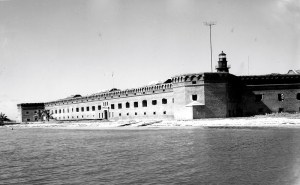
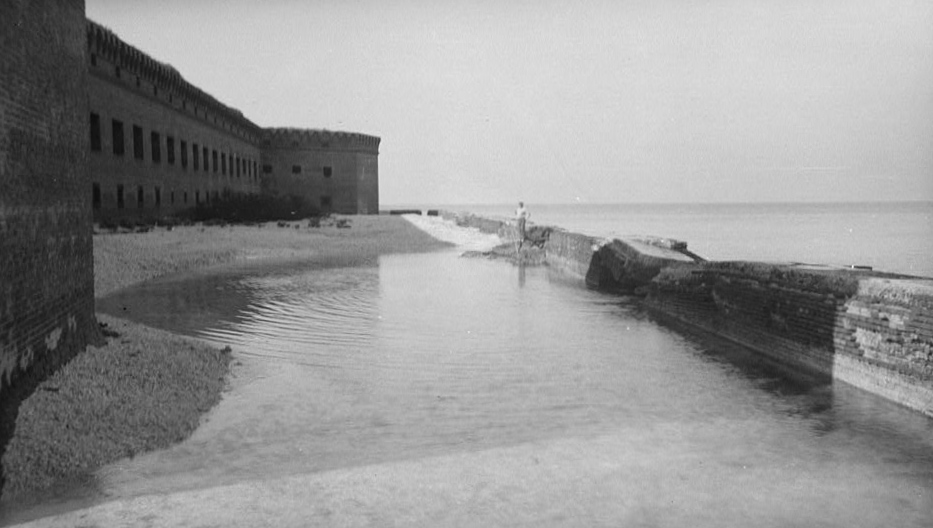
Fort Jefferson, Dry Tortugas, Florida, view from the sea, 1946 (vacation photograph collection of President Harry Truman, November 1946, U.S. National Archives and Records Administration, public domain).

Another alert was sounded on May 7 when a Union gunboat chased a blockade runner from Great Britain into the harbor at Fort Jefferson, enabling D Company Captain Henry D. Woodruff and a party of his men to capture the British crew. Their prisoners were subsequently transported to Fort Taylor in Key West for processing.

Three days later, G Company Private William Eberhart died at Fort Jefferson’s hospital while being treated there for consumption (tuberculosis). According to Schmidt, he had been ill since Christmas Day of 1862, when he had first been hospitalized with dysentery. After being discharged on January 10, 1863, he had then been hospitalized again on March 3 tuberculosis-related phthisis. Quickly interred at 4 p.m. on the same day of his death (May 10), he was laid to rest with military honors somewhere on the grounds of the fort or on one of its neighboring islands where soldiers with infectious diseases were quarantined.

The next day (May 11), D Company Private Jesse D. Reynolds died from disease-related complications and was also quickly interred on the fort’s grounds or on a neighboring island. He, too, had battled a series of illnesses, having been hospitalized with hemeralopia on March 27, discharged on April 5, and readmitted to the fort’s hospital on May 8 with one of the many fever variants that plagued the regiment during the war. (An alternate date of May 30 was listed in the hospital’s death ledger.)

On May 16, D Company Captain Henry D. Woodruff and his men marched to the wharf at Fort Jefferson and climbed aboard yet another ship—this time for their return to Fort Taylor, where they resumed garrison duties under the command of Colonel Tilghman H. Good.

Two days later, G Company Private Irwin Scheirer also succumbed from tuberculosis-related complications at the fort’s hospital, after having previously been admitted and then discharged for asthma treatment on April 14 and 19, respectively. According to Schmidt, Private Scheirer’s “remains were buried at Bird Key at 2 PM by Sgt. Hutcheson, and the key and the site of the grave have been lost to time and the elements.”

The interment record of the Post Cemetery at Fort Jefferson indicated his grave was inventoried in 1873 and 1879, along with the graves of William Eberhart and Edward Frederick of the 47th, but the wooden markers were … unreadable. In 1879 it was noted that one grave contained seven bodies, and another grave contained bodies whose identification was unknown and which had been washed out to sea and returned by the Ordnance Sergeant and Fort Keeper. The following tribute of respect to Privates Scheirer and Eberhart was published in the Allentown Democrat on June 10, 1863:

‘TRIBUTE OF RESPECT—At a meeting of the members of Company G, 47th Regiment P. V., held at Fort Jefferson, Tortugas, Florida, on the evening of May 17 [sic], 1863, a committee was appointed to draft resolutions expressive of said Company G in regard to the death of two of their fellow members, viz.: William Eberhard of Bucks County, Pa., dec’d May 8, 1863, and Irvin Scheirer of Lehigh County, Pa., dec’d May 18 [sic], 1863. The following preamble and resolutions were unanimously adopted:

WHEREAS, It has pleased an All-wise Providence to remove from our midst, by the hand of death, within the brief period of a fortnight, two of our fellow members and companions in arms, viz.: William Eberhard and Irvin Scheirer, (who unfortunately became victims of that fell destroyer, consumption) therefore be it

RESOLVED, That by the death of these men we have lost from our ranks characters of true devotion to their country and the government thereof—such as were beloved by each of their fellow members, as well as all who knew them—kind companions and Christians.

RESOLVED, That since the connection of these men with Company G we have found them faithful to the duties they were asked to perform, obedient in all respects to their commanders; and while unfit for duty, either in the company or in the hospital—submissive to the desires of the Almighty God.

RESOLVED, That a copy of these resolutions be sent the families of each deceased, and be published in all the Allentown papers.

COMMITTEE.—Sergt. T. B. Leisenring, Corp. R. M. Fornwalt [sic, Fornwald], John Pratt, and Privates Wm. Hartz and William Steckel.

Bucks County papers please copy.’

On May 20, enlisted members of the 47th Pennsylvania Volunteer Infantry were finally given eight months’ worth of their back pay—a significant percentage of which was quickly sent home to family members who had been struggling to make ends meet.

Five days later, G Company Private Joseph Hallmeier was honorably discharged on a surgeon’s certificate of disability when regimental physicians made the determination that his recovery from the back wound he had sustained during the Battle of Pocotaligo was not progressing well enough to enable him to perform any meaningful duties.

On the final day of the month, H Company Captain James Kacy issued Company Order No. 33:

Until further notice, card playing for profit or amusement in company quarters or elsewhere is strictly prohibited. Each Sergeant will visit each room twice a day to see that this order is carried out. Any Private found violating will be immediately put on a barrel in front of the guard house, there to remain for ten consecutive hours. Any non-commissioned officer playing with cards will be reduced to ranks and court martialed for disobedience of orders.

The next day, the “dreaded month of June came again and found us in Key West-to break the terrible monotony of island life,” recalled Emily Holder via an article she penned for a history magazine in the 1890s.

The feeling in Key West between the various political factions became more and more intensified as time went on. The sectional spirit had been so strong that it had almost resulted in the residents keeping entirely aloof from each other, although the greater part of them professed to be Unionists.

Those who owned the greatest number of slaves were at times defiant, although made no attempt to join the other side. Society was anything but pleasant, and we felt that the efforts of General Woodbury, who was now Military Governor, to bring people into more friendly relations were most commendable, and were seemingly successful.

Just as we were about ready to go down to the boat [at Fort Jefferson’s wharf] before starting for Key West, someone came for us to go to the ramparts as there was a fight at sea; one of our gun-boats was firing at a big steamer.

Taking the glass we were soon with the others on top of the Fort, and, surely enough, about five miles out was an immense steamer emitting a dense black smoke, which announced its character as only the Confederates used soft coal, and when they were running away, as that one evidently was, they put in pine wood or anything they had.

She was running from a little boat that in comparison was like a pigmy. Two larger steamers were trying to head her off, and they passed out of sight in that position. There were between twenty and thirty guns fired, and all in all it was quite an exciting affair.

We saw nothing of them on our way to Key West, but the day after our arrival a steamer brought into port a large Mississippi River boat, a side wheeler, loaded high upon deck with cotton—a prize valued at half a million dollars.

Colonel Alexander met one of the owners of the steamer who said that the people in the south were hopeless; but, he added, ‘we have nothing now to lose and we are going to fight as long as we can.’

I met at the hotel a lady from Mobile who ran the blockade with her husband on a vessel loaded with cotton. She said she stood on deck all the time they were being fired at, and would avow herself a Secessionist at the cannons’ mouth.

Her husband lost a large amount of property in the steamer. He was going to Europe while she returned to Mobile with her three children.

Officers’ quarters and parade grounds, interior of Fort Jefferson, Dry Tortugas, Florida, 1898 (U.S. National Park Service and National Archives and Records Administration, public domain).

The remainder of the month progressed in much the same manner for the 47th Pennsylvania Volunteers as the first five months of the year had—drilling, training with the fort’s light and heavy artillery, standing for long periods during weekly inspections, and marching in dress parades—even in the face of the higher temperatures and humidity so common to Florida summers then and now.

During mid-June, Fort Jefferson’s commanding officer and the 47th Pennsylvania’s second-in-command, Lieutenant-Colonel Alexander, negotiated new pay structures for two of his subordinates with his superior officer, Colonel Tilghman Good. Agreeing to pay Musicians Daniel Dachrodt and William A. Heckman an additional four dollars per month for the past pay period of September to December 9, 1862, the two senior officers also agreed to pay them each thirteen dollars per month for their service from December 9, 1862 through April 30, 1863.

And, once again, the grim reaper reared his ugly head—swinging his scythe through the regiment’s ranks to claim E Company Private Leonard Frankenfield, who was laid to rest somewhere on the grounds of Fort Jefferson after succumbing to complications from dysentery on June 22.

The most significant event of the month, which would prove to be one of the more consequential of the entire war for many Union soldiers, was a directive issued by the Office of the Adjutant General in the U.S. War Department on June 25, 1863:

General Orders, No. 191
War Department, Adjutant General’s Office
June 25, 1863

In order to increase the armies now in the field, volunteer infantry, cavalry, and artillery may be enlisted at any time within ninety days from this date, in the respective states, under the regulations herein later mentioned. The volunteers so enlisted, and such of the three years’ troops now in the field as may enlist in accordance with the provisions of this order, will constitute a force to be designated Veteran Volunteers. The regulations for enlisting this force are as follows:

I. The period of service for the enlistments and re-enlistments above mentioned shall be for three years, or during the war.

II. All able-bodied men between the ages of eighteen and forty-five years, who have heretofore been enlisted, and have served for not less than nine months, and can pass the examination required by the mustering regulations of the United States, may be enlisted under this order as Veteran Volunteers, in accordance with the provisions hereafter set forth.

III. Every volunteer enlisted and mustered into service as a Veteran, under this order, shall be entitled to receive from the United States one month’s pay in advance, and a bounty and premium of four hundred and two ($402) dollars, to be paid as follows:

  1. Upon being mustered into the service, he shall be paid
    one month’s pay in advance . . . . . . . . . . . . . . . . . . . .  $13.00
    First installment of bounty . . . . . . . . . . . . . . . . . . . . . .  25.00
    Premium . . . . . . . . . . . . . . . . . . . . . . . . . . . . . . . . . . . . .     2.00
    Total payment on muster . . . . . . . . . . . . . . . . . . . . . .  $40.00
  2. At the first regular pay-day, or two months after
    muster-in, an additional installment of bounty
    will be paid. . . . . . . . . . . . . . . . . . . . . . . . . . . . . . . . . .   $50.00
  3. At the first regular pay-day after six months’
    service, he shall be paid an additional
    installment of bounty . . . . . . . . . . . . . . . . . . . . . . . . .   $50.00
  4. At the first regular pay-day after the end of the
    first years’ service, an additional installment of
    bounty will be paid . . . . . . . . . . . . . . . . . . . . . . . . . . .   $50.00
  5. At the first regular pay-day after 18 months’
    service, an additional installment of bounty will
    be paid . . . . . . . . . . . . . . . . . . . . . . . . . . . . . . . . . . . . .   $50.00
  6. At the first regular pay-day after two years’
    service, an additional installment of bounty will
    be paid . . . . . . . . . . . . . . . . . . . . . . . . . . . . . . . . . . . . .   $50.00
  7. At the first regular pay-day after two and a
    half years’ service, an additional installment of
    bounty will be paid . . . . . . . . . . . . . . . . . . . . . . . . . . . $50.00
  8. At the expiration of three years’ service, the
    remainder of the bounty will be paid . . . . . . . . . . . . $75.00

IV. If the government shall not require these troops for the full period of three years, and they shall be mustered honorably out of the service before the expiration of their term of enlistment, they shall receive upon being mustered out, the whole amount of their bounty remaining unpaid, the same as if their whole term has been served. The legal heirs of volunteers who die in service shall be entitled to receive the whole bounty remaining unpaid at the time of the soldier’s death.

V. Veteran Volunteers enlisted under this order will be permitted at their option to enter old regiments now in the field; but their service will continue for the full term of their own enlistment, notwithstanding the expiration of the term for which the regiment was originally enlisted. New organizations will be officered only by persons who have been in service, and have shown themselves properly qualified for command. As a badge of honorable distinction, “service chevrons” will be furnished by the War Department, to be worn by the Veteran Volunteers.

VI. Officers of regiments whose term has expired, will be authorized, on proper application, and approval of their respective Governors, to raise companies and regiments within the period of sixty days; and if the companies and regiments authorized to be raised shall be filled up and mustered in the service within the said period of sixty days, the officers may be recommissioned on the date of their original commissions, and for the time engaged in recruiting they will be entitled to receive the pay belonging to their rank.

VII. Volunteers or Militia, now in service, whose term of service will expire within ninety days, and who then shall have been in service at least nine months, shall be entitled to the aforesaid bounty and premium of $402, provided they re-enlist, before the expiration of their present term, for three years or the war; and said bounty and premium shall be paid in the manner herein provided for other troops re-entering the service. The new term will commence from the date of re-enlistment.

VIII. After the expiration of ninety days from this date, volunteers serving in three year organizations, who may re-enlist for three years or the war, shall be entitled to the aforesaid bounty and premium of $402, to be paid in the manner herein provided for other troops entering the service. The new term will commence from date of re-enlistment.

IX. Officers in service, whose regiments or companies may re-enlist, in accordance with the provisions of this order, before the expiration of their present term, shall have their commission continued, so as to preserve their date of rank as fixed by their original muster into the United States service.

X. As soon after the expiration of their original term of enlistment as the exigencies will permit, a furlough of thirty days will be granted to men who may reenlist in accordance with the provisions of this order.

XI. Volunteers enlisted under this order will be credited as three years’ men in the quotas of their respective states. Instructions for the appointment of recruiting officers and for enlisting Veteran Volunteers will be immediately issued to the Governors of States.

By Order of the Secretary of War:
E. D. Townsend, Assistant Adjutant General

As questions were raised by Union Army officers, who were being asked by their own subordinates for details about this potentially important change for their immediate finances and the financial futures of their families, the War Department’s Veteran Volunteers directive was followed by a clarification, in July 1863, via General Orders, No. 216:

General Orders, No. 216,
War Department, Adjutant General’s Office
Washington, July 1863

I. All able-bodied men between the ages of eighteen and forty-five years, who have heretofore been enlisted and have served for not less than nine months, have been honorably discharged, and can pass the examination required by the Mustering Regulations of the United States, may be enlisted in any Regiment they choose, new or old; and when mustered into the United States service, will be entitled to all the benefits provided by General Orders No. 191, for Recruiting “Veteran Volunteers.”

A Regiment, Battalion, or Company shall bear the title of “Veteran” only in case at least one-half its numbers, at the time of muster into the United States service, are “Veteran Volunteers.”

II. The benefits provided by General Orders, No. 191, for Veteran Volunteers, will be extended to men who re-enlisted prior to the promulgation of that order, provided they have fulfilled the conditions therein set forth.

By Order of the Secretary of War
E.
D. Townsend, Assistant Adjutant General

As word continued to spread regarding the federal government’s new plan to provide improved compensation for soldiers choosing to reenlist with the Union Army, the Office of the Adjutant General at the U.S. War Department issued a series of additional general orders to refine its new policy and procedures with respect to the designation of men as “Veteran Volunteers.”

General Orders, No. 305,
War Department, Adjutant General’s Office
Washington, September 11, 1863

Par. VIII, of General Orders, No. 191, from this office, relative to recruiting Veteran Volunteers, is hereby amended to read as follows:

After the expiration of ninety days from this date, (June 25,) Volunteers serving in three years’ organizations, who may re-enlist for three years or the war, in Companies or Regiments to which they now belong, and who may have, at the date of re-enlistment, less than one year to serve, shall be entitled to the aforesaid bounty and premium of $402, to be paid in the manner herein provided for other troops re-entering the service. The new term will commence from the date of re-enlistment.

By Order of the Secretary of War:
E.
D. Townsend, Assistant Adjutant General

On November 6, 1863, this further clarification was issued:

General Orders, No. 359
War Department, Adjutant General’s Office
Washington, November 6, 1863

I. To carry out the provisions of paragraphs 8 and 9, General Orders, No. 191, current series, from this office, in reference to volunteers who may come within the limit for re-enlistment as Veteran Volunteers, as fixed by General Orders, No. 305, current series, the following regulations are established:

MUSTERS-OUT OF SERVICE.

  1. The muster-out or discharge of all men who may re-enlist, and their re-enlistments and consequent re-musters, will be under the immediate supervision and direction of the Commissaries and Assistant Commissaries of Musters for the respective Armies and Departments. The said officers will make all musters-out of and re-musters into the service.
  2. All men who desire to take advantage of the benefits of the Veteran Volunteer order, by re-enlistment under it, will be regularly mustered out of service on the prescribed muster-out rolls. The discharges prescribed by paragraph 79, Mustering Regulations, will be furnished in all cases. A remark will be made on the muster-out rolls, over the signature of the Commissary or Assistant Commissary of Musters, as follows: ‘Discharged by virtue of re-enlistment as a Veteran Volunteer, under the provisions of General Orders, No. 191, series of 1863, from the War Department.”RE-ENLISTMENTS AND RE-MUSTERS.
  3. Simultaneously with the muster-out and discharge, but of the date next following it, the Veteran Volunteers will be formally re-mustered into the United States service ‘for three years or during the war.” This will be done on the prescribed muster-in rolls (muster and descriptive rolls of recruits). These rolls will be made out from the re-enlistments and descriptive lists of the men. (See section 4 of this paragraph.) The following remark will be made on the muster-in rolls, over the signature of the Commissary or Assistant Commissary of Musters: ‘Re-mustered as Veteran Volunteers, under G. O., 191, War Department, series of 1863.’
  4. Regimental Commanders, under the direction of Commanders of Brigades, will select and appoint a recruiting officer for their respective commands, and charge him with the re-enlistment of the Veterans thereof. The re-enlistments will be made in duplicate, and on the blank for “Volunteer Enlistment.” A descriptive roll of the men will be made out at the same time. The duplicate re-enlistments and descriptive rolls will be forwarded, or taken, by the recruiting officer, to the Commissary or Assistant Commissary of Musters who may be in charge of the musters for the organization to which the men belong. The mustering officer will countersign the re-enlistment papers, and file the descriptive roll with the records of his office. One copy of the re-enlistment will be delivered by the mustering officer to the Paymaster, to assist him in the examination and verification of the accounts; this copy will be forwarded with the said accounts to the proper accounting officer of the Treasury. The second copy of the re-enlistments will be returned by the mustering officer to the Regimental Commander, and by him forwarded to the Adjutant General of the Army with the Monthly Recruiting Return required by par. 919 Army Regulations, from Superintendents of Regimental Recruiting Service.PAYMENTS.
  5. The Pay Department of the Army is hereby charged with all payments (final due under original enlistments, advanced pay, bounties, and premiums) of the volunteers discharged and re-mustered as directed in this order. The final payments under the original enlistments will be made on the muster-out rolls.The amount of the ‘total payment on Muster,’ (re-muster,) par. II, G. O. 324, A. G. O., current series, will be made under the rules set forth in General Orders, No. 163. The consolidated receipt rolls, referred to in the said order, will be certified to by the Commissary or Assistant Commissary of Musters charged with the re-muster of the Veteran Volunteers into service. The payments on discharge, and those due on re-muster, will be made at the same time, and in full, immediately after the men are re-mustered into the service.

II. Commanders of Armies and Departments are hereby charged with the faithful execution of this order, and will issue such instructions under it as in their opinion will best secure the object in view. Troops to be discharged and re-mustered as Veterans will be reported to the proper commanders, through Army or Department Headquarters, to the Paymaster General. The reports will be made at a date such as will avoid delay in the payments being made.

By Order of the Secretary of War:
E.
D. Townsend, Assistant Adjutant General

The U.S. War Department then issued yet another order related to Veteran Volunteers on November 21, 1863:

General Orders, No. 376
War Department, Adjutant General’s Office
Washington, November 21, 1863

I. It is hereby ordered that volunteers now in the service, re-enlisting as Veteran Volunteers under General Orders 191 from this office, shall have a furlough of at least thirty days previous to the expiration of their original enlistment. This privilege will be secured to the volunteers either by ordering all so-re-enlisting with their officers, to report in their respective States, through the Governors, to the Superintendent of the recruiting service, for furlough and reorganization, or by granting furloughs to the men individually.

II. Mustering officers shall make the following stipulation on the muster-in rolls of Veteran Volunteers now in the service re-enlisting as above: “To have a furlough of at least thirty days in their States before expiration of original term.

III. Commanding Generals of Departments and Armies are hereby authorized to grant the aforesaid furloughs, within the limit of time fixed in compliance with this order, as the demands of the service will best permit, reporting their action to the Adjutant General of the Army.

IV. In going to and from their respective States and homes, the Veteran Volunteers furloughed as herein provided will be furnished with transportation by the Quartermaster’s Department.

V. When three-fourths of a regiment or company re-enlist, the volunteers so enlisted may be furloughed in a body, for at least thirty days as aforesaid, to go home with their officers to their respective States and districts to reorganize and recruit; and the individuals of the companies and regiments who do not re-enlist shall be assigned to duty in other companies and regiments until the expiration of their terms of service.

By Order of the Secretary of War:
E.
D. Townsend, Assistant Adjutant General

As those subsequent updates continued to be released, newspapers across the nation began carrying word to the families of soldiers about the War Department’s stepped-up efforts to retain the nation’s most experienced soldiers, including the November 29, 1863 edition of The New York Times, which reprinted the text of General Orders, No. 376 and then added the following analysis:

The above order consists substantially of the series of propositions made to the War Department, three months ago, by Gov. MORTON, of Indiana, and was the suggestion of his comprehensive care for the interests of the country as well as the soldier. We have recently had occasion—indeed, ever since the war began we have had occasion—to notice the extraordinary energy and sagacity displayed by the Executive of Indiana in the conduct of the military affairs of that heroic State; and the success that has attended his efforts, and the appreciation of those efforts by the people of his own State and of the whole country, is the fit reward which his patriotic services have received….

Another proposal of Gov. MORTON, looking to the benefit of the soldier, we find referred to in the Indianapolis Journal, and we learn that it is now under discussion, with strong influences in its favor. It is that Paymasters of the army shall be authorized to take with them “five-twenty bonds,” from $50 to any larger amount, and allow the soldiers to take them in the place of any back pay, back bounty, or advance bounty (if he should reenlist) to which he may be entitled, or invest any pay in possession or due to him, which he may choose, in them. The proposal is urged for all the troops, but has as yet been acceded to only in the case of those from Indiana. The advantages of this arrangement are obvious, and we wish we could say that they were as generally bestowed as they are manifest. The soldier has the opportunity to turn every dollar due him, if he should not need it for immediate use, into an investment which has the double advantage of being just as good as “greenbacks” for currency, if they should be needed as money, and six per cent. better if they should be preferred as an investment.

At the present price of gold, on which the interest on these bonds is paid, the income they will yield the soldier will be about 9 per cent., fully equal to the first average investments of money in loans or real estate. On the other hand, the advantage to the country in giving the soldier a pecuniary interest in the permanence of the Government is obvious. The bonds are a little better than greenbacks, and of course can be used in their stead. If the bonds should not happen to be ready for delivery when the Paymasters go round, they are to take certificates, which shall be to the soldier the same as a bond. Now, a great many soldiers will leave the service with his last installment of bounty due, $75, with his advance bounty, (if he reenlists,) in his hands, $75, with his advance pay, $13, and whatever back pay may be due, not unlikely to amount to $50 or more, and can in nine cases out of ten invest $200 to $300, a very pretty sum to lay up against a rainy day.

Lieutenant-Colonel George Warren Alexander, second-in-command, 47th Pennsylvania Volunteer Infantry, with officers from the 47th, Fort Jefferson, Dry Tortugas, Florida, circa 1863 (public domain).

When news of the federal government’s new inducements reached the far-flung 47th Pennsylvanians in Key West and the Dry Tortugas, Florida, hundreds of weary men who had been battered by brutal combat and the ever-present spectre of disease realized they were being given a much-needed “shot in the arm” of recognition from their elected officials and took renewed comfort in knowing that their service had, in fact, actually been valued.

In response, more than half of the men serving with the 47th Pennsylvania Volunteer Infantry opted to reenlist in 1863—a collective action that resulted in another historic achievement for the regiment—the permanent change of the organization’s name  to the 47th Pennsylvania Veteran Volunteers.


Sources:

  1. “A Word from Captain Gobin’s Company” (May 1863 letter from C Company Sergeant Christian S. Beard). Sunbury, Pennsylvania: The Sunbury Gazette, May 2, 1873.
  2. Bates, Samuel P. History of Pennsylvania Volunteers, 1861-5, vol. 1. Harrisburg, Pennsylvania: B. Singerly, State Printer, 1869.
  3. Florida’s Role in the Civil War: ‘Supplier of the Confederacy.’” Tampa, Florida: Florida Center for Instructional Technology, College of Education, University of South Florida, retrieved online January 15, 2020.
  4. General Orders of the War Department, Embracing the Years, 1861, 1862 & 1863, vol. II, pp. 217-219 (General Orders No. 191), p. 245 (General Orders No. 216), 412 (General Orders No. 305), 602-603 (General Orders No. 359), and 644 (General Orders No. 376). New York, New York: Derby & Miller and Boston, Massachusetts: Little, Brown, & Co., et al., 1864.
  5. Holder, Emily. At the Dry Tortugas During the War.” San Francisco, California: Californian Illustrated Magazine, 1892 (part four, retrieved online, March 28, 2024, courtesy of Lit2Go, the website of the Educational Technology Clearinghouse at the Florida Center for Instructional Technology, College of Education, University of South Florida).
  6. History: Crops (Historic Florida Barge Canal Trail).” Historical Marker Database, retrieved online December 30, 2023.
  7. Owsley, Frank Lawrence, and Harriet Fason Chappell. King Cotton Diplomacy: Foreign Relations of the Confederate States of America. Chicago, Illinois: University of Chicago Press, 1959.
  8. Preventing Diplomatic Recognition of the Confederacy, 1861–1865,” and The Alabama Claims, 1862–1872,” in “Milestones: 1861–1865.” Washington, D.C.: Office of the Historian, Foreign Service Institute, United States Department of State, retrieved online December 30, 2023.
  9. Re-enlistment of Veterans.; General Order. War Department, Adjutant-General’s Office.” New York, New York: The New York Times, November 29, 1863.
  10. Reports of Committees of the Senate of the United States for the First Session of the Fifty-First Congress, 1889-90. Washington, D.C.: Government Printing Office, 1890.
  11. Schmidt, Lewis G. A Civil War History of the 47th Regiment of Pennsylvania Veteran Volunteers. Allentown, Pennsylvania: Self-published, 1986.
  12. Wharton, Henry. Letters from the Sunbury Guards. Sunbury, Pennsylvania: Sunbury American, 1861-1868.

 

Sitting in Judgment: Four Officers of the 47th Pennsylvania Volunteers Oversee Court Martial Proceedings (1862–1863)

Captain John Peter Shindel Gobin, Company C, 47th Pennsylvania Volunteers, shown here circa 1863, went on to become lieutenant governor of Pennsylvania after the war (public domain).

One of the terms that crops up when researching the history of the 47th Pennsylvania Volunteers is court martial—a phrase that often conjures images of soldiers deserting their posts or behaving in some other dishonorable manner, and who then ended up facing charges of conduct unbecoming.”

With respect to the 47th Pennsylvania Volunteer Infantry, the phrase “court martial” appears, more often than not, in relation to the service by multiple officers of the regiment who were assigned to serve as judges or members of the jury during trials of civilians in territories where the 47th Pennsylvania Volunteers were assigned to provost (military police and civilian court) duties, or as judges or members of the jury during the court martials of other members of the Union Army during the American Civil War.

This article presents details about two of the multiple military courts martial in which members of the 47th Pennsylvania were involved.

1862

In mid to late December 1862, Brigadier-General John Milton Brannan directed the three most senior officers of the 47th Pennsylvania Volunteer Infantry—Colonel Tilghman H. Good, Lieutenant-Colonel George Warren Alexander and Major William H. Gausler—to serve on a judicial panel with other Union Army officers during the court martial trial of Colonel Richard White of the 55th Pennsylvania Volunteers. Brannan then also appointed Captain John Peter Shindel Gobin of the 47th Pennsylvania’s C Company as judge advocate for the proceedings.

Of the four, Gobin was, perhaps, the most experienced from a legal standpoint. Prior to the war, he was a practicing attorney in Sunbury, Pennsylvania. Post-war, he went on to serve in the Pennsylvania State Senate and as lieutenant governor of the Commonwealth of Pennsylvania.

On December 18, 1862, The New York Herald provided the following report regarding Colonel White’s court martial:

A little feud [had] arisen in Beaufort between General [Rufus] Saxton and the forces of the Tenth Army corps. Last week, during the absence at Fernandina of General Brannan and Colonel Good, the latter of whom is in command of the forces on Port Royal Island, Colonel Richard White of the Fifty-fifth Pennsylvania, was temporarily placed in authority. By his command a stable, used by some of General Saxton’s employes [sic, employees], was torn down. General Saxton remonstrated, and … hard words ensued … the General presumed upon his rank to place Colonel White in arrest, and to assume the control of the military forces. Upon General Brannan’s return, last Monday, General Saxton preferred against Colonel White several charges, among which are ‘conduct prejudicial to good order and military discipline’ and ‘conduct unbecoming an officer and a gentleman.’ General Brannan, while denying the right of General Saxton to exercise any authority over the troops, has, nevertheless, ordered a general court martial to be convened, and the following officers, comprising the detail of the court, are to-day [sic, today] trying the case:— Brigadier General Terry, United States Volunteers; Colonel T. H. Good, Forty-seventh Pennsylvania; Colonel H. R. Guss, Ninety-seventh Pennsylvania; Colonel J. D. Rust, Eighth Maine; Colonel J. R. Hawley, Seventh Connecticut; Colonel Edward Metcalf, Third Rhode Island artillery; Lieutenant Colonel G. W. Alexander, 47th Pennsylvania; Lieutenant Colonel J. F. Twitchell, Eighth Maine; Lieutenant Colonel J. H. Bedell, Third New Hampshire; Major Gausler, Forty-seventh Pennsylvania; Major John Freese, Third Rhode Island artillery; Captain J. P. S. Gobin, Forty-seventh Pennsylvania, Judge Advocate. Among the officers of the corps the act of General Saxton is generally deemed a usurpation on his part; and, inasmuch as this opinion is either to be sustained or outweighed by the Court, a good deal of interest is manifested in the trial.

White, whose regiment had just recently fought side-by-side with the 47th Pennsylvania and other Brannan regiments in the Battle of Pocotaligo, was ultimately acquitted, according to subsequent reports by the United States War Department.

1863

Major William H. Gausler, third-in-command of the 47th Pennsylvania Volunteer Infantry, 1861-1864 (photo used with permission, courtesy of Julian Burley).

Three months after the aforementioned court martial proceedings, Major William Gausler was called upon again to oversee legal proceedings against his fellow Union Army soldiers—this time serving as president of the courts martial of two members of the 90th New York Volunteer Infantry. Those trials and their resulting findings were subsequently reported by the Adjutant General’s Office of the U.S. War Department roughly a year later as follows:

General Orders, No. 118
War Department, Adjutant General’s Office
Washington, March 24, 1864

I. Before a General Court Martial, which convened at Fort Taylor, Key West, Florida, March 23, 1863, pursuant to Special Orders, No. 130, dated Headquarters, Department of the South, Hilton Head, Port Royal, South Carolina, March 7, 1863, and of which Major W. H. Gausler, 47th Pennsylvania Volunteers, is President, were arraigned and tried—

1. Captain Edward D. Smythe, 90th New York State Volunteers.

CHARGE I.—“Violation of the 7th Article of War.”

Specification—“In this, that Captain Edward D. Smythe, 90th Regiment New York State Volunteers, did join in a seditious combination of officers of the 90th Regiment New York State Volunteers. This at Key West, Florida, on or about the 20th day of February, 1863.”

CHARGE II.—“Violation of the 8th Article of War.”

Specification 1st—“In this; that Captain Edward D. Smyth, 90th Regiment New York State Volunteers, being present at an unlawful and seditious assemblage of officers of the 90th Regiment New York State Volunteers, held at the Light-house Barracks, Key West, Florida, on or about the 20th day of February, 1863.”

Specification 2d—“In this; that Captain Edward D. Smyth, Company ‘G,’ 90th Regiment New York State Volunteers, having knowledge of an intended unlawful and seditious assemblage of officers of the 90th New York State Volunteers being held at the Light-house Barracks, Key West, Florida, did not without delay give information of the same to his Commanding Officer. This at Key West, Florida, on or about the 20th day of February, 1863.”

CHARGE III.—“Rebellious conduct, tending to excite mutiny.”

Specification 1st —“In this; that Captain Edward D. Smyth, Company ‘G,’ 90th Regiment New York State Volunteers, did, with, thirteen other officers of the 90th New York State Volunteers, tender his resignation, and insist upon its being forwarded, at a time when there were apprehensions of a general resistance to the execution of an order from the Headquarters of the Department of the South. This at Key West, Florida, on or about the 20th day of February, 1863.”

Specification 2d—“In this; that Captain Edward D. Smyth, Company ‘G,’ 90th Regiment New York State Volunteers, did, after so tendering his resignation, positively refuse to withdraw the same when requested to do so by his Commanding Officer, Colonel Joseph S. Morgan, 90th Regiment New York State Volunteers, then commanding the post, he having been notified by Commanding Officer that there were apprehensions of imminent danger at the post. All this at Key West, Florida, on our about the 20th day of February, 1863.”

To which charges and specifications the accused, Captain Edward D. Smyth, 90th New York State Volunteers, pleaded “Not Guilty.”

FINDING.

The Court, having maturely considered the evidence adduced, finds the accused, Captain Edward D. Smyth, 90th New York State Volunteers, as follows:

CHARGE I.

Of the Specification, “Not Guilty.”
Of the Charge, “Not Guilty.”

CHARGE II.

Of the 1st Specification, “Not Guilty.”
Of the 2d Specification, “Not Guilty.”
Of the Charge, “Not Guilty.”

CHARGE III.

Of the 1st Specification, “Guilty, except the words ‘insist upon its being forwarded at a time when there were apprehensions of a general resistance to the execution of an order from the Headquarters of the Department of the South.’”

Of the 2d Specification, “Guilty.”
Of the Charge, “Not Guilty.”

And the Court, being of opinion there was no criminality, does therefore acquit him.


2. 1st Lieutenant Charles N. Smith, 90th New York Volunteers.

CHARGE I.—“Neglect of duty.

Specification—“In this; that the said Lieutenant Charles N. Smith, Company ‘G,’ 90th New York Volunteers, did, on the night of the 10th of March, when he was the Officer of the Day, permit and encourage an enlisted man who was drunk to occupy and sleep in his, the said Lieutenant C. N. Smith’s quarters, and to create an uproar, to the disturbance and annoyance of the officers in the same building, and did not send him, the said enlisted man, although after ‘taps,’ to his proper quarters, or cause him to be quiet.”

CHARGE II.—“Conduct unbecoming an officer and a gentleman, and prejudicial to good order and military discipline.”

Specification—“In this; that the said Lieutenant Charles N. Smith did allow and keep in his quarters all night a drunken enlisted man, and encourage him to speak disrespectfully and abusively of his superior officers; and upon the said enlisted man saying ‘that every officer who had sent in his resignation was a cock-sucking son-of-a-bitch,’ did reply ‘that’s so;’ and did further permit, encourage, and agree to many other things said of a like nature. All this at Key West, Florida, on or about March 10, 1863.”

To which charges and specifications the accused, 1st Lieutenant Charles N. Smith, 90th New York Volunteers, pleaded “Not Guilty.”

FINDING.

The Court, having maturely considered the evidence adduced, finds the accused, 1st Lieutenant Charles N. Smith, 90th New York Volunteers, as follows:

CHARGE I.

Of the Specification, “Guilty, excepting the words ‘encouraged’ or ‘cause him to be quiet.’”
Of the Charge, “Guilty.”

CHARGE II.

Of the Specification, “Guilty of allowing and keeping in his quarters all night a drunken enlisted man.”
Of the Charge, “Guilty, except the words ‘unbecoming an officer and a gentleman.’”

SENTENCE.

And the Court does therefore sentence him, the said Charles N. Smith, 1st Lieutenant, 90th New York Volunteers, “To be reprimanded by his Commanding Officer.”

Trusted to honorably and faithfully fulfill their responsibilities by senior Union Army leaders, those and other officers of the 47th Pennsylvania Volunteer Infantry would be called upon repeatedly for the remainder of the war to serve in similar judicial roles throughout the remaining years of the war.


Sources:

  1. General Orders No., 118, Washington, March 24, 1864, in Index of General Orders Adjutant General’s Office, 1864. Washington, D.C.: Government Printing Office, 1865.
  2. “Our Hilton Head Correspondence.” New York New York: The New York Herald, December 16, 1862.
  3. South Carolina.; Military Organization of the Department of South Carolina.” New York, New York: The New York Times, August 8, 1865.


New Year, New Duty Station: Adjusting to Life at Fort Jefferson in Florida’s Dry Tortugas (Late December 1862 – Late February 1863)

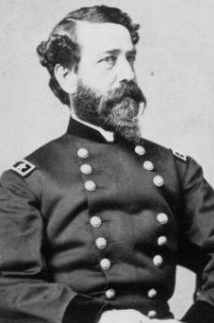
Brigadier-General John Milton Brannan, U.S. Army (public domain).

“It is hardly necessary to point out to you the extreme military importance of the two works now intrusted [sic, entrusted] to your command. Suffice it to state that they cannot pass out of our hands without the greatest possible disgrace to whoever may conduct their defense, and to the nation at large. In view of difficulties that may soon culminate in war with foreign powers, it is eminently necessary that these works should be immediately placed beyond any possibility of seizure by any naval or military force that may be thrown upon them from neighboring ports….

Seizure of these forts by coup de main may be the first act of hostilities instituted by foreign powers, and the comparative isolation of their position, and their distance from reinforcements, point them out (independent of their national importance) as peculiarly the object of such an effort to possess them.”

— Excerpt from orders issued by Brigadier-General John Milton Brannan, commanding officer, United States Army, Department of the South, to Colonel Tilghman H. Good, commanding officer of the 47th Pennsylvania Volunteer Infantry in December 1862


Fort Jefferson, Dry Tortugas, Florida, view from the sea, 1946 (vacation photograph collection of President Harry Truman, November 1946 U.S. National Archives and Records Administration, public domain).

Having been ordered by Union Brigadier-General John Milton Brannan to resume garrison duties in Florida in December 1862, after having been badly battered in the Battle of Pocotaligo, South Carolina two months earlier, the officers and enlisted members of the 47th Pennsylvania Volunteer Infantry were also informed in December that their regiment would become a divided one. This was being done, Brannan said, not as a punishment for their performance, which had been valiant, but to help the federal government to ensure that the foreign governments that had granted belligerent status to the Confederate States of America would not be able to aid the Confederate army and navy further in their efforts to move troops and supplies from Europe and the Deep South of the United States to the various theaters of the American Civil War.

As a result, roughly sixty percent of 47th Pennsylvanians (Companies A, B, C, E, G, and I) were sent back to Fort Taylor in Key West shortly before Christmas in 1862 while the remaining members of the regiment (from Companies D, F, H, and K) were transported by the USS Cosmopolitan to Fort Jefferson, the Union’s remote outpost in the Dry Tortugas, which was situated roughly seventy miles off the coast of Florida. They arrived there in late December of that same year.

Life at Fort Jefferson

Union Army Columbiad on the Terreplein at Fort Jefferson, Dry Tortugas, Florida (George A. Grant, 1937, U.S. National Park Service, public domain).

Garrison duty in Florida proved to be serious business for the 47th Pennsylvania Volunteers. Per records of the United States Army’s Ordnance Department, the defense capabilities of Fort Jefferson in 1863 were impressive—thirty-three smoothbore cannon (twenty-four of which were twenty-four pounder howitzers that had been installed in the fort’s bastions to protect the installation’s flanks, and nine of which were forty-two pounders available for other defensive actions); six James rifles (forty-two pounder seacoast guns); and forty-three Columbiads (six ten-inch and thirty-seven eight-inch seacoast guns).

Fort Jefferson was so heavily armed because it was “key in controlling … shipping in the Gulf of Mexico and was being used as a supply depot for the distribution of rations and munitions to Federal troops in the Mississippi Delta; and as a supply and fueling station for naval vessels engaged in the blockade or transport of supplies and troops,” according to historian Lewis Schmidt.

Large quantities of stores, including such diverse items as flour … ham … coal, shot, shell, powder, 5000 crutches, hospital stores, and stone, bricks and lumber for the fort, were collected and stored at the Tortugas for distribution when needed. Federal prisoners, most of them court martialed Union soldiers, were incarcerated at the fort during the period of the war and used as laborers in improving the structure and grounds. As many as 1200 prisoners were kept at the fort during the war, and at least 500 to 600 were needed to maintain a 200 man working crew for the engineers.

With respect to housing and feeding the soldiers stationed here:

Cattle and swine were kept on one of the islands nearest the fort, called Hog Island (today’s Bush Key), and would be compelled to swim across the channel to the fort to be butchered, with a hawser fastened to their horns. The meat was butchered twice each week, and rations were frequently supplemented by drawing money for commissary stores not used, and using it to buy fish and other available food items from the local fishermen. The men of the 7th New Hampshire [who were also stationed at Fort Jefferson] acquired countless turtle and birds’ eggs … from adjacent keys, including ‘Sand Key’ [where the fort’s hospital was located]. Loggerhead turtles were also caught … [and] were kept in the ‘breakwater ditch outside of the walls of the fort’, and used to supplement the diet [according to one soldier from New Hampshire].

Second-tier casemates, lighthouse keeper’s house, sallyport, and lean-to structure, Fort Jefferson, Dry Tortugas, Florida, late 1860s (U.S. National Park Service and National Archives, public domain).

In addition, the fort’s “interior parade grounds, with numerous trees and shrubs in evidence, contained … officers’ quarters, [a] magazine, kitchens and out houses,” as well as a post office and “a ‘hot shot oven’ which was completed in 1863 and used to heat shot before firing,” according to Schmidt.

Most quarters for the garrison … were established in wooden sheds and tents inside the parade [grounds] or inside the walls of the fort in second-tier gun rooms of ‘East’ front no. 2, and adjacent bastions … with prisoners housed in isolated sections of the first and second tiers of the southeast, or no. 3 front, and bastions C and D, located in the general area of the sallyport. The bakery was located in the lower tier of the northwest bastion ‘F’, located near the central kitchen….

According to H Company Second Lieutenant Christian Breneman, the walk around Fort Jefferson’s barren perimeter was less than a mile long with a sweeping view of the Gulf of Mexico. Brennan also noted the presence of “six families living [nearby], with 12 or 15 respectable ladies.”

Balls and parties are held regularly at the officers’ quarters, which is a large three-story brick building with large rooms and folding doors.

Lieutenant-Colonel George Warren Alexander, second-in-command, 47th Pennsylvania Volunteer Infantry, standing next to his horse, with officers from the 47th, Fort Jefferson, Dry Tortugas, Florida, circa 1863 (public domain; click to enlarge).

Shortly after the arrival of the 47th Pennsylvania Volunteers at Fort Jefferson, First Lieutenant George W. Fuller was appointed as adjutant for Lieutenant-Colonel George Warren Alexander, who had been placed in command of the fort’s operations. Assistant Regimental Surgeon Jacob Scheetz, M.D. was appointed as post surgeon and given command of the fort’s hospital operations, responsibilities he would continue to execute for fourteen months. In addition, Private John Schweitzer of the 47th Pennsylvania’s A Company was directed to serve at the fort’s baker, B Company’s Private Alexander Blumer was assigned as clerk of the quartermaster’s department, and H Company’s Third Sergeant William C. Hutchinson began his new duties as provost sergeant while H Company Privates John D. Long and William Barry were given additional duties as a boatman and baker, respectively.

When Christmas Day dawned, many at the fort experienced feelings of sadness and ennui as they continued to mourn friends who had recently been killed at Pocotaligo and worried about others who were still fighting to recover from their battle wounds.

1863

Unidentified Union Army artillerymen standing beside one of the fifteen-inch Rodman guns installed on the third level of Fort Jefferson in the Dry Tortugas, Florida, circa 1862. Each smoothbore Rodman weighed twenty-five tons, and was able to fire four-hundred-and-fifty-pound shells more than three miles (U.S. National Park Service, public domain).

The New Year arrived at Fort Jefferson with a bang—literally—as the fort’s biggest guns thundered in salute, kicking off a day of celebration designed by senior military officials to lift the spirits of the men and inspire them to continued service. Donning their best uniforms, the 47th Pennsylvania Volunteers assembled on the parade grounds, where they marched in a dress parade and drilled to the delight of the civilians living on the island, including Emily Holder, who had been living in a small house within the fort’s walls since 1860 with her husband, who had been stationed there as a medical officer for the fort’s engineers. When describing that New Year’s Day and other events for an 1892 magazine article, she said:

On January 1st, 1863, the steamer Magnolia visited Fort Jefferson and we exchanged hospitalities. One of the officers who dined with us said it was the first time in nine months he had sat at a home table, having been all that time on the blockade….

Colonel Alexander, our new Commander, said that in Jacksonville, where they paid visits to the people, the young ladies would ask to be excused from not rising; they were ashamed to expose their uncovered feet, and their dresses were calico pieced from a variety of kinds.

Two days later, the 47th Pennsylvania Volunteers’ dress parade was a far less enjoyable one as temperatures and tempers soared. The next day, H Company Corporal George Washington Albert and several of his comrades were given the unpleasant task of carrying the regiment’s foul-smelling garbage to a flatboat and hauling it out to sea for dumping.

As the month of January progressed, it became abundantly clear to members of the regiment that the practice of chattel slavery was as ever present at and beyond the walls of Fort Jefferson as it had been at Fort Taylor and in South Carolina. It seemed that the changing of hearts and minds would take time even among northerners—despite President Lincoln’s best efforts, as illustrated by these telling observations made later that same month by Emily Holder:

We received a paper on the 10th of January, which was read in turns by the residents, containing rumors of the emancipation which was to take place on the first, but we had to wait another mail for the official announcement.

I asked a slave who was in my service if he thought he should like freedom. He replied, of course he should, and hoped it would prove true; but the disappointment would not be as great as though it was going to take away something they had already possessed. I thought him a philosopher.

In Key West, many of the slaves had already anticipated the proclamation, and as there was no authority to prevent it, many people were without servants. The colored people seemed to think ‘Uncle Sam’ was going to support them, taking the proclamation in its literal sense. They refused to work, and as they could not be allowed to starve, they were fed, though there were hundreds of people who were offering exorbitant prices for help of any kind—a strange state of affairs, yet in their ignorance one could not wholly blame them. Colonel Tinelle [sic, Colonel L. W. Tinelli] would not allow them to leave Fort Jefferson, and many were still at work on the fort.

John, a most faithful boy, had not heard the news when he came up to the house one evening, so I told him, then asked if he should leave us immediately if he had his freedom.

His face shone, and his eyes sparkled as he asked me to tell him all about it. He did not know what he would do. The next morning Henry, another of our good boys, who had always wished to be my cook, but had to work on the fort, came to see me, waiting until I broached the subject, for I knew what he came for. He hoped the report would not prove a delusion. He and John had laid by money, working after hours, and if it was true, they would like to go to one of the English islands and be ‘real free.’

I asked him how the boys took the news as it had been kept from them until now, or if they had heard a rumor whether they thought it one of the soldier’s stories.

‘Mighty excited, Missis,’ he replied….

Henry had been raised in Washington by a Scotch lady, who promised him his freedom when he became of age; but she died before that time arrived, and Henry had been sold with the other household goods.

The 47th Pennsylvanians continued to undergo inspections, drill and march for the remainder of January as regimental and company assignments were fine-tuned by their officers to improve efficiency. Among the changes made was the reassignment of Private Blumer to service as clerk of the fort’s ordnance department.

Three key officers of the regiment, however, remained absent. D Company’s Second Lieutenant George Stroop was still assigned to detached duties with the U.S. Army’s Signal Corps aboard the Union Navy’s war sloop, Canandaigua, and H Company’s First Lieutenant William Wallace Geety was back home in Pennsylvania, still trying to recruit new members for the regiment while recovering from the grievous injuries he had sustained at Pocotaligo, while Company K’s Captain Charles W. Abbott was undergoing treatment for disease-related complications at Fort Taylor’s post hospital.

Disease, in fact, would continue to be one of the Union Army’s most fearsome foes during this phase of duty, felling thirty-five members of its troops stationed at Fort Jefferson during the months of January and February alone. Those seriously ill enough to be hospitalized included twenty men battling dysentery and/or chronic diarrhea, four men suffering from either intermittent or bilious remittent fever, and two who were recovering from the measles with others diagnosed with rheumatism and general debility.

Fort Jefferson’s moat and wall, circa 1934, Dry Tortugas, Florida (C. E. Peterson, U.S. Library of Congress; public domain).

The primary reason for this shocking number of sick soldiers was the problematic water quality. According to Schmidt:

‘Fresh’ water was provided by channeling the rains from the fort’s barbette through channels in the interior walls, to filter trays filled with sand; and finally to the 114 cisterns located under the fort which held 1,231,200 gallons of water. The cisterns were accessible in each of the first level cells or rooms through a ‘trap hole’ in the floor covered by a temporary wooden cover…. Considerable dirt must have found its way into these access points and was responsible for some of the problems resulting in the water’s impurity…. The fort began to settle and the asphalt covering on the outer walls began to deteriorate and allow the sea water (polluted by debris in the moat) to penetrate the system…. Two steam condensers were available … and distilled 7000 gallons of tepid water per day for a separate system of reservoirs located in the northern section of the parade ground near the officers [sic, officers’] quarters. No provisions were made to use any of this water for personal hygiene of the [planned 1,500-soldier garrison force]….

Consequently, soldiers were forced to wash themselves and their clothes using saltwater hauled from the ocean. As if that were not difficult enough, “toilet facilities were located outside of the fort.” According to Schmidt:

At least one location was near the wharf and sallyport, and another was reached through a door-sized hole in a gunport, and a walk across the moat on planks at the northwest wall…. These toilets were flushed twice each day by the actions of the tides, a procedure that did not work very well and contributed to the spread of disease. It was intended that the tidal flush should move the wastes into the moat, and from there, by similar tidal action, into the sea. But since the moat surrounding the fort was used clandestinely by the troops to dispose of litter and other wastes … it was a continuous problem for Lt. Col. Alexander and his surgeon.

When it came to the care of soldiers with more serious infectious diseases such as smallpox, soldiers and prisoners were confined to isolation roughly three miles away on Bird Key to prevent contagion. The small island also served as a burial ground for Union soldiers stationed at the fort.

* Note: During this same period, First Lieutenant Lawrence Bonstine was assigned to special duty as Post Adjutant at Fort Taylor in Key West, a position he continued to hold from at least January 10, 1863 through the end of December 1863. Reporting directly to the regiment’s founder and commanding officer, Colonel Tilghman H. Good, he was essentially Good’s right hand, ensuring that regimental records and reports to more senior military officials were kept up to date while performing other higher level administrative and leadership tasks.

On February 3, 1863, Colonel Tilghman Good, visited Fort Jefferson, in his capacity as regimental commanding officer and accompanied by the newly re-formed Regimental Band (band no. 2). Led by Regimental Bandmaster Anton Bush, the ensemble was on hand to perform the music for that evening’s officers’ ball.

Sometime during this phase of duty, Corporal George W. Albert was reassigned to duties as camp cook for Company H, giving him the opportunity to oversee at least one of the formerly enslaved Black men who had enlisted with the 47th Pennsylvania Volunteer Infantry while the regiment was stationed in Beaufort, South Carolina. Subsequently assigned to duties as an Under-Cook,” that Black soldier who fell under his authority was most likely Thomas Haywood, who had been entered onto the H Company roster after enrolling with the 47th Pennsylvania on November 1, 1862.

* Note: This was likely not a pleasant time for Thomas Haywood. One of the duties of his direct superior, Corporal George Albert, was to butcher a shipment of cattle that had just been received by the fort. Both men took on that task on Saturday, February 24—a day that Corporal Albert later described as hot, sultry and plagued by mosquitoes.

Based on Albert’s known history of overt racism, their interpersonal interactions were likely made worse that day by his liberal use of racial epithets, which were a frequent component of the diary entries he had penned during this time—hate speech that has all too often been wrongly attributed to the regiment’s entire membership by some mainstream historians and Civil War enthusiasts without providing actual evidence to back up those claims. There were a considerable number of officers and enlisted members of the 47th Pennsylvania who strongly supported the efforts of President Lincoln and senior federal government military leaders to eradicate the practice of chattel slavery nationwide with at least several members of the regiment known to be members of prominent abolitionist families in Pennsylvania.

Officers’ quarters and parade grounds, interior of Fort Jefferson, Dry Tortugas, Florida, 1898 (U.S. National Park Service and National Archives and Records Administration, public domain).

During this same period, Private Edward Frederick of the 47th Pennsylvania’s K Company was readmitted to the regimental hospital for further treatment of the head wound he had sustained at Pocotaligo. As his condition worsened, his health failed, and he died there late in the evening on February 15 from complications related to an abscess that had developed in his brain. He was subsequently laid to rest on the parade grounds at Fort Jefferson.

In a follow-up report, Post Surgeon Jacob H. Scheetz, M.D., the 47th Pennsylvania’s assistant regimental surgeon, provided these details of the battle wound and treatment that Frederick had endured:

Private Edward Frederick, Co. K, 47th Pennsylvania Vols, was struck by a musket ball at the battle of Pocotaligo, South Carolina, October 22, 1862. The ball lodged in the frontal bone and was removed. The wound did well for three weeks when he had a slight attack of erysipelas, which, however, soon subsided under treatment. The wound commenced suppurating freely and small spiculae of bone came away, or were removed, on several occasions. Cephalgia was a constant subject of complaint, which was described as a dull aching sensation. The wound had entirely closed on January 1, 1863, and little complaint made except the pain in the head when he exposed himself to the sun. About the 4th of February he was ordered into the hospital with the following symptoms: headache, pain in back and limbs, anorexia, tongue coated with a heavy white coating, bowels torpid. He had alternate flashes of heat; his pupils slightly dilated; his pulse 75, and of moderate volume. He was blistered on the nape of the neck, and had a cathartic given him, which produced a small passage. Growing prostrate, he was put upon the use of tonics, and opiates at night to promote sleep; without any advantage, however. His mind was clear til [sic] thirty-six hours before death, when his pupils were very much dilated, and he gradually sank into a comatose state until 12 M. [midnight] on the night of the 15th of February when he expired.

Another twelve hours after death: Upon removing the calvarium the membranes of the brain presented no abnormal appearance, except slight congestion immediately beneath the part struck. A slight osseus deposition had taken place in the same vicinity. Upon cutting into the left cerebrum, (anterior lobe) it was found normal, but an incision into the left anterior lobe was followed by a copious discharge of dark colored and very offensive pus, and was lined by a yellowish white membrane which was readily broken up by the fingers. I would also have stated that his inferior extremities were, during the last four days, partially paralyzed.

Lieutenant-Colonel George Warren Alexander, 47th Pennsylvania Volunteers, circa 1861 (public domain).

As Private Frederick’s body was being autopsied, the unceasing routine of fort life continued as members of the regiment went about performing their duties and the USS Cosmopolitan arrived with a new group of prisoners. On February 25, 1863, Lieutenant-Colonel Alexander issued Special Order No. 17:

I. Company commanders are hereby ordered to instruct the chief of detachment in their respective companies to see that all embrasures in the lower tier, both at and between their batteries, are properly closed and bolted immediately after retreat.

II. As the safety of the garrison depends on the carrying out of the above order, they will hold chiefs of detachments accountable for all delinquencies.

In addition, orders were given to company cooks to relocate their operations to bastion C of the fort, which was a much cooler place for them to do their duties—a change that was likely appreciated as much or more by the under-cooks as the higher-ranking cooks who oversaw their grueling work.

This was the first of several initiatives undertaken by Lieutenant-Colonel Alexander who, according to Schmidt, “was having some difficulty in exercising proper control over Fort Jefferson as it related to the Engineering Department and persons in their employ.”

It was his duty to train the garrison, guard the prisoners, and provide the necessary protection for the fort and its environs, a situation fraught with many problems not always understood by other military and non-military personnel on station there. It was during this period that relationships between the various interests began to deteriorate, as overseer George Phillips, temporarily filling in for Engineer Frost, refused the request of Lt. Col. Alexander to have as many engineer workmen removed from the casemates as could be comfortably accommodated inside the barracks outside the walls of the fort. Phillips lost the argument and the quarters were vacated, but the tone of the several letters exchanged between the two commands left much to be desired. Differences were aired concerning occupations of the prisoners and their possible use by the engineers; the amount of water used by the workmen as Alexander limited them to one gallon per day per man; Engineer Frost arriving and reclaiming for his department the central Kitchen, and another kitchen near it that had been used by Capt. Woodruff and others; stagnant water in the ditches which involved the post surgeon [Jacob H. Scheetz, M.D.] in the controversy; uncovering of the ‘cistern trap holes’ located in the floors of the first or lower tier, which allowed the water supplies to become contaminated; who exercised jurisdiction over the schooner Tortugas of the Engineering Department; depredations of wood belonging to the engineers; and many other conflicts….

Around this same time, Corporal George Nichols, who had piloted the Confederate steamer, the Governor Milton, behind Union lines after it had been captured by members of the 47th’s Companies E and K in October, was assigned once again to engineering duties—this time at Fort Jefferson—but he was not happy about it, according to a letter he wrote to family and friends:

So I am detailed on Special duty again as Engineer. I cannot See in this I did not Enlist as an Engineer. But I get Extra Pay for it but I do not like it. So I must get the condencer redy [sic, condenser ready] to condece [sic, condense] fresh water. Get her redy [ready] and no tools to do it with.

Corporal Nichols’ reassignment was made possible when the contingent of 47th Pennsylvanians at Fort Jefferson was strengthened with the transfer there of members of Companies E and G from Fort Taylor on February 28. That same day, the men of F Company received additional training with both light and heavy artillery at the fort while the men from K Company gained more direct experience with the installation’s seacoast guns. In addition, members of the regiment finally received the six months of back pay they were owed.

Rev. William DeWitt Clinton Rodrock, chaplain, 47th Pennsylvania Volunteers, Fort Jefferson, Dry Tortugas, Florida, 1863 (courtesy of Robert Champlin, used with permission).

It was also during this latest phase of duty that Regimental Chaplain William DeWitt Clinton Rodrock was transferred from Fort Taylor to Fort Jefferson—possibly to render spiritual comfort after what had been a brutal month in terms of hospitalizations. Among the seventy members of the 47th Pennsylvania who had been admitted to the post’s hospital in the Dry Tortugas were fifty-four men with dysentery and/or diarrhea, four men with remittent or bilious remittent fevers, three men suffering from catarrh, one man who had contracted typhoid fever, one man who had contracted tuberculosis and was suffering from the resulting wasting away syndrome known as phthisis, and three men suffering from diseases of the eye (two with nyctalopia, also known as night blindness, and one with cataracts).

One of the additional challenges faced by the men stationed in the Dry Tortugas (albeit a less serious one) was that there was no camp sutler available to them at Fort Jefferson, as there was for the 47th Pennsylvanians who were stationed at Fort Taylor. So, it was more difficult, if not impossible, to obtain their favorite foods, replacements for worn-out clothing, tobacco, and other items not furnished by the quartermasters of the Union Army—making their lives more miserable with each passing day as they depleted the care packages that had been sent to them by their families during the holidays.

Stationed farther from home than they had ever been, they could see no end in sight for the devastating war that had torn their nation apart.


Sources:

  1. Bates, Samuel P. History of Pennsylvania Volunteers, 1861-5, vol. 1. Harrisburg, Pennsylvania: B. Singerly, State Printer, 1869.
  2. Florida’s Role in the Civil War: ‘Supplier of the Confederacy.’ Tampa, Florida: Florida Center for Instructional Technology, College of Education, University of South Florida, retrieved online January 15, 2020.
  3. Holder, Emily. At the Dry Tortugas During the War.” San Francisco, California: Californian Illustrated Magazine, 1892 (part four, retrieved online, March 28, 2024, courtesy of Lit2Go, the website of the Educational Technology Clearinghouse at the Florida Center for Instructional Technology, College of Education, University of South Florida).
  4. History: Crops (Historic Florida Barge Canal Trail).” Historical Marker Database, retrieved online December 30, 2023.
  5. Malcom, Corey. Emancipation at Key West,” in “The 20th of May: The History and Heritage of Florida’s Emancipation Day Digital History Project.” St. Petersburg, Florida: Florida Humanities, retrieved online March 28, 2024.
  6. Owsley, Frank Lawrence, and Harriet Fason Chappell. King Cotton Diplomacy: Foreign Relations of the Confederate States of America. Chicago, Illinois: University of Chicago Press, 1959.
  7. Preventing Diplomatic Recognition of the Confederacy, 1861–1865,” and The Alabama Claims, 1862–1872,” in “Milestones: 1861–1865.” Washington, D.C.: Office of the Historian, Foreign Service Institute, United States Department of State, retrieved online December 30, 2023.
  8. Schmidt, Lewis G. A Civil War History of the 47th Regiment of Pennsylvania Veteran Volunteers. Allentown, Pennsylvania: Self-published, 1986.
  9. Staubach, Lieutenant Colonel James C. Miami During the Civil War: 1861-65, in Tequesta: The Journal of the Historical Association of Southern Florida, vol. LIII, pp. 31-62. Miami, Florida: Historical Museum of Southern Florida, 1993.
  10. Wharton, Henry D. Letters from the Sunbury Guards. Sunbury, Pennsylvania: Sunbury American, 1861-1868.
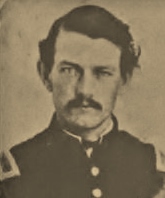
 

Peeling Onions: Researching and Writing the Biographies You Read at “47th Pennsylvania Volunteers: One Civil War Regiment’s Story”

“Life is like an onion; you peel it off one layer at a time and sometimes you weep.”

— Carl Sandburg


The lives of the men who served with the 47th Pennsylvania Volunteer Infantry during the American Civil War are like onions waiting to be peeled to our researchers at 47th Pennsylvania Volunteers: One Civil War Regiment’s Story.

Each time we decide to take on a new biography, we begin by carefully peeling away each layer of a soldier’s life to reveal the heart of each man, and, when we do, we often weep at what we have uncovered.

So many of the men who served with the 47th Pennsylvania Volunteer Infantry were just average Americans who gave the last full measure of devotion during the American Civil War to preserve our nation’s union—not just for themselves, but for future generations they would never meet.

We hope that perspective comes through each time you read one of the biographies we have created for this educational project, and that, after you do, you’ll not only continue to remember the names of the soldiers you’ve learned about, but that you’ll do all you can to honor the individual and collective sacrifices that they made during the American Civil War.

Each of us, today, owes each of them an enormous debt.


Research Update: Additional New Details Learned About Bristor Gethers, One of the Nine Formerly Enslaved Men Who Enlisted with the 47th Pennsylvania Volunteers

Page one of the U.S. Army’s Civil War enlistment paperwork for Bristor Gethers (mistakenly listed as “Presto Garris”), 47th Pennsylvania Volunteer Infantry, Company F, October 5, 1862 (U.S. National Archives and Records Administration, public domain; click to enlarge).

Fleeing the brutal experience of chattel slavery in Georgetown County, South Carolina, a thirty-three-year-old Black man was willing to enlist for military service in the fall of 1862 as an “undercook”—a designation within the United States Army that was first authorized by the U.S. War Department on September 28, 1863—in order to ensure his freedom in America’s Deep South during the American Civil War.

Arriving at a federal military recruiting depot in Union Army-occupied Beaufort, South Carolina, that man—Bristor Gethers—was certified as fit for duty by Dr. William Reiber, an assistant surgeon with the 47th Pennsylvania Volunteer Infantry, and was then accepted into that regiment on October 5, 1862 by Captain Henry Samuel Harte, a German immigrant who had been commissioned as the commanding officer of that regiment’s F Company.

The reason that officers of the 47th Pennsylvania Volunteer Infantry were able to enroll Bristor Gethers, along with three additional formerly enslaved men that fall (roughly three months before U.S. President Abraham Lincoln officially issued the nation’s Emancipation Proclamation), was because the U.S. Congress had previously passed the Militia Act of 1862 on July 17, 1862, which authorized state and federal military units in Union-held territories to recruit and enroll enslaved and free Black men to fill labor-related jobs.

According to section twelve of that legislation, starting on that date, President Lincoln was “authorized to receive into the service of the United States, for the purpose of constructing intrenchments, or performing camp service or any other labor, or any military or naval service for which they may be found competent, persons of African descent, and such persons shall be enrolled and organized under such regulations, not inconsistent with the Constitution and laws, as the President may prescribe” while the next three sections specified the following additional details of that military service:

SEC. 13. And be it further enacted, That when any man or boy of African descent, who by the laws of any State shall owe service or labor to any person who, during the present rebellion, has levied war or has borne arms against the United States, or adhered to their enemies by giving them aid and comfort, shall render any such service as is provided for in this act, he, his mother and his wife and children, shall forever thereafter be free, any law, usage, or custom whatsoever to the contrary notwithstanding: Provided, That the mother, wife and children of such man or boy of African descent shall not be made free by the operation of this act except where such mother, wife or children owe service or labor to some person who, during the present rebellion, has borne arms against the United States or adhered to their enemies by giving them aid and comfort.

SEC. 14. And be it further enacted, That the expenses incurred to carry this act into effect shall be paid out of the general appropriation for the army and volunteers.

SEC. 15. And be it further enacted, That all persons who have been or shall be hereafter enrolled in the service of the United States under this act shall receive the pay and rations now allowed by law to soldiers, according to their respective grades: Provided, That persons of African descent, who under this law shall be employed, shall receive ten dollars per month and one ration, three dollars of which monthly pay may be in clothing.

Seeking to add more teeth to its anti-slavery legislation, the U.S. Congress then also passed the Confiscation Act of 1862 that same day, proclaiming that “every person who shall hereafter commit the crime of treason against the United States, and shall be adjudged guilty thereof, shall suffer death, and all his slaves, if any, shall be declared and made free.”

General Orders No. 323 (enlistment and pay of undercooks of African descent), U.S. War Department and Office of the Adjutant General, September 28, 1863 (U.S. Library of Congress, public domain; click to enlarge).

By taking that important step toward securing what he hoped would be permanent freedom from the plantation enslavement he had endured in South Carolina for more than three decades, Bristor Gethers was, in reality, trading one form of backbreaking labor (slavery) for another that was only marginally better because he was entering military life as an “undercook”—a designation that placed him on the very bottom of the 47th Pennsylvania’s military rosters—beneath the names of soldiers who were listed at the rank of private or drummer boy.

His status clearly improved enough over time, though, that he was willing to stay with the 47th Pennsylvania Volunteer Infantry for nearly the entire duration of its service to the nation. Traveling with the 47th to Florida, where the regiment was stationed on garrison duty at Forts Taylor and Jefferson from late December 1862 through early February 1864, he likely participated side by side with the regiment’s white soldiers as they felled trees, built new roads and engaged in other similar tasks designed to strengthen the fortifications of those federal installations. It was during this same time that he would have learned from his commanding officer, Captain Harte, that President Abraham Lincoln had officially issued the Emancipation Proclamation on January 1, 1863 and that the U.S. War Department and Adjutant General’s Office had issued General Orders No. 323 on September 28th of that same year, which authorized all Union Army units “to cause to be enlisted for each cook [in each Union Army regiment] two under-cooks of African descent, who shall receive for their full compensation ten dollars per month and one ration per day” (three dollars of which could be issued to undercooks “in clothing,” rather than money).

Bristor Gethers was listed as a private on the final version of the Commonwealth of Pennsylvania’s “Registers of Volunteers, 1861-1865” for Company F of the 47th Pennsylvania Volunteer Infantry (Pennsylvania State Archives, public domain; click to enlarge and scroll down).

Promoted to the rank of Cook by the spring of 1863, according to regimental muster rolls, his duties were also likely expanded to include the job of caring for the regiment’s combat casualties by the spring and fall of 1864, when the 47th Pennsylvania was engaged in the Union’s 1864 Red River Campaign across Louisiana and the 1864 Shenandoah Valley Campaign across Virginia. In addition to rescuing and carrying wounded men from multiple fields of battle under fire as a stretcher bearer during this time, as many other undercooks in the Union Army were ordered to do, he may very well also have helped to dig the graves for his 47th Pennsylvania comrades who had been killed in action.

Apparently so well thought of by his superior officers, according to the regiment’s final muster-out ledgers, Bristor Gethers was ultimately accorded the rank of private—a hard-won title that, on paper in the present day, may seem as if it were a minor achievement.

It wasn’t. It was, in reality, historic.

About “Faces of the 47th: Freedmen of the 47th Pennsylvania Volunteer Infantry”

Faces of the 47th: Freedmen of the 47th Pennsylvania Volunteer Infantry is a special project of 47th Pennsylvania Volunteers: One Civil War Regiment’s Story, an educational program designed to teach children and adults about the history of the 47th Pennsylvania Veteran Volunteers, a Union Army regiment which served for nearly the entire duration of the American Civil War and became the only military unit from the Commonwealth of Pennsylvania to participate in the Union’s 1864 Red River Campaign across Louisiana.

This important initiative is dedicated to researching, documenting and presenting the life stories of nine formerly enslaved Black men who enlisted with the 47th Pennsylvania Volunteer Infantry during two of the regiment’s most eventful years of service to the nation—1862 and 1864. Largely forgotten for more than a century after honorably completing their historic military service, these nine men have been repeatedly overlooked by mainstream historians over the years as potentially important subjects for research and have also been an ongoing source of mystery and frustration to their descendants because the majority of their military service records have still not been digitized by state and national archives.

To learn more about the life of Bristor Gethers before, during and after the war, and to view his U.S. Civil War military and pension records, visit his profile on “Freedmen of the 47th Pennsylvania Volunteer Infantry.”


Sources:

  1. Berlin, Ira, Joseph P. Reidy, and Leslie S. Rowland. Freedom’s Soldiers: the Black Military Experience in the Civil War. Cambridge, United Kingdom: Cambridge University Press, 1998.
  2. Blight, David W. Frederick Douglass’ Civil War: Keeping Faith in Jubilee. Baton Rouge, Louisiana: Louisiana State University Press, 1989.
  3. Foner, Eric. The Fiery Trial: Abraham Lincoln and American Slavery. New York, New York: W.W. Norton, 2010.
  4. “Garris, Presto” [sic, “Gethers, Bristor”], in Civil War Veterans’ Card File, 1861-1866. Harrisburg, Pennsylvania: Pennsylvania State Archives.
  5. “Garris, Presto” [sic, “Gethers, Bristor”], in “Registers of Pennsylvania Volunteers, 1861-1865” (47th Regiment, Company F), in “Records of the Department of Military and Veterans’ Affairs” (RG-19). Harrisburg, Pennsylvania: Pennsylvania State Archives.
  6. “Garris, Presto” [sic, “Gethers, Bristor”], in U.S. Civil War Compiled Military Service Records, 1862-1865. Washington, D.C.: U.S. National Archives and Records Administration.
  7. “Garris, Presto” [sic, “Gethers, Bristor”], in U.S. Civil War General Pension Index (veteran’s pension application no.: 773063, certificate no.: 936435, filed from South Carolina, February 1, 1890; widow’s pension application no.: 598937, certificate no.: 447893, filed from South Carolina, July 27, 1894). Washington, D.C.: U.S. National Archives and Records Administration.
  8. “Garris, Presto” [sic, “Gethers, Bristor”], in U.S. Civil War Muster Rolls (47th Pennsylvania Volunteer Infantry, Company F), 1862-1865. Harrisburg, Pennsylvania: Pennsylvania State Archives.
  9. McPherson, James M. The Negro’s Civil War: How American Blacks Felt and Acted During the War for the Union. New York, New York: Ballantine Books, 1991.
  10. Oakes, James. The Radical and the Republican: Frederick Douglass, Abraham Lincoln, and the Triumph of Antislavery Politics. New York, New York: W. W. Norton & Co., 2007.
  11. Smith, John David. Black Soldiers in Blue: African American Troops in the Civil War Era. Chapel Hill, North Carolina: University of North Carolina, 2002.
  12. The Militia Act of 1862, in U.S. Statutes at Large, Treaties, and Proclamations of the United States of America, vol. 12, pp. 597-600: Boston, Massachusetts: Little, Brown and Company, 1863.
  13. The Confiscation Act.” New York, New York: The New York Times, July 15, 1862.
  14. The Confiscation Acts of 1861 and 1862.” Washington, D.C.: United States Senate, retrieved online January 14, 2024.


New Year, Familiar Duties: Preventing Assaults on Federal Forts by Confederate Troops and Foreign Powers (Florida, late December 1862 – early February 1864)

Brigadier-General John Milton Brannan, U.S. Army, circa 1863 (public domain).

“It is hardly necessary to point out to you the extreme military importance of the two works now intrusted [sic, entrusted] to your command. Suffice it to state that they cannot pass out of our hands without the greatest possible disgrace to whoever may conduct their defense, and to the nation at large. In view of difficulties that may soon culminate in war with foreign powers, it is eminently necessary that these works should be immediately placed beyond any possibility of seizure by any naval or military force that may be thrown upon them from neighboring ports….

Seizure of these forts by coup de main may be the first act of hostilities instituted by foreign powers, and the comparative isolation of their position, and their distance from reinforcements, point them out (independent of their national importance) as peculiarly the object of such an effort to possess them.”

Excerpt from orders issued by Brigadier-General John M. Brannan, commanding officer, United States Army, Department of the South, to Colonel Tilghman H. Good, commanding officer of the 47th Pennsylvania Volunteer Infantry in December 1862


Colonel Tilghman H. Good, commanding officer, 47th Pennsylvania Volunteers (public domain image, circa 1863).

With those words above, Colonel Tilghman H. Good, the founder and commanding officer of the 47th Pennsylvania Volunteer Infantry, learned that he and his subordinates were being sent back to Florida to resume their garrison duties at Fort Taylor in Key West, Florida. Far from being a punishment, following the regiment’s performance during the Battle of Pocotaligo, South Carolina on October 22, 1862, though, as several historians have claimed over the years, those words written to Colonel Good make clear that the return of the 47th Pennsylvania Volunteers to Florida was viewed by senior Union military officers as a critically important assignment, not only for the regiment, but for the United States of America.

More simply put, senior federal government officials, in consultation with senior Union Army officers, had determined that two key federal military installations in Florida—Fort Taylor in Key West and Fort Jefferson in the Dry Tortugas—were at continuing risk of attack and capture by foreign powers, as well as by Confederate States Army troops, because Confederate States leaders had been able to secure support from several European nations, despite promises by the leaders of those nations that they would remain “neutral” as the American Civil War progressed. In addition to helping Confederate troops defeat the Union’s blockade of Confederate States ports that had been established in 1861, enabling the Confederacy to raise financial support for its war efforts through the sale of cotton to European nations, Great Britain had been “provid[ing] significant assistance in other ways, chiefly by permitting the construction in English shipyards of Confederate warships,” according to historians J. Matthew Gallman and Eric Foner.

The most serious incidents of this nature were initiated with the launch of the Confederate cruiser, Alabama, on July 29, 1862. Per research completed by historians at the United States Department of State:

[The Alabama] captured 58 Northern merchant ships before it was sunk in June 1864 by a U.S. warship off the coast of France. In addition to the Alabama, other British-built ships in the Confederate Navy included the Florida, Georgia, Rappahannock, and Shenandoah. Together, they sank more than 150 Northern ships and impelled much of the U.S. merchant marine to adopt foreign registry. The damage to Northern shipping would have been even worse had not fervent protests from the U.S. Government persuaded British and French officials to seize additional ships intended for the Confederacy. Most famously, on September 3, 1863, the British Government impounded two ironclad, steam-driven “Laird rams” that Confederate agent James D. Bulloch had surreptitiously arranged to be built at a shipyard in Liverpool.

The United States demanded compensation from Britain for the damage wrought by the British-built, Southern-operated commerce raiders, based upon the argument that the British Government, by aiding the creation of a Confederate Navy, had inadequately followed its neutrality laws. The damages discussed were enormous. Charles Sumner, Chairman of the Senate Foreign Relations Committee, argued that British aid to the Confederacy had prolonged the Civil War by 2 years, and indirectly cost the United States hundreds of millions, or even billions of dollars (the figure Sumner suggested was $2.125 billion)….

As a result, senior federal government and military officials grew increasingly worried that Confederate States troops would attempt to take over Forts Taylor and Jefferson—possibly in much the same way that Rebel forces had captured Fort Sumter in April 1861.

Ordered to prevent those takeovers from happening by Special Order No. 384, which was issued by Brigadier-General Brannan of the United States Army’s Department of the South, the 47th Pennsylvania Volunteers were specifically chosen for this mission because of the reputation they had built during their first sixteen months of Civil War service. Cited by senior Union Army leaders as being specially worthy of notice by their bravery and praiseworthy conduct during the Battle of Pocotaligo, members of the 47th Pennsylvania had already become known for their “attention to duty, discipline and soldierly bearing” as early as 1861, according to historian Samuel P. Bates.

Another Sea Journey

Elisha Wilson Bailey, M.D., Regimental Surgeon, 47th Pennsylvania Volunteer Infantry, circa 1863 (used with permission; courtesy of Julian Burley).

After packing their belongings at their Beaufort, South Carolina encampment and loading their equipment onto the U.S. Steamer Cosmopolitan, the officers and enlisted members of the 47th Pennsylvania Volunteer Infantry sailed toward the mouth of the Broad River on December 15, 1862, and anchored briefly at Port Royal Harbor in order to allow the regiment’s medical director, Elisha W. Baily, M.D., and members of the regiment who had recuperated enough from their Pocotaligo-related battle injuries at the Union’s General Hospital at Hilton Head, to rejoin the regiment.

At 5 p.m. that same evening, the regiment sailed for Florida, during what was later described by several members of the regiment as a treacherous and nerve-wracking voyage. According to historian Lewis Schmidt, the ship’s captain “steered a course along the coast of Florida for most of the voyage,” which made the voyage more precarious “because of all the reefs.” On December 16, “the second night, the ship was jarred as it ran aground on one during a storm, but broke free, and finally steered a course further from shore, out in the Gulf Stream.”

Woodcut depicting the harsh climate at Fort Taylor in Key West, Florida during the Civil War (U.S. Library of Congress, public domain).

In a letter penned to the Sunbury American on 21 December, C Company Musician Henry Wharton provided the following details about the regiment’s trip:

On the passage down, we ran along almost the whole coast of Florida. Rather a dangerous ground, and the reefs are no playthings. We were jarred considerably by running on one, and not liking the sensation our course was altered for the Gulf Stream. We had heavy sea all the time. I had often heard of ‘waves as big as a house,’ and thought it was a sailor’s yarn, but I have seen ‘em and am perfectly satisfied; so now, not having a nautical turn of mind, I prefer our movements being done on terra firma, and leave old neptune to those who have more desire for his better acquaintance. A nearer chance of a shipwreck never took place than ours, and it was only through Providence that we were saved. The Cosmopolitan is a good river boat, but to send her to sea, loadened [sic, loaded] with U.S. troops is a shame, and looks as though those in authority wish to get clear of soldiers in another way than that of battle. There was some sea sickness on our passage; several of the boys ‘casting up their accounts’ on the wrong side of the ledger.

According to Corporal George Nichols of Company E, “When we got to Key West the Steamer had Six foot of water in her hole [sic]. Waves Mountain High and nothing  but an old river Steamer. With Eleven hundred Men on I looked for her to go to the Bottom Every Minute.”

Although the Cosmopolitan arrived at the Key West Harbor on Thursday, December 18, the 47th Pennsylvania Volunteers did not set foot on Florida soil until noon the next day. The men from Companies C and I were immediately marched to Fort Taylor, where they were placed under the command of Major William H. Gausler, the regiment’s third-in-command. The men from Companies B and E were assigned to the older barracks that had been erected by the United States Army, and were placed under the command of B Company Captain Emanual P. Rhoads while the men from Companies A and G were placed under the command of A Company Captain Richard A. Graeffe, and stationed at newer facilities known as the “Lighthouse Barracks” on “Lighthouse Key.”

Lieutenant-Colonel George Warren Alexander, second-in-command, 47th Pennsylvania Volunteer Infantry, with officers from the 47th, Fort Jefferson, Dry Tortugas, Florida, circa 1863 (public domain; click to enlarge).

Three days later, on Saturday, December 21, 1862, Lieutenant-Colonel George Warren Alexander, the regiment’s second-in-command, sailed away aboard the Cosmopolitan with the men from the regiment’s remaining companies—Companies D, F, H, and K—and headed south to Fort Jefferson, where they would assume garrison duties at the Union’s remote outpost in the Dry Tortugas, roughly seventy miles off the coast of Florida (in the Gulf of Mexico). According to Henry Wharton:

We landed here on last Thursday at noon, and immediately marched to quarters. Company I. and C., in Fort Taylor, E. and B. in the old Barracks, and A. and G. in the new Barracks. Lieut. Col. Alexander, with the other four companies proceeded to Tortugas, Col. Good having command of all the forces in and around Key West. Our regiment relieves the 90th Regiment N.Y.S. Vols. Col. Joseph Morgan, who will proceed to Hilton Head to report to the General commanding. His actions have been severely criticized by the people, but, as it is in bad taste to say anything against ones [sic, one’s] superiors, I merely mention, judging from the expression of the citizens, they were very glad of the return of the 47th Pennsylvania Volunteers….

Key West has improved very little since we left last June, but there is one improvement for which the 90th New York deserve a great deal of praise, and that is the beautifying of the ‘home’ of dec’d. soldiers. A neat and strong wall of stone encloses the yard, the ground is laid off in squares, all the graves are flat and are nicely put in proper shape by boards eight or ten inches high on the ends sides, covered with white sand, while a head and foot board, with the full name, company and regiment, marks the last resting place of the patriot who sacrificed himself for his country….

Although water quality was a challenge for members of the regiment at both of these duty stations, it was particularly problematic at Fort Jefferson. According to Schmidt:

‘Fresh’ water was provided by channeling the rains from the fort’s barbette through channels in the interior walls, to filter trays filled with sand; and finally to the 114 cisterns located under the fort which held 1,231,200 gallons of water. The cisterns were accessible in each of the first level cells or rooms through a ‘trap hole’ in the floor covered by a temporary wooden cover…. Considerable dirt must have found its way into these access points and was responsible for some of the problems resulting in the water’s impurity…. The fort began to settle and the asphalt covering on the outer walls began to deteriorate and allow the sea water (polluted by debris in the moat) to penetrate the system…. Two steam condensers were available … and distilled 7000 gallons of tepid water per day for a separate system of reservoirs located in the northern section of the parade ground near the officers [sic, officers’] quarters. No provisions were made to use any of this water for personal hygiene of the [planned 1,500-soldier garrison force]….

Fort Jefferson’s moat and wall, circa 1934, Dry Tortugas, Florida (C.E. Peterson, U.S. Library of Congress, public domain).

As a result, the soldiers stationed at Fort Jefferson washed themselves and their clothes, using saltwater from the ocean. As if that weren’t difficult enough, “toilet facilities were located outside of the fort,” according to Schmidt:

At least one location was near the wharf and sallyport, and another was reached through a door-sized hole in a gunport, and a walk across the moat on planks at the northwest wall…. These toilets were flushed twice each day by the actions of the tides, a procedure that did not work very well and contributed to the spread of disease. It was intended that the tidal flush should move the wastes into the moat, and from there, by similar tidal action, into the sea. But since the moat surrounding the fort was used clandestinely by the troops to dispose of litter and other wastes … it was a continuous problem for Lt. Col. Alexander and his surgeon.

As for housing and feeding the soldiers stationed here, as well as daily operations, there was a fort post office and the “interior parade grounds, with numerous trees and shrubs in evidence, contained … officers quarters, [a] magazine, kitchens and out houses,” according to Schmidt, as well as “a ‘hot shot oven’ which was completed in 1863 and used to heat shot before firing.”

Most quarters for the garrison … were established in wooden sheds and tents inside the parade [grounds] or inside the walls of the fort in second-tier gun rooms of ‘East’ front no. 2, and adjacent bastions … with prisoners housed in isolated sections of the first and second tiers of the southeast, or no. 3 front, and bastions C and D, located in the general area of the sallyport. The bakery was located in the lower tier of the northwest bastion ‘F’, located near the central kitchen….

Additional Duties: Diminishing Florida’s Role as the “Supplier of the Confederacy”

On top of the strategic role played by the 47th Pennsylvania Volunteers in preventing foreign powers from assisting the Confederate Army and Navy in gaining control over federal forts in the Deep South, members of this regiment would also be called upon to play an ongoing role in weakening Florida’s abilities to supply and transport food and troops throughout the area held by the Confederate States of America.

Prior to intervention by Union Army and Navy forces, the owners of plantations and livestock ranches, as well as the operators of small, family farms across Florida, had been able to consistently furnish beef and pork, fish, fruits, and vegetables to Confederate troops stationed throughout the Deep South during the first year of the American Civil War. Large herds of cattle were raised near Fort Myers, for example, while orchard owners in the Saint John’s River area were actively engaged in cultivating large orange groves (while other types of citrus trees were easily found growing throughout the state’s wilderness areas).

The state was also a major producer of salt, which was used as a preservative for the foods. As a result, the 47th Pennsylvania Volunteers and other Union troops across Florida were ordered to capture or destroy salt manufacturing facilities in order to further curtail the enemy’s access to food.

And they would be undertaking all of these duties in conditions that were far more challenging than what many other Union Army units were experiencing up north in the Eastern Theater. The weather was frequently hot and humid as spring turned to summer, the mosquitos and other insects were an ever-present annoyance and serious threat when they were carrying tropical diseases, and there were also scorpions and snakes that put the men’s health at further risk.

Consequently, the time spent in Florida during the whole of 1863 and early 1864 was most definitely not “easy duty” for the 47th Pennsylvania Volunteers. It was a serious and perilous time for them, and it would prove to be one that a significant number of 47th Pennsylvanians would not survive.


Sources:

  1. Bates, Samuel P. History of Pennsylvania Volunteers, 1861-5, vol. 1. Harrisburg, Pennsylvania: B. Singerly, State Printer, 1869.
  2. Florida’s Role in the Civil War: ‘Supplier of the Confederacy.’” Tampa, Florida: Florida Center for Instructional Technology, University of South Florida (College of Education), retrieved online January 15, 2020.
  3. Gallman, J. Matthew, editor, and Eric Foner, introduction. The Civil War Chronicle: The Only Day-by-Day Portrait of Americas Tragic Conflict as Told by Soldiers, Journalists, Politicians, Farmers, Nurses, Slaves, and Other Eyewitnesses. New York, New York: Crown, 2000.
  4. History: Crops (Historic Florida Barge Canal Trail).” Historical Marker Database, retrieved online December 30, 2023.
  5. Mathews, Alfred and Austin N. Hungerford. History of the Counties of Lehigh and Carbon, in the Commonwealth of Pennsylvania. Philadelphia, Pennsylvania: Everts & Richards, 1884.
  6. Owsley, Frank Lawrence and Harriet Fason Chappell. King Cotton Diplomacy: Foreign Relations of the Confederate States of America. Chicago, Illinois: University of Chicago Press, 1959.
  7. Preventing Diplomatic Recognition of the Confederacy, 1861–1865,” and The Alabama Claims, 1862–1872,” in “Milestones: 1861–1865.” Washington, D.C.: Office of the Historian, Foreign Service Institute, United States Department of State, retrieved online December 30, 2023.
  8. Schmidt, Lewis G. A Civil War History of the 47th Regiment of Pennsylvania Veteran Volunteers. Allentown, Pennsylvania: Self-published, 1986.
  9. Staubach, Lieutenant Colonel James C. Miami During the Civil War: 1861-65,” in Tequesta: The Journal of the Historical Association of Southern Florida, vol. LIII, pp. 31-62. Miami, Florida: Historical Museum of Southern Florida, 1993.
  10. Stuckey, Sterling, Linda Kerrigan and Judith L. Irvin, et. al. Call to Freedom. Austin, Texas: Holt, Reinhart and Winston, 2000.
  11. Wharton, Henry D. Letters from the Sunbury Guards. Sunbury, Pennsylvania: Sunbury American, 1861-1868.


Sheridan’s 1864 Shenandoah Valley Campaign: Camp Fairview, Charlestown, West Virginia (December 20, 1864 – early April 1865)

Charlestown West Virginia, circa 1863 (public domain).

Encamped in early December 1864 with the United States Army of the Shenandoah at its winter quarters at Camp Russell, which was located just west of Stephens City (now Newtown) and south of Winchester, Virginia, the members of the 47th Pennsylvania Volunteer Infantry were learning that their stay at this Union Army complex was destined to be shorter than they had hoped. Ordered to prepare for yet another march, they were informed by their superiors that they were being reassigned yet again—this time to help fulfill the directive of Major-General Philip H. Sheridan that the Army of the Shenandoah search out and eliminate the ongoing threat posed by Confederate States Army guerrilla soldiers who had been attacking federal troops, railroad systems and supply lines throughout Virginia and West Virginia.

So, after packing up and saying goodbye to the new friends they’d made at Camp Russell, they began a new, thirty-mile march, five days before Christmas. Trudging north during a driving snowstorm on December 20, 1864, they finally reached Charlestown, West Virginia, where they quickly established their latest “new home” at Camp Fairview, which was situated roughly two miles outside of the village.

Per an 1870 edition of The Lehigh Register, while marching for Charlestown, the 47th Pennsylvania Volunteers made their way through Winchester and followed the Charlestown and Winchester Railroad line “until two o’clock the following morning” when they were forced to sleep on their arms “until daylight, the guide having lost his way.”

Initially using this camp as the regiment’s winter quarters, the 47th Pennsylvania Volunteers were soon “on constant active duty, guarding the railroad and constructing works for defense against the incursions of guerrillas. The regiment participated in a number of reconnoissances [sic] and skirmishes during the winter”—as the old year of 1864 became the New Year of 1865.

More specifically, by 1865, according to historians at the Pennsylvania State Archives, who had uncovered details about the 47th Pennsylvania’s time at Camp Fairview by reading the diaries of Jeremiah Siders of Company H, the 47th Pennsylvania Volunteers “were employed building blockhouses at all the railroad ‘posts’ (meaning loading stations).”

A Chaplain Expresses His Thoughts on the Ongoing War

Rev. William DeWitt Clinton Rodrock, chaplain, 47th Pennsylvania Volunteers, Fort Jefferson, Dry Tortugas, Florida, 1863 (courtesy of Robert Champlin, used with permission).

On New Year’s Eve in 1864, the Rev. William DeWitt Clinton Rodrock, the regimental chaplain of the 47th Pennsylvania Volunteer Infantry, penned the following words in a report to his superiors:

Camp, 47th Reg. Pa. Vet. Vol’s
Near Charlestown Va, Dec. 31st 1864

Brig. Gen’l L. Thomas,
Adj. Gen’l, U.S. Army

Sir.

I respectfully, beg leave to state that absence from the Reg. accounts for my failing to report for the previous month.

And in submitting my report for the present month it affords me great pleasure to state that the condition and morale of the Reg. is in every respect encouraging.

Of the large number of wounded in the terrible battle of Cedar Creek, Oct. 19th/64, comparatively few have died, probably fourteen, or even a less number will cover the entire loss, whilst nearly all the surviving ones, will be able to join our ranks.

No deaths have occurred in the Reg during the month, whilst few are sick in Hospital, and the health generally is good.

For some time past, the Reg. had been deficient in its quota of officers, but this deficiency is now being happily filled by suitable promotions from the ranks.

In the aggregate it now numbers 882 men. Of which 24 are officers.

In a moral and religious point of view, there is still a large margin for improvement and it is my earnest endeavor to devote all proper and available means for the spiritual welfare of the command.

Under its new organization and in the fourth year of its history, our Reg. has an encouraging future before it.

In conclusion, I may yet say that the review of our National life during the year that is about being numbered with the past, affords rare promise for the future. At no period in the history of our great contest for freedom and Unity has the prospect of returning peace, through honorable conflict, been so promising.

The efforts, the sacrifices, the patience of the loyal states and People are crowned, at last, with triumphs worthy of the holy cause of liberty.

Yet a little while, and we shall rejoice in a peace based on the everlasting foundations of Religion, Humanity, Nationality, and freedom.

For this defeat of traitors at home as well as of Rebels in arms and their sympathizers abroad, for this expression of stern and resolute purpose, for this unshrinking determination to make the last needed sacrifice, how can we be sufficiently grateful?

May the God of our fathers still smile upon us.

I have the honor, Gen’l, to remain,
Very Respectfully, Your Obed’t Serv’nt

W.D. C. Rodrock, Chap., 47th Reg. P.V.V.
2nd Brig. 1st Div. 19th A.C.

* Note: Chaplain Rodrock’s December 31, 1864 report to superiors had noticeable errors, including his significant underestimation of his regiment’s casualty figures during Sheridan’s 1864 Shenandoah Valley Campaign. During the Battle of Cedar Creek alone, more than one hundred and seventy-four members of the 47th Pennsylvania were declared killed, wounded, captured, or missing (forty killed in action, ninety-nine wounded in action, fifteen of whom later died, twenty-five captured, ten of whom later died while still being held as POWs or shortly after their release by CSA troops, nine missing, one unresolved). While he may not yet have had full casualty figures by the time he penned the report above, he would certainly have been able to at least obtain accurate figures regarding the number of men who had been killed and mortally wounded.

Page one of a report written by the Rev. William DeWitt Clinton Rodrock, 47th Pennsylvania Volunteer Infantry Regimental Chaplain, from Camp Fairview, West Virginia to his superiors, January 31, 1865 (U.S. Army, U.S. National Archives and Records Administration, public domain).

Exactly one month later, Rev. Rodrock was putting the final touches on his latest report:

Camp Fairview.
Two miles from Charlestown, Va
January 31st, 1865

Brig. Gen’l L. Thomas
Adj. Gen’l, U.S. Army

Sir.

I have the honor respectfully, to submit the following report for the present month.

Although God is not in men’s thoughts; his law being violated with impunity and his authority contemned “at will”; yet as a nation, our God is the Lord. The mind rest with pleasure on the abounding proof of this great fact. The history of the past, how full of it!

From the first planting of our Fathers on this soil, onward to this day, the true God has been claimed as ours. The foundations of our government were laid in the full and firm apprehension and acknowledgment of this fact. There is one scene recorded in our history which more than all others prove this; we have it commemorated in the engraving of the First Prayer in Congress.

There were the sages and patriots of our land – the representations of the whole country. They had reached a most critical point in their deliberations. They felt the need of higher wisdom than their own. They call in the minister of God, the servant of Jesus Christ; and there and then, in most affecting, service, our country – our whole country is laid at the foot of the Divine throne.

If ever there was heartfelt acknowledgment of a living and true God, and most hearty and sincere invocation of his favor, it was there. For themselves, for their living countrymen, for those to come after them, they cast their all on God, and bound themselves and all to him! Most touching and ever-memorable scene! Worthy the occasion and worthy of a great nation. In this spirit the Christian and the patriot, whether in civic or military life strive to labor, and should fire all hearts and nerve all arms in our present fiery struggle for universal freedom.

I am happy to report the favorable and healthy condition of the Reg. Our aggregate is 891. Of these 19 are transiently on the sick list. No deaths have occurred during the month.

We employ all available means for promoting the temporal and spiritual welfare of the command.

Having a large library of select books, I am prepared to meet the wants of the men in this direction.

Besides I distribute several hundred religious papers among them every week. I am convinced, by experience, that this is one of the effectual and welcome means of gaining the attention of the mass of the men to religious truth, and keeping up the tie between them and the Church at home.

Ever striving to labor with an eye single to the glory of God and our country.

I have the honor,
Gen’l to remain
Your Obed’t Servant

W. D. C. Rodrock
Chaplain, 47th Reg. P.V.V.
2nd Brig. 1st Div. 19th Corps

Page one of a report written by the Rev. William DeWitt Clinton Rodrock, 47th Pennsylvania Volunteer Infantry Regimental Chaplain, from Camp Fairview, West Virginia to his superiors, February 28, 1865 (U.S. Army, U.S. National Archives and Records Administration, public domain).

While Rev. Rodrock’s next monthly report conveyed the following to his superiors:

Camp Fairview
Near Charlestown, Va
Feb. 28th 1865

Brig. Gen. L. Thomas
Adj. Gen’l U.S. Army

Sir.

I have the honor herewith, to present my report for the month of February.

That blessed peace whose type and emblem is our holy Gospel it is as yet not ours to enjoy. The stern alarums of war still resound in the ears of the nation. And as our victorious columns are marching on, they are sounding the death-knell of the so called Southern Confederacy.

In the strange system and series of paradoxes which make up human life, it often happens that the very disciples of “good will” and brotherly love must buckle on the harness of war. Such emphatically is the case in our present contest. Nor should it be otherwise.

Even our Saviour [sic] came not to bring peace, but a sword until the right should triumph and the sword be beat to a ploughshare. And as our present struggle involves on our side, all that is worthy living for and all that is worth dying for, it may very well fire all hearts and nerve all arms in its behalf.

The Flag which Hernando Cortes carried in that most extraordinary of expeditions in Mexico had for its device, flames of fire on a white and blue ground, with a red cross in the midst of the blaze, and the following words on the borders as a motto, ‘Amici, Crucem sequamur, et in hoc signo vincemur!’ Friends, let us follow the cross, and, trusting in that emblem we shall conquer!’

In these more enlightened times, with more intelligent soldiers, with a purer Church at our back, and with a holier cause, we will keep the motto of Cortes steadily before our eyes; and in personal as in national experience, we shall turn the war into a blessing to the country and to humanity.

It gives me great pleasure to report the improved condition and general good health of the Reg. A large influx of recruits has materially increased our numbers; making our present aggregate 954 men, including 35 commissioned officers.

The number of sick in the Reg. is 22; all of which are transient cases, and no deaths have occurred during the month.

Whilst in a moral and religious point of view there is still a wide margin for amendment and improvement; it is nevertheless gratifying to state that all practicable and available means are employed for the promotion of the spiritual and physical welfare of the command.

And in this connection, I desire to mention our indebtedness to the U.S. Christian Commission for furnishing us with a large supply of excellent reading matter and such delicacies as are highly useful for the Hospital.

That God is in this war of rebellion, that he has brought it upon us, that He over rules it, that its issues are in his hand, that he intends to teach us and the whole world some of the greatest and most sublime lessons ever taught in his providential dealings since the world began, is becoming more and more manifest.

To Him, we will ascribe all Honor and Glory, now and forever.

I have the honor, Gen’l, to remain
Respectfully, Your Obed’t Servant.

W. D. C. Rodrock,
Chaplain, 47th Reg. P.V.V.
2nd Brig. 1st Division, 19th A.C.

Page one of a report written by the Rev. William DeWitt Clinton Rodrock, 47th Pennsylvania Volunteer Infantry Regimental Chaplain, from Camp Fairview, West Virginia to his superiors, March 31, 1865 (U.S. Army, U.S. National Archives and Records Administration, public domain).

In his final report from Camp Fairview, Rev. Rodrock wrote:

Camp Fairview.
Near Charlestown, Va.
March 31st/65

Brig. Gen’l L. Thomas
Adj. Gen’l U.S. Army

Sir.
I have the honor herewith, to transmit my report for the present month.

Very Respectfully Yours,

W. D. C. Rodrock
Chapl’n, 47th Reg. P. Vols


Camp Fairview
Two Miles from Charlestown, Va.
March 5th/65

Brig. Gen’l L. Thomas
Adj. Gen., U.S. Army

Sir.

I hereby enclose my report for Feb. It having been returned from Brig. Hd. Qrts, to be forwarded direct. In accordance with Gen’l  Orders No 158, dated Apl. 13th 1864, I hitherto forwarded my reports through the “usual military channels”. Why I am now ordered to forward direct, is not clear to my mind. Would you have the kindness to forward me any orders issued since the one of the above date & bearing on the duties of Chaplains etc.

If any have been issued, I never recd [sic] them.

I have the honor, Gen’l
To remain, respectfully,
Your Obed’t Servant

W. D. C. Rodrock
Chap. 47th Reg. P.V.V.
2nd Brig. 1st Div. 19th Corps
Washington, D.C.


Camp Fairview, Va.
March 31st 1865

Brig. Gen’l L. Thomas
Adj. Gen’l, U.S. Army

Sir.

Amidst the general glory and success attending our arms on land and sea, it is my pleasant duty to report also the favorable and improved condition of our Reg. for the present month.

In a military sense it has greatly improved in efficiency and strength. By daily drill and a constant accession of recruits, these desirable objects have been attained. The entire strength of the Reg. rank and file is now 1019 men.

Its sanitary condition is all that can be desired. But 26 are on the sick list, and these are only transient cases. We have now our full number of Surgeons, – all efficient and faithful officers.

We have lost none by natural death. Two of our men were wounded by guerillas, while on duty at their Post. From the effects of which one died on the same day of the sad occurrence. He was buried yesterday with appropriate ceremonies. All honor to the heroic dead.

In a moral and religious point of view, we can never attain too great a proficiency. And in our Reg. like in all others, the vices incident to army life prevail to a considerable extent, whatever means may be employed for their restraint.

Still it affords me pleasure to state, that every possible facility is extended the men for moral and religious culture. Divine services are held whenever practicable, and a good supply of moral and religious reading matter, in the form of books and papers, is furnished to the command.

Glory be to the Father and to the Son, and to the Holy Ghost; as it was in the beginning, is now, and ever shall be, world without end.

I have the honor, Gen’l
To remain, Respectfully
Your Obed’t. Servant.

W. D. C. Rodrock
Chapl’n, 47th Reg. P.V. Vols

Another New Mission, Another March

“The capitulation and surrender of Robt. E. Lee and his army at Appomattox C.H., Va. to Lt. Gen. U.S. Grant. April 9th 1865” (Kurz & Allison, 16 September 1885, U.S. Library of Congress, public domain).

According to The Lehigh Register, as the end of March 1865 loomed, “The command was ordered to proceed up the valley to intercept the enemy’s troops, should any succeed in making their escape in that direction.”

By April 4, 1865, the 47th Pennsylvania Volunteers had made their way back to Winchester, Virginia and were headed for Kernstown. Five days later, they received word that General Robert E. Lee had surrendered the Confederate Army of Northern Virginia to Union General Ulysses S. Grant at Appomattox on April 9, 1865. The long war appeared to be over.

But it wasn’t. In a letter penned to the Sunbury American on April 12, 47th Pennsylvanian Henry Wharton described the celebration that took place following Lee’s surrender while also explaining to residents of his hometown that Union Army operations in Virginia were still continuing in order to ensure that the Confederate surrender would hold:

Letter from the Sunbury Guards.
CAMP NEAR SUMMIT POINT, Va.,
April 12, 1865

Since yesterday a week we have been on the move, going as far as three miles beyond Winchester. There we halted for three days, waiting for the return or news from Torbett’s cavalry who had gone on a reconnoisance [sic] up to the valley. They returned, reporting they were as far up as Mt. Jackson, some sixty miles, and found nary an armed reb. The reason of our move was to be ready in case Lee moved against us, or to march on Lynchburg, if Lee reached that point, so that we could aid in surrounding him and [his] army, and with Sheridan and Mead capture the whole party. Grant’s gallant boys saved us that march and bagged the whole crowd. Last Sunday night our camp was aroused by the loud road of artillery. Hearing so much good news of late, I stuck to my blanket, not caring to get up, for I suspected a salute, which it really was for the ‘unconditional surrender of Lee.’ The boys got wild over the news, shouting till they were hoarse, the loud huzzas [sic] echoing through the Valley, songs of ‘rally round the flag,’ &c., were sung, and above the noise of the ‘cannons opening roar,’ and confusion of camp, could be heard ‘Hail Columbia’ and Yankee Doodle played by our band. Other bands took it up and soon the whole army let loose, making ‘confusion worse confounded.’

The next morning we packed up, struck tents, marched away, and now we are within a short distance of our old quarters. – The war is about played out, and peace is clearly seen through the bright cloud that has taken the place of those that darkened the sky for the last four years. The question now with us is whether the veterans after Old Abe has matters fixed to his satisfaction, will have to stay ‘till the expiration of the three years, or be discharged as per agreement, at the ‘end of the war.’ If we are not discharged when hostilities cease, great injustice will be done.

The members of Co. ‘C,’ wishing to do honor to Lieut. C. S. Beard, and show their appreciation of him as an officer and gentleman, presented him with a splendid sword, sash and belt. Lieut. Beard rose from the ranks, and as one of their number, the boys gave him this token of esteem.

A few nights ago, an aid [sic] on Gen. Torbett’s staff, with two more officers, attempted to pass a safe guard stationed at a house near Winchester. The guard halted the party, they rushed on, paying no attention to the challenge, when the sentinel charged bayonet, running the sharp steel through the abdomen of the aid [sic], wounding him so severely that he died in an hour. The guard did his duty as he was there for the protection of the inmates and their property, with instruction to let no one enter.

The boys are all well, and jubilant over the victories of Grant, and their own little Sheridan, and feel as though they would soon return to meet the loved ones at home, and receive a kind greeting from old friends, and do you believe me to be

Yours Fraternally,
H. D. W.

Two days later, that fragile peace was shattered when a Confederate loyalist fired the bullet that ended the life of President Abraham Lincoln.


Sources:

  1. Camp Russell.” The Historical Marker Database, retrieved online December 27, 2023.
  2. Civil War, 1861-1865.” Stephens City, Virginia: Newtown History Center, retrieved online December 27, 2023.
  3. Diaries of Jeremiah Siders (Company H. 47th Pennsylvania Volunteer Infantry), in “Pennsylvania Military Museum Collections, 1856-1970” (MG 272). Harrisburg, Pennsylvania: Pennsylvania State Archives.
  4. Dyer, Frederick H. A Compendium of the War of the Rebellion, p. 1589. Des Moines, Iowa: The Dyer Publishing Company, 1908.
  5. Letters home from ”H.D.W.” and the “Sunbury Guards.” Sunbury, Pennsylvania: Sunbury American, 1864-1865.
  6. Noyalas, Jonathan. The Fight at Cedar Creek Was Over. So Why Couldn’t Union Troops Let Their Guard Down? Arlington, Virginia: HistoryNet, 27 February 2023.
  7. Reports and Other Correspondence of W. D. C. Rodrock, Chaplain, 47th Pennsylvania Volunteer Infantry (Record Group R29). Washington, D.C.: U.S. National Archives and Records Administration, 1864-1865.
  8. “The History of the Forty-Seventh Regt. P. V.” Allentown, Pennsylvania: The Lehigh Register, July 20, 1870.


Sheridan’s 1864 Shenandoah Valley Campaign: Camp Russell, Stephens City, Virginia (November 1864 – December 20, 1864)

General J. D. Fessenden’s headquarters, U.S. Army of the Shenandoah at Camp Russell near Stephens City (now Newtown) in Virginia (Lieutenant S. S. Davis, Frank Leslie’s Illustrated Newspaper, December 31, 1864, public domain; click to enlarge).

Erected in November 1864 on grounds that were adjacent to the Opequon Creek, just west of Stephens City (now Newtown) and south of Winchester, Virginia, by Union Army troops operating under the command of Major-General Philip H. Sheridan, Camp Russell was the site where the 47th Pennsylvania Volunteer Infantry was housed from November 1864 until December 20, 1864, while it was still attached to the United States Army of the Shenandoah.

Named after Brigadier-General David A. Russell, who had been killed in action on September 19, 1864 during the Battle of Opequan (also known as “Third Winchester”), which had unfolded just over two miles away during the earlier part of Sheridan’s 1864 Shenandoah Valley Campaign, Camp Russell was built using the lumber and bricks from a neighboring African American Methodist chapel that had been dismantled by Sheridan’s troops, according to historians at the Newtown History Center.

It quickly became a two-mile-long complex that consisted of separate encampments for each of the Army of the Shenandoah’s individual regiments, as well as a hospital system, and was protected by a roughly four-mile-long system of earthworks and trenches that had been installed on both sides of the Valley Pike (south of what, today, is the intersection of Interstate 81 and Virginia Route 37).

These earthworks and trenches were subsequently connected to the Carysbrooke Redoubt on the pike’s eastern side, which ensured that the southern end of Camp Russell was also well fortified (a critical planning component since the Confederate States Army troops of Lieutenant-General Jubal Early were positioned to the south during this point in time). In addition, Camp Russell was also heavily guarded around the clock by Union Army soldiers who were assigned to scouting duties and picket details.

During this same time, C Company soldier Henry Wharton penned a new letter to the Sunbury American, his hometown newspaper:

NEAR NEWTOWN, VA. 
November 14, 1864.

DEAR WILVERT:

The day after election the entire army of the Shenandoah left their old camps at Cedar creek and fell back to this place. The reason of this was the scouts reported a force coming down the Luray Valley and the removal enabled General Sheridan to get a better position and establish lines unknown to the enemy. Intrenchments [sic] have been, and are now being constructed that will baffle the ingeniousness of the best rebel Generals, and such, that behind them our forces can repel double their numbers, and if they have the temerity to make an attack, with the number not slain or crippled by our arms, few could escape being capture. – Such is the position we now occupy.

For the last three days a considerable number of the enemy’s cavalry have been bothering our pickets, with the purpose, no doubt, of finding out our position. Our Brigade, (the 2d) was sent out to give the Johnnies a chance for a fight, but on their arrival, the cavalry of Jefferson D. fell back out of range of our rifles. Since then our cavalry went out in several directions for the purpose of giving them fight or gobble them up, the latter if possible. Brigadier General Powell took the road to Front Royal, met the graybacks, whipped them, captured one hundred and sixty prisoners, two pieces of artillery, (all they had) their caissons, ammunition, ambulances, wagon train, and drove the balance ten miles from where they first met. Of the other cavalry we have had no report as yet, but from the fact that they are led by a man who knows not defeat, the daring General Custer, we can expect news that will cheer the hearts of all who are in favor of putting down the rebellion by force of arms.

The election passed off quietly and without any military interference, not the influence of officers used in controlling any man’s vote. In the regiments from the old Keystone, the companies were formed by the first Sergeant, when he stated to the men the object for which they were called to ‘fail to,’ and then they proceeded to the election of officers to hold the election – the boys having the whole control, none of the officers interfering in the least.

Wharton went on to report the numbers of the election results by company as follows:

  • Company A (ten votes for Abraham Lincoln, one vote for George McClellan);
  • Company B (twenty-six votes for Abraham Lincoln, two votes for George McClellan);
  • Company C (twenty-nine votes for Abraham Lincoln, fifteen votes for George McClellan);
  • Company D (thirty-one votes for Abraham Lincoln, eleven votes for George McClellan);
  • Company E (twenty-four votes for Abraham Lincoln, three votes for George McClellan);
  • Company F (eighteen votes for Abraham Lincoln, sixteen votes for George McClellan);
  • Company G (nine votes for Abraham Lincoln, thirteen votes for George McClellan);
  • Company H (ten votes for Abraham Lincoln, twenty-four votes for George McClellan);
  • Company I (nineteen votes for Abraham Lincoln, sixteen votes for George McClellan); and
  • Company K (eighteen votes for Abraham Lincoln, twenty votes for George McClellan).
  • Lincoln’s Majority: 73 votes.

According to Wharton, “The battle at Cedar Creek thinned our ranks by which we lost many votes—this number and those away in hospitals would have increased the Union majority to three hundred.”

* Note: To read more of Henry Wharton’s letters from 1864, click here.

A Time of Celebration and Sadness

As evidenced by several of the letters that were written by 47th Pennsylvanians during this phase of duty, life at Camp Russell was a time of both celebration and profound heartache. According to Professor Jonathan A. Noyalas, director of Shenandoah University’s McCormick Civil War Institute:

In celebrating Maj. Gen. Philip H. Sheridan’s triumph at the Battle of Cedar Creek on October 19, 1864, newspapers across the North enthusiastically conjectured that this latest in a series of spectacular Union successes would finally end military operations in the Shenandoah Valley…. On October 23, a correspondent for Iowa’s Muscatine Evening Journal concluded the same, proclaiming, ‘Sheridan’s victory at Cedar Creek makes the third he has gained during the present campaign in the Shenandoah Valley. This last defeat will, it is more than probable, end the campaign on the part of the enemy in that region.’

…. Yet in Sheridan’s army itself, the soldiers’ mood generally remained much more restrained, reflective, and somber. Veterans especially found it difficult to reconcile the joy of victory with the grief they felt….

Beyond such melancholy reflections, the army’s veterans also confronted the stark reality that Confederate Lt. Gen. Jubal Early likely wasn’t done yet….

In Cedar Creek’s immediate wake, continued harassment from Confederate partisans, irregulars, and bushwhackers only added to the uncertainty. Sheridan had been particularly annoyed by ‘guerrilla bands’ throughout the campaign [but] was confident these guerrillas could be curtailed by depriving them of potential manpower. On October 22, Sheridan ordered the arrest of every Confederate male civilian capable of bearing arms….

Significant Recognition for the 47th Pennsylvania’s Distinguished Service

Second State Colors, 47th Pennsylvania Veteran Volunteers, showing the battles for which the 47th Pennsylvania Volunteer Infantry was honored for its distinguished service to the United States during the American Civil War (presented to the regiment 7 March 1865).

One of the more uplifting moments in the history of the 47th Pennsylvania Volunteer Infantry occurred in late November 1864 when this regiment’s members were honored by a senior Union Army officer, Brevet Major-General William H. Emory, for their valiant service during the Union’s spring 1864 Red River Campaign across Louisiana.

GENERAL ORDERS, HDQRS. NINETEENTH ARMY CORPS, No. 12.
Camp Russell, November 22, 1864.

The following-named regiments are hereby authorized to inscribe upon their colors the names of the engagements set opposite their respective names in which they bore a distinguished part:

Thirteenth, Fifteenth, Twenty-ninth, and Thirtieth Maine Volunteers-Sabine Cross-Roads, Pleasant Hill, Cane River Crossing, La.; One hundred and fourteenth, One hundred and sixteenth, One hundred and fifty-third, One hundred and sixteenth, One hundred and sixty-second, One hundred and sixty-fifth, and One hundred and seventy-third New York Volunteers-Sabine Cross-Roads, Pleasant Hill, Cane River Crossing, La; Forty-seventh Pennsylvania Volunteers-Sabine Cross-Roads, Pleasant Hill, Cane River Crossing, La.; Thirty-eight Massachusetts, Thirteenth Connecticut, and One hundred and twenty-eight New York Volunteers-Cane River Crossing, La.

By command of Brevet Major-General Emory:
PETER FRENCH, Acting Assistant Adjutant-General.”

A War That Still Needed to Be Won

Charlestown West Virginia, circa 1863 (public domain).

Rested and somewhat healed, thanks to their stay at Camp Russell, the 47th Pennsylvania Volunteers were informed less than a month after being honored by Brigadier-General Emory that their stay at their new winter quarters was destined to be shorter than they had hoped. They were being reassigned yet again—this time to help fulfill Major-General Sheridan’s directive that the Army of the Shenandoah eliminate the continuing threat posed by Confederate guerrillas and their sympathizers.

And so, after packing up and saying goodbye to the new friends they’d made at Camp Russell, they began a new, thirty-mile march, five days before Christmas. Trudging north during a driving snowstorm, they finally reached Charlestown, West Virginia, where they quickly established their latest “new home” at Camp Fairview, and continued to soldier on.


Sources:

  1. Camp Russell.” The Historical Marker Database, retrieved online December 27, 2023.
  2. Civil War, 1861-1865.” Stephens City, Virginia: Newtown History Center, retrieved online December 27, 2023.
  3. General Orders, No. 12 (Issued by Brigadier-General William H. Emory, Camp Russell, Virginia, November 22, 1864), in The War of the Rebellion: Official Records of the Civil War: Chapter LV: “Operations in Northern Virginia, West Virginia, Maryland, and Pennsylvania: Correspondence.” Washington, D.C.: Government Printing Office, 1894.
  4. Noyalas, Jonathan . The Fight at Cedar Creek Was Over. So Why Couldn’t Union Troops Let Their Guard Down? Arlington, Virginia: HistoryNet, 27 February 2023.


Sheridan’s 1864 Shenandoah Valley Campaign: Battlefield and Follow-up Medical Care (Sheridan Field Hospital)

“Thanksgiving 1864: Raising the Flag at the Sheridan Field Hospital Near Winchester, Virginia,” 1864 (James E. Taylor, Frank Leslie’s Illustrated Newspaper, public domain).

In response to the stunning casualty count incurred by the Union Army following the Battle of Opequan, Virginia on September 19, 1864 (also known as “Third Winchester”), senior Union Army medical personnel realized that drastic improvements in federal military medical services were needed—and needed quickly—if Major-General Philip Sheridan and his Army of the Shenandoah were to continue waging successful war against the Confederate States Army troops commanded by Lieutenant-General Jubal Early.

Three days after that pivotal battle, U.S. Army Surgeon James T. Ghiselin, the medical director of the Army of the Shenandoah and Sheridan’s direct report, ordered one of his subordinates, U.S. Army Surgeon John H. Brinton, to plan and implement a new Union Army field hospital that would be capable of delivering higher quality medical care to the thousands of Union Army troops who would likely be wounded over the coming weeks and months.

Erected near Major-General Sheridan’s Winchester, Virginia headquarters, this new medical facility was initially referred to by the name of its location—Shawnee Springs—and was subsequently renamed as the Sheridan Field Hospital.

First opened with five hundred beds, it became so large that it stretched north from Shawnee Springs to the Church Ridge property of Jacob Senseny. Staffed by twenty physicians, it was stocked early on with enough medical supplies to care for five thousand troops, the first of whom were transported from regimental and other field hospital facilities near Winchester’s Northern railyard.

The grounds also included administrative buildings and housing for military and medical personnel. As late fall turned to winter, it was all kept warm by a radiant heating system, which appeared to be an improvement over the initial system of Crimean Ovens that were used to heat Union Army field hospitals during the first year of the war.

Regimental and division surgeons from the Union Army treat Union soldiers inside of the St. Thomas Episcopal Church near Winchester, Virginia, following the Battle of Cedar Creek, October 19, 1864 (James E. Taylor, Frank Leslie’s Illustrated Newspaper, public domain).

In an almost constant state of expansion until mid-October 1864, Sheridan Field Hospital soon began to accept Union Army patients from battles farther away. The process often unfolded as follows:

  1. Regimental surgeons rendered immediate care to their units’ wounded, dressing wounds and performing amputations wherever they could find safe spaces—inside churches, farmhouses or tents—but still close enough to actual battlefields to provide the kinds of triage and emergency care that would stabilize soldiers enough for them to be transported to the Sheridan Field Hospital for more advanced treatment by better trained medical personnel.
  2. Once those patients arrived at Sheridan Hospital, the surgeons there frequently performed more intricate surgeries over extended periods of time for a range of grievous injuries (artillery and gunshot wounds to soldiers’ heads, bodies or limbs, for example), and also treated patients for fevers, gangrene, tetanus and other related complications.
  3. Physicians then collaborated with nurses and hospital stewards to help soldiers reach the point where they were able to be moved on to other Union Army hospitals in northern locations, where they were able to receive extended rehabilitative care while they were safely housed behind Union lines.

Commanded by U.S. Army Surgeon James Van Zandt Blaney, the physicians, nurses and hospital stewards stationed at Sheridan Field Hospital ultimately treated well over four thousand Union Army soldiers from the time of this temporary facility’s opening on September 28, 1864 until its closing on January 4, 1865, creating the largest field hospital operation during the American Civil War. They also secured help from the U.S. Sanitary Commission to feed and clothe soldiers in preparation for their honorable discharges on surgeons’ certificates of disabilities or their transfers to other facilities.

Among those cared for during this time, were more than three thousand casualties transported from multiple farms and other sites related to the Battle of Cedar Creek, Virginia, which took place on October 19, 1864.

Sheridan’s physicians finally sent their last remaining patient away to another facility on December 28, 1864.

Although few traces of this famed field hospital remain today, sharp-eyed visitors to the Shawnee Springs Preserve in Virginia will be able to find a wayside marker that was erected on Opequon Avenue in Winchester (on the right side of the street when traveling south), which commemorates this field hospital’s role in preserving America’s Union.


Sources:

  1. Bean, Robert, Bjarne W. Olesen, and Kwang Woo Kim. History of Radiant Heating & Cooling Systems,” in ASHRAE Journal, vol. 52, no. 2 (2010). Peachtree Corners, Georgia: American Society of Heating, Refrigerating, and Air-Conditioning Engineers, Inc. (ASHRAE).
  2. Beck, Brandon. The Third Battle of Winchester.” New Market, Virginia: Shenandoah Valley Battlefields Foundation, retrieved online December 27, 2023.
  3. Policastro, Anatoly. Civil War Crimean Ovens: Origins, Models, and Modifications,” in The Journal of Civil War Medicine, vol. 21, no. 4, pp. 267-279, October/November/December 2017. Reynoldsburg, Ohio: The Society of Civil War Surgeons, Inc.
  4. Shawnee Springs Hospital.” The Historical Marker Database, retrieved online December 27, 2023.
  5. “Stop 13—Shawnee Springs: Sheridan’s Field Hospital,” in Winchester at War: Battlefield Driving Tour.” Washington, D.C.: History eLibrary, U.S. National Park Service, retrieved online December 27, 2023.