The Shenandoah Valley Viewed from the Maryland Heights: Contemplating 1864’s Gathering Storm

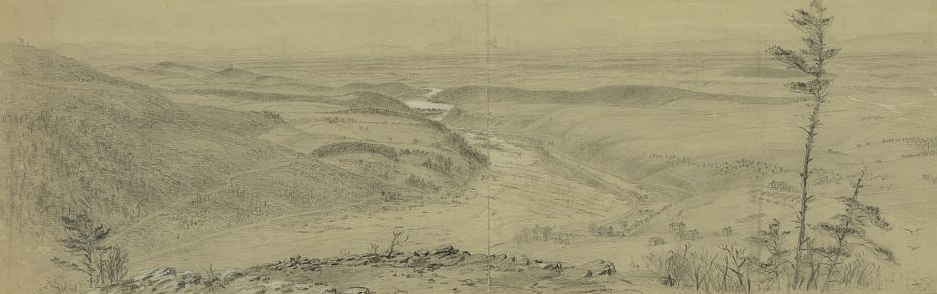
Shenandoah Valley from Maryland Heights (Alfred R. Waud, 1864, U.S. Library of Congress, public domain).


Transcription of Alfred Waud’s Description of His Illustration Above:
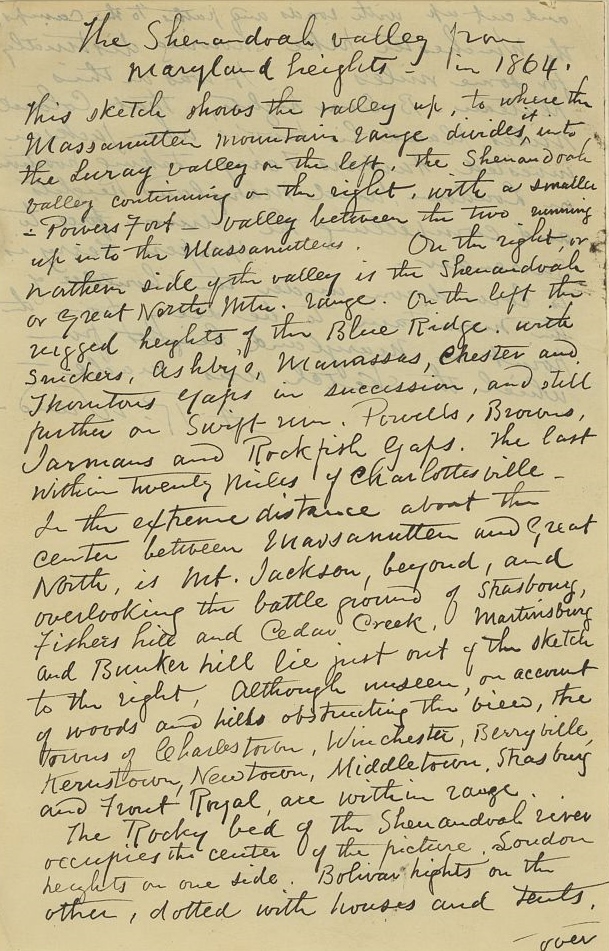
Shenandoah Valley from Maryland Heights (Alfred Waud’s notes, p. 1, U.S. Library of Congress, public domain).

The Shenandoah valley from Maryland Heights – in 1864.

This sketch shows the valley up to where the Massanutten Mountain range divides it into the Luray valley on the left. The Shenandoah valley continuing on the right, with a smaller – Powers Fort – valley between the two running up into the Massanuttens. On the right, or the northern side of the valley is the Shenandoah or Great North Mtn. range. On the left the rugged heights of the Blue Ridge, with Snickers, Ashby’s, Manassas, Chester, and Thorntons Gaps in succession, and still further on Swift-run, Powells, Browns, Jarmans, and Rockfish Gaps. The last within twenty miles of Charlottesville.

In the extreme distance about the center between Massanutten and Great North, is Mt. Jackson, beyond, and overlooking the battle ground of Strasbourg, Fisher’s hill and Cedar Creek. Martinsburg and Bunker Hill lie just out of the sketch to the right. Although unseen, on account of woods and hills obstructing the view, the towns of Charlestown, Winchester, Berryville, Kernstown, Newtown, Middletown, Strasburg, and Front Royal, are within range.
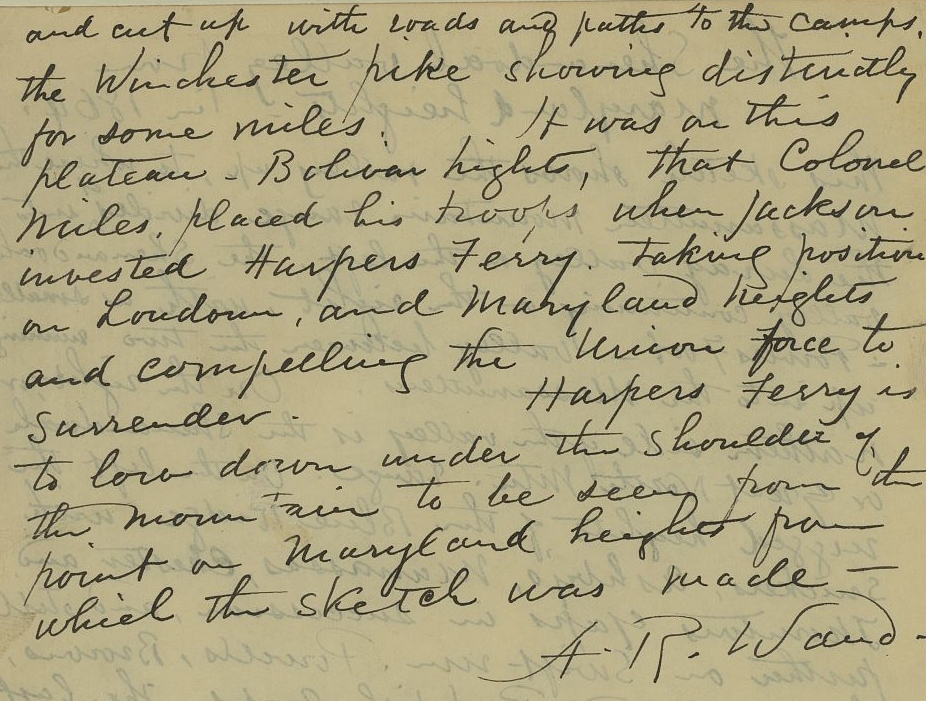
Shenandoah Valley from Maryland Heights (Alfred Waud’s notes, p. 2, U.S. Library of Congress, public domain).

The Rocky bed of the Shenandoah river occupies the center of the picture. Loudon heights on one side. Bolivar heights on the other, dotted with houses and tents, and cut up with roads and paths to the camps, the Winchester pike showing distinctly for some miles. It was on this plateau – Bolivar heights, that Colonel Miles placed his troops when Jackson invested Harpers Ferry, taking position on Loudoun, and Maryland heights and compelling the Union force to surrender. Harpers Ferry is to [sic, “too”] low down under the shoulder of the mountain to be seen from the point on Maryland heights from which the sketch was made.

– A.R. Waud
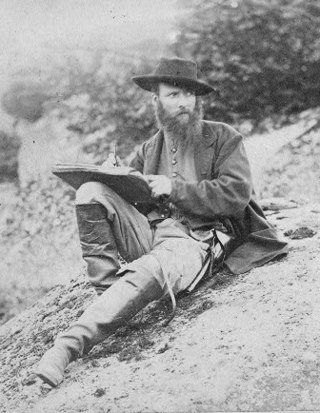
 

Alfred Waud sitting in the Devil’s Den in July 1863, following the Battle of Gettysburg (Timothy H. O’Sullivan, 1863, public domain).

Alfred Rudolph Waud (1827-1891) was a London-born artist who became a notable chronicler of the American Civil War. Hired as a full-time staff illustrator for the New York Illustrated News in 1860 and then by Harper’s Weekly in 1861, he reportedly observed every battle fought by the U.S. Army of the Potomac between July 1861 and March 1865, and became one of only two sketch artists to witness and illustrate the strategic maneuvering, valor and carnage which transpired during the Battle of Gettysburg in 1863.

His sketches of the 1864 Shenandoah Valley Campaign, which turned the tide of the U.S. Civil War significantly in favor of the Union, preserved for posterity the stark contrasts between the valley’s beauty and the ugliness wrought by war.
 

Faces of the 47th Project Honors History-Making Civil War Soldiers from Pennsylvania

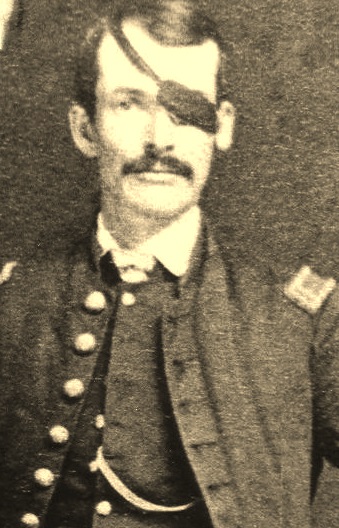
First Lieutenant William Wallace Geety, Co. H, 47th Pennsylvania Volunteers, c. 1864-1865.

A tantalizing new video released by 47th Pennsylvania Volunteers: One Civil War Regiment’s Story just opened an important new portal to the 19th century for Civil War enthusiasts, teachers, students, and genealogists.

Faces of the 47th is part of a larger, ongoing initiative to document and raise public awareness about the 47th Regiment, Pennsylvania Volunteer Infantry – the only regiment from the Keystone State to fight in the Union’s 1864 Red River Campaign  across Louisiana. The video presents the photographic and illustrated images of more than two dozen men who fought with the all-volunteer unit between 1861 and 1865.

“Each one of these images holds the potential to help family history researchers feel closer to their Civil War-era ancestors while also enabling teachers, students and Civil War enthusiasts to deepen their connections to one of the most painful chapters in the American narrative,” explains Laurie Snyder, managing editor for the project. “By ‘putting faces to the names’ on military muster rolls, we’re bringing history to life while also paying tribute to those who fought to eradicate slavery and preserve our nation’s union.”

The photo digitization project received early support from Thomas MacEntee, founder of High-Definition Genealogy, via The Genealogy Fairy™ program, which enabled Snyder to locate and digitize photographs of key members of the regiment. Among the images preserved in this initial collection are the faces of a regimental chaplain, musicians, prisoners of war (POWs), military surgeons, and officers and enlisted men who were grievously wounded or killed in combat, as well as several men who became inventors, leading business executives and elected officials in and beyond Pennsylvania after the war.

George Dillwyn John (third from left; formerly, 47th Pennsylvania Volunteers), Grand Army of the Republic gathering, Will Robinson Post, Illinois, c. 1926.

“At the time I applied for the grant, there were hundreds of photographs tucked away in public libraries, historical societies, universities, and private family history collections from Maine to California and Michigan to Louisiana. Most had not yet been digitized and might have been lost for all time had Thomas MacEntee not provided the support he did when he did,” said Snyder. “More work still needs to be done, of course, because there are photos still not yet scanned, but the project took more than two dozen giant steps forward with just that one grant from Thomas. He’s a hero in my book.”

Other significant support for the project has been provided by the Burrowes and Wasserman families.

About the 47th Pennsylvania Volunteers

Joseph Eugene Walter, Regimental Band, 47th Pennsylvania Volunteers, c. 1861.

Recruited primarily at community gathering places in their respective home towns, the soldiers who served with the 47th Pennsylvania Volunteer Infantry were primarily men of German heritage whose families still spoke German or “Pennsylvania Dutch” more than a century after their ancestors emigrated from Germany in search of religious and political freedom. Still others were recent immigrants from Germany, Ireland and Cuba. Formerly enslaved black men who had been freed by the regiment from plantations in South Carolina and Louisiana were added to regimental rosters in 1862 and 1864.

In addition to fighting in the battles of Sabine Cross Roads/Mansfield, Pleasant Hill and Monett’s Ferry/Cane River during the Red River Campaign, the 47th Pennsylvania Volunteers also engaged in the defense of Washington, D.C. in 1861 and again in 1865, following the assassination of President Abraham Lincoln; the capture of Saint John’s Bluff, Florida and Battle of Pocotaligo, South Carolina (1862); the garrisoning of Forts Taylor and Jefferson in Key West and the Dry Tortugas, Florida (1863); Union Major-General Philip Sheridan’s tide-turning Shenandoah Valley Campaign (1864), including the battles of Berryville, Opequon, Fisher’s Hill, and Cedar Creek; and provost (military police) and Reconstruction duties in Savannah, Georgia and Charleston, South Carolina (1865). Most were finally released from duty when the regiment formally mustered out on Christmas Day in 1865.

Learn More and Support

To learn more about the 47th Pennsylvania Volunteers and lend your support to this historic initiative, visit the website of 47th Pennsylvania Volunteers: One Civil War Regiment’s Story, and follow the project on Facebook, Twitter, Tumblr, and YouTube.


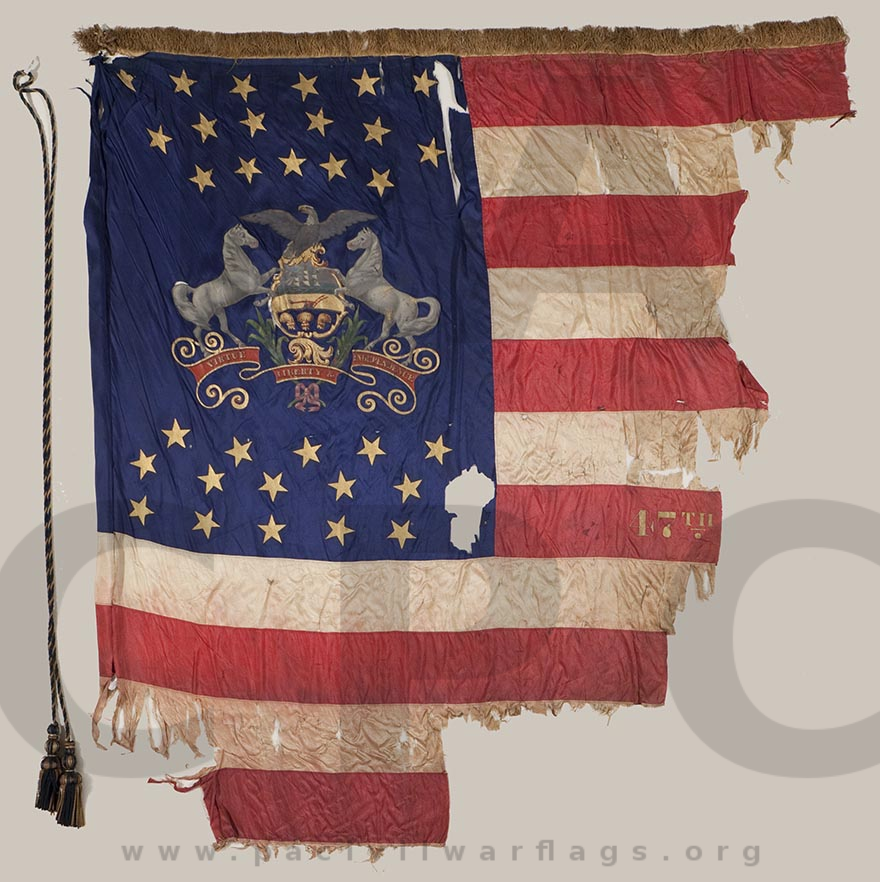
Battle Flags – 47th Regiment, Pennsylvania Volunteer Infantry

First State Color, 47th Regiment, Pennsylvania Volunteer Infantry. Presented to the Regiment by Pennsylvania Governor Andrew Curtin on 20 September 1861. Retired 11 May 1865. Source: Pennsylvania Capitol Preservation Committee (1985.057, State Color, Evans and Hassall, v1p126).

First State Color, 47th Regiment, Pennsylvania Volunteer Infantry. Presented to the Regiment by Pennsylvania Governor Andrew Curtin on 20 September 1861. Retired 11 May 1865. Source: Pennsylvania Capitol Preservation Committee (1985.057, State Color, Evans and Hassall, v1p126).

Second State Color, 47th Regiment, Pennsylvania Volunteer Infantry. Presented to the Regiment, Spring 1865; documents the Regiment's major engagements. Source: Pennsylvania Capitol Preservation Committee (1985.058. State Color, Horstmann Brothers and Company, v1p127).

Second State Color, 47th Regiment, Pennsylvania Volunteer Infantry. Presented to the Regiment, 7 March 1865; documents the Regiment’s major engagements. Source: Pennsylvania Capitol Preservation Committee (1985.058. State Color, Horstmann Brothers and Company, v1p127).

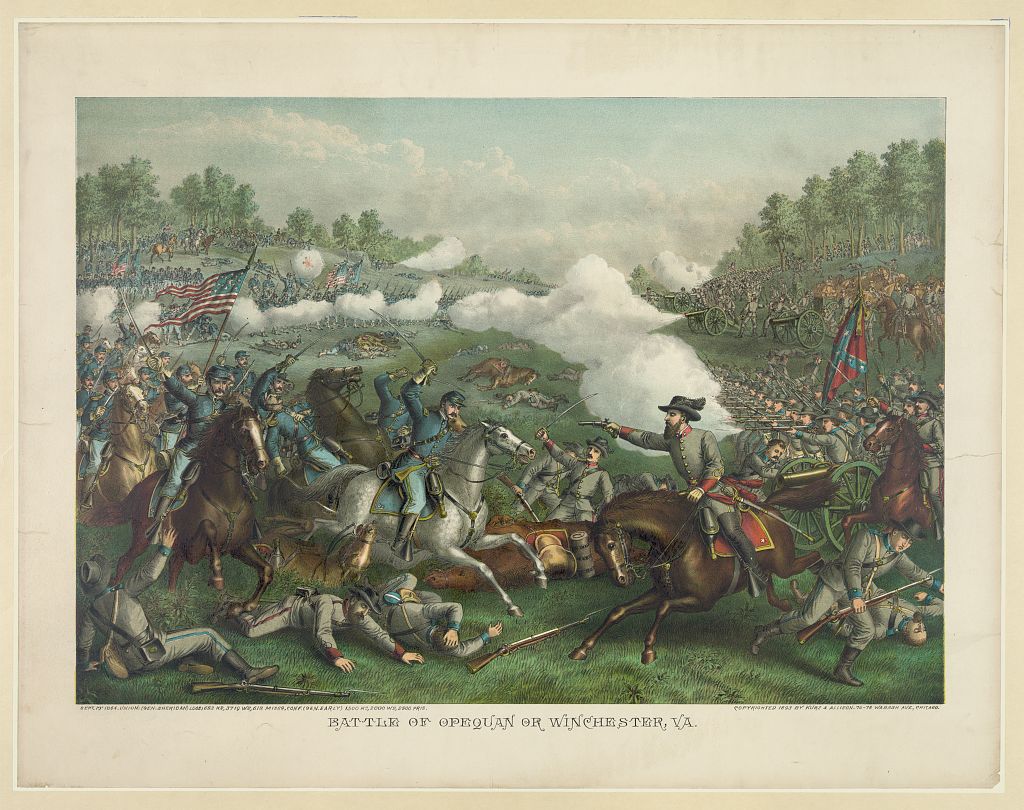
Battle of Opequan – 19 September 1864

Image of the victory of Philip Sheridan’s Union army over Jubal Early’s Confederate forces. Kurz & Allison, circa 1893. Public domain, courtesy of the Library of Congress: LC-DIG-pga-01855 (digital file from original print) LC-USZC4-1753 (color film copy transparency).

Image of the victory of Philip Sheridan’s Union army over Jubal Early’s Confederate forces. Kurz & Allison, circa 1893. Public domain, courtesy of the Library of Congress: LC-DIG-pga-01855 (digital file from original print) LC-USZC4-1753 (color film copy transparency).