Pardon Our Dust: Periodic Website Page Updates in 2025

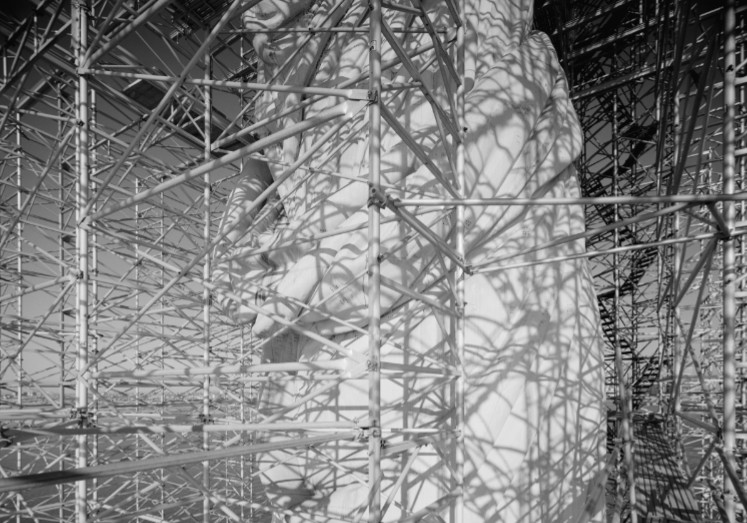
Scaffolding, mid-section of the Statue of Liberty, 1985 restoration (U.S. Library of Congress, public domain).

One of the proudest accomplishments of the staff and volunteers who are associated with 47th Pennsylvania Volunteers: One Civil War Regiment’s Story is the knowledge that our educational project celebrated its tenth anniversary in 2024.

That first decade passed quickly, as we kept our noses to the grindstone, researching, writing and posting new content about the 47th Pennsylvania Volunteer Infantry and its members.

But, as so often happens with content that has been posted online for any serious length of time, some of the links that we added years ago to the first profiles we created for the regiment’s companies and our first soldiers’ biographies have broken and need to be updated. In addition, some of our older pages need to be updated to reflect the advancements in research that we’ve made since those web pages were first published.

So, we ask that you pardon our “dust” over the next several months. You’ll be seeing changes to our website’s older pages, as we take on several necessary “home improvement” projects, in between our efforts to research, write and publish brand new content.

Fear not. You will still be seeing new biographies and posts as we continue our march forward into our project’s second decade. We look forward to having you join us on our trek through time.


A Decade and a Year in Review

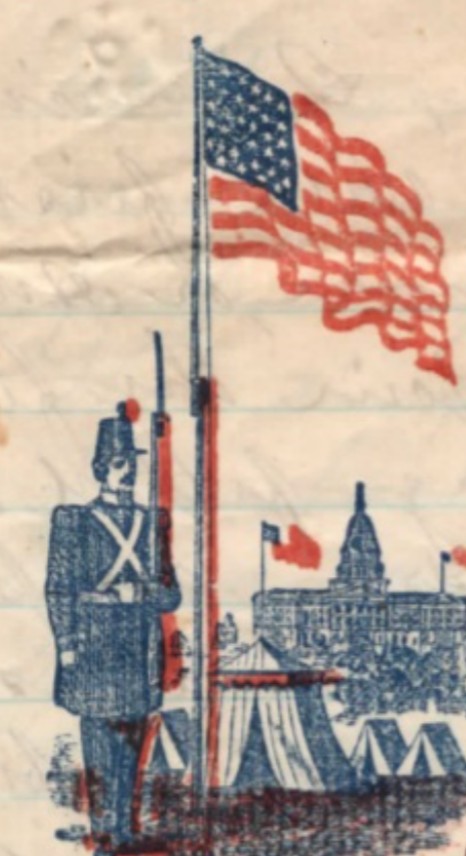
Detail from stationery used in a letter by a 47th Pennsylvania Volunteer to his parents (1862, public domain).

When I launched the website for 47th Pennsylvania Volunteers: One Civil War Regiment’s Story in 2014, my goal was simple — to create an online space that could function as a basic “placeholder” for the research that I had been conducting, for years, about the life of my great-grandfather, Timothy M. Snyder, who had served with the 47th Pennsylvania Volunteer Infantry during the American Civil War.

I was simply trying to understand why Tim Snyder had continued to serve with his regiment for such a long period of time (from mid-August 1861 through early January 1866), despite having completed his initial, three-year term of enlistment and despite his having been wounded twice in battle.

Along the way, I began uncovering details about another man — Henry D. Wharton. It seemed, from letters that Henry had written to my great-grandfather’s hometown newspaper, that he had not only served beside Tim Snyder on battlefields far from home, but that he might actually have been Tim’s neighbor or friend — or possibly even his cousin.

So, I began searching Civil War-era newspaper collections for more of Henry Wharton’s letters in the hope of finding more information about my great-grandfather, but what I found was so much more — accounts of battles so poetic, so lyrical, that I felt that Henry might have become a friend of mine, had we lived in the same town, during the same decades.

I needed to know what happened to Henry. Did he survive? Did he make it home? What was his life like before the war? How did he become such a gifted writer? As I learned more about him, I realized that, yes, he did survive, and, yes, he did marry — but he never had children. (“So there’s no one left to tell his story.”)

It was that single thought that inspired me to research and write a biography about Henry Wharton, and it was that biography that prompted me, in turn, to create 47th Pennsylvania Volunteers: One Civil War Regiment’s Story.

I could not have imagined back then that my research would attract the attention of descendants of other men who had also served with the 47th Pennsylvania, nor that my research findings would be of help to other academic and public historians and educators in K-12 school systems, colleges and universities, historical societies, public libraries, and museums across the United States.

Nor could I have anticipated the extraordinary generosity of the volunteers who have trekked over hill and dale through cemeteries, in all kinds of weather, to photograph the graves of 47th Pennsylvania Volunteer Infantrymen, or have ventured to far-flung flea markets and archives of small-town historical societies (or into the dusty, spider-friendly attics of grandparents — “Eek!”) in search of military records, photos and other memorabilia to help me create accurate biographies of their 47th Pennsylvania ancestors.

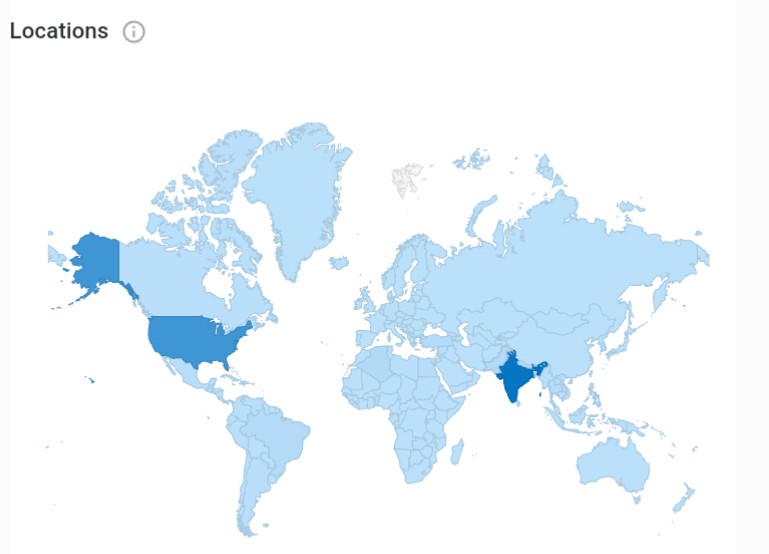
And I certainly could not have conceived of any future in which my audience would become a global one, with readers of my posts about the regiment’s activities and biographies of individual soldiers transformed into avid fans of the 47th Pennsylvania Volunteer Infantrymen who helped to preserve a nation’s Union and end the brutal practice of chattel slavery, wherever they encountered it, whenever they had the power to do so.

But each of those scenarios did come to pass, fueled largely by word of mouth. As my research findings grew, transforming a “placeholder website” into an educational outreach initiative, WordPress and other technology tools documented the history of “The 47th Pennsylvania Volunteers’ Project,” enabling me to provide this helpful snapshot of success for you.

Key Project Statistics (as of 2 p.m. on December 31, 2024):

  • First Content Posted to Website: May 25, 2014
  • Total Website Page Views to Date: 892,101
  • Total Number of Website Visitors to Date: 745,686
  • Total Number of 47th Pennsylvania Volunteer Gravesites Documented via the Project’s Virtual Cemetery to Date: 1,448
  • Total Number of Individual Officers, Enlisted Men and Regimental Support Personnel Profiled to Date: 302

I am profoundly grateful to my great-grandfather. He bequeathed the gift of all gifts to each of his descendants and to history lovers everywhere — breadcrumbs scattered, with and without thought, along the path of his life’s journey, never dreaming that his “factcrumbs” would be found, analyzed, layered and baked into satisfying, lifelong “brainfood” for present-day and future students of history.

I am also grateful to Henry Wharton for his presence of mind to faithfully chronicle the activities of the 47th Pennsylvania Volunteer Infantry in ways that made readers want to learn more about so many of the regiment’s individual members and their families.

As I close out both 2024 and the first decade of operations for “the 47th Pennsylvania Volunteers’ Project,” I thank you, dear reader, for joining me on this journey and ask to you to stay engaged with the content on this website, its related social media accounts and our companion website, Freedmen of the 47th Pennsylvania Volunteer Infantry, because there are more than a thousand soldiers’ stories that are still waiting to be uncovered and told.

May your New Year be filled with laughter, love and light!


Reunited in Death: The Virtual Cemetery Project of “47th Pennsylvania Volunteers: One Civil War Regiment’s Story”

Gravestone of Private John M. Cohler, Company A, 47th Pennsylvania Volunteers, Easton Cemtery, Easton, Pennsylvania, June 2024 (used with the permission of Julian Burley).

From eastern Maine down to Southern California and Florida’s Dry Tortugas up through Seattle, Washington, the men who served with the 47th Pennsylvania Volunteer Infantry are being reunited again—this time in death, thanks to a “virtual cemetery” that has recently undergone a significant expansion.

Established in 2014, the Virtual Cemetery Project of 47th Pennsylvania Volunteers: One Civil War Regiment’s Story has been fueled by the energy of more than a dozen volunteers, who have trekked through cemeteries coast to coast over the years, in good weather and bad, to find and photograph the final resting places of, and monuments erected to, the 47th Pennsylvania Volunteers who fought to preserve America’s Union during the American Civil War.

What those Virtual Cemetery Project volunteers have created is an astonishing treasure trove of vital statistics, combined with thought-provoking imagery illustrating the stirring patriotism of average Americans and the heartbreaking cost of disunion and war.

A Milestone Reached

By the time that the first rocket illuminates the night sky on the Fourth of July in 2024, the 47th Pennsylvania Volunteers’ Virtual Cemetery will have grown to include memorials honoring more than fourteen hundred members of the regiment, including:

  • John Boulton Young, a thirteen-year-old drummer boy who was the first member of the regiment to die;
  • Professor Thomas Coates, the “Father of Band Music in America” who became the first conductor of the 47th Pennsylvania’s renowned regimental band;
  • Fuller Family members who were Mayflower descendants and prominent, nineteenth-century civic leaders and industrialists;
  • Inventors Daniel Reeder and Abraham N. Wolf;
  • John Peter Shindel Gobin, the regiment’s final commanding officer who later became the seventh lieutenant governor of the Commonwealth of Pennsylvania;
  • Franz Schwentzer, a leading, nineteenth-century Frakturist, wood carver and furniture maker; and
  • Dead-Eye Dick,” one of the regiment’s “mystery men.”

Supporters of the project hope that the grave of every member of the 47th Pennsylvania Volunteer Infantry will eventually be located and properly marked, and that a biographical sketch will be written and posted for each soldier.

To learn more, visit the Resting Places and Memorials section of the 47th Pennsylvania Volunteers’ website.


This Website Is Copyright Protected (©)

Copyright symbol reminding you that this website is copyright protected.

All of the content on this website, 47th Pennsylvania Volunteers: One Civil War Regiment’s Story, and its subsidiary website, Freedmen of the 47th Pennsylvania Volunteer Infantry, is copyright protected.

This copyright protection covers the research, written text, photographs, videos, and other content contained on both websites, which means that any content found on either website may not be excerpted, reprinted, republished, reproduced, reposted, or otherwise reused in any form whatsoever without the written permission of the sites’ creator, Laurie Snyder, particularly if that content will be reused for marketing, sales, or other for-profit purposes by an individual or business.

For information on how to obtain permission to reuse the research or content from either website, read our full Copyright and Permissions Statement first, and then submit your request in writing via email to: 47thpennsylvaniavolunteers@gmail.com, using the subject heading “Permissions Request.”

Auctioneers or others engaged in the resale of Civil War memorabilia who are found to be in violation of these procedures will be directed to immediately remove any research or other content they have taken without permission from one or both websites. Failure to promptly remove our copyright-protected content upon request may result in legal action.


© Laurie Snyder, 2010-present.


Make a Difference This Giving Tuesday and Beyond by Supporting 47th Pennsylvania Volunteers: One Civil War Regiment’s Story

November 28, 2023


The $1,200 sale to a private collector of the identification disc of a Union Army officer who was captured and held by Confederate troops as a prisoner of war.

Boxes of soldiers’ handwritten diaries and letters, filled with important data about their day-to-day lives and families, as well as the battles in which they were engaged, passed from one collector to another for $500 to $750.

The ongoing inaccessibility to teachers and students of thousands of U.S. soldiers’ Civil War military and pension files, including those of formerly enslaved Black men who enlisted with the Union Army, because it costs $110 per soldier or more to purchase these records from the local, state and national archives where they’re stored in order to digitize them and make them freely available to the public.

The auction of an American Civil War soldier’s photograph that drove the normal purchase price of that item from $25 to $300—far out of reach for a descendant of that soldier.

The staff and volunteers of 47th Pennsylvania Volunteers: One Civil War Regiment’s Story have personally experienced each of these and other similarly heartbreaking situations on an almost monthly basis since launching our decade-long, educational project to preserve and share information about the history-making 47th Pennsylvania Volunteer Infantry.

While we’ve managed to rescue a number of photographs and documents over the last ten years, we’ve lost intense battles during entirely too many auctions—all because we simply did not have the financial resources to win when we really needed to.

That’s why we’ve decided to join forces with the Giving Tuesday movement in 2023. So, today, we’re reaching out to ask each of you who has enjoyed reading the content we have been researching and presenting to step up and show us that you truly do value our work by making a donation on or before Giving Tuesday this year—on November 28, 2023.

By donating whatever amount you can afford right now, you’ll be joining with other fans of the 47th to help us expand our work and save more photographs, soldiers’ letters and other important documents in order to make them available free of charge to you—our loyal readers and fellow history enthusiasts.

Two Ways to Give

Please Help

Together, we can save history. Please help us make an even greater difference as we head into our second decade.

Kind Regards,

Laurie Snyder, Founder and Managing Editor
47th Pennsylvania Volunteers: One Civil War Regiment’s Story

St. Charles County Historical Society Donates David H. Smith Papers to 47th Pennsylvania Volunteers: One Civil War Regiment’s Story

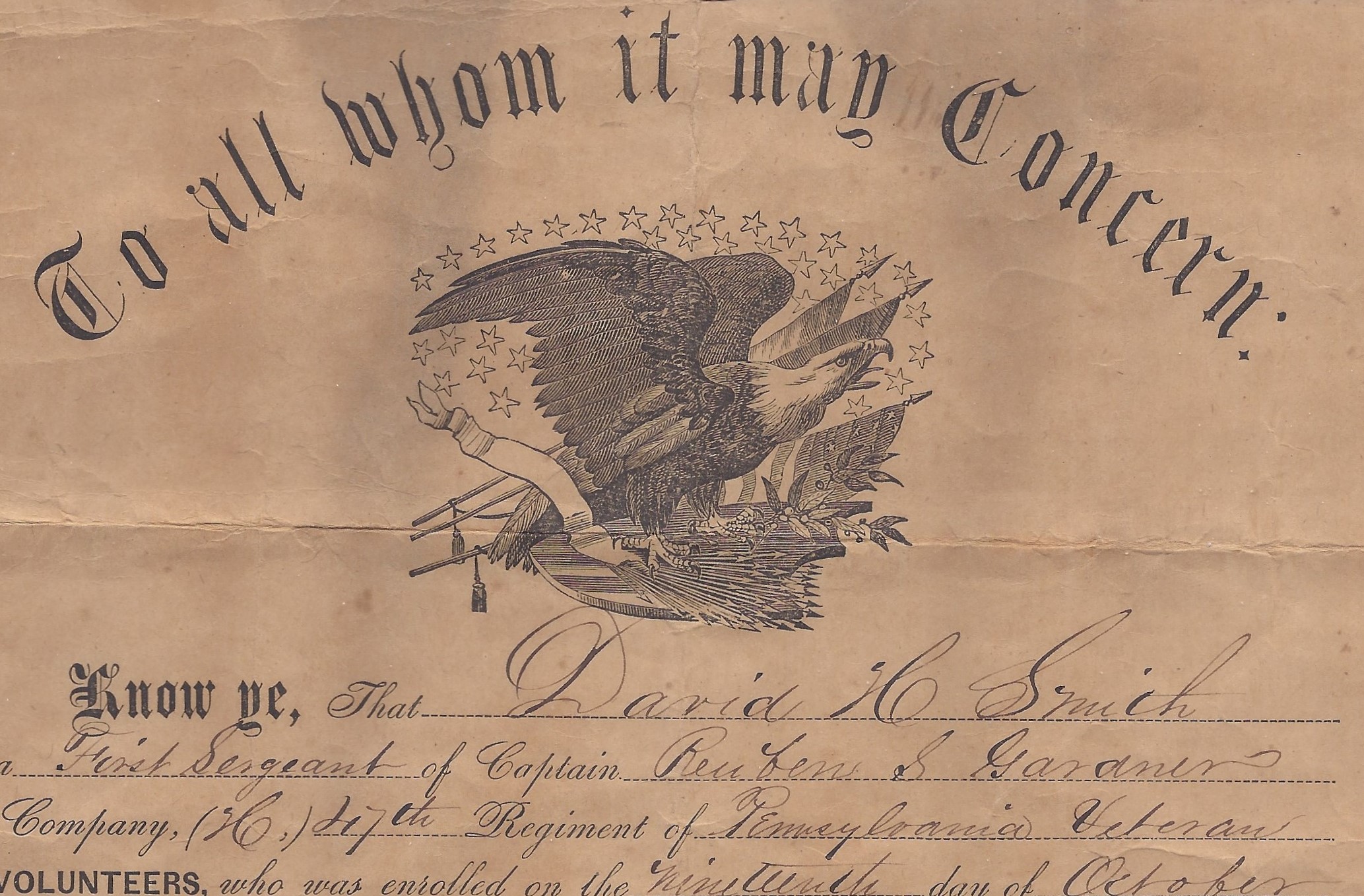
Honorable Discharge (excerpt), First Sergeant David H. Smith, Company H, 47th Pennsylvania Volunteers, December 25, 1865 (public domain).

A challenging year for many Americans due to the COVID-19 pandemic, a faltering economy, and civil strife, 2020 proved to be a remarkably constructive one on many fronts for a humanities project dedicated to preserving and educating children and adults about the 47th Pennsylvania Volunteer Infantry—a Union Army unit which made history during the American Civil War as the only regiment from Pennsylvania to participate in the 1864 Red River Campaign across Louisiana, and which also was involved in guarding Mary Surratt and the other key conspirators involved in Lincoln’s assassination in 1865.

One of the most important developments in 2020 was the donation by the St. Charles County Historical Society in St. Charles, Missouri of its David H. Smith Papers collection to 47th Pennsylvania Volunteers: One Civil War Regiment’s Story.

David H. Smith was one of the 47th Pennsylvania Volunteers who served for the duration of the war. Following his enrollment at Harrisburg, Pennsylvania on August 22, 1861, Smith mustered in at Camp Curtin in Harrisburg on September 19 of that year as a private with Company H. Described as a nineteen-year-old farmer with light hair, blue eyes, and a light complexion who was five feet, nine inches tall, he was promoted to the rank of corporal on October 21, 1862—the day before the regiment was bloodied badly in the Battle of Pocotaligo, South Carolina. He then re-enlisted with the 47th Pennsylvania Volunteers in mid-October of 1863 at Fort Jefferson in the Dry Tortugas, Florida, where half of the regiment was stationed at the time, and was subsequently promoted to the rank of Sergeant on September 18, 1864—one day before the Battle of Opequan, Virginia, and promoted again to First Sergeant on April 21, 1865—exactly one week after Lincoln’s assassination. Smith then continued to serve until the regiment was honorably mustered out at Charleston, South Carolina on Christmas Day of that same year.

According to Adam Pesek, a collections volunteer with the St. Charles County Historical Society who reached out to Laurie Snyder, the managing editor of the 47th Pennsylvania Volunteers’ project, society personnel made the helpful overture because they had made a decision to downsize the society’s collection, and were seeking to redistribute a range of items to other organizations whose ties to those items were stronger.

Society archivist Amy G. Haake explained that she and her colleagues had made the decision to donate Smith’s papers when they realized “that Smith had no connections to St. Charles County, whether through marriage or otherwise,” and wanted to find a group which would ensure that the historic documents would be preserved and made publicly available for study by other historians and history students. Among the original documents are certificates related to promotions received by Smith during his tenure with the 47th Pennsylvania, as well as his reenlistment and honorable discharge paperwork.

“My plan is to digitize Sergeant Smith’s papers in 2021, research and write a biographical sketch of his life, and then make each of Smith’s documents and his biography publicly available online via our project’s website and Facebook page. I will then also donate Smith’s papers to a museum or historical society in Pennsylvania,” said Snyder. “These precious papers not only document Smith’s service to the nation; they provide tangible links to a defining time in our nation’s history—reminding us all of the sacrifices made by the heroes who left hearth and home to fight for the Union of a country they loved more than life.”

*******************************************************

47th Pennsylvania Volunteers: One Civil War Regiment’s Story is an educational initiative dedicated to documenting and raising public awareness about the history-making role played by the 47th Pennsylvania Volunteer Infantry during the American Civil War, as well as the contributions made by its members, post-war, to America’s growth and the advancement of its democratic ideals. Integrated in October of 1862 (prior to President Abraham Lincoln’s official release of the Emancipation Proclamation), this regiment went on to become the only regiment from Pennsylvania to participate in the Union’s 1864 Red River Campaign across Louisiana and the only regiment from Pennsylvania to have men held captive as prisoners of war at Camp Ford—the largest Confederate prison west of the Mississippi River, and was also involved in guarding Mary Surratt and the other key conspirators in Lincoln’s assassination in 1865 during the early days of their imprisonment.

Founded in 1956, the St. Charles County Historical Society (SCCHS) is a nonprofit organization which was initially established to preserve the history of St. Charles County, Missouri. In 2009, it merged with the St. Charles Genealogical Society in order to expand upon its mission “to foster an understanding and appreciation of all aspects of Saint Charles County history” to ensure that genealogical records of county residents are also preserved.


His First Name was “Presto?” A Black History Month Mystery

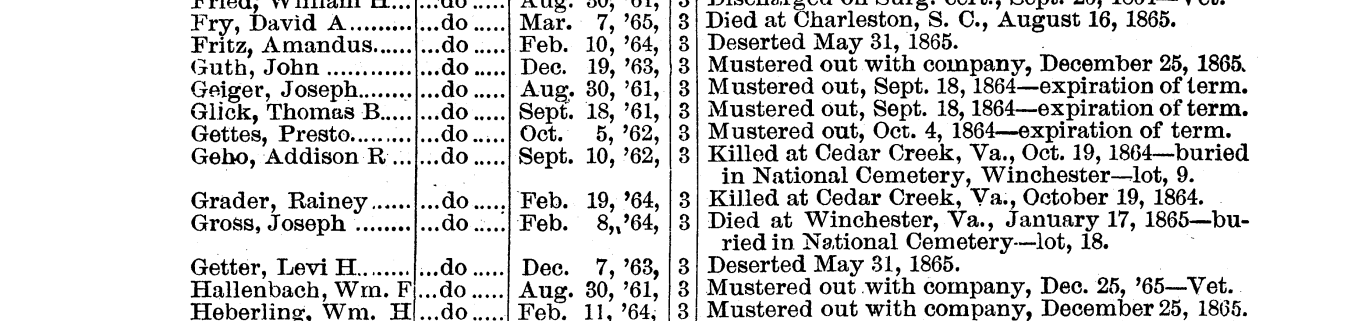
Roster entry: Presto Garris,” Company F, 47th Pennsylvania Volunteers, Bates’ History of Pennsylvania Volunteers, Vol. 1, 1869 (public domain; double click to enlarge).

“Presto?” The first name stood out like a sore thumb on the roster of my great-grandfather’s Civil War regiment—one with a rank and file populated largely by soldiers with Germanic surnames: “Acher,” “Bachman,” “Bauer,” “Bauman,” “Burger,” “Dachrodt,” “Diehl,” “Eisenbraun,” “Eppler,” “Fritz,” “Grimm,” “Guth,” “Handwerk,” “Hertzog,” “Keiser,” “Knecht,” “Knorr,” “Koenig,” “Laub,” “Metzger,” “Münch,” “Rehrig,” “Reinert,” “Richter,” “Sauerwein,” “Schmidt,” “Schneider,” “Strauss,” “Ulrich,” “Volkenand,” “Wagner,” “Weiss,” and “Zeppenfeld.”

Many of their given or middle names were equally as Germanic—“Adolph,” “Bernhard,” “Gottlieb,” “Friedrich,” “Heinrich,” “Levi,” “Matthias,” “Reinhold,” “Tilghman,” “Tobias,” and “Werner.” In addition, one of the regiment’s component units—Company K—had even been founded by a German immigrant with the intent of creating “a new German company” staffed entirely by German-Americans who had been born in the Lehigh Valley, as well as recent émigrés from Germany.

So, “Presto” as a given name seemed like it warranted further investigation. Did the spelling of this soldier’s given name signal that he had emigrated from a different part of the world—possibly Italy? There was, after all, another member of the 47th Pennsylvania’s ranks with a seemingly Italian surname—Battaglia (later proven to be an immigrant of Switzerland). Plus, there were also multiple men with Irish surnames who had also enlisted with the 47th.

Or, maybe this soldier had been employed as a magician prior to enlisting in the military? (Probably not, but strange discoveries are surprisingly common with genealogical research.)

A more likely scenario? A harried Union Army clerk, in his haste to process new enlistees, simply omitted the “n” at the end of this soldier’s name—making him “Presto” for posterity’s sake rather than “Preston.”

I just had to know. Who was Presto?

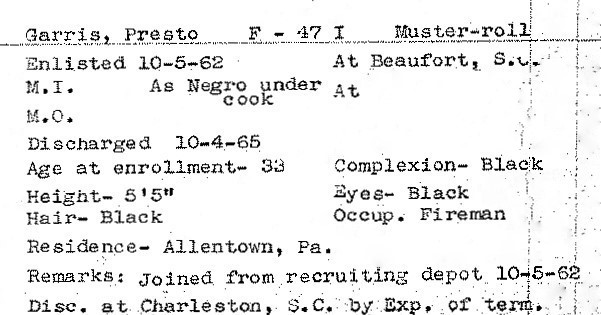
Listing for “Presto Garris,” Company F, 47th Pennsylvania Volunteers, Civil War Veterans’ Card File, 1861-1866, Pennsylvania State Archives (public domain).

It turned out that this 47th Pennsylvania Volunteer wasn’t a magician, and he wasn’t an immigrant from Italy, but he was someone whose first and last names were badly mangled by multiple “mis-spellers” over decades of data entry.

Upon further investigation, it became clear that he was a formerly enslaved, 33-year-old black man who had enlisted with the 47th Pennsylvania Volunteer Infantry on October 5, 1862 while the regiment was stationed near Beaufort, South Carolina—meaning that my great-grandfather’s regiment had become an integrated one at least three months before President Lincoln had issued the Emancipation Proclamation.

Totally “wowed” by this discovery, I searched for even more information about this very important enlisted man, but my quest wasn’t as easy as I hoped it would be because the regimental clerk who had entered “Presto” on the roster for Company F of the 47th Pennsylvania Regiment in the Registers of Pennsylvania Volunteers had spelled his name incorrectly—an error that was then perpetuated by historian Samuel P. Bates in his History of Pennsylvania Volunteers, 1861-5.

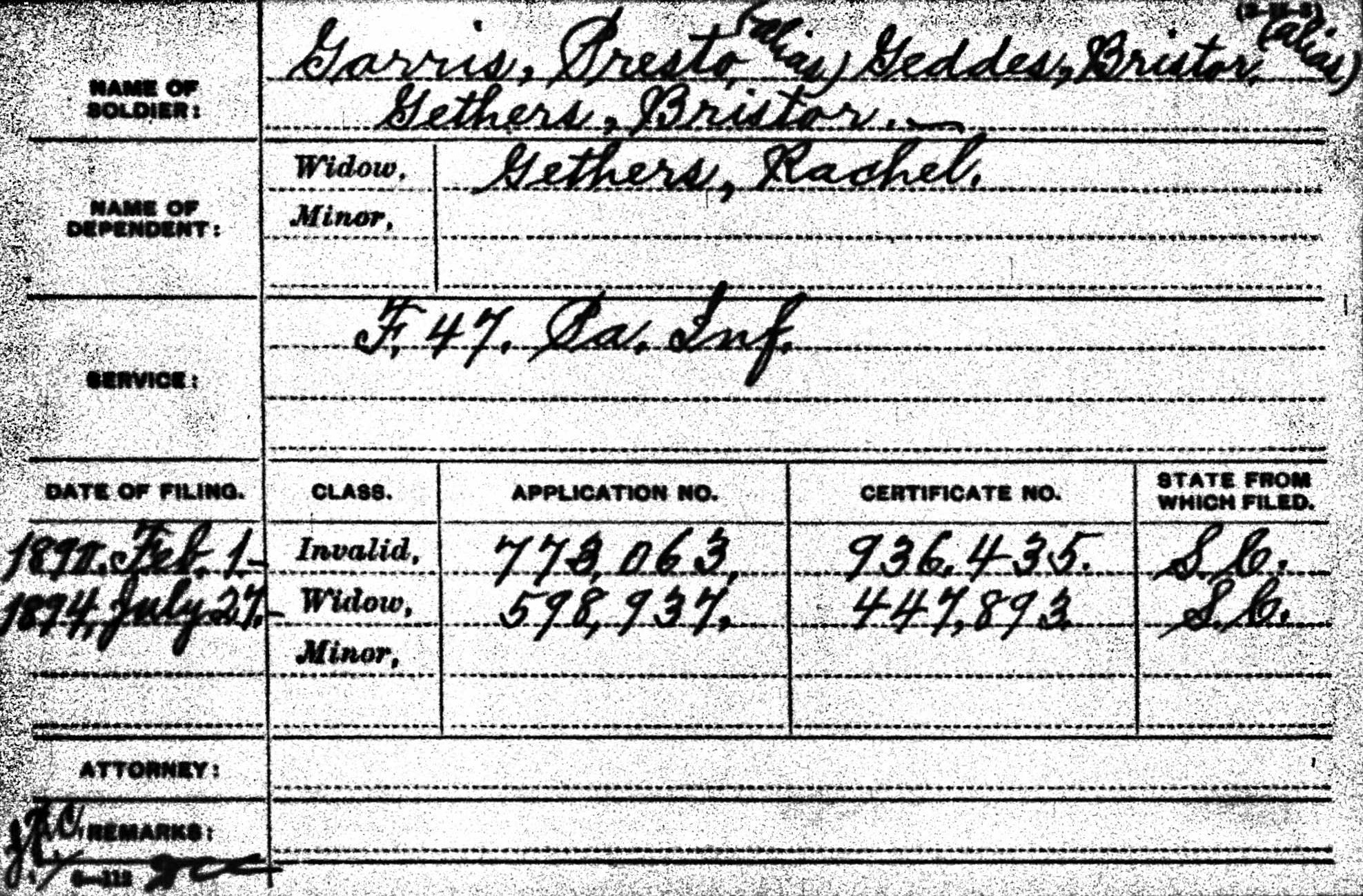
Possible name variants for an African American member of the 47th Pennsylvania Volunteers, U.S. Civil War General Pension Index Cards (National Archives, public domain).

Fortunately, this soldier’s listing in the U.S. Civil War General Pension Index Card system was slightly more helpful, providing multiple “alias” (alternate) spellings of his name: “Presto Garris,” “Bristor Geddes,” and “Bristor Gethers,” as well as a potential spelling for the name of his wife, “Rachel Gethers,” and a possible place of residency and year of death—1894—because his widow had filed for a U.S. Civil War Widow’s Pension from South Carolina on July 27, 1894.

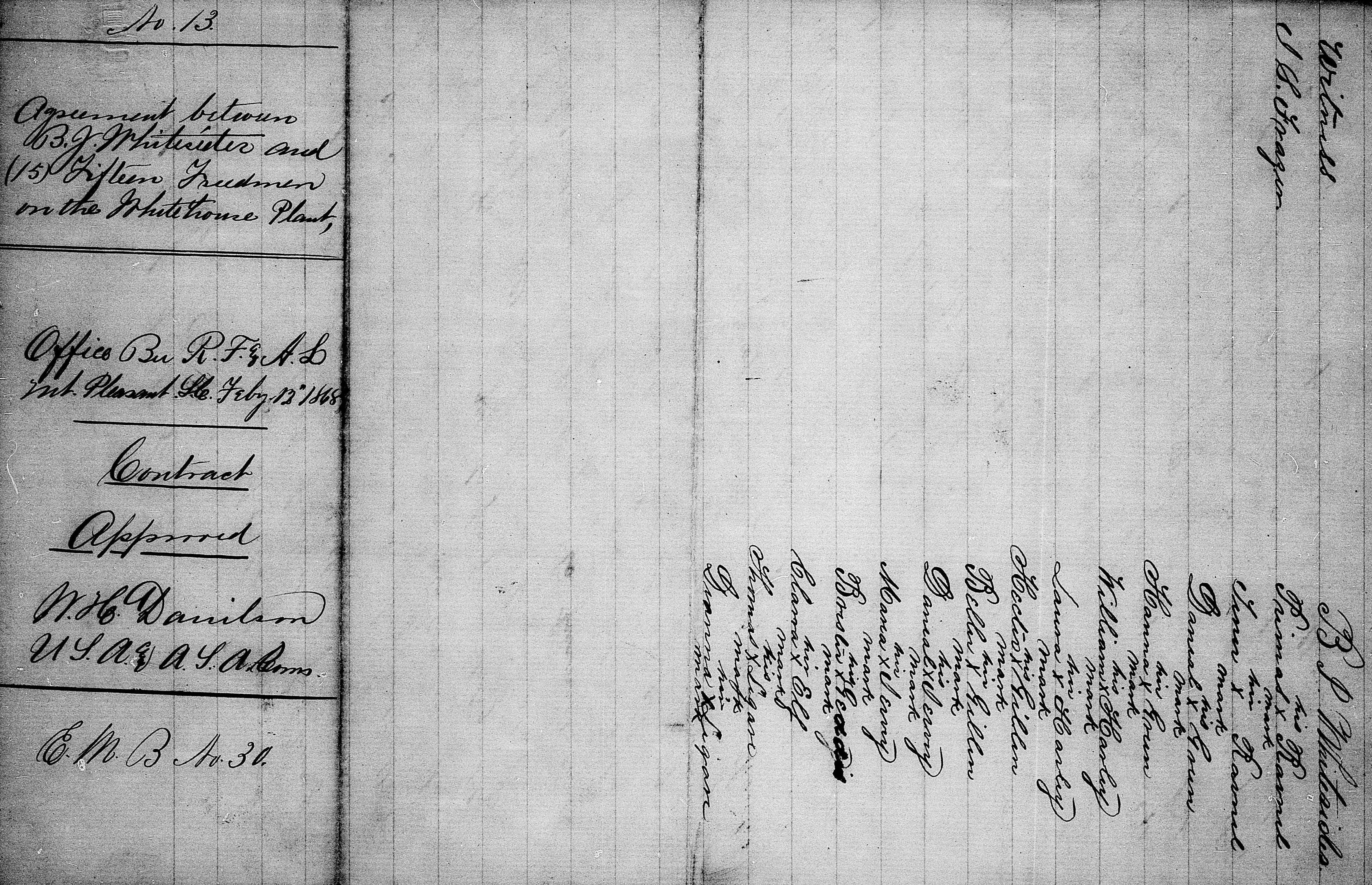
Despite those hints, it took quite some time to pick up this soldier’s trail again. Eventually, though, that pension index card data helped me to find a Freedmen’s Bureau contract for him which confirmed that he had indeed settled in South Carolina post-war. Dated February 12, 1868, this document also confirmed that he had been signed to a contract with 14 other Freedmen by the Mt. Pleasant, South Carolina office of the U.S. Freedmen’s Bureau to provide labor for the Whitehouse Plantation.

List showing “Brister Geddis,” et. al. on an 1868 Freedmen’s Bureau contract with the Whitehouse Plantation in South Carolina (public domain; double click to enlarge).

But, in another seemingly frustrating turn of events, that contract caused further confusion surrounding his name—this time spelling it as “Brister Geddis.” Fortunately, this new variant was repeated in the 1870 federal census—a sign that it was either the correct spelling or at least a closer approximation of how this soldier had pronounced his own name. Describing him as a 42-year-old black male residing in Beaufort, South Carolina, that same census also noted that he lived in Beaufort Township with his wife “Rachel,” a 24-year-old black woman (estimated birth year 1846), and son “Peter,” a 6-year-old black child, and confirmed that all three had been born in South Carolina. And that census record also noted that both “Brister” and “Rachel” were involved in farming land valued at $1,500.

Unfortunately, the 1880 federal census taker created still more confusion by illegibly writing the name as “Geddes, Brista” or “Geddis, Bristor”—and gave rise to two new puzzles by omitting son Peter’s name and also radically altering the estimated birth year of wife “Rachel”—changing it from 1846 to 1820 by stating that she was a 60-year-old who was four years older than her husband (rather than younger as she had reportedly been in 1870).

Even more frustrating? The special veterans’ census of 1890 altered the spelling of his name yet again—this time to “Brister Gedders.”

At that point, I made the decision to do everything humanly possible to right the wrong of this 47th Pennsylvania Volunteer’s forgotten military service by launching a GoFundMe campaign to support the purchase of this his full set of his military and pension records from the National Archives (as well as those of the other eight African American men who enlisted with the 47th Pennsylvania Volunteer Infantry).

If just three of you who regularly read the content on this website and follow our Facebook page donate $10 each to this campaign, we will be able to purchase the entire Compiled Military Service File for this forgotten member of the 47th Pennsylvania Volunteers and make it publicly available (free of charge) to other family history researchers and historians. If just four of you donate $20 each, we would also be able to purchase the entire Federal Military Pension Application File for that same soldier—a file that may very well contain critical vital statistics about this soldier’s birth, life and death, as well as vital statistics for his widow and son.

We might just even be able to determine when and where Brister/Bristor was buried and whether or not a gravestone marks his final resting place. If we find that no marker exists, or that the existing one has been damaged, or that the gravestone carver spelled his name incorrectly, we can then fix that wrong as well by asking the appropriate county, state and federal authorities to erect a suitable veteran’s headstone for him.

Please help us honor the military service of this unsung hero by making your donation today to our GoFundMe campaign, Honor 9 Black Soldiers of the American Civil War.”

With Sincere Gratitude,

Laurie Snyder, Managing Editor
47th Pennsylvania Volunteers: One Civil War Regiment’s Story


Sources:

1. Bates, Samuel P. History of Pennsylvania Volunteers: 1861-5, Vol. 1. Harrisburg, Pennsylvania: B. Singerly, State Printer, 1869.

2. “Garris, Presto,” in Civil War Veterans’ Card File, 1861-1866. Harrisburg, Pennsylvania: Pennsylvania State Archives.

3. “Garris, Presto” (alias “Geddes, Bristor”, alias “Gethers, Bristor”), in U.S. Civil War General Pension Index, 1890-1894. Washington, D.C.: U.S. National Archives and Records Administration.

4. “Roll of Co. F., 47th Regiment, Infantry,” in Registers of Pennsylvania Volunteers, 1861-1865, in “Records of the Department of Military and Veterans’ Affairs.” Harrisburg, Pennsylvania: Pennsylvania State Archives, retrieved online February 10, 2020.


Faces of the 47th Project Honors History-Making Civil War Soldiers from Pennsylvania

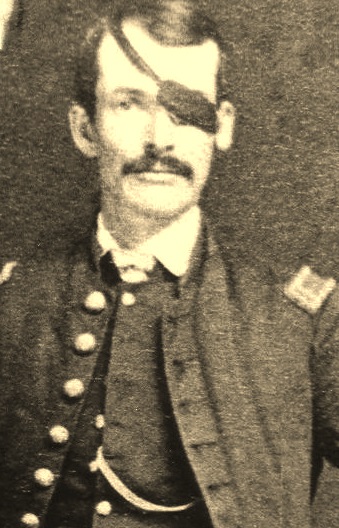
First Lieutenant William Wallace Geety, Co. H, 47th Pennsylvania Volunteers, c. 1864-1865.

A tantalizing new video released by 47th Pennsylvania Volunteers: One Civil War Regiment’s Story just opened an important new portal to the 19th century for Civil War enthusiasts, teachers, students, and genealogists.

Faces of the 47th is part of a larger, ongoing initiative to document and raise public awareness about the 47th Regiment, Pennsylvania Volunteer Infantry – the only regiment from the Keystone State to fight in the Union’s 1864 Red River Campaign  across Louisiana. The video presents the photographic and illustrated images of more than two dozen men who fought with the all-volunteer unit between 1861 and 1865.

“Each one of these images holds the potential to help family history researchers feel closer to their Civil War-era ancestors while also enabling teachers, students and Civil War enthusiasts to deepen their connections to one of the most painful chapters in the American narrative,” explains Laurie Snyder, managing editor for the project. “By ‘putting faces to the names’ on military muster rolls, we’re bringing history to life while also paying tribute to those who fought to eradicate slavery and preserve our nation’s union.”

The photo digitization project received early support from Thomas MacEntee, founder of High-Definition Genealogy, via The Genealogy Fairy™ program, which enabled Snyder to locate and digitize photographs of key members of the regiment. Among the images preserved in this initial collection are the faces of a regimental chaplain, musicians, prisoners of war (POWs), military surgeons, and officers and enlisted men who were grievously wounded or killed in combat, as well as several men who became inventors, leading business executives and elected officials in and beyond Pennsylvania after the war.

George Dillwyn John (third from left; formerly, 47th Pennsylvania Volunteers), Grand Army of the Republic gathering, Will Robinson Post, Illinois, c. 1926.

“At the time I applied for the grant, there were hundreds of photographs tucked away in public libraries, historical societies, universities, and private family history collections from Maine to California and Michigan to Louisiana. Most had not yet been digitized and might have been lost for all time had Thomas MacEntee not provided the support he did when he did,” said Snyder. “More work still needs to be done, of course, because there are photos still not yet scanned, but the project took more than two dozen giant steps forward with just that one grant from Thomas. He’s a hero in my book.”

Other significant support for the project has been provided by the Burrowes and Wasserman families.

About the 47th Pennsylvania Volunteers

Joseph Eugene Walter, Regimental Band, 47th Pennsylvania Volunteers, c. 1861.

Recruited primarily at community gathering places in their respective home towns, the soldiers who served with the 47th Pennsylvania Volunteer Infantry were primarily men of German heritage whose families still spoke German or “Pennsylvania Dutch” more than a century after their ancestors emigrated from Germany in search of religious and political freedom. Still others were recent immigrants from Germany, Ireland and Cuba. Formerly enslaved black men who had been freed by the regiment from plantations in South Carolina and Louisiana were added to regimental rosters in 1862 and 1864.

In addition to fighting in the battles of Sabine Cross Roads/Mansfield, Pleasant Hill and Monett’s Ferry/Cane River during the Red River Campaign, the 47th Pennsylvania Volunteers also engaged in the defense of Washington, D.C. in 1861 and again in 1865, following the assassination of President Abraham Lincoln; the capture of Saint John’s Bluff, Florida and Battle of Pocotaligo, South Carolina (1862); the garrisoning of Forts Taylor and Jefferson in Key West and the Dry Tortugas, Florida (1863); Union Major-General Philip Sheridan’s tide-turning Shenandoah Valley Campaign (1864), including the battles of Berryville, Opequon, Fisher’s Hill, and Cedar Creek; and provost (military police) and Reconstruction duties in Savannah, Georgia and Charleston, South Carolina (1865). Most were finally released from duty when the regiment formally mustered out on Christmas Day in 1865.

Learn More and Support

To learn more about the 47th Pennsylvania Volunteers and lend your support to this historic initiative, visit the website of 47th Pennsylvania Volunteers: One Civil War Regiment’s Story, and follow the project on Facebook, Twitter, Tumblr, and YouTube.


47th Pennsylvania Volunteers: One Civil War Regiment’s Story Receives Grant to Digitize Historic Civil War-era Photographs

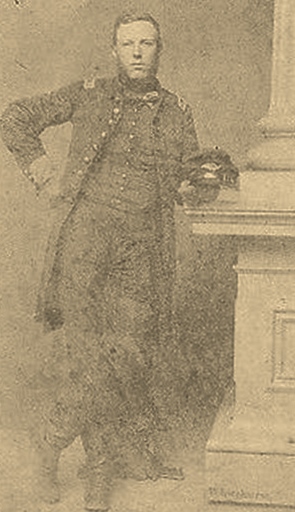
Captain John Peter Shindel Gobin, Co. C, 47th Pennsylvania Volunteers, c. 1862 (public domain).

Captain John Peter Shindel Gobin, Co. C, 47th Pennsylvania Volunteers, c. 1862 (public domain).

Thomas MacEntee, founder of High-Definition Genealogy, recently announced that 47th Pennsylvania Volunteers: One Civil War Regiment’s Story will receive a grant to begin digitizing and making publicly available photographs of the officers and enlisted men who served with the 47th Regiment, Pennsylvania Volunteer Infantry during America’s Civil War.

“Five percent of all revenue at Genealogy Bargains is set aside each month to fund The Genealogy Fairy™ program,” explained MacEntee. “The goal is to give back to the genealogy community through a series of grants to organizations and individuals undertaking worthwhile genealogy-related projects.”

“This early support of our work is incredibly important,” said Laurie Snyder, managing editor for 47th Pennsylvania Volunteers: One Civil War Regiment’s Story. “There are currently hundreds of photographs scattered across America in public libraries, historical societies, universities, and private family history collections – carte de visite images of individual soldiers and the physicians who treated their battle wounds, as well as group photos of the companies in which they served. Most have yet to be digitized, and could be lost for all time if a fire or flood damaged one of the buildings where they’re held.”

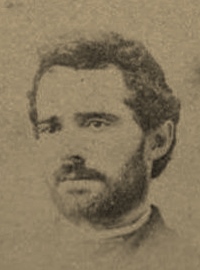
William DeWitt Clinton Rodrock, Chaplain, 47th Pennsylvania Volunteers (Fort Jefferson, 1 December 1863, public domain)

William DeWitt Clinton Rodrock, Chaplain, 47th Pennsylvania Volunteers (Fort Jefferson, 1 December 1863, public domain)

Preserving the photographs of those who served with this particular Civil War unit is especially vital, explained Snyder, because the 47th Pennsylvania was the only regiment from the Keystone State to fight in the Union’s Red River Campaign across Louisiana during the spring of 1864 and was also the only Pennsylvania regiment to have men held as prisoners of war at Camp Ford, the largest Confederate Army prison west of the Mississippi. In addition, the 47th Pennsylvania was also stationed at Beaufort, South Carolina and fought in the Battle of Pocotaligo in 1862, garrisoned Forts Taylor and Jefferson in Florida, fought in the Union’s tide-turning Shenandoah Valley Campaign during the fall of 1864, helped to defend the nation’s capital following the assassination of President Abraham Lincoln, and assisted with Reconstruction efforts in Charleston, South Carolina during the summer and fall of 1865.

“Each one of these photos not only holds the potential to help family members feel closer to their ancestors, but has the power to enable teachers to help students truly connect with and appreciate their Civil War studies. By ‘putting faces to the names’ on military muster rolls, we will be bringing history to life for those wanting to learn more about this regiment while also honoring those who fought to preserve our nation’s union.”

To learn more about the 47th Pennsylvania Volunteers and lend your support to this historic initiative, visit the website of 47th Pennsylvania Volunteers: One Civil War Regiment’s Story, and follow the project on Facebook and Twitter.