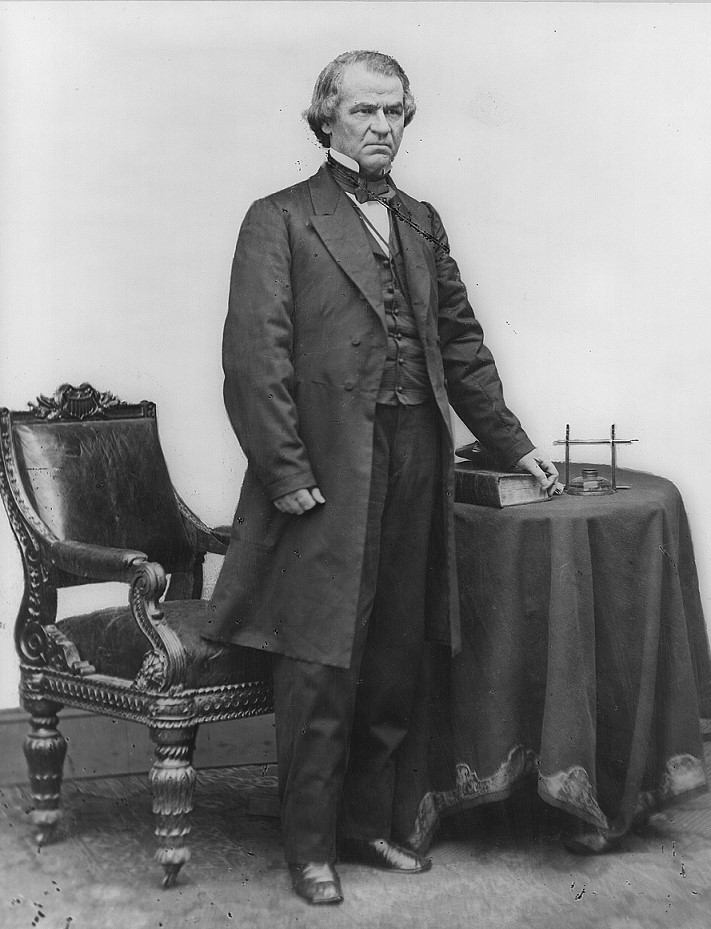
U.S. President Andrew Johnson, circa 1865 (Matthew Brady, U.S. Library of Congress, public domain).
With the American Civil War officially over, and the shock of his assassinated predecessor beginning to ease, U.S. President Andrew Johnson was now in charge of healing a divided, battered nation. According to historian Eric Foner, President Johnson “inaugurated the period of Presidential Reconstruction (1865-67) in May of 1865.”
Johnson offered a pardon to all southern Whites except Confederate leaders and wealthy planters (although most of these subsequently received individual pardons), restoring their political rights and all property except for slaves. He also outlined how new state governments would be created.
In order to facilitate the rebuilding of those new local and state governments, President Johnson also made the decision to station federal troops in key locations throughout the nation’s southern and western states. Among the federal troops ordered to assist with the operations were members of the 47th Pennsylvania Volunteer Infantry (who were known by this time as the 47th Pennsylvania Veteran Volunteers).
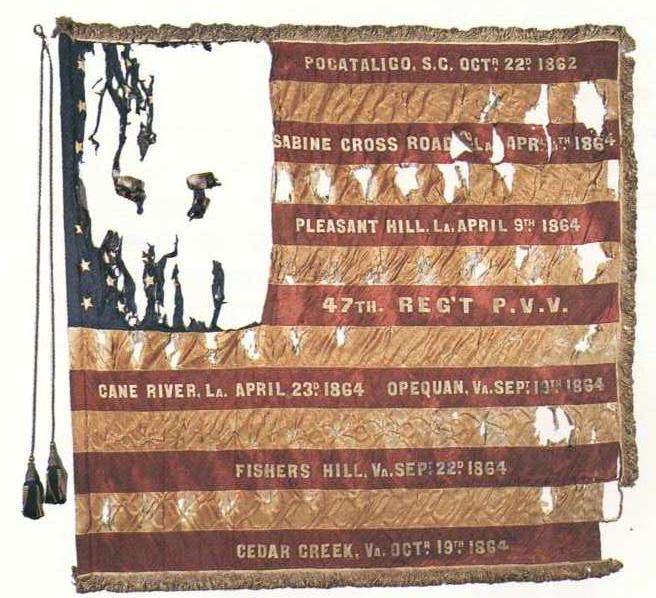
Second State Colors, 47th Pennsylvania Veteran Volunteers (presented to the regiment 7 March 1865).
A New Mission Begins
The Reconstruction Era for the 47th Pennsylvania Veteran Volunteers effectively began with the regiment’s departure for America’s Deep South on June 3, 1865, according to Assistant Regimental Surgeon John Young Shindel, M.D., who wrote these words on that day in history:
At about 10 o’clock, went on board the U.S.S. North Star…. Some of the Reg. went on Board the “Haze”. Dr. S. [and] Some on board the “Metis” from W. [Washington]. Started down the Potomac. Passed Mt. Vernon….
Reaching Fortress Monroe the next morning circa 11:00 a.m., the North Star continued south through the Atlantic Ocean and on to the waters off Cape Hatteras, North Carolina around 10:00 p.m. on June 4, according to Dr. Young. Suffering from seasickness the following day, he noted that his ship had already reached Cape Fear in North Carolina.
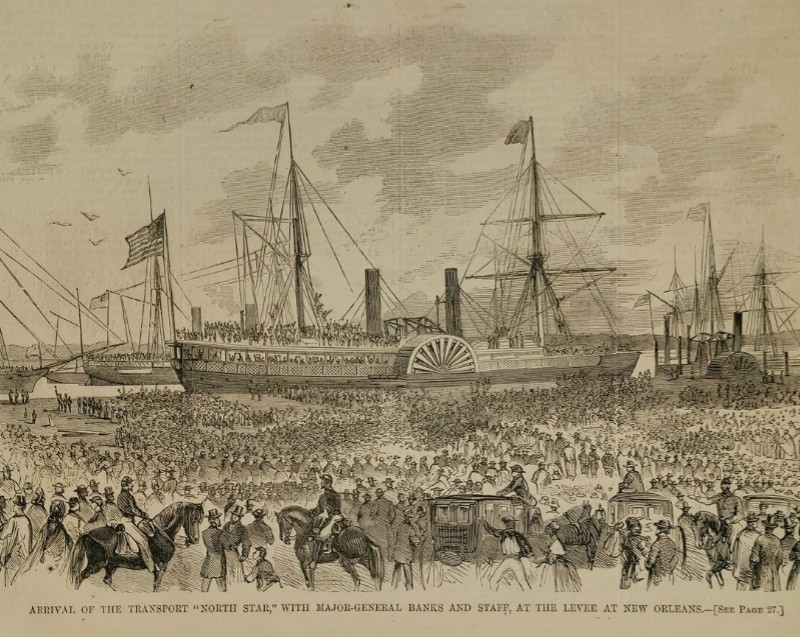
U.S.S. North Star, circa 1863 (Harper’s Weekly, January 10, 1863, public domain).
By Tuesday, June 6, the North Star had steamed to the mouth of the Savannah River, where it stopped, briefly, in order to allow a pilot to board. That pilot then moved the ship along the river, past Fort Pulaski, across the bar, and toward the harbor in the city of Savannah, Georgia, where it finally then dropped its anchor. The ship’s passengers were then directed to effect their transfer to smaller troop transports — the General Grant and the Oneita, according to Private Luther Horn of Company E. Those smaller steamers then took the 47th Pennsylvanians directly into the city. Upon their arrival at their designated landing spots at 4:00 a.m. the next morning (June 7), they disembarked, setting their feet on the soil of Georgia for the first time in the regiment’s history.
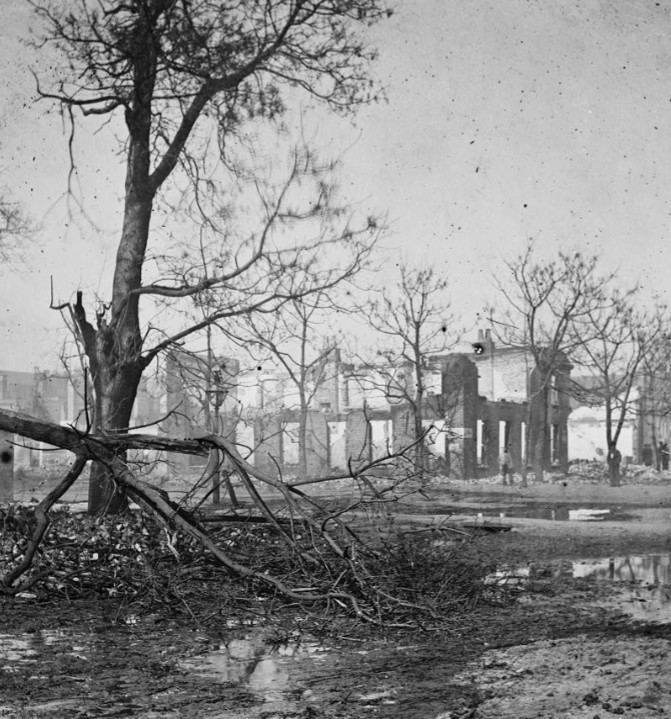
War-damaged houses in Savannah, Georgia, 1865 (Sam Cooley, U.S. Army, U.S. Library of Congress, public domain).
Using the next three hours to unload their equipment, they then lined up, by company, and stepped forward into their new mission at 7:30 a.m. Marching through the streets of Savannah, they headed one mile south, toward the city’s southern section, where they began erecting their Sibley tents.
* Note: Meanwhile, the steamships carrying the remaining 47th Pennsylvanians (the Metis and the Haze) were still en route. The Metis arrived later that day (June 7); the Haze arrived during the afternoon of June 8 with the members of Companies A, D, H, and I.
As the reunited 47th Pennsylvania Veteran Volunteers began settling in to their new routine, Regimental Orders, No. 67 directed members of Regimental Band No. 2 to practice between 9:00 and 10:00 every morning and perform every evening at 7:00 outside of the tent of the regiment’s commanding officer, Colonel John Peter Shindel Gobin.
On Friday, June 9, the entire regiment took part in a brigade parade. Five days later, Regimental Orders, No. 69 directed that “the first call for dress parade would be at 6 PM, and commanders were instructed to fall in their companies and drill them in the manual of arms until the second call at 6:30 PM,” according to regimental historian Lewis Schmidt. By mid-June the regiment was staffed by a total of eight hundred and sixty-three officers and enlisted men.
C Company’s Adam Maul and G Company’s Benjamin Neur, both privates, were subsequently detached to duties as clerks at the U.S. Department of the South’s headquarters. On June 21, Regimental Orders, No. 70 directed the captains of each company to “have their respective companies policed every morning and see that the tents and quarters of the men are properly ventilated and kept scrupulously clean, necessary for health,” adding that “one of the medical officers will inspect.”
Battling the elements once again, the 47th Pennsylvanians broke camp and relocated a short distance away — to drier ground — on Monday, June 26.
Confident in his regiment’s abilities to keep the peace, even as other Union Army regiments were receiving orders to depart from Georgia, leaving the 47th Pennsylvania with far less support, Colonel Gobin “requested permission from Maj. Wilkinson, AA Gen. of the District of Savannah, to turn in excess ordnance and ordnance stores” on June 27. The diplomacy phase of their new mission had begun.
Sources:
- Bates, Samuel P. History of Pennsylvania VolunteersVolunteers, 1861-5, vol. 1. Harrisburg, Pennsylvania: B. Singerly, State Printer, 1869.
- Civil War Muster Rolls (47th Pennsylvania Infantry). Harrisburg, Pennsylvania: Pennsylvania State Archives.
- Civil War Veterans’ Card File, 1861-1866 (47th Pennsylvania Infantry). Harrisburg, Pennsylvania: Pennsylvania State Archives.
- Foner, Eric. “Reconstruction.” Washington, D.C.: U.S. National Park Service, retrieved online June 3, 2025.
- “From Charleston and Savannah.” Pittsburgh, Pennsylvania: The Pittsburgh Daily Gazette, July 13, 1865.
- “From the South,” in “By Telegraph from Charleston.” Baraboo, Wisconsin: Baraboo Republic, July 19, 1865.
- “Savannah Intelligence.” Charleston, South Carolina: Charleston Daily Courier, July 4, 1865.
- Schmidt, Lewis. A Civil War History of the 47th Regiment of Pennsylvania Veteran Volunteers. Allentown, Pennsylvania: Self-published, 1986.
- Shindel, John Young. Diary and Personal Letters, 1865-1866. Allentown, Pennsylvania: Personal Collection of Lewis Schmidt.
- “The History of the Forty-Seventh Regt. P. V.” Allentown, Pennsylvania: The Lehigh Register, July 20, 1870.
 47th Pennsylvania Volunteers
You must be logged in to post a comment.