Research regarding the lives of the nine formerly enslaved Black men who enlisted with the 47th Pennsylvania Volunteer Infantry in 1862 and 1864 has continued to progress—even in the middle of a pandemic that has forced the closure of numerous local, state, and national archives.*
In addition to uncovering details about the life of the soldier from South Carolina who was mistakenly listed on muster rolls for the 47th Pennsylvania as “Presto Gettes” (learn more about him in this article here), researchers for 47th Pennsylvania Volunteers: One Civil War Regiment’s Story have been able to determine more about what happened to two of the other men post-war, and have also located records which seem to indicate that there may have been two or three other Black men who enlisted with the regiment (potentially bringing the total number of Black enlistees in the regiment to twelve).
Aaron French (enlisted as Aaron Bullard):

Muster roll entries for Aaron Bullard and Hamilton Blanchard, Company D, 47th Pennsylvania Volunteers (U.S. National Archives, public domain).
1864 was a life-changing year for Aaron Bullard and four other young Black men in Louisiana. After enlisting with the 47th Pennsylvania Volunteer Infantry on April 5 while the 47th was stationed at Natchitoches, Louisiana, Samuel Jones, Hamilton Blanchard (also known as John Hamilton), and Aaron, James, and John Bullard traveled with the 47th Pennsylvania as it participated in the multiple battles associated with the Union’s 1864 Red River Campaign across Louisiana. On or about June 22, they were formally mustered into the regiment at Morganza, Louisiana.
Sometime later (possibly post-war), Aaron Bullard changed his surname to French. After the American Civil War, he married, became a land-owning farmer—and a dad.
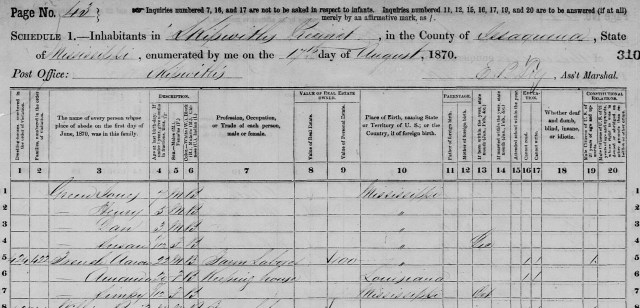
Post-Civil War, Aaron French and his family resided in Issaquena County, Mississippi (U.S. Census, 1870, public domain).
In August of 1870, Aaron French and his wife, Amanda, lived with their eight-month-old daughter, “Simpy” (also known as Cynthia or Cyntha) in Skipworth Precinct, Issaquena County, Mississippi. Still residing in Issaquena County a decade later when the June 1880 federal census was taken, Aaron and Amanda were the proud parents of three daughters: Cynthia (who would go on to marry Samuel L. Dixon on March 20, 1890), Jesanna (also known as Jessie/Jesse), and “Arctavia” (also known as Octavia). Jessie, who later went on to wed John B. Cobb on January 28, 1892, made a life with her husband and son in Mayersville, Mississippi, where she was a teacher in the local schools. Octavia married Frank Childress on March 20, 1894.
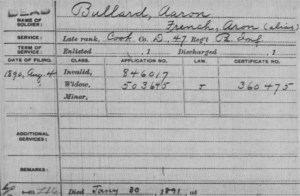
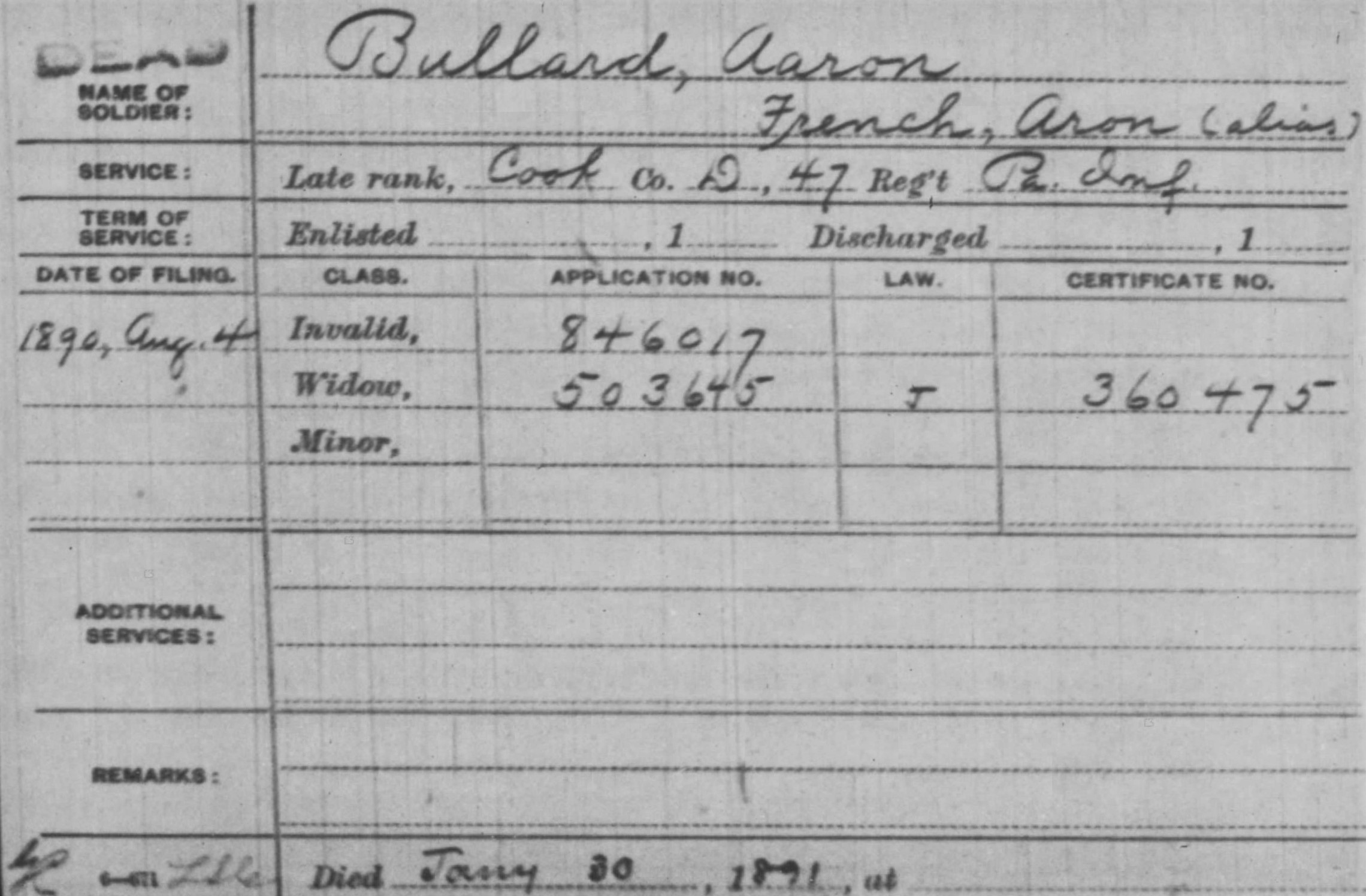
U.S. Civil War Pension Index Card for Aaron French, who enlisted with the 47th Pennsylvania Volunteers in Louisiana in 1864 (U.S. National Archives, public domain).
Sadly, Aaron French did not live to see his two youngest daughters marry because he died in Mississippi on January 30, 1891. He was just 40-43 years old, according to U.S. Census records and other data, which indicate that he was born in Louisiana sometime between 1848 and 1850.
Hearteningly, though, an even more intriguing piece of data has recently been uncovered about the later life of Aaron French—one that indicates that he had become active in politics prior to his death. According to the Vicksburg Evening Post, Aaron was appointed as a delegate from Issaquena County to the Republican Congressional Convention for the Third District, which was held in Greenville, Mississippi on August 7, 1886. Researchers are continuing to search for further details about his political activities and untimely death, as well as the exact location of his gravesite.
Thomas Haywood (alternate spellings of surname: Hayward, Haywood, Heywood) and Jack Jacobs:

Muster roll entries of Thomas Haywood and Edward Jassum, Company H, 47th Pennsylvania Volunteers (U.S. National Archives, public domain).
Born into slavery in South Carolina sometime around 1832, Thomas Haywood enlisted for a three-year term of service as an Under Cook with Company H of the 47th Pennsylvania Volunteer Infantry at Beaufort, South Carolina on November 1, 1862. He and three other formerly enslaved Black men—Abraham and Edward Jassum and “Presto Gettes”—who had previously enlisted with the 47th Pennsylvania at Beaufort in October of 1862, then traveled with the 47th Pennsylvania as it participated in multiple military engagements, including the 47th’s garrisoning of Fort Taylor and Fort Jefferson in Florida in 1863 and 1864, the battles of the Union’s spring 1864 Red River Campaign across Louisiana, and the battles of Sheridan’s tide-turning Shenandoah Valley Campaign across Virginia in the fall of 1864.
On or about June 22, 1864 all nine of these Black soldiers were formally mustered into the regiment at Morganza, Louisiana; Thomas Haywood and seven of the eight others all successfully completed their tours of duty, and were honorably mustered out upon expiration of their respective terms of enlistment. In Thomas Haywood’s case, that honorable discharge was awarded on October 31, 1865.
Post-war, it appears from various Freedmen’s Bureau records that he may have entered into yearly contracts with several men who had previously been plantation owners in the Beaufort, South Carolina area. In exchange for agreeing to plant and cultivate cotton for those men on three to five-acre parcels of land that had been leased to him by those white men, he was allowed to keep portions of the cotton sales (the largest portions of which went to the former plantation owners who had also most likely been slave owners prior to and during the Civil War).
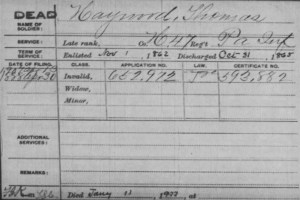
U.S. Civil War Index Card for Thomas Haywood, who enlisted with the 47th Pennsylvania Volunteers in South Carolina in 1862 (U.S. National Archives, public domain).
His body warn out from years of slavery prior to the war, difficult military service during the war, and harsh sharecropping experiences post-war, Thomas Hayward applied for, and was awarded a U.S. Civil War Pension on April 30, 1888. That pension was subsequently renewed by the federal government in 1907 at the rate of $15 per month (roughly $415 per month in today’s U.S. dollar equivalency).
By 1890, Thomas Haywood was living in Sheldon Township, Beaufort County, South Carolina. After a long life, he died on January 13, 1911. Unfortunately, his burial location has also not yet been identified by researchers.

In 1890, Thomas Haywood lived near Hanna Jacobs, the widow of Jack Jacobs, who may have been another Black soldier who enlisted with the 47th Pennsylvania Volunteers (U.S. Census, 1890, Sheldon Township, Beaufort County, South Carolina, public domain).
One other piece of tantalizing data that has recently been discovered is that a woman named “Hanna Jacobs” lived near Thomas Haywood in 1890. This information may be significant because Hanna was described on the 1890 U.S. Census of Union soldiers and widows as the widow of “Jack Jacobs,” who had served in the same company with Thomas Haywood (according to that special census).
Researchers currently believe that Jack Jacobs may, in fact, have been another formerly enslaved Black man who had enlisted with the 47th Pennsylvania when it was stationed near Beaufort in 1862, and are currently conducting a Go Fund Me campaign to raise funds to purchase the Civil War military and pension records of Hanna and Jack Jacobs, as well as the nine known formerly enslaved Black men who enlisted with the 47th Pennsylvania Volunteer Infantry in 1862 and 1864.
Jackson Haywood:
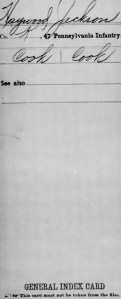
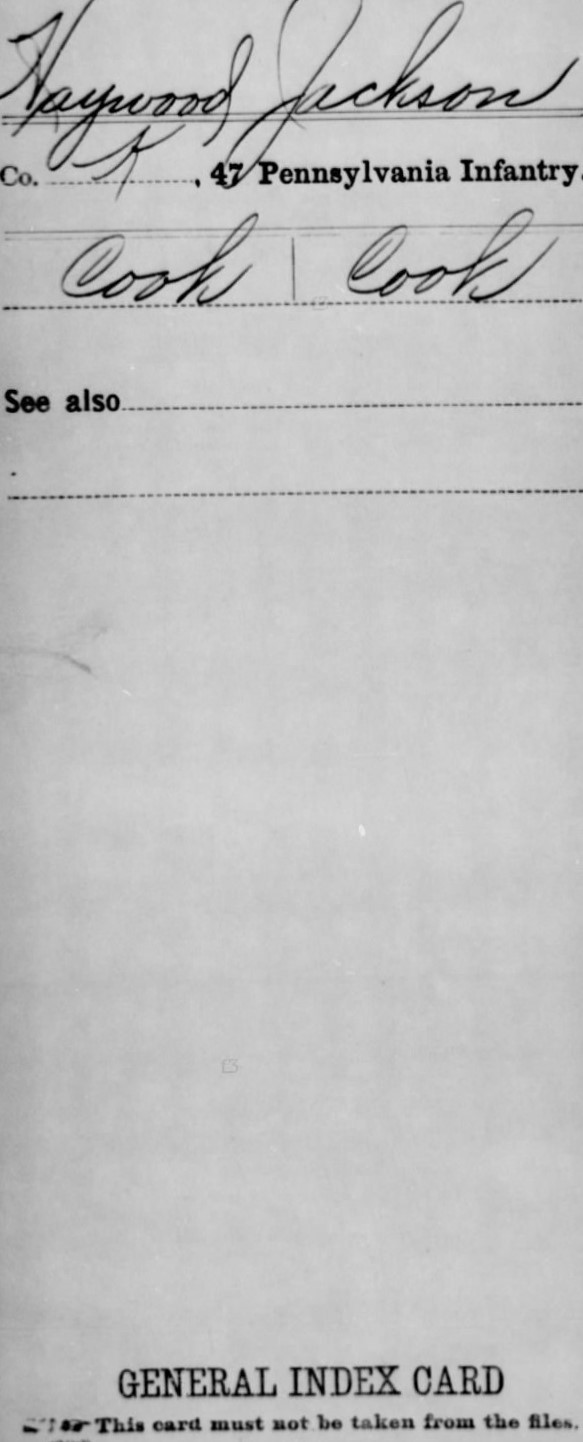
General Index Card for Jackson Haywood, who may have been a Black soldier who enlisted with the 47th Pennsylvania Volunteers (U.S. National Archives, public domain).
According to the “Index to Compiled Service Records of Volunteers Who Served in Organizations from the State of Pennsylvania,” which was created by staff at the U.S. National Archives, a General Index Card was created for yet another mystery man—a soldier named “Jackson Hayward.”
To date, researchers have only been able to determine that he may have enlisted with Company K of the 47th Pennsylvania Volunteer Infantry as a cook—a rank similar to that at which the known nine formerly enslaved Black men who enlisted with the 47th Pennsylvania were entered on the muster rolls of the regiment.
Researchers hope, with time and the continued financial support of the followers of 47th Pennsylvania Volunteers: One Civil War Regiment’s Story, to be able to confirm the dates of military service and race of this individual, as well as that of “Jack Jacobs.”
As always, we appreciate everyone’s help in ensuring that the service to the nation of these soldiers will never be forgotten. They helped to preserve our Union and deserve to be recognized more fully for their heroism and dedication.
* Our most important goal continues to be the purchase of the Compiled Military Service Records (CMSR) and U.S. Civil War Pension records for each of these remarkable men in order to document and freely share their stories with the widest possible audience. We continue to await word from staff at the U.S. National Archives regarding the timeframe for their resumption of digitization and reproduction services that have temporarily been suspended due to the coronavirus pandemic. As soon as those services have resumed, we will request an update regarding their estimated timeframe for fulfilling our records requests. In the interim, we will seek out further details about each of these soldiers via local and state archival resources across the nation, and will post updates as we confirm more data.
Sources:
- Bullard, Aaron, in Index to Compiled Service Records of Volunteers. Washington, DC: U.S. National Archives, 1861-1865.
- Bullard, Aaron and French, Aaron, in U.S. Civil War Pension Index Cards. Washington, DC: U.S. National Archives, 1890-1891.
- Bullard, Aaron, Presto Garris, Thomas Haywood, et. al. in U.S. Civil War Muster Out Rolls (47th Pennsylvania Volunteer Infantry). Washington, DC: U.S. National Archives, 1865-1866 (available via Ancestry.com).
- French, Aaron, in “Proceedings of the Third District Republican Convention.” Vicksburg, Mississippi: Vicksburg Evening Post, August 9, 1886.
- French, Aaron and Family, in U.S. Census Records (Issaquena County, Mississippi): Washington, DC: U.S. National Archives, 1870-1910.
- Haywood, Jackson, in Index to Compiled Service Records of Volunteers. Washington, DC: U.S. National Archives, 1861-1865.
- Haywood, Thomas, in Index to Compiled Service Records of Volunteers. Washington, DC: U.S. National Archives, 1861-1865.
- Haywood, Thomas, in U.S. Civil War Pension Index Cards. Washington, DC: U.S. National Archives, 1888, 1907.
- Haywood, Thomas, in U.S. Veterans’ Administration Pension Payment Cards. Washington, DC: U.S. National Archives, 1888, 1907.
- Haywood, Thomas, in U.S. Census (Beaufort County, South Carolina): Washington, DC: U.S. National Archives, 1890.
- Hanna Jacobs, widow of Jack Jacobs, in U.S. Census (Beaufort County, South Carolina): Washington, DC: U.S. National Archives, 1890.







 47th Pennsylvania Volunteers
You must be logged in to post a comment.