Camp Brightwood, Washington, D.C. (Mid-April – June 2, 1865)

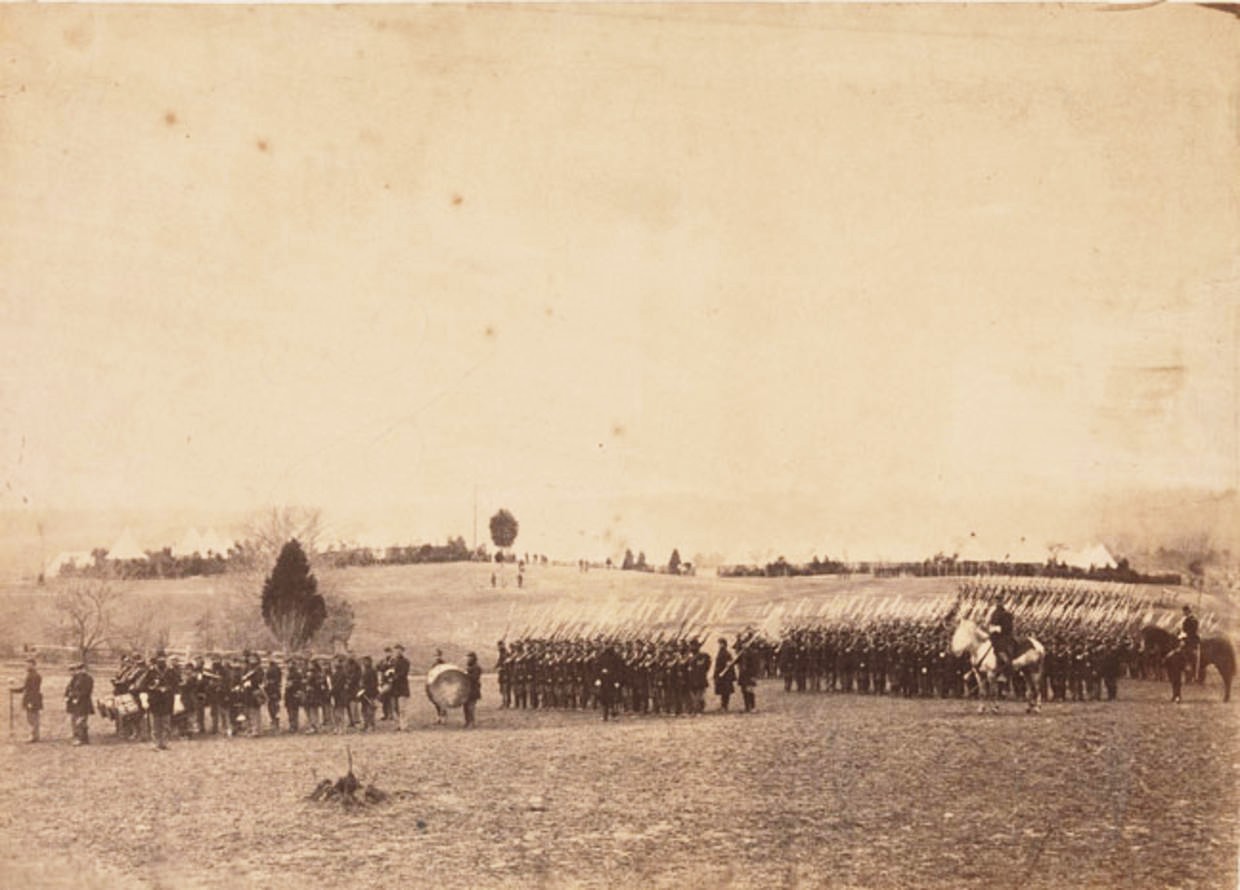
Unidentified Union infantry regiment, Camp Brightwood, Washington, D.C., circa 1865 (public domain; click to enlarge).

Marched closer to the nation’s capital in the wake of U.S. President Abraham Lincoln’s assassination in mid-April 1865, the 47th Pennsylvania Veteran Volunteers were directed to proceed to the Brightwood district in the northwestern section of Washington, D.C. and erect their Sibley tents at the Union Army duty station known as Camp Brightwood.

Their new job was to prevent Confederate States Army troops and their sympathizers from reigniting the flames of civil war that had just been stamped out weeks earlier.

According to historians at Cultural Tourism DC, Brightwood was “one of Washington, DC’s early communities and the site of the only Civil War battle to take place within the District of Columbia” — the Battle of Fort Stevens.

This crossroads community developed from the Seventh Street Turnpike, today’s Georgia Avenue, and Military Road. Its earliest days included a pre-Civil War settlement of free African Americans…. Eventually Brightwood boasted a popular race track, country estates, and sturdy suburban housing. In 1861 the area was known as Brighton, but once it was large enough to merit a U.S. Post Office, the name was changed to Brightwood to distinguish it from Brighton, Maryland.

Also, according to Cultural Tourism historians, Camp Brightwood was established on the grounds of “Emery Place, the summer estate of Matthew Gault Emery,” who had “made a fortune in stone-cutting, including the cornerstone for the Washington Monument,” which was laid in 1848.

During the Civil War (1861-1865), Captain Emery led the local militia. His hilltop became a signal station where soldiers used flags or torches to communicate with nearby Fort DeRussy or the distant Capitol. Soldiers of the 35th New York Volunteers created Camp Brightwood here. During the Battle of Fort Stevens in July 1864, Camp Brightwood was a transfer point for the wounded.

By late April of 1865, it was home to multiple Union Army regiments, including the 47th Pennsylvania Veteran Volunteers.

Guarding the Lincoln Assassination Conspirators
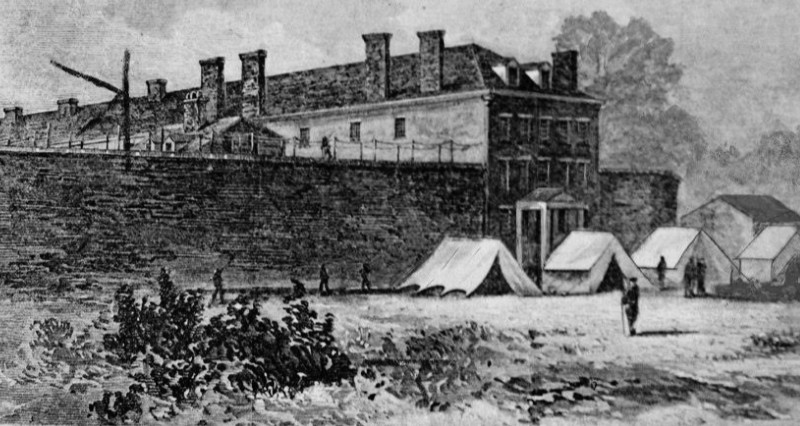
Washington Arsenal Penitentiary, Washington, D.C., 1865 (Joseph Hanshew, public domain; click to enlarge).

Sometime after their arrival at Camp Brightwood during that fateful spring of 1865, a group of 47th Pennsylvania Veteran Volunteers were given a new assignment — guard duty at the Washington Arsenal and its prison facility, where eight people were being held in connection with their involvement in the assassination of President Abraham Lincoln. They had been arrested between April 17 and 26.
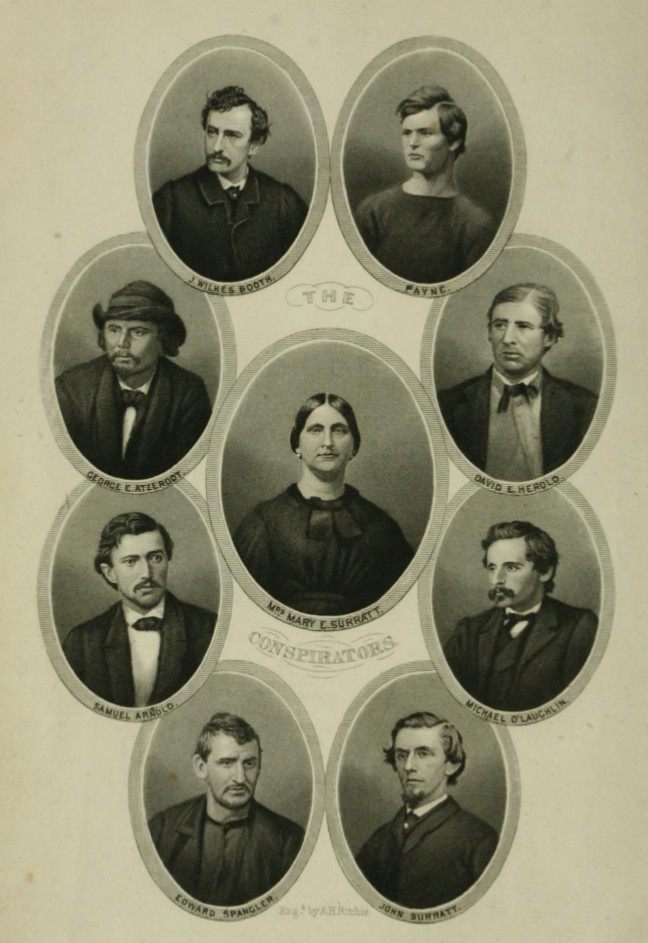
The key conspirators involved in President Abraham Lincoln’s assassination (Benn Pitman, The Assassination of President Lincoln and the Trial of the Conspirators,” 1865, U.S. Library of Congress, public domain).

While researchers for 47th Pennsylvania Volunteers: One Civil War Regiment’s Story have not yet determined the exact start date of the 47th Pennsylvania’s guard duties at the Washington Arsenal Penitentiary, they are now able to offer a better estimate — thanks to the work of Lincoln scholars Edward Steers, Jr. and Harold Holzer, who published documents written by Union Major-General John Frederick Hartranft, the Pennsylvanian appointed by U.S. President Andrew Johnson on May 1, 1865 “to command the military prison at the Washington Arsenal, where the U.S. government had just incarerated the seven men and one woman accused of complicity in the shooting.” Included in the Steers-Holzer compilation is a letter from Major-General Hartranft, governor and commander of the “Washington Arsenal Military Prison,” to Major-General Winfield S. Hancock, commanding officer of the United States Middle Military Division, which was dated May 11, 1865. Hartranft began by informing Hancock that “at 10:25 yesterday [May 10, 1865], Lt. Col. J. M. Clough, 18th N. H. reported with 450 muskets, for four days duty, relieving the 47th Pa. Vols.” He then went on to describe the duties performed by 18th New Hampshire Volunteers at the Washington Arsenal on May 10:

At 11:45, the prisoners on trial were taken into Court, in compliance with the orders of the same. At 1 P.M. the Court ordered the prisoners returned to their cells, which was done.

At 1:10 P.M. dinner was served to the prisoners in the usual manner.

At 1:30 in compliance with your orders Marshal McPhail was admitted to see the prisoner in 161 [Atzerodt], his hood having been previously removed; he remained with him until 2.35, immediately after which his hood was replaced and the door locked.

At 3:45 P.M. Mr. George L. Crawford in accordance with your instructions, was permitted to have an interview with prisoner in 209. I was present during the same, and heard all that was said. The conversation was in regard to the property of the prisoner in Philadelphia. At 4:25 the hood was replaced and the cell locked.

At 6 P.M. Supper was furnished the prisoners and at the same time Dr. Porter and myself made inspections of all the cells and prisoners.

At 6 P.M. in accordance with your instructions, Mr. Stone, counsel for Dr. Mudd, was permitted to visit his client. The interview took place in the presence of Lt. Col. McCall but not in his hearing.

At 6:35 the interview closed, and the door was again locked.

At 7 this A.M. breakfast was served to the prisoners in the usual manner. At 7:15, Dr. Porter and myself made Inspections of all the cells and prisoners.

I would respectfully recommend that the prisoner in 190 be removed to cell 165.

All passes admitting persons during the last 24 hours are here with enclosed.

As a result, researchers for the 47th Pennsylvania Volunteers’ project postulate that:

  1. As many as four hundred and fifty 47th Pennylvania Veteran Volunteer Infantrymen may have been stationed at the Washington Arsenal between May 6-10, 1865; and
  2. At least some of those 47th Pennsylvanians may very well have interacted with the key Lincoln assassination conspirators (Samuel Bland Arnold, George A. Atzerodt, David E. Herold, Dr. Samuel Alexander Mudd, Michael O’Laughlen, Lewis Thornton Powell/Lewis Payne, Edman Spangler/Ned Spangler, and Mary Elizabeth Surratt) — interactions which likely took place while those eight prisoners were confined at the Washington Arsenal prison; on the way to and from the courtroom, where they were being tried for conspiring to assassinate President Lincoln; inside that courtroom during trial proceedings; and possibly also at other sites related to their confinement and trial.

Although the duties performed between by 47th Pennsylvania Volunteers between May 6-9 would not have been exactly the same as those performed by the New Hampshire soldiers on May 10, they may very well have been similar — meaning that at least some 47th Pennsylvania Volunteers may have been involved in locking and unlocking the doors of the conspirators’ cells, escorting the conspirators into the courtroom of their military trial (which began on May 9, 1865), standing guard over the conspirators during their trial to prevent their escape, escorting them from the courtroom, and interacting with them in their cells by:

  • Bringing meals to them;
  • Removing and replacing the hoods that covered their heads so that they could interact with their lawyers and other visitors;
  • Verifying the legitimacy of passes held by would-be visitors and denying or granting access to those visitors as appropriate;
  • Escorting visitors to and from their cells; and
  • Monitoring their visits with anyone granted entry to their cells.

With their guard assignment completed by the morning of May 10, 1865, the 47th Pennsylvania Volunteers who were serving on detached duty at the Washington Arsenal were marched back to Camp Brightwood, where they would remain until their next assignment — participating in the Union’s Grand Review of the National Armies on May 23, 1865.
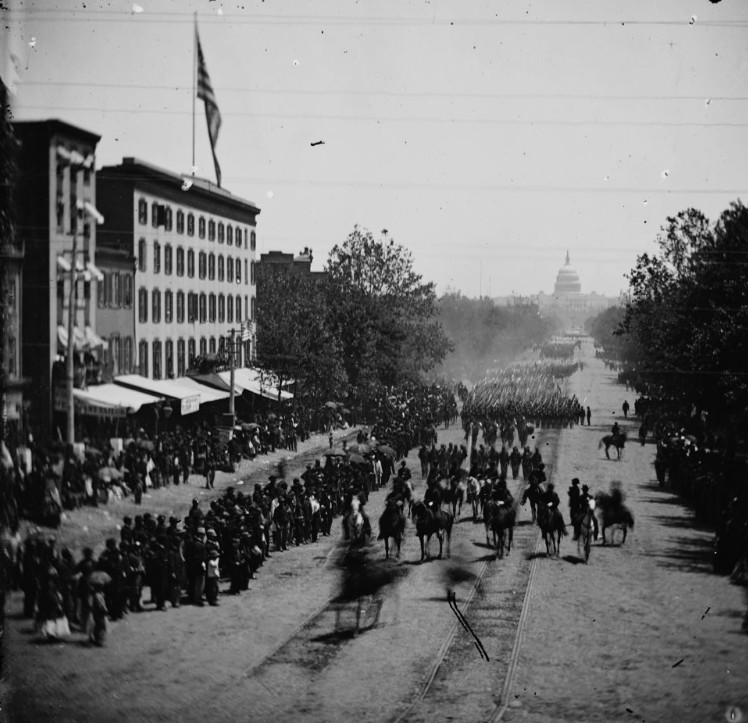
19th Corps, Army of the United States, Grand Review of the National Armies, Pennsylvania Avenue, Washington, D.C., May 23, 1865 (Matthew Brady, U.S. Library of Congress, public domain).

The Grandest of the Grand Reviews

The 47th Pennsylvania Veteran Volunteer Infantry was just one group of the more than one hundred and forty-five thousand Union military men who marched from Capitol Hill through the streets of Washington, D.C. during a two-day spectacle designed to celebrate the end of the American Civil War and heal Americans’ heartbreak in the wake of President Lincoln’s assassination. Held from May 23-24, 1865, it was a sight that had never been seen before — and one that would likely never be seen anywhere in the United States of America ever again. The first day’s parade alone lasted six hours.
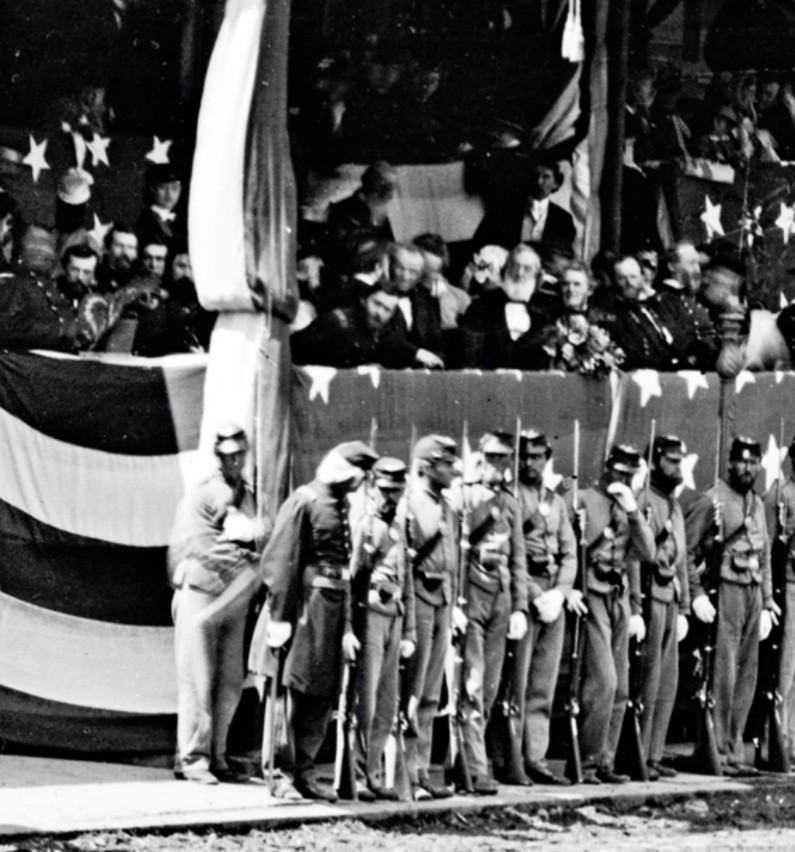
Lieutenant-General Ulysses S. Grant, leaning forward, President Andrew Johnson to his left, Grand Review of the National Armies, Washington, D.C., May 23, 1865 (U.S. Library of Congress, public domain).

According to The New York Times, the 47th Pennsylvanians were positioned behind the parade’s third division, as part of the Nineteenth Army Corps (XIX Corps) in Dwight’s Division. Marching with the precision for which they had become renowned, they passed in front of a review stand which sheltered U.S. President Andrew Johnson, Secretary of War Edwin M. Stanton and Lieutenant-General Ulysses S. Grant. The division directly behind the 47th Pennsylvanians in that day’s line of march included other officers and general staff of the Army of the United States and regiments commanded by American Civil War icon Brigadier-General Joshua L. Chamberlain, one of the most beloved heroes from the tide-turning Battle of Gettysburg.

Rev. William DeWitt Clinton Rodrock, chaplain, 47th Pennsylvania Volunteers (courtesy of Robert Champlin, used with permission).

Afterward, 47th Pennsylvania Chaplain William DeWitt Clinton Rodrock summed up the experience in a report penned at Camp Brightwood on May 31:

The wise king of the Scriptures speaks of a sorrow that pervades the human heart “in the midst of laughter.” The truthfulness of this Divine philosophy is a matter of daily experience. Our most joyous seasons are intermingled with a sadness that often challenges definition. Every garden has its sepulchre. Every draft of sweet has its ingredient of bitter. This fact has never been so fully realized as this month. With the mighty army of brave soldiers congregated and reviewed in Washington and the … expressions of deep regret that Abraham Lincoln is not here to have witnessed the great pageant of the 23rd and 24th inst. have been universal. Not the splendid victories which our brave soldiers have won — not the pleasing prospect that they are “homeward bound” — not the consolatory thought that the reins of government have fallen into the hands of so good a man as Andrew Johnson — have served to restrain these utterances of grief and sorrow. Had it been God’s will to spare Mr. Lincoln’s life, what an eclat his presence would have imparted to the mighty pageant.

But as He willed otherwise and “doeth all things well,” it is ours to learn the great lesson of the hour.

Rebuilding a Shattered Nation

Ruins of Charleston, South Carolina as seen from the Circular Church, 1865 (U.S. National Archives and Records Administration, public domain).

As the cheers of the Grand Review crowds faded, the 47th Pennsylvania Veteran Volunteers resumed life at Camp Brightwood, with many assuming that their days of wearing “Union Blue” were finally coming to an end. But that assumption proved to be an incorrect one when the 47th Pennsylvania Veteran Volunteers received word that they were being reassigned. Ordered to pack their belongings in late May 1865, they would be heading back to America’s Deep South — this time to assist with Reconstruction duties in Georgia and South Carolina, beginning the first week in June.


Sources:

  1. Assassination of President Abraham Lincoln.” Washington, D.C.: U.S. Library of Congress, retrieved online May 21, 2025.
  2. Bates, Samuel P. History of Pennsylvania Volunteers, 1861-5, vol. 1. Harrisburg, Pennsylvania: B. Singerly, State Printer, 1869.
  3. Battleground National Cemetery: Battleround to Community — Brightwood Heritage Trail,” “Fort Stevens” and “Mayor Emery and the Union Army.” United States: Historical Marker Database, retrieved online May 20, 2025.
  4. “Battleground to Community: Brightwood Heritage Trail.” Washington, D.C.: Cultural Tourism DC, 2008.
  5. “Grand Military Review: Streets Crowded with Spectators: Sherman Greeted with Deafening Cheers.” Pittsburgh, Pennsylvania: The Daily Post, May 25, 1865.
  6. Grant” (television mini-series). New York, New York: History Channel Education, 2020.
  7. “Our Heroes! The Grand Review at Washington. Honor to the Brave. Immense Outpouring of the People. The Troops Reviewed by Gen. Grant.” Harrisburg, Pennsylvania: Daily Telegraph, May 23, 1865.
  8. Pitman, Benn. The Assassination of President Abraham Lincoln and the Trial of the Conspirators. Cincinnati, Ohio and New York, New York: Moore, Wilstach & Boldwin, 1865.
  9. Reconstruction: An Overview.” Washington, D.C.: American Battlefield Trust, November 28, 2023.
  10. Review of the Armies; Propitious Weather and a Splendid Spectacle. Nearly a Hundred Thousand Veterans in the Lines.” New York, New York: The New York Times, May 24, 1865, front page.
  11. Rodrock, Rev. William D. C. Chaplain’s Reports (47th Pennsylvania Volunteer Infantry, 1865). Washington, D.C.: U.S. National Archives and Records Administration.
  12. Schmidt, Lewis. A Civil War History of the 47th Regiment of Pennsylvania Veteran Volunteers. Allentown, Pennsylvania: Self-published, 1986.
  13. “Serenade to General Grant” (performance for Lieutenant-General Ulysses S. Grant by the 47th Pennsylvania Veteran Volunteers’ Regimental Band), in “Washington.” Philadelphia, Pennsylvania: The Inquirer, May 22, 1865.
  14. Steers, Edward Jr. and Harold Holzer. The Lincoln Assassination Conspirators: Their Confinement and Execution, as Recorded in the Letterbook of John Frederick Hartranft. Baton Rouge, Louisiana, 2009.
  15. The Final March: Grand Review of the Armies.” Washington, D.C.: U.S. National Park Service, retrieved online May 20, 2025.
  16. “The Grand Review: A Grand Spectacle Witnessed.” Pittsburgh, Pennsylvania: The Daily Post, May 24, 1865.
  17. “The Grand Review: Immense Crowds in Washington: Fine Appearance of the Troops: Their Enthusiastic Reception.” Harrisburg, Pennsylvania: Pennsylvania Daily Telegraph, May 24, 1865; and West Chester, Pennsylvania: The Record, May 17, 1865.
  18. “The Grand Review: The City Crowded with Visitors: Order of Corps, Divisions, Brigades and Regiments.” Philadelphia, Pennsylvania: Daily Constitutional Union, May 23, 1865.
  19. “The History of the Forty-Seventh Regt. P. V.” Allentown, Pennsylvania: The Lehigh Register, 20 July 1870.
  20. The Lincoln Conspirators,” in “Ford’s Theatre.” Washington, D.C.: U.S. National Park Service, retrieved online May 21, 2025.

 

April 15th: A Date of Decision and Death for President Abraham Lincoln

This 1865 photograph of President Abraham Lincoln by Alexander Gardner is believed by historians to be the final photo taken of Lincoln (1865, U.S. Library of Congress, public domain).

There were multiple key moments in the life of the man who would become the sixteenth president of the United States of America. Some, like the deaths of his mother and sister, would dramatically alter the trajectory of his life; others, like his decision to embark upon a life of public service, would reshape the future of a nation.

But his actions on one particular date, during two entirely different years, did both.

So pivotal in history, that particular date’s annual arrival still stops average Americans in their tracks each year, prompting them to reflect on the legacy of that one man — and the question, “What if?”

That man was U.S. President Abraham Lincoln and that date is April 15.

Lincoln’s Call for Seventy-Five Thousand Volunteers (April 15, 1861)

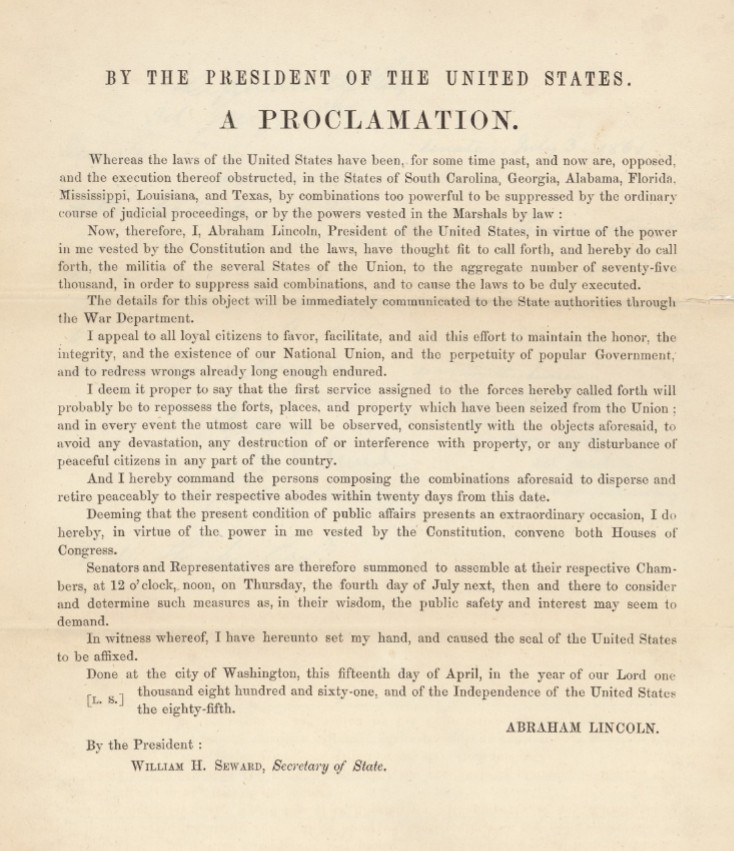
Proclamation issued by U.S. President Abraham Lincoln, calling for seventy-five thousand state militia troops to bring an end to the secession of, and insurrection by, eleven of fifteen southern slaveholding states, April 15, 1861 (U.S. National Archives and Records Administration, public domain; click to enlarge).

In response to the fall of Fort Sumter in Charleston, South Carolina to Confederate States troops on April 14, 1861, President Abraham Lincoln issued a proclamation in which he called for seventy-five thousand men across the United States to risk their lives to defend the nation’s capital and bring a swift end to the secession crisis and insurrection initiated by eleven of fifteen southern slave holding states. That proclamation, which was issued on April 15, 1861 read as follows:

By the President of the United States.

A Proclamation.

Whereas the laws of the United States have been, for some time past, and now are, opposed, and the execution thereof obstructed, in the States of South Carolina, Georgia, Alabama, Florida, Mississippi, Louisiana, and Texas, by combinations too powerful to be suppressed by the ordinary course of judicial proceedings, or by the powers vested in the Marshals by law:

Now, therefore, I, Abraham Lincoln, President of the United States, in virtue of the power in me vested by the Constitution and the laws, have thought fit to call forth, and hereby do call forth, the militia of the several States of the Union, to the aggregate number of seventy-five thousand, in order to suppress said combinations, and to cause the laws to be duly executed.

The details for this object will be immediately communicated to the State authorities through the War Department.

I appeal to all loyal citizens to favor, facilitate, and aid this effort to maintain the honor, the integrity, and the existence of our National Union, and the perpetuity of popular Government, and to redress wrongs already long enough endured.

I deem it proper to say that the first service assigned to the forces hereby called forth will probably be to repossess the forts, places, and property which have been seized from the Union; and in every event the utmost care will be observed, consistently with the objects aforesaid, to avoid any devastation, any destruction of or interference with property, or any disturbance of peaceful citizens in any part of the country.

And I hereby command the persons composing the combinations aforesaid to disperse and retire peaceably to their respective abodes within twenty days from this date.

Deeming that the present condition of public affairs presents an extraordinary occasion, I do hereby, in virtue of the power in me vested by the Constitution, convene both Houses of Congress.

Senators and Representatives are therefore summoned to assemble at their respective Chambers, at 12 o’clock, noon, on Thursday, the fourth day of July next, then and there to consider and determine such measures as, in their wisdom, the public safety and interest may seem to demand.

In witness whereof, I have hereunto set my hand, and caused the seal of the United States to be affixed.

Done at the city of Washington, this fifteenth day of April, in the year of our Lord one thousand eight hundred and sixty-one, and of the Independence of the United States the eighty-fifth.

Abraham Lincoln

By the President: William H. Seward, Secretary of State.

Four years later, on the exact same date, President Abraham would draw his last breath.

Lincoln’s Death from an Assassin’s Bullet (April 15, 1865)

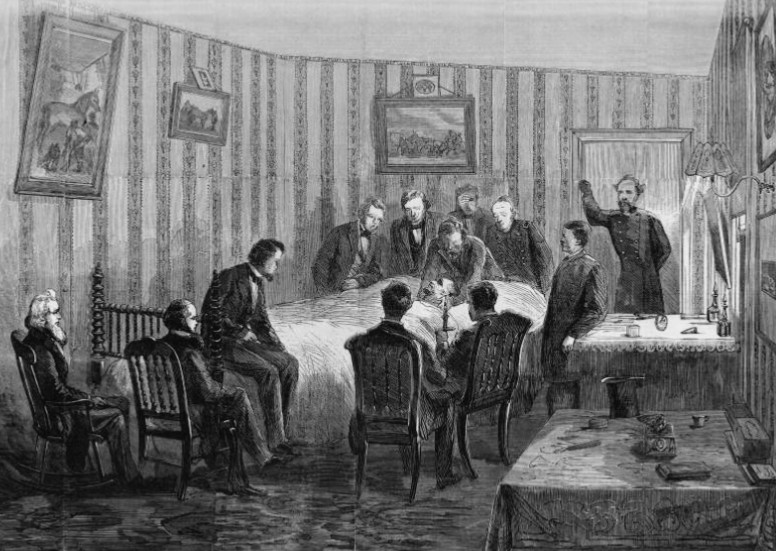
President Abraham Lincoln on his deathbed at the Petersen House in Washington, D.C., April 15, 1865 (Harper’s Weekly, 1865, public domain; click to enlarge).

Mortally wounded by a shot to his head, which was fired by an assassin and Confederate sympathizer while President Abraham Lincoln was watching a performance of the popular stage play, Our American Cousin, at Ford’s Theatre in Washington, D.C., on the evening of Good Friday, April 14, 1865, President Lincoln was initially examined on site in the presidential box, by fellow theatre attendee and physician Charles Leale, before being carried downstairs by Union Army soldiers and taken across Tenth Street — and into a room at the Petersen boarding house, where he was then gently lowered onto the bed of Willie Clark.

As additional physicians arrived and assessed the president’s condition, a decision was made to make him as comfortable as possible, when it was determined that he would likely not survive the night.

A remarkably strong man, even as he waged his toughest battle, President Lincoln managed to hang onto until the following morning, drawing his final ragged breath at 7:22 a.m. on April 15, 1865 — and leaving the work of national healing and Reconstruction in far less capable hands.

One hundred and sixty years later, Americans still wonder, “Would we be a better nation if Lincoln had survived?”


Sources:

  1. A Proclamation by the President of the United States, April 15, 1861.” Washington, D.C.: U.S. Capitol Visitor Center, retrieved online April 15, 2025.
  2. Abraham Lincoln’s Assassination,” in “History Channel: Civil War.” New York, New York: A&E Television Networks, February 27, 2025.
  3. Eric Foner: Reconstruction and the Constitution” (video). Chicago, Illinois: Chicago Humanities Festival, 2019.
  4. Lincoln’s Death,” in “Lincoln Assassination.” Washington, D.C.: Ford’s Theatre, retrieved online December 1, 2024.
  5. The Petersen House.” Washington, D.C.: U.S. National Park Service, December 1, 2024.


April 16, 1865: Stanton and Grant Inform the Union Army That President Lincoln Has Been Assassinated

Broadside showing the text of General Orders, No. 66 issued by U.S. Secretary of War Edwin Stanton and Lieutenant-General Ulysses S. Grant on 16 April 1865 to inform Union Army troops about the assassination of President Abraham Lincoln and provide instructions regarding the appropriate procedures for mourning (U.S. Library of Congress, public domain; click to enlarge).

General Orders, No. 66
War Department, Adjutant-General’s Office
Washington, April 16, 1865

The following order of the Secretary of War announces to the Armies of the United States the untimely and lamentable death of the illustrious ABRAHAM LINCOLN, late President of the United States:

WAR DEPARTMENT,
WASHINGTON, CITY, April 16, 1865

The distressing duty has devolved upon the Secretary of War to announce to the armies of the United States, that at twenty-two minutes after 7 o’clock, on the morning of Saturday, the 15th day of April, 1865, ABRAHAM LINCOLN, President of the United States, died of a mortal wound inflicted upon him by an assassin.

The Armies of the United States will share with their fellow-citizens the feelings of grief and horror inspired by this most atrocious murder of their great and beloved President and Commander-in-Chief, and with profound sorrow will mourn his death as a national calamity.

The Headquarters of every Department, Post, Station, Fort, and Arsenal will be draped in mourning for thirty days, and appropriate funeral honors will be paid by every Army, and in every Department, and at every Military Post, and at the Military Academy at West Point, to the memory of the late illustrious Chief Magistrate of the Nation and Commander-in-Chief of its Armies.

Lieutenant-General Grant will give the necessary instructions for carrying this order into effect.

EDWIN M. STANTON,
Secretary of War

On the day after the receipt of this order at the Headquarters of each Military Division, Department, Army, Post, Station, Fort, and Arsenal and at the Military Academy at West Point the troops and cadets will be paraded at 10 o’clock a. m. and the order read to them, after which all labors and operations for the day will cease and be suspended as far as practicable in a state of war.

The national flag will be displayed at half-staff.

At dawn of day thirteen guns will be fired, and afterwards at intervals of thirty minutes between the rising and setting sun a single gun, and at the close of the day a national salute of thirty-six guns.

The officers of the Armies of the United States will wear the badge of mourning on the left arm and on their swords and the colors of their commands and regiments will be put in mourning for the period of six months.

By command of Lieutenant-General Grant:
W. A. NICHOLS, Assistant Adjutant-General.


Sources:

  1. General Orders No. 66: War Department, Adjutant General’s Office, Washington, April 16, 1865.” Washington, D.C.: United States Library of Congress, retrieved online April 16, 2024.
  2. Stanton, Edwin McMasters (1814-1869) General Orders No. 66. New York, New York: The Gilder Lehrman Institute of American History, retrieved online April 16, 2024.
  3. Wooley, John and Gerhard Peters. Announcement to the Army of the Death of President Lincoln,” in “The American Presidency Project.” Santa Barbara, California: Department of Political Science, University of California, Santa Barbara, retrieved online April 16, 2024.


President Abraham Lincoln’s Final Public Address (11 April 1865)

This 1865 photograph of President Abraham Lincoln by Alexander Gardner is believed by historians to be the final photo taken of Lincoln (1865, U.S. Library of Congress, public domain).

We meet this evening, not in sorrow, but in gladness of heart. The evacuation of Petersburg and Richmond, and the surrender of the principal insurgent army, give hope of a righteous and speedy peace whose joyous expression can not be restrained. In the midst of this, however, He, from Whom all blessings flow, must not be forgotten. A call for a national thanksgiving is being prepared, and will be duly promulgated. Nor must those whose harder part gives us the cause of rejoicing, be overlooked. Their honors must not be parcelled out with others. I myself, was near the front, and had the high pleasure of transmitting much of the good news to you; but no part of the honor, for plan or execution, is mine. To Gen. Grant, his skilful officers, and brave men, all belongs. The gallant Navy stood ready, but was not in reach to take active part.

By these recent successes the re-inauguration of the national authority—reconstruction—which has had a large share of thought from the first, is pressed much more closely upon our attention. It is fraught with great difficulty. Unlike the case of a war between independent nations, there is no authorized organ for us to treat with. No one man has authority to give up the rebellion for any other man. We simply must begin with, and mould from, disorganized and discordant elements. Nor is it a small additional embarrassment that we, the loyal people, differ among ourselves as to the mode, manner, and means of reconstruction.

As a general rule, I abstain from reading the reports of attacks upon myself, wishing not to be provoked by that to which I can not properly offer an answer. In spite of this precaution, however, it comes to my knowledge that I am much censured for some supposed agency in setting up, and seeking to sustain, the new State Government of Louisiana. In this I have done just so much as, and no more than, the public knows. In the Annual Message of Dec. 1863 and accompanying Proclamation, I presented a plan of re-construction (as the phrase goes) which, I promised, if adopted by any State, should be acceptable to, and sustained by, the Executive government of the nation. I distinctly stated that this was not the only plan which might possibly be acceptable; and I also distinctly protested that the Executive claimed no right to say when, or whether members should be admitted to seats in Congress from such States. This plan was, in advance, submitted to the then Cabinet, and distinctly approved by every member of it. One of them suggested that I should then, and in that connection, apply the Emancipation Proclamation to the theretofore excepted parts of Virginia and Louisiana; that I should drop the suggestion about apprenticeship for freed-people, and that I should omit the protest against my own power, in regard to the admission of members to Congress; but even he approved every part and parcel of the plan which has since been employed or touched by the action of Louisiana. The new constitution of Louisiana, declaring emancipation for the whole State, practically applies the Proclamation to the part previously excepted. It does not adopt apprenticeship for freed-people; and it is silent, as it could not well be otherwise, about the admission of members to Congress. So that, as it applies to Louisiana, every member of the Cabinet fully approved the plan. The Message went to Congress, and I received many commendations of the plan, written and verbal; and not a single objection to it, from any professed emancipationist, came to my knowledge, until after the news reached Washington that the people of Louisiana had begun to move in accordance with it. From about July 1862, I had corresponded with different persons, supposed to be interested, seeking a reconstruction of a State government for Louisiana. When the Message of 1863, with the plan before mentioned, reached New-Orleans, Gen. Banks wrote me that he was confident the people, with his military co-operation, would reconstruct, substantially on that plan. I wrote him, and some of them to try it; they tried it, and the result is known. Such only has been my agency in getting up the Louisiana government. As to sustaining it, my promise is out, as before stated. But, as bad promises are better broken than kept, I shall treat this as a bad promise, and break it, whenever I shall be convinced that keeping it is adverse to the public interest. But I have not yet been so convinced.

I have been shown a letter on this subject, supposed to be an able one, in which the writer expresses regret that my mind has not seemed to be definitely fixed on the question whether the seceded States, so called, are in the Union or out of it. It would perhaps, add astonishment to his regret, were he to learn that since I have found professed Union men endeavoring to make that question, I have purposely forborne any public expression upon it. As appears to me that question has not been, nor yet is, a practically material one, and that any discussion of it, while it thus remains practically immaterial, could have no effect other than the mischievous one of dividing our friends. As yet, whatever it may hereafter become, that question is bad, as the basis of a controversy, and good for nothing at all—a merely pernicious abstraction.

We all agree that the seceded States, so called, are out of their proper practical relation with the Union; and that the sole object of the government, civil and military, in regard to those States is to again get them into that proper practical relation. I believe it is not only possible, but in fact, easier, to do this, without deciding, or even considering, whether these states have even been out of the Union, than with it. Finding themselves safely at home, it would be utterly immaterial whether they had ever been abroad. Let us all join in doing the acts necessary to restoring the proper practical relations between these states and the Union; and each forever after, innocently indulge his own opinion whether, in doing the acts, he brought the States from without, into the Union, or only gave them proper assistance, they never having been out of it.

The amount of constituency, so to to [sic] speak, on which the new Louisiana government rests, would be more satisfactory to all, if it contained fifty, thirty, or even twenty thousand, instead of only about twelve thousand, as it does. It is also unsatisfactory to some that the elective franchise is not given to the colored man. I would myself prefer that it were now conferred on the very intelligent, and on those who serve our cause as soldiers. Still the question is not whether the Louisiana government, as it stands, is quite all that is desirable. The question is “Will it be wiser to take it as it is, and help to improve it; or to reject, and disperse it?” “Can Louisiana be brought into proper practical relation with the Union sooner by sustaining, or by discarding her new State Government?”

Some twelve thousand voters in the heretofore slave-state of Louisiana have sworn allegiance to the Union, assumed to be the rightful political power of the State, held elections, organized a State government, adopted a free-state constitution, giving the benefit of public schools equally to black and white, and empowering the Legislature to confer the elective franchise upon the colored man. Their Legislature has already voted to ratify the constitutional amendment recently passed by Congress, abolishing slavery throughout the nation. These twelve thousand persons are thus fully committed to the Union, and to perpetual freedom in the state—committed to the very things, and nearly all the things the nation wants—and they ask the nations recognition, and it’s assistance to make good their committal. Now, if we reject, and spurn them, we do our utmost to disorganize and disperse them. We in effect say to the white men “You are worthless, or worse—we will neither help you, nor be helped by you.” To the blacks we say “This cup of liberty which these, your old masters, hold to your lips, we will dash from you, and leave you to the chances of gathering the spilled and scattered contents in some vague and undefined when, where, and how.” If this course, discouraging and paralyzing both white and black, has any tendency to bring Louisiana into proper practical relations with the Union, I have, so far, been unable to perceive it. If, on the contrary, we recognize, and sustain the new government of Louisiana the converse of all this is made true. We encourage the hearts, and nerve the arms of the twelve thousand to adhere to their work, and argue for it, and proselyte for it, and fight for it, and feed it, and grow it, and ripen it to a complete success. The colored man too, in seeing all united for him, is inspired with vigilance, and energy, and daring, to the same end. Grant that he desires the elective franchise, will he not attain it sooner by saving the already advanced steps toward it, than by running backward over them? Concede that the new government of Louisiana is only to what it should be as the egg is to the fowl, we shall sooner have the fowl by hatching the egg than by smashing it? Again, if we reject Louisiana, we also reject one vote in favor of the proposed amendment to the national constitution. To meet this proposition, it has been argued that no more than three fourths of those States which have not attempted secession are necessary to validly ratify the amendment. I do not commit myself against this, further than to say that such a ratification would be questionable, and sure to be persistently questioned; while a ratification by three fourths of all the States would be unquestioned and unquestionable.

I repeat the question. “Can Louisiana be brought into proper practical relation with the Union sooner by sustaining or by discarding her new State Government?

What has been said of Louisiana will apply generally to other States. And yet so great peculiarities pertain to each state; and such important and sudden changes occur in the same state; and, withal, so new and unprecedented is the whole case, that no exclusive, and inflexible plan can safely be prescribed as to details and colatterals. Such exclusive, and inflexible plan, would surely become a new entanglement. Important principles may, and must, be inflexible.

In the present ‘situation’ as the phrase goes, it may be my duty to make some new announcement to the people of the South. I am considering, and shall not fail to act, when satisfied that action will be proper.


Annotation (per Roy Basler, et. al., editors):

[1]   AD-P, ISLA. On April 11, Salmon P. Chase had written Lincoln at length about reconstruction:

“I am very anxious about the future: and most about the principles which are to govern reconstruction for as these principles are sound or unsound so will be the work & its results. . . .

“And first as to Virginia.

“By the action of every branch of the Government we are committed to the recognition & maintenance of the State organization of which Governor Pierpont is the head. You know all the facts. . . . There will be a pressure for the recognition of the rebel organization on condition of profession of loyalty. It will be far easier and wiser, in my judgment, to stand by the loyal organization already recognized.

“And next as to the other rebel States:

“The easiest & safest way seems to me to be the enrollment of the loyal citizens without regard to complexion and encouragement & support to them in the reorganization of State Governments under constitutions securing suffrage to all citizens. . . . This you know has long been my opinion. . . .

“This way is recommended by its simplicity, facility & above all, justice. It will be, hereafter, counted equally a crime & a folly if the colored loyalists of the rebel states shall be left to the control of restored rebels, not likely, in that case, to be either wise or just, until taught both wisdom and justice by new calamities.

“The application of this principle to Louisiana is made somewhat difficult by the organization which has already taken place: but happily the Constitution enables the Legislature to extend the right of suffrage. . . .

“The same result can be assured in Arkansas by an amendment of the state constitution; or what would be better, I think, by a new Convention . . . without distinction of color. To all the other states the general principle may be easily applied. . . .'” (DLC-RTL).


On the morning after Lincoln’s speech, Chase wrote again:

“The American of this morning contains your speech of last evening. Seeing that you say something on the subject of my letter to you yesterday—reconstruction—, & refer, though without naming me, to the suggestions I made in relation to the Amnesty Proclamation, when you brought it before the Heads of Departments, I will ask your permission to add some observations to what I have already written.

“I recollect the suggestions you mention; my impression is that they were in writing. There was another which you do not mention and which, I think, was not in writing. It is distinct in my memory; though doubtless forgotten by you. It was an objection to the restriction of participation in reorganization to persons having the qualifications of voters under the laws of their several states just before rebellion.

“Ever since questions of reconstruction have been talked about, it has been my opinion that the colored loyalists ought to be allowed to participate in it and it was because of this opinion that I was anxious to have this question left open. I did not however say much about the restriction. I was the only one who expressed a wish for its omission; & I did not desire to seem pertinacious.

“You will remember, doubtless, that the first order ever issued for enrollment with a view to reconstruction went to General Shepley & directed the enrollment of all loyal citizens; and I suppose that, since the opinion of Attorney General Bates, no one, connected with your administration, has questioned the citizenship of free colored men more than that of free white men. The restriction in the amnesty proclamation operated as a revocation of the order to General Shepley:—but, as I understood you not to be wedded to any particular plan of reconstruction, I hoped & believed that reflection & observation would probably satisfy you that the restriction should not be adhered to.

“I fully sympathized with your desire for the restoration of the Union by the change of rebel slave States into Union free States; and was willing, if I could not get exactly the plan I thought best, to take the plan you thought best, & to trust the future for modifications. I welcomed, therefore, with joy the prospects of good results from the cooperation of General Banks with the free state men of Louisiana. I think General Banks’ error, & I have said so to him, was in not acting through instead of over the Free State Committee. This Committee had already shown itself disposed to a degree of liberality towards the colored people quite remarkable at that time. They had admitted delegates from the creole colored population into their free State Convention, & had evinced a readiness to admit intelligent colored citizens of that class to the rights of suffrage. I have no doubt that great & satisfactory progress would have been made in the same direction had not the work been taken out of their hands. This created the impression that the advocates of general suffrage were to be treated with disfavor by the representatives of the Government. Discouragement & disinterest were the natural consequences.

“For one I was glad of all the good that was done; and, naturally, wanted more. So when I came to Washington last winter I saw Gen Banks: and, being now more deeply than ever persuaded of the necessity of universal suffrage, I begged him to write himself & to induce the Senators & Representatives elect from Louisiana to write to members of the Legislature and urge them to exercise their power under the constitution by passing an act extending suffrage to colored citizens. I knew that many of our best men in and out of Congress had become thoroughly convinced of the impolicy and injustice of allowing representation in Congress to States which had been in rebellion and were not yet prepared to concede equal political rights to all loyal citizens. They felt that if such representation should be allowed & such states reinstated in all their former rights as loyal members of the Union, the colored population would be practically abandoned to the disposition of the white population, with every probability against them; and this, they believed would be equally unjust & dangerous.

“I shared their sentiment & was therefore extremely desirous that General Banks should take the action I urged upon him. I thought indeed that he concurred, mainly, in my views, & would to some extent at least act upon them. I must have been mistaken, for I never heard that he did anything in that direction.

“I know you attach much importance to the admission of Louisiana, or rather to the recognition of her right to representation in Congress as a loyal State in the Union. If I am not misinformed there is nothing in the way except the indisposition of her Legislature to give satisfactory proof of loyalty by a sufficient guaranty of safety & justice to colored citizens through the extension to loyal colored men of the right of suffrage. Why not, then, as almost every loyal man concurs with you as to the desirableness of that recognition, take the shortest road to it by causing every proper representation to be made to the Louisiana Legislature of the importance of such extension.

“I most earnestly wish you could have read the New Orleans papers for the last few months. Your duties have not allowed it. I have read them a good deal—quite enough to be satisfied that, if you had read what I have, your feelings of humanity & justice would not let you rest till all loyalists are made equal in the right of self protection by suffrage.

“Once I should have been, if not satisfied, reasonably contented by suffrage for the more intelligent & for those who have been soldiers; now I am convinced that universal suffrage is demanded by sound policy and impartial justice alike.

“I have written too much already & will not trouble you with my reasons for this conclusion. I shall return to Washington in a day or two & perhaps it will not be disagreeable to you to have the whole subject talked over. . . .” (DLC-RTL).


Sources:

1. Basler, Roy P., editor, et. al. Collected works. The Abraham Lincoln Association/Springfield, Illinois, vol. 8. New Brunswick, New Jersey: Rutgers University Press, 1953.

2. Masur, Louis P. Lincoln’s Last Speech. New York, New York: Opinionator: Disunion, The New York Times, 10 April 2015.