St. Charles County Historical Society Donates David H. Smith Papers to 47th Pennsylvania Volunteers: One Civil War Regiment’s Story

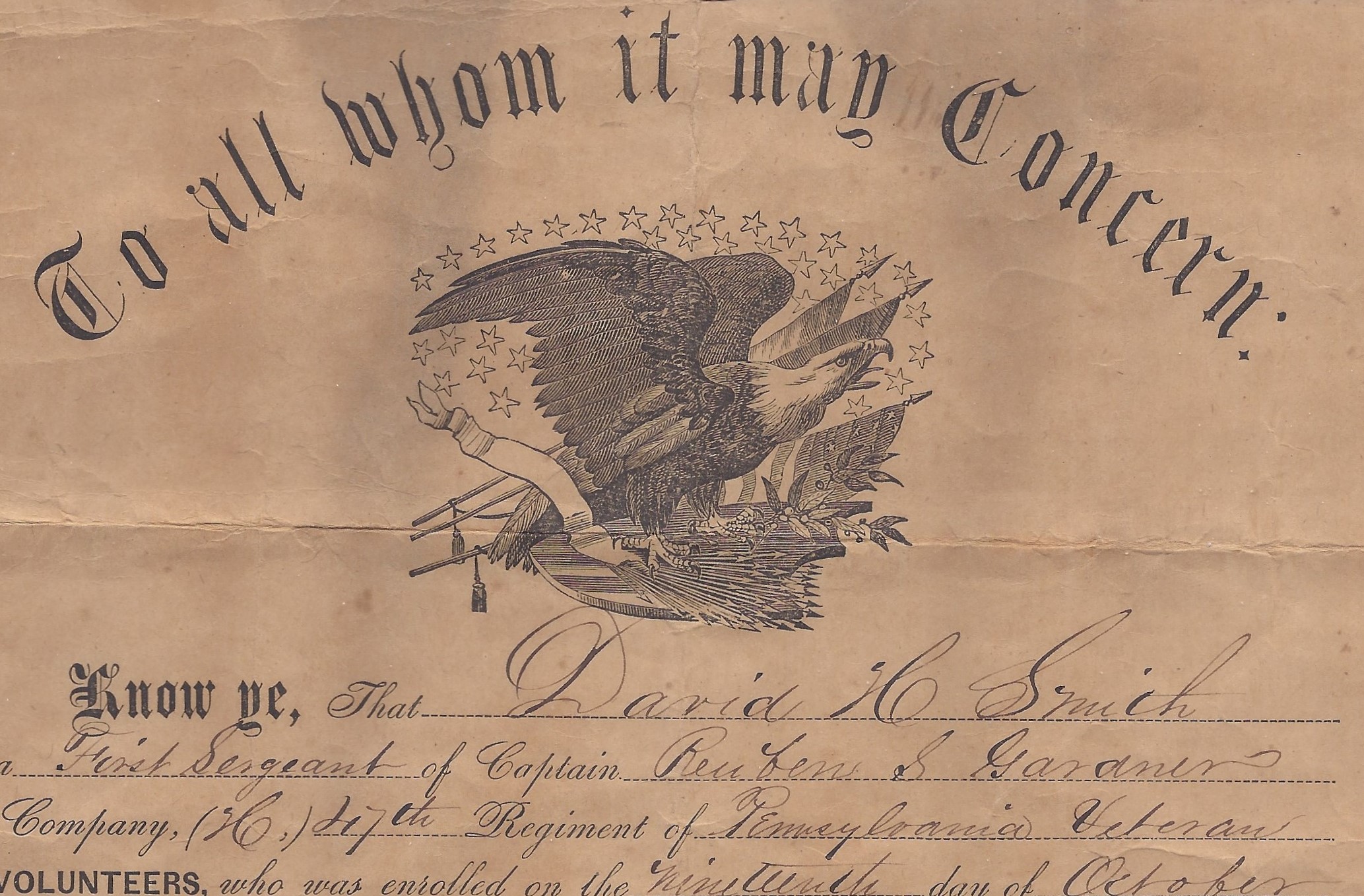
Honorable Discharge (excerpt), First Sergeant David H. Smith, Company H, 47th Pennsylvania Volunteers, December 25, 1865 (public domain).

A challenging year for many Americans due to the COVID-19 pandemic, a faltering economy, and civil strife, 2020 proved to be a remarkably constructive one on many fronts for a humanities project dedicated to preserving and educating children and adults about the 47th Pennsylvania Volunteer Infantry—a Union Army unit which made history during the American Civil War as the only regiment from Pennsylvania to participate in the 1864 Red River Campaign across Louisiana, and which also was involved in guarding Mary Surratt and the other key conspirators involved in Lincoln’s assassination in 1865.

One of the most important developments in 2020 was the donation by the St. Charles County Historical Society in St. Charles, Missouri of its David H. Smith Papers collection to 47th Pennsylvania Volunteers: One Civil War Regiment’s Story.

David H. Smith was one of the 47th Pennsylvania Volunteers who served for the duration of the war. Following his enrollment at Harrisburg, Pennsylvania on August 22, 1861, Smith mustered in at Camp Curtin in Harrisburg on September 19 of that year as a private with Company H. Described as a nineteen-year-old farmer with light hair, blue eyes, and a light complexion who was five feet, nine inches tall, he was promoted to the rank of corporal on October 21, 1862—the day before the regiment was bloodied badly in the Battle of Pocotaligo, South Carolina. He then re-enlisted with the 47th Pennsylvania Volunteers in mid-October of 1863 at Fort Jefferson in the Dry Tortugas, Florida, where half of the regiment was stationed at the time, and was subsequently promoted to the rank of Sergeant on September 18, 1864—one day before the Battle of Opequan, Virginia, and promoted again to First Sergeant on April 21, 1865—exactly one week after Lincoln’s assassination. Smith then continued to serve until the regiment was honorably mustered out at Charleston, South Carolina on Christmas Day of that same year.

According to Adam Pesek, a collections volunteer with the St. Charles County Historical Society who reached out to Laurie Snyder, the managing editor of the 47th Pennsylvania Volunteers’ project, society personnel made the helpful overture because they had made a decision to downsize the society’s collection, and were seeking to redistribute a range of items to other organizations whose ties to those items were stronger.

Society archivist Amy G. Haake explained that she and her colleagues had made the decision to donate Smith’s papers when they realized “that Smith had no connections to St. Charles County, whether through marriage or otherwise,” and wanted to find a group which would ensure that the historic documents would be preserved and made publicly available for study by other historians and history students. Among the original documents are certificates related to promotions received by Smith during his tenure with the 47th Pennsylvania, as well as his reenlistment and honorable discharge paperwork.

“My plan is to digitize Sergeant Smith’s papers in 2021, research and write a biographical sketch of his life, and then make each of Smith’s documents and his biography publicly available online via our project’s website and Facebook page. I will then also donate Smith’s papers to a museum or historical society in Pennsylvania,” said Snyder. “These precious papers not only document Smith’s service to the nation; they provide tangible links to a defining time in our nation’s history—reminding us all of the sacrifices made by the heroes who left hearth and home to fight for the Union of a country they loved more than life.”

*******************************************************

47th Pennsylvania Volunteers: One Civil War Regiment’s Story is an educational initiative dedicated to documenting and raising public awareness about the history-making role played by the 47th Pennsylvania Volunteer Infantry during the American Civil War, as well as the contributions made by its members, post-war, to America’s growth and the advancement of its democratic ideals. Integrated in October of 1862 (prior to President Abraham Lincoln’s official release of the Emancipation Proclamation), this regiment went on to become the only regiment from Pennsylvania to participate in the Union’s 1864 Red River Campaign across Louisiana and the only regiment from Pennsylvania to have men held captive as prisoners of war at Camp Ford—the largest Confederate prison west of the Mississippi River, and was also involved in guarding Mary Surratt and the other key conspirators in Lincoln’s assassination in 1865 during the early days of their imprisonment.

Founded in 1956, the St. Charles County Historical Society (SCCHS) is a nonprofit organization which was initially established to preserve the history of St. Charles County, Missouri. In 2009, it merged with the St. Charles Genealogical Society in order to expand upon its mission “to foster an understanding and appreciation of all aspects of Saint Charles County history” to ensure that genealogical records of county residents are also preserved.
 

His First Name was “Presto?” A Black History Month Mystery

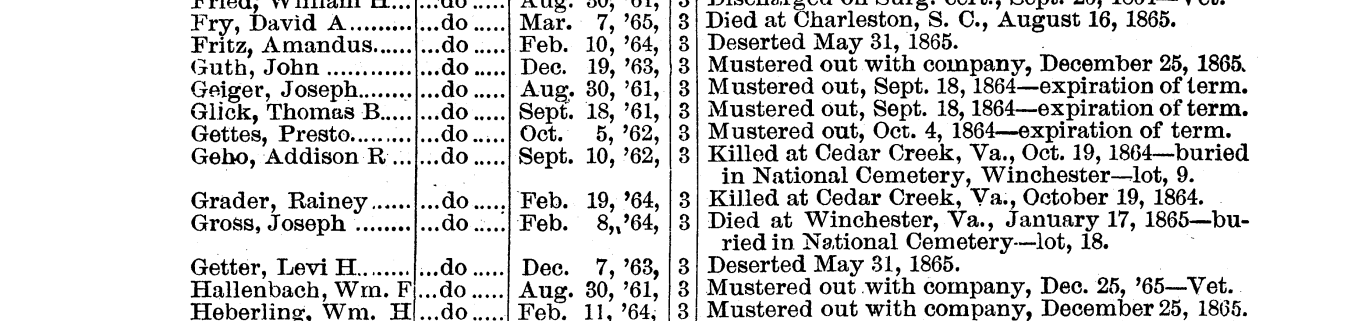
Roster entry: Presto Garris,” Company F, 47th Pennsylvania Volunteers, Bates’ History of Pennsylvania Volunteers, Vol. 1, 1869 (public domain; double click to enlarge).

“Presto?” The first name stood out like a sore thumb on the roster of my great-grandfather’s Civil War regiment—one with a rank and file populated largely by soldiers with Germanic surnames: “Acher,” “Bachman,” “Bauer,” “Bauman,” “Burger,” “Dachrodt,” “Diehl,” “Eisenbraun,” “Eppler,” “Fritz,” “Grimm,” “Guth,” “Handwerk,” “Hertzog,” “Keiser,” “Knecht,” “Knorr,” “Koenig,” “Laub,” “Metzger,” “Münch,” “Rehrig,” “Reinert,” “Richter,” “Sauerwein,” “Schmidt,” “Schneider,” “Strauss,” “Ulrich,” “Volkenand,” “Wagner,” “Weiss,” and “Zeppenfeld.”

Many of their given or middle names were equally as Germanic—“Adolph,” “Bernhard,” “Gottlieb,” “Friedrich,” “Heinrich,” “Levi,” “Matthias,” “Reinhold,” “Tilghman,” “Tobias,” and “Werner.” In addition, one of the regiment’s component units—Company K—had even been founded by a German immigrant with the intent of creating “a new German company” staffed entirely by German-Americans who had been born in the Lehigh Valley, as well as recent émigrés from Germany.

So, “Presto” as a given name seemed like it warranted further investigation. Did the spelling of this soldier’s given name signal that he had emigrated from a different part of the world—possibly Italy? There was, after all, another member of the 47th Pennsylvania’s ranks with a seemingly Italian surname—Battaglia (later proven to be an immigrant of Switzerland). Plus, there were also multiple men with Irish surnames who had also enlisted with the 47th.

Or, maybe this soldier had been employed as a magician prior to enlisting in the military? (Probably not, but strange discoveries are surprisingly common with genealogical research.)

A more likely scenario? A harried Union Army clerk, in his haste to process new enlistees, simply omitted the “n” at the end of this soldier’s name—making him “Presto” for posterity’s sake rather than “Preston.”

I just had to know. Who was Presto?

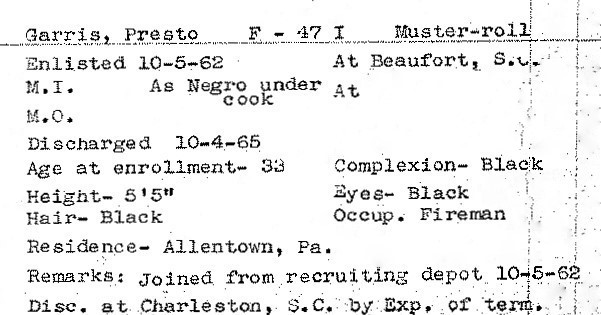
Listing for “Presto Garris,” Company F, 47th Pennsylvania Volunteers, Civil War Veterans’ Card File, 1861-1866, Pennsylvania State Archives (public domain).

It turned out that this 47th Pennsylvania Volunteer wasn’t a magician, and he wasn’t an immigrant from Italy, but he was someone whose first and last names were badly mangled by multiple “mis-spellers” over decades of data entry.

Upon further investigation, it became clear that he was a formerly enslaved, 33-year-old black man who had enlisted with the 47th Pennsylvania Volunteer Infantry on October 5, 1862 while the regiment was stationed near Beaufort, South Carolina—meaning that my great-grandfather’s regiment had become an integrated one at least three months before President Lincoln had issued the Emancipation Proclamation.

Totally “wowed” by this discovery, I searched for even more information about this very important enlisted man, but my quest wasn’t as easy as I hoped it would be because the regimental clerk who had entered “Presto” on the roster for Company F of the 47th Pennsylvania Regiment in the Registers of Pennsylvania Volunteers had spelled his name incorrectly—an error that was then perpetuated by historian Samuel P. Bates in his History of Pennsylvania Volunteers, 1861-5.

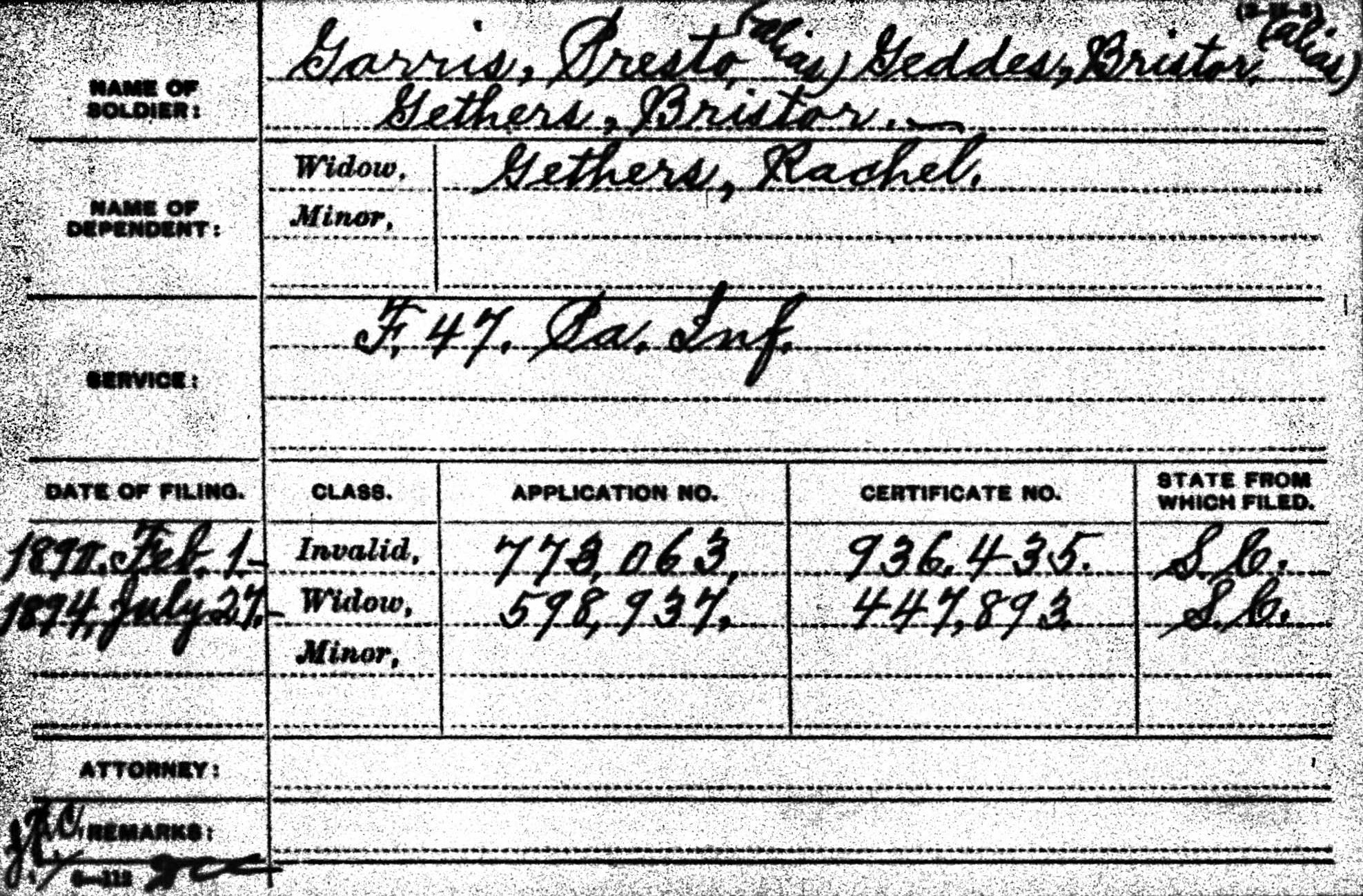
Possible name variants for an African American member of the 47th Pennsylvania Volunteers, U.S. Civil War General Pension Index Cards (National Archives, public domain).

Fortunately, this soldier’s listing in the U.S. Civil War General Pension Index Card system was slightly more helpful, providing multiple “alias” (alternate) spellings of his name: “Presto Garris,” “Bristor Geddes,” and “Bristor Gethers,” as well as a potential spelling for the name of his wife, “Rachel Gethers,” and a possible place of residency and year of death—1894—because his widow had filed for a U.S. Civil War Widow’s Pension from South Carolina on July 27, 1894.

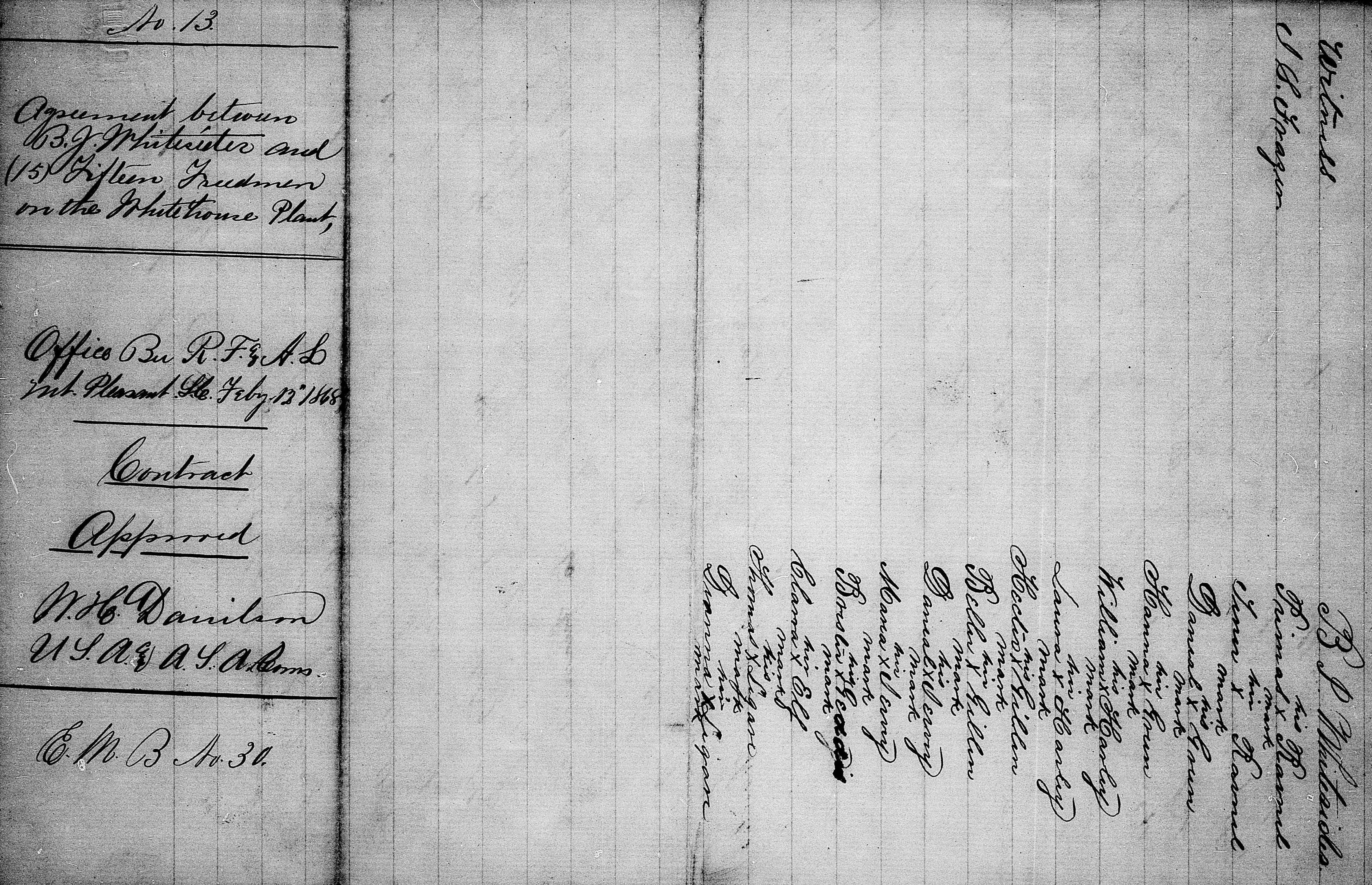
Despite those hints, it took quite some time to pick up this soldier’s trail again. Eventually, though, that pension index card data helped me to find a Freedmen’s Bureau contract for him which confirmed that he had indeed settled in South Carolina post-war. Dated February 12, 1868, this document also confirmed that he had been signed to a contract with 14 other Freedmen by the Mt. Pleasant, South Carolina office of the U.S. Freedmen’s Bureau to provide labor for the Whitehouse Plantation.

List showing “Brister Geddis,” et. al. on an 1868 Freedmen’s Bureau contract with the Whitehouse Plantation in South Carolina (public domain; double click to enlarge).

But, in another seemingly frustrating turn of events, that contract caused further confusion surrounding his name—this time spelling it as “Brister Geddis.” Fortunately, this new variant was repeated in the 1870 federal census—a sign that it was either the correct spelling or at least a closer approximation of how this soldier had pronounced his own name. Describing him as a 42-year-old black male residing in Beaufort, South Carolina, that same census also noted that he lived in Beaufort Township with his wife “Rachel,” a 24-year-old black woman (estimated birth year 1846), and son “Peter,” a 6-year-old black child, and confirmed that all three had been born in South Carolina. And that census record also noted that both “Brister” and “Rachel” were involved in farming land valued at $1,500.

Unfortunately, the 1880 federal census taker created still more confusion by illegibly writing the name as “Geddes, Brista” or “Geddis, Bristor”—and gave rise to two new puzzles by omitting son Peter’s name and also radically altering the estimated birth year of wife “Rachel”—changing it from 1846 to 1820 by stating that she was a 60-year-old who was four years older than her husband (rather than younger as she had reportedly been in 1870).

Even more frustrating? The special veterans’ census of 1890 altered the spelling of his name yet again—this time to “Brister Gedders.”

At that point, I made the decision to do everything humanly possible to right the wrong of this 47th Pennsylvania Volunteer’s forgotten military service by launching a GoFundMe campaign to support the purchase of this his full set of his military and pension records from the National Archives (as well as those of the other eight African American men who enlisted with the 47th Pennsylvania Volunteer Infantry).

If just three of you who regularly read the content on this website and follow our Facebook page donate $10 each to this campaign, we will be able to purchase the entire Compiled Military Service File for this forgotten member of the 47th Pennsylvania Volunteers and make it publicly available (free of charge) to other family history researchers and historians. If just four of you donate $20 each, we would also be able to purchase the entire Federal Military Pension Application File for that same soldier—a file that may very well contain critical vital statistics about this soldier’s birth, life and death, as well as vital statistics for his widow and son.

We might just even be able to determine when and where Brister/Bristor was buried and whether or not a gravestone marks his final resting place. If we find that no marker exists, or that the existing one has been damaged, or that the gravestone carver spelled his name incorrectly, we can then fix that wrong as well by asking the appropriate county, state and federal authorities to erect a suitable veteran’s headstone for him.

Please help us honor the military service of this unsung hero by making your donation today to our GoFundMe campaign, Honor 9 Black Soldiers of the American Civil War.”

With Sincere Gratitude,

Laurie Snyder, Managing Editor
47th Pennsylvania Volunteers: One Civil War Regiment’s Story


Sources:

1. Bates, Samuel P. History of Pennsylvania Volunteers: 1861-5, Vol. 1. Harrisburg, Pennsylvania: B. Singerly, State Printer, 1869.

2. “Garris, Presto,” in Civil War Veterans’ Card File, 1861-1866. Harrisburg, Pennsylvania: Pennsylvania State Archives.

3. “Garris, Presto” (alias “Geddes, Bristor”, alias “Gethers, Bristor”), in U.S. Civil War General Pension Index, 1890-1894. Washington, D.C.: U.S. National Archives and Records Administration.

4. “Roll of Co. F., 47th Regiment, Infantry,” in Registers of Pennsylvania Volunteers, 1861-1865, in “Records of the Department of Military and Veterans’ Affairs.” Harrisburg, Pennsylvania: Pennsylvania State Archives, retrieved online February 10, 2020.


Snyder Family Recipes: Turkey, Filling and Gravy (Thanksgiving and Christmas)


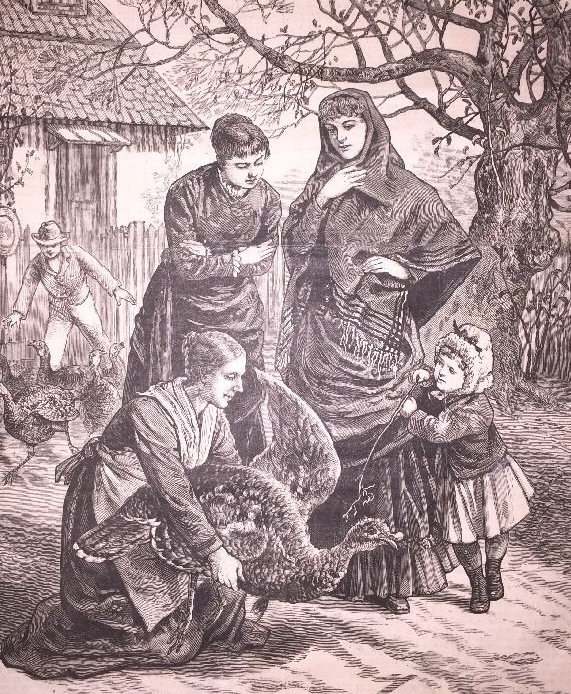
Selecting the Thanksgiving Turkey, cover, Frank Leslie’s Illustrated Newspaper (4 December 1860, public domain).

Ingredients – Filling:

  •  4½ pounds of sliced onions
  • 2 tablespoons of parsley
  • 3 tablespoons of sweet marjoram*
    (also called leaf marjoram)
  • 4 heaping tablespoons of butter-flavored Crisco (original recipe used lard)
  • 2 heaping tablespoons of margarine
  • 20 slices of dried bread
    (cut into cubes, excluding crusts)
  • 3 pounds of quartered potatoes
  • salt and pepper
  • margarine and milk
    (the amounts typically used in mashed potatoes)
  • 3 raw eggs
    (leave unbroken until you reach the appropriate step in the filling recipe)

Ingredients and Cooking Implements – Turkey and Gravy:

  • 1 turkey (or chicken)
  • salt and pepper
  • butter-flavored PAM cooking spray
  • 1 Reynolds Kitchen oven bag
    (add 2 tablespoons of flour and shake to coat bag)
  • 2 chicken bouillon cubes
  • 1 beef bouillon cube
  • 2 tablespoons of flour
  • 1½ to 3 cups of water


Making the Filling:

1. Use 2 frying pans. Place 2 tablespoons of Crisco and 1 tablespoon of margarine in each pan.

 2. Melt the Crisco-margarine mix, and then add 2¼ pounds of onions to each pan. Sauté the onions for roughly 1½ to 2 hours (over low heat so they won’t burn) until they’re translucent and golden.

3a. Lower the burner heat to simmer. Add 1 tablespoon of parsley and 1½ tablespoons of sweet marjoram to each pan; mix well. (*Note: By using sweet marjoram also called leaf marjoram rather than regular marjoram, you will preserve the taste of the original recipe, which is believed to have originated in Germany and to have been passed down through generations of the Snyder and Strohecker families prior to and following their pre-Revolutionary War arrival in America.)

3b. While the onions are cooking, boil 3 pounds of quartered potatoes in salted water until soft. Drain. Whip with hand mixer until well broken up. Add margarine and milk (in the same proportions as used for mashed potatoes). Add salt and pepper to taste. Set aside and keep warm until the onions have finished cooking.

4. Then add half of the dried bread cubes to each pan, and mix until evenly coated. DO NOT BURN.

5. After the onions have finished cooking and the seasonings and bread cubes have been added and browned, turn off the burner’s heat. Then add half of the mashed potatoes to each pan and mix well.

6. Combine the potato-onion-bread filling mixture from both pans in one large bowl; refrigerate until cold. [Reminder: ALWAYS fill a COLD BIRD with COLD FILLING to reduce the potential for salmonella.]

6a. Before stuffing the turkey with the filling, break 3 raw eggs over the filling and mix well.

6b. Put the remaining filling (which was not used to stuff the bird) into a buttered casserole dish, and cover with aluminum foil. Then, 20 minutes before the bird is done, place the casserole dish into the oven beside the bird so that the “non-bird version” of the filling mix will also heat through in time to be served.


Preparing and Roasting the Turkey:

1. Unwrap the bird, remove the turkey neck and giblet packages from the bird’s cavities, and soak the turkey in ice-cold salt water for 10 minutes. Then, drain the water, rinse the bird in cold water, and soak the turkey in fresh ice water for an additional 10 minutes to remove the salt. (Use a bowl which is large enough to cover the bird, or keep the water running, and turn the turkey over frequently.) Once the bird is thoroughly cleaned, remove and pat dry with paper towels.

2. Pre-heat the oven to 350 degrees Farenheit.

3. Salt and pepper the bird’s cavities to taste. Then stuff the cavities of the turkey loosely with the filling mix created from the recipe above. (Note: Stuffing the bird too tightly with filling may cause the turkey to explode.)

4. Spray the bird all over (including the bottom) with butter-flavored PAM cooking spray. Then, shield the bird’s legs and wings with aluminum foil so they won’t burn, and place the bird in a Reynolds Kitchens oven bag (to which 2 tablespoons of flour have been added and shaken around to coat the bag). Cut 4 one-inch slits in the bag, and roast. (Make sure the roasting pan is large enough so the bird doesn’t hang over the sides, and follow the roasting time instructions on the package of bags. Or see the roasting times posted on the Reynolds Brands’ website.

5. Check on the progress of the bird every 30 minutes, rotating the turkey in the oven so that it browns evenly; spray with more PAM if the bird looks dry. As the end of the roasting time approaches for the bird, stick a meat thermometer into the thigh and, without touching any bone, verify whether or not the turkey is fully cooked. (When the temperature reaches 190 degrees, the bird is done.)

6a. Remove the roasting pan from the oven, carefully take the turkey out of the bag, and set it to the side of your workspace (covered with aluminum foil). Begin preparing the gravy while the turkey is cooling.

6b. After 20 minutes, remove the filling from the cavities and carve the bird.


Making the Perfect Gravy:  

1. Carefully empty the turkey’s juices from the roasting bag into a pot. Place the pot on a stove burner and, on low heat, bring the juices to a slow boil, stirring to keep from burning.

2. When the juices reach a slow boil, turn off the heat, strain the contents through a sieve to remove the accumulated grease, and return the contents to the pan.

3a. Stirring constantly, bring the juices to a slow boil once again. During this process, add 2 chicken bouillon cubes, 1 beef bouillon cube (for color), and extra water (½ cup at a time, stirring until cubes are dissolved and your desired taste is achieved).

3b. In a container with a tight fitting lid, create a thickening mixture for the turkey juices by combining 2 tablespoons of flour with 1 cup of cold water; shake until smooth. Then, while constantly stirring, add the flour-water mixture to turkey juices a little at a time until the gravy reaches your desired consistency (while also being careful not to burn the gravy). Keep the gravy warm while carving the bird; then transfer to a gravy boat and serve with the roast turkey, Snyder Family Filling, and vegetables of your choice.


To learn more about the Snyder family’s history during the U.S. Civil War, see Corporal Timothy Matthias Snyder – A Patriot’s Great-Grandson and Telephone Pioneer’s Father.


Copyright: Snyder Family Archives, © 2017-present. All rights reserved.

Recipe Disclaimer: 47th Pennsylvania Volunteers: One Civil War Regiment’s Story and its creators assume no obligation or liability for any accidents, fires, food poisoning/food borne disease, or other problems that may result from preparing or eating these recipes, and make no warranties or guarantees of favorable results from this recipe’s use. Results may differ due to variations in the quality of ingredients used, omissions from the recipes posted, cooking temperatures, and/or individual cooking abilities. Caution is advised when working with eggs and other raw ingredients. Please see the U.S. Department of Health and Human Services’ website for these important food safety tips.