Election Day 1864 — Lincoln or McClellan? How the 47th Pennsylvania Volunteers Voted

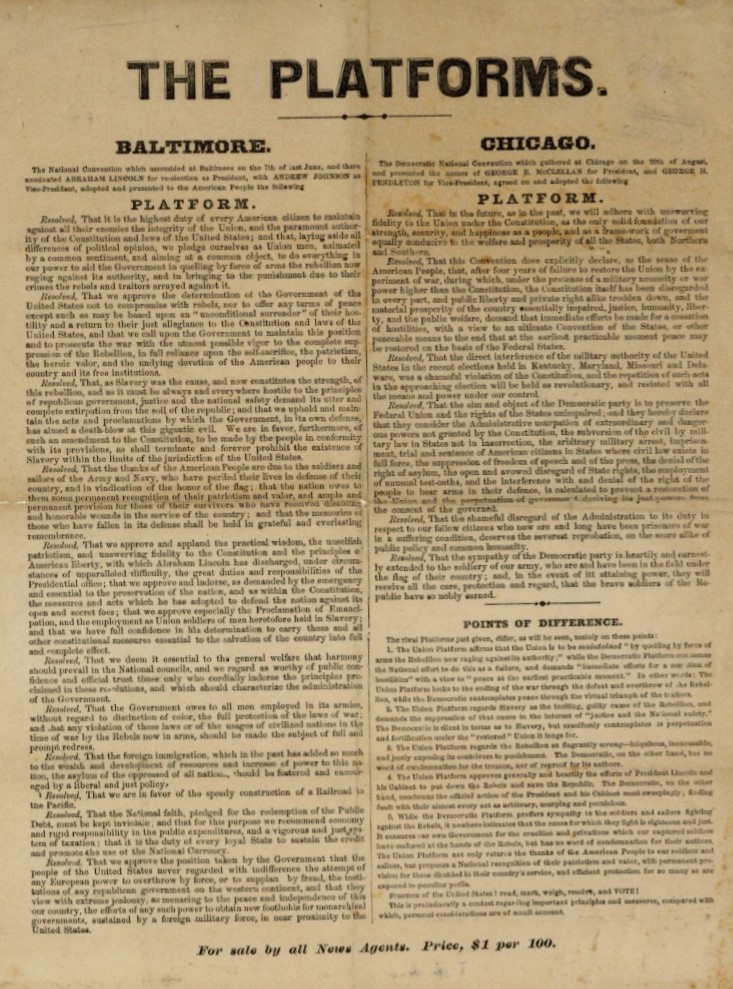
The platforms of the Union and Democratic parties, U.S. Presidential Election of 1864 (courtesy of the University of Illinois Urbana-Champaign; click to enlarge).

Even in the midst of a devastating civil war, Americans across the United States managed to come together to fulfill their civic responsibilities by voting on Election Day. Fathers and sons flocked to city and small town polling places while soldiers on active duty filled out ballot forms wherever they were stationed during the early to mid-1860s.

With respect to the Presidential Election of 1864, which was held in multiple states across America on November 8, 1864, that voting took place for members of the 47th Pennsylvania Volunteer Infantry at their encampment near Newtown, Virginia, according to a letter that was subsequently penned by 47th Pennsylvanian Henry D. Wharton to his hometown newspaper in Sunbury, Pennsylvania on November 14:

“The election passed off quietly and without any military interference, not the influence of officers used in controlling any man’s vote. In the regiments from the old Keystone, the companies were formed by the first Sergeant, when he stated to the men the object for which they were called to ‘fail to,’ and then they proceeded to the election of officers to hold the election – the boys having the whole control, none of the officers interfering in the least.”

Were the 47th Pennsylvania Volunteers pro-Lincoln or pro-McClellan?
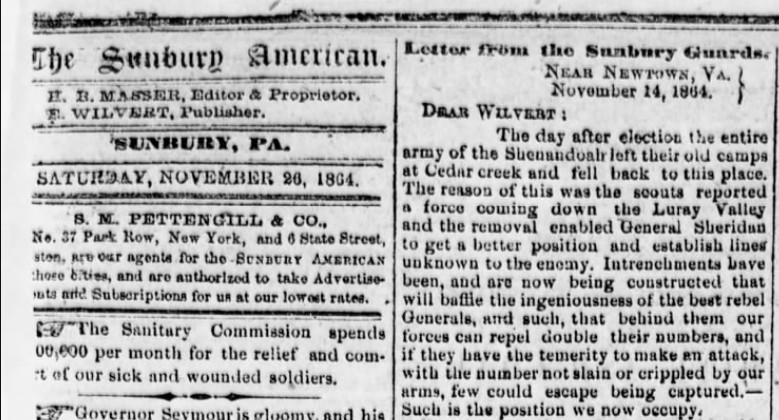
Excerpt from Henry Wharton’s letter to his hometown newspaper, November 14, 1864 (The Sunbury American, November 14, 1864, public domain; click to enlarge).

Wharton reported that, after the votes from members of the regiment were counted, President Abraham Lincoln was the favored choice of most of the 47th Pennsylvania Volunteers. Lincoln had garnered one hundred and ninety-four votes to General George B. McClellan’s one hundred and twenty-one (a margin of seventy-three votes). Those votes, by individual company, were tallied as follows:

  • Company A: President Lincoln (ten); General McClellan (one)
  • Company B: President Lincoln (twenty-six); General McClellan (two)
  • Company C: President Lincoln (twenty-nine); General McClellan (thirteen)
  • Company D: President Lincoln (thirty-one); General McClellan (eleven)
  • Company E: President Lincoln (twenty-four); General McClellan (three)
  • Company F: President Lincoln (eighteen); General McClellan (sixteen)
  • Company G: President Lincoln (nine); General McClellan (thirteen)
  • Company H: President Lincoln (ten); General McClellan (twenty-four)
  • Company I: President Lincoln (nineteen); General McClellan (sixteen)
  • Company K: President Lincoln (eighteen); General McClellan (twenty)

But Wharton’s figures for the men from Company K were incorrect, according to historian Lewis Schmidt, who noted in his book, A Civil War History of the 47th Regiment of Pennsylvania Veteran Volunteers, that “Fifteen of the members [of Company K] voted for the Lincoln electors and seven for the McClellan electors” when they “voted on the battlefield of Cedar Creek, November 8, 1864.” The members of Company K who cast votes that day were: “David H. Fetherolf, Mathias Miller, John Keiser, Phaon Guth, James D. Weil, Daniel Strauss, Paul Strauss, George Sherer, Lewis G. Seip, Henry Hantz, Charles W. Abbott, George Kase, Charles Stoudt, William Schlicher, William F. Knerr, E. F. Benner, George Delp, Tilghman Boger, William H. Barber, William D. Schick, Frank Beisel, and David Semmel.”

Apathy or Attrition?

One of the first things that researchers notice when looking at those figures for the 1864 election is that the number of votes tendered by 47th Pennsylvania Volunteers that November day was lower than it should have been — shockingly so when considering that each company of the regiment had been staffed by roughly one hundred men when the 47th Pennsylvania left Camp Curtin and headed for Washington, D.C. three years earlier. The turnout of 47th Pennsylvanians was not a sign of voter apathy, however, but of a simple, ugly truth. The regiment had just recently lost the equivalent of nearly two full companies of men in combat. According to Wharton, “The battle at Cedar Creek thinned our ranks by which we lost many votes – this number and those away in hospitals would have increased the Union majority to three hundred.”

* Note: When Henry Wharton wrote the phrase “Union majority,” he was referring to the National Union Party, which had been established during the 1860s by prominent Republicans as a way to bring members of their party together with “War Democrats” and potential voters from border states to vote for President Lincoln and others who supported the Republican platform for eradicating chattel slavery and ending the nation’s secession crisis and civil war.

What Happened After That Election in 1864?

President Abraham Lincoln signing the Emancipation Proclamation in 1862 (W.E. Winner, painter, J. Serz, engraver, circa 1864; public domain, U.S. Library of Congress).

Successful in his bid for re-election, both in terms of the electoral college and popular vote, President Abraham Lincoln went on to deliver one of his most inspiring addresses to the nation, urging his fellow Americans “to bind up the nation’s wounds” and “do all which may achieve and cherish a just and lasting peace among ourselves and with all nations.” He then continued to shepherd his nation through one of its darkest times until the war was finally over.

Food for Thought

If Henry Wharton and his fellow soldiers could make it to the polls on Election Day after all they endured in battle, so can you. Please vote. Your voice does matter.


Sources:

  1. Political Party Timeline: 1836-1864,” in American Experience: Abraham and Mary Lincoln: A House Divided. Boston, Massachusetts: GBH Education for WGBH-TV (PBS), 2001.
  2. Schmidt, Lewis G. A Civil War History of the 47th Regiment of Pennsylvania Veteran Volunteers. Allentown, Pennsylvania: Self-published, 1986.
  3. The People’s Candidate: Lincoln’s Presidential Elections,” in “Illinois History & Lincoln Collections.” Urbana, Illinois: Main Library, University of Illinois Champaign-Urbana, retrieved online November 3, 2025.
  4. Transcript of Abraham Lincoln’s Second Inaugural Address (delivered Saturday March 4, 1865), in “UShistory.org.” Philadelphia, Pennsylvania: Independence Hall Association, retrieved online March 4, 2020 and November 3, 2025.
  5. Wharton, Henry D. “Letter from the Sunbury Guards, Near Newtown, VA, November 14, 1864.” Sunbury, Pennsylvania: The Sunbury American, November 26, 1864.

Abraham Lincoln’s Road to the Presidency

Abraham Lincoln in New York City on Monday morning, February 27, 1860, several hours before he delivered his Cooper Union address (Matthew Brady, U.S. Library of Congress, public domain).

During the almost quarter of a century that he resided in his adopted hometown of Springfield, Illinois, Abraham Lincoln was transformed from an average, young adult, who was embarking upon a crucial phase of his life’s journey in early nineteenth-century America, into the lawyer-turned-civic leader that would place his feet on the path to the White House.

A product of rural America, his formative years had been spent in Kentucky and southern Indiana. A resident of New Salem, Illinois in 1831, he was just twenty-five when he was elected to his first term in the Illinois State Legislature and began to study law more seriously. By 1837, he was a solicitor who lived and practiced law in Springfield. Married to Mary Todd five years later, he built his life with her at their Eighth and Jackson street-corner home, while also carving out a name for himself as a skilled and trustworthy legal scholar and successful courtroom attorney. Avidly interested in politics, he also became an active member of the Whig Party.

Persuaded by his wife and political associates to run for federal office in 1846, he was elected to the U.S. House of Representatives in that same year. His initial service was short-lived, however; he had pledged to serve only one, two-year term, hoping to secure a more stable, federal government job in the administration of U.S. President Zachary Taylor. But when that opportunity fell through, he returned home to Springfield and threw himself back into the practice of law.

* Note: During his tenure with the U.S. House of Representatives, Abraham Lincoln co-wrote a bill with Congressman Joshua R. Giddings that he hoped would end the practice of slavery in the District of Columbia. Lacking support from his fellow Whig Party members, however, he subsequently chose to withdraw that bill.

By the mid-1850s, Abraham Lincoln was realizing that his conscience would no longer permit him to sit on the sidelines, politically, when there was so much in his country that needed to be changed. Incensed by the passage of the Kansas-Nebraska Act in 1854, which paved the way for the brutal practice of chattel slavery to spread like a wave of toxic sludge over newly-forming states, Lincoln left the Whigs behind to join a new, more forward-thinking political organization—the Republican Party.

Four years later, he mounted a campaign against U.S. Senator Stephen A. Douglas. Although he lost that race, he would forever become linked to that Democrat as a result of their famously intense Lincoln-Douglas Debates, a forum that gave him a nationwide name recognition so high that it enabled him to become President of the United States.

Chosen by the Republican Party in 1860 to be its candidate for the highest office in the nation, Abraham Lincoln was elected as President on November 6, 1860.

How That Crucial Election Day Unfolded

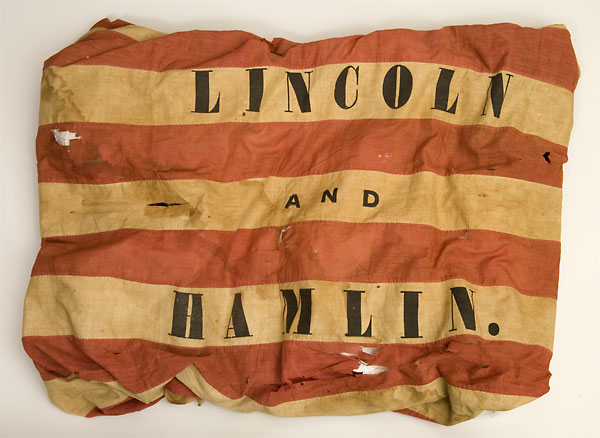
Hand-sewn banner used in Abraham Lincoln’s 1860 campaign for President of the United States (Lincoln Home, U.S. National Park Service, public domain).

According to Jamie Malanowski, a former editor at Time magazine:

“There were no surprises: the long-settled Yankees in Maine and New Hampshire and pioneering Germans of Michigan and Wisconsin delivered the expected victories. And then came news from Illinois: ‘We have stood fine. Victory has come.’ And then from Indiana: ‘Indiana over twenty thousand for honest Old Abe.’

The throngs in the streets cheered every report, every step towards the electoral college number, but news from the big Eastern states was coming painfully slowly…. The advisers paced the floorboards, jumping at every eruption of the rapid clacking of Morse’s machine….

It wasn’t until after 10 that reports of victory in Pennsylvania arrived in the form a telegram from the canny vote-counter Simon Cameron, the political boss of the Keystone State, who tucked within his state’s tallies joyfully positive news about New York: ‘Hon. Abe Lincoln, Penna seventy thousand for you. New York safe. Glory enough.’

Not until 2 a.m. did official results from New York arrive … the one-time rail-splitter won by 50,000 votes.”

The Aftermath

“As the votes were counted, Lincoln had about 40 percent of the popular vote and 180 electoral votes, compared with 133 for his opponents combined,” according to historians at the National Constitution Center, but events in America’s Deep South “cast a pall over the upcoming Electoral College voting process”:

“What if the southern states refused to take part in the Electoral College? Or what if a unified front to avoid secession could convince enough ‘faithless electors’ to switch sides to derail the election?

And what if the southern states boycotted the Electoral College?”

Lincoln scholar Harold Holzer sums up what was in the minds of many Americans in the days following the 1860 presidential election:

“If these states did not participate in the traditional process, could the Electoral College proceed? What would constitute a quorum? No one, least of all Lincoln, knew the answers to these vexing questions.”

Those questions were finally answered when those southern states agreed to participate in the Electoral College process of the United States.

“But there was a greater than normal military presence on Capitol Hill” to ensure that the peaceful transfer of power would take place that certification day, according to historians at the National Constitution Center. And it did.

Abraham Lincoln’s election was officially certified by the U.S. Congress on February 15, 1861.


Sources:

  1. Donald, David Herbert. Lincoln. New York, New York: Simon & Schuster, 1996.
  2. Foner, Eric. The Fiery Trial: Abraham Lincoln and American Slavery. New York, New York: W. W. Norton & Company, Inc., 2010.
  3. Harris, William C. Lincoln’s Rise to the Presidency. Lawrence, Kansas: University Press of Kansas, 2007.
  4. “Lawyer to President,” in “Virtual Museum Exhibit.” Springfield, Illinois: Lincoln Home National Historic Site, retrieved online November 6, 2023.
  5. Malanowski, Jamie. “Lincoln Wins. Now What,” in “Disunion.” New York, New York: The New York Times, November 7, 2010.
  6. Oates, Stephen B. “Abraham Lincoln 1861–1865,” in C. Vann Woodward, ed. Responses of the Presidents to Charges of Misconduct. New York City: Dell Publishing Co., Inc. pp. 111–123, 1974.
  7. Oates, Stephen B. With Malice Toward None: A Life of Abraham Lincoln. New York, New York: Harper Collins, 2011.
  8. On This Day, Abraham Lincoln Is Elected President.” Philadelphia, Pennsylvania: National Constitution Center, November 6, 2023.
  9. President Abraham Lincoln.” Washington, D.C.: U.S. Library of Congress, retrieved online November 6, 2023.