Through a War Correspondent’s Eyes: The Art of Winslow Homer

Winslow Homer, 1880 (public domain).

Winslow Homer (1836-1910) was a Boston native who became one of the most important artists in nineteenth-century America. Best known for his pastoral landscapes and seascapes, he was also a notable chronicler of the lives of average American Civil War-era soldiers.

Apprenticed to Boston lithographer J. H. Bufford during the mid-1850s, he subsequently turned down a job offer by Harper’s Weekly later that same decade to become a staff illustrator, choosing, instead, to make his living as a freelancer and founder of his own art studio in New York City.

American Civil War

“The Civil War Surgeon at Work in the Field,” Winslow Homer, 12 July 1862 (National Library of Medicine, public domain).

During the early 1860s, however, Winslow Homer was ultimately persuaded to serve as a war correspondent for Harper’s Weekly, leading him to create some of the most evocative illustrations of the American Civil War era.

In 1862, for example, he showed Americans what it was like to be “The Civil War Surgeon at Work in the Field” by sketching a group of Union Army surgeons and wounded soldiers and then turning that sketch into a powerful illustration for a July edition of Harper’s Weekly. In November of that same year, he documented “A Sharp-Shooter on Picket Duty,” perched high up in a tree in the Virginia countryside, protecting his fellow members of the Army of the Potomac.

“Thanksgiving in Camp” (Winslow Homer, Harper’s Weekly, 29 November 1862, public domain).

That same month, he also preserved, for all time, a Thanksgiving celebration of one pensive group of Union Army soldiers who were stationed far from the arms of loved ones.

Why Was His Work So Popular?

Homer’s work captured the hearts and minds of Harper’s Weekly readers for three simple reasons. He had a great eye and great instincts to match his great skills as an illustrator.

“Sleeping on Their Arms” (Winslow Homer, Harper’s Weekly, 21 May 1864, public domain).

According to a 2015 Yale News article about Homer by Amy Athey Mcdonald, “Artist-reporters” of the Civil War era “had to be more than merely good draftsmen. They had to be astute observers, have an instinct for story and drama, the ability to sketch quickly and accurately, and no small amount of daring, as they faced battles, injuries, starvation, and disease first hand.”

Post-War Life

After the Civil War ended, Winslow put a fair amount of distance between himself and the United States. In 1866, he traveled to France, where he spent ten months studying and honing his skills. According to the late H. Barbara Weinberg, a renowned American art scholar and former curator at The Metropolitan Museum of Art in New York City, “While there [was] little likelihood of influence from members of the French avante-garde” during this phase of Homer’s life, “Homer shared their subject interests, their fascination with serial imagery, and their desire to incorporate into their works outdoor light, flat and simple forms (reinforced by their appreciation of Japanese design principles), and free brushwork.”

Recognized as a master of oil painting in the United States by the 1870s (while still just in his thirties), he also began to explore his talent as a watercolor artist.

“The Cotton Pickers” (Winslow Homer, 1876, public domain).

And, he began to document the post-war lives of men and women who had been freed from chattel enslavement. Painted in oil in 1876, “The Cotton Pickers” illustrated the harsh reality of the Reconstruction era–that many Freedmen and Freedwomen were still engaged in the same backbreaking work that they had endured while enslaved before the war. According to author Carol Strickland, “Although the artist left scant record of his convictions about race, his paintings of Black people are unlike those of his contemporaries.”

“The Gulf Stream” (Winslow Homer, 1899, public domain).

When speaking to Strickland for a 2022 profile of Homer, Associate Professor Gwendolyn DuBois Shaw observed that “before Emancipation, artists had elicited sympathy for enslaved people by portraying them on the auction block, for example. But the market for such work evaporated after the 1860s…. Caricatures derived from minstrel shows appeared in paintings, but ‘it was really unusual for Homer to stake so much on Black subjects connected to Reconstruction.'” His work in this regard, however, was not only limited to the Reconstruction era; in later years, he depicted the struggles of the Black men, women and children that he met while visiting the Bahamas.

“The Life Line” (Winslow Homer, 1884, public domain).

But it was, perhaps, through his paintings of the sea that he became best known to a wider audience across America. According to Weinberg:

He enjoyed isolation and was inspired by privacy and silence to paint the great themes of his career: the struggle of people against the sea and the relationship of fragile, transient human life to the timelessness of nature.


Sources:

  1. McDonald, Amy Athey. “As Embedded Artist with the Union Army, Winslow Homer Captured Life at the Front of the Civil War.” New Haven, Connecticut: Yale News, 20 April 2015.
  2. Strickland, Carol. “Not Just Seascapes: Winslow Homer’s Rendering of Black Humanity.” Boston, Massachusetts: The Christian Science Monitor, 7 June 2022.
  3. “Thanksgiving in Camp (from ‘Harper’s Weekly,’ Vol. VII).” New York, New York: The Metropolitan Museum of Art, retrieved online 28 November 2024.
  4. “The Army of the Potomac — A Sharp-Shooter on Picket Duty (from ‘Harper’s Weekly,’ Vol. VII).” New York, New York: The Metropolitan Museum of Art, retrieved online 28 November 2024.
  5. Weinberg, H. Barbara. “Winslow Homer (1836-1910).” New York, New York: The Metropolitan Museum of Art, October 2004.


Thoughts of Home at Christmas: The Influence of Thomas Nast’s Art During a 47th Pennsylvania Volunteer’s Lifetime

“Christmas Eve,” 1862 (Thomas Nast, Harper’s Weekly, Vol. 7, pp. 8-9, Christmas edition, 1862, public domain; click to enlarge).

When thinking about what life was like for the Pennsylvania volunteer soldiers who served their nation during the American Civil War, the influence of nineteenth century artists on their lives would likely not be the first thing that comes to mind. The orders they received from their superior officers in the Army and the “trickle down” effect of the directives issued by state and federal elected officials to those Union Army officers, yes, but visual artists? Probably not.

But artists and their artwork—paintings and illustrations created during and after the 1860s—did leave their mark on the psyches of soldiers in ways that were profoundly illuminating and long lasting.

Many of the most powerful artworks that were likely seen and reflected on by members of the 47th Pennsylvania Volunteer Infantry were those drawn by Thomas Nast (1840-1902), a native of Germany who had emigrated to the United States from Bavaria with his mother and siblings in 1846. He spent most of his formative years in New York City, where he took up drawing while still in school. As he aged, he came to view America as his homeland, but still grew up experiencing many German traditions—as had many 47th Pennsylvania Volunteers during their own formative years. (Company K, for example, was established in August 1861 as an “all-German company” of the 47th Pennsylvania.)

Nast’s first depiction of the Christmas season (shown above) was created for the cover and centerfold of the Christmas edition of Harper’s Weekly 1862, shortly after he was hired as a staff illustrator.

“Santa Claus in Camp,” 1863 (Thomas Nast, Harper’s Weekly, January 3, 1863, public domain; click to enlarge).

He then continued to create illustrations of Santa for Harper’s Weekly in subsequent years. According to journalist Lorraine Boissoneault:

You could call it the face that launched a thousand Christmas letters. Appearing on January 3, 1863, in the illustrated magazine Harper’s Weekly, two images cemented the nation’s obsession with a jolly old elf. The first drawing shows Santa distributing presents in a Union Army camp. Lest any reader question Santa’s allegiance in the Civil War, he wears a jacket patterned with stars and pants colored in stripes. In his hands, he holds a puppet toy with a rope around its neck, its features like those of Confederate president Jefferson Davis….

According to historians at Grant Cottage, “In 1868, newly elected 18th President U.S. Grant paid tribute to Thomas Nast by saying, ‘Two things elected me, the sword of Sheridan and the pencil of Thomas Nast.’”

As a result, members of the 47th Pennsylvania Volunteer Infantry had ample time to become well acquainted with Nast’s artistry and his support for their efforts, as part of the United States Army, to end the Civil War and preserve America’s Union. An ardent abolitionist, Nast also actively supported the federal government’s efforts to eradicate the brutal practice of chattel slavery.

Fort Taylor, Key West, Florida (Harper’s Weekly, 1864, public domain).

Nast’s first illustrations of Santa Claus and depictions of soldiers longing for family at Christmas would initially have been seen by 47th Pennsylvania Volunteers while they were stationed far from home at Fort Taylor in Key West, Florida—just two months after the regiment had sustained a shockingly high rate of casualties during the Battle of Pocotaligo, South Carolina on October 22, 1862. More than one hundred members of the regiment had been killed in action, mortally wounded, grievously wounded, or wounded less seriously, but still able to continue their service.

So terrible was the outcome that it would have been enough to make an impression even on individual 47th Pennsylvanians who hadn’t been wounded. They were not only now battle tested, they were battle scarred, according to comments made by individual members of the regiment in the letters they wrote to families and friends back home during that Christmas of 1862.

No matter how strong their capacity for overcoming adversity had been before that battle, their hearts and minds would never be the same. It would take time to heal and move forward—time they were given while stationed on garrison duty for more than a year.

Fort Jefferson (Harper’s Weekly, August 26, 1865, public domain; click to enlarge).

By the time that the American Civil War was ending its third year, the mental wounds of Pocotaligo were far less fresh than they had been the previous Christmas. Still stationed in Florida on garrison duty in 1863, the 47th Pennsylvania Volunteer Infantry was now a divided regiment. While slightly more than half of the regiment was still on duty at in Key West, as companies A, B, C, E, G, and I remained at Fort Taylor, the remaining members of the regiment—companies D, F, H, and K—were now even farther away from home—stationed at Fort Jefferson, the Union’s remote outpost that was situated so far off of Florida’s coast that it was accessible only by ship.

Letters penned to family and friends back in Pennsylvania during the early part of 1863 capture a sense of sadness and longing that pervaded the regiment—as 47th Pennsylvanians mourned the loss of their deceased comrades and thought about how deeply they missed their own families.

Gradually, as the year wore on, those feelings turned to acceptance of their respective losses and, eventually, frustration at still being assigned to garrison duty when they felt they could and should be helping the federal government bring a faster end to the war by defeating the Confederate States Army through enough tide-turning combat engagements that the Confederate States of America would finally surrender and agree to re-unify the nation.

By early 1864, the wish of those 47th Pennsylvanians was granted by senior Union Army officials. They were not only given the opportunity to return to combat, but to return to intense combat as a history-making regiment.

The only regiment from Pennsylvania to fight in the Union’s 1864 Red River Campaign across Louisiana, the 47th Pennsylvanians repeatedly displayed their valor as the blood of more and more of their comrades was spilled to eradicate slavery across the nation while also fighting to preserve the nation’s Union. By the fall of 1864, they were participating in such fierce, repeated battles across Virginia during Union Major-General Philip Sheridan’s 1864 Shenandoah Valley Campaign that President Abraham Lincoln was able to secure his reelection and the tide of the American Civil War was decisively turned in the federal government’s favor once and for all.

Ruins of Charleston, South Carolina as seen from the Circular Church, 1865 (U.S. National Archives and Records Administration, public domain).

By April 1865, the Confederate States Army had surrendered, the war was over and President Lincoln was gone, felled by an assassin’s bullet that had too easily found its target. So, once again, the 47th Pennsylvania Volunteers were in mourning.

Sent back to America’s Deep South that summer, they were assigned to Reconstruction duties in Savannah, Georgia and Charleston, South Carolina, where they helped to reestablish functioning local and state governments, rebuild shattered infrastructure, and reinvigorate a free press that was dedicated to supporting a unified nation—all while other Pennsylvania volunteer regiments were being mustered out and sent home.

Finally, after a long and storied period of service to their nation, the 47th Pennsylvania Veteran Volunteers were given their honorable discharge papers at Camp Cadwalader in Philadelphia, and were then sent home to their own family and friends in communities across Pennsylvania in early January 1866.

Return to Civilian Life

“Santa Claus and His Works,” 1866 (Thomas Nast, Harper’s Weekly, December 29, 1866, public domain; click to enlarge).

Attempting to regain some sense of normalcy as their post-war lives unfolded over the years between the late 1860s and the early 1900s, many of the surviving veterans of the 47th Pennsylvania Volunteer Infantry resumed the jobs they held prior to the war while others found new and better ways to make a living. Some became small business creators, pastors or other church officials, members of their local town councils or school boards, beloved doctors, or even inventors. One even became the lieutenant governor of the Commonwealth of Pennsylvania.

Most also married and began families, some small, some large. Still others made their way west—as far as the states of California and Washington—in search of fortune or, more commonly, places where war’s Grim Reaper would never find them again.

“‘Twas the Night Before Christmas,” 1866 (Thomas Nast, Harper’s Weekly, December 25, 1886, public domain; click to enlarge).

As the years rolled on, they saw more and more of Thomas Nast’s work as it was published in Harper’s Weekly, particularly at Christmas. But the Santa Claus of war was now transformed by Nast as the Saint Nicholas of his childhood in Germany—kind, altruistic, loving, and jolly.

Over time, those illustrations collectively formed the “mind pictures” that the majority of American children and adults experienced when they imagined Santa Claus. So powerful has Nast’s influence been that, even today, when Americans encounter the many variations of Santa used to promote products in Christmas advertising campaigns, they see images that are often based on Nast’s nineteenth century drawings—drawings that had their genesis as beacons of light and hope during one of the darkest times in America’s history.

Like Abraham Lincoln, Nast has been helping Americans to summon and follow “the better angels of our nature” for more than one hundred and sixty years. May the power of his art help us all continue to do so this year and for the remainder of our days.


Sources:

  1. Boissoneault, Lorraine. A Civil War Cartoonist Created the Modern Image of Santa Claus as Union Propaganda.” Washington, D.C.: Smithsonian Magazine, December 19, 2018.
  2. Drawn Together: The Friendship of U.S. Grant and Thomas Nast (video). Wilton, New York: Grant Cottage, May 14, 2022.
  3. Santa Claus,” in “Thomas Nast.” Columbus, Ohio: University Libraries, The Ohio State University, retrieved online December 23, 2023.
  4. Santa Claus in Camp (from ‘Harper’s Weekly,’ vol. 7, p. 1).” New York, New York: The Met, retrieved online December 23, 2023.
  5. Vinson, J. Chal. Thomas Nast and the American Political Scene,” in American Quarterly, vol. 9, no. 3, Autumn 1957, pp. 337-344. Baltimore, Maryland: The Johns Hopkins University Press.


The Battle of Pocotaligo, South Carolina: Unpredictable Outcomes

“The Commencement of the Battle near Pocotaligo River” (Frank Leslie’s Illustrated Newspaper, October 1862, public domain; click to enlarge).

And among them Strife and Tumult joined, and destructive Fate, grasping one man alive, fresh-wounded, another without a wound, and another she dragged dead through the melee by the feet; and the raiment she had about her shoulders was red with the blood of men. Just like living mortals joined they and fought; and they each were dragging away the bodies of the others’ slain.”

—Homer, The Iliad, Volume II, Book 18


October 22, 1862 was a deadly day for the 47th Pennsylvania Volunteer Infantry, and the succeeding days throughout that month and beyond proved to be deadlier still, as one member of the regiment after another succumbed to the wounds they had sustained in battle—or to complications that arose from the multiple surgeries that had been performed by Union Army surgeons in valiant, but vain attempts to save their lives.

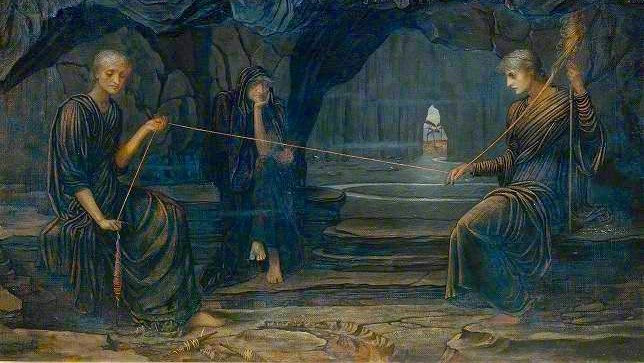
Excerpt from “A Golden Thread” (John Melhuish Strudwick, circa 1885, public domain).

What will be striking to any student of history engaged in even just a cursory review of this regiment’s medical and death records during this period of American Civil War-era service, is the seeming fickleness of who lived or died—as if Lachesis and Atropos had debated and determined their fates while Clotho spun out the thread of each life, giving them no say in their individual destinies.

Or was it the decision-making mind and finger of God? “You, but not you.”

This randomness dawns with startling clarity when examining the vastly different outcomes of Sunbury, Pennsylvania brothers, Samuel and Peter Haupt, and of company commanding officers Charles Mickley, George Junker and William Wallace Geety.

Captain Charles Mickley of G Company was killed instantly, early on in the Battle of Pocotaligo on October 22, 1862—brought swiftly to the ground by a rifle shot to his head. He never knew what hit him—or what happened to the men of his company who were marching head on with him into an intense barrage of canister and grape shot, mingled with rifle fire and artillery shell shrapnel.

Captain George Junker of Company K was felled by a minié ball fired from a Confederate rifle during his company’s advance on the Frampton Plantation. Initially stabilized in the field before being transported back to Hilton Head, where he was hospitalized at the Union Army’s post hospital, he died there the next day. He, too, had been shot in the head.

But First Lieutenant William Wallace Geety miraculously survived the gunshot that he sustained to his head—despite having been initially described by The New York Times in its list of Pocotaligo casualties as “mortally wounded.” His survival subsequently became the subject of multiple newspaper reports and medical journal articles. According to the Commemorative Biographical Encyclopedia of Dauphin County, he was wounded in action when “grape shot struck him between the eyes and passing to the left destroyed the eye, shattered the bones of the face, injuring the nerves and lodged near the carotid artery. While lying upon the field he was for a while given up for dead.”

The Union Army surgeons who treated him throughout his convalescence provided even more telling and precise accounts, documenting that William W. Geety had been struck between the eyes by a one-half-inch-diameter iron ball propelled by a cannon shrapnel shell which had exploded on impact in front of him while he was commanding his men on the field. As the shrapnel peppered the air around him, the ball traveled upward through his head before striking the back of his skull, where it then reversed course, traveled down toward his left jaw and neck, and lodged behind the carotid artery. In the process, his left eye was destroyed along with nerve sensation on his left neck and face, which was also disfigured. When battlefield surgeons realized that one of the major fragments was located perilously close to his carotid artery and could not be removed without killing their patient, they opted to leave that piece of shrapnel in place, stabilized Geety, and continued to care for him until he could safely be moved to one of the Union’s larger and better equipped hospitals for more advanced treatment.

Finally well enough to pen a letter home to his wife and children on November 19, 1864, Geety wrote:

I have lost my left eye, the base of the nose has been taken out. My jaw has been splintered besides some other bones about the brain being cracked. I am very thankful that I got through so safely, as my life was despared [sic] of at first.

In later accounts, he recalled that the grapeshot had struck him near the bottom of his nose, and “after knocking a piece out of my skull, turned and lodged in my throat against the carotid artery from whence I had it cut, at the same time part of the casing of the shell struck me in the face, making a longitudinal cut across my left eye, breaking the lower jaw, and staving in the upper jaw bone on the right side of the face. The socket for the lower jaw to work is broken off, so that every time I open my mouth the jaw flies out of joint.”

Astoundingly ambulatory just a month after the battle, he continued to receive medical care at the Union Officers’ Hospital in Beaufort, South Carolina, and was actually able to walk around the city under his own power.

* For more information about what happened to First Lieutenant William W. Geety after he was released from the Union Army’s hospital in South Carolina, read First Lieutenant William W. Geety — Battling Back from a Nearly Fatal Head Wound.”

But a Foot Wound Was Fatal?

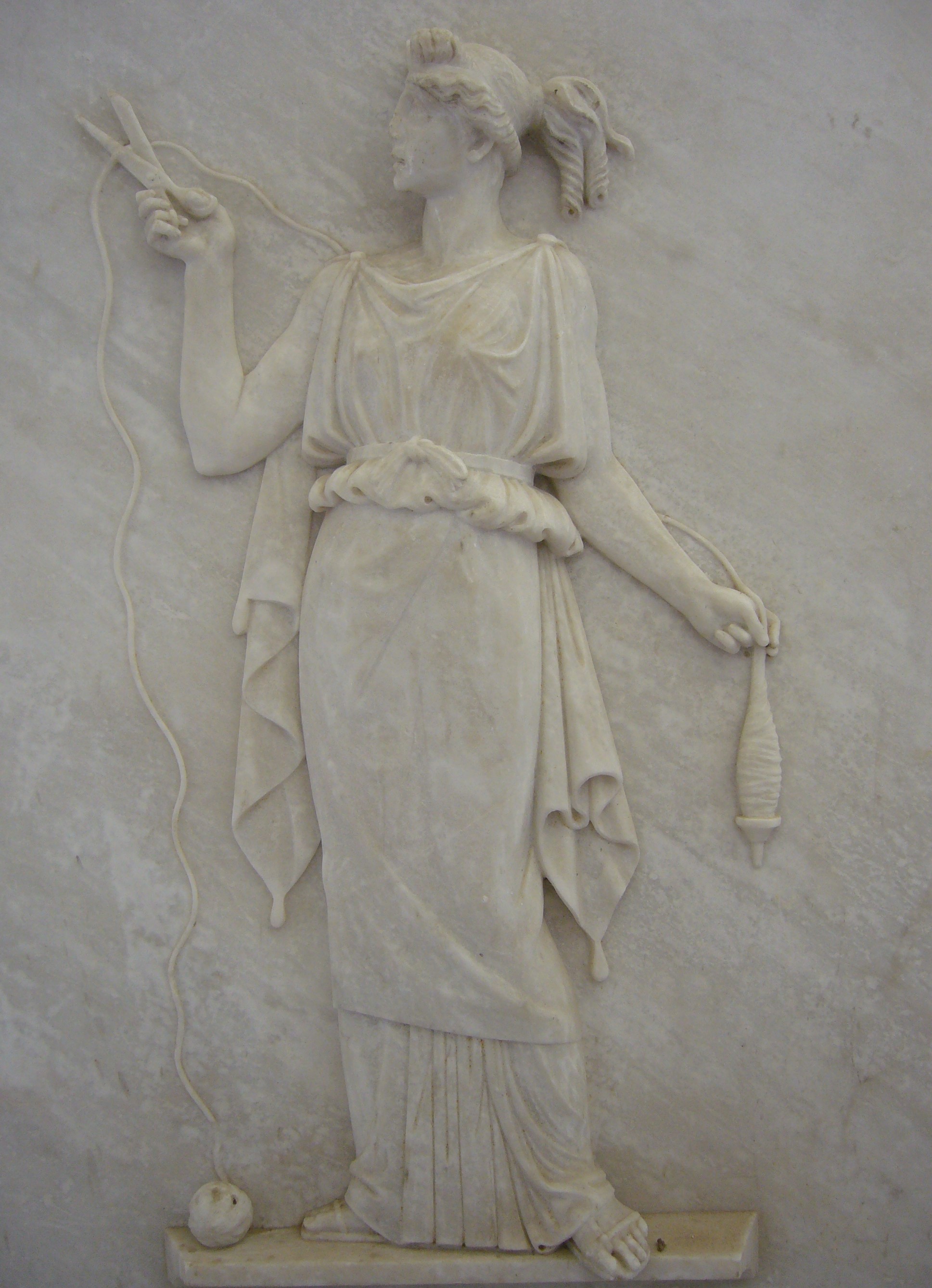
Atropos, one of the Three Fates in Greek mythology, cuts the thread of life (bas relief image, public domain).

Also wounded that same day, but seemingly less seriously than their commanding officers had been, were the Haupt brothers of the 47th Pennsylvania’s C Company (the color-bearer unit). Private Samuel Haupt was struck in the chin—presumably by one of the countless artillery shell fragments flying through the air as the enemy unleashed a barrage of cannon fire on their company as it advanced toward its target—while his brother, Sergeant Peter Haupt, was struck in the foot that had been fired by a musket or rifle ball.

Sam survived, but Peter did not.

A seemingly minor wound, ballistic injuries to a foot are often extremely painful and traumatic—even today. According to the editors of Ballistic Trauma: A Practical Guide, “There are three mechanisms whereby a projectile can cause tissue injury:

  1. In a low-energy transfer wound, the projectile crushes and lacerates tissue along the track of the projectile, causing a permanent cavity. In addition, bullet and bone fragments can act as secondary missiles, increasing the volume of tissue crushed.
  2. In a high-energy transfer wound, the projectile may impel the walls of the wound track [and] radially outwards, causing a temporary cavity lasting 5 to 10 milliseconds before its collapse in addition to the permanent mechanical disruption produced….
  3. In wounds where the firearm’s muzzle is in contact with the skin at the time of firing, tissues are forced aside by the gases expelled from the barrel of the fire, causing a localized blast injury.”

In Peter Haupt’s case, the high degree of damage to his foot was compounded by the fact that his wound was caused by a musket or minié ball that was made of lead—a substance known to cause blood poisoning and damage to human tissue and organs—and likely also by surgical procedures that were less than sterile, which resulted in a subsequent infection. His cause of death at the Union Army’s post hospital at Hilton Head, South Carolina on November 14, 1862—just over three weeks after the battle—was “traumatic tetanus,” according to the Union Army’s Registers of Deaths of Volunteer soldiers.

The Consequences of Human Conflict

Random, divergent and seemingly senseless fates.

Whether determined by the finger of God, the pre-battle machinations of the Moirai of Greek mythology, or the sheer dumb luck of being positioned at precisely the wrong spot in the regiment’s line of march that terrible day, the final outcomes of the 47th Pennsylvanians who did or did not make it home stand as a testament to the often inexplicable and heartbreaking nature of war.


Sources:

  1. “A Soldier’s Death” (obituary of Captain W. W. Geety). Harrisburg, Pennsylvania: Harrisburg Telegraph, 20 January 1887.
  2. Affidavit Regarding Peter Haupt’s Death (written by Second Lieutenant Daniel Oyster on August 14, 1863 and certified by Captain John Peter Shindel Gobin on August 20, 1863, Company C, 47th Pennsylvania Volunteer Infantry, Fort Taylor, Key West, Florida). Washington, D.C.: Officer of the United States Commissioner of Pensions.
  3. Burial Ledgers, in Record Group 15, The National Cemetery Administration, and Record Group 92, United States Departments of Defense and Army (Quartermaster General). Washington, D.C.: U.S. National Archives and Records Administration: 1861-1865.
  4. Commemorative Biographical Encyclopedia of Dauphin County, Containing Sketches of Representative Citizens, and Many of the Early Scotch-Irish and German Settlers. Chambersburg, Pennsylvania: J. M. Runk & Company, 1896.
  5. “Extraordinary Case” (account of the injury and treatment of William Wallace Geety). Harrisburg, Pennsylvania: Patriot & Union, June 12, 1863.
  6. Haupt, Peter, in Registers of Deaths of Volunteer Soldiers, United States Army, 1862. Washington, D.C.: U.S. National Archives and Records Administration.
  7. Homer, The Iliad, II, Book 18 (A. T. Murray, translator). Cambridge, Massachusetts: Harvard University Press, 1924.
  8. Junker, George, in Registers of Deaths of Volunteer Soldiers, United States Army, 1862. Washington, D.C.: U.S. National Archives and Records Administration.
  9. Lead Toxicity: Biological Fate,” in “Environmental Health and Medicine.” Atlanta, Georgia: Agency for Toxic Substances and Disease Registry, United States Centers for Disease Control, May 2023.
  10. Letter from Captain James Kacy from Beaufort, South Carolina, October 25, 1862, regarding H Company casualties sustained during the Battle of Pocotaligo, South Carolina, October 22, 1862. Bloomfield, Pennsylvania: The Perry County Democrat, November 6, 1862.
  11. “List of Casualties: Forty-Seventh Pennsylvania Volunteers—Col. T. H. Good.” New York, New York: The New York Times, October 29, 1862.
  12. Mahoney, Peter F., James Ryan, et. al. Ballistic Trauma: A Practical Guide, Second Edition, pp. 31-66, 91-121, 168-179, 356-395, 445-464, 535-540, 596-605. London, England: Springer-Verlag London Limited, 2005.
  13. Reimer, Terry. Wounds, Ammunition, and Amputation.” Frederick, Maryland: National Museum of Civil War Medicine, 2007.
  14. Reports of Col. Tilghman H. Good, Forty-seventh Pennsylvania Infantry and Report of Col. Tilghman H. Good, Forty-seventh Pennsylvania Infantry, commanding First Brigade, Tenth Army Corps, in The War of the Rebellion: A Compilation of the Official Records of the Union and Confederate Armies. Prepared Under the Direction of the Secretary of War, By Lieut. Col. Robert N. Scott, Third U.S. Artillery, and Published Pursuant to Act of Congress Approved June 16, 1880, Series I, Vol. XIV. Washington, D.C.: Government Printing Office, 1885.
  15. Schroeder-Lein, Glenna. The Wounded,” in “Essential Civil War Curriculum.” Blacksburg, Virginia: Virginia Center for Civil War Studies, Virginia Tech University, retrieved online November 8, 2023.
  16. “The Killed and Wounded in the Battle” (casualty list from the Battle of Pocotaligo). New York, New York: The New York Herald, October 29, 1862.
  17. “Younker, George [sic],” in United States Records of Headstones of Deceased Union Veterans, 1879-1903.” Washington, D.C.: U.S. National Archives and Records Administration.
  18. “Zurückgefehrt” (announcement of the return to Pennsylvania for reburial of the remains of Captain George Junker, Henry A. Blumer, Aaron Fink and Henry Zeppenfeld). Allentown, Pennsylvania: Der Lecha Caunty Patriot, December 3, 1862.