“I was married about 14 years before the late War of the Rebellion, on Mr. Pringle plantation, in Georgetown County, S.C. I do not know the date, but from our crops we make for our former master I judged it was about 14 years before the war that I got married to Bristo Geddes by slave custom.” — Rachael (Richardson) Gethers, excerpt from an affidavit filed by her attorney on February 12, 1895
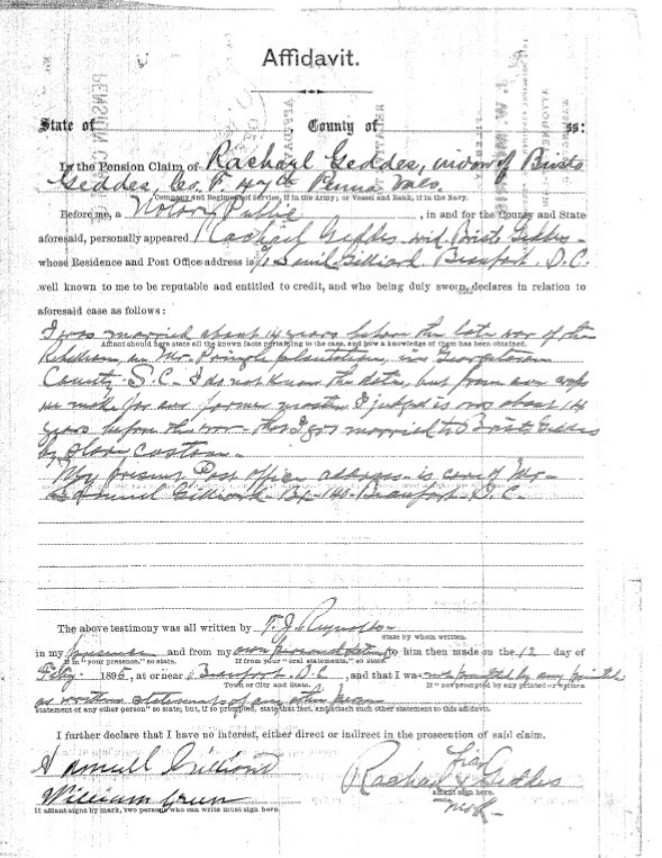
Attestation made February 12, 1895 by Rachael (Richardson) Gethers of her 1847 marriage “by slave custom” on the Pringle plantation in Georgetown County, South Carolina to Bristor Gethers (affidavit excerpt, U.S. Civil War Widow’s Pension File of Bristor and Rachael Gethers, U.S. National Archives and Records Administration, public domain; click to enlarge).
We do not know the names of this woman’s parents, but we do know her name and the names of her husband and their closest friends, thanks to documents that were filed on her behalf by an attorney in Beaufort County, South Carolina, as part of her application for a U.S. Civil War Widow’s Pension during the late 1890s.
Her name was Rachael (Richardson) Gethers, and she was born into slavery in South Carolina circa 1825. Her parents, who had also been born in South Carolina, according to Rachael’s U.S. Census entries for 1870 and 1880, had also likely been born into slavery.
Virtually nothing else is known at present about her childhood and teen years. What researchers do know is that Rachael was still enslaved at the time of her marriage in Georgetown County, South Carolina, circa 1847 — during her early twenties, to Bristor Gethers, a man who was enslaved on the same plantation in that county.
* Note: The plantation where Rachael Richardson and Bristor Gethers were enslaved was owned by one of the largest family of enslavers in the United States — the Pringles. Among their multiple plantations and other Georgetown County properties were Beneventum and the White House Plantation, both of which were devoted primarily to rice production and profited from the labor of hundreds of enslaved Black men, women and children. (The Pringles had been actively engaged in the slave trade since the 1700s, and had broadened their wealth and power by marrying members of other families that were also heavily involved in chattel slavery, including the Allstons.)
Unfortunately, the first and last names of Rachael (Richardson) Gethers’ husband were repeatedly misspelled in multiple civic, Freedmen’s Bureau, and military records throughout the nineteenth century. Variants of his given name between 1862 and 1893 included: Brista, Brister, Bristo, Bristor, Presto, Prestor, and Pristo; variants of his surname included: Gaddis, Garres, Garrees, Garris, Gathers, Geddes, Geddis, Gethers, Gettes. Affidavits filed in later life by Bristor Gethers and his attorney during the early 1890s finally confirmed the correct spelling of his name as “Bristor Gethers.” Rachael’s married surname was also spelled in various ways during her lifetime. In later years, an attorney who filed documents on her behalf for her application for a U.S. Civil War Widow’s Pension chose to spell her married surname as “Geddes.” Written as “Rachael” by that same attorney, her given name was spelled as “Rachel” on other records of the mid to late nineteenth century.
American Civil War
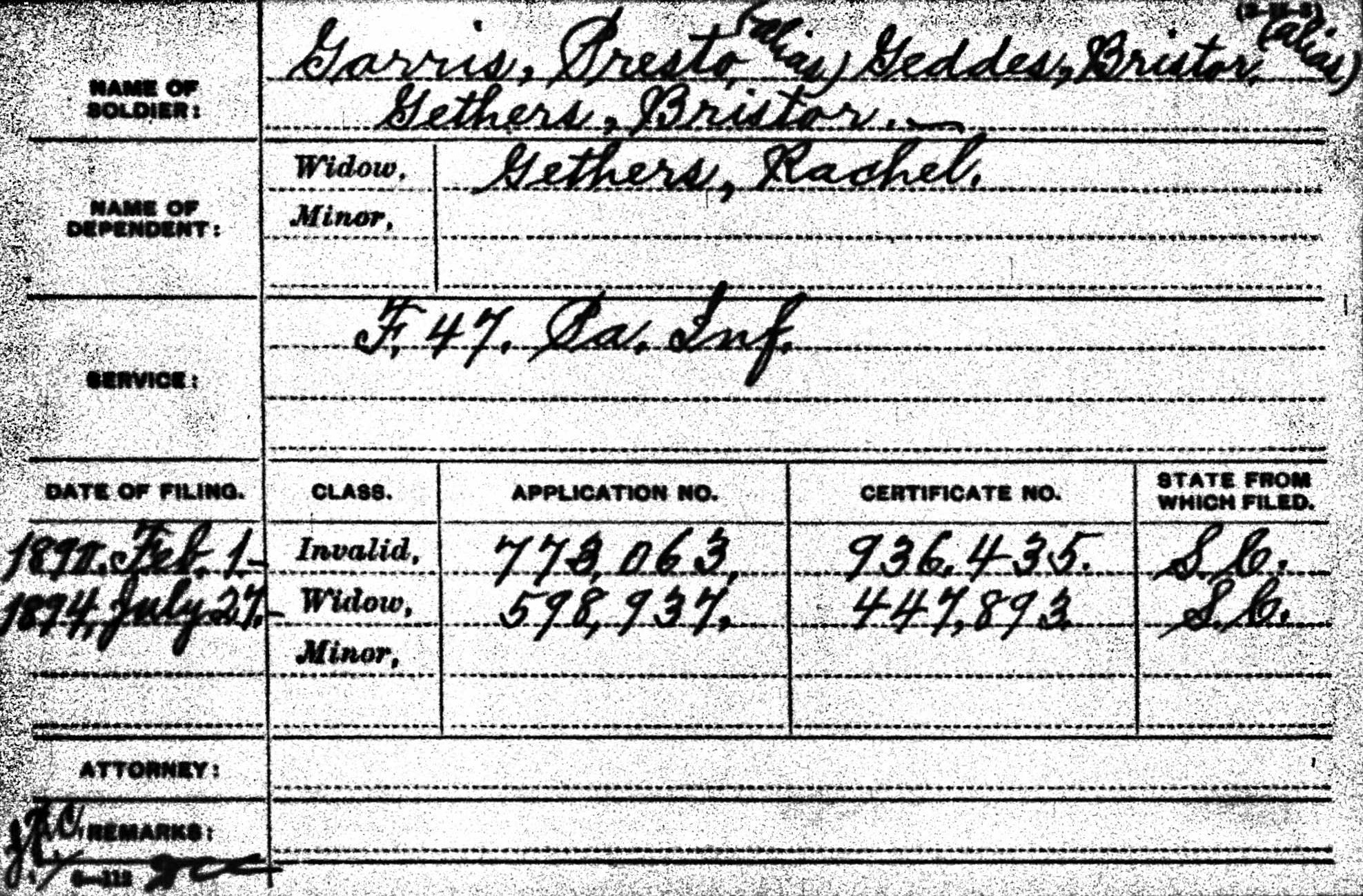
Spelling variants for Rachael (Richardson) Gethers and Bristor Gethers (U.S. Civil War General Pension Index Cards, U.S. National Archives, public domain).
The exact details of what happened to Rachael (Richardson) Gethers and her husband between the time of her marriage and the first years of the American Civil War are presently not known, but researchers do know that a new chapter in their life story began when her husband enlisted with a Union Army regiment in the city of Beaufort, South Carolina during the fall of 1862. Freed or escaped from slavery by that time, he joined the Union Army as a “Negro Under-Cook,” was entered onto the roster of Company F of the 47th Pennsylvania Volunteer Infantry on October 5, 1862, would go on to receive promotions to the rank of cook and then private during his three-year term of enlistment, and would travel with the 47th Pennsylvania as a member of its F Company to multiple duty stations and battle sites in Florida, Louisiana, Virginia, and Washington, D.C. during that war — and then to Georgia and South Carolina during five post-war months of the Reconstruction Era, at which point he was honorably discharged and allowed to return home to his wife.
Researchers have not yet determined what happened to Rachel during that same period, however; she may have escaped with Bristor and traveled with him to Beaufort or may have been freed herself by Union troops — or she may have remained behind, still enslaved on the Georgetown County plantation where they had been married, hoping that her husband would eventually return to free her.
What is known for certain is that Bristor did find her again.
Post-War Years
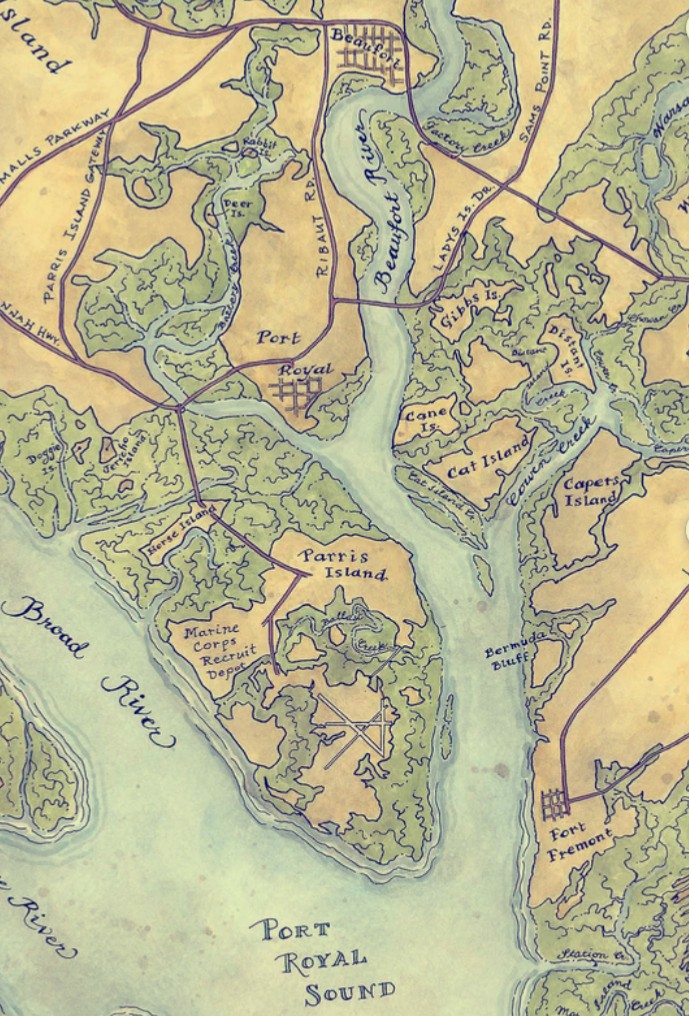
Horse Island, slightly above and to the left of Parris Island in Beaufort County, South Carolina (public domain; click to enlarge).
Following her husband’s honorable discharge from the Union Army, Rachael (Richardson) Gethers and her husband, Bristor, resumed life as a married couple. U.S. Census and Freedmen’s Bureau records confirm that they initially made their home in or near the city of Beaufort, South Carolina. Sometime around 1869, however, they relocated to Horse Island, in Beaufort Township, Beaufort County. According to the 1870 federal census, they resided there with their six-year-old son, Peter. By the time that the federal census was enumerated in 1880, however, their Horse Island household no longer included Peter.
Throughout their post-war years, Rachael and Bristor Gethers were farmers who often struggled to make ends meet. This was largely due to the fact that they were often required to turn over a significant portion of the funds they earned from their crops each harvest — under the terms of Freedmen’s Bureau contracts and other legal agreements that favored the wealthy White landowners whose land they were hired to farm. Adding to their worries was Bristor’s failing health. Having fallen seriously ill with dysentery during his military service, he was plagued by lifelong heart problems and chronic diarrhea that often left him too disabled to work.
But they persisted and managed to build a life together on Horse Island that lasted for nearly three decades. Preceded in death by her husband when he passed away on Horse Island in Beaufort Township on June 25, 1894, Rachael was so financially insecure at that point in her life that she was unable to pay for his burial. So, she reached out to friends for help.
Her husband’s close friend, Samuel Gilliard, was among the first to come to her rescue. He brought a coffin to the Gethers’ home, placed Bristor’s body in it and enlisted the help of Rachael’s neighbors in carrying the coffin down to the water, where they placed it on a boat, enabling Sam to transport it to Beaufort County’s Parris Island. Met there by William Green and other able-bodied men, Sam and his friends carried the coffin to a graveyard somewhere on that island, dug a new grave and laid Bristor to rest on June 26, 1894, according to affidavits that Sam and William both filed in support of Rachael’s Civil War widow’s pension application.
Life as a Widow
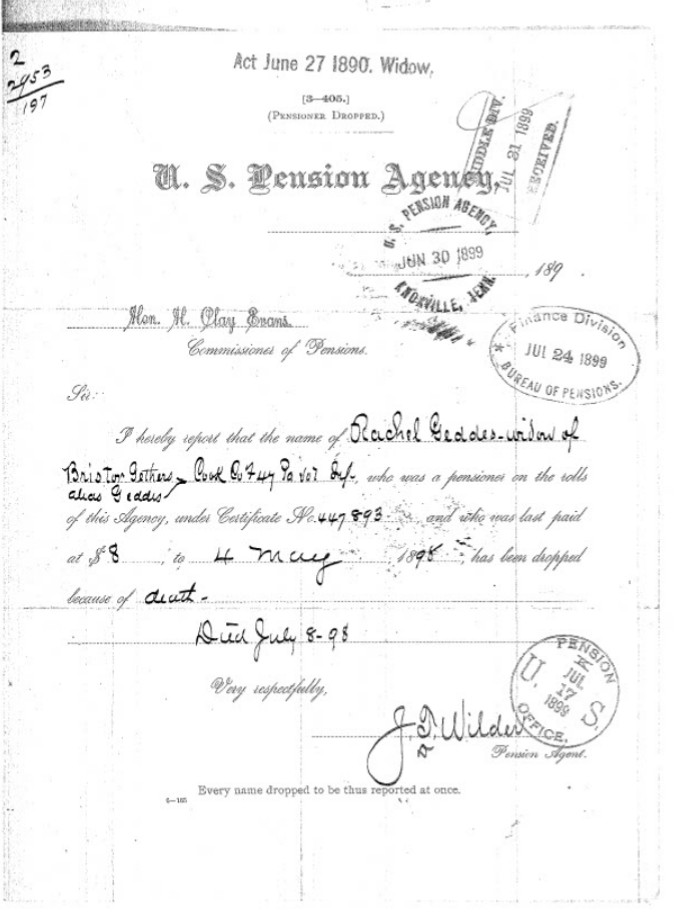
U.S. Pension Agency’s confirmation of Rachael (Richardson) Gethers’ date of death (U.S. National Archives and Records Administration, public domain; click to enlarge).
With a small U.S. Civil War Widow’s Pension of eight dollars per month (roughly three hundred and fifteen dollars per month in 2026 dollars), Rachael (Richardson) Gethers managed to survive her late husband by roughly four years. A certificate prepared by J. T. Wilder on behalf of the U.S. Pension Agency on June 30, 1899 confirmed that she died in Beaufort County, South Carolina on July 8, 1898.
Her exact burial location remains unknown, but is believed by researchers to be located somewhere on Parris Island in Beaufort County, South Carolina, based on U.S. Civil War Pension records which confirm that Parris Island was the burial location of her husband, Bristor Gethers.
* Note: To learn more about Rachael (Richardson) Gethers and her husband, Bristor, please read their full biography here and view their census and pension records, which are located on our website, Freedmen of the 47th Pennsylvania Volunteer Infantry (part of our special project dedicated to documenting the life histories of the nine formerly enslaved Black men who enlisted with the 47th Pennsylvania Volunteers).
Sources:
- Gaddis, Rachael, in U.S. Freedmen’s Bureau Hospital Records (Beaufort, South Carolina, December 1867), in Records of the Bureau of Refugees, Freedmen, and Abandoned Lands. Washington, D.C.: U.S. National Archives and Records Administration.
- Garris, Presto [sic, “Bristor Gethers”], in Civil War Muster Rolls and Civil War Veterans’ Card File, 1861-1866 (Company F, 47th Pennsylvania Infantry). Harrisburg, Pennsylvania: Pennsylvania State Archives.
- Garris, Presto (alias “Geddes, Bristor” and “Gethers, Bristor”) and Gethers, Rachel, in U.S. Civil War General Pension Index Cards (veteran’s application no.: 773063, veteran’s certificate no.: 936435, filed by the veteran from South Carolina, February 1, 1890; veteran’s widow’s application no.: 598937, veteran’s widow’s certificate no.: 447893, filed by the veteran’s widow from South Carolina, July 27, 1894). Washington, D.C.: U.S. National Archives and Records Administration.
- Geddes, Brister [sic, “Bristor Gethers”], Rachel and Peter, in U.S. Census (Beaufort, Beaufort Township, Beaufort County, South Carolina, 1870). Washington, D.C.: U.S. National Archives and Records Administration.
- Geddis, Brista [sic, “Bristor Gethers”] and Rachel, in U.S. Census (Beaufort Township, Beaufort County, South Carolina, 1880). Washington, D.C.: U.S. National Archives and Records Administration.
- Power, J. Tracy and Sherry Piland. “National Register of Historic Places Form: Beneventum Plantation” (filed by historians at the South Carolina Department of Archives and History, Columbia, South Carolina, September 15, 1987). Washington, D.C.: U.S. Department of the Interior, National Park Service.
- Roldán-Shaw, Michele. “Exploring the Sea Islands of Beaufort County.” Hilton Head, South Carolina: Local Life Insiders, retrieved online March 31, 2026.
 47th Pennsylvania Volunteers
You must be logged in to post a comment.