
The phrase, “Dum Tacent Clamant” (“While they are silent, they cry aloud”), is inscribed on the Grand Army of the Republic monument at the Chalmette National Cemetery in Louisiana (G.A.R. Monument, Chalmette National Cemetery, circa 1910, U.S. Library of Congress, public domain).
For many Americans, the phrase “March Madness” conjures visions of college life or good times spent with friends at sports bars, cheering on favorite teams as future NBA All Stars steal and dunk their way through basketball championships en route to fame and fortune. But a very real form of “madness” affected Americans during the American Civil War — and it was a devastating experience for many of the boys and men who were forced to endure it by circumstances that were largely out of their control. That condition, which was referred to by physicians as nostalgia, was known to cause feelings of “despair and homesickness so severe that soldiers became listless and emaciated and sometimes died,” according to the late journalist Tony Horwitz, and it affected multiple members of the 47th Pennsylvania Volunteer Infantry throughout the regiment’s long and storied history.
“Though geographically less distant from home than soldiers in foreign wars, most Civil War servicemen were farm boys, in their teens and early 20s, who had rarely if ever traveled far from family and familiar surrounds….”
Horowitz’s description of young Civil War-era soldiers was particularly true for the teenagers and young men who served with the 47th Pennsylvania Volunteer Infantry. Among the most distantly located of Union Army troops, many were transported from farms and small towns across Pennsylvania to Virginia in 1861 — and then down to America’s Deep South as the war raged on toward its second year. Initially stationed at Fort Taylor in Key West, Florida during the late winter of 1862, they were subsequently transferred to South Carolina, and were then moved back and forth between Florida and South Carolina between the fall of 1862 and mid-February 1864 as they engaged in the capture of Saint John’s Bluff, Florida, the Battle of Pocotaligo, South Carolina, the capture of Jacksonville, Florida, and the garrisoning of Fort Taylor in Key West and of Fort Jefferson in Florida’s Dry Tortugas — the latter of which was a duty station that was about as far south as any American could travel in the United States.
And then they were shipped west to Louisiana to fight in the Union’s 1864 Red River Campaign, during which time they made history as the only regiment from Pennsylvania to take part in that campaign — a series of intense military engagements in which more than a dozen 47th Pennsylvania Volunteers would be captured by Confederate troops and force marched to Texas, only to be held in deplorable conditions as prisoners of war at Camp Ford — the largest Confederate POW camp west of the Mississippi River. Several never made it out alive; those who did were never the same.
Even more damaging were the horrific conditions experienced by a far larger group of 47th Pennsylvania Volunteers who were taken prisoner in Virginia roughly six months later, including First Sergeant William Fry (1836-1865) of Company C and Corporal James Huff (1835-1865) of Company E, who were both captured during the Battle of Cedar Creek and then dragged away to the two most infamous POW camps in the Confederacy. Sergeant Fry, who “was paroled [on March 4, 1865], only to ‘come home to die’ from starvation and slow poison — the victim [at Andersonville] of atrocities such as have only been practiced by the traitors to our own government, and from which savages would turn in disgust,” died three weeks later at his mother’s home (on March 28, 1865), according to the 15 April 1865 edition of The Sunbury American, while Corporal Huff lost his will to live on 5 March 1865, after suffering through the months of mental and physical torment of starvation that he endured at Salisbury. (His body was then thrown into an unmarked trench grave there with those of thousands of other Union POWs, and was never able to be identified.)
War-Induced Trauma
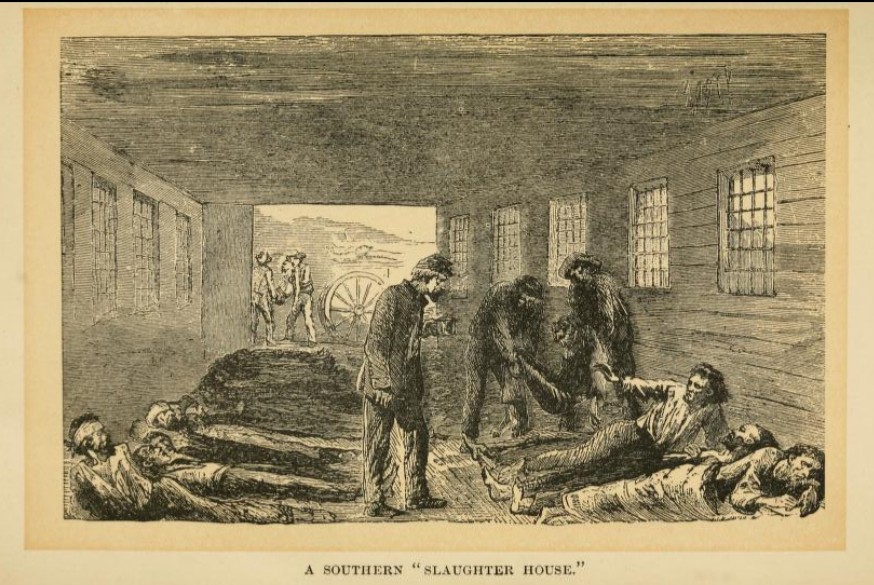
“A Southern ‘Slaughter House'” depicted the suffering of Union soldiers at the Confederacy’s Salisbury Prison Camp (Charles S. Greene, Sparks from the Campfire, 1889, public domain).
While it is true that the majority of 47th Pennsylvania Volunteers managed to avoid being killed or imprisoned as POWs, it is also true that a significant number of them suffered serious emotional trauma — either personally because they were wounded or became ill as a direct result of their military service, or vicariously — because they saw one of their comrades fall in battle or watched as a sibling or friend succumbed to disease-related complications at a Union Army hospital. So, it’s often heartbreaking for present-day descendants to read diary entries and letters that were penned by their 47th Pennsylvania ancestors as they tried to convey their thoughts in shaky, cursive handwriting while cycling between happy memories of home, their hope for better days and their profound feelings of bewilderment, grief and despair.
While scribbling one such letter during church services on Sunday, December 29, 1861, for example, Private Abraham N. Wolf told his wife that the 47th Pennsylvania’s Regimental Band was playing a hymn at that moment, and went on to state, with childlike wonder and incandescent joy, that he’d received the gift box she’d sent him, adding “everything was in it yet what you said was in it and it came on the second day of Christmas.” But his words then turned bittersweet as he reported that he had already “fried some of the sausages” that she’d sent him in order to take with him for dinner as he headed out for duty to chop wood for the regiment. “They tasted pretty good to me for it was something new to me for it was from home.”
The next year, homesickness and grief darkened the holidays for a very pensive Henry Hornbeck, as evidenced by this diary notation:
“How different this Christmas from last year when all was Joy at home. Mary & myself for the sake of a Joyful surprise, placed upon the plate (before Breakfast) of Dear Mother, a Christmas Gift, and how pleased she was for that present, which was entirely unexpected. Now, alas, she is no more, never more are we to see her in this world. No one who has not lost a dearly beloved Mother, can feel that loss or have the least idea of what the loss of his or her dearest friend on earth is, until he or she experiences what we have, Standing at the death bed of a dying parent, and to feel as we felt, alone in this wide world…. Retrospection is often times pleasing and also horrifying. I wish you a Merry Christmas.”
The Consequences of Untreated Suffering
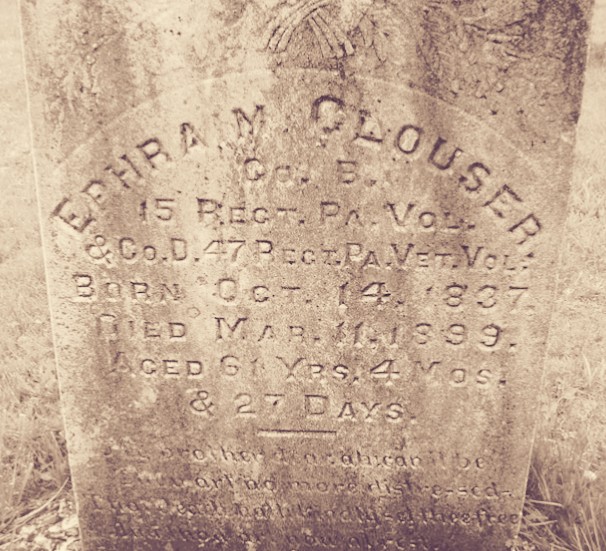
Placed by loved ones at the Bloomfield Cemetery in Perry County, Pennsylvania, this gravestone expresses the hope that the heart of 47th Pennsylvania veteran Ephraim Clouser is no longer distressed (public domain; click to enlarge).
One of the many heartbreaking truths of the American Civil War era is that soldiers who were battling depression or other mental health issues rarely received sympathy or support from their superior officers because those officers were advised by military physicians to respond harshly, rather than with compassion, to any behavior that might be perceived — or misperceived — as “malingering.” That surprising guidance was given by those surgeons because they had received medical school training which had taught them that any failure to shake off feelings of homesickness, sadness or grief was a sign of “weakness” or a “character flaw” rather than a symptom of a legitimate disease that required prompt and ongoing treatment. According to Horwitz:
“Military and medical officials recognized nostalgia as a serious ‘camp disease,’ but generally blamed it on ‘feeble will,’ ‘moral turpitude’ and inactivity in camp. Few sufferers were discharged or granted furloughs, and the recommended treatment was drilling and shaming of ‘nostalgic’ soldiers.”
In more than a few cases, the untreated or poorly-treated nostalgia experienced by 47th Pennsylvania Volunteer Infantrymen became so severe that it broke the hearts of those 47th Pennsylvanians — figuratively and then literally — as it led to the development of damaging heart or brain diseases that would later be termed “Soldier’s Heart” or “PTSD” (post-traumatic stress disorder).
One of the earliest casualties of that sub-standard treatment was Private Adolph Finster of the 47th Pennsylvania’s A Company, who ended his life by suicide in Key West, Florida on May 15, 1863. A twenty-five-year-old who had been employed as a clerk in Easton prior to the war, Private Finster was subsequently buried in grave number 180 “of the Key West Post Cemetery,” according to historian Lewis Schmidt.
Another was D Company Private Ephraim Clouser, who was hospitalized for months at one Union Army hospital after another, following his release from captivity as a POW on November 25, 1864. (Shot in the knee during the Battle of Pleasant Hill, Louisiana on April 9th, he had been force marched to Camp Ford in Texas, where he had then been subjected to starvation and dangerously unsanitary living conditions). Awarded a U.S. Civil War soldier’s invalid pension in 1866, he was then diagnosed with dementia (1868), described as “an insane veteran” by his hometown newspaper (1896) and “jailed as a dangerous character” (1898), before he was finally committed to the Pennsylvania State Lunatic Asylum (later known as the Harrisburg State Hospital).
Two of the other post-war casualties were William H. Sieger, a field musician from Company G, who died by suicide eight years after receiving his honorable discharge and eleven days after his twenty-ninth birthday, and Daniel Battaglia, a Swiss immigrant who served as a private with Adolph Finster in Company A and later battled mental health issues for decades before he was finally committed to the “Government Hospital for the Insane” (later known as St. Elizabeths Hospital) in Washington, D.C. — forty-five years after receiving his honorable discharge.
Still others, who managed to survive and be welcomed home with huzzahs and hearty backslaps after the war, seemed “just fine” to neighbors and co-workers but, in reality, were actually suffering greatly from physical or mental illnesses that would plague them for the remainder of their days — quiet casualties of a war that continued to claim lives more than half a century after it ended.
* Note: To see an image and read more of Abraham Wolf’s letter, read the article, “1861: Abraham Nicholas Wolf, Jr. to Sarah (Trexler) Wolf,” by Spared and Shared.
Sources:
- Da Costa, Jacob Mendez. “Observations on the diseases of the heart noticed among soldiers, particularly the organic diseases,” in Contributions relating to the Causation and Prevention of Disease, and to Camp Diseases; together with a Report of the Diseases, etc., Among the Prisoners at Andersonville, GA. New York: United States Sanitary Commission and Hurd and Houghton, 1867.
- Da Costa, Jacob Mendez. “On Irritable Heart; a Clinical Study of a Form of Functional Cardiac Disorder and Its Consequences: Result in Two Hundred Cases,” in The American Journal of the Medical Sciences, vol. 61, no. 121, p. 17. Philadelphia, Pennsylvania: Henry C. Lea, 1871.
- Friedman, Matthew J. “History of PTSD in Veterans: Civil War to DSM-5.” Washington, D.C.: National Center for PTSD, U.S. Department of Veterans Affairs, retrieved online, March 23, 2026.
- Greene, Lieutenant-Colonel Charles S. Sparks from the Campfire: Thrilling Stories of Heroism, Adventure, Daring and Suffering, Re-Told by the Boys Who Were There. New York: W. A. Houghton, 1889.
- Horwitz, Tony. “Did Civil War Soldiers Have PTSD?“, in Smithsonian Magazine. Washington, D.C.: Smithsonian Institution, January 2015.
- Pollard, Harvey, Chittari Shivakumari, et.al. “‘Soldier’s Heart’: A Genetic Basis for Elevated Cardiovascular Disease Risk Associated with Post-Traumatic Stress Disorder,” in Frontiers in Neuromolecular Science, September 23, 2016. Switzerland: Frontiers Research Foundation.
- “Resolutions of Condolence” (report regarding the death of former Andersonville prisoner of war, Sergeant William Fry, at his home in Sunbury). Sunbury, Pennsylvania: The Sunbury American, April 15, 1865.
- Schmidt, Lewis G. A Civil War History of the 47th Regiment of Pennsylvania Veteran Volunteers. Allentown, Pennsylvania: Self-published, 1986.
 47th Pennsylvania Volunteers
You must be logged in to post a comment.