First Blood: The Battle of Pocotaligo, South Carolina (Planning and Preparation: Mid-October 1862)

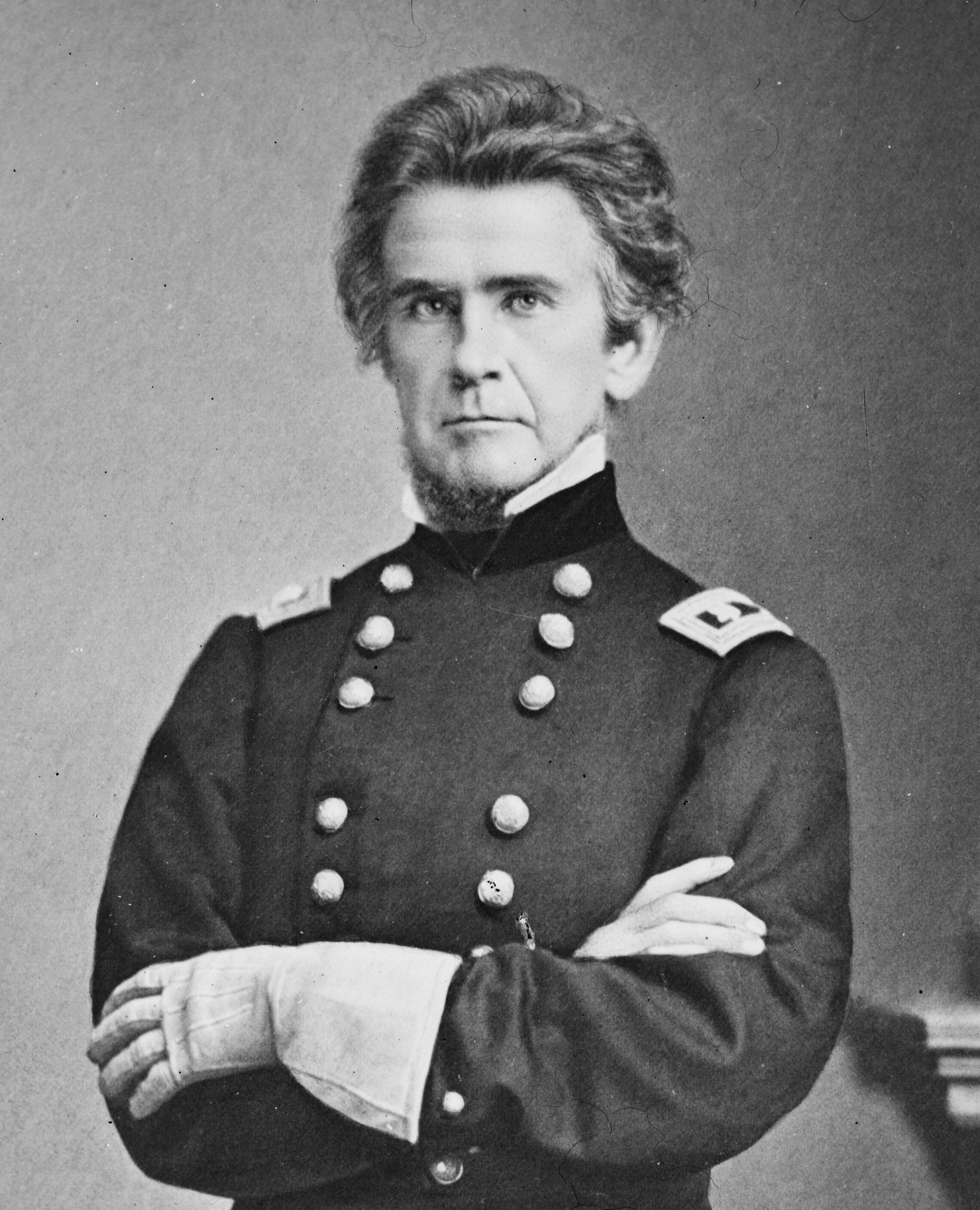
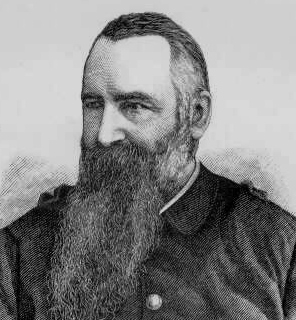
Major-General Ormsby MacKnight Mitchel, Commanding Officer, U.S. Department of the South and Tenth Corps, U.S. Army, circa 1862 (public domain).

On the heels of his army’s successful capture of Saint John’s Bluff, Florida and related events in early October 1862, Union Major-General Ormsby MacKnight Mitchel, commanding officer of the United States Army’s Department of the South, directed his senior staff and leadership of the U.S. Army’s Tenth Corps (X Corps) to intensify actions against the Confederate States Army and Navy in an effort to further disrupt the enemy’s ability to move troops and supplies throughout Florida, Georgia and South Carolina. As part of this directive, he engaged his senior officers in planning a new expedition — this time to Pocotaligo, South Carolina. According to Mitchel, preparations for that event began in earnest in mid-October, with an eye to the following objectives:

First, to make a complete reconnaissance of the Broad River and its three tributaries, Coosawhatchie, Tulifiny [sic], and Pocotaligo; second, to test practically the rapidity and safety with which a landing could be effected; third to learn the strength of the enemy on the main-land, now guarding the Charleston and Savannah Railroad; and fourth, to accomplish the destruction of so much of the road as could be effected in one day….
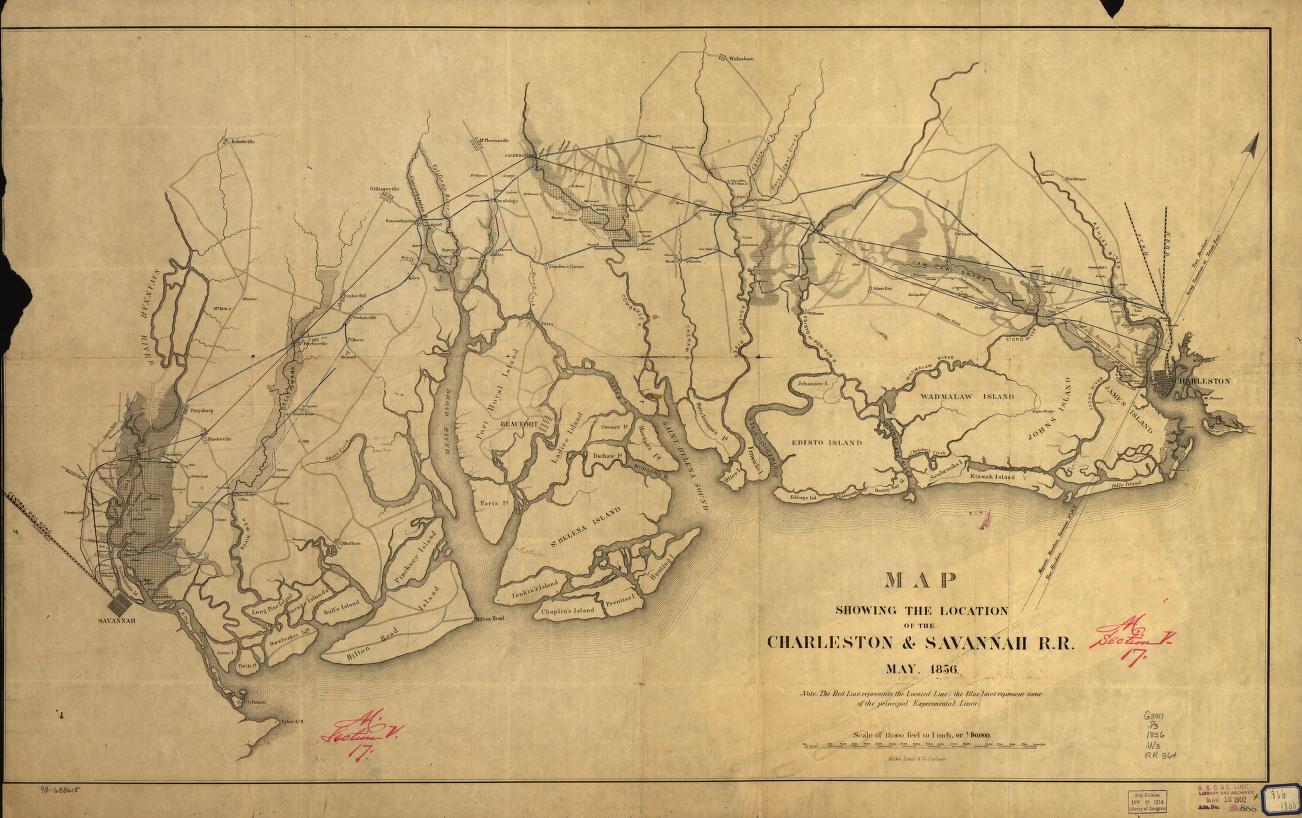
This 1856 map of the Charleston & Savannah Railroad shows the island of Hilton Head, South Carolina in relation to the town of Pocotaligo (U.S. Library of Congress, public domain; click to enlarge).

Mitchel then worked with his subordinate officers to determine how much of the U.S. Army’s Tenth Corps would take part in the expedition, assess the potential weak spots in his strategy and revise planning details to improve his soldiers’ likelihood of success:

The troops composing the expedition were the following: Forty-seventh Pennsylvania, 600 men; Fifty-fifth Pennsylvania, 400 men; Fourth New Hampshire, 600 men; Seventh Connecticut, 500 men; Third New Hampshire: 480 men; Sixth Connecticut, 500 men; Third Rhode Island, 300 men; Seventy-sixth Pennsylvania, 430 men; New York Mechanics and Engineers, 250 men; Forty-eighth New York, 300 men; one section of Hamilton’s battery and 40 men; one section of the First Regiment Artillery, Company M, battery and 40 men, and the First Massachusetts Cavalry, 100 men. Making an entire force of 4,500 men.

Every pains [sic] had been taken to secure as far as possible success for the expedition. Scouts and spies had been sent to the main-land to all the most important points between the Savannah River railroad bridge and the bridge across the Salkehatchie. A small party was sent out to cut, if possible, the telegraph wires. Scouts had been sent in boats up the tributaries of the Broad River. All the landings had been examined, and the depth of water in the several rivers ascertained as far as practicable. Two of our light-draught transports have been converted into formidable gunboats and are now heavily armed, to wit, The Planter and the George Washington. By my orders the New York Mechanics and Engineers, Colonel Serrell, had constructed two very large flat-boats, or scows, each capable of transporting half a battery of artillery, exclusive of the caissons, with the horses. They were provided with hinged aprons, to facilitate the landing not only of artillery but of troops from the transports.

Owing to an accident which occurred to the transport Cosmopolitan during the expedition to the Saint John’s River I found myself deficient in transportation, and applied to the commanding officer, Commodore Godon, of the South Atlantic Blockading Squadron, who promptly placed under my orders a number of light-draught gunboats for the double purpose of transportation and military protection.
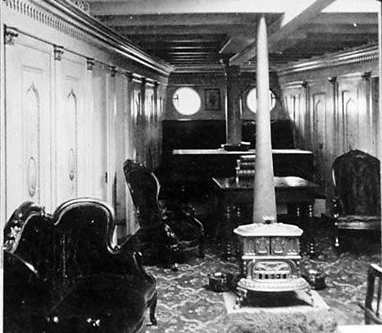
The after cabin inside of the U.S. Steamer Ben Deford, c. 1860s (U.S. Library of Congress, public domain).

As planning progressed, details were firmed up regarding the Union Navy’s anticipated support. According to Mitchel:

On the evening of the 21st, under the command of Captain Steedman, U.S. Navy, the gunboats and transports were arranged in the following order for sailing: The Paul Jones, Captain Steedman, without troops; the Ben De Ford, Conemaugh, Wissahickon, Boston, Patroon, Darlington, steam-tug Relief, with schooner in tow; Marblehead, Vixen, Flora, Water Witch, George Washington, and Planter. The flat-boats, with artillery, were towed by the Ben De Ford and Boston. The best negro pilots which could be found were placed on the principal vessels, as well as signal officers, for the purpose of intercommunication. The night proved to be smoky and hazy, which produced some confusion in the sailing of the vessels, as signal lights could not be seen by those most remote from the leading ship. The larger vessels, however, got under way about 12 o’clock at night.

Union Army map, Pocotaligo-Coosawhatchie Expedition, 21-23 October 1862 (public domain; click to enlarge).

Mitchel and his leadership team also worked out the details of the expedition’s landing and debarkation plans, decided upon the weaponry they would need to disrupt and permanently disable the railroad tracks and the bridge at Pocotaligo and identified other possible actions to be undertaken by the expeditionary force:

After a careful examination of the map I ordered a landing to be effected at the mouth of the Pocotaligo River, at a place known as Mackay’s Point. This is really a narrow neck of land made by the Broad River and the Pocotaligo, in both of which rivers gunboats could lie and furnish a perfect protection for the debarkation and embarkation of the troops. There is a good country road leading from the Point to the old town of Pocotaligo, then entering a turnpike, which leads from the town of Coosawhatchie to the principal ferry on the Salkehatchie River. The distance to the railroad was only about 7 or 8 miles, thus rendering it possible to effect a landing, cut the railroad and telegraph wires, and return to the boats in the same day. I saw that it would be impossible for the troops to be attacked by the enemy either in flank or rear, as the two flanks were protected by the Pocotaligo River on the one hand and by the Broad and by the Tulifiny [sic, Tulifinny], its tributary, on the other. Presuming that the enemy would make his principal defense at or near Pocotaligo, I directed that a detachment of the Forty-eighth New York, under command of Colonel Barton, with the armed transport Planter, accompanied by one or two light-draught gunboats, should ascend the Coosawhatchie River, for the purpose of making a diversion, and in case no considerable force of the enemy was met, to destroy the railroad at and near the town of Coosawhatchie.

In addition to our land forces we were furnished by the Navy with several transports, armed with howitzers, three of which were landed with the artillery, and thus gave us a battery of seven pieces. All the troops were furnished with 100 rounds of ammunition. Two light ambulances and one wagon, with its team, accompanied the expedition.

The Integral Role of the 47th Pennsylvania

Design of the U.S. Army’s insignia for the Tenth (X) Army Corps, which would have been sewn onto uniforms of the 47th Pennsylvania Volunteer Infantry and displayed on a flag carried by the regiment during the Battle of Pocotaligo, South Carolina on 22 October 1862 (public domain).

The Union Army regiments selected for participation in the Pocotaligo expedition were part of the U.S. Army’s Tenth Corps (X Corps), which was part of the U.S. Army’s larger Department of the South, which was headquartered at Hilton Head, South Carolina and oversaw Union military operations in Florida, Georgia and South Carolina during this time. Established on 13 September 1862, the Tenth Corps served under the command of Union Major-General Ormsby MacKnight Mitchel from the time of its founding until his death from yellow fever on 30 October of that same year. It was then placed under the command of Brigadier-General John Milton Brannan, who had also assumed command of the U.S. Army’s Department of the South, a position he held until 21 January 1863.

Among the regiments attached to the U.S. Army’s Tenth Corps in the U.S. Department of the South during fall of 1862 was the 47th Pennsylvania Volunteer Infantry, which would later make history as the only regiment from Pennsylvania to participate in the Union’s 1864 Red River Campaign across Louisiana. The 47th Pennsylvania, which had been founded on 5 August 1861 by Colonel Tilghman H. Good, remained under Colonel Good’s command. Regimental operations were also overseen by Good’s second-in-command, Lieutenant-Colonel George Warren Alexander.

As preparations continued to be refined, Brigadier-General Brannan determined, in his new role as commanding officer of the expedition, that he would need one of his subordinate officers to take his place on the field as the expedition began. He chose Colonel Good of the 47th Pennsylvania Volunteers, who would go on to become a three-time mayor of Allentown, Pennsylvania after the war. Good then placed Lieutenant-Colonel Alexander in direct command of the 47th Pennsylvania. A New Hampshire native, Alexander had served as captain of the Reading Artillerists in Berks County, Pennsylvania prior to the war; post-war, he founded G. W. Alexander & Sons, a renowned hat manufacturing company that was based in West Reading.

What all of those Union Army infantrymen did not know at the time they boarded their respective transport ships on 21 October 1862 was that they would soon been engaged in combat so intense that the day would come to be described in history books more than a century later as the Second Battle of Pocotaligo (or the Battle of Yemassee, due to its proximity to the town of Yemassee, South Carolina).

This encounter between the Union and Confederate armies would unfold on 22 October 1862 between Savannah, Georgia and Charleston, South Carolina on the banks of the Pocotaligo River in northern Beaufort County, South Carolina.

Next: The Second Battle of Pocotaligo


Sources:

  1. “General Orders, Hdqrs., Department of the South, Numbers 40, Hilton Head, Port Royal, S. C., September 17, 1862” (announcement by Major-General Ormsby M. Mitchel that he has assumed command of the newly formed Department of the South), in The War of the Rebellion: A Compilation of the Official Records of the Union and Confederate Armies. Prepared Under the Direction of the Secretary of War, By Lieut. Col. Robert N. Scott, Third U.S. Artillery, and Published Pursuant to Act of Congress Approved June 16, 1880, Series I, Vol. XIV, Serial 20, p. 382. Washington, D.C.: Government Printing Office, 1885.
  2. “Report of Maj. Gen. Ormsby M. Mitchel, U.S. Army, commanding Department of the South and Return of Casualties in the Union forces in the skirmish at Coosawhatchie and engagements at the Caston and Frampton Plantations, near Pocotaligo, S.C., October 22, 1862,” in The War of the Rebellion: A Compilation of the Official Records of the Union and Confederate Armies. Prepared Under the Direction of the Secretary of War, By Lieut. Col. Robert N. Scott, Third U.S. Artillery, and Published Pursuant to Act of Congress Approved June 16, 1880, Series I, Vol. XIV. Washington, D.C.: Government Printing Office, 1885.
August 5, 1861 — A New Pennsylvania Volunteer Regiment Is Born

Colonel Tilghman H. Good, Commanding Officer, 47th Pennsylvania Volunteers (public domain).

Watch the related YouTube video.

When Lieutenant-Colonel Tilghman H. Good received permission from Pennsylvania Governor Andrew Gregg Curtin, on 5 August 1861, to form an entirely new regiment of volunteer soldiers in response to President Abraham Lincoln’s 22 July 1861 call for five hundred thousand men to preserve America’s Union in the face of the expanding U.S. Civil War, he only knew that his nation was in crisis and needed his help. He could not possibly have foreseen then that most of the men he would recruit for the 47th Regiment, Pennsylvania Volunteer Infantry would make genuine history while repeatedly distinguishing themselves in battle during terms of service which would be far longer than the three years Lincoln had envisioned.

Good, himself, had been tested in battle by the time he had received Curtin’s permission to form the 47th Pennsylvania, having mustered out from the 1st Regiment, Pennsylvania Volunteer Infantry on 23 July 1861 after honorably completing his Three Months’ Service as second-in-command of that regiment during the war’s opening months. His new subordinates, who would later come to be known as the 47th Pennsylvania Veteran Volunteers, would be so well-trained and, ultimately, become so toughened by battle that they would frequently be placed on point when a massive corps of combined Union Army regiments was marched into battle—or assigned to guard the rear, protecting the retreating troops of other regiments from Confederate States Army (C.S.A.) fire and potential capture by the advancing enemy when brigades of that same Union corps were forced into retreat.

And his beloved 47th would also become the only regiment from the great Keystone State to fight in the Union’s 1864 Red River Campaign across Louisiana, as well as the only Pennsylvania regiment to have men imprisoned at Camp Ford, the largest POW camp operated by the C.S.A. west of the Mississippi River.

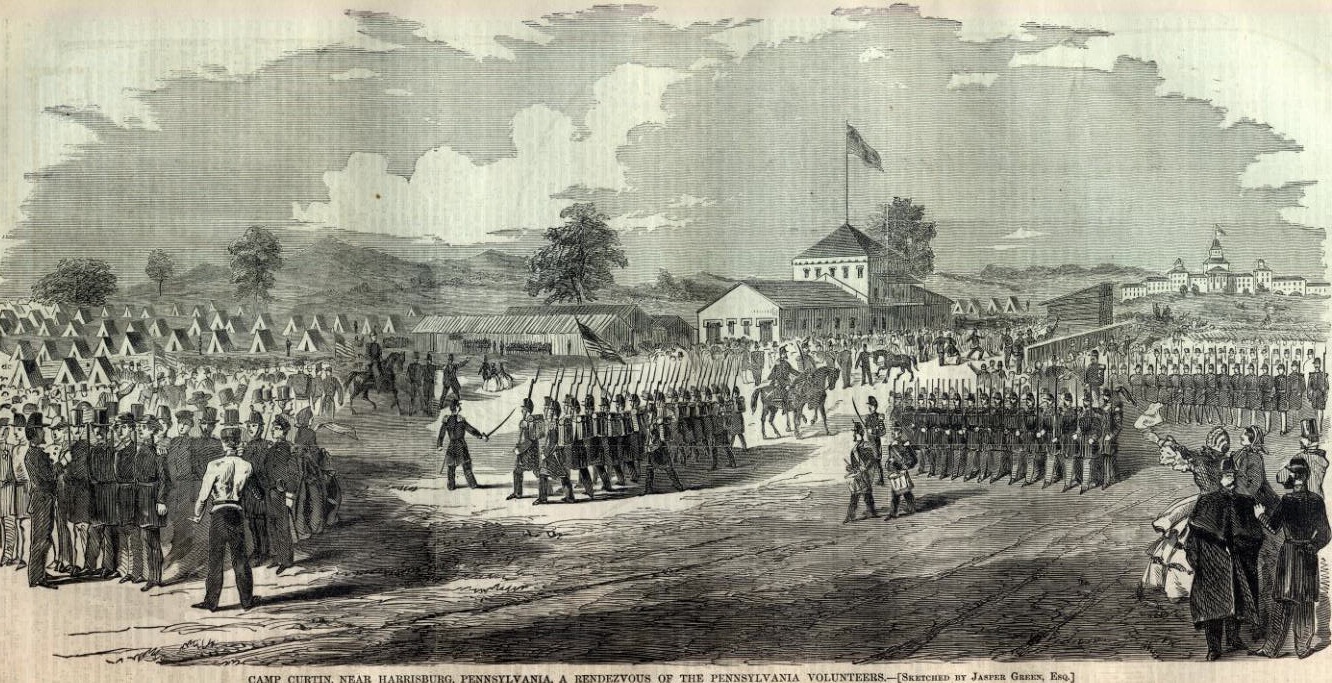
Camp Curtin (Harper’s Weekly, 1861, public domain).

After receiving permission from Governor Curtin to form a new regiment on 5 August 1861, Good was commissioned as a colonel and re-enrolled for a three-year term of military service that same day. He then promptly reached out to recruit William H. Gausler, George Warren Alexander, and other former subordinates from his officer corps with the 1st Pennsylvania, as well as John Peter Shindel Gobin from the 11th Pennsylvania and other respected officers from other three-month Pennsylvania regiments to enlist their service in recruiting men for the 47th Pennsylvania Volunteer Infantry. In short order, Good ensured that Alexander was commissioned as a lieutenant-colonel and appointed as his second-in-command with Gausler appointed to central command as a commissioned major. Gobin was commissioned as a captain and given the critical role of commanding the regiment’s color-bearer unit.

Also helping to recruit men to serve with the 47th Pennsylvania was Northumberland County’s former constable and sheriff James Van Dyke, Sr. The owner-operator of Sunbury’s Central Hotel, Van Dyke took out an advertisement in the Sunbury American on 10 August 1861, which read:

GOOD MEN, able bodied, between the ages of 18 and 35, who love their country and to Volunteer in the Army, are requested to apply to the subscriber at the Central Hotel, Sunbury, before the 18th day of August next.

The Term of service is for three years or during the war. Pay from $12 to $21 per month.

This company is intended to form a part of the first Regiment of the new requisition of ten Regiments from Pennsylvania, and is ordered to report in ten days at Camp Curtin.

The company will select its own officers to be appointed by the Governor.

JAMES VAN DYKE.
August 10, 1861

According to historian Lewis Schmidt, nine hundred and eleven of the men who would initially serve under Good (roughly ninety percent of the total number typically required to form a Union Army regiment) were mustered in at Camp Curtin in Harrisburg from mid-August through mid-September by Captain Jonathan R. Snead of the 5th U.S. Artillery. The regiment’s ten companies were processed as follows:

Company F, which was recruited and enrolled in Catasauqua, Lehigh County and mustered in from 13 to 30 August, was led by Captain Henry Samuel Harte;
Regimental Band No. 1, which was recruited from the membership of the Pomp’s Cornet Band in Easton, Northampton County, enrolled in Easton, and mustered in on 14 August, was conducted by Thomas Coates;
Company C (Sunbury Guards), which was recruited primarily from Northumberland and Juniata counties, enrolled at Sunbury, Northumberland County, and mustered in from 19 August to 2 September, was led by Captain John Peter Shindel Gobin, who had personally volunteered the services of the Sunbury Guards to Governor Curtin on 18 April 1861, following President Lincoln’s earlier call for 75,000 volunteers after the Fall of Fort Sumter;
Company D, which was recruited primarily from Bloomfield and other Perry County towns, enrolled in Bloomfield, and mustered in from 20 to 31 August, was led by Captain Henry Durant (“H. D.”) Woodruff;
Company I, which was recruited primarily from Lehigh County, enrolled in the city of Allentown in Lehigh County, and mustered in on 30 August as the largest company (with 102 men), was led by Captain Coleman A.G. Keck;
Company B, which was recruited and enrolled in Allentown, mustered in at Camp Curtin from 30 to 31 August, and led by Captain Emanuel P. Rhoads;
Company A, which was recruited at the saloon operated by Charles Frederick William Glanz in Easton, enrolled in Easton, and mustered in from 15 to 16 September, was led by Captain Richard A. Graeffe;
Company E, which was recruited and enrolled at the Easton-based saloon owned by Charles Hickman Yard, Sr. and mustered in on 16 September as the smallest company with just 83 men and with Yard commissioned as its captain;
Company K, which was formed by George Junker, an Allentown-based tombstone carver, with the intent of being an “all-German company”, recruited from the Lehigh County communities of Allentown, Guthsville, Hazleton, Longswamp, and Saegersville, enrolled in Allentown, and mustered in on 17 September, was led by Junker, who had been commissioned as captain;
Company G, which was recruited and enrolled in Allentown and mustered in on 18 September, was led by Captain Charles Mickley;
Company H, which was recruited and enrolled primarily from Newport and its surrounding Perry County communities and mustered in on 19 September as the 47th Pennsylvania’s final company to form at Camp Curtin, was led by Captain James Kacy, who had personally enrolled in the Perry County community of Elliotsburg.

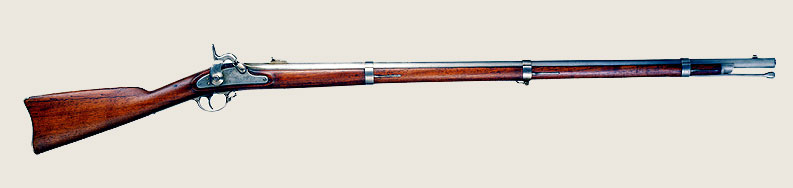
Springfield rifle, 1861 model (public domain).

From late August through mid-September of that first year of the American Civil War, Good and his second-in-command, Lieutenant-Colonel G. W. Alexander, drilled their Mississippi rifle-armed subordinates in light infantry strategies and procedures, using Hardee’s Rifle and Light Infantry Tactics, a training manual penned by William Joseph Hardee, a 1938 graduate of the United States Military Academy at West Point and U.S. Army officer who had been brevetted as a lieutenant-colonel during the Mexican-American War and who had, on 31 January 1861, just resigned his U.S. Army commission in order to accept a commission as a lieutenant-general with the Confederate States Army.

The best known of military training manuals in use during the Civil War, “Hardee’s Tactics,” as it was frequently known, defined not only how the most senior officers should conduct themselves (the “field officers, colonel, lieutenant colonel and major are supposed to be mounted, and [when] on active service shall be on horseback” while the “adjutant, when the battalion is manoeuvring [sic], will be on foot”), it made clear the importance of the regiment’s junior leaders (“the discipline and efficiency of a company materially depend on the conduct and character of its sergeants”), and also spelled out in detail the physical movements which would be made by the rank and file while drilling, at rest, or in combat. Lesson one for each new private was “Position of the Soldier”:

  • “Heels on the same line, as near each other as the conformation of the man will permit;
    The feet turned out equally, and forming with each other something less than a right angle;
    The knees straight without stiffness;
    The body erect on the hips, including a little forward;
    The shoulders square and falling equally;
    The arms hanging naturally;
    The elbows near the body;
    The palm of the hand turned a little to the front, the little finger behind the seam of the pantaloons;
    The head erect and square to the front, without constraint;
    The chin near the stock, without covering it;
    The eyes fixed straight to the front, and striking the ground about the distance of fifteen paces.”

The second lesson was “Eyes”:

  • “At the word right, the recruit will turn the head gently, so as to bring the inner corner of the left eye in a line with the buttons of the coat, the eyes fixed on the line of the eyes of the men in, or supposed to be in, the same rank;
    At the second command, the head will resume the direct or habitual position;
    The movement of Eyes—Left will be executed by inverse means;
    The instructor will take particular care that the movement of the head does not derange the squareness of the shoulders, which will happen if the movement of the former be too sudden.”

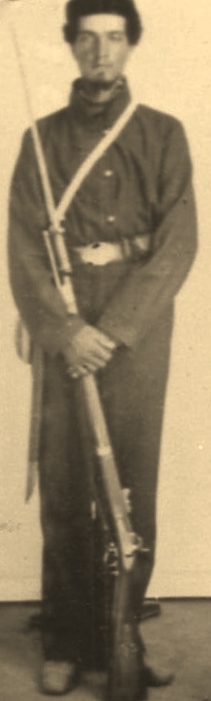
Pvt. Abraham N. Wolf, of Co. B, 47th Pennsylvania Volunteers, standing with his Mississippi rifle, circa 1861 (public domain).

Instructed next in the basics of marching, the privates were subsequently drilled in the Manual of Arms—taught how to support, present, shoulder, and order arms before learning how to load and ready their rifles for firing and also learning to fix their bayonets in preparation for hand-to-hand combat.

In lesson four, they were finally taught how to fire and cease fire, and how to fire obliquely, by file, and by rank.

In lesson five, they learned how to fire and load while kneeling or lying down.

They drilled until their leaders deemed they were ready to meet the enemy—the Confederate States Army—in a war which would ultimately cost America $4.183 million (period value) and kill 623,026 (total killed in battle from both sides, not including disease-related deaths). By late September of 1861, the 47th Pennsylvania Volunteers were serving in the Eastern Theater of combat, officially enrolled as part of the United States Army, and attached to the massive Army of the Potomac (“Mr. Lincoln’s Army).

Watch the related YouTube video, 47th Pennsylvania Volunteers: One Civil War Regiment’s Story: The Birth of a New Regiment.”

Then, to learn even more about the 47th Pennsylvania Volunteer Infantry’s efforts to preserve America’s Union and end the scourge of slavery, visit our “About” page.


Sources:

  1. Bates, Samuel P. History of Pennsylvania Volunteers, 1861-5, Prepared in Compliance with Acts of the Legislature, vol. 1, 1150-1190. Harrisburg, Pennsylvania: B. Singerly, State Printer, 1869.
  2. “Casualties and Costs of the Civil War” (infographic). New York, New York: The Gilder Lehrman Institute of American History.
  3. Egle, William H. Life and Times of Andrew Gregg Curtin, pp. 127, 250. Philadelphia, Pennsylvania: The Thompson Publishing Co., 1896.
  4. Good, Tilghman H. (F&S – 47 I), in Civil War Veterans’ Card File, 1861-1866. Harrisburg, Pennsylvania: Pennsylvania State Archives.
  5. Hardee, William Joseph. Hardee’s Rifle and Light Infantry Tactics. Memphis, Tennessee: E.C. Kirk & Co., 1861.
  6. Mathews, Alfred and Austin N. Hungerford. History of the Counties of Lehigh and Carbon, in the Commonwealth of Pennsylvania. Philadelphia, Pennsylvania: Everts & Richards, 1884.
  7. Schmidt, Lewis. A Civil War History of the 47th Regiment of Pennsylvania Veteran Volunteers. Allentown, Pennsylvania: Self-published, 1986.
  8. Stewart, Richard, ed. American Military History, Vol. I: The United States Army and the Forging of a Nation, 1775-1917 (Chapter 9: “The Civil War, 1861). Washington, D.C.: Center of Military History, United States Army, 2009.
  9. “The New State Regiments.” Harrisburg, Pennsylvania: Pennsylvania Daily Telegraph, September 23, 1861, p. 3.