
This 1865 photograph of President Abraham Lincoln by Alexander Gardner is believed by historians to be the final photo taken of Lincoln (1865, U.S. Library of Congress, public domain).
There were multiple key moments in the life of the man who would become the sixteenth president of the United States of America. Some, like the deaths of his mother and sister, would dramatically alter the trajectory of his life; others, like his decision to embark upon a life of public service, would reshape the future of a nation.
But his actions on one particular date, during two entirely different years, did both.
So pivotal in history, that particular date’s annual arrival still stops average Americans in their tracks each year, prompting them to reflect on the legacy of that one man — and the question, “What if?”
That man was U.S. President Abraham Lincoln and that date is April 15.
Lincoln’s Call for Seventy-Five Thousand Volunteers (April 15, 1861)
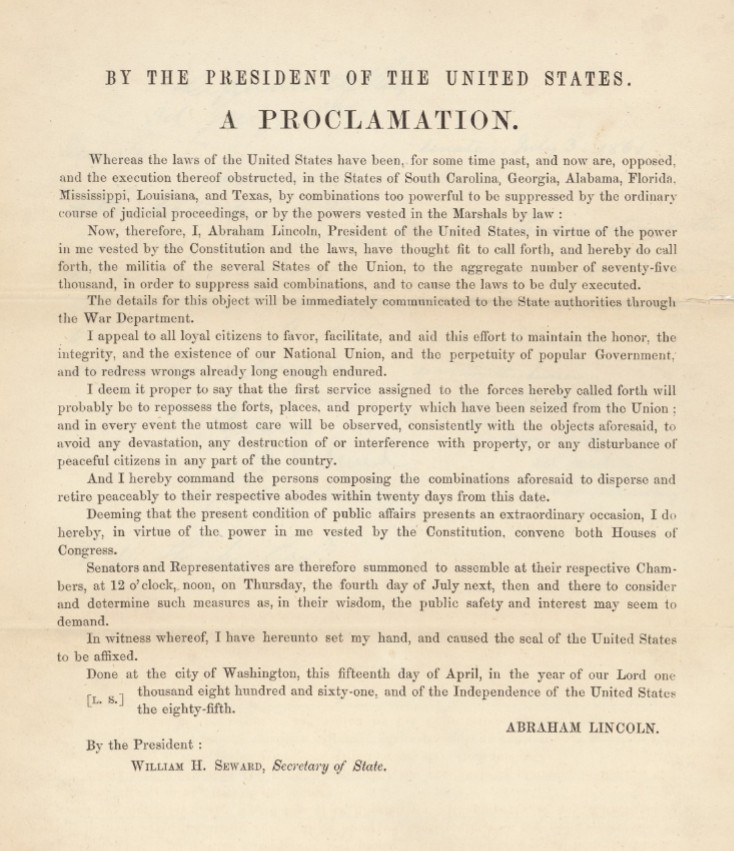
Proclamation issued by U.S. President Abraham Lincoln, calling for seventy-five thousand state militia troops to bring an end to the secession of, and insurrection by, eleven of fifteen southern slaveholding states, April 15, 1861 (U.S. National Archives and Records Administration, public domain; click to enlarge).
In response to the fall of Fort Sumter in Charleston, South Carolina to Confederate States troops on April 14, 1861, President Abraham Lincoln issued a proclamation in which he called for seventy-five thousand men across the United States to risk their lives to defend the nation’s capital and bring a swift end to the secession crisis and insurrection initiated by eleven of fifteen southern slave holding states. That proclamation, which was issued on April 15, 1861 read as follows:
By the President of the United States.
A Proclamation.
Whereas the laws of the United States have been, for some time past, and now are, opposed, and the execution thereof obstructed, in the States of South Carolina, Georgia, Alabama, Florida, Mississippi, Louisiana, and Texas, by combinations too powerful to be suppressed by the ordinary course of judicial proceedings, or by the powers vested in the Marshals by law:
Now, therefore, I, Abraham Lincoln, President of the United States, in virtue of the power in me vested by the Constitution and the laws, have thought fit to call forth, and hereby do call forth, the militia of the several States of the Union, to the aggregate number of seventy-five thousand, in order to suppress said combinations, and to cause the laws to be duly executed.
The details for this object will be immediately communicated to the State authorities through the War Department.
I appeal to all loyal citizens to favor, facilitate, and aid this effort to maintain the honor, the integrity, and the existence of our National Union, and the perpetuity of popular Government, and to redress wrongs already long enough endured.
I deem it proper to say that the first service assigned to the forces hereby called forth will probably be to repossess the forts, places, and property which have been seized from the Union; and in every event the utmost care will be observed, consistently with the objects aforesaid, to avoid any devastation, any destruction of or interference with property, or any disturbance of peaceful citizens in any part of the country.
And I hereby command the persons composing the combinations aforesaid to disperse and retire peaceably to their respective abodes within twenty days from this date.
Deeming that the present condition of public affairs presents an extraordinary occasion, I do hereby, in virtue of the power in me vested by the Constitution, convene both Houses of Congress.
Senators and Representatives are therefore summoned to assemble at their respective Chambers, at 12 o’clock, noon, on Thursday, the fourth day of July next, then and there to consider and determine such measures as, in their wisdom, the public safety and interest may seem to demand.
In witness whereof, I have hereunto set my hand, and caused the seal of the United States to be affixed.
Done at the city of Washington, this fifteenth day of April, in the year of our Lord one thousand eight hundred and sixty-one, and of the Independence of the United States the eighty-fifth.
Abraham Lincoln
By the President: William H. Seward, Secretary of State.
Four years later, on the exact same date, President Abraham would draw his last breath.
Lincoln’s Death from an Assassin’s Bullet (April 15, 1865)
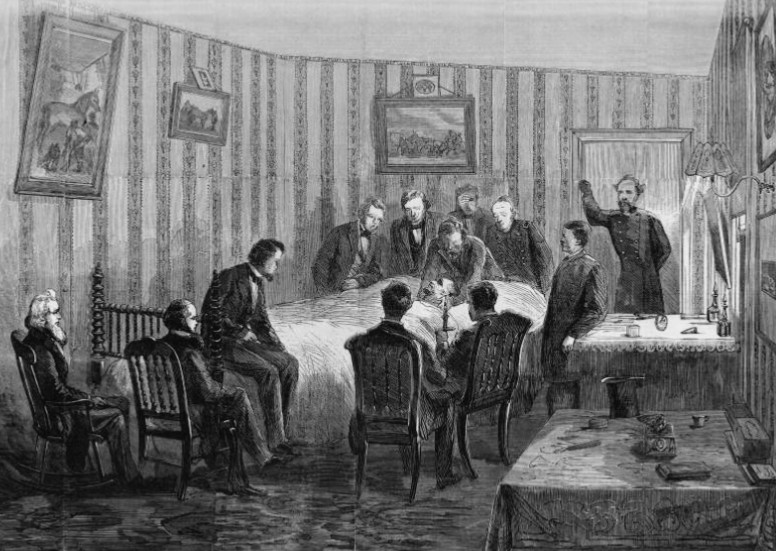
President Abraham Lincoln on his deathbed at the Petersen House in Washington, D.C., April 15, 1865 (Harper’s Weekly, 1865, public domain; click to enlarge).
Mortally wounded by a shot to his head, which was fired by an assassin and Confederate sympathizer while President Abraham Lincoln was watching a performance of the popular stage play, Our American Cousin, at Ford’s Theatre in Washington, D.C., on the evening of Good Friday, April 14, 1865, President Lincoln was initially examined on site in the presidential box, by fellow theatre attendee and physician Charles Leale, before being carried downstairs by Union Army soldiers and taken across Tenth Street — and into a room at the Petersen boarding house, where he was then gently lowered onto the bed of Willie Clark.
As additional physicians arrived and assessed the president’s condition, a decision was made to make him as comfortable as possible, when it was determined that he would likely not survive the night.
A remarkably strong man, even as he waged his toughest battle, President Lincoln managed to hang onto until the following morning, drawing his final ragged breath at 7:22 a.m. on April 15, 1865 — and leaving the work of national healing and Reconstruction in far less capable hands.
One hundred and sixty years later, Americans still wonder, “Would we be a better nation if Lincoln had survived?”
Sources:
- “A Proclamation by the President of the United States, April 15, 1861.” Washington, D.C.: U.S. Capitol Visitor Center, retrieved online April 15, 2025.
- “Abraham Lincoln’s Assassination,” in “History Channel: Civil War.” New York, New York: A&E Television Networks, February 27, 2025.
- “Eric Foner: Reconstruction and the Constitution” (video). Chicago, Illinois: Chicago Humanities Festival, 2019.
- “Lincoln’s Death,” in “Lincoln Assassination.” Washington, D.C.: Ford’s Theatre, retrieved online December 1, 2024.
- “The Petersen House.” Washington, D.C.: U.S. National Park Service, December 1, 2024.
 47th Pennsylvania Volunteers
You must be logged in to post a comment.