Camp Griffin (also known as “Camp Big Chestnut”), Langley, Virginia

The Big Chestnut Tree, Camp Griffin, Langley, Virginia, 1861 (U.S. Library of Congress, public domain).

Located near Langley, Virginia, Camp Griffin was a key muster-in point for multiple Union Army units during the early years of the American Civil War. Originally named “Camp Big Chestnut” in recognition of the large chestnut tree that was one of the earliest defining features of the campground, it quickly became a major training base and staging area for multiple state volunteer infantry and artillery units that fought under the banner of the United States government.

During the fall of 1861, it was renamed as “Camp Griffin” to honor Captain Charles Griffin, who had distinguished himself in combat as the commanding officer of the United States Artillery’s 5th Regiment, Battery D (the “West Point Battery”) during the First Battle of Bull Run in July 1861. Griffin was then also later promoted to Brigadier-General of Volunteers on June 12, 1862.

The 47th Pennsylvania Volunteers at Camp Griffin

The Sibley tents of an unidentified Union Army regiment, Camp Griffin, Virginia, fall 1861 (U.S. Library of Congress, public domain; click to enlarge).

“Camp Big Chestnut” (later known as Camp Griffin) was the first “real home” of the 47th Pennsylvania Volunteer Infantry after its extended muster-in and basic training period at Camp Curtin in Harrisburg, Pennsylvania from August through mid-September 1861. Initially transported by rail to the Washington, D.C. area and stationed on the Kalorama Heights in the District of Columbia, the 47th Pennsylvania Volunteers were ordered to set up and tear down their camps multiple times during their earliest weeks on the job, moving from Camp Kalorama to Camp Lyon, Maryland on the Potomac River’s eastern shore during an intense, two-hour rainstorm, and then across the “Chain Bridge” into Virginia, where they briefly encamped before marching for Camp Advance near Falls Church the next day. During their brief stay there, they were situated close to Fort Ethan Allen and the headquarters of Brigadier-General William Farrar Smith (also known as “Baldy”).

Shortly after that, they were ordered to move yet again—this time, to “Camp Big Chestnut” near Langley, Virginia. They couldn’t have known it at the time, but it was here where they would spend the bulk of their assigned duties from the fall of 1861 through early January 1862.

It was from this point that they were sent out to perform picket duties and skirmish with Confederate troops that were stationed nearby, and it was here and near this camp that they continued to drill daily and participate in Grand Reviews with multiple other Union Army units to demonstrate their readiness for battle to the most senior of Union Army leaders like General George B. McClellan, commanding officer of the U.S. Army of the Potomac—and even to their commander-in-chief, President Abraham Lincoln.

It was also here that they also served as part of that Army of the Potomac (“Mr. Lincoln’s Army”), ensuring that no troops from the Confederate States Army were ever able to breach the Union’s defensive lines and enter Washington, D.C. Quite simply put, the 47th Pennsylvania Volunteer Infantry’s job was to defend the nation’s capital—a task which its members performed well and faithfully. No Rebel ever carried a Confederate flag into the U.S. Capitol Building or White House during its time on the job.

On October 11, the 47th Pennsylvania marched in a review of massed troops that was held near the camp. In his letter of  October 13 to the Sunbury American newspaper, Henry Wharton described their duties, as well as their new home:

The location of our camp is fine and the scenery would be splendid if the view was not obstructed by heavy thickets of pine and innumerable chesnut [sic] trees. The country around us is excellent for the Rebel scouts to display their bravery; that is, to lurk in the dense woods and pick off one of our unsuspecting pickets. Last night, however, they (the Rebels) calculated wide of their mark; some of the New York 33d boys were out on picket; some fourteen or fifteen shots were exchanged, when our side succeeded in bringing to the dust, (or rather mud,) an officer and two privates of the enemy’s mounted pickets. The officer was shot by a Lieutenant in Company H [?], of the 33d.

Our own boys have seen hard service since we have been on the ‘sacred soil.’ One day and night on picket, next day working on entrenchments at the Fort, (Ethan Allen.) another on guard, next on march and so on continually, but the hardest was on picket from last Thursday morning ‘till Saturday morning – all the time four miles from camp, and both of the nights the rain poured in torrents, so much so that their clothes were completely saturated with the rain. They stood it nobly – not one complaining; but from the size of their haversacks on their return, it is no wonder that they were satisfied and are so eager to go again tomorrow. I heard one of them say ‘there was such nice cabbage, sweet and Irish potatoes, turnips, &c., out where their duty called them, and then there was a likelihood of a Rebel sheep or young porker advancing over our lines and then he could take them as ‘contraband’ and have them for his own use.’ When they were out they saw about a dozen of the Rebel cavalry and would have had a bout with them, had it not been for…unlucky circumstance – one of the men caught the hammer of his rifle in the strap of his knapsack and caused his gun to fire; the Rebels heard the report and scampered in quick time….

In his own mid-October letter home, Captain John Peter Shindel Gobin, the commanding officer of C Company, reported that the right wing of the 47th Pennsylvania (companies A, C, D, F and I) was ordered to picket duty after the left-wing’s companies (B, G, K, E, and H) were forced to return to camp by Confederate troops:

I was ordered to take my company to Stewart’s house, drive the Rebels from it, and hold it at all hazards. It was about 3 o’clock in the morning, so waiting until it was just getting day, I marched 80 men up; but the Rebels had left after driving Capt. Kacy’s company [H] into the woods. I took possession of it, and stationed my men, and there we were for 24 hours with our hands on our rifles, and without closing an eye. I took ten men, and went out scouting within half a mile of the Rebels, but could not get a prisoner, and we did not dare fire on them first. Do not think I was rash, I merely obeyed orders, and had ten men with me who could whip a hundred; Brosius [sic, Brosious], Piers [sic, Pyers], Harp and McEwen were among the number. Every man in the company wanted to go. The Rebels did not attack us, and if they had they would have met with a warm reception, as I had my men posted in such a manner that I could have whipped a regiment. My men were all ready and anxious for a “fight.”

On Friday, October 22, the 47th engaged in a Divisional Review, described by historian Lewis Schmidt as “about 10,000 infantry, 1000 cavalry, and twenty pieces of artillery all in one big open field.” Four days later, Company B’s drummer boy, Alfred Eisenbraun, was dead—the second “man” from the regiment to die since the 47th Pennsylvania’s formation. (The first was another drummer boy, John Boulton Young of C Company, who was felled by smallpox at the Kalorama eruptive fever hospital in Georgetown on October 17.)

Of all of the dangerous foes the 47th Pennsylvania Volunteers would encounter during their stay at Camp Griffin, it seemed that disease would prove to be the most persistent—and deadliest. In subsequent letters home, Captain Gobin asked Sunbury residents to donate blankets for the Sunbury Guards (the men of Company C):

The government has supplied them with one blanket apiece, which, as the cold weather approaches, is not sufficient…. Some of my men have none, two of them, Theodore Kiehl and Robert McNeal, having given theirs to our lamented drummer boy when he was taken sick… Each can give at least one blanket, (no matter what color, although we would prefer dark,) and never miss it, while it would add to the comfort of the soldiers tenfold. Very frequently while on picket duty their overcoats and blankets are both saturated by the rain. They must then wait until they can dry them by the fire before they can take their rest.

In late October 1861, the men from Companies B, G and H woke at 3 a.m., according to Schmidt, assembled a day’s worth of rations, marched four miles from camp, and took over picket duties from the 49th New York:

Company B was stationed in the vicinity of a Mrs. Jackson’s house, with Capt. Kacy’s Company H on guard around the house. The men of Company B had erected a hut made of fence rails gathered around an oak tree, in front of which was the house and property, including a persimmon tree whose fruit supplied them with a snack. Behind the house was the woods were the Rebels had been fired on last Wednesday morning while they were chopping wood there.

Less than a month later, in his letter of 17 November, Henry Wharton revealed more details about life at Camp Griffin:

This morning our brigade was out for inspection; arms, accoutrements [sic], clothing, knapsacks, etc, all were out through a thorough examination, and if I must say it myself, our company stood best, A No. 1, for cleanliness. We have a new commander to our Brigade, Brigadier General Brannen [sic, Brannan], of the U.S. Army, and if looks are any criterion, I think he is a strict disciplinarian and one who will be as able to get his men out of danger as he is willing to lead them to battle….

The boys have plenty of work to do, such as piquet [sic] duty, standing guard, wood-chopping, police duty and day drill; but then they have the most substantial food; our rations consist of fresh beef (three times a week) pickled pork, pickled beef, smoked pork, fresh bread, daily, which is baked by our own bakers, the Quartermaster having procured portable ovens for that purpose, potatoes, split peas, beans, occasionally molasses and plenty of good coffee, so you see Uncle Sam supplies us plentifully….

A few nights ago our Company was out on piquet [sic, picket]; it was a terrible night, raining very hard the whole night, and what made it worse, the boys had to stand well to their work and dare not leave to look for shelter. Some of them consider they are well paid for their exposure, as they captured two ancient muskets belonging to Secessia. One of them is of English manufacture, and the other has the Virginia militia mark on it. They are both in a dilapidated condition, but the boys hold them in high estimation as they are trophies from the enemy, and besides they were taken from the house of Mrs. Stewart, sister to the rebel Jackson who assassinated the lamented Ellsworth at Alexandria. The honorable lady, Mrs. Stewart, is now a prisoner at Washington and her house is the headquarters of the command of the piquets [sic]….

Since the success of the secret expedition, we have all kinds of rumors in camp. One is that our Brigade will be sent to the relief of Gen. Sherman, in South Carolina. The boys all desire it and the news in the ‘Press’ is correct, that a large force is to be sent there, I think their wish will be gratified….
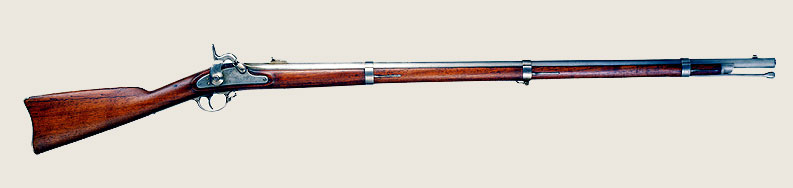
Springfield rifle, 1861 model (public domain).

On 20 November, the 47th Pennsylvania Volunteers marched in The Grand Review of the Army of the Potomac at Bailey’s Crossroads, Virginia. According to National Portrait Gallery historian James Barber:

For three hours some 70,000 polished troops marched passed the reviewing stand, where the president, members of his cabinet, and Washington dignitaries were in attendance. It was the largest military assemblage up to that time in North America. ‘The Grand Review went off splendidly,’ wrote McClellan that night in a letter to his wife, ‘not a mistake was made, not a hitch. I never saw so large a Review in Europe so well done—I was completely satisfied & delighted beyond expression.’

Among the 20,000 spectators to witness the Grand Review was the poet and social activist Julia Ward Howe of Boston, Massachusetts, who was visiting the Washington area with her husband, Dr. Samuel Gridley Howe.

After leaving the review, during the carriage ride back to Washington, she heard troops singing the song John Brown’s Body.’ A companion suggested that she should write new lyrics to the song, the melody of which lingered in her mind that night in her room at Willard’s Hotel in Washington. She awoke ‘in the gray of the morning twilight’ with the song still in her head and ‘the long lines of the desired poem began to twine themselves in my mind.’ She arose quickly and in the dimness of the early hour she began scribbling the verses on stationery ‘almost without looking at the paper.’

Her poem, The Battle Hymn of the Republic, was first published in The Atlantic Monthly in February 1862; the magazine paid her five dollars. Soon thereafter her verse was set to music and her inspirational song became a wartime favorite….
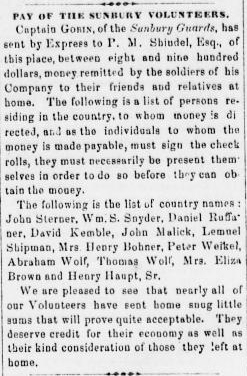
The November 30, 1861 edition of the Sunbury American carried the good news of pay sent home to loved ones by Sunbury’s boys in blue (public domain; click to enlarge).

The next day, according to Schmidt, the regiment participated in a morning divisional headquarters review overseen by the 47th Pennsylvania’s commanding officer, Colonel Tilghman H. Good, followed by brigade and division drills all afternoon. According to Schmidt, “each man was supplied with ten blank cartridges.” Afterward, “Gen. Smith requested Gen. Brannan to inform Col. Good that the 47th was the best regiment in the whole division.” As a reward—and in preparation for bigger things to come, Brannan obtained new Springfield rifles for every member of the 47th Pennsylvania.

As November came to a close, Captain Gobin helped a number of Sunbury Guardsmen to send a total of $900 from their collective pay back home to their families and friends in Pennsylvania. The editors of the Sunbury American subsequently announced the names of the family members and others who could expect to receive the sorely needed financial support from their boys in blue via a special notice in the newspaper’s November 30, 1861 edition.

Winter Quarters at Camp Griffin

Sketch of the 47th Pennsylvania Volunteers’ winter quarters at Camp Griffin, near Langley, Virginia, by Second Lieutenant William H. Wyker, Company E, December 1861 (public domain).

As fall deepened and progressed into winter, the 47th Pennsylvania Volunteer Infantry was ordered to batten down the hatches and establish its winter quarters—during a time when the guns on both sides of the war fell silent as snow blanketed Virginia, making it nearly impossible for Union and Confederate troops to march over the slippery, icy farm grounds around them—let alone drag their artillery into fighting positions in order to continue blasting away at one another.

It was simply too cold and too miserable to expend energy as combatants. But there were lighter moments as well.

Quartermaster James VanDyke procured a holiday surprise for the 47th Pennsylvania Volunteers (Sunbury American, December 21, 1861, public domain).

According to the December 21, 1861 edition of the Sunbury American, Regimental Quartermaster James Van Dyke, who was enjoying an approved furlough at home in Sunbury, Pennsylvania, was able to procure “various articles of comfort, for the inner as well as the outer man.” Upon his return to camp, many of the 47th Pennsylvanians of German heritage were pleasantly surprised to learn that the well-liked former sheriff of Sunbury had thoughtfully brought a sizable supply of sauerkraut with him. The German equivalent of “comfort food,” this favored treat warmed stomachs and lifted more than a few spirits that first cold winter away from loved ones.

Also, in a letter written sometime around Christmas 1861, Captain Gobin reported that Private John D. Colvin had been detailed to special duty with the signal corps in Washington, D.C. while Musician Henry D. Wharton, increasingly known to folks back home for his letters to the Sunbury American, had assumed additional responsibilities as a clerk who was assigned to the staff of Brigadier-General Brannan at Brigade Headquarters.

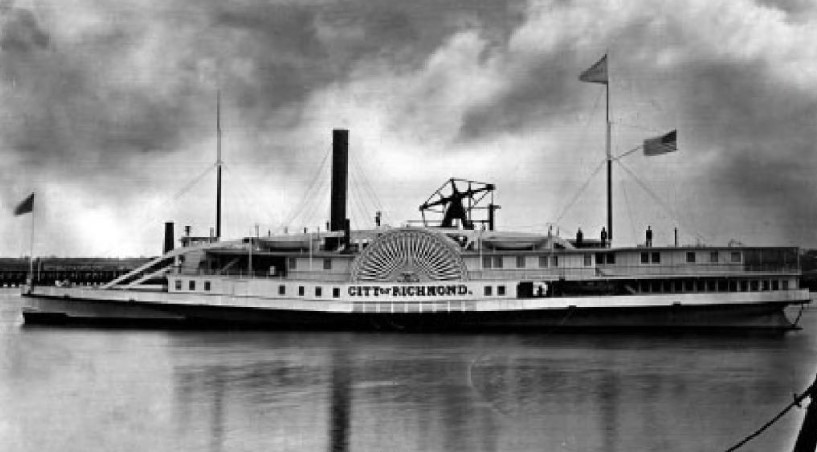
As fall fell away, the 47th Pennsylvania Volunteers continued to wait for better weather, hunkered down in their sturdier, winter quarters at Camp Griffin, remaining here until January 22, 1862, when the regiment was ordered to pack up and march for the railroad station at Falls Church. Transported from there by rail to Alexandria, they then sailed the Potomac via the steamship City of Richmond to the Washington Arsenal, where they were reequipped before being marched off for dinner and rest at the Soldiers’ Retreat in Washington, D.C. The next afternoon, they hopped cars on the Baltimore & Ohio Railroad, and headed for Annapolis, Maryland.

Arriving around 10 p.m., they were assigned quarters in barracks at the United States Naval Academy. They then spent that Friday through Monday (January 24-27, 1862) loading their equipment and other supplies onto the steamship Oriental, before sailing away at 4 p.m. that final afternoon. They were headed for America’s far warmer Deep South—and a very long time away from the arms of their loved ones and the comforts of home.

To learn more about the 47th Pennsylvania’s next phase of duty, read “Late Winter through Early Spring 1862 (Florida): Serving as Soldiers and Surrogates for Family.”


Sources:

  1. Bates, Samuel P. History of Pennsylvania Volunteers, 1861-5, vol 1. Harrisburg, Pennsylvania: B. Singerly, State Printer, 1869.
  2. Gobin, John Peter Shindel. Personal Letters, 1861-1865. Northumberland, Pennsylvania: Personal Collection of John Deppen.
  3. Lincoln and McClellan: An Army Ready for War.” Washington, D.C.: National Portrait Gallery, retrieved online December 1, 2023.
  4. Schmidt, Lewis G. A Civil War History of the 47th Regiment of Pennsylvania Veteran Volunteers. Allentown, Pennsylvania: Self-published, 1986.
  5. Wharton, Henry D. Letters from the Sunbury Guards. Sunbury, Pennsylvania: Sunbury American, 1861-1868.
 

January-Early February 1862: New Year, New Civil War Mission — A Pennsylvania Regiment Heads for Florida

Unknown regiment, Camp Griffin, Virginia, Fall 1861 (public domain, U.S. Library of Congress).

“He was the light and life of our company, and his death has caused a blight and sadness to prevail, that only the rude wheels of time can efface….” — Captain John Peter Shindel Gobin to the parents of drummer boy John Boulton Young, mid-October, 1861

“I passed the night in ‘watching,’ but somewhat differently from the watch meetings at home. I spent from 8 to 12 at night on the outposts, and we were in expectation of an attack all the time…. At 12, I was relieved and moved with my men back to the main reserve where we built a huge fire, and six to eight officers of us gathered around the fire and spent the time in telling yarns, cracking jokes.” — Captain John Peter Shindel Gobin to his own parents in a letter penned on New Year’s Day, 1862

“Will write again if I am spared to do so.” — G Company Sergeant John Gross Helfrich to his parents in a letter penned on January 12, 1862


As America’s Civil War dragged on, the contemplation of life’s biggest questions became an increasing preoccupation for more than a few members of the 47th Regiment, Pennsylvania Volunteer Infantry. Initially elated by their August 1861 enrollment for service in the fight to preserve their nation’s Union, many were propelled heart and headlong into a valley of grief just weeks later by the untimely deaths of John Boulton Young and Alfred Eisenbraun, two of the regiment’s beloved drummer boys.

Their equilibrium was gradually restored by their work as Union Army soldiers, however, and their spirits were raised further by the approaching Christmas season—largely thanks to surprise shipments by families and friends of “care packages” stuffed with favored foods and other items of comfort. Naturally, though, many members of the regiment began ruminating again as the New Year’s Eve of 1861 gave way to the New Year’s Day of 1862—as shown by this January 1, 1862 letter written to family by C Company Captain John Peter Shindel Gobin:

“I went on picket yesterday morning, and was relieved this morning. So the entire programme [sic] of the departure of the old and advent of the New Year was open to me. I passed the night in ‘watching,’ but somewhat differently from the watch meetings at home. I spent from 8 to 12 at night on the outposts, and we were in expectation of an attack all the time. This kept me constantly in the line, among the men preparing for an attack. At 12, I was relieved and moved with my men back to the main reserve where we built a huge fire, and six to eight officers of us gathered around the fire and spent the time in telling yarns, cracking jokes. Officers from the 7th Maine, 49th & 53d New York were present. Occasionally a shot or two would bring us all to our feet, but as all would be quiet again down we would go into the fire again. About four oclock [sic] this morning, I spread my blanket on the ground, and with a stone for a pillow, slept peaceably my first sleep for 1862. I got to Camp about 9 a.m. and found your letters awaiting me.

…. I would like to have been at home on Christmas, and had set my heart upon going, but somehow or other Col Good and Gen Brannen [sic] both do not want me to leave at present. The fact is we are daily expecting an engagement and they seem to think my company will not do as well as they expect it to unless I am there. I have the crack company in the Regiment. Yesterday was muster day and Sam Miller received the premium for having the cleanest arms in the Regiment….

…. I will make a desperate effort to spend my birthday at home. Mother if I get there I want you to cook a dish of schnitz und knep [sic]. I have been wishing for them all day. Yesterday I went into a house on the line and bought a mince pie and cup of coffee of a girl there. They were first rate, but Mother could beat them.”

* Note: Schnitz und knepp, which translates from the Pennsylvania German to English as “apples and buttons,” was a traditional fall recipe for Pennsylvania Dutch families during the 1800s, and remains so today. Made in a large kettle with dried apples, ham, and dumplings, and flavored with brown sugar and other seasonings, its aroma, taste, and warmth have long come together to create the very definition of “comfort food” on the chilly fall days of the Great Keystone State.

“I had not intended mentioning the following but for fear some of the boys may and an incorrect story gets out, I will tell you the other night while on picket, Mark Shipman fired upon one man crawling up to him, or he supposed he was. Sergeant Piers [sic] and I went out to the line to see the cause of the report, and someone attempted to shoot at us, but his cap snapped. The fellow made tracks in a hurry before we could catch him, but I think he got badly frightened anyhow. You do not say anything about this and do not be alarmed as he could not hit us. It was too dark. And if he had fired, or his gun gone off, we could have shot him, by the flash. We have not lost a man on picket in our entire division.

…. The wind is blowing a perfect hurricane around the house. I have my house papered all over now, and I tell you it is the best this side of Gen Smiths head quarters [sic]. Jake Keaffer [sic] just came in. He was on picket with me last night and tried for about two hours to catch some guinea hens for a New Year dinner. They were too wild for him and so he filled his haversack with potatoes out of a hole he found. He wont [sic] starve in this country. Remember me to all friends and all write soon.

Then, barely a week into the New Year, the regiment’s most persistent and dangerous foe to date resumed its assault, claiming H Company Private Jacob S. R. Gardner as one of the first of what would be a stunning number of casualties for the 47th Pennsylvania in 1862. Unable to withstand the “one-two punch” he absorbed from contracting measles after having just survived a battle with Variola (smallpox), the former Perry County laborer died on January 8. His brothers, Sergeant Reuben Shatto Gardner and Corporal John A. Gardner, who had both been serving side-by-side with him in H Company, saw to the shipping arrangements which sent Jacob’s body back home for interment at the Newport Cemetery in Newport, Pennsylvania, but they did not accompany the transport. Instead, they tamped down their grief and returned to duty—a difficult act that would continue to be repeated by numerous other heartbroken brothers for years to come across a bitterly divided United States.

Meanwhile, at dawn on the same day of Private Gardner’s passing, the bulk of the 47th Pennsylvania Volunteer Infantry had just begun to carry out the latest directive from superior officers. Marching from Camp Griffin toward the Army of the Potomac’s central commandthe headquarters of Brigadier-General William F. (“Baldy”) Smith, the 47th Pennsylvanians met up with six additional Union infantry regiments, one cavalry regiment, and a ten-piece artillery unit. Moving on as part of this larger force, they continued on to Lewinsville, where they picked up the support of an additional 233 Union wagons.

Heading out again, they trekked on for eight miles until reaching Peacock Hill, where they chased off a significantly smaller group of Confederate States Army troops from picket duty, and then proceeded to remove 200 bushels of corn and 30 loads of hay.

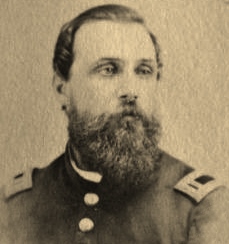
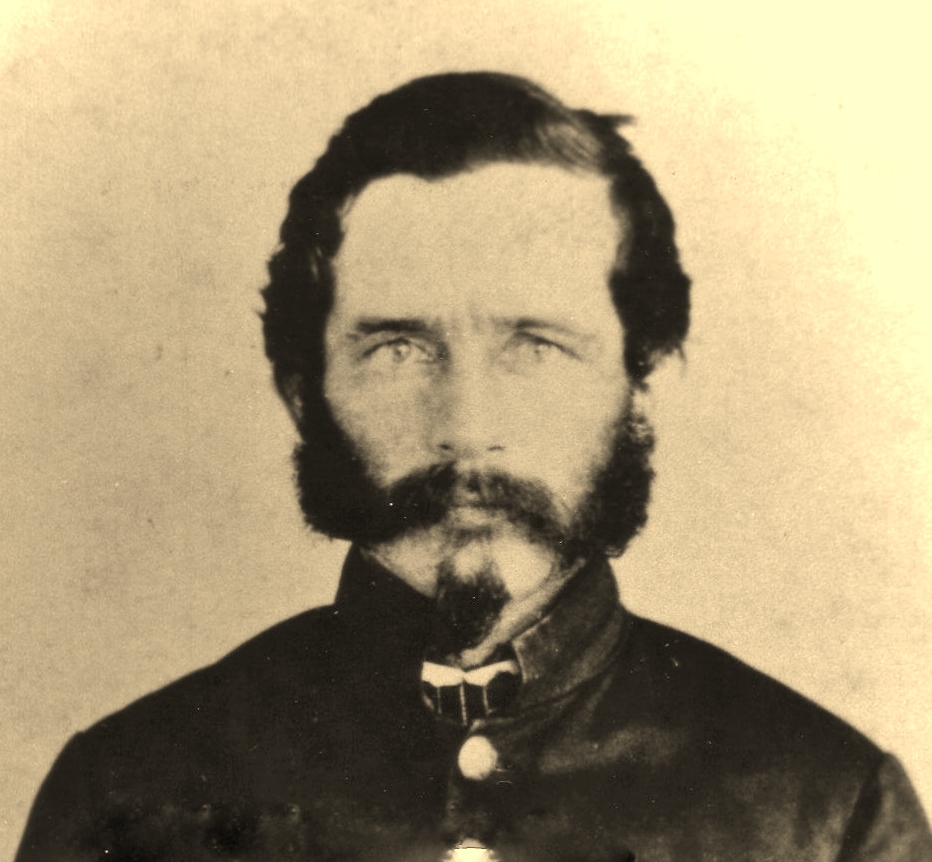
Sergeant-Major William M. Hendricks, central regimental command, 47th Pennsylvania Volunteers (c. 1863, public domain).

In his subsequent recap of the event, Sergeant-Major William M. Hendricks noted, “We just marched up to a corn crib, and off went the roof, and the wagons were backed up and filled.” The 47th Pennsylvanians were back in camp that same day by 4 p.m.

According to Gobin in his own letter home, which was penned on the same day of the expedition:

“Yesterday our division of about ten thousand men went out to Hunters Mill, and got 252 wagon loads of forage. We drove in the Rebel pickets and waited a long time for them to come at us, but they did not show themselves. The march was a hard one. I was very tired, but one nights [sic] sleep, and all as sound as ever.”

On Friday, January 10, the 47th Pennsylvania Volunteers were informed that they had performed their duties so admirably up to this point that they had been chosen by Union Brigadier-General John Milton Brannan to join a new expedition under his leadership. Shortly thereafter, the members of the 47th Pennsylvania Volunteer Infantry began packing up their regiment’s tents, Springfield rifles, ammunition, cooking utensils, and other equipment critical to any Union Army unit on the move.

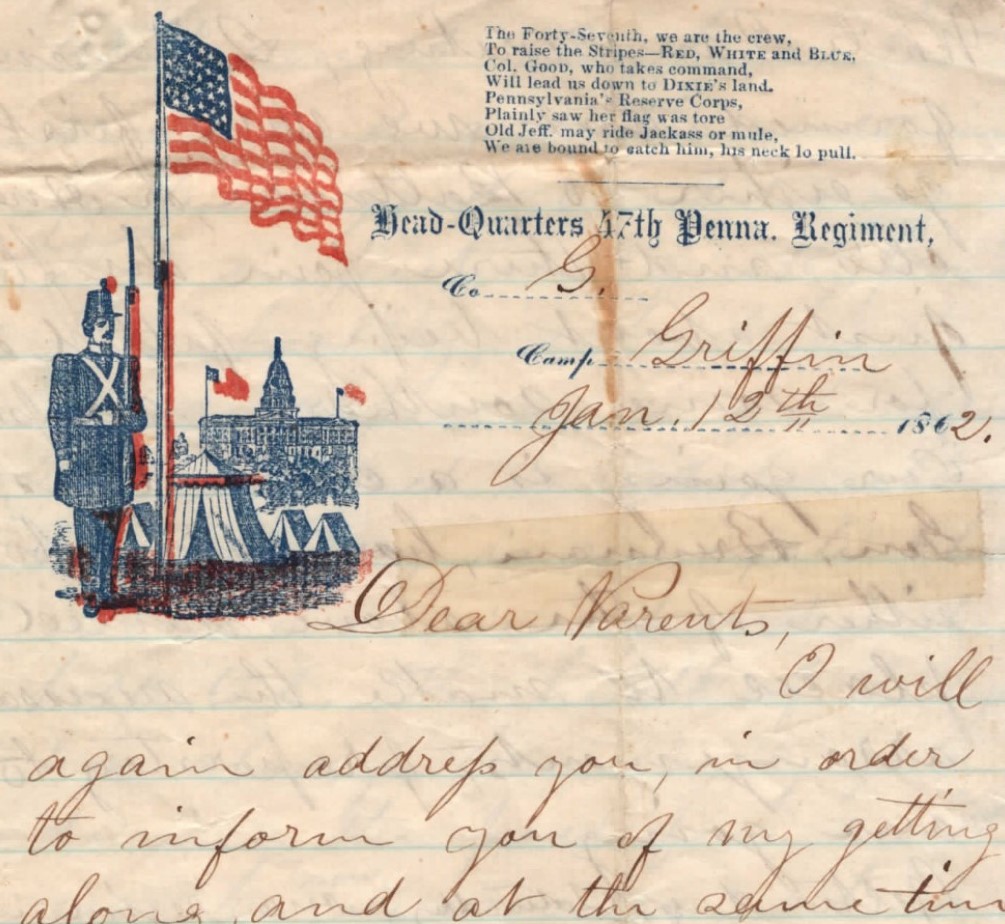
Excerpt of letter from Sergeant John Helfrich, 47th Pennsylvania Volunteers, January 12, 1862 (used with permission from Colin Colfield).

In the midst of all of this, G Company Sergeant John Helfrich carved time out to pen the following letter:

“Camp Griffin,
Jan. 12th 1862

Dear Parents,

I will again address you, in order to inform you of my getting along, and at the same time I will remark that this will to all probability be the last letter that I may be able to write, while at this place, as we have orders to leave at almost any moment. The place of our destination I can not [sic] name for certain, however, it is rumored that we would go to Florida.

While I am writing, I am informed that we will first go either to Baltimore or Anapolis [sic], and there join the fleet just about being fitted out for some southern seaport. Our going is a certainty, as Gen. Brannan, has gone to either of the above named places to make the necessary arrangements, preparatory to our going.

Yesterday, (Saturday) our regiment was paid for the preceeding [sic] two month service. The monthly wages of a sergeant is seventeen and those of a private thirteen, dollars.

Our company has first passed through the usual Sunday morning inspection, when each man is [to] have a suit of clean clothes in his knapsack, and must also have his arms, and accoutrements, in perfect good condition. This inspection, greatly promotes the healthy, as well as the good appearances of the soldier, and in fact is indispensable.

Our company is in excellent health not a man is at present in the hospital. The health of the regt. has always been pretty good during the first four month [sic] we are now in service, which is verified by the fact that there occurred but seven cases that proved fatal, out of our nine hundred men, and we can not [sic] find language to express our thanks to the Great giver of this our greatest and blessing, that a mortal being can enjoy, and it is our prayer that He may continue to bless us in the future.

I would very much like to see my friends and relations first before we go, but time, and circumstances, will not permit me to do so. I hope however that the time may soon be at hand, when peace may again be restored to our former blessed land, and when those who are now separated from their Parents and friends, fighting for their country, cause and honor, may again be permitted to return home, and enter the circle of their Parents, families, and friends, left and home in peace and prosperity.

Enclosed find ten dollars of my wages. I would send you more, but perhaps I may need it myself, from this until next payday. I must now close by saying that I am well, hoping that you and all the rest of the family are enjoying the same. Remember me kindly to all my friends at home and abroad.

A friendly goodby [sic] to you all.

Your son,

John G. Helfrich

Will write again soon if I am spared to do so.

J. G. Helfrich”

The City of Richmond, a sidewheel steamer which transported Union troops during the Civil War (Maine, c. late 1860s, public domain).

Lined up and ready to move out early on the morning of Wednesday, January 22, the 47th Pennsylvania Volunteers “gave three cheers for Camp Griffin” after listening to the 47th Pennsylvania’s Regimental Band play “Auld Lang Syne,” according to regimental historian Lewis Schmidt. Marching forth at 8:30 a.m., the men of B Company brought up the rear as the regiment slogged through snow and deep mud for three miles in order to reach the Vienna railroad depot in Falls Church, Virginia. Arriving at 9:30 a.m., they boarded a train and departed at 11 for Alexandria, Virginia where, a half hour later, they marched behind their band to the strains of “Yankee Doodle.”

Arriving at the docks nearby, they quickly began loading their equipment on the City of Richmond, a steamship which ultimately transported them along the Potomac River to the Washington Arsenal, where they disembarked sometime around 4 p.m. Marched from the arsenal area’s docks to the munitions storage area, regimental leaders replenished the ammunition supplies of the regiment, one company at a time—a process which took roughly two hours. They were then marched off for dinner and rest at the Soldiers’ Retreat in Washington, D.C.

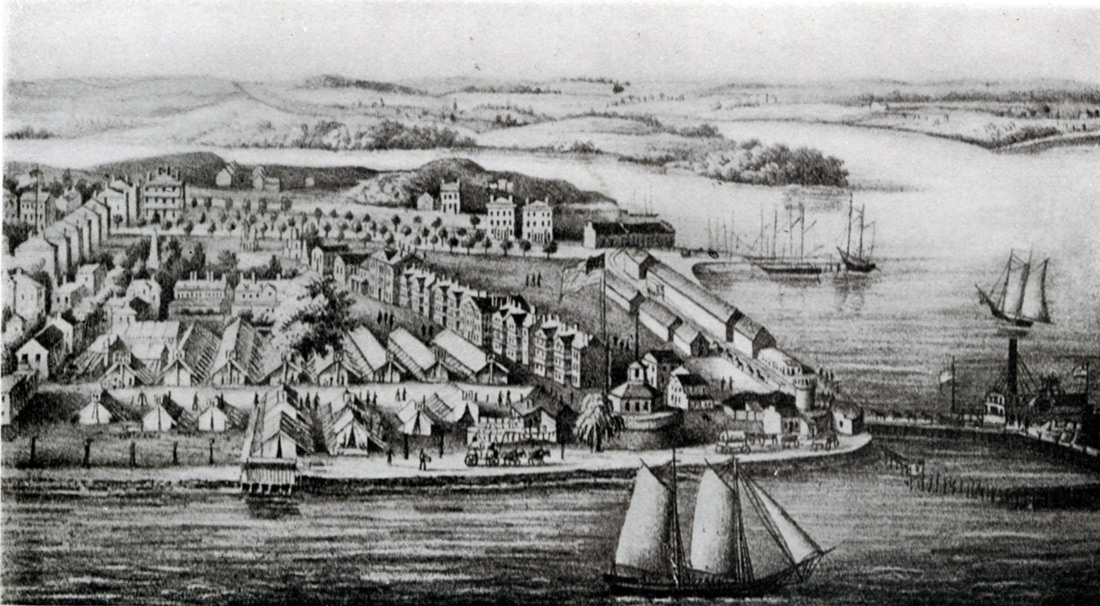
U.S. Naval Academy Barracks and temporary hospital, Annapolis, Maryland (c. 1861-1865, public domain).

The next day (January 23), the 47th Pennsylvanians reloaded their equipment onto and then boarded a Baltimore & Ohio Railroad train. Departing for Annapolis, Maryland at 2 p.m., they arrived around 10 p.m., were assigned quarters in barracks at the U.S. Naval Academy, and turned in for the night. They then spent that Friday through Monday (January 24-27) loading their equipment and other supplies onto the 210-foot steamship S.S. Oriental. Those preparations ceased on Monday, January 27, at 10 a.m., however, in order to make time for a very public dismissal of one member of the regiment—Private James C. Robinson—who was dishonorably discharged from the 47th Pennsylvania (effective on that same date). According to regimental historian Schmidt and letters home from members of the regiment:

“The regiment was formed and instructed by Lt. Col. Alexander ‘that we were about drumming out a member who had behaved himself unlike a soldier.’ …. The prisoner, Pvt. James C. Robinson of Company I, was a 36 year old miner from Allentown who had been ‘disgracefully discharged’ by order of the War Department. Pvt. Robinson was marched out with martial music playing and a guard of nine men, two men on each side and five behind him at charge bayonets. The music then struck up with ‘Robinson Crusoe’ as the procession was marched up and down in front of the regiment, and Pvt. Robinson was marched out of the yard.”

The 47th Pennsylvania Volunteers were transported to Florida aboard the steamship S.S. Oriental in January 1862 (public domain).

Reloading then resumed and, that same afternoon (January 27), the enlisted members of the 47th Regiment, Volunteer Infantry began to board the Oriental, followed by their superior officers. Ferried to that Philadelphia-built steamship by smaller steamers, they sailed away for America’s Deep South at 4 p.m., per the directive of Brigadier-General Brannan. They were headed for Florida which, despite its secession from the Union, remained strategically important to the Union due to the presence of Forts Taylor and Jefferson in Key West and the Dry Tortugas. Their ship, which was captained by Benjamin F. Tuzo, was rocked by rough seas for much of their trip; consequently, many members of the regiment suffered from intense seasickness—particularly as the Oriental made its way down the stormy coast of the Carolinas and passed the Bahamas and Great Abaco Island.

On February 2, Regimental Chaplain William DeWitt Clinton Rodrock gathered his flock together for Sunday services, which began with the tolling of the ship’s bell at 11 a.m., a selection of hymns performed by the Regimental Band, and an opening prayer and scripture reading by Rodrock. Following the regiment’s singing of “From All That Dwell Below the Skies” (accompanied by the band to the music of “Old Hundred”), Rodrock presented that week’s sermon, which was based on the Bible’s “Acts of the Apostles,” chapter 17, verse 23. The service then closed with the singing of “Lord Dismiss Us with Thy Blessing” and the Doxology, followed by Rodrock’s benediction.

That day and the next, the men’s spirits were boosted further by the sight of dolphins swimming alongside the Oriental.

Rendering of Fort Taylor, Key West, Florida (Harper’s Weekly, 1864, public domain).

Arriving in the waters off Key West, Florida at 8 p.m. on Monday, February 3, the 47th Pennsylvanians were forced to endure a waiting game aboard ship until a pilot could be brought aboard to bring the ship into a safe place in the harbor—a process the pilot began at 7 a.m. the next morning.

According to Schmidt, “The deck was crowded with the regiment’s men, with the band playing as they passed some of the men-at-war…. Arriving in the harbor at 8 AM, the bands playing ‘national songs’ and numerous onlookers, including many ‘colored women,’ along the shore watching the ship sail into port.”

“After disembarking at 9 AM on the dock about one mile west of Fort Taylor, the regiment marched down the main street of the city in their regular order of column of divisions, and stacked their weapons, waiting until the unit would be notified where to make camp…. At 12 in the afternoon, the men were ordered to fall in and stand to attention, and with their 23 member band playing and the ladies of Key West waving their handkerchiefs, and with quite a crowd of followers, the 1000 men marched to their new camp ‘one fourth mile out of the city, near the beach,’ across from the barracks of the 90th New York Regiment.”

Led to the area of Key West that is now known as Palm and White streets, the 47th Pennsylvania Volunteers were, in fact, initially housed just 350 feet from the ocean—a locale which may sound breathtakingly luxurious to the modern day reader until one realizes that the 47th Pennsylvanians’ first nights were “spent in blankets on the beach, with knapsacks for pillows”—a vexing, sandy state of affairs which persisted until their tents were unloaded and assembled on Thursday, February 6.

Even so, the members of the regiment still managed to make an early, favorable impression on Key West residents, including a New York Herald reporter who “commented on the fact that the 47th was equipped with the best weapons available, and was the best looking Volunteer Regiment he had ever seen.’’

Adjutant and 1st Lieutenant Washington H. R. Hangen (c. 1862-1864, public domain).

This was in very large part due to the leadership of Colonel Tilghman H. Good, the founder and commanding officer of the 47th Pennsylvania Volunteer Infantry, who had been placed in charge not just of the 47th Pennsylvania, but of all of the men who had been assigned to serve under Brannan in Key West, including two volunteer regiments from New York and U.S. Army artillery units. Good would continue to perform this role until Brannan was able to reach Florida and assume command of his brigade. The 47th Pennsylvania’s Regimental Adjutant Washington H. R. Hangen was then also appointed as Adjutant General for Brannan’s brigade.

And those tents which took so long to be delivered and assembled? They were officially designated as “Camp Brannan” in honor of the brigadier-general who had requested that the 47th Pennsylvania be assigned to his command.

* NOTE: Three months after dropping the 47th Pennsylvania Volunteers off in Key West, the steamship Oriental ran aground and sank north of Cape Hatteras, North Carolina. Its boiler may still be seen from shore while walking along the beach at the Pea Island National Wildlife Refuge.


Sources:

1. Bates, Samuel P. History of Pennsylvania Volunteers, 1861-5, Vol 1. Harrisburg, Pennsylvania: B. Singerly, State Printer, 1869.

2. Faust, Drew G. “The Civil War soldier and the art of dying,” in The Journal of Southern History, Vol. 67, No. 1, pp. 3-38. Houston, Texas: Southern Historical Association (Rice University), 2001.

3. Gobin, John Peter Shindel. Personal Letters, 1861-1865. Northumberland, Pennsylvania: Personal Collection of John Deppen.

4. Helfrich, John G. Personal Letters, 1862. Mesa, Arizona: Personal Collection of Colin Cofield.

5. Schmidt, Lewis G. A Civil War History of the 47th Regiment of Pennsylvania Veteran Volunteers. Allentown, Pennsylvania: Self-published, 1986.

6. Wharton, Henry D. Letters from the Sunbury Guards. Sunbury, Pennsylvania: Sunbury American, 1861-1868.