January-Early February 1862: New Year, New Civil War Mission — A Pennsylvania Regiment Heads for Florida

Unknown regiment, Camp Griffin, Virginia, Fall 1861 (public domain, U.S. Library of Congress).

“He was the light and life of our company, and his death has caused a blight and sadness to prevail, that only the rude wheels of time can efface….” — Captain John Peter Shindel Gobin to the parents of drummer boy John Boulton Young, mid-October, 1861

“I passed the night in ‘watching,’ but somewhat differently from the watch meetings at home. I spent from 8 to 12 at night on the outposts, and we were in expectation of an attack all the time…. At 12, I was relieved and moved with my men back to the main reserve where we built a huge fire, and six to eight officers of us gathered around the fire and spent the time in telling yarns, cracking jokes.” — Captain John Peter Shindel Gobin to his own parents in a letter penned on New Year’s Day, 1862

“Will write again if I am spared to do so.” — G Company Sergeant John Gross Helfrich to his parents in a letter penned on January 12, 1862


As America’s Civil War dragged on, the contemplation of life’s biggest questions became an increasing preoccupation for more than a few members of the 47th Regiment, Pennsylvania Volunteer Infantry. Initially elated by their August 1861 enrollment for service in the fight to preserve their nation’s Union, many were propelled heart and headlong into a valley of grief just weeks later by the untimely deaths of John Boulton Young and Alfred Eisenbraun, two of the regiment’s beloved drummer boys.

Their equilibrium was gradually restored by their work as Union Army soldiers, however, and their spirits were raised further by the approaching Christmas season—largely thanks to surprise shipments by families and friends of “care packages” stuffed with favored foods and other items of comfort. Naturally, though, many members of the regiment began ruminating again as the New Year’s Eve of 1861 gave way to the New Year’s Day of 1862—as shown by this January 1, 1862 letter written to family by C Company Captain John Peter Shindel Gobin:

“I went on picket yesterday morning, and was relieved this morning. So the entire programme [sic] of the departure of the old and advent of the New Year was open to me. I passed the night in ‘watching,’ but somewhat differently from the watch meetings at home. I spent from 8 to 12 at night on the outposts, and we were in expectation of an attack all the time. This kept me constantly in the line, among the men preparing for an attack. At 12, I was relieved and moved with my men back to the main reserve where we built a huge fire, and six to eight officers of us gathered around the fire and spent the time in telling yarns, cracking jokes. Officers from the 7th Maine, 49th & 53d New York were present. Occasionally a shot or two would bring us all to our feet, but as all would be quiet again down we would go into the fire again. About four oclock [sic] this morning, I spread my blanket on the ground, and with a stone for a pillow, slept peaceably my first sleep for 1862. I got to Camp about 9 a.m. and found your letters awaiting me.

…. I would like to have been at home on Christmas, and had set my heart upon going, but somehow or other Col Good and Gen Brannen [sic] both do not want me to leave at present. The fact is we are daily expecting an engagement and they seem to think my company will not do as well as they expect it to unless I am there. I have the crack company in the Regiment. Yesterday was muster day and Sam Miller received the premium for having the cleanest arms in the Regiment….

…. I will make a desperate effort to spend my birthday at home. Mother if I get there I want you to cook a dish of schnitz und knep [sic]. I have been wishing for them all day. Yesterday I went into a house on the line and bought a mince pie and cup of coffee of a girl there. They were first rate, but Mother could beat them.”

* Note: Schnitz und knepp, which translates from the Pennsylvania German to English as “apples and buttons,” was a traditional fall recipe for Pennsylvania Dutch families during the 1800s, and remains so today. Made in a large kettle with dried apples, ham, and dumplings, and flavored with brown sugar and other seasonings, its aroma, taste, and warmth have long come together to create the very definition of “comfort food” on the chilly fall days of the Great Keystone State.

“I had not intended mentioning the following but for fear some of the boys may and an incorrect story gets out, I will tell you the other night while on picket, Mark Shipman fired upon one man crawling up to him, or he supposed he was. Sergeant Piers [sic] and I went out to the line to see the cause of the report, and someone attempted to shoot at us, but his cap snapped. The fellow made tracks in a hurry before we could catch him, but I think he got badly frightened anyhow. You do not say anything about this and do not be alarmed as he could not hit us. It was too dark. And if he had fired, or his gun gone off, we could have shot him, by the flash. We have not lost a man on picket in our entire division.

…. The wind is blowing a perfect hurricane around the house. I have my house papered all over now, and I tell you it is the best this side of Gen Smiths head quarters [sic]. Jake Keaffer [sic] just came in. He was on picket with me last night and tried for about two hours to catch some guinea hens for a New Year dinner. They were too wild for him and so he filled his haversack with potatoes out of a hole he found. He wont [sic] starve in this country. Remember me to all friends and all write soon.

Then, barely a week into the New Year, the regiment’s most persistent and dangerous foe to date resumed its assault, claiming H Company Private Jacob S. R. Gardner as one of the first of what would be a stunning number of casualties for the 47th Pennsylvania in 1862. Unable to withstand the “one-two punch” he absorbed from contracting measles after having just survived a battle with Variola (smallpox), the former Perry County laborer died on January 8. His brothers, Sergeant Reuben Shatto Gardner and Corporal John A. Gardner, who had both been serving side-by-side with him in H Company, saw to the shipping arrangements which sent Jacob’s body back home for interment at the Newport Cemetery in Newport, Pennsylvania, but they did not accompany the transport. Instead, they tamped down their grief and returned to duty—a difficult act that would continue to be repeated by numerous other heartbroken brothers for years to come across a bitterly divided United States.

Meanwhile, at dawn on the same day of Private Gardner’s passing, the bulk of the 47th Pennsylvania Volunteer Infantry had just begun to carry out the latest directive from superior officers. Marching from Camp Griffin toward the Army of the Potomac’s central commandthe headquarters of Brigadier-General William F. (“Baldy”) Smith, the 47th Pennsylvanians met up with six additional Union infantry regiments, one cavalry regiment, and a ten-piece artillery unit. Moving on as part of this larger force, they continued on to Lewinsville, where they picked up the support of an additional 233 Union wagons.

Heading out again, they trekked on for eight miles until reaching Peacock Hill, where they chased off a significantly smaller group of Confederate States Army troops from picket duty, and then proceeded to remove 200 bushels of corn and 30 loads of hay.
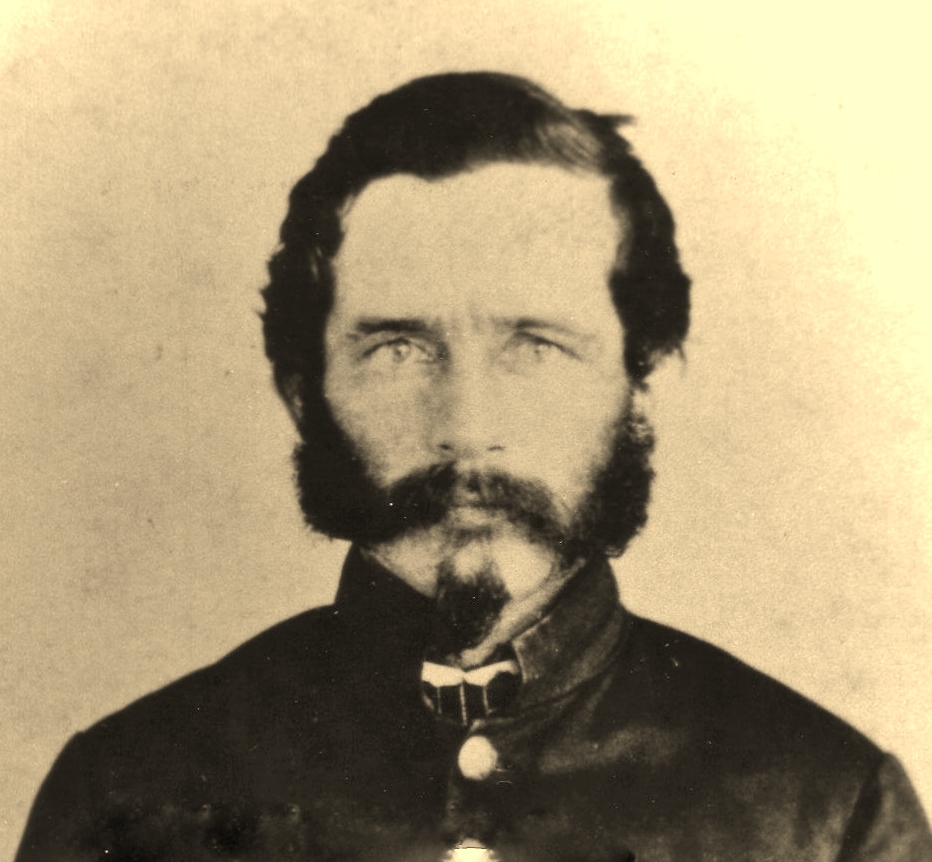
Sergeant-Major William M. Hendricks, central regimental command, 47th Pennsylvania Volunteers (c. 1863, public domain).

In his subsequent recap of the event, Sergeant-Major William M. Hendricks noted, “We just marched up to a corn crib, and off went the roof, and the wagons were backed up and filled.” The 47th Pennsylvanians were back in camp that same day by 4 p.m.

According to Gobin in his own letter home, which was penned on the same day of the expedition:

“Yesterday our division of about ten thousand men went out to Hunters Mill, and got 252 wagon loads of forage. We drove in the Rebel pickets and waited a long time for them to come at us, but they did not show themselves. The march was a hard one. I was very tired, but one nights [sic] sleep, and all as sound as ever.”

On Friday, January 10, the 47th Pennsylvania Volunteers were informed that they had performed their duties so admirably up to this point that they had been chosen by Union Brigadier-General John Milton Brannan to join a new expedition under his leadership. Shortly thereafter, the members of the 47th Pennsylvania Volunteer Infantry began packing up their regiment’s tents, Springfield rifles, ammunition, cooking utensils, and other equipment critical to any Union Army unit on the move.
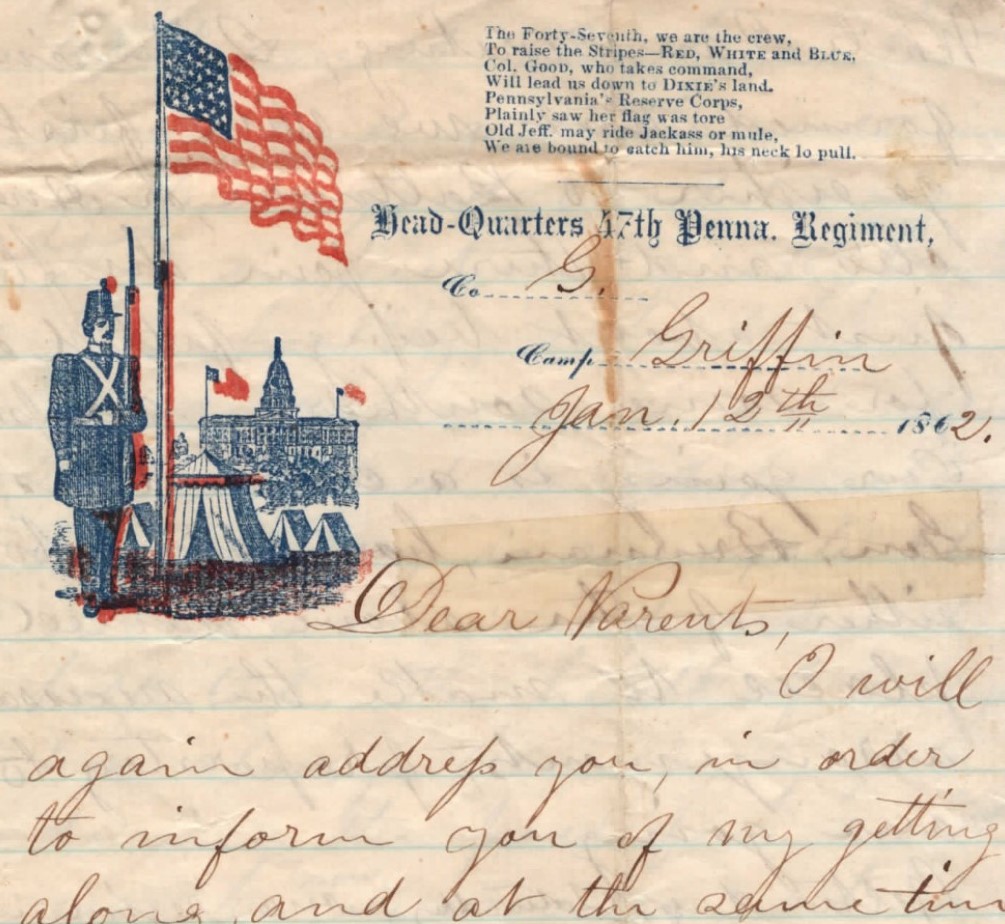
Excerpt of letter from Sergeant John Helfrich, 47th Pennsylvania Volunteers, January 12, 1862 (used with permission from Colin Colfield).

In the midst of all of this, G Company Sergeant John Helfrich carved time out to pen the following letter:

“Camp Griffin,
Jan. 12th 1862

Dear Parents,

I will again address you, in order to inform you of my getting along, and at the same time I will remark that this will to all probability be the last letter that I may be able to write, while at this place, as we have orders to leave at almost any moment. The place of our destination I can not [sic] name for certain, however, it is rumored that we would go to Florida.

While I am writing, I am informed that we will first go either to Baltimore or Anapolis [sic], and there join the fleet just about being fitted out for some southern seaport. Our going is a certainty, as Gen. Brannan, has gone to either of the above named places to make the necessary arrangements, preparatory to our going.

Yesterday, (Saturday) our regiment was paid for the preceeding [sic] two month service. The monthly wages of a sergeant is seventeen and those of a private thirteen, dollars.

Our company has first passed through the usual Sunday morning inspection, when each man is [to] have a suit of clean clothes in his knapsack, and must also have his arms, and accoutrements, in perfect good condition. This inspection, greatly promotes the healthy, as well as the good appearances of the soldier, and in fact is indispensable.

Our company is in excellent health not a man is at present in the hospital. The health of the regt. has always been pretty good during the first four month [sic] we are now in service, which is verified by the fact that there occurred but seven cases that proved fatal, out of our nine hundred men, and we can not [sic] find language to express our thanks to the Great giver of this our greatest and blessing, that a mortal being can enjoy, and it is our prayer that He may continue to bless us in the future.

I would very much like to see my friends and relations first before we go, but time, and circumstances, will not permit me to do so. I hope however that the time may soon be at hand, when peace may again be restored to our former blessed land, and when those who are now separated from their Parents and friends, fighting for their country, cause and honor, may again be permitted to return home, and enter the circle of their Parents, families, and friends, left and home in peace and prosperity.

Enclosed find ten dollars of my wages. I would send you more, but perhaps I may need it myself, from this until next payday. I must now close by saying that I am well, hoping that you and all the rest of the family are enjoying the same. Remember me kindly to all my friends at home and abroad.

A friendly goodby [sic] to you all.

Your son,

John G. Helfrich

Will write again soon if I am spared to do so.

J. G. Helfrich”
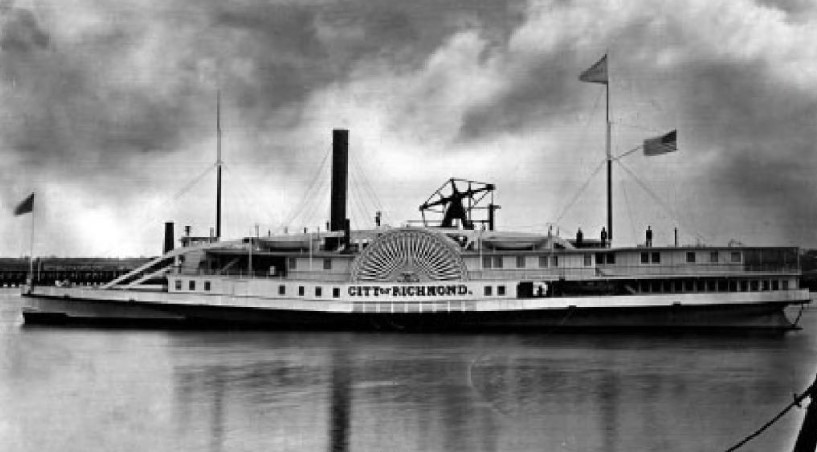
The City of Richmond, a sidewheel steamer which transported Union troops during the Civil War (Maine, c. late 1860s, public domain).

Lined up and ready to move out early on the morning of Wednesday, January 22, the 47th Pennsylvania Volunteers “gave three cheers for Camp Griffin” after listening to the 47th Pennsylvania’s Regimental Band play “Auld Lang Syne,” according to regimental historian Lewis Schmidt. Marching forth at 8:30 a.m., the men of B Company brought up the rear as the regiment slogged through snow and deep mud for three miles in order to reach the Vienna railroad depot in Falls Church, Virginia. Arriving at 9:30 a.m., they boarded a train and departed at 11 for Alexandria, Virginia where, a half hour later, they marched behind their band to the strains of “Yankee Doodle.”

Arriving at the docks nearby, they quickly began loading their equipment on the City of Richmond, a steamship which ultimately transported them along the Potomac River to the Washington Arsenal, where they disembarked sometime around 4 p.m. Marched from the arsenal area’s docks to the munitions storage area, regimental leaders replenished the ammunition supplies of the regiment, one company at a time—a process which took roughly two hours. They were then marched off for dinner and rest at the Soldiers’ Retreat in Washington, D.C.
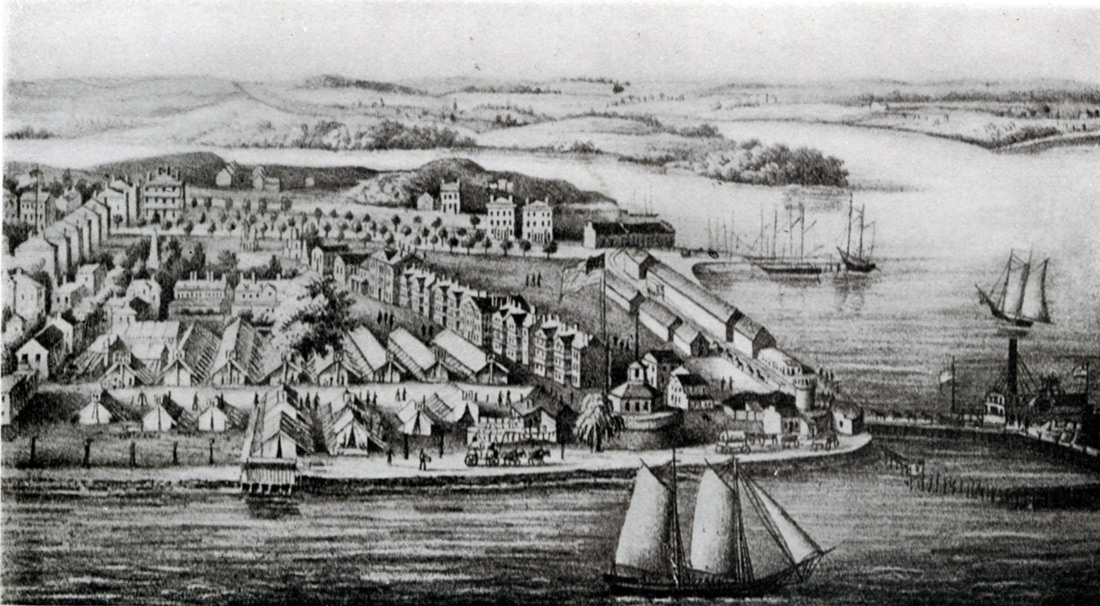
U.S. Naval Academy Barracks and temporary hospital, Annapolis, Maryland (c. 1861-1865, public domain).

The next day (January 23), the 47th Pennsylvanians reloaded their equipment onto and then boarded a Baltimore & Ohio Railroad train. Departing for Annapolis, Maryland at 2 p.m., they arrived around 10 p.m., were assigned quarters in barracks at the U.S. Naval Academy, and turned in for the night. They then spent that Friday through Monday (January 24-27) loading their equipment and other supplies onto the 210-foot steamship S.S. Oriental. Those preparations ceased on Monday, January 27, at 10 a.m., however, in order to make time for a very public dismissal of one member of the regiment—Private James C. Robinson—who was dishonorably discharged from the 47th Pennsylvania (effective on that same date). According to regimental historian Schmidt and letters home from members of the regiment:

“The regiment was formed and instructed by Lt. Col. Alexander ‘that we were about drumming out a member who had behaved himself unlike a soldier.’ …. The prisoner, Pvt. James C. Robinson of Company I, was a 36 year old miner from Allentown who had been ‘disgracefully discharged’ by order of the War Department. Pvt. Robinson was marched out with martial music playing and a guard of nine men, two men on each side and five behind him at charge bayonets. The music then struck up with ‘Robinson Crusoe’ as the procession was marched up and down in front of the regiment, and Pvt. Robinson was marched out of the yard.”

The 47th Pennsylvania Volunteers were transported to Florida aboard the steamship S.S. Oriental in January 1862 (public domain).

Reloading then resumed and, that same afternoon (January 27), the enlisted members of the 47th Regiment, Volunteer Infantry began to board the Oriental, followed by their superior officers. Ferried to that Philadelphia-built steamship by smaller steamers, they sailed away for America’s Deep South at 4 p.m., per the directive of Brigadier-General Brannan. They were headed for Florida which, despite its secession from the Union, remained strategically important to the Union due to the presence of Forts Taylor and Jefferson in Key West and the Dry Tortugas. Their ship, which was captained by Benjamin F. Tuzo, was rocked by rough seas for much of their trip; consequently, many members of the regiment suffered from intense seasickness—particularly as the Oriental made its way down the stormy coast of the Carolinas and passed the Bahamas and Great Abaco Island.

On February 2, Regimental Chaplain William DeWitt Clinton Rodrock gathered his flock together for Sunday services, which began with the tolling of the ship’s bell at 11 a.m., a selection of hymns performed by the Regimental Band, and an opening prayer and scripture reading by Rodrock. Following the regiment’s singing of “From All That Dwell Below the Skies” (accompanied by the band to the music of “Old Hundred”), Rodrock presented that week’s sermon, which was based on the Bible’s “Acts of the Apostles,” chapter 17, verse 23. The service then closed with the singing of “Lord Dismiss Us with Thy Blessing” and the Doxology, followed by Rodrock’s benediction.

That day and the next, the men’s spirits were boosted further by the sight of dolphins swimming alongside the Oriental.

Rendering of Fort Taylor, Key West, Florida (Harper’s Weekly, 1864, public domain).

Arriving in the waters off Key West, Florida at 8 p.m. on Monday, February 3, the 47th Pennsylvanians were forced to endure a waiting game aboard ship until a pilot could be brought aboard to bring the ship into a safe place in the harbor—a process the pilot began at 7 a.m. the next morning.

According to Schmidt, “The deck was crowded with the regiment’s men, with the band playing as they passed some of the men-at-war…. Arriving in the harbor at 8 AM, the bands playing ‘national songs’ and numerous onlookers, including many ‘colored women,’ along the shore watching the ship sail into port.”

“After disembarking at 9 AM on the dock about one mile west of Fort Taylor, the regiment marched down the main street of the city in their regular order of column of divisions, and stacked their weapons, waiting until the unit would be notified where to make camp…. At 12 in the afternoon, the men were ordered to fall in and stand to attention, and with their 23 member band playing and the ladies of Key West waving their handkerchiefs, and with quite a crowd of followers, the 1000 men marched to their new camp ‘one fourth mile out of the city, near the beach,’ across from the barracks of the 90th New York Regiment.”

Led to the area of Key West that is now known as Palm and White streets, the 47th Pennsylvania Volunteers were, in fact, initially housed just 350 feet from the ocean—a locale which may sound breathtakingly luxurious to the modern day reader until one realizes that the 47th Pennsylvanians’ first nights were “spent in blankets on the beach, with knapsacks for pillows”—a vexing, sandy state of affairs which persisted until their tents were unloaded and assembled on Thursday, February 6.

Even so, the members of the regiment still managed to make an early, favorable impression on Key West residents, including a New York Herald reporter who “commented on the fact that the 47th was equipped with the best weapons available, and was the best looking Volunteer Regiment he had ever seen.’’
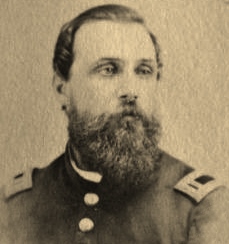
Adjutant and 1st Lieutenant Washington H. R. Hangen (c. 1862-1864, public domain).

This was in very large part due to the leadership of Colonel Tilghman H. Good, the founder and commanding officer of the 47th Pennsylvania Volunteer Infantry, who had been placed in charge not just of the 47th Pennsylvania, but of all of the men who had been assigned to serve under Brannan in Key West, including two volunteer regiments from New York and U.S. Army artillery units. Good would continue to perform this role until Brannan was able to reach Florida and assume command of his brigade. The 47th Pennsylvania’s Regimental Adjutant Washington H. R. Hangen was then also appointed as Adjutant General for Brannan’s brigade.

And those tents which took so long to be delivered and assembled? They were officially designated as “Camp Brannan” in honor of the brigadier-general who had requested that the 47th Pennsylvania be assigned to his command.

* NOTE: Three months after dropping the 47th Pennsylvania Volunteers off in Key West, the steamship Oriental ran aground and sank north of Cape Hatteras, North Carolina. Its boiler may still be seen from shore while walking along the beach at the Pea Island National Wildlife Refuge.


Sources:

1. Bates, Samuel P. History of Pennsylvania Volunteers, 1861-5, Vol 1. Harrisburg, Pennsylvania: B. Singerly, State Printer, 1869.

2. Faust, Drew G. “The Civil War soldier and the art of dying,” in The Journal of Southern History, Vol. 67, No. 1, pp. 3-38. Houston, Texas: Southern Historical Association (Rice University), 2001.

3. Gobin, John Peter Shindel. Personal Letters, 1861-1865. Northumberland, Pennsylvania: Personal Collection of John Deppen.

4. Helfrich, John G. Personal Letters, 1862. Mesa, Arizona: Personal Collection of Colin Cofield.

5. Schmidt, Lewis G. A Civil War History of the 47th Regiment of Pennsylvania Veteran Volunteers. Allentown, Pennsylvania: Self-published, 1986.

6. Wharton, Henry D. Letters from the Sunbury Guards. Sunbury, Pennsylvania: Sunbury American, 1861-1868.



October 1861: Drummer Boys, Disease, and Death

U.S. Soldiers’ Asylum Home Cemetery, Washington, D.C., circa 1861 (public domain).

“[T]he impact and meaning of the war’s casualties were not simply a consequence of scale, of the sheer numbers of Union and Confederate soldiers who died. Death’s significance for the Civil War generation derived as well from the way it violated prevailing assumptions about life’s proper end — about who should die, when and where, and under what circumstances.”

— Drew Gilpin Faust, Ph.D., President Emeritus and the Arthur Kingsley Porter University Professor, Harvard University and author, This Republic of Suffering: Death and the Civil War


Less than a month after leaving the great Keystone State for the Eastern Theater of America’s shattering Civil War, the members of the 47th Pennsylvania Volunteer Infantry encountered their most fearsome foe — the one they would consistently find the most difficult to defeat throughout the long war — disease.

It was an enemy, in fact, that turned out to be the deadliest not just for the 47th Pennsylvania Volunteers, but for the entire Union Army as it fought to preserve the nation’s Union while ending the practice of slavery across the United States. Per The Gilder Lehrman Institute of American History, sixty-two percent of all Union soldiers who died during the American Civil War were felled by disease, rather than by the shrapnel-spewing blasts of Confederate cannon or the accurately targeted minié balls of CSA rifles.

Surprising as this may seem to this century’s students of American History, it shouldn’t be, according to infectious disease specialist Jeffrey S. Sartin, M.D.:

“The American Civil War represents a landmark in military and medical history as the last large-scale conflict fought without knowledge of the germ theory of disease. Unsound hygiene, dietary deficiencies, and battle wounds set the stage for epidemic infection, while inadequate information about disease causation greatly hampered disease prevention, diagnosis, and treatment. Pneumonia, typhoid, diarrhea/dysentery, and malaria were the predominant illnesses. Altogether, two-thirds of the approximately 660,000 deaths of soldiers were caused by uncontrolled infectious diseases, and epidemics played a major role in halting several major campaigns. These delays, coming at a crucial point early in the war, prolonged the fighting by as much as 2 years.”

With respect to the 47th Pennsylvania Volunteers, the two diseases which wreaked such devastating havoc early on were Variola (smallpox) and typhoid fever.

Variola

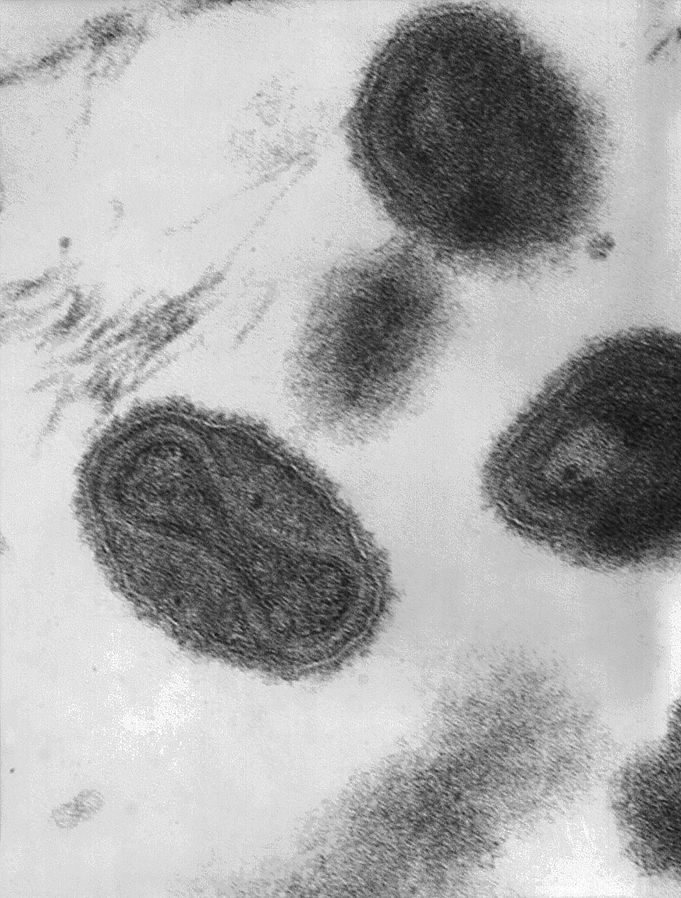
A transmission electron micrograph of an 1849 strain of Variola shows several smallpox virions. Note the “dumbbell-shaped” structure. Located inside the virion, this is the viral core, and contains the DNA of the virus (Temple University, public domain via Wikipedia).

Variola, more commonly known as “smallpox,” was an acute infectious disease that, even in the mildest of cases in 1861, was highly contagious. Notable for the high fever it caused, it also produced individual, boil-like eruptions across the human body. Known as “pocks,” these eruptions would quickly become fluid-filled pustules — even with the weakest strains of the disease — that would, if sufferers survived, eventually burst, leaving them badly scarred.

If, however, the soldier contracted the most virulent form of the disease — Variola confluens — as happened with at least one member of the 47th Pennsylvania — the suffering and likelihood of death was much, much greater. Far more severe than the strain that would have typically sickened the average child or adult during the mid-1800s, Variola confluens produced patches of pustules, rather than individual pocks. Forming on the face in such large swaths, the skin of the soldier who had been unfortunate to contract this strain of the disease would have appeared to have been burned or blistered. In addition to the horrific facial disfigurement, that soldier would also likely have experienced hair loss, severe pain and damage to his mucous membranes, mouth, throat, and eyes as the fever ravaged his body and continued to climb. If the disease devolved into the hemorrhagic phase prior to his death, the pocks on his face and mucous membranes would then also have begun to bleed.

Most likely exposed to the disease sometime while they were encamped in Virginia with their regiment, the first of the 47th Pennsylvanians to contract Variola would not initially have noticed any symptoms during this disease’s ten to fourteen-day incubation period. The first symptoms they would have experienced would have been due to rigor (sudden chills as the onset of fever began, alternating with shivering and sweating). As this primary fever increased, their temperatures would have risen to 103° or 104° Fahrenheit or higher over a two-day period, quickening the pulse and causing intense thirst, headache, constipation, vomiting, and back pain. As their conditions worsened, they might also have experienced convulsions and/or a redness on their abdomens or inner thighs — markings which might have appeared to be a rash of some sort or the beginnings of scarlet fever, but which were, in fact, a series of small, flat, circular spots on the body caused by bleeding under the skin and known as “petechiae.”

It would only have been on roughly the third day, post-incubation period, that these same men would have noticed that their faces were erupting with boils, but even then, they might have missed this sign because such pocks typically appeared as a single patch of redness on the sufferer’s forehead, near the roots of the hair. Within hours of this first eruption, however, the soldiers would most certainly have realized that something was wrong as they began scratching to relieve the itching on patches that had spread across their faces and bodies — particularly when the pocks began to fill with fluid and swelled to pea-sized bumps.

Likely sent to the regiment’s hospital sometime around this time, these 47th Pennsylvanians would have been transferred to the eruptive fever hospital on the Kalorama Heights in Georgetown before the week was out because, by day eight or nine, their skin would have become inflamed and swollen as the fluid in the pocks changed from clear to yellow, began to smell, and spread to their mouths, throats, noses, and eyes, putting their breathing and vision at risk. Increasingly hoarse, despite the increase in saliva they were experiencing, their bodies would then also have been overtaken by secondary fever, followed possibly by delirium and then coma.

If they somehow managed to survive until the disease’s latter phase, the pustules would have eventually dried up (typically on the twelfth day, post-incubation); if they didn’t, death most likely would have ensued due to myocardial insufficiency caused by the weakening of their heart muscles.

Typhoid Fever

An image of Salmonella typhi, the bacteria which cause typhoid fever (U.S. Armed Forces. Institute of Pathology, public domain).

Often confused with the insect-borne typhus fever, typhoid fever is caused by bacteria. Poorly understood well into and beyond the mid-nineteenth century, despite having sickened countless numbers of individuals since the time of Hippocrates, according to American University historian Thomas V. DiBacco, typhoid fever’s method of transmission remained unidentified until 1856. That year, it finally dawned on scientists that fecal matter contaminated with Salmonella typhosa, one of the strains of bacteria now known to cause food poisoning, was at the root of the “persistently high fever, rash, generalized pains, headache and severe abdominal discomfort,” and intestinal bleeding of the patients physicians were failing to save.

Spread by the unsanitary conditions so common to the close living quarters shared by America’s Civil War-era soldiers, as well as by their respective regimental company cooks who were often forced to prepare meals with unclean hands when their regiments stopped briefly during long marches, the typhoid fever-causing Salmonella typhosa bacterium would typically enter a soldier’s body “through food, milk or water contaminated by a carrier,” but might also have been contracted just as easily via a bite from one of the many flies swarming around a regiment’s latrine facilities or horses.

And, because the “worst manifestations” of the disease did not appear until two or three weeks into an individual’s illness, according to DiBacco, typhoid fever was able to spread like wildfire not just during its incubation period, but even when soldiers were aware that others within their respective companies were ill because “typhoid victims were disposed to think the malady less serious as time went by.”

It is this latter fact alone that, perhaps, explains why outbreaks of typhoid fever continued to plague the 47th Pennsylvania throughout the duration of the war when Variola did not.

The First ”Men” to Die

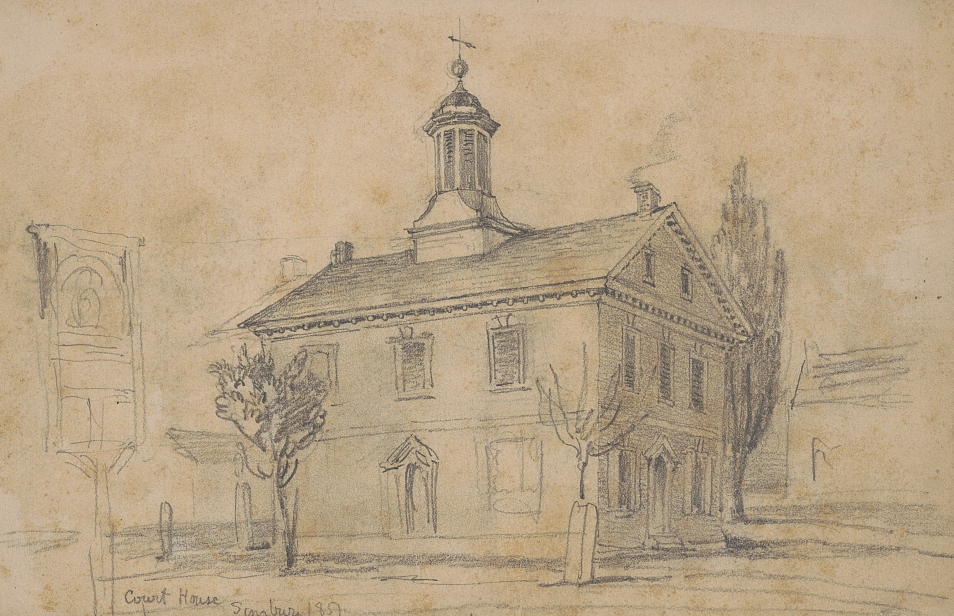
Court House, Sunbury, Pennsylvania, 1851 (James Fuller Queen, U.S. Library of Congress, public domain).

The first “man” to die from the 47th Pennsylvania Volunteer Infantry was John Boulton Young, a thirteen-year-old drummer boy who was known affectionately as “Boulty” (alternatively, “Boltie”). A member of the regiment’s C Company, he served under Captain John Peter Shindel Gobin, but was known to, and beloved by, the majority of the roughly one thousand men who served with the 47th.

Born on 25 September 1848 in Sunbury, Pennsylvania as the second oldest son of Pennsylvania natives, Michael A. and Elizabeth (Boulton) Young, Boulty was still in school at the time of his enlistment for Civil War military service in his hometown on 19 August 1861. He clearly lied about his age on military paperwork that day, indicating that he was fourteen, rather than twelve — a fiction which was maintained by Gobin and his fellow C Company officers throughout the boy’s tenure of service.

* Note: According to historians at the American Battlefield Trust, “For most of the war, the minimum enlistment age in the North was legally held at 18 for soldiers and 16 for musicians, although younger men could enlist at the permission of their parents until 1862. In the South, the age limit for soldiers stayed at 18 until 1864 when it was legally dropped to 17.”

Just four feet tall at the time of his official muster in at the rank of musician (drummer boy) at Camp Curtin in Harrisburg on 2 September, Boulty was so small that his superiors needed to customize both his uniform and his drum to make it easier for him to function as a member of the 47th Pennsylvania.

The Kalorama Eruptive Fever Hospital (also known as the Anthony Holmead House in Georgetown, D.C. after it was destroyed in a Christmas Eve fire in 1865 (U.S. Library of Congress, public domain).

After completing basic training and traveling by train with his regiment to the Washington, D.C. area in mid-September, Boulty subsequently endured several long marches, including at least one undertaken in a driving rain. By late September or early October of 1861, Boulty had contracted such a challenging case of Variola (smallpox) that regimental surgeons ordered his superiors to ship him from Virginia, where the 47th Pennsylvania was encamped as part of the Army of the Potomac, to the eruptive fever hospital on the Kalorama Heights in Georgetown, District of Columbia.

Diagnosed by the physicians there with Variola confluens, the most virulent form of the disease, he died at that hospital on 17 October 1861. His body was then quickly prepared and transported for burial. Initially interred in Washington, D.C. at the Soldiers’ Asylum Cemetery (now known the United States Soldiers’ and Airmen’s Home Cemetery), his remains were disinterred in early 1862, and returned to Pennsylvania for reburial at Penn’s Cemetery in his hometown of Sunbury.

To learn more about Boulty’s life before and during the Civil War, as well as what happened to the surviving members of his family, read his biographical sketch, The First “Man” to Die: Drummer Boy John Boulton Young.

Alfred Eisenbraun

Allentown, circa 1840 (public domain).

The second “man” from the 47th Pennsylvania to die was also a drummer boy — fifteen-year-old Alfred Eisenbraun, who served with the regiment’s B Company. A native of Allentown, Pennsylvania who was born in June of 1846, he was a son of Johann Daniel Eisenbraun, a noted Frakturist and tombstone carver who had emigrated from Württemberg, Germany to the United States in 1820, and Lehigh County, Pennsylvania native Margaret (Troxell) Eisenbraun.

Unlike “Boulty,” however, Alfred Eisenbraun had already left his studies behind, and had joined his community’s local workforce in order to help support his family. Employed as a “tobacco stripper,” he separated tobacco leaves from their stems before stacking those leaves in piles for the creation of cigars or chewable tobacco. As he did this, he likely would have been “breathing foul air, in rooms bare and cold or suffocatingly hot”, possibly “in a damp basement, musty with mould [sic] or lurking miasma,” according to Clare de Graffenried, a 19th-century U.S. Bureau of Labor employee who researched and wrote extensively about child labor.

So, it comes as no surprise that a boy in Eisenbraun’s situation would have viewed service with the military as a vast improvement over his existing job — especially if the pay was higher — which it most certainly was. Just barely fifteen when he enrolled for Civil War service in his hometown on 20 August 1861, Eisenbraun officially mustered in at the rank of musician (drummer boy) with the 47th Pennsylvania’s Company B at Camp Curtin on 30 August. Military records at the time described him as being five feet, five inches tall with black hair, black eyes and a dark complexion. His commanding officer was Captain Emanuel P. Rhoads.

Like Boulty, Eisenbraun completed basic training, traveled by train with his regiment to the Washington, D.C. area in mid-September, and then endured several long marches, including the same one that was undertaken in a driving rain. And, like Boulty, Eisenbraun also fell ill in late September or early October.

The Union Hotel in Georgetown, District of Columbia became one of the U.S. Army’s general hospitals during the American Civil War (image circa 1861-1865, U.S. Library of Congress, public domain).

But unlike Boulty, Eisenbraun was felled by typhoid fever. According to regimental historian Lewis Schmidt, the teen “had been sick almost from the time the regiment left Camp Curtin” in mid-September. After initially receiving treatment from regimental physicians through at least mid-October, he was sent back to the Washington, D.C. area to receive more advanced care. Per Schmidt, two of Eisenbraun’s fellow B Company members “visited Alfred at the fort on the 21st … and found him getting better, pleased to see them, and happy to engage in some conversation.”

But on Thursday morning, 24 October, after Captain Rhoads headed over to the fort’s hospital nearby, he was informed that Eisenbraun “and all the other sick men had been moved to the General Hospital in Georgetown.” Assuming that Eisenbraun’s condition had improved, since he’d apparently been deemed well enough to travel, Rhoads returned to his camp site, confident that he’d see the boy again — but he was wrong.

Eisenbraun, it turned out, had been transported to the former Union Hotel in Georgetown, which had been converted into one of the U.S. Army’s general hospitals. He died there from typhoid fever on 26 October 1861. Like Boulty, he was laid to rest at the Soldiers’ Asylum Cemetery in Washington, D.C.; unlike Boulty, however, his remains were never brought home.

To learn more about Alfred’s life before and during the Civil War, read his biographical sketch, Alfred Eisenbraun, Drummer Boy – The Regiment’s Second “Man” to Die.

The Third to Die: Sergeant Franklin M. Holt

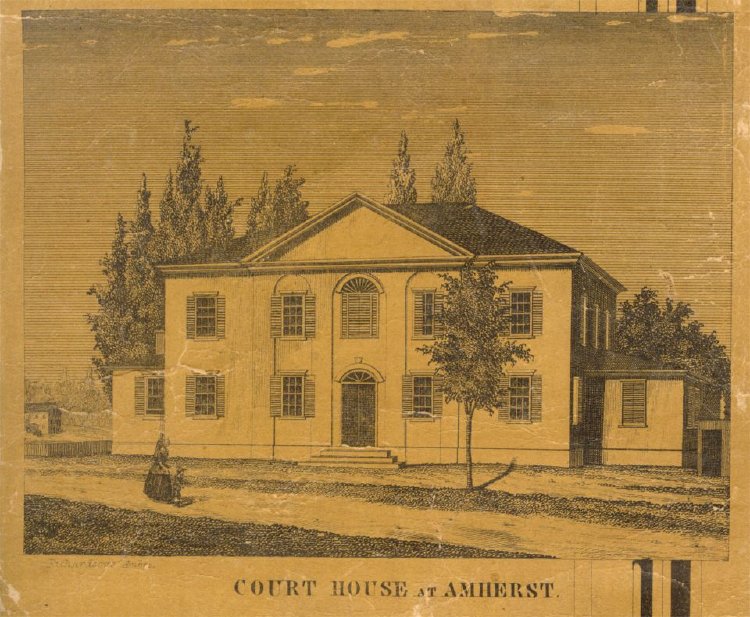
Court House, Amherst, New Hampshire, circa 1858 (public domain).

Franklin M. Holt had already distinguished himself before becoming the first “true man” from the 47th Pennsylvania’s rosters to die. The regiment’s third fatality, he was also one of a handful of non-Pennsylvanians serving with this all-volunteer Pennsylvania regiment.

Born in New Hampshire in 1838, Frank Holt was a son of Cambridge, Massachusetts native, Edwin Holt, and Mont Vernon, New Hampshire native, Susan (Marden) Holt. A farmer like his father, he left his home state sometime around the summer of 1860, and took a job as a “map agent” in Monmouth County, New Jersey. But by the spring of 1861, he had relocated again, and had adopted the Perry County, Pennsylvania community of New Bloomfield as his new hometown.

That same spring, when President Abraham Lincoln issued his call for seventy-five thousand volunteers to help defend the nation’s capital following the fall of Fort Sumter to troops of the Confederate States Army, Holt enrolled with Company D of the 2nd Pennsylvania Infantry, completing his Three Months’ Service from 20 April to 26 July 1861 under the leadership of Henry D. Woodruff.

Realizing that the fight to preserve America’s Union was far from over, Holt re-enlisted in the 47th Regiment, Pennsylvania Volunteer Infantry’s D Company, which was also commanded by Captain Woodruff. Following his re-enrollment on 20 August in Bloomfield, he then re-mustered at Camp Curtin on 31 August at the rank of sergeant and, like drummer boys John Boulton Young and Alfred Eisenbraun, completed basic training before traveling with the regiment to the Washington, D.C. area for service with the Army of the Potomac.

Enduring a climate of torrential rain and pervasive, persistent dampness during his early days of service, Holt ultimately also fell ill with Variola (smallpox) and, like drummer boy Young who had also contracted the disease, he was transported to the eruptive fever hospital on the Kalorama Heights in Georgetown, District of Columbia, where he was treated by at least one of the same physicians who treated Boulty. Despite having apparently been diagnosed with a less severe form of the disease (according to military records which noted that Holt was sickened by Variola rather than the Variola confluens that felled Boulty), Sergeant Holt died at Kalorama on 28 October 1861.

“Kind, gentlemanly courteous, and honest in all his transactions,” according to the New Bloomfield Democrat, Holt had also “won for himself the esteem of all who knew him” prior to his untimely death. Like the two young drummer boys before him, he too was buried quickly at the Soldiers’ Asylum Cemetery in Washington, D.C. Although his remains were also never returned home, Holt was ultimately honored by members of his family, who erected a cenotaph in his honor at the Meadow View Cemetery in Amherst, New Hampshire.

To learn more about Frank’s life before and during the Civil War, read his biographical sketch, Holt, Franklin M. (Sergeant).

To learn more about Civil War Medicine, in general, as well as the battle wounds and illnesses most commonly experienced by members of the 47th Pennsylvania Volunteers, please visit the Medical section of this website.


Sources:

  1. Affleck, M.D., J. O. Smallpox,” in “1902 Encyclopedia.” Encyclopedia Britannica, 9th and 10th editions (online), 2005-2019.
  2. Alfred Eisenbraun (obituary). Allentown, Pennsylvania: Lehigh Register, 30 October 1861.
  3. Alfred Eisenbraun (obituary), in “Gestörben.” Allentown, Pennsylvania: Der Lecha Caunty Patriot, 6 November 1861.
  4. Allen Eisenbraun (death notice), in “Deaths of Soldiers.” Washington, D.C.: The Evening Star, 28 October 1861.
  5. Barker, M.D., Lewellys Franklin. Monographic Medicine, Vol. II: The Clinical Diagnosis of Internal Diseases,” p. 431 (“Variola confluens”). New York, New York: D. Appleton and Company, 1916.
  6. Bates, Samuel P. History of Pennsylvania Volunteers, 1861-5, vol.1. Harrisburg, Pennsylvania: B. Singerly, State Printer, 1869.
  7. Burial Ledgers (Eisenbraun, Alfred; Holt, Franklin M.; Young, J. Bolton), in Records of The National Cemetery Administration and U.S. Departments of Defense and Army (Quartermaster General), 1861. Washington, D.C.: U.S. National Archives and Records Administration.
  8. Casualties and Costs of the Civil War.” New York, New York: The Gilder Lehrman Institute of American History.
  9. Civil War General Index Cards (Eisenbraun, Alfred and Eisenbrown, Allen), in Records of the U.S. Department of the Army. Washington, D.C.: U.S. National Archives and Records Administration and Fold3: 1861.
  10. Civil War Veterans’ Card File, 1861-1865 (Eisenbraun, Alfred; Holt, Franklin M.; Young, J. Bolton). Harrisburg, Pennsylvania: Pennsylvania State Archives.
  11. “Death of a Young Soldier” (obituary of John Boulton Young). Bloomsburg, Pennsylvania: Star of the North, Wednesday, 30 October 1861 (reprinted from the Sunbury Gazette).
  12. “Deaths of Soldiers” (death notice for John Boulton Young). Washington, D.C.: The National Republican, 18 October 1861.
  13. de Graffenried, Clare. “Child Labor,” in Publications of the American Economic Association, Vol. 5, No. 2. New York, New York: March 1890 (accessed 22 March 2016).
  14. DiBacco, Thomas V. When Typhoid Was Dreaded.” Washington, D.C.: The Washington Post, 25 January 1994.
  15. “The Drummer Boy’s Monument” (monument erected to John Boulton Young). Sunbury, Pennsylvania: Sunbury American, 6 February 1864.
  16. Fabian, Monroe H. John Daniel Eisenbrown, in “Pennsylvania Folklife Book 62,” in Pennsylvania Folklife Magazine, Vol. 24, No. 2. Lancaster, Pennsylvania: 1975.
  17. Faust, Drew G. The Civil War soldier and the art of dying,” in The Journal of Southern History, Vol. 67, No. 1, pp. 3-38. Houston, Texas: Southern Historical Association (Rice University), 2001.
  18. Holt Eulogy. New Bloomfield, Pennsylvania: New Bloomfield Democrat, 1861. Inkrote, Cindy. “Civil War drummer boy was different kind of hero.” Sunbury, Pennsylvania: The Daily Item, 4 October 2009.
  19. Letters of John Peter Shindel Gobin, 1861-1900. Various Collections (descendants of the 47th Pennsylvania Volunteers, et. al.).
  20. “Registers of Pennsylvania Volunteers, 1861-1865: 47th Regiment” (Companies B, C, and D) in Records of the Department of Military and Veterans’ Affairs (Record Group 19, Series 19.11). Harrisburg, Pennsylvania: Pennsylvania State Archives.
  21. Sartin, M.D., Jeffrey S. Infectious diseases during the Civil War: The triumph of the ‘Third Army,’ in Clinical Infectious Diseases, Vol. 16, No. 4, pp. 580-584. Cary, North Carolina: Oxford University Press, April 1993.
  22. Schmidt, Lewis. A Civil War History of the 47th Regiment of Pennsylvania Veteran Volunteers. Allentown, Pennsylvania: Self-published, 1986.
  23. U.S. Census. Washington, D.C. and Pennsylvania (Allentown and Sunbury, Pennsylvania; Amherst, New Hampshire; Monmouth, New Jersey): 1840-1930.
  24. U.S. Registers of Deaths of Volunteers, 1861 (Eisenbraun/Eisenbraum, Alfred; Holt, Franklin/Frank M; Young, J. Bolton/Jno. B.). Washington, D.C.: United States Army and U.S. National Archives and Records Administration.