
An adept wordsmith and astute observer of the world around him, Henry D. Wharton had already built a successful career as a journalist and newspaper editor by the time the United States was beginning its descent into disunion and civil war.
He would go on to become an unofficial war correspondent, chronicling the war’s impact on one history-making, but often overlooked, Union Army regiment. Memorizing the details of what he was seeing, hearing, smelling, tasting, and feeling, he transferred those details to any scrap of paper that he could find, writing furiously, but thoughtfully, from his vantage point as a drummer boy-turned-company clerk with the 47th Pennsylvania Volunteer Infantry.
Mailed to his hometown newspaper from regimental duty stations as far away as Florida and Louisiana, his letters “brought the war home” to the front doors of Pennsylvanians, kindling the fires of their imaginations by recounting grueling marches and fierce battles, while also providing his readers with moments of respite from their worries about their fathers, brothers and sons as he described the frequently mundane periods of daily life as an infantryman.
More than one hundred and sixty years after he first set pen to paper, his words still hold the power to transport readers across distance and time.
Formative Years
Born in Sunbury, Northumberland County, Pennsylvania on 28 November 1826, Henry D. Wharton was the eldest son of Charles Doughty Wharton, Sr. and Maria (Donnel or Donnell) Wharton. Various sources indicate that Henry’s middle name was either Doughty or Donnel/Donnell.
A longtime member of the Presbyterian Church, he was also active with the church choir.
Trained as a printer by Colonel Best, Henry D. Wharton became editor of the Intelligencer, a newspaper serving the community of Danville in Montour County, Pennsylvania. He honed his journalistic skills there for a time before returning home to take a position as a compositor with the Sunbury American.
American Civil War
On 23 April 1861, Henry Wharton’s life changed from one of service to his community to one serving an entire nation when he became one of Pennsylvania’s earliest responders to President Abraham Lincoln’s call for 75,000 troops to help defend the nation’s capital, following Fort Sumter’s surrender to Confederate forces.

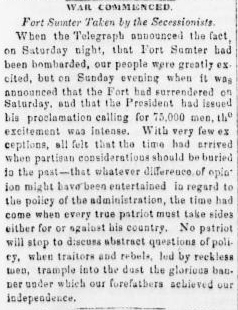
Sunbury American, 20 April 1861
Wharton enrolled for military service from Sunbury, and mustered in as a field musician under Captain Charles J. Bruner with Company F of the 11th Regiment, Pennsylvania Volunteer Infantry. Engaged in the thick of the fighting during the Battle of Falling Waters in Virginia, the 11th Pennsylvania also saw action at Martinsburg and Bunker Hill. Heralded for their bravery, the regiment’s members were designated as “the Bloody Eleventh” by Governor Andrew Curtin, Pennsylvania’s fifteenth governor and the man who would later establish the Keystone State’s system of soldiers’ and orphans’ schools to care for the children of military families whose lives had been shattered by the war. Company F, also known as the “Sunbury Guards,” was largely composed of men from Sunbury and surrounding areas in Northumberland County. Many of F Company’s men promptly re-enlisted following completion of their initial Three Months’ Service, opting to stay together with the Sunbury Guards when the company reformed and was incorporated into the 47th Regiment of the Pennsylvania Volunteers as Company C. (Company C was also awarded the honor of bearing and protecting the regimental and federal colors.)
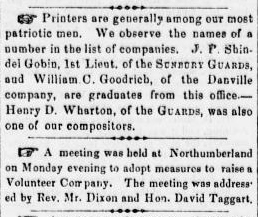 Sunbury American, 27 April 1861
Henry D. Wharton was one of those who chose to re-enlist. After completing his Three Months’ Service with the 11th Regiment, Wharton mustered out at Harrisburg in Dauphin County on 1 August 1861.
He then re-upped for a three-year term of service. Enrolling again from Sunbury on 19 August 1861, he then mustered in again at Camp Curtin with fellow members of the Sunbury Guards just a short time later (on 2 September 1861). This time, the Sunbury Guards joined Company C of a newly formed regiment, the 47th Regiment, Pennsylvania Volunteer Infantry.
During his time with the 47th Pennsylvania Volunteers, Wharton became widely known by readers of the Sunbury American as “H. D. W.,” the author of regular letters to the editor which recapped the activities of the Sunbury Guards (Company C). His riveting prose conveyed the gallant exploits of comrades engaged in small skirmishes and major battles across the South while telegraphing his sorrow, as peach fuzz-faced boys were cut down by typhoid fever or cannon fire.
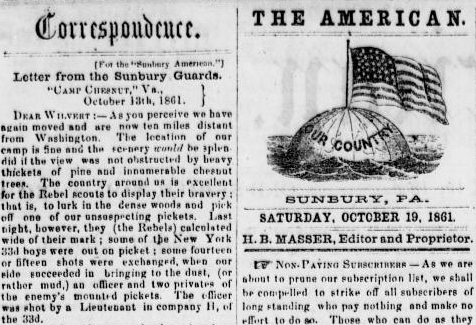
Henry D. Wharton’s Civil War letters became so popular with readers of the Sunbury American that they were often featured prominently on the front page or with the publication’s masthead (public domain).
Taking on additional duties as a clerk for Brigadier-General John Milton Brannan (his commanding officers’ commanding officer), his letter writing lessened in frequency as the war’s first year rolled into its second, as evidenced by this brief mention in the 18 January 1862 edition of the Sunbury American:
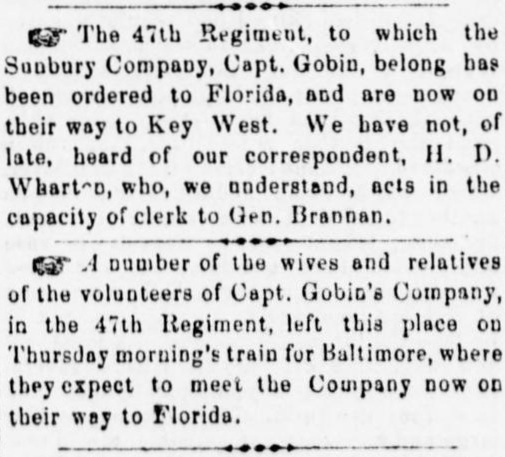
As the 47th Pennsylvania was ordered to Florida and Sunbury families bid their sons and husbands farewell, Henry Wharton aided Brigadier-General John Brannan (Sunbury American, 18 January 1862, public domain).
Fortunately for historians, genealogists and descendants of the 47th Pennsylvanians, Henry Wharton’s correspondence and war reporting resumed its regular frequency. His words, displaying the genuine goodness for which he was known throughout his life, became a trusted resource for the loved ones of 47th soldiers who were worrying and waiting back home in Pennsylvania.
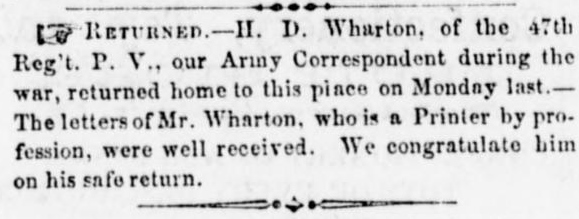
Promoted from Company C to the rank of full commissary sergeant for the entire 47th Regiment on 1 July 1865, Henry D. Wharton was finally permitted to muster out out just several months shy of the Civil War’s end. Although Bates’ History of Pennsylvania Volunteers, 1861-5 indicates that he mustered out from Charleston, South Carolina with his regiment on 25 December 1865, an October 1865 edition of the Sunbury American was already reporting the glad tidings of “his safe return”:
A Comrade’s Help
A report from the first session of the 43rd U.S. Congress (1873-74) confirms that Wharton did, in fact, muster out in October of 1865. During that session of Congress, the members of the U.S. House of Representatives’ Committee on Military Affairs were asked to consider bill H.R. 1245, “in relation to the case of Henry D. Wharton, late commissary-sergeant Forty-seventh Regiment Pennsylvania Veteran Volunteers, on application for pay of installment of bounty…. That, after having served two years under the first three years’ enlistment, he re-enlisted at Key-West, Fla., where his regiment, the Forty-Seventh Pennsylvania Veteran Volunteers, was then stationed, for three years or during the war, as a veteran. This re-enlistment was in accordance with General Orders No. 191 and No. 305, of the War Department. On the 12th day of October, 1865, he was honorably discharged from the service of the United States….” Supporting documentation of his honorable discharge was provided by E.D. Townsend, Assistant Adjutant-General, and W. Scott Johnston, First Lieutenant and Adjutant 47th Pennsylvania Veteran Volunteers. The following information provided by these officers clears up the confusion:
There were then due him three installments of bounty, viz, 6th, 7th, and 8th. His last discharge was given at Charleston, S.C., from which place he was ordered to Hilton Head, S.C., to receive pay and bounty due him. The paymaster paid him all that was due for wages and clothing account, and the sixth and eighth installments of veteran bounty, but declined paying him the seventh installment of bounty that was due him. Your committee can see no reason why the seventh installment was withheld when the eighth was paid, and therefore recommend passage of this bill for relief.
Return to Civilian Life
Returning home at war’s end, Henry Wharton gravitated toward the public service arena, where his skills as a printer, writer, editor, and manager were increasingly in demand. Throughout the Reconstruction era and remaining years of his life, he wielded his talents on behalf of the federal government’s Washington, D.C. printing office, U.S. Departments of the Interior (Washington) and Treasury (Philadelphia) and U.S. Mint (Philadelphia). He also served as a clerk in Sunbury for The Honorable John Black Packer.
On 4 May 1869, Henry D. Wharton married Pennsylvania native, Harriet Sophia Raymond. Born in 1834, Hattie was the daughter of William Newton Raymond (1808-1882) and Mary (Camp) Raymond (1812-1901). By 1860, Hattie was residing with her parents and siblings in Hyde Park, Luzerne County, where her father was employed as a merchant.
Sadly, Hattie widowed Henry early. She passed away in Philadelphia on 29 June 1876, and was interred with her parents, William and Mary (Camp) Raymond, and her younger brother Charles Henry Raymond (1836-1837), at the Nicholson Cemetery in Nicholson, Wyoming County, Pennsylvania.
Two years later, Henry married again. On 19 September 1878, he wed Philadelphia, Pennsylvania native, Mary A. Kinsler, at the First Moravian Church in Philadelphia.
Despite being married twice, though, Henry Wharton had no children of his own; however, he and his second wife did help to raise Willie and Mary A. Grant, the children of Henry’s late sister, Amelia (Wharton) Grant (1839-1875).
Final Years
Tragically, after surviving the most precarious of Civil War moments, and during a time that he should have been enjoying his twilight years, Henry D. Wharton’s unique voice was nearly silenced by a criminal act. On 15 March 1895, at the age of sixty-nine, he was attacked and beaten severely during a burglary at his place of employment. The Saturday, 16 March edition of The Times of Philadelphia provided these details:
Henry D. Wharton, who is employed as a watchman for the Globe Mill Company, at Forty-eighth and Lancaster avenue, was surprised last night on his rounds and shot at by some burglars who had entered the works. The shot, however, was wide of the mark, and the burglars seeing that they were cornered, came at Watchman Wharton from behind and clubbed him into insensibility.
He was found by some neighbors, who notified the police who scoured the vicinity for his assailants, but without success. The injured watchman was taken to the Presbyterian Hospital.
Thankfully, he survived and was able to return home.
Death and Interment
Three years later, however, Henry D. Wharton suffered an episode of apoplexy (on 1 February 1898). Following his death on 4 February, his widow, Mary A. Wharton, filed for a U.S. Civil War Widow’s Pension (on 28 February 1898).
A Philadelphia church burial ledger subsequently documented Henry D. Wharton’s date of death as 4 February 1898 and his place of burial as Section D, Lot 639 at Philadelphia’s Monument Cemetery. His Philadelphia death certificate also confirmed that same interment location. Now a defunct burial ground, latter day cemetery records note that the remains of all of the individuals who had been interred there were transferred to the Lawnview Cemetery in Rockledge, Montgomery County in 1956.
Although the precise resting place of Henry Wharton remains unidentified, a memorial has been created for him on Find a Grave as a tribute to his service to the nation.
To read a sample of his letters home during his Three Months’ Service, click here: Henry’s Letters, 11th Regiment, Pennsylvania Volunteers (Sunbury Guards, April-July 1861).
To read a sample of his letters home during his two, three-year terms of service with the 47th Pennsylvania, click here: Henry’s Letters, 47th Regiment, Pennsylvania Volunteers (Sunbury Guards, 1861-1865).
Sources:
- “A Watchman’s Peril: Henry D. Wharton Is Shot At and Then Clubbed Into Insensibility.” Philadelphia, Pennsylvania: The Times, 16 March 1895.
- Bates, Samuel P. History of Pennsylvania Volunteers, 1861-5, vol. 1. Harrisburg, Pennsylvania: B. Singerly, State Printer, 1869.
- Death Certificate (Henry D. Wharton, City of Philadelphia, Philadelphia County, Pennsylvania, date of death: 4 February 1898). Philadelphia, Pennsylvania: Archives, City of Philadelphia.
- Dyer, Frederick H. A Compendium of the War of the Rebellion, p. 1589. Des Moines, Iowa: The Dyer Publishing Company, 1908.
- Henry D. Wharton, in “Report No. 822,” in Reports of the Committees of the House of Representatives for the First Session of the Forty-Third Congress, 1873-74 in Five Volumes. Washington, D.C.: U.S. Congress.
- Letters home from”H.D.W.” and the “Sunbury Guards.” Sunbury, Pennsylvania: Sunbury American, 1861-1865.
- Schmidt, Lewis. A Civil War History of the 47th Regiment of Pennsylvania Veteran Volunteers. Allentown, Pennsylvania: Self-published, 1986.
- “The History of the Forty-Seventh Regt. P. V.” Allentown, Pennsylvania: The Lehigh Register, 20 July 1870.
- U.S. Civil War Pension Index (application no.: 1128782, certificate no.: 922449, filed from Pennsylvania on 30 August 1892 by the veteran, Henry D. Wharton, and his attorney, William J. Wray; application no.: 671283, certificate no.: 475667, filed from New Jersey on 26 February 1898 by the veteran’s widow, Mary A. Wharton). Washington, D.C.: U.S. National Archives and Records Administration.
 47th Pennsylvania Volunteers
You must be logged in to post a comment.