1861
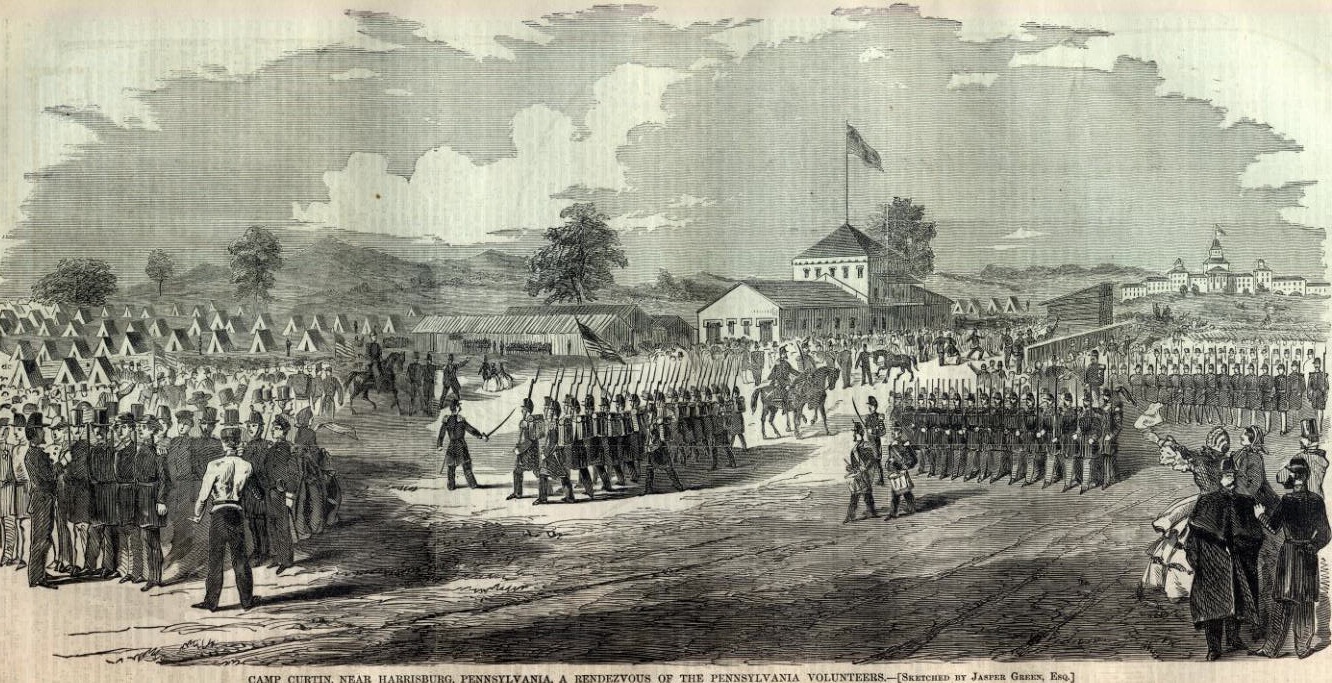
Camp Curtin (Harper’s Weekly, 1861).
Camp Curtin, Harrisburg, Dauphin County (mustering in and basic training in light infantry tactics, mid-August 1861 – 20 September 1861)
Transportation of the 47th Regiment, Pennsylvania Volunteer Infantry to the Washington, D.C. area via:
- North Central Railroad (Harrisburg to York, Pennsylvania and Baltimore, Maryland, 1:30-11 p.m., 20 September 1861);
- Baltimore & Ohio Railroad (Baltimore to Washington, D.C. 2:30-9 a.m., 21 September 1861)
Soldiers’ Retreat, Washington, D.C. (meals, rest and march readiness preparations from 10 a.m.-4 p.m. followed by march to Camp Kalorama from 4-5 p.m., 21 September 1861)
Camp Kalorama, Georgetown, Washington, D.C. (21-27 September 1861)
Camp Advance, Virginia (encampment at Advance following march by way of Camp Lyon, Maryland, 27-28 September 1861)
Fort Ethan Allen, Virginia (28 September 1861 – 6 October 1861):
- While encamped near Fort Ethan Allen, individual companies from the 47th Pennsylvania Volunteers were ordered to picket duty within four to five miles of camp, as well as drilled daily and inspected regularly;
- During the evening of 6 October, the regiment broke camp, and marched for Camp Griffin, Virginia beginning at 3 a.m. on 7 October. As they progressed, they pushed back Confederate pickets along the entire route to Lewinsville, Virginia.
Prospect Hill, Lewinsville, Virginia (7-9 October 1861):
- At 8 a.m. on 7 October 1861, the 47th Pennsylvania Volunteers formed a battle line on Prospect Hill behind Lewinsville, Virginia. Each wing of the 47th supported Union artillery batteries posted on either side of the regiment;
- With Rebel pickets in sight, but no attack made, the 47th Pennsylvania Volunteers fortified the artillery batteries from 10 a.m. until ordered to rest from sundown until daylight. Felling trees, they built a five-mile-long road, dug rifle pits, and built earthen breastworks around the placements of Union cannon.
Camp Griffin, Virginia (also known as “Camp Big Chestnut”; 9 October – 22 January 1862)
- Report of Major-General George B. McClellan Upon the Organization of the Army of the Potomac, and Its Campaigns in Virginia and Maryland, from July 26, 1861, to November 7, 1862 (December 1863)
1862
Movement of the 47th Regiment, Pennsylvania Volunteer Infantry from Camp Griffin, Virginia to Annapolis, Maryland (brief quartering prior to naval transport, late January 1862):
- 8:30 a.m. march from Camp Griffin to Vienna train station, Falls Church, Virginia (22 January 1862);
- Thirty-minute trip by rail to Alexandria, Virginia (22 January 1862);
- Transportation by steamship City of Richmond along the Potomac River, arriving at the Washington Arsenal, Washington, D.C. at 4 p.m.; re-equipped with new Springfield rifles (22 January 1862);
- March to the Soldiers’ Retreat, Washington, D.C. for dinner and rest (22 January 1862);
- Transportation of the regiment via the Baltimore & Ohio Railroad to the U.S. Naval Academy at Annapolis, Maryland (2-10 p.m., 23 January 1862);
- Loading of weapons, equipment and other supplies by the regiment onto the steamship Oriental (24-27 January 1862);
- Ferrying of the entire regiment (enlisted men first, officers last) to the steamship Oriental via smaller steamers (afternoon, 27 January 1862)
Transportation of the 47th Regiment, Pennsylvania Volunteer Infantry from Annapolis Maryland to Key West, Florida via the steamship Oriental (departure: 4 p.m., 27 January 1862, arrival: early February 1862)

Fort Taylor, Harper’s Weekly, 1864.
FortTaylor, Key West, Florida (February-June 1862):
- Parade, Key West (14 February 1862);
- Fortification of the federal facility by the regiment, including improvements to facility’s ingress and egress by felling trees and building roads (February 1862 – early June 1862)
Hilton Head and Beaufort District, South Carolina (June 1862 – 30 September 1862)
- Encamped near Fort Walker, Hilton Head Island (June 1862)
- Relocation to the U.S. Department of the South, Beaufort District (July 1862)
- Expedition to Fenwick Island (9 July 1862)
- Demonstration against Pocotaligo (10 July 1862)

Confederate battery, Saint John’s Bluff, 1862.
Capture of Saint John’s Bluff, Florida (1-3 October 1862)
Capture of Jacksonville, Florida and the Confederate Steamer, Governor Milton, at Hawkinsville by Companies E and K, 47th Pennsylvania Volunteers as part of special collaboration with other Union regiments (5-6 October 1862)
- Reports on Saint John’s Bluff and Related Events: Brigadier-General John M. Brannan, U.S. Army, Commanding Expedition (4 and 13 October 1862); and
- Reports on Saint John’s Bluff and Related Events: Lieutenant-Colonel Tilghman H. Good, Commanding 47th Pennsylvania Infantry (2-3 October 1862).
Integration of 47th Regiment, Pennsylvania Volunteer Infantry begins with enrollment of several young to middle-aged Black men from Beaufort, South Carolina; duties assigned were largely those of Cook or Under-Cook (5-15 October 1862 with most official muster dates listed as having been granted at Morganza, Louisiana 22 June 1864)

Charleston & Savannah Railroad, Harper’s Weekly, 1865.
Battle of Pocotaligo, South Carolina (transport via Ben DeFord; battle in and around the Frampton Plantation and the Pocotaligo Railroad Bridge and Train Depot, 21-23 October 1862)
Fort Taylor, Key West, Florida and Fort Jefferson, Dry Tortugas, Florida (regiment returned to Fort Taylor on 15 November 1862; later split in half in order to garrison both forts)
1863
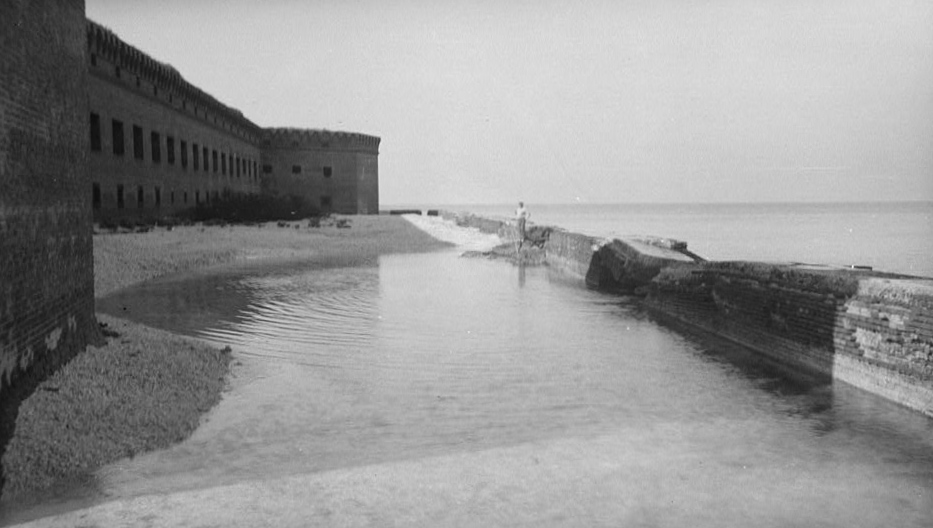
Fort Jefferson, circa 1934, U.S. Library of Congress, public domain.
Fort Taylor, Key West, Florida and Fort Jefferson, Dry Tortugas, Florida (Companies A, B, C, E, G, and I assigned to garrison Fort Taylor while Companies D, F, H, and K assigned to garrison duty at Fort Jefferson, the remote federal installation located in the Dry Tortugas which was accessible only by boat; note: the members of Company D remain at Fort Jefferson for just over five months; on 16 May 1863, they are marched back to the wharf at Fort Jefferson, where they climb aboard yet another ship—this time to return to Fort Taylor, where they resume garrison duties under the command of Colonel Tilghman H. Good)
Integration of the 47th Pennsylvania Volunteers continues with enrollment at Fort Taylor of the first Cuban immigrant to serve with the regiment
Re-enlistment of significant numbers of the 47th Pennsylvania Volunteers for second three-year terms begins, resulting in the regiment’s ultimate designation as the 47th Pennsylvania Veteran Volunteers when it achieves the milestone of having more than fifty percent of its membership re-muster for continuing military service
1864
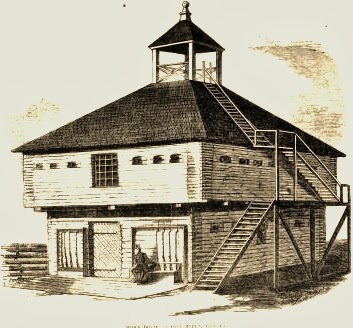
Blockhouse, Fort Myers, Florida Memory Project.
Fort Myers, Fort Taylor, and Fort Jefferson, Florida:
- Companies B, C, E, G, I garrison Fort Taylor;
- Companies D, F, H, K garrison Fort Jefferson;
- Special “Florida Rangers” detachment from Company A ordered to rehabilitate Fort Myers, abandoned in 1858 after U.S. government’s third war with Seminole Indians, and to secure food for Union troops via raids on Confederate sympathizer cattle herds
1864 – Red River Campaign
Transportation of the 47th Regiment, Pennsylvania Volunteer Infantry to Louisiana:
- From Florida to Algiers, Louisiana via the steamer Charles Thomas (25-28 February 1864)
- From Algiers to Brashear City, Louisiana (now Morgan City) via rail
- From Brashear City to the Bayou Teche and Franklin, Louisiana via steamer
From Franklin to Alexandria and Natchitoches Parish, Louisiana by way of New Iberia, Vermilionville, Opelousas, and Washington (14-26 March 1864)
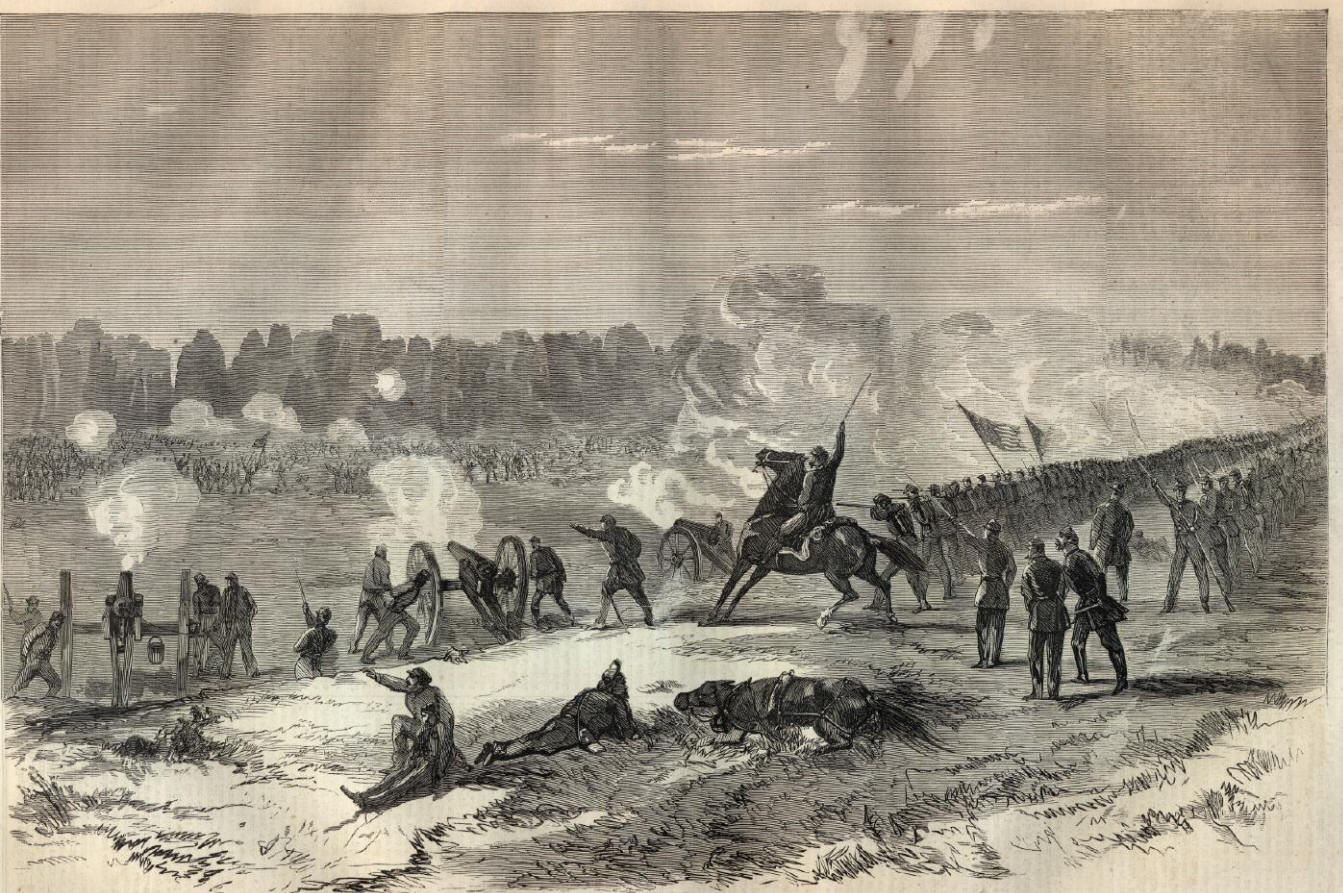
Battle of Pleasant Hill, Louisiana, 9 April 1864 (Harper’s Weekly, 7 May 1864, public domain).
Battles of Sabine Cross Roads/Mansfield and Pleasant Hill, Louisiana (8-9 April 1864):
- Battle of Sabine Cross Roads (also known as the Battle of Mansfield, DeSoto Parish, 8 April 1864)
- Battle of Pleasant Hill, parishes of DeSoto and Sabine (9 April 1864)
- Imprisonment of sixteen members of the 47th Pennsylvania by the Confederate Army at Pleasant Hill, Louisiana, and then at Camp Groce and Camp Ford near Tyler, Texas or at the Confederate Army hospital in Shreveport, Louisiana (mid-April 1864 – 22 July 1864 or later)
Grand Ecore, Natchitoches Parish, Louisiana (10-22 April 1864)

Bailey’s Dam, 1864.
Battle of Cane River, Natchitoches Parish, Louisiana (also known as the Battle of Monett’s Ferry, or Cane River Crossing, or the Affair at Monett’s Bluff, 23 April 1864)
Construction of Bailey’s Dam across the Red River, Alexandria, Rapides Parish, Louisiana (30 April 1864 – 10 May 1864)
Battle of Mansura, Avoyelles Parish, Louisiana (also known as the Battle of Marksville or Smith’s Place, 16 May 1864)
Return of the 47th Pennsylvania Volunteers to New Orleans by way of Simmesport, across the Atchafalaya to Morganza and New Orleans, Louisiana (16 May 1864 – 20 June 1864)
- Red River Campaign Report, Major-General Nathaniel P. Banks, U.S. Army, Commanding Expedition and U.S. Department of the Gulf (6 April 1865)
- “Bailey’s Dam” Construction Report, Lieutenant-Colonel Joseph Bailey, Fourth Wisconsin Cavalry, Acting Engineer, 19th Corps, U.S. Army (17 May 1864)
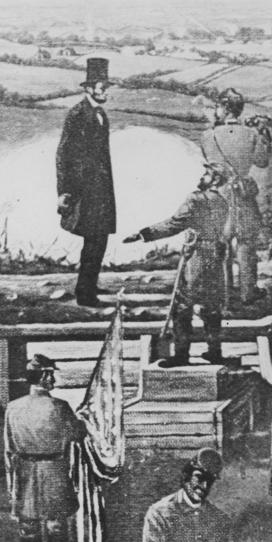
Pres. Abraham Lincoln at Fort Stevens, July 1864 (public domain illustration).
Transportation of Companies A, C, D, E, F, H, and I of the 47th Regiment, Pennsylvania Volunteer Infantry to the Washington, D.C. area aboard U.S. Steamer McClellan and a Memorable Encounter with President Abraham Lincoln (5-12 July 1864):
- Departure aboard the U.S. Steamer McClellan from Algiers, Louisiana (7 July 1864)
- Burial at sea of Private Jonas Snyder, I Company, who dies from consumption while en eroute (in the Gulf of Mexico off the American coast 8 July 1864)
- U.S. Steamer McClellan rounds the coast of Florida and bypasses Forts Taylor and Jefferson to avoid yellow fever epidemic ravaging Key West (10 July 1864)
- 47th Pennsylvania Volunteers arrive aboard the McClellan at Hampton Roads, Virginia ( afternoon of 11 July 1864)
- Companies A, C, D, E, F, H, and I of the 47th Pennsylvania Volunteers ordered to march for Fort Stevens; while there, many members of the regiment are thrilled to realize they are seeing President Abraham Lincoln in person; later, after the regiment marches out to connect with Bidwell’s Brigade, the regiment is informed that President Lincoln survived being shot at by Confederate troops; the 47th then bivouacks that night near the remains of a burnt house which said to be Montgomery Blair’s (12 July 1864)
Transportation of Companies B, G and K of the 47th Regiment, Pennsylvania Volunteer Infantry under the command of Captain Henry S. Harte to the Washington, D.C. area board the Blackstone by way of Bermuda Hundred, Virginia aboard the Blackstone (rejoining 47th Pennsylvania and U.S. 19th Army Corps at Monocacy, Virginia between 31 July and 2 August 1864)
1864 – Shenandoah Valley Campaign
Battle of Snicker’s Gap, Virginia (also known as the Battle of Cool Spring, 18 July 1864; involved Companies A, C, D, E, F, H, and I; Companies B, G and K were still in Louisiana at this time)
Defensive duties in and around Halltown, Virginia and participation in back-and-forth troop movements between Halltown, Berryville, Charlestown, and Winchester as part of Union Major-General Philip H. Sheridan’s “mimic war” with Confederate Lieutenant-General Jubal Early’s Confederate forces (August 1864)

Battle of Opequan, 19 September 1864 (U.S. Library of Congress, public domain).
Battle of Berryville, Virginia (3-4 September 1864) and ensuing “clean-up skirmishes” with Confederate forces over the next several days
Battle of Opequan, Virginia (or “Opequon Creek” or “Third Winchester”, 19 September 1864)
Battle of Fisher’s Hill, Virginia (21-22 September 1864)
Camp of the U.S. Army of the Shenandoah, Cedar Creek, Virginia (23 September 1864 – 19 October 1864)
Battle of Cedar Creek, Virginia (19 October 1864):
- Battle of Cedar Creek, Virginia (19 October 1864)
- Imprisonment by the Confederate Army of at least one member of the 47th Pennsylvania at the C.S.A. prison at Andersonville, Georgia and of multiple 47th Pennsylvania Volunteers at the C.S.A. prison at Salisbury, North Carolina
- Treatment of the wounded at Union Army hospitals, including the Sheridan Field Hospital at Shawnee Springs near Winchester (November 1864 through the Sheridan Field Hospital’s closure on 4 January 1865 and then at other Union Army general hospitals in Maryland and Virginia, for men still recuperating from their wounds and illnesses)
Camp Russell, near Stephens City (now Newtown), Virginia near Winchester (November 1864 – 20 December 1864)
Camp Fairview, Charlestown, West Virginia (20 December 1864 – early April 1865):
- Winter quarters
- Outpost and guard duties of key Union supply routes, including the Baltimore & Ohio Railroad
1865
Camp Fairview, Charlestown, West Virginia (service from late December 1864 through early April 1865)
Provisional Division, 2nd Brigade, U.S. Army of the Shenandoah (February 1865)

Spectators at crepe-draped U.S. Capitol, Grand Review of the Armies, 23-24 May 1865, flag at half-staff following Lincoln’s assassination (Matthew Brady, Library of Congress).
Camp Brightwood and the Washington Arsenal, Washington, D.C.; Baltimore & Ohio Railroad (mid-April 1865 – late May 1865):
- Defense of the nation’s capital following the assassination of President Abraham Lincoln (April-May 1865)
- Honor Guard, President Lincoln’s Funeral Train (C Company Musician Samuel Pyers, Baltimore & Ohio Railroad, Washington, D.C. to Relay Station, Maryland, 21 April 1865)
- Guard Duties, Washington Arsenal Penitentiary, Washington, D.C. (per letters of prison commanding officer, Brevet Major-General John F. Hartanft, the 47th Pennsylvania Volunteers performed guard duties associated with the imprisonment of the key Lincoln assassination conspirators in early May 1865; that assignment ended on the morning of 10 May 1865)
- Grand Review of the Armies, Washington, D.C. (23 May 1865)

Ruins of Charleston, South Carolina, 1865.
Source: U.S. National Archives, public domain.
Provost (military police) and Reconstruction Duties, Savannah, Georgia (early June 1865)
Provost (military police) and Reconstruction Duties, Charleston, South Carolina (mid-June 1865 – early January 1866)
Beginning of 47th Pennsylvania Volunteers’ Regimental Honorable Discharge Process, Charleston, South Carolina (25 December 1865 through early January 1866)
Return of the 47th Regiment, Pennsylvania Volunteer Infantry to Pennsylvania:
- Transport by sea to New York, New York (early January 1866);
- Transport by rail to Philadelphia, Pennsylvania (early January 1866);
- Honorable Discharge Papers granted to 47th Pennsylvania Volunteers, Camp Cadwalader, Philadelphia, Pennsylvania (9 January 1866)
Sources:
- Bates, Samuel P. History of Pennsylvania Volunteers, 1861-5, vol. 1. Harrisburg, Pennsylvania: B. Singerly, State Printer, 1869.
- “Camp Russell.” The Historical Marker Database, retrieved online December 27, 2023.
- “Civil War, 1861-1865.” Stephens City, Virginia: Newtown History Center, retrieved online 27 December 2023.
- Civil War Muster Rolls and Related Records (Record Group 19, Series 19.11). Harrisburg, Pennsylvania: Pennsylvania Department of Military and Veterans’ Affairs.
- Dyer, Frederick H. A Compendium of the War of the Rebellion, p. 1589. Des Moines, Iowa: The Dyer Publishing Company, 1908.
- “Florida’s Role in the Civil War,” in Florida Memory. Tallahassee, Florida: State Archives of Florida.
- Noyalas, Jonathan. “The Fight at Cedar Creek Was Over. So Why Couldn’t Union Troops Let Their Guard Down?” Arlington, Virginia: HistoryNet, 27 February 2023.
- Registers of Deaths of Volunteers, U.S. Adjutant General’s Office. Washington, D.C.: U.S. National Archives and Records Administration, 1861-1865.
- Reports and Other Correspondence of W. D. C. Rodrock, Chaplain, 47th Pennsylvania Volunteer Infantry (Record Group R29). Washington, D.C.: U.S. National Archives and Records Administration, 1864-1865.
- Returns from U.S. Military Posts, in Records of the U.S. Adjutant General’s Office and Fort Taylor, Key West, Florida (Record Group 84, Microfilm M617). Washington, D.C.: U.S. National Archives and Records Administration, March 1863–December 1863.
- “Roster of the 47th P. V. Inf.” Allentown, Pennsylvania: The Morning Call, 26 October 1930.
- Schmidt, Lewis. A Civil War History of the 47th Regiment of Pennsylvania Veteran Volunteers. Allentown, Pennsylvania: Self-published, 1986.
- Stegall, Joel T. “Salisbury Prison: North Carolina’s Andersonville.” Fayetteville, North Carolina: North Carolina Civil War & Reconstruction History Center, 13 September 2018.
- “Tamiami Trail Modifications: Next Steps—Draft Environmental Impact Statement,” Appendix E. U.S. National Park Service – Everglades National Park: 29 January 2010.
- “The History of the Forty-Seventh Regt. P. V.” Allentown, Pennsylvania: The Lehigh Register, 20 July 1870.
- Wharton, Henry D. Letters from the Sunbury Guards. Sunbury, Pennsylvania: Sunbury American, 1861-1868.
 47th Pennsylvania Volunteers
You must be logged in to post a comment.