Honoring the Battle-Tested Soldier: The Meaning and Value of the Designation “Veteran Volunteer”

A regiment, battalion, or company shall bear the title of ‘veteran’ only in case at least one-half its members, at the time of muster into United States Service, are ‘veteran volunteers.’ – excerpt from General Order No. 216, U.S. War Department, 14 July 1863
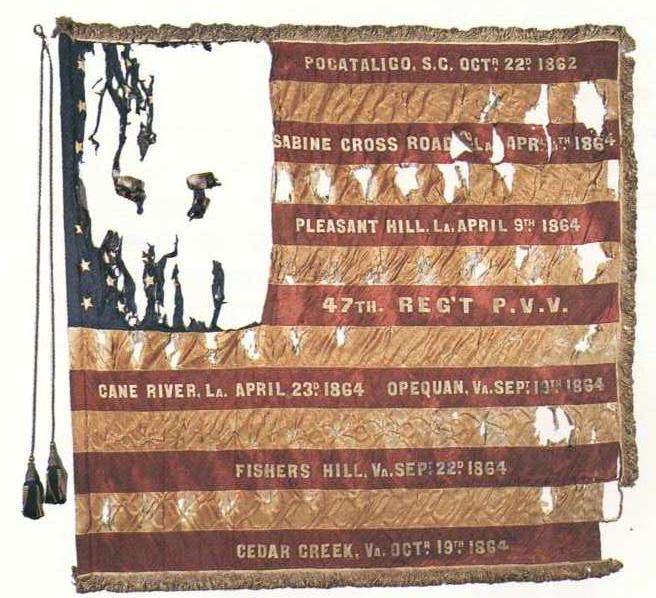
 

Second State Colors, 47th Pennsylvania Veteran Volunteers (presented to the regiment 7 March 1865).

Second State Color, 47th Regiment, Pennsylvania Volunteer Infantry with stripe designating the unit as “P.V.V.” (Pennsylvania Veteran Volunteers”). Presented to Company C Captain Daniel Oyster, 7 March 1865.

Those words above are at the very heart of what it meant when military units fighting for the Union during America’s Civil War were honored with the coveted and highly respected label of “Veteran Volunteer,” and further clarify the intent of General Order No. 191, which spelled out the expectations of the U.S. War Department for, and the benefits which accrued to, the individual soldiers and regiments ultimately awarded this designation.

A literal “badge of honor,” the appellation “Veteran Volunteer” conferred upon its recipients the right to sew volunteer service chevrons (or service stripes) on their uniforms and regimental flags, signaling to all whom they encountered that they were battle-tested, long-serving and long-suffering combatants dedicated to the fight to preserve America’s Union.

In the case of the men who served with the 47th Regiment, Pennsylvania Volunteer Infantry, the designation was conferred most frequently in the latter part of 1863 and early 1864 during the regiment’s service in Florida. Assigned to garrison Forts Taylor and Jefferson in Key West and the Dry Tortugas, the 47th Pennsylvanians had already, by the fall of 1862, defended Washington, D.C. and played key roles in the capture of Saint John’s Bluff and Jacksonville, Florida, and had been severely bloodied during the Battle of Pocotaligo, South Carolina in late October of that same year.

In addition to having completed their initial three-year terms of service by the time they re-enlisted in 1863 or 1864, many had also fulfilled their “Three Months’ Service,” having been among the first responders to President Abraham Lincoln’s initial April 1861 call for volunteers to defend the nation’s capital following the fall of Fort Sumter.

U.S. General Order No. 191, issued by the U.S. War Department, 25 June 1863:

In order to increase the armies now in the field, volunteer infantry, cavalry, and artillery may be enlisted, at any time within 90 days from this date in the respective States, under the regulations hereinafter mentioned. The volunteers so enlisted, and such of the three-years troops now in the field as may re-enlist in accordance with the provisions of this order, will constitute a force to be designated ‘Veteran Volunteers.’ The regulations for enlisting this force are as follows:

I. The period of service for the enlistments and re-enlistments above mentioned shall be for three years or during the war.

II. All able bodied men, between the ages of 18 and 45 years, who have been heretofore enlisted, and have served for not less than nine months, and can pass the examination required by the mustering regulations of the United States, may be enlisted under this order as veteran volunteers, in accordance with the provisions hereinafter set forth.

 III. Every volunteer enlisted and mustered into service under this order shall be entitled to receive from the United States, one month’s pay in advance and a bounty and premium of $402, to be paid as follows:

  1. Upon being mustered into the service, he shall be paid
    one month’s pay in advance . . . . . . . . . . . . . . . . . . . . $13.00
    First installment of bounty . . . . . . . . . . . . . . . . . . . . .   25.00
    Premium . . . . . . . . . . . . . . . . . . . . . . . . . . . . . . . . . . . . .    2.00
    Total payment on muster . . . . . . . . . . . . . . . . . . . . .  $40.00
  1. At the first regular pay-day, or two months after
    muster-in, an additional installment of bounty
    will be paid. . . . . . . . . . . . . . . . . . . . . . . . . . . . . . . . .    $50.00
  2. At the first regular pay-day after six months’
    service, he shall be paid an additional
    installment . . . . . . . . . . . . . . . . . . . . . . . . . . . . . . . . .   $50.00
  3. At the first regular pay-day after the end of the
    first year’s service, an additional installment of
    bounty will be paid . . . . . . . . . . . . . . . . . . . . . . . . . .   $50.00
  4. At the first regular pay-day after 18 months’
    service an additional installment of bounty will
    be paid . . . . . . . . . . . . . . . . . . . . . . . . . . . . . . . . . . . . .  $50.00
  5. At the first regular pay-day after two years’
    service an additional installment of bounty will
    be paid . . . . . . . . . . . . . . . . . . . . . . . . . . . . . . . . . . . .    $50.00
  6. At the first regular pay-day after two and a
    half years’ service an additional installment of
    bounty will be paid,                                                     $50.00
  7. At the expiration of three years’ service the
    remainder of the bounty will be paid . . . . . . . . . .   $75.00

IV. If the government shall not require these troops for the full period of three years, and they shall be mustered honorably out of the service before the expiration of their term of enlistment, they shall receive, upon being mustered out, the whole amount of their bounty remaining unpaid, the same as if their whole term had been served. The legal heirs of volunteers who die in service shall be entitled to receive the whole bounty remaining unpaid at the time of the soldier’s death.

V. Veteran Volunteers enlisted under this order will be permitted at their option to enter old regiments now in the field, but their service will continue for the full term of their own enlistment notwithstanding the expiration of the term for which the regiment was originally enlisted. New organizations will be officered by persons who have been in service and have shown themselves properly qualified for command. As a badge of honorable distinction, ‘SERVICE CHEVRONS’ will be furnished by the War Department to be worn by the Veteran Volunteers.

VI. Officers of regiments whose term has expired will be authorized on proper application and approval of their respective Governors, to raise companies and regiments within the period of 60 days, and if the companies and regiments authorized to be raised shall be filled up and mustered in the service within the said period of 60 days, the officers may be commissioned of the date of their original commission, and for the time engaged in recruiting they will be entitled to receive the pa belonging to their rank.

VII. Volunteers or Militia now in service whose terms of service will expire within 90 days, and who then shall have been in service at least nine months, shall be entitled to the aforesaid bounty and premium of $402, provided they re-enlist before the expiration of their present term for three years or the war; and said bounty and premium shall be paid in the manner herein provided for other troops re-entering the service. The new term will commence from the date of re-enlistment.

VIII. After the expiration of 90 days from this date, volunteers serving in three year organizations who may re-enlist for three years or the war, shall be entitled to the aforesaid bounty and premium of $402, to be paid in the manner herein provided for other troops entering the service. The new term will commence from date of re-enlistment.

IX. Officers in service whose regiments or companies may re-enlist in accordance with the provisions of this order before the expiration of their present term, shall have their commission confirmed so as to preserve their date of rank as fixed by their original muster into United States service.

X. As soon after the expiration of their original term of enlistment as the exigencies of the service will permit, a furlough of 30 days will be granted to men who may enlist in accordance with the provisions of this order.

XI. Volunteers enlisted under the provisions of this order will be credited as three year men in the quotas of their respective states. Instructions for the appointment of recruiting officers and for enlisting Veteran Volunteers, will be immediately issued to Governors as states.

Secretary of War E. D. Townsend


Sources:

  1. Reports of Committees of the Senate of the United States for the First Session of the Fifty-First Congress, 1889-90. Washington, D.C.: Government Printing Office, 1890.
  2. Schmidt, Lewis. A Civil War History of the 47th Regiment of Pennsylvania Veteran Volunteers. Allentown, Pennsylvania: Self-published, 1986.


Celebrating the Fourth Far from Home

The city was gaily dressed in flags, and the prettiest thing of the kind was that at the guard station, under Lt. Reese of Company C. Five flags were suspended from the quarters, with wreaths, while the whole front of the enclosure of the yard was covered with evergreens and the red, white, and blue. The Navy had their vessels dressed in their best ‘bib and tucker’, flags flying fore and aft, of our own and those of all nations. It was a pretty sight, and in a measure paid for the fatigue of the boys on their march. At 12 noon, both Army and Navy fired a national salute of thirty five guns. – Henry D. Wharton


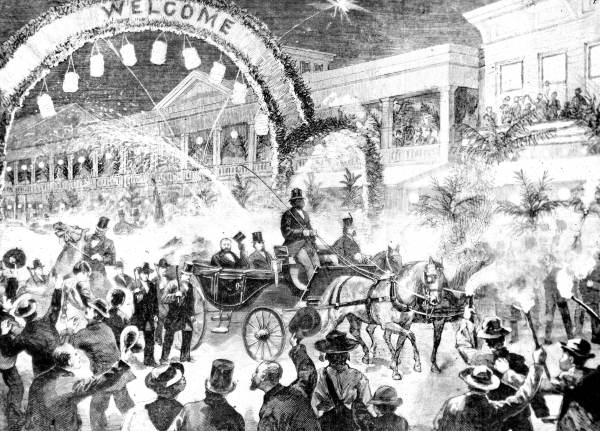
The 1863 Fourth of July celebrations in Key West, Florida likely resembled those captured in this image from January 1880 in which former U.S. President Ulysses S. Grant and General Philip Sheridan arrived at the Russell House on Duval Street (Florida Memory Project, public domain).

The 1863 Fourth of July celebrations in Key West, Florida likely resembled those captured in this image from January 1880 in which former U.S. President Ulysses S. Grant and General Philip Sheridan arrived at the Russell House on Duval Street (Florida Memory Project, public domain).

It was the Fourth of July, 1863, and the native sons of Pennsylvania enrolled for Civil War military service with the 47th Pennsylvania Volunteers were stationed about as far from home as they could possibly be. The men serving with Companies A, B, C, D, and I were stationed at Fort Taylor in Key West, Florida while those assigned to companies E, F, G, H, and K were toughing it out at Fort Jefferson, the Union’s remote outpost in the Dry Tortugas. The men from D Company had only just returned to Key West from Fort Jefferson a month earlier.

But life was not all about duty for the Keystone Staters in 1863. According to historian Lewis Schmidt,”July 4th fell on a Saturday, and the celebrations began at Key West at 9 AM when the five companies of the 47th stationed there were reviewed by Gen. Woodbury before the regiment’s office. Immediately after inspection, the regiment marched in a ‘street parade through the principal streets of the city in the heat of 100 degrees Fahrenheit and the dust almost suffocating.’ After which each ‘detachment was taken to their quarters, dismissed, and then to enjoy themselves as best they could.'”

Henry D. Wharton, a member of Company C known for his detailed letters to his hometown newspaper, the Sunbury American, added, “The day passed off pleasantly, all seemed to enjoy themselves.” Afterward, said Wharton, “the city was as quiet as could be expected.”


Sources:

1. Letters from Henry D. Wharton, in Sunbury American. Sunbury, Pennsylvania: 1861-1865.

2. Schmidt, Lewis. A Civil War History of the 47th Regiment of Pennsylvania Veteran Volunteers. Allentown, Pennsylvania: Self-published, 1986.
 

Blest Be the Tie That Binds – Putting Aside Differences to Become One Nation, Indivisible on Memorial Day

Ottumwa today showed her honor to the nation’s defenders by closing shop and factory, school and place of merchandising, that all might lend their token of honor and veneration to the memory of those who fought, bled and died that the country might live. The Grand Army of the Republic, the Women’s Relief corps, those who were orphaned through the great strife of nearly half a century ago, and others that represent a grateful nation, have devoted this day to the memory of the Union soldiery of the civil war, both living and dead. The dead are being remembered by eulogy and flower tribute, the living by the willingness manifest by the people generally to honor the dead and the cause that all feel a like interest in. Music and eloquence, silent tears and prayers, the floral tribute that adds a fragrance incense-like to the solemn occasion – all are blended with the full heart of gratitude and esteem paid the memory of the dead and living veterans who made possible the happiness and prosperity, peace and security that today is the blessed heritage of the citizens of the United States. – Ottumwa Courier (1 June 1911)


Ottumwa, Iowa. Most Americans recognize the name of this community in the nation’s heartland as the hometown of fictional television character Walter O’Reilly – better known as “Radar,” the young corporal at the 4077th M.A.S.H. who slept with a teddy bear while coming of age at an army hospital during the Korean War. His eyes witnessed the worst of humanity; his responses to the most painful of those moments tweaked the collective conscience of the millions of television viewers tuning in each week, reminding us that displays of kindness, compassion and hope are still possible even in the midst of hate and horror.

But Ottumwa also has ties to very real wars, including to America’s terrible Civil War – and to one of that war’s lesser known, but valiant regiments – the 47th Pennsylvania Volunteers. For it was in Ottumwa where Lewis W. Saylor (1845-1877) chose to resettle after serving two terms as a Private with Company H of the 47th Pennsylvania Volunteers, and where he closed his eyes for the final time and was buried with military honors.

Memorial Day Planning Headline, Ottumwa Courier, 9 May 1901 (public domain).

Memorial Day Planning Headline, Ottumwa Courier, 9 May 1901 (public domain).

On Memorial Day in 1911, Ottumwans honored Lewis Saylor and more than 200 other Civil War veterans with pomp and poignant oratory. The day began with a gathering by members of the Grand Army of the Republic’s Cloutman post who rode or marched from the court house to the Ottumwa Cemetery, the place where the largest number of Civil War soldiers had been laid to rest. The 1 June 1911 edition of the Ottumwa Courier described the procession as follows:

Led by six police officers each of whom carried a large bouquet of flowers to place upon the graves of the veteran dead, the parade formed and wended its way up Court hill. The Fifty-fourth regiment band attired in its military uniforms added a martial aspect to the pageant which was inspired by the national melodies that were rendered by this excellent musical organization. The local guardsmen of Co. G.I.N.G. were also in the line as were a number of Sons of Veterans aiding by their presence to the occasion that honored their fathers’ memory. The speakers in carriages and the old soldiers in vehicles were also in evidence and excited the love and esteem of the onlookers as the parade moved forward to the cemetery. Both Cloutman and Tuttle posts of the G.A.R. and the Relief corps of the two posts were a part of the parade. Citizens voluntarily fell in to swell the ranks and lend their aid to the expression of honor and esteem of the veterans. 

A large crowd was gathered in the city park preliminary to the starting of the parade and in the band stand of the park, the Fifty-fourth rendered several selections while the crowds assembled. Carriages and autos gathered about the park ready to join in the parade to the cemetery, and the street cars carried hundreds to the graves of the departed veterans and relatives as the pageant moved slowly toward the cemetery.

The Courier went on to report that members of the G.A.R and Women’s Relief Corps also decorated the graves of Union veterans at the Calvary Cemetery, and added:

Honorable Ellsworth Rominger of Bloomfield this morning made the Memorial day address in South Ottumwa. He told a remnant of the Grand Army of the Republic, their wives who largely comprised the Women’s Relief Corps and the children of the veterans, of the great debt the nation owes the noble sons who in the stormy days of the nation’s strife and her hour of greatest need, responded to the call. He graphically sketched and in a realistic panorama brought before the minds of the assemblage the days of the civil war, and equally effective was his treatment of the fruits of this terrible conflict so great in cost to the nation.

 Noting that the ranks of the aging Civil War veterans were now “somewhat thinner,” the Courier also observed that:

The ravages of passing years was made more evident in the expressions and step of the veterans who each year have assembled at this memorial gatherings. There were present those who had to be wheeled to the hall in a chair, some who are bent with age an infirmity, but all seemed young once more as the days of the civil war were recalled by the speakers.”

The Program

Memorial Day Headline, Ottumwa Courier, 31 May 1900 (public domain).

Memorial Day Headline, Ottumwa Courier, 31 May 1900 (public domain).

Commander J. Trisler began the day’s events at the 1911 Memorial Day ceremony in Ottumwa with a brief speech, followed by prayers delivered by the pastor of the Davis Street Christian Church, Rev. S. I. Elder, and the formal Memorial Day address by Major Hamilton. The regimental band of the Fifty-Fourth Iowa then led the G.A.R marchers into the ceremonial gathering, and Ellsworth Rominger began his aforementioned address. Declaring that the Grand Army of the Republic would continue to live on in the hearts and minds of Americans even after the passing of the G.A.R.’s final member, Rominger added:

If you would ask me what this great war cost, I would ask you to accompany me through the soldiers’ home of this state and look into the faces of 600 veterans. There your answer would be plain and you would readily appreciate the great cost the war had been. It is said that this strife cost the nation $400,000,000 and 100,000 lives, more than enough to purchase all of the slaves. But that was not the cost, for it cannot be computed in money.

Rominger then said something which still holds a powerful truth, and is worthy of taking to heart in the midst of America’s recent heated election season. Despite the extreme divisiveness which erupted before and during America’s Civil War, Americans who had opposed each other in battle later went on to come together to work for the betterment of their nation and respective communities. They found the strength to forgive, to put aside their differences, and to compromise. To illustrate his point, he recalled the dignity accorded to a Confederate soldier’s recent burial. Accompanied by a Grand Army of the Republic honor guard, the soldier’s casket was draped with both the Confederate flag (“stars and bars”) and the American flag.

To solidify that sentiment and close that 1911 Memorial Day program, Ottumwans joined in singing Blest Be the Tie That Binds:

Blest be the tie that binds
Our hearts in Christian love;
The fellowship of kindred minds
Is like to that above. 

Before our Father’s throne
We pour our ardent prayers;
Our fears, our hopes, our alms, are one,
Our comforts and our cares. 

We share our mutual woes,
Our mutual burdens bear,
And often for each other flows
The sympathizing tear. 

When here our pathways part,
We suffer bitter pain;
Yet, one in Christ and one in heart,
We hope to meet again. 

This glorious hope revives
Our courage by the way,
While each in expectation lives
And longs to see the day. 

From sorrow, toil, and pain,
And sin we shall be free
And perfect love and friendship reign
Through all eternity. 

– John Fawcett (1772)

Others who had served with East Coast or federal units during the Civil War and were also lionized that day included:

  • Applegate, N. S.: Co. E, 9th New Jersey Infantry, interred at Ottumwa Cemetery;
  • Barnhart, Ira: Co. H, 124th New York Infantry, interred at Ottumwa Cemetery;
  • Buckley, Thomas R.: Co. M, 3rd New York Cavalry, interred at Ottumwa Cemetery;
  • Best, Nelson: Co. I, 47th New York Infantry, interred at Ottumwa Cemetery;
  • Bannister, D.: Colonel and paymaster, U.S. Volunteers, interred at Ottumwa Cemetery;
  • Caton, James C.: 50th U.S. Infantry, interred at the Catholic Cemetery;
  • Conlin, Michael: Co. K, 160th New York Infantry, interred at Ottumwa Cemetery;
  • Carter, Josiah: Co. C, 3rd U.S. Colored Heavy Artillery, interred at Ottumwa Cemetery;
  • Davenport, W.D.: Co. H, 3rd New York Cavalry, interred at Ottumwa Cemetery;
  • Davis, Edmund: 24th Pennsylvania Reserves, interred at Ottumwa Cemetery;
  • Dodd, Zachariah: Co. C, 18th U.S. Colored Troops, interred at Ottumwa Cemetery;
  • Dougherty, Constantine: 1st Mechanical Engineering Corps, interred at the Catholic Cemetery;
  • Fetzer, W. H.: 10th Pennsylvania Infantry, interred at Ottumwa Cemetery;
  • Fleming, John: 16th U.S. Infantry, interred at the Catholic Cemetery;
  • Grebby, George: Co. F, 8th Pennsylvania Infantry, interred at Ottumwa Cemetery;
  • Hutchison, J. G.; 131st Pennsylvania Infantry, interred at Ottumwa Cemetery;
  • Hoffman, William: Pennsylvania Reserves, interred at Ottumwa Cemetery;
  • Jolliff, Jas.: Co. K, 116th Pennsylvania Infantry, interred at Ottumwa Cemetery;
  • Keister, J. D.: Co. I, 44th Pennsylvania Infantry, interred at Ottumwa Cemetery;
  • Kilby, L. W.: Co. F, 147th New York Volunteers, interred at Ottumwa Cemetery;
  • Manchester, J. C.: Co. E, 1st Connecticut Artillery, interred at Ottumwa Cemetery;
  • Mahon, S. K.: Captain, 16th U.S. Infantry, interred at Ottumwa Cemetery;
  • Miller, William: 55th Pennsylvania Infantry, interred at Ottumwa Cemetery;
  • Mills, Robert: 11th U.S. Cavalry, interred at Ottumwa Cemetery;
  • Morley, George: Co. C, 19th U.S. Infantry, interred at Ottumwa Cemetery;
  • Peck, Jesse: Co. H, 85th Pennsylvania Infantry, interred at Ottumwa Cemetery;
  • Powell, C. C.: Co. I, 9th Delaware, interred at Ottumwa Cemetery;
  • Shaw, F. B.: 33rd Massachusetts Infantry, interred at Shaul Cemetery;
  • Smith, Zachias: Corporal, Co. G, 1st U.S. Battery, interred at Ottumwa Cemetery;
  • Stewart, Calloway: Co. G, 2nd U.S. Infantry, interred at Shaul Cemetery;
  • Stoddard, John C.: Surgeon, 56th U.S. Infantry, interred at Ottumwa Cemetery; and
  • Wilson, J. H.: Co. C, 15th New York Artillery.

As you celebrate Memorial Day this year, take a moment to give thanks to the men, women and children who gave so much so that we might remain “one nation, indivisible, with liberty and justice for all.”