A Musical Tribute to Beloved Commanding Officers: The 47th Pennsylvania’s Regimental Band “Serenades” Generals Grant and Sheridan (May 22, 1865)

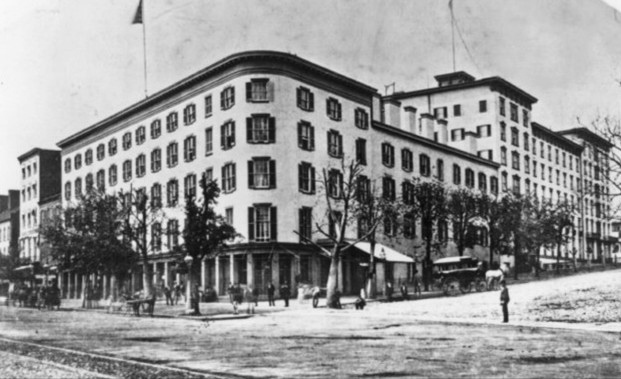
Willard’s Hotel, Washington, D.C., circa 1860-1865 (public domain; click to enlarge).

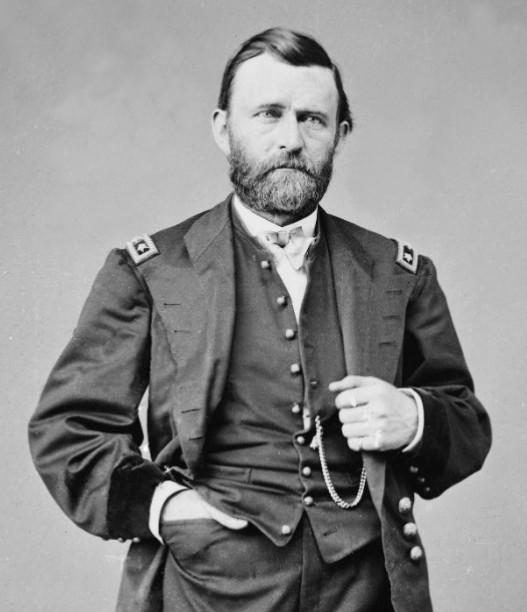
On the eve of the headline-making Grand Review of the National Armies in the nation’s capital in late May 1865, members of the 47th Pennsylvania Veteran Volunteers’ Regimental Band made their own small headlines in newspapers nationwide when they performed a selection of patriotic and popular musical numbers during an hour-long, impromptu concert for Union Lieutenant-General Ulysses S. Grant and Major-General Philip H. Sheridan, who were engaged in a meeting at Willard’s Hotel. Also joining in the musical tribute were musicians from one of Maine’s volunteer infantry regiments.

Lieutenant-General Ulysses S. Grant (public domain).

As the 47th Pennsylvanians performed, a crowd gathered nearby to listen. When the music ceased, calls of “Speech! Speech!” to Grant and Sheridan began to ripple through the crowd. Both men demurred, however, choosing instead to continue their “parting interview,” according to the Bangor Daily Whig and Courier — a decision which evidently did not disappoint the throng for long. Per The Philadelphia Inquirer, “The music was very fine, both bands rivaling each other in doing honor to the greatest General of the age” (General Grant).

Joseph Eugene Walter, Regimental Band, 47th Pennsylvania Volunteers, circa 1861.

Among the 47th Pennsylvanians who may very well have performed for Grant and Sheridan that evening were Private Joseph Eugene Walter and Principal Musician Daniel Dachrodt. (Walter, a private with Company E, had been a cornetist with Pomp’s Cornet Band in Easton, Northampton County, Pennsylvania prior to the start of the American Civil War and had previously served with the 47th Pennsylvania’s highly-regarded first Regimental Band, which had been led by Thomas Coates, the “Father of Band Music in America.” Dachrodt, who had been promoted to the rank of Drum Major and had then been placed in charge of all of the regiment’s field drummers, would ultimately survive the war — and all of his comrades — to become the last living member of the regiment in 1939.)

Major-General Philip Sheridan, U.S. Army (c. 1864, U.S. Library of Congress, public domain).

Standing on the balcony of Willard’s Hotel again the next morning (May 23), Major-General Sheridan was treated to another rousing tribute as members of his cavalry “passed before him to pay a farewell salute … while the bands played ‘Hail to the Chief!'” Those same units would take part, later that morning and afternoon, in the Army of the Potomac’s march down Pennsylvania Avenue during the parade on day one of the Grand Review. That evening, Sheridan would depart for the train depot in Baltimore, Maryland, for transportation to his new assignment — spearheading regional Reconstruction efforts as the military governor of Louisiana and Texas.

Sources:

  1. Discover Our History.” Washington, D.C.: Willard Intercontinental Hotel, retrieved online May 20, 1865.
  2. General Philip H. Sheridan.” Washington, D.C.: U.S. National Park Service, retrieved online, May 20, 2025.
  3. Grant” (television mini-series). New York, New York: History Channel Education, 2020.
  4. “Our Heroes! The Grand Review at Washington. Honor to the Brave. Immense Outpouring of the People. The Troops Reviewed by Gen. Grant.” Harrisburg, Pennsylvania: Daily Telegraph, May 23, 1865.
  5. Regimental Band of the 47th Pennsylvania Veteran Volunteers (report on the band’s performance for Lieutenant-General Ulysses S. Grant in Washington, D.C.), in “Special Dispatch to the Boston Journal.” Bangor, Maine: Bangor Daily Whig and Courier, May 23, 1865.
  6. Review of the Armies; Propitious Weather and a Splendid Spectacle. Nearly a Hundred Thousand Veterans in the Lines.” New York, New York: The New York Times, May 24, 1865, front page.
  7. “Serenade to General Grant” (performance for Lieutenant-General Ulysses S. Grant by the 47th Pennsylvania Veteran Volunteers’ Regimental Band), in “Washington.” Philadelphia, Pennsylvania: The Inquirer, May 22, 1865.
  8. The Final March: Grand Review of the Armies.” Washington, D.C.: U.S. National Park Service, retrieved online May 20, 2025.
  9. “The Grand Review: The City Crowded with Visitors: Order of Corps, Divisions, Brigades and Regiments.” Philadelphia, Pennsylvania: Daily Constitutional Union, May 23, 1865.


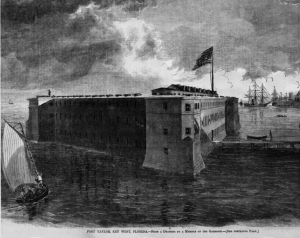
Honoring President George Washington, Fort Taylor, Key West, Florida (February 22, 1862)

Fort Taylor, Key West, Florida (Harper’s Weekly, 1864, public domain).

Letter from the Sunbury Guards
Camp Brannan. Key West, Fla., Feb. 27, 1862.

DEAR WILVERT:– Gen. Brannan and staff arrived here on Friday last, on the steamer Philadelphia. He made his first appearance, to us, on our parade ground, at dress parade, and seemed pleased at the improvement the men had made with their new arms, in the manual. After dress parade he rode passed [sic] the different streets of the regiment, and the enthusiastic cheers given him showed that he was liked, and that the men had perfect confidence in him.

Saturday last, the anniversary of the birth of “the Father of his Country,” WASHINGTON, was celebrated in a becoming manner. The whole Brigade was formed in Divisions, which made three sides of a square; the officers in the centre [sic]. A prayer was then offered to the Throne of Grace asking for success to our arms, that this wicked rebellion might be put down, and that we might hereafter celebrate the anniversary of Washington’s birthday in peace. The farewell ‘Address’ was then read….
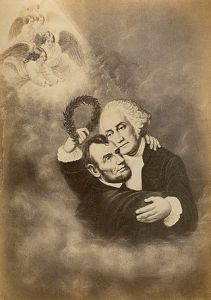
Washington & Lincoln (Apotheosis), J. A. Arthur, 1865 (public domain).

When 47th Pennsylvania Volunteer Henry D. Wharton penned those words from his duty station at Fort Taylor in Key West on February 27, he was referring to the final public address given by the first President of the United States, GeorgeWashington, as he prepared to retire from his life of public service. Written on September 19, 1796, Washington’s insightful words reminded Wharton and his fellow Union Army soldiers what they were fighting to preserve.

Picture them as they stood there, attired in their blue uniforms, the American flag wafting gently in the breeze under the brilliant blue sky of a sunny, Florida day, as a senior officer solemnly read Washington’s final guidance to his beloved fellow Americans–guidance that remains relevant even now.

Washington’s Final Address (Excerpt)

Friends and Fellow Citizens:

The period for a new election of a citizen to administer the executive government of the United States being not far distant, and the time actually arrived when your thoughts must be employed in designating the person who is to be clothed with that important trust, it appears to me proper, especially as it may conduce to a more distinct expression of the public voice, that I should now apprise you of the resolution I have formed, to decline being considered among the number of those out of whom a choice is to be made.

I beg you, at the same time, to do me the justice to be assured that this resolution has not been taken without a strict regard to all the considerations appertaining to the relation which binds a dutiful citizen to his country; and that in withdrawing the tender of service, which silence in my situation might imply, I am influenced by no diminution of zeal for your future interest, no deficiency of grateful respect for your past kindness, but am supported by a full conviction that the step is compatible with both.

The acceptance of, and continuance hitherto in, the office to which your suffrages have twice called me have been a uniform sacrifice of inclination to the opinion of duty and to a deference for what appeared to be your desire. I constantly hoped that it would have been much earlier in my power, consistently with motives which I was not at liberty to disregard, to return to that retirement from which I had been reluctantly drawn….

The unity of government which constitutes you one people is also now dear to you. It is justly so, for it is a main pillar in the edifice of your real independence, the support of your tranquility at home, your peace abroad; of your safety; of your prosperity; of that very liberty which you so highly prize. But as it is easy to foresee that, from different causes and from different quarters, much pains will be taken, many artifices employed to weaken in your minds the conviction of this truth; as this is the point in your political fortress against which the batteries of internal and external enemies will be most constantly and actively (though often covertly and insidiously) directed, it is of infinite moment that you should properly estimate the immense value of your national union to your collective and individual happiness; that you should cherish a cordial, habitual, and immovable attachment to it; accustoming yourselves to think and speak of it as of the palladium of your political safety and prosperity; watching for its preservation with jealous anxiety; discountenancing whatever may suggest even a suspicion that it can in any event be abandoned; and indignantly frowning upon the first dawning of every attempt to alienate any portion of our country from the rest, or to enfeeble the sacred ties which now link together the various parts.

For this you have every inducement of sympathy and interest. Citizens, by birth or choice, of a common country, that country has a right to concentrate your affections. The name of American, which belongs to you in your national capacity, must always exalt the just pride of patriotism more than any appellation derived from local discriminations.

With slight shades of difference, you have the same religion, manners, habits, and political principles. You have in a common cause fought and triumphed together; the independence and liberty you possess are the work of joint counsels, and joint efforts of common dangers, sufferings, and successes.

But these considerations, however powerfully they address themselves to your sensibility, are greatly outweighed by those which apply more immediately to your interest. Here every portion of our country finds the most commanding motives for carefully guarding and preserving the union of the whole….

In contemplating the causes which may disturb our Union, it occurs as matter of serious concern that any ground should have been furnished for characterizing parties by geographical discriminations, Northern and Southern, Atlantic and Western; whence designing men may endeavor to excite a belief that there is a real difference of local interests and views.

One of the expedients of party to acquire influence within particular districts is to misrepresent the opinions and aims of other districts. You cannot shield yourselves too much against the jealousies and heartburnings which spring from these misrepresentations; they tend to render alien to each other those who ought to be bound together by fraternal affection….

To the efficacy and permanency of your Union, a government for the whole is indispensable. No alliance, however strict, between the parts can be an adequate substitute; they must inevitably experience the infractions and interruptions which all alliances in all times have experienced. Sensible of this momentous truth, you have improved upon your first essay, by the adoption of a constitution of government better calculated than your former for an intimate union, and for the efficacious management of your common concerns. This government, the offspring of our own choice, uninfluenced and unawed, adopted upon full investigation and mature deliberation, completely free in its principles, in the distribution of its powers, uniting security with energy, and containing within itself a provision for its own amendment, has a just claim to your confidence and your support. Respect for its authority, compliance with its laws, acquiescence in its measures, are duties enjoined by the fundamental maxims of true liberty. The basis of our political systems is the right of the people to make and to alter their constitutions of government. But the Constitution which at any time exists, till changed by an explicit and authentic act of the whole people, is sacredly obligatory upon all. The very idea of the power and the right of the people to establish government presupposes the duty of every individual to obey the established government.

All obstructions to the execution of the laws, all combinations and associations, under whatever plausible character, with the real design to direct, control, counteract, or awe the regular deliberation and action of the constituted authorities, are destructive of this fundamental principle, and of fatal tendency. They serve to organize faction, to give it an artificial and extraordinary force; to put, in the place of the delegated will of the nation the will of a party, often a small but artful and enterprising minority of the community; and, according to the alternate triumphs of different parties, to make the public administration the mirror of the ill-concerted and incongruous projects of faction, rather than the organ of consistent and wholesome plans digested by common counsels and modified by mutual interests.

However combinations or associations of the above description may now and then answer popular ends, they are likely, in the course of time and things, to become potent engines, by which cunning, ambitious, and unprincipled men will be enabled to subvert the power of the people and to usurp for themselves the reins of government, destroying afterwards the very engines which have lifted them to unjust dominion.

Towards the preservation of your government, and the permanency of your present happy state, it is requisite, not only that you steadily discountenance irregular oppositions to its acknowledged authority, but also that you resist with care the spirit of innovation upon its principles, however specious the pretexts. One method of assault may be to effect, in the forms of the Constitution, alterations which will impair the energy of the system, and thus to undermine what cannot be directly overthrown. In all the changes to which you may be invited, remember that time and habit are at least as necessary to fix the true character of governments as of other human institutions; that experience is the surest standard by which to test the real tendency of the existing constitution of a country; that facility in changes, upon the credit of mere hypothesis and opinion, exposes to perpetual change, from the endless variety of hypothesis and opinion; and remember, especially, that for the efficient management of your common interests, in a country so extensive as ours, a government of as much vigor as is consistent with the perfect security of liberty is indispensable. Liberty itself will find in such a government, with powers properly distributed and adjusted, its surest guardian. It is, indeed, little else than a name, where the government is too feeble to withstand the enterprises of faction, to confine each member of the society within the limits prescribed by the laws, and to maintain all in the secure and tranquil enjoyment of the rights of person and property.

I have already intimated to you the danger of parties in the State, with particular reference to the founding of them on geographical discriminations. Let me now take a more comprehensive view, and warn you in the most solemn manner against the baneful effects of the spirit of party generally.

This spirit, unfortunately, is inseparable from our nature, having its root in the strongest passions of the human mind. It exists under different shapes in all governments, more or less stifled, controlled, or repressed; but, in those of the popular form, it is seen in its greatest rankness, and is truly their worst enemy.

The alternate domination of one faction over another, sharpened by the spirit of revenge, natural to party dissension, which in different ages and countries has perpetrated the most horrid enormities, is itself a frightful despotism. But this leads at length to a more formal and permanent despotism. The disorders and miseries which result gradually incline the minds of men to seek security and repose in the absolute power of an individual; and sooner or later the chief of some prevailing faction, more able or more fortunate than his competitors, turns this disposition to the purposes of his own elevation, on the ruins of public liberty.

Without looking forward to an extremity of this kind (which nevertheless ought not to be entirely out of sight), the common and continual mischiefs of the spirit of party are sufficient to make it the interest and duty of a wise people to discourage and restrain it.

It serves always to distract the public councils and enfeeble the public administration. It agitates the community with ill-founded jealousies and false alarms, kindles the animosity of one part against another, foments occasionally riot and insurrection. It opens the door to foreign influence and corruption, which finds a facilitated access to the government itself through the channels of party passions. Thus the policy and the will of one country are subjected to the policy and will of another….

Against the insidious wiles of foreign influence (I conjure you to believe me, fellow-citizens) the jealousy of a free people ought to be constantly awake, since history and experience prove that foreign influence is one of the most baneful foes of republican government. But that jealousy to be useful must be impartial; else it becomes the instrument of the very influence to be avoided, instead of a defense against it. Excessive partiality for one foreign nation and excessive dislike of another cause those whom they actuate to see danger only on one side, and serve to veil and even second the arts of influence on the other. Real patriots who may resist the intrigues of the favorite are liable to become suspected and odious, while its tools and dupes usurp the applause and confidence of the people, to surrender their interests.

The great rule of conduct for us in regard to foreign nations is in extending our commercial relations, to have with them as little political connection as possible. So far as we have already formed engagements, let them be fulfilled with perfect good faith. Here let us stop. Europe has a set of primary interests which to us have none; or a very remote relation. Hence she must be engaged in frequent controversies, the causes of which are essentially foreign to our concerns. Hence, therefore, it must be unwise in us to implicate ourselves by artificial ties in the ordinary vicissitudes of her politics, or the ordinary combinations and collisions of her friendships or enmities.

Our detached and distant situation invites and enables us to pursue a different course. If we remain one people under an efficient government, the period is not far off when we may defy material injury from external annoyance; when we may take such an attitude as will cause the neutrality we may at any time resolve upon to be scrupulously respected; when belligerent nations, under the impossibility of making acquisitions upon us, will not lightly hazard the giving us provocation; when we may choose peace or war, as our interest, guided by justice, shall counsel.

Why forego the advantages of so peculiar a situation? Why quit our own to stand upon foreign ground? Why, by interweaving our destiny with that of any part of Europe, entangle our peace and prosperity in the toils of European ambition, rivalship, interest, humor or caprice?

It is our true policy to steer clear of permanent alliances with any portion of the foreign world; so far, I mean, as we are now at liberty to do it; for let me not be understood as capable of patronizing infidelity to existing engagements. I hold the maxim no less applicable to public than to private affairs, that honesty is always the best policy….

Harmony, liberal intercourse with all nations, are recommended by policy, hunanity, and interest. But even our commercial policy should hold an eual and impartial hand: neither seeking nor granting exclusive favors or preferences; consulting the natural course of things; diffusing and diversifying by gentle means the streams of commerce but forcing nothing; establishing with powers so disposed–in order to give to trade a stable course, to define the rights of our merchants, and to enable the government to support them, conventional rules of intercourse, the best that present circumstances and mutual opinion will permit … constantly keeping in view, that it is folly in one nation to look for disinterested favors from another….

Though in reviewing the incidents of my administration I am unconscious of intentional error, I am nevertheless too sensible of my defects not to think it probable that I have committed many errors. Whatever they may be, I beseech the Almighty to avert or mitigate the evils to which they may tend. I shall also carry with me the hope that my country will never cease to view them with indulgence….

The reading of Washington’s lengthy final address continued on. The full address is available online here. It is well worth reading–and re-reading, on an annual basis.


Sources:

  1. Farewell Address (1796).” Philadelphia, Pennsylvania: National Constitution Center, retrieved online February 17, 2025.
  2. George Washington’s Farewell Address.” Mount Vernon, Virginia: George Washington’s Mount Vernon, retrieved online February 17, 2025.
  3. Wharton, Henry. “Letter from the Sunbury Guards: Camp Brannan, Key West, Florida, February 27, 1862.” Sunbury, Pennsylvania: Sunbury American, 15 March 1862.
 

Music of the American Civil War Era

“The Songs of the War,” Homer Winslow (Harper’s Weekly, November 23, 1861, public domain; click image to enlarge).

“Music has done its share, and more than its share, in winning this war.” — Major-General Philip H. Sheridan


“The Civil War played an instrumental role in the development of an American national identity,” according to historians at the Smithsonian Institution in Washington, D.C. “Specifically for American folk music, the war inspired songwriting on both sides of the conflict, as amateurs and professionals wrote new, timely lyrics to old English, Scottish, and Irish ballads as well as original compositions.”

That new music, in turn, inspired one American artist, Winslow Homer, to capture the support he was witnessing and hearing for the United States government and its Union Army defenders during the mid-nineteenth century — support that was conveyed through the enthusiastic singing of pro-Union songs by soldiers, abolitionists and others who had dedicated themselves to the preservation of America’s Union and the eradication of the brutal practice of chattel slavery.

His sketch, “The Songs of the War,” which first appeared in print in the November 23, 1861 edition of Harper’s Weekly, featured seven of the most popular songs during the first year of the American Civil War: “The Bold Soldier Boy,” “Hail to the Chief,” “We’ll Be Free and Easy Still,” “Rogue’s March,” “Glory Hallelujah,” “The Girl I Left Behind Me,” and “Dixie.”

“The Bold Soldier Boy,” excerpt from the illustration, “The Songs of the War” (Winslow Homer, Harper’s Weekly, November 23, 1861, public domain).

“The Bold Soldier Boy” was an old folk song that had been arranged by multiple composers in different ways throughout the nineteenth century prior to Homer’s first hearing of it. The specific variant of the tune that sparked Homer’s imagination as he drew the scene in the upper left corner of “The Songs of the War” was most likely the version that had been arranged by S. Lover and William Dressler. Published by Wm. Hall & Son of New York in 1851, that variant was one of the selections that was included in book one of Dressler’s Scraps of Melody for Young Pianists.

According to Dressler’s obituary in the The Brooklyn Daily Eagle, William Dressler had created this arrangement shortly after his emigration to the United States. A native of Nottingham, England, he was a son of the “court flutist to the King of Saxony” and an 1847 graduate of the Cologne Conservatory of Music in Germany, and had become well-known across the United States as an “organist and professor of music.”

“Hail to the Chief,” excerpt from “The Songs of the War” (Winslow Homer, Harper’s Weekly, November 23, 1861).

“Hail to the Chief,” has since become familiar to generations of Americans as the triumphal tune performed by the United States Marine Band (“The President’s Own“) to herald the arrival of presidents of the United States at State of the Union addresses presented to the United States Congress, as well as other functions of the United States government. According to military music historian Jari Villaneuva, this particular piece of music “was already very popular when the Marine Band played it from a barge for the opening of the Chesapeake and Ohio Canal on July 4, 1828, in the presence of President John Quincy Adams.”

During the American Civil War, “Hail to the Chief” was frequently performed by the bands of state and federal military regiments to announce the arrival of Union Army generals at special events, including the often well-attended public ceremonies when generals reviewed their troops. On September 17, 1861, for example, the Lancaster Intelligencer noted that Major-General George B. McClellan was greeted with a performance of “Hail to the Chief” as he arrived with a group of dignitaries at the camp of the Seventy-Ninth New York Volunteer Infantry on September 10.

“We’ll Be Free and Easy Still,” excerpt from “The Songs of the War” (Winslow Homer, Harper’s Weekly, November 23, 1861, public domain).

With his scene, “We’ll Be Free and Easy Still,” Homer was referencing a song that had been promoted in broadside advertisements in London, England as far back as 1832. The song had been made popular thanks to its frequent performance in music halls across Great Britain during the 1840s.

According to historians at the U.S. Library of Congress, the melody was included as “Free and Easy,” in a medley of songs for cornet that was arranged by David L. Downing circa 1861 for concert band performance, and had been included in one of the manuscript books of the Manchester Cornet Band.

The source for the tune appears to have been the chorus of “‘Gay and Happy.’ Composed and sung by Miss Fanny Forrest (with unbounded applause) (Baltimore: Henry McCaffrey [1860])…. This version, or one similar to it, was almost certainly what Winslow Homer had in mind:

I’m the lad that’s free and easy,
Wheresoe’er I chance to be;
And I’ll do my best to please ye,
If you will but list to me.

Chorus.–So let the world jog along as it will,
I’ll be free and easy still….

“We’ll Be Free and Easy Still” had become so popular by the mid-nineteenth century, in fact, that composer Stephen Foster referenced it in his 1866 song, “The Song of All Songs.

“Rogue’s March,” excerpt from “The Songs of the War” (Winslow Homer, Harper’s Weekly, November 23, 1861, public domain).

Rogue’s March can be traced to an even earlier time — the mid-eighteenth century. It “was one of the most widespread and recognized melodies in martial repertory of the era,” according to Andrew Kuntz and Valerio Pelliccioni, creators of The Traditional Tune Archive. Also known as “Poor Old Robinson Crusoe,” this English march in G Major “was played in the British and American armies when military and civil offenders and other undesirable characters were drummed from camps and cantonments, sometimes with a halter about their necks, sometimes with the final disgrace of a farewell ritual kick from the regiment’s youngest drummer.” Also according to Kuntz and Pelliccioni:

[T]he actual ceremony consisted of as many drummers and fifers as possible (to make it the more impressive) [who] would parade the prisoner along the front of the regimental formation to this tune, and then to the entrance of the camp. The offender’s coat would be turned inside out as a sign of disgrace, and his hands were bound behind him…. The sentence would then be published in the local paper.

The fifers and drummers of the 47th Pennsylvania Volunteer Infantry were actually called upon to play the “Rogue’s March” during the punishment and dismissal of one of their regiment’s own while the 47th Pennsylvania Volunteers were preparing for the regiment’s departure for America’s Deep South. According to regimental historian Lewis Schmidt, the public shaming of Private James C. Robinson of the 47th Pennsylvania’s Company I began at 10 a.m. on Monday, January 27, 1862, at the United States Naval Academy in Annapolis, Maryland, where the regiment was briefly stationed.

The regiment was formed and instructed by Lt. Col. Alexander ‘that we were about drumming out a member who had behaved himself unlike a soldier.’ …. The prisoner, Pvt. James C. Robinson of Company I, was a 36 year old miner from Allentown who had been ‘disgracefully discharged’ by order of the War Department. Pvt. Robinson was marched out with martial music playing and a guard of nine men, two men on each side and five behind him at charge bayonets. The music then struck up with ‘Robinson Crusoe’ as the procession was marched up and down in front of the regiment, and Pvt. Robinson was marched out of the yard.

“Glory Hallelujah,” excerpt from “The Songs of the War” (Winslow Homer, Harper’s Weekly, November 23, 1861, public domain).

“Glory Hallelujah” was almost certainly a reference to the chorus verse of the “Battle Hymn of the Republic,” the song which quickly became an anthem for the Union Army after the lyrics were written by abolitionist and suffragist Julia Ward Howe during November 1861. Set to the melody (and partially derived from the lyrics) of “John Brown’s Body,” a song sung often by Union soldiers during the earliest months of the war, Howe’s “Battle Hymn” was published in The Atlantic Monthly in February 1862 and remains one of the most popular patriotic songs in the United States.

The chorus of “Glory Hallelujah” was also then employed by Mrs. M. A. Kidder in an arrangement for piano by Augustus Cull of “Brave McClellan Is Our Leader Now, or Glory Hallelujah!“, which was published by Horace Waters of New York in 1862.

“The Girl I Left Behind Me,” excerpt from “The Songs of War” (Winslow Homer, Harper’s Weekly, November 23, 1861, public domain).

Dating back to the 1700s, “The Girl I Left Behind Me” was derived from a popular Irish folk tune that reportedly served as the melody for multiple popular and military songs during the eighteenth and ninetenth centuries, according to Kuntz and Pelliccioni.

There are a few literary references to the song or melody. For example, “The Girl I Left Behind Me,” clearly a reference to the military use of the song, was the title of a chapter (XXX) in William Makepeace Thackeray’s Vanity Fair (1848)…. The English novelist Thomas Hardy, himself an accordianist and fiddler, mentioned the tune in scene notes to The Dynasts….

James Fenimore Cooper mentions the tune in his novel of the sea, The Pilot (1824)….

“The Girl I Left Behind Me” has a long and illustrious history in America…. [I]t appears in Riley’s Flute Melodies, published in several volumes in New York beginning in 1814…. The melody appears in Bruce and Emmett’s Drummers’ and Fifers’ Guide, published in 1862 to help codify and train the hordes of new musicians needed for service in the Union Army early in the American Civil War. Therein it is remarked: “This air and (drum) beat is generally played at the departure of the soldiers from one city (or camp) to another….

“Dixie,” excerpt from “The Songs of the War” (Winslow Homer, Harper’s Weekly, November 23, 1861, public domain).

The final song that Homer chose to include in his pro-Union music montage, “Dixie” (an anthem of the Confederacy), might seem to have been an odd choice on his part, were in not for the way in which he chose to illustrate it. In the foreground, a free Black man looks thoughtfully off into the distance as he sits atop a barrel labeled with the word, “Contraband,” while a still-enslaved Black man struggles to move a heavy bale of cotton in the background, his body buckling from the burden he shoulders. That image was Homer’s powerful way of reminding Harper’s Weekly readers that, although some progress had already been made in the fight against the brutal practice of chattel slavery in parts of the United States, that fight was not yet won in “Dixie,” where many who were still enslaved continued to suffer greatly.


Sources:

  1. Band Instruments,” in “Collection: Band Music from the Civil War Era.” Washington, D.C.: U.S. Library of Congress, retrieved online January 17, 2025.
  2. Band Music,” in “Collection: Band Music from the Civil War Era.” Washington, D.C.: U.S. Library of Congress, retrieved online January 17, 2025.
  3. Baxter, John. “Free and Easy,” in “Folk Song and Music Hall.” Self-published, John Baxter, retrieved online January 17, 2025.
  4. “Brave McClellan Is Our Leader Now, or Glory Hallelujah!”, in “New Music,” in “Local Items.” Brooklyn, New York: The Brooklyn Daily Times, 9 February 1862.
  5. Brave McClellan Is Our Leader Now, or Glory Hallelujah!”, in “Notated Music.” Washington, D.C.: U.S. Library of Congress, retrieved online January 17, 2025.
  6. Civil War Music: Dixie.” Washington, D.C.: American Battlefield Trust, retrieved online January 17, 2025.
  7. “Free and Easy,” in “A Concert for Brass Band Voice and Piano,” in “Band Music from the Civil War Era.” Washington, D.C.: U.S. Library of Congress, retrieved online January 17, 2025.
  8. Homer, Winslow. “The Songs of the Civil War.” New York, New York: Harper’s Weekly, November 23, 1861.
  9. Kuntz, Andrew and Valerio Pelliccioni. “Rogue’s March.” Wappingers Falls, New York and Basiano, Italy: The Traditional Tune Archive, November 14, 2024.
  10. Kuntz, Andrew and Valerio Pelliccioni. “The Girl I Left Behind Me.” Wappingers Falls, New York and Basiano, Italy: The Traditional Tune Archive, December 22, 2024.
  11. McCollum, Sean. “Battle Hymn of the Republic: The Story Behind the Song.” Washington, D.C.: The Kennedy Center, September 17, 2019.
  12. “Pennsylvanians at Washington” (performance of “Hail to the Chief” to honor Major-General George B. McClellan). Lancaster, Pennsylvania: Lancaster Intelligencer, September 17, 1861.
  13. Songs of the Civil War,” in “Smithsonian Folkways Recordings.” Washington, D.C.: Smithsonian Institution, retrieved online January 17, 2025.
  14. The Bold Soldier Boy,” in “Notated Music.” Washington, D.C.: U.S. Library of Congress, retrieved online January 17, 2025.
  15. “The Bold Soldier Boy,” in Scraps of Melody for Young Pianists, in “New Music.” Cleveland Ohio: Morning Daily True Democrat, December 25, 1861.
  16. The Civil War Bands,” in “Collection: Band Music from the Civil War Era.” Washington, D.C.: U.S. Library of Congress, retrieved online January 17, 2025.
  17. Thomas, Anne Elise. “Music of the Civil War.” Washington, D.C.: The Kennedy Center, retrieved online January 17, 2025.
  18. Thompson, Beth. in “The Song of All Songs,” in “Beth’s Notes: Supporting and Inspiring Music Educators.” Self-published: Beth Thompson, retrieved online January 17, 2025.
  19. Villanueva, Jari. “Hail to the Chief.” Catonsville, Maryland: TapsBugler, January 17, 2025.
  20. “William Dressler” (obituary). Brooklyn, New York: The Brooklyn Daily Eagle, July 3, 1914.