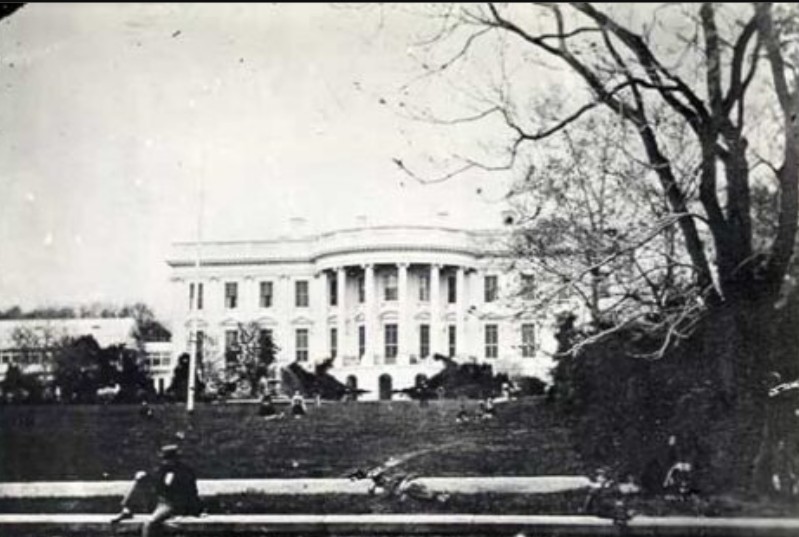
White House, Washington, D.C., 1861 (Matthew Brady, U.S. Library of Congress, public domain).
“There is another chapter to the story of how four young soldiers from Allentown, members of the Forty-Seventh Regiment, managed to see President Lincoln in 1861 after they had made two ineffectual efforts to see the great man. The young soldiers were Allen Wolf, William H. Smith, Jacob Worman, and George Hepler. They were members of Captain Mickley’s Company G and the pass which they had expired at 5 p.m. of that day.”
—The Allentown Democrat, April 5, 1911
Their mission to shake the hand of President Abraham Lincoln accomplished, Private George Heppler, Drummer William N. Smith, Private Allen David Wolf, and Private Jacob Peter Worman, of the 47th Pennsylvania Volunteer Infantry, had a second mission to accomplish in late September of 1861 — to make it back to their regiment’s encampment, safely and quickly — because the pass that they had received from one of their superior officers was about to expire.
But their new mission would prove to be even more difficult than had their successful White House meeting with President Lincoln. According to The Allentown Democrat:
“It was growing late in the afternoon when the young soldiers left the White House and they made tracks for the camp. What followed can best be told in Mr. Wolf’s own words:
‘When we got to the point where our regiment had been encamped in the morning we saw nothing but strange faces. We asked for Company G, and were directed to a point. When we came there we found that during our absence the Forty-seventh had been ordered to move and a Wisconsin regiment was encamped there. We decided to return to the city [Washington, D.C.] and in due time fell into the hands of the patrol. We showed our pass and were sent to the headquarters of General McClellan. The general met us personally. We told him of our predicament and he told us that our regiment was now encamped in a different location. He directed us to cross the chain bridge. The general also informed us that a wagon train would go that way and that we should follow it. We did as he instructed us to do. What a march that was, however! It was raining all night and we were drenched to the skin by the time we reached our regiment. But we felt amply repaid. We had seen the greatest man in the country and had spoken to General McClellan.’”

Chain Bridge across the Potomac above Georgetown looking toward Virginia, 1861 (The Illustrated London News, public domain).
The inability of the four 47th Pennsylvania Volunteers to locate their regiment’s camp is more easily understood when reading a letter penned on 29 September by Company C Musician Henry Wharton, in which he informed readers of the Sunbury American that the 47th Pennsylvania had changed camps three times in three days:
“On Friday last we left Camp Kalorama, and the same night encamped about one mile from the Chain Bridge on the opposite side of the Potomac from Washington. The next morning, Saturday, we were ordered to this Camp [Camp Advance near Fort Ethan Allen, Virginia], one and a half miles from the one we occupied the night previous. I should have mentioned that we halted on a high hill (on our march here) at the Chain Bridge, called Camp Lyon, but were immediately ordered on this side of the river. On the route from Kalorama we were for two hours exposed to the hardest rain I ever experienced. Whew, it was a whopper; but the fellows stood it well – not a murmur – and they waited in their wet clothes until nine o’clock at night for their supper. Our Camp adjoins that of the N.Y. 79th (Highlanders.)….
“We had not been in this Camp more than six hours before our boys were supplied with twenty rounds of ball and cartridge, and ordered to march and meet the enemy; they were out all night and got back to Camp at nine o’clock this morning, without having a fight. They are now in their tents taking a snooze preparatory to another march this morning…. I don’t know how long the boys will be gone, but the orders are to cook two days’ rations and take it with them in their haversacks….”
Despite that confusion, all four of the adventurous 47th Pennsylvania Volunteers eventually did manage to reconnect with their regiment at its encampment in Virginia. They then went on to follow President Lincoln’s directive to them: “Be good and above all obey your commander.”
Private Allen David Wolf, who was ultimately promoted up through the ranks to become Corporal Wolf, and Drummer William N. Smith both survived their initial three-year terms of enlistment and were both honorably discharged from the 47th Pennsylvania Volunteer Infantry’s encampment near Berryville, Virginia on September 18, 1864.
Private George Heppler, who was also ultimately promoted to the rank of corporal, and Private Worman, who was promoted to the rank of sergeant, served far longer — until the 47th was mustered out for the final time on Christmas Day in 1865.
All four witnessed both the worst and best of humanity and were forever changed by all that they had seen and heard as they fought to save their nation from disunion.
Sources:
- Bates, Samuel P. History of Pennsylvania Volunteers, 1861-5, vol. 1. Harrisburg, Pennsylvania: B. Singerly, State Printer, 1869.
- “Gleanings by the Way.” Allentown, Pennsylvania: The Allentown Democrat, April 4, 1911.
- “Gleanings By the Way.” Allentown, Pennsylvania: The Allentown Democrat, April 5, 1911.
- Wharton, Henry D. “Letters from the Sunbury Guards.” Sunbury, Pennsylvania: The Sunbury American, September 1861.
 47th Pennsylvania Volunteers
You must be logged in to post a comment.