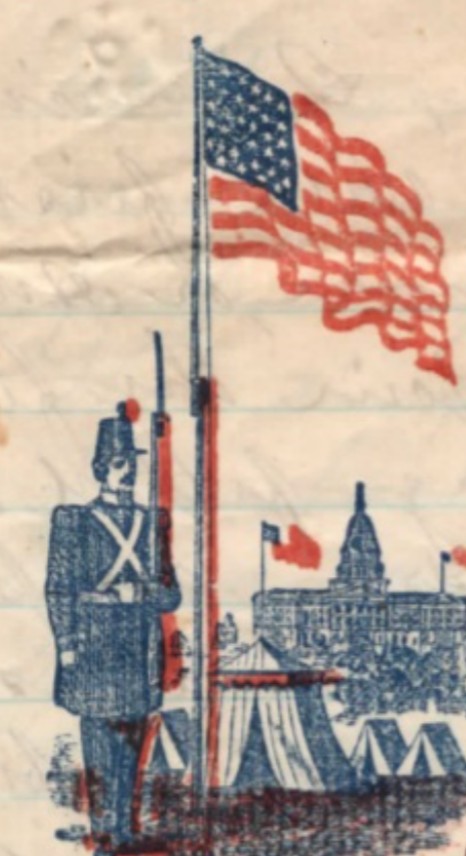
Detail from stationery used in a letter by a 47th Pennsylvania Volunteer to his parents (1862, public domain).
When I launched the website for 47th Pennsylvania Volunteers: One Civil War Regiment’s Story in 2014, my goal was simple — to create an online space that could function as a basic “placeholder” for the research that I had been conducting, for years, about the life of my great-grandfather, Timothy M. Snyder, who had served with the 47th Pennsylvania Volunteer Infantry during the American Civil War.
I was simply trying to understand why Tim Snyder had continued to serve with his regiment for such a long period of time (from mid-August 1861 through early January 1866), despite having completed his initial, three-year term of enlistment and despite his having been wounded twice in battle.
Along the way, I began uncovering details about another man — Henry D. Wharton. It seemed, from letters that Henry had written to my great-grandfather’s hometown newspaper, that he had not only served beside Tim Snyder on battlefields far from home, but that he might actually have been Tim’s neighbor or friend — or possibly even his cousin.
So, I began searching Civil War-era newspaper collections for more of Henry Wharton’s letters in the hope of finding more information about my great-grandfather, but what I found was so much more — accounts of battles so poetic, so lyrical, that I felt that Henry might have become a friend of mine, had we lived in the same town, during the same decades.
I needed to know what happened to Henry. Did he survive? Did he make it home? What was his life like before the war? How did he become such a gifted writer? As I learned more about him, I realized that, yes, he did survive, and, yes, he did marry — but he never had children. (“So there’s no one left to tell his story.”)
It was that single thought that inspired me to research and write a biography about Henry Wharton, and it was that biography that prompted me, in turn, to create 47th Pennsylvania Volunteers: One Civil War Regiment’s Story.
I could not have imagined back then that my research would attract the attention of descendants of other men who had also served with the 47th Pennsylvania, nor that my research findings would be of help to other academic and public historians and educators in K-12 school systems, colleges and universities, historical societies, public libraries, and museums across the United States.
Nor could I have anticipated the extraordinary generosity of the volunteers who have trekked over hill and dale through cemeteries, in all kinds of weather, to photograph the graves of 47th Pennsylvania Volunteer Infantrymen, or have ventured to far-flung flea markets and archives of small-town historical societies (or into the dusty, spider-friendly attics of grandparents — “Eek!”) in search of military records, photos and other memorabilia to help me create accurate biographies of their 47th Pennsylvania ancestors.
And I certainly could not have conceived of any future in which my audience would become a global one, with readers of my posts about the regiment’s activities and biographies of individual soldiers transformed into avid fans of the 47th Pennsylvania Volunteer Infantrymen who helped to preserve a nation’s Union and end the brutal practice of chattel slavery, wherever they encountered it, whenever they had the power to do so.
But each of those scenarios did come to pass, fueled largely by word of mouth. As my research findings grew, transforming a “placeholder website” into an educational outreach initiative, WordPress and other technology tools documented the history of “The 47th Pennsylvania Volunteers’ Project,” enabling me to provide this helpful snapshot of success for you.
Key Project Statistics (as of 2 p.m. on December 31, 2024):
- First Content Posted to Website: May 25, 2014
- Total Website Page Views to Date: 892,101
- Total Number of Website Visitors to Date: 745,686
- Total Number of 47th Pennsylvania Volunteer Gravesites Documented via the Project’s Virtual Cemetery to Date: 1,448
- Total Number of Individual Officers, Enlisted Men and Regimental Support Personnel Profiled to Date: 302
- Most Popular Post in 2024: Reunited in Death: The Virtual Cemetery Project of 47th Pennsylvania Volunteers: One Civil War Regiment’s Story
I am profoundly grateful to my great-grandfather. He bequeathed the gift of all gifts to each of his descendants and to history lovers everywhere — breadcrumbs scattered, with and without thought, along the path of his life’s journey, never dreaming that his “factcrumbs” would be found, analyzed, layered and baked into satisfying, lifelong “brainfood” for present-day and future students of history.
I am also grateful to Henry Wharton for his presence of mind to faithfully chronicle the activities of the 47th Pennsylvania Volunteer Infantry in ways that made readers want to learn more about so many of the regiment’s individual members and their families.
As I close out both 2024 and the first decade of operations for “the 47th Pennsylvania Volunteers’ Project,” I thank you, dear reader, for joining me on this journey and ask to you to stay engaged with the content on this website, its related social media accounts and our companion website, Freedmen of the 47th Pennsylvania Volunteer Infantry, because there are more than a thousand soldiers’ stories that are still waiting to be uncovered and told.
May your New Year be filled with laughter, love and light!

 47th Pennsylvania Volunteers
You must be logged in to post a comment.