The Aftermath of Combat: An Army Captain Reports His Company’s Losses During the Union’s 1864 Red River Campaign Across Louisiana

With sincere gratitude to Julian Burley for his purchase and preservation of Captain Charles W. Abbott’s letter and for his permission to use the letter’s image and text for 47th Pennsylvania Volunteers: One Civil War Regiment’s Story.


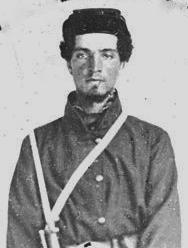
Captain Charles William Abbott, Company K, 47th Pennsylvania Volunteers, went on to become a lieutenant-colonel and second-in-command of his regiment (public domain).

His company had barely gotten back to camp after surviving the brutal combat of the Battle of Sabine Cross Roads during the Union’s 1864 Red River Campaign across Louisiana when his men were expected to suck it up, turn around and march back toward the enemy for what would ultimately turn into the Battle of Pleasant Hill, Louisiana later that day—9 April 1864.

He was Captain Charles William Abbott, and he was the commanding officer of Company K—the second to have headed “the all-German company” that had been recruited for service with the 47th Pennsylvania Volunteer Infantry in August 1861 by Captain George Junker, who had been killed during the Battle of Pocotaligo in October 1862. Unlike his predecessor, though, Captain Abbott would turn out to be a survivor of multiple battles and would later be commissioned as a lieutenant-colonel and appointed as second-in-command of the 47th Pennsylvania Volunteers.

But in April 1864, during the opening weeks of the Red River Campaign, he was still “middle management”—a company captain who had to explain to superiors why he needed more supplies for his company when his own commanding officers were thinking that he and his men had already been given their designated allotment of food and other items necessary to perform their duties in the Western Theater of the American Civil War.

Captain Abbott’s brief report, penned on 12 April 1864—three days after the Battle of Pleasant Hill, from the U.S. Army of the Gulf’s encampment at Grand Ecore, Louisiana, documented a significant hardship faced by Union Army troops when they were suddenly ordered into combat—the unanticipated loss of unit-related supplies and personal belongings. That same report also presented key details about his company’s movements before and after its most recent battle, as well as its post-battle casualty status.

Transcription of Captain Abbott’s Letter:

Report by Captain Charles W. Abbott, Company K, 47th Pennsylvania Volunteers, Grand Ecore, Louisiana, 12 April 1864 (courtesy of Julian Burley, used with permission; click to enlarge).

Grand Ecore, La.
April 12th 1864.

I certify on honor that on the 9th day of April 1864 at Pleasant Hill, La., the Camp and Garrison Equipage enumerated below were lost under the following Circumstances. The Regiment to which my Company belongs were ordered to leave their knapsacks in Camp, and prepare for action. During the Engagement the Enemy got possession of our Camp but were driven from the field. During the Engagement One Sergeant and One Private were wounded, and Ten Privates missing. The Regiment lay on their arms during the Night in a different locality and were ordered to retreat in good Order at 2 O’clock A.M. April 10th. It was therefore unpossible [sic, impossible] to recover the Camp and Garrison Equipage. The following is a List of the Stores abandoned:

21 Knapsacks
31 Haversacks
19 Canteen’s & Straps
18 Shelter tents

4 Camp Kettles

Chas. W. Abbott Capt.
Comdg. Co. K. 47th Pa Vols

The undersigned, being duly sworn, deposes and says that he is cognizant of the facts as above set forth, and that they are correct, to the best of his knowledge and belief.

G. W. Alexander
Lt. Col. 47 R.P.V.

Sworn to and subscribed before me; at Grand Ecore, La. this 12th day of April 1864.


Sources:

  1. Abbott, Charles W., in Civil War Veterans’ Card File, 1861-1865 (K-47 I and F&S-47 I). Harrisburg, Pennsylvania: Pennsylvania State Archives.
  2. Abbott, Charles W., in Civil War Muster Rolls (K-47 I and F&S-47 I). Harrisburg, Pennsylvania: Pennsylvania State Archives.
  3. Abbott, Charles W. Report from Captain Charles W. Abbott, Company K, 47th Pennsylvania Volunteer Infantry, to senior officers of the U.S. Army of the Gulf’s XIX Corps (19th Corps), Grand Ecore, Louisiana, 12 April 1864. Nazareth, Pennsylvania: Personal Collection of Julian Burley.
  4. Bates, Samuel P. History of Pennsylvania Volunteers, 1861-5, vol. 1. Harrisburg, Pennsylvania: B. Singerly, State Printer, 1869.
  5. “History of the Forty-Seventh Regiment P.V., The.” Allentown, Pennsylvania: The Lehigh Register, 20 July 1870.
  6. Schmidt, Lewis G. A Civil War History of the 47th Regiment of Pennsylvania Veteran Volunteers. Allentown, Pennsylvania: Self-published, 1986.


The March from Marksville to Morganza, Louisiana and the Battle of Mansura, Mid to Late-May, 1864

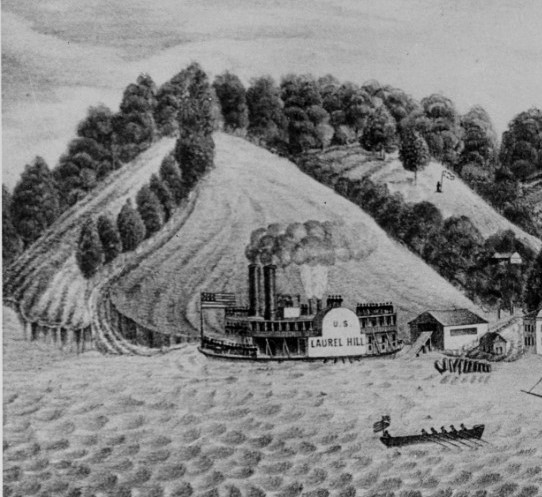
USS Laurel Hill, May 26, 1862 (Baldwin Lithograph, Collection of President Franklin D. Roosevelt, Hyde Park, New York, 1936, U.S. Naval Heritage Command, public domain).

Barely out of sight of the city of Alexandria, in Rapides Parish Louisiana, when it ran into the enemy during its retreat south in mid-May 1864, the Union’s Army of the Gulf easily defeated the Confederate States Army troops it encountered and continued its trek toward the village of Marksville in Avoyelles Parish. Members of the 47th Pennsylvania Volunteer Infantry, which was positioned farther back in the Union column, were aware of, but not involved in, that short engagement. According to C Company Musician Henry D. Wharton:

After marching a few miles skirmishing commenced in front between the cavalry and the enemy in riflepits [sic] on the bank of the river, but they were easily driven away. When we came up we discovered their pits and places where there had been batteries planted. At this point the John Warren, an unarmed transport, on which were sick soldiers and women, was fired into and sunk, killing many and those that were not drowned taken prisoners. A tin-clad gunboat was destroyed at the same place, by which we lost a large mail. Many letters and directed envelopes were found on the bank – thrown there after the contents had been read by the unprincipled scoundrels. The inhumanity of Guerrilla bands in this department is beyond belief, and if one did not know the truth of it or saw some of their barbarities, he would write it down as the story of a ‘reliable gentleman’ or as told by an ‘intelligent contraband.’ Not satisfied with his murderous intent on unarmed transports he fires into the Hospital steamer Laurel Hill, with four hundred sick on board. This boat had the usual hospital signal floating fore and aft, yet, notwithstanding all this, and the customs of war, they fired on them, proving by this act that they are more hardened than the Indians on the frontier.

* Note: The USS Laurel Hill survived the attack and, in a few short weeks, became the final home for ailing 47th Pennsylvania Volunteers, including Corporal William Schweitzer and Privates Amandus Bellis and Nicholas Hoffman (Company A) and Private John Witz (Company E).

Map of key 1864 Red River Campaign locations, showing the battle sites of Sabine Cross Roads, Pleasant Hill and Mansura in relation to the Union’s occupation sites at Alexandria, Grand Ecore, Morganza, and New Orleans (excerpt from Dickinson College/U.S. Library of Congress map, public domain; click to enlarge).

Resuming their trek south with the retreating Army of the Gulf, the 47th Pennsylvania Volunteers engaged in yet another long march, trudging more than thirty miles as the month of May 1864 wore on. According to the expedition’s commanding officer, Union Major-General Nathaniel P. Banks:

The fleet passed below Alexandria on the 13th of May. The army on its march from Alexandria did not encounter the enemy in force until near the town of Mansura. He was driven through the town in the evening of the 14th of May, and at daybreak next morning our advance encountered his cavalry on the prairie east of the town.

According to Henry Wharton, “On Sunday, May 15, we left the river road and took a short route through the woods, saving considerable distance.”

The windings of Red river are so numerous that it resembles the tape-worm railroad wherewith the politicians frightened the dear people during the administration of Ritner and Stevens. – We stopped several hours in the woods to leave cavalry pass, when we moved forward and by four o’clock emerged into a large open plain where we formed in line of battle, expecting a regular engagement. The enemy, however, retired and we advanced ‘till dark, when the forces halted for the night, with orders to rest on their arms. – ‘Twas here that Banks rode through our regiment, amidst the cheers of the boys, and gave the pleasant news that Grant had defeated Lee.

“Sleeping on Their Arms” by Winslow Homer (Harper’s Weekly, May 21, 1864).

Positioned just outside of the town of Marksville, under orders to “rest on their arms” for the night, the 47th Pennsylvanians half-dozed with their rifles within a finger’s length—but without the benefit of tents for cover. It was the eve of the Battle of Mansura, which unfolded on May 16, 1864 as follows, according to Wharton:

Early next morning we marched through Marksville into a prairie nine miles long and six wide where every preparation was made for a fight. The whole of our force was formed in line, in support of artillery in front, who commenced operations on the enemy driving him gradually from the prairie into the woods. As the enemy retreated before the heavy fire of our artillery, the infantry advanced in line until they reached Mousoula [sic, Mansura], where they formed in column, taking the whole field in an attempt to flank the enemy, but their running qualities were so good that we were foiled. The maneuvring [sic, maneuvering] of the troops was handsomely done, and the movements was [sic, were] one of the finest things of the war. The fight of artillery was a steady one of five miles. The enemy merely stood that they might cover the retreat of their infantry and train under cover of their artillery.

Per Major-General Banks, the Confederate troops “fell back, with steady and sharp skirmishing across the prairie, to a belt of woods, which he occupied.”

The enemy’s position covered three roads diverging from Mansura to the Atchafalaya. He manifested a determination here to obstinately resist our passage. The engagement, which lasted several hours, was confined chiefly to the artillery until our troops got possession of the edge of the woods – first upon our left by General Emory; subsequently on our right by General Smith, when he was driven from the field, after a sharp and decisive fight, with considerable loss.

According to military historian Steven E. Clay, “As the Army of the Gulf marched from Alexandria to Simmesport, it followed the River Road. As it moved, Taylor’s cavalry harassed the column from all sides.”

Steele’s men resumed the pressure on A. J. Smith’s rearguard. Annoying Emory and the cavalry advanced guard was Major and Bagby’s commands. The troops also attempted to slow the Federal march by cutting trees and placing other obstacles in the way. Parson’s men skirmished with Gooding’s troopers on the right flank. None of the rebel cavalry’s efforts, however, appreciably slowed the Union column.

On 14 May, the army’s van arrived at Bayour Choctaw. Emory called the pontoon train forward, and within a short time, the pontonniers had the stream bridged and the army was crossing…. That evening the troops of the XIX Corps [including the 47th Pennsylvania Volunteers] bivouacked beside the wrecks of the John Warner, Signal, and Covington. Strewn upon the ground were the letters many of the men had mailed to their loved ones earlier and had been placed on the Warner bound for New Orleans. The rebel soldiers had opened the letters, read them for entertainment, and simply tossed them aside. The idea did not sit well with the Federals, but neither did the wanton destruction and plunder of civilian homes with the Confederates.

On 15 May the column slowly crossed the Bayou Choctaw Swamp and entered the Avoyelles … Prairie. There, Major’s cavalry, later along with Bagby’s troops, attacked the lead elements several times. The fighting became so hot at moments that Emory deployed his artillery to help drive the bothersome rebel troopers away…. By nightfall … the XIX Corps had reached Marksville with the rest of the army strung out behind.

Late on 15 May, Banks learned that Taylor had massed his forces six miles ahead at the town of Mansura, evidently with the intention of blocking further Federal movement on the road to Simmesport…. On learning of the concentration of rebel forces, Banks sent orders to Emory directing him to move no later than 0300 [3 a.m.] on 16 May and to attack the enemy at daybreak. Further, Smith advanced on Emory’s right to attack into Taylor’s left flank. The XIII Corps [13th Corps], now under Lawler since 9 May … was to remain in front of Marksville as the reserve. The trains [Union wagon trains] were held behind that town….

As ordered, the Army of the Gulf moved south before sunrise. As morning dawned, the Federal army began its deployment on the wide open plain of the Avoyelles Prairie. The US troops advanced with Emory’s XIX [including the 47th Pennsylvania] in the lead with Grover’s 1st Division on the Federal left near the Grand River and McMillan’s 2nd Division [including the 47th Pennsylvania] on the right. The XIX Corps was followed by A. J. Smith’s XVI Corps [16th Corps] in column; Mower’s division was followed by that of Kilby Smith. As the Federal brigades deployed on the field they could see the Confederate battle line in the distance. Virtually in the center of the battlefield was the tiny village of Mansura.

According to Clay, Confederate Major-General Richard Taylor (a plantation owner and son of former U.S. President Zachary Taylor) “had placed eight dismounted cavalry regiments from Major’s and Bagby’s commands to the east of the hamlet” of Mansura. “At least 19 cannon with the batteries interspersed among the brigades supported these troops.” Confederate Brigadier-General Camille Armand Jules Marie, the Prince de Polignac, a prince of France who fought with the Confederate Army during America’s Civil War and whom the 47th Pennsylvanian Volunteers had previously faced in combat during the Battle of Sabine Cross Roads near Mansfield, Louisiana, “posted his two small infantry brigades and two dismounted regiments of cavalry on the left, west of town, and thirteen more guns supported Polignac’s force.”

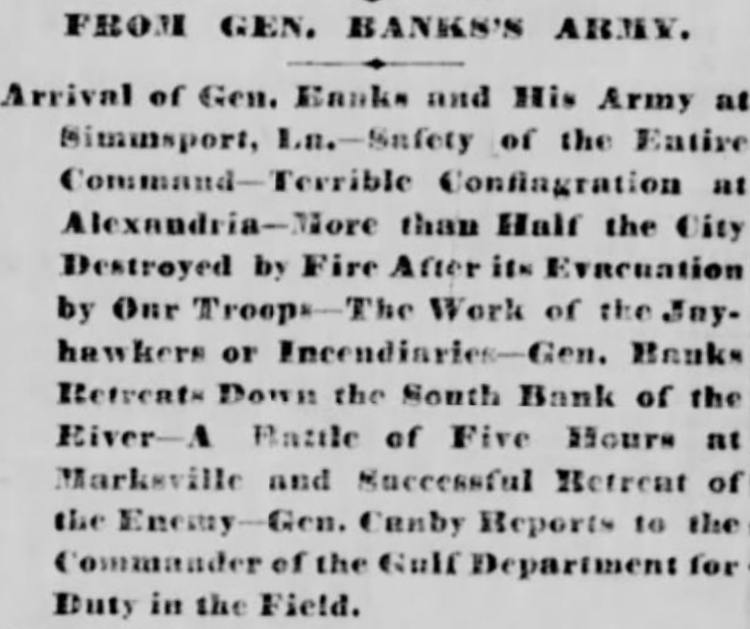
New York Tribune headline announcing the U.S. Army of the Gulf’s May 1864 victory near Marksville, Louisiana (New York Tribune, June 3, 1864, public domain).

Standing “on a flat, green savanna,” according to Clay, the troops under Brigadier-General Emory’s command, including the 47th Pennsylvania Volunteers, were the first to march into the battle’s fray, followed by A. J. Smith’s “divisions to the right of the line.” It quickly became obvious to all who were watching the scene unfold that Taylor had woefully misjudged his opponents; his six thousand Confederates were greeted with the spectacle of the eighteen-thousand strong Army of the Gulf arrayed before them.

According to Clay, “The battle began sometime after 0600 [6 a.m.] with a mutual artillery bombardment.”

As the fusillade opened, commanders on both sides ordered their men to lie down in order to reduce casualties during the artillery duel. The tactic was effective. The barrage lasted about four hours, but few men were struck by the many rounds fired. As the Union battle line rose and moved forward on occasion, Taylor’s skirmish line responded by slowly giving ground…. Finally, at about 1000 (1 p.m.), as the XVI Corps pressed forward on the Confederate left to flank Taylor’s position as planned, the rebel line quickly sidestepped the move and fell back toward their trains which were located southwest in the village of Evergreen.

Unlike the sanguinary opening battles of the Red River Campaign, the Battle of Mansura was far less brutal. Per Wharton:

Our loss was slight. Of the rebels we could not ascertain correctly, but learned from citizens who had secreted themselves during the fight, that they had many killed and wounded, who threw them into wagons, promiscuously, and drove them off so that we could not learn their casualties.

Afterward, the victorious Army of the Gulf resumed its march south. According Major-General Banks:

The 16th of May we reached Simmsport [sic, Simmesport], on the Atchafalaya. Being entirely destitute of any ordinary bridge material for the passage of this river – about six hundred yards wide – a bridge was constructed of the steamers, under direction of Lieutenant Colonel Bailey. This work was not of the same magnitude, but was as important to the army as the dam at Alexandria was to the navy. It had the merit of being an entirely novel construction, no bridge of such magnitude having been constructed of similar materials. The bridge was completed at one o’clock on the 19th of May. The wagon train passed in the afternoon, and the troops the next morning, in better spirit and condition, as able and eager to meet the enemy as at any period of the campaign.

Union Major-General Nathaniel Banks subsequently reported that, during the Army of the Gulf’s final engagement with Confederates, the “command of General A. J. Smith, which covered the rear of the army during the construction of the bridge and the passage of the army, had a severe engagement with the enemy, under Polignac, on the afternoon of the 19th, at Yellow Bayou, which lasted several hours.”

Our loss was about one hundred and fifty in killed and wounded; that of the enemy much greater, besides many prisoners who were taken by our troops. Major General E. R. S. Canby arrived at Simmsport [sic, Simmesport] on the 19th of May, and the next day assumed command of the troops as a portion of the forces of the military division of the West Mississippi, to the command of which he had been assigned.

The 47th Pennsylvania, however, was not involved in that battle at Yellow Bayou; according to Wharton:

This fight was the last one of the expedition. The whole of the force is safe on the Mississippi, gunboats, transports and trains. The 16th and 17th have gone to their old commands.

It is amusing to read the statements of correspondents to papers North, concerning our movements and the losses of our army. I have it from the best source that the Federal loss from Franklin to Mansfield, and from their [sic] to this point does not exceed thirty-five hundred in killed, wounded and missing, while that of the rebels is over eight thousand.

Union Army base at Morganza Bend, Louisiana, circa 1863-1865 (U.S. Library of Congress, public domain).

After that final battle, the surviving members of the 47th made their way through Simmesport and into the Atchafalaya Basin, and then moved on to the village of Morganza, where they made camp again. According to Wharton, the members of Company C were sent on a special mission which took them on an intense journey of one hundred and twenty miles:

Company C, on last Saturday was detailed by the General in command of the Division to take one hundred and eighty-seven prisoners (rebs) to New Orleans. This they done [sic] satisfactorily and returned yesterday to their regiment, ready for duty. While in the City some of the boys made Captain Gobin quite a handsome present, to show their appreciation of him as an officer gentleman.

By May 28, 1864, the men from Company C had returned from New Orleans and were once again encamped at Morganza with the full 47th Pennsylvania Volunteer Infantry, prompting Henry Wharton to write:

The boys are well. James Kennedy who was wounded at Pleasant Hill, died at New Orleans hospital a few days ago. His friends in the company were pleased to learn that Dr. Dodge of Sunbury, now of the U.S. Steamer Octorora, was with him in his last moments, and ministered to his wants. The Doctor was one of the Surgeons from the Navy who volunteered when our wounded was [sic, were] sent to New Orleans.

Their long trek through Louisiana was over, but their fight to preserve America’s Union was not.

Sources:

  1. Banks, Nathaniel P. “Report of the Red River Campaign,” in “Annual Report of the Secretary of  War,” in Message of the President of the United States, and Accompanying Documents, to the Two Houses of Congress, at the Commencement of the First Session of the Thirty-Ninth Congress. Washington: Government Printing Office, 1866.
  2. Bates, Samuel P. History of Pennsylvania Volunteers, 1861-5, vol. 1. Harrisburg, Pennsylvania: B. Singerly, State Printer, 1869.
  3. Battle of Pleasant Hill, April 9, 1864, Walker’s Texas Division Campaign Map, Detail,” in “House Divided.” Carlisle, Pennsylvania: History Department, Dickinson College, November 21, 2009 (cropped from the original public domain map available on the website of the U.S. Library of Congress).
  4. Clay, Steven E. The Staff Ride Handbook for the Red River Campaign, 7 March-19 May 1864. Fort Leavenworth, Kansas: Combat Studies Institute Press, U.S. Army Combined Arms Centers, 2023.
  5. Prisoner of War Records, Camp Ford and Camp Groce (47th Pennsylvania Volunteer Infantry). Tyler Texas: Smith County Historical Society, 2010.
  6. Report of Maj. Gen. Nathaniel P. Banks, U. S. Army, Commanding Expedition and Department of the Gulf (to Edwin M. Stanton, Secretary of War), in Annual Report of the Secretary of War, in Message of the President of the United States, and Accompanying Documents, to the Two Houses of Congress, at the Commencement of the First Session of the Thirty-Ninth Congress. Washington, D.C.: Government Printing Office, 1866.
  7. Schmidt, Lewis G. A Civil War History of the 47th Regiment of Pennsylvania Veteran Volunteers. Allentown, Pennsylvania: Self-published, 1986.
  8. “The History of the Forty-Seventh Regt. P. V.” Allentown, Pennsylvania: The Lehigh Register, July 20, 1870.
  9. Wharton, Henry D. Letters from the Sunbury Guards, 1861-1868. Sunbury, Pennsylvania: Sunbury American.


Building Bailey’s Dam on the Red River, Alexandria, Louisiana, Late April to Mid-May, 1864


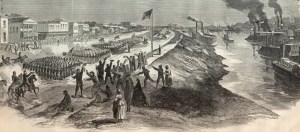
The Union’s Army of the Gulf marched into Alexandria, Louisiana, during the weekend of April 22, 1864 (Harper’s Weekly, public domain; click to enlarge).

Resupplied with ammunition and food by the Union Navy’s fleet of quartermaster ships after reaching Alexandria, Louisiana on April 26, 1864, the 47th Pennsylvania Volunteers and other Union infantry and artillery troops were placed temporarily under the command of Lieutenant-Colonel Joseph Bailey and assigned to the hard labor of fortification work. Throwing their backs into erecting “Bailey’s Dam,” they helped to create a timber dam that was designed by Bailey to enable the Union Navy’s gunboats and other vessels to be able to travel along the Red River without fear of running aground. This construction was undertaken, according to C Company Musician Henry D. Wharton, because:

The water in the Red river had fallen so much that it prevented the gunboats from operating with us, and kept our transports from supplying the troops with rations, (and you know soldiers, like other people, will eat) so Banks was compelled to relinquish his designs on Shreveport and fall back to the Mississippi. To do this a large dam had to be built on the falls at Alexandria to get the ironclads down the river.

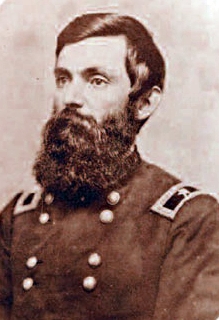
Brigadier-General Joseph Bailey, shonw here circa 1865, was responsible for designing and overseeing the construction of Bailey’s Dam nexr Alexandria, Louisiana during the spring of 1864 (public domain).

Historian Steven Clay notes that, by this point in the Red River Campaign, “The depth of the river was only between three and four feet; it took seven feet of water to get the gunboats over the rocky bottom at the rapids.” To make that happen, Lieutenant-Colonel Bailey had initially floated the idea to build a dam while also sinking “several stone-laden barges to block the passage of water and cause the river to pool up behind them.”

There would be three narrow chutes constructed in the middle to allow passage of the largest gunboats. Then when the depth was sufficient, the boats would steam over the rocks, through the passageways, and into safe and deep waters below the dam.

According to archaeologist and military historian Steven D. Smith, Ph.D. and staff of the Louisiana Archaeological Survey and Antiquities Commission, “Military engineer Joseph Bailey’s presence with the Red River expedition was, in a sense, one of those coincidences of history that sometimes result in turning the course of events.”

His knowledge of engineering was not acquired through formal study at West Point. Instead, he had learned practical engineering on the Wisconsin frontier, where damming was a skill perfected by lumbermen to float logs to their sawmills.

Born in Ashtabula County, Ohio on May 6, 1827, Bailey grew up in Illinois. In 1850 he moved to Wisconsin, where for the next 20 years he was involved in the construction of dams, mills, and bridges. At the beginning of the war, Bailey formed a company of lumbermen and became a captain. Soon, though, his construction genius was recognized and he was supervising various engineering projects for the North, including construction at Fort Dix in Washington D.C….

In 1863 Bailey won distinction at the battle of Port Hudson. There, despite the scoffs of formally trained military engineers, he constructed a gun emplacement in full sight of rebel fortifications and proceeded to silence the Confederate guns. He also built a dam during the siege to refloat two grounded steamboats.

Christened “Bailey’s Dam” in reference to the Union officer who designed and oversaw its construction, Lieutenant-Colonel Joseph Bailey, this timber dam was built by the Union Army on the Red River near Alexandria, Louisiana in May 1864 to facilitate Union gunboat passage (U.S. Library of Congress, public domain; click to enlarge).

The construction of Bailey’s Dam near Alexandria during the spring of 1864 was described by Lieutenant-Colonel Bailey in a post-construction report to his superiors as follows:

…. Immediately after our army received a check at Sabine Cross-Roads and the retreat commenced I learned through reliable sources that the Red River was rapidly falling. I became assured that by the time the fleet could reach Alexandria there would not be sufficient water to float the gun-boats over the falls. It was evident, therefore, that they were in imminent danger. Believing, as I did, that their capture or destruction would involve the destruction of our army, the blockade of the Mississippi, and even greater disasters to our cause, I proposed to Major-General Franklin on the 9th of April, previous to the battle of Pleasant Hill, to increase the depth of water by means of a dam, and submitted to him my plan of the same. In the course of the conversation he expressed a favorable opinion of it.

During the halt of the army at Grand Ecore on the 17th of April, General Franklin, having heard that the iron-clad gun-boat Eastport had struck a snag on the preceding day and sunk at a point 9 miles below, gave me a letter of introduction to Admiral Porter and directed me to do all in my power to assist in raising the Eastport, and to communicate to the admiral my plan of constructing a dam to relieve the fleet, with his belief in its practicability; also that he thought it advisable that the admiral should at once confer with General Banks and urge him to make the necessary preparations, send for tools, &c. Nothing further was done until after our arrival at Alexandria. On the 26th, the admiral reached the head of the falls. I examined the river and submitted additional details of the proposed dam. General Franklin approved of them and directed me to see the admiral and again urge upon him the necessity of prevailing upon General Banks to order the work to be commenced immediately. There was no doubt that the entire fleet then above the rapids would be lost unless the plan of raising the water by a dam was adopted and put into execution with all possible vigor. I represented that General Franklin had full confidence in the success of the undertaking, and that the admiral might rely upon him for all the assistance in his power. The only preliminary required was an order from General Banks. On the 29th, by order of General Franklin, I consulted with Generals Banks and Hunter, and explained to them the proposed plan in detail. The latter remarked that, although he had little confidence in its feasibility, he nevertheless thought it better to try the experiment, especially as General Franklin, who is an engineer, advised it. Upon this General Banks issued the necessary order for details, teams, &c., and I commenced the work on the morning of the 30th.

I presume it is sufficient in this report to say that the dam was constructed entirely on the plan first given to General Franklin, and approved by him.

During the first few days I had some difficulty in procuring details, &c., but the officers and men soon gained confidence and labored faithfully. The work progressed rapidly, without accident or interruption, except the breaking away of two coal barges which formed part of the dam. This afterward proved beneficial. In addition to the dam at the foot of the falls, I constructed two wing-dams on each side of the river at the head of the falls.

The width of the river at the point where the dam was built is 758 feet, and the depth of the water from 4 to 6 feet. The current is very rapid, running about 10 miles per hour. The increase of depth by the main dam was 5 feet 4 inches; by the wing-dams, 1 foot 2 inches; total, 6 feet 6 inches. On the completion of the dam, we had the gratification of seeing the entire fleet pass over the rapids to a place of safety below, and we found ample reward for our labors in witnessing their result. The army and navy were relieved from a painful suspense, and eight valuable gunboats saved from destruction. The cheers of the masses assembled on the shore when the boats passed down attested their joy and renewed confidence. To Major-General Franklin, who, previous to the commencement of the work, was the only supporter of my proposition to save the fleet by means of a dam, and whose persevering efforts caused its adoption, I desire to return my grateful thanks. I trust the country will join with the Army of the Gulf and the Mississippi Squadron in awarding to him due praise for his earnest and intelligent efforts in their behalf. Major-General Banks promptly issued all necessary orders and assisted me by his constant presence and co-operation. General Dwight, his chief of staff, Colonel Wilson and Lieutenant Sargent, aides-de-camp, also rendered valuable assistance by their personal attention to our wants. Admiral Porter furnished a detail from his ships’ crews, under command of an excellent officer, Captain Langthorne, of the Mound City. All his officers and men were constantly present, and to their extraordinary exertions and to the well-known energy and ability of the admiral much of the success of the undertaking is due….
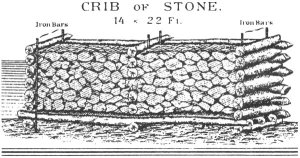
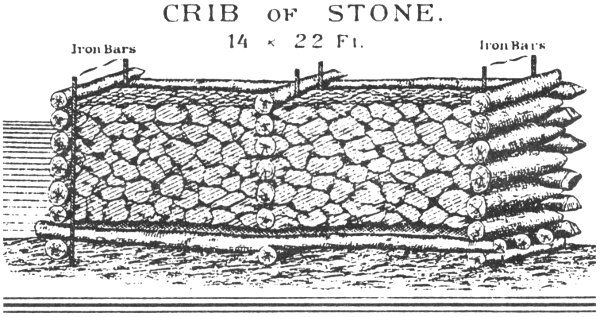
The crib dam designed by Lieutenant-Colonel Joseph Bailey to improve the water levels of the Red River near Alexandria, Louisiana, spring 1864 (Joseph Bailey, “Report on the Construction of the Dam Across the Red River,” 1865, public domain).

According to Smith, “Historical documents indicate that Bailey first built his dam just above the lower, downstream rapids.”

By constructing the dam at that particular location, he hoped the water would rise enough behind the dam to allow the gunboats to float over the upper rapids. Then, with the built-up water pressure, the dam could be broken through at the proper time and the gunboats could rush over the lower rapids, carried by the force of the released water.

Following Bailey’s practical nature, the dam was built with any locally available material readily at hand. To do so, he used different methods of construction for each riverbank. On the west (Alexandria) bank, he built the dam of large wooden boxes called cribs. Bailey constructed a number of cribs which were placed side by side from the bank out into the river.

Historical accounts indicate that lumber from Alexandria mills, homes, and barns was quickly stripped for use in building the cribs. Bricks, stone, and even machinery were used to fill and anchor the cribs. Additionally, historical illustrations show that iron bars were placed vertically in the four corners of each crib, to provide a supporting framework….

On the east (Pineville) bank, there were no town buildings to strip for lumber but there was, quite conveniently, a forest. With abundant trees available, Bailey constructed a ‘self-loading’ tree dam. According to historical diagrams, trees were stacked lengthwise with the flow of the stream. The upstream treetops were anchored to the river bottom with stones. The downstream trunks were raised higher than the upstream tops by alternating layers of other logs running perpendicular to, or across, the stream. This technique presented a dam face of logs angled upward with the stream flow. As the river was held back by the log face, the water pressure actually made the dam stronger or ‘self-loading.’
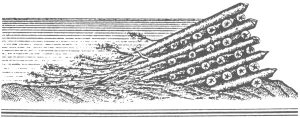
The tree dam designed by Lieutenant-Colonel Joseph Bailey for the Red River near Alexandria, Louisiana, spring 1864 (Joseph Bailey, “Report on the Construction of the Dam Across the Red River,” 1865, public domain).

Putting readers into the shoes of the Union Army troops on the ground during those days, the 1868 publication, The Rebellion Record: A Diary of American Events, noted that:

Oak, elm, and pine trees … were falling to the ground under the blows of the stalwart pioneers of Maine, bearing with them in their fall trees of lesser growth; mules and oxen were dragging the trees, denuded of their branches, to the river’s bank; wagons heavily loaded were moving in every direction; flat-boats carrying stone were floating with the current, while others were being drawn up the stream in the manner of canal boats. Meanwhile hundreds of men were at work at each end of the dam, moving heavy logs to the outer end of the tree-dam, … wheeling brick out to the cribs, carrying bars of railway iron to the barges, … while on each bank of the river were to be seen thousands of spectators, consisting of officers of both services, groups of sailors, soldiers, camp-followers, and citizens of Alexandria, all eagerly watching our progress and discussing the chances of success.

Initially, according to Smith, the “dam complex” worked well. “By May 6, the water held by the dam had risen 4 feet. By May 8, the water level was up 5 feet 4 inches.” But then the water levels continued to increase to such an extent that “the pressure against the dam became tremendous,” causing the dam to burst.

Two of the barges used in the dam had broken loose, and the water was gushing through. Porter, seeing the crisis, quickly ordered the gunboat Lexington to run the gap….

The Lexington’s run was followed by the three gunboats waiting behind the dam. Had the rest of the fleet been prepared, all of the boats might have escaped at that time. However … valuable time was wasted as the fleet gathered steam to attempt the run. Eventually, the water behind the dam fell and six gunboats still remained trapped.

But the Lexington’s adventure had proven that the dam could work, and troops confidently went back to work. Bailey worried that the dam would break again and decided to leave the 70-foot gap in the dam as it was. But this time he added smaller, lighter dams near the upper rapids. Like the dam sections at the lower rapids, both crib and tree dam methods were employed. These dams helped channel the water while reducing the pressure on the main dam. Thus, instead of relying on one dam to hold back the water until another run could be made, a series of dams were built to create a deep channel of water along the whole course of the shoals in that part of the Red River.

And, at that point, “Bailey’s Dam” became “Bailey’s Dams.”
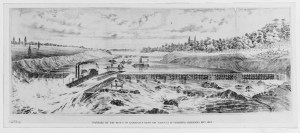
“Passage of the Fleet of Gunboats Over the Falls at Alexandria, Louisiana, May 1864 (Frank Leslie’s Illustrated Newspaper, July 16, 1864, U.S. Library of Congress, public domain; click to enlarge).

“While the army labored to build the upper dam, the navy … worked to lighten the loads on the trapped gunboats,” according to Smith.

From May 10 through 12, the remaining gunboats above the rapids struggled through the upper shoals to the pool behind the main dam. Yet another dam had to be built to refloat a gunboat that got stuck during this passage. Then on the twelfth of May, the Mound City, the largest gunboat of the fleet, ran for the gap in the main dam. The previous scene was repeated, with thousands lining the banks to watch the excitement. Marching bands played the ‘Star Spangled Banner’ and the ‘Battle Cry for Freedom [sic, ‘Battle Cry of Freedom’].’ Like the Lexington before it, as the Mound City hit the gap, it ground against the rocky river bottom, and then shot through. The next day all of the trapped vessels lay safely below the rapids.

Through it all, members of the 47th Pennsylvania Volunteer Infantry put their backs into their work, along with multiple other Union Army soldiers, including men from the 16th and 23rd Ohio Volunteers, the 19th Kentucky, the 23rd and 29th Wisconsin Volunteers, the 24th Iowa, the 24th and 27th Indiana, the 29th Maine, the 77th and 130th Illinois Volunteers, and the 97th and 99th U.S. Colored Infantry.

Lieutenant-Colonel Bailey later stated that his “details labored patiently and enthusiastically by day and night, standing waist deep in the water, under a broiling sun,” adding:

Their reward is the consciousness of having performed their duty as true soldiers, and they deserve the gratitude of their countrymen.

The massive construction project lasted roughly two weeks, according to 47th Pennsylvanian Henry Wharton, but proved to be worth it.

After a great deal of labor this was accomplished and by the morning of May 13th the last one was through the shute [sic], when we bade adieu to Alexandria, marching through the town with banners flying and keeping step to the music of Rally around the flag,’ and ‘When this cruel war is over.’

The Army of the Gulf’s departure, however, also brought shock and heartache; according to Major-General Banks:

Rumors were circulated freely throughout the camp at Alexandria that upon the evacuation of the town it would be burned. To prevent this destruction of property – part of which belonged to loyal citizens – General Grover, commanding the post, was instructed to organize a thorough police, and to provide for its occupation by an armed force until the army had marched for Simmsport [sic, Simmesport]. The measures taken were sufficient to prevent a conflagration in the manner in which it had been anticipated. But on the morning of the evacuation, while the army was in full possession of the town, a fire broke out in a building on the levee, which had been occupied by refugees or soldiers, in such a manner as to make it impossible to prevent a general conflagration. I saw the fire when it was first discovered. The ammunition and ordnance transports and the depot of ammunition on the levee were within a few yards of the fire. The boats were floated into the river and the ammunition moved from the levee with all possible dispatch [sic]. The troops labored with alacrity and vigor to suppress the conflagration, but owing to a high wind and the combustible material of the buildings it was found impossible to limit its progress, and a considerable portion of the town was destroyed.

According to Smith, “It is unclear who started the fires, as some accounts describe soldiers looting and setting fires, while other accounts note that army guards shot looters.” What is known for certain is that the 47th Pennsylvania Volunteers could not possibly have taken part in Alexandria’s destruction because they had actually left the city before the fire had even begun. According to Henry Wharton:

The next morning, at our camping place, the fleet of boats passed us, when we were informed that Alexandria had been destroyed by fire – the act of a dissatisfied citizen and several negroes. Incendiary acts were strictly forbidden in a general order the day before we left the place, and a cavalry guard was left in the rear to see the order enforced.

Injured or Sick:
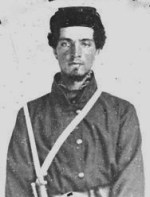
Private Abraham Wolf, Company B, 47th Pennsylvania Volunteers, circa 1861 (public domain).

Wolf, Abraham: Private, Company B; developed first signs of rheumatism, a condition that would last for the remainder of his life; also fell ill with chronic diarrhea during the construction of Bailey’s Dam due to poor water quality; subsequently developed hemorrhoids as a direct result of that illness.

Captured and Held as Prisoner of War (POW):

Maul, Adam (alternate spellings: Moll, Moul): Private, Company C; captured by Confederate forces at the Cane River on May 3, 1864 while assigned to duties away from the regiment’s Alexandria, Louisiana encampment—possibly during the construction of Bailey’s Dam; held as a prisoner of war (POW) at Camp Ford, a Confederate Army prison camp near Tyler, Texas until being released as part of a prisoner exchange between the Union and Confederate armies on July 22, 1864; received medical treatment, recovered from his experience, and returned to duty with Company C.

Smith, Frederick: Private, Company D; possibly wounded in action during the Battle of Pleasant Hill, Louisiana on April 9, 1864; captured by Confederate States Army troops during that battle and marched one hundred and twenty-five miles to Camp Ford near Tyler, Texas, where he was held captive as a prisoner of war (POW) until his death on May 4, 1864.


Sources:

  1. Bailey, Joseph. Report on the construction of the dam across the Red River,” in Report of the Joint Committee on the Conduct of the War, at the Second Session Thirty-Eighth Congress, Red River Expedition, Fort Fisher Expedition, Heavy Ordnance. Washington: Government Printing Office, 1865.
  2. Bailey’s Dam.” Washington, D.C.: American Battlefield Trust, retrieved online May 6, 2024.
  3. Bailey’s Dam,” in Anthropological Study No. 8. Baton Rouge, Louisiana: Archaeological Survey and Antiquities Commission, Louisiana Department of Culture, Recreation and Tourism, March 1986.
  4. Bates, Samuel P. History of Pennsylvania Volunteers, 1861-5, vol. 1. Harrisburg, Pennsylvania: B. Singerly, State Printer, 1869.
  5. Clay, Steven E. The Staff Ride Handbook for the Red River Campaign, 7 March-19 May 1864. Fort Leavenworth, Kansas: Combat Studies Institute Press, U.S. Army Combined Arms Centers, 2023.
  6. Dollar, Susan E. The Red River Campaign, Natchitoches Parish, Louisiana: A Case of Equal Opportunity Destruction,” in Louisiana History: The Journal of the Louisiana Historical Association, vol. 43, no. 4 (Autumn 2002), pp. 411-432, accessed April 22, 2024. Baton Rouge, Louisiana: Louisiana Historical Association.
  7. Moore, Frank, editor. “The Red River Dam,” in The Rebellion Record: A Diary of American Events, vol. 11, pp. 11-12. New York, New York: D. Van Nostrand, 1868.
  8. Prisoner of War Records, Camp Ford and Camp Groce (47th Pennsylvania Volunteer Infantry). Tyler Texas: Smith County Historical Society, 2010.
  9. Report of Maj. Gen. Nathaniel P. Banks, U. S. Army, Commanding Expedition and Department of the Gulf (to Edwin M. Stanton, Secretary of War), in Annual Report of the Secretary of War, in Message of the President of the United States, and Accompanying Documents, to the Two Houses of Congress, at the Commencement of the First Session of the Thirty-Ninth Congress. Washington, D.C.: Government Printing Office, 1866.
  10. Schmidt, Lewis G. A Civil War History of the 47th Regiment of Pennsylvania Veteran Volunteers. Allentown, Pennsylvania: Self-published, 1986.
  11. The History of the Forty-Seventh Regt. P. V.” Allentown, Pennsylvania: The Lehigh Register, July 20, 1870.