
Abraham Lincoln in New York City on Monday morning, February 27, 1860, several hours before he delivered his Cooper Union address (Matthew Brady, U.S. Library of Congress, public domain).
Acutely aware that Union military casualty figures had continued to climb as the American Civil War moved into and through its second year, President Abraham Lincoln and his senior military advisors soon realized that more drastic measures would need to be taken—and far more volunteer soldiers would need to be recruited if they were to ever begin healing their divided nation.
During the summer of 1862, President Lincoln kicked off that series of drastic measures by issuing his July 2 call for volunteers in which he pressed state governors of Connecticut, Maine, New Hampshire, Illinois, Indiana, Maryland, Michigan, Minnesota, Missouri, New Jersey, New York, Ohio, Pennsylvania, Vermont, Virginia, Tennessee, and Wisconsin, as well as the president of the Military Board of Kentucky, to furnish an additional three hundred thousand men for military service. That action was followed by the passage, two weeks later, of the Militia Act of 1862 on July 17, through which the U.S. Congress empowered Lincoln to “make all necessary rules and regulations to provide for enrolling the militia,” and also authorized state and federal military units in Union-held territories to recruit and enroll enslaved and free Black men to fill labor-related jobs.
Starting on July 17, according to section twelve of that legislation, President Lincoln was “authorized to receive into the service of the United States, for the purpose of constructing intrenchments, or performing camp service or any other labor, or any military or naval service for which they may be found competent, persons of African descent.” In addition, the new law’s next section specified that “when any man or boy of African descent, who by the laws of any State shall owe service or labor to any person who, during the present rebellion, has levied war or has borne arms against the United States, or adhered to their enemies by giving them aid and comfort, shall render any such service as is provided for in this act, he, his mother and his wife and children, shall forever thereafter be free, any law, usage, or custom whatsoever to the contrary notwithstanding: Provided, That the mother, wife and children of such man or boy of African descent shall not be made free by the operation of this act except where such mother, wife or children owe service or labor to some person who, during the present rebellion, has borne arms against the United States or adhered to their enemies by giving them aid and comfort.”
The subsequent two sections of this act then spelled out how the newly enlisted Black soldiers would be compensated for their work, stating that “the expenses incurred to carry this act into effect shall be paid out of the general appropriation for the army and volunteers,” and that “all persons who have been or shall be hereafter enrolled in the service of the United States under this act shall receive the pay and rations now allowed by law to soldiers, according to their respective grades: Provided, That persons of African descent, who under this law shall be employed, shall receive ten dollars per month and one ration, three dollars of which monthly pay may be in clothing.”
Adding More Teeth to the Fight’s Bite
That same day (July 17 1862), the U.S. Congress then also passed the Confiscation Act of 1862, proclaiming that “every person who shall hereafter commit the crime of treason against the United States, and shall be adjudged guilty thereof, shall suffer death, and all his slaves, if any, shall be declared and made free.”
A subsequent push that same summer by President Lincoln and his senior military advisors to state leaders to furnish an additional three hundred thousand men—for a revised total of six hundred thousand new volunteer soldiers—resulted in the enlistment of more than half a million men—with an additional ninety thousand troops added to Union rosters through the implementation of a nationwide draft.
Freeing More Enslaved Men and Enabling Them to Enlist
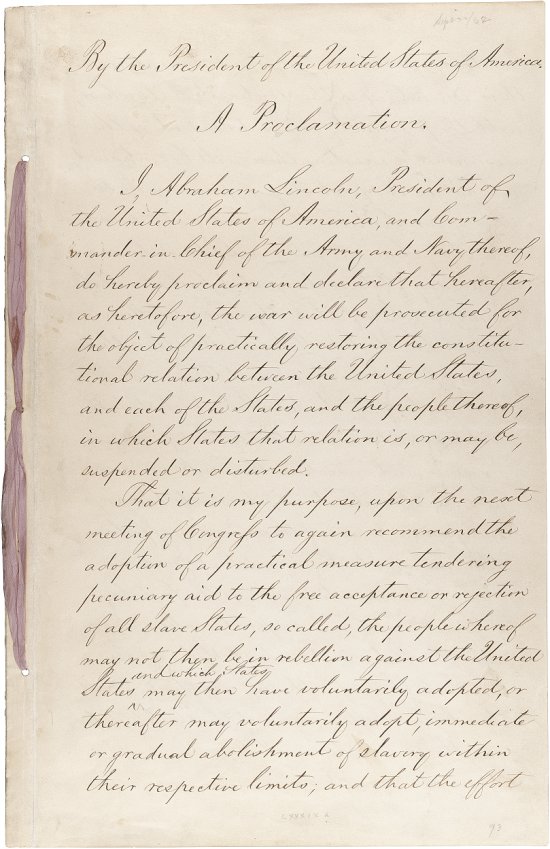
Page one of the Preliminary Emancipation Proclamation issued by President Abraham Lincoln, September 22, 1862 (U.S. National Archives and Records Administration, public domain; click to enlarge).
President Lincoln followed up his blistering recruitment drive of the summer of 1862 by adding even more support for his plan to increase federal troop strength by issuing his Preliminary Emancipation Proclamation on September 22, 1862. Giving a preview of what he intended to do in 1863 if Confederate States officials failed to cease hostilities and rejoin the Union, he began paving the road for Union regiments to rescue and recruit larger numbers of enslaved men:
By the President of the United States of America.
A Proclamation.I, Abraham Lincoln, President of the United States of America, and Commander-in-Chief of the Army and Navy thereof, do hereby proclaim and declare that hereafter, as heretofore, the war will be prosecuted for the object of practically restoring the constitutional relation between the United States, and each of the States, and the people thereof, in which States that relation is, or may be, suspended or disturbed.
That it is my purpose, upon the next meeting of Congress to again recommend the adoption of a practical measure tendering pecuniary aid to the free acceptance or rejection of all slave States, so called, the people whereof may not then be in rebellion against the United States and which States may then have voluntarily adopted, or thereafter may voluntarily adopt, immediate or gradual abolishment of slavery within their respective limits; and that the effort to colonize persons of African descent, with their consent, upon this continent, or elsewhere, with the previously obtained consent of the Governments existing there, will be continued.
That on the first day of January in the year of our Lord, one thousand eight hundred and sixty-three, all persons held as slaves within any State, or designated part of a State, the people whereof shall then be in rebellion against the United States shall be then, thenceforward, and forever free; and the executive government of the United States, including the military and naval authority thereof, will recognize and maintain the freedom of such persons, and will do no act or acts to repress such persons, or any of them, in any efforts they may make for their actual freedom.
That the executive will, on the first day of January aforesaid, by proclamation, designate the States, and part of States, if any, in which the people thereof respectively, shall then be in rebellion against the United States; and the fact that any State, or the people thereof shall, on that day be, in good faith represented in the Congress of the United States, by members chosen thereto, at elections wherein a majority of the qualified voters of such State shall have participated, shall, in the absence of strong countervailing testimony, be deemed conclusive evidence that such State and the people thereof, are not then in rebellion against the United States.
That attention is hereby called to an Act of Congress entitled ‘An Act to make an additional Article of War’ approved March 13, 1862, and which act is in the words and figure following:
‘Be it enacted by the Senate and House of Representatives of the United States of America in Congress assembled, That hereafter the following shall be promulgated as an additional article of war for the government of the army of the United States, and shall be obeyed and observed as such:
Article-All officers or persons in the military or naval service of the United States are prohibited from employing any of the forces under their respective commands for the purpose of returning fugitives from service or labor, who may have escaped from any persons to whom such service or labor is claimed to be due, and any officer who shall be found guilty by a court martial of violating this article shall be dismissed from the service.
Sec.2. And be it further enacted, That this act shall take effect from and after its passage.
Also to the ninth and tenth sections of an act entitled ‘An Act to suppress Insurrection, to punish Treason and Rebellion, to seize and confiscate property of rebels, and for other purposes,’ approved July 17, 1862, and which sections are in the words and figures following:
Sec.9. And be it further enacted, That all slaves of persons who shall hereafter be engaged in rebellion against the government of the United States, or who shall in any way give aid or comfort thereto, escaping from such persons and taking refuge within the lines of the army; and all slaves captured from such persons or deserted by them and coming under the control of the government of the United States; and all slaves of such persons found on (or) being within any place occupied by rebel forces and afterwards occupied by the forces of the United States, shall be deemed captives of war, and shall be forever free of their servitude and not again held as slaves.
Sec.10. And be it further enacted, That no slave escaping into any State, Territory, or the District of Columbia, from any other State, shall be delivered up, or in any way impeded or hindered of his liberty, except for crime, or some offence against the laws, unless the person claiming said fugitive shall first make oath that the person to whom the labor or service of such fugitive is alleged to be due is his lawful owner, and has not borne arms against the United States in the present rebellion, nor in any way given aid and comfort thereto; and no person engaged in the military or naval service of the United States shall, under any pretence whatever, assume to decide on the validity of the claim of any person to the service or labor of any other person, or surrender up any such person to the claimant, on pain of being dismissed from the service.’
And I do hereby enjoin upon and order all persons engaged in the military and naval service of the United States to observe, obey, and enforce, within their respective spheres of service, the act, and sections above recited.
And the executive will in due time recommend that all citizens of the United States who shall have remained loyal thereto throughout the rebellion, shall (upon the restoration of the constitutional relation between the United States, and their respective States, and people, if that relation shall have been suspended or disturbed) be compensated for all losses by acts of the United States, including the loss of slaves.
In witness whereof, I have hereunto set my hand, and caused the seal of the United States to be affixed.
Done at the City of Washington this twenty-second day of September, in the year of our Lord, one thousand, eight hundred and sixty-two, and of the Independence of the United States the eighty seventh.
[Signed:] Abraham Lincoln
By the President[Signed:] William H. Seward
Secretary of State

Page one of the Emancipation Proclamation issued by U.S. President Abraham Lincoln, January 1, 1863 (U.S. National Archives and Records Administration, public domain; click to enlarge).
When those state officials failed to comply, President Lincoln officially issued the Emancipation Proclamation on January 1, 1863:
By the President of the United States of America:
A Proclamation.Whereas, on the twenty-second day of September, in the year of our Lord one thousand eight hundred and sixty-two, a proclamation was issued by the President of the United States, containing, among other things, the following, to wit:
‘That on the first day of January, in the year of our Lord one thousand eight hundred and sixty-three, all persons held as slaves within any State or designated part of a State, the people whereof shall then be in rebellion against the United States, shall be then, thenceforward, and forever free; and the Executive Government of the United States, including the military and naval authority thereof, will recognize and maintain the freedom of such persons, and will do no act or acts to repress such persons, or any of them, in any efforts they may make for their actual freedom.
That the Executive will, on the first day of January aforesaid, by proclamation, designate the States and parts of States, if any, in which the people thereof, respectively, shall then be in rebellion against the United States; and the fact that any State, or the people thereof, shall on that day be, in good faith, represented in the Congress of the United States by members chosen thereto at elections wherein a majority of the qualified voters of such State shall have participated, shall, in the absence of strong countervailing testimony, be deemed conclusive evidence that such State, and the people thereof, are not then in rebellion against the United States.’
Now, therefore I, Abraham Lincoln, President of the United States, by virtue of the power in me vested as Commander-in-Chief, of the Army and Navy of the United States in time of actual armed rebellion against the authority and government of the United States, and as a fit and necessary war measure for suppressing said rebellion, do, on this first day of January, in the year of our Lord one thousand eight hundred and sixty-three, and in accordance with my purpose so to do publicly proclaimed for the full period of one hundred days, from the day first above mentioned, order and designate as the States and parts of States wherein the people thereof respectively, are this day in rebellion against the United States, the following, to wit:
Arkansas, Texas, Louisiana, (except the Parishes of St. Bernard, Plaquemines, Jefferson, St. John, St. Charles, St. James Ascension, Assumption, Terrebonne, Lafourche, St. Mary, St. Martin, and Orleans, including the City of New Orleans) Mississippi, Alabama, Florida, Georgia, South Carolina, North Carolina, and Virginia, (except the forty-eight counties designated as West Virginia, and also the counties of Berkley, Accomac, Northampton, Elizabeth City, York, Princess Ann, and Norfolk, including the cities of Norfolk and Portsmouth[)], and which excepted parts, are for the present, left precisely as if this proclamation were not issued.
And by virtue of the power, and for the purpose aforesaid, I do order and declare that all persons held as slaves within said designated States, and parts of States, are, and henceforward shall be free; and that the Executive government of the United States, including the military and naval authorities thereof, will recognize and maintain the freedom of said persons.
And I hereby enjoin upon the people so declared to be free to abstain from all violence, unless in necessary self-defence; and I recommend to them that, in all cases when allowed, they labor faithfully for reasonable wages.
And I further declare and make known, that such persons of suitable condition, will be received into the armed service of the United States to garrison forts, positions, stations, and other places, and to man vessels of all sorts in said service.
And upon this act, sincerely believed to be an act of justice, warranted by the Constitution, upon military necessity, I invoke the considerate judgment of mankind, and the gracious favor of Almighty God.
In witness whereof, I have hereunto set my hand and caused the seal of the United States to be affixed.
Done at the City of Washington, this first day of January, in the year of our Lord one thousand eight hundred and sixty three, and of the Independence of the United States of America the eighty-seventh.
By the President: ABRAHAM LINCOLN
WILLIAM H. SEWARD, Secretary of State.
Adding More Teeth to the Fight’s Bite

This Civil War-era recruiting flyer documents the service of the 47th Pennsylvania Volunteer Infantry at Forts Taylor and Jefferson, Florida, under the leadership of Colonel Tilghman Good, as well as the premium and bounty added to standard pay to inspire more men to enlist (public domain).
Just over a month later, in February 1863, the United States Congress passed U.S. Senate Bill 511 (“An act for enrolling and calling out the national forces, and for other purposes”). Better known as the “Enrollment Act of 1863” or “Conscription Act,” it was signed into law by President Lincoln on 3 March 1863, and gave state officials throughout the north the ability to draft men to serve whenever those officials were unable to meet their federal troop quotas through volunteer recruitment drives. It also allowed draftees to recruit others to muster in and serve for them.
Whereas there now exist in the United States an insurrection and rebellion against the authority thereof, and it is, under the Constitution of the United States, the duty of the government to suppress insurrection and rebellion, to guarantee to each State a republican form of government, and to preserve the public tranquility; and whereas, for these high purposes, a military force is indispensable, to raise and support which all persons ought willingly to contribute; and whereas no service can be more praiseworthy and honorable than that which is rendered for the maintenance of the Constitution and Union, and the consequent preservation of free government: Therefore—
Be it enacted by the Senate and House of Representatives of the United States of America in Congress assembled, That all able-bodied male citizens of the United States, and persons of foreign birth who shall have declared on oath their intention to become citizens under and in pursuance of the laws thereof, between the ages of twenty and forty-five years, except as hereinafter excepted, are hereby declared to constitute the national forces, and shall be liable to perform military duty in the service of the United States when called out by the President for that purpose.
SEC 2. And be it further enacted, That the following persons be, and they are hereby, excepted and exempt from the provisions of this act, and shall not be liable to military duty under the same, to wit: Such as are rejected as physically or mentally unfit for the service; also, First the Vice-President of the United States, the judges of the various courts of the United States, the heads of the various executive departments of the government, and the governors of the several States. Second, the only son liable to military duty of a widow dependent upon his labor for support. Third, the only son of aged or infirm parent or parents dependent upon his labor for support. Fourth, where there are two or more sons of aged or infirm parents subject to draft, the father, or, if he be dead, the mother, may elect which son shall be exempt. Fifth, the only brother of children not twelve years old, having neither father nor mother dependent upon his labor for support. Sixth, the father of motherless children under twelve years of age dependent upon his labor for support. Seventh, where there are a father and sons in the same family and household, and two of them are in the military service of the United States as non-commissioned officers, musicians, or privates, the residue of such family and household, not exceeding two, shall be exempt. And no persons but such as are herein excepted shall be exempt: Provided, however, That no person who has been convicted of any felony shall be enrolled or permitted to serve in said forces.
SEC. 3. And be it further enacted, That the national forces of the United States not now in the military service, enrolled under this act, shall be divided into two classes: the first of which shall comprise all persons subject to do military duty between the ages of twenty and thirty-five years, and all unmarried persons subject to do military duty above the age of thirty-five and under the age of forty-five; the second class shall comprise all other persons subject to do military duty, and they shall not, in any district, be called into the service of the United States until those of the first class hall have been called.
SEC. 4. And be it further enacted, That, for greater convenience in enrolling, calling out, and organizing the national forces, and for the arrest of deserters and spies of the enemy, the United States shall constitute one or more, as the President shall direct, and each congressional district of the respective states, as fixed by a law of the state next preceding the enrolment, shall constitute one: Provided, That in states which have not by their laws been divided into two or more congressional districts, the President of the United States shall divide the same into so many enrolment districts as he may deem fit and convenient.
SEC 8. And be it further enacted, That in each of said districts there shall be a board of enrolment, to be composed of the provost-marshal, as president, and two other persons, to be appointed by the President of the United States, one of whom shall be a licensed and practising physician and surgeon.
SEC. 10. And be it further enacted, That the enrolment of each class shall be made separately, and shall only embrace those whose ages shall be on the first day of July thereafter between twenty and forty-five years.
SEC. 11. And be it further enacted, That all persons thus enrolled shall be subject, for two years after the first day of July succeeding the enrolment, to be called into the military service of the United States, and to continue in service during the present rebellion, not, however, exceeding the term of three years; and when called into service shall be placed on the same footing, in all respects, as volunteers for three years, or during the war, including advance pay and bounty as now provided by law.
SEC. 12. And be it further enacted, That whenever it may be necessary to call out the national forces for military service, the President is hereby authorized to assign to each district the number of men to be furnished by said district; and thereupon the enrolling board shall, under the direction of the President, make a draft of the required number, and fifty per cent, in addition, and shall make an exact and complete roll of the names of the person so drawn, and of the order in which they are drawn, so that the first drawn may stand first upon the said roll and the second may stand second, and so on; and the persons so drawn shall be notified of the same within ten days thereafter, by a written or printed notice, to be served personally or by leaving a copy at the last place of residence, requiring them to appear at a designated rendezvous to report for duty. In assigning to the districts the number of men to be furnished therefrom, the President shall take into consideration the number of volunteers and militia furnished by and from the several states in which said districts are situated, and the period of their service since the commencement of the present rebellion, and shall so make said assignment as to equalize the numbers among the districts of the several states, considering and allowing for the numbers already furnished as aforesaid and the time of their service.
SEC. 13. And be it further enacted, That any person drafted and notified to appear as aforesaid, may, on or before the day fixed for his appearance, furnish an acceptable substitute to take his place in the draft; or he may pay to such person as the Secretary of War may authorize to receive it, such sum, not exceeding three hundred dollars, as the Secretary may determine, for the procuration of such substitute; which sum shall be fixed at a uniform rate by a general order made at the time of ordering a draft for any state or territory; and thereupon such person so furnishing the substitute, or paying the money, shall be discharged from further liability under that draft. And any person failing to report after due service of notice, as herein prescribed, without furnishing a substitute, or paying the required sum therefor, shall be deemed a deserter, and shall be arrested by the provost-marshal and sent to the nearest military post for trial by court-martial, unless, upon proper showing that he is not liable to do military duty, the board of enrolment shall relive him from the draft.
SEC. 16. And be it further enacted, That as soon as the required number of able-bodied men liable to do military duty shall be obtained from the list of those drafted, the remainder shall be discharged; and all drafted persons reporting at the place of rendezvous shall be allowed travelling pay from their places of residence; and all persons discharged at the place of rendezvous shall be allowed travelling pay to their places of residence; and all expenses connected with the enrolment and draft, including subsistence while at the rendezvous, shall be paid form the appropriation for enrolling and drafting, under such regulations as the President of the United States shall prescribe; and all expenses connected with the arrest and return of deserters to their regiments, or such other duties as the provost-marshal shall be called upon to perform, shall be paid from the appropriation for arresting deserters, under such regulations as the President of the United States shall prescribe: Provided, The provost-marshals shall in no case receive commutation for transportation or for fuel and quarters, but only for forage, when not furnished by the government, together with actual expenses of postage, stationery, and clerk hire authorized by the provost-marshal-general.
SEC. 17. And be it further enacted, That any person enrolled and drafted according to the provisions of this act who shall furnish an acceptable substitute, shall thereupon receive from the board of enrolment a certificate of discharge from such draft, which shall exempt him from military duty during the time for which he was drafted; and such substitute shall be entitled to the same pay and allowances provided by law as if he had been originally drafted into the service of the United States.
SEC. 18. And be it further enacted, That such of the volunteers and militia now in the service of the United States as may reenlist to serve one year, unless sooner discharged, after the expiration of their present term of service, shall be entitled to a bounty of fifty dollars, one half of which to be paid upon such reenlistment, and the balance at the expiration of the term of reenlistment; and such as may reenlist to serve for two years, unless sooner discharged, after the expiration of their present term of enlistment, shall receive, upon such reenlistment, twenty-five dollars of the one hundred dollars bounty for enlistment provided by the fifth section of the act approved twenty-second of July, eighteen hundred and sixty-one, entitled “An act to authorize the employment of volunteers to aid in enforcing the laws and protecting public property.”
SEC. 25. And be it further enacted, That if any person shall resist any draft of men enrolled under this act into the service of the United States, or shall counsel or aid any person to resist any such draft; or shall counsel or aid any person to resist any such draft; or shall assault or obstruct any officer in making such draft, or in the performance of any service in relation thereto; or shall counsel any person to assault or obstruct any such officer, or shall counsel any drafted men not to appear at the place of rendezvous, or wilfully dissuade them from the performance of military duty as required by law, such person shall be subject to summary arrest by the provost-marshal, and shall be forthwith delivered to the civil authorities, and upon conviction thereof, be punished by a fine not exceeding five hundred dollars, or by imprisonment not exceeding two years, or by both of said punishments.
SEC. 33. And be it further enacted, That the President of the United States is hereby authorized and empowered, during the present rebellion, to call forth the national forces, by draft, in the manner provided for in this act.
Those combined actions by President Lincoln and the U.S. Congress enabled the officers of the 47th Pennsylvania Volunteer Infantry to enroll the first four of nine formerly enslaved men in their regiment in early October 1862 while it was stationed in Beaufort, South Carolina—and then enabled the regiment’s officers to enroll five more formerly enslaved men in early April 1864 while the 47th Pennsylvania Volunteers were stationed in Natchitoches, Louisiana.
Initially assigned the rank of “Under-Cook,” and entered on regimental muster rolls below the names of the men who had enrolled at the rank of private, several of these nine formerly enslaved men were later awarded the rank of private, according to subsequent regimental records. After completing their respective terms of enlistment, all but one were honorably discharged during the fall of 1865 with several also being awarded U.S. Civil War Pensions in later life. Their life stories are now being documented on the website, “Faces of the 47th: Freedmen of the 47th Pennsylvania Volunteer Infantry.”
Next: Black History Month: The Authorization, Duties and Pay of “Under-cooks”
Sources:
- “An Act for enrolling and calling out the national Forces, and for other Purposes,” Congressional Record. 37th Cong. 3d. Sess. Ch. 74, 75. 1863. March 3, 1863.” New Haven, Connecticut: Gilder Lehrman Center for the Study of Slavery, Resistance, and Abolition at the Whitney and Betty MacMillan Center for International and Area Studies at Yale University, retrieved online February 1, 2024.
- “Emancipation Proclamation, January 1, 1863,” in “Presidential Proclamations, 1791-1991” (Record Group 11: General Records of the United States Government). Washington, D.C.: U.S. National Archives and Records Administration.
- “Preliminary Emancipation Proclamation, September 22, 1862,” in “Presidential Proclamation 93” (Record Group 11, vault, box 2: General Records of the U.S. Government). Washington, D.C.: U.S. National Archives and Records Administration.
- “The Conscription Act.; Judge Cadwallader’s Opinion Establishing Its Constitutionality.” New York, New York: The New York Times, September 13, 1863.
- “The Law of the Draft.; Important Circulars Issued by the Provost-Marshal General. No Escape After a Name is Enrolled. Penalties of a Failure to Respond The Treatment of Deserters. The Question of Exemptions.” New York, New York: The New York Times, July 19, 1863.
 47th Pennsylvania Volunteers
You must be logged in to post a comment.