
“Thanksgiving 1864: Raising the Flag at the Sheridan Field Hospital Near Winchester, Virginia,” 1864 (James E. Taylor, Frank Leslie’s Illustrated Newspaper, public domain).
In response to the stunning casualty count incurred by the Union Army following the Battle of Opequan, Virginia on September 19, 1864 (also known as “Third Winchester”), senior Union Army medical personnel realized that drastic improvements in federal military medical services were needed—and needed quickly—if Major-General Philip Sheridan and his Army of the Shenandoah were to continue waging successful war against the Confederate States Army troops commanded by Lieutenant-General Jubal Early.
Three days after that pivotal battle, U.S. Army Surgeon James T. Ghiselin, the medical director of the Army of the Shenandoah and Sheridan’s direct report, ordered one of his subordinates, U.S. Army Surgeon John H. Brinton, to plan and implement a new Union Army field hospital that would be capable of delivering higher quality medical care to the thousands of Union Army troops who would likely be wounded over the coming weeks and months.
Erected near Major-General Sheridan’s Winchester, Virginia headquarters, this new medical facility was initially referred to by the name of its location—Shawnee Springs—and was subsequently renamed as the Sheridan Field Hospital.
First opened with five hundred beds, it became so large that it stretched north from Shawnee Springs to the Church Ridge property of Jacob Senseny. Staffed by twenty physicians, it was stocked early on with enough medical supplies to care for five thousand troops, the first of whom were transported from regimental and other field hospital facilities near Winchester’s Northern railyard.
The grounds also included administrative buildings and housing for military and medical personnel. As late fall turned to winter, it was all kept warm by a radiant heating system, which appeared to be an improvement over the initial system of “Crimean Ovens” that were used to heat Union Army field hospitals during the first year of the war.
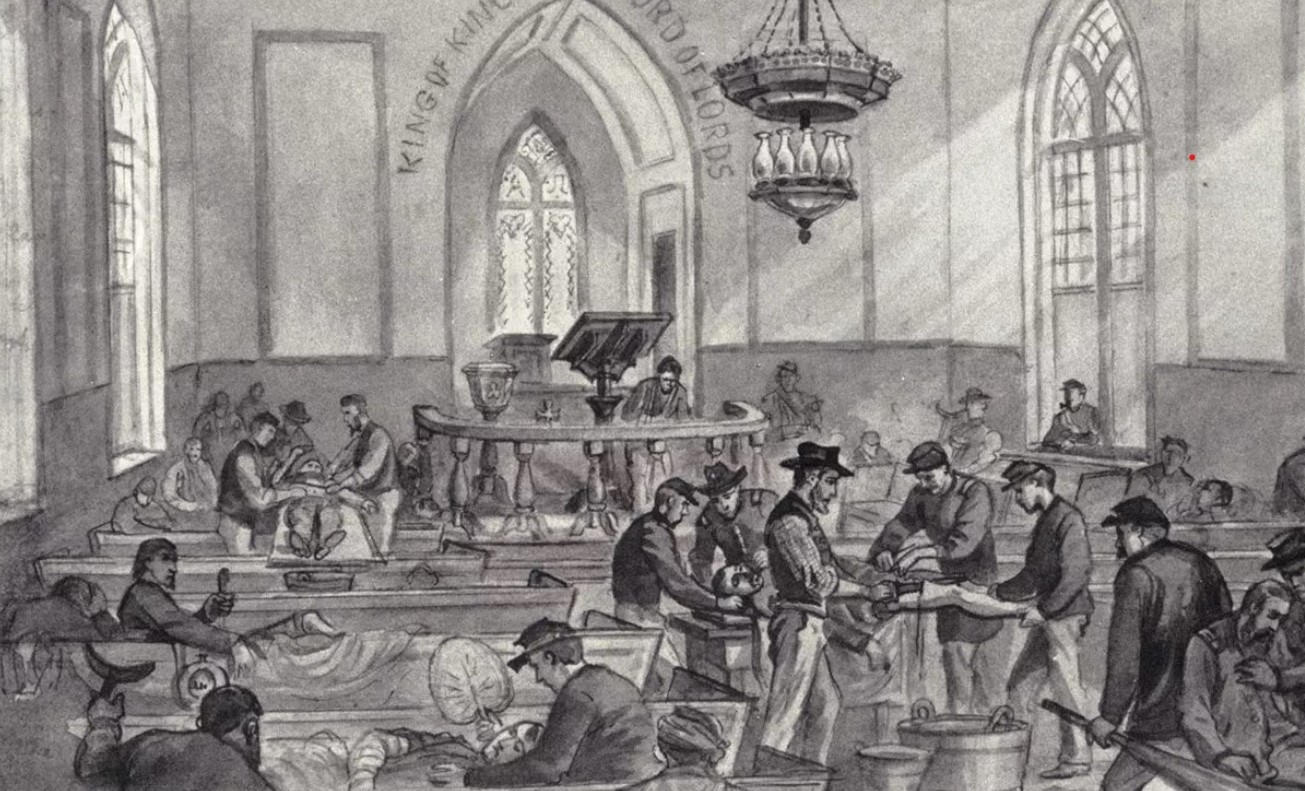
Regimental and division surgeons from the Union Army treat Union soldiers inside of the St. Thomas Episcopal Church near Winchester, Virginia, following the Battle of Cedar Creek, October 19, 1864 (James E. Taylor, Frank Leslie’s Illustrated Newspaper, public domain).
In an almost constant state of expansion until mid-October 1864, Sheridan Field Hospital soon began to accept Union Army patients from battles farther away. The process often unfolded as follows:
- Regimental surgeons rendered immediate care to their units’ wounded, dressing wounds and performing amputations wherever they could find safe spaces—inside churches, farmhouses or tents—but still close enough to actual battlefields to provide the kinds of triage and emergency care that would stabilize soldiers enough for them to be transported to the Sheridan Field Hospital for more advanced treatment by better trained medical personnel.
- Once those patients arrived at Sheridan Hospital, the surgeons there frequently performed more intricate surgeries over extended periods of time for a range of grievous injuries (artillery and gunshot wounds to soldiers’ heads, bodies or limbs, for example), and also treated patients for fevers, gangrene, tetanus and other related complications.
- Physicians then collaborated with nurses and hospital stewards to help soldiers reach the point where they were able to be moved on to other Union Army hospitals in northern locations, where they were able to receive extended rehabilitative care while they were safely housed behind Union lines.
Commanded by U.S. Army Surgeon James Van Zandt Blaney, the physicians, nurses and hospital stewards stationed at Sheridan Field Hospital ultimately treated well over four thousand Union Army soldiers from the time of this temporary facility’s opening on September 28, 1864 until its closing on January 4, 1865, creating the largest field hospital operation during the American Civil War. They also secured help from the U.S. Sanitary Commission to feed and clothe soldiers in preparation for their honorable discharges on surgeons’ certificates of disabilities or their transfers to other facilities.
Among those cared for during this time, were more than three thousand casualties transported from multiple farms and other sites related to the Battle of Cedar Creek, Virginia, which took place on October 19, 1864.
Sheridan’s physicians finally sent their last remaining patient away to another facility on December 28, 1864.
Although few traces of this famed field hospital remain today, sharp-eyed visitors to the Shawnee Springs Preserve in Virginia will be able to find a wayside marker that was erected on Opequon Avenue in Winchester (on the right side of the street when traveling south), which commemorates this field hospital’s role in preserving America’s Union.
Sources:
- Bean, Robert, Bjarne W. Olesen, and Kwang Woo Kim. “History of Radiant Heating & Cooling Systems,” in ASHRAE Journal, vol. 52, no. 2 (2010). Peachtree Corners, Georgia: American Society of Heating, Refrigerating, and Air-Conditioning Engineers, Inc. (ASHRAE).
- Beck, Brandon. “The Third Battle of Winchester.” New Market, Virginia: Shenandoah Valley Battlefields Foundation, retrieved online December 27, 2023.
- Policastro, Anatoly. “Civil War Crimean Ovens: Origins, Models, and Modifications,” in The Journal of Civil War Medicine, vol. 21, no. 4, pp. 267-279, October/November/December 2017. Reynoldsburg, Ohio: The Society of Civil War Surgeons, Inc.
- “Shawnee Springs Hospital.” The Historical Marker Database, retrieved online December 27, 2023.
- “Stop 13—Shawnee Springs: Sheridan’s Field Hospital,” in “Winchester at War: Battlefield Driving Tour.” Washington, D.C.: History eLibrary, U.S. National Park Service, retrieved online December 27, 2023.
 47th Pennsylvania Volunteers
You must be logged in to post a comment.