
“The Commencement of the Battle near Pocotaligo River” (Frank Leslie’s Illustrated Newspaper, October 1862, public domain; click to enlarge).
And among them Strife and Tumult joined, and destructive Fate, grasping one man alive, fresh-wounded, another without a wound, and another she dragged dead through the melee by the feet; and the raiment she had about her shoulders was red with the blood of men. Just like living mortals joined they and fought; and they each were dragging away the bodies of the others’ slain.”
—Homer, The Iliad, Volume II, Book 18
October 22, 1862 was a deadly day for the 47th Pennsylvania Volunteer Infantry, and the succeeding days throughout that month and beyond proved to be deadlier still, as one member of the regiment after another succumbed to the wounds they had sustained in battle—or to complications that arose from the multiple surgeries that had been performed by Union Army surgeons in valiant, but vain attempts to save their lives.
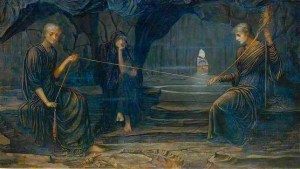
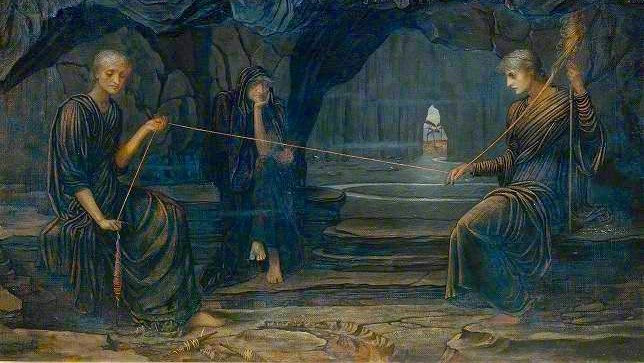
Excerpt from “A Golden Thread” (John Melhuish Strudwick, circa 1885, public domain).
What will be striking to any student of history engaged in even just a cursory review of this regiment’s medical and death records during this period of American Civil War-era service, is the seeming fickleness of who lived or died—as if Lachesis and Atropos had debated and determined their fates while Clotho spun out the thread of each life, giving them no say in their individual destinies.
Or was it the decision-making mind and finger of God? “You, but not you.”
This randomness dawns with startling clarity when examining the vastly different outcomes of Sunbury, Pennsylvania brothers, Samuel and Peter Haupt, and of company commanding officers Charles Mickley, George Junker and William Wallace Geety.
Captain Charles Mickley of G Company was killed instantly, early on in the Battle of Pocotaligo on October 22, 1862—brought swiftly to the ground by a rifle shot to his head. He never knew what hit him—or what happened to the men of his company who were marching head on with him into an intense barrage of canister and grape shot, mingled with rifle fire and artillery shell shrapnel.
Captain George Junker of Company K was felled by a minié ball fired from a Confederate rifle during his company’s advance on the Frampton Plantation. Initially stabilized in the field before being transported back to Hilton Head, where he was hospitalized at the Union Army’s post hospital, he died there the next day. He, too, had been shot in the head.
But First Lieutenant William Wallace Geety miraculously survived the gunshot that he sustained to his head—despite having been initially described by The New York Times in its list of Pocotaligo casualties as “mortally wounded.” His survival subsequently became the subject of multiple newspaper reports and medical journal articles. According to the Commemorative Biographical Encyclopedia of Dauphin County, he was wounded in action when “grape shot struck him between the eyes and passing to the left destroyed the eye, shattered the bones of the face, injuring the nerves and lodged near the carotid artery. While lying upon the field he was for a while given up for dead.”
The Union Army surgeons who treated him throughout his convalescence provided even more telling and precise accounts, documenting that William W. Geety had been struck between the eyes by a one-half-inch-diameter iron ball propelled by a cannon shrapnel shell which had exploded on impact in front of him while he was commanding his men on the field. As the shrapnel peppered the air around him, the ball traveled upward through his head before striking the back of his skull, where it then reversed course, traveled down toward his left jaw and neck, and lodged behind the carotid artery. In the process, his left eye was destroyed along with nerve sensation on his left neck and face, which was also disfigured. When battlefield surgeons realized that one of the major fragments was located perilously close to his carotid artery and could not be removed without killing their patient, they opted to leave that piece of shrapnel in place, stabilized Geety, and continued to care for him until he could safely be moved to one of the Union’s larger and better equipped hospitals for more advanced treatment.
Finally well enough to pen a letter home to his wife and children on November 19, 1864, Geety wrote:
I have lost my left eye, the base of the nose has been taken out. My jaw has been splintered besides some other bones about the brain being cracked. I am very thankful that I got through so safely, as my life was despared [sic] of at first.
In later accounts, he recalled that the grapeshot had struck him near the bottom of his nose, and “after knocking a piece out of my skull, turned and lodged in my throat against the carotid artery from whence I had it cut, at the same time part of the casing of the shell struck me in the face, making a longitudinal cut across my left eye, breaking the lower jaw, and staving in the upper jaw bone on the right side of the face. The socket for the lower jaw to work is broken off, so that every time I open my mouth the jaw flies out of joint.”
Astoundingly ambulatory just a month after the battle, he continued to receive medical care at the Union Officers’ Hospital in Beaufort, South Carolina, and was actually able to walk around the city under his own power.
* For more information about what happened to First Lieutenant William W. Geety after he was released from the Union Army’s hospital in South Carolina, read “First Lieutenant William W. Geety — Battling Back from a Nearly Fatal Head Wound.”
But a Foot Wound Was Fatal?

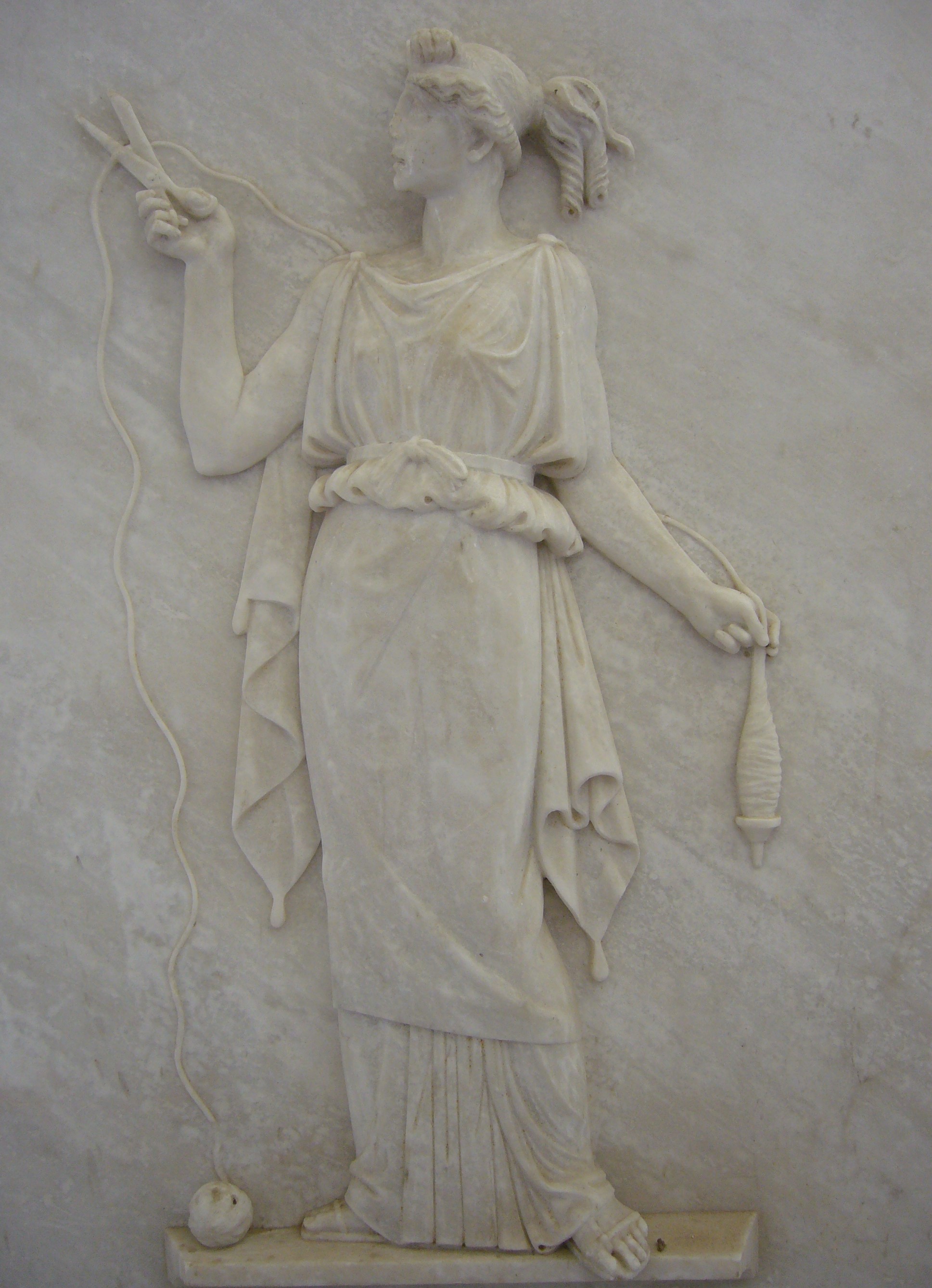
Atropos, one of the Three Fates in Greek mythology, cuts the thread of life (bas relief image, public domain).
Also wounded that same day, but seemingly less seriously than their commanding officers had been, were the Haupt brothers of the 47th Pennsylvania’s C Company (the color-bearer unit). Private Samuel Haupt was struck in the chin—presumably by one of the countless artillery shell fragments flying through the air as the enemy unleashed a barrage of cannon fire on their company as it advanced toward its target—while his brother, Sergeant Peter Haupt, was struck in the foot that had been fired by a musket or rifle ball.
Sam survived, but Peter did not.
A seemingly minor wound, ballistic injuries to a foot are often extremely painful and traumatic—even today. According to the editors of Ballistic Trauma: A Practical Guide, “There are three mechanisms whereby a projectile can cause tissue injury:
- In a low-energy transfer wound, the projectile crushes and lacerates tissue along the track of the projectile, causing a permanent cavity. In addition, bullet and bone fragments can act as secondary missiles, increasing the volume of tissue crushed.
- In a high-energy transfer wound, the projectile may impel the walls of the wound track [and] radially outwards, causing a temporary cavity lasting 5 to 10 milliseconds before its collapse in addition to the permanent mechanical disruption produced….
- In wounds where the firearm’s muzzle is in contact with the skin at the time of firing, tissues are forced aside by the gases expelled from the barrel of the fire, causing a localized blast injury.”
In Peter Haupt’s case, the high degree of damage to his foot was compounded by the fact that his wound was caused by a musket or minié ball that was made of lead—a substance known to cause blood poisoning and damage to human tissue and organs—and likely also by surgical procedures that were less than sterile, which resulted in a subsequent infection. His cause of death at the Union Army’s post hospital at Hilton Head, South Carolina on November 14, 1862—just over three weeks after the battle—was “traumatic tetanus,” according to the Union Army’s Registers of Deaths of Volunteer soldiers.
The Consequences of Human Conflict
Random, divergent and seemingly senseless fates.
Whether determined by the finger of God, the pre-battle machinations of the Moirai of Greek mythology, or the sheer dumb luck of being positioned at precisely the wrong spot in the regiment’s line of march that terrible day, the final outcomes of the 47th Pennsylvanians who did or did not make it home stand as a testament to the often inexplicable and heartbreaking nature of war.
Sources:
- “A Soldier’s Death” (obituary of Captain W. W. Geety). Harrisburg, Pennsylvania: Harrisburg Telegraph, 20 January 1887.
- Affidavit Regarding Peter Haupt’s Death (written by Second Lieutenant Daniel Oyster on August 14, 1863 and certified by Captain John Peter Shindel Gobin on August 20, 1863, Company C, 47th Pennsylvania Volunteer Infantry, Fort Taylor, Key West, Florida). Washington, D.C.: Officer of the United States Commissioner of Pensions.
- Burial Ledgers, in Record Group 15, The National Cemetery Administration, and Record Group 92, United States Departments of Defense and Army (Quartermaster General). Washington, D.C.: U.S. National Archives and Records Administration: 1861-1865.
- Commemorative Biographical Encyclopedia of Dauphin County, Containing Sketches of Representative Citizens, and Many of the Early Scotch-Irish and German Settlers. Chambersburg, Pennsylvania: J. M. Runk & Company, 1896.
- “Extraordinary Case” (account of the injury and treatment of William Wallace Geety). Harrisburg, Pennsylvania: Patriot & Union, June 12, 1863.
- Haupt, Peter, in Registers of Deaths of Volunteer Soldiers, United States Army, 1862. Washington, D.C.: U.S. National Archives and Records Administration.
- Homer, The Iliad, II, Book 18 (A. T. Murray, translator). Cambridge, Massachusetts: Harvard University Press, 1924.
- Junker, George, in Registers of Deaths of Volunteer Soldiers, United States Army, 1862. Washington, D.C.: U.S. National Archives and Records Administration.
- “Lead Toxicity: Biological Fate,” in “Environmental Health and Medicine.” Atlanta, Georgia: Agency for Toxic Substances and Disease Registry, United States Centers for Disease Control, May 2023.
- Letter from Captain James Kacy from Beaufort, South Carolina, October 25, 1862, regarding H Company casualties sustained during the Battle of Pocotaligo, South Carolina, October 22, 1862. Bloomfield, Pennsylvania: The Perry County Democrat, November 6, 1862.
- “List of Casualties: Forty-Seventh Pennsylvania Volunteers—Col. T. H. Good.” New York, New York: The New York Times, October 29, 1862.
- Mahoney, Peter F., James Ryan, et. al. Ballistic Trauma: A Practical Guide, Second Edition, pp. 31-66, 91-121, 168-179, 356-395, 445-464, 535-540, 596-605. London, England: Springer-Verlag London Limited, 2005.
- Reimer, Terry. “Wounds, Ammunition, and Amputation.” Frederick, Maryland: National Museum of Civil War Medicine, 2007.
- Reports of Col. Tilghman H. Good, Forty-seventh Pennsylvania Infantry and Report of Col. Tilghman H. Good, Forty-seventh Pennsylvania Infantry, commanding First Brigade, Tenth Army Corps, in The War of the Rebellion: A Compilation of the Official Records of the Union and Confederate Armies. Prepared Under the Direction of the Secretary of War, By Lieut. Col. Robert N. Scott, Third U.S. Artillery, and Published Pursuant to Act of Congress Approved June 16, 1880, Series I, Vol. XIV. Washington, D.C.: Government Printing Office, 1885.
- Schroeder-Lein, Glenna. “The Wounded,” in “Essential Civil War Curriculum.” Blacksburg, Virginia: Virginia Center for Civil War Studies, Virginia Tech University, retrieved online November 8, 2023.
- “The Killed and Wounded in the Battle” (casualty list from the Battle of Pocotaligo). New York, New York: The New York Herald, October 29, 1862.
- “Younker, George [sic],” in United States Records of Headstones of Deceased Union Veterans, 1879-1903.” Washington, D.C.: U.S. National Archives and Records Administration.
- “Zurückgefehrt” (announcement of the return to Pennsylvania for reburial of the remains of Captain George Junker, Henry A. Blumer, Aaron Fink and Henry Zeppenfeld). Allentown, Pennsylvania: Der Lecha Caunty Patriot, December 3, 1862.



 47th Pennsylvania Volunteers
You must be logged in to post a comment.