Alternate Spellings of Surname: Kolb, Kolp, Kulp
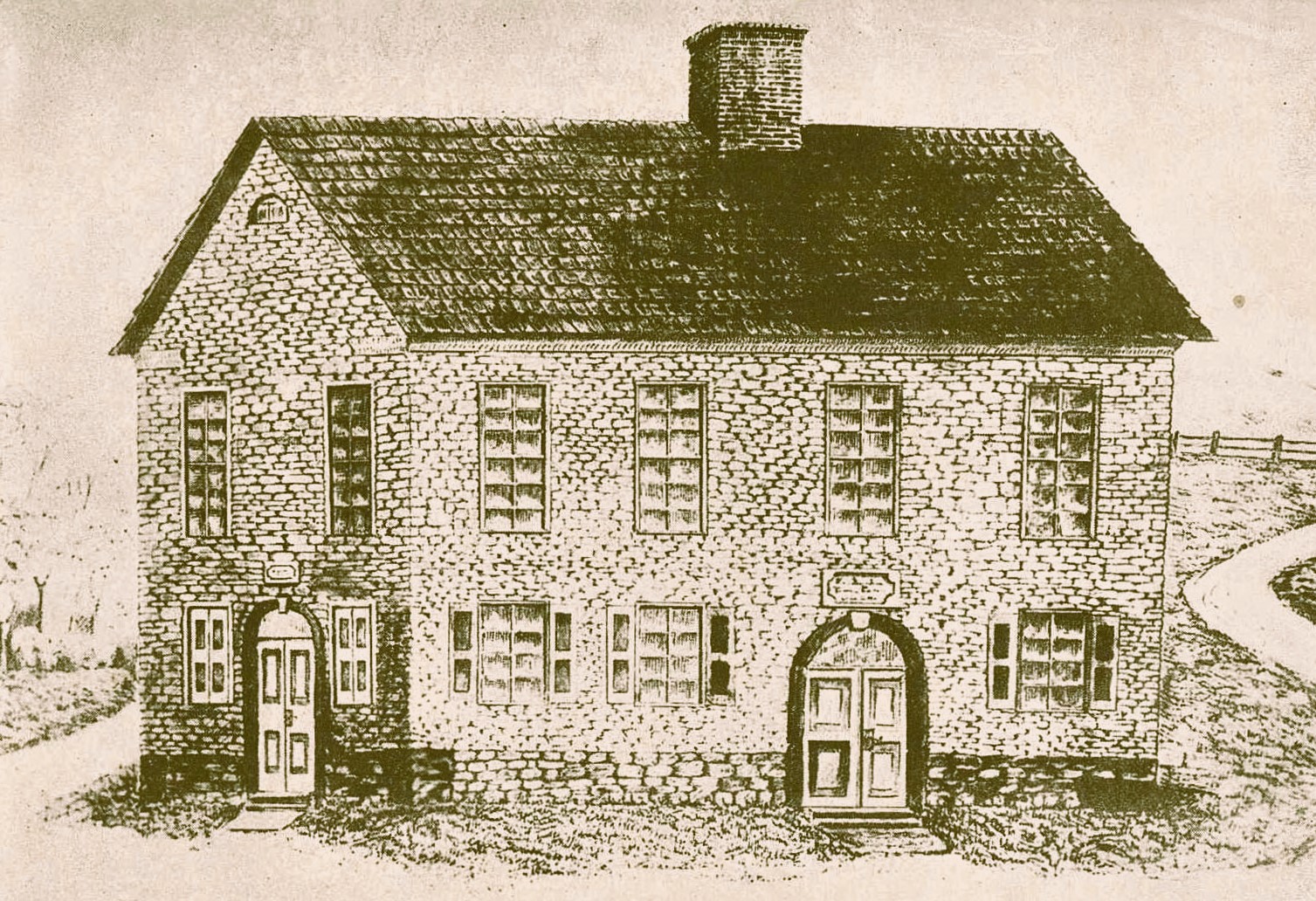
New Goshenhoppen Church, 1770-1857 (William John Hinke, A History of the Goshenhoppen Reformed Charge, Montgomery County, Pennsylvania (1727-1819), illustration adjacent to p. 220; public domain).
They were two of the countless Pennsylvanians of German heritage who risked everything to defend their state and nation in times of trouble. Facing danger together during multiple battles of the American Civil War, they were separated by the hand of fate for all time before that war’s end, altering their own life journeys, as well as those of their family and friends.
Formative Years
Born in Germantown, Philadelphia County, Pennsylvania in 1816, John Kolb married Hannah Imborly (alternate spelling “Imboden”) on 4 August 1842. His new bride had been born in Pennsylvania circa 1820; her given name was sometimes written in the public records of the period as “Johanna.” Their wedding ceremony was performed by the Rev. Daniel Weiser of the New Goshenhoppen German Reformed Church in Upper Hanover Township, Montgomery County, Pennsylvania.
* Note: Although Hannah Kolb’s maiden name was entered into court records during the mid to late 1860s as “Imboden,” she later attested that this was a spelling error created by her legal representatives and said that the correct spelling of her maiden name was “Imborly.” The death certificate of their son, Hiram, however, spelled her surname as “Embody.”
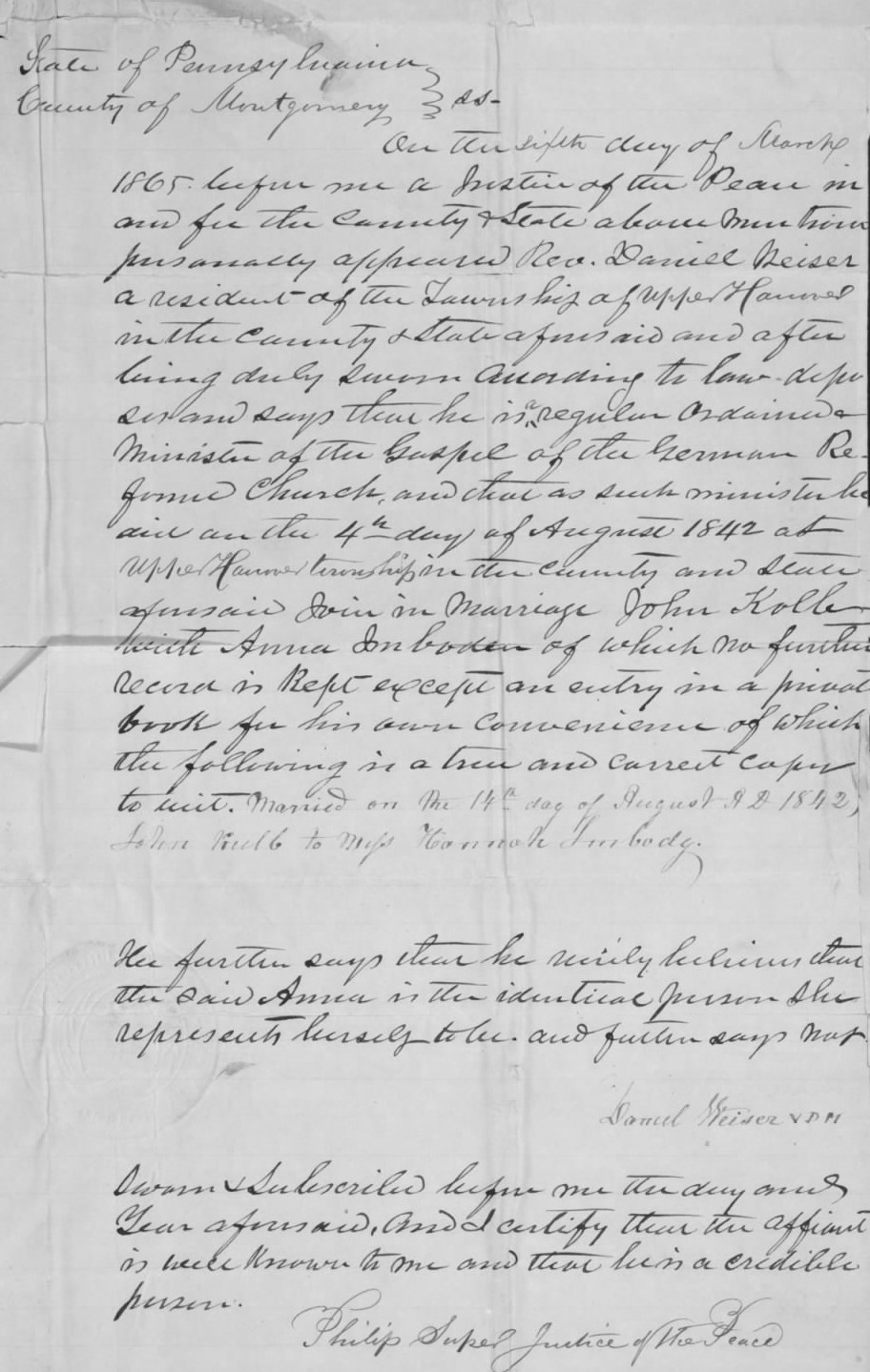
March 1865 affidavit filed by the Rev. Daniel Weiser which affirmed the 1842 marriage of John Kolb to “Hannah Imbolden” (U.S. Civil War Widows’ Pension Files, U.S. National Archives and Records Administration, public domain; click to enlarge).
Following their wedding, John and Hannah Kolb began their new lives together by establishing their first home in Montgomery County. Children soon followed, including: Jeremiah/William Kolb (1843-1916), who was born on the Fourth of July in 1843 and later changed the spelling of his surname to “Kolp”; Hiram Kolb (1844-1913), who was born on 4 August 1844 and later changed the spelling of his surname to “Kulp”; William Kolb, who was born circa 1847; and Susanna Kolb (1848-1931), who was born on 6 September 1848 and later wed Benneville Derr (1842-1912).
In 1850, the Kolb family lived in Upper Hanover Township in Montgomery County, where the family’s patriarch was employed as a laborer. The household that year included John Kolb (father), Johanna (mother), and their children: Jeremiah (aged seven), Hiram (aged five), William (aged four), and Susanna (aged two). Two more children subsequently arrived during the opening years of this decade. A daughter, Hannah Kolb, was born on 9 December 1851, followed by a son, Daniel Kolb, who was born on 17 January 1853. Both were delivered by physician John Hillegass. M.D., an 1849 graduate of the University of Pennsylvania’s School of Medicine.
According to Theodore Bean’s History of Montgomery County, which was published in 1884, the lives of the Kolb family would have been pastoral with lands surrounding them that were “rolling and in some parts quite hilly” and soil that was “chiefly red shale.”
The Hosensack Hills, the highest elevation, commence[d] near the Douglas line and extend[ed] across the whole northwestern part of the township at the distance of a mile from the Berks County line. They [were] covered with large bowlders of granite, which … furnish[ed] the best of material for building purposes. From the top of these hills splendid views of the valley on each side, with the hills beyond, [were] had, the view to the south being especially fine. Below, the valley expand[ed into a] broad basin surrounded with hills, extending a distance of over six miles, nearly through the centre of which the Perkiomen Creek flow[ed] in a southern direction upwards of seven miles, and [powered] in this distance five grist-mills and four saw-mills [as of 1884]. Hosenstack, West Branch and Macoby Creeks [were] tributaries of this stream, the last-mentioned flowing through the eastern part of the township. They also furnish[ed] some water-power.
The Goshenhoppen and Green Lane Turnpike extend[ed] to Treichlersville, Berks Co., and was completed in 1851. It passe[d] on the ridge between the Perkiomen and Macoby Creeks, its elevation being such that persons driving along the road [had] a full view of the valley and surrounding hills. For about four miles this road [was] nearly level, and present[ed] one of the most beautiful and attractive drives, with its succession of villages, farms, churches and fine scenery….
As the township’s population grew from 1,300 to 1,741 between 1830 and 1850, the education of its youngest residents became an increasing priority. According to Bean:
Here, as probably in nearly all the townships or territory now included within the limits of Montgomery County, the parochial system was the prevailing order. Lutherans, German Reformed, Mennonites and Schwenkfeldians had their several schools. The Catholics had a school across the line, in Berks, and, like the Protestants, sent their children to their own school….
The first English school was established in the spring of 1835 in an old carpenter-shop. The following year it was taken into a new house, erected for that purpose. In this township, as in others, the teacher served in the capacity also of organist.
With respect to families of German descent, classes were often conducted in German. According to Bean, one well-respected Montgomery County teacher assigned five recitations to each student, daily, from such texts as: Das A, B, C Buch, as well as Der Psalter and Das Neue Testament. The popular German language newspaper, Der Bauern Freund, was also commonly used by township educators as a teaching tool.
During this same period of time, two governors of the Commonwealth of Pennsylvania were working to establish a consistent set of statewide education standards for students through the creation of a common-school system. On 8 May 1854, the Pennsylvania General Assembly enacted legislation requiring county school boards to appoint county school superintendents “whose duties were carefully defined, among which were the examination of all teachers, periodical visitations to all the schools, and the making of annual reports to the State superintendent.” On 18 April 1857, “the common-school system was made a separate department” within state government by the Pennsylvania Assembly, “and the office of State superintendent was created, the incumbent to be appointed by the Governor for the period of three years.”
The 1850s were also a period of transition for the Kolb family. Sometime after the birth of their son, Daniel, John and Hannah Kolb packed up their children and belongings and relocated to Lehigh County, ultimately settling in Heidelberg Township. Sadly, from that point on, their lives appear to have taken a downward turn.
In its 27 February 1856 edition, Der Lecha Caunty Patriot (the Lehigh County Patriot) reported that the children and seventy-two-year-old mother-in-law of a man named “John Kolb” had been attacked in their home, which was located two miles outside of Lehigh County’s major city of Allentown. On 21 February, an “Eirischer Namens Patrick Carney” (an Irishman named Patrick Carney), who had traveled seven miles from Weatherly, Northampton County, was bothered by the freezing temperature of the day. After pulling out a bottle of brandy to warm himself, he spotted the Kolb’s house and walked over to it, where he encountered John Kolb’s mother-in-law and children and offered to share his brandy with them. When she declined, he reportedly became angry and made a series of inappropriate comments to her, which prompted her to order him to leave her property. In response, Carney attacked her and injured her badly by kicking her repeatedly after grabbing her hair and pulling her to the ground. He then also badly beat John Kolb’s eight-year-old son. As this was happening, the Kolb’s other children ran for their lives, barefooted and without warm clothing, finally reaching the nearest house, which was located some distance away. So arduous was their escape that they reportedly sustained frostbite by the time they reached help.
That terrible day apparently left a lasting impact on the Kolb family. According to the 8 February 1860 edition of The Lehigh Register, they were in such a dire financial situation that the Directors of the Poor of Montgomery County had sent fifty dollars in cash on their behalf to the Directors of the Poor and House of Employment of the County of Lehigh during the period between1 January 1858 and 31 December 1859. The newspaper reported that this transfer of funds had been made in order to provide “out door relief to John Kolb’s family.”
As if that news had not been troubling enough, the family’s matriarch Hannah (Imborly) Kolb, was documented as living only with her sons William (aged fourteen) and Daniel (aged seven), and her daughter, Hannah (aged nine), but without her husband, in Germansville, Heidelberg Township, Lehigh County when a federal enumerator arrived on her doorstep on 20 July 1860.
Additional research has determined that the family’s patriarch, John Kolb, may not have been found at home that day because he may have been in jail. According to the federal census roll for Allentown’s Fifth Ward, which was dated 11 June 1860, a man by the name of John Kolb had been incarcerated at the Lehigh County Prison sometime during the summer of 1860 for “stealing.” Apparently being held pending trial, perhaps because his family did not have the financial means to post bail for him, he was subsequently acquitted in the case of “Commonwealth vs. John Kolb—Larceny of a number of whips, the property of Tobias Smith of Lynn township,” according to the 15 August 1860 edition of The Lehigh Register.
* Note: The tone of the aforementioned Lecha Caunty Patriot report regarding the apparent 1856 attack on John Kolb’s family seemed to convey that his mother-in-law was badly enough injured that she might not have survived that attack, and that his son had been seriously injured by the intruder. When comparing this 1856 news report with the data from the 1850 and 1860 federal census records for John Kolb’s family, it appears that the eight-year-old boy mentioned in the news article was most likely the child listed on the 1850 federal census as “William” (aged four) and on the 1860 federal census as “William” (aged fourteen).
The Lehigh County arrest for theft of a man named John Kolb mentioned above might therefore serve as one possible explanation for why the John Kolb who is the subject of this biography did not appear with his wife, Hannah (Imborly) Kolb, and their children on the 1860 federal census for Germansville. That alleged theft of whips may have been a desperate act committed by him in order to support his poverty-stricken family after they had become the victims of a terrible crime—a theory that may be further supported by the previously mentioned Lehigh County Register article from February 1860, which reported that Montgomery County’s Directors of the Poor had sent fifty dollars to Lehigh County’s Directors of the Poor to assist the Kolb family. Further research has determined that just $10.87 of that support had been provided to the family as of 8 February 1860.
It is equally possible, however, that John Kolb had actually been wrongly accused of theft and jailed as a form of harassment, possibly by an unscrupulous neighbor who was trying to take advantage of him, and/or by the local police because his family had been labeled as vagrants relying on support from the poor house for “out door relief.”
Researchers have not yet determined what happened to the Kolb’s son, Hiram, during this same period. What is known for certain is that the family’s patriarch was ultimately acquitted of the theft charges against him in August 1860, and subsequently returned home to live with his wife and children.
Nearly a year later to the date of his acquittal, John Kolb then chose to become one of the early responders to President Abraham Lincoln’s call for volunteers to help bring an end to the American Civil War—a disastrous period in the nation’s history that had been sparked by South Carolina’s secession from the United States on 20 December 1860.
Also joining him in that fight was his son, Hiram.
Civil War
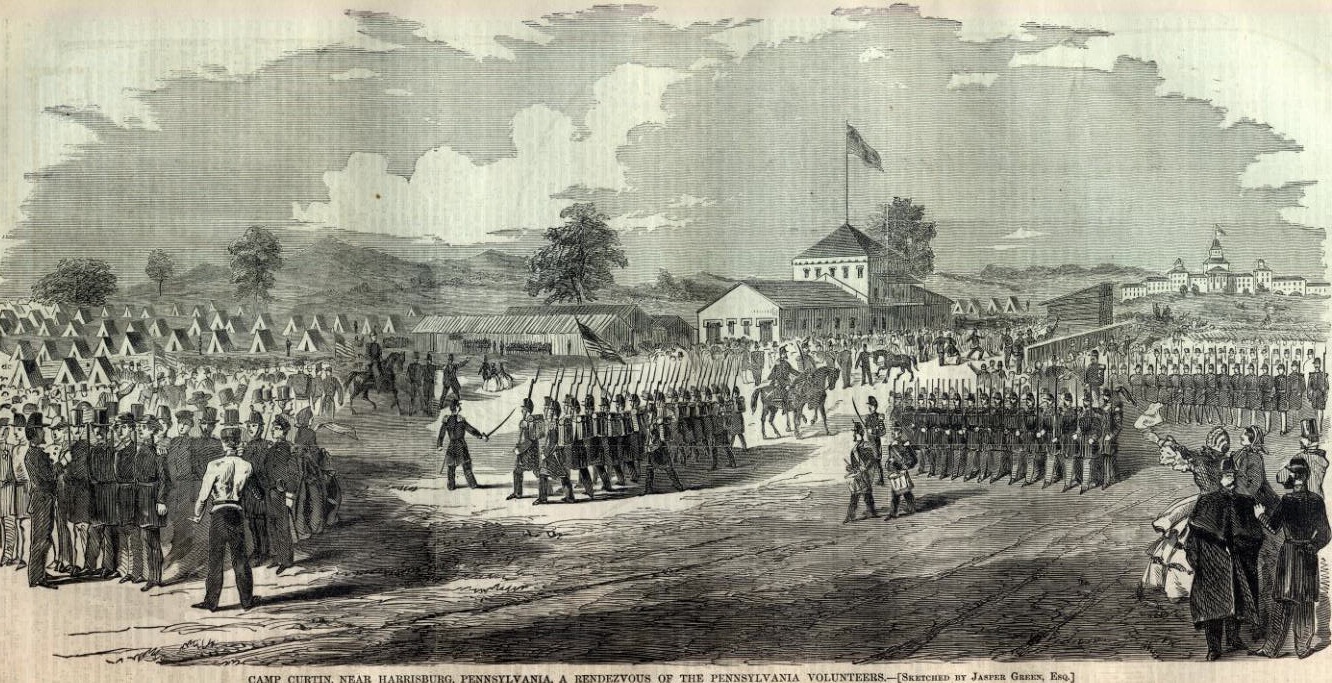
Camp Curtin (Harper’s Weekly, 1861, public domain).
On 21 August 1861, John Kolb and his son, Hiram, enrolled for military service in Lehigh County, Pennsylvania. They had been recruited by George Junker, a German immigrant who had settled in Lehigh County’s major city, Allentown, where he had become a successful tombstone carver. Less than a month later, the Kolbs followed Junker to Dauphin County, along with the other men he had recruited, and officially mustered in for duty at Camp Curtin, which was located on the outskirts of Harrisburg.
Both father and son were entered onto the muster rolls of the Pennsylvania Volunteer Infantry on 17 September 1861; both entered the service of the Commonwealth of Pennsylvania at the rank of private with Company K of an entirely new regiment—the 47th Pennsylvania Volunteers. At that time, Company K was known as “the all-German company” of the regiment because Junker, who had been commissioned as its captain, had purposefully recruited men who were either fellow German immigrants or were native-born Pennsylvanians of German heritage, many of whom still spoke German or Pennsylvania Dutch at home and in their communities.
Military records at the time described John Kolb as a forty-five-year-old carpenter residing in Saegersville, Lehigh County, who was five feet, nine inches tall with dark hair, brown eyes and a dark complexion while describing his son, Hiram, as a twenty-one-year-old laborer who also lived in Saegersville, but who was just five feet, seven inches tall and had light hair, brown eyes and a light complexion. Their surname was subsequently spelled in various ways on army muster rolls over the next several years, including as “Kolp” and “Kulp.”
* Note: Although the 1890 Special Census of Civil War Veterans (“U.S. Census (Special Schedule.—Surviving Soldiers, Sailors, and Marines, and Widows, etc.”) indicated that Hiram Kolb’s younger brother, William, may also have enlisted with the 47th Pennsylvania Volunteer Infantry (but with its B Company, rather than K), that appears not to have been the case because that year’s census enumerator also noted the following: “I am not sure he was in the army, but claims to have been. Papers not at home.”
Because that entry did not include dates for William’s alleged service, and because researchers for 47th Pennsylvania Volunteers: One Civil War Regiment’s Story have not yet been able to find any other evidence of William’s alleged service with the 47th Pennsylvania, his name has not been included in the Civil War section of this biography or on the rosters for Company B. (For readers who want to learn more about William’s life, please see the “Formative Years” and “What Happened to the Widow and Other Children of John Kolb?” sections of this biography.)

The U.S. Capitol Building, unfinished at the time of President Abraham Lincoln’s first inauguration, was still not completed when the Kolbs arrived in Washington, D.C. with the 47th Pennsylvania Volunteers in September 1861 (public domain).
Following a brief training period in light infantry tactics at Camp Curtin, the men of Company K and their fellow 47th Pennsylvanians hopped aboard a train at the Harrisburg depot, and were transported by rail to Washington, D.C. Stationed roughly two miles from the White House, they pitched tents at “Camp Kalorama” on the Kalorama Heights near Georgetown beginning 21 September.
* Note: The training and departure process was clearly a hectic one. Private Elias Reidy (alternate spelling: “Ready”) of the 47th Pennsylvania was felled by “friendly fire” from an errant pistol shot; hospitalized, he was discharged on a surgeon’s certificate of disability just over two months later on 26 November. Meanwhile, Private William Schubert was incorrectly labeled a deserter when the scribe in charge of the regiment’s muster rolls failed to update his entry to note that he had been left behind at the camp hospital for disease-related treatment as the regiment moved on to the nation’s capital.
On 22 September, Henry D. Wharton, a musician with the regiment’s C Company, penned the following update to his hometown newspaper, the Sunbury American:
After a tedious ride we have, at last, safely arrived at the City of ‘magnificent distances.’ We left Harrisburg on Friday last at 1 o’clock A.M. and reached this camp yesterday (Saturday) at 4 P.M., as tired and worn out a sett [sic] of mortals as can possibly exist. On arriving at Washington we were marched to the ‘Soldiers Retreat,’ a building purposely erected for the benefit of the soldier, where every comfort is extended to him and the wants of the ‘inner man’ supplied.
After partaking of refreshments we were ordered into line and marched, about three miles, to this camp. So tired were the men, that on marching out, some gave out, and had to leave the ranks, but J. Boulton Young, our ‘little Zouave,’ stood it bravely, and acted like a veteran. So small a drummer is scarcely seen in the army, and on the march through Washington he was twice the recipient of three cheers.
We were reviewed by Gen. McClellan yesterday [21 September 1861] without our knowing it. All along the march we noticed a considerable number of officers, both mounted and on foot; the horse of one of the officers was so beautiful that he was noticed by the whole regiment, in fact, so wrapt [sic] up were they in the horse, the rider wasn’t noticed, and the boys were considerably mortified this morning on dis-covering they had missed the sight of, and the neglect of not saluting the soldier next in command to Gen. Scott.
Col. Good, who has command of our regiment, is an excellent man and a splendid soldier. He is a man of very few words, and is continually attending to his duties and the wants of the Regiment.
…. Our Regiment will now be put to hard work; such as drilling and the usual business of camp life, and the boys expect and hope an occasional ‘pop’ at the enemy.
Acclimated somewhat to their new way of life, the soldiers of the 47th Regiment, Pennsylvania Volunteer Infantry finally became part of the U.S. Army when they were officially mustered into federal service on 24 September.

Chain Bridge across the Potomac above Georgetown looking toward Virginia, 1861 (The Illustrated London News, public domain).
On 27 September—a rainy day, the 47th Pennsylvania was assigned to the 3rd Brigade of Brigadier-General Isaac Stevens, which also included the 33rd, 49th and 79th New York regiments. By that afternoon, the 47th Pennsylvania was on the move again. Ordered onward by Brigadier-General Silas Casey, the Mississippi rifle-armed 47th Pennsylvania infantrymen marched behind their regimental band until reaching Camp Lyon, Maryland on the Potomac River’s eastern shore. At 5 p.m., they joined the 46th Pennsylvania in moving double-quick (one hundred and sixty-five steps per minute using thirty-three-inch steps) across the “Chain Bridge” marked on federal maps and continued on for roughly another mile before being ordered to make camp.
The next morning, they broke camp and moved again. Marching toward Falls Church, Virginia, they arrived at Camp Advance around dusk. There, about two miles from the bridge they had crossed a day earlier, they re-pitched their tents in a deep ravine near a new federal fort under construction (Fort Ethan Allen). They had completed a roughly eight-mile trek, were situated fairly close to the headquarters of Brigadier-General William Farrar Smith (also known as “Baldy”) and were now part of the massive U.S. Army of the Potomac (“Mr. Lincoln’s Army”). Under Smith’s leadership, their regiment and brigade would help to defend the nation’s capital from the time of their September arrival through late January when the men of the 47th Pennsylvania would be shipped south.
Once again, Company C musician Henry Wharton recapped the regiment’s activities, noting, via his 29 September letter home to the Sunbury American, that the 47th had changed camps three times in three days:
On Friday last we left Camp Kalorama, and the same night encamped about one mile from the Chain Bridge on the opposite side of the Potomac from Washington. The next morning, Saturday, we were ordered to this Camp [Camp Advance near Fort Ethan Allen, Virginia], one and a half miles from the one we occupied the night previous. I should have mentioned that we halted on a high hill (on our march here) at the Chain Bridge, called Camp Lyon, but were immediately ordered on this side of the river. On the route from Kalorama we were for two hours exposed to the hardest rain I ever experienced. Whew, it was a whopper; but the fellows stood it well – not a murmur – and they waited in their wet clothes until nine o’clock at night for their supper. Our Camp adjoins that of the N.Y. 79th (Highlanders.)….
We had not been in this Camp more than six hours before our boys were supplied with twenty rounds of ball and cartridge, and ordered to march and meet the enemy; they were out all night and got back to Camp at nine o’clock this morning, without having a fight. They are now in their tents taking a snooze preparatory to another march this morning…. I don’t know how long the boys will be gone, but the orders are to cook two days’ rations and take it with them in their haversacks….
There was a nice little affair came off at Lavensville [sic, Lewinsville], a few miles from here on Wednesday last; our troops surprised a party of rebels (much larger than our own.) killing ten, took a Major prisoner, and captured a large number of horses, sheep and cattle, besides a large quantity of corn and potatoes, and about ninety six tons of hay. A very nice day’s work. The boys are well, in fact, there is no sickness of any consequence at all in our Regiment….

The Big Chestnut Tree, Camp Griffin, Langley, Virginia, 1861 (U.S. Library of Congress, public domain).
Sometime during this phase of duty, as part of the 3rd Brigade, the 47th Pennsylvanians were moved to a site they initially christened “Camp Big Chestnut” in reference to the large chestnut tree located within their campsite’s boundaries. The site would eventually become known to the Keystone Staters as “Camp Griffin,” and was located roughly ten miles from Washington, D.C.
On 11 October, the 47th Pennsylvania Volunteers marched in the Grand Review at Bailey’s Cross Roads. In a mid-October letter home, Captain John Peter Shindel Gobin (the leader of C Company who would be promoted in 1864 to lead the entire 47th Regiment) reported that companies D, A, C, F and I (the 47th Pennsylvania’s right wing) were ordered to picket duty after the left-wing companies (B, E, G, H, and K) had been forced to return to camp by Confederate troops. In his letter of 13 October, Henry Wharton described their duties, as well as their new home:
The location of our camp is fine and the scenery would be splendid if the view was not obstructed by heavy thickets of pine and innumerable chesnut [sic] trees. The country around us is excellent for the Rebel scouts to display their bravery; that is, to lurk in the dense woods and pick off one of our unsuspecting pickets. Last night, however, they (the Rebels) calculated wide of their mark; some of the New York 33d boys were out on picket; some fourteen or fifteen shots were exchanged, when our side succeeded in bringing to the dust, (or rather mud,) an officer and two privates of the enemy’s mounted pickets. The officer was shot by a Lieutenant in Company H [?], of the 33d.
Our own boys have seen hard service since we have been on the ‘sacred soil.’ One day and night on picket, next day working on entrenchments at the Fort, (Ethan Allen.) another on guard, next on march and so on continually, but the hardest was on picket from last Thursday morning ‘till Saturday morning – all the time four miles from camp, and both of the nights the rain poured in torrents, so much so that their clothes were completely saturated with the rain. They stood it nobly – not one complaining; but from the size of their haversacks on their return, it is no wonder that they were satisfied and are so eager to go again tomorrow. I heard one of them say ‘there was such nice cabbage, sweet and Irish potatoes, turnips, &c., out where their duty called them, and then there was a likelihood of a Rebel sheep or young porker advancing over our lines and then he could take them as ‘contraband’ and have them for his own use.’ When they were out they saw about a dozen of the Rebel cavalry and would have had a bout with them, had it not been for…unlucky circumstance – one of the men caught the hammer of his rifle in the strap of his knapsack and caused his gun to fire; the Rebels heard the report and scampered in quick time….

Unknown regiment, Camp Griffin, Virginia, fall 1861 (U.S. Library of Congress, public domain).
On Friday morning, 22 October 1861, the 47th engaged in a Divisional Review, described by historian Lewis Schmidt as massing “about 10,000 infantry, 1000 cavalry, and twenty pieces of artillery all in one big open field.” Also around this time, Captain Junker issued his first Special Order:
I. 15 minutes after breakfast every tent will be cleaned. The commander of each tent will be held responsible for it, and every soldier must obey the orders of the tent commander. If not, said commanders will report such men to the orderly Sgt. who will report them to headquarters.
II. There will be company drills every two hours during the day, including regimental drills with knapsacks. No one will be excused except by order of the regimental surgeon. The hours will be fixed by the commander, and as it is not certain therefore, every man must stay in his quarter, being always ready for duty. The roll will be called each time and anyone in camp found not answering will be punished the first time with extra duty. The second with carrying the 75 lb. weights, increased to 95 lb. The talking in ranks is strictly forbidden. The first offense will be punished with carrying 80 lb. weights increased to 95 lbs. for four hours.
In his letter of 17 November, Henry Wharton revealed still more details about life at Camp Griffin:
This morning our brigade was out for inspection; arms, accoutrements [sic], clothing, knapsacks, etc, all were out through a thorough examination, and if I must say it myself, our company stood best, A No. 1, for cleanliness. We have a new commander to our Brigade, Brigadier General Brannen [sic], of the U.S. Army, and if looks are any criterion, I think he is a strict disciplinarian and one who will be as able to get his men out of danger as he is willing to lead them to battle….
The boys have plenty of work to do, such as piquet [sic] duty, standing guard, wood-chopping, police duty and day drill; but then they have the most substantial food; our rations consist of fresh beef (three times a week) pickled pork, pickled beef, smoked pork, fresh bread, daily, which is baked by our own bakers, the Quartermaster having procured portable ovens for that purpose, potatoes, split peas, beans, occasionally molasses and plenty of good coffee, so you see Uncle Sam supplies us plentifully….
A few nights ago our Company was out on piquet [sic]; it was a terrible night, raining very hard the whole night, and what made it worse, the boys had to stand well to their work and dare not leave to look for shelter. Some of them consider they are well paid for their exposure, as they captured two ancient muskets belonging to Secessia. One of them is of English manufacture, and the other has the Virginia militia mark on it. They are both in a dilapidated condition, but the boys hold them in high estimation as they are trophies from the enemy, and besides they were taken from the house of Mrs. Stewart, sister to the rebel Jackson who assassinated the lamented Ellsworth at Alexandria. The honorable lady, Mrs. Stewart, is now a prisoner at Washington and her house is the headquarters of the command of the piquets [sic]….
Since the success of the secret expedition, we have all kinds of rumors in camp. One is that our Brigade will be sent to the relief of Gen. Sherman, in South Carolina. The boys all desire it and the news in the ‘Press’ is correct, that a large force is to be sent there, I think their wish will be gratified….
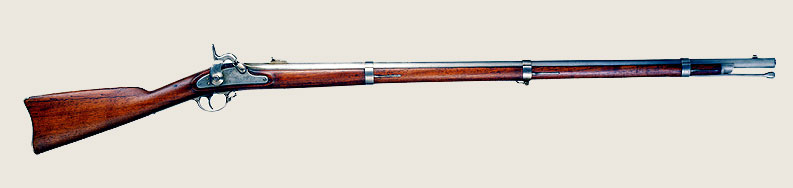
Springfield rifle, 1861 model (public domain).
On 21 November, the 47th participated in a morning divisional headquarters review overseen by the 47th Pennsylvania’s founder, Colonel Tilghman Good, followed by brigade and division drills all afternoon. According to Schmidt, “each man was supplied with ten blank cartridges.” Afterward, “Gen. Smith requested Gen. Brannan to inform Col. Good that the 47th was the best regiment in the whole division.”
As a reward for the regiment’s impressive performance that day—and in preparation for the even bigger adventures and honors that were yet to come, Brigadier-General John Milton Brannan ordered his staff to ensure that brand new Springfield rifles were obtained and distributed to every member of the 47th Pennsylvania Volunteers.
1862
The New Year brought several changes to the regiment, including the departures of First Lieutenant and Regimental Adjutant James W. Fuller, Jr., on 9 January, and Private Paul Ferg, a saddler by trade whose hearing was damaged after he fell ill due to exposure from the cold, who was subsequently discharged on a surgeon’s certificate of disability on 20 January.
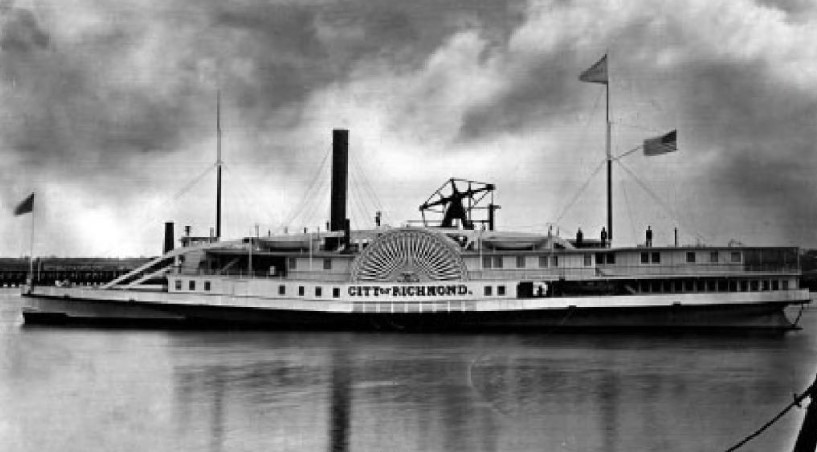
The City of Richmond, a sidewheel steamer which transported Union troops during the Civil War (Maine, circa late 1860s, public domain).
Next ordered to move from their Virginia encampment back to Maryland, Privates John and Hiram Kolb and their fellow 47th Pennsylvania Volunteers left Camp Griffin at 8:30 a.m. on Wednesday, 22 January 1862. Marching through deep mud with their equipment for three miles in order to reach the railroad station at Falls Church, they were then transported by rail to Alexandria, Virginia, where they boarded the steamship City of Richmond and sailed to the Washington Arsenal. While there, they were reequipped with weapons and ammunition before being marched off for dinner and rest at the Soldiers’ Retreat in Washington, D.C.
The next afternoon, they hopped aboard cars on the Baltimore & Ohio Railroad, and headed for Annapolis, Maryland. Arriving around 10 p.m., they were assigned quarters in barracks at the United States Naval Academy. They then spent that Friday through Monday (24-27 January 1862) loading their equipment and other supplies onto the steamship USS Oriental.
By the afternoon of Monday, 27 January, the 47th Pennsylvania Volunteers had commenced boarding the Oriental. Ferried to the big steamship by smaller steamers, the enlisted men boarded first, followed by the officers. Then, per the directive of Brigadier-General Brannan, they steamed away for the Deep South at 4 p.m. The 47th Pennsylvanians were headed for Florida which, despite its secession from the United States, remained strategically important to the Union due to the presence of Forts Taylor and Jefferson in Key West and the Dry Tortugas.
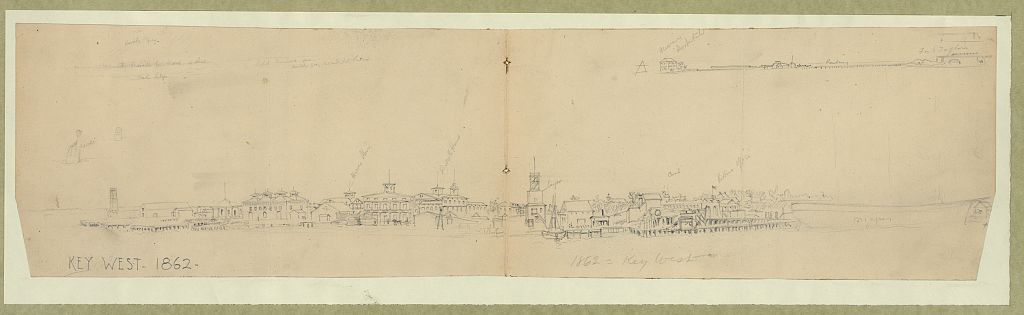
Alfred Waud’s 1862 sketch of Fort Taylor and Key West, Florida (U.S. Library of Congress, public domain).
Company K and their fellow 47th Pennsylvania Volunteers arrived in Key West by early February 1862. Once there, they made camp on the beach, re-erecting their Sibley tents, and were then assigned to garrison Fort Taylor. During the weekend of Friday, 14 February, the 47th Pennsylvania Volunteers introduced their presence to Key West residents by parading through the streets of the city. That Sunday, a number of soldiers from the regiment attended local church services, where they met and mingled with residents from the area as part of the first of many community outreach efforts to build support for the army’s efforts to preserve the nation’s Union.
Drilling daily in heavy artillery tactics, they also strengthened the fortifications at this federal installation, felled trees and built new roads.
Sometime during this phase of service, several members of the 47th Pennsylvania Volunteers contracted typhoid fever, and were confined to the post hospital at Fort Taylor. Privates Amandus Long, Augustus Schirer (alternate spelling: “Shirer”), George Leonhard (alternate spelling: “Leonard”), and Lewis Dipple of K Company were among those documented as having died from “Febris Typhoides,” passing away, respectively, on March 29, 5 April, 19 April, and 27 April 1862.
In point of fact, it would be disease and not Confederate troops that would ultimately prove to be the deadliest foe for the 47th Pennsylvania.
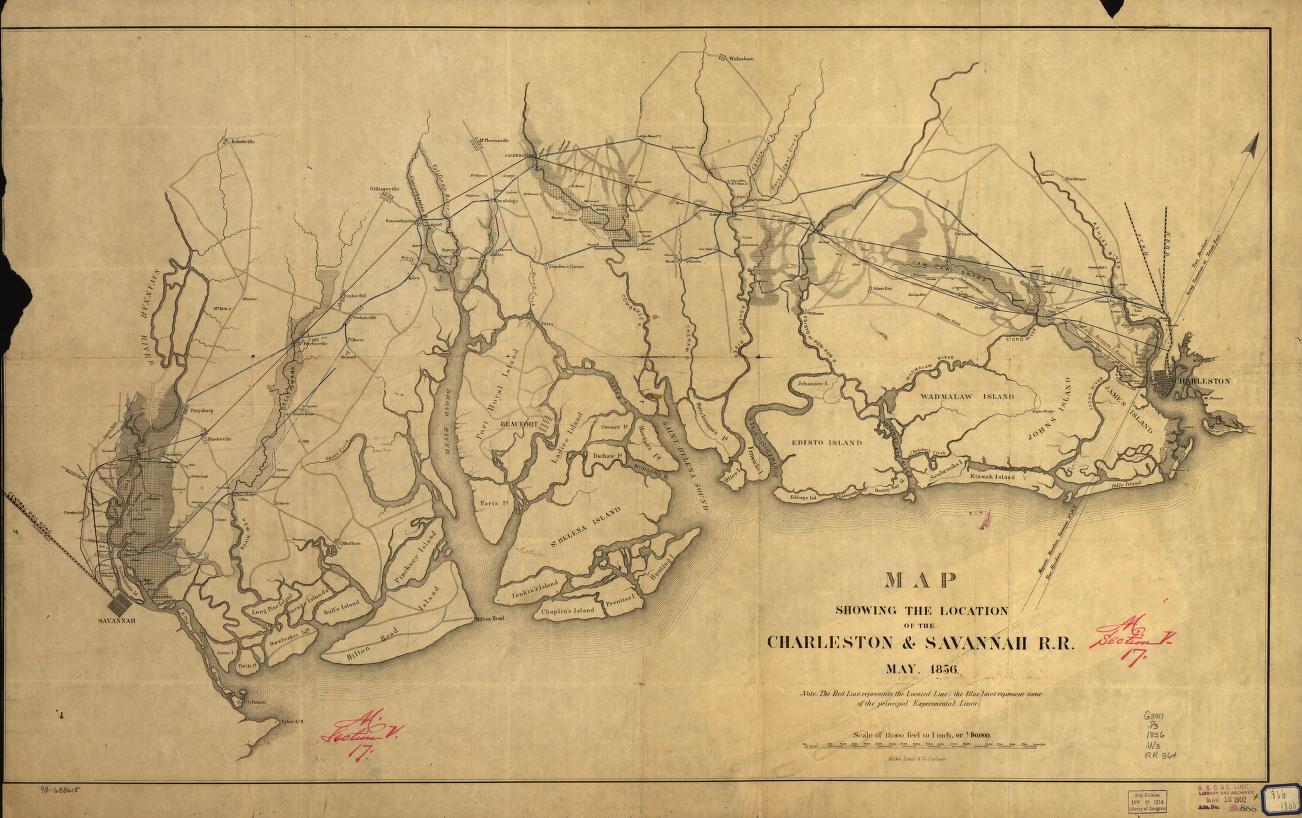
This 1856 map of the Charleston & Savannah Railroad shows the island of Hilton Head, South Carolina in relation to the towns of Beaufort and Pocotaligo (U.S. Library of Congress, public domain).
Next ordered to Hilton Head, South Carolina from mid-June through July, they camped near Fort Walker before relocating to the Beaufort District in the U.S. Army’s Department of the South, roughly thirty-five miles away. Frequently assigned to hazardous picket detail north of their main camp (as Company K was so assigned on 5 July), the Kolbs and other members of the 47th Pennsylvania were put at increased risk from enemy sniper fire when sent out on these special teams. According to historian Samuel P. Bates, during this phase of their service, the men of the 47th “received the highest commendation from Generals Hunter and Brannan” for their “attention to duty, discipline and soldierly bearing.”
Detachments from the regiment were also assigned to the Expedition to Fenwick Island (9 July) and the Demonstration against Pocotaligo (10 July).
During the second week of July, according to Schmidt, the regiment’s third-in-command—Major William H. Gausler—and F Company’s Captain Henry S. Harte returned home to Pennsylvania’s Lehigh Valley to resume the 47th Pennsylvania’s recruiting efforts. After arriving in Allentown on 15 July, they quickly re-established an efficient operation, which they would keep running through early November 1862. During this time, Major Gausler was able to persuade fifty-four new recruits to join the 47th Pennsylvania while Harte rounded up an additional twelve.
Meanwhile, the remainder of the regiment continued to soldier on. From 20-31 August 1862, Company K resumed picket duty, this time stationed at “Barnwells” (so labeled by Company C Captain J. P. S. Gobin) while other companies from the regiment performed picket duty in the areas around Point Royal Ferry.
But the month of September brought new changes. Sometime during late August, Private Frederick Sackenheimer (alternate spellings: “Sachsenheimer,” “Saxonheimer”) fell while marching double-quick with the regiment. The fall, severe enough to cause a ruptured hernia, resulted in his discharge on a surgeon’s certificate of disability on 1 September 1862.
That same day (1 September), musician-privates William A. Heckman (a fifer) and Daniel Dachrodt (a drummer) were promoted from the rank of musician to principal musician. (Dachrodt would go on to serve with his regiment for the duration of the war and live to become the last surviving member of the 47th Pennsylvania’s Regimental Band.)
On 12 September, Colonel Tilghman Good and his adjutant, First Lieutenant Washington H. R. Hangen, issued Regimental Order No. 207 from the 47th Pennsylvania’s Headquarters in Beaufort, South Carolina:
I. The Colonel commanding desires to call the attention of all officers and men in the regiment to the paramount necessity of observing rules for the preservation of health. There is less to be apprehended from battle than disease. The records of all companies in climate like this show many more casualties by the neglect of sanitary post action then [sic] by the skill, ordnance and courage of the enemy. Anxious that the men in my command may be preserved in the full enjoyment of health to the service of the Union. And that only those who can leave behind the proud epitaph of having fallen on the field of battle in the defense of their country shall fail to return to their families and relations at the termination of this war.
II. All the tents will be struck at 7:30 a.m. on Monday, Wednesday and Saturday of each week. The signal for this purpose will be given by the drum major by giving three taps on the drum. Every article of clothing and bedding will be taken out and aired; the flooring and bunks will be thoroughly cleaned. By the same signal at 11 a.m. the tents will be re-erected. On the days the tents are not struck the sides will be raised during the day for the purpose of ventilation.
III. The proper cooking of provisions is a matter of great importance more especially in this climate but have not yet received from a majority of officers of the regiment that attention that should be paid to it.
IV. Thereafter an officer of each company will be detailed by the commander of each company and have their names reported to these headquarters to superintend the cooking of provisions taking care that all food prepared for the soldiers is sufficiently cooked and that the meats are all boiled or seared (not fried). He will also have charge of the dress table and he is held responsible for the cleanliness of the kitchen cooking utensils and the preparation of the meals at the time appointed.
V. The following rules for the taking of meals and regulations in regard to the conducting of the company will be strictly followed. Every soldier will turn his plate, cup, knife and fork into the Quarter Master Sgt who will designate a permanent place or spot for each member of the company and there leave his plate & cup, knife and fork placed at each meal with the soldier’s rations on it. Nor will any soldier be permitted to go to the company kitchen and take away food therefrom.
VI. Until further orders the following times for taking meals will be followed Breakfast at six, dinner at twelve, supper at six. The drum major will beat a designated call fifteen minutes before the specified time which will be the signal to prepare the tables, and at the time specified for the taking of meals he will beat the dinner call. The soldier will be permitted to take his spot at the table before the last call.
VII. Commanders of companies will see that this order is entered in their company order book and that it is read forth with each day on the company parade. All commanding officers of companies will regulate daily their time by the time of this headquarters. They will send their 1st Sergeants to this headquarters daily at 8 a.m. for this purpose.
Great punctuality is enjoined in conforming to the stated hours prescribed by the roll calls, parades, drills, and taking of meals; review of army regulations while attending all roll calls to be suspended by a commissioned officer of the companies, and a Captain to report the alternate to the Colonel or the commanding officer.
At 5 a.m., Commanders of companies are imperatively instructed to have the company quarters washed and policed and secured immediately after breakfast.
At 6 a.m., morning reports of companies request [sic] by the Captains and 1st Sgts and all applications for special privileges of soldiers must be handed to the Adjutant before 8 a.m.
By Command of Col. T. H. Good
W. H. R. Hangen Adj
In addition, First Lieutenant and Regimental Adjutant Hangen clarified the regiment’s schedule as follows:
- Reveille (5:30 a.m.) and Breakfast (6:00 a.m.)
- First and Second Calls for Guard (6:10 a.m. and 6:15 a.m.)
- Surgeon’s Call (6:30 a.m.)
- First and Second Calls for Company Drill (6:45 a.m. and 7:00 a.m.)
- Recall from Company Drill (8:00 a.m.)
- First and Second Calls for Squad Drill (9:00 a.m. and 9:15 a.m.)
- Recall from Squad Drill (10:30 a.m.) and Dinner (12:00 noon)
- Call for Non-commissioned Officers (1:30 p.m.)
- Recall for Non-commissioned Officers (2:30 p.m.)
- First and Second Calls for Squad Drills (3:15 p.m. and 3:30 p.m.)
- Recall from Squad Drill (4:30 p.m.)
- First and Second Calls for Dress Parade (5:10 p.m. and 5:15 p.m.)
- Supper (6:10 p.m.)
- Tattoo (9:00 p.m.) and Taps (9:15 p.m.)

First State Color, 47th Regiment, Pennsylvania Volunteer Infantry (presented to the regiment by Pennsylvania Governor Andrew Curtin, 20 September 1861; retired 11 May 1865, public domain).
As the one-year anniversary of the 47th Pennsylvania’s departure from the Great Keystone State dawned on 20 September, thoughts turned to home and Divine Providence as Colonel Tilghman Good issued Special Order No. 60 from the 47th’s Regimental Headquarters in Beaufort, South Carolina:
The Colonel commanding takes great pleasure in complimenting the officers and men of the regiment on the favorable auspices of today.
Just one year ago today, the organization of the regiment was completed to enter into the service of our beloved country, to uphold the same flag under which our forefathers fought, bled, and died, and perpetuate the same free institutions which they handed down to us unimpaired.
It is becoming therefore for us to rejoice on this first anniversary of our regimental history and to show forth devout gratitude to God for this special guardianship over us.
Whilst many other regiments who swelled the ranks of the Union Army even at a later date than the 47th have since been greatly reduced by sickness or almost cut to pieces on the field of battle, we as yet have an entire regiment and have lost but comparatively few out of our ranks.
Certain it is we have never evaded or shrunk from duty or danger, on the contrary, we have been ever anxious and ready to occupy any fort, or assume any position assigned to us in the great battle for the constitution and the Union.
We have braved the danger of land and sea, climate and disease, for our glorious cause, and it is with no ordinary degree of pleasure that the Colonel compliments the officers of the regiment for the faithfulness at their respective posts of duty and their uniform and gentlemanly manner towards one another.
Whilst in numerous other regiments there has been more or less jammings and quarrelling [sic] among the officers who thus have brought reproach upon themselves and their regiments, we have had none of this, and everything has moved along smoothly and harmoniously. We also compliment the men in the ranks for their soldierly bearing, efficiency in drill, and tidy and cleanly appearance, and if at any time it has seemed to be harsh and rigid in discipline, let the men ponder for a moment and they will see for themselves that it has been for their own good.
To the enforcement of law and order and discipline it is due our far fame as a regiment and the reputation we have won throughout the land.
With you he has shared the same trials and encountered the same dangers. We have mutually suffered from the same cold in Virginia and burned by the same southern sun in Florida and South Carolina, and he assures the officers and men of the regiment that as long as the present war continues, and the service of the regiment is required, so long he stands by them through storm and sunshine, sharing the same danger and awaiting the same glory.
Saint John’s Bluff and the Capture of a Confederate Steamer
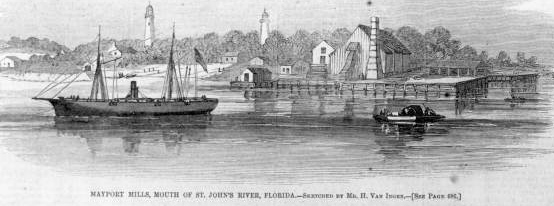
Union Navy Base, Mayport Mills, Florida (Harper’s Weekly, 5 October 1862, public domain).
During a return expedition to Florida beginning 30 September, the 47th joined with the 1st Connecticut Battery, 7th Connecticut Infantry, and part of the 1st Massachusetts Cavalry in assaulting Confederate forces at their heavily protected camp at Saint John’s Bluff, overlooking the Saint John’s River area. Trekking and skirmishing through roughly twenty-five miles of dense swampland and forests after disembarking from ships at Mayport Mills on 1 October, the 47th captured artillery and ammunition stores (on 3 October) that had been abandoned by Confederate forces during the bluff’s bombardment by Union gunboats.
The capture of Saint John’s Bluff followed a string of U.S. Army and Navy successes which enabled the Union to gain control over key southern towns and transportation hubs. In November 1861, the Union’s South Atlantic Blockading Squadron had established an operations base at Port Royal, South Carolina, facilitating Union expeditions to Georgia and Florida, during which U.S. troops were able to take possession of Fort Clinch and Fernandina, Florida (3-4 March 1862), secure the surrender of Fort Marion and Saint Augustine (11 March) and establish a Union Navy base at Mayport Mills (mid-March).

Earthworks surrounding the Confederate battery atop Saint John’s Bluff above the Saint John’s River in Florida (J. H. Schell, 1862, public domain).
That summer, Brigadier-General Joseph Finnegan, commanding officer of the Confederate States of America’s Department of Middle and Eastern Florida, ordered the placement of earthworks-fortified gun batteries atop Saint John’s Bluff and at Yellow Bluff nearby. Confederate leaders hoped to disable the Union’s naval and ground force operations at and beyond Mayport Mills with as many as eighteen cannon, including three eight-inch siege howitzers and eight-inch smoothbores and Columbiads (two of each).
After the U.S. gunboats Uncas and Patroon exchanged shell fire with the Confederate battery at Saint John’s Bluff on 11 September, Rebel troops were initially driven away, but then returned to the bluff. When a second, larger Union gunboat flotilla tried and failed again six days later to shake the Confederates loose, Union military leaders ordered an army operation with naval support.
Backed by U.S. gunboats Cimarron, E. B. Hale, Paul Jones, Uncas, and Water Witch that were armed with twelve-pound boat howitzers, the 1,500-strong Union Army force of Brigadier-General Brannan moved up the Saint John’s River and further inland along the Pablo and Mt. Pleasant Creeks on 1 October 1862 before disembarking and marching for Saint John’s Bluff. When the 47th Pennsylvanians reached Saint John’s Bluff with their fellow Union brigade members on 3 October 1862, they found the battery abandoned. (Other Union troops discovered that the Yellow Bluff battery was also Rebel free.)
According to Henry Wharton, “On the day following our occupation of these works the guns were dismounted and removed on board the steamer Neptune, together with the shot and shell, and removed to Hilton Head. The powder was all used in destroying the batteries.”
Meanwhile that same weekend (Friday and Saturday, 3-4 October 1862), Brigadier-General Brannan, who was quartered on board the Ben Deford as the Union expedition’s commanding officer, was busy penning reports to his superiors while also planning the next move of his expeditionary force. That Saturday, Brannan chose several officers to direct their subordinates to prepare rations and ammunition for a new foray that would take them roughly twenty miles upriver to Jacksonville. (A sophisticated hub of cultural and commercial activities with a racially diverse population of more than two thousand residents, the city had repeatedly changed hands between the Union and Confederacy until its occupation by Union forces on 12 March 1862.) Among the Union soldiers selected for this mission were 47th Pennsylvania Volunteers from Company C, Company E and Company K.
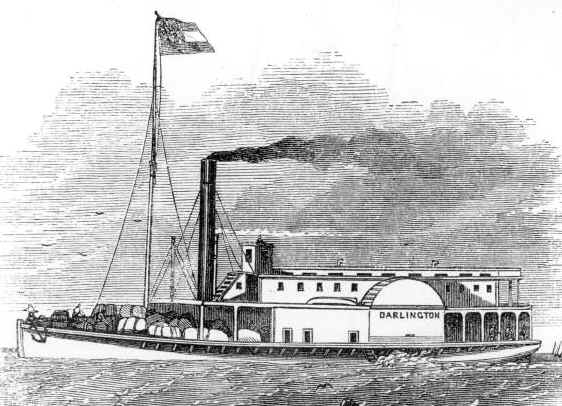
The Darlington, a former Confederate steamer turned Union gunboat (Frank Leslie’s Illustrated Newspaper, public domain).
Companies E and K of the 47th were then led by E Company Captain Charles Hickman Yard on a special mission; the men of E and K Companies joined with other Union Army soldiers in the reconnaissance and subsequent capture of Jacksonville, Florida on 5 October 1862.
A day later, sailing upriver on board the Union gunboat Darlington (formerly a Confederate steamer)—with protection from the Union gunboat Hale, men from the 47th Pennsylvania’s Companies E and K traveled two hundred miles along the Saint John’s River. They were charged with locating and capturing Confederate ships that had been engaged in furnishing troops, ammunition and other supplies to Confederate Army units scattered throughout the region, including the batteries at Saint John’s Bluff and Yellow Bluff. Describing the Darlington in a subsequent diary entry, Corporal George R. Nichols of the 47th Pennsylvania Volunteers’ E Company wrote:
This steamer is runn [sic] by a negro crew and this same crew runn [sic] her away from the Rebels out of charleston [sic] harbor Passed [sic] forts Sumpter and Moltre [sic] and all the land Batterys [sic] and turned her over to Uncle Sam. The crew is Brave and Smart and that if they are Black men.
According to Schmidt, the small force steamed upriver roughly one to two hundred miles “to Lake Beresford, where they then assisted in capturing the [68-ton] steamer Governor Milton,” which had been renamed in honor of Florida’s governor after having been “formerly known as the George M. Bird [under its previous owners] a New England family named ‘Swift’, who were timber cutters and used it as a tug boat to tow rafts loaded with live oak to the lumber market.”

The Governor Milton, a Confederate steamer that was captured by Companies E and K, 47th Pennsylvania Volunteers, October 1862 (Frank Leslie’s Illustrated Newspaper, public domain).
Corporal Nichols of E Company went on to describe the capture as follows:
At 9 PM … October 7, discovered the steamer Gov. Milton in a small creek, 2 miles above Hawkinsville; boarded her in a small boat, and found that she had been run in there but a short time before, as her fires were not yet out. Her engineer and mate, then in charge, were asleep on board at the time of her capture. They informed us that owing to the weakness of the steamer’s boiler we found her where we did. We returned our prize the next day….
I commanded one of the Small Boats that whent [sic] in after her. I was Boatman and gave orders when the headman jumped on Bord [sic] take the Painter with him. That however belongs to Wm. Adams or Jacob Kerkendall [sic]. It was So dark I could not tell witch [sic] Struck the deck first. But when I Struck the deck I demanded the Surrend [sic] of the Boat in the name of the U.S. after we had the boat an offercier [sic] off the Paul Jones, a Gun Boat was with us he ask me how Soon could I move her out in the Stream I said five minuts [sic]. So an Engineer one of coulered [sic] Men helped me. and I will Say right hear [sic] he learned Me More than I ever knowed about Engineering. Where we Started down the River we was one hundred and twenty five miles up the river. When we Stopped at Polatkey [Palatka] to get wood for the Steamer I whent [sic] out and Borrowed a half of a deer that hung up in a cut house and a bee hive for some honey for the Boys. I never forget the boys.’
According to Brigadier-General Brannan, the Union party “returned on the morning of the 9th with a Rebel steamer, Governor Milton, which they captured in a creek about 230 miles up the river and about 27 miles north [and slightly west] from the town of Enterprise. Lt. Bacon, my aide-de-camp, accompanied the expedition… On the return of the successful expedition after the Rebel steamers… I proceeded with that portion of my command to St. John’s Bluff, awaiting the return of the Boston.”
This return trip did not happen without complications, however; in a letter penned to The New York Times on October 14, Wharton reported the following:
Finding that the Cosmopolitan, which had been sent to Hilton Head for provisions, had struck heavily in crossing the bar, on her return to the St. John’s River, and was temporarily disabled for service, the Seventh Connecticut Regiment was sent to Hilton Head on the Boston, with the request that she should return for the remainder of the troops, and she got back on the 11th, when the command was reembarked, reaching this plane yesterday, excepting one company of the Forty-seventh Pennsylvania, which is left for the protection of the Cosmopolitan. The accident to this valuable steamer is severe. A large hole was made in her bottom and she filled, but she will not be a wreck, as was at first feared.
The Governor Milton, which would later be appraised by the Union Navy at two thousand dollars (the equivalent of slightly more than seventy-four thousand dollars in 2024), was also temporarily left behind, under the command of Captain Steedman so that its boiler could be repaired. Overseeing those repairs was Corporal Nichols, who had been temporarily detached from the 47th Pennsylvania’s E Company. Observed Nichols:
So hear [sic] we are at Jacksonville and off we go down the river again, and the Captain Yard Said you are detailed on detached duty as Engineer well that beats hell. I told him I did not Enlist for an Engineer. well I cannot help it he said. I got orders for you to stay hear [sic]. When the Boys was gone about a week orders came for us to come to Beaufort, S. Carolina by the inland rout over the Museley Mash Rout. So I Borrowed a twelve pound gun with amanition [sic] for to Protect our Selves with. But I only used it once to clear Some cavelry [sic] away. We Passed fort Palask [sic]. But that was in our Possession and we got Back to Beaufort all right. and I whent [sic] up to See the Boys and Beged [sic] captain to get me Back in the company, But he could not make it go.
Integration of the Regiment
On 5 and 15 October 1862, respectively, the 47th Pennsylvania made history as it became an integrated regiment, adding to its muster rolls several Black men who had escaped chattel enslavement from plantations near Beaufort, South Carolina. Among the formerly enslaved men who enlisted at this time were Bristor Gethers, Abraham Jassum and Edward Jassum.
Battle of Pocotaligo, South Carolina

Highlighted version of the U.S. Army’s map of the Pocotaligo-Coosawhatchie Expedition, South Carolina, October 22, 1862. Blue Arrow: Mackay’s Point, where the U.S. Tenth Army debarked and began its march. Blue Box: Position of Union troops (blue) and Confederate troops (red) in relation to the Pocotaligo bridge and town of Pocotaligo, the Charleston & Savannah Railroad, and the Caston and Frampton plantations (blue highlighting added by Laurie Snyder, 2023; public domain; click to enlarge).
From 21-23 October 1862, under the brigade and regimental commands of Colonel T. H. Good and Lieutenant-Colonel George W. Alexander, the 47th Pennsylvania Volunteers next engaged the heavily protected Confederate forces in and around Pocotaligo, South Carolina—including at Frampton’s Plantation and the Pocotaligo Bridge—a key piece of southern railroad infrastructure that Union leaders had ordered to be destroyed in order to disrupt the flow of Confederate troops and supplies in the region.
Harried by snipers en route to the Pocotaligo Bridge, they met resistance from an entrenched, heavily fortified Confederate battery which opened fire on the Union troops as they entered an open cotton field. Those headed toward higher ground at the Frampton Plantation fared no better as they encountered artillery and infantry fire from the surrounding forests. The Union soldiers grappled with Confederates where they found them, pursuing the Rebels for four miles as they retreated to the bridge. There, the 47th relieved the 7th Connecticut. But the enemy was just too well armed. After two hours of intense fighting in an attempt to take the ravine and bridge, depleted ammunition forced the 47th to withdraw to Mackay’s Point.
Losses for the 47th Pennsylvania were significant. Two officers and eighteen enlisted men died; an additional two officers and one hundred and fourteen enlisted were wounded. Among the most serious casualties suffered by Company K were Captain George Junker, who had been mortally wounded by a minie ball fired from a Confederate rifle during the intense fighting near the Frampton Plantation, and Privates Abraham Landes and Joseph Louis (alternate spelling: “Lewis”). All three died the next day while being treated for their wounds at the Union Army’s General Hospital at Hilton Head, South Carolina. Private John Schuchard then died there from his own mortal wounds on 24 October.
The command vacancy created when Captain George Junker fell in battle at Pocotaligo was immediately filled when First Lieutenant Charles W. Abbott was advanced to the rank of captain on the day of the battle (22 October).
Following their return to Hilton Head on 23 October 1862, the remaining 47th Pennsylvania Volunteers recuperated from their physical and emotional battering as they gradually resumed their normal duties. On 27 October 1862, First Sergeant Alfred P. Swoyer was honorably discharged from Company K in order to re-enlist as a second lieutenant with the same unit and regiment, which he did that same day at Fort Jefferson in the Dry Tortugas in Florida.
In short order, several members of the regiment were called upon to serve as the funeral honor guard for Major-General Ormsby M. Mitchel and given the honor of firing the salute over this grave. (Commander of the U.S. Army’s 10th Corps and Department of the South, Mitchel succumbed to yellow fever on 30 October 1862. The Mountains of Mitchel, a part of Mars’ South Pole discovered in 1846 by Mitchel as a University of Cincinnati astronomer, and Mitchelville, the first Freedmen’s town created after the Civil War, were both named after him.)

Fort Jefferson, Dry Torguas, Florida (interior, circa 1934, C. E. Peterson, photographer, U.S. Library of Congress, public domain).
Having been ordered back to Key West on 15 November 1862, much of 1863 would be spent garrisoning federal installations in Florida as part of the 10th Corps, U.S. Department of the South. Companies A, B, C, E, G, and I would once again garrison Fort Taylor in Key West, but this time, the men from Companies D, F, H, and K, including Privates John and Hiram Kolb, would garrison Fort Jefferson, the Union’s remote outpost in the Dry Tortugas off the southern coast of Florida.
After packing their belongings at their Beaufort, South Carolina encampment and loading their equipment onto the U.S. Steamer Cosmopolitan, the officers and enlisted members of the 47th Pennsylvania Volunteer Infantry sailed toward the mouth of the Broad River on 15 December 1862, and anchored briefly at Port Royal Harbor in order to allow the regiment’s medical director, Elisha W. Baily, M.D., and members of the regiment who had recuperated enough from their Pocotaligo-related battle injuries at the Union’s General Hospital at Hilton Head, to rejoin the regiment.
At 5 p.m. that same evening, the regiment sailed for Florida, during what was later described by several members of the regiment as a treacherous and nerve-wracking voyage. According to Schmidt, the ship’s captain “steered a course along the coast of Florida for most of the voyage,” which made the voyage more precarious “because of all the reefs.” On 16 December “the second night, the ship was jarred as it ran aground on one during a storm, but broke free, and finally steered a course further from shore, out in the Gulf Stream.”
In a letter penned to the Sunbury American on 21 December, Henry Wharton provided the following details about the regiment’s trip:
On the passage down, we ran along almost the whole coast of Florida. Rather a dangerous ground, and the reefs are no playthings. We were jarred considerably by running on one, and not liking the sensation our course was altered for the Gulf Stream. We had heavy sea all the time. I had often heard of ‘waves as big as a house,’ and thought it was a sailor’s yarn, but I have seen ‘em and am perfectly satisfied; so now, not having a nautical turn of mind, I prefer our movements being done on terra firma, and leave old neptune to those who have more desire for his better acquaintance. A nearer chance of a shipwreck never took place than ours, and it was only through Providence that we were saved. The Cosmopolitan is a good river boat, but to send her to sea, loadened [sic, loaded] with U.S. troops is a shame, and looks as though those in authority wish to get clear of soldiers in another way than that of battle. There was some sea sickness on our passage; several of the boys ‘casting up their accounts’ on the wrong side of the ledger.
According to Corporal George Nichols of Company E, “When we got to Key West the Steamer had Six foot of water in her hole [sic]. Waves Mountain High and nothing but an old river Steamer. With Eleven hundred Men on I looked for her to go to the Bottom Every Minute.”
Although the Cosmopolitan arrived at the Key West Harbor on Thursday, 18 December, the 47th Pennsylvania Volunteers did not set foot on Florida soil until noon the next day. The men from Companies C and I were immediately marched to Fort Taylor, where they were placed under the command of Major William Gausler, the regiment’s third-in-command. The men from Companies B and E were assigned to the older barracks that had been erected by the United States Army, and were placed under the command of B Company Captain Emanuel P. Rhoads while the men from Companies A and G were placed under the command of A Company Captain Richard A. Graeffe, and stationed at newer facilities known as the “Lighthouse Barracks” on “Lighthouse Key.”

Fort Jefferson (Harper’s Weekly, 26 Aug 1865, public domain).
On Saturday, 21 December, Lieutenant-Colonel G. W. Alexander, the regiment’s second-in-command, sailed away aboard the Cosmopolitan with the men from the regiment’s remaining companies—Companies D, F, H, and K—and headed south to Fort Jefferson, where they would assume garrison duties in the Dry Tortugas, roughly seventy miles off the coast of Florida (in the Gulf of Mexico). According to Henry Wharton:
We landed here on last Thursday at noon, and immediately marched to quarters. Company I. and C., in Fort Taylor, E. and B. in the old Barracks, and A. and G. in the new Barracks. Lieut. Col. Alexander, with the other four companies proceeded to Tortugas, Col. Good having command of all the forces in and around Key West. Our regiment relieves the 90th Regiment N.Y.S. Vols. Col. Joseph Morgan, who will proceed to Hilton Head to report to the General commanding. His actions have been severely criticized by the people, but, as it is in bad taste to say anything against ones [sic, one’s] superiors, I merely mention, judging from the expression of the citizens, they were very glad of the return of the 47th Pennsylvania Volunteers….
Key West has improved very little since we left last June, but there is one improvement for which the 90th New York deserve a great deal of praise, and that is the beautifying of the ‘home’ of dec’d. soldiers. A neat and strong wall of stone encloses the yard, the ground is laid off in squares, all the graves are flat and are nicely put in proper shape by boards eight or ten inches high on the ends sides, covered with white sand, while a head and foot board, with the full name, company and regiment, marks the last resting place of the patriot who sacrificed himself for his country….
1863
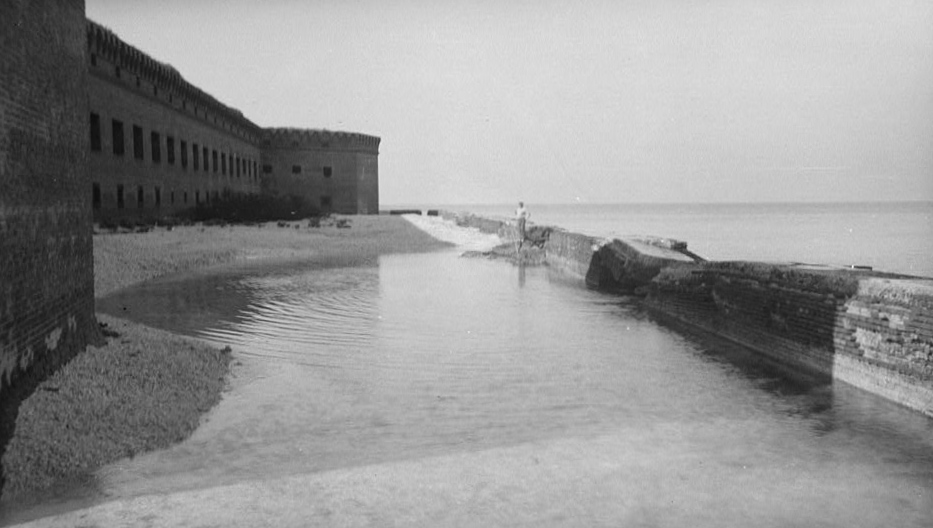
Fort Jefferson’s moat and wall, circa 1934, Dry Tortugas, Florida (C.E. Peterson, Library of Congress; public domain).
Although water quality was a challenge for members of the regiment at both of their Florida duty stations throughout 1863, it was particularly problematic for Privates John and Hiram Kolb and the other 47th Pennsylvanians who were stationed at Fort Jefferson. According to Schmidt:
‘Fresh’ water was provided by channeling the rains from the fort’s barbette through channels in the interior walls, to filter trays filled with sand; and finally to the 114 cisterns located under the fort which held 1,231,200 gallons of water. The cisterns were accessible in each of the first level cells or rooms through a ‘trap hole’ in the floor covered by a temporary wooden cover…. Considerable dirt must have found its way into these access points and was responsible for some of the problems resulting in the water’s impurity…. The fort began to settle and the asphalt covering on the outer walls began to deteriorate and allow the sea water (polluted by debris in the moat) to penetrate the system…. Two steam condensers were available … and distilled 7000 gallons of tepid water per day for a separate system of reservoirs located in the northern section of the parade ground near the officers [sic, officers’] quarters. No provisions were made to use any of this water for personal hygiene of the [planned 1,500-soldier garrison force]….
As a result, the soldiers stationed there washed themselves and their clothes, using saltwater from the ocean. As if that weren’t difficult enough, “toilet facilities were located outside of the fort,” according to Schmidt:
At least one location was near the wharf and sallyport, and another was reached through a door-sized hole in a gunport, and a walk across the moat on planks at the northwest wall…. These toilets were flushed twice each day by the actions of the tides, a procedure that did not work very well and contributed to the spread of disease. It was intended that the tidal flush should move the wastes into the moat, and from there, by similar tidal action, into the sea. But since the moat surrounding the fort was used clandestinely by the troops to dispose of litter and other wastes … it was a continuous problem for Lt. Col. Alexander and his surgeon.
As for daily operations in the Dry Tortugas, there was a fort post office and the “interior parade grounds, with numerous trees and shrubs in evidence, contained … officers quarters, [a] magazine, kitchens and out houses,” per Schmidt, as well as “a ‘hot shot oven’ which was completed in 1863 and used to heat shot before firing.”
Most quarters for the garrison … were established in wooden sheds and tents inside the parade [grounds] or inside the walls of the fort in second-tier gun rooms of ‘East’ front no. 2, and adjacent bastions … with prisoners housed in isolated sections of the first and second tiers of the southeast, or no. 3 front, and bastions C and D, located in the general area of the sallyport. The bakery was located in the lower tier of the northwest bastion ‘F’, located near the central kitchen….
While serving as a second lieutenant at Fort Jefferson, Company K’s David K. Fetherolf was promoted to the rank of first lieutenant on 2 May 1863, and was then appointed as acting quartermaster at Fort Jefferson in August 1863—an appointment he continued to hold through at least December of that year.
Additional Duties: Diminishing Florida’s Role as the “Supplier of the Confederacy”
On top of the strategic role played by the 47th Pennsylvania Volunteers in preventing foreign powers from assisting the Confederate Army and Navy in gaining control over federal forts in the Deep South, the Kolbs and other members of their regiment would also be called upon to play an ongoing role in weakening Florida’s abilities to supply and transport food and troops throughout the area held by the Confederate States of America.
Prior to intervention by Union Army and Navy forces, the owners of plantations and livestock ranches, as well as the operators of small, family farms across Florida, had been able to consistently furnish beef and pork, fish, fruits, and vegetables to Confederate troops stationed throughout the Deep South during the first year of the American Civil War. Large herds of cattle were raised near Fort Myers, for example, while orchard owners in the Saint John’s River area were actively engaged in cultivating large orange groves (while other types of citrus trees were easily found growing throughout the state’s wilderness areas).
The state was also a major producer of salt, which was used as a preservative for food. As a result, the 47th Pennsylvania Volunteers and other Union troops across Florida were ordered to capture or destroy salt manufacturing facilities in order to further curtail the enemy’s access to food.
And they would be undertaking all of these duties in conditions that were far more challenging than what many other Union Army units were experiencing up north in the Eastern Theater. The weather was frequently hot and humid as spring turned to summer, the mosquitos and other insects were an ever-present annoyance and serious threat when they were carrying tropical diseases, and there were also scorpions and snakes that put the men’s health at further risk.
Despite all of these hardships, when members of the 47th Pennsylvania Volunteer Infantry were offered the opportunity to re-enlist during the fall of 1863, more than half chose to do so, knowing full well that the fight to preserve America’s Union was not yet over. Among those opting to re-up were Privates John and Hiram Kolb, who were both honorably discharged at Fort Jefferson on 19 October 1863 in order to re-enlist as Veteran Volunteers under General Order No. 191 of the U.S. War Department (Adjutant General’s Office 1863), which they both did at Fort Jefferson later that same month. Both father and son retained the rank of private. (Private Hiram Kolb was confirmed on muster rolls as having re-enlisted on 27 October 1863.)
1864
The winter holidays of late 1863 and early 1864 proved to be times of both celebration and hardship for members of the 47th Pennsylvania. Stationed far from home, many would mark another year away from friends and family with promotions following their re-enlistment at Fort Taylor or Fort Jefferson. Corporal Matthias Miller was one such man; he advanced to the rank of first sergeant on New Year’s Day.
In early January 1864, the regiment experienced yet another significant change when it was ordered to expand the Union Army’s reach by sending part of its membership north to retake possession of Fort Myers, a federal installation that had been abandoned in 1858 following the U.S. government’s third war with the Seminole Indians. Per orders issued earlier in 1864 by General D. P. Woodbury, Commanding Officer, U.S. Department of the Gulf, District of Key West and the Tortugas, that the fort be used to facilitate the Union’s Gulf Coast blockade, Captain Richard Graeffe and a group of men from Company A were charged with expanding the fort and conducting raids on area cattle herds to provide food for the growing Union troop presence across Florida. Graeffe and his men subsequently turned the fort into both their base of operations and a shelter for pro-Union supporters, escaped slaves, Confederate Army deserters, and others fleeing Rebel troops.
Red River Campaign
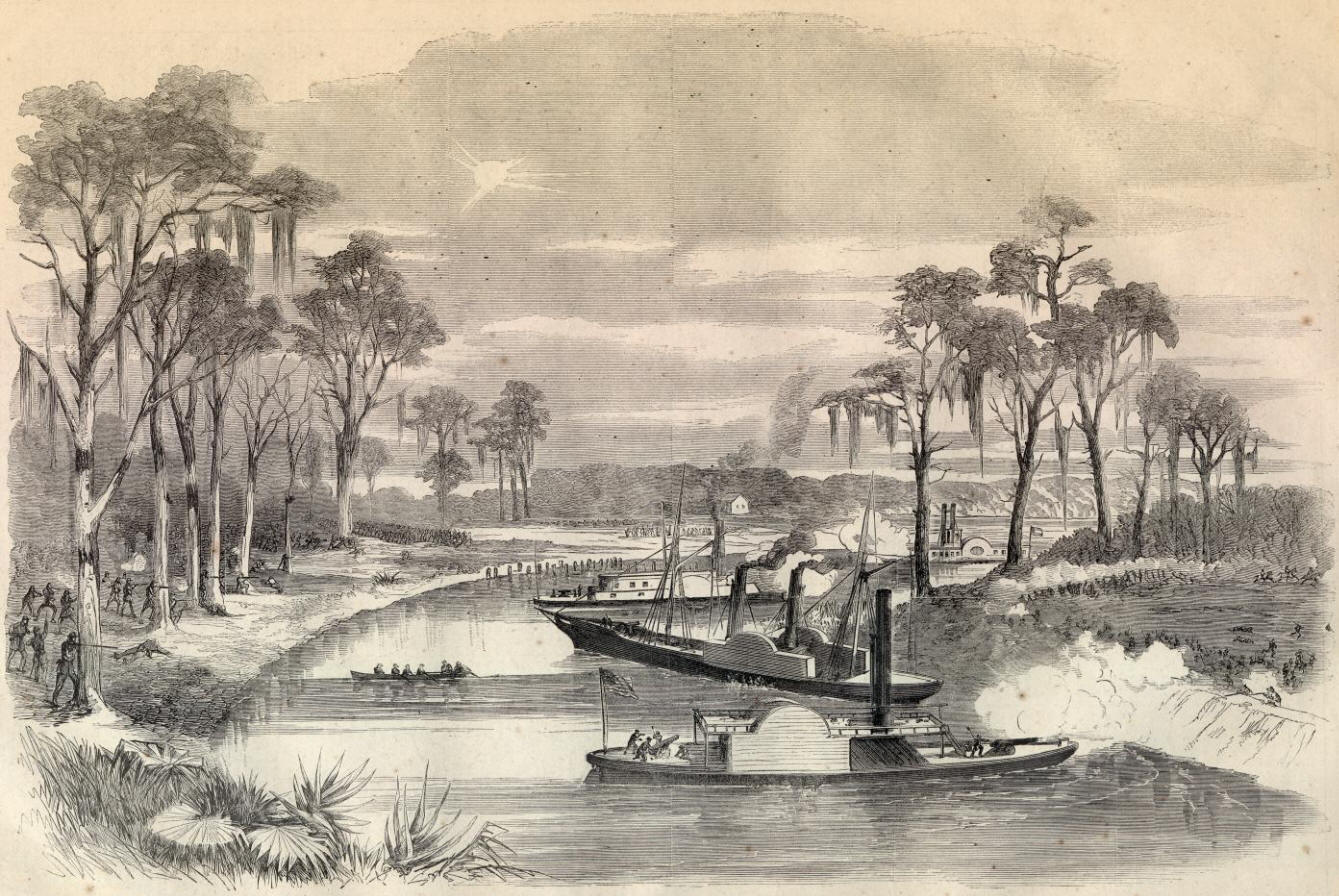
Bayou Teche, Louisiana (Harper’s Weekly, 14 February 1863, public domain).
Meanwhile, all of the other companies of the 47th Pennsylvania Volunteer Infantry had begun preparing for the regiment’s history-making journey to Louisiana. Boarding yet another steamer—the Charles Thomas—on 25 February 1864, the men from Companies B, C, D, I, and K of the 47th Pennsylvania headed for Algiers, Louisiana (across the river from New Orleans), followed on 1 March by other members of the regiment from Companies E, F, G, and H who had been stationed at Fort Jefferson in the Dry Tortugas.
Upon the second group’s arrival, the now almost-fully-reunited regiment moved by train on 28 February to Brashear City (now Morgan City, Louisiana) before heading to Franklin by steamer through the Bayou Teche. There, the 47th Pennsylvania Volunteer Infantry joined the 2nd Brigade, 1st Division of the Department of the Gulf’s 19th Army Corps (XIX Corps), and became the only Pennsylvania regiment to serve in the Red River Campaign of Union Major-General Nathaniel P. Banks. (Unable to reach Louisiana until 23 March, the men from Company A were effectively placed on a different type of detached duty in New Orleans while they awaited transport to enable them to catch up with the main part of their regiment. Charged with guarding and overseeing the transport of two hundred and forty-five Confederate prisoners, they were finally able to board the Ohio Belle on 7 April, and reached Alexandria, Louisiana with those prisoners on 9 April.)

Natchitoches, Louisiana (Frank Leslie’s Illustrated Newspaper, 7 May 1864, U.S. Library of Congress, public domain).
The early days on the ground in Louisiana quickly woke the 47th Pennsylvania Volunteers up to just how grueling this new phase of duty would be. From 14-26 March, most members of the 47th marched for Alexandria and Natchitoches, near the top of the L-shaped state. Among the towns that the 47th Pennsylvanians passed through during their long marches while stationed in Louisiana were: New Iberia, Vermilionville (now part of Lafayette), Opelousas, and Washington.
From 4-5 April 1864, the regiment added to its roster of young Black soldiers when Aaron Bullard (later known as Aaron French), James Bullard, John Bullard, Samuel Jones, and Hamilton Blanchard (also known as John Hamilton) enrolled for military service with the 47th Pennsylvania at Natchitoches. According to their respective entries in the Civil War Veterans’ Card File at the Pennsylvania State Archives and on regimental muster rolls, the men were then officially mustered in for duty on 22 June at Morganza. Several of their entries noted that they were assigned the rank of “(Colored) Cook” while others were given the rank of “Under Cook.”
Often short on food and water throughout their long, harsh-climate trek through enemy territory, the 47th Pennsylvania encamped briefly at Pleasant Hill (now the Village of Pleasant Hill) the night of 7 April before continuing on the next day.
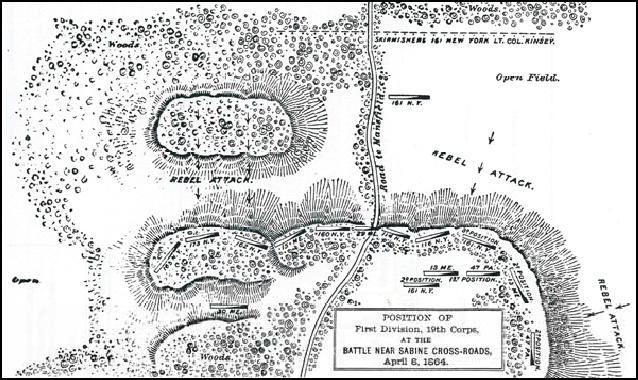
19th U.S. Army Map, Phase 3, Battle of Sabine Cross Roads/Mansfield (8 April 1864, public domain).
Rushed into battle ahead of other regiments in the 2nd Division, sixty members of the 47th were cut down on 8 April during the intense volley of fire unleashed during the Battle of Sabine Cross Roads (also known as the Battle of Mansfield because of its proximity to the community of Mansfield). The fighting waned only when darkness fell. The exhausted, but uninjured collapsed beside the gravely wounded. After midnight, the surviving Union troops withdrew to Pleasant Hill.
The next day, the 47th Pennsylvania Volunteers were ordered into a critically important defensive position at the far right of the Union lines, their right flank spreading up onto a high bluff. By 3 p.m., after enduring a midday charge by the troops of Confederate Major-General Richard Taylor (a plantation owner who was the son of Zachary Taylor, former president of the United States), the brutal fighting still showed no signs of ending. Suddenly, just as the 47th was shifting to the left side of the massed Union forces, the men of the 47th Pennsylvania were forced to bolster the 165th New York’s buckling lines by blocking another Confederate assault.
During this engagement, the 47th Pennsylvania succeeded in recapturing a Massachusetts artillery battery lost during the earlier Confederate assault. Unfortunately, the regiment’s second-in-command, Lieutenant-Colonel Alexander, was nearly killed during the fight that day, and Color-Sergeant Benjamin Walls was shot in the left shoulder while mounting the 47th Pennsylvania’s colors on one of the recaptured caissons. Sergeant William Pyers was then also wounded while grabbing the American flag from Walls as he fell to prevent it from falling into enemy hands.
Alexander, Walls and Pyers all survived the day and continued to fight on with the 47th, but many others, like Second Lieutenant Alfred Swoyer, were killed in action during the two days of chaotic fighting, or wounded so severely that they were unable to continue their service with the 47th. (Swoyer’s final words were, “They’re coming nine deep!” His body was never recovered.)
Still others from the 47th were captured by Confederate troops, marched roughly one hundred and twenty-five miles to Camp Ford, a Confederate Army prison camp near Tyler, Texas, and held there as prisoners of war until they were released during prisoner exchanges that began in July and continued through November. At least two members of the 47th Pennsylvania never made it out of there alive. Private Samuel Kern of Company D died there on 12 June 1864, and Private John Weiss of F Company, who had been wounded in action at Pleasant Hill, died from those wounds on 15 July.
Meanwhile, as the captured 47th Pennsylvanians were being spirited away to Texas, the bulk of the regiment was carrying out orders from senior Union Army leaders to head for Grand Ecore, Louisiana. Encamped there from 11 April to 22 April 1864, they engaged in the hard labor of strengthening regimental and brigade fortifications.
They then moved back to Natchitoches Parish on 22 April. While en route, they were attacked again—this time at the rear of their retreating brigade, but were able to quickly end the encounter and continue on to reach Cloutierville at 10 p.m. that same night—after a forty-five-mile march.

The 47th Pennsylvania Volunteers were stationed just to the left of the “Thick Woods” with Emory’s 2nd Brigade, 1st Division as shown on this map of Union troop positions for the Battle of Cane River Crossing at Monett’s Ferry, Louisiana, 23 April 1864 (Major-General Nathaniel Banks’ official Red River Campaign Report, public domain).
The next morning (23 April 1864), episodic skirmishing quickly roared into the flames of a robust fight. As part of the advance party led by Union Brigadier-General William Emory, the 47th Pennsylvanians took on the Confederate cavalry of Brigadier-General Hamilton P. Bee in the Battle of Cane River (also known as “the Affair at Monett’s Ferry” or the “Cane River Crossing”).
Responding to a barrage from the Confederate artillery’s twenty-pound Parrott guns and raking fire from enemy troops situated near a bayou and on a bluff, Brigadier-General Emory directed one of his brigades to keep Bee’s Confederates busy while sending the other two brigades to find a safe spot where his Union troops could ford the Cane River. As part of the “beekeepers,” the 47th Pennsylvania supported Emory’s artillery.
Meanwhile, other troops serving with Emory’s brigade attacked Bee’s flank to force a Rebel retreat, and then erected a series of pontoon bridges that enabled the 47th and other remaining Union soldiers to make the Cane River Crossing by the next day. As the Confederates retreated, they torched their own food stores, as well as the cotton supplies of their fellow southerners. In a letter penned from Morganza, Louisiana on 29 May, Henry Wharton described what had happened to the 47th Pennsylvanians during and immediately after making camp at Grand Ecore:
Our sojourn at Grand Ecore was for eleven days, during which time our position was well fortified by entrenchments for a length of five miles, made of heavy logs, five feet high and six feet wide, filled in with dirt. In front of this, trees were felled for a distance of two hundred yards, so that if the enemy attacked we had an open space before us which would enable our forces to repel them and follow if necessary. But our labor seemed to the men as useless, for on the morning of 22d April, the army abandoned these works and started for Alexandria. From our scouts it was ascertained that the enemy had passed some miles to our left with the intention of making a stand against our right at Bayou Cane, where there is a high bluff and dense woods, and at the same attack Smith’s forces who were bringing up the rear. This first day was a hard one on the boys, for by ten o’clock at night they made Cloutierville, a distance of forty-five miles. On that day the rear was attacked which caused our forces to reverse their front and form in line of battle, expecting too, to go back to the relief of Smith, but he needed no assistance, sending word to the front that he had ‘whipped them, and could do it again.’ It was well that Banks made so long a march on that day, for on the next we found the enemy prepared to carry out their design of attacking us front and rear. Skirmishing commenced early in the morning and as our columns advanced he fell back towards the bayou, when we soon discovered the position of their batteries on the bluff. There was then an artillery duel by the smaller pieces, and some sharp fighting by the cavalry, when the ‘mule battery,’ twenty pound Parrott guns, opened a heavy fire, which soon dislodged them, forcing the chivalry to flee in a manner not at all suitable to their boasted courage. Before this one cavalry, the 3d Brigade of the 1st Div., and Birges’ brigade of the second, had crossed the bayou and were doing good service, which, with the other work, made the enemy show their heels. The 3d brigade done some daring deeds in this fight, as also did the cavalry. In one instance the 3d charged up a hill almost perpendicular, driving the enemy back by the bayonet without firing a gun. The woods on this bluff was so thick that the cavalry had to dismount and fight on foot. During the whole of the day, our brigade, the 2d was supporting artillery, under fire all the time, and could not give Mr. Reb a return shot.
While we were fighting in front, Smith was engaged some miles in the rear, but he done his part well and drove them back. The rebel commanders thought by attacking us in the rear, and having a large face on the bluffs, they would be able to capture our train and take us all prisoners, but in this they were mistaken, for our march was so rapid that we were on them before they had thrown up the necessary earthworks. Besides they underrated the amount of our artillery, calculating from the number engaged at Pleasant Hill. The rebel prisoners say it ‘seems as though the Yankees manufacture, on short notice, artillery to order, and the men are furnished with wings when they wish to make a certain point.
The damage done to the Confederate cause by the burning of cotton was immense. On the night of the 22d our route was lighted up for miles and millions of dollars worth of this production was destroyed. This loss will be felt more by Davis & Co., than several defeats in this region, for the basis of the loan in England was on the cotton of Western Louisiana.
After the rebels had fled from the bluff the negro troops put down the pontoons, and by ten that night we were six miles beyond the bayou safely encamped. The next morning we moved forward and in two days were in Alexandria. Johnnys followed Smith’s forces, keeping out of range of his guns, except when he had gained the eminence across the bayou, when he punished them (the rebs) severely.

Christened “Bailey’s Dam” in reference to the Union officer who ordered its construction, Lieutenant-Colonel Joseph Bailey, this timber dam built by the Union Army on the Red River near Alexandria, Louisiana in May 1864 facilitated Union gunboat passage (public domain).
Having finally reached Alexandria on 26 April, they learned they would remain at their latest new camp for at least two weeks. Placed temporarily under the command of Lieutenant-Colonel Joseph Bailey, they were assigned yet again to the hard labor of fortification work, helping to erect “Bailey’s Dam,” a timber structure that enabled Union gunboats to more easily make their way back down the Red River. According to Wharton:
We were at Alexandria seventeen days, during which time the men were kept busy at throwing up earthworks, foraging and three times went out some distance to meet the enemy, but they did not make their appearance in numbers large enough for an engagement. The water in the Red river had fallen so much that it prevented the gunboats from operating with us, and kept our transports from supplying the troops with rations, (and you know soldiers, like other people, will eat) so Banks was compelled to relinquish his designs on Shreveport and fall back to the Mississippi. To do this a large dam had to be built on the falls at Alexandria to get the ironclads down the river. After a great deal labor this was accomplished and by the morning of May 13th the last one was through the shute [sic], when we bade adieu to Alexandria, marching through the town with banners flying and keeping step to the music of ‘Rally around the flag,’ and ‘When this cruel war is over.’ The next morning, at our camping place, the fleet of boats passed us, when we were informed that Alexandria had been destroyed by fire – the act of a dissatisfied citizen and several negroes. Incendiary acts were strictly forbidden in a general order the day before we left the place, and a cavalry guard was left in the rear to see the order enforced. After marching a few miles skirmishing commenced in front between the cavalry and the enemy in riflepits [sic] on the bank of the river, but they were easily driven away. When we came up we discovered their pits and places where there had been batteries planted. At this point the John Warren, an unarmed transport, on which were sick soldiers and women, was fired into and sunk, killing many and those that were not drowned taken prisoners. A tin-clad gunboat was destroyed at the same place, by which we lost a large mail. Many letters and directed envelopes were found on the bank – thrown there after the contents had been read by the unprincipled scoundrels. The inhumanity of Guerrilla bands in this department is beyond belief, and if one did not know the truth of it or saw some of their barbarities, he would write it down as the story of a ‘reliable gentleman’ or as told by an ‘intelligent contraband.’ Not satisfied with his murderous intent on unarmed transports he fires into the Hospital steamer Laurel Hill, with four hundred sick on board. This boat had the usual hospital signal floating fore and aft, yet, notwithstanding all this, and the customs of war, they fired on them, proving by this act that they are more hardened than the Indians on the frontier.

“Sleeping on Their Arms” by Winslow Homer (Harper’s Weekly, 21 May 1864, public domain).
Continuing their march, the 47th Pennsylvania Volunteers headed toward Avoyelles Parish. According to Wharton:
On Sunday, May 15, we left the river road and took a short route through the woods, saving considerable distance. The windings of Red river are so numerous that it resembles the tape-worm railroad wherewith the politicians frightened the dear people during the administration of Ritner and Stevens. – We stopped several hours in the woods to leave cavalry pass, when we moved forward and by four o’clock emerged into a large open plain where we formed in line of battle, expecting a regular engagement. The enemy, however, retired and we advanced ‘till dark, when the forces halted for the night, with orders to rest on their arms. – ‘Twas here that Banks rode through our regiment, amidst the cheers of the boys, and gave the pleasant news that Grant had defeated Lee.
Having entered Avoyelles Parish, they “rested on their arms” for the night, half-dozing without pitching their tents, but with their rifles right beside them. They were now positioned just outside of Marksville, Louisiana on the eve of the 16 May 1864 Battle of Mansura, which unfolded as follows, according to Wharton:
Early next morning we marched through Marksville into a prairie nine miles long and six wide where every preparation was made for a fight. The whole of our force was formed in line, in support of artillery in front, who commenced operations on the enemy driving him gradually from the prairie into the woods. As the enemy retreated before the heavy fire of our artillery, the infantry advanced in line until they reached Mousoula [sic], where they formed in column, taking the whole field in an attempt to flank the enemy, but their running qualities were so good that we were foiled. The maneuvring [sic] of the troops was handsomely done, and the movements was [sic] one of the finest things of the war. The fight of artillery was a steady one of five miles. The enemy merely stood that they might cover the retreat of their infantry and train under cover of their artillery. Our loss was slight. Of the rebels we could not ascertain correctly, but learned from citizens who had secreted themselves during the fight, that they had many killed and wounded, who threw them into wagons, promiscuously, and drove them off so that we could not learn their casualties. The next day we moved to Simmsport [sic, Simmesport] on the Achafalaya [sic, Atchafalaya] river, where a bridge was made by putting the transports side by side, which enabled the troops and train to pass safely over. – The day before we crossed the rebels attacked Smith, thinking it was but the rear guard, in which they, the graybacks, were awfully cut up, and four hundred prisoners fell into our hands. Our loss in killed and wounded was ninety. This fight was the last one of the expedition. The whole of the force is safe on the Mississippi, gunboats, transports and trains. The 16th and 17th have gone to their old commands.
It is amusing to read the statements of correspondents to papers North, concerning our movements and the losses of our army. I have it from the best source that the Federal loss from Franklin to Mansfield, and from their [sic] to this point does not exceed thirty-five hundred in killed, wounded and missing, while that of the rebels is over eight thousand.

Union Army base at Morganza Bend, Louisiana, circa 1863-1865 (U.S. Library of Congress, public domain).
Continuing on, the surviving members of the 47th marched for Simmesport and then Morganza, where they made camp again. According to Wharton, the members of Company C were sent on a special mission which took them on an intense one-hundred-and-twenty-mile journey:
Company C, on last Saturday was detailed by the General in command of the Division to take one hundred and eighty-seven prisoners (rebs) to New Orleans. This they done [sic] satisfactorily and returned yesterday to their regiment, ready for duty.
While encamped at Morganza, the nine formerly enslaved Black men who had enlisted with the 47th Pennsylvania in Beaufort, South Carolina (1862) and Natchitoches, Louisiana (April 1864) were officially mustered into the regiment between 20-24 June 1864. The regiment then headed back to New Orleans, where it arrived later that month.
As they did during their tour through the Carolinas and Florida, the men of the 47th had battled the elements and disease, as well as the Confederate Army, in order to survive and continue to defend their nation. Among those who fell ill, according to Charles W. Abbott, was Private John Kolb. In an affidavit filed in 1867, Abbott, who had been Kolb’s company captain during that Louisiana campaign, attested that “John Kolb contracted a disease whilst in said service in the state of LA. but however marched on with his said company….”
After arriving in New Orleans, they received orders on the 4th of July to return to the East Coast and loaded their men onto ships in two stages. Companies A, C, D, E, F, H, and I steamed for the Washington, D.C. area beginning 7 July while the men from Companies B, G and K, including Privates John and Hiram Kolb, remained behind on detached duty while awaiting transportation. Led by F Company Captain Henry S. Harte, the Kolbs and other 47th Pennsylvanians who had been left behind in Louisiana finally sailed away at the end of the month aboard the Blackstone. Arriving in Virginia on 28 July, they reconnected with the bulk of the regiment at Monocacy, Virginia on 2 August, but they missed the opportunity the earlier departing men had to have a memorable encounter with President Abraham Lincoln on 12 July 1864, and also missed the mid-July Battle of Cool Spring at Snicker’s Gap, Virginia.
On 24 July 1864, Captain John Peter Shindel Gobin was promoted from his leadership of Company C to the rank of major and appointed as third-in-command of the 47th Pennsylvania.
Sheridan’s1864 Shenandoah Valley Campaign

Halltown Ridge, the site where Union troops entrenched after Major-General Philip Sheridan took command of the Middle Military Division, 7 August 1864 (Thomas Dwight Biscoe, 2 August 1884, courtesy of Southern Methodist University).
On 1 August, K Company received word that their own First Sergeant Matthias Miller would be promoted again, advanced this time to the rank of second lieutenant; in addition, Corporal Franklin Beisel became First Sergeant Beisel that same day, and Private Samuel Reinert was promoted to the rank of corporal.
Attached to the Middle Military Division, U.S. Army of the Shenandoah beginning in early August, and placed under the command of legendary Union Major-General Philip H. Sheridan (“Little Phil”), the 47th Pennsylvania Volunteer Infantry was assigned to defensive duties in and around Halltown, and also engaged over the next several weeks in a series of back-and-forth movements between Halltown, Berryville, Middletown, Charlestown, and Winchester as part of a “mimic war”being waged by Sheridan’s Union forces with those commanded by Confederate Lieutenant-General Jubal Early.
During this phase of duty, K Company continued to lose members. Among those who were honorably discharged were: Privates Martin Reifinger and Elenois Druckenmiller who departed via surgeons’ certificates of disability on 3 and 18 August, respectively, and Private Conrad Nagle (alternate spellings: “Nagel,” “Neihl,” “Niehl”), who fell ill and was confined to the Union Army’s hospital at Virginia’s Fairfax Seminary near Alexandria, Virginia before succumbing to disease-related complications on 22 August. Private Charles Richter subsequently died at the Union Army’s Newton General Hospital in Baltimore on 1 September. The likely cause of his death was dysentery.
The 47th Pennsylvania then engaged with Confederate troops in the Battle of Berryville, Virginia from 3-4 September. Several men were killed or wounded in action, including Private George Kilmore (alternate spelling “Killmer”), who sustained a fatal gunshot wound to the abdomen on 5 September.
On 14 September, K Company Corporal Elias F. Benner was promoted to the rank of sergeant.
Men departing around this time from the 47th Pennsylvania Volunteers were: Company D’s Captain Henry Woodruff, E Company’s Captain Charles H. Yard and Captain Harte of F Company, as well as K Company’s Sergeant-Major Conrad Volkenand, Sergeant Peter Reinmiller, Corporals Lewis Benner and George Knuck, and Privates Valentine Amend, M. Bornschier, Charles Fisher, Charles Heiney, Jacob Kentzler, John Koldhoff, Anthony Krause, Elias Leh, Samuel Madder, Lewis Metzger, Alfred Muthard, John Schimpf, John Scholl, and Christopher Ulrich. All mustered out at Berryville, Virginia on 18 September 1864 upon expiration of their respective three-year terms of service.
Those members of the 47th who remained on duty were about to engage in their regiment’s greatest moments of valor.
Battles of Opequan and Fisher’s Hill

Battle of Opequan (aka Third Winchester), Virginia, 19 September 1864 (public domain).
Together with other regiments under the command of Union Major-General Sheridan and Brigadier-General William H. Emory, commander of the 19th Corps (XIX Corps), the Kolbs and their fellow 47th Pennsylvanians helped to inflict heavy casualties on Lieutenant-General Early’s Confederate forces in the Battle of Opequan (also spelled as “Opequon” and referred to as “Third Winchester”). The battle is still considered by many historians to be one of the most important during Sheridan’s 1864 campaign; the Union’s victory here helped to ensure the reelection of President Abraham Lincoln.
The 47th Pennsylvania’s march toward destiny at Opequan began at 2 a.m. on 19 September 1864 as the regiment left camp and joined up with others in the Union’s 19th Corps. Advancing slowly from Berryville toward Winchester, the 19th Corps became bogged down for several hours by the massive movement of Union troops and supply wagons, enabling Early’s men to dig in. Finally reaching the Opequon Creek, Sheridan’s men came face to face with Early’s Confederate Army. The fighting, which began in earnest at noon, was long and brutal. The Union’s left flank (6th Corps) took a beating from Confederate artillery stationed on high ground.
Meanwhile, the 47th Pennsylvania and the 19th Corps were directed by Brigadier-General Emory to attack and pursue Major-General John B. Gordon’s Confederate forces. Some success was achieved, but casualties mounted as a Confederate artillery group opened fire on Union troops trying to cross a clearing. When a nearly fatal gap began to open between the 6th and 19th Corps, Sheridan sent in units led by Brigadier-Generals Emory Upton and David A. Russell. Russell, hit twice—once in the chest, was mortally wounded.

Victory of Philip Sheridan’s Union army over Jubal Early’s Confederate forces, Battle of Opequan, 19 September 1864 (Kurz & Allison, circa 1893, U.S. Library of Congress, public domain).
The 47th Pennsylvania subsequently opened its lines long enough to enable the Union cavalry under William Woods Averell and the foot soldiers of Brigadier-General George Crook to charge the Confederates’ left flank. As the 19th Corps began pushing the Confederates back, with the 47th involved in the thick of the fight, Early’s “grays” retreated. Sheridan’s “blue jackets” ultimately went on to win the day.
That same day (on 19 September), Privates Samuel Kunfer, William Landis and Christian Weidenbach were promoted to the rank of Corporal.
Leaving 2,500 wounded behind, the Rebels retreated to Fisher’s Hill, eight miles south of Winchester (21-22 September). Among the 47th Pennsylvanians listed on the casualty rosters following the Battle of Fisher’s Hill was Private James M. Sieger of Company K, who had sustained a wound above one of his knees but would survive after receiving treatment from army surgeons.
Following a successful early morning flanking attack by Sheridan’s Union men which outnumbered Early’s three to one, Early’s Confederates then fled to Waynesboro. The 47th Pennsylvania Volunteers were among those sent out in skirmishing parties.
Afterward, they made camp at Cedar Creek. They would continue to distinguish themselves in battle, but they would do so without two more of their respected commanders: Colonel Tilghman H. Good and Good’s second in command, Lieutenant-Colonel George Alexander, who mustered out 23-24 September upon the expiration of their respective terms of service. Fortunately, they were replaced with leaders who were equally respected for their front-line experience and temperament, including Major John Peter Shindel Gobin, formerly of the 47th’s Company C, who had been promoted up through the regimental staff (and who would be promoted again on 4 November to the rank of lieutenant-colonel and regimental commanding officer).
On 26 September, Private Edwin Person became Corporal Person.
Battle of Cedar Creek

Alfred Waud’s 1864 sketch, “Surprise at Cedar Creek,” captured the flanking attack on the rear of Union Brigadier-General William Emory’s 19th Corps by Lieutenant-General Jubal Early’s Confederate army, and the subsequent resistance by Emory’s troops from their Union rifle-pit positions, 19 October 1864 (public domain).
During the fall of 1864, Major-General Sheridan began the first of the Union’s true “scorched earth” campaigns, starving the enemy into submission by destroying Virginia’s farming infrastructure. Viewed through today’s lens of history as inhumane, the strategy claimed many innocents—civilians whose lives were cut short by their inability to find food. This same strategy, however, almost certainly contributed to the further turning of the war’s tide in the Union’s favor during the Battle of Cedar Creek on 19 October 1864. Successful throughout most of their engagement with Union forces at Cedar Creek, Early’s Confederate troops began peeling off in ever growing numbers to forage for food, thus enabling the 47th Pennsylvania and others under Sheridan’s command to rally and win the day.
From a military standpoint, it was another impressive, but heartrending encounter. During the morning of 19 October, Early launched a surprise attack directly on Sheridan’s Cedar Creek-encamped forces. Early’s men were able to capture Union weapons while freeing a number of Confederates who had been taken prisoner during previous battles—all while pushing seven Union divisions back. According to Bates:
When the Army of West Virginia, under Crook, was surprised and driven from its works, the Second Brigade, with the Forty-seventh on the right, was thrown into the breach to arrest the retreat…. Scarcely was it in position before the enemy came suddenly upon it, under the cover of fog. The right of the regiment was thrown back until it was almost a semi-circle. The brigade, only fifteen hundred strong, was contending against Gordon’s entire division, and was forced to retire, but, in comparative good order, exposed, as it was, to raking fire. Repeatedly forming, as it was pushed back, and making a stand at every available point, it finally succeeded in checking the enemy’s onset, when General Sheridan suddenly appeared upon the field, who ‘met his crest-fallen, shattered battalions, without a word of reproach, but joyously swinging his cap, shouted to the stragglers, as he rode rapidly past them – “Face the other way, boys! We are going back to our camp! We are going to lick them out of their boots!’”

Sheridan Rallying His Troops, Battle of Cedar Creek, Virginia, 19 October 1864 (U.S. Library of Congress, public domain).
In response, Union troops staged a decisive counterattack that punched Early’s forces into submission. Afterward, the men of the 47th were commended for their heroism by General Stephen Thomas who, in 1892, was awarded the Medal of Honor for his own “distinguished conduct in a desperate hand-to-hand encounter, in which the advance of the enemy was checked” that day. Bates described the 47th’s actions:
When the final grand charge was made, the regiment moved at nearly right angles with the rebel front. The brigade charged gallantly, and the entire line, making a left wheel, came down on his flank, while engaging the Sixth Corps, when he went “whirling up the valley” in confusion. In the pursuit to Fisher’s Hill, the regiment led, and upon its arrival was placed on the skirmish line, where it remained until twelve o’clock noon of the following day. The army was attacked at early dawn…no respite was given to take food until the pursuit was ended.
Once again, casualties for the 47th were high. Sergeant William Pyers, the C Company man who had so gallantly rescued the flag at Pleasant Hill was cut down and later buried on the battlefield. Privates Lewis Berliner and Lewis Schneck of K Company were killed in action, as was Private Moses Klotz, who sustained a fatal head wound.

U.S. Army death ledger entry for Private John Kolb, Company K, 47th Pennsylvania Volunteer Infantry, October 1864 (U.S. Registers of Deaths of Volunteers, U.S. National Archives and Records Administration, public domain; click to enlarge).
K Company Private John Kolb (alternate spelling: “Kolp”) died two days later from an unseen foe. The father of K Company Private Hiram Kolb, John Kolb had fallen ill in September. Diagnosed with typhoid fever, he had been transported to Baltimore, Maryland, where he was confined to the Union’s Jarvis General Hospital sometime that month (meaning that Private Hiram Kolb had likely fought at Fisher’s Hill, while his father, Private John Kolb, had not).
According to subsequent records produced by the military, Private John Kolb ultimately succumbed, on 20 or 21 October, to a combination of complications from typhoid fever and from the illness he had contracted earlier while stationed in Louisiana during the Red River Campaign. Following his death at Jarvis Hospital, he was laid to rest at the Loudon Park National Cemetery near Baltimore. Der Lecha Caunty Patriot later reported on his death in its 20 June 1865 edition, noting that a memorial service was held for him on 14 May 1865 at the Heidelberg Union Church in Heidelberg Township. Editors of the publication also noted that he had been survived by his widow, with whom he had had nine children.
* Note: According to Lieutenant-Colonel Charles W. Abbott, who had been the captain of K Company at the time of John Kolb’s death: “John Kolb contracted a disease whilst in said service in the state of LA. but however marched on with his said company [from] Richmond to Harrisonburg Va. and then from there he was sent to Jarvis U.S.A. G— Hospital at Baltimore Md. once Regt. reached Harrisonsburg [circa] 25th of Sept. 1864 and the said John Kolb reached that place [circa 27 September] and was the same day he reached there [transferred to Jarvis Hospital].”
Lieutenant-Colonel Abbott went on to state that he had “received notice from the surgeon of said Hospital on or about the 21st day of October 1864 that the said John Kolb had died of Hemorrhoids on the 21st day of October 1864, and that on the same day he had made out his Final Statement, and forwarded it to the Adjutant General on the 30th day of October 1864”—an action that was documented in the regiment’s Book of Memoranda and Company K muster roll for that month. Lieutenant-Colonel Abbott concluded his affidavit by stating that, while Private Kolb had been “a robust man and a good soldier up to the time,” he had finally become so ill that he required hospitalization, and that, by the time he was hospitalized, “he was very weak and not … able to walk.” Abbott then confirmed for the record that Private Kolb’s deterioration was directly attributable to his military service with the Union Army.
There were, however, significant discrepancies in the records surrounding the dates of illness and hospitalization of Private John Kolb; according to subsequent reports by the U.S. Surgeon General, John Kolb had been suffering from typhoid fever-related diarrhea in October 1864, and was admitted to Jarvis on 13 October.
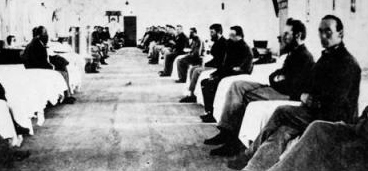
Ward of U.S. Army General Hospital, Penn Park, York, Pennsylvania (circa 1864, public domain).
What is known for certain is that Private John Kolb certainly was not involved in the Battle of Cedar Creek on 19 October 1864; however, his son, Private Hiram Kolb of Company K was—and Hiram was wounded severely enough that he, too, needed to be transported to a Union Army hospital for more advanced medical care.
Struck in the left hand by a Confederate bullet or shrapnel from cannon fire, Private Hiram Kolb finally ended up back in Pennsylvania, where he was placed in the care of the army surgeons at the Union Army Hospital in York County. After losing two fingers from his wounded left hand, he reportedly deserted from that hospital just over a month later on 27 November 1864.
Return to Civilian Life — Hiram Kolb
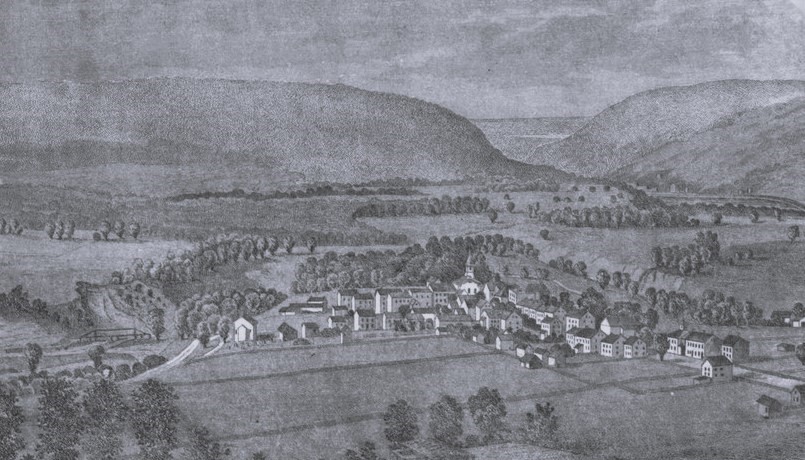
Slatington, Lehigh County, Pennsylvania, circa 1865 (public domain).
Following the end of his military service, Hiram Kolb (alternate spelling: Kulp) returned home to the Lehigh Valley, where he found work as a laborer. By 1870, he was documented by a federal census enumerator as a twenty-five-year-old laborer who was living next door or across the street from his mother, Hannah, and his brother, William, in Slatington, Heidelberg Township. Living with Hiram at the time were two children, who may have been his offspring: Mary, who had been born circa 1867, and Daniel, who was six months old and had been born circa January 1870. Also residing at Hiram’s home was twenty-eight-year-old Mary Swager, who was described as a housekeeper; however, no wife was listed as residing in Hiram’s household.
Documented as unmarried and childless by the time of the federal census in 1880, Hiram Kolb was described as a charcoal burner who was living as a boarder at the home of Mary Hummel and her daughter, Matilda, in East Penn Township, Carbon County. The year before (1879), he applied for a U.S. Civil War Pension—federal assistance for which he would have been ineligible had he actually been confirmed by the U.S. Pension Bureau as a deserter from the Union Army (as had been alleged on muster rolls of the 47th Pennsylvania Volunteer Infantry).
Still unmarried by the turn of the century, Hiram Kolb was employed as a woodchopper, but was residing that year at the home of Paul Rehrig and his family in Slatedale, Lehigh County. The federal census enumerator documented that, while Hiram was still unable to read or write in English, he was able to speak English.
Still employed as a woodchopper in 1910, he resided as a boarder that year at the Carbon County home of Nathan Eck and Eck’s daughter, Eve, in East Penn Township. He continued to live there for the remainder of his life, according to his Pennsylvania death certificate, which listed Nathan Eck as the official informant of his death.
Described on that death certificate as a sixty-eight-year-old widower suffering from hepatic cancer, Hiram Kolb had passed away at Eck’s home in East Penn Township, Carbon County on 21 April 1913. Subsequently laid to rest at the Ashfield Cemetery (now known as the Dinkey Memorial Cemetery) in Lehighton, Carbon County, his grave was not provided with a headstone at the time and reportedly remains unmarked to this day.
What Happened to the Widow and Other Children of Private John Kolb
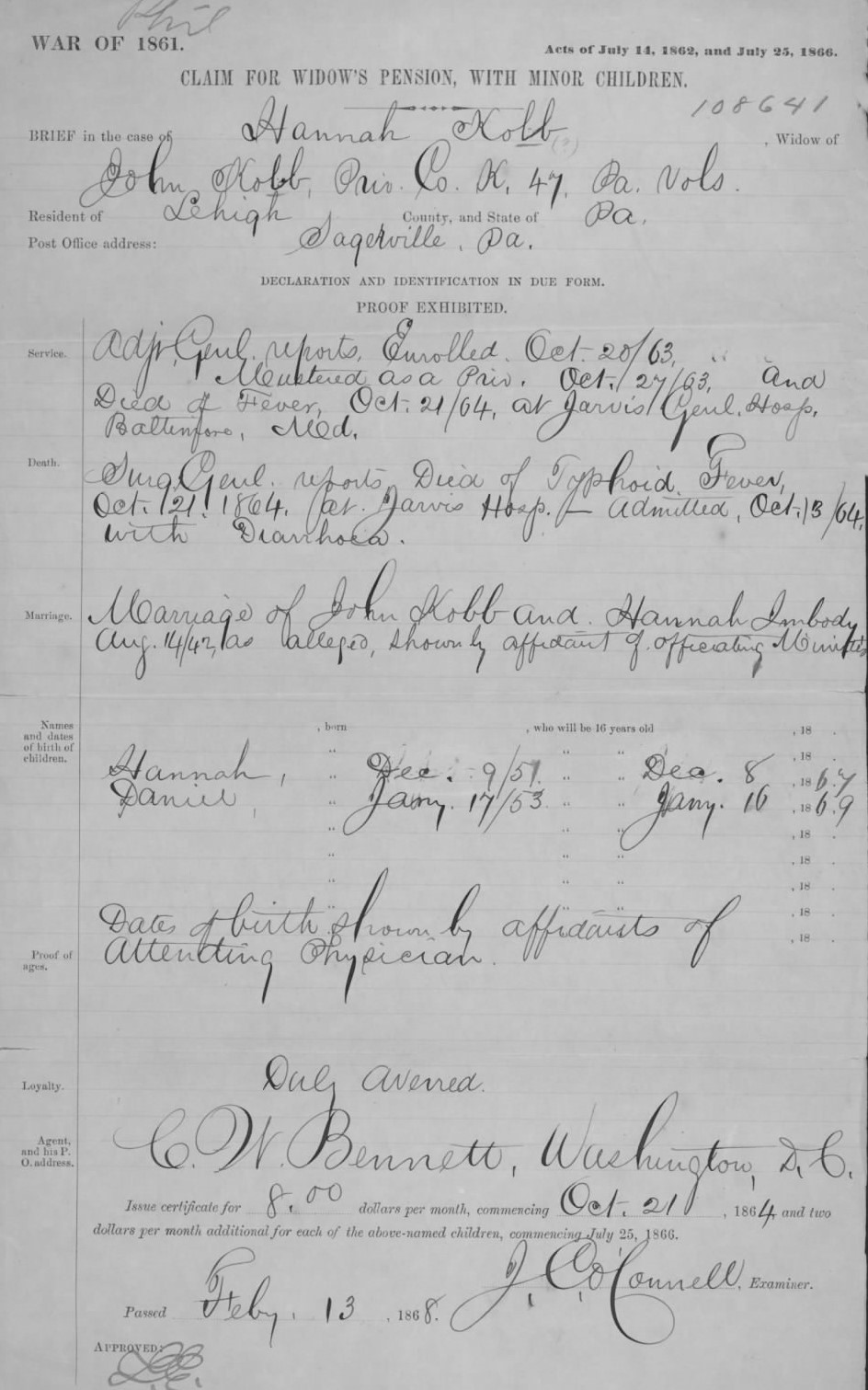
U.S. Civil War Widow’s and Orphans’ Pension claim history of Hannah Kolb, the widow of Private John Kolb, Company K, 47th Pennsylvania Volunteer Infantry, February 1868 (U.S. Civil War Widows’ Pension Files, U.S. National Archives and Records Administration, public domain; click to enlarge).
Following the untimely death of her husband, Private John Kolb, Hannah (Imborly) Kolb quickly realized that she faced a challenging future as a widow, single mom and head of a household that was in a precarious financial state. Putting her shock and grief to the side, she sought help from the federal government by filing a Civil War Widow’s Pension claim on 12 December 1864. She was then forced to jump through a series of hoops to try to gain access to the pension support to which she was entitled.
Filing document after document with the court systems of both Lehigh and Montgomery counties, she also appeared before justices of the peace and other county officials within those two counties to affirm that she had been married to, and had had children with, John Kolb, who had died in 1864 during his American Civil War service on behalf of the United States.
During one of her earliest appearances, she testified before a judge of the General Courts, Lehigh County, State of Pennsylvania on 14 February 1865 “to obtain the benefit of the provision made by the act of Congress approved July 14, 1862.” During her deposition, she stated that she was a forty-five-year-old resident of Saegersville in Heidelberg Township, Lehigh County who was “the widow of John Kolb who was a Private in Company ‘K’ commanded by Captain C. W. Abbott in the 47th Regiment of Pennsylvania Volunteers who re-enlisted as a Veteran Volunteer in the fall of 1863, and died in the U.S. Genl. Hospital at Baltimore in the State of Maryland on the 21st day of October 1864 of Hemorrhoides [sic] while in the service of the United States.”
She then explained that she had been “married to the said John Kolb on the fourth day of August 1842 by Daniel Weiser at Montgomery; that her husband, the aforesaid John Kolb, died on the day above mentioned, and that she [had] remained a widow ever since that period,” noting that “her name before said marriage was Hannah Imboden” and that there was “no public or private record” available of their marriage. She then further attested to the birth of their children, Hannah, who had been born on 9 September 1852, and Daniel, who had been born on 17 January 1853—dates of birth that made them eligible to receive U.S. Civil War Orphans’ Pension support because they were still both under the age of sixteen.
Still residing in Heidelberg Township in 1866, she appeared that year before a Lehigh County justice of the peace on 8 December 1866 to re-state for the record that she was the widow of Private John Kolb, who “died in the Military Service of the United States on the 21st day of October 1864 at the United States General Hospital Baltimore MD. while a private in company ‘K’ Commanded by Capt. C. W. Abbott 47th Regiment Penna. Vols. Commanded by Col. T. H. Good in the war of 1861,” and reiterated that she had “remained a widow” since the death of her husband the said John Kolb. In addition, she repeated the vital statistics related to her marriage to John Kolb and the births of their children, Hannah and Daniel, who were both still living at home with her. She further stated that she was filing her 1866 affidavit “for the purpose of obtaining the benefit of the provisions made by the Second Section of the Act of Congress increasing the pensions for widows and orphans approved July 25, 1866.” At that time, she also stated for the record that she was appointing C. W. Bennett, Esquire of Washington, D.C. as her attorney to assist her with her application for a pension increase and represent her in ongoing proceedings related to the widow’s pension claim that she had filed initially.
She then made her mark on that affidavit, signaling that she could not read or write English well enough to complete her pension paperwork, and was most likely someone who still spoke German or Pennsylvania Dutch at home and in her community—like many of the men who had served with her husband’s military unit—Company K, the “all-German company” of the 47th Pennsylvania Volunteer Infantry.
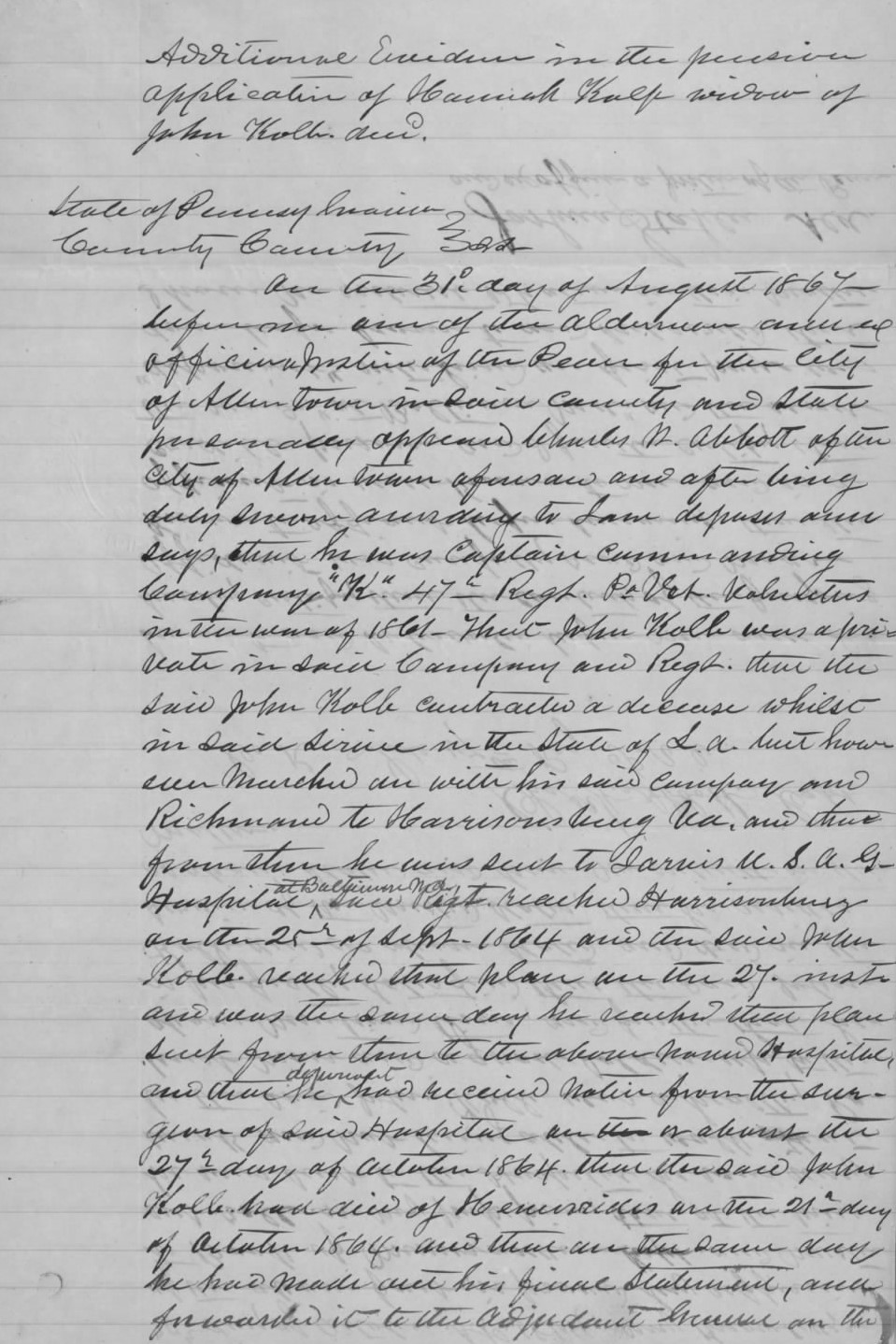
Page one of the August 1867 affidavit filed by Lieutenant-Colonel Charles W. Abbott, 47th Pennsylvania Veteran Volunteers on behalf of the pension claim made by Hanna Kolb, the widow of his subordinate, Private John Kolb (U.S. Civil War Widows’ Pension Files, U.S. National Archives and Records Administration, public domain; click to enlarge).
Still battling to obtain the federal financial assistance she needed to keep her family housed and fed, Hannah Kolb next sought help from her husband’s former superior officer—Lieutenant-Colonel Charles W. Abbott. On 31 August 1867, Lieutenant-Colonel Abbott submitted an affidavit to the county courts in which he attested that “John Kolb contracted a disease whilst in said service in the state of LA. [Louisiana] but however marched on with his said company [from] Richmond to Harrisonburg Va. and then from there he was sent to Jarvis U.S.A. G— Hospital at Baltimore Md. once Regt. reached Harrisonsburg [circa] 25th of Sept. 1864 and the said John Kolb reached that place [circa 27 September] and was the same day he reached there [was transferred to Jarvis Hospital].”
Lieutenant-Colonel Abbott went on to present additional facts related to John Kolb’s illness and death, and made clear to court officials that his subordinate’s illness and death were both directly related to his military service with the 47th Pennsylvania.
Less than three months later, on 18 November 1867, Hannah Kolb appeared before Lehigh County Justice of the Peace Samuel J. Kistler for the purpose of “explaining discrepancies between the Original Application” for her pension and the paperwork she had subsequently filed to request an increase in the amount of that pension. The justice asked questions regarding the birth date of her daughter, Hannah, which she stated for the record was 9 December 1851. Her legal representative added that any error in the child’s date of birth on previous paperwork was not Hannah Kolb’s fault, but was due solely to the legal representation she had received previously.
On 1 February 1868, Hannah Kolb appeared before a Lehigh County alderman to attest, yet again, that she was a resident of Heidelberg Township who was “the widow of John Kolb who was a private in Co. ‘K’ – 47 Regt. Pa. Vols. In the war of 1861,” reiterating that she “was married to John Kolb on the 4th day of August A.D. 1842.”
This time, however, her attorney came better prepared. Stating for the record that her marriage data “appear[ed] by a family Record in an old prayer Book now in my possession (which said Record reads as follows…),” he presented court officials with an affidavit which presented, verbatim, in German, the text from Hannah’s prayer book which contained the vital statistics of her marriage. During that round of testimony, Hannah and her attorney also corrected the spelling of her maiden name, stating for the record that it was “Imborly” and not “Imboden,” as had been written by her previous legal representatives. Once again, she made an “X” mark in lieu of her signature, signaling that she was still not proficient in English.
On 13 March 1879, she appeared before Lehigh County Justice of the Peace Samuel Kistler to file a new claim that would enable her to restart her Civil War Widow’s Pension, the monthly payments of which had fallen into “arrears” (unpaid) status. Still residing in Saegersville, she again marked an “X” on the legal document in lieu of her signature—a process that was witnessed by Aaron and Peter Miller.
Throughout this long process, as she cleared one hurdle after another that had drained the emotional energy she needed to raise her children, Hannah (Imborly) Kolb sought the help of the minister who had married her, the physician who had delivered two of her children, and neighbors Andrew Leffler, Jonas Sensinger, et. al.—each of whom attested that she was, indeed, who she said she was—the widow of 47th Pennsylvania Volunteer Infantryman John Kolb and mother of his children.
Finally awarded a U.S. Civil War Widow’s Pension of eight dollars per month, an award that was made retroactive to the U.S. Pension Bureau-confirmed date of her soldier-husband’s death (21 October 1864), she was then awarded an additional four dollars per month on 19 February 1868, giving her an additional two dollars per month for each of her two children who were still under the age of sixteen. That increase was made retroactive to 25 July 1866.
Her total pension amount, when she finally was receiving everything she had been entitled to was still only twelve dollars per month (roughly two hundred and thirty-six dollars per month in 2024 dollars).
Slatington, Lehigh County, Pennsylvania, circa 1870s-1880s (public domain).
As stated earlier, she was documented by the 1870 federal census as a resident of Slatington, Heidelberg Township, whose twenty-five-year-old son, William Kolb, was living with her. Residing next door or across the street from her was her another son, Civil War veteran Hiram Kolb, who had two children living with him—Hannah and Daniel Kolb—both of whom may have been his offspring. Also residing with the trio was twenty-eight-year-old housekeeper Mary Swager.
Researchers for 47th Pennsylvania Volunteers: One Civil War Regiment’s Story have not yet located the burial location for Hannah (Imborly) Kolb, but have been able to determine that her daughter, Susanna, grew up and began her own family when she wed Benneville Derr (1842-1912) sometime during the 1860s. Together, they welcomed the births of: Percival F. Derr (1864-1947); Sarah Amanda Derr (1866-1926), who was born in Pennsylvania on 30 August 1866 and later wed Daniel Oldt (1857-1900), circa 1892; Henry Albert Derr (1878-1960), who was born in Lehigh County on 27 September 1878; and Phaon J. Derr (1883-1969), who was born on 23 March 1883.
Widowed by her husband on 17 December 1912, due to his death from dropsy and pneumonia, Susanna (Kolb) Derr went on to live a long, full life. After falling ill in late May 1931, she developed lobar pneumonia, which took her life on 3 June 1931. Following her death in Lynn Township, Lehigh County, she was laid to rest beside her husband at Saint Peters Union Church Cemetery in Lynnville on 9 June.
Researchers have also been able to determine that Hannah (Imborly) Kolb’s son, William Kolb, who was listed on the 1850 federal census as “Jeremiah Kolb” and was identified on his Pennsylvania death certificate as “William Kolp,” never married. In increasingly poor health in his later years, he was diagnosed with chronic nephritis and an enlarged prostate, and ultimately died from disease-related complications at the County Home in South Whitehall Township, Lehigh County on 4 June 1916. According to that same death certificate, he was subsequently laid to rest at the “S.A.B.” in Philadelphia on 8 June 1916, a notation which appears to indicate that his body had initially been donated to the State Anatomical Board for medical research and then interred after that research was concluded.
* To view more of the key U.S. Civil War Pension records related to the Kolb family, visit our Kolb Family Collection.
Sources:
- Bates, Samuel P. History of Pennsylvania Volunteers, 1861-5, vol. 1. Harrisburg, Pennsylvania: B. Singerly, State Printer, 1869.
- Bean, Theodore Weber. History of Montgomery County, Pennsylvania, pp. 399-400, 526, 654-655, 1105-1112, and 1133. Philadelphia, Pennsylvania: Everts & Peck, 1884.
- “Cash Received by Directors of the Poor of Montgomery Co., for out door relief to John Kolb’s family,” in “DR” [funds received], and “John Kolp’s family,” in “Washington,” in the article, “Poor House Account: Account of E. R. Newhard, Esq., Treasurer of the Directors of the Poor and House of Employment of the County of Lehigh, from January 1st, 1858, to December 31st, 1859.” Allentown, Pennsylvania: The Lehigh Register, 8 February 1860.
- “Commonwealth vs. John Kolb,” in “Local Affairs.” Allentown, Pennsylvania: The Lehigh Register, 15 August 1860.
- “Deaths Out of Town” (Hiram Kolb’s death notice). Allentown, Pennsylvania: The Allentown Leader, 29 April 1913.
- Eck, Nathan and Eve; and Kolb, Hiram, in U.S. Census (East Penn Township, Carbon County, Pennsylvania, 1910). Washington, D.C.: U.S. National Archives and Records Administration.
- “Florida’s Role in the Civil War,” in Florida Memory. Tallahassee, Florida: State Archives of Florida.
- “Gestorben” (“Died”). Allentown, Pennsylvania: Der Lecha Caunty Patriot, 20 June 1865.
- “Grausame Miβhandlung” (“Cruel Abuse”; report on the attack on the family or a John Kolb in Lehigh County). Allentown, Pennsylvania: Der Lecha Caunty Patriot, 27 February 1856.
- Hauser, James Joseph. A History of Lehigh County, Pennsylvania from the Earliest Settlements to the Present Time, pp. 40, 100. Allentown, Pennsylvania: Self-published, 1901.
- Henry Albert Derr (son of Susanna Kolb Derr), in Death Certificates (file no.: 63916; date of death: 7 July 1960). Harrisburg, Pennsylvania: Commonwealth of Pennsylvania, Department of Health, Bureau of Vital Statistics.
- Hinke, William John. A History of the Goshenhoppen Reformed Charge, Montgomery County, Pennsylvania (1727-1819), pp. 220 (illustration on adjoining page), 464. Lancaster, Pennsylvania: The Pennsylvania-German Society, 1920.
- Hiram Kulp, in Death Certificates (file no.: 37523, registered no.: 45; date of death: 21 April 1913). Harrisburg, Pennsylvania: Commonwealth of Pennsylvania, Department of Health, Bureau of Vital Statistics.
- Hummel, Mary and Matilda; and Kolb, Hiram, in U.S. Census (East Penn Township, Carbon County, Pennsylvania, 1880). Washington, D.C.: U.S. National Archives and Records Administration.
- Kob [sic], John, in “Interment in the Loudon Park, Baltimore, Md. National Cemetery” Records (date of death: 21 October 1864). Washington, D.C.: U.S. War Department and Office of the Quartermaster General.
- Kolb, Hannah and William, in U.S. Census (Heidelberg Township, Lehigh County, Pennsylvania, 1870; note: shown as living next door to/near Hiram Kolb, who was Hannah’s son and William’s brother); Washington, D.C.: U.S. National Archives and Records Administration.
- Kolb, Hiram, in Records of Places of Burials of Veterans (Dinkey Memorial Cemetery). Harrisburg, Pennsylvania: Commonwealth of Pennsylvania, Department of Veterans’ Affairs.
- Kolb, Hiram, in U.S. Civil War Pension General Index Cards (Co. G and K, 47th Pennsylvania Infantry; application no.: 301623, filed on 4 August 1879). Washington, D.C.: U.S. National Archives and Records Administration.
- Kolb, Hiram, Mary (daughter) and Daniel (son); and Swager, Mary (housekeeper), in U.S. Census (Heidelberg Township, Lehigh County, Pennsylvania, 1870; note: shown as living next door to/near his mother, Hannah Kolb, and his brother, William). Washington, D.C.: U.S. National Archives and Records Administration.
- Kolb, John and Kolb, Hiram, in Civil War Muster Rolls (Co. K, 47th Pennsylvania Infantry). Harrisburg, Pennsylvania: Pennsylvania State Archives.
- Kolb, John and Kolb, Hiram, in Civil War Veterans’ Card File, 1861-1866 (Co. K, 47th Pennsylvania Infantry). Harrisburg, Pennsylvania: Pennsylvania State Archives.
- Kolb, John and Hannah, in U.S. Civil War Widows’ Pension Files. Washington, D.C.: U.S. National Archives and Records Administration.
- Kolb, John, Johanna, Jeremiah, Hiram, William, and Susanna, in U.S. Census (Upper Hanover Township, Montgomery County, Pennsylvania, 1850). Washington, D.C.: U.S. National Archives and Records Administration.
- Kolb, John, in U.S. Census (Allentown, Fifth Ward, Lehigh County, Pennsylvania, 1860). Washington, D.C.: U.S. National Archives and Records Administration.
- Kolp [sic], John, in Roll of Honor: Names of Soldiers Who Died in Defence of the American Union, vol. XIX (Loudon Park National Cemetery, near Baltimore, Maryland), p. 22. Washington, D.C.: Government Printing Office, 1869.
- Kolp [sic], John, in U.S. Registers of Deaths of Volunteers (date of death 21 October 1864). Washington, D.C.: U.S. National Archives and Records Administration.
- Kolp [sic], William, in U.S. Census (Special Schedule.—Surviving Soldiers, Sailors, and Marines, and Widows, etc.: Heidelberg Township, Lehigh County, Pennsylvania, 1890). Washington, D.C.: U.S. National Archives and Records Administration.
- Kulp [sic], Hannah (mother), William, Daniel, and Hannah (daughter), in U.S. Census (Germansville, Heidelberg Township, Lehigh County, Pennsylvania, 1860). Washington, D.C.: U.S. National Archives and Records Administration.
- Rehrig, Paul, Manda, Henry, William, Oscar, Annie, and Aaron; and Kulp [sic], Hiram, in U.S. Census (Slatedale, Washington Township, Lehigh County, Pennsylvania, 1900). Washington, D.C.: U.S. National Archives and Records Administration.
- Sarah Amanda Oldt (daughter of Susanna (Kolb Derr) and granddaughter of Private John Kolb), in Death Certificates (file no.: 89176, registered no.: 35; date of death: 20 August 1926). Harrisburg, Pennsylvania: Commonwealth of Pennsylvania, Department of Health, Bureau of Vital Statistics.
- Schmidt, Lewis G. A Civil War History of the 47th Regiment of Pennsylvania Veteran Volunteers. Allentown, Pennsylvania: Self-published, 1986.
- Susanna Derr (daughter of Private John Kolb), in Death Certificates (file no.: 62561, registered no.: 52; date of death: 3 June 1931). Harrisburg, Pennsylvania: Commonwealth of Pennsylvania, Department of Health, Bureau of Vital Statistics.
- “The History of the Forty-Seventh Regt. P. V.” Allentown, Pennsylvania: The Lehigh Register, 20 July 1870.
- William Kolp (son of Private John Kolb), in Death Certificates (file no.: 60530, registered no.: 565; date of death: 4 June 1916). Harrisburg, Pennsylvania: Commonwealth of Pennsylvania, Department of Health, Bureau of Vital Statistics.
 47th Pennsylvania Volunteers
You must be logged in to post a comment.