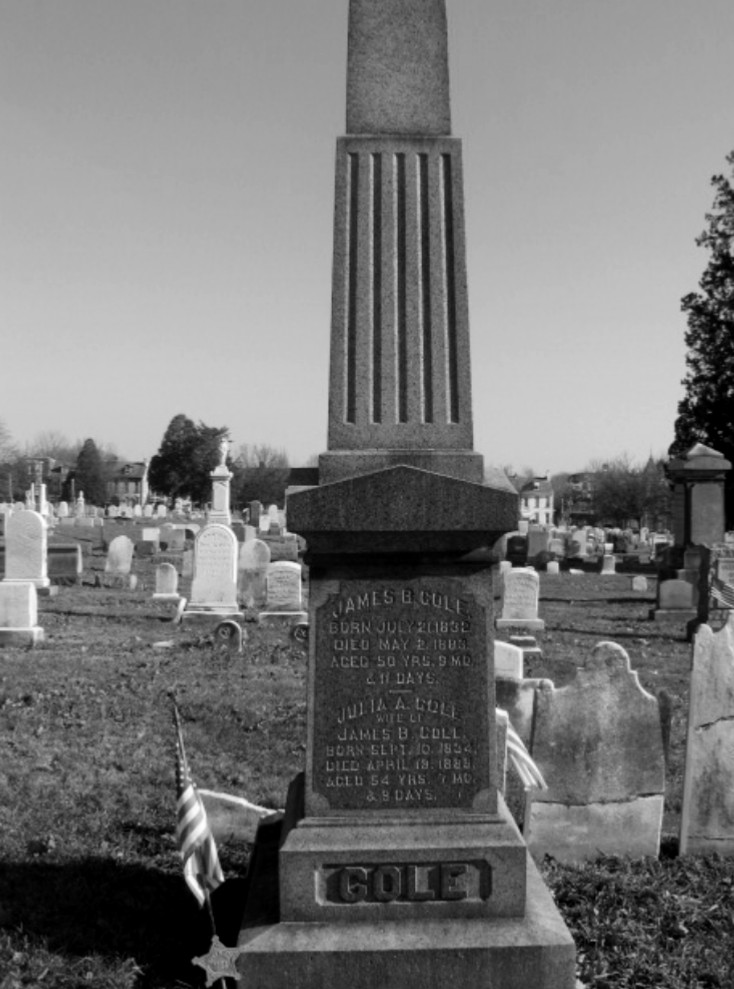
Obelisk, grave of industrialist James B. Cole and his wife, Julia, Union-West End Cemetery, Allentown, Pennsylvania (public domain; click to enlarge).
Few men had his rare capacity for business, and few, indeed, were more skillful in making practical and useful the employment of those means which bring success and good will. His was a life of industry and perseverance, and seldom, may it be said, did his judgment err in the transaction of business. — The Allentown Democrat, 9 May 1883
Blacksmith. Wounded warrior. Pioneering industrialist. Champion of public education.
James B. Cole was all of these during a short life that saw him rise from relative obscurity to become a prominent American industrialist and a civic leader in Pennsylvania’s Lehigh Valley.
Formative Years
Born in Berwick, Columbia County, Pennsylvania on 21 July 1832, James B. Cole was a son of Pennsylvania native Amos Schmidt Cole (1809-1882), a blacksmith, and Columbia County native Sarah Ann (Frederici) Cole (1811-1891), and a brother of: William Cole, who had been born circa 1829; and Joseph S. Cole (1834-1900), who had been born on 28 November 1834 and who later wed Josephine Sensenbach (1837-1881) in 1865.
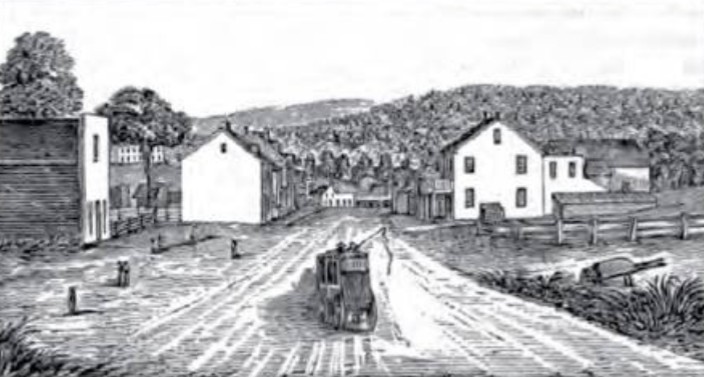
Tamaqua, Pennsylvania, 1843 (public domain).
Sometime during the early 1830s, he relocated with his parents and brothers to the Borough of Tamaqua in Schuylkill County, Pennsylvania. The following siblings were then born: Sybilla S. Cole (1836-1910), who had been born on 23 August 1836 and would later wed Jacob Ross (1827-1877); Sarah Cole, who had been born circa 1839; Amos S. Cole (1840-1909), who had been born on 14 October 1840 and would later wed and be widowed by Caroline Saeger (1845-1877), before marrying his second wife, Sarah (1845-1904); Norman Harrison Cole (1842-1913), who had been born on 7 July 1842 and would later wed Elizabeth Kaziah Roney (1845-1911); and Madison Melville Cole (circa 1846-1877), who had been born circa 1846 and would later serve with the Pennsylvania Militia’s 41st Regiment, before enlisting with the 202nd Pennsylvania Volunteer Infantry during the American Civil War.
While residing residing with his family in Tamaqua, James B. Cole was educated in the community’s common schools and then began to train as a blacksmith, progressing through the stages of apprentice and journeyman.
Officially employed as a blacksmith by August 1850, according to that year’s federal census, he resided in Tamaqua’s East Ward with his parents and siblings: William Cole, who was also employed as a blacksmith; Joseph S. Cole, who was employed as a screw cutter; and Sybilla, Sarah, Amos, Norman, and Madison Melville Cole. Also residing with them was sixteen-year-old screw cutter Alexander Gibson. Their lives that year were clearly comfortable, as evidenced by the federal census enumerator’s report that patriarch Amos Cole’s real estate was valued at fourteen hundred dollars (the equivalent of roughly fifty-seven thousand four hundred U.S. dollars in 2025).
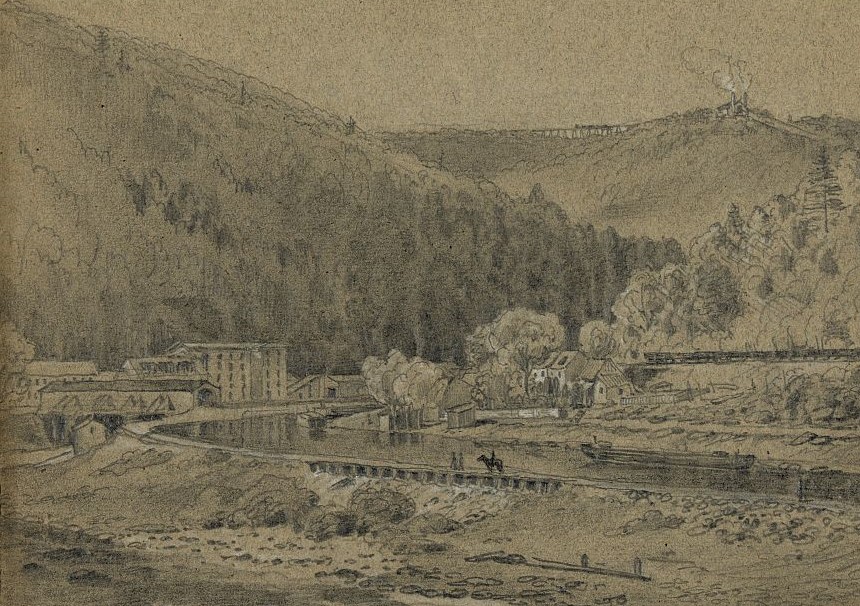
Canal boat on the Lehigh Canal as it flowed through Mauch Chunk, Pennsylvania, 1855 (James Fuller Queen, U.S. Library of Congress, public domain).
Around this same time, James B. Cole relocated to the community of Mauch Chunk (now Jim Thorpe) in Carbon County, Pennsylvania. It was here that he met and courted his future wife — Julia A. Whitehead (1834-1889; alternate surname spelling: “Whitehouse”). Following their marriage, circa 1851, they welcomed the Mauch Chunk births of: William P. Cole (1852-1855), who was born in 1852; and Theodore F. Cole (1853-1892), who was born on 11 June 1853 and would later wed Tusnelda F. Miller (1853-1905).
In early January 1855, he relocated with his wife and sons to the city of Allentown in Lehigh County, where he accepted a job as a blacksmith with Thayer, Wilson & Co., a large machine shop and foundry operation. But the move proved to be “a mixed blessing” when his son, William P. Cole, died in Allentown just weeks later — on 12 January. Following William’s passing, the toddler was laid to rest at the city’s Union-West End Cemetery.
Joy returned to the Cole household before that decade was out, however, thanks to the Allentown births of: Alice R. Cole (1857-1907), who was born on 15 March 1857 and would later wed Samuel F. Jordan (1850-1931); and Elizabeth Sarah Cole (circa 1859-1919), who was born circa September 1859 and would later wed Harry Ulman.
Still employed as a blacksmith by June 1860, he resided with his family in Allentown’s First Ward. His personal estate was valued by that year’s federal census enumerator at one hundred and fifty dollars (the equivalent of roughly five thousand eight hundred U.S. dollars in 2025).
The following year, on 3 June 1861, James B. Cole and his wife, Julia, welcomed the birth of another son, James Willard Cole (1861-1896; alternate birth date: 2 June 1862), who would later become a prominent physician in northeastern Pennsylvania before marrying Bessie Silliman (1868-1932) in 1885.
But James Cole would not be able to enjoy the company of that child for much longer.
American Civil War
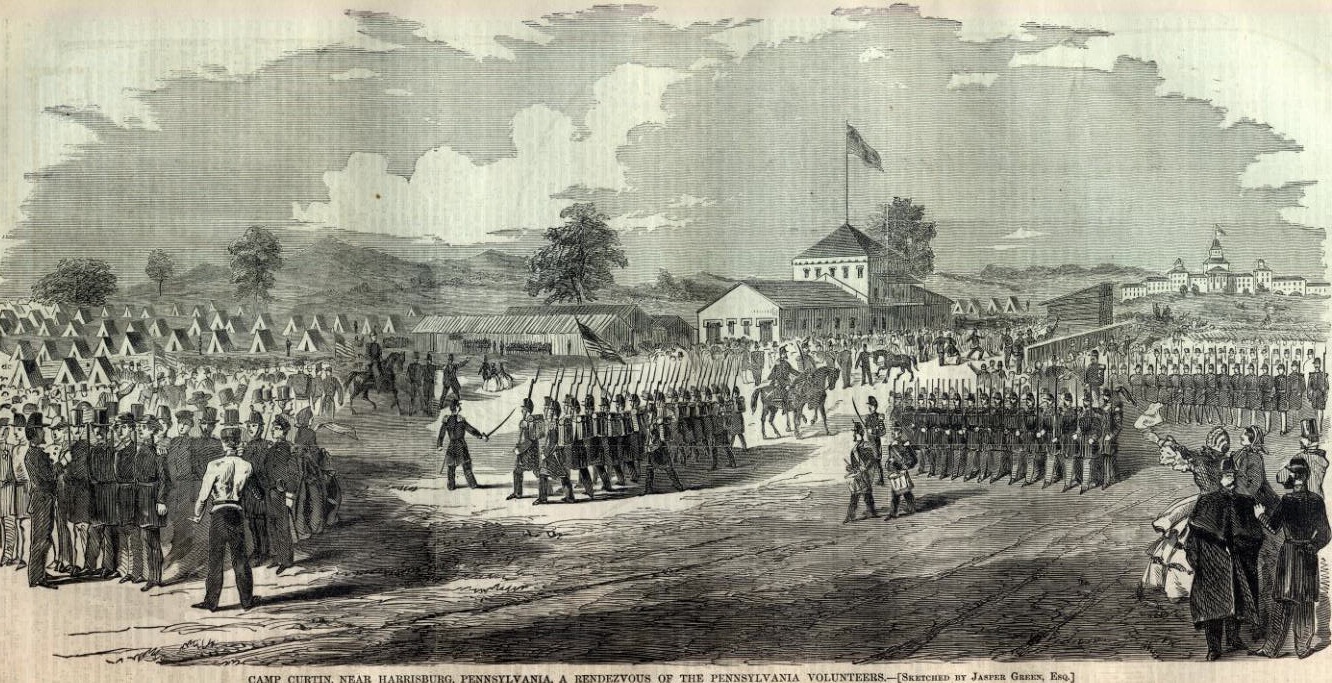
Camp Curtin (Harper’s Weekly, 1861, public domain).
On 5 August 1861 — the same day on which the 47th Pennsylvania Volunteer Infantry was founded — James B. Cole became an early responder to President Abraham Lincoln’s call for seventy-five thousand militia troops to defend the nation’s capital from a likely invasion by the Confederate States Army. Traveling to Camp Curtin in Harrisburg, Dauphin County, Pennsylvania, he enrolled for military service there and returned to Allentown to pack his clothing and other basic supplies in preparation for a much longer, life-changing trip.
Later that month, he said goodbye to his wife and children and traveled back to Camp Curtin. On 30 August, he officially mustered in for duty as a private with Company I of the 47th Pennsylvania Volunteers. Military records at the time described him as a twenty-eight-year-old blacksmith who was five feet, eight inches tall with brown hair, blue eyes and a dark complexion.
* Note: Company I was one of the first two companies from Allentown to join the Pennsylvania Volunteers’ 47th Regiment, and was also the largest of the regiment’s ten companies to muster in during the summer and early fall of 1861, with most of its one hundred and two members logged in as available for duty on 30 August — the same day that Coleman A. G. Keck was commissioned as a captain with the 47th Pennsylvania and placed in charge of I Company. Most of Company I’s members were Keck-recruited novices, including Private James B. Cole.
Following a brief training period in light infantry tactics at Camp Curtin, Private James B. Cole and his fellow 47th Pennsylvania Volunteers were marched to the Harrisburg train station, where they boarded Northern Central Railway cars on 20 September and headed for the nation’s capital. Arriving in Washington, D.C. during the wee hours of the next morning, they disembarked and marched to that city’s Soldiers’ Rest, where they were fed and allowed to sleep for a few hours before marching for the Kalorama Heights in Georgetown in the District of Columbia.
Ordered to pitch their tents at Camp Kalorama, roughly two miles from the White House, they continued to drill. On 22 September, C Company Musician Henry D. Wharton penned these words to his hometown newspaper, the Sunbury American:
After a tedious ride we have, at last, arrived at the City of ‘magnificent distances.’ We left Harrisburg on Friday last at 1 o’clock A.M. and reached this camp yesterday (Saturday) at 4 P.M., as tired and worn out a setting [sic, set] of mortals as can possibly exist. On arriving at Washington we were marched to the ‘Soldiers Retreat,’ a building purposefully erected for the benefit of the soldier, where every comfort is extended to him and the wants of the ‘inner man’ supplied.
After partaking of refreshments we were ordered into line and marched, about three miles, to this camp. So tired were the men that, on marching out, some gave out, and had to leave the ranks, but J. Boulton Young, our ‘little Zouave,’ stood it bravely, and acted like a veteran. So small a drummer is scarcely seen in the army, and on the march through Washington he was twice the recipient of three cheers.
We were reviewed by Gen. McClellan yesterday [21 September] without our knowing it. All along the march we noticed a considerable number of officers, both mounted and on foot; the horse of one of the officers was so beautiful that he was noticed by the whole regiment, in fact, so wrapt [sic, wrapped] up were they in the horse, the rider wasn’t noticed, and the boys were considerably mortified this morning on discovering they had missed the sight of, and the neglect of not saluting the soldier next in command to Gen. Scott.
Col. Good, who has command of our regiment, is an excellent man and a splendid soldier. He is a man of very few words, and is continually attending to his duties and the wants of the Regiment.
…. Our Regiment will now be put to hard work; such as drilling and the usual business of camp life, and the boys expect and hope for an occasional ‘pop’ at the enemy.

Chain Bridge across the Potomac above Georgetown looking toward Virginia, 1861 (The Illustrated London News, public domain).
Acclimated somewhat to their new life, the soldiers of the 47th Pennsylvania Volunteer Infantry finally became part of the Army of the United States when they were officially mustered into federal service on 24 September. Three days later, they were assigned to the 3rd Brigade of Brigadier-General Isaac Ingalls Stevens, which also included the 33rd, 49th and 79th New York regiments. By that afternoon, the 47th Pennsylvania Volunteers were on the move again.
Ordered onward by Brigadier-General Silas Casey, the Mississippi rifle-armed 47th Pennsylvania infantrymen marched behind their Regimental Band until reaching Camp Lyon, Maryland on the Potomac River’s eastern shore. At 5 p.m., they joined the 46th Pennsylvania in moving double-quick (one hundred and sixty five steps per minute using thirty-three-inch steps) across the “Chain Bridge” marked on federal maps, and continued on for roughly another mile before being ordered to make camp.
The next morning, they broke camp and moved again. Marching toward Falls Church, Virginia, they arrived at Camp Advance around dusk. There, about two miles from the bridge they had crossed a day earlier, they re-pitched their tents in a deep ravine near a new federal fort under construction (Fort Ethan Allen). They had completed a roughly eight-mile trek, were situated close to the headquarters of Brigadier-General William Farrar Smith (also known as “Baldy”) and were now part of the massive U.S. Army of the Potomac (“Mr. Lincoln’s Army”). Under Smith’s leadership, their regiment and brigade would help to defend the nation’s capital from the time of their arrival through late January when the men of the 47th Pennsylvania would be shipped south.
Once again, Company C Musician Henry Wharton recalled the regiment’s activities, noting, via his 29 September letter to the Sunbury American:
On Friday last we left Camp Kalorama, and the same night encamped about one mile from the Chain Bridge on the opposite side of the Potomac from Washington. The next morning, Saturday, we were ordered to this camp [Camp Advance near Fort Ethan Allen, Virginia], one and a half miles from the one we occupied the night previous. I should have mentioned that we halted on a high hill (on our march here) at the Chain Bridge, called Camp Lyon, but were immediately ordered on this side of the river. On the route from Kalorama we were for two hours exposed to the hardest rain I ever experienced. Whew, it was a whopper; but the fellows stood it well – not a murmur – and they waited in their wet clothes until nine o’clock at night for their supper. Our Camp adjoins that of the N.Y. 79th (Highlanders.)….
We had not been in this Camp more than six hours before our boys were supplied with twenty rounds of ball and cartridge, and ordered to march and meet the enemy; they were out all night and got back to Camp at nine o’clock this morning, without having a fight. They are now in their tents taking a snooze preparatory to another march the morning…. I don’t know how long the boys will be gone, but the orders are to cook two days’ rations and take it with them in their haversacks….
There was a nice little affair came off at Lavensville [sic, Lewinsville], a few miles from here on Wednesday last; our troops surprised a party of rebels (much larger than our own.) killing ten, took a Major prisoner, and captured a large number of horses, sheep and cattle, besides a large quantity of corn and potatoes, and about ninety six tons of hay. A nice day’s work. The boys are well, in fact, there is no sickness of any consequence at all in our Regiment….

The Big Chestnut Tree, Camp Griffin, Langley, Virginia, 1861 (U.S. Library of Congress, public domain).
Sometime during this phase of duty, as part of the 3rd Brigade, the 47th Pennsylvanians were moved to a site they initially christened “Camp Big Chestnut,” in reference to a large chestnut tree growing there. The site would eventually become known to them as “Camp Griffin,” and was located roughly ten miles from Washington, D.C.
On 11 October, the 47th Pennsylvania Volunteers marched in the Grand Review at Bailey’s Cross Roads. In a mid-October letter to his own family and friends, Captain John Peter Shindel Gobin, the commanding officer of Company C, reported that Companies D, A, C, F, and I (the 47th Pennsylvania’s right wing) were ordered to picket duty after the regiment’s left-wing companies (B, E, G, H, and K) had been forced to return to camp by Confederate troops.
In his letter of 13 October, Musician Henry Wharton described the duties of the average 47th Pennsylvanian, as well as the regiment’s new home:
The location of our new camp is fine and the scenery would be splendid if the view was not obstructed by heavy thickets of pine and innumerable chesnut [sic, chestnut] trees. The country around us is excellent for the Rebel scouts to display their bravery; that is, to lurk in the dense woods and pick off one of our unsuspecting pickets. Last night, however, they (the Rebels) calculated wide of their mark; some of the New York 33d boys were out on picket; some fourteen or fifteen shots were exchanged, when our side succeeded in bringing to the dust, (or rather mud,) an officer and two privates of the enemy’s mounted pickets. The officer was shot by a Lieutenant in Company H [?], of the 33d.
Our own boys have seen hard service since we have been on the ‘sacred soil.’ One day and night on picket, next day working on entrenchments at the Fort (Ethan Allen.) another on guard, next on march and so on continually, but the hardest was on picket from last Thursday morning ’till Saturday morning – all the time four miles from camp, and both of the nights the rain poured in torrents, so much so that their clothes were completely saturated with the rain. They stood it nobly – not one complaining; but from the size of their haversacks on their return, it is no wonder that they were satisfied and are so eager to go again tomorrow. I heard one of them say ‘there was such nice cabbage, sweet and Irish potatoes, turnips, &c., out where their duty called them, and then there was a likelihood of a Rebel sheep or young porker advancing over our lines and then he could take take them as ‘contraband’ and have them for his own use.’ When they were out they saw about a dozen of the Rebel cavalry and would have had a bout with them, had it not been for … unlucky circumstance – one of the men caught the hammer of his rifle in the strap of his knapsack and caused his gun to fire; the Rebels heard the report and scampered in quick time….

Unknown regiment, Camp Griffin, Virginia, fall 1861 (U.S. Library of Congress, public domain).
On Friday morning, 22 October, the 47th Pennsylvania engaged in a divisional review, described by regimental historian Lewis Schmidt as massing “about 10,000 infantry, 1000 cavalry, and twenty pieces of artillery all in one big open field.”
In his letter of 17 November, Musician Henry Wharton revealed still more details about life at Camp Griffin:
This morning our brigade was out for inspection; arms, accoutrements, clothing, knapsacks, etc., all were out through a through examination, and if I must say it myself, our company [Company C] stood best, A No. 1, for cleanliness. We have a new commander to our brigade, Brigadier General Brannon [sic, Brannan], of the U.S. Army, and if looks are any criterion, I think he is a strict disciplinarian and one who will be as able to get his men out of danger as he is willing to lead them to battle….
The boys have plenty of work to do, such as piquet [sic, picket] duty, standing guard, wood-chopping, police duty and day drill; but then they have the most substantial food; our rations consist of fresh beef (three times a week), pickled pork, pickled beef, smoked pork, fresh bread, daily, which is baked by our own bakers, the Quartermaster having procured portable ovens for that purpose, potatoes, split peas, beans, occasionally molasses and plenty of good coffee, so you see Uncle Sam supplies us plentifully….
A few nights ago our Company was out on piquet [sic, picket]; it was a terrible night, raining very hard the whole night, and what made it worse, the boys had to stand well to their work and dare not leave to look for shelter. Some of them consider they are well paid for their exposure, as they captured two ancient muskets belonging to Secessia. One of them is of English manufacture, and the other has the Virginia militia mark on it. They are both in a dilapidated condition, but the boys hold them in high estimation as they are trophies from the enemy, and besides they were taken from the house of Mrs. Stewart, sister to the rebel Jackson who assassinated the lamented Ellsworth at Alexandria. The honorable lady, Mrs. Stewart, is now a prisoner at Washington and her house is the headquarters of the command of the piquets [sic, pickets]….
Since the success of the secret expedition, we have all kinds of rumors in camp. One is that our brigade will be sent to the relief of Gen. Sherman, in South Carolina. The boys all desire it and if the news in the ‘Press’ is correct, that a large force is to be sent there, I think their wish will be gratified.
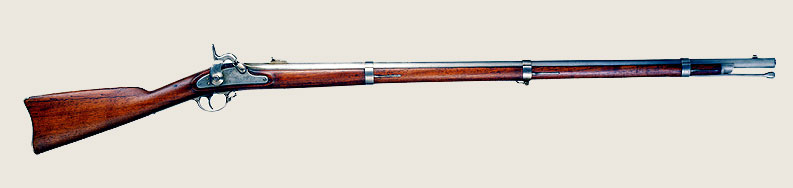
Springfield rifle, 1861 model (public domain).
On 21 November, the 47th Pennsylvania Volunteers participated in a morning divisional review that was viewed by the 47th’s founder and commanding officer, Colonel Tilghman Good, followed by brigade and division drills all afternoon. According to Schmidt, “each man was supplied with ten blank cartridges. Afterward, “Gen. Smith requested Gen. Brannan to inform Col. Good that the 47th was the best regiment in the whole division.”
As a reward for the regiment’s impressive performance that day, and in preparation for the even bigger adventures and honors that were yet to come, Brigadier-General John Milton Brannan, ordered his staff to ensure that brand new Springfield rifles were obtained and distributed to every member of the 47th Pennsylvania Volunteers.
1862
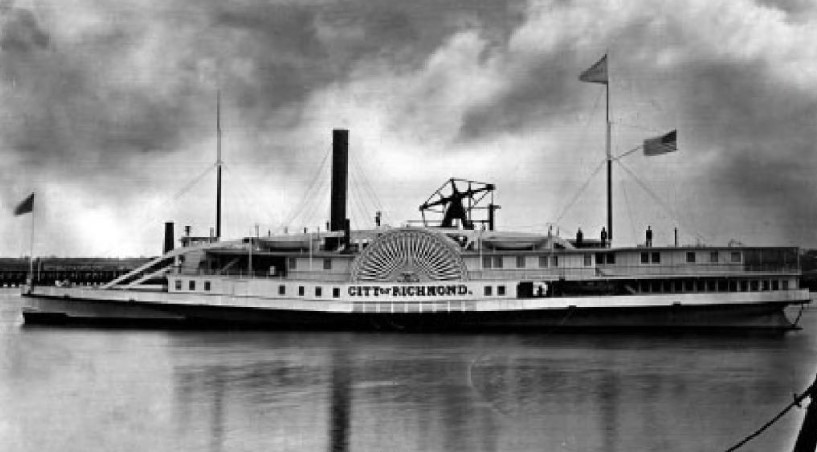
The City of Richmond, a sidewheel steamer, transported Union troops during the Civil War (Maine, circa late 1860s, public domain).
Next ordered to move from their Virginia encampment back to Maryland, the 47th Pennsylvania Volunteers left Camp Griffin at 8:30 a.m. on Wednesday, 22 January 1862. Marching through deep mud with their equipment for three miles in order to reach the railroad station at Falls Church, they were then transported by rail to Alexandria, where they boarded the steamship City of Richmond and sailed the Potomac River to the Washington Arsenal. After being resupplied with weapons and ammunition, they were then marched off for dinner and rest at the Soldiers’ Retreat in Washington, D.C.
The next afternoon, the 47th Pennsylvanians hopped aboard cars on the Baltimore & Ohio Railroad, and headed for Annapolis, Maryland. Arriving around 10 p.m., they were assigned quarters in barracks at the United States Naval Academy. They then spent that Friday through Monday (24-27 January 1862) loading their equipment and other supplies onto the steamship U.S. Oriental. Ferried to the big steamship by smaller steamers during the afternoon of 27 January, the enlisted men climbed aboard the ship for the final time, with the officers boarding last. At 4 p.m., per the directive of Brigadier-General John Milton Brannan, they then steamed away for the Deep South. They were headed for Florida which, despite its secession from the Union, remained strategically important to the Union due to the presence of Fort Taylor (Key West) and Fort Jefferson (Dry Tortugas).
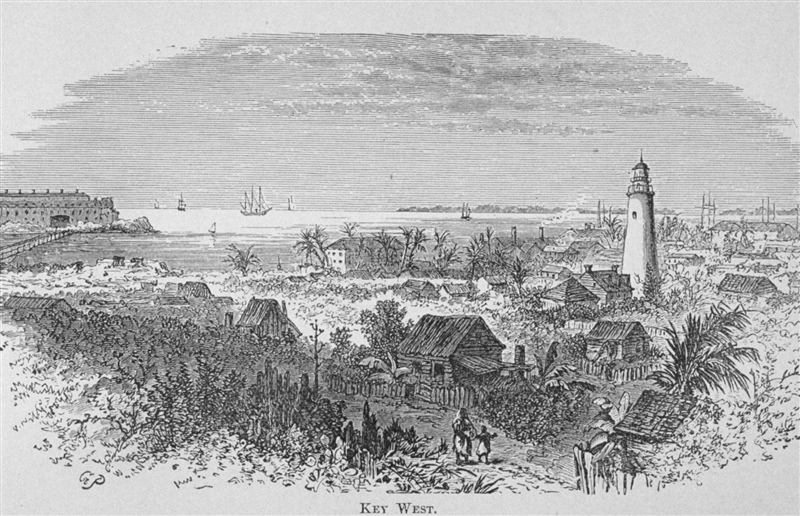
Lighthouse, Key West, Florida, early to mid-1800s (Florida for Tourists, Invalids, and Settlers, George M. Barbour, 1881, public domain).
Arriving at the harbor in Key West, Florida in early February 1862, Private James B. Cole and his fellow 47th Pennsylvania Volunteers were assigned to garrison Fort Taylor. In addition to drilling daily during this phase of duty, the 47th Pennsylvanians also felled trees, helped to build new roads and strengthened fortifications in and around the Union Army’s presence at Key West. They quickly realized, however, that this new assignment would place them at odds with an old foe, when Private Frederick Watts died from “brain fever” at the 47th Pennsylvania’s Regimental Hospital on 13 February 1862.
But there were lighter moments as well. According to a letter penned by Henry Wharton on 27 February 1862, the regiment commemorated the birthday of former U.S. President George Washington with a parade, a special ceremony involving the reading of Washington’s farewell address to the nation (first delivered in 1796), the firing of cannon at the fort, and a sack race and other games on 22 February. The festivities resumed two days later when the 47th Pennsylvania’s Regimental Band hosted an officers’ ball at which “all parties enjoyed themselves, for three o’clock of the morning sounded on their ears before any motion was made to move homewards.” This was then followed by a concert by the Regimental Band on Wednesday evening, 26 February.
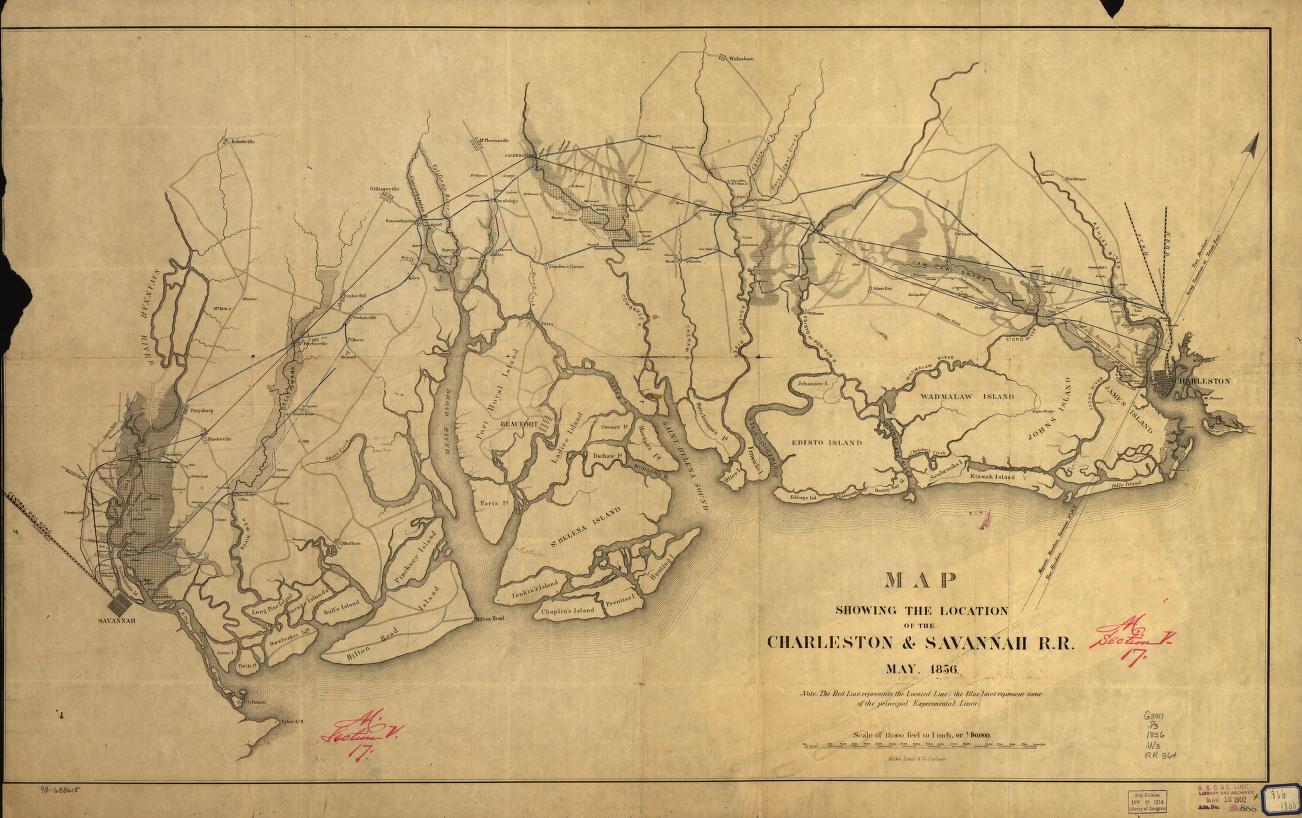
This 1856 map of the Charleston & Savannah Railroad shows the island of Hilton Head, South Carolina in relation to the towns of Beaufort and Pocotaligo (U.S. Library of Congress, public domain).
Next ordered to Hilton Head, South Carolina from mid-June through July, the 47th Pennsylvanians camped near Fort Walker before relocating to the Beaufort District in the U.S. Army’s Department of the South, roughly thirty-five miles away. Frequently assigned to hazardous picket detail north of their main camp, which put them at increased risk from enemy sniper fire, the members of the 47th Pennsylvania became known for their “attention to duty, discipline and soldierly bearing,” and “received the highest commendation from Generals Hunter and Brannan,” according to historian Samuel P. Bates.
Detachments from the regiment were also assigned to the Expedition to Fenwick Island (9 July) and the Demonstration against Pocotaligo (10 July) while men from Companies B and H “crossed the Coosaw River at the Port Royal Ferry and drove off the Rebel pickets before returning ‘home’ without a loss,” according to Schmidt. The actions were the Union’s response to the burning by Confederate troops of the ferry house at Port Royal. H Company’s Sergeant Reuben Shatto Gardner described their actions later in a letter to family and friends:
So the other day we took a notion to turn the joke on them and we crossed over to this side and drove them off their posts and back several miles, and burnt four houses that were used by them to picket in. Our skirmishers had four shots at the rebels, but with what effect we don’t know as they soon got out of harm’s way. Companies H and B were all that crossed. The boys got so eager to follow up the rebels that they did not want to come back when ordered. Our force was too small to advance far, so we went back after doing all the damage we could to them. They fled in such a hurry as to leave three saddles, one double barreled shot gun, several overcoats, haversacks, canteens, &c., all of which our boys brought along as relics, that being the first of anything of that kind our regiment had. Now the boys want to cross every day; but the Colonel won’t allow them as it is beyond his orders to cross the river, and probably we would meet with a repulse, as the rebels have been in force on the opposite side since we drove them off. They are like a bee’s nest when stirred up. The day after we were over they fired more than a hundred shots at our boys. They returned some shots and only laughed at them. The distance across the river is from 800 to 1000 yards, and of course there can be but little damage done at that distance.
On Saturday, 12 July, H Company First Lieutenant William Geety documented the engagement of Union troops with other Confederate soldiers, noting that troops from five Union gunboats had “shelled the shore and crossed over and burned three shanties…. I had command of the right of the skirmish but did not get an opportunity to kill any secessionists. I got a secessionist cap box made in New York and case of a shell.”
The next day (a Sunday), Sergeant Reuben Gardner continued working on his letter, noting:
We have been on picket now ten days [near Port Royal Ferry, along the Broad River] and were due to be relieved tomorrow; but for some cause are now to stay five days longer. The general rule is ten days; but always whip the horse that pulls the hardest. We are ten miles from camp, and are picketing around the west end of the island, for 12 miles along the shore. Five companies of our regiment are out at a time. The rebel pickets are right opposite to us, across the river, and dozens of shots are exchanged every day; but without any effect on our side. The rebel’s [sic] guns fail to reach across. Our files will shoot across with a double charge, but we only fire at each other for fun. The 7th New Hampshire were on here before we came out and the rebels made them leave the line. They took advantage of that and crossed over and burnt a ferry house that stood on the end of the causeway on this side….
We have the greatest picket line here entirely. At low tide down along the beach at night you can’t hear thunder, by times, for the snapping of oysters, croaking of frogs, buzzing of mosquitoes, and the noise of a thousand other reptiles and varmints. It beats all I have heard since the commencement of the war. We have had a pretty good time out here on picket and good weather; but 15 days is a little too long to lie in the woods for my fancy.
By August, it was “98 degrees in the shade,” according to C Company Musician Henry Wharton, forcing Union officers to suspend military drills.

First State Color, 47th Regiment, Pennsylvania Volunteer Infantry (presented to the regiment by Pennsylvania Governor Andrew Curtin, 20 September 1861; retired 11 May 1865, public domain).
As the summer wore on, more and more men fell ill. In response, Colonel Tilghman Good and his adjutant, First Lieutenant Washington H. R. Hangen, issued Regimental Orders, No. 207 from the 47th Pennsylvania’s Headquarters in Beaufort, South Carolina on 12 September 1862:
I. The Colonel commanding desires to call the attention of all officers and men in the regiment to the paramount necessity of observing rules for the preservation of health. There is less to be apprehended from battle than disease. The records of all companies in climate like this show many more casualties by the neglect of sanitary post action then [sic] by the skill, ordnance and courage of the enemy. Anxious that the men in my command may be preserved in the full enjoyment of health to the service of the Union. And that only those who can leave behind the proud epitaph of having fallen on the field of battle in the defense of their country shall fail to return to their families and relations at the termination of this war.
II. All the tents will be struck at 7:30 a.m. on Monday, Wednesday and Saturday of each week. The signal for this purpose will be given by the drum major by giving three taps on the drum. Every article of clothing and bedding will be taken out and aired; the flooring and bunks will be thoroughly cleaned. By the same signal at 11 a.m. the tents will be re-erected. On the days the tents are not struck the sides will be raised during the day for the purpose of ventilation.
III. The proper cooking of provisions is a matter of great importance more especially in this climate but have not yet received from a majority of officers of the regiment that attention that should be paid to it.
IV. Thereafter an officer of each company will be detailed by the commander of each company and have their names reported to these headquarters to superintend the cooking of provisions taking care that all food prepared for the soldiers is sufficiently cooked and that the meats are all boiled or seared (not fried). He will also have charge of the dress table and he is held responsible for the cleanliness of the kitchen cooking utensils and the preparation of the meals at the time appointed.
V. The following rules for the taking of meals and regulations in regard to the conducting of the company will be strictly followed. Every soldier will turn his plate, cup, knife and fork into the Quarter Master Sgt who will designate a permanent place or spot each member of the company and there leave his plate & cup, knife and fork placed at each meal with the soldier’s rations on it. Nor will any soldier be permitted to go to the company kitchen and take away food therefrom.
VI. Until further orders the following times for taking meals will be followed Breakfast at six, dinner at twelve, supper at six. The drum major will beat a designated call fifteen minutes before the specified time which will be the signal to prepare the tables, and at the time specified for the taking of meals he will beat the dinner call. The soldier will be permitted to take his spot at the table before the last call.
VII. Commanders of companies will see that this order is entered in their company order book and that it is read forth with each day on the company parade. All commanding officers of companies will regulate daily their time by the time of this headquarters. They will send their 1st Sergeants to this headquarters daily at 8 a.m. for this purpose.
Great punctuality is enjoined in conforming to the stated hours prescribed by the roll calls, parades, drills, and taking of meals; review of army regulations while attending all roll calls to be suspended by a commissioned officer of the companies, and a Captain to report the alternate to the Colonel or the commanding officer.
At 5 a.m., Commanders of companies are imperatively instructed to have the company quarters washed and policed and secured immediately after breakfast.
At 6 a.m., morning reports of companies request [sic] by the Captains and 1st Sgts and all applications for special privileges of soldiers must be handed to the Adjutant before 8 a.m.
By Command of Col. T. H. Good.
W. H. R. Hangen Adj
In addition, First Lieutenant and Regimental Adjutant Hangen clarified the regiment’s schedule as follows:
- Reveille (5:30 a.m.) and Breakfast (6:00 a.m.)
- First and Second Calls for Guard (6:10 a.m. and 6:15 a.m.)
- Surgeon’s Call (6:30 a.m.)
- First and Second Calls for Company Drill (6:45 a.m. and 7:00 a.m.)
- Recall from Company Drill (8:00 a.m.)
- First and Second Calls for Squad Drill (9:00 a.m. and 9:15 a.m.)
- Recall from Squad Drill (10:30 a.m.)
- Dinner (12:00 noon)
- Call for Non-commissioned Officers (1:30 p.m.)
- Recall for Non-commissioned Officers (2:30 p.m.)
- First and Second Calls for Squad Drills (3:15 p.m. and 3:30 p.m.)
- Recall from Squad Drill (4:30 p.m.)
- First and Second Calls for Dress Parade (5:10 p.m. and 5:15 p.m.)
- Supper (6:10 p.m.)
- Tattoo (9:00 p.m.) and Taps (9:15 p.m.)
Then, as the one-year anniversary of the 47th Pennsylvania’s departure from the Great Keystone State dawned, thoughts turned to home and Divine Providence as Colonel Tilghman Good issued Special Orders, No. 60 from the 47th’s Regimental Headquarters in Beaufort, South Carolina:
The Colonel commanding takes great pleasure in complimenting the officers and men of the regiment on the favorable auspices of today.
Just one year ago today, the organization of the regiment was completed to enter into the service of our beloved country, to uphold the same flag under which our forefathers fought, bled, and died, and perpetuate the same free institutions which they handed down to us unimpaired.
It is becoming therefore for us to rejoice on this first anniversary of our regimental history and to show forth devout gratitude to God for this special guardianship over us.
Whilst many other regiments who swelled the ranks of the Union Army even at a later date than the 47th have since been greatly reduced by sickness or almost cut to pieces on the field of battle, we as yet have an entire regiment and have lost but comparatively few out of our ranks.
Certain it is we have never evaded or shrunk from duty or danger, on the contrary, we have been ever anxious and ready to occupy any fort, or assume any position assigned to us in the great battle for the constitution and the Union.
We have braved the danger of land and sea, climate and disease, for our glorious cause, and it is with no ordinary degree of pleasure that the Colonel compliments the officers of the regiment for the faithfulness at their respective posts of duty and their uniform and gentlemanly manner towards one another.
Whilst in numerous other regiments there has been more or less jammings and quarrelling [sic] among the officers who thus have brought reproach upon themselves and their regiments, we have had none of this, and everything has moved along smoothly and harmoniously. We also compliment the men in the ranks for their soldierly bearing, efficiency in drill, and tidy and cleanly appearance, and if at any time it has seemed to be harsh and rigid in discipline, let the men ponder for a moment and they will see for themselves that it has been for their own good.
To the enforcement of law and order and discipline it is due our far fame as a regiment and the reputation we have won throughout the land.
With you he has shared the same trials and encountered the same dangers. We have mutually suffered from the same cold in Virginia and burned by the same southern sun in Florida and South Carolina, and he assures the officers and men of the regiment that as long as the present war continues, and the service of the regiment is required, so long he stands by them through storm and sunshine, sharing the same danger and awaiting the same glory.
A Regiment Victorious — and Bloodied
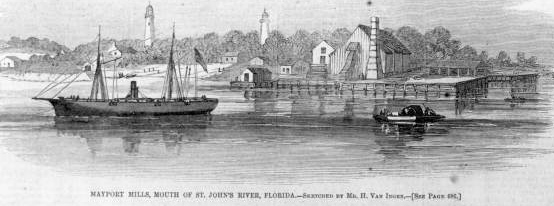
Union Navy Base, Mayport Mills, Florida (Harper’s Weekly, 5 October 1862, public domain).
Sent on a return expedition to Florida as September 1862 waned, the men of Company I saw their first truly intense moments of service when they participated with the 47th Pennsylvania and other Union regiments in the capture of Saint John’s Bluff from 1 to 3 October.
Commanded by Brigadier-General John Milton Brannan, the 47th Pennsylvanians disembarked with a fifteen-hundred-plus Union force at Mayport Mills and Mount Pleasant Creek from troop carriers guarded by Union gunboats. Taking point, the 47th Pennsylvanians then led the 3rd Brigade through twenty-five miles of dense, pine forested swamps populated with deadly snakes and alligators.
By the time the expedition ended, the Union brigade had forced the Confederate Army to abandon its artillery battery atop Saint John’s Bluff, and had paved the way for the Union Army to occupy the town of Jacksonville, Florida, which was effected by a Union force personally commanded by Brigadier-General Brannan aboard the Paul Jones. That force, which departed from the bluff on Sunday, 5 October, was composed of two companies from each of the regiments Brannan had brought with him to Florida, and included the men from the 47th Pennsylvania’s Companies C and H. (Around this same time, two other companies from the 47th Pennsylvania — E and K — were engaged in capturing the Governor Milton, a Confederate steamer that had equipped the bluff and surrounding Rebel troop placements with men and supplies.)

Earthworks surrounding the Confederate battery atop Saint John’s Bluff along the Saint John’s River in Florida (J. H. Schell, 1862, public domain).
In his report on the matter, filed from Mount Pleasant Landing, Florida on 2 October 1862, Colonel Tilghman H. Good described the Union Army’s assault on Saint John’s Bluff:
In accordance with orders received I landed my regiment on the bank of Buckhorn Creek at 7 o’clock yesterday morning. After landing I moved forward in the direction of Parkers plantation, about 1 mile, being then within about 14 miles of said plantation. Here I halted to await the arrival of the Seventh Connecticut Regiment. I advanced two companies of skirmishers toward the house, with instructions to halt in case of meeting any of the enemy and report the fact to me. After they had advanced about three-quarters of a mile they halted and reported some of the enemy ahead. I immediately went forward to the line and saw some 5 or 6 mounted men about 700 or 800 yards ahead. I then ascended a tree, so that I might have a distinct view of the house and from this elevated position I distinctly saw one company of infantry close by the house, which I supposed to number about 30 or 40 men, and also some 60 or 70 mounted men. After waiting for the arrival of the Seventh Connecticut Volunteers until 10 o’clock, and it not appearing, I dispatched a squad of men back to the landing for a 6-pounder field howitzer which had been kindly offered to my service by Lieutenant Boutelle, of the Paul Jones. This howitzer had been stationed on a flat-boat to protect our landing. The party, however, did not arrive with the piece until 12 o’clock, in consequence of the difficulty of dragging it through the swamp. Being anxious to have as little delay as possible, I did not await the arrival of the howitzer, but at 11 a.m. moved forward, and as I advanced the enemy fled.
After reaching the house I awaited the arrival of the Seventh Connecticut and the howitzer. After they arrived I moved forward to the head of Mount Pleasant Creek to a bridge, at which place I arrived at 2 p.m. Here I found the bridge destroyed, but which I had repaired in a short time. I then crossed it and moved down on the south bank toward Mount Pleasant Landing. After moving about 1 mile down the bank of the creek my skirmishing companies came upon a camp, which evidently had been very hastily evacuated, from the fact that the occupants had left a table standing with a sumptuous meal already prepared for eating. On the center of the table was placed a fine, large meat pie still warm, from which one of the party had already served his plate. The skirmishers also saw 3 mounted men leave the place in hot haste. I also found a small quantity of commissary and quartermasters stores, with 23 tents, which, for want of transportation, I was obliged to destroy. After moving about a mile farther on I came across another camp, which also indicated the same sudden evacuation. In it I found the following articles … breech-loading carbines, 12 double-barreled shot-guns, 8 breech-loading Maynard rifles, 11 Enfield rifles, and 96 knapsacks. These articles I brought along by having the men carry them. There were, besides, a small quantity of commissary and quartermasters stores, including 16 tents, which, for the same reason as stated, I ordered to be destroyed. I then pushed forward to the landing, where I arrived at 7 p.m.
We drove the enemys [sic] skirmishers in small parties along the entire march. The march was a difficult one, in consequence of meeting so many swamps almost knee-deep.
On 3 October, Good filed his report from Saint John’s Bluff, Florida, now in Union hands:
At 9 o’clock last night Lieutenant Cannon reported to me that his command, consisting of one section of the First Connecticut Battery, was then coming up the creek on flat-boats with a view of landing. At 4 o’clock this morning a safe landing was effected and the command was ready to move. The order to move to Saint John’s Bluff reached me at 4 p.m. yesterday. In accordance with it I put the column in motion immediately and moved cautiously up the bank of the Saint John’s River, the skirmishing companies occasionally seeing small parties of the enemy’s cavalry retiring in our front as we advanced. When about 2 miles from the bluff the left wing of the skirmishing line came upon another camp of the enemy, which, however, in consequence of the lateness of the hour, I did not take time to examine, it being then already dark.
After my arrival at the bluff, it then being 7:30 o’clock, I dispatched Lieutenant-Colonel Alexander with two companies back to the last-named camp (which I found, from a number of papers left behind, to have been called Camp Hopkins and occupied by the Milton Artillery, of Florida) to reconnoiter and ascertain its condition. Upon his return he reported that from every appearance the skedaddling of the enemy was as sudden as in the other instances already mentioned, leaving their trunks and all the camp equipage behind; also a small store of commissary supplies, sugar, rice, half barrel of flour, one bag of salt, &c., including 60 tents which I have brought in this morning. The commissary stores were used by the troops of my command.
In his own post-engagement reports, Brigadier-General Brannan described the Union Army’s capture of Jacksonville, Florida as follows:
Jacksonville I found to be nearly deserted, there being but a small portion of its inhabitants left, chiefly old men, women, and children…. Before reaching the city you see the ruins of a large number of steam saw mills, they were burned before our people reached there last season. The work was done by the Rebels to keep them from our possession. I believe they are owned mostly by northern capital. Grass and weeds grow rank and tall in the principal streets. Houses with blinds closed…. Stores with shelves but no goods. Churches deserted and gloomy…. On our first arrival some Rebel cavalry were hovering around the town, but they immediately retired on my establishing a picket line….
Three companies were thrown out as pickets, the negro guide directing. We went about a mile from the wharf, two companies on the left and one on the right…. We had hardly got stationed and were just about to send the negro and a party of men for his family three miles further on when the pickets gave the alarm that the Rebel cavalry was coming. The reserve was very speedily in line to receive them. We were on the railroad, but the cavalry came down the plank road. The outpost men fired and fell back on the reserve.
Approaching from the left, the Confederate cavalry was initially repulsed by troops from Pennsylvania, but then regrouped and made second and third charges at the Union’s center and rear — attacks that were also repulsed by Brannan’s men, enabling the Union troops to advance into Jacksonville, which they occupied until 11 p.m. when they returned to the wharf and set up camp. The next morning, Union troops then went back into Jacksonville where, sadly, a number of them engaged in looting local stores — until Brigadier-General Brannan put a stop to their plunder. In a subsequent report, Brannan noted that he brought “several refugees and about two hundred and seventy-six contrabands, including men, women, and children” back with him as he returned to his main force at the bluff.
While those adventures were unfolding, Colonel Tilghman Good, who had been placed in command of the remaining troops at the bluff, was directing the removal of all of the Confederate cannon from the area — a process that took several days. On 10 October, the Union troops then set explosive charges and destroyed the fort, which was known as Fort Finnegan.
Shortly thereafter, the combined Union force made its way back to Hilton Head, South Carolina in a staged departure, and the 47th Pennsylvanians then moved from Hilton Head back to Beaufort.
Integration of the Regiment
On 5 and 15 October 1862, respectively, the 47th Pennsylvania made history as it became an integrated regiment, adding to its muster rolls several Black men who had escaped chattel enslavement from plantations near Beaufort, South Carolina. Among the formerly enslaved men who enlisted at this time were Bristor Gethers, Abraham Jassum and Edward Jassum.
Battle of Pocotaligo, South Carolina

Highlighted version of the U.S. Army map of the Coosawhatchie-Pocotaligo Expedition, 22 October 1862 (public domain).
Serving under the brigade and regimental commands of Colonel Tilghman H. Good and Lieutenant-Colonel George W. Alexander, respectively, Private James B. Cole and his fellow 47th Pennsylvanians courageously engaged Confederate forces in and around Pocotaligo, South Carolina on what turned out to be a date so difficult that surviving members of the 47th would continue to honor it for decades after the end of the Civil War.
Landing at Mackay’s Point, the men of the 47th were placed on point once again, leading their 3rd Brigade comrades into a direct faceoff with a larger and better-equipped Confederate force than senior Union Army officials had anticipated. Harried by snipers en route to the Pocotaligo Bridge during what would come to be known as the Second Battle of Pocotaligo on 22 October 1862, they also met resistance from an entrenched, heavily-fortified Confederate battery which opened fire on the Union troops as they entered an open cotton field. Those headed toward higher ground at the Frampton Plantation fared no better as they encountered artillery and infantry fire from the surrounding forests.
Grappling with the Confederates where they found them, they still managed to pursue Rebels who had been ordered to retreat for four miles. Upon reaching the bridge, members of the 47th relieved the 7th Connecticut — but the enemy was just too well armed. After two hours of intense fighting in an attempt to take the ravine and bridge, depleted ammunition forced the 47th to withdraw to Mackay’s Point.
Losses for the 47th were significant. Two officers and eighteen enlisted men died, including Privates Peter Deitrick, J. T. Robinson, Henry Stambaugh, and Jefferson Waggoner. All four fell during the fighting which raged near Frampton Plantation.
And an additional two officers and one hundred and fourteen enlisted members of the 47th were wounded, including Private James B. Cole of Company I. Returned by troop transport to the Union’s base of operations in South Carolina, Private Cole received medical treatment for his battle wound and was subsequently discharged on a surgeon’s certificate of disability from the regiment’s encampment in Beaufort, South Carolina on 15 November of that same year.
Return to Civilian Life
Following his honorable discharge from the Union Army, Private James B. Cole returned home to his wife and children in Pennsylvania’s Lehigh Valley.
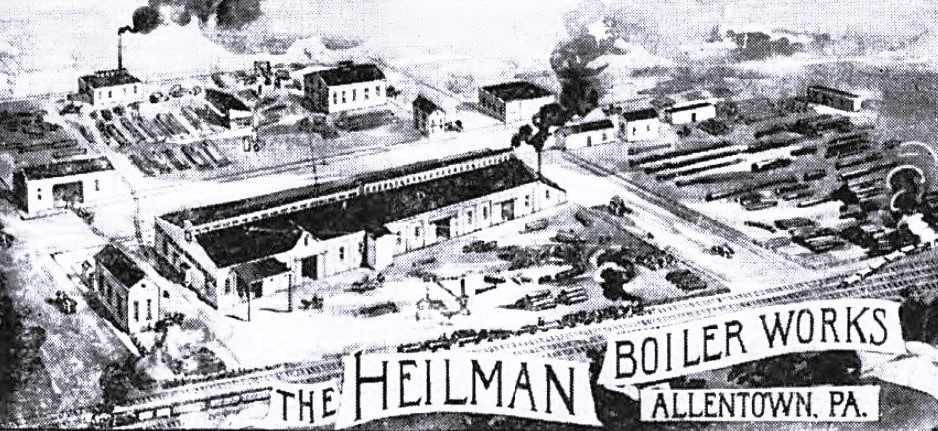
Heilman Boiler Works advertisement, circa 1900 (public domain).
In 1863, he partnered with Abiel Heilman to found Cole & Heilman, a boiler manufacturing plant that was located near the intersection of Front and Linden Streets. That company, which quickly achieved success, would later became known as the Heilman Boiler Works, the “oldest and most substantial company” in Pennsylvania’s Lehigh Valley, according to The Morning Call newspaper’s 1928 profile of the factory.
When Abiel Heilman and James Cole put down the foundation for this flourishing industry sixty-five years ago, they began the building of an industry which was to take the name of Allentown to all sections of the country. Today [in 1928], the firm, with energetic and expert steel and iron men at the reins, the business has reached new heights and there is every indication that the future holds still greater things in store.
In 1863 Abiel Heilman came to Allentown and with James B. Cole formed the firm of Cole & Heilman for the manufacture of boilers and general plate work doing business until 1882 [sic, 1883] when by the death of Mr. Cole, Mr. Heilman took over the business until his death which occurred in 1892.
The business was then reorganized with his widow, Mrs. Mary E. Heilman who with James N. Rhoda and Samuel F. Jordan entered into partnership under the firm name of the Heilman Boiler Works….
As a result of his company’s success, James B. Cole went on to become one of Allentown’s “most prominent residents,” according to the obituaries of his children, Charles H. Cole and Bertha (Cole) Wickman. It was also during that phase of his life, that he and his wife, Julia, welcomed the births of two more children to their Allentown home: Charles Howard Cole (1866-1922), who was born in 1866 and later wed Mary Buchterkirck; and Delphina M. Cole (1870-1890), who was born on 2 January 1870.
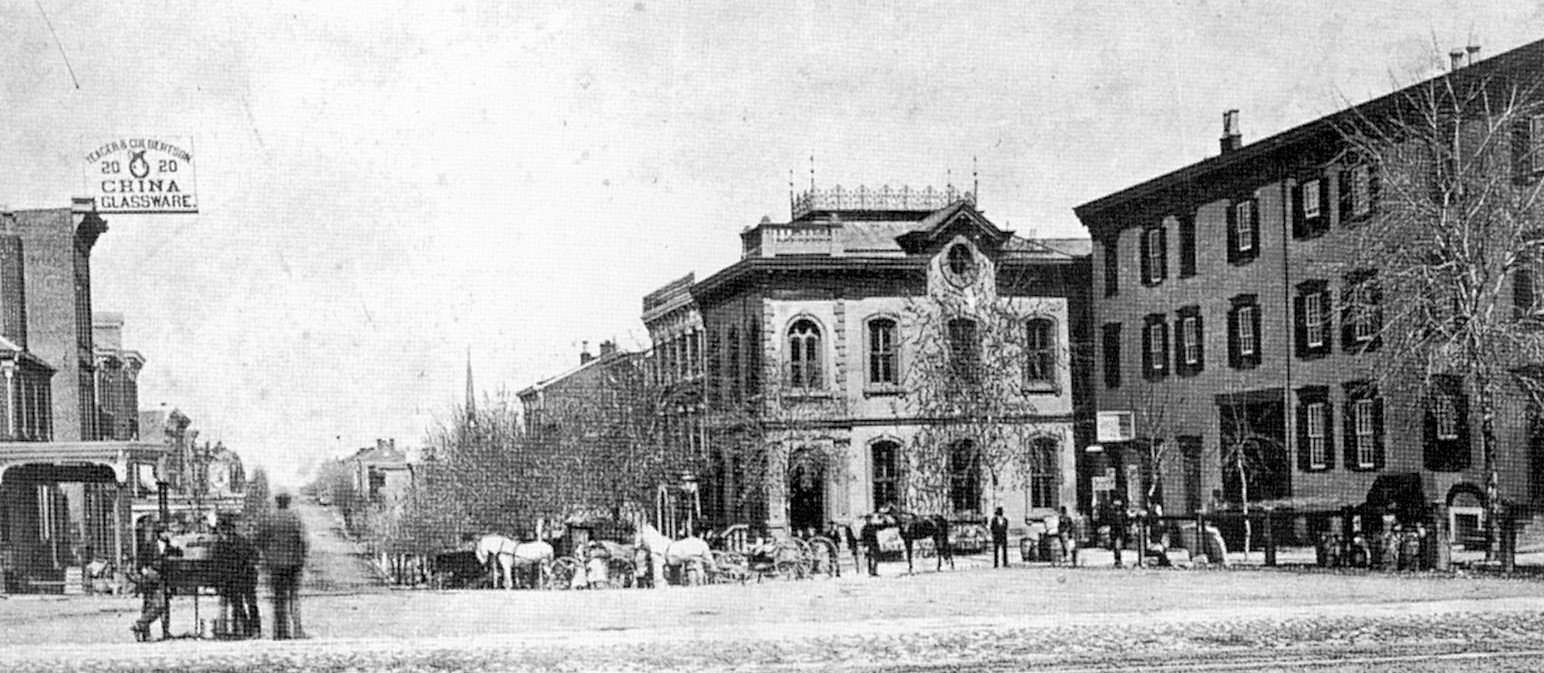
Eagle Hotel (left), Center Square, Allentown, Pennsylvania, 1876 (public domain; click to enlarge).
By July of that same year (1870), he was residing in Allentown’s First Ward with his wife and children Theodore, Alice, Elizabeth, James Willard, Charles, and Delphina. A federal census enumerator who arrived on his doorstep that year documented that he owned real estate and personal property worth eleven thousand dollars (the equivalent of roughly two hundred and sixty-nine thousand U.S. dollars in 2025).
* Note: Among the workers at James B. Cole’s factory during this same period was William D. Hiskey, the father of 47th Pennsylvania veterans Oliver and Franklin Hiskey. (By 1870, William Hiskey had begun the start of a forty-year career with the Heilman Boilerworks. An engineer for thirty of those years, he would ultimately be promoted to “master of the tool house” before retiring ten years later as “the oldest employe [sic, employee] in years and point of consecutive service.”)
In 1872, James and Julia Cole welcomed the birth of Bertha Cole (1872-1924), who was born on 13 April 1872, was known to family and friends as “Bertie” and later wed Dr. Robert Fatzinger, a veterinarian, before marrying John Wickman.
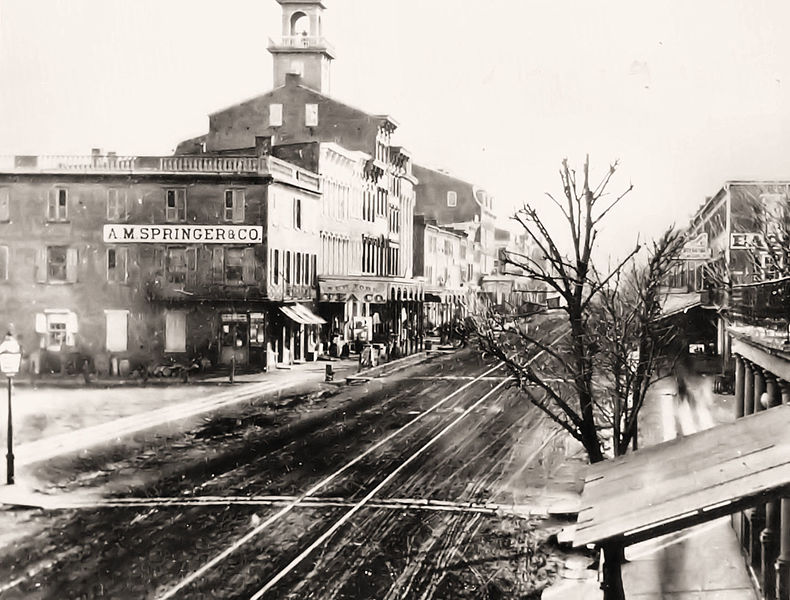
Hamilton Street, looking west from Center Square, Allentown, Pennsylvania, 1880 (public domain).
Still residing in Allentown’s First Ward as of June 1880 and still running his company as a “boilermaker,” the household of James Cole and his wife also included their children James Willard, Charles H., Delphina, and Bertie, as well as Louisa George, a twenty-year-old servant. By this time, his son, Charles H. Cole, was employed at his factory as an apprentice boilermaker, and his son, James Willard Cole, was pursuing higher education studies in medicine, while daughters Delphina and Bertie were enrolled in Allentown’s public school system.
But, once again, fate had other plans for the Coles.
Death and Interment
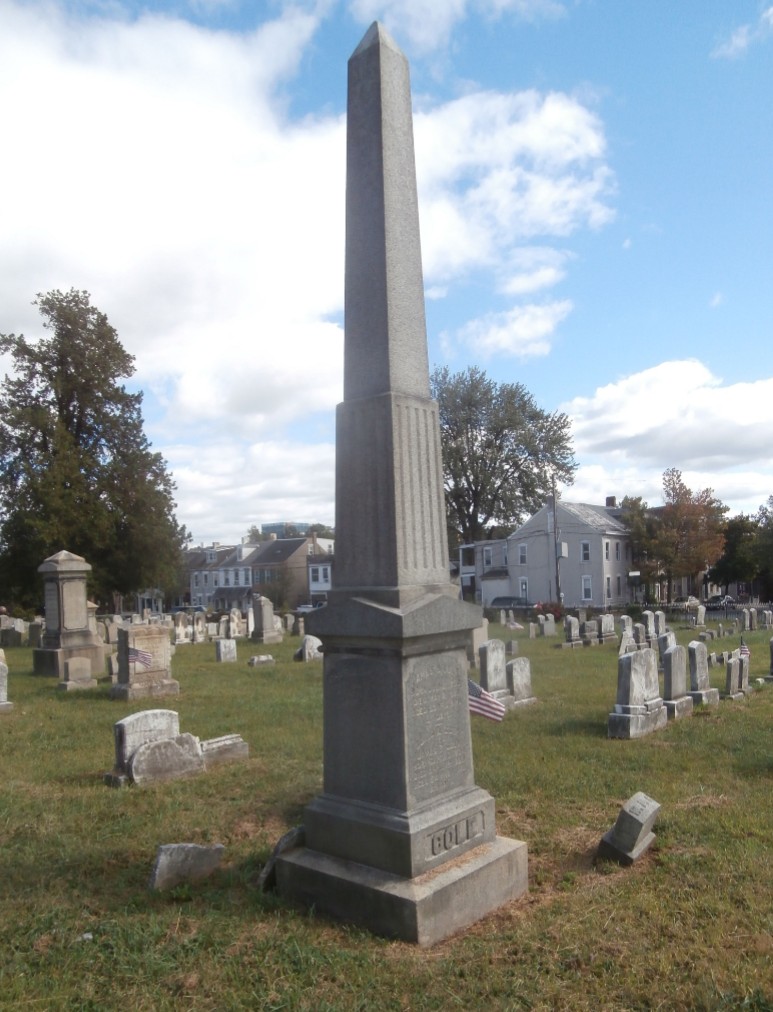
Cole Family Obelisk, Union-West End Cemetery, Allentown, Pennsylvania (photographer: Jerry Haas, 2019, used with permission; click to enlarge).
Under intense stress throughout the 1870s and early 1880s, due to The Panic of 1873 (the world’s first Great Depression), James B. Cole would unwittingly become a victim of that silent killer on 1 May 1883 when he suffered an episode of apoplexy — a cerebrovascular incident often preciptated by high blood pressure that is more commonly known today as a “stroke.”
Although a physician was called, his condition was so dire that he died at the age of fifty in Allentown at 2:00 a.m. the next morning. Following funeral services, James B. Cole was laid to rest at the Union-West End Cemetery. The Allentown Democrat eulogized him as follows:
Allentown has just been bereft of an esteemed citizen, one who has been long and largely identified with its manufacturing interests. We refer to Mr. James B. Cole, of the firm of Cole & Heilman, steam boiler manufacturers, who died suddenly, of apoplexy, on Tuesday night of last week. He on Monday before went to Scranton, where his firm has of late been putting up work to the value of over $40,000, and on the evening of next day returned home in his usual good health. He retired at about 10, and was all right then. After he had been in bed half an hour he was taken with vomiting, followed by heavy breathing, symptoms of apoplexy. Dr. Fegely was hurriedly summoned, and did all he could to save, but without avail; the sufferer sank rapidly, and about a quarter of 2 passed away. The announcement of his demise next morning occasioned much surprise and most profound sorrow among the people of our city. That a man of powerful frame and great physical strength like Mr. Cole, without any known organic disease sufficient to produce such a sudden extinction of life, should be thus unexpectedly launched into eternity, could hardly be believed, yet it was only too true. He was one of our best known citizens, always busy, and always moving about. Always surrounded by a large body of workmen, amidst the clatter and hum of industry, there was something about his genial, cheerful manner, which was ever the admiration of his hands. And so it happened when he came down to death there were many in addition to the immediate members of his family who mourned his departure. He was born in Berwick, Columbia county, in 1822 [sic, 1832], and was a son of Amos Cole, who died in this city about a year ago. At an early age he went to Tamaqua and apprenticed himself to a blacksmith to acquire a knowledge of the business. Serving his full term he continued to work there as a journeyman, for some time, and afterward went to Mauch Chunk, having secured employment in one of the blacksmith shops in that town. While residing in the place he was married to Miss Julia Whitehouse [sic], and continued to live there until 1855, when he removed to this city. At that time Thayer, Wilson & Co. were conducting the large foundry and machine shops at present the property of the Allentown Rolling Mill Company, and upon his arrival here he entered into their employ as a blacksmith, he being an excellent and industrious mechanic. When the war broke out he entered his country’s service as one of the emergency men, and after his discharge returned home and then in connection with Mr. Abiel Heilman, a first-class iron worker, started up in the boiler making business. They commenced on a very small scale, but they prospered largely, and seven years later erected large new Shops, recognized now as among the most extensive and best of their kind in the State. From a modest beginning, with only a few hands, they gradually rose up until they found themselves in a vast establishment employing generally from 150 to 200 hands. — They were struck very hard by the panic, but they weathered the storm, and since the revival of business amassed a handsome competency for themselves. The deceased was a useful citizen, noted for his great activity and endurance. Few men had his rare capacity for business, and few, indeed, were more skillful in making practical and useful the employment of those means which bring success and good will. His was a life of industry and perseverance, and seldom, may it be said, did his judgment err in the transaction of business. For such a life to go out suddenly when many years of usefulness were in promise, is truly a matter full of sadness and regret.
Deceased was a man of broad and liberal views, and possessed much general knowledge and information of which he made practical use. He held a prominent place in the Allentown Board of School Control, was prominently identified with the Evangelical Church, superintendent of the Sabbath School, and an earnest worker in the temperance cause. He often appeared as an exhorter in the church and sabbath school, and frequently delivered sermons in country school houses and churches, as also addresses upon temperance. He was a self-made man — active, enterprising and strictly honest. To his family his ministrations were constant and abounding, rich in loving kindnesses and fragrant with tender care. The deep feelings of respect and affection by which he was regarded by the entire community were mournfully shown in the great concourse and solemn ceremony with which he was attended to his final resting place on Saturday, but more than all by the tender and sorrowful regard that will linger in the hearts of associates for a long time to come. He left a wife and seven children, two of them married. He had three brothers, Amos, a boiler maker, Joseph, a machinist, both living in this city, and Norman, who is a member of the mounted police force of Washington, D.C. He brought his age to 50 years, 9 months, and 5 days.
When his estate was assessed, it noted that there was:
- “One Mortgage against Alice and Samuel Jordan dated April 5. 1883 at 3 per-cent interest, Amount $2,500.00”; and
- “One Judgment against Theodore F. Cole, dated January 1st. 1883, interest from April 1st. 1883 at 3 per-cent, Amount $3000.00.”
In addition, assessors reported that “The value of the interest in the Firm of Cole & Heilman” was “unable to be ascertained at the present time.” A list of his possessions included: one piano (value: one hundred dollars), one bay mare (value: one hundred dollars), two sett harnesses (one valued at eight dollars and one at three dollars), one two-seated carriage (value: one hundred and twenty-five dollars), one Phaeton buggy (value: forty dollars), one piano-box carriage (value: fifty dollars), one two-seated sleigh (value: twenty-five dollars), one whip (twenty-five cents), and one shifting pole (five dollars).
The amount to be distributed to his beneficiaries, after the payment of his debts, was slightly more than twenty-two hundred dollars.
What Happened to James B. Cole’s Family?

Obelisk Inscription, Grave of James B. and Julia Cole, Union-West End Cemetery, Allentown, Pennsylvania (public domain).
James B. Cole was followed in death by his widow, Julia (Sherry) Cole, who passed away in Allentown at the age of fifty-four on 19 April 1889 and was laid to rest beside him at Allentown’s Union-West End Cemetery. Sadly, their daughter, Delphina M. Cole (1870-1890), also died young. She was just twenty years, eight months and one day old at the time of her death in Allentown on 3 September 1890.
James B. Cole’s son, Theodore F. Cole, then also suffered an untimely death two years later, when he passed away on 2 October 1892 in Allentown at the age of thirty-nine. A boiler manufacturer like his father, he was already ailing with diabetes when he developed blood poisoning — a complication of diseases that proved to be fatal. Buried at the Union-West End Cemetery, he had been married to Tusnelda F. Miller, and had welcomed the Allentown births with her of: Gertude Cole (1873-1959), who was born on 10 June 1873 and later wed Samuel F. Bushey (1869-1947); James B. Cole (1875-1925), who was born on 23 January 1875, later wed Mabel J. Dreisbach (1883-1976) and became an assessor for the City of Allentown; and Julia Cole (1890-1944), who was born in 1890 and later adopted the married surname of Huber.
Incredibly, James B. Cole’s son, James Willard Cole, M.D., also suffered an untimely death. A summa cum laude graduate of the Jefferson Medical School in Philadelphia in 1881, he had begun his private practice of medicine as a member of Dr. Longshore’s medical staff in Hazleton, Luzerne County, Pennsylvania before traveling throughout the western United States in search of a potential location to establish his own, new medical office, but had abandoned the search when he was urged to return home to care for his ailing mother. After resuming his practice under Dr. Longshore, he then wed Bessie Silliman on 9 November 1885 (alternate marriage year: 1895), and then “embarked in the drug business,” but subsequently abandoned that venture to return to private medicine. “When his illness became known every physician in Hazleton hastened to his bedside,” according to his 1896 obituary. Ailing for just five days, he passed away at the age of thirty-five on 16 December, and was laid to rest at that city’s Vine Street Cemetery.
Following her own marriage — to Samuel F. Jordan, James B. Cole’s daughter, Alice R. (Cole) Jordan, welcomed the birth of son Floyd A. Jordan (1878-1932). The trio also resided in Allentown, where Samuel had begun working as a bookkeeper in 1878 for Cole & Heilman — the company that had been co-founded by Alice’s father. Samuel subsequently became the firm’s corporate treasurer, which had been renamed as Heilman Boiler Works. Sadly, like her older siblings before her, Alice (Cole) Jordan also died at a relatively young age. Just fifty years old when she passed away from “a complication of diseases” at her home in Allentown on 14 August 1907, she was subsequently buried at Allentown’s Union-West End Cemetery.
Following her marriage to Harry G. Ulman, James B. Cole’s daughter, Elizabeth Sarah (Cole) Ulman, went on to make a new life with him in Philadelphia. Ailing with heart disease during the final years of her life, she succumbed to complications from myocarditis at her home on 27 October 1919. Just sixty years old at the time of her passing, she was cremated at that city’s Chelten Hills Crematory.
Like his father before him, Charles Howard Cole was “engaged in the boiler making business,” according to his obituary. Following his marriage to Mary Buchterkirck (alternate surname: Hermann), he relocated with her to the State of New York and settled with her in the community of Elmhurst on Long Island. The manager of Elmhurst’s boiler manufacturing plant, he welcomed the births with her of: Howard A. Cole (1910-1989), who was born in New York on 18 February 1910 and who grew up to become a mortgage banker; and Alice Elsie Cole (1913-1926), who was born on 22 June 1913, but died from an appendicular abscess and pertonitis at the Flushing Hospital in Queens County, New York, at the age of thirteen, on 17 August 1926.
Charles H. Cole did not live to witness that terrible day, however; ailing during the final years of his life, he had passed away at the age of fifty-six, at his home in Elmhurst, New York, on 22 June 1922. His remains were ultimately returned to Allentown for interment at the Union-West End Cemetery.
Defying all odds, Bertha (Cole) Wickman was able to achieve the distinction of being the last surviving member of James B. Cole’s immediate family. A lifelong resident of Allentown who was known to family and friends as “Bertie,” she had married Charles A. Fatzinger in Philadelphia on 1 November 1904.
Widowed by her husband on 7 May 1911, she subsequently wed widower and first-generation American John Wickman on 12 April 1916. (Her second husband was a fifty-four-year-old stockkeeper who was a native of Wisconsin and son of German immigrants George and Charlotte Wickman.)
Ailing during her own final years, Bertha (Cole) Wickman died at the Allentown Hospital “from a complication of diseases,” according to her obituary. Just fifty-two years old at the time of her passing on 15 October 1924, she was also laid to rest at Allentown’s Union-West End Cemetery.
Sources:
- Alice E. Cole (deceased; a granddaughter of James B. Cole and a daughter of Charles H. Cole), Mary E. Cole (mother and next of kin), and Howard A. Cole (brother and next of kin), in Wills and Probate Records (Queens County, New York, 1926). Queens County, New York: Surrogate’s Court of the County of Queens, New York.
- Alice E. Cole (a granddaughter of James B. Cole), Charles Cole (father) and Mary Cole (mother), in Death Certificates (Queens County, New York, date of death: 17 August 1926). New York, New York: New York City Department of Records.
- Bates, Samuel P. History of Pennsylvania Volunteers, 1861-5, vol. 1. Harrisburg, Pennsylvania: B. Singerly, State Printer, 1869.
- “Charles H. Cole” (obituary of a son of American Civil War veteran James B. Cole). Allentown, Pennsylvania: The Morning Call, 24 June 1922.
- “Cole” (death notice of James B. Cole’s son, Charles H. Cole”). Brooklyn, New York: The Times Standard Union, 24 June 1922.
- “Cole” (death notice of James B. Cole’s daughter, Delphina M. Cole). Allentown, Pennsylvania: The Morning Call, 6 September 1890.
- “Cole, Alice E.” (death notice of James B. Cole’s granddaughter, who was a daughter of Charles H. Cole). Brooklyn, New York: The Times Standard Union, 24 August 1926.
- Cole, Amos (father), Sarah, William, James (son), Joseph, Sabilla, Sarah, Amos (son), Norman, and Melville; and Gibson, Alexander (screw cutter), in U.S. Census (Borough of Tamaqua, East Ward, Schuylkill County, Pennsylvania, 1850). Washington, D.C.: U.S. National Archives and Records Administration.
- Cole, Howard A. (a grandson of James B. Cole and a son of Charles H. Cole), in U.S. Social Security Claims Index. Washington, D.C.: U.S. National Archives and Records Administration.
- Cole, James B., in Civil War Muster Rolls (Company I, 47th Pennsylvania Infantry). Harrisburg, Pennsylvania: Pennsylvania State Archives.
- Cole, James B., in Civil War Veterans’ Card File, 1861-1866 (Company I, 47th Pennsylvania Infantry). Harrisburg, Pennsylvania: Pennsylvania State Archives.
- Cole, James, Julia, Theodore, Allis [sic, Alice], and Elisa, in U.S. Census (Borough of Allentown, First Ward, Lehigh County, Pennsylvania, 1860). Washington, D.C.: U.S. National Archives and Records Administration.
- Cole, James, Julia, Theodore, Alice, Elizabeth, Wm. [sic, James Willard], Chas., and Del., in U.S. Census (Allentown, First Ward, Lehigh County, Pennsylvania, 1870). Washington, D.C.: U.S. National Archives and Records Administration.
- Cole, James B., Julia, Willard J. [sic, James Willard], Charles H., Delphina, and Bertie; and George, Louisa (servant), in U.S. Census (Allentown, First Ward, Lehigh County, Pennsylvania, 1880). Washington, D.C.: U.S. National Archives and Records Administration.
- Cole, Madison, in Records of Burial Places of Veterans (Union-West End Cemetery, Allentown, Pennsylvania). Harrisburg, Pennsylvania: Commonwealth of Pennsylvania, Department of Military Affairs.
- Coles [sic, Cole], Madison (a brother of James B. Cole), in U.S. Headstones Provided for U.S. Civil War Veterans (Union-West End Cemetery, Allentown, Pennsylvania; date of death: 1 May 1877). Washington, D.C.: U.S. National Archives and Records Administration.
- “Death of Theodore F. Cole” (obituary of a son of James B. Cole). Allentown, Pennsylvania: The Allentown Democrat, 5 October 1892.
- Elizabeth Sarah Ulman (a daughter of James B. Cole), in Death Certificates (file no.: 99508, registered no.: 23313, date of death: 27 October 1919). Harrisburg, Pennsylvania: Commonwealth of Pennsylvania, Department of Health, Bureau of Vital Statistics.
- “Fatzinger-Cole” (wedding notice of James B. Cole’s daughter, “Beatrice Cole” [sic, Bertha Cole]). Allentown, Pennsylvania: The Morning Call, 4 November 1904.
- “Florida’s Role in the Civil War,” in “Florida Memory.” Tallahassee, Florida: State Archives of Florida.
- “Funeral Saturday” (funeral notice of James B. Cole’s son, James Willard Cole, M.D.). Hazleton, Pennsylvania: The Plain Speaker, 22 December 1896.
- “Hazleton Physician Dead” (obituary of James B. Cole’s son, James Willard Cole, M.D.). Wilkes-Barre, Pennsylvania: The Record of the Times, 22 December 1896.
- “Heilman Boiler Works Products of National Reputation: Company Oldest and Most Substantial in Lehigh Valley.” Allentown, Pennsylvania: The Morning Call (Allentown Jubilee Festival advertisements), 1928.
- “James B. Cole Dies, Victim of Apoplexy” (obituary of James B. Cole’s grandson and eponym of James B. Cole, who was a son of Theodore F. Cole). Allentown, Pennsylvania: The Morning Call, 3 October 1925.
- James B. Cole’s Final Will, in Wills and Probate Records (Lehigh County, Pennsylvania, 1883). Allentown, Pennsylvania: Office of the Register of Wills, Lehigh County, Pennsylvania.
- James Willard Cole (infant), James Cole (father) and Julia Cole (mother), in Birth and Baptismal Records (Methodist Church, Allentown, Lehigh County, Pennsylvania, 1862-1865). Allentown, Pennsylvania: Asbury United Methodist Church.
- John Wickman and Bertie Fatzinger (James B. Cole’s daughter, Bertha (Cole) Fatzinger), in “Marriage License Docket of Lehigh County, Pa.” (1916). Allentown, Pennsylvania: Office of the Clerk of the Orphans’ Court, Lehigh County, Pennsylvania.
- Jordan, John W. and Edgar Moore Greene, et. al. Historic Homes and Institutions and Genealogical and Personal Memoirs of the Lehigh Valley Pennsylvania, vol. II, pp. 116-117: “Samuel F. Jordan.” New York, New York and Chicago, Illinois: The Lewis Publishing Company, 1905.
- “Mrs. John Wickman” (obituary of James B. Cole’s daughter, Bertha (Cole) Wickman). Allentown, Pennsylvania: The Morning Call, 16 October 1924.
- “Mrs. Samuel Jordan Dead: Well-Known Woman Succumbs to Long Sickness” (obituary of James B. Cole’s daughter, Alice R. (Cole) Jordan). Allentown, Pennsylvania: The Allentown Leader, 15 August 1907.
- Past, Present and Future of the City of Allentown, Pa., pp. 87-88. Allentown, Pennsylvania: Daily Chronicle and News Print for the Allentown Board of Trade, 1886.
- Roberts, Charles Rhoads and Rev. John Baer Stoudt, et. al. History of Lehigh County Pennsylvania and a Genealogical and Biographical Record of Its Families, vol. 1, pp. 1041-1042. Allentown, Pennsylvania: Lehigh Valley Publishing Company, Ltd, 1914.
- Schmidt, Lewis. A Civil War History of the 47th Regiment of Pennsylvania Veteran Volunteers. Allentown, Pennsylvania: Self-published, 1986.
- “Suddenly Called — Death of James B. Cole.” Allentown, Pennsylvania: The Allentown Democrat, 9 May 1883.
- “The Panic of 1873,” in “American Experience.” Boston, Massachusetts: GBH Education, WGBH-TV (PBS).
- “Ulman, Elizabeth Sarah” (death notice of James B. Cole’s daughter). Philadelphia, Pennsylvania: Evening Public Ledger, 30 October 1919.
- Wharton, Henry D. Letters from the Sunbury Guards. Sunbury, Pennsylvania: Sunbury American, 1861-1868.
- “William D. Hiskey, Civil War Veteran, Answers Last Call: ‘Engine is Wearing Down and Can’t Repair Itself’ He Said Before Death: Gained Reputation as Furnace Builder: Was for 40 Years in Employ of Heilman Boiler Works—Lived Here 70 Years” (obituary of Oliver and Frank Hiskey’s father). Allentown, Pennsylvania: The Allentown Democrat, 27 October 1910.
- “Woman Fatally Stricken at 8th And Hamilton” (death report of James B. Cole’s granddaughter, Julia (Cole) Huber, who was a daughter of Theodore F. Cole). Allentown, Pennsylvania: The Morning Call, 9 February 1944.
 47th Pennsylvania Volunteers
You must be logged in to post a comment.