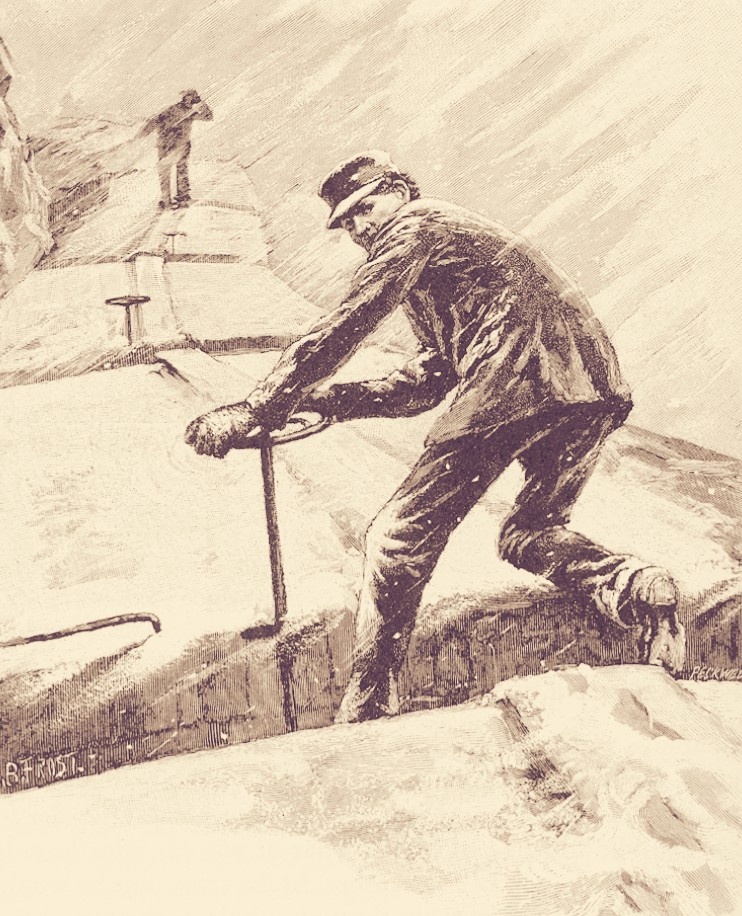
A railroad brakeman risking his life to operate a hand brake (T. C. Clarke, The American Railway, 1889, public domain).
Born in Pennsylvania in February 1833, John Pratt was a first-generation American whose parents were both natives of England.
Very little else is presently known about his formative years. What is known for certain is that John Pratt became one of the early responders to President Abraham Lincoln’s call for help during the opening months of the American Civil War, and that, during America’s post-war Reconstruction Era, he was employed as a brakeman and laborer by a railroad company in Pennsylvania from the 1870s through the end of the nineteenth century.
American Civil War
Following his enrollment for military service in the city of Allentown in Lehigh County, Pennsylvania on 18 September 1861, John Pratt officially mustered in for duty at Camp Curtin in Dauphin County that same day as a corporal with Company G of the newly-formed 47th Pennsylvania Volunteer Infantry.
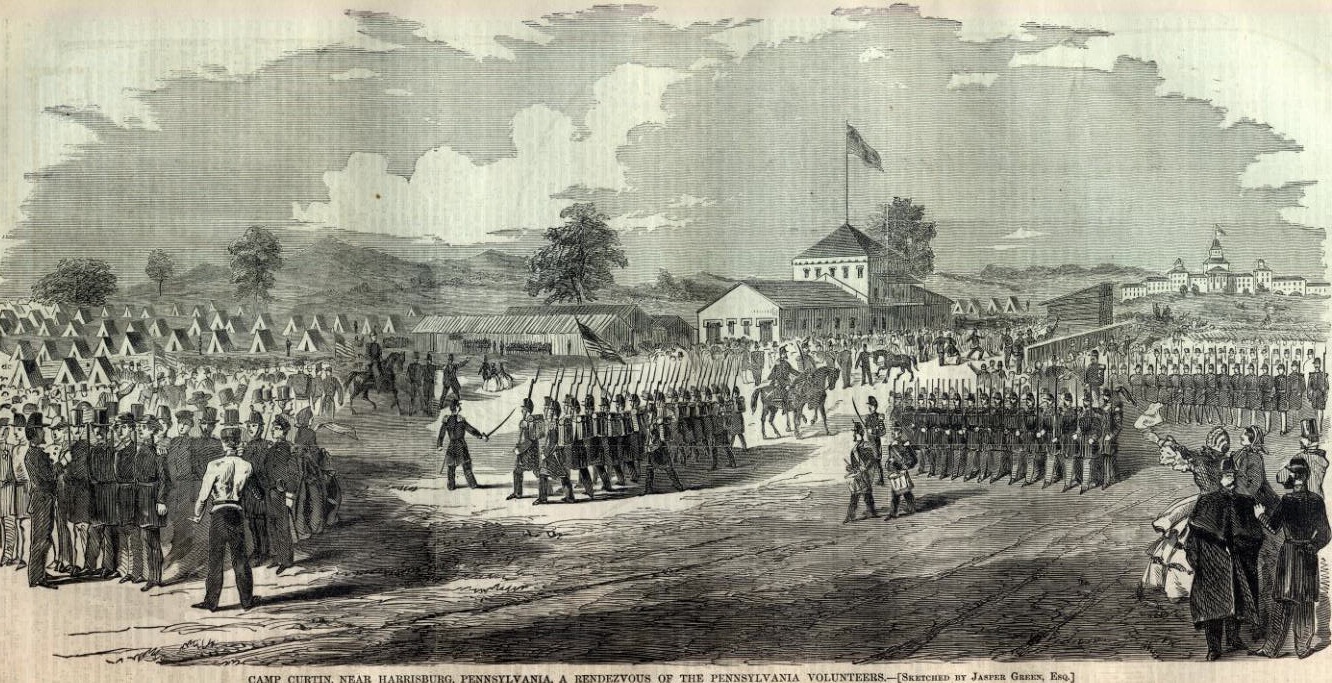
Camp Curtin (Harper’s Weekly, 1861, public domain).
Company G was initially led by Charles Mickley, a miller and merchant who was a native of Mickleys near Whitehall Township in Lehigh County, Pennsylvania. After recruiting the men who would form the 47th Pennsylvania’s G Company, Charles Mickley had personally mustered in for duty as a corporal with the 47th Regiment, Pennsylvania Volunteer Infantry on 18 September 1861, and was then promptly commissioned as a captain and given command of Company G that same day. Also on that day, Charles A. Henry was made Company G’s second lieutenant, and John J. Goebel was commissioned as G Company’s first lieutenant. The remainder of Company G — ninety-five men — also enrolled and mustered in that same day; by the next month, the roster numbered ninety-eight — a figure that would hold until 1862. By the time the Civil War ended in 1865, a total of one hundred and ninety-five men would ultimately serve with G Company, including Thomas B. Leisenring, who would go on to become the company’s captain.
Military records described Corporal John Pratt as a twenty-six-year-old laborer living in Lehigh County who was five feet, six inches tall with light hair, gray eyes and a florid complexion.

The U.S. Capitol Building, unfinished at the time of President Abraham Lincoln’s inauguration, was still not completed when the 47th Pennsylvania Volunteers arrived in Washington, D.C. in September 1861 (public domain).
Following a brief light infantry training period at Camp Curtin, Captain Mickley and his company were sent by train with the 47th Pennsylvania to Washington, D.C., where they were stationed at “Camp Kalorama” on the Kalorama Heights near Georgetown, about two miles from the White House, beginning 21 September. Henry Wharton, a field musician (drummer) with the regiment’s C Company, penned an update the next day to his hometown newspaper, the Sunbury American:
After a tedious ride we have, at last, safely arrived at the City of ‘magnificent distances.’ We left Harrisburg on Friday last at 1 o’clock A.M. and reached this camp yesterday (Saturday) at 4 P.M., as tired and worn out a sett [sic] of mortals as can possibly exist. On arriving at Washington we were marched to the ‘Soldiers Retreat,’ a building purposely erected for the benefit of the soldier, where every comfort is extended to him and the wants of the ‘inner man’ supplied.
After partaking of refreshments we were ordered into line and marched, about three miles, to this camp. So tired were the men, that on marching out, some gave out, and had to leave the ranks, but J. Boulton Young, our ‘little Zouave,’ stood it bravely, and acted like a veteran. So small a drummer is scarcely seen in the army, and on the march through Washington he was twice the recipient of three cheers.
We were reviewed by Gen. McClellan yesterday [21 September 1861] without our knowing it. All along the march we noticed a considerable number of officers, both mounted and on foot; the horse of one of the officers was so beautiful that he was noticed by the whole regiment, in fact, so wrapt [sic] up were they in the horse, the rider wasn’t noticed, and the boys were considerably mortified this morning on dis-covering they had missed the sight of, and the neglect of not saluting the soldier next in command to Gen. Scott.
Col. Good, who has command of our regiment, is an excellent man and a splendid soldier. He is a man of very few words, and is continually attending to his duties and the wants of the Regiment.
…. Our Regiment will now be put to hard work; such as drilling and the usual business of camp life, and the boys expect and hope for an occasional ‘pop’ at the enemy.

Chain Bridge across the Potomac above Georgetown looking toward Virginia, 1861 (The Illustrated London News, public domain).
On 24 September 1861, the members of Company G and their fellow 47th Pennsylvania Volunteers officially mustered in with the U.S. Army. Three days later, on 27 September, a rainy, drill-free day which permitted many of the men to read or write letters home, the 47th Pennsylvanians were assigned to the 3rd Brigade of Brigadier-General Isaac Ingalls Stevens. By that afternoon, they were on the move again, headed for the Potomac River’s eastern side where, upon arriving at Camp Lyon in Maryland, they were ordered to march double-quick over a chain bridge and off toward Falls Church, Virginia.
Arriving at Camp Advance at dusk, the men pitched their tents in a deep ravine about two miles from the bridge they had just crossed, near a new federal military facility under construction (Fort Ethan Allen), which was also located near the headquarters of Brigadier-General William Farrar Smith (nicknamed “Baldy”), the commander of the Union’s massive Army of the Potomac (“Mr. Lincoln’s Army”). Armed with Mississippi rifles supplied by the Keystone State, their job was to help defend the nation’s capital.
Once again, Company C Musician Henry Wharton recapped the regiment’s activities, noting, via his 29 September letter home to the Sunbury American, that the 47th had changed camps three times in three days:
On Friday last we left Camp Kalorama, and the same night encamped about one mile from the Chain Bridge on the opposite side of the Potomac from Washington. The next morning, Saturday, we were ordered to this Camp [Camp Advance near Fort Ethan Allen, Virginia], one and a half miles from the one we occupied the night previous. I should have mentioned that we halted on a high hill (on our march here) at the Chain Bridge, called Camp Lyon, but were immediately ordered on this side of the river. On the route from Kalorama we were for two hours exposed to the hardest rain I ever experienced. Whew, it was a whopper; but the fellows stood it well – not a murmur – and they waited in their wet clothes until nine o’clock at night for their supper. Our Camp adjoins that of the N.Y. 79th (Highlanders.)….
We had not been in this Camp more than six hours before our boys were supplied with twenty rounds of ball and cartridge, and ordered to march and meet the enemy; they were out all night and got back to Camp at nine o’clock this morning, without having a fight. They are now in their tents taking a snooze preparatory to another march this morning…. I don’t know how long the boys will be gone, but the orders are to cook two days’ rations and take it with them in their haversacks….
There was a nice little affair came off at Lavensville [sic, Lewinsville], a few miles from here on Wednesday last; our troops surprised a party of rebels (much larger than our own.) killing ten, took a Major prisoner, and captured a large number of horses, sheep and cattle, besides a large quantity of corn and potatoes, and about ninety six [sic] tons of hay. A very nice day’s work. The boys are well, in fact, there is no sickness of any consequence at all in our Regiment….

The Big Chestnut Tree, Camp Griffin, Langley, Virginia, 1861 (U.S. Library of Congress, public domain).
Sometime during this phase of duty, as part of the 3rd Brigade, the 47th Pennsylvanians were moved to a site they initially christened “Camp Big Chestnut” in reference to a large chestnut tree located nearby. The site would eventually become known to the Keystone Staters as “Camp Griffin,” and was located roughly ten miles from Washington, D.C. While en route, according to historian Lewis Schmidt, “Pvt. Reuben Wetzel, a forty-six-year-old cook in Capt. Mickley’s Company G,” climbed up on a horse that was pulling his company’s wagon while his regiment was engaged in a march from Fort Ethan Allen to Camp Griffin (both in Virginia). When the regiment arrived at a deep ditch, “the horses lost their footing and the wagon overturned and plunged into the ditch, with ‘the old man, wagon, and horses, under everything.’”
Based on his review of military records, Schmidt believed that Pvt. Jacob H. Bowman (aged thirty-five), a former Allentown miller who was Company G’s designated wagon master, was likely the driver at the time of Private Wetzel’s accident. Although alive when pulled from the wreckage, Pvt. Wetzel had fractured a tibia, a serious injury even today. He succumbed to complications just five weeks later (on 17 November 1861) while being treated for the fracture and resulting amputation of his leg at the Union Hotel General Hospital in Georgetown, Washington, D.C. He was interred at Military Asylum Cemetery (now known as the U.S. Soldiers’ and Airmen’s Home National Cemetery).
Pageantry and Hard Work
Meanwhile, the 47th Pennsylvania Volunteers were engaged in the Grand Review at Bailey’s Cross Roads on 11 October 1861. In a letter that was written to family back home around this same time, Captain John Peter Shindel Gobin (the leader of C Company who would be promoted in 1864 to head the entire 47th Regiment) reported that companies D, A, C, F and I (the 47th Pennsylvania’s right wing) were ordered to picket duty after the left-wing companies (B, G, K, E, and H) had been forced to return to camp by Confederate troops. In his letter of 13 October, Henry Wharton described their duties, as well as their new home:
The location of our camp is fine and the scenery would be splendid if the view was not obstructed by heavy thickets of pine and innumerable chesnut [sic] trees. The country around us is excellent for the Rebel scouts to display their bravery; that is, to lurk in the dense woods and pick off one of our unsuspecting pickets. Last night, however, they (the Rebels) calculated wide of their mark; some of the New York 33d boys were out on picket; some fourteen or fifteen shots were exchanged, when our side succeeded in bringing to the dust, (or rather mud,) an officer and two privates of the enemy’s mounted pickets. The officer was shot by a Lieutenant in Company H [?], of the 33d.
Our own boys have seen hard service since we have been on the ‘sacred soil.’ One day and night on picket, next day working on entrenchments at the Fort, (Ethan Allen.) another on guard, next on march and so on continually, but the hardest was on picket from last Thursday morning ‘till Saturday morning – all the time four miles from camp, and both of the nights the rain poured in torrents, so much so that their clothes were completely saturated with the rain. They stood it nobly – not one complaining; but from the size of their haversacks on their return, it is no wonder that they were satisfied and are so eager to go again tomorrow. I heard one of them say ‘there was such nice cabbage, sweet and Irish potatoes, turnips, &c., out where their duty called them, and then there was a likelihood of a Rebel sheep or young porker advancing over our lines and then he could take them as ‘contraband’ and have them for his own use.’ When they were out they saw about a dozen of the Rebel cavalry and would have had a bout with them, had it not been for…unlucky circumstance – one of the men caught the hammer of his rifle in the strap of his knapsack and caused his gun to fire; the Rebels heard the report and scampered in quick time….
On Friday morning, 22 October 1861, the 47th engaged in a divisional review, described by historian Lewis Schmidt as massing “about 10,000 infantry, 1000 cavalry, and twenty pieces of artillery all in one big open field.” In late October, according to Schmidt, the men from Companies B, G and H woke at 3 a.m., assembled a day’s worth of rations, marched four miles from camp, and took over picket duties from the 49th New York:
Company B was stationed in the vicinity of a Mrs. Jackson’s house, with Capt. Kacy’s Company H on guard around the house. The men of Company B had erected a hut made of fence rails gathered around an oak tree, in front of which was the house and property, including a persimmon tree whose fruit supplied them with a snack. Behind the house was the woods were the Rebels had been fired on last Wednesday morning while they were chopping wood there.

Unknown regiment, Camp Griffin, Virginia, fall 1861 (U.S. Library of Congress, public domain).
In his letter of 17 November, Henry Wharton revealed still more details about life at Camp Griffin:
This morning our brigade was out for inspection; arms, accoutrements [sic], clothing, knapsacks, etc, all were out through a thorough examination, and if I must say it myself, our company stood best, A No. 1, for cleanliness. We have a new commander to our Brigade, Brigadier General Brannen [sic], of the U.S. Army, and if looks are any criterion, I think he is a strict disciplinarian and one who will be as able to get his men out of danger as he is willing to lead them to battle….
The boys have plenty of work to do, such as piquet [sic] duty, standing guard, wood-chopping, police duty and day drill; but then they have the most substantial food; our rations consist of fresh beef (three times a week) pickled pork, pickled beef, smoked pork, fresh bread, daily, which is baked by our own bakers, the Quartermaster having procured portable ovens for that purpose, potatoes, split peas, beans, occasionally molasses and plenty of good coffee, so you see Uncle Sam supplies us plentifully….
A few nights ago our Company was out on piquet [sic]; it was a terrible night, raining very hard the whole night, and what made it worse, the boys had to stand well to their work and dare not leave to look for shelter. Some of them consider they are well paid for their exposure, as they captured two ancient muskets belonging to Secessia. One of them is of English manufacture, and the other has the Virginia militia mark on it. They are both in a dilapidated condition, but the boys hold them in high estimation as they are trophies from the enemy, and besides they were taken from the house of Mrs. Stewart, sister to the rebel Jackson who assassinated the lamented Ellsworth at Alexandria. The honorable lady, Mrs. Stewart, is now a prisoner at Washington and her house is the headquarters of the command of the piquets [sic]….
Since the success of the secret expedition, we have all kinds of rumors in camp. One is that our Brigade will be sent to the relief of Gen. Sherman, in South Carolina. The boys all desire it and the news in the ‘Press’ is correct, that a large force is to be sent there, I think their wish will be gratified….
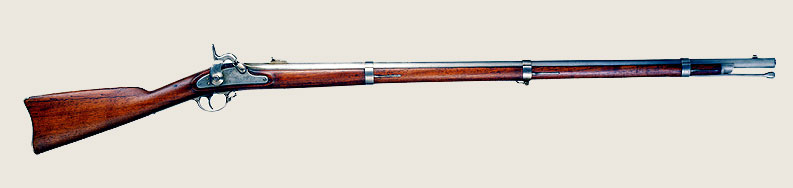
Springfield rifle, 1861 model (public domain).
On 21 November, the 47th participated in a morning divisional headquarters review that was overseen by Colonel Tilghman Good, followed by brigade and division drills all afternoon. According to Schmidt, “each man was supplied with ten blank cartridges.” Afterward, “Gen. Smith requested Gen. Brannan to inform Col. Good that the 47th was the best regiment in the whole division.”
As a reward—and in preparation for bigger things to come, Brigadier-General John Milton Brannan obtained brand new Springfield rifles for every member of the 47th Pennsylvania.
1862
Shortly after the dawn of the New Year of 1862, Corporal John Pratt’s superior officer, First Sergeant George G. Hunsberger, was honorably discharged from Company G in order to accept a commission as a second lieutenant within the same regiment. On 13 January 1862, he became Second Lieutenant George W. Hunsberger when he re-enrolled with Company G.
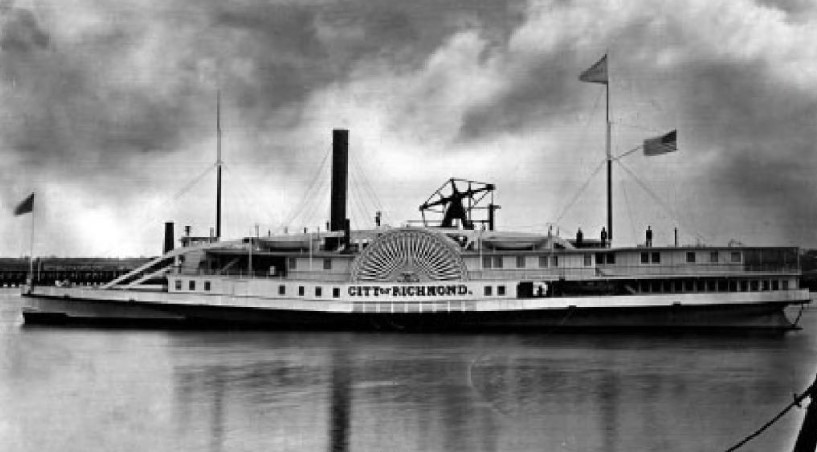
The City of Richmond, a sidewheel steamer, transported Union troops during the Civil War (Maine, circa late 1860s, public domain).
Next ordered to move from their Virginia encampment back to Maryland, Corporal Pratt and his fellow 47th Pennsylvania Volunteers departed from Camp Griffin at 8:30 a.m. on Wednesday, 22 January 1862. Marching through deep mud with their equipment for three miles in order to reach the railroad station at Falls Church, they were then transported by rail to Alexandria, Virginia, where they boarded the steamship City of Richmond. Transported via the Potomac River to the Washington Arsenal, they were reequipped before they were marched off for dinner and rest at the Soldiers’ Retreat in Washington, D.C.
The next afternoon, they hopped aboard cars on the Baltimore & Ohio Railroad, and headed for Annapolis, Maryland. Arriving around 10 p.m., they were assigned quarters in barracks at the United States Naval Academy. They then spent that Friday through Monday (24-27 January 1862) loading their equipment and other supplies onto the steamship Oriental.
Ferried to the Oriental by smaller steamers during the afternoon of 27 January 1862, the enlisted members of the 47th Pennsylvania Volunteer Infantry commenced boarding the big steamship, followed by their officers. Then, per the directive of Brigadier-General Brannan, the Oriental steamed away for the Deep South at 4 p.m. and headed for Florida which, despite its secession from the Union, remained strategically important to the Union due to the presence of Forts Taylor and Jefferson in Key West and the Dry Tortugas.

Fort Taylor, Key West, Florida (Harper’s Weekly, 1864, public domain).
In early February 1862, Corporal Pratt and his fellow 47th Pennsylvania Volunteers arrived in Key West, Florida, where they were assigned to garrison Fort Taylor. During the weekend of Friday, 14 February, the regiment introduced itself to Key West residents as it paraded through the streets of the city. That Sunday, a number of the men from the regiment mingled with local residents at area church services.
Drilling daily in heavy artillery tactics and other military strategies, they felled trees, built new roads and helped to strengthen the facility’s fortifications. But there were lighter moments as well.
According to a letter penned by Henry Wharton on 27 February 1862, the regiment commemorated the birthday of former U.S. President George Washington with a parade, a special ceremony involving the reading of Washington’s farewell address to the nation (first delivered in 1796), the firing of cannon at the fort, and a sack race and other games on 22 February. The festivities resumed two days later when the 47th Pennsylvania’s Regimental Band hosted an officers’ ball at which “all parties enjoyed themselves, for three o’clock of the morning sounded on their ears before any motion was made to move homewards.” This was then followed by a concert by the Regimental Band on Wednesday evening, 26 February.
As the 47th Pennsylvanians soldiered on, many were realizing that they were operating in an environment that was far more challenging than what they had experienced to date — and in an area where the water quality was frequently poor. That meant that disease would now be their constant companion — an unseen foe that would continue to claim the lives of multiple members of the regiment during this phase of duty — if they weren’t careful.
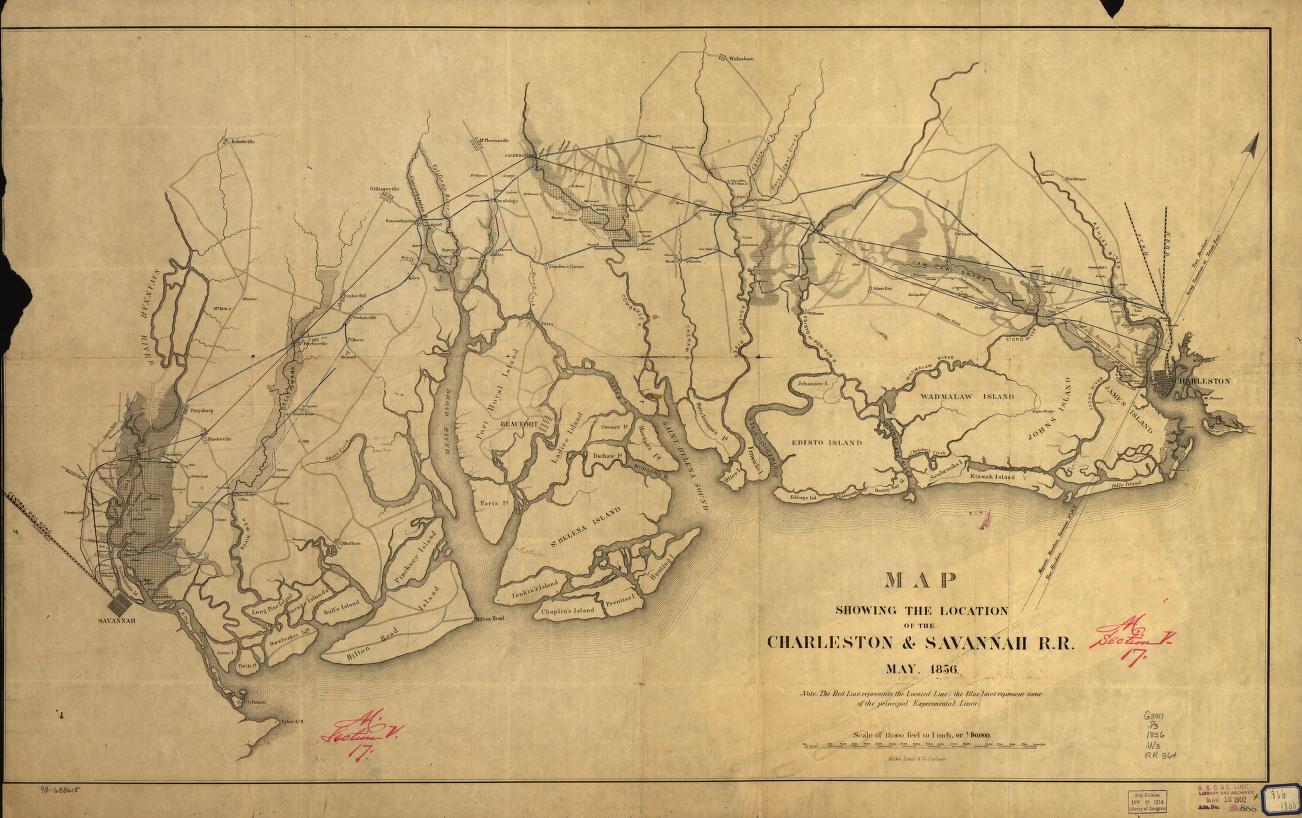
This 1856 map of the Charleston & Savannah Railroad shows the island of Hilton Head, South Carolina in relation to the towns of Beaufort and Pocotaligo (U.S. Library of Congress, public domain).
Next ordered to Hilton Head, South Carolina from mid-June through July, the 47th Pennsylvanians camped near Fort Walker before relocating to the Beaufort District, Department of the South, roughly thirty-five miles away. Frequently assigned to hazardous picket detail north of their main camp, which put them at increased risk from enemy sniper fire, the members of the 47th Pennsylvania became known for their “attention to duty, discipline and soldierly bearing,” and “received the highest commendation from Generals Hunter and Brannan,” according to historian Samuel P. Bates.
Detachments from the regiment were also assigned to the Expedition to Fenwick Island (9 July) and the Demonstration against Pocotaligo (10 July), while men from Companies B and H “crossed the Coosaw River at the Port Royal Ferry and drove off the Rebel pickets before returning ‘home’ without a loss,” according to Schmidt. The actions were the Union’s response to the burning by Confederate troops of the ferry house at Port Royal.
Saint John’s Bluff and the Capture of a Confederate Steamer

Earthworks surrounding the Confederate battery atop Saint John’s Bluff along the Saint John’s River in Florida (J. H. Schell, 1862, public domain).
During a return expedition to Florida beginning 30 September, Corporal John Pratt and his fellow 47th Pennsylvanians joined with the 1st Connecticut Battery, 7th Connecticut Infantry, and part of the 1st Massachusetts Cavalry in assaulting Confederate forces at their heavily protected camp at Saint John’s Bluff, overlooking the Saint John’s River area. Trekking and skirmishing through roughly twenty-five miles of dense swampland and forests after disembarking from ships at Mayport Mills on 1 October, they subsequently captured artillery and ammunition stores (on 3 October) that had been abandoned by Confederate forces during a bombardment of the bluff by Union gunboats.
According to Henry Wharton, “On the day following our occupation of these works the guns were dismounted and removed on board the steamer Neptune, together with the shot and shell, and removed to Hilton Head. The powder was all used in destroying the batteries.”
Meanwhile that same weekend (Friday and Saturday, 3-4 October 1862), Brigadier-General Brannan, who was quartered on board the Ben Deford as the Union expedition’s commanding officer, was busy penning reports to his superiors while also planning the next move of his expeditionary force. That Saturday, Brannan chose several officers to direct their subordinates to prepare rations and ammunition for a new foray that would take them roughly twenty miles upriver to Jacksonville. (A sophisticated hub of cultural and commercial activities with a racially diverse population of more than two thousand residents, the city had repeatedly changed hands between the Union and Confederacy until its occupation by Union forces on 12 March 1862.) Among the Union soldiers selected for this mission were 47th Pennsylvania Volunteers from Company C, Company E and Company K.
Boarding the Union gunboat Darlington (formerly a Confederate steamer), they moved upriver, along the Saint John’s, with protection from the Union gunboat Hale, ultimately traveling a distance of two hundred miles. Charged with locating and capturing Confederate ships that had been engaged in furnishing troops, ammunition and other supplies to Confederate Army units scattered throughout the region, including the batteries at Saint John’s Bluff and Yellow Bluff, they played a key role in capturing the Governor Milton, a Confederate steamer that was docked near Hawkinsville.
Integration of the Regiment
The 47th Pennsylvania also made history during the month of October 1862 as it became an integrated regiment, adding to its muster rolls several Black men who had escaped chattel enslavement from plantations near Beaufort, South Carolina. Among the formerly enslaved men who enlisted at this time were Bristor Gethers, Abraham Jassum and Edward Jassum.
Battle of Pocotaligo, South Carolina

Highlighted version of the U.S. Army map of the Coosawhatchie-Pocotaligo Expedition, 22 October 1862 (public domain).
From 21-23 October 1862, under the brigade and regimental commands of Colonel Tilghman Good and Lieutenant-Colonel George Warren Alexander, the 47th Pennsylvania Volunteers joined with other Union troops in engaging heavily protected Confederate forces in and around Pocotaligo, South Carolina, including at the Frampton Plantation and the Pocotaligo Bridge, a key piece of railroad infrastructure that senior Union military leaders felt should be eliminated.
Harried by snipers while en route to destroy the bridge, they also met resistance from Confederate artillerymen who opened fire as they entered an open cotton field.
Those headed toward higher ground at the Frampton Plantation fared no better as they encountered rifle and cannon fire from the surrounding forests. But the Union soldiers would not give in. Grappling with Rebel troops wherever they found them, they pursued them for four miles as the Confederate Army retreated to the bridge. Once there, the 47th Pennsylvania relieved the 7th Connecticut.
The engagement proved to be a costly one for the 47th Pennsylvania, however, with multiple members of the regiment killed instantly or so grievously wounded that they died the next day or within weeks of the battle. Among those killed in action was Captain Charles Mickley of Company G; one of the mortally wounded was K Company Captain George Junker.
Following the 47th Pennsylvania’s return to Hilton Head on 23 October, members of the regiment mourned their lost friends and attempted to heal from the physical and mental trauma they had sustained. A week later, several 47th Pennsylvanians were called upon to serve as the funeral honor guard for Major-General Ormsby M. Mitchel, commander of the U.S. Army’s Tenth Corps (X Corps) and Department of the South, who died from yellow fever on 30 October.
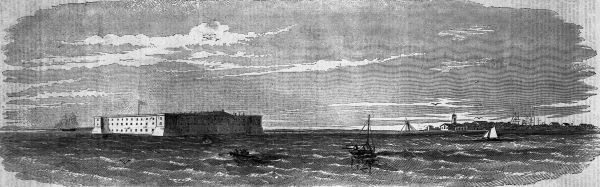
Fort Taylor, Key West, Florida, circa 1861 (courtesy, State Archives of Florida).
Having been ordered back to Key West on 15 November 1862, the 47th Pennsylvania Volunteers would spend the coming year guarding federal installations in Florida. Companies A, B, C, E, G, and I would once again garrison Fort Taylor in Key West, while the men from Companies D, F, H, and K would garrison Fort Jefferson, the Union’s remote outpost in the Dry Tortugas off the southern coast of Florida.
After packing their belongings at their Beaufort, South Carolina encampment and loading their equipment onto the U.S. Steamer Cosmopolitan, the officers and enlisted members of the 47th Pennsylvania Volunteer Infantry sailed toward the mouth of the Broad River on 15 December 1862, and anchored briefly at Port Royal Harbor in order to allow the regiment’s medical director, Elisha W. Baily, M.D., and members of the regiment who had recuperated enough from their Pocotaligo-related battle injuries at the Union’s general hospital at Hilton Head, to rejoin the regiment.
At 5 p.m. that same evening, the regiment sailed for Florida, during what was described by several members of the 47th as a treacherous and nerve-wracking voyage. According to historian Lewis Schmidt, the ship’s captain “steered a course along the coast of Florida for most of the voyage,” which made the voyage more precarious “because of all the reefs.” On 16 December, “the second night, the ship was jarred as it ran aground on one during a storm, but broke free, and finally steered a course further from shore, out in the Gulf Stream.”
In a letter penned to the Sunbury American on 21 December, Company C soldier Henry Wharton provided the following details about the regiment’s trip:
On the passage down, we ran along almost the whole coast of Florida. Rather all dangerous ground, and the reefs are no playthings. We were jarred considerably by running on one, and not liking the sensation our course was altered for the Gulf Stream. We had heavy sea all the time. I had often heard of ‘waves as big as a house,’ and thought it was a sailors yarn, but I have seen ’em and am perfectly satisfied; so now, not having a nautical turn of mind, I prefer our movements being done on terra firma, and leave old neptune to those who have more desire for his better acquaintance. A nearer chance of a shipwreck never took place than ours, and it was only through Providence that we were saved. The Cosmopolitan is a good riverboat, but to send her to sea, loadened [sic, loaded] with U.S. troops is a shame, and looks as though those in authority wish to get clear of soldiers in another way than that of battle. There was some sea sickness on our passage; several of the boys ‘casting up their accounts’ on the wrong side of the ledger.
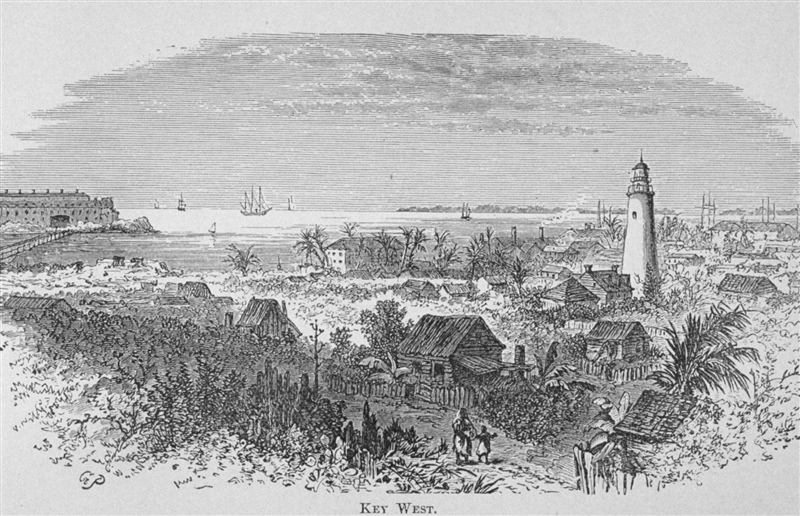
Lighthouse, Key West, Florida, early to mid-1800s (Florida for Tourists, Invalids, and Settlers, George M. Barbour, 1881, public domain).
According to Corporal George Nichols of Company E, “When we got to Key West the Steamer had Six foot of water in her hole [sic, hold]. Waves Mountain High and nothing but an old river Steamer. With Eleven hundred Men on I looked for her to go to the Bottom Every Minute.”
Although the Cosmopolitan arrived at Key West Harbor on Thursday, 18 December, the 47th Pennsylvania Volunteers did not set foot on Florida soil until noon the next day. The men from Companies C and I were immediately marched to Fort Taylor, while the men from Companies B and E were assigned to older barracks that had previously been erected by the U.S. Army. Members of Companies A and G were marched to the newer “Lighthouse Barracks” located on “Lighthouse Key.”
On Saturday, 21 December, Lieutenant-Colonel George Warren Alexander, the regiment’s second-in-command, sailed away aboard the Cosmopolitan with the men from Companies D, F, H, and K, and headed south to Fort Jefferson, roughly seventy miles off the coast of Florida (in the Gulf of Mexico) to assume garrison duties there. According to Musician Henry Wharton:
We landed here [Fort Taylor] on last Thursday at noon, and immediately marched to quarters. Company I. and C., in Fort Taylor, Company E. and B. in the old Barracks, and A. and G. in the new Barracks. Lieut. Col. Alexander, with the other four companies proceeded to Tortugas, Col. Good having command of all the forces in and around Key West. Our regiment relieved the 90th Regiment N. Y. Vols. Col. Joseph Morgan, who will proceed to Hilton Head to report to the General commanding. His actions have been severely criticized by the people, but, as it is in bad taste to say anything against ones superiors, I merely mention, judging from the expression of the citizens, they were very glad of the return of the 47th Pennsylvania Volunteers….
1863
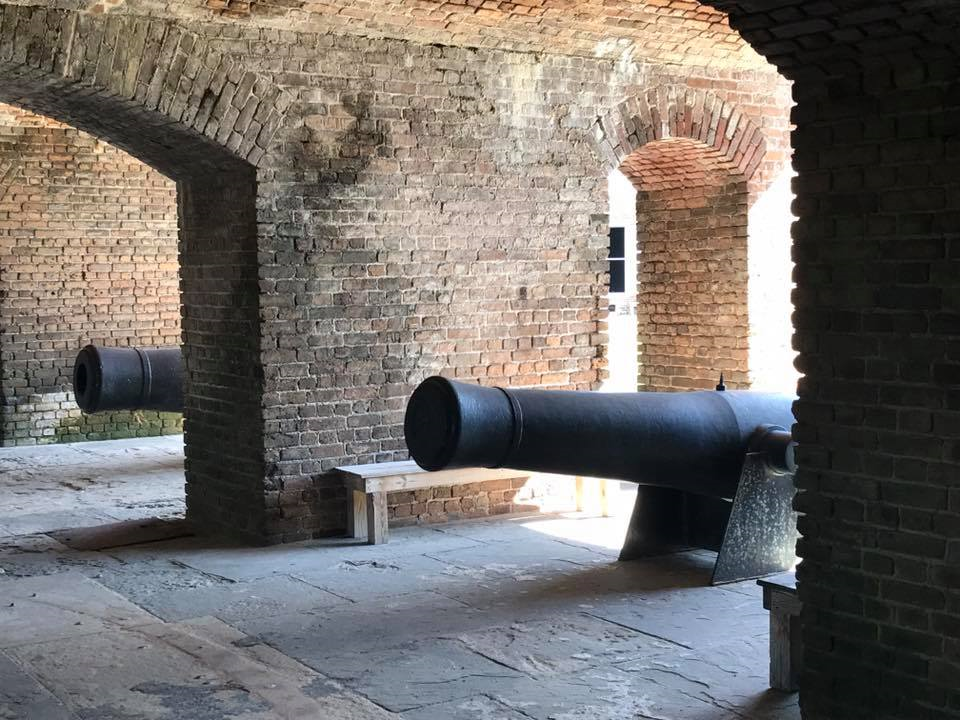
Artillery, Fort Taylor, Key West, Florida (Phil Spaugy, 2017, photo used with permission).
Stationed in Florida for the entire year of 1863, Corporal John Pratt and his fellow 47th Pennsylvania Volunteers were literally ordered to “hold the fort.” Their primary duty was to prevent foreign powers from assisting the Confederate Army and Navy in gaining control over federal installations and other territories across the Deep South. In addition, the regiment was also called upon to play an ongoing role in weakening Florida’s ability to supply and transport food and troops throughout areas held by the Confederate States of America.
Prior to intervention by the Union Army and Navy, the owners of plantations, livestock ranches and fisheries, as well as the operators of smaller family farms across Florida, had been able to consistently furnish beef and pork, fish, fruits, and vegetables to Confederate troops stationed throughout the Deep South during the first year of the American Civil War. Large herds of cattle were raised near Fort Myers, for example, while orchard owners in the Saint John’s River area were actively engaged in cultivating sizeable orange groves. (Other types of citrus trees were found growing throughout more rural areas of the state.)
Florida was also a major producer of salt, which was used as a preservative for food. Consequently, the 47th Pennsylvania Volunteers and other Union troops across Florida were ordered to capture or destroy salt manufacturing plants in order to further curtail the enemy’s access to food.
But once again, they were performing their duties in often dangerous conditions. The weather was frequently hot and humid as spring turned to summer, mosquitos and other insects were an ever-present annoyance (and a serious threat when they were carrying tropical diseases), and there were also scorpions and snakes that put the health of Second Lieutenant Hunsberger and his comrades at further risk. In addition, there was a serious shortage of clean water for drinking and bathing.
Despite all of those hardships, when given the opportunity to walk away from the Union Army or re-enlist for continued service, the majority of 47th Pennsylvania Volunteers chose to re-enlist, including John Pratt who re-enrolled as a corporal with Company G of the 47th Pennsylvania Volunteer Infantry on 21 October 1863.
1864
In early January 1864, the 47th Pennsylvania Volunteers experienced yet another significant change when members of the regiment were ordered to expand the Union’s reach by sending part of the regiment north to retake Fort Myers, a federal installation that had been abandoned in 1858, following the federal government’s third war with the Seminole Indians. In response, Company A Captain Richard Graeffe and a detachment of his subordinates traveled north, captured the fort and began conducting cattle raids to provide food for the growing Union troop presence across the region. They subsequently turned their fort not only into their base of operations, but into a shelter for pro-Union supporters, escaped slaves, Confederate deserters, and others fleeing Rebel troops.
Red River Campaign

Map of key 1864 Red River Campaign locations, showing the battle sites of Sabine Cross Roads, Pleasant Hill and Mansura in relation to the Union’s occupation sites at Alexandria, Grand Ecore, Morganza, and New Orleans (excerpt from Dickinson College/U.S. Library of Congress map, public domain).
Meanwhile, all of the other companies of the 47th Pennsylvania Volunteer Infantry had begun preparing for the regiment’s history-making journey to Louisiana. Boarding yet another steamer, the Charles Thomas, the men from Companies B, C, D, I, and K headed for Algiers, Louisiana (across the river from New Orleans), followed on 1 March by the men from Companies E, F, G, and H.
Upon the second group’s arrival, the now almost-fully-reunited-regiment moved by train to Brashear City (now Morgan City), before heading to Franklin by steamer through the Bayou Teche. There, the 47th Pennsylvania Volunteer Infantry joined the 2nd Brigade, 1st Division of the 19th Corps (XIX) of the United States’ Army of the Gulf, and became the only regiment from the Commonwealth of Pennsylvania to serve in the Red River Campaign commanded by Union Major-General Nathaniel P. Banks. (Unable to reach Louisiana until 23 March, the soldiers from Company A were assigned to detached duty while awaiting transport that enabled them to reconnect with their regiment at Alexandria, Louisiana on 9 April.)
The early days on the ground quickly woke Corporal John Pratt and his fellow 47th Pennsylvania Volunteers up to just how grueling their new phase of duty would be. From 14-26 March, most members of the 47th marched for Alexandria and Natchitoches, near the top of the L-shaped state. Among the towns that the 47th Pennsylvanians passed through were New Iberia, Vermilionville (now part of Lafayette), Opelousas, and Washington.
From 4-5 April 1864, the regiment added to its roster of young Black soldiers when Aaron Bullard (later known as Aaron French), James Bullard, John Bullard, Samuel Jones, and Hamilton Blanchard (also known as John Hamilton) enrolled for military service with the 47th Pennsylvania at Natchitoches. According to their respective entries in the Civil War Veterans’ Card File at the Pennsylvania State Archives and on regimental muster rolls, the men were officially mustered into the regiment on 22 June at Morganza, Louisiana. Several of their entries noted that they were assigned the rank of “Colored Cook” while others were given the rank of “Under-Cook.”
Often short on food and water throughout their long, harsh-climate trek, the 47th Pennsylvania Volunteers encamped briefly at Pleasant Hill (now the Village of Pleasant Hill) the night of 7 April, before continuing on the next day.
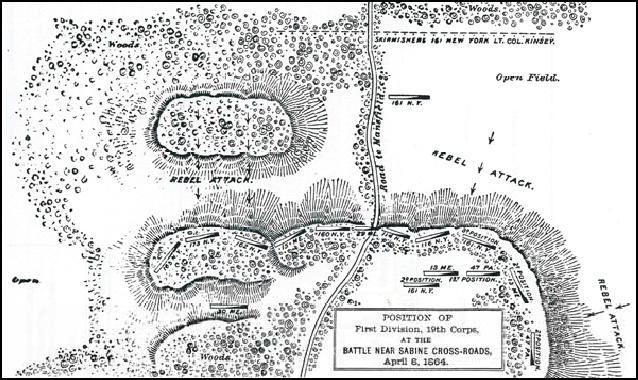
19th U.S. Army Map, Phase 3, Battle of Sabine Cross Roads/Mansfield (8 April 1864, public domain).
Rushed into battle ahead of other regiments in the second division, sixty members of the 47th Pennsylvania Volunteer Infantry were cut down on 8 April 1864 during the intense volley of fire in the Battle of Sabine Cross Roads (also known as the Battle of Mansfield due to its proximity to the town of Mansfield). The fighting waned only when darkness fell. The exhausted, but uninjured collapsed beside the gravely wounded and dead. After midnight, the surviving Union troops withdrew to Pleasant Hill.
The next day, the 47th Pennsylvania Volunteers were ordered into a critically important defensive position at the far right of the Union lines, their right flank spreading up unto a high bluff. By 3 p.m., after enduring a midday charge by the troops of Confederate Major-General Richard Taylor (a plantation owner who was the son of Zachary Taylor, a former president of the United States), the brutal fighting still showed no signs of ending. Suddenly, just as the 47th was shifting to the left side of the Union force, the men of the 47th were forced to bolster the 165th New York’s buckling lines by blocking another Confederate assault.
During that engagement (now known as the Battle of Pleasant Hill), the 47th Pennsylvania Volunteers succeeded in recapturing a Massachusetts artillery battery that had been lost during the earlier Confederate assault. Unfortunately, the regiment’s second-in-command, Lieutenant-Colonel George Warren Alexander, and its two color-bearers, Sergeants Benjamin Walls and William Pyers, were wounded. Alexander sustained wounds to both of his legs, and Walls was shot in the left shoulder as he attempted to mount the 47th Pennsylvania’s colors on caissons that had been recaptured, while Pyers was wounded as he grabbed the flag from Walls to prevent it from falling into Confederate hands.
All three survived the day, however, and continued to serve with the regiment, but many others, like K Company Sergeant Alfred Swoyer, were killed in action during those two days of chaotic fighting, or were wounded so severely that they were unable to continue the fight. (Swoyer’s final words were, “They’re coming nine deep!” Shot in the right temple shortly afterward, his body was never recovered).
Still others were captured by Confederate troops, marched roughly one hundred and twenty-five miles to Camp Ford, a Confederate Army prison camp near Tyler, Texas, and held there as prisoners of war until they were released during a series of prisoner exchanges that began on 22 July and continued through November. At least two members of the regiment never made it out of that prison camp alive; another died at a Confederate hospital in Shreveport.
Meanwhile, as the captured 47th Pennsylvanians were being spirited away to Camp Ford, the bulk of the regiment was carrying out orders from senior Union Army leaders to head for Grand Ecore, Louisiana. Encamped there from 11-22 April, the Union soldiers engaged in the hard labor of strengthening regimental and brigade fortifications.
They then moved back to Natchitoches Parish on 22 April. While they were in route, they were attacked again, this time, at the rear of their retreating brigade, but they were able to end the encounter quickly and move on to reach Cloutierville at 10 p.m. that same night (after a forty-five-mile march).

The 47th Pennsylvania Volunteers were stationed just to the left of the “Thick Woods” with Emory’s 2nd Brigade, 1st Division as shown on this map of Union troop positions for the Battle of Cane River Crossing at Monett’s Ferry, Louisiana, 23 April 1864 (Major-General Nathaniel Banks’ official Red River Campaign Report, public domain).
The next morning (23 April), episodic skirmishing quickly roared into the flames of a robust fight. As part of the advance party led by Union Brigadier-General William Emory, the 47th Pennsylvanians took on the Confederate Cavalry of Brigadier-General Hamilton Bee in the Battle of Cane River (also known as “the affair at Monett’s Ferry” or the “Cane River Crossing”).
Responding to a barrage from the Confederate Artillery’s twenty-pound Parrott guns and from enemy troops positioned atop a bluff and near a bayou, Brigadier-General Emory directed one of his brigades to keep Bee’s Confederate troops busy while sending two other brigades to find a safe spot for the Union’s forces to cross the Cane River. As part of “the beekeepers,” the 47th Pennsylvania supported Smith’s artillery.
Meanwhile, additional troops under Smith’s command attacked Bee’s flank to force a Rebel retreat, and then erected a series of pontoon bridges that enabled the 47th Pennsylvania and other Union regiments to make the Cane River Crossing by the next day. As the Confederates retreated, they torched their own food stores, as well as the cotton supplies of their fellow southerners. In a letter penned from Morganza, C Company Musician Henry Wharton described what had happened:
Our sojourn at Grand Score was for eleven days, during which time our position was well fortified by entrenchments for a length of five miles, made of heavy logs, five feet high and six feet wide, filled in with dirt. In front of this, trees were felled for a distance of two hundred yards, so that if the enemy attacked we had an open space before us which would enable our forces to repel them and follow if necessary. But our labor seemed to the men as useless, for on the morning of 22d April, the army abandoned these works and started for Alexandria. From our scouts it was ascertained that the enemy had passed some miles to our left with the intention of making a stand against our right at Bayou Cane, where there is a high bluff and dense woods, and at the same attack Smith’s forces who were bringing up the rear. This first day was a hard one for the boys, for at 10 o’clock at night they made Cloutierville, a distance of forty drive miles. On that day our rear was attacked which caused our forces to reverse their front and form in line of battle, expecting too, to go back to the relief of Smith, but he needed no assistance, sending word to the front that he had ‘whipped them, and could do it again.’ It was well that Banks made so long a march on that day, for on the next we found the enemy prepared to carry out their design of attacking us front and rear. Skirmishing commenced early in the morning and as our columns advanced he fell back towards the bayou, when we soon discovered the position of their batteries on the bluff. There was then an artillery duel by the smaller pieces, and some sharp fighting by the cavalry, when the ‘mule battery,’ twenty pound Parrott guns opened a heavy fire, which soon dislodged them, forcing the chivalry to flee in a manner not at all suitable to their boasted courage. Before this one cavalry, the 3d Brigade of the 1st Div., and Birges’ brigade of the second, had crossed the bayou and were doing good service, which, with the other work, made the enemy show their heels. The 3d brigade done some daring deeds in this fight, as also did the cavalry. In one instance the 3d charged up a hill almost perpendicular, driving the enemy back by the bayonet without firing a gun. The woods on this bluff was so thick that the cavalry had to dismount and fight on foot. During the whole of the day, our brigade, the 2d, was supporting artillery, under fire all the time, and could not give Mr. Reb a return shot.
While we were fighting in front, Smith was engaged some miles in the rear, but he done his part well and drove them back. The rebel commanders thought by attacking us in the rear, and having a large face on the bluffs, they would be able to capture our train and take us all prisoners, but in this they were mistaken, for our march was so rapid that we were on them before they had thrown up the necessary earthworks. Besides they underrated the amount of our artillery, calculating from the number engaged at Pleasant Hill. The rebels say it ‘seems as though the Yankees manufacture, on short notice, artillery to order, and the men are furnished with wings when they wish to make a certain point.’
The damage done to the Confederate cause by the burning of cotton was immense. On the night of the 22d our route was lighted up for miles and millions of dollars worth if this production was destroyed. This loss will be felt more by Davis & Co., than several defeats in this region, for the basis of the loan in England was on the cotton in Louisiana.
After the rebels had fled from the bluff the negro troops put down the pontoons, and by ten that night we were six miles beyond the bayou safely encamped. The next morning we moved forward and in two days were in Alexandria. Johnnys followed Smith’s forces, keeping out of range of his guns, except when he had gained the eminence across the bayou, when he punished them (the rebs) severely.
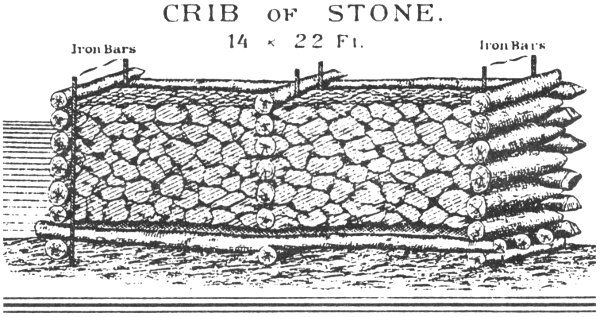
Sketches of the crib and tree dams designed by Lieutenant-Colonel Joseph Bailey to improve the water levels of the Red River near Alexandria, Louisiana, spring 1864 (Joseph Bailey, “Report on the Construction of the Dam Across the Red River,” 1865, public domain).
Having finally reached Alexandria on 26 April, they learned that they would remain at their latest new camp for at least two weeks. Placed temporarily under the command of Lieutenant-Colonel Joseph Bailey, they were assigned yet again to the hard labor of construction work, helping to erect “Bailey’s Dam,” a timber structure that was designed to enable Union gun boats to safely navigate the fluctuating water levels of the Red River. According to Musician Henry Wharton:
We were at Alexandria seventeen days, during which time the men were kept busy at throwing up earthworks, foraging and three times went out some distance to meet the enemy, but they did not make their appearance in numbers large enough for an engagement. The water in the Red river had fallen so much that it prevented the gun boats from operating with us, and kept our transports from supplying the troops with rations, (and you know soldiers, like other people will eat), so Banks was compelled to relinquish his designs on Shreveport and fall back to the Mississippi. To do this a large dam had to be built on the falls at Alexandria to get the iron clads down the river. After a great deal of labor this was accomplished and by the morning of May 13th the last one was through the shute [sic, chute], when we bade adieu to Alexandria, marching through the town with banners flying and keeping step to the music of ‘Rally around the flag,’ and ‘When this cruel war is over.’ The next morning, at our camping place, the fleet of boats passed us, when we were informed that Alexandria had been destroyed by fire – the act of a dissatisfied citizen and several negroes. Incendiary acts were strictly forbidden in a general order before we left the place, and a cavalry guard was left in the rear to see the order enforced. After marching a few miles skirmishing commenced in front between the cavalry and the enemy in riflepits on the bank of the river, but they were easily driven away. When we came up we discovered their pits and places where there had been batteries planted. At this point the John Warren, an unarmed transport, on which were sick soldiers and women, was fired into and sunk, killing many and those that were not drowned taken prisoners. A tin-clad gunboat was destroyed at the same place, by which we lost a large mail. Many letters and directed envelopes were found on the bank – thrown there after the contents had been read by the unprincipled scoundrels. The inhumanity of Guerrilla bands in this department is beyond belief, and if one did not know the truth of it or saw some of their barbarities, he would write it down as the story of a ‘reliable gentleman’ or as told by an ‘intelligent contraband.’ Not satisfied with his murderous intent on unarmed transports he fires into the Hospital steamer Laurel Hill, with four hundred sick on board. This boat had the usual hospital signal floating fore and aft, yet, notwithstanding all this, and the customs of war, they fired on them, proving by this act that they are more hardened than the Indians on the frontier.
Continuing their march, the 47th Pennsylvania Volunteers headed toward Avoyelles Parish. According to Wharton:
On Sunday, May 15th, we left the river road and took a short route through the woods, saving considerable distance. The windings of the Red river are so numerous that it resembles the tape-worm railroad where with the politicians frightened the dear people during the administration of Ritner and Stevens. — We stopped several hours in the woods to leave cavalry pass, when we moved forward and by four o’clock emerged into a large open plain where we formed into line of battle, expecting a regular engagement. The enemy, however, retired, and we advanced ’till dark, when the forces halted for the night with orders to rest on their arms. ‘Twas here that Banks rode through our regiment, amidst the cheers of the boys, and gave the pleasant news that Grant had defeated Lee.

“Sleeping on Their Arms” by Winslow Homer (Harper’s Weekly, 21 May 1864).
“Resting on their arms” (half-dozing, without pitching their tents, and with their rifles right beside them), they were now positioned just outside of Marksville, on the eve of the 16 May 1864 Battle of Mansura, which unfolded as follows, according to Wharton:
Early next morning we marched through Marksville into a prairie nine miles long and six wide where every preparation was made for a fight. The whole of our force was formed in line, in support of artillery in front, who commenced operations on the enemy driving him gradually from the prairie into the woods. As the enemy retreated before the heavy fire of our artillery, they reached Missoula [sic, Mansura], where they formed in column, taking the whole field in an attempt to flank the enemy, but their running qualities were so good that we were foiled. The maneuvring [sic, maneuvering] of the troops was handsomely done, and the movements was [sic, were] one of the finest things of the war. The fight of artillery was a steady one of five miles. The enemy merely stood that they might cover the retreat of their infantry and train under cover of their artillery. Our loss was slight. Of the rebels we could not ascertain directly, but learned from citizens who had secreted themselves during the fight, that they had many killed and wounded, who threw them into wagons, promiscuously, and drove them off so that we could not learn their casualties. The next day we moved to Simmsport [sic, Simmesport] on the Achafalaya [sic, Atchafalaya] river, where a bridge was made by putting the transports side by side, which enabled the troops and train to pass safely over.– The day before we crossed the rebels attacked Smith, thinking it was but the rear guard, in which they, the graybacks, were awfully cut up, and four hundred prisoners fell into our hands. Our loss in killed and wounded was ninety. This fight was the last one of the expedition. The whole of the force is safe on the Mississippi, gunboats, transports and trains. The 16th and 17th have gone to their old commands.
It is amusing to read the statements of correspondents to papers North, concerning our movements and the losses of the army. I have it from the best source that the Federal loss from Franklin to Mansfield, and from their [sic, there] to this point does not exceed thirty-five hundred in killed, wounded and missing, while that of the rebels is over eight thousand.

Union Army base at Morganza Bend, Louisiana, circa 1863-1865 (U.S. Library of Congress, public domain).
Continuing on, the healthy members of the 47th Pennsylvania Volunteer Infantry marched for Simmesport and then Morganza, where they made camp again. While encamped there, the nine formerly enslaved Black men who had enlisted with the regiment in Beaufort, South Carolina (1862) and Natchitoches, Louisiana (1864) were officially mustered into the regiment between 22-24 June.
The regiment then moved on and arrived in New Orleans in late June. On the Fourth of July, the 47th Pennsylvania Volunteers received orders to return to the East Coast. Three days later, they began loading the regiment and its men onto ships, a process that unfolded in two stages. Companies A, C, D, E, F, H, and I boarded the U.S. Steamer McClellan on 7 July and departed that day, while the members of Companies B, G and K, including Corporal John Pratt, remained behind, awaiting transport. They subsequently departed aboard the Blackstone, weighing anchor and sailing forth at the end of that month. Arriving in Virginia, on 28 July, the second group reconnected with the first group at Monocacy, having missed an encounter with President Abraham Lincoln and the Battle of Cool Spring at Snicker’s Gap in mid-July (a battle in which the first group of 47th Pennsylvanians had participated).
Sheridan’s 1864 Shenandoah Valley Campaign
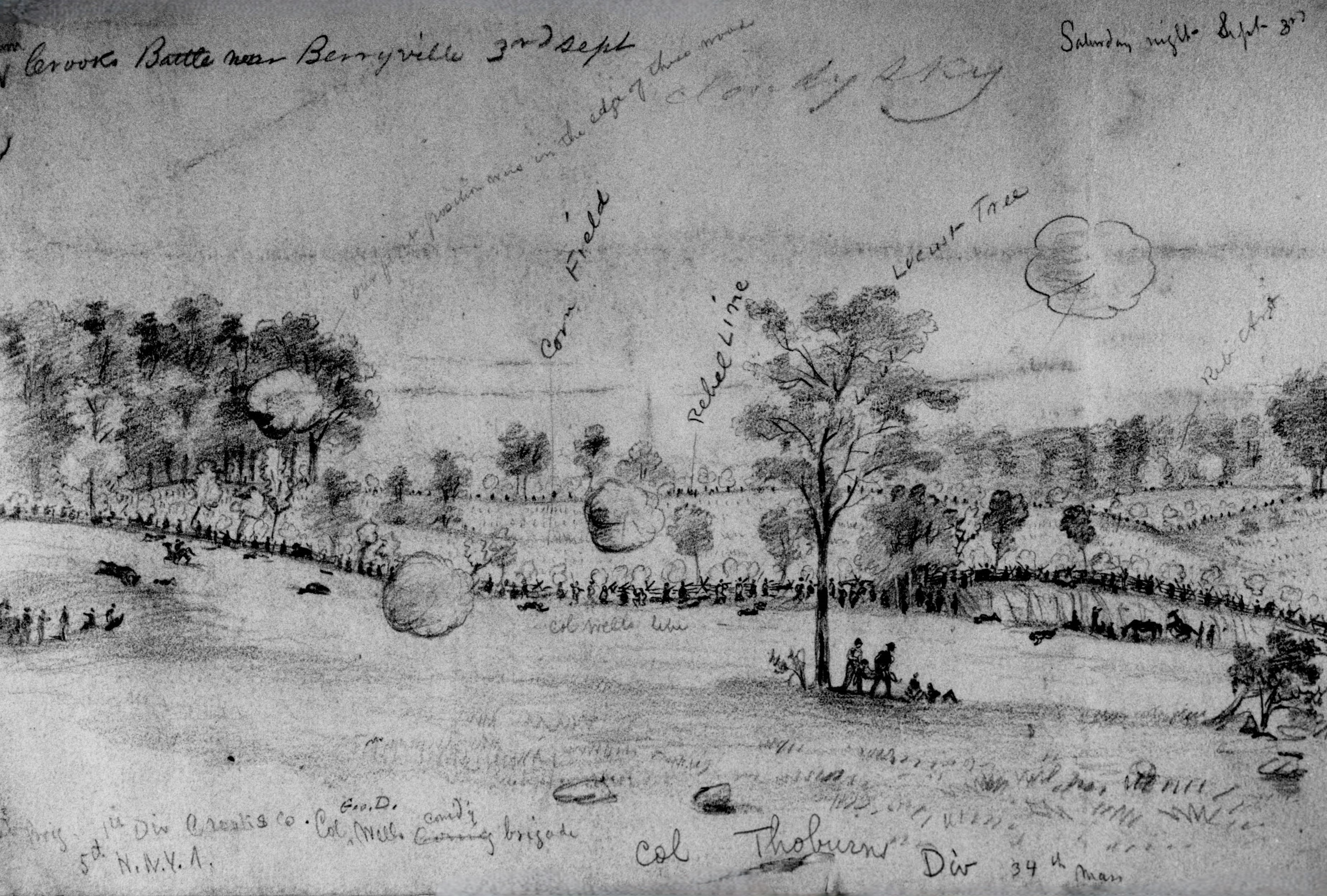
General Crook’s Battle Near Berryville, Virginia, September 3, 1864 (James E. Taylor, public domain).
Attached to the Middle Military Division, U.S. Army of the Shenandoah, beginning in early August of 1864, and placed under the command of Union Major-General Philip H. Sheridan, the 47th Pennsylvania Volunteer Infantry was assigned to defensive duties in and around Halltown, and also engaged over the next several weeks in a series of back-and-forth movements between Halltown, Berryville, Middletown, Charlestown, and Winchester as part of a “mimic war” being waged by Sheridan’s Union forces with those commanded by Confederate Lieutenant-General Jubal Early.
The 47th Pennsylvania then engaged with Confederate forces in the Battle of Berryville from 3-4 September.
Battles of Opequan and Fisher’s Hill

Battle of Opequan (aka Third Winchester), Virginia, 19 September 1864 (public domain).
On 19 September 1864, Corporal John Pratt and his fellow 47th Pennsylvania Volunteers next began a series of battles that would turn the tide of the American Civil War firmly in favor of the Union and help President Abraham Lincoln to secure re-election.
Together, with other regiments under the command of Union Major-General Philip Sheridan and Brigadier-General William Emory, commander of the 19th Corps (XIX Corps), the 47th Pennsylvania Volunteers helped to inflict heavy casualties on Lieutenant-General Jubal Early’s Confederate forces in the Battle of Opequan (also spelled as “Opequon” and known as “Third Winchester”).
The 47th Pennsylvania Volunteers’ march toward destiny began at 2 a.m. that 19 September as the regiment left camp and joined up with other regiments in the Union’s 19th Corps. Advancing from Berryville toward Winchester, the 19th Corps bogged down for several hours as Union wagon trains made their way slowly across the terrain. As a result, Early’s troops were able to dig in and wait.
The fighting, which began at noon, was long and brutal. The Union’s left flank (6th Corps) took a beating from Confederate artillery that was positioned on higher ground.

Victory of Philip Sheridan’s Union Army over Jubal Early’s Confederate forces, Battle of Opequan, 19 September 1864 (Kurz & Allison, circa 1893, U.S. Library of Congress, public domain).
Meanwhile, the 47th Pennsylvania and other 19th Corps regiments were directed by Brigadier-General William Emory to attack and pursue Major-General John B. Gordon’s Confederate forces. Some success was achieved, but casualties mounted as a Confederate artillery group opened fire on Union troops that were trying to cross clearing. When a nearly fatal gap began to open between the 6th and 19th Corps, Sheridan sent in units that were led by Brigadier-Generals Emory Upton and David A. Russell. Russell, hit twice (once in the chest), was mortally wounded.
The 47th Pennsylvania subsequently opened its lines long enough to enable the Union cavalry under William Woods Averell and the foot soldiers of Brigadier-General George Crook to charge the Confederates’ left flank. As the 19th Corps began pushing the Confederates back, with the 47th Pennsylvania in the thick of the fight, Early’s “grays” retreated.
Sheridan’s “blue jackets” ultimately went on to win the day.
Leaving twenty-five hundred wounded behind, the Rebels retreated to Fisher’s Hill, eight miles south of Winchester, where a second engagement, the Battle of Fisher’s Hill, was waged from 21-22 September. Following a successful morning flanking attack by Sheridan’s Union forces, which outnumbered Early’s Confederate troops three to one, Early’s troops fled to Waynesboro, but were pursued by the 47th Pennsylvania and other Union regiments. Afterward, the 47th Pennsylvanians made camp at Cedar Creek.
They would continue to distinguish themselves in battle, but they would do so without their two most senior leaders, Colonel Tilghman H. Good and Lieutenant-Colonel George Warren Alexander, who mustered out from 23-24 September, upon expiration of their respective terms of service. Fortunately, they were replaced by leaders who were equally respected for their front-line experience and temperament, including Major John Peter Shindel Gobin, formerly of Company C, who had been promoted up through the regimental officers’ corps to the regiment’s central command staff (and who would be promoted again on 4 November to the rank of lieutenant-colonel and appointed as the 47th Pennsylvania’s final commanding officer).
Battle of Cedar Creek

Alfred Waud’s 1864 sketch, “Surprise at Cedar Creek,” captured the flanking attack on the rear of Union Brigadier-General William Emory’s 19th Corps by Lieutenant-General Jubal Early’s Confederate army, and the subsequent resistance by Emory’s troops from their Union rifle-pit positions, 19 October 1864 (public domain).
During the fall of 1864, Major-General Sheridan began the first of the Union’s true “scorched earth” campaigns, starving the enemy into submission by destroying Virginia’s farming infrastructure. Viewed today through the lens of history as inhumane, the strategy claimed the lives of many innocent civilians, whose lives were uprooted or even cut short by the inability to find food or adequate shelter. This same strategy, however, almost certainly contributed to the further turning of the war in the Union’s favor during the Battle of Cedar Creek on 19 October 1864.
Successful throughout most of their engagement with Union forces at Cedar Creek, Lieutenant-General Jubal Early’s Confederates began peeling off in ever greater numbers as the battle wore on in order to search for food to ease their gnawing hunger, thus enabling Sheridan’s well-fed troops to rally and win the day.
From a military standpoint, it was another impressive show of the Union’s might. From a human perspective, it was both inspiring and heartbreaking. During the morning of 19 October, Early launched a surprise attack on Sheridan’s Cedar Creek-encamped forces. Early’s men were able to capture Union weapons while freeing a number of Confederates who had been taken prisoner during previous battles, all while pushing seven Union divisions back. According to historian Samuel P. Bates:
When the Army of West Virginia, under Crook, was surprised and driven from its works, the Second Brigade, with the Forty-seventh on the right was thrown into the breach to arrest the retreat…. Scarcely was it in position before the enemy came suddenly upon it, under the cover of fog. The right of the regiment was thrown back until it was almost a semi-circle. The brigade, only fifteen hundred strong, was contending against Gordon’s entire division, and was forced to retire, but, in comparative good order, exposed, as it was, to raking fire. Repeatedly forming, as it was pushed back, and making a stand at every available point, it finally succeeded in checking the enemy’s onset, when General Sheridan suddenly appeared upon the field, who ‘met his crest-fallen, shattered battalions without a word of reproach, but joyously swinging his cap, shouted to the stragglers as he rode rapidly past them – ‘Face the other way, boys! We are going back to our camp! We are going to lick them out of their boots!'”

Sheridan Rallying His Troops, Battle of Cedar Creek, Virginia, 19 October 1864 (U.S. Library of Congress, public domain).
In response, Union troops staged a decisive counterattack that punched Early’s forces into submission. Afterward, the 47th Pennsylvania Volunteers were commended for their heroism by General Stephen Thomas, who, in 1892, was awarded the Medal of Honor for his own “distinguished conduct in a desperate hand-to-hand encounter, in which the advance of the enemy was checked” that day.
But the day proved to be a particularly costly one for the 47th Pennsylvania Volunteer Infantry. The regiment lost the equivalent of two full companies of men in killed, wounded and missing, as well as soldiers who were captured by Rebel troops and dragged off to prisoner of war (POW) camps, including the Confederates’ Libby Prison in Virginia, the notorious Salisbury Prison in North Carolina and the hellhole known as “Andersonville” in Georgia. Subjected to harsh treatment at the latter two, many of the 47th Pennsylvanians confined there never made it out alive. Those who did either died soon after their release, or lived lives that were greatly reduced in quality by their damaged health.
As the casualty lists were revised and re-revised upward, the name of Corporal John Pratt was added to the list of those who had been wounded in action. Fortunately, after receiving medical treatment, he was able to return to duty with his company.

Charlestown West Virginia, circa 1863 (public domain).
Following those major engagements, the 47th was ordered to Camp Russell near Winchester from November through most of December. Rested and somewhat healed, the 47th was then ordered to outpost and railroad guard duties at Camp Fairview in Charlestown, West Virginia five days before Christmas.
1865 — 1866
As the New Year of 1865 dawned, Corporal John Pratt and other members of the 47th Pennsylvania Volunteer Infantry continued to patrol key Union railroad lines in the vicinity of Charlestown and chase down Confederate guerrillas who had repeatedly attempted to disrupt railroad operations and kill soldiers from other Union regiments. He was then promoted from the rank of corporal to sergeant on 5 February 1865.
Assigned in February 1865 to the Provisional Division of the 2nd Brigade of the U.S. Army of the Shenandoah, the 47th Pennsylvania Volunteers continued to perform their guerrilla-fighting duties until late March, when they were ordered to head back to Washington, D.C., by way of Winchester and Kernstown, Virginia.
Joyous News and Then Tragedy

Spectators gather for the Grand Review of the Armies, 23-24 May 1865, beside the crepe-draped U.S. Capitol, flag at half-staff after the assassination of President Abraham Lincoln (Matthew Brady, U.S. Library of Congress, public domain).
As April 1865 opened, the battles between the Army of the United States and the Confederate States Army intensified, finally reaching the decisive moment when the Confederate troops of General Robert E. Lee surrendered to Union General Ulysses S. Grant at Appomattox on 9 April.
The long war, it seemed, was finally over. Less than a week later, however, the fragile peace was threatened when an assassin’s bullet ended the life of President Abraham Lincoln. Shot while attending an evening performance of Our American Cousin at Ford’s Theatre on 14 April 1865, he died from his head wound at 7:22 a.m. the next morning.
Shocked, and devastated by the news, which was received at their Fort Stevens encampment, the 47th Pennsylvania Volunteers were given little time to mourn their beloved commander-in-chief before they were ordered to grab their weapons and move into the regiment’s assigned position, from which it helped to protect the nation’s capital and thwart any attempt by Confederate soldiers and their sympathizers to re-ignite the flames of civil war that had finally been stamped out.
So key was their assignment that the 47th Pennsylvania Volunteers were not even allowed to march in the funeral procession of their slain leader. Instead, they took part in a memorial service with other members of their brigade that was officiated by the 47th Pennsylvania’s regimental chaplain, the Reverend William D. C. Rodrock.
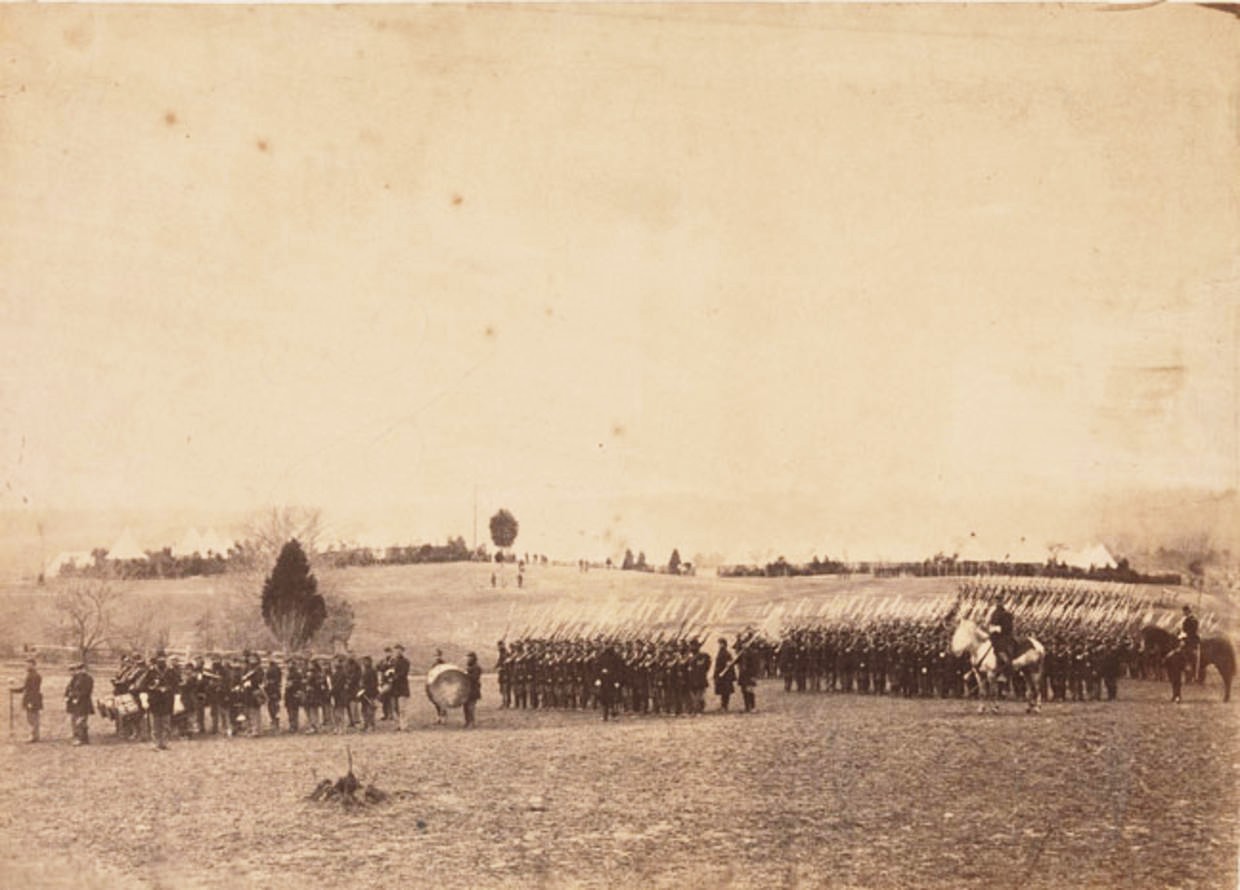
Unidentified Union infantry regiment, Camp Brightwood, Washington, D.C., circa 1865 (public domain).
Present-day researchers who read letters sent by 47th Pennsylvania Volunteers to family and friends back home in Pennsylvania during this period, or post-war interviews conducted by newspaper reporters with veterans of the regiment in later years, will learn that the 47th Pennsylvania Volunteers were collectively heartbroken by Lincoln’s death and deeply angry at those whose actions had culminated in his murder. Researchers will also learn that at least one member of the regiment, C Company Drummer Samuel Hunter Pyers, was given the high honor of guarding President Lincoln’s funeral train, while other members of the regiment were assigned to guard duty at the prison where the key assassination conspirators were being held during the early days of their imprisonment and trial, which began on 9 May 1865. The regiment was headquartered at Camp Brightwood during this period.
Attached to Dwight’s Division of the 2nd Brigade of the Department of Washington’s 22nd Corps, the 47th Pennsylvania Volunteers were permitted to march in the Union’s Grand Review of the National Armies, which took place in Washington, D.C. on 23 May.
Reconstruction

Ruins of Charleston, South Carolina as seen from the Circular Church, 1865 (U.S. National Archives and Records Administration, public domain).
On their final southern tour, Sergeant John Pratt and his fellow 47th Pennsylvania Volunteers served in Savannah, Georgia in early June. Assigned again to Dwight’s Division, this time they were attached to the 3rd Brigade, Department of the South. Relieving the 165th New York Volunteers in July, they quartered in the former mansion of the Confederate Secretary of the Treasury. Duties for the 47th during this phase were Provost (military police) and Reconstruction-related, including rebuilding railroads and other key segments of the region’s battered infrastructure.
Beginning on Christmas day of that year, Sergeant Pratt and the majority of 47th Pennsylvania Veteran Volunteers, finally began to honorably muster out for the final time in Charleston, South Carolina — a process which continued through early January. Following a stormy voyage home, they disembarked in New York City. Weary, but eager to see their loved ones, they were transported to Philadelphia by train where, at Camp Cadwalader between 9-11 January 1866, they were officially given their honorable discharge papers.
Return to Civilian Life
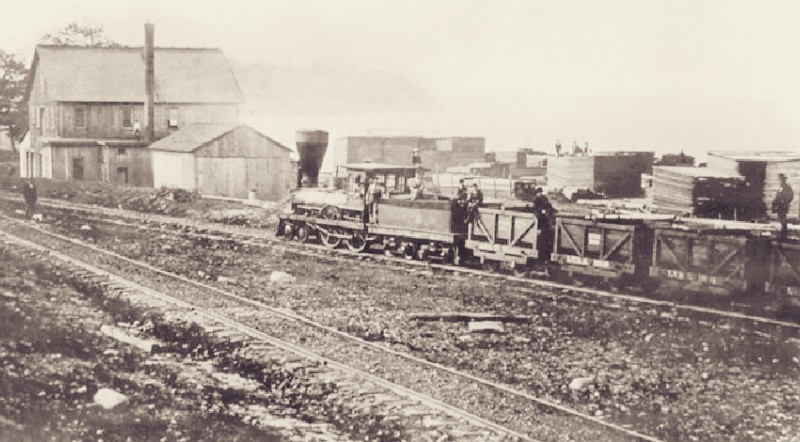
A Lehigh Valley Railroad coal train stopped in North Fair Haven, New York, near the Little Sodus Bay, 1872 (public domain).
Following his honorable discharge from the military, John Pratt found work with a railroad company, and began his new journey in life. Sometime during the late 1860s, he married Elizabeth Blackwell (1849-1917), who was a daughter of Solomon Blackwell and Elizabeth (Drett) Blackwell.
By 1870, he and his wife were residing in the Borough of Lehighton in Carbon County, where he was employed as a railroad brakeman.
During the spring of 1884, he narrowly escaped injury when a coal train, on which he was working as the first brakeman, collided with a second coal train “a short distance above Biery’s bridge, near Catasauqua,” on 23 April, according to The Allentown Critic.
It appears that the second section of coal train No. 182, drawn by engine No. 20, had slacked and stopped a few rods above Biery’s bridge on the Lehigh Valley Railroad. Shortly after section three, of the same number, drawn by engine No. 41, appeared around the curve when near the bridge. The train was speeding at about 25 miles an hour and the engineer, Chas. W. Miller, seeing that the section was but a short distance ahead, reversed his engine, but it was too late to prevent a collision and the two trains came together with a thud. The engineer, and Richard Bartolet, fireman, and John Pratt, first brakesman, jumped off the train at the moment of collision. The engineer was struck on the arm, which was badly injured. The fireman and brakesman were unharmed. The second train was composed of twelve cars and a caboose and the third section had 130 cars and a caboose. The engine of the third section crushed in the caboose of the second section, and the coal cars on all sides were thrown in all directions and completely wrecked. The caboose and engine suffered badly, the former being knocked into pieces and but little of it remained intact. The engine was completely stripped on one side, the smoke stack, bell, etc., being broken off and the cab presented a pitiable sight. Coal cars were piled up on the top of each other and both tracks were filled with cars, machinery and debris….
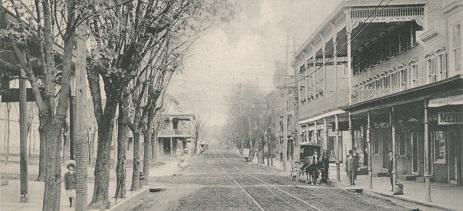
First Street, Lehighton, Pennsylvania (circa early 1900s, public domain).
By the turn of the century, John Pratt and his wife, Lizzie, were residing in a rented home at 127 Third Street in the Borough of Lehighton in Carbon County, where John was employed as a railroad laborer. A federal census taker noted that they had been the parents of one child who had died sometime prior to that year’s enumeration.
Death and Interment
Less than two years later, John Pratt was gone. Following his death in Carbon County at the age of sixty-eight, in January 1902, he was laid to rest at the Lehighton Cemetery in Lehighton, Carbon County.
What Happened to His Widow?
John Pratt’s widow, Elizabeth (Blackwell) Pratt, subsequently filed for a U.S. Civil War Widow’s Pension, which was ultimately awarded to her, enabling her to live out her remaining years in Carbon County with a small measure of security. She died at the Palmerton Hospital in Palmerton, Carbon County, on 13 April 1917, and was laid to rest beside her husband at the Lehighton Cemetery in Lehighton.
Sources:
- “6 Railroad Workers of the Past and Present,” in “Back to Rail Lines.” Ronks, Pennsylvania: Strasburg Rail Road, 18 July 2023.
- Bates, Samuel P. History of Pennsylvania Volunteers, 1861-5, vol. 1. Harrisburg, Pennsylvania: B. Singerly, State Printer, 1869.
- “Florida’s Role in the Civil War,” in Florida Memory. Tallahassee, Florida: State Archives of Florida.
- John Pratt (funeral notice). Lehighton, Pennsylvania: The Lehighton Press, 31 January 1902.
- “Memorable Anniversary” (casualty lists from the Battle of Cedar Creek, Virginia, 19 October 1864). Allentown, Pennsylvania: The Allentown Democrat, 13 October 1897.
- “Mrs. Elizabeth Pratt” (death notice of John Pratt’s widow). Allentown, Pennsylvania: The Morning Call, 16 April 1917.
- Pratt, John, in Civil War Muster Rolls (Company G, 47th Pennsylvania Infantry). Harrisburg, Pennsylvania: Pennsylvania State Archives.
- Pratt, John, in Civil War Veterans’ Card File, 1861-1866 (Company G, 47th Pennsylvania Infantry). Harrisburg, Pennsylvania: Pennsylvania State Archives.
- Pratt, John, in Records of Burial Places of Veterans (Lehighton Cemetery, Carbon County, Pennsylvania). Harrisburg, Pennsylvania: Commonwealth of Pennsylvania, Department of Military Affairs.
- Pratt, John and Elizabeth, in U.S. Census (Borough of Lehighton, Carbon County, Pennsylvania, 1870). Washington, D.C.: U.S. National Archives and Records Administration.
- Pratt, John and Lizzie, in U.S. Census (Borough of Lehighton, Carbon County, Pennsylvania, 1900). Washington, D.C.: U.S. National Archives and Records Administration.
- Pratt, John and Elizabeth, in U.S. Civil War Pension General Index Cards (veteran’s application no.: 436561, veteran’s certificate no.: 406207, filed from Pennsylvania by the veteran, 3 January 1882; widow’s application no.: 760186, widow’s certificate no.: 575237, filed by the veteran’s widow from Pennsylvania, 1 April 1902). Washington, D.C.: U.S. National Archives and Records Administration.
- “Roster of the 47th P. V. Inf.” Allentown, Pennsylvania: The Morning Call, 26 October 1930.
- Schmidt, Lewis G. A Civil War History of the 47th Regiment of Pennsylvania Veteran Volunteers. Allentown, Pennsylvania: Self-published, 1986.
- “The Gallant Forty-Seventh: Summary of the Losses Suffered by Allentown and Catasauqua Companies.” Allentown, Pennsylvania: The Morning Call, 14 October 1897.
- “The History of the Forty-Seventh Regt. P. V.” Allentown, Pennsylvania: The Lehigh Register, 20 July 1870.
- “The Railroad in Pennsylvania,” in “Stories from PA History.” Harrisburg, Pennsylvania: Pennsylvania Historical and Museum Commission, 2025.
- “Wreck on the Valley: Two Coal Trains Collide with Damaging Results.” Allentown, Pennsylvania: The Allentown Critic, 24 April 1884.
 47th Pennsylvania Volunteers
You must be logged in to post a comment.