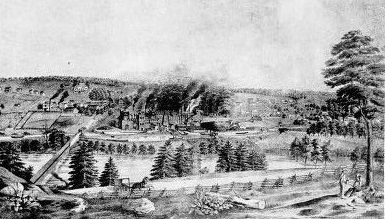
Catasauqua, Lehigh County, Pennsylvania (circa 1852, public domain).
He had everything to live for—a young wife, an infant daughter and a job in the construction industry that, while taxing, likely paid better than most during the mid-nineteenth century. Despite these simple facts, or maybe because of them—because he was trying to ensure that he and his young family would have the best possible future that they could imagine—James A. Ritter became one of the countless young Pennsylvanians who have answered the call when their state and nation needed help since the founding of the Great Keystone State.
He went on to serve his nation faithfully until his future was changed by the bite of a mosquito.
Formative Years
Born circa 1840, James A. Ritter remains somewhat of a “mystery man.” Very few details about his parents and early years appear to exist, even with all of the digitized records that twenty-first century researchers now have available at their disposal.
What is known for certain is that he married Pauline Wilt (1842-1922; alternate spelling of given name: Paulina; alternate spelling of surname: Will), who was a daughter of Christian and Pauline Wilt. Their wedding ceremony was performed by the Rev. A. Fuchs in Bath, Northampton County, Pennsylvania on 16 August 1860.
Their daughter Mary Jane Ritter (1861-1902) was then born in Catasauqua, Lehigh County, Pennsylvania nearly a year to the day later, on 15 August 1861, when she was delivered by Daniel Yoder, M.D.
Civil War
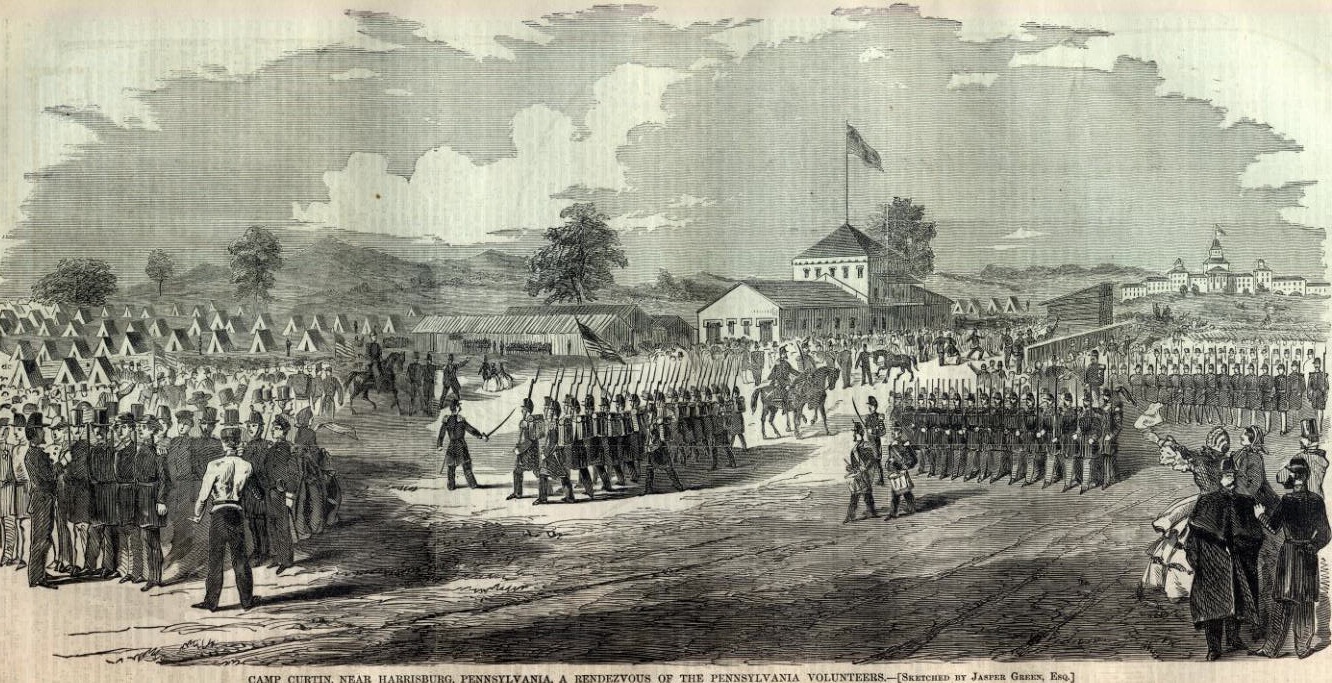
Camp Curtin (Harper’s Weekly, 1861, public domain).
Just six days after his daughter’s arrival, the new, twenty-one-year-old father became one of the early responders to President Abraham Lincoln’s call for volunteers to bring a swift end to the American Civil War. After enrolling in Catasauqua on 21 August 1861, James A. Ritter officially mustered in for duty at Camp Curtin in Harrisburg, Dauphin County on 30 August, as a corporal with Company F of the 47th Pennsylvania Volunteer Infantry.
Military records at the time described him as a brick moulder and resident of Catasauqua who was five feet, ten inches tall with light hair, light eyes and a light complexion.
* Note: Company F of the 47th Regiment, Pennsylvania Volunteer Infantry was the first company of this Union regiment to muster in for duty. The initial recruitment for members to staff Company F was conducted in Catasauqua by Henry Samuel Harte, a native of Darmstadt, Grand Duchy of Hesse (now Darmstadt, Hesse, Germany) who had become a naturalized American citizen in 1851, had been appointed captain of the Lehigh County militia unit known as the Catasauqua Rifles during the late 1850s and was then commissioned as captain of Company F of the 47th Pennsylvania Volunteers during the fateful summer of 1861.
Researchers for 47th Pennsylvania Volunteers: One Civil War Regiment’s Story theorize that James Ritter may have served previously under Captain Harte—possibly in the Catasauqua Rifles—because Ritter began his service with the 47th Pennsylvania Volunteers as a corporal, rather than a private—a rank that would likely not have been awarded to him had he not had previous experience with one of Lehigh County’s ten militia units.
Following a brief training period in light infantry tactics at Camp Curtin, the soldiers of Company F and their fellow 47th Pennsylvanians were transported south by rail to Washington, D.C. Stationed roughly two miles from the White House, they pitched their tents at “Camp Kalorama” on the Kalorama Heights near Georgetown beginning 21 September. Henry D. Wharton, a musician from the regiment’s C Company, penned an update the next day to the Sunbury American, his hometown newspaper:
After a tedious ride we have, at last, safely arrived at the City of ‘magnificent distances.’ We left Harrisburg on Friday last at 1 o’clock A.M. and reached this camp yesterday (Saturday) at 4 P.M., as tired and worn out a sett [sic] of mortals as can possibly exist. On arriving at Washington we were marched to the ‘Soldiers Retreat,’ a building purposely erected for the benefit of the soldier, where every comfort is extended to him and the wants of the ‘inner man’ supplied.
After partaking of refreshments we were ordered into line and marched, about three miles, to this camp. So tired were the men, that on marching out, some gave out, and had to leave the ranks, but J. Boulton Young, our ‘little Zouave,’ stood it bravely, and acted like a veteran. So small a drummer is scarcely seen in the army, and on the march through Washington he was twice the recipient of three cheers.
We were reviewed by Gen. McClellan yesterday [21 September 1861] without our knowing it. All along the march we noticed a considerable number of officers, both mounted and on foot; the horse of one of the officers was so beautiful that he was noticed by the whole regiment, in fact, so wrapt [sic] up were they in the horse, the rider wasn’t noticed, and the boys were considerably mortified this morning on dis-covering they had missed the sight of, and the neglect of not saluting the soldier next in command to Gen. Scott.
Col. Good, who has command of our regiment, is an excellent man and a splendid soldier. He is a man of very few words, and is continually attending to his duties and the wants of the Regiment.
…. Our Regiment will now be put to hard work; such as drilling and the usual business of camp life, and the boys expect and hope for an occasional ‘pop’ at the enemy.
While at Camp Kalorama, Captain Harte issued his first directive (Company Order No. 1), that his company drill four times per day, each time for one hour
On 24 September, the 47th Regiment, Pennsylvania Volunteer Infantry finally became part of the United States Army when its men were officially mustered into federal service. On 27 September—a rainy day, the 47th Pennsylvania was assigned to the 3rd Brigade of Brigadier-General Isaac Stevens, which also included the 33rd, 49th and 79th New York regiments. By that afternoon, the 47th Pennsylvania was on the move again.

Chain Bridge across the Potomac above Georgetown looking toward Virginia, 1861 (The Illustrated London News, public domain).
Ordered onward by Brigadier-General Silas Casey, the 47th Pennsylvanians marched behind their regimental band until reaching Camp Lyon, Maryland on the Potomac River’s eastern shore. At 5 p.m., they joined the 46th Pennsylvania in moving double-quick (one hundred and sixty-five steps per minute using thirty-three-inch steps) across the “Chain Bridge” marked on federal maps, and continued on for roughly another mile before being ordered to make camp.
The next morning, they broke camp and moved again. Marching toward Falls Church, Virginia, they arrived at Camp Advance around dusk. There, about two miles from the bridge they had crossed a day earlier, they re-pitched their tents in a deep ravine near a new federal fort under construction (Fort Ethan Allen). Having completed a roughly eight-mile trek, they were now situated near the headquarters of Brigadier-General William Farrar Smith (nicknamed “Baldy”), the commander of the Union’s massive U.S. Army of the Potomac (“Mr. Lincoln’s Army”). Armed with Mississippi rifles supplied by the Keystone State, their job was to prevent attacks by the Confederate States Army on the nation’s capital.
Once again, Company C Musician Henry Wharton recapped the regiment’s activities, noting, via his 29 September letter home to the Sunbury American, that the 47th had changed camps three times in three days:
On Friday last we left Camp Kalorama, and the same night encamped about one mile from the Chain Bridge on the opposite side of the Potomac from Washington. The next morning, Saturday, we were ordered to this Camp [Camp Advance near Fort Ethan Allen, Virginia], one and a half miles from the one we occupied the night previous. I should have mentioned that we halted on a high hill (on our march here) at the Chain Bridge, called Camp Lyon, but were immediately ordered on this side of the river. On the route from Kalorama we were for two hours exposed to the hardest rain I ever experienced. Whew, it was a whopper; but the fellows stood it well – not a murmur – and they waited in their wet clothes until nine o’clock at night for their supper. Our Camp adjoins that of the N.Y. 79th (Highlanders.)….
We had not been in this Camp more than six hours before our boys were supplied with twenty rounds of ball and cartridge, and ordered to march and meet the enemy; they were out all night and got back to Camp at nine o’clock this morning, without having a fight. They are now in their tents taking a snooze preparatory to another march this morning…. I don’t know how long the boys will be gone, but the orders are to cook two days’ rations and take it with them in their haversacks….
There was a nice little affair came off at Lavensville [sic, Lewinsville], a few miles from here on Wednesday last; our troops surprised a party of rebels (much larger than our own.) killing ten, took a Major prisoner, and captured a large number of horses, sheep and cattle, besides a large quantity of corn and potatoes, and about ninety six tons of hay. A very nice day’s work. The boys are well, in fact, there is no sickness of any consequence at all in our Regiment….

The Big Chestnut Tree, Camp Griffin, Langley, Virginia, 1861 (U.S. Library of Congress, public domain).
Sometime during this phase of duty, as part of the 3rd Brigade, the 47th Pennsylvanians were moved to a site they initially christened “Camp Big Chestnut” in reference to the large chestnut tree located within their camp’s boundaries. The site would eventually become known to the Keystone Staters as “Camp Griffin,” and was located roughly ten miles from Washington, D.C.
On 11 October, the 47th Pennsylvania Volunteers marched in the Grand Review at Bailey’s Cross Roads. In a mid-October letter home, Captain John Peter Shindel Gobin (the leader of C Company who would be promoted in 1864 to lead the entire 47th Regiment) reported that companies D, A, C, F and I (the 47th Pennsylvania’s right wing) were ordered to picket duty after the left-wing companies (B, G, K, E, and H) had been forced to return to camp by Confederate troops. In his letter of 13 October, Henry Wharton described their duties, as well as their new home:
The location of our camp is fine and the scenery would be splendid if the view was not obstructed by heavy thickets of pine and innumerable chesnut [sic] trees. The country around us is excellent for the Rebel scouts to display their bravery; that is, to lurk in the dense woods and pick off one of our unsuspecting pickets. Last night, however, they (the Rebels) calculated wide of their mark; some of the New York 33d boys were out on picket; some fourteen or fifteen shots were exchanged, when our side succeeded in bringing to the dust, (or rather mud,) an officer and two privates of the enemy’s mounted pickets. The officer was shot by a Lieutenant in Company H [?], of the 33d.
Our own boys have seen hard service since we have been on the ‘sacred soil.’ One day and night on picket, next day working on entrenchments at the Fort, (Ethan Allen.) another on guard, next on march and so on continually, but the hardest was on picket from last Thursday morning ‘till Saturday morning – all the time four miles from camp, and both of the nights the rain poured in torrents, so much so that their clothes were completely saturated with the rain. They stood it nobly – not one complaining; but from the size of their haversacks on their return, it is no wonder that they were satisfied and are so eager to go again tomorrow. I heard one of them say ‘there was such nice cabbage, sweet and Irish potatoes, turnips, &c., out where their duty called them, and then there was a likelihood of a Rebel sheep or young porker advancing over our lines and then he could take them as ‘contraband’ and have them for his own use.’ When they were out they saw about a dozen of the Rebel cavalry and would have had a bout with them, had it not been for…unlucky circumstance – one of the men caught the hammer of his rifle in the strap of his knapsack and caused his gun to fire; the Rebels heard the report and scampered in quick time….

Unknown regiment, Camp Griffin, Virginia, fall 1861 (U.S. Library of Congress, public domain).
On Friday morning, 22 October 1861, the 47th engaged in a Divisional Review, described by Schmidt as massing “about 10,000 infantry, 1000 cavalry, and twenty pieces of artillery all in one big open field.” Less than a month later, in his letter of 17 November, Henry Wharton revealed more details about life at Camp Griffin:
This morning our brigade was out for inspection; arms, accoutrements [sic], clothing, knapsacks, etc, all were out through a thorough examination, and if I must say it myself, our company stood best, A No. 1, for cleanliness. We have a new commander to our Brigade, Brigadier General Brannen [sic], of the U.S. Army, and if looks are any criterion, I think he is a strict disciplinarian and one who will be as able to get his men out of danger as he is willing to lead them to battle….
The boys have plenty of work to do, such as piquet [sic] duty, standing guard, wood-chopping, police duty and day drill; but then they have the most substantial food; our rations consist of fresh beef (three times a week) pickled pork, pickled beef, smoked pork, fresh bread, daily, which is baked by our own bakers, the Quartermaster having procured portable ovens for that purpose, potatoes, split peas, beans, occasionally molasses and plenty of good coffee, so you see Uncle Sam supplies us plentifully….
A few nights ago our Company was out on piquet [sic]; it was a terrible night, raining very hard the whole night, and what made it worse, the boys had to stand well to their work and dare not leave to look for shelter. Some of them consider they are well paid for their exposure, as they captured two ancient muskets belonging to Secessia. One of them is of English manufacture, and the other has the Virginia militia mark on it. They are both in a dilapidated condition, but the boys hold them in high estimation as they are trophies from the enemy, and besides they were taken from the house of Mrs. Stewart, sister to the rebel Jackson who assassinated the lamented Ellsworth at Alexandria. The honorable lady, Mrs. Stewart, is now a prisoner at Washington and her house is the headquarters of the command of the piquets [sic]….
Since the success of the secret expedition, we have all kinds of rumors in camp. One is that our Brigade will be sent to the relief of Gen. Sherman, in South Carolina. The boys all desire it and the news in the ‘Press’ is correct, that a large force is to be sent there, I think their wish will be gratified….
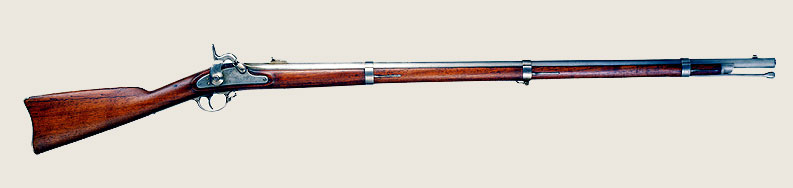
Springfield rifle, 1861 model (public domain).
On 21 November, the 47th participated in a morning divisional headquarters review that was overseen by the regiment’s founder and commanding officer, Colonel Tilghman H. Good, followed by brigade and division drills all afternoon. According to Schmidt, “each man was supplied with ten blank cartridges.” Afterward, “Gen. Smith requested Gen. Brannan to inform Col. Good that the 47th was the best regiment in the whole division.”
As a reward for their performance—and in preparation for bigger things to come, Brigadier-General John Milton Brannan obtained brand new Springfield rifles for every member of the 47th Pennsylvania Volunteers.
1862
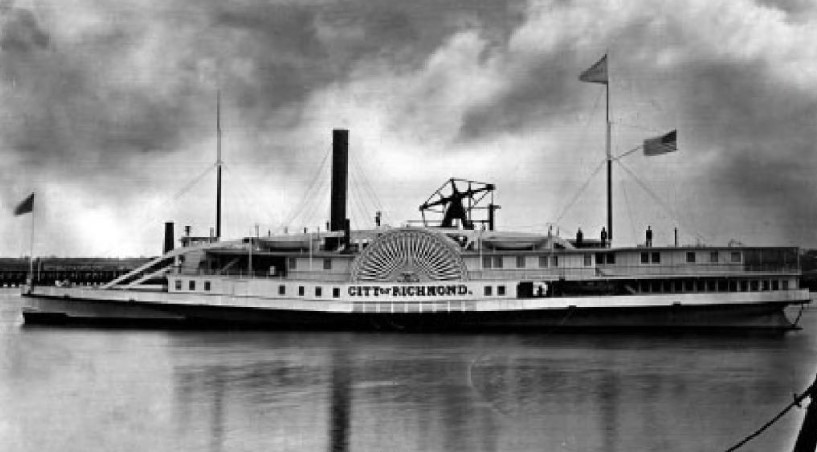
The City of Richmond, a sidewheel steamer which transported Union troops during the Civil War (Maine, circa late 1860s, public domain).
Next ordered to move from their Virginia encampment back to Maryland, the 47th Pennsylvania Volunteers left Camp Griffin at 8:30 a.m. on Wednesday, 22 January 1862. Marching through deep mud with their equipment for three miles in order to reach the railroad station at Falls Church, they were transported by rail to Alexandria, Virginia, where they boarded the steamship City of Richmond, and sailed the Potomac to the Washington Arsenal. Reequipped there, they were then marched off for dinner and rest at the Soldiers’ Retreat in Washington, D.C.
The next afternoon, the 47th Pennsylvanians hopped cars on the Baltimore & Ohio Railroad, and headed for Annapolis, Maryland. Arriving around 10 p.m., they were assigned quarters in barracks at the United States Naval Academy. They then spent that Friday through Monday (24-27 January 1862) loading their equipment and other supplies onto the steamship U.S. Oriental.
Ferried to the big steamship by smaller steamers on Monday, 27 January, the 47th Pennsylvania Volunteers commenced boarding the Oriental for the final time, with the officers boarding last. Then, at 4 p.m., per the directive of Brigadier-General Brannan, they steamed away for the Deep South. They were headed for Florida which, despite its secession from the Union, remained strategically important to the Union due to the presence of Fort Taylor (Key West) and Fort Jefferson (Dry Tortugas).
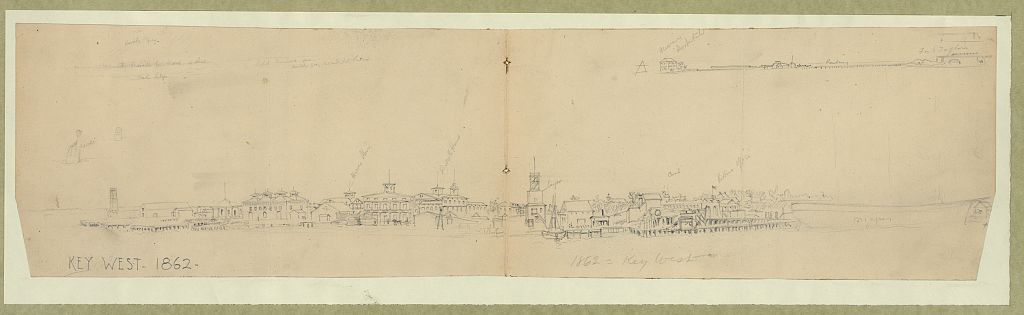
Alfred Waud’s 1862 sketch of Fort Taylor and Key West, Florida (U.S. Library of Congress, public domain).
Corporal James Ritter and the other members of Company F arrived in Key West in early February 1862, and were assigned with their fellow 47th Pennsylvania Volunteers to garrison Fort Taylor. During the weekend of Friday, 14 February, the 47th Pennsylvanians introduced their presence to Key West residents as the regiment paraded through the streets of the city. That Sunday, soldiers from the 47th Pennsylvania also mingled with locals by attending services at area churches.
Drilling daily in heavy artillery tactics, they also strengthened the fortifications at this federal installation. On 1 April 1862, Sergeant Augustus Eagle was promoted to the rank of second lieutenant.
In addition to their exhausting military duties, the 47th Pennsylvanians also encountered a persistent and formidable foe—disease. Multiple members of the regiment fell ill, largely due to poor sanitary conditions and water quality. As a result, several members of the regiment were discharged on surgeons’ certificates of disability and Second Lieutenant Henry H. Bush and Private Edward Bartholomew died at Fort Taylor, respectively, on 31 March and 3 April.
But there were lighter moments as well.

Fort Taylor, Key West, Florida (Harper’s Weekly, 1864, public domain).
According to a letter penned by Henry Wharton on 27 February 1862, the regiment commemorated the birthday of former U.S. President George Washington with a parade, a special ceremony involving the reading of Washington’s farewell address to the nation (first delivered in 1796), the firing of cannon at the fort, and a sack race and other games on 22 February.
The festivities resumed two days later when the 47th Pennsylvania’s Regimental Band hosted an officers’ ball at which “all parties enjoyed themselves, for three o’clock of the morning sounded on their ears before any motion was made to move homewards.” This was then followed by a concert by the Regimental Band on Wednesday evening, 26 February.
Per Schmidt, another festive day was 4 June 1862. As the USS Niagara sailed for Boston after transferring its responsibilities as the flagship of the Union Navy squadron in that sector to the USS Potomac, the guns of fifteen warships anchored nearby issued a salute, as did the 47th Pennsylvania Volunteers. Captain Harte and F Company played a prominent role in the day’s events as they “fired 15 of the heavy casemate guns from Fort Taylor at 4 PM.”
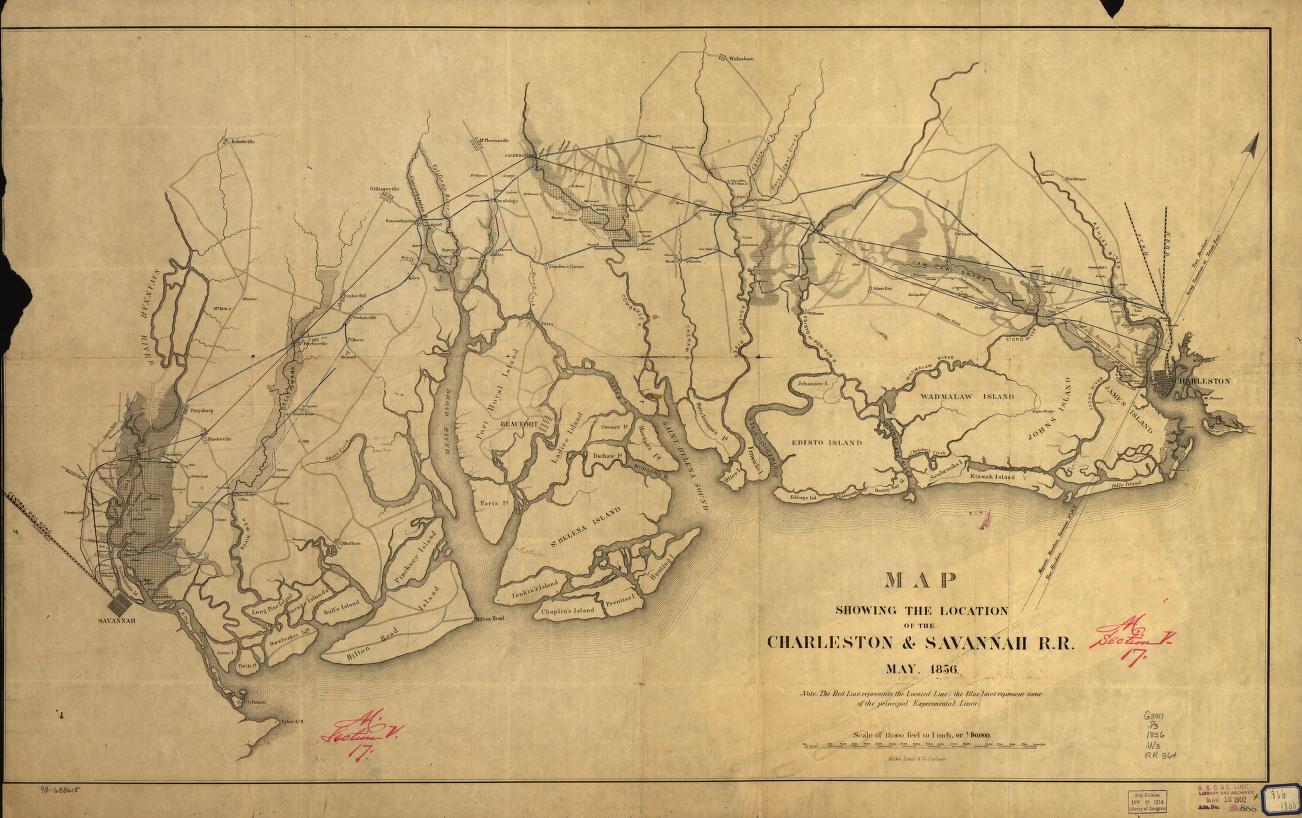
This 1856 map of the Charleston & Savannah Railroad shows the island of Hilton Head, South Carolina in relation to the towns of Beaufort and Pocotaligo (U.S. Library of Congress, public domain).
Next ordered to Hilton Head, South Carolina from mid-June through July, the 47th Pennsylvanians camped near Fort Walker before relocating to the Beaufort District in the U.S. Army’s Department of the South, roughly thirty-five miles away. Frequently assigned to hazardous picket detail north of their main camp, which put them at increased risk from enemy sniper fire, the members of the 47th Pennsylvania became known for their “attention to duty, discipline and soldierly bearing,” and “received the highest commendation from Generals Hunter and Brannan,” according to historian Samuel P. Bates.
Detachments from the regiment were also assigned to the Expedition to Fenwick Island (9 July) and the Demonstration against Pocotaligo (10 July).
During the second week of July, according to Schmidt, Major William H. Gausler and Captain Henry S. Harte returned home to the Lehigh Valley to resume their recruiting efforts. After arriving in Allentown on 15 July, they quickly re-established an efficient operation, which they would keep running through early November 1862. During this time, Major Gausler was able to persuade fifty-four new recruits to join the 47th Pennsylvania while Harte rounded up an additional twelve.
Meanwhile, back in the Deep South, Captain Harte’s F Company men were commanded by Harte’s direct subordinates, First Lieutenant George W. Fuller and Second Lieutenant August G. Eagle.
On 12 September, Colonel Tilghman Good and his adjutant, First Lieutenant Washington H. R. Hangen, issued Regimental Order No. 207 from the 47th Pennsylvania’s Headquarters in Beaufort, South Carolina:
I. The Colonel commanding desires to call the attention of all officers and men in the regiment to the paramount necessity of observing rules for the preservation of health. There is less to be apprehended from battle than disease. The records of all companies in climate like this show many more casualties by the neglect of sanitary post action then [sic] by the skill, ordnance and courage of the enemy. Anxious that the men in my command may be preserved in the full enjoyment of health to the service of the Union. And that only those who can leave behind the proud epitaph of having fallen on the field of battle in the defense of their country shall fail to return to their families and relations at the termination of this war.
II. All the tents will be struck at 7:30 a.m. on Monday, Wednesday and Saturday of each week. The signal for this purpose will be given by the drum major by giving three taps on the drum. Every article of clothing and bedding will be taken out and aired; the flooring and bunks will be thoroughly cleaned. By the same signal at 11 a.m. the tents will be re-erected. On the days the tents are not struck the sides will be raised during the day for the purpose of ventilation.
III. The proper cooking of provisions is a matter of great importance more especially in this climate but have not yet received from a majority of officers of the regiment that attention that should be paid to it.
IV. Thereafter an officer of each company will be detailed by the commander of each company and have their names reported to these headquarters to superintend the cooking of provisions taking care that all food prepared for the soldiers is sufficiently cooked and that the meats are all boiled or seared (not fried). He will also have charge of the dress table and he is held responsible for the cleanliness of the kitchen cooking utensils and the preparation of the meals at the time appointed.
V. The following rules for the taking of meals and regulations in regard to the conducting of the company will be strictly followed. Every soldier will turn his plate, cup, knife and fork into the Quarter Master Sgt who will designate a permanent place or spot for each member of the company and there leave his plate & cup, knife and fork placed at each meal with the soldier’s rations on it. Nor will any soldier be permitted to go to the company kitchen and take away food therefrom.
VI. Until further orders the following times for taking meals will be followed Breakfast at six, dinner at twelve, supper at six. The drum major will beat a designated call fifteen minutes before the specified time which will be the signal to prepare the tables, and at the time specified for the taking of meals he will beat the dinner call. The soldier will be permitted to take his spot at the table before the last call.
VII. Commanders of companies will see that this order is entered in their company order book and that it is read forth with each day on the company parade. All commanding officers of companies will regulate daily their time by the time of this headquarters. They will send their 1st Sergeants to this headquarters daily at 8 a.m. for this purpose.
Great punctuality is enjoined in conforming to the stated hours prescribed by the roll calls, parades, drills, and taking of meals; review of army regulations while attending all roll calls to be suspended by a commissioned officer of the companies, and a Captain to report the alternate to the Colonel or the commanding officer.
At 5 a.m., Commanders of companies are imperatively instructed to have the company quarters washed and policed and secured immediately after breakfast.
At 6 a.m., morning reports of companies request [sic] by the Captains and 1st Sgts and all applications for special privileges of soldiers must be handed to the Adjutant before 8 a.m.
By Command of Col. T. H. Good
W. H. R. Hangen Adj
In addition, First Lieutenant and Regimental Adjutant Hangen clarified the regiment’s schedule as follows:
- Reveille (5:30 a.m.) and Breakfast (6:00 a.m.)
- First and Second Calls for Guard (6:10 a.m. and 6:15 a.m.)
- Surgeon’s Call (6:30 a.m.)
- First and Second Calls for Company Drill (6:45 a.m. and 7:00 a.m.)
- Recall from Company Drill (8:00 a.m.)
- First and Second Calls for Squad Drill (9:00 a.m. and 9:15 a.m.)
- Recall from Squad Drill (10:30 a.m.) and Dinner (12:00 noon)
- Call for Non-commissioned Officers (1:30 p.m.)
- Recall for Non-commissioned Officers (2:30 p.m.)
- First and Second Calls for Squad Drills (3:15 p.m. and 3:30 p.m.)
- Recall from Squad Drill (4:30 p.m.)
- First and Second Calls for Dress Parade (5:10 p.m. and 5:15 p.m.)
- Supper (6:10 p.m.)
- Tattoo (9:00 p.m.) and Taps (9:15 p.m.)

First State Color, 47th Regiment, Pennsylvania Volunteer Infantry (presented to the regiment by Pennsylvania Governor Andrew Curtin, 20 September 1861; retired 11 May 1865, public domain).
As the one-year anniversary of the 47th Pennsylvania’s departure from the Great Keystone State dawned on 20 September, thoughts turned to home and Divine Providence as Colonel Tilghman Good issued Special Order No. 60 from the 47th’s Regimental Headquarters in Beaufort, South Carolina:
The Colonel commanding takes great pleasure in complimenting the officers and men of the regiment on the favorable auspices of today.
Just one year ago today, the organization of the regiment was completed to enter into the service of our beloved country, to uphold the same flag under which our forefathers fought, bled, and died, and perpetuate the same free institutions which they handed down to us unimpaired.
It is becoming therefore for us to rejoice on this first anniversary of our regimental history and to show forth devout gratitude to God for this special guardianship over us.
Whilst many other regiments who swelled the ranks of the Union Army even at a later date than the 47th have since been greatly reduced by sickness or almost cut to pieces on the field of battle, we as yet have an entire regiment and have lost but comparatively few out of our ranks.
Certain it is we have never evaded or shrunk from duty or danger, on the contrary, we have been ever anxious and ready to occupy any fort, or assume any position assigned to us in the great battle for the constitution and the Union.
We have braved the danger of land and sea, climate and disease, for our glorious cause, and it is with no ordinary degree of pleasure that the Colonel compliments the officers of the regiment for the faithfulness at their respective posts of duty and their uniform and gentlemanly manner towards one another.
Whilst in numerous other regiments there has been more or less jammings and quarrelling [sic] among the officers who thus have brought reproach upon themselves and their regiments, we have had none of this, and everything has moved along smoothly and harmoniously. We also compliment the men in the ranks for their soldierly bearing, efficiency in drill, and tidy and cleanly appearance, and if at any time it has seemed to be harsh and rigid in discipline, let the men ponder for a moment and they will see for themselves that it has been for their own good.
To the enforcement of law and order and discipline it is due our far fame as a regiment and the reputation we have won throughout the land.
With you he has shared the same trials and encountered the same dangers. We have mutually suffered from the same cold in Virginia and burned by the same southern sun in Florida and South Carolina, and he assures the officers and men of the regiment that as long as the present war continues, and the service of the regiment is required, so long he stands by them through storm and sunshine, sharing the same danger and awaiting the same glory.
A Regiment Victorious — and Bloodied

Earthworks surrounding the Confederate battery atop Saint John’s Bluff above the Saint John’s River in Florida (J. H. Schell, 1862, public domain).
During a return expedition to Florida beginning 30 September, the 47th joined with the 1st Connecticut Battery, 7th Connecticut Infantry, and part of the 1st Massachusetts Cavalry in assaulting Confederate forces at their heavily protected camp at Saint John’s Bluff, overlooking the Saint John’s River area. Trekking and skirmishing through roughly twenty-five miles of dense swampland and forests after disembarking from ships at Mayport Mills on 1 October, the 47th captured artillery and ammunition stores (on 3 October) that had been abandoned by Confederate forces during the bluff’s bombardment by Union gunboats.
The capture of Saint John’s Bluff followed a string of U.S. Army and Navy successes which enabled the Union to gain control over key southern towns and transportation hubs. In November 1861, the Union’s South Atlantic Blockading Squadron had established an operations base at Port Royal, South Carolina, facilitating Union expeditions to Georgia and Florida, during which U.S. troops were able to take possession of Fort Clinch and Fernandina, Florida (3-4 March 1862), secure the surrender of Fort Marion and Saint Augustine (11 March) and establish a Union Navy base at Mayport Mills (mid-March). That summer, Brigadier-General Joseph Finnegan, commanding officer of the Confederate States of America’s Department of Middle and Eastern Florida, ordered the placement of earthworks-fortified gun batteries atop Saint John’s Bluff and at Yellow Bluff nearby. Confederate leaders hoped to disable the Union’s naval and ground force operations at and beyond Mayport Mills with as many as eighteen cannon, including three eight-inch siege howitzers and eight-inch smoothbores and Columbiads (two of each).
After the U.S. gunboats Uncas and Patroon exchanged shell fire with the Confederate battery at Saint John’s Bluff on 11 September, Rebel troops were initially driven away, but then returned to the bluff. When a second, larger Union gunboat flotilla tried and failed again six days later to shake the Confederates loose, Union military leaders ordered an army operation with naval support.
Backed by U.S. gunboats Cimarron, E. B. Hale, Paul Jones, Uncas, and Water Witch that were armed with twelve-pound boat howitzers, the 1,500-strong Union Army force of Brigadier-General Brannan moved up the Saint John’s River and further inland along the Pablo and Mt. Pleasant Creeks on 1 October 1862 before disembarking and marching for Saint John’s Bluff. When the 47th Pennsylvanians reached Saint John’s Bluff with their fellow Union brigade members on 3 October 1862, they found the battery abandoned. (Other Union troops discovered that the Yellow Bluff battery was also Rebel free.)
According to Henry Wharton, “On the day following our occupation of these works the guns were dismounted and removed on board the steamer Neptune, together with the shot and shell, and removed to Hilton Head. The powder was all used in destroying the batteries.”
Meanwhile that same weekend (Friday and Saturday, 3-4 October 1862), Brigadier-General Brannan, who was quartered on board the Ben Deford as the Union expedition’s commanding officer, was busy penning reports to his superiors while also planning the next move of his expeditionary force. That Saturday, Brannan chose several officers to direct their subordinates to prepare rations and ammunition for a new foray that would take them roughly twenty miles upriver to Jacksonville. (A sophisticated hub of cultural and commercial activities with a racially diverse population of more than two thousand residents, the city had repeatedly changed hands between the Union and Confederacy until its occupation by Union forces on 12 March 1862.) Among the Union soldiers selected for this mission were 47th Pennsylvania Volunteers from Company C, Company E and Company K.
One of the first groups to depart—Company C of the 47th Pennsylvania—did so that Saturday as part of a small force made up of infantry and gunboats, the latter of which were commanded by Captain Charles E. Steedman. Their mission was to destroy all enemy boats they encountered to stop the movement of Confederate troops throughout the region. Upon arrival in Jacksonville later that same day, the infantrymen were charged by Brannan with setting fire to the office of that city’s Southern Rights newspaper. Before that action was taken, however, Captain Gobin and his subordinate, Henry Wharton, who had both been employed by the Sunbury American newspaper in Sunbury, Pennsylvania prior to the war, salvaged the pro-Confederacy publication’s printing press so that Wharton could more efficiently produce the regimental newspaper he had launched while the 47th Pennsylvania was stationed at Fort Taylor in Key West, Florida.
On Sunday, 5 October, Brannan and his detachment sailed away for Jacksonville at 6:30 a.m. Per Wharton, the weekend’s events unfolded as follows:
As soon as we had got possession of the Bluff, Capt. Steedman and his gunboats went to Jacksonville for the purpose of destroying all boats and intercepting the passage of the rebel troops across the river, and on the 5th Gen. Brannan also went up to Jacksonville in the steamer Ben Deford, with a force of 785 infantry, and occupied the town. On either side of the river were considerable crops of grain, which would have been destroyed or removed, but this was found impracticable for want of means of transportation. At Yellow Bluff we found that the rebels had a position in readiness to secure seven heavy guns, which they appeared to have lately evacuated, Jacksonville we found to be nearly deserted, there being only a few old men, women, and children in the town, soon after our arrival, however, while establishing our picket line, a few cavalry appeared on the outskirts, but they quickly left again. The few inhabitants were in a wretched condition, almost destitute of food, and Gen. Brannan, at their request, brought a large number up to Hilton Head to save them from starvation, together with 276 negroes—men, women, and children, who had sought our protection.
Receiving word soon after his arrival at Jacksonville that “Rebel steamers were secreted in the creeks up the river,” Brigadier-General Brannan ordered Captain Charles Yard of the 47th Pennsylvania’s Company E to take a detachment of one hundred men from his own company and those of the 47th’s Company K, and board the steamer Darlington “with two 24-pounder light howitzers and a crew of 25 men.” All would be under the command of Lieutenant Williams of the U.S. Navy, who would order the “convoy of gunboats to cut them out.”
According to Brigadier-General Brannan, the Union party “returned on the morning of the 9th with a Rebel steamer, Governor Milton, which they captured in a creek about 230 miles up the river and about 27 miles north [and slightly west] from the town of Enterprise.… On the return of the successful expedition after the Rebel steamers … I proceeded with that portion of my command to St. John’s Bluff, awaiting the return of the Boston.”
In his report on the matter, filed from Mount Pleasant Landing, Florida on 2 October 1862, Colonel Tilghman H. Good described the Union Army’s assault on Saint John’s Bluff:
In accordance with orders received I landed my regiment on the bank of Buckhorn Creek at 7 o’clock yesterday morning. After landing I moved forward in the direction of Parkers plantation, about 1 mile, being then within about 14 miles of said plantation. Here I halted to await the arrival of the Seventh Connecticut Regiment. I advanced two companies of skirmishers toward the house, with instructions to halt in case of meeting any of the enemy and report the fact to me. After they had advanced about three-quarters of a mile they halted and reported some of the enemy ahead. I immediately went forward to the line and saw some 5 or 6 mounted men about 700 or 800 yards ahead. I then ascended a tree, so that I might have a distinct view of the house and from this elevated position I distinctly saw one company of infantry of infantry close by the house, which I supposed to number about 30 or 40 men, and also some 60 or 70 mounted men. After waiting for the arrival of the Seventh Connecticut Volunteers until 10 o’clock, and it not appearing, I dispatched a squad of men back to the landing for a 6-pounder field howitzer which had been kindly offered to my service by Lieutenant Boutelle, of the Paul Jones. This howitzer had been stationed on a flat-boat to protect our landing. The party, however, did not arrive with the piece until 12 o’clock, in consequence of the difficulty of dragging it through the swamp. Being anxious to have as little delay as possible, I did not await the arrival of the howitzer, but at 11 a.m. moved forward, and as I advanced the enemy fled.
After reaching the house I awaited the arrival of the Seventh Connecticut and the howitzer. After they arrived I moved forward to the head of Mount Pleasant Creek to a bridge, at which place I arrived at 2 p.m. Here I found the bridge destroyed, but which I had repaired in a short time. I then crossed it and moved down on the south bank toward Mount Pleasant Landing. After moving about 1 mile down the bank of the creek my skirmishing companies came upon a camp, which evidently had been very hastily evacuated, from the fact that the occupants had left a table standing with a sumptuous meal already prepared for eating. On the center of the table was placed a fine, large meat pie still warm, from which one of the party had already served his plate. The skirmishers also saw 3 mounted men leave the place in hot haste. I also found a small quantity of commissary and quartermasters stores, with 23 tents, which, for want of transportation, I was obliged to destroy. After moving about a mile farther on I came across another camp, which also indicated the same sudden evacuation. In it I found the following articles … breech-loading carbines, 12 double-barreled shot-guns, 8 breech-loading Maynard rifles, 11 Enfield rifles, and 96 knapsacks. These articles I brought along by having the men carry them. There were, besides, a small quantity of commissary and quartermasters stores, including 16 tents, which, for the same reason as stated, I ordered to be destroyed. I then pushed forward to the landing, where I arrived at 7 p.m.
We drove the enemys [sic] skirmishers in small parties along the entire march. The march was a difficult one, in consequence of meeting so many swamps almost knee-deep.
Integration of the Regiment
On 5 and 15 October 1862, respectively, the 47th Pennsylvania made history as it became an integrated regiment, adding to its muster rolls several Black men who had escaped chattel enslavement from plantations near Beaufort, South Carolina. Among the formerly enslaved men who enlisted at this time were Bristor Gethers, Abraham Jassum and Edward Jassum.
Battle of Pocotaligo, South Carolina

Highlighted version of the U.S. Army’s map of the Pocotaligo-Coosawhatchie Expedition, South Carolina, October 22, 1862. Blue Arrow: Mackay’s Point, where the U.S. Tenth Army debarked and began its march. Blue Box: Position of Union troops (blue) and Confederate troops (red) in relation to the Pocotaligo bridge and town of Pocotaligo, the Charleston & Savannah Railroad, and the Caston and Frampton plantations (blue highlighting added by Laurie Snyder, 2023; public domain; click to enlarge).
From 21-23 October 1862, under the brigade and regimental commands of Colonel T. H. Good and Lieutenant-Colonel George W. Alexander, the 47th Pennsylvania Volunteers next engaged the heavily protected Confederate forces in and around Pocotaligo, South Carolina—including at Frampton’s Plantation and the Pocotaligo Bridge—a key piece of southern railroad infrastructure that Union leaders had ordered to be destroyed in order to disrupt the flow of Confederate troops and supplies in the region.
Harried by snipers en route to the Pocotaligo Bridge, they met resistance from an entrenched, heavily fortified Confederate battery which opened fire on the Union troops as they entered an open cotton field. Those headed toward higher ground at the Frampton Plantation fared no better as they encountered artillery and infantry fire from the surrounding forests. The Union soldiers grappled with Confederates where they found them, pursuing the Rebels for four miles as they retreated to the bridge. There, the 47th relieved the 7th Connecticut. But the enemy was just too well armed. After two hours of intense fighting in an attempt to take the ravine and bridge, depleted ammunition forced the 47th to withdraw to Mackay’s Point.
Losses for the 47th Pennsylvania were significant. Two officers and eighteen enlisted men died; an additional two officers and one hundred and fourteen enlisted were wounded.
Following their return to Hilton Head, the 47th Pennsylvania Volunteers recuperated from their wounds and resumed their normal duties. In short order, several members of the 47th were called upon to serve as the funeral honor guard for Major-General Ormsby M. Mitchel, and given the high honor of firing the salute over this grave. (Commander of the U.S. Army’s 10th Corps and Department of the South, Mitchel succumbed to yellow fever on 30 October 1862. The Mountains of Mitchel, a part of Mars’ South Pole discovered in 1846 by Mitchel as a University of Cincinnati astronomer, and Mitchelville, the first Freedmen’s town created after the Civil War, were both named after him.)
Having been ordered back to Key West on 15 November 1862, much of 1863 would be spent garrisoning federal installations in Florida as part of the 10th Corps, U.S. Department of the South. Companies A, B, C, E, G, and I would once again garrison Fort Taylor in Key West, but this time, the men from Companies D, F, H, and K, including Corporal James Ritter, would garrison Fort Jefferson, the Union’s remote outpost in the Dry Tortugas off the southern coast of Florida.
After packing their belongings at their Beaufort, South Carolina encampment and loading their equipment onto the U.S. Steamer Cosmopolitan, the officers and enlisted members of the 47th Pennsylvania Volunteer Infantry sailed toward the mouth of the Broad River on 15 December 1862, and anchored briefly at Port Royal Harbor in order to allow the regiment’s medical director, Elisha W. Baily, M.D., and members of the regiment who had recuperated enough from their Pocotaligo-related battle injuries at the Union’s General Hospital at Hilton Head, to rejoin the regiment.
At 5 p.m. that same evening, the regiment sailed for Florida, during what was later described by several members of the regiment as a treacherous and nerve-wracking voyage. According to Schmidt, the ship’s captain “steered a course along the coast of Florida for most of the voyage,” which made the voyage more precarious “because of all the reefs.” On 16 December “the second night, the ship was jarred as it ran aground on one during a storm, but broke free, and finally steered a course further from shore, out in the Gulf Stream.”
In a letter penned to the Sunbury American on 21 December, Henry Wharton provided the following details about the regiment’s trip:
On the passage down, we ran along almost the whole coast of Florida. Rather a dangerous ground, and the reefs are no playthings. We were jarred considerably by running on one, and not liking the sensation our course was altered for the Gulf Stream. We had heavy sea all the time. I had often heard of ‘waves as big as a house,’ and thought it was a sailor’s yarn, but I have seen ‘em and am perfectly satisfied; so now, not having a nautical turn of mind, I prefer our movements being done on terra firma, and leave old neptune to those who have more desire for his better acquaintance. A nearer chance of a shipwreck never took place than ours, and it was only through Providence that we were saved. The Cosmopolitan is a good river boat, but to send her to sea, loadened [sic, loaded] with U.S. troops is a shame, and looks as though those in authority wish to get clear of soldiers in another way than that of battle. There was some sea sickness on our passage; several of the boys ‘casting up their accounts’ on the wrong side of the ledger.
According to Corporal George Nichols of Company E, “When we got to Key West the Steamer had Six foot of water in her hole [sic]. Waves Mountain High and nothing but an old river Steamer. With Eleven hundred Men on I looked for her to go to the Bottom Every Minute.”
Although the Cosmopolitan arrived at the Key West Harbor on Thursday, 18 December, the 47th Pennsylvania Volunteers did not set foot on Florida soil until noon the next day. The men from Companies C and I were immediately marched to Fort Taylor, where they were placed under the command of Major William Gausler, the regiment’s third-in-command. The men from Companies B and E were assigned to the older barracks that had been erected by the United States Army, and were placed under the command of B Company Captain Emanuel P. Rhoads while the men from Companies A and G were placed under the command of A Company Captain Richard A. Graeffe, and stationed at newer facilities known as the “Lighthouse Barracks” on “Lighthouse Key.”

Fort Jefferson (Harper’s Weekly, 26 August 1865, public domain).
On Saturday, 21 December, Lieutenant-Colonel G. W. Alexander, the regiment’s second-in-command, sailed away aboard the Cosmopolitan with the men from the regiment’s remaining companies—Companies D, F, H, and K—and headed south to Fort Jefferson, where they would assume garrison duties at the Union’s remote outpost in the Dry Tortugas, roughly seventy miles off the coast of Florida (in the Gulf of Mexico). According to Henry Wharton:
We landed here on last Thursday at noon, and immediately marched to quarters. Company I. and C., in Fort Taylor, E. and B. in the old Barracks, and A. and G. in the new Barracks. Lieut. Col. Alexander, with the other four companies proceeded to Tortugas, Col. Good having command of all the forces in and around Key West. Our regiment relieves the 90th Regiment N.Y.S. Vols. Col. Joseph Morgan, who will proceed to Hilton Head to report to the General commanding. His actions have been severely criticized by the people, but, as it is in bad taste to say anything against ones [sic, one’s] superiors, I merely mention, judging from the expression of the citizens, they were very glad of the return of the 47th Pennsylvania Volunteers….
Key West has improved very little since we left last June, but there is one improvement for which the 90th New York deserve a great deal of praise, and that is the beautifying of the ‘home’ of dec’d. soldiers. A neat and strong wall of stone encloses the yard, the ground is laid off in squares, all the graves are flat and are nicely put in proper shape by boards eight or ten inches high on the ends sides, covered with white sand, while a head and foot board, with the full name, company and regiment, marks the last resting place of the patriot who sacrificed himself for his country….
1863
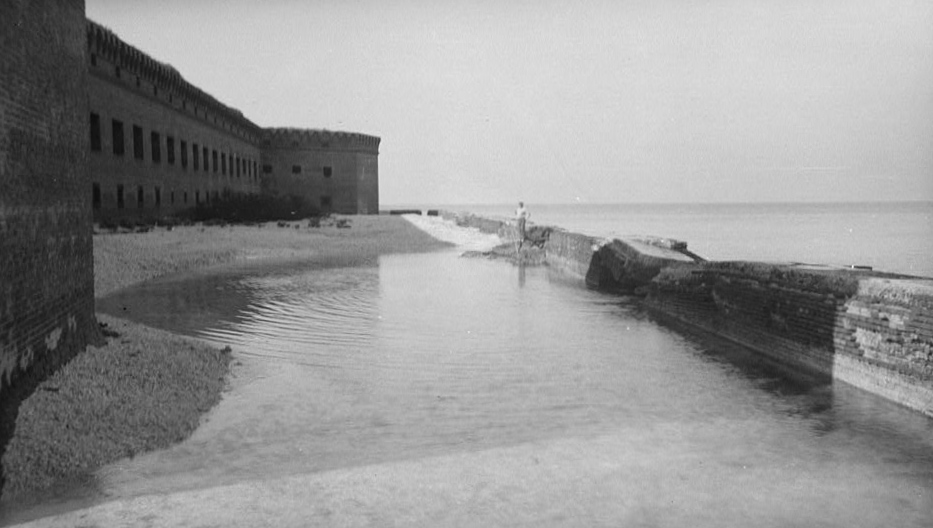
Fort Jefferson’s moat and wall, circa 1934, Dry Tortugas, Florida (C. E. Peterson, Library of Congress; public domain)
Although water quality was a challenge for members of the regiment at both of their Florida duty stations throughout 1863, it was particularly problematic for Corporal James Ritter and the other 47th Pennsylvanians who were stationed at Fort Jefferson. According to Schmidt:
‘Fresh’ water was provided by channeling the rains from the fort’s barbette through channels in the interior walls, to filter trays filled with sand; and finally to the 114 cisterns located under the fort which held 1,231,200 gallons of water. The cisterns were accessible in each of the first level cells or rooms through a ‘trap hole’ in the floor covered by a temporary wooden cover…. Considerable dirt must have found its way into these access points and was responsible for some of the problems resulting in the water’s impurity…. The fort began to settle and the asphalt covering on the outer walls began to deteriorate and allow the sea water (polluted by debris in the moat) to penetrate the system…. Two steam condensers were available … and distilled 7000 gallons of tepid water per day for a separate system of reservoirs located in the northern section of the parade ground near the officers [sic, officers’] quarters. No provisions were made to use any of this water for personal hygiene of the [planned 1,500-soldier garrison force]….
As a result, the soldiers stationed there washed themselves and their clothes, using saltwater from the ocean. As if that weren’t difficult enough, “toilet facilities were located outside of the fort,” according to Schmidt:
At least one location was near the wharf and sallyport, and another was reached through a door-sized hole in a gunport, and a walk across the moat on planks at the northwest wall…. These toilets were flushed twice each day by the actions of the tides, a procedure that did not work very well and contributed to the spread of disease. It was intended that the tidal flush should move the wastes into the moat, and from there, by similar tidal action, into the sea. But since the moat surrounding the fort was used clandestinely by the troops to dispose of litter and other wastes … it was a continuous problem for Lt. Col. Alexander and his surgeon.
As for daily operations in the Dry Tortugas, there was a fort post office and the “interior parade grounds, with numerous trees and shrubs in evidence, contained … officers quarters, [a] magazine, kitchens and out houses,” per Schmidt, as well as “a ‘hot shot oven’ which was completed in 1863 and used to heat shot before firing.”
Most quarters for the garrison … were established in wooden sheds and tents inside the parade [grounds] or inside the walls of the fort in second-tier gun rooms of ‘East’ front no. 2, and adjacent bastions … with prisoners housed in isolated sections of the first and second tiers of the southeast, or no. 3 front, and bastions C and D, located in the general area of the sallyport. The bakery was located in the lower tier of the northwest bastion ‘F’, located near the central kitchen….
Additional Duties: Diminishing Florida’s Role as the “Supplier of the Confederacy”
On top of the strategic role played by the 47th Pennsylvania Volunteers in preventing foreign powers from assisting the Confederate Army and Navy in gaining control over federal forts in the Deep South, members of this regiment would also be called upon to play an ongoing role in weakening Florida’s abilities to supply and transport food and troops throughout the area held by the Confederate States of America.
Prior to intervention by Union Army and Navy forces, the owners of plantations and livestock ranches, as well as the operators of small, family farms across Florida, had been able to consistently furnish beef and pork, fish, fruits, and vegetables to Confederate troops stationed throughout the Deep South during the first year of the American Civil War. Large herds of cattle were raised near Fort Myers, for example, while orchard owners in the Saint John’s River area were actively engaged in cultivating large orange groves (while other types of citrus trees were easily found growing throughout the state’s wilderness areas).
The state was also a major producer of salt, which was used as a preservative for the foods. As a result, the 47th Pennsylvania Volunteers and other Union troops across Florida were ordered to capture or destroy salt manufacturing facilities in order to further curtail the enemy’s access to food.
And they would be undertaking all of these duties in conditions that were far more challenging than what many other Union Army units were experiencing up north in the Eastern Theater. The weather was frequently hot and humid as spring turned to summer, the mosquitos and other insects were an ever-present annoyance and serious threat when they were carrying tropical diseases, and there were also scorpions and snakes that put the men’s health at further risk.
Despite all of these hardships, when members of the 47th Pennsylvania Volunteer Infantry were offered the opportunity to re-enlist during the fall of 1863, more than half chose to do so, knowing full well that the fight to preserve America’s Union was not yet over.
But, despite his commitment to his regiment’s mission, Corporal James Ritter would not be among that group.
Felled by a Fearsome Foe
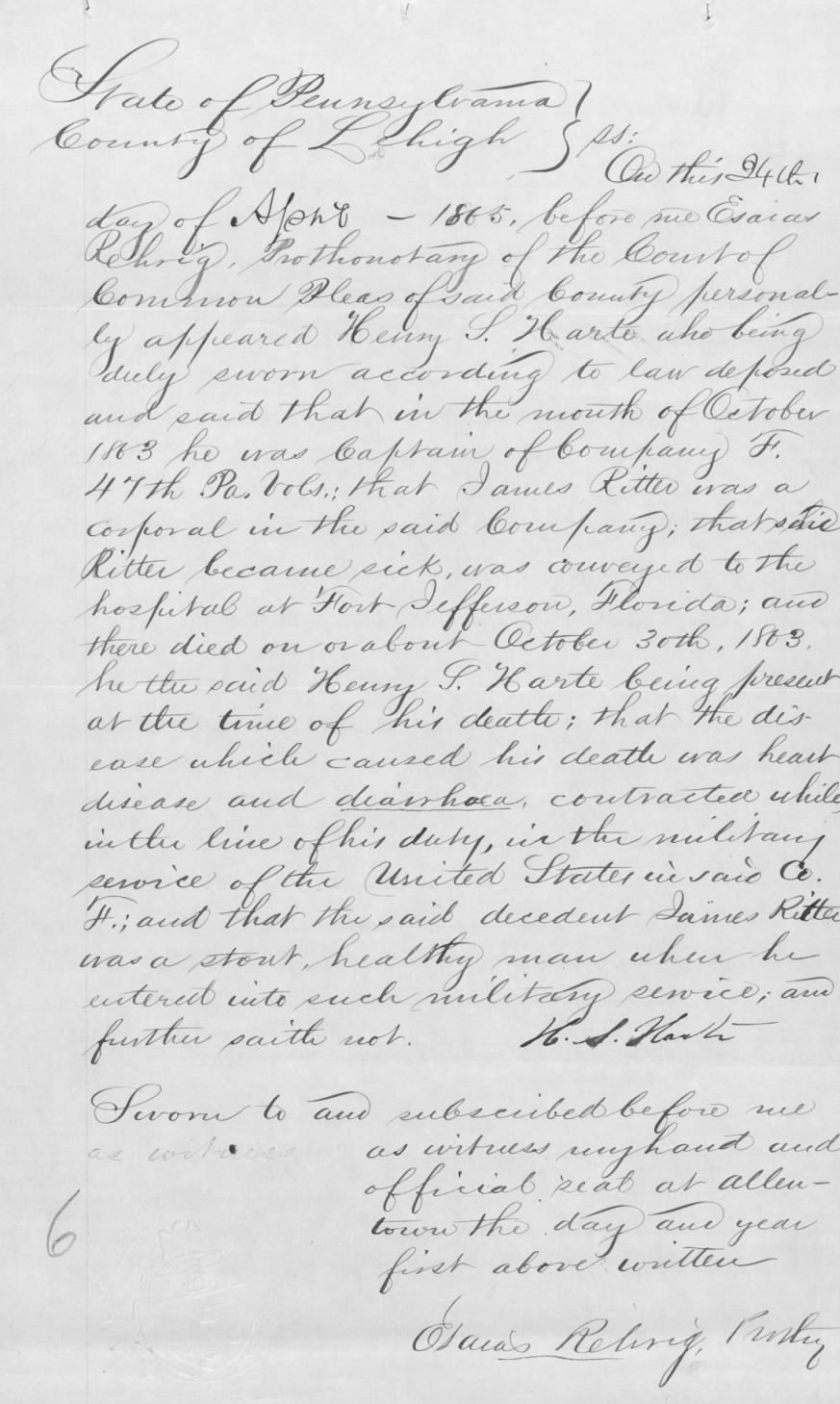
Page one of the April 1865 affidavit filed by Captain Henry Harte, Company F, 47th Pennsylvania Volunteers, which confirmed the October 1863 death of Corporal James Ritter at Fort Jefferson, Florida (U.S. Civil War Widows’ Pension Files, U.S. National Archives and Records Administration, public domain; click to enlarge).
As the heat of summer gave way to a more temperate fall, Corporal James Ritter became one of the 47th Pennsylvania Volunteers who was overtaken by illness. Diagnosed with “congestive fever”—what has been alternatively labeled as algid, pernicious or malignant malaria since that time—he was confined to the post hospital at Fort Jefferson. According to Thomas D. Coleman, A.M., M.D., a professor of medicine at the Medical College of Georgia in 1920, “Pernicious malaria [was] a grave form of chronic malaria, and its exciting cause is the plasmodium malaria.”
It always occurs in patients who give a definite history of previous malarial attacks or in those who have resided for a time in regions where malaria prevails, in which latter case the disease may have been so mild or the constitution of the individual so phlegmatic that the attack passed unnoticed. These ‘accès pernicieux’ … may supervene in apparently mild cases and carry off the patient with horrifying suddenness, as suddenly as an attack of malignant cholera.
Explanation of the method by which the various types of pernicious malaria are produced is found in the life history of the plasmodium in the living human body and the post mortem findings after death from one or other of these types, e.g. clumping of the organisms in the capillories [sic] of the cerebrum produces the comatose and [other] forms; in the region of the medulla and basal ganglia the heat regulating centers of the medulla, the algid; and the massive destruction of the red blood cells in the general circulation the haemoglobinuric….
Most of the patients with algid malaria will present the following picture, a history of definite or indefinite attacks of fever, or it may be chills and fever. There are ill-defined pains complained of in the back and limbs and sometimes headache, not infrequently with periodicity. There is a lack of inclination to exertion, either mental or physical, loss of appetite, indigestion with attacks of diarrhoea or constipation, more frequently the latter. The red blood corpuscles are diminished, as is the haemoglobin, and the mononuclear leucocytes. The heart muscle suffers in in consequence of the toxaemia, becomes flabby, and not infrequently a haemic bruit may be heard. The urine is high colored and contains an excess of urates and urobilin. The spleen is enlarged so that it frequently may be palpated below the free border of the ribs, but it is usually not tender as one so often finds in acute malaria. The liver is likewise enlarged. The tongue usually has a white or brownish coating on the dorsium, and the edges are red; sometimes it is bile tinged. The conjunctivae are yellowish with sometimes a pearly white substratum. The skin is harsh and greenish yellow. Some cases do not show jaundice but simply appear anaemic.
The attack or exacerbation comes on as stated with great suddenness usually with a chill, anorexia, nausea and vomiting and extreme prostration approximating collapse. The countenance wears an anxious expression, the features are pinched, the nose is sharp, the cheek bones prominent, the eyes sunken, and usually bright; the lips and extremities cyanotic, the nails blue; the pulse soft, small and frequent; the skin cold and clammy, the respiration labored; the voice weak. The bowels may at first be constipated, but usually a watery diarrhoea is present and there may be meteorism and abdominal tenderness….
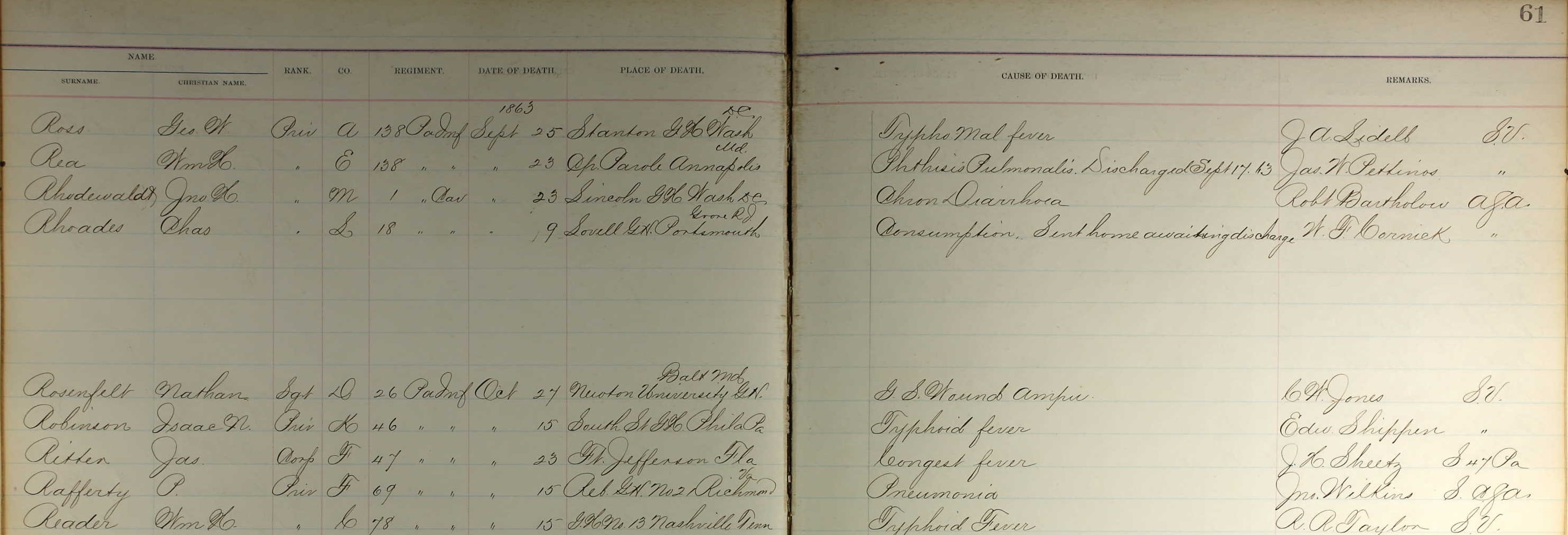
U.S. Army death ledger entry for Corporal James Ritter, Company F, 47th Pennsylvania Volunteers, by Assistant Regimental Surgeon Jacob H. Scheetz, M.D., Fort Jefferson, Florida, October 1863 (Registers of Deaths of Volunteers, U.S. National Archives and Records Administration, public domain; click to enlarge).
Although Schmidt indicated in his history of the regiment that “Cpl. James Ritter of Company F, died on Friday, October 23, from the ‘Black Vomit’ (yellow fever) and … had been admitted to the hospital with congestive fever on the day of his death,” Schmidt’s statement partially conflicts with the entry made by Regimental Assistant Surgeon Jacob H. Scheetz, M.D., in the U.S. Army death ledgers for the post hospital, which documented that Corporal Ritter died from congestive fever at the post hospital on 23 October. (Schmidt appears to have obtained this incorrect diagnosis of Ritter’s cause of death from the Pennsylvania Civil War Veterans’ Card File, which was based on the sometimes-inaccurate research and documentation that Samuel P. Bates created for his History of Pennsylvania Volunteers, 1861-5, which was published in 1869.)
Scheetz’s diagnosis of congestive fever (pernicious malaria) was later supported by an affidavit filed on 24 April 1865 by Captain Henry S. Harte, the commanding officer of F Company—and Corporal Ritter’s superior officer. Captain Harte stated that “James Ritter was a corporal in the said Company; that said Ritter became sick, was conveyed to the hospital at Fort Jefferson, Florida; and there died on or about October 30th, 1863, he the said Henry S. Harte being present at the time of his death; that the disease which caused his death was heart disease and diarrhoea, contracted while, in the line of duty, in the military service of the United States in said Co. F; and that the said decedent James Ritter was a stout, healthy man when he entered into such military service.”
Those two causes of death described by Captain Harte—heart disease and diarrhea—more closely align with the symptoms of pernicious malaria outlined in the medical journal article written by Dr. Coleman, rather than those of yellow fever.
* Further Analysis: It is also doubtful that Corporal Ritter actually had yellow fever because the disease, even today, tends to unfold over a two-week period, during which time sufferers become so ill that those around them are aware something is significantly wrong. (In a nutshell, if James Ritter had actually contracted yellow fever, Ritter would have felt so ill that he would likely have sought treatment from one of the 47th Pennsylvania’s physicians, but even if he hadn’t been motivated enough to seek help for himself, one of his superior officers would most certainly have noticed how sick he was becoming—because Ritter’s early symptoms would likely have included jaundice and an unusual lack of energy. And because those officers were charged by their superiors to closely monitor the health of their men in order to prevent major disease outbreaks, they would have undoubtedly ordered Ritter to undergo an evaluation by one of the regimental physicians to ensure that whatever was making Ritter sick would not spread to other members of his company.
Furthermore, if Ritter had been walking around with yellow fever and interacting with his fellow soldiers during the incubation and early phases of this highly contagious disease, he would very likely have infected multiple other soldiers—causing an outbreak that would have been reported in the hospital admissions and death register of the regiment and Union Army. But no such outbreak reports appear to exist. Added to this is the fact that military records for the regiment consistently documented that typhoid fever (and not yellow fever) was the 47th Pennsylvania’s primary tropical disease-related foe.
Interment of Corporal Ritter’s Remains

Report re: the return of Corporal James Ritter’s Remains to Allentown, Pennsylvania for reburial (“Todte Korper Heimgebracht, Der Lecha Caunty Patriot, 2 February 1864, public domain).
What was confirmed for certain, by Regimental Assistant Surgeon Jacob H. Scheetz, M.D., is that Corporal James Ritter died at the post hospital from congestive fever on 23 October 1863.
Initially interred “the next day on East Key by Sgt. Hutcheson,” according to Schmidt, Corporal Ritter’s body was later exhumed and returned to Lehigh County on 28 January 1864 by Paul Balliet, an undertaker from Allentown who had made several trips to Florida to bring the remains of Pennsylvania Volunteer Infantrymen back to the Keystone State for reburial. Corporal James Ritter was subsequently laid to rest in Lehigh County on 30 January of that same year.
What Happened to the Widow and Child of Private James Ritter?
Following her husband’s untimely death, Pauline (Wilt) Ritter continued to reside in Lehigh County with her daughter, Mary Jane. She was just twenty-one years old at the time that she became a single mother and head of her household.
On 4 December 1863, she filed for a U.S. Civil War Widow’s Pension in order to keep Mary Jane housed, clothed and fed.
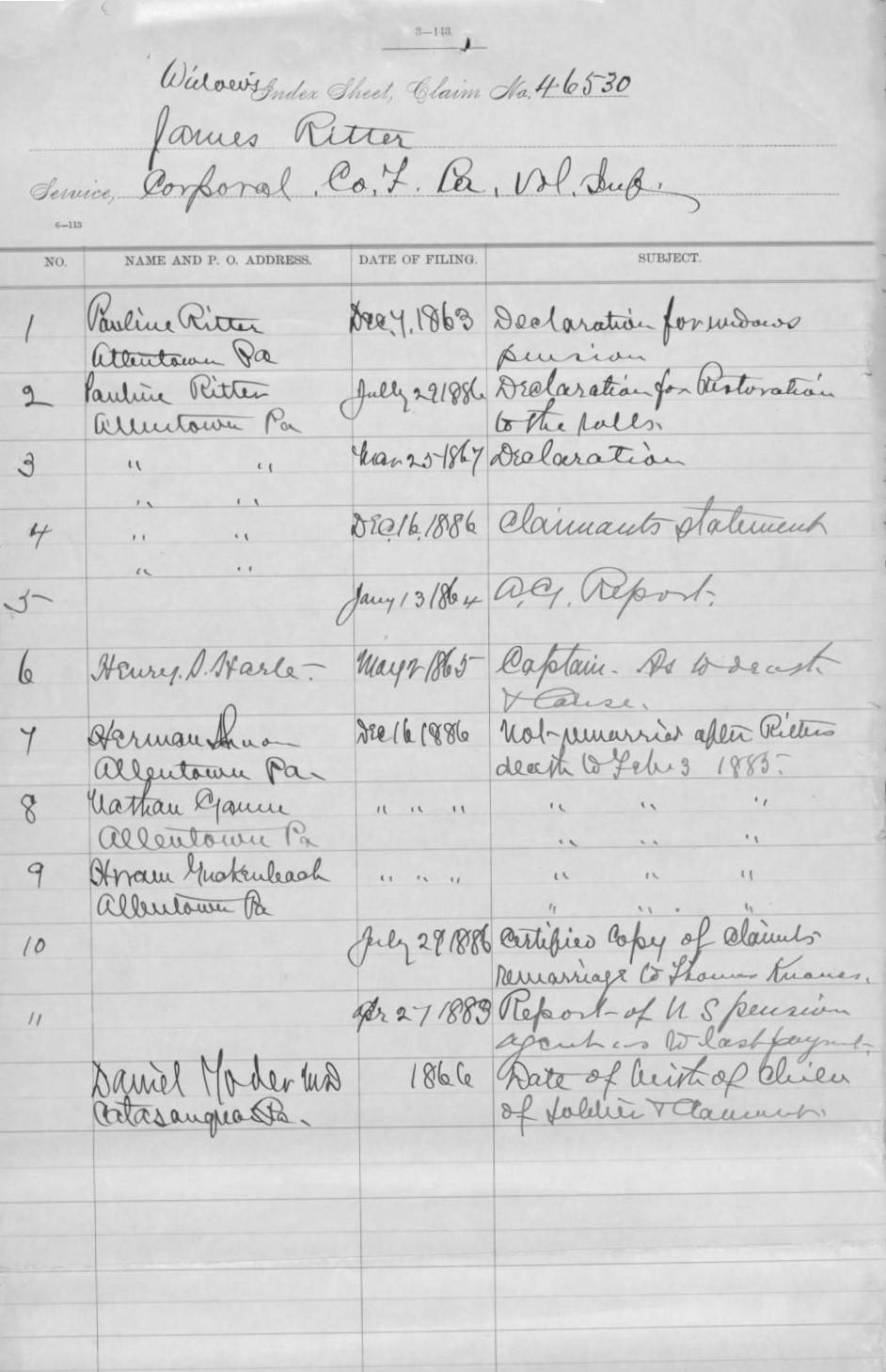
Pauline Ritter’s U.S. Civil War Widow’s Pension claim history (U.S. Civil War Widows’ Pension Files, U.S. National Archives and Records Administration, public domain click to enlarge).
The attorney she hired to assist her with what would become extensive claim-related paperwork was Edwin Albright. According to records related to that pension claim, she and her daughter were residents of the Borough of Allentown in Lehigh County at the time of her pension claim filing in 1863, and as that claim progressed through its review and eventual approval on 8 May 1865.
Her eventual pension award—eight dollars per month—was made retroactive to 30 October 1863—the date of her soldier-husband’s death. She then continued to reside in Allentown with her daughter.
On 3 February 1885, Pauline (Wilt) Ritter remarried in a ceremony that was performed by the Rev. M. H. Diefenderfer at the home of her second husband, Thomas M. Knauss (1828-1900), a veteran of the Civil War who had served with Company L of the 1st Pennsylvania Cavalry.
But the years immediately prior to, and after, that marriage were filled with worry, frustration—and embarrassment.
The Controversy
During the summer of 1879, Pauline (Will) Ritter made an unusual decision for a widow—to stop cashing her pension checks. She took this step, according to testimony that she provided for Lehigh County officials, because she had been told by several neighbors that she was not entitled to receive Civil War Pension support because she had “a suitor.”
Several years later, when she realized that she had been given incorrect information by those neighbors, she filed a claim with the U.S. Pension Bureau, on 26 July 1886, to be compensated for the back payments that she believed had rightly been due her since 1879.
On 30 November 1886, she filed an additional affidavit, in which she stated for Lehigh County officials, that she “did not draw her pension during the period from June 4, 1879 to Feb. 3, 1885 because during said period her present husband was her suitor or beau and she was told that because of said fact she could no longer draw her pension, and that being so informed by her neighbors she failed to execute her vouchers and never made inquiry of the pension office … taking it for granted that she could no longer get her pension.”
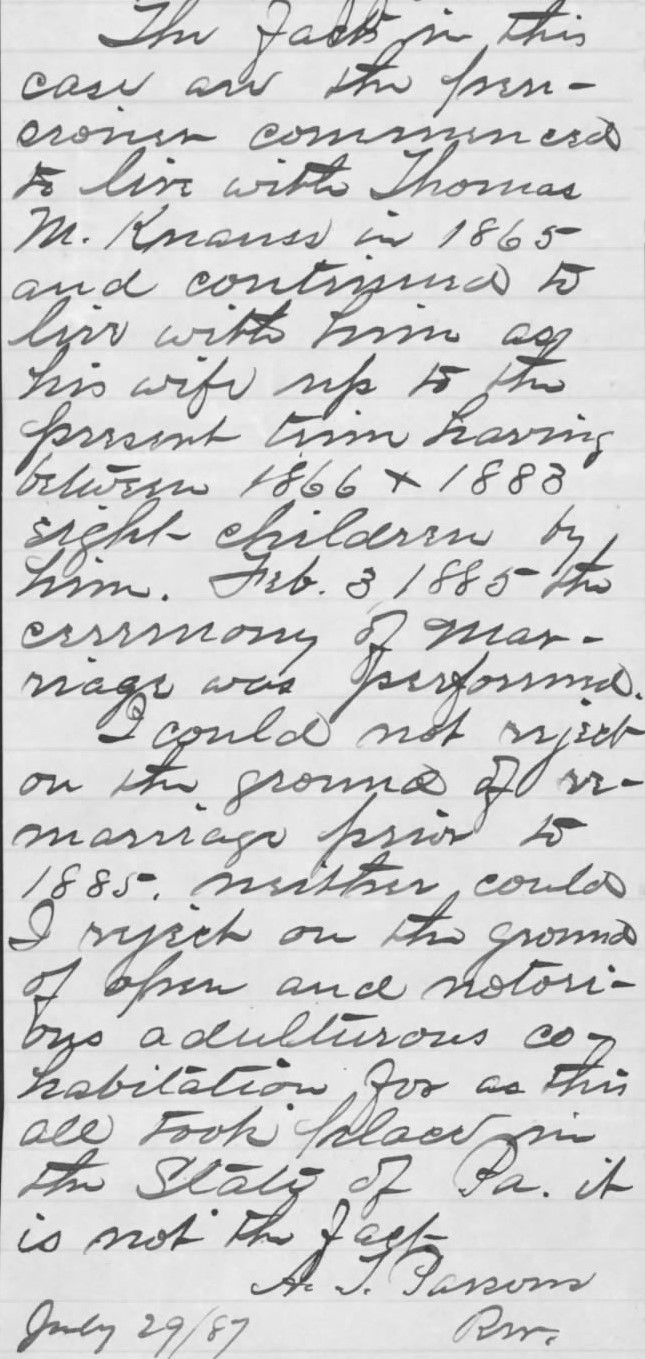
Accusation of adultery made against Pauline (Wilt Ritter) Knauss by a U.S Pension Bureau official (Pauline Ritter’s U.S. Civil War Widow’s Pension File, Restoration Claim Rejection, 1887, page 3, U.S. National Archives and Records Administration, public domain; click to enlarge).
An ugly dispute then ensued.
After the initial Pension Bureau examiner who was assigned to review the claim by Pauline (Wilt Ritter) Knauss rejected that claim, a Pension Bureau staffer assigned to re-review Pauline Ritter’s request looked into her case—and made a determination that the first examiner’s work wasn’t up to par. On 27 July 1887, that staffer of the Board of Re-Review issued this finding: “The Reviewer gives no grounds for rejecting this claim for restoration.”
Two days later, on 29 July 1887, A. T. Parsons wrote this shocking letter to the Chief of the Board of Reviewers:
The Reviewer does give grounds for rejecting claim for restoration; if a pensioner has overdrawn all pension to which she is entitled is not grounds for rejection of a claim for restoration, and sufficient ground for such action I fail to understand what can be more effective.
The facts in this case are the pensioner commenced to live with Thoman M. Knauss in 1865 and continued to live with him as his wife up to the present time having between 1866 and 1883 eight children by him. Feb. 3 1885 the ceremony of marriage was performed.
I could not reject on the grounds of remarriage prior to 1885. Neither could I reject on the ground of open and notorious adulterous cohabitation for as this all took place in the State of Pa. it is not the fact.
Parsons made these incendiary claims, despite evidence which came in the form of affidavits that had been filed by Herman Schuon, Hiram Gackenbach and Nathan Gaumer—three of Pauline (Will Ritter) Knauss’s neighbors, who stated for the record that they had all known Pauline for a long time (in Gaumer’s case, twelve years; in Schuon’s, twenty years) and knew for certain that she had not remarried since the death of her husband, Corporal James Ritter, until she wed Thomas Knauss in February 1885. They also stated that, if she had remarried before that time, they both would have known because their own homes were located so closely to hers—with Schuon going ever further by implying that he certainly would have known if Pauline had been having any kind of live-in relationship with another man.
* Note: Gackenbach (1857-1930) was also the son-in-law of Pauline (Wilt Ritter) Knauss. He had married Mary Jane Ritter, the daughter of Pauline and James Ritter circa 1880.
That first Pension Bureau claims reviewer, however, appears to have been in possession of evidence that contradicted the testimony given by Pauline’s son-in-law and neighbors. According to the federal census enumerator who visited her home in 1870, Pauline (Wilt) Ritter was already using the name of Pauline Knauss that year, and was also describing herself as the wife of Thomas Knauss and the mother of Mary Ritter (aged nine), George (aged four) and Robert (aged two). By the time of the 1880 federal census, the household she shared with Thomas Knauss had grown to include four more children: daughters Emma (aged nine), Agnes (aged eight), Effy (aged three), and Minerva (aged one).
Meanwhile, Mary Jane—her daughter from her first marriage—had begun her own married life with her new husband—Hiram Gackenbach, ultimately becoming the mother of: Frank (1881-1942), Raymond (1887-1972) and Florence Gackenbach (1895-1967). Sadly, Mary Jane’s life would prove to be a short one. She passed away in Allentown while just in her early forties. Following her death on 29 November 1902, she was laid to rest at Allentown’s Union-West End Cemetery. According to The Allentown Leader:
Mary, wife of Hiram Gackenbach, died Saturday evening after a short illness at her home at 712 Jordan Street. She was 41 years, 3 months and 15 days old. Her husband and six small children survive. The funeral service will be held on Thursday at 1:30 o’clock, Rev. C. D. Dreher officiating. Interment will be made in Union Cemetery.
Meanwhile, Pauline (Wilt Ritter) Knauss continued to soldier on. After her son John Ellsworth Knauss (1881-1922) was born on 19 August 1881, she continued to do battle with the U.S. Pension Bureau while also continuing to make a life in Allentown with her second husband and their large family well into the 1890s. She was then widowed by her second husband less than three months after the turn of the century.
Having survived the deaths of her first husband (1863), her second husband (March 1900), her daughter from her first marriage, Mary Jane (1902), and two of her sons from her second marriage—George W. Knauss (1866-1918) in 1918, and John Ellsworth Knauss (1881-1922), who had died suddenly from toxemia related to an abscessed appendix on 11 February 1922, Pauline died in Allentown from mesenteric thrombosis (a blood clot in one of her intestinal arteries) on 27 February 1922—just over two weeks after her son, John, had passed away. Subsequently buried beside her second husband at Allentown’s Greenwood Cemetery, she was survived by her daughter from her second marriage, Goldie Viola (Knauss) Landis (1883-1960).
* To view more of the key U.S. Civil War Military and Pension records related to the Ritter family, visit our James Ritter and Pauline (Wilt Ritter) Knauss Family Collection.
Sources:
- Bates, Samuel P. History of Pennsylvania Volunteers, 1861-5, vol. 1. Harrisburg, Pennsylvania: B. Singerly, State Printer, 1869.
- Coleman, Thomas D. “The Diagnosis and Treatment of Algid Malaria,” in Transactions of the American Climatological and Clinical Association, vol. 36, pp. 61-71. New York, New York: American Climatological and Clinical Association, 1920.
- “Death of Mrs. Gackenbach” (obituary of James Ritter’s daughter, Mary Jane). Allentown, Pennsylvania: The Allentown Leader, December 1902.
- Knauss, Thomas, Pauline, George, and Robert, and Ritter, Mary, in U.S. Census (Allentown, First Ward, Lehigh County, Pennsylvania, 1870). Washington, D.C.: U.S. National Archives and Records Administration.
- Knauss, Thomas, Pauline, George, Robert, Emma, Agnes, Effy, and Minerva, in U.S. Census (Allentown, Lehigh County, Pennsylvania, 1880). Washington, D.C.: U.S. National Archives and Records Administration.
- Pauline Knauss, in Death Certificates (file no.: 15329, registered no.: 219; date of death: 27 February 1922). Harrisburg, Pennsylvania: Commonwealth of Pennsylvania, Department of Health, Bureau of Vital Statistics).
- Ritter, James, in Civil War Muster Rolls (Co. F, 47th Pennsylvania Infantry). Harrisburg, Pennsylvania: Pennsylvania State Archives.
- Ritter, James, in Civil War Veterans’ Card File, 1861-1866 (Co. F, 47th Pennsylvania Infantry). Harrisburg, Pennsylvania: Pennsylvania State Archives.
- Ritter, James and Paulina, in U.S. Civil War Widows’ Pension Files. Washington, D.C.: U.S. National Archives and Records Administration.
- Schmidt, Lewis G. A Civil War History of the 47th Regiment of Pennsylvania Veteran Volunteers. Allentown, Pennsylvania: Self-published, 1986.
- “The Civil War in America: April 1861–April 1862.” Washington, D.C.: U.S. Library of Congress, retrieved online 25 February 2024.
- “Todte Körper Heimgebracht” (“Dead Bodies Brought Home”). Allentown, Pennsylvania: Der Lecha Caunty Patriot, 2 February 1864.
 47th Pennsylvania Volunteers
You must be logged in to post a comment.