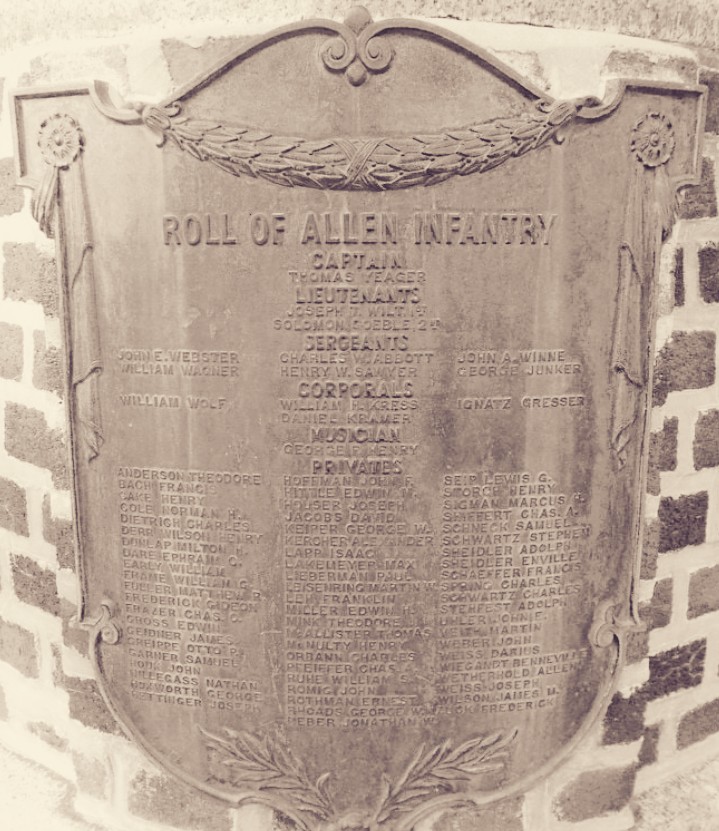
The roll of the Allen Infantry on the First Defenders Memorial that was erected in Allentown, Pennsylvania in 1917 (public domain; click to enlarge).
“Mr. Rhoads was one of the first — indeed, the very first — soldiers who arrived in Washington to save our Capitol and our Union against the forward-born Rebels. He served in the field throughout the entire war and was one of the last soldiers to return home after the Rebel General Lee had presented the victory to the Union General Grant. — He was always a faithful and brave soldier, never one of those who were cowardly, and was beloved by all his fellow soldier.” — Der Lecha Caunty Patriot, referring to George W. Rhoads, 18 June 1867
“He has the reputation of having been one of the best drilled and bravest ‘boys in blue’ in Uncle Sam’s service…. That he may retain good health, and ever be the happy and jolly ‘Colonel,’ as he is generally known, is the wish of all his many friends.” — The Allentown Democrat, referring to Allen P. Rhoads, 16 September 1903
Formative Years

Allentown (aka Northampton Towne, 1851, Frederick Wulff, public domain).
Born in Allentown, Lehigh County, Pennsylvania on 19 June 1841, Allen P. Rhoads was a son of Josiah Rhoads (1802-1853) and Hannah (Kramer) Rhoads (1805-1844) and the twin brother of Anna E. Rhoads (1841-1916), who was known to family and friends as “Annie” and would later wed Charles H. Dankel (1838-1911), who would serve with Allen in the 47th Pennsylvania Volunteer Infantry during the American Civil War — as would Allen and Annie Rhoads’ older brother, George W. Rhoads (1830-1867), who had been born on 22 February 1830.
Their siblings were: William George Rhoads (circa 1823/4/5-1825), who died in infancy or early childhood (in 1925) — before George, Allen and Annie E. Rhoads were born; Maria Rhoads (1824-1863), who had been born on 28 November 1824 and would later wed widower Reuben Guth (1813-1868), the managing editor of Allentown’s German language newspaper, Der Lecha Caunty Patriot (also known as The Lehigh Patriot); Sarah E. Rhoads (1830-1904), who had been born in 1830 and would later wed Mexican War veteran Jacob Remmel (1818-1900); Henry J. Rhoads (1833-1862), who had been born on 8 April 1833 and would later wed Catharine Anna Wolf (1832-1866); Tilghman Victor Rhoads (1835-1872), who had been born in Allentown in 1835 and would later wed Elizabeth Rebecca Breinig (1836-1916); James W. Rhoads (1837-1888), who was born on 10 June 1837 (alternate birth year: 1838) and would later wed Eliza Rebecca George (1844-1908); and Ann C. Rhoads (1839-1840), who died in infancy in 1840 and was buried at the Allentown Cemetery (later known as the Linden Street Cemetery) before Allen P. Rhoads and his twin sister, Annie E. Rhoads (1841-1916), were born.
* Note: Josiah Rhoads and his children were lineal descendants of Peter Rhoads, who reportedly “read the Declaration of Independence to the citizenry in front of the Zion Reformed Church” in Northampton Towne (later known as “Allentown”) on 8 July 1776, and later became a justice of the peace and Northampton Towne’s first burgess.
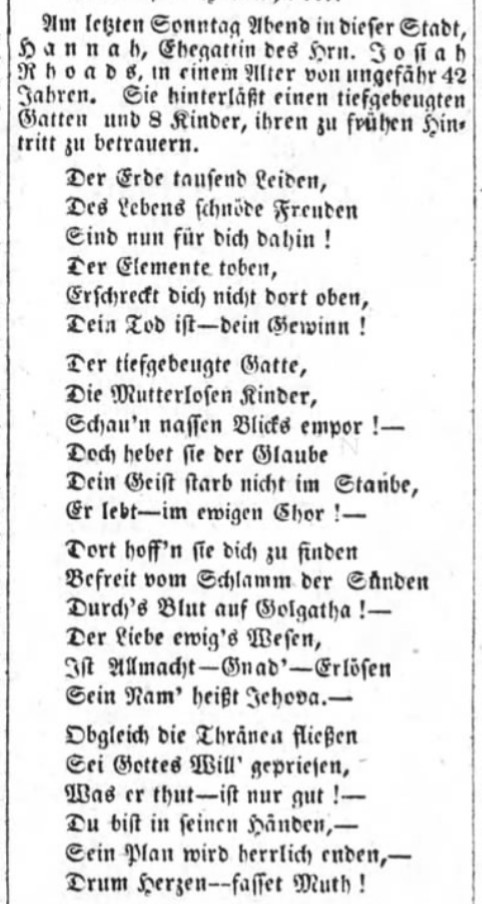
Obituary of Hannah (Kramer) Rhoads, Der Lecha Caunty Patriot, Allentown, Pennsylvania, 16 October 1844 (public domain; click to enlarge).
Tragedy then struck the Rhoads when family matriarch Hannah (Kramer) Rhoads died in Allentown on Sunday evening, 13 October 1844. Researchers for 47th Pennsylvania Volunteers: One Civil War Regiment’s Story have not yet determined her burial location, but are currently researching a theory that she was laid to rest at the Allentown Cemetery (now known as the Linden Street Cemetery). Der Lecha Caunty Patriot, which reported in its 16 October 1844 edition that Hannah was forty-two at the time of her death, also noted that she was survived by her husband, Josiah, and eight children. It also included the following:
Der Erde tausend Leiden,
Des Lebens schnöde Freuden
Sind nun für dich dahin!
Der Elemente toben,
Erschrecht dich nicht dort oben,
Dein Tod ist — dein Gewinn!Der tiefgebeugte Gatte,
Die Mutterlosen Kinder,
Schau’n nassen Blicks’ empor! —
Doch hebet sie der Glaube
Dein Geist stein nicht im Stanbe,
Er lebt — im ewigen Chor!Dort hoff’n sie dich zu finden
Befreit vom Schlamm der Sünden
Durch’s Blut auf Golgatha! —
Der Liebe ewig’s Wesen,
Ist Allmacht — Gnad’ — Erlösen
Sein Nam’ heisst Jehova. —
Obgleich die Thränea fliessen
Sei Gottes’ Will’ gepriesen,
Was er thut — ist nur gut! —
Du bist in seinen händen,
Sein Plan wird herrlich enden,
Drum herzen — fasset Muth!
Roughly translated from the original German, it said:
The earth’s thousand sorrows,
Life’s vile joys
Are now gone for you!
The elements’ raging,
Do not be dismayed in Heaven,
Your death is — your gain!The deeply bowed husband,
The motherless children,
Look up with tearful eyes! —
But faith lifts them
Your spirit does not die in death,
It lives in the eternal choir!There they hope to find you,
Freed from the mire of sins
Through the blood on Golgotha! —
Love’s eternal essence,
Is omnipotence — grace — redemption
His name is Jehovah. —Though tears may flow,
Praised be God’s will,
What He does is only good!
You are in his hands,
His plan will end gloriously,
Therefore embrace, take courage!
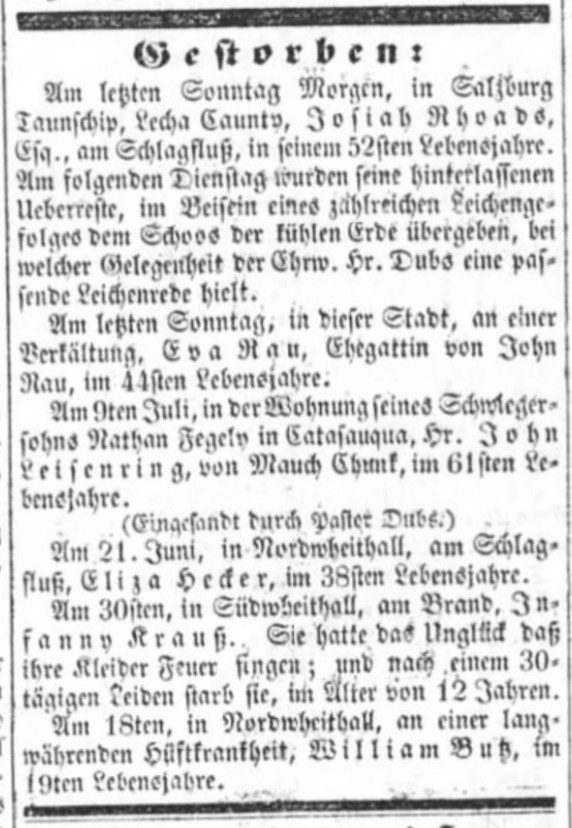
Josiah Rhoads’ death notice, Der Lecha Caunty Patriot, 20 July 1853 (public domain; click to enlarge).
The 1850s then brought more heartache with the loss of the family’s’ patriarch, Josiah Rhoads, who suffered a stroke and died on Sunday morning, 17 July 1853, at the age of fifty-two, in Salisbury Township, Lehigh County, where he had been employed as an agent involved in the sale of real estate, according to several advertisements that were published in Der Lecha Caunty Patriot during the early 1850s. His death notice, which was published in the 20 July 1853 edition of that same newspaper, reported that he was buried on Tuesday, 19 July. Although a memorial created for him on Find A Grave suggests that he was interred at what is now the Union-West End Cemetery in Allentown, that memorial may be misleading because Josiah Rhoads’ obituary did not actually include the name of the cemetery where he was buried.
* Note: Upon closer examination of Josiah Rhoads’ Find A Grave memorial, readers will see this qualifying statement: “Burial place unknown. This memorial placed with this cemetery because it has several early Rhoads burials.” Consequently, researchers for 47th Pennsylvania Volunteers: One Civil War Regiment’s Story doubt the accuracy of this memorial’s link to the Union-West End Cemetery, and believe, instead, that Josiah was likely buried elsewhere — possibly at the Allentown Cemetery (now known as the Linden Street Cemetery), which was established prior to the deaths of Josiah Rhoads’ daughter and wife, both of whom died before the Union Cemetery was established in 1854. Furthermore, Josiah Rhoads’ unmarried son, 47th Pennsylvania Veteran Volunteer George W. Rhoads, was also laid to rest at the Allentown Cemetery (in 1867) — rather than at Union-West End, where Union Army soldiers were typically interred.
As a result, researchers are continuing to search for records that will help to confirm the cemetery(ies) where Joseph and Hannah Rhoads were buried, and will update this bio if and when those records are found.
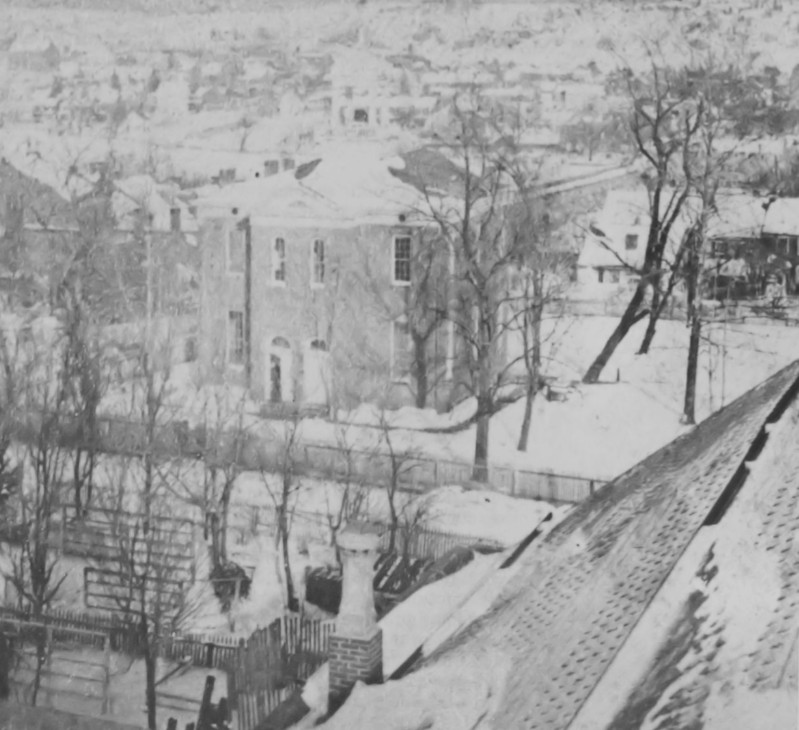
Second Ward, Allentown, Pennsylvania, winter 1860 (public domain).
By the time that the federal census of 1860 was enumerated in Allentown, the Rhoads’ siblings had splintered, and were either married and living in their own homes or unmarried and living in the homes of other area residents. Allen Rhoads’ unmarried twin sister, Annie, for example was living at the home of their older married sister, Maria (Rhoads) Guth and her husband, newspaper printer Reuben Guth, in Allentown’s Fourth Ward, while Allen’s older sister, Sarah (Rhoads) Remmel, was residing with her husband, wagoner Jacob Remmel, and their three children in Allentown’s Fifth Ward.
Meanwhile, Allen Rhoads had become “a printer in early life, serving his apprenticeship on the Allentown Democrat,” according to Allentown’s Morning Call newspaper. After working at that publication “for a number of years … he left to enter the employ of the Lehigh Patriot, a German weekly that was published in Allentown” that was also known as Der Lecha Caunty Patriot.
American Civil War — “First Defenders”
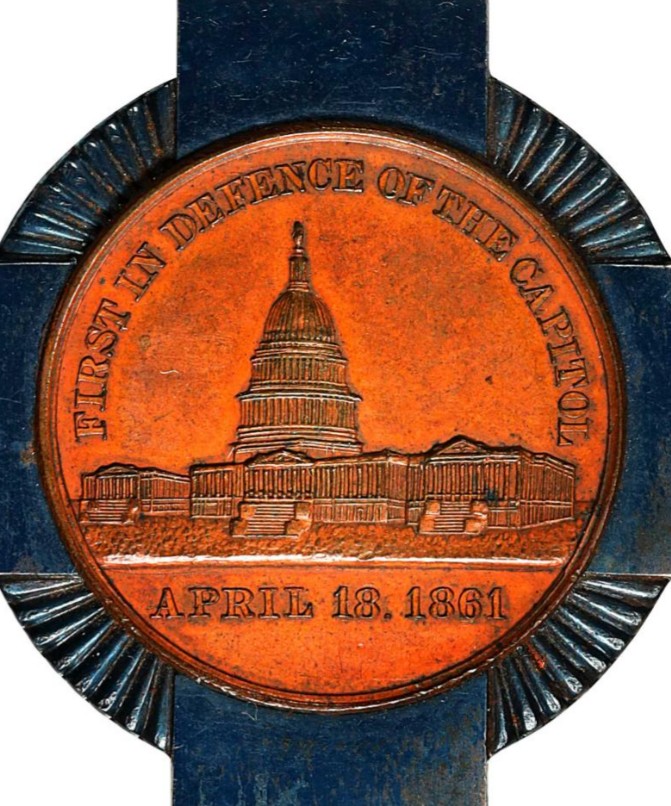
The front side of the First Defenders’ Medal awarded to all members of the Allen Infantry for their service during the first days of the American Civil War (public domain).
During the spring of 1861, at the dawn of the American Civil War, twenty-nine-year-old George W. Rhoads became a “First Defender” — a distinction which signified that he was one of the first men from Allentown to respond to President Abraham Lincoln’s call for volunteers to defend the nation’s capital following the fall of Fort Sumter in mid-April. A member of the Allen Infantry, a local militia group that was based in Allentown and was also known as the “Allen Guards,” he enrolled for military service there and then officially mustered for duty at Camp Curtin in Harrisburg, Dauphin County on 18 April 1861. Entering at the rank of private, he was assigned with his fellow Allen Infantrymen to Company G of the 25th Pennsylvania Volunteer Infantry, and continued to serve with his regiment until its honorable muster out on 26 July of that same year.
During their tenure of service, the members of the 25th Pennsylvania’s G Company were marched to Rockville, Maryland, along with the members of Companies D, F, I, and K, and were then moved to Poolsville, Maryland, where, on 1 July 1861, they were marched to Sandy Hook, which was located on the opposite side of Harper’s Ferry in what is now West Virginia. Attached to Colonel Charles P. Stone’s 7th Brigade, in Major-General Charles W. Sandford’s Third Division, they were part of the Union Army force that was commanded by Major-General Robert Patterson. Marched to Martinsburg (7-8 July 1861), the members of Company G subsequently participated in the Union Army’s advance to Bunker Hill (15 July), before making camp at Harper’s Ferry (17-23 July).
American Civil War — 47th Pennsylvania Volunteers
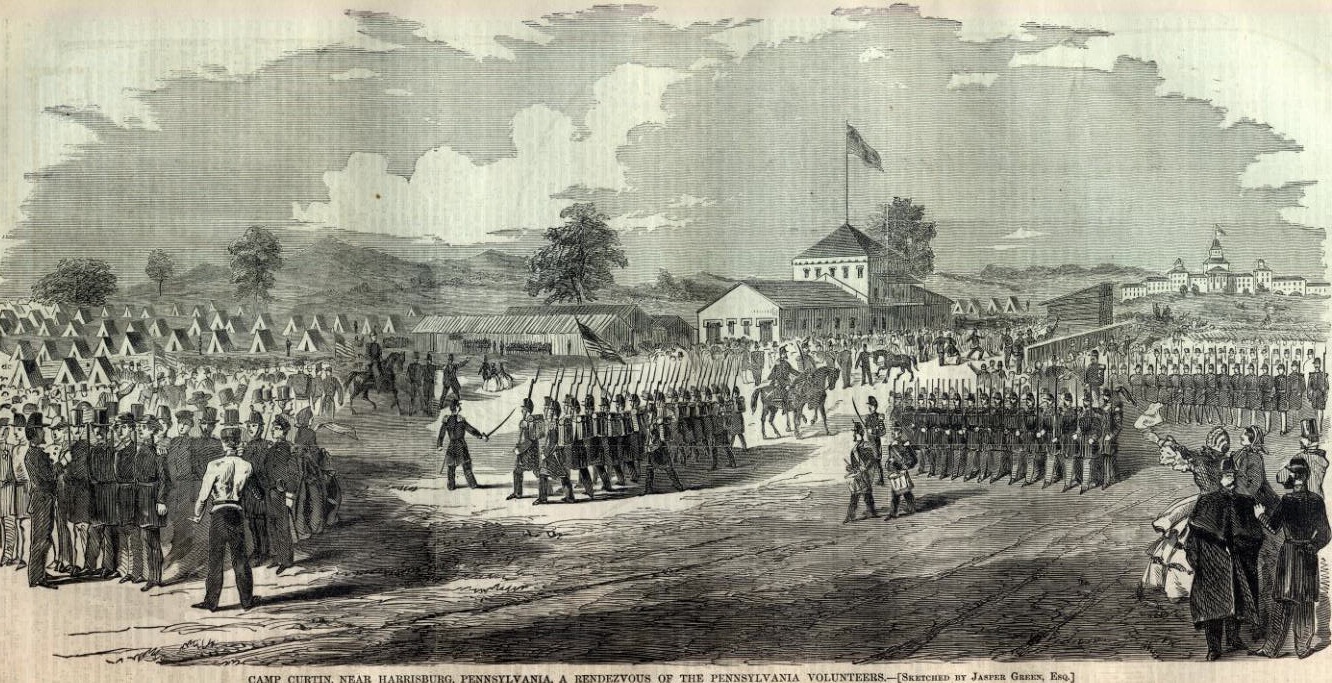
Camp Curtin (Harper’s Weekly, 1861, public domain).
Inspired by the bravery and patriotism of his older brother, George W. Rhoads, twenty-one-year-old Allen P. Rhoads then also decided it was his turn to try to save America’s union. So, he enrolled for military service in Allentown on 5 August 1861 — the same day on which the 47th Pennsylvania Volunteer Infantry was established. Roughly two weeks later, George W. Rhoads re-enlisted for a second tour of duty — in Allentown on 20 August 1861. Ten days after that, the brothers said goodbye to their family, hopped aboard a railroad car at the Allentown train station and headed for Harrisburg, where they officially mustered in at Camp Curtin on 30 August as privates with the 47th Pennsylvania, with Allen assigned to Company B and George assigned to Company I.
Military records described Allen as a twenty-one-year-old printer residing in Allentown who was five feet, ten inches tall with sandy hair, gray eyes and a dark complexion, while George was described as a twenty-nine-year-old laborer and Allentown resident who was five feet, eight inches tall with sandy hair, gray eyes and a dark complexion.

The U.S. Capitol Building, unfinished at the time of President Abraham Lincoln’s inauguration, was still not completed when the 47th Pennsylvania Volunteers arrived in Washington, D.C. in September 1861 (public domain).
Following a brief light infantry training period, the Rhoads brothers and their respective companies were sent by train with the 47th Pennsylvania to Washington, D.C., where they were stationed at “Camp Kalorama” on the Kalorama Heights near Georgetown, about two miles from the White House, beginning 21 September. Henry Wharton, a musician with the regiment’s C Company, penned the following update the next day to his hometown newspaper, the Sunbury American:
After a tedious ride we have, at last, safely arrived at the City of ‘magnificent distances.’ We left Harrisburg on Friday last at 1 o’clock A.M. and reached this camp yesterday (Saturday) at 4 P.M., as tired and worn out a sett [sic] of mortals as can possibly exist. On arriving at Washington we were marched to the ‘Soldiers Retreat,’ a building purposely erected for the benefit of the soldier, where every comfort is extended to him and the wants of the ‘inner man’ supplied.
After partaking of refreshments we were ordered into line and marched, about three miles, to this camp. So tired were the men, that on marching out, some gave out, and had to leave the ranks, but J. Boulton Young, our ‘little Zouave,’ stood it bravely, and acted like a veteran. So small a drummer is scarcely seen in the army, and on the march through Washington he was twice the recipient of three cheers.
We were reviewed by Gen. McClellan yesterday [21 September 1861] without our knowing it. All along the march we noticed a considerable number of officers, both mounted and on foot; the horse of one of the officers was so beautiful that he was noticed by the whole regiment, in fact, so wrapt [sic] up were they in the horse, the rider wasn’t noticed, and the boys were considerably mortified this morning on dis-covering they had missed the sight of, and the neglect of not saluting the soldier next in command to Gen. Scott.
Col. Good, who has command of our regiment, is an excellent man and a splendid soldier. He is a man of very few words, and is continually attending to his duties and the wants of the Regiment.
…. Our Regiment will now be put to hard work; such as drilling and the usual business of camp life, and the boys expect and hope an occasional ‘pop’ at the enemy.
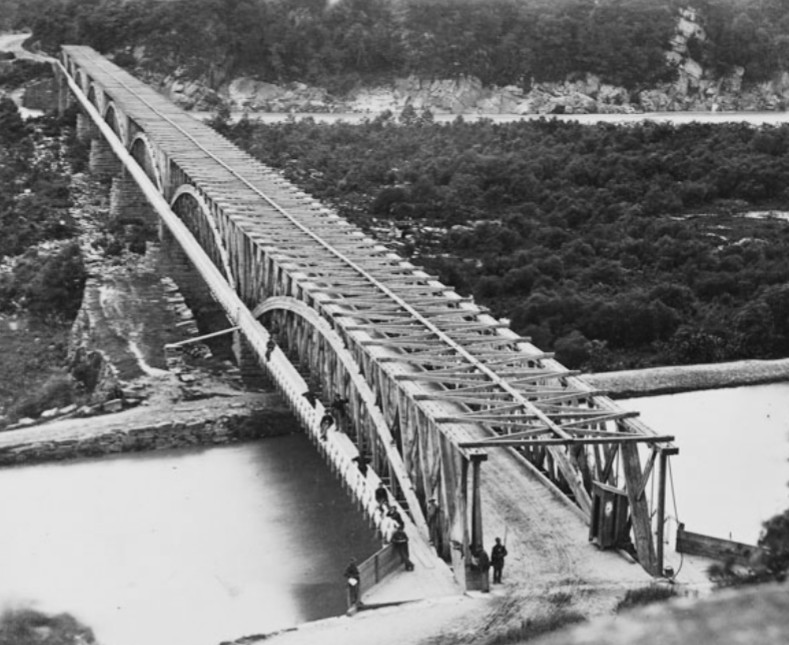
Unidentified Union soldiers guarding the Chain Bridge between Washington, D.C. and Virginia, circa 1861 (U.S. Library of Congress, public domain.
On 24 September, the Rhoads brothers and their fellow 47th Pennsylvania Volunteers became part of the federal service when the regiment officially mustered into the U.S. Army. On 27 September, the 47th Pennsylvania was assigned to the 3rd Brigade of Brigadier-General Isaac Ingalls Stevens, which also included the 33rd, 49th and 79th New York regiments. By that afternoon, the 47th Pennsylvania was on the move again. Ordered onward by Brigadier-General Silas Casey, the Mississippi rifle-armed 47th Pennsylvania infantrymen marched behind their Regimental Band until reaching Camp Lyon, Maryland on the Potomac River’s eastern shore. At 5 p.m., they joined the 46th Pennsylvania in moving double-quick (one hundred and sixty-five steps per minute using thirty-three-inch steps) across the “Chain Bridge” marked on federal maps, and continued on for roughly another mile before being ordered to make camp.
The next morning, they broke camp and moved again. Marching toward Falls Church, Virginia, they arrived at Camp Advance around dusk. There, about two miles from the bridge they had crossed a day earlier, they re-pitched their tents in a deep ravine near a new federal fort under construction (Fort Ethan Allen). They had completed a roughly eight-mile trek, were situated fairly close to the headquarters of Brigadier-General William Farrar Smith (also known as “Baldy”) and were now part of the massive Army of the Potomac (“Mr. Lincoln’s Army”). Under Smith’s leadership, their regiment and brigade would help to defend the nation’s capital from the time of their September arrival through late January when the men of the 47th Pennsylvania would be shipped south.
Once again, Company C Musician Henry Wharton recapped the regiment’s activities, noting, via his 29 September letter home to the Sunbury American, that the 47th had changed camps three times in three days:
On Friday last we left Camp Kalorama, and the same night encamped about one mile from the Chain Bridge on the opposite side of the Potomac from Washington. The next morning, Saturday, we were ordered to this Camp [Camp Advance near Fort Ethan Allen, Virginia], one and a half miles from the one we occupied the night previous. I should have mentioned that we halted on a high hill (on our march here) at the Chain Bridge, called Camp Lyon, but were immediately ordered on this side of the river. On the route from Kalorama we were for two hours exposed to the hardest rain I ever experienced. Whew, it was a whopper; but the fellows stood it well – not a murmur – and they waited in their wet clothes until nine o’clock at night for their supper. Our Camp adjoins that of the N.Y. 79th (Highlanders.)….
We had not been in this Camp more than six hours before our boys were supplied with twenty rounds of ball and cartridge, and ordered to march and meet the enemy; they were out all night and got back to Camp at nine o’clock this morning, without having a fight. They are now in their tents taking a snooze preparatory to another march this morning…. I don’t know how long the boys will be gone, but the orders are to cook two days’ rations and take it with them in their haversacks….
There was a nice little affair came off at Lavensville [sic, Lewinsville], a few miles from here on Wednesday last; our troops surprised a party of rebels (much larger than our own.) killing ten, took a Major prisoner, and captured a large number of horses, sheep and cattle, besides a large quantity of corn and potatoes, and about ninety six tons of hay. A very nice day’s work. The boys are well, in fact, there is no sickness of any consequence at all in our Regiment….

The Big Chestnut Tree, Camp Griffin, Langley, Virginia, 1861 (U.S. Library of Congress, public domain).
Sometime during that phase of duty, as part of the 3rd Brigade, the 47th Pennsylvanians were moved to a site they initially christened “Camp Big Chestnut” in reference to a large chestnut tree located nearby. The site would eventually become known to the Keystone Staters as “Camp Griffin,” and was located roughly ten miles from Washington, D.C.
On 11 October, the 47th Pennsylvania Volunteers marched in the Grand Review at Bailey’s Cross Roads. In a letter home in mid-October, Captain John Peter Shindel Gobin (the leader of C Company who would later be promoted to lead the entire 47th Regiment in 1864) reported that companies D, A, C, F and I (the 47th Pennsylvania’s right wing) were ordered to picket duty after the left-wing companies (B, G, K, E, and H) had been forced to return to camp by Confederate troops. In his letter of 13 October, Henry Wharton described their duties, as well as their new home:
The location of our camp is fine and the scenery would be splendid if the view was not obstructed by heavy thickets of pine and innumerable chesnut [sic] trees. The country around us is excellent for the Rebel scouts to display their bravery; that is, to lurk in the dense woods and pick off one of our unsuspecting pickets. Last night, however, they (the Rebels) calculated wide of their mark; some of the New York 33d boys were out on picket; some fourteen or fifteen shots were exchanged, when our side succeeded in bringing to the dust, (or rather mud,) an officer and two privates of the enemy’s mounted pickets. The officer was shot by a Lieutenant in Company H [?], of the 33d.
Our own boys have seen hard service since we have been on the ‘sacred soil.’ One day and night on picket, next day working on entrenchments at the Fort, (Ethan Allen.) another on guard, next on march and so on continually, but the hardest was on picket from last Thursday morning ‘till Saturday morning – all the time four miles from camp, and both of the nights the rain poured in torrents, so much so that their clothes were completely saturated with the rain. They stood it nobly – not one complaining; but from the size of their haversacks on their return, it is no wonder that they were satisfied and are so eager to go again tomorrow. I heard one of them say ‘there was such nice cabbage, sweet and Irish potatoes, turnips, &c., out where their duty called them, and then there was a likelihood of a Rebel sheep or young porker advancing over our lines and then he could take them as ‘contraband’ and have them for his own use.’ When they were out they saw about a dozen of the Rebel cavalry and would have had a bout with them, had it not been for…unlucky circumstance – one of the men caught the hammer of his rifle in the strap of his knapsack and caused his gun to fire; the Rebels heard the report and scampered in quick time….
On Friday, 22 October, the 47th engaged in a morning divisional review, described by historian Lewis Schmidt as massing “about 10,000 infantry, 1000 cavalry, and twenty pieces of artillery all in one big open field.”

Unknown regiment, Camp Griffin, Virginia, fall 1861 (U.S. Library of Congress, public domain).
In his letter of 17 November, Henry Wharton revealed still more details about life at Camp Griffin:
This morning our brigade was out for inspection; arms, accoutrements [sic], clothing, knapsacks, etc, all were out through a thorough examination, and if I must say it myself, our company stood best, A No. 1, for cleanliness. We have a new commander to our Brigade, Brigadier General Brannen [sic], of the U.S. Army, and if looks are any criterion, I think he is a strict disciplinarian and one who will be as able to get his men out of danger as he is willing to lead them to battle….
The boys have plenty of work to do, such as piquet [sic] duty, standing guard, wood-chopping, police duty and day drill; but then they have the most substantial food; our rations consist of fresh beef (three times a week) pickled pork, pickled beef, smoked pork, fresh bread, daily, which is baked by our own bakers, the Quartermaster having procured portable ovens for that purpose, potatoes, split peas, beans, occasionally molasses and plenty of good coffee, so you see Uncle Sam supplies us plentifully….
A few nights ago our Company was out on piquet [sic]; it was a terrible night, raining very hard the whole night, and what made it worse, the boys had to stand well to their work and dare not leave to look for shelter. Some of them consider they are well paid for their exposure, as they captured two ancient muskets belonging to Secessia. One of them is of English manufacture, and the other has the Virginia militia mark on it. They are both in a dilapidated condition, but the boys hold them in high estimation as they are trophies from the enemy, and besides they were taken from the house of Mrs. Stewart, sister to the rebel Jackson who assassinated the lamented Ellsworth at Alexandria. The honorable lady, Mrs. Stewart, is now a prisoner at Washington and her house is the headquarters of the command of the piquets [sic]….
Since the success of the secret expedition, we have all kinds of rumors in camp. One is that our Brigade will be sent to the relief of Gen. Sherman, in South Carolina. The boys all desire it and the news in the ‘Press’ is correct, that a large force is to be sent there, I think their wish will be gratified….
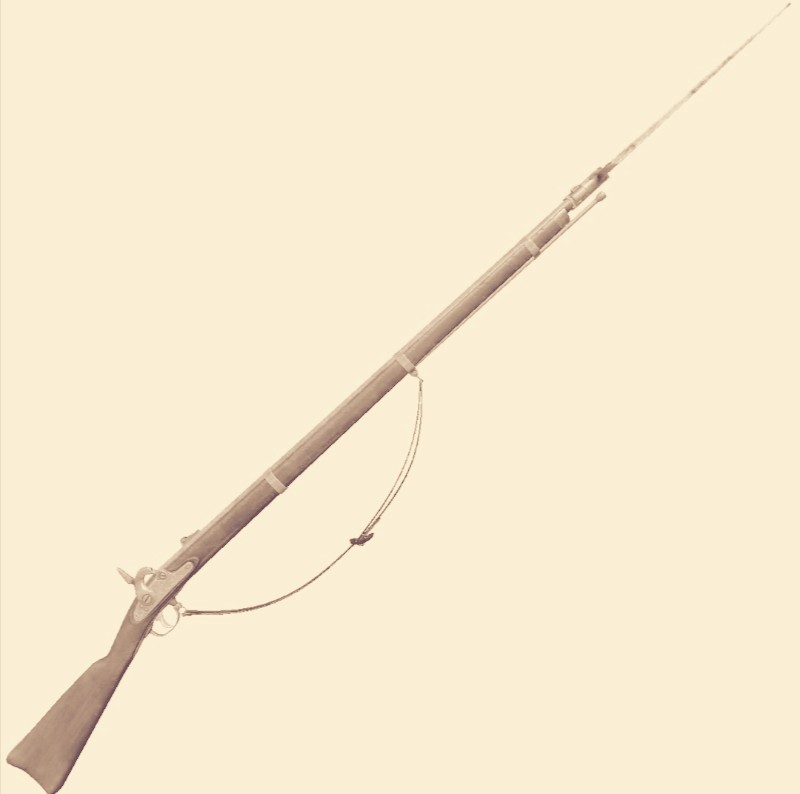
1861 Springfield rifle with attached bayonet (public domain).
On 21 November, the 47th participated in another morning divisional review, which was monitored by the regiment’s founder, Colonel Tilghman H. Good. Brigade and division drills were then held that afternoon. According to Schmidt, “each man was supplied with ten blank cartridges.” Afterward, “Gen. Smith requested Gen. Brannan to inform Col. Good that the 47th was the best regiment in the whole division. As a reward for their performance that day — and in preparation for the even bigger events which were yet to come, Brigadier-General John Milton Brannan ordered that brand new Springfield rifles be obtained for every member of the 47th Pennsylvania Volunteers.
But those frequent marches and their guard duties in rainy weather gradually began to wear the men down; more and more members of the regiment fell ill with fever and other ailments. Entirely too many died.
1862

The 47th Pennsylvania Volunteers were transported to Florida aboard the steamship Oriental in January 1862 (public domain).
Next ordered to move from their Virginia encampment back to Maryland, the 47th Pennsylvania Volunteers left Camp Griffin at 8:30 a.m. on Wednesday, 22 January 1862. Marching through deep mud with their equipment for three miles in order to reach the railroad station at Falls Church, they were then transported by train to Alexandria, where they boarded the steamship City of Richmond, and sailed the Potomac to the Washington Arsenal, where they were reequipped before being marched off for dinner and rest at the Soldiers’ Retreat in Washington, D.C.
The next afternoon, the 47th Pennsylvanians hopped cars on the Baltimore & Ohio Railroad and headed for Annapolis, Maryland. Arriving around 10 p.m., they were assigned quarters in barracks at the United States Naval Academy. They then spent that Friday through Monday (24-27 January 1862) loading their equipment and other supplies onto the steamship Oriental.
Those preparations ceased on Monday, 27 January, at 10 a.m. for a very public dismissal of one member of the regiment — I Company’s Private James C. Robinson — who was dishonorably discharged from the 47th Pennsylvania (effective 27 January 1862). According to Schmidt and letters home from members of the regiment:
The regiment was formed and instructed by Lt. Col. Amlexander ‘that we were about drumming out a member who had behaved himself unlike a soldier.’ …. The prisoner, Pvt. James C. Robinson ofThose preparations ceased on Monday, 27 January, at 10 a.m. for a very public dismissal of one member of the regiment — I Company’s Private James C. Robinson who was dishonorably discharged from the 47th Pennsylvania (effective 27 January 1862). According to Schmidt and letters home from members of the regiment: Company I, was a 36 year old miner from Allentown who had been ‘disgracefully discharged’ by order of the War Department. Pvt. Robinson was marched out with martial music playing and a guard of nine men, two men on each side and five behind him at charge bayonets. The music then struck up with ‘Robinson Crusoe’ as the procession was marched up and down in front of the regiment, and Pvt. Robinson was marched out of the yard.
Reloading then resumed. Ferried to the big steamship by smaller steamers on 27 January, the 47th Pennsylvania Volunteers commenced boarding the Oriental with the officers boarding last. Then, per the directive of Brigadier-General John Milton Brannan, they steamed away for the Deep South at 4 p.m. They were headed for Florida which, despite its secession from the Union, remained strategically important to the Union due to the presence of Fort Taylor (Key West) and Fort Jefferson (Dry Tortugas).
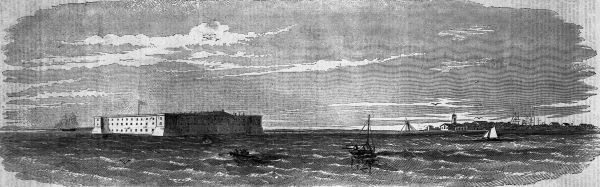
Fort Taylor, Key West, Florida, circa 1861 (courtesy, State Archives of Florida).
In February 1862, the Rhoads brothers arrived in Key West with their fellow 47th Pennsylvania Volunteers in order to garrison Fort Taylor. Initially pitching their Sibley tents on the beach after disembarking, members of the regiment were then gradually reassigned to improved quarters. During that phase of duty, they drilled daily in heavy artillery tactics and other military strategies, felled trees, helped to build new roads, and strengthened the fortifications in and around the Union Army’s presence at Key West and began to introduce themselves to locals by parading through the town’s streets during the weekend of Friday, 14 February. They also attended area church services that Sunday — a community outreach activity they would continue to perform on and off for the duration of their Key West service.
According to a letter penned by Henry Wharton on 27 February 1862, the regiment commemorated the birthday of former U.S. President George Washington with a parade, a special ceremony involving the reading of Washington’s farewell address to the nation (first delivered in 1796), the firing of cannon at the fort, and a sack race and other games on 22 February. The festivities resumed two days later when the 47th Pennsylvania’s Regimental Band hosted an officers’ ball at which “all parties enjoyed themselves, for three o’clock of the morning sounded on their ears before any motion was made to move homewards.” That was then followed by a concert by the Regimental Band on Wednesday evening, 26 February.
As the 47th Pennsylvanians soldiered on in Florida, though, many were realizing that they were operating in an environment that was far more challenging than what they had experienced to date — and in an area where the water quality was frequently poor. Disease would now be their constant companion — an unseen foe that would continue to claim the lives of multiple members of the regiment if they weren’t careful.
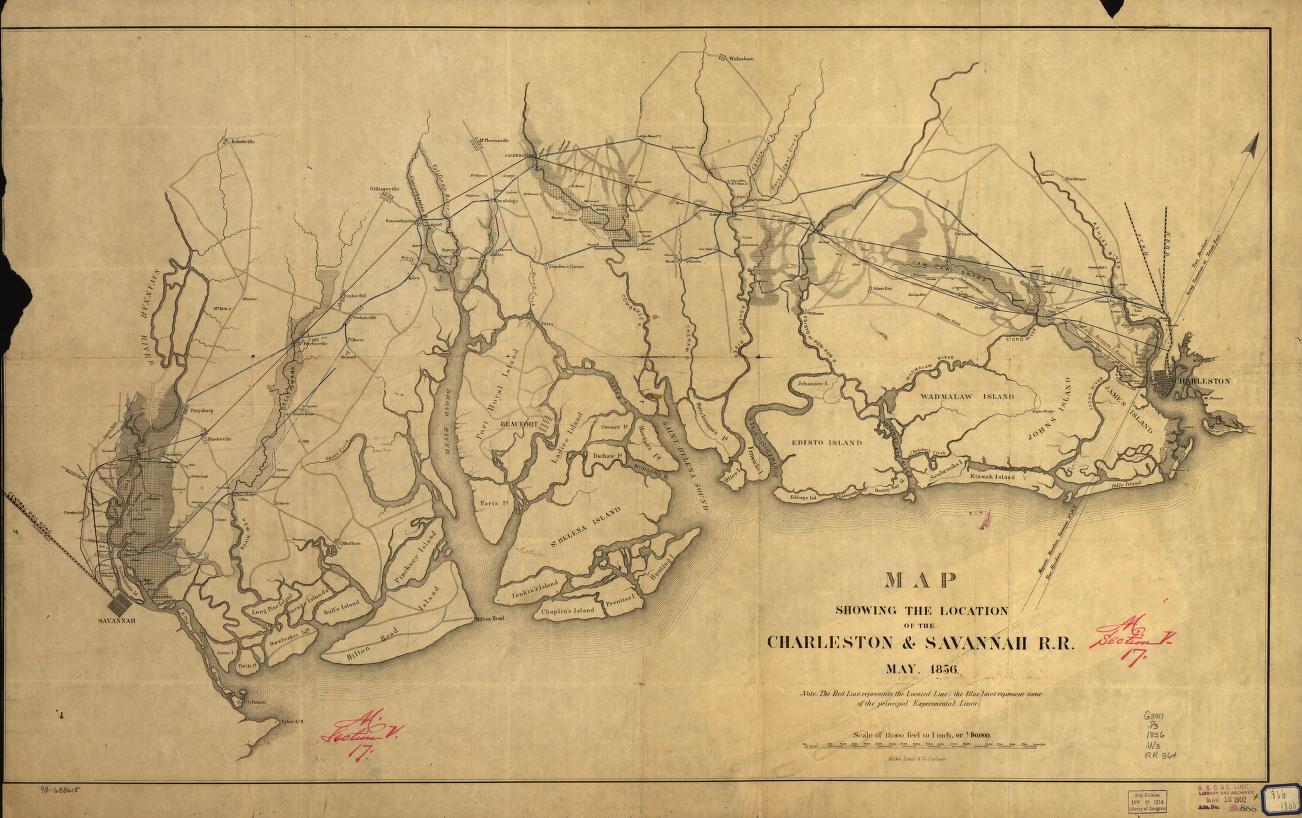
This 1856 map of the Charleston & Savannah Railroad shows the island of Hilton Head, South Carolina in relation to the towns of Beaufort and Pocotaligo (U.S. Library of Congress, public domain).
Next ordered to Hilton Head, South Carolina from mid-June through July, the Rhoads brothers and their fellow 47th Pennsylvania Volunteers camped near Fort Walker before relocating to the Beaufort District, U.S. Department of the South, roughly thirty-five miles away. Frequently assigned to hazardous picket detail north of their main camp, which put them at increased risk from enemy sniper fire, the members of the 47th Pennsylvania became known for their “attention to duty, discipline and soldierly bearing,” and “received the highest commendation from Generals Hunter and Brannan,” according to historian Samuel P. Bates.
Detachments from the regiment were also assigned to the Expedition to Fenwick Island (9 July) and the Demonstration against Pocotaligo (10 July), while men from Companies B and H “crossed the Coosaw River at the Port Royal Ferry and drove off the Rebel pickets before returning ‘home’ without a loss,” according to Schmidt. The actions were the Union’s response to the burning by Confederate troops of the ferry house at Port Royal.
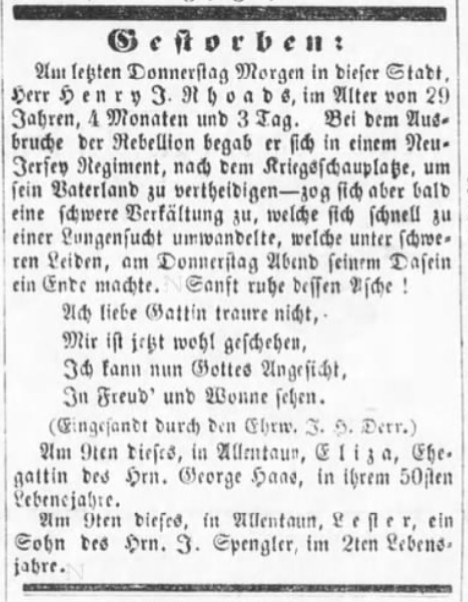
Henry J. Rhoads’ Death Notice, Der Lecha Caunty Patriot, Allentown, Pennsylvania, 17 Sep 1862 (public domain; click to enlarge).
Sadly, just months later, Privates George and Allen Rhoads would learn that their twenty-nine-year-old brother, Henry J. Rhoads (1833-1862), had died in Allentown on Thursday morning, 11 September 1862, after having contracted tuberculosis, while serving with the Union Army as a member of a volunteer regiment from New Jersey. Married to Catharine Anna Wolf (1832-1866) circa the early 1850s, Henry had welcomed the birth with her of a son, Franklin P. Rhoads (circa 1852-1861), who had died in childhood, according to data obtained from several family history websites. (Catharine would also later suffer an untimely death, passing away at the age of thirty-three in Allentown on 11 March 1866, according to those same websites — and according to her Find A Grave memorial.) Buried in Allentown, at what is now the Union-West End Cemetery, Henry J. Rhoads was eulogized a week after his death by Der Lecha Caunty Patriot in its 17 September 1862 edition:
Gestorben: Am letzten Donnerstag Morgen in dieser Stadt, Herr Henry J. Rhoads, im Alter von 29 Jahren, 4 Monaten und 3 Tag. Bei dem Ausbruche der Rebellion begab er sich in einem New Jersey Regiment, nach dem Kriegschauplasse, um sein Vaterland zu vertheidogen — zog sich aber bald eine schwere Befältung zu, welche sich schnell zu einer Lungensucht umwandelte, welche unter schweren Leiden, am Donnerstag Abend seinem Dasein eine Ende machte. Sanst ruhe dessen Leiche!
Ach liebe Gattin trauere nicht,
Mir ist jetzt wohl geschehen,
Ich fan nun Gottes Angesicht,
In Freud’ und Wonne sehen.(Eingefandt durch den Chrw. J. H. Derr.)
Roughly translated, that tribute said:
Deceased: Last Thursday morning in this city, Mr. Henry J. Rhoads, at the age of 29 years, 4 months and 3 days. At the outbreak of the Rebellion, he went to the front lines in a New Jersey regiment to defend his country — but soon contracted a severe rash, which quickly developed into tuberculosis, and which, after great suffering, brought his life to an end on Thursday evening. May he rest in peace!
Oh, dear wife, do not grieve,
I am now well,
I have now beheld God’s face,
In joy and bliss.(Submitted by the Rev. J. H. Derr.)
Saint John’s Bluff and the Capture of a Confederate Steamer

Earthworks surrounding the Confederate battery atop Saint John’s Bluff along the Saint John’s River in Florida (J. H. Schell, 1862, public domain).
During a return expedition to Florida beginning 30 September, members of the 47th Pennsylvania Volunteer Infantry joined with members of the 1st Connecticut Battery, 7th Connecticut Infantry, and part of the 1st Massachusetts Cavalry in assaulting Confederate forces at their heavily protected camp at Saint John’s Bluff, overlooking the Saint John’s River area. Trekking and skirmishing through roughly twenty-five miles of dense swampland and forests after disembarking from ships at Mayport Mills on 1 October, they subsequently captured artillery and ammunition stores (on 3 October) that had been abandoned by Confederate forces during a bombardment of the bluff by Union gunboats.
According to Henry Wharton, “On the day following our occupation of these works the guns were dismounted and removed on board the steamer Neptune, together with the shot and shell, and removed to Hilton Head. The powder was all used in destroying the batteries.”
Meanwhile that same weekend (Friday and Saturday, 3-4 October 1862), Brigadier-General Brannan, who was quartered on board the Ben Deford as the Union expedition’s commanding officer, was busy planning the next move of his expeditionary force. That Saturday, Brannan chose several officers to direct their subordinates to prepare rations and ammunition for a new foray that would take them roughly twenty miles upriver to Jacksonville. (A sophisticated hub of cultural and commercial activities with a racially diverse population of more than two thousand residents, the city had repeatedly changed hands between the Union and Confederacy until its occupation by Union forces on 12 March 1862.) Among the Union soldiers selected for that mission were 47th Pennsylvania Volunteers from Company C, Company E and Company K.
Boarding the Union gunboat Darlington (formerly a Confederate steamer), they moved upriver, along the Saint John’s, with protection from the Union gunboat Hale, ultimately traveling a distance of two hundred miles. Directed to locate and capture ships that were furnishing troops, ammunition and other supplies to Confederate Army units scattered throughout the region, the members of Company C were also ordered to set fire to the office of the Southern Rights newspaper, due to its repeated publication of pro-Confederacy propaganda, while the members of Companies E and K played a key role in capturing the Governor Milton, a Confederate steamer that had been transporting Confederate troops and military supplies throughout the region. Docked near Hawkinsville when captured, the Milton was subsequently moved back down the river and behind Union lines by members of the 47th Pennsylvania.
Integration of the Regiment
The 47th Pennsylvania also made history during the month of October 1862 as it became an integrated regiment, adding to its muster rolls several Black men who had escaped chattel enslavement from plantations near Beaufort, South Carolina. Among the formerly enslaved men who enlisted at that time were Bristor Gethers, Abraham Jassum and Edward Jassum.
Battle of Pocotaligo, South Carolina

Highlighted version of the U.S. Army map of the Coosawhatchie-Pocotaligo Expedition, 22 October 1862 (public domain).
From 21-23 October 1862, under the brigade and regimental commands of Colonel Tilghman Good and Lieutenant-Colonel George Warren Alexander, the 47th Pennsylvania Volunteers joined with other Union troops in engaging heavily protected Confederate forces in and around Pocotaligo, South Carolina, including at the Frampton Plantation and the Pocotaligo Bridge, a key piece of railroad infrastructure that senior Union military leaders felt should be eliminated.
Harried by snipers while en route to destroy the bridge, they also met resistance from Confederate artillerymen who opened fire as they entered an open cotton field. Those headed toward higher ground at the Frampton Plantation fared no better as they encountered rifle and cannon fire from the surrounding forests. But the Union soldiers would not give in. Grappling with Rebel troops wherever they found them, they pursued them for four miles as the Confederate Army retreated to the bridge. Once there, the 47th Pennsylvania relieved the 7th Connecticut.
The engagement proved to be a costly one for the 47th Pennsylvania, however, with multiple members of the regiment killed instantly or so grievously wounded that they died the next day or within weeks of the battle. Among those killed in action was Captain Charles Mickley of Company G; one of the mortally wounded was K Company Captain George Junker.
In a letter penned to friends back home in Sunbury on 27 October 1862, C Company Captain John Peter Shindel Gobin provided details about the Battle of Pocotaligo and about members of his company who had been killed or wounded:
For the first time since our terrible engagement on the main land, I find time to write you an account of the affair…. On Tuesday morning [21 October 1862] our regiment received orders for six hundred men to embark on a Transport, with two days’ rations, at 1 o’clock P.M. I selected sixty men, and embarked. Our destination was unknown, although it was the general opinion that it was the Charleston and Savannah Railroad bridges. We steamed down the river, and were all advised by. Gen. Brannan, who was on the boat with our regiment, to get as much sleep as possible. I sought my berth, and when I awoke next morning, found we were in the Broad River, opposite Mackay’s Point. A detachment of the 4th New Hampshire, sent on shore to capture the enemy’s pickets, having failed, we were ordered to disembark immediately. Eight Companies of our regiment, (the other two being on another Transport) were gotten [illegible word], and at once took up the line of march. After about three miles, we came in sight of the pickets, when we halted until joined by the 55th Pennsylvania, 6th Connecticut, and one section of the 1st U.S. Artillery. We were again ordered forward — a few of the enemy’s cavalry slowly retiring before us, until we reached a place known as Caston, where two pieces of artillery, supported by cavalry, were discovered in position in the road. — They fired two shells at us, which went wide. While our artillery ran to the front and unlimbered, our regiment was ordered forward at double quick. The enemy however left after receiving one round from our artillery, which killed one of their men. We followed them closely for about two miles, when we found their battery of six pieces, posted in a strong position at the edge of a wood, supported by infantry and cavalry.
They opened upon us immediately, which was replied to by our artillery, posted in the road. This road ran through a sweet potato field, covered with vines and brush. Our regiment was thrown in mass and deployed on my company [Company C, the flag-bearer unit], which brought my right in the road. We were ordered to charge, and with a yell the men went in. We had scarcely taken a dozen steps before we were greeted with a shower of round shot and shell from the enemy’s artillery. A round shot struck the ground fairly in front of me, covering me with sand, bounding to the right and killing the third man in the company to my right. It was followed by a shell, that gave us another shower of sand, and flew between the legs of Corporal Keefer, the man on my left, tearing his pantaloons, striking his file coverer, Billington [Samuel Billington], on the knee, and glancing and striking a man named Gensemer on Billington’s left, and bringing them to the ground, but fortunately failing to explode. Almost at the same instant Jeremiah Haas and Jno. Bartlow were struck, the former in the face and breast by a piece of shell, the latter through the leg by a cannister shot. The shower we received here was terrific. Nothing daunted, on they rushed for the battery, but it was almost impossible to get through the weeds and vines. When within a hundred yards the enemy limbered up, and retreated through the woods. We followed as rapidly as possible, but we had scarcely entered the woods, when we were again greeted with a terrific storm of shell, grape and cannister from a new position, on the other side of the woods.
Ordering my men to keep to the right of the road, we pushed forward through a wood almost impenetrable. We were at times obliged to crawl on our hands and knees. — In the meantime the enemy’s infantry opened upon us, and assisted in raking the woods. Sergeant Haupt [Peter Haupt] here received his wound. When at length we pushed through, we found ourselves separated from the enemy by an impassable swamp, about one hundred yards in width. The only means of getting over was by a narrow causeway of about twelve feet in width. Seeing this, our regiment fell back to the edge of the woods, lay down and engaged the enemy’s infantry opposite us. In the meantime two howitzers from the Wabash, [which] had been placed in position in the rear of the woods, commenced shelling the enemy, whose artillery was on the right of the road on the opposite side of the swamp. The latter replied, the shells of both parties passing over us. Our situation here was extremely critical. Exposed to the cross-fire of the contending artillery and the infantry in the front, with the limbs and tops of trees falling on and around us, it was indeed a position I never want to be placed in again. — Here, Peter Wolf, while endeavoring in company with Sergeant Brosious, Corp S. Y. Haupt and Isaac Kembel, to pick off some artillerymen, received two balls and fell dead. I had him carried five miles and buried by the side of the road. Corporal S. Y. Haupt, had the stock of his rifle shattered by a rifle ball, that embedded itself.
In about twenty minutes the fire became too hot for them, and they again “skedaddled” just as Gen. Terry’s Brigade, 75th Pennsylvania in advance, were ordered up to relieve us. They followed them up rapidly until they arrived at Pocotaligo creek, over which the rebels crossed, and tore up the bridge, and ensconced themselves behind their breastworks and in their rifle pits. — We were again ordered forward, deployed to the right, and advanced to the bank of the creek, or marsh, which was fringed by woods. We lay a short time supporting the 7th Connecticut, when their ammunition became expended, and we took the front. Here occurred the most desperate fighting of the day. The enemy were reinforced by the 26th South Carolina, which came upon the breastworks with a rush. We gave them a volley that sent them staggering, but they formed in the rear of the first line, and the two poured into us one of the most scathing, withering fires ever endured. Added to it, their artillery commenced throwing grape and cannister amongst us, but we soon drove the artillerymen from their guns, and silenced them. The colors on the left of my company attracting a very heavy fire, I ordered the Sergeant to wrap them up. — This caused quite a yell among the Confederates, but we soon changed their tune. — We fired until our ammunition was nearly expended, when we ceased. This caused the enemy’s artillery to open upon us, while the musketry continued with redoubled energy. Eight men of my company fell at this last fight. We held our position, unsupported, until dark, when we were ordered to fall back. We did so and covered the retreat. We were the first regiment in the fight, and last out of it. Our men fought like veterans, and did fearful execution among the enemy. Our loss was very heavy, losing one hundred and twelve men out of six hundred. I detailed my entire company to carry their dead and wounded comrades to the boat, which I did not reach until 4 o’clock A.M., bringing with me the last man, Billington. In consequence of having no stretchers or ambulances, we were compelled to carry our wounded in blankets. They were, however, all taken good care of.
My men fought as men accustomed to it all their life. Nothing could exceed their valor. In addition to the loss in my own company, of the color guard, composed of Corporals from other companies attached to it, all but two were struck. Every man seemed determined to win….
On 23 October, the 47th Pennsylvania headed back to Hilton Head. Just over a week later, members of the regiment were assigned to serve on the honor guard during the funeral of Major-General Ormsby M. Mitchel, commander of the U.S. Army’s 10th Corps and Department of the South. Mitchel, who had died from yellow fever at the Union Army’s hospital at Hilton Head on 30 October, had initially gained fame in 1846 as an astronomer at the University of Cincinnati, following his discovery of The Mountains of Mitchel on Mars. The town of Mitchelville, the first Freedmen’s self-governed community created after the Civil War, was also named for him.
1863

Fort Taylor, Key West, Florida (Harper’s Weekly, 1864, public domain).
Having been ordered back to Key West on 15 November 1862, the Rhoads brothers and their fellow 47th Pennsylvania Volunteers spent the year of 1863 and first two months of 1864 guarding federal installations in Florida as part of the U.S. Army’s 10th Corps (X Corps) and Department of the South. Companies A, B, C, E, G, and I were assigned to garrison Fort Taylor in Key West, under the command of Colonel Good, while Companies D, F, H, and K were placed under the command of Lieutenant-Colonel Alexander and assigned to garrison Fort Jefferson in Florida’s Dry Tortugas.
Far from being a punishment for the regiment’s recent combat performance, though, as several historians have claimed over the years, the return to Florida of the 47th Pennsylvania Volunteers was viewed by senior Union military officers as a critically important assignment because both forts were at continuing risk of attack and capture by foreign powers, as well as by Confederate States Army troops. The 47th Pennsylvania Volunteers were specifically chosen for the mission because of their “bravery and praiseworthy conduct” during the Battle of Pocotaligo,” as well as for their “attention to duty, discipline and soldierly bearing.”
Directed to weaken Florida’s abilities to supply and transport food and troops throughout the area to the Confederate States by conducting raids on cattle ranches and salt production facilities, they also prevented foreign powers from assisting the Confederate Army and Navy in gaining control key points of entry in the Deep South. Once again, though, water quality was a challenge; as a result, disease became their constant companion and most dangerous foe.
Despite the hardships they faced, though, more than half of the officers and enlisted members of the 47th Pennsylvania still opted to re-enroll that year for additional tours of duty, including Privates George W. Rhoads and Allen P. Rhoads, who re-enrolled at Fort Taylor in Key West on 8 October 1863 (alternate re-enlistment date: 10 October 1863), earning each one the coveted title of “Veteran Volunteer.”
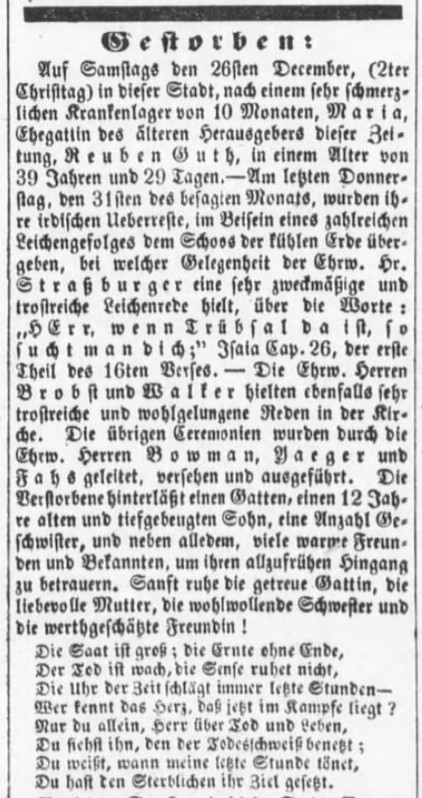
Obituary of Maria (Rhoads) Guth, Der Lecha Caunty Patriot, Allentown, Pennsylvania, 5 January 1864 (public domain; click to enlarge).
But the year ended on a sad note for the Rhoads brothers as they digested more sad news from home — another of their siblings, Maria Rhoads (1824-1863), had died the day after Christmas (a Saturday) and had been buried on New Year’s Eve at the same cemetery where many of her family members would later be interred — Allentown’s Union-West End Cemetery. Married to widower Reuben Guth (1813-1868), the managing editor of Allentown’s German language newspaper, Der Lecha Caunty Patriot, on 14 January 1851 (according to the Bucks County Intelligencer), Maria had welcomed the birth with him of a son, Morris Stanley Guth (1851-1912), who had been born in Allentown on 3 November 1851 and would later become a physician who served as the superintendent of the state mental hospital in Warren County, Pennsylvania before retiring to the city of Erie in Erie County, Pennsylvania. Maria was thirty-nine years and twenty-nine days old at the time of her passing. Her husband penned the following words for her obituary, which was published in the 5 January 1864 edition of his newspaper:
Die Saat ist gross; die Ernte ohne Ende,
Der Tod ist mach, die Sense ruhet nicht,
Die Uhr der Zeit, schlägt immer letzten Stunden —
Wer fennt das herz, das iesst im Kampfe liegt?
Nur du allein, herr über Tod und Leben,
Du siehst ihn, den der Todesichweissbenesst;
Du weisst, wann meine letzte Stunde tönet,
Du hast zen Sterblichen ihr viel gesesst.
Roughly translated, Reuben Guth’s words were:
The sowing is great; the harvest without end,
Death is swift, the scythe never rests,
The clock strikes ever shorter hours —
Who knows the heart that lies in battle?
Only you alone, lord of death and life,
You see him whom death possesses;
You know when my last hour will sound,
You have slain many a soul.
1864
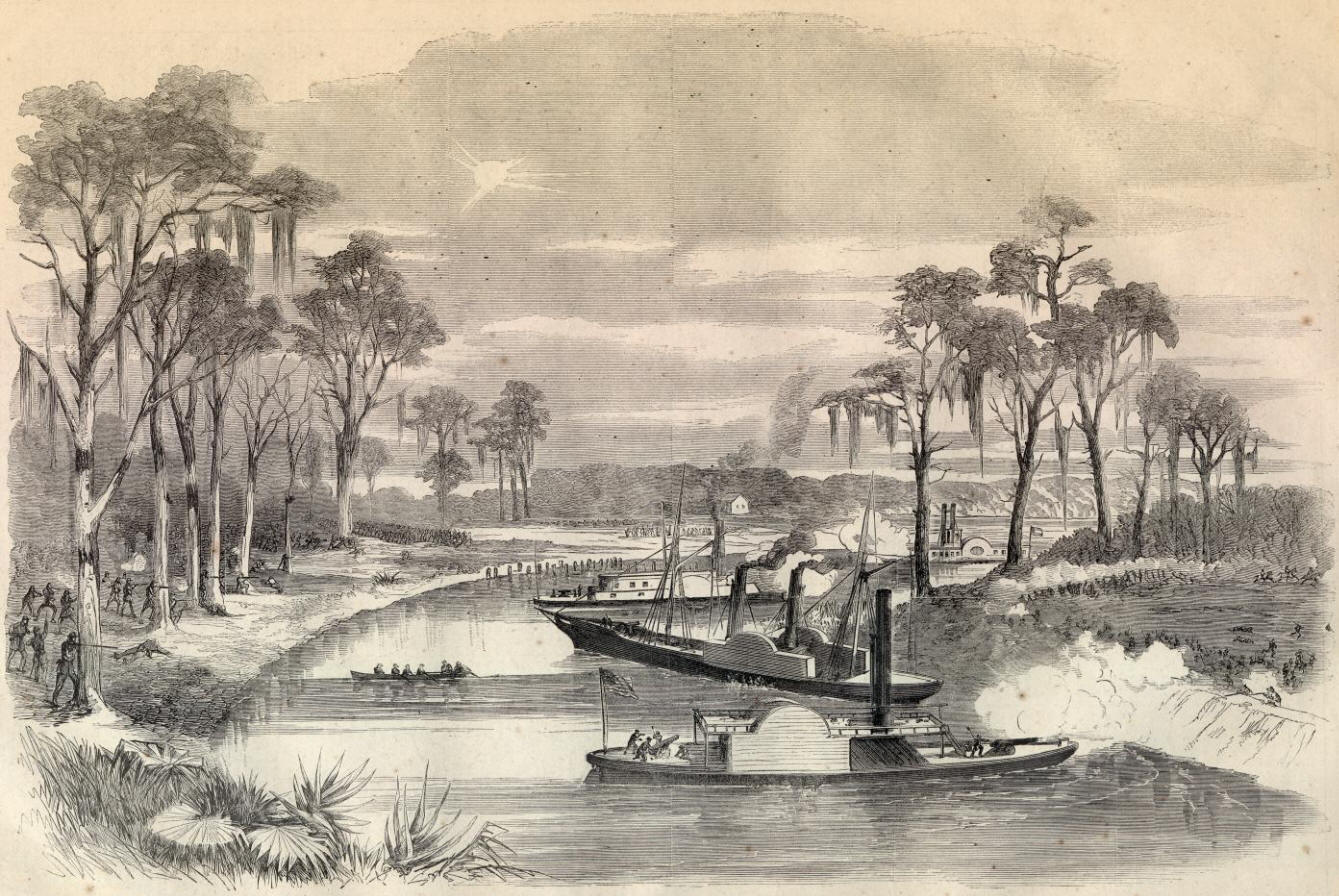
Bayou Teche, Louisiana (Harper’sWeekly, 14 February 1863, public domain).
In early January 1864, the 47th Pennsylvania Volunteer Infantry was ordered to expand the Union’s reach by sending part of the regiment north to retake possession of Fort Myers, a federal installation that had been abandoned in 1858 following the U.S. government’s third war with the Seminole Indians. Per orders issued earlier in 1864 by Major-General D. P. Woodbury, Commanding Officer, U.S. Department of the Gulf, District of Key West and the Tortugas, that the fort be reclaimed to facilitate the Union’s Gulf Coast blockade, Captain Richard Graeffe and a group of men from Company A were charged with expanding the fort and conducting raids on area cattle herds to provide food for the growing Union troop presence across Florida. Graeffe and his men subsequently turned the fort into both their base of operations and a shelter for pro-Union supporters, escaped slaves, Confederate Army deserters, and others fleeing Rebel troops.
Meanwhile, all of the other companies of the 47th Pennsylvania Volunteer Infantry were preparing for the regiment’s history-making journey to Louisiana. Boarding yet another steamer — the Charles Thomas — on 25 February 1864, the men from Companies B, C, D, I, and K headed for Algiers, Louisiana (across the river from New Orleans), followed on 1 March by other members of the regiment from Companies E, F, G, and H who had been stationed at Fort Jefferson in the Dry Tortugas.
Upon the second group’s arrival, the now almost-fully-reunited regiment moved by train on 28 February to Brashear City (now Morgan City, Louisiana) before heading to Franklin by steamer through the Bayou Teche. There, the 47th Pennsylvania Volunteer Infantry joined the 2nd Brigade, 1st Division of the Department of the Gulf’s 19th Army Corps (XIX Corps), and became the only Pennsylvania regiment to serve in the Red River Campaign of Union Major-General Nathaniel P. Banks. (Unable to reach Louisiana until 23 March, the men from Company A were effectively placed on a different type of detached duty in New Orleans while they awaited transport to enable them to catch up with the main part of their regiment. Charged with guarding and overseeing the transport of two hundred and forty-five Confederate prisoners, they were finally able to board the Ohio Belle on 7 April, and reached Alexandria, Louisiana with those prisoners on 9 April.)
Red River Campaign
The early days on the ground in Louisiana quickly woke the 47th Pennsylvania Volunteers up to just how grueling their new phase of duty would be. From 14-26 March, most members of the regiment marched for Alexandria and Natchitoches, Louisiana, by way of New Iberia, Vermilionville (now part of Lafayette), Opelousas, and Washington.
From 4-5 April 1864, the regiment added to its roster of young Black soldiers when Aaron Bullard (later known as Aaron French), James Bullard, John Bullard, Samuel Jones, and Hamilton Blanchard (also known as John Hamilton) enrolled for military service with the 47th Pennsylvania at Natchitoches. According to their respective entries in the Civil War Veterans’ Card File at the Pennsylvania State Archives and on regimental muster rolls, the men were then officially mustered in for duty on 22 June at Morganza. Several of their entries noted that they were assigned the rank of “(Colored) Cook” while others were given the rank of “Under-Cook.”
Often short on food and water throughout their long harsh-climate trek through enemy territory, the 47th Pennsylvania encamped briefly at Pleasant Hill (now the Village of Pleasant Hill) the night of 7 April before continuing on the next day.
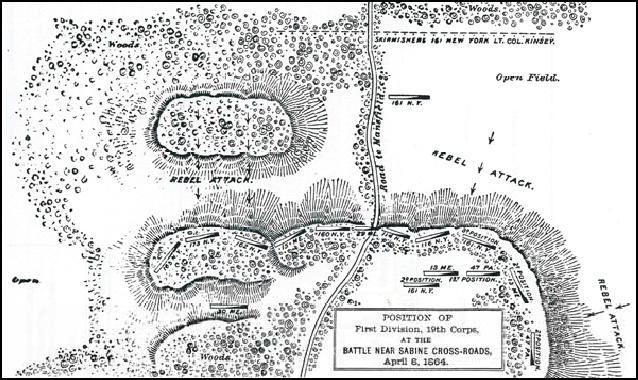
19th U.S. Army Map, Phase 3, Battle of Sabine Cross Roads/Mansfield (8 April 1864, public domain).
Rushed into battle ahead of other regiments in the 2nd Division, sixty members of the 47th were cut down on 8 April during the volley of fire unleashed in the Battle of Sabine Cross Roads (also known as the Battle of Mansfield). The fighting waned only when darkness fell as those who were uninjured collapsed beside the gravely wounded and the dead. Finally, after midnight, the surviving Union troops were ordered to withdraw to Pleasant Hill.
The next day, the 47th Pennsylvania Volunteers were ordered into a critically important defensive position at the far right of the Union lines, their right flank spreading up onto a high bluff. By 3 p.m., after enduring a midday charge by the troops of Confederate Major-General Richard Taylor (a plantation owner and son of Zachary Taylor, former president of the United States), the brutal fighting still showed no signs of ending. Suddenly, just as the 47th was shifting to the left side of the massed Union forces, the men of the 47th Pennsylvania were forced to bolster the 165th New York’s buckling lines by blocking another Confederate assault, during what has since become known as the Battle of Pleasant Hill.
Casualties were once again high. Lieutenant-Colonel Alexander was severely wounded in both legs, and the regiment’s two color-bearers, both from Company C, were also wounded while preventing the American flag from falling into enemy hands. Still others from the 47th were captured, marched roughly one hundred and twenty-five miles to Camp Ford, a Confederate Army prison camp near Tyler, Texas, and held there as prisoners of war (POWs) until released during prisoner exchanges beginning 22 July 1864. At least two men from the 47th never made it out of that camp alive; another member of the regiment died while being treated at the Confederate Army hospital in Shreveport, Louisiana.
Following what some historians have called a rout by Confederates at Pleasant Hill and others have labeled a technical victory for the Union or a draw for both sides, the 47th fell back to Grand Ecore, where the men engaged in the hard labor of strengthening regimental and brigade fortifications. After eleven days at Grand Ecore, they then moved back to Natchitoches Parish on 22 April. Marching forty-five miles that day, they arrived in Cloutierville at 10 p.m. While en route, they were attacked again — at the rear of their brigade — but were able to quickly end the encounter and continue on.

The 47th Pennsylvania Volunteers were stationed just to the left of the “Thick Woods” with Emory’s 2nd Brigade, 1st Division as shown on this map of Union troop positions for the Battle of Cane River Crossing at Monett’s Ferry, Louisiana, 23 April 1864 (Major-General Nathaniel Banks’ official Red River Campaign Report, public domain).
The next morning (23 April 1864), episodic skirmishing quickly roared into the flames of a robust fight. As part of the advance party led by Union Brigadier-General William Emory, the 47th Pennsylvanians took on the Confederate cavalry of Brigadier-General Hamilton P. Bee in the Battle of Cane River (also known as “the Affair at Monett’s Ferry” or the “Cane River Crossing”).
Responding to a barrage from the Confederate artillery’s twenty-pound Parrott guns and raking fire from enemy troops situated near a bayou and on a bluff, Brigadier-General Emory directed one of his brigades to keep Bee’s Confederates busy while sending the other two brigades to find a safe spot where his Union troops could ford the Cane River. As part of the “beekeepers,” the 47th Pennsylvania supported Emory’s artillery.
Meanwhile, other troops in Emory’s command worked their way across the Cane River, attacked Bee’s flank, forced a Rebel retreat, and erected a series of pontoon bridges, enabling the 47th and other remaining Union troops to make the Cane River Crossing by the next day. As the Confederates retreated, they torched their own food stores, as well as the cotton supplies of their fellow southerners. In a letter penned from Morganza, Louisiana on 29 May, Henry Wharton described what had happened to the 47th Pennsylvanians during and immediately after making camp at Grand Ecore:
Our sojourn at Grand Ecore was for eleven days, during which time our position was well fortified by entrenchments for a length of five miles, made of heavy logs, five feet high and six feet wide, filled in with dirt. In front of this, trees were felled for a distance of two hundred yards, so that if the enemy attacked we had an open space before us which would enable our forces to repel them and follow if necessary. But our labor seemed to the men as useless, for on the morning of 22d April, the army abandoned these works and started for Alexandria. From our scouts it was ascertained that the enemy had passed some miles to our left with the intention of making a stand against our right at Bayou Cane, where there is a high bluff and dense woods, and at the same attack Smith’s forces who were bringing up the rear. This first day was a hard one on the boys, for by ten o’clock at night they made Cloutierville, a distance of forty-five miles. On that day the rear was attacked which caused our forces to reverse their front and form in line of battle, expecting too, to go back to the relief of Smith, but he needed no assistance, sending word to the front that he had ‘whipped them, and could do it again.’ It was well that Banks made so long a march on that day, for on the next we found the enemy prepared to carry out their design of attacking us front and rear. Skirmishing commenced early in the morning and as our columns advanced he fell back towards the bayou, when we soon discovered the position of their batteries on the bluff. There was then an artillery duel by the smaller pieces, and some sharp fighting by the cavalry, when the ‘mule battery,’ twenty pound Parrott guns, opened a heavy fire, which soon dislodged them, forcing the chivalry to flee in a manner not at all suitable to their boasted courage. Before this one cavalry, the 3d Brigade of the 1st Div., and Birges’ brigade of the second, had crossed the bayou and were doing good service, which, with the other work, made the enemy show their heels. The 3d brigade done some daring deeds in this fight, as also did the cavalry. In one instance the 3d charged up a hill almost perpendicular, driving the enemy back by the bayonet without firing a gun. The woods on this bluff was so thick that the cavalry had to dismount and fight on foot. During the whole of the day, our brigade, the 2d was supporting artillery, under fire all the time, and could not give Mr. Reb a return shot.
While we were fighting in front, Smith was engaged some miles in the rear, but he done his part well and drove them back. The rebel commanders thought by attacking us in the rear, and having a large face on the bluffs, they would be able to capture our train and take us all prisoners, but in this they were mistaken, for our march was so rapid that we were on them before they had thrown up the necessary earthworks. Besides they underrated the amount of our artillery, calculating from the number engaged at Pleasant Hill. The rebel prisoners say it ‘seems as though the Yankees manufacture, on short notice, artillery to order, and the men are furnished with wings when they wish to make a certain point.
The damage done to the Confederate cause by the burning of cotton was immense. On the night of the 22d our route was lighted up for miles and millions of dollars worth of this production was destroyed. This loss will be felt more by Davis & Co., than several defeats in this region, for the basis of the loan in England was on the cotton of Western Louisiana.
After the rebels had fled from the bluff the negro troops put down the pontoons, and by ten that night we were six miles beyond the bayou safely encamped. The next morning we moved forward and in two days were in Alexandria. Johnnys followed Smith’s forces, keeping out of range of his guns, except when he had gained the eminence across the bayou, when he punished them (the rebs) severely.
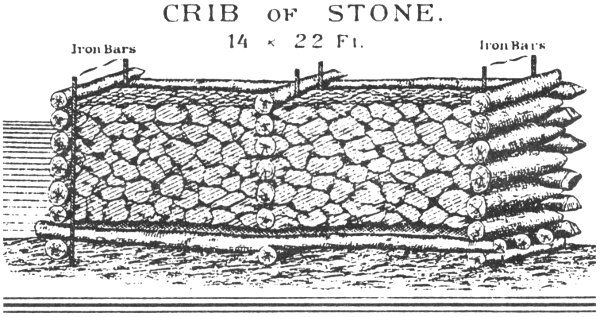
Sketches of the crib and tree dams designed by Lieutenant-Colonel Joseph Bailey to improve the water levels of the Red River near Alexandria, Louisiana, spring 1864 (Joseph Bailey, “Report on the Construction of the Dam Across the Red River,” 1865, public domain).
Having finally reached Alexandria on 26 April, the 47th Pennsylvanians learned they would remain at their latest new camp for at least two weeks. Placed temporarily under the command of Lieutenant-Colonel Joseph Bailey, they were assigned yet again to the hard labor of fortification work, helping to erect “Bailey’s Dam,” a timber structure that enabled Union gunboats to more easily make their way back down the Red River. While stationed in Rapides Parish in late April and early May, according to Wharton:
We were at Alexandria seventeen days, during which time the men were kept busy at throwing up earthworks, foraging and three times went out some distance to meet the enemy, but they did not make their appearance in numbers large enough for an engagement. The water in the Red river had fallen so much that it prevented the gunboats from operating with us, and kept our transports from supplying the troops with rations, (and you know soldiers, like other people, will eat) so Banks was compelled to relinquish his designs on Shreveport and fall back to the Mississippi. To do this a large dam had to be built on the falls at Alexandria to get the ironclads down the river. After a great deal of labor this was accomplished and by the morning of May 13th the last one was through the shute [sic], when we bade adieu to Alexandria, marching through the town with banners flying and keeping step to the music of ‘Rally around the flag,’ and ‘When this cruel war is over.’ The next morning, at our camping place, the fleet of boats passed us, when we were informed that Alexandria had been destroyed by fire – the act of a dissatisfied citizen and several negroes. Incendiary acts were strictly forbidden in a general order the day before we left the place, and a cavalry guard was left in the rear to see the order enforced. After marching a few miles skirmishing commenced in front between the cavalry and the enemy in riflepits [sic] on the bank of the river, but they were easily driven away. When we came up we discovered their pits and places where there had been batteries planted. At this point the John Warren, an unarmed transport, on which were sick soldiers and women, was fired into and sunk, killing many and those that were not drowned taken prisoners. A tin-clad gunboat was destroyed at the same place, by which we lost a large mail. Many letters and directed envelopes were found on the bank – thrown there after the contents had been read by the unprincipled scoundrels. The inhumanity of Guerrilla bands in this department is beyond belief, and if one did not know the truth of it or saw some of their barbarities, he would write it down as the story of a ‘reliable gentleman’ or as told by an ‘intelligent contraband.’ Not satisfied with his murderous intent on unarmed transports he fires into the Hospital steamer Laurel Hill, with four hundred sick on board. This boat had the usual hospital signal floating fore and aft, yet, notwithstanding all this, and the customs of war, they fired on them, proving by this act that they are more hardened than the Indians on the frontier.
On Sunday, May 15, we left the river road and took a short route through the woods, saving considerable distance. The windings of Red river are so numerous that it resembles the tape-worm railroad wherewith the politicians frightened the dear people during the administration of Ritner and Stevens. – We stopped several hours in the woods to leave cavalry pass, when we moved forward and by four o’clock emerged into a large open plain where we formed in line of battle, expecting a regular engagement. The enemy, however, retired and we advanced ‘till dark, when the forces halted for the night, with orders to rest on their arms. – ‘Twas here that Banks rode through our regiment, amidst the cheers of the boys, and gave the pleasant news that Grant had defeated Lee.

“Sleeping on Their Arms” by Winslow Homer (Harper’s Weekly, 21 May 1864).
Having entered Avoyelles Parish, they “rested on their arms” for the night, half-dozing without pitching their tents, but with their rifles right beside them. They were now positioned just outside of Marksville, Louisiana on the eve of the 16 May 1864 Battle of Mansura, which unfolded as follows, according to Wharton:
Early next morning we marched through Marksville into a prairie nine miles long and six wide where every preparation was made for a fight. The whole of our force was formed in line, in support of artillery in front, who commenced operations on the enemy driving him gradually from the prairie into the woods. As the enemy retreated before the heavy fire of our artillery, the infantry advanced in line until they reached Mousoula [sic], where they formed in column, taking the whole field in an attempt to flank the enemy, but their running qualities were so good that we were foiled. The maneuvring [sic] of the troops was handsomely done, and the movements was [sic] one of the finest things of the war. The fight of artillery was a steady one of five miles. The enemy merely stood that they might cover the retreat of their infantry and train under cover of their artillery. Our loss was slight. Of the rebels we could not ascertain correctly, but learned from citizens who had secreted themselves during the fight, that they had many killed and wounded, who threw them into wagons, promiscuously, and drove them off so that we could not learn their casualties. The next day we moved to Simmsport [sic, Simmesport] on the Achafalaya [sic, Atchafalaya] river, where a bridge was made by putting the transports side by side, which enabled the troops and train to pass safely over. – The day before we crossed the rebels attacked Smith, thinking it was but the rear guard, in which they, the graybacks, were awfully cut up, and four hundred prisoners fell into our hands. Our loss in killed and wounded was ninety. This fight was the last one of the expedition. The whole of the force is safe on the Mississippi, gunboats, transports and trains. The 16th and 17th have gone to their old commands.
It is amusing to read the statements of correspondents to papers North, concerning our movements and the losses of our army. I have it from the best source that the Federal loss from Franklin to Mansfield, and from their [sic] to this point does not exceed thirty-five hundred in killed, wounded and missing, while that of the rebels is over eight thousand.

Union Army base at Morganza Bend, Louisiana, circa 1863-1865 (U.S. Library of Congress, public domain).
Continuing on, the surviving members of the 47th marched for Simmesport and then Morganza, where they made camp again. While encamped there, the nine formerly enslaved Black men who had enlisted with the 47th Pennsylvania in Beaufort, South Carolina (1862) and Natchitoches, Louisiana (April 1864) were officially mustered into the regiment between 20-24 June 1864. The regiment then moved on once again, and arrived in New Orleans in late June.
As they did during their tour through the Carolinas and Florida, the men of the 47th had battled the elements and disease, as well as the Confederate Army, in order to continue to defend their nation. One of those who survived the Red River experience, after being struck down early on in combat, was Sergeant William Haltiman, who was able to return to duty with the 47th Pennsylvania after receiving medical treatment for his wounds.
Ironically, on the Fourth of July — “Independence Day” — the 47th Pennsylvania Volunteers learned from their superior officers that their independence from military life would not be happening anytime soon. The regiment had received new orders to return to the Eastern Theater of the war.
The first to depart Bayou Country were the members of Companies A, C, D, E, F, H, and I, who boarded the U.S. Steamer McClellan and sailed out of the harbor at New Orleans on 7 July. As they watched their comrades steam away, the members of Companies B, G and K cooled their heels. Finally departing later that month aboard the Blackstone, Private Allen Rhoads would learn, upon disembarkation back east, that he had missed out on an opportunity to see President Abraham Lincoln in person and had also missed the Battle of Cool Spring at Snicker’s Gap in Virginia, while his older brother had experienced both historic events.
Sheridan’s 1864 Shenandoah Valley Campaign
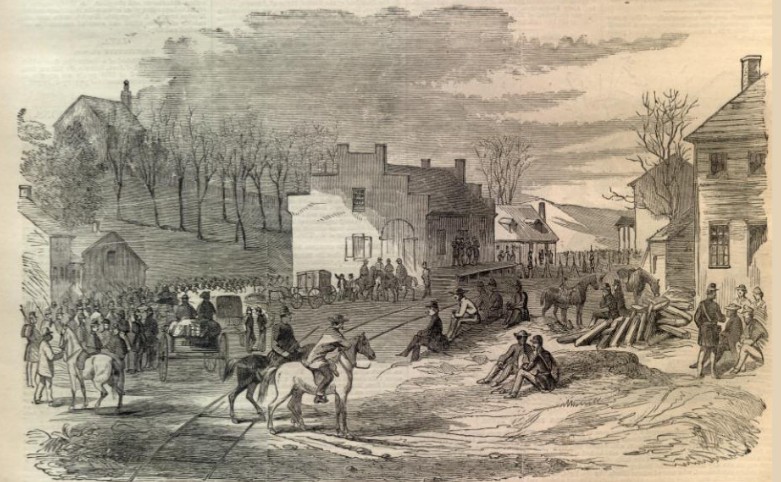
“The Rendezvous of the Virginians at Halltown, Virginia, 5 p.m. on April 18, 1861 to March on Harper’s Ferry” (D. H.Strother, Harper’s Weekly, 11 May 1861, public domain).
Attached to the Middle Military Division, U.S. Army of the Shenandoah in Virginia, beginning in August 1864, the 47th Pennsylvania Volunteer Infantry was initially assigned to defensive duties in and around Halltown during the opening days of that month before engaging in a series of back-and-forth movements over the next several weeks between Halltown, Berryville and other locations within that vicinity (Middletown, Charlestown and Winchester) as part of a “mimic war” being waged by the Union forces of Major-General Philip H. Sheridan with those commanded by Confederate Lieutenant-General Jubal Early.
After the 47th Pennsylvania Volunteers fought in the Battle of Berryville, Virginia from 3-4 September, clean-up skirmishes were waged with Confederate stragglers over the next several days. The regiment’s makeup was then altered significantly as multiple 47th Pennsylvania Volunteers opted to end their military service when their respective terms of military service expired on 18 September, including Captain Emanuel P. Rhoads and Sergeant Oliver Hiskey of Company B. Those who remained on duty, like the Rhoads brothers, were about to engage in their regiment’s greatest moments of valor.
Battle of Opequan

Battle of Opequan (aka Third Winchester), Virginia, 19 September 1864 (public domain).
Together with other regiments under the command of Union Major-General Sheridan and Brigadier-General Emory, commander of the U.S. Army’s 19th Corps, the Rhoads brothers and their fellow 47th Pennsylvania Volunteers helped to inflict heavy casualties on the Confederate forces of Lieutenant-General Jubal Early in the Battle of Opequan (also spelled as “Opequon” and referred to as “Third Winchester”). Many historians still consider the battle to be one of the most important during Sheridan’s 1864 campaign; the Union’s victory here helped to ensure the reelection of President Abraham Lincoln.
The 47th Pennsylvania’s march toward destiny at Opequan began at 2 a.m. on 19 September 1864 as the regiment left camp and joined up with others in the Union’s 19th Corps. After advancing slowly from Berryville toward Winchester, the 19th Corps became bogged down for several hours by the massive movement of Union troops and supply wagons, enabling Early’s men to dig in.
After finally reaching the Opequon Creek, Sheridan’s men came face to face with the Confederate Army commanded by Early. The fighting, which began in earnest at noon, was long and brutal. The Union’s left flank (6th Corps) took a beating from Confederate artillery stationed on high ground.

Victory of Philip Sheridan’s Union Army over Jubal Early’s Confederate forces, Battle of Opequan, 19 September 1864 (Kurz & Allison, circa 1893, U.S. Library of Congress, public domain).
Meanwhile, the 47th Pennsylvania and the 19th Corps were directed by Brigadier-General Emory to attack and pursue Major-General John B. Gordon’s Confederate forces. Some success was achieved, but casualties mounted as another Confederate artillery group opened fire on Union troops trying to cross a clearing. When a nearly fatal gap began to open between the 6th and 19th Corps, Sheridan sent in units led by Brigadier-Generals Emory Upton and David A. Russell. Russell, hit twice — once in the chest, was mortally wounded. The 47th Pennsylvania opened its lines long enough to enable the Union cavalry under William Woods Averell and the foot soldiers of General George Crook to charge the Confederates’ left flank. The 19th Corps, with the 47th in the thick of the fighting, then began pushing the Confederates back. Early’s “grays” retreated in the face of the valor displayed by Sheridan’s “blue jackets.” Leaving twenty-five hundred wounded behind, the Rebels retreated to Fisher’s Hill (21-22 September), eight miles south of Winchester, and then to Waynesboro, following a successful early morning flanking attack by Sheridan’s Union men which outnumbered Early’s three to one. Afterward, the 47th Pennsylvania Volunteers were sent out on skirmishing parties before making camp at Cedar Creek.
Moving forward, they would continue to distinguish themselves in battle, but they would do so without their two most senior and respected and commanders: Colonel Good and Good’s second in command, Lieutenant-Colonel Alexander, who mustered out 23-24 September upon expiration of their respective terms of service. Fortunately, they were replaced by others equally admired both for temperament and their front-line experience, including John Peter Shindel Gobin, a man who would later go on to become Lieutenant Governor of the Commonwealth of Pennsylvania.
* Note: During that period of the American Civil War, Sheridan’s Army had also begun the first Union “scorched earth” campaign, starving Confederate forces and their supporters into submission by destroying Virginia’s farming infrastructure. Viewed by many today as inhumane, the strategy claimed many innocents. This same strategy, however, almost certainly contributed to the turning of the war further in favor of the Union. Early’s men, successful in many prior engagements but now weakened by hunger, strayed from battlefields in increasing numbers to forage for food, thus enabling the 47th Pennsylvania and others under Sheridan’s command to rally and win the day during the Battle of Cedar Creek on 19 October 1864.
Battle of Cedar Creek

Alfred Waud’s 1864 sketch, “Surprise at Cedar Creek,” captured the flanking attack on the rear of Union Brigadier-General William Emory’s 19th Corps by Lieutenant-General Jubal Early’s Confederate army, and the subsequent resistance by Emory’s troops from their Union rifle-pit positions, 19 October 1864 (public domain).
From a military standpoint, 19 October 1864 was an impressive, but heartrending day. During the early morning that day, Confederate Lieutenant-General Early launched a surprise attack directly on Sheridan’s Cedar Creek-encamped forces. Able to capture Union weapons while freeing a number of Confederates who had been taken prisoner during previous battles, Early’s men also succeeded in pushing seven Union divisions back. According to Bates:
When the Army of West Virginia, under Crook, was surprised and driven from its works, the Second Brigade, with the Forty-seventh on the right, was thrown into the breach to arrest the retreat…. Scarcely was it in position before the enemy came suddenly upon it, under the cover of fog. The right of the regiment was thrown back until it was almost a semi-circle. The brigade, only fifteen hundred strong, was contending against Gordon’s entire division, and was forced to retire, but, in comparative good order, exposed, as it was, to raking fire. Repeatedly forming, as it was pushed back, and making a stand at every available point, it finally succeeded in checking the enemy’s onset, when General Sheridan suddenly appeared upon the field, who ‘met his crest-fallen, shattered battalions, without a word of reproach, but joyously swinging his cap, shouted to the stragglers, as he rode rapidly past them – “Face the other way, boys! We are going back to our camp! We are going to lick them out of their boots!”

Sheridan Rallying His Troops, Battle of Cedar Creek, Virginia, 19 October 1864 (U.S. Library of Congress, public domain).
The Union’s counterattack pounded Early’s forces so far into submission that the men of the 47th would later be commended for their heroism by General Stephen Thomas who, in 1892, was awarded the Medal of Honor for his own “distinguished conduct in a desperate hand-to-hand encounter, in which the advance of the enemy was checked” that day. Bates described the 47th’s actions:
When the final grand charge was made, the regiment moved at nearly right angles with the rebel front. The brigade charged gallantly, and the entire line, making a left wheel, came down on his flank, while engaging the Sixth Corps, when he went “whirling up the valley” in confusion. In the pursuit to Fisher’s Hill, the regiment led, and upon its arrival was placed on the skirmish line, where it remained until twelve o’clock noon of the following day. The army was attacked at early dawn…no respite was given to take food until the pursuit was ended.
But, through it all, the casualty rates for the 47th continued to climb. Captain Edwin G. Minnich and Privates John Schimpf, Thomas Steffen, and James Tice of Company B were among those killed in action while Corporal August C. Scherer and others died later from their battle wounds. Charles Bachman, Harrison Geiger, Allen L. Kramer, and Henry H. Kramer were among those who survived their wounds, but Private Franklin Rhoads reportedly succumbed to disease after being captured and transported from the Cedar Creek battlefield area to the Confederate Army’s notorious Salisbury, North Carolina prison camp. He was just eighteen years old.
Given a slight respite after Cedar Creek, the men of the 47th were quartered at the Union’s Camp Russell near Winchester from November through most of December before receiving orders to assume outpost duty at Camp Fairview in Charlestown, West Virginia just five days before Christmas. They would remain there through early April 1865, assigned by Major-General Sheridan to protect the Union’s key supply and railroad lines by preventing guerrilla raids from being perpetrated by Confederate troops and their sympathizers.
1865 — 1866

Spectators gather for the Grand Review of the Armies, 23-24 May 1865, beside the crepe-draped U.S. Capitol, flag at half-staff after the assassination of President Abraham Lincoln (Matthew Brady, U.S. Library of Congress, public domain).
In February of 1865, the 47th Pennsylvania Volunteers were attached to the Provisional Division of the 2nd Brigade of the U.S. Army of the Shenandoah. By 19 April, they were back in Washington, D.C., ordered there to defend the nation’s capital again — this time following the assassination of President Abraham Lincoln.
While serving in the 2nd Brigade of the Department of Washington’s 22nd Corps (Dwight’s Division), the 47th also participated in the Union’s Grand Review of the Armies on 23-24 May. During that phase of duty, the 47th Pennsylvania Volunteers were headquartered at Camp Brightwood in Washington, D.C.
Letters sent home by 47th Pennsylvania Volunteers during that period in 1865, as well as interviews that were conducted in later years with veteran members of the regiment, confirm that at least one member of the 47th was given the honor of guarding President Lincoln’s funeral train while still others were assigned to guard duties at the prison where the key Lincoln assassination conspirators were held during the early days of their imprisonment and trial.
Reconstruction
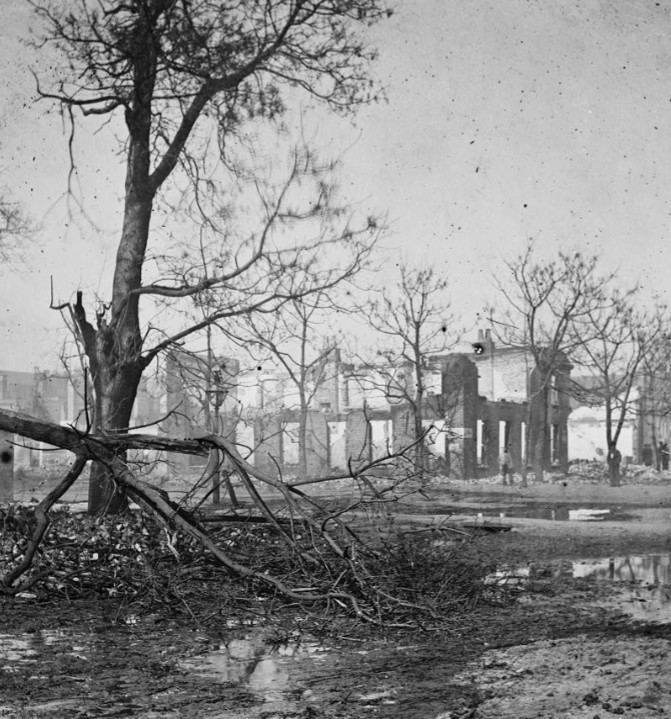
War-damaged houses in Savannah, Georgia, 1865 (Sam Cooley, U.S. Army, U.S. Library of Congress, public domain).
Taking one final swing through the South, the Rhoads brothers and their fellow 47th Pennsylvanians served in Savannah, Georgia from 31 May to 4 June as part of the U.S. Department of the South’s 3rd Brigade (Dwight’s Division) and in Charleston, South Carolina beginning in June. Duties during that time were Provost (military police) and Reconstruction-related, including rebuilding railroads and other key aspects of the region’s infrastructure that had been damaged or destroyed during the long war.
Finally, on Christmas Day in 1865, the Rhoads brothers and the majority of their fellow 47th Pennsylvania Volunteers began the process of mustering out for the final time and packing up to head home. Boarding yet another ship for yet another stormy sea voyage, they sailed north to New York City, disembarked at the harbor there, marched to the railroad station, and boarded yet another train, which transported them to Philadelphia. Marched to Camp Cadwalader in that city, the now very experienced and very weary 47th Pennsylvania Veteran Volunteers received their final discharge papers there between 9-11 January 1866, and were then finally allowed to return home to the arms of their loved ones and neighbors.
Return to Civilian Life — Allen P. Rhoads and George W. Rhoads
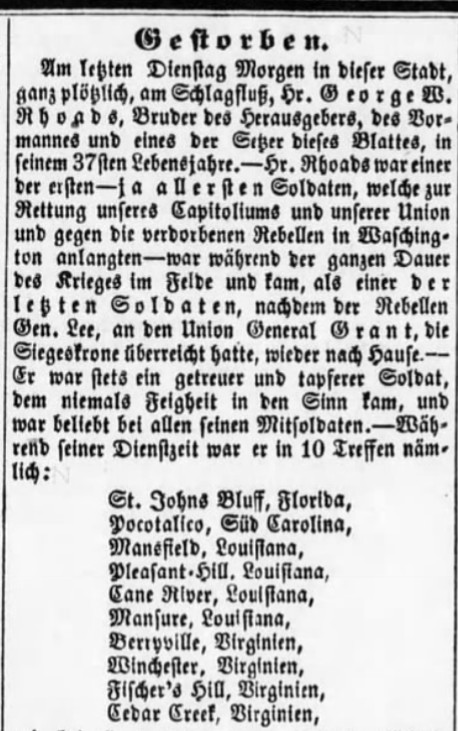
Excerpt of the lengthy obituary for 47th Pennsylvania Veteran Volunteer George W. Rhoads, Der Lecha Caunty Patriot, Allentown, Pennsylvania, 18 June 1867 (public domain; click to enlarge).
Following their respective honorable discharges from the military in early January of 1866, Allen P. Rhoads and his older brother, George W. Rhoads, both returned home to Pennsylvania’s Lehigh Valley, where Allen resumed work as a newspaper printer and welcomed the birth with his wife, Sarah, of: Henry Jacob Rhoads (1866-unknown), who was born in Allentown on 30 June 1866.
Sadly, Allen’s older brother and fellow 47th Pennsylvania Veteran Volunteer, George W. Rhoads, died roughly seventeen months later — on 11 June 1867 — and was laid to rest at the Allentown Cemetery. The following lengthy, loving tribute to him was published by the managers and staff of his hometown newspaper, Der Lecha Caunty Patriot, in its 18 June 1867 edition:
Gestorben: Am letzten Dienstag Morgen in dieser Stadt, ganz plötzlich, an Schlagfluss, Herr George W. Rhoads, Bruder des herausgebers, des Vormannes und eines der Setzer dieses Blattes, in seinem 37sten Lebehsjahre. — Hr. Rhoads war einer der ersten — ja allersten Soldaten, welche zur Rettung unseres Capitoliums und unserer Union und gegen die vordenbornen Rebellen in Waschington anlangten — war während der ganzen Dauer des Krieges im Felde und fam, als einer der letzten Soldaten, nachdem der Rebellen Gen. Lee, an den Union General Grant, die Siegesfrone überricht hatte, wieder nach hause. — Er war stets ein getreuer und tapferer Soldat, dem niemals Feigheit in dem Sinn fam, und war beliebt by allen seinen Mitsoldaten. — Während seiner Dienstzeit war er in 10 treffen nämlich:
Saint Johns Bluff, Florida,
Pocotalico, Süd Carolina,
Mansfield, Louisiana,
Pleasant Hill, Louisiana,
Cane River, Louisiana,
Mansure, Louisiana,
Berryville, Virginien,
Winchester, Virginien,
Fischer’s Hill, Virginien,
Cedar Creek, Virginien,und bei alle denselben war er flets so glücklich, gänzlich von den Kugeln und den geschleuterten Schells der Feinden der Union verschont zu bleiben, und der Allesregierende liess es zu, ihn nach Hause kommen zu letzten und dann allhier einen natürlichen Tod zu sterben. — Am letzten Donnerstag Nachmittag wurden dessen irrdischen Uerberreste unter militärischen Ehrenbezeugungen dem Schoos der fühlen Erde übergeben, bei welcher Gelegenheit der Chrw. Hr. Strassburger eine passende und geschicte Leichenrede hielt.– Sanft ruhe dessen Aiche!
Ich ging zum Todesader,
Fand dort ein off’nes Grab,
Ich fragt’ den Totengräber:
Wen legt man da hinab?Der heute hier wird schlassen,
Der war ein braver Mann,
Der seinen Menschenbrüdern,
Manch’ Gutes hat geihan.Drum wird er sanft auch schlummern,
Im stillen Grabgemach,
Und tausend Segenswünsche,
Die folgen ihm ja nach.Ich ging vom Gottesader,
Mein Aug’ wir Thränen schwer,
Ich wusst wen man begrabet
Den Freund seh ich nicht mehr!
Roughly translated, it says:
Died, last Tuesday morning in this city, quite suddenly, of a stroke, Mr. George W. Rhoads, brother of the publisher, editor, and one of the typesetters of this paper, in his 37th year. — Mr. Rhoads was one of the first — indeed, the very first — soldiers who arrived in Washington to save our Capitol and our Union against the forward-born Rebels. He served in the field throughout the entire war and was one of the last soldiers to return home after the Rebel General Lee had presented the victory to the Union General Grant. — He was always a faithful and brave soldier, never one of those who were cowardly, and was beloved by all his fellow soldiers. — During his service, he was in 10 engagements, namely:
Saint John’s Bluff, Florida,
Pocotaligo, South Carolina,
Mansfield, Louisiana,
Pleasant Hill, Louisiana,
Cane River, Louisiana,
Mansura, Louisiana,
Berryville, Virginia,
Winchester, Virginia,
Fisher’s Hill, Virginia,
Cedar Creek, Virginia,and throughout it all, he was so fortunate as to remain entirely unscathed by the bullets and hurled shells of the Union’s enemies; and the All-Ruling Providence permitted him to return home and, here, to die a natural death. — Last Thursday afternoon, his earthly remains were committed to the bosom of the nurturing earth with full military honors, on which occasion the Rev. Mr. Strassburger delivered a fitting and eloquent funeral oration. May he rest in peace!
I went to the grave,
Found there an open grave,
I asked the gravedigger:
Whom do you lay down there?He who died here today,
He was a good man,
Who gave his fellow men,
Many a good thing.Therefore he will slumber peacefully,
In the quiet burial chamber,
And a thousand blessings,
That follow him.I left the grave,
My eyes heavy with tears,
I know the one who is being buried,
I will see my friend no more!
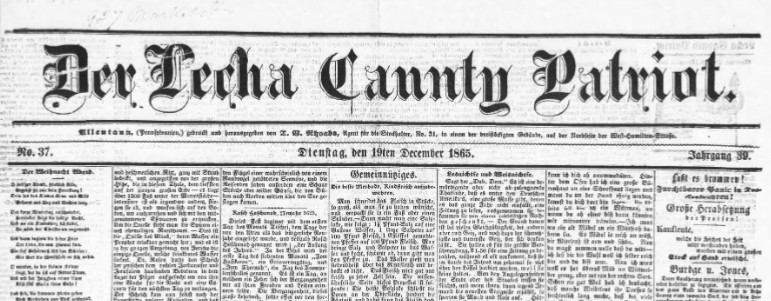
The name of Allen P. Rhoads’ brother, Tilghman V. Rhoads, was prominently displayed at the top of the front pages of the German language newspaper that he published in Allentown, Pennsylvania (Der Lecha Caunty Patriot, 19 Dec 1865, public domain; click to enlarge).
Forced to soldier on without his older brother (who had truly understood the horrors of combat and the other hardships of war because he had served with Allen in the 47th Pennsylvania), Allen P. Rhoads took his wife, Sarah, and baby, Henry Jacob Rhoads (1866-unknown), to their Lutheran Church six weeks after George Rhoads’ death and had Henry baptized on 14 August 1867. By 1870, Allen, Sarah and Henry were residents of Allentown’s Fifth Ward. Also living with them was thirty-year-old Anna Dankel, Allen’s twin sister, who had married Charles H. Dankel but was living separately from Charles at the time of that year’s federal census.
Sadly, Allen Rhoads was then also preceded in death by his brother, Tilghman Victor Rhoads (1835-1872; alternate surname spelling: “Rhoades”), who passed away in his mid-thirties, on 27 October 1872, while serving as the Assessor of Internal Revenue in Lehigh County. Subsequently interred at the Green Mount Cemetery in Bath Township, Northampton County, Pennsylvania, Tilghman V. Rhoads had previously been employed as the publisher of the Lehigh County Patriot (Allentown’s German language newspaper that was also known as Der Lecha Caunty Patriot), had married Elizabeth Rebecca Breinig (1836-1916) sometime during the early 1860s and had welcomed the births with her of: Mary Rhoads (1863-1932), who had been born in Allentown in 1863 and would later wed Thomas S. Gillin (1853-1943) and settle with him in Ambler, Pennsylvania; William Breinig Rhoads (1864-1927), who had been born in Allentown on 31 October 1864 and would go on to become a justice of the peace in Pennsylvania but never marry; Magdalena Elizabeth Rhoads (1867-1940), who had been born in Allentown on 8 April 1867 and would later wed Samuel Yeakle (1853-1928) in 1889 and reside with him in Fort Washington, Pennsylvania, where she became prominent in the civic and social affairs of her community; and Anna Victoria Rhoads (1870-1949), who was born on 30 November 1870 and would later wed David Brooke Johnson (1865-1952) and settle with him in Ambler, Pennsylvania.
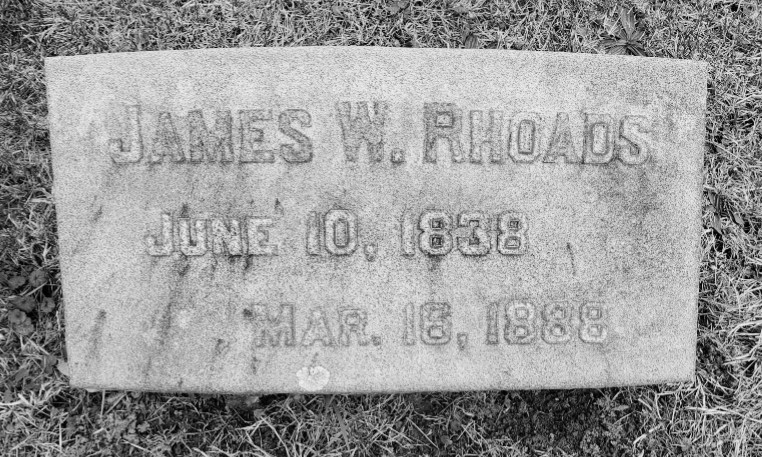
Gravestone of Morning Critic pressman James W. Rhoads (1838-1888), Linden Street Cemetery, Allentown, Pennsylvania (public domain).
More heartache then followed when Allen Rhoads was preceded in death by yet another of his brothers — James W. Rhoads (1837-1888) — who died from complications relating to dropsy at the age of fifty-one in Allentown on 16 March 1888 and was subsequently interred at the Linden Street Cemetery in Allentown. A printer like his younger brother, Allen, James Rhoads had been employed as the longtime pressman for Allentown’s Morning Critic newspaper (later known as The Morning Call), had married Eliza Rebecca George (1844-1908) sometime during the 1860s and had welcomed the births with her of: Jacob Allen Rhoads (1866-1936), who had been born on 22 August 1866; Emily May Rhoads (1869-1935), who had been born on 24 March 1869 and would later wed and be widowed by William H. Ott; and Harry F. Rhoads (1871-1892), who had been born on 18 August 1871.
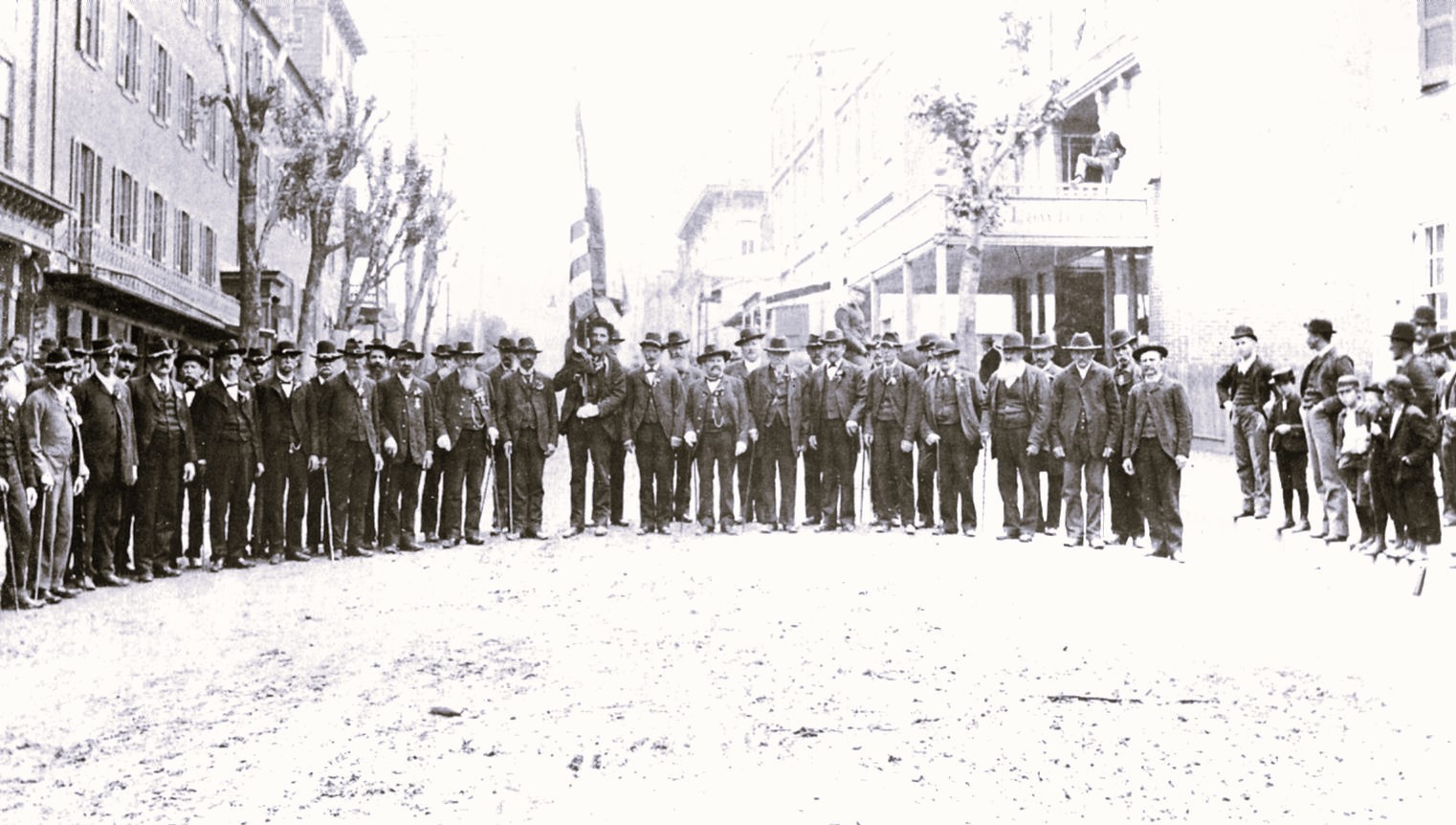
Annual Reunion, 47th Pennsylvania Veteran Volunteers, Allentown, Pennsylvania, October 1887 (public domain; click to enlarge).
A member of the Grand Army of the Republic’s E. B. Young Post, No. 87, Allen P. Rhoads filed for his U.S. Civil War Pension on 15 August 1889. It appears, however, that his application was unsuccessful because his entry in the system of U.S. Civil War Pension General Index Cards that is maintained by the U.S. National Archives and Records Administration does not provide a pension certificate number for him (a number that would confirm that he had been awarded a pension). Four years later, Allen P. Rhoads was widowed by his wife, Sarah (Frederick) Rhoads, when she passed away in Allentown at the age of fifty-four on 6 September 1893. Following funeral services at St. Michael’s Lutheran Church, she was laid to rest at the Union-West End Cemetery in Allentown.
Note: Records for Allen P. Rhoads in later life note that he was also preceded in death by two children. Researchers theorize that one of those children was Allen’s son, Henry Jacob Rhoads, who had been born on 30 June 1866; they are continuing to search for the names and vital statistics for both children, and will update this biography if and when that data is found.
Seven years after his wife’s death, fifty-eight-year-old Allen Rhoads was documented by a federal census enumerator as a day laborer who resided at a boarding house that was operated by James and Lydia Merkle at 513 Gordon Street in Allentown’s Ninth Ward. Also living there with Allen was forty-seven-year-old Mary A. Rhoads (October 1852-unknown).
* Note: Although the enumerator of the federal census of 1900 noted that Allen P. Rhoads and Mary A. Rhoads were each married in 1895, researchers have not yet confirmed if they were married to each other or were married to different spouses, but living without those spouses at the Merkle boarding house in Allentown in early June of that year. Subsequent news updates about Allen P. Rhoads do not mention “Mary A. Rhoads” as his wife or widow.
Illness, Death and Interment
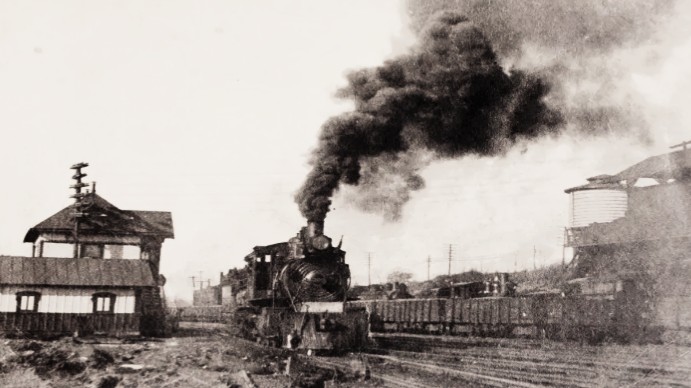
A Philadelphia & Reading Railroad train shown departing from the East Penn Junction near Allentown, Pennsylvania, 1905 (public domain).
By the fall of 1903, Allen Rhoads’ health had declined significantly enough that he required the kind of advanced medical care that was available to veterans only at one of the branches of the U.S. National Home for Disabled Volunteer Soldiers. So, according to the 16 September edition of The Allentown Democrat, he packed his bags and boarded a train bound for the city of Dayton in Montgomery County, Ohio on 15 September 1903:
Mr. Allen P. Rhoads, of this city, a private in Co. B, 47th Penna. regiment, Col. Good, during the whole civil war, and having received an honorable discharge, left yesterday for the Soldiers’ Home at Dayton, Ohio, for the remainder of his life. He has the reputation of having been one of the best drilled and bravest “boys in blue” in Uncle Sam’s service, but his advanced years have disabled him from making an honorable living, and being without a family or a home to his liking, he finally decided to make application for a government home, and having the best of recommendations he had no trouble in securing papers of admission, together with a free railroad pass to carry him to the handsome city in which the Home is located — a home in fact as well as in name. That he may retain good health, and ever be the happy and jolly ‘Colonel,’ as he is generally known, is the wish of all his many friends.
Sadly, during the late summer of the following year, Allen Rhoads received word that his sister, Sarah E. (Rhoads) Remmel, had succumbed to complications from heart disease and dropsy at the age of seventy-five at her home at 335 North Seventh Street in Allentown, in September 1904, and had been laid to rest beside her husband at Allentown’s Fairview Cemetery. Widowed by Mexican War veteran Jacob Remmel (1818-1900) in 1900, she had been an active member of St. John’s Lutheran Church in Allentown, and had welcomed the births with her husband of: Hannah J. Remmel (1851-1903), who had been born in Allentown in 1851 and would later wed John T. Eckert (1849-1880); Frank J. Remmel (1854-1938), who had been born in 1854 and would later become the superintendent of the Ainey furnace and bookkeeper for the Ainey estate, but would never marry; and Alice M. Remmel (1858-1937), who had been born in 1858 and would also never marry.
Meanwhile, as that tragedy was unfolding, Allen Rhoads may actually not have been living out “the remainder of his life” at the U.S. National Home for Disabled Volunteer Soldiers in Dayton as The Morning Call had previously foretold. Although researchers have not yet located records for that Soldiers’ Home to confirm that Allen Rhoads was ever admitted there, they have found U.S. Census records which confirm that he was residing at two different boarding houses in Allentown between 1900 and 1906. (In June 1900, he lived at the boarding home of James and Lydia Merkle; during the winter of 1906, he was a resident of a boarding house at 506 North Lumber Street.)
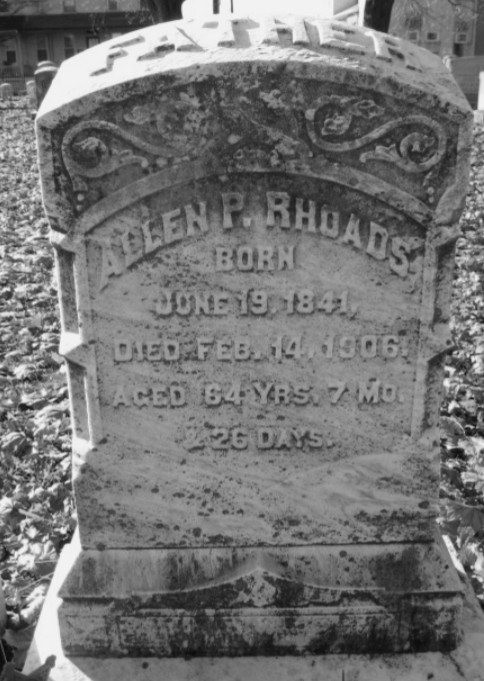
Headstone of 47th Pennsylvania Veteran Volunteer Allen P. Rhoads, Union-West End Cemetery, Allentown, Pennsylvania (public domain).
Ailing with pancreatitis and “recurrent gastrointestinal catarrh” during his final years, according to records from the Commonwealth of Pennsylvania’s Department of Health, Allen P. Rhoads died from acute hemorrhagic pancreatitis and cardiac paralysis at the age of sixty-four, on 14 February 1906 (alternate death date: 15 February), at that second boarding house in Allentown. Following funeral services there, he was laid to rest beside his wife, Sarah, at the Union-West End Cemetery in Allentown. He was then eulogized by his hometown newspaper, The Morning Call, as follows:
Allen P. Rhoads, the well-known war veteran, died yesterday of a heart affection at his home, No. 506 North Lumber street. Deceased was an enthusiastic Grand Army man and an attendant at many veterans’ affairs. He was born in Allentown and was 64 years of age. He became a printer in early life, serving his apprenticeship on the Allentown Democrat. He remained there for a number of years when he left to enter the employ of the Lehigh Patriot, a German weekly that was published in Allentown. On August 30, 1861, he enlisted in Company B, Forty-seventh Regiment, and fought through three years with that command. He was mustered out on Christmas Day, 1865. Disabilities received in the service forced him to retire a few years after the close of the war. The only surviving relative is Mrs. Charles Dankel, of this city, who is a sister. The funeral will be held on Sunday [18 February 1906].
What Happened to Allen Rhoads’ Twin Sister and Her Family?
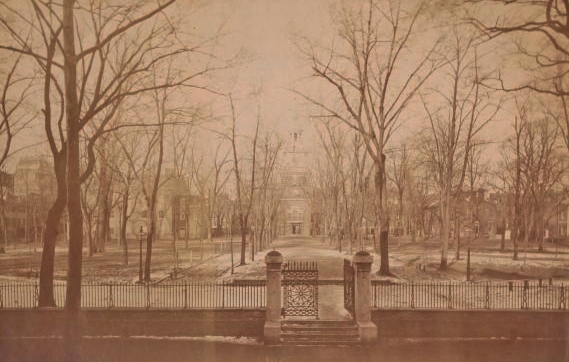
State House and Independence Square, Philadelphia, 1868 (public domain; click tl enlarge).
Following her marriage to Charles Dankel (1838-1911), Allen Rhoads’ twin sister, Anna E. (Rhoads) Dankel, who was known to family and friends as “Annie,” had settled with her husband in the city of Philadelphia, where they then welcomed the birth of Catherine I. Dankel (1868-1956), who was born on the Fourth of July in 1868 and would become known to family and friends as “Katie” and later wed painter Henry W. Bartholomew (1871-1928).
Although Annie (Rhoads) Dankel appeared to have separated briefly from her husband sometime after the birth of that child (because the 1870 federal census noted that she resided with her twin brother, Allen, and his family, but without her husband or daughter), Annie clearly was living with her husband, Charles Dankel, later that decade. Having returned to Lehigh County, they subsequently welcomed the births of: Mary Dankel (1875-1955), who was born in Alburtis on 19 December 1875, would become known to family and friends as “Mamie” and would later wed Harry L. Heist; and Anna May Dankel (1880-1952), who was born on 22 May 1880, would become known to family and friends as “Annie” and would later wed John D. Cope (1890-1956). When the federal census was conducted in Allentown in June of that same year (1880), all four members of the Dankel household were confirmed as residents of the home of farming agent Charles Dankel on North Twelfth Street. By 1900, the quartet resided in a rented home at 424 North Sixth Street in Allentown’s Fifth Ward. That year, Charles Dankel was employed as a slate roofer, while his daughters were both working as cigarmakers. Residents of Allentown’s Second Ward by 1910, the only member of the quartet who was working at the time of that year’s federal census was the Dankels’ unmarried daughter, Katie, who was employed as a laundress.
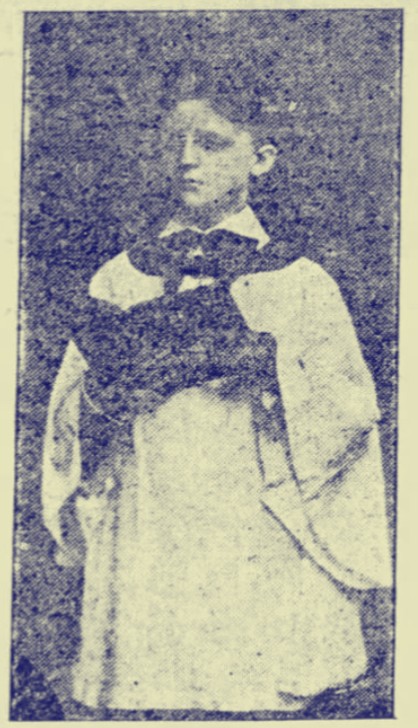
Charles H. Malcolm (1902-1918), Grace Episcopal Church Choir, Allentown, Pennsylvania, circa 1917 (public domain).
But that year (1910) was noteworthy for an entirely different reason — the Dankel quartet had expanded into a sextet and now included Charles H. Malcolm (1902-1918), who had been born on 16 February 1902, and Grace R. Malcolm (1905-1974), who had been born on 5 October 1905. According to the federal census enumerator who had interviewed the Dankels in 1910, the Malcolm children had been adopted by Charles and Annie Dankel — but that data appears to have been incorrect. Per Grace’s 1956 obituary in Allentown’s Morning Call newspaper, Grace’s birth parents were “William and Anna Dancho.” (Please see the end of this section of the biography for more information about her.) In addition, a funeral notice that was published in the 12 June 1921 edition of The Morning Call reported that the funeral of Charles H. Malcolm would be held at “the residence of his mother, Mrs. Annie Cope, No. 966 Union Street, on Saturday afternoon, June 18, at 1:30 o’clock.” And a previous report by that same newspaper on 23 October 1918 documented that Charles H. Malcolm was the grandson of Charles and Annie Dankel — further confirming that he may have actually been the son of the Dankels’ daughter, Anna May (Dankel) Cope. That article also presented important details about Charles Malcolm’s life and death, including that he may have been adopted as an infant by Mary (Dankel) Heist — a daughter of Charles and Anna (Rhoads) Dankel:
Private Charles H. Malcolm, of 31 South College street, a member of Co. D, 110th Infantry, 28th Division, A. E. F., one of the youngest soldiers that ever left this city, has been slain on the battlefields of France, word to this effect being received early yesterday morning by Mr. and Mrs. H. L. Heist, of the above address. Private Malcolm was killed in action on September 6 [1918].
Scarcely sixteen years of age when he presented his five feet eleven inches to the recruiting officer at 5th and Hamilton streets, on April 19, 1918, he easily deceived the officer and a day later was on his way to Columbus, O. Reaching Harrisburg, the party of recruits was intercepted by a telegram and along with several other rookies, Private Malcolm was transferred to the engineer corps leaving an embarkation point May 1, and with very little preliminary training he was sent across.
Adopted by Mr. and Mrs. Heist in early infancy, he soon became like a son to the couple…. He [Charles H. Malcolm] was born in this city and was a confirmed member of Grace Episcopal church where he was also a soprano soloist on the choir.
Private Malcolm can best be judged by his near relatives. He comes from a family of patriotic citizens. His grandfather, Charles Dankel, who died seven years ago at the age of 73, was a Civil War veteran. He served as a Pennsylvania volunteer throughout the four years of warfare. He was an active member of E. B. Young Post, G.A.R., at the time of his death and there were few if any who displayed more patriotic fervor than this loved old veteran. Then there is the uncle, Mr. Heist. He was a Spanish-American war veteran…. Personally Private Malcolm was one of the most likeable young men in the city and word of his supreme sacrifice, while showing the true American spirit of which he was made, will be received with regret. He was born Feb. 31, 1902 [sic, “16 February 1902”], and was sixteen years of age last February.
But, as that news article indicated, Charles H. Dankel never received that heartbreaking news regarding the fate of his grandson because he (Charles H. Dankel) died in Allentown seven years before Private Charles Malcolm’s World War I death. Following his passing in Allentown at the age of seventy-three on 13 March 1911, Charles Dankel was laid to rest at the Fairview Cemetery in Allentown, leaving Annie (Rhoads) Dankel to soldier on as a widow and mother, and as the grandmother of Charles and Grace Malcolm. Ailing with heart disease and chronic bronchitis, Annie (Rhoads) Dankel died from aortic regurgitation at the age of seventy-four in Allentown on 7 January 1916, and was laid to rest beside her husband at the Fairview Cemetery in Allentown. She was survived by “her three daughters, Mrs. Katie Bartholomew, Mrs. Harry Heist, Mrs. Annie Cope and two grandchildren, Charles and Grace, all of Allentown.”
* Note: Grace R. Malcolm (1905-1974) had taken the surname of “Bartholomew” after her adoption by Catherine I. (Dankel) Bartholomew (1868-1956), the married daughter of Charles and Annie (Rhoads) Dankel. Trained as a practical nurse, Grace would later welcome the birth of a son, Wellington C. Guyler (1925-1995).
More Tragedy
As if all of those previous episodes of heartache were not enough, a truly shocking death occurred in the Rhoads-Dankel family nearly forty years after the the death of Allen Rhoads’ twin sister. That terrible event involved the alleged murder of Anna May (Dankel) Cope — the daughter of Allen’s twin sister, Annie (Rhoads) Dankel. According to the 5 November 1952 edition of Allentown’s Morning Call newspaper:
A state police guard has been placed on the hospital room of John Cope, 77, who was found in a dazed condition lying next to his wife’s body in the couple’s S. Pike Street home.
The death of his wife, Mrs. Anna M. Cope, 72, has been attributed to a broken neck by Coroner Clayton O. P. Werley. An autopsy was performed on the woman yesterday.
Sgt. John I. Swann, who is conducting an investigation into the death for the state police, refused last night to implicate Cope in the death of his wife.
He said simply that “Naturally we are interested in questioning him” in light of the circumstances under which the dead woman was found.
Cope was unable to answer questions of the state police who broke into the one-room cabin after being called by the owner who became alarmed when he didn’t see his tenants around the premises on Sunday and Monday.
Sgt. Swann said he was able to talk to Cope for a short while yesterday but was not able to get all the information he desired.
He said that as soon as Cope’s condition improves he intends to question him further.
Cope is still undergoing treatment at the Sacred Heart Hospital for a nervous condition and malnutrition.
Police originally thought that the latter malady might have been the cause of his wife’s death.
To Trace Movements
Swann said that the investigation now hopes to trace Mrs. Cope’s movements during the latter part of last week.
The coroner said yesterday’s autopsy showed that the woman had been dead since Sunday. She was discovered around 6 p.m. on Monday by state police.
Mrs. Cope was the former Anna May Dankel, a daughter of the late Charles and Anna (Rhoads) Dankel. She is survived by a daughter, Grace, Allentown; and two sisters, Mrs. Catherine Bartholomew, Allentown, and Mamie, Philadelphia.
As the state police investigation continued, The Morning Call corrected its coverage of the tragedy to reflect that police had initially believed that malnutrition had caused Anna May (Dankel) Cope’s death (and not the medical condition of John Cope, as was first reported). The newspaper also noted that police had stated that “Sgt. Swann ordered a police guard [to be] placed on Cope’s hospital room” after receiving the coroner’s report which indicated that Anna May’s death had been caused by a broken neck, but also added “there was no evidence that a scuffle had ensued” at the cabin. On 16 November 1952, The Morning Call published a photograph with a caption describing the arraignment of John Cope “on a charge of killing his wife.” Less than two weeks later, Cope was declared mentally incompetent and unable to proceed to trial. He was then moved from the Lehigh County Prison to the Allentown State Hospital, where he was expected to remain for the “forseeable future,” according to The Morning Call.
*Note: If you or someone you know is at risk of domestic violence, please reach out for advice and help to the National Domestic Violence Hotline: (800) 799-SAFE (7233).
Sources:
- Allen P. Rhoads, in Death Certificates (file no.: 30827, registered no.: 90, date of death: 14 February 1906 [sic, “15 February 1906”]). Harrisburg, Pennsylvania: Commonwealth of Pennsylvania, Department of Health, Bureau of Vital Statistics.
- Anna May Cope (a daughter of Allen P. Rhoads’ twin sister, Anna E. (Rhoads) Dankel), in Death Certificates (file no.: 96192, registered no.: 1482, date of death: 3 November 1952). Harrisburg, Pennsylvania: Commonwealth of Pennsylvania, Department of Health, Bureau of Vital Statistics.
- Anna Victoria Johnson (a niece of Allen P. and George W. Rhoads and a daughter of Tilghman Victor Rhoads), in Death Certificates (file no.: 24329, registered no.: 23, date of death: 24 March 1949). Harrisburg, Pennsylvania: Commonwealth of Pennsylvania, Department of Health, Bureau of Vital Statistics.
- Annie E. Dankel (the twin sister of Allen P. Rhoads), in Death Certificates (file no.: 258, registered no.: 28, date of death: 7 January 1917). Harrisburg, Pennsylvania: Commonwealth of Pennsylvania, Department of Health, Bureau of Vital Statistics.
- Bartholomew, Henry W. and Katie F. [sic, “Catherine I. (Dankel) Bartholomew”] (a daughter of Allen P. Rhoads’ twin sister, Anna (Rhoads) Dankel; and Danro, Grace R. (a fourteen-year-old girl who would subsequently be adopted by Catherine (Dankel) Bartholomew, but was shown on the 1910 federal census as “Grace R. Malcolm,” a daughter of Anna (Rhoads) Dankel), in U.S. Census (Allentown, Third Ward, Lehigh County, Pennsylvania, 1920). Washington, D.C.: U.S. National Archives and Records Administration.
- Bates, Samuel P. History of Pennsylvania Volunteers, 1861-5, vol. 1. Harrisburg, Pennsylvania: B. Singerly, State Printer, 1869.
- “Catherine Bartholomew” (obituary of a daughter Allen P. Rhoads’ twin sister, Anna E. (Rhoads) Dankel). Allentown, Pennsylvania: The Morning Call, 14 March 1956.
- Catherine I. Bartholomew (a daughter Allen P. Rhoads’ twin sister, Anna E. (Rhoads) Dankel), in Death Certificates (file no.: 25041, registered no.: 405, date of death: 13 March 1956). Harrisburg, Pennsylvania: Commonwealth of Pennsylvania, Department of Health, Bureau of Vital Statistics.
- “Charles H. Malcolm, Victor Solt, Elwynn H. Mannhart Gone West” (announcement of the World War I combat-related death in France of Charles H. Malcolm, a grandson of Charles H. Dankel and Anna May (Rhoads) Dankel, the twin sister of Allen P. Rhoads). Allentown, Pennsylvania: The Morning Call, 23 October 1918.
- “Cope Arraignment” (photograph with caption describing the arraignment of John Cope on the charge of murdering Anna May (Dankel) Cope, who was a daughter of Anna (Rhoads) Dankel, the twin sister of Allen P. Rhoads). Allentown, Pennsylvania: The Morning Call, 16 November 1952.
- “Cope Committed to State Hospital; Action Stays All Murder Case Proceedings (report on the state hospital commitment of John Cope for the alleged murder of Anna May (Dankel) Cope, who was a daughter of Anna (Rhoads) Dankel, the twin sister of Allen P. Rhoads). Allentown, Pennsylvania: The Morning Call, 29 November 1952.
- Dankel, Charles, Annie (the twin sister of Allen P. Rhoads), Katie, and Mary [sic, “Anna May Dankel”], in U.S. Census (Allentown, Seventh Ward, Lehigh County, Pennsylvania, 1880). Washington, D.C.: U.S. National Archives and Records Administration.
- Dankel, Charles, Annie (the twin sister of Allen P. Rhoads), Katie, and Annie, in U.S. Census (Allentown, Fifth Ward, Lehigh County, Pennsylvania, 1900). Washington, D.C.: U.S. National Archives and Records Administration.
- Dankel, Charles H., Annie C. (the twin sister of Allen P. Rhoads), Katie I., and Mamie H. [sic, “Anna May Dankel”]; and Malcolm, Charles I. and Grace R. (adopted children of Charles and Annie Dankel; sic, “grandchildren”), in U.S. Census (Allentown, Second Ward, Lehigh County, Pennsylvania, 1910). Washington, D.C.: U.S. National Archives and Records Administration.
- “Dead Woman’s Husband Still Under Guard” (update regarding the alleged murder of Anna May (Dankel) Cope, who was a daughter of Anna (Rhoads) Dankel, the twin sister of Allen P. Rhoads). Allentown, Pennsylvania: The Morning Call, 6 November 1952.
- “Death of A. P. Rhoads” (obituary of Allen P. Rhoads). Allentown, Pennsylvania: The Allentown Leader, 15 February 1906.
- “Death of the Widow of a Mexican War Veteran” (obituary of Sarah E. (Rhoads) Remmel, a sister of Allen P. and George W. Rhoads). Allentown, Pennsylvania: The Allentown Democrat, 14 September 1904.
- “Dr. M. T. Guth Died at His Home in Erie” (obituary of a nephew of Allen P. and George W. Rhoads and a son of Maria (Rhoads) Guth). Allentown, Pennsylvania: The Morning Call, 28 March 1912.
- “Florida’s Role in the Civil War: Supplier of the Confederacy.” Tampa, Florida: Florida Center for Instructional Technology, University of South Florida (College of Education), retrieved online, 15 January 2020.
- “Former Allentown Woman Dies at Ambler” (obituary of Mary (Rhoads) Gillen, who was a niece of Allen P. and George W. Rhoads and a daughter of Tilghman Victor Rhoads). Allentown, Pennsylvania: The Morning Call, 21 December 1932.
- “Friday: James W. Rhoads” (death notice of a brother of Allen P. and George W. Rhoads), in “The Week.” Allentown, Pennsylvania: The Sunday Critic, 18 March 1888.
- “Gestorben: George W. Rhoads” (George W. Rhoads’ obituary). Allentown, Pennsylvania: Der Lecha Caunty Patriot, 18 June 1867.
- “Gestorben: Henry Rhoads” (death notice of a brother of Allen P. and George W. Rhoads). Allentown, Pennsylvania: Der Lecha Caunty Patriot, 17 September 1862.
- “Gestorben: Josiah Rhoads” (death notice of the father of Allen P. and George W. Rhoads). Allentown, Pennsylvania: Der Lecha Caunty Patriot, 20 July 1853.
- “Gestorben: Maria Guth” (obituary of the oldest sister of Allen P. and George W. Rhoads). Allentown, Pennsylvania: Der Lecha Caunty Patriot, 5 January 1864.
- Gobin, John Peter Shindel. Personal Letters, 1861-1865. Northumberland, Pennsylvania: Personal Collection of John Deppen.
- Good [sic, “Guth”], Reuben (printer), Maria (an older sister of Allen P. and George W. Rhoads) and Morris S.; Rhoades [sic, “Rhoads”], Anna (Allen P. Rhoads’ twin sister); Good, Samuel (printer’s apprentice); and Nagel, Elemina (servant), in U.S. Census (Allentown, Fourth Ward, Lehigh County, Pennsylvania, 1960). Washington, D.C.: U.S. National Archives and Records Administration.
- “Grace R. Bartholomew” (obituary of the adopted daughter of Catherine I. (Dankel) Bartholomew, who was a daughter of Anna (Rhoads) Dankel and a niece of Allen P. Rhoads). Allentown, Pennsylvania: The Morning Call, 3 June 1974.
- Grant, Ulysses S. Personal Memoirs of Ulysses S. Grant. New York, New York: Charles L. Webster & Company, 1885.
- Grodzins, Dean and David Moss. “The U.S. Secession Crisis as a Breakdown of Democracy,” in When Democracy Breaks: Studies in Democratic Erosion and Collapse, from Ancient Athens to the Present Day (chapter 3). New York, New York: Oxford University Press, 2024.
- Hannah Rhoads (the widow of Josiah Rhoads and the mother of Allen P. and George W. Rhoads), in “Died.” Allentown, Pennsylvania: Der Lecha Caunty Patriot, 16 October 1844.
- Henry Jacob Rhoads (infant) and Allen and Sarah Rhoads (parents), in Birth and Baptismal Records (St. Paul’s Lutheran Church, date of birth: 30 June 1866, baptism: 14 August 1867). Allentown, Pennsylvania: St. Paul’s Lutheran Church.
- “Important From Port Royal.; The Expedition to Jacksonville, Destruction of the Rebel Batteries. Capture of a STEAMBOAT. Another Speech from Gen. Mitchell. His Policy and Sentiments on the Negro Question.” New York, New York: The New York Times, 20 October 1862.
- Irwin, Richard Bache. History of the Nineteenth Army Corps. New York, New York: G. P. Putnam’s Sons, 1893.
- “Left for the Soldiers’ Home in Ohio Yesterday” (report of the departure of Allen P. Rhoads for Ohio to receive medical care at the Dayton, Ohio branch of the U.S. National Home for Disabled Volunteer Soldiers). Allentown, Pennsylvania: The Allentown Democrat, 16 September 1903.
- “Magdalena E. Yeakle” (obituary of a niece of Allen P. Rhoads and a daughter of Tilghman Victor Rhoads). Ambler, Pennsylvania: The Ambler Gazette, 26 December 1940.
- Maime M. Heist (a daughter of Allen P. Rhoads’ twin sister, Anna (Rhoads) Dankel), in Death Certificates (file no.: 5090, registered no.: 11, date of death: 2 January 1955). Harrisburg, Pennsylvania: Commonwealth of Pennsylvania, Department of Health, Bureau of Vital Statistics.
- “Malcolm” (announcement of the funeral of Charles H. Malcolm, a grandson of Anna (Rhoads) Dankel, the twin sister of Allen P. Rhoads, and a son of Annie (Dankel) Cope). Allentown, Pennsylvania: The Morning Call, 14 June 1921.
- Merkle, James and Lydia (boarding house operators); and Rhoads, Allen P. and Mary A., in U.S. Census (Allentown, Ninth Ward, Lehigh County, Pennsylvania, 1900). Washington, D.C.: U.S. National Archives and Records Administration.
- Morris S. Guth (a nephew of Allen P. Rhoads and a son of Maria (Rhoads) Guth), in Death Certificates (file no.: 24260, registered no.: 282, date of death: 27 March 1912). Harrisburg, Pennsylvania: Commonwealth of Pennsylvania, Department of Health, Bureau of Vital Statistics.
- “Mrs. Annie C. Dankel” (obituary of the twin sister of Allen P. Rhoads). Allentown, Pennsylvania: The Morning Call, 8 January 1916.
- “Mrs. Mamie M. Heist” (obituary of Mary (Dankel) Heist, a daughter of Allen P. Rhoads’ twin sister, Anna (Rhoads) Dankel). Allentown, Pennsylvania: The Morning Call, 3 January 1955.
- “Obituary: Allen P. Rhoads.” Allentown, Pennsylvania: The Morning Call, 16 February 1906.
- “Peter Rhoads, Ardent Patriot, Read ‘Declaration’ to People.” Allentown, Pennsylvania: The Morning Call, 22 April 1962.
- Proctor, Samuel. “Jacksonville During the Civil War,” in Florida Historical Quarterly, vol. 41, no. 4, 1962, pp. 343-355. Orlando, Florida STARS (Showcase of Text, Archives, Research & Scholarship), University of Central, Florida.
- Remmel, Jacob (wagoner), Sarah (an older sister of Allen P. and George W. Rhoads), Hannah, Frank, and Alice, in U.S. Census (Allentown, Fifth Ward, Lehigh County, Pennsylvania, 1860). Washington, D.C.: U.S. National Archives and Records Administration.
- “Rhoads” (death and funeral notice of Sarah (Frederick) Rhoads, the wife of Allen P. Rhoads, in “Deaths.” Allentown, Pennsylvania: The Morning Call, 7 September 1903.
- “Rhoads” (funeral notice of Allen P. Rhoads). Allentown, Pennsylvania: The Morning Call, 16-17 February 1906.
- Rhoads, Allen P., in Civil War Muster Rolls (Company B, 47th Pennsylvania Infantry). Harrisburg, Pennsylvania: Pennsylvania State Archives.
- Rhoads, Allen P., in Civil War Veterans’ Card File, 1861-1866 (Company B, 47th Pennsylvania Infantry). Harrisburg, Pennsylvania: Pennsylvania State Archives.
- Rhoads, Allen P., in Records of Burial Places of Veterans (Union-West End Cemetery, Allentown, Lehigh County, Pennsylvania). Harrisburg, Pennsylvania: Commonwealth of Pennsylvania, Department of Military Affairs.
- Rhoads, Allen P., in U.S. Civil War Pension General Index Cards (veteran’s application no.: 723241, filed by the veteran, 15 August 1889).
- Rhoads, Allen, Sarah and Henry H.; and Dankel, Anna, in U.S. Census (Allentown, Fifth Ward, Lehigh County, Pennsylvania, 1870). Washington, D.C.: U.S. National Archives and Records Administration.
- Rhoads, George, in Card Records of Headstones Provided for Deceased Civil War Veterans (gravesite location: Village Cemetery/Allentown Cemetery, Allentown, Lehigh County, Pennsylvania, date of death: 11 June 1867, date of headstone request: 29 November 1879), in Records of the Office of the Quartermaster General (record group: 92, series: M1845). Washington, D.C.: U.S. National Archives and Records Administration.
- Rhoads, George W., in Civil War Muster Rolls (Company G, 25th Pennsylvania Infantry and Company I, 47th Pennsylvania Infantry). Harrisburg, Pennsylvania: Pennsylvania State Archives.
- Rhoads, George W., in Civil War Veterans’ Card File (Company G, 25th Pennsylvania Infantry and Company I, 47th Pennsylvania Infantry). Harrisburg, Pennsylvania: Pennsylvania State Archives.
- Rhoads, George W., in Records of Burial Places of Veterans (Allentown Cemetery, “New Part,” Allentown, Lehigh County, Pennsylvania). Harrisburg, Pennsylvania: Commonwealth of Pennsylvania, Department of Military Affairs.
- Rhoades [sic, “Rhoads”], Tilghman (a brother of Allen P. and George W. Rhoads), Lizzie, Mary, Willie, Maggie, and Annie; and Shoemaker, Maria (domestic servant), in U.S. Census (Allentown, Lehigh County, Pennsylvania, 1870). Washington, D.C.: U.S. National Archives and Records Administration.
- “Roster of the 47th P. V. Inf.” Allentown, Pennsylvania: The Morning Call, 26 October 1930.
- Schmidt, Lewis G. A Civil War History of the 47th Regiment of Pennsylvania Veteran Volunteers. Allentown, Pennsylvania: Self-published, 1986.
- Sheridan, Philip Henry. Personal Memoirs of P. H. Sheridan, General, United States Army in Two Volumes. New York, New York: Charles L. Webster & Company, 1888.
- “The 47th Regiment in Battle” (mentions 47th Pennsylvania Volunteers who were wounded during the Battle of Pocotaligo, South Carolina). Sunbury, Pennsylvania: The Sunbury Gazette, 1 November 1862.
- “The History of the Forty-Seventh Regt. P. V.” Allentown, Pennsylvania: The Lehigh Register, 20 July 1870.
- Uriah S. Litzenberger and Tilghman V. Rhoads (a brother of Allen P. and George W. Rhoads), in “State Items.” Lancaster, Pennsylvania: The Lancaster Weekly Intelligencer, 20 November 1872.
- “Veterans’ Reunion: Heroes of the 47th Assembled at the Duck Farm: Their Old Commander Present: Large Gathering of Old Soldiers in Whom Martial Spirit Is Still Strong.” Allentown, Pennsylvania: The Allentown Leader, 22 October 1902.
- Wharton, Henry D. “Letters from the Sunbury Guards.” Sunbury, Pennsylvania: The Sunbury American, 1861-1864.
- William B. Rhoades [sic, “Rhoads”] (a nephew of Allen P. Rhoads and a son of Tilghman Victor Rhoads), in Death Certificates (file no.: 1980, registered no.: 1778, date of death: 23 January 1927). Harrisburg, Pennsylvania: Commonwealth of Pennsylvania, Department of Health, Bureau of Vital Statistics.
- “Woman’s Death in Cabin Caused by Broken Neck; Husband Is Under Guard (report on the alleged murder of Anna May (Dankel) Cope, who was a daughter of Anna (Rhoads) Dankel, the twin sister of Allen P. Rhoads). Allentown, Pennsylvania: The Morning Call, 5 November 1952.
 47th Pennsylvania Volunteers
You must be logged in to post a comment.