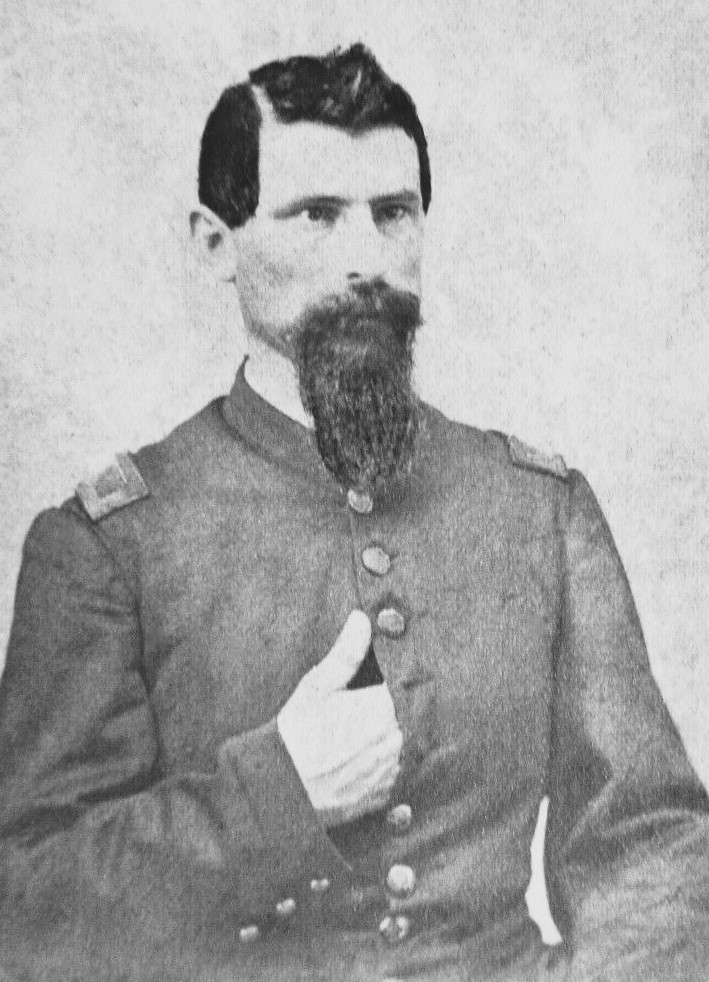
Second Lieutenant Allen G. Balliet, Company B, 47th Pennsylvania Volunteers, circa 1863 (public domain).
Friends and relatives before they became brothers-in-arms, Allen G. Balliet and Francis Sanders were young Allentonians with promising futures ahead of them during the 1850s, as they embarked on their mid-nineteenth-century lives focused around building families and businesses. Many of their hopes and dreams would likely have come true, as they had planned, had their nation not descended into one of its darkest periods in history—a descent that would radically alter not only their futures, but those of hundreds of thousands of other Americans as well.
Formative Years
Born in Allentown, Pennsylvania on 30 May 1834, Allen G. Balliet was a son of Bartholomew Balliet (1794-1858), a veteran of the War of 1812 who became one of Allentown’s leading contractors, and Allentown native Anna (Weiss) Balliet (1797-1882). Raised in Allentown with his siblings, Maria E. Balliet (1818-1890), who would later wed Stephen Burger (1814-1867); Edmund J. Balliet (1821-1871), who later wed Caroline Donner (1828-1870); William H. Balliet (1823-1904), who later wed Louisa Geiss (1825-1906); Henrietta Susannah Balliet (1826-1916), who later wed Francis Sanders (circa 1830-1864; alternate surname spelling: Xander), who would be declared missing in action while serving with Company B of the 47th Pennsylvania Volunteer Infantry during the American Civil War; Franklin C. Balliet (1830-1869), who wed Mary A. Schadt (1832-1897) circa 1850; and Joseph E. Balliet (1837-1897), who later became Lehigh County’s deputy treasurer and auditor, Allen G. Balliet and his siblings were descended from a prominent Huguenot line in Pennsylvania.
They were also reared in one of the earliest brick houses erected in the city, which had been built by their father circa 1822.

Allentown (aka Northampton Towne, 1851, Frederick Wulff, public domain).
On 12 March 1853, Allen G. Balliet wed Sarah Ann Hoffman (1832-1862), a daughter of John and Sarah Hoffman at the Lutheran Church in Allentown. He and his wife, Sarah, welcomed the arrival of daughter Clara E. Balliet (1853-1886), who later married and was widowed by Calvin T. Steckel. By 1860, the trio were residing in the Second Ward of Allentown, where Allen was employed as a sash manufacturer.
Around this same time Allen Balliet’s sister, Henrietta S. Balliet, wed Francis Sanders (circa 1830-1864; alternate surname spelling: Xander), a carpenter who worked for her father. On 30 August 1856, they welcomed the arrival of son David Balliet Sanders (1856-1922), followed by several children who died in infancy or early childhood, including daughter Ellen (1855-1858), who was born in Allentown on 11 March 1855 and died there on 15 May 1858, and Erwin Joseph, who was born and died circa 1858. Like his older brother David, their next child, Frank E. Sanders (1860-1899), who was born in Allentown on 29 January 1860, would have a happier outcome, surviving until he reached the age of thirty-nine.
* Note: According to the 1850 federal census, twenty-year-old carpenter Francis Sanders (surname spelled as “Xander”) resided in Allentown, Lehigh County, Pennsylvania with twenty-two-year-old “Hennetta Xander.” By the time that the 1860 federal census enumerator arrived, the household included: Francis “Xander,” a twenty-eight-year-old carpenter; his wife, “Henriette”; their three-year-old son David and their three-month-old son Franklin.
American Civil War
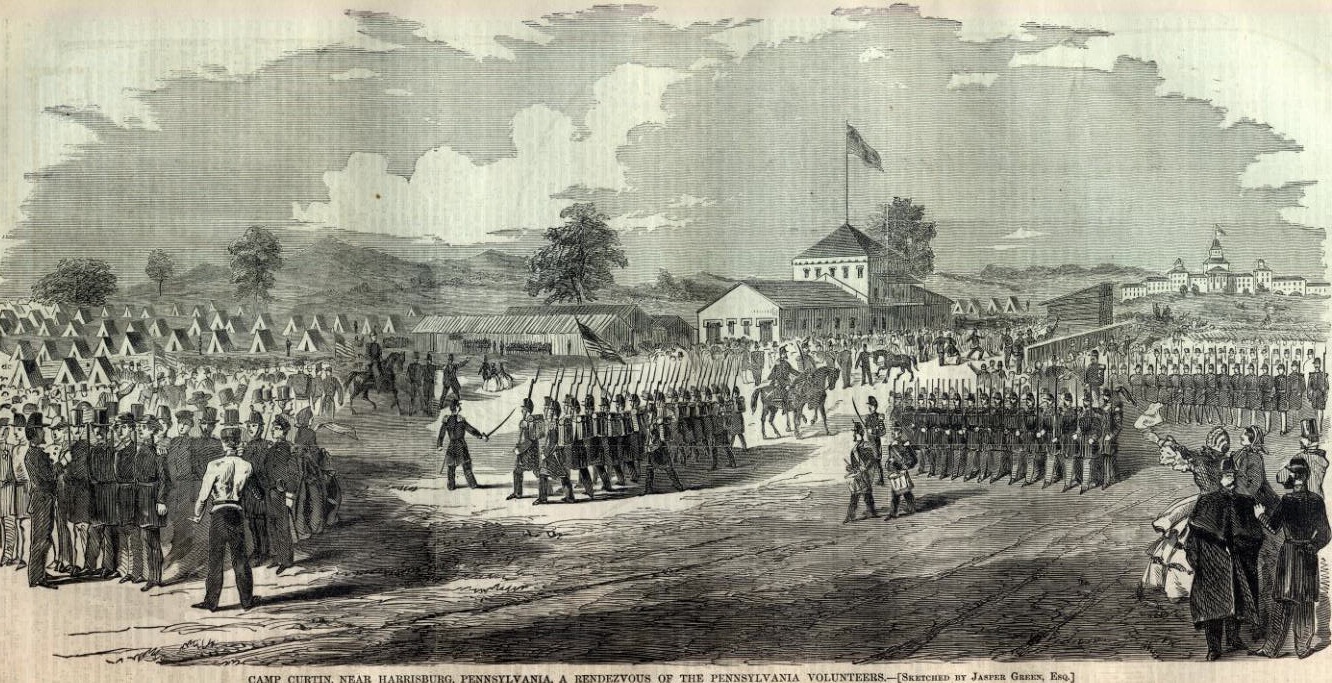
Camp Curtin (Harper’s Weekly, 1861, public domain).
On 20 August 1861, twenty-seven-year-old Allen G. Balliet became one of the early responders to President Lincoln’s call for volunteers to defend the nation’s capital when he enrolled for Civil War military service in Allentown, Pennsylvania. After mustering in for duty with the newly-formed 47th Pennsylvania Volunteer Infantry at Camp Curtin in Harrisburg, Dauphin County, he was promoted to the rank of Second Lieutenant with Company B of that regiment on 30 August. Military records at the time described him as being a carpenter residing in Lehigh County, who was 5’11” tall with dark brown hair, brown eyes and a dark complexion.
On those same exact dates, Allen Balliet’s brother-in-law, Francis Sanders (alternate surname spelling: Xander) also enrolled for Civil War military service (20 August 1861) and mustered in at Camp Curtin (30 August). Aged thirty-one at the time, he entered at the rank of Corporal, and was assigned to the same regiment and company as his brother-in-law—Company B of the 47th Pennsylvania Volunteer Infantry. Military records described him as being a carpenter residing in Allentown who was 5’7-½” tall with light hair, blue eyes and a light complexion.
* Note: Over the years, army clerks, historians, genealogists, and even newspaper reporters have confused two soldiers who both served in the 47th Pennsylvania Volunteer Infantry during the American Civil War: Corporal Francis Sanders of Company B and Wagoner/Teamster Francis Xander of Company I. This confusion is partly due to the multiple entries made by Union Army clerks of Francis Sanders’ surname on regimental muster rolls as “Xander” or “Xanders.” Had historians and news reporters who confused these two men when writing about them checked the 47th Pennsylvania’s muster rolls more closely, however, they would have realized that these were two separate individuals whose appearances differed greatly. (Francis Sanders, who was presumed to have died from battle wounds sustained during the 1864 Red River Campaign, had light hair and blue eyes, whereas Francis Xander, who served for the full duration of the war, had black hair and brown eyes.) As further confirmation, the surname spelling of Corporal Francis Sanders was later documented by his widow, Henrietta (Balliet) Sanders, when she filed for a U.S. Civil War Widow’s Pension. Her gravestone and those of her surviving sons also all bear that same surname spelling (“Sanders”).
The newly-formed company that Allen Balliet and Francis Sanders joined that day was led by Emanuel P. Rhoads, a grandson of Peter Rhoads, Jr., former president of the Northampton Bank. Often referred to as “E. P.,” Rhoads had previously performed his Three Months’ Service as a First Lieutenant with the Allen Rifles during the opening months of the war. The initial recruitment for members to fill Company B began in Allentown, Lehigh County, Pennsylvania—the city in which the 47th’s founder, Colonel Tilghman H. Good, would later go on to serve three terms as mayor.
Following a brief training period in light infantry tactics, the 47th Pennsylvanians headed for Washington, D.C. Stationed roughly two miles from the White House, they made their new home at “Camp Kalorama” on the Kalorama Heights near Georgetown, beginning 21 September. Henry D. Wharton, a Musician with the regiment’s C Company, penned the following update for the Sunbury American newspaper on 22 September:
After a tedious ride we have, at last, safely arrived at the City of ‘magnificent distances.’ We left Harrisburg on Friday last at 1 o’clock A.M. and reached this camp yesterday (Saturday) at 4 P.M., as tired and worn out a sett [sic] of mortals as can possibly exist. On arriving at Washington we were marched to the ‘Soldiers Retreat,’ a building purposely erected for the benefit of the soldier, where every comfort is extended to him and the wants of the ‘inner man’ supplied.
After partaking of refreshments we were ordered into line and marched, about three miles, to this camp. So tired were the men, that on marching out, some gave out, and had to leave the ranks, but J. Boulton Young, our ‘little Zouave,’ stood it bravely, and acted like a veteran. So small a drummer is scarcely seen in the army, and on the march through Washington he was twice the recipient of three cheers.
We were reviewed by Gen. McClellan yesterday [21 September 1861] without our knowing it. All along the march we noticed a considerable number of officers, both mounted and on foot; the horse of one of the officers was so beautiful that he was noticed by the whole regiment, in fact, so wrapt [sic] up were they in the horse, the rider wasn’t noticed, and the boys were considerably mortified this morning on dis-covering they had missed the sight of, and the neglect of not saluting the soldier next in command to Gen. Scott.

Chain Bridge across the Potomac above Georgetown looking toward Virginia, 1861 (The Illustrated London News, public domain).
On 24 September, the men of Company B became part of the federal military service, mustering into the U.S. Army with their fellow members of the 47th Pennsylvania Volunteers. Three days later, the 47th Pennsylvania Volunteers were assigned to the 3rd Brigade of Brigadier-General Isaac Ingalls Stevens, which also included the 33rd, 49th and 79th New York regiments. By that afternoon, the 47th Pennsylvania was on the move again. Ordered onward by Brigadier-General Silas Casey, the Mississippi rifle-armed 47th Pennsylvania infantrymen marched behind their Regimental Band until reaching Camp Lyon, Maryland on the Potomac River’s eastern shore. At 5 p.m., they joined the 46th Pennsylvania in moving double-quick (165 steps per minute using 33-inch steps) across the “Chain Bridge” marked on federal maps, and continued on for roughly another mile before being ordered to make camp.
The next morning, they broke camp and moved again. Marching toward Falls Church, Virginia, they arrived at Camp Advance around dusk. There, about two miles from the bridge they had crossed a day earlier, they re-pitched their tents in a deep ravine near a new federal fort under construction (Fort Ethan Allen). They had completed a roughly eight-mile trek, were situated close to the headquarters of Brigadier-General William Farrar Smith (also known as “Baldy”), and were now part of the Army of the Potomac (“Mr. Lincoln’s Army”). Under Smith’s leadership, their regiment and brigade would help to defend the nation’s capital from the time of their September arrival through late January when the men of the 47th Pennsylvania would be shipped to the nation’s Deep South.
Once again, Company C Musician Henry Wharton recapped the regiment’s activities, noting, via his 29 September letter home to the Sunbury American, that the 47th had changed camps three times in three days:
On Friday last we left Camp Kalorama, and the same night encamped about one mile from the Chain Bridge on the opposite side of the Potomac from Washington. The next morning, Saturday, we were ordered to this Camp [Camp Advance near Fort Ethan Allen, Virginia], one and a half miles from the one we occupied the night previous. I should have mentioned that we halted on a high hill (on our march here) at the Chain Bridge, called Camp Lyon, but were immediately ordered on this side of the river. On the route from Kalorama we were for two hours exposed to the hardest rain I ever experienced. Whew, it was a whopper; but the fellows stood it well – not a murmur – and they waited in their wet clothes until nine o’clock at night for their supper. Our Camp adjoins that of the N.Y. 79th (Highlanders.)….
We had not been in this Camp more than six hours before our boys were supplied with twenty rounds of ball and cartridge, and ordered to march and meet the enemy; they were out all night and got back to Camp at nine o’clock this morning, without having a fight. They are now in their tents taking a snooze preparatory to another march this morning…. I don’t know how long the boys will be gone, but the orders are to cook two days’ rations and take it with them in their haversacks….
There was a nice little affair came off at Lavensville [sic, “Lewinsville”], a few miles from here on Wednesday last; our troops surprised a party of rebels (much larger than our own.) killing ten, took a Major prisoner, and captured a large number of horses, sheep and cattle, besides a large quantity of corn and potatoes, and about ninety six tons of hay. A very nice day’s work. The boys are well, in fact, there is no sickness of any consequence at all in our Regiment….

Unknown regiment, Camp Griffin, Virginia, fall 1861 (public domain, U.S. Library of Congress).
Sometime during this phase of duty, as part of the 3rd Brigade, the 47th Pennsylvanians were moved to a site they initially christened “Camp Big Chestnut” for the large chestnut tree located within their lodging’s boundaries. The site would eventually become known to the Keystone Staters as “Camp Griffin,” and was located roughly ten miles from Washington, D.C.
On 11 October, the 47th Pennsylvania marched in the Grand Review at Bailey’s Cross Roads. Also around this time, companies D, A, C, F and I (the 47th Pennsylvania’s right wing) were ordered to picket duty after the left-wing companies (B, G, K, E, and H) had been forced to return to camp by Confederate troops. In his letter of 13 October, Henry Wharton described their duties, as well as their new home:
The location of our camp is fine and the scenery would be splendid if the view was not obstructed by heavy thickets of pine and innumerable chesnut [sic] trees. The country around us is excellent for the Rebel scouts to display their bravery; that is, to lurk in the dense woods and pick off one of our unsuspecting pickets. Last night, however, they (the Rebels) calculated wide of their mark; some of the New York 33d boys were out on picket; some fourteen or fifteen shots were exchanged, when our side succeeded in bringing to the dust, (or rather mud,) an officer and two privates of the enemy’s mounted pickets. The officer was shot by a Lieutenant in Company H [?], of the 33d.
Our own boys have seen hard service since we have been on the ‘sacred soil.’ One day and night on picket, next day working on entrenchments at the Fort, (Ethan Allen.) another on guard, next on march and so on continually, but the hardest was on picket from last Thursday morning ‘till Saturday morning – all the time four miles from camp, and both of the nights the rain poured in torrents, so much so that their clothes were completely saturated with the rain. They stood it nobly – not one complaining; but from the size of their haversacks on their return, it is no wonder that they were satisfied and are so eager to go again tomorrow. I heard one of them say ‘there was such nice cabbage, sweet and Irish potatoes, turnips, &c., out where their duty called them, and then there was a likelihood of a Rebel sheep or young porker advancing over our lines and then he could take them as ‘contraband’ and have them for his own use.’ When they were out they saw about a dozen of the Rebel cavalry and would have had a bout with them, had it not been for…unlucky circumstance – one of the men caught the hammer of his rifle in the strap of his knapsack and caused his gun to fire; the Rebels heard the report and scampered in quick time….
On Friday, 22 October, the 47th engaged in a Divisional Review, described by historian Lewis Schmidt as “about 10,000 infantry, 1000 cavalry, and twenty pieces of artillery all in one big open field.” Four days later, Company B’s drummer boy, Alfred Eisenbraun, was dead—the second “man” from the regiment to die since the 47th Pennsylvania’s formation. (The first was another drummer boy, John Boulton Young of C Company.)
Soldiering On
In late October 1861, according to Schmidt, the men from Companies B, G and H woke at 3 a.m., assembled a day’s worth of rations, marched four miles from camp, and took over picket duties from the 49th New York:
Company B was stationed in the vicinity of a Mrs. Jackson’s house, with Capt. Kacy’s Company H on guard around the house. The men of Company B had erected a hut made of fence rails gathered around an oak tree, in front of which was the house and property, including a persimmon tree whose fruit supplied them with a snack. Behind the house was the woods were the Rebels had been fired on last Wednesday morning while they were chopping wood there.
In his letter of 17 November, Henry Wharton revealed still more details about life at Camp Griffin:
This morning our brigade was out for inspection; arms, accoutrements [sic], clothing, knapsacks, etc, all were out through a thorough examination, and if I must say it myself, our company stood best, A No. 1, for cleanliness. We have a new commander to our Brigade, Brigadier General Brannen [sic, Brannan], of the U.S. Army, and if looks are any criterion, I think he is a strict disciplinarian and one who will be as able to get his men out of danger as he is willing to lead them to battle….
The boys have plenty of work to do, such as piquet [sic] duty, standing guard, wood-chopping, police duty and day drill; but then they have the most substantial food; our rations consist of fresh beef (three times a week) pickled pork, pickled beef, smoked pork, fresh bread, daily, which is baked by our own bakers, the Quartermaster having procured portable ovens for that purpose, potatoes, split peas, beans, occasionally molasses and plenty of good coffee, so you see Uncle Sam supplies us plentifully….
A few nights ago our Company was out on piquet [sic]; it was a terrible night, raining very hard the whole night, and what made it worse, the boys had to stand well to their work and dare not leave to look for shelter. Some of them consider they are well paid for their exposure, as they captured two ancient muskets belonging to Secessia. One of them is of English manufacture, and the other has the Virginia militia mark on it. They are both in a dilapidated condition, but the boys hold them in high estimation as they are trophies from the enemy, and besides they were taken from the house of Mrs. Stewart, sister to the rebel Jackson who assassinated the lamented Ellsworth at Alexandria. The honorable lady, Mrs. Stewart, is now a prisoner at Washington and her house is the headquarters of the command of the piquets [sic]….
Since the success of the secret expedition, we have all kinds of rumors in camp. One is that our Brigade will be sent to the relief of Gen. Sherman, in South Carolina. The boys all desire it and the news in the ‘Press’ is correct, that a large force is to be sent there, I think their wish will be gratified….
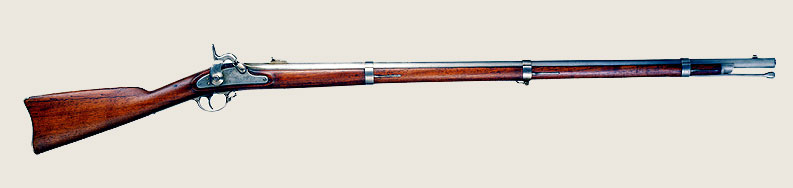
Springfield rifle, 1861 model (public domain).
On 21 November, the 47th participated in a morning divisional headquarters review overseen by the regiment’s founder, Colonel Tilghman H. Good, followed by brigade and division drills all afternoon. According to Schmidt, “each man was supplied with ten blank cartridges.” Afterward, “Gen. Smith requested Gen. Brannan to inform Col. Good that the 47th was the best regiment in the whole division.” As a reward—and in preparation for bigger things to come, Brigadier-General John Milton Brannan obtained new Springfield rifles for every member of the 47th Pennsylvania.
The guard duties in rainy weather and frequent marches gradually began to wear the men down, however; a number of 47th Pennsylvanians fell ill with fever. Several contracted Variola (smallpox), which was also sickening Confederate troops stationed nearby. Sent back to Union Army hospitals in Washington, D.C., at least two members of the regiment died there while receiving treatment.
1862

The 47th Pennsylvania Volunteers were transported to Florida aboard the steamship U.S. Oriental in January 1862 (public domain).
Next ordered to move from their Virginia encampment back to Maryland, the 47th Pennsylvania Volunteers left Camp Griffin at 8:30 a.m. on Wednesday, 22 January 1862. Marching through deep mud with their equipment for three miles in order to reach the railroad station at Falls Church, they were sent by rail to Alexandria, and then sailed the Potomac via the steamship City of Richmond to the Washington Arsenal, where they were reequipped before they were marched off for dinner and rest at the Soldiers’ Retreat in Washington, D.C. The next afternoon, the 47th Pennsylvanians hopped cars on the Baltimore & Ohio Railroad, and headed for Annapolis, Maryland. Arriving around 10 p.m., they were assigned quarters in barracks at the Naval Academy. They then spent that Friday through Monday (24-27 January 1862) loading their equipment and other supplies onto the steamship Oriental.
By the afternoon of 27 January, when the 47th Pennsylvania Volunteers commenced boarding the Oriental, they were ferried to the big steamship by smaller steamers. The officers boarded last and, per the directive of Brigadier-General Brannan, they steamed away for the Deep South at 4 p.m. They were headed for Florida which, despite its secession from the Union, remained strategically important to the Union due to the presence of Forts Taylor and Jefferson in Key West and the Dry Tortugas.
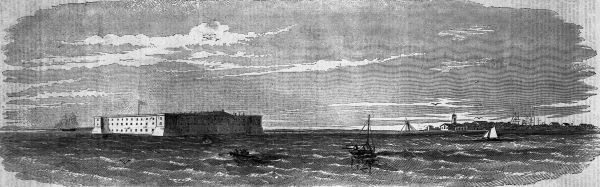
Fort Taylor, Key West, Florida, circa 1861 (courtesy, State Archives of Florida; click to enlarge).
The 47th Pennsylvania Volunteers arrived in Key West in February, and were quickly assigned to garrison Fort Taylor. During the weekend of Friday, 14 February, they introduced their presence to Key West residents as the regiment paraded through the streets of the city. That Sunday, a number of the men attended to their spiritual needs by participating in services at local churches.
While stationed in Key West, the men of the 47th drilled in heavy artillery and other tactics—often as much as eight hours per day. They also felled trees, built roads and strengthened the installation’s fortifications.
But their time was made more difficult by the prevalence of disease. Many of the 47th’s men lost their lives to typhoid and other tropical illnesses, or to dysentery and other ailments spread from soldier to soldier by poor sanitary conditions.
It was also during this phase of duty that Second Lieutenant Allen G. Balliet received the heartbreaking news that he was now a widower. His wife, Sarah, had passed away back home in Allentown on 20 April 1862, and had been laid to rest at that city’s Union West-End Cemetery.
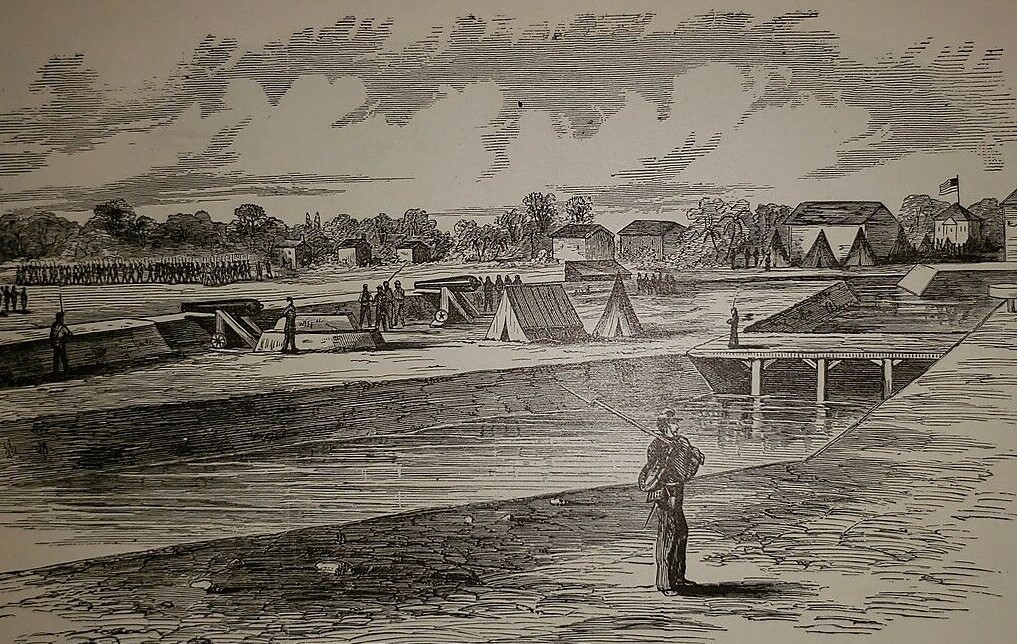
Fort Walker, Hilton Head, South Carolina, circa 1861 (Frank Leslie’s Illustrated Newspaper, public domain).
Next ordered to Hilton Head, South Carolina from mid-June through July, they camped near Fort Walker before relocating to the Beaufort District, U.S. Army Department of the South, roughly 35 miles away. Frequently assigned to hazardous picket detail north of their main camp, which put them at increased risk from enemy sniper fire, the members of the 47th Pennsylvania became known for their “attention to duty, discipline and soldierly bearing,” and “received the highest commendation from Generals Hunter and Brannan,” according to historian Samuel P. Bates.
Detachments from the regiment were also assigned to the Expedition to Fenwick Island (9 July) and the Demonstration against Pocotaligo (10 July).
First Victory
On 30 September the 47th was sent on a return expedition to Florida, where B Company participated with its regiment and other Union forces from 1 to 3 October in the capture of Saint John’s Bluff. Led by Brigadier-General Brannan, the 1,500-plus Union force disembarked from gunboat-escorted troop carriers at Mayport Mills and Mount Pleasant Creek. With the 47th Pennsylvania in the lead and braving alligators, skirmishing Confederates and killer snakes, the brigade negotiated 25 miles of thickly forested swamps in order to capture the bluff and pave the way for the Union’s second occupation of Jacksonville, Florida.
Integration of the Regiment
On 5 and 15 October 1862, respectively, the 47th Pennsylvania made history as it became an integrated regiment, adding to its muster rolls several young to middle-aged Black men who had escaped chattel enslavement from plantations near Beaufort, South Carolina. Among the formerly enslaved men who enlisted at this time were Bristor Gethers, Abraham Jassum and Edward Jassum.
More men of color would then continue to be added to the 47th Pennsylvania’s rosters in the weeks and years to come.
Battle of Pocotaligo, South Carolina
From 21-23 October, the 47th Pennsylvania Volunteers engaged Confederate forces in the Battle of Pocotaligo, South Carolina. Landing at Mackay’s Point under the regimental command of Colonel Tilghman H. Good and Lieutenant-Colonel George W. Alexander, the men of the 47th were placed on point once again as part of the U.S. 10th Army’s 1st Brigade. This time, however, their luck would run out. Their brigade was bedeviled by snipers and faced massive resistance from an entrenched Confederate battery, which opened fire on the Union troops as they headed through an open cotton field. Those trying to reach the higher ground of the Frampton Plantation were pounded by Confederate artillery and infantry hidden in the surrounding forests.
Part-way into the conflict, their brigade’s commanding officer was wounded, requiring Colonel Good to assume command of the 1st Brigade and Lieutenant-Colonel Alexander to assume command of the 47th Pennsylvania.
Charging into the fire, Union forces fought the Confederates where they found them, pushing them into a four-mile retreat to the Pocotaligo Bridge. At this juncture, the 47th then relieved the 7th Connecticut, but after two hours of exchanging fire while attempting, unsuccessfully, to take the ravine and bridge, the men of the 47th were forced by their dwindling ammunition to withdraw to Mackay’s Point.
Losses for the 47th Pennsylvania at Pocotaligo were significant. Two officers and 18 enlisted men died; an additional two officers and 114 enlisted were wounded, including Privates Martin W. Leisenring and Obadiah Pfeiffer.
On 23 October, the 47th Pennsylvania headed back to Hilton Head, where members of the regiment were assigned to serve on the honor guard during the funeral of Major-General Ormsby M. Mitchel, commander of the U.S. Army’s 10th Corps and Department of the South. Mitchel, who had died from yellow fever at the Union Army’s hospital at Hilton Head on 30 October, had initially gained fame in 1846 as an astronomer at the University of Cincinnati, following his discovery of The Mountains of Mitchel on Mars. The town of Mitchelville, the first Freedmen’s self-governed community created after the Civil War, was also named for him.
Members of the 47th Pennsylvania Volunteers were awarded the honor of firing the salute over the grave of the departed general.
1863
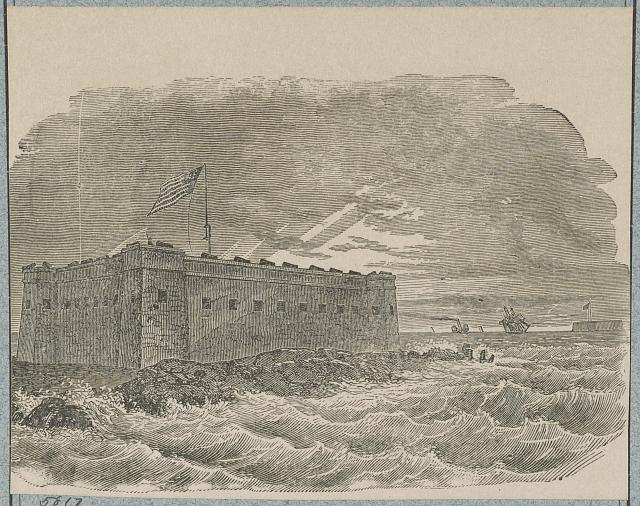
Woodcut depicting the harsh climate at Fort Taylor in Key West, Florida during the Civil War (U.S. Library of Congress, public domain).
Having been ordered back to Key West on 15 November 1862, much of 1863 for the men of the 47th Pennsylvania was spent garrisoning federal installations in Florida as part of the U.S. Army’s 10th Corps, Department of the South. Captain Rhoads and his B Company men joined with Companies A, C, E, G, and I in duties at Key West’s Fort Taylor while the soldiers from Companies D, F, H, and K garrisoned Fort Jefferson, the Union’s remote outpost in the Dry Tortugas off the coast of Florida.
In a letter to the Sunbury American on 23 August 1863, Henry Wharton described Thanksgiving celebrations held by the regiment and residents of Key West and a yacht race the following Saturday at which participants had “an opportunity of tripping the ‘light, fantastic toe,’ to the fine music of the 47th Band, led by that excellent musician, Prof. Bush.”
It was also a noteworthy year due to the casualties incurred—and for the clear commitment of the men of the 47th to preserving the Union. Many chose to reenlist when their terms of service expired, opting to finish the fight rather than returning home to families and friends. Corporal Francis Sanders of Company B was one of the men who committed themselves to second, three-year tours of duty. He re-enlisted at Fort Taylor on 18 December 1863.
1864
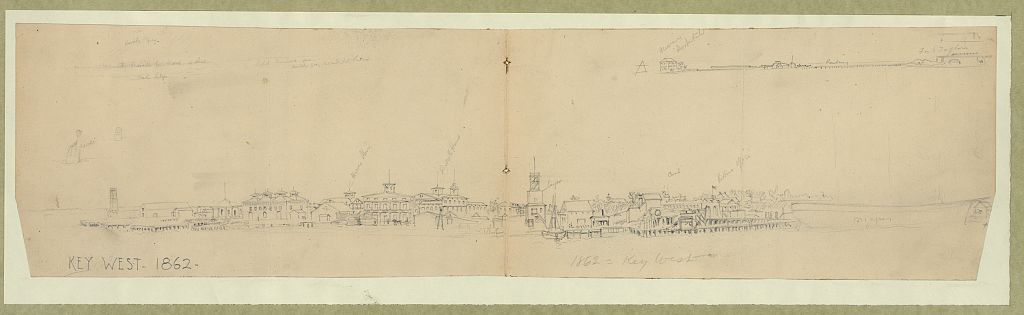
Alfred Waud’s 1862 sketch of Fort Taylor and Key West, Florida (U.S. Library of Congress, public domain; click to enlarge).
In early January 1864, the 47th Pennsylvania Volunteer Infantry was ordered to expand the Union’s reach even further by sending part of the regiment north from Key West to retake possession of Fort Myers, a federal installation that had been abandoned in 1858 following the U.S. government’s third war with the Seminole Indians. Per orders issued earlier in 1864 by General D. P. Woodbury, Commanding Officer, U.S. Department of the Gulf, District of Key West and the Tortugas, that the fort be used to facilitate the Union’s Gulf Coast blockade, Captain Richard Graeffe and a group of men from Company A were assigned to special duty, charged with expanding the fort and conducting raids on area cattle herds to provide food for the growing Union troop presence. Graeffe and his men subsequently turned the fort into both their base of operations and a shelter for pro-Union supporters, escaped slaves, Confederate Army deserters, and others fleeing Rebel troops.
Meanwhile, back at Forts Taylor and Jefferson, Second Lieutenant Allen Balliet, Corporal Francis Sanders and the other members of the 47th Pennsylvania Volunteer Infantry had already begun preparing for the regiment’s history-making journey to Louisiana. Boarding yet another steamer—the Charles Thomas—on 25 February 1864, the men from Companies B, C, D, I, and K of the 47th Pennsylvania headed for Algiers, Louisiana (across the river from New Orleans), followed on 1 March by other members of the regiment from Companies E, F, G, and H who had been stationed at Fort Jefferson in the Dry Tortugas. Upon the second group’s arrival, the now almost fully reunited regiment moved by train on 28 February to Brashear City (now Morgan City, Louisiana) before heading to Franklin by steamer through the Bayou Teche. There, the 47th Pennsylvania Volunteer Infantry joined the 2nd Brigade, 1st Division of the Department of the Gulf’s 19th Army Corps (XIX Corps), and became the only Pennsylvania regiment to serve in the Red River Campaign of Union Major-General Nathaniel P. Banks.
Red River Campaign
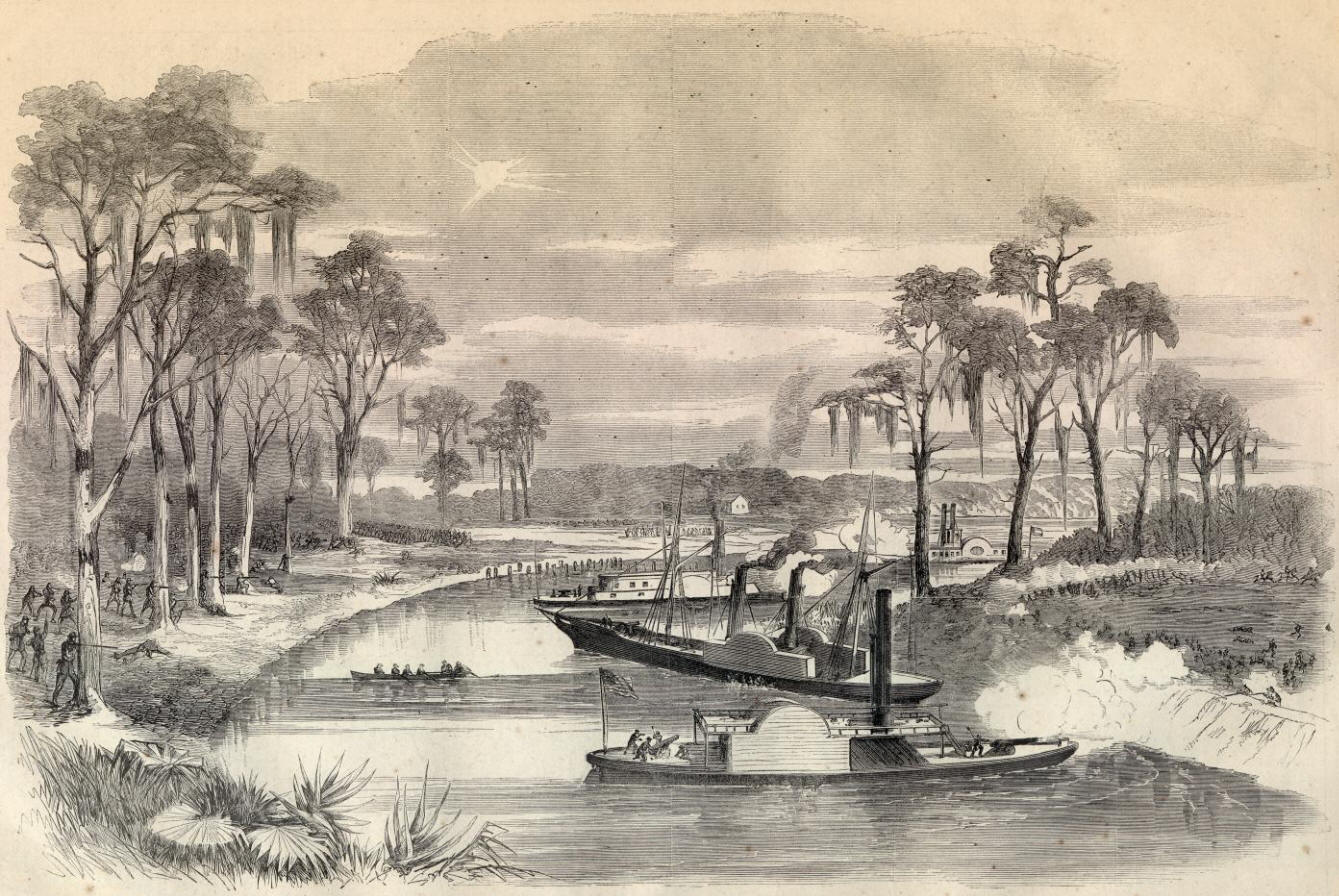
Bayou Teche, Louisiana (Harper’s Weekly, 14 February 1863, public domain).
From 14-26 March, the soldiers of the 47th Pennsylvania headed for Alexandria and Natchitoches, Louisiana (near the top of the “L” of this L-shaped state). As they progressed, they made their way through New Iberia, Vermilionville, Opelousas, and Washington. Often short on food and water during their long, hard trek through enemy territory, they finally arrived at their destination in early April.
From 4-5 April 1864, the regiment added to its roster of young Black soldiers when Aaron Bullard (also known as Aaron French), James Bullard, John Bullard, Samuel Jones, and Hamilton Blanchard (also known as John Hamilton) enrolled for service with the 47th Pennsylvania Volunteers at Natchitoches. According to their respective entries in the Civil War Veterans’ Card File at the Pennsylvania State Archives and on regimental muster rolls, the men would be officially mustered in for duty when the regiment reached a safer base of Union operations. Several of their entries noted that they were assigned the rank of “(Colored) Cook” while others were given the rank of “Under Cook.”
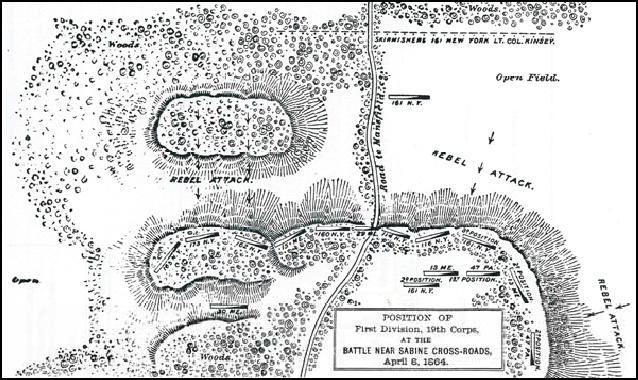
19th U.S. Army Map, Phase 3, Battle of Sabine Cross Roads/Mansfield (8 April 1864, public domain).
Resuming their march, the 47th Pennsylvanians made camp briefly at Pleasant Hill on the night of 7 April before continuing on the next day. Marching until mid-afternoon, it was on that day (8 April 1864) that they engaged in the Battle of Sabine Cross Roads, also known as the Battle of Mansfield, losing 60 of their friends to fierce gun and cannon fire. The fighting waned only when darkness fell, the uninjured collapsing in exhaustion beside their gravely wounded or dead comrades.
In the confusion, a number of 47th Pennsylvania Volunteers were reported as killed in action, but had actually survived. Among the many wounded was Corporal Francis Sanders of the 47th Pennsylvania’s B Company. Reportedly carried to the rear by his brother, according to newspaper accounts of the time, he was subsequently declared missing. (Later, when no further information about his whereabouts was found by his regiment’s commanding officers, he was declared dead, his fate presumed to have been that of an unknown soldier who had been buried in an unmarked grave somewhere near Mansfield, Louisiana.)
* Note: The aforementioned newspaper reports may have been referring to B Company Second Lieutenant Allen Balliet, Corporal Sanders’ brother-in-law, rather than an unidentified brother; however, there were other men serving with the 47th Pennsylvania Volunteer Infantry during this time who had similar surnames, including B Company Private Dallas Xander. Researchers for 47th Pennsylvania Volunteers: One Civil War Regiment’s Story have not yet determined whether or not there was a familial relationship between Sanders and Xander.
Corporal Sanders’ status as deceased was further confirmed in the 1916 obituary of his widow, Henrietta Susannah (Balliet) Sanders, which was published in the 15 May edition of Allentown’s Morning Call newspaper that year. The newspaper reported that Francis Sanders “enlisted in the Forty-seventh regiment and saw service for two enlistments until the battle of Sabine Cross Roads, La., where he was wounded and carried to the rear by his brother. From that day to this not a word was heard from him and the supposition was that he died from his wounds….” The obituary went on to say that Francis Sanders of Company B most likely was still buried in an unknown, unmarked grave.
After midnight, Second Lieutenant Allen Balliet and his fellow surviving 47th Pennsylvania Volunteers withdrew with other Union troops to Pleasant Hill.
The next day (9 April), the 47th Pennsylvania Volunteers were ordered into a critically important defensive position at the far right of the Union lines, their right flank spreading up onto a high bluff near the village of Pleasant Hill. By 3 p.m., after enduring a midday charge by the troops of Confederate General Richard Taylor (a plantation owner who was the son of Zachary Taylor, former President of the United States), the brutal fighting still showed no signs of ending. Suddenly, just as the 47th was shifting to the left side of the massed Union forces, the men of the 47th Pennsylvania were forced to bolster the 165th New York’s buckling lines by blocking another Confederate assault.
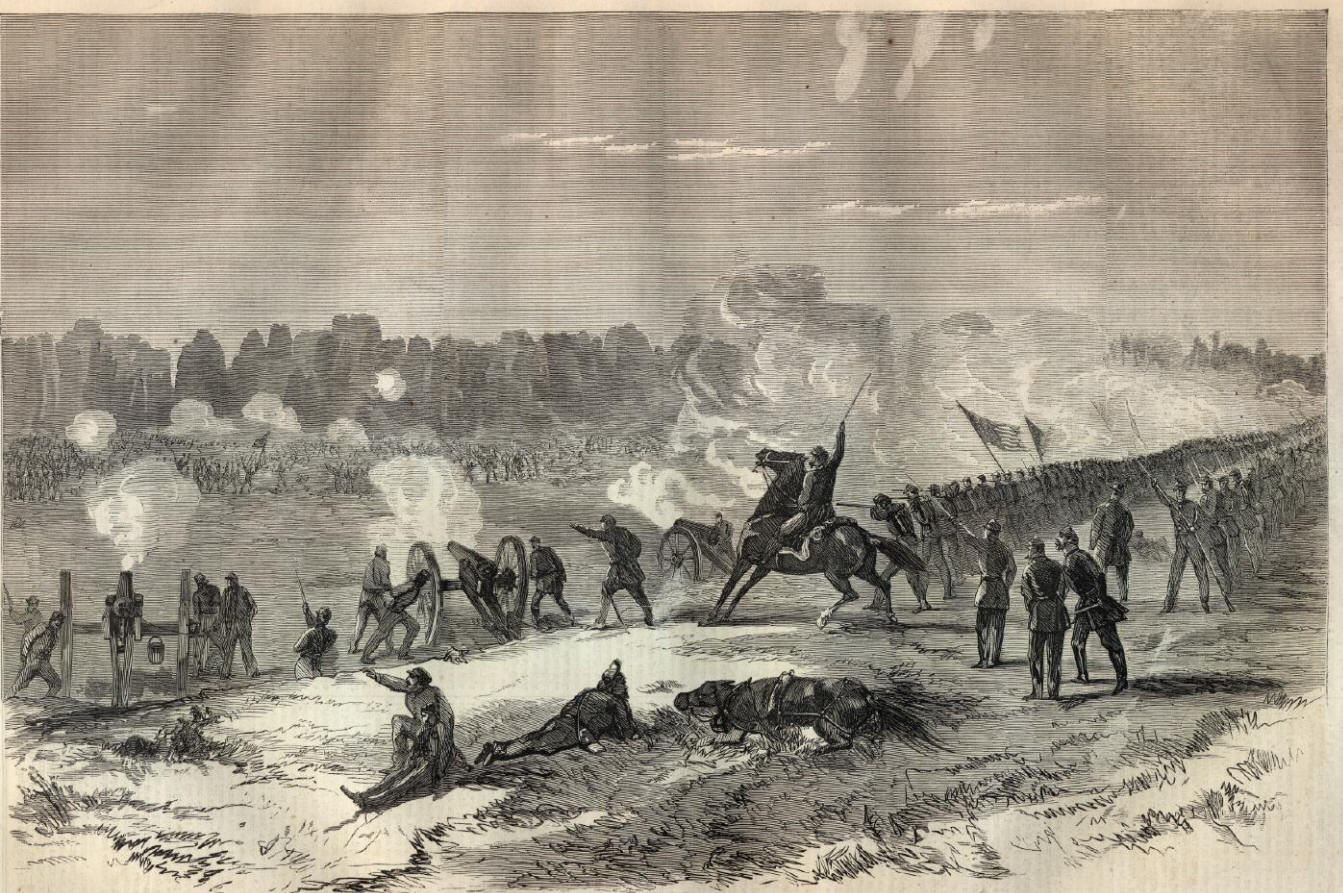
Battle of Pleasant Hill, Louisiana, 9 April 1864 (Harper’s Weekly, 7 May 1864, public domain).
On that day, now known as the Battle of Pleasant Hill, the 47th nearly lost its second-in-command, Lieutenant-Colonel George W. Alexander, who had been severely wounded in both legs. In addition, 68-year-old Color-Sergeant Benjamin Walls of Company C was wounded while trying to mount the regimental colors on a caisson that had been recaptured from Confederate troops, as was Sergeant William Pyers of the same company, who had picked up the American flag when Walls fell, preventing it from falling into enemy hands.
In B Company, John Fries and Tilghman H. Reinsmith were wounded; Edward Fink was dead. Others, who had been captured, were marched roughly 125 miles to Camp Ford near Tyler, Texas (the largest Confederate prison west of the Mississippi), where they were held as prisoners of war (POWs) until released during prisoner exchanges in July, August, September, or November. Sadly, at least two members of the 47th died while in captivity there while still others remain missing to this day, possibly having been hastily interred on or between battlefields—or in unmarked prison graves.
Following what some historians have called a rout by Confederates at Pleasant Hill and others have labeled a technical victory for the Union or a draw for both sides, Second Lieutenant Allen Balliet and his fellow 47th Pennsylvanians fell back to Grand Ecore, where they remained for a total of eleven days (through 22 April 1864). After engaging in the hard labor of strengthening regimental and brigade fortifications, they then moved back to Natchitoches Parish on 22 April, arriving in Cloutierville at 10 p.m. that night after completing a 45-mile march. En route, the Union forces were attacked again—this time in the rear, but were able to end the encounter fairly quickly and continue on.

The 47th Pennsylvania Volunteers were stationed just to the left of the “Thick Woods” with Emory’s 2nd Brigade, 1st Division as shown on this map of Union troop positions for the Battle of Cane River Crossing at Monett’s Ferry, Louisiana, 23 April 1864 (Major-General Nathaniel Banks’ official Red River Campaign Report, public domain).
The next morning (23 April 1864), episodic skirmishing quickly roared into the flames of a robust fight. As part of the advance party led by Brigadier-General William Emory, the 47th Pennsylvanians took on Brigadier-General Hamilton P. Bee’s Confederate Cavalry in the Battle of Cane River (also known as “the Affair at Monett’s Ferry” or the “Cane River Crossing”). Responding to a barrage from the Confederate artillery’s 20-pound Parrott guns and raking fire from enemy troops situated near a bayou and atop a bluff, Emory directed one of his brigades to keep Bee’s Confederates busy while sending the other two brigades to find a safe spot where his Union troops could ford the Cane River. As part of the “beekeepers,” the 47th Pennsylvania supported Emory’s artillery.
As Emory’s troops worked their way toward the Cane River, they attacked Bee’s flank, forced a Rebel retreat, and erected a series of pontoon bridges, enabling the 47th Pennsylvania and other remaining Union troops to make the Cane River Crossing by the next day. As the Confederates retreated, they torched their own food stores, as well as the cotton supplies of their fellow southerners.
In a letter penned from Morganza, Louisiana on 29 May, Henry Wharton described what had happened to the 47th Pennsylvanians during and immediately after making camp at Grand Ecore:
Our sojourn at Grand Ecore was for eleven days, during which time our position was well fortified by entrenchments for a length of five miles, made of heavy logs, five feet high and six feet wide, filled in with dirt. In front of this, trees were felled for a distance of two hundred yards, so that if the enemy attacked we had an open space before us which would enable our forces to repel them and follow if necessary. But our labor seemed to the men as useless, for on the morning of 22d April, the army abandoned these works and started for Alexandria. From our scouts it was ascertained that the enemy had passed some miles to our left with the intention of making a stand against our right at Bayou Cane, where there is a high bluff and dense woods, and at the same attack Smith’s forces who were bringing up the rear. This first day was a hard one on the boys, for by ten o’clock at night they made Cloutierville, a distance of forty-five miles. On that day the rear was attacked which caused our forces to reverse their front and form in line of battle, expecting too, to go back to the relief of Smith, but he needed no assistance, sending word to the front that he had ‘whipped them, and could do it again.’ It was well that Banks made so long a march on that day, for on the next we found the enemy prepared to carry out their design of attacking us front and rear. Skirmishing commenced early in the morning and as our columns advanced he fell back towards the bayou, when we soon discovered the position of their batteries on the bluff. There was then an artillery duel by the smaller pieces, and some sharp fighting by the cavalry, when the ‘mule battery,’ twenty pound Parrott guns, opened a heavy fire, which soon dislodged them, forcing the chivalry to flee in a manner not at all suitable to their boasted courage. Before this one cavalry, the 3d Brigade of the 1st Div., and Birges’ brigade of the second, had crossed the bayou and were doing good service, which, with the other work, made the enemy show their heels. The 3d brigade done some daring deeds in this fight, as also did the cavalry. In one instance the 3d charged up a hill almost perpendicular, driving the enemy back by the bayonet without firing a gun. The woods on this bluff was so thick that the cavalry had to dismount and fight on foot. During the whole of the day, our brigade, the 2d was supporting artillery, under fire all the time, and could not give Mr. Reb a return shot.
While we were fighting in front, Smith was engaged some miles in the rear, but he done his part well and drove them back. The rebel commanders thought by attacking us in the rear, and having a large face on the bluffs, they would be able to capture our train and take us all prisoners, but in this they were mistaken, for our march was so rapid that we were on them before they had thrown up the necessary earthworks. Besides they underrated the amount of our artillery, calculating from the number engaged at Pleasant Hill. The rebel prisoners say it ‘seems as though the Yankees manufacture, on short notice, artillery to order, and the men are furnished with wings when they wish to make a certain point.
The damage done to the Confederate cause by the burning of cotton was immense. On the night of the 22d our route was lighted up for miles and millions of dollars worth of this production was destroyed. This loss will be felt more by Davis & Co., than several defeats in this region, for the basis of the loan in England was on the cotton of Western Louisiana.
After the rebels had fled from the bluff the negro troops put down the pontoons, and by ten that night we were six miles beyond the bayou safely encamped. The next morning we moved forward and in two days were in Alexandria. Johnnys followed Smith’s forces, keeping out of range of his guns, except when he had gained the eminence across the bayou, when he punished them (the rebs) severely.

Christened “Bailey’s Dam” for the Union officer who ordered its construction, Lt.-Col. Joseph Bailey, this timber dam built by the Union Army on the Red River near Alexandria, Louisiana in May 1864 facilitated Union gunboat passage (public domain).
Having finally reached Alexandria on 26 April, they learned they would remain at their latest new camp for at least two weeks. Placed temporarily under the command of Lieutenant-Colonel Joseph Bailey, they were assigned yet again to the hard labor of fortification work, helping to erect “Bailey’s Dam,” a timber structure that enabled Union gunboats to more easily make their way back down the Red River. According to Wharton:
We were at Alexandria seventeen days, during which time the men were kept busy at throwing up earthworks, foraging and three times went out some distance to meet the enemy, but they did not make their appearance in numbers large enough for an engagement. The water in the Red river had fallen so much that it prevented the gunboats from operating with us, and kept our transports from supplying the troops with rations, (and you know soldiers, like other people, will eat) so Banks was compelled to relinquish his designs on Shreveport and fall back to the Mississippi. To do this a large dam had to be built on the falls at Alexandria to get the ironclads down the river. After a great deal of labor this was accomplished and by the morning of May 13th the last one was through the shute [sic], when we bade adieu to Alexandria, marching through the town with banners flying and keeping step to the music of ‘Rally around the flag,’ and ‘When this cruel war is over.’ The next morning, at our camping place, the fleet of boats passed us, when we were informed that Alexandria had been destroyed by fire – the act of a dissatisfied citizen and several negroes. Incendiary acts were strictly forbidden in a general order the day before we left the place, and a cavalry guard was left in the rear to see the order enforced. After marching a few miles skirmishing commenced in front between the cavalry and the enemy in riflepits [sic] on the bank of the river, but they were easily driven away. When we came up we discovered their pits and places where there had been batteries planted. At this point the John Warren, an unarmed transport, on which were sick soldiers and women, was fired into and sunk, killing many and those that were not drowned taken prisoners. A tin-clad gunboat was destroyed at the same place, by which we lost a large mail. Many letters and directed envelopes were found on the bank – thrown there after the contents had been read by the unprincipled scoundrels. The inhumanity of Guerrilla bands in this department is beyond belief, and if one did not know the truth of it or saw some of their barbarities, he would write it down as the story of a ‘reliable gentleman’ or as told by an ‘intelligent contraband.’ Not satisfied with his murderous intent on unarmed transports he fires into the Hospital steamer Laurel Hill, with four hundred sick on board. This boat had the usual hospital signal floating fore and aft, yet, notwithstanding all this, and the customs of war, they fired on them, proving by this act that they are more hardened than the Indians on the frontier.
On Sunday, May 15, we left the river road and took a short route through the woods, saving considerable distance. The windings of Red river are so numerous that it resembles the tape-worm railroad wherewith the politicians frightened the dear people during the administration of Ritner and Stevens. – We stopped several hours in the woods to leave cavalry pass, when we moved forward and by four o’clock emerged into a large open plain where we formed in line of battle, expecting a regular engagement. The enemy, however, retired and we advanced ‘till dark, when the forces halted for the night, with orders to rest on their arms. – ‘Twas here that Banks rode through our regiment, amidst the cheers of the boys, and gave the pleasant news that Grant had defeated Lee.

“Sleeping on Their Arms” by Winslow Homer (Harper’s Weekly, 21 May 1864).
Having entered Avoyelles Parish, they “rested on their arms” for the night, half-dozing without pitching their tents, but with their rifles right beside them. They were now positioned just outside of Marksville, Louisiana on the eve of the 16 May 1864 Battle of Mansura, which unfolded as follows, according to Wharton:
Early next morning we marched through Marksville into a prairie nine miles long and six wide where every preparation was made for a fight. The whole of our force was formed in line, in support of artillery in front, who commenced operations on the enemy driving him gradually from the prairie into the woods. As the enemy retreated before the heavy fire of our artillery, the infantry advanced in line until they reached Mousoula [sic], where they formed in column, taking the whole field in an attempt to flank the enemy, but their running qualities were so good that we were foiled. The maneuvring [sic] of the troops was handsomely done, and the movements was [sic] one of the finest things of the war. The fight of artillery was a steady one of five miles. The enemy merely stood that they might cover the retreat of their infantry and train under cover of their artillery. Our loss was slight. Of the rebels we could not ascertain correctly, but learned from citizens who had secreted themselves during the fight, that they had many killed and wounded, who threw them into wagons, promiscuously, and drove them off so that we could not learn their casualties. The next day we moved to Simmsport [sic] on the Achafalaya [sic] river, where a bridge was made by putting the transports side by side, which enabled the troops and train to pass safely over. – The day before we crossed the rebels [and] attacked Smith, thinking it was but the rear guard, in which they, the graybacks, were awfully cut up, and four hundred prisoners fell into our hands. Our loss in killed and wounded was ninety. This fight was the last one of the expedition. The whole of the force is safe on the Mississippi, gunboats, transports and trains. The 16th and 17th have gone to their old commands.
It is amusing to read the statements of correspondents to papers North, concerning our movements and the losses of our army. I have it from the best source that the Federal loss from Franklin to Mansfield, and from their [sic] to this point does not exceed thirty-five hundred in killed, wounded and missing, while that of the rebels is over eight thousand.

Union Army base at Morganza Bend, Louisiana, circa 1863-1865 (U.S. Library of Congress, public domain).
After B Company Second Lieutenant Allen Balliet the other surviving members of the 47th made their way through Simmesport and into the Atchafalaya Basin, they moved on to Morganza, where they made camp again. According to Wharton, the members of Company C were then sent on a special mission which took them on an intense 120-mile journey:
Company C, on last Saturday was detailed by the General in command of the Division to take one hundred and eighty-seven prisoners (rebs) to New Orleans. This they done [sic] satisfactorily and returned yesterday to their regiment, ready for duty.
While encamped at Morganza, the nine formerly enslaved Black men who had enlisted with the 47th Pennsylvania in Beaufort, South Carolina (1862) and Natchitoches, Louisiana (April 1864) were officially mustered into the regiment between 20-24 June 1864. The regiment then moved on once again, and arrived in New Orleans in late June.
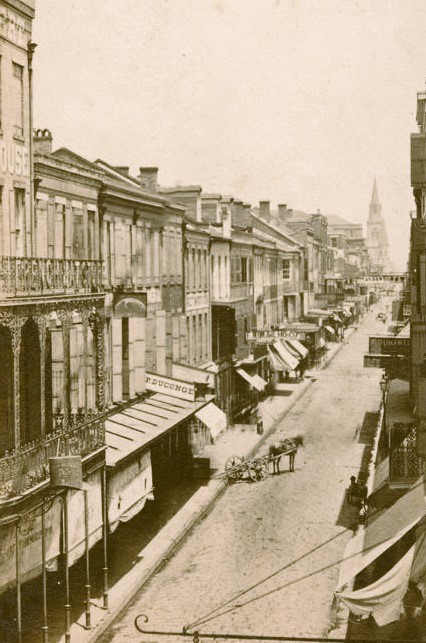
Upper Chartres Street, New Orleans, Louisiana, 1864 (public domain).
As they did during their tour through the Carolinas and Florida, the men of the 47th had battled the elements and disease, as well as the Confederate Army, in order to survive and continue to defend their nation. But the Red River Campaign’s most senior leader, Union Major-General Nathaniel P. Banks, would not. Removed from command amid the controversy regarding the Union Army’s successes and failures, he was placed on leave by President Abraham Lincoln. He later redeemed himself by spending much of his time in Washington, D.C. as a Reconstruction advocate for the people of Louisiana. Undaunted by their travails in Bayou country, the 47th Pennsylvania Volunteers continued their fight to preserve the Union during the summer of 1864. After receiving orders on the 4th of July to return to the East Coast, they did so in two stages.
Companies A, C, D, E, F, H, and I steamed for the Washington, D.C. area aboard the McClellan beginning 7 July while the men from Companies B, G and K remained behind on detached duty and to await transportation. Led by F Company Captain Henry S. Harte, they finally sailed away at the end of the month aboard the Blackstone, arrived in Virginia on 28 July, and reconnected with the bulk of the regiment at Monocacy, Virginia on 2 August.
Due to the delay, Second Lieutenant Allen Balliet and the other men from B Company missed out on a memorable encounter with President Abraham Lincoln, and also missed the fighting at Snicker’s Gap, Virginia.
Sheridan’s 1864 Shenandoah Valley Campaign
Attached to the Middle Military Division, U.S. Army of the Shenandoah from August through November of 1864, it was in Virginia at this time in history that the now full-strength 47th Pennsylvania Volunteers would engage in their greatest moments of valor.

“Berryville from the West. Blue Ridge on the Horizon,” according to T. D. Biscoe DeGloyer, who photographed the Berryville Pike on 1 August 1884, two decades after the 47th Pennsylvania Volunteers fought in this vicinity (photo T. D. Biscoe, courtesy of Southern Methodist University).
Records of the 47th Pennsylvania Volunteers confirm that the regiment was assigned to defensive duties in and around Halltown in early August 1864, and engaged in a series of back-and-forth movements between Halltown, Berryville and other locations within the vicinity (Middletown, Charlestown and Winchester) as part of a “mimic war” being waged by Sheridan’s Union forces with those commanded by Confederate Lieutenant-General Jubal Early.
From 3-4 September, the 47th Pennsylvania Volunteers fought in the Battle of Berryville, and engaged in related post-battle skirmishes with the enemy over subsequent days.
But those days of service were now ticking rapidly away for multiple members of the 47th Pennsylvania Volunteer Infantry. Following the Battle of Berryville, a number of its members who had served honorably, including B Company’s Captain E. P. Rhoads and Second Lieutenant Allen G. Balliet, mustered out at Berryville, Virginia on 18 September 1864, upon expiration of their respective three-year terms of service. They were all then transported back home to Pennsylvania, where they tried to resume life with their respective families.
Return to Civilian Life — Allen G. Balliet

Allentown, Pennsylvania, circa 1865 (public domain).
The first days of post-war civilian life in Allentown would be radically different for Allen Balliet, however; a widower since 1862, he initially lived the life of a single father, trying to juggle work duties with the responsibilities of parenting two young children—eight-year-old David Sanders and his six-year-old brother Frank.
By 1870, he had made the decision to tie the knot again, this time marrying Mary A. (Schadt) Balliet. A daughter of Henry and Magdalena (Knauss) Schadt, Mary had been widowed by Allen’s brother Franklin C. Balliet in 1869. He then also adopted Mary’s daughter (the daughter of his brother, Franklin).
It was also during this phase of his life that Allen Balliet managed a restaurant that was located at Pfeiffer’s saloon on North Seventh Street in Allentown.
He subsequently left that work in order to operate an ice cream shop in Allentown’s Yundt Building.
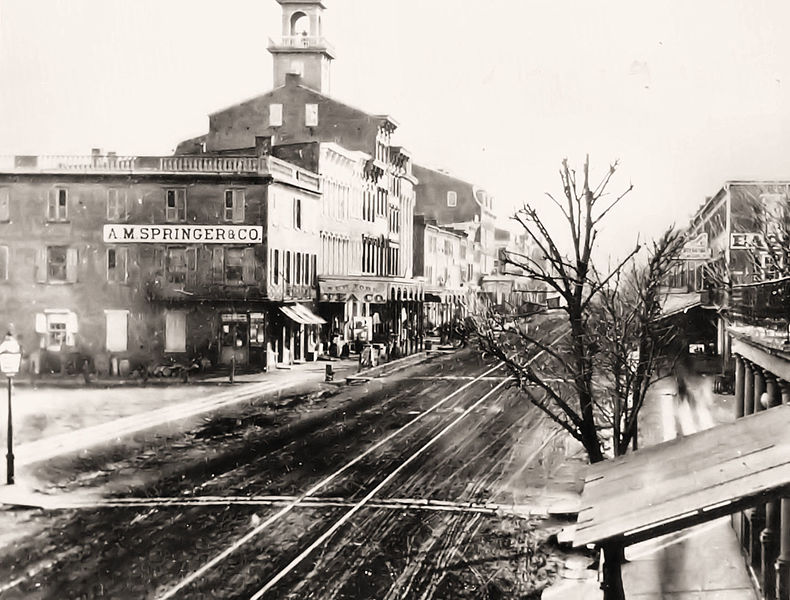
Hamilton Street, looking west from Center Square, Allentown, Pennsylvania, 1880 (public domain).
By December of 1880, he was engaged in the early stages of managing and growing the capacity of the Jordan Ice House in Scherersville, until his failing health compelled him to take on less demanding work—that of managing a boarding house at the corner of Penn and Hamilton Streets.
Illness, Death, Funeral, and Interment
During the summer of 1883, while still just in his late forties, Allen Balliet caught a cold while working inside of the Jordan Ice House in Scherersville while “in an overheated condition,” according to The Allentown Democrat. As he cold worsened over the next several days and weeks, he also contracted tuberculosis (consumption). That disease progressed rapidly, according to The Morning Call.
He died in Allentown at 8 a.m. on 10 February 1884.
Following funeral services held at 1:30 p.m. on 14 February at his home at 415 Hamilton Street and services at the Salem Reformed Church that were officiated by the Rev. Dubbs, his coffin was carried to the Union-West End Cemetery by a procession involving the following organizations:
- Allentown Cornet Band;
- Company B, 4th Regiment, Pennsylvania National Guard;
- Members of the 47th Pennsylvania Veteran Volunteers;
- Members of the Grand Army of the Republic (Colonel E. B. Young Post No. 87); and
- Members of the International Order of Odd Fellows (Allen Lodge No. 71).
He was then laid to rest with military honors at Union-West End Cemetery.
* What happened to the families of Allen G. Balliet and Francis Sanders? Read part two of this biography to find out.
Sources:
- Balliet, Allen G., in Applications for Headstones of Deceased Union Veterans, 19 November 1975. Washington, D.C.: U.S. National Archives and Records Administration.
- Balliet, Allen G., in Burial Records. Allentown Pennsylvania: Salem Reformed Church (later Salem United Church of Christ), 10 February 1884.
- Balliet, Allen G., in Civil War Veterans’ Card File, 1861-1866. Harrisburg, Pennsylvania: Pennsylvania State Archives.
- Balliet, Allen G., in Headstones Provided for Deceased Union Veterans. Washington, D.C.: U.S. National Archives and Records Administration.
- Balliet, Allen G., Bartholomew and Anna, and Hoffman, Sarah, John and Sarah, in Marriage Records. Allentown, Pennsylvania: Lehigh County, 12 March 1853.
- Balliet, Allen G., Polly, Clara, et. al. in U.S. Census (Allentown, Lehigh County, Pennsylvania: 1870). Washington, D.C.: U.S. National Archives and Records Administration.
- Balliet, Allen G., Sarah and Clara, in U.S. Census (Allentown, Lehigh County, Pennsylvania: 1860). Washington, D.C.: U.S. National Archives and Records Administration.
- Balliet, Bartholomew, Anna, Allen G., and Joseph; James Lowry and Barbara Weiss, in U.S. Census (Allentown, Lehigh County, Pennsylvania: 1850). Washington, D.C. U.S. National Archives and Records Administration.
- Bates, Samuel P. History of Pennsylvania Volunteers, 1861-5, vol. 1. Harrisburg, Pennsylvania: B. Singerly, State Printer.
- “Burial of Lieut. A. G. Balliet.” Allentown, Pennsylvania: The Morning Call, 15 February 1884.
- “Death of Allen G. Balliet.” Allentown, Pennsylvania: The Allentown Democrat, 13 February 1884.
- “Death of Allen G. Balliet.” Allentown, Pennsylvania: The Allentown Democrat, 7 April 1897.
- “Fine Ice.” Allentown, Pennsylvania: The Allentown Democrat, 15 December 1880.
- “Henrietta Sanders Dies in Her 90th Year” (obituary of Francis Sanders’ widow). Allentown, Pennsylvania: The Morning Call, 15 May 1916.
- “Obituary.” Allentown, Pennsylvania: The Morning Call, 11 February 1884.
- Sanders, Francis and Henrietta, in U.S. Civil War Widow’s Pension Files (application no.: 61040, certificate no.: 33762; filed by the widow on 15 August 1864). Washington, D.C.: U.S. National Archives and Records Administration.
- Schmidt, Lewis. A Civil War History of the 47th Regiment of Pennsylvania Veteran Volunteers. Allentown, Pennsylvania: Self-published, 1986.
- “Verheirathet” (“Married”). Allentown, Pennsylvania: Der Lecha Caunty Patriot, 16 March 1853.
- “Xander, Francis [sic, surname was spelled: Sanders]” (Company B, 47th Pennsylvania Volunteer Infantry, and “Xander, Francis’ (Company I, 47th Pennsylvania Volunteer Infantry), in Civil War Veterans’ Card File, 1861-1866. Harrisburg, Pennsylvania: Pennsylvania State Archives.
- “Xander,” Francis and “Hennetta” [sic, surname was spelled: Sanders],” in U.S. Census (Allentown, Lehigh County, Pennsylvania: 1850). Washington, D.C.: U.S. National Archives and Records Administration.
- “Xander,” Francis and “Henriette” [sic, surname was spelled: Sanders],” in U.S. Census (Allentown, Lehigh County, Pennsylvania: 1860). Washington, D.C.: U.S. National Archives and Records Administration.
- “Xander,” Francis and Henrietta, in U.S. Civil War Pension File Index (Company B, 47th Pennsylvania Volunteer Infantry; widow’s pension application no.: 61040, certificate no.: 33762; filed by the widow on 15 August 1864). Washington, D.C.: U.S. National Archives and Records Administration.
 47th Pennsylvania Volunteers
You must be logged in to post a comment.