Alternate Spellings of Given Name: Uriah, Uric, Urice, Urie. Alternate Spellings of Surname: Keiser, Keizer, Kiser
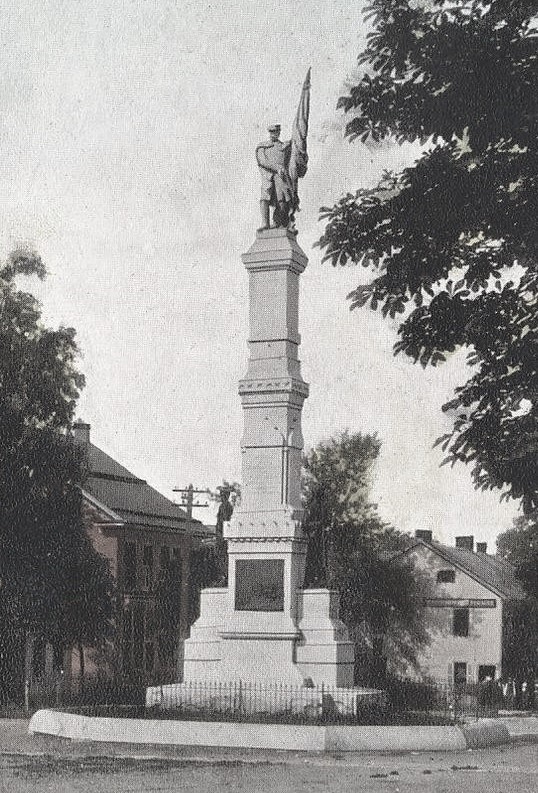
Soldiers’ and Sailors’ Monument, New Bloomfield, Perry County, Pennsylvania, circa early 1900s (public domain).
Born in Perry County, Pennsylvania on 10 June 1818, Uriah William (“Urie”) Keiser was the husband of Margaret (Saylor; alternate spelling: Sailor) Keiser, a native Pennsylvanian born on 8 November 1820. They were married in Perry County, Pennsylvania on 22 March 1844. Together, they welcomed to their world the following children:
- Emanuel H. (born on 2 September 1844);
- Sarah (born sometime around 1846);
- Margaret Ann (born 24 or 26 November 1848); and
- Joseph T. (born 2 December 1851).
Both of the younger children, Margaret and Joseph, were born in the Keiser family home in Saville Township, Perry County.
Civil War Military Service — Emanuel Keiser
Emanuel H. Keiser, eldest son of the Keiser family of Saville Township in Perry County, became the first of his immediate family members to enlist for Civil War Military Service. Enrolling and mustering in at the age of 18 at Sunbury in Northumberland County, Pennsylvania on 27 November 1863, he entered as a private with the 47th Pennsylvania Volunteers’ Company C (also known as the “Sunbury Guards“). Military records at the time described him as being a laborer who was five feet, eight inches tall with brown hair, hazel eyes and a florid complexion.
Uriah Keiser Joins His Son’s Regiment

Map of key 1864 Red River Campaign locations, showing the battle sites of Sabine Cross Roads, Pleasant Hill and Mansura in relation to the Union’s occupation sites at Alexandria, Grand Ecore, Morganza, and New Orleans (excerpt from Dickinson College/U.S. Library of Congress map, public domain).
Uriah Keiser enrolled for Civil War military service at Camp Curtin in Harrisburg, Dauphin County, Pennsylvania on 20 February 1864, and mustered in as a private with the 47th Regiment, Pennsylvania Volunteer Infantry, the same regiment with which his eldest son, Emanuel H. Keiser, had been serving. While Uriah’s son Emanuel had been assigned to Company C since 27 November 1863, Uriah was placed on the 47th’s roster of “Unassigned Men” in February 1864. (According to the U.S. Civil War Pension application filed by his widow, Margaret Keiser, he remained on that roster of Unsassigned Men for the duration of his service while Emanuel continued to serve with Company C.)
Both of the Keiser men joined just in time to help their fellow 47th Pennsylvania Volunteers make history as the only Pennsylvania regiment to participate in Union Major-General Nathaniel Banks’ Red River Campaign across Louisiana from March to May 1864.
From 14-26 March, the Keisers joined with their fellow 47th Pennsylvanians in trekking through New Iberia, Vermilionville, Opelousas, and Washington while en route to Alexandria and Natchitoches, Louisiana. Often short on food and water, the men encamped briefly at Pleasant Hill the night of 7 April before continuing on the next day, marching until mid-afternoon.
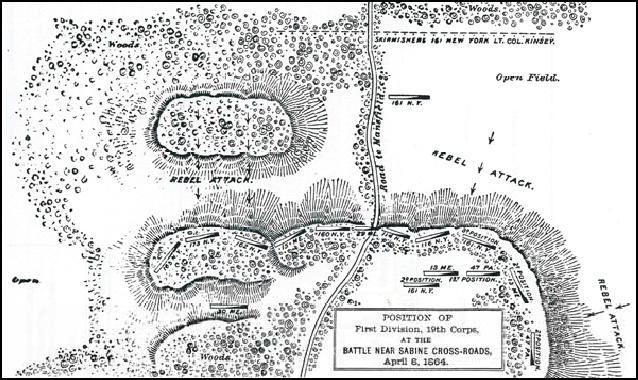
19th U.S. Army Map, Phase 3, Battle of Sabine Cross Roads/Mansfield (8 April 1864, public domain).
Rushed into battle ahead of other regiments in the 2nd Division, sixty members of the 47th were cut down on 8 April during the volley of fire unleashed during the Battle of Sabine Cross Roads. The fighting waned only when darkness fell. Exhausted, those who were uninjured collapsed beside the gravely wounded and the dead. After midnight, the surviving Union troops withdrew to Pleasant Hill.
The next day, the 47th Pennsylvania Volunteers were ordered into a critically important defensive position at the far right of the Union lines, their right flank spreading up onto a high bluff. By 3 p.m., after enduring a midday charge by the troops of Confederate Major-General Richard Taylor (a plantation owner and son of Zachary Taylor, former president of the United States), the brutal fighting still showed no signs of ending. Suddenly, just as the 47th was shifting to the left side of the massed Union forces, the men of the 47th Pennsylvania were forced to bolster the 165th New York’s buckling lines by blocking another Confederate assault, during what is now known as the Battle of Pleasant Hill.
Casualties were once again severe. A number of men were killed instantly or died later from their wounds. Lieutenant-Colonel George W. Alexander was nearly killed, and the regiment’s two color-bearers, both from Company C, were also wounded while preventing the American flag from falling into enemy hands. Still others from the 47th were captured, marched roughly one hundred and twenty-five miles to Camp Ford, a Confederate Army prison camp near Tyler, Texas, and held there as prisoners of war (POWs) until released during prisoner exchanges beginning 22 July 1864. At least two men from the 47th never made it out of that camp alive; another member of the regiment died while being treated at the Confederate Army hospital in Shreveport, Louisiana.M
Meanwhile, as the captured 47th Pennsylvanians were being spirited away to Camp Ford, the majority of 47th Pennsylvania Volunteers were carrying out orders from senior Union Army leaders to head for Grand Ecore, Louisiana. Encamped there from 11-22 April, they engaged in the hard labor of strengthening regimental and brigade fortifications.
They then moved back to Natchitoches Parish on 22 April. While en route, they were attacked again, this time, at the rear of their retreating brigade, but they were able to end the encounter quickly and move on to reach Cloutierville at 10 p.m. that same night (after a forty-five-mile march).

The 47th Pennsylvania Volunteers were stationed just to the left of the “Thick Woods” with Emory’s 2nd Brigade, 1st Division as shown on this map of Union troop positions for the Battle of Cane River Crossing at Monett’s Ferry, Louisiana, 23 April 1864 (Major-General Nathaniel Banks’ official Red River Campaign Report, public domain).
The next morning (23 April), episodic skirmishing quickly roared into the flames of a robust fight. As part of the advance party led by Union Brigadier-General William Emory, the 47th Pennsylvanians took on the Confederate cavalry of Brigadier-General Hamilton P. Bee in the Battle of Cane River (also known as “the Affair at Monett’s Ferry” or the “Cane River Crossing”).
Responding to a barrage from the Confederate artillery’s twenty-pound Parrott guns and raking fire from enemy troops positioned near a bayou and atop a bluff, Brigadier-General Emory directed one of his brigades to keep Bee’s Confederates busy while sending two other brigades to find a safe spot for the Union force to cross the Cane River. As part of the “beekeepers,” the 47th Pennsylvania supported Emory’s artillery.
Meanwhile, additional troops under Smith’s command, attacked Bee’s flank to force a Rebel retreat, and then erected a series of pontoon bridges that enabled the 47th Pennsylvania and other Union troops to make the Cane River Crossing by the next day. As the Confederates retreated, they torched their own food stores, as well as the cotton supplies of their fellow southerners. In a letter penned from Morganza, C Company’s Henry Wharton described what had happened:
Our sojourn at Grand Ecore was for eleven days, during which time our position was well fortified by entrenchments for a length of five miles, made of heavy logs, five feet high and six feet wide, filled in with dirt. In front of this, trees were felled for a distance of two hundred yards, so that if the enemy attacked we had an open space before us which would enable our forces to repel them and follow if necessary. But our labor seemed to the men as useless, for on the morning of 22d April, the army abandoned these works and started for Alexandria. From our scouts it was ascertained that the enemy had passed some miles to our left with the intention of making a stand against our right at Bayou Cane, where there is a high bluff and dense woods, and at the same attack Smith’s forces who were bringing up the rear. This first day was a hard one on the boys, for at 10 o’clock at night they made Cloutierville, a distance of forty-five miles. On that day the rear was attacked which caused our forces to reverse their front and form in line of battle, expecting too, to go back to the relief of Smith, but he needed no assistance, sending word to the front that he had ‘whipped them, and could do it again.’ It was well that Banks made so long a march on that day, for on the next we found the enemy prepared to carry out their design of attacking us front and rear. Skirmishing commenced early in the morning and as our columns advanced he fell back towards the bayou, when we soon discovered the position of their batteries on the bluff. There was then an artillery duel by the smaller pieces, and some sharp fighting by the cavalry, when the ‘mule battery,’ twenty pound Parrott guns opened a heavy fire, which soon dislodged them, forcing the chivalry to flee in a manner not at all suitable to their boasted courage. Before this one cavalry, the 3d Brigade of the 1st Div., and Birges’ brigade of the second, had crossed the bayou and were doing good service, which, with the other work, made the enemy show their heels. The 3d brigade done some daring deeds in this fight, as also did the cavalry. In one instance the 3d charged up a hill almost perpendicular, driving the enemy back by the bayonet without firing a gun. The woods on this bluff was so thick that the cavalry had to dismount and fight on foot. During the whole of the day, our brigade, the 2d, was supporting artillery, under fire all the time, and could not give Mr. Reb a return shot.
While we were fighting in front, Smith was engaged some miles in the rear, but he done his part well and drove them back. The rebel commanders thought by attacking us in the rear, and having a large face on the bluffs, they would be able to capture our train and take us all prisoners, but in this they were mistaken, for our march was so rapid that we were on them before they had thrown up the necessary earthworks. Besides they underrated the amount of our artillery, calculating from the number engaged at Pleasant Hill. The rebels say ‘it seems as though the Yankees manufacture, on short notice, artillery to order, and the men are furnished with wings when they wish to make a certain point.’
The damage done to the Confederate cause by the burning of cotton was immense. On the night of the 22d our route was lighted up for miles and millions of dollars worth of this production was destroyed. This loss will be felt more by Davis & Co., than several defeats in this region, for the basis of the loan in England was on the cotton in Louisiana.
After the rebels had fled from the bluff the negro troops put down the pontoons, and by ten that night we were six miles beyond the bayou safely encamped. The next morning we moved forward and in two days were in Alexandria. Johnnys followed Smith’s forces, keeping out of range of his guns, except when he had gained the eminence across the bayou, when he punished them (the rebs) severely.

Christened “Bailey’s Dam” in reference to Lieutenant-Colonel Joseph Bailey, the Union officer who oversaw its construction, this timber dam built by the Union Army on the Red River near Alexandria, Louisiana in May 1864 facilitated Union gunboat passage (public domain).
Having finally reached Alexandria on 26 April, they learned they would remain at their latest new camp for at least two weeks. Placed temporarily under the command of Lieutenant-Colonel Joseph Bailey, they were assigned yet again to the hard labor of construction work, helping to erect “Bailey’s Dam,” a timber structure that was designed to enable Union Navy gunboats to safely navigate the fluctuating waters of the Red River. According to Wharton:
We were at Alexandria seventeen days, during which time the men were kept busy at throwing up earthworks, foraging and three times went out some distance to meet the enemy, but they did not make their appearance in numbers large enough for an engagement. The water in the Red river had fallen so much that it prevented the gun boats from operating with us, and kept our transports from supplying the troops with rations, (and you know soldiers, like other people will eat), so Banks was compelled to relinquish his designs on Shreveport and fall back to the Mississippi. To do this a large dam had to be built on the falls at Alexandria to get the iron clads down the river. After a great deal of labor this was accomplished and by the morning of May 13th the last one was through the shute [sic, chute], when we bade adieu to Alexandria, marching through the town with banners flying and keeping step to the music of ‘Rally around the flag,’ and ‘When this cruel war is over.’ The next morning, at our camping place, the fleet of boats passed us, when we were informed that Alexandria had been destroyed by fire – the act of a dissatisfied citizen and several negroes. Incendiary acts were strictly forbidden in a general order before we left the place, and a cavalry guard was left in the rear to see the order enforced. After marching a few miles skirmishing commenced in front between the cavalry and the enemy in riflepits on the bank of the river, but they were easily driven away. When we came up we discovered their pits and places where there had been batteries planted. At this point the John Warren, an unarmed transport, on which were sick soldiers and women, was fired into and sunk, killing many and those that were not drowned taken prisoners. A tin-clad gun boat was destroyed at the same place, by which we lost a large mail. Many letters and directed envelopes were found on the bank – thrown there after the contents had been read by the unprincipled scoundrels. The inhumanity of Guerrilla bands in this department is beyond belief, and if one did not know the truth of it or saw some of their barbarities, he would write it down as the story of a ‘reliable gentleman’ or as told by an ‘intelligent contraband.’ Not satisfied with his murderous intent on unarmed transports he fires into the Hospital steamer Laurel Hill, with four hundred sick on board. This boat had the usual hospital signal floating fore and aft, yet, notwithstanding all this, and the customs of war, they fired on them, proving by this act that they are more hardened than the Indians on the frontier.
Continuing their march, the 47th Pennsylvania Volunteers headed toward Avoyelles Parish. According to Wharton:
On Sunday, May 15th, we left the river road and took a short route through the woods, saving considerable distance. The windings of the Red river are so numerous that it resembles the tape-worm railroad where with the politicians frightened the dear people during the administration of Ritner and Stevens. – We stopped several hours in the woods to leave cavalry pass, when we moved forward and by four o’clock emerged into a large open plain where we formed in line of battle, expecting a regular engagement. The enemy, however, retired, and we advanced ’till dark, when the forces halted for the night with orders to rest on their arms. – ‘Twas here that Banks rode through our regiment, amidst the cheers of the boys, and gave the pleasant news that Grant had defeated Lee.
“Resting on their arms,” (half-dozing, without pitching their tents, and with their rifles right beside them), they were now positioned just outside of Marksville, on the eve of the 16 May 1864 Battle of Mansura, which unfolded as follows, according to Wharton:
Early next morning we marched through Marksville into a prairie nine miles long and six wide where every preparation was made for a fight. The whole of our force was formed in line, in support of artillery in front, who commenced operations on the enemy driving him gradually from the prairie into the woods. As the enemy retreated before the heavy fire of our artillery, they reached Missoula [sic, Mansura], where they formed in column, taking the whole field in an attempt to flank the enemy, but their running qualities were so good that we were foiled. The maneuvring [sic, maneuvering] of the troops was handsomely done, and the movements was [sic, were] one of the finest things of the war. The fight of artillery was a steady one of five miles. The enemy merely stood that they might cover the retreat of their infantry and train under cover of their artillery. Our loss was slight. Of the rebels we could not ascertain correctly, but learned from citizens who had secreted themselves during the fight, that they had many killed and wounded, who threw them into wagons, promiscuously, and drove them off so that we could not learn their casualties. The next day we moved to Simmsport [sic, Simmesport] on the Achafalaya [sic, Atchafalaya] river, where a bridge was made by putting the transports side by side, which enabled the troops and train to pass safely over. – The day before we crossed the rebels attacked Smith, thinking it was but the rear guard, in which they, the graybacks, were awfully cut up, and four hundred prisoners fell into our hands. Our loss in killed and wounded was ninety. This fight was the last one of the expedition. The whole of the force is safe on the Mississippi, gunboats, transports and trains. The 16th and 17th have gone to their old commands.
It is amusing to read the statements of correspondents to papers North, concerning our movements and the losses of the army. I have it from the best source that the Federal loss from Franklin to Mansfield, and from their [sic, there] to this point does not exceed thirty-five hundred in killed, wounded and missing, while that of the rebels is over eight thousand.

Union Army base at Morganza Bend, Louisiana, circa 1863-1865 (U.S. Library of Congress, public domain).
Continuing on, the surviving members of the 47th Pennsylvania Volunteer Infantry marched for Simmesport and then Morganza, where they made camp again. While encamped there, the nine formerly enslaved Black men who had enlisted with the regiment in Beaufort, South Carolina (October 1862) and Natchitoches, Louisiana (April 1864) were officially mustered into the regiment between 20-24 June 1864.
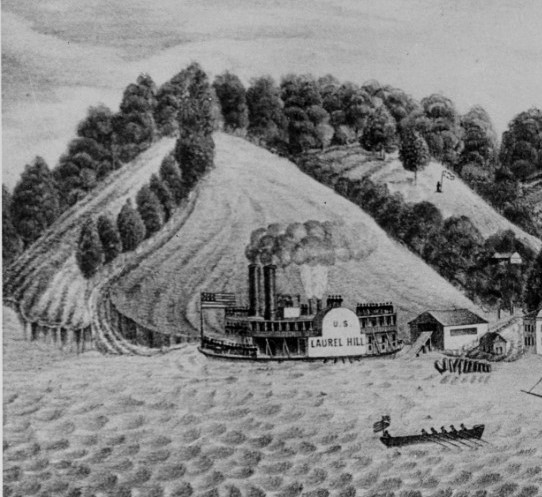
USS Laurel Hill, 26 May 1862 (Baldwin Lithograph, Collection of President Franklin D. Roosevelt, Hyde Park, New York, 1936, U.S. Naval Heritage Command, public domain).
Sadly, Private Uriah Keiser became one of those whose service was short lived. Sometime during the Red River Campaign, Private Keiser fell ill with tertiary intermittent fever or camp fever, as well as other medical issues. He was initially admitted to Union Army medical facilities aboard the USS Laurel Hill , which was docked near Morganza. He was then transferred to the Union’s Marine General Hospital in New Orleans, Louisiana on 23 May 1864.
Transferred from the 47th Pennsylvania Volunteers to the Veteran Reserve Corps (also known as the “invalid corps”) on 22 June 1864, he died from disease-related complications at the Union’s Barracks Hospital in New Orleans, Louisiana on 18 or 29 July 1864. He was interred at the Chalmette National Cemetery.
In a letter sent from the headquarters of the 47th Pennsylvania Volunteers at Charleston, South Carolina on 11 September 1865 to Uriah Keiser’s widow at her Sandy Hill, Perry County, Pennsylvania address, First Lieutenant and Regimental Adjutant W. Scott Johnston, a member of the 47th Pennsylvania’s central regimental command staff, confirmed Private Uriah Keiser’s death, and provided a physical description of the late private, as well as additional details:
Madam,
Yours of September 1st 1865, inquiring how the name of your husband appeared on the Rolls & Records of the 47th Pa Vols, addressed to Col Gobin, was this day referred by him to me for investigation and report.
In reply I would state that our Records contain the name of Uriah Keiser, 45 years of age, 5 feet 10 1/2 inches high, Dark complexion, Blue Eyes, Black hair. Born in Perry County Penna, Laborer by occupation. Enlisted Feby 22nd 1864 Harrisburg Pa. for 3 years. Mustered into service at Harrisburg Pa. Feb 22, 1864, and that he died at Barracks Hospital New Orleans La. July 1864. His final Statements and Inventory of Effects were forwarded to Brig Genl L Thomas [sp?] Adjt. Genl. U.S. Army July 5th 1865.
Uriah Keiser was never assigned to any company but carried on our Rolls and Returns as an unassigned Recruit.
Any further information you may desire, (if in my possession) will be cheerfully furnished upon application.
I am Very Respectfully Yours,
W. Scott Johnston
1st Lieut. & Adj. 47th Pa Vols
A Son Soldiers On

U.S. Steamer McClellan (Alfred Waud, circa 1860-1865, U.S. Library of Congress, public domain).
Following his father’s tragic death, Private Emanuel H. Keiser continued to serve with Company C of the 47th Pennsylvania Volunteers. Stationed in New Orleans beginning 20 June 1864, he and his fellow 47th Pennsylvanians sailed north to Washington, D.C. via the steamer McClellan from 5-12 July 1864. Upon their arrival, the 47th Pennsylvania Volunteers joined up with Major-General David Hunter’s forces at Snicker’s Gap, Virginia in mid-July where they assisted in defending the nation’s capital while also helping to drive Confederate forces from Maryland.
Sheridan’s 1864 Shenandoah Valley Campaign
Attached to the Middle Military Division, U.S. Army of the Shenandoah from August through November of 1864, it was at this time and place, under the leadership of legendary Union Major-General Philip Sheridan and Brigadier-General William H. Emory, that the members of the 47th Pennsylvania Volunteer Infantry would engage in their greatest moments of valor. Of the experience, Company C’s Samuel Pyers said it was “our hardest engagement.”
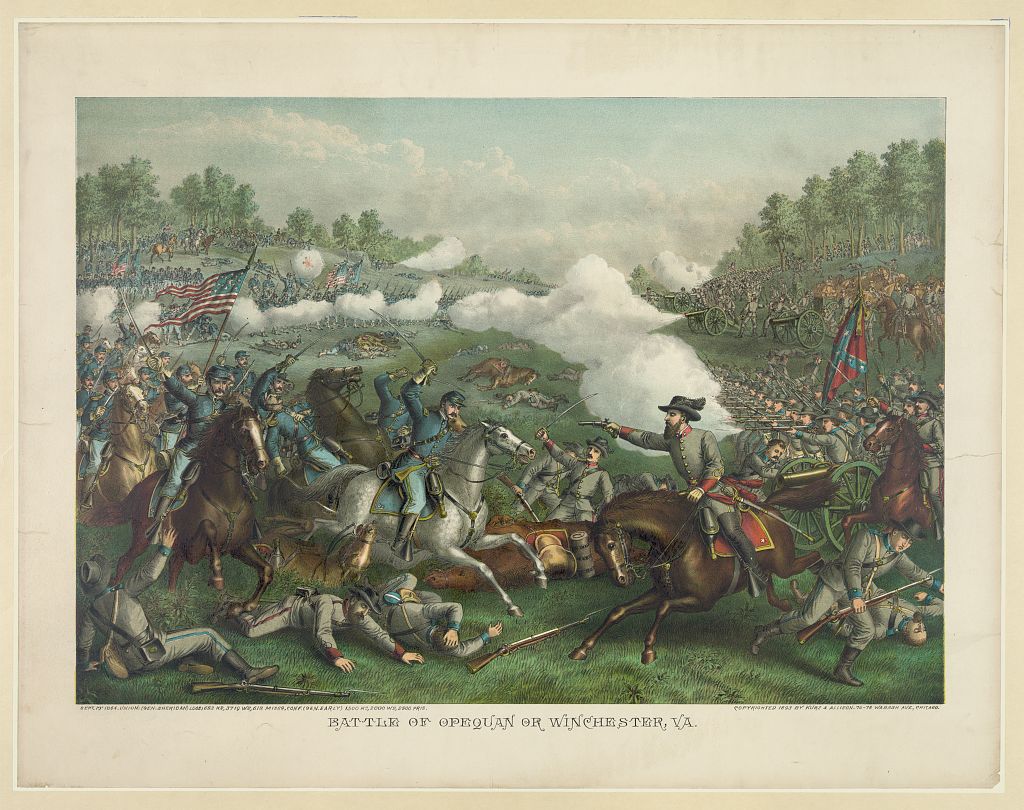
Victory of Philip Sheridan’s Union army over Jubal Early’s Confederate forces. Kurz & Allison, circa 1893 (U.S. Library of Congress, public domain).
Inflicting heavy casualties during the Battle of Opequan (also known as “Third Winchester”) on 19 September 1864, Sheridan’s gallant blue jackets forced a stunning retreat of Jubal Early’s grays — first to Fisher’s Hill (21-22 September) and then, following a successful early morning flanking attack, to Waynesboro.
Sent out on skirmishing parties afterward, the men of the 47th Pennsylvania finally made camp at Cedar Creek. Moving forward, they would continue to distinguish themselves in battle, but they would do so without two respected commanders: Colonel Tilghman Good and his second-in-command, Lieutenant-Colonel George W. Alexander, who mustered out on 23-24 September upon expiration of their respective terms of service. Fortunately, Good and Alexander were replaced by others equally admired both for their temperament and the front-line experience: John Peter Shindel Gobin, Charles W. Abbott and Levi Stuber.
Battle of Cedar Creek –19 October 1864
On 19 October 1864, Early’s Confederate forces briefly stunned the Union Army, launching a surprise attack at Cedar Creek, but Sheridan was able to rally his troops. Intense fighting raged for hours and ranged over a broad swath of Virginia farmland. Weakened by hunger wrought by the Union’s earlier destruction of crops, Early’s army gradually peeled off, one by one, to forage for food while Sheridan’s forces fought on, and won the day.
It was, however, yet another costly engagement for Pennsylvania’s native sons. The 47th experienced a total of one hundred and seventy-six casualties during the Cedar Creek encounter alone, including: Sunbury Guards’ Sergeant John Bartlow and Privates James Brown (a carpenter), Jasper B. Gardner (a conductor), George W. Keiser (an eighteen-year-old farmer), Theodore Kiehl, Joseph Smith, and John E. Will — all killed in action on 19 October. Sergeant William Pyers, father of Company C Field Musician Samuel H. Pyers and the very same gallant Sunbury Guarsdsman wounded while protecting the colors at Pleasant Hill, also departed from the field of battle forever at Cedar Creek.
C Company’s Captain Daniel Oyster, shot in his shoulder just weeks earlier, sustained a gunshot wound to his other shoulder.
Stationed at Camp Russell near Winchester from November through most of December, the 47th Pennsylvania Volunteers mourned their dead while the wounded recuperated. Five days before Christmas, the 47th Pennsylvania Volunteers were ordered to march again — this time through a snowstorm for outpost duty at Camp Fairview in Charlestown, West Virginia.
1865 – 1866

Spectators gather, Grand Review of the Armies, 23-24 May 1865; note crepe-draped U.S. Capitol, flag at half-mast, following the assassination of President Abraham Lincoln. (U.S. Library of Congress, public domain).
Assigned first to the Provisional Division of the 2nd Brigade of the Army of the Shenandoah in February, the men of the 47th were ordered back to Washington, D.C. 19 April to defend the nation’s capital following President Abraham Lincoln’s assassination. At least one member of the regiment was assigned to guard the late president’s funeral train while others may have guarded key assassination conspirators during the early days of their imprisonment and trial. All who served during this time were eyewitnesses to one of the most important and pivotal times in America’s history.
While serving in Dwight’s Division, 2nd Brigade, U.S. Department of Washington’s 22nd Corps, Company C and their fellow 47th Pennsylvania Volunteers also participated in the Union’s Grand Review of the Armies on 23-24 May.
Captain Levi Stuber of Company I was also promoted to central regimental command at this time, and assumed the rank of major.
On their final swing through the South, the 47th served in Savannah, Georgia from 31 May to 4 June 1865 as part of the 3rd Brigade, Dwight’s Division, U.S. Department of the South, and at Charleston, South Carolina beginning in June.

Ruins of Charleston, South Carolina as seen from the Circular Church, 1865 (U.S. National Archives, public domain).
Duties at this time were largely provost (military police) or Reconstruction-related (repairing railroads and other key regional infrastructure items which had been destroyed or damaged during the long war). The 9 August 1865 edition of the New York Times provided an update regarding the Union Army’s occupation of Charleston, South Carolina. Major Stuber was one of the officers listed in this article, and was described as: “Assistant Provost-Marshal Maj. LEVI STUBER, 47th Pennsylvania Volunteers.”
Finally, on Christmas Day, 1865, at Charleston, South Carolina, Private Emanuel H. Keiser and the other men of the 47th Regiment, Pennsylvania Volunteers, began to be honorably mustered out. Some were not released until after the New Year but, eventually, they were all sent home by steamship to New York, and then via train to Philadelphia and Camp Caldwalader, where they were paid for their service and given discharge papers.
After the War
Sadly, the children of Private Uriah Keiser were orphaned soon after the Civil War’s end when their mother, Margaret (Sailor) Keiser, passed away in Saville Township, Perry County, Pennsylvania on 5 September 1866. She was laid to rest at the Buffalo Stone Church Cemetery in Saville Township on 7 September.
A guardian, Andrew Loy (alternate spelling “Foy”), a fifty-year-old resident of Madison Township in Perry County, was appointed to protect the youngest of the Keiser children’s welfare (Margaret A. and Joseph T. Keiser); he subsequently filed for Private Keiser’s Civil War Pension with the assistance of Washington, D.C.-based attorney William Helmick, and then administered that pension of behalf of the minor Keiser children from the time of its award (awarded at $8.00 per month, beginning 5 April 1869; retroactive to 29 July 1864) through 1 December 1867 when Private Keiser’s youngest child turned sixteen.
Emanuel H. Keiser went on to marry and live a long, full life with his wife Elizabeth (born 22 June 1845; died 31 March 1914). They both lived to see the dawn of a new century. Emanuel passed away on 28 March 1900, and was interred at the Paxtang Cemetery in Dauphin County, Pennsylvania.
* To view more of the key U.S. Civil War Military and Pension records related to Uriah Keiser and his family, visit our Keiser Family Collection.
Sources:
- Civil War Muster Rolls, in Records of the Department of Military and Veterans’ Affairs (Record Group 19, Series 19.11). Harrisburg, Pennsylvania: Pennsylvania Historical and Museum Commission.
- Civil War Veterans’ Card File, 1861-1866. Harrisburg, Pennsylvania: Pennsylvania State Archives.
- “Keizer, Uriah,” in U.S. Civil War Military Records (Union Army), U.S. Civil War Widows’ Pension Files and U.S. Civil War Claims for Minor’s Pension Files, 1864-1868. Washington, D.C.: U.S. National Archives and Records Administration.
- U.S. Census (Pennsylvania, 1850-1900). Washington, D.C.: U.S. National Archives and Records Administration.
- U.S. Veterans’ Schedule (1890). Washington, D.C.: U.S. National Archives and Records Administration.
 47th Pennsylvania Volunteers
You must be logged in to post a comment.