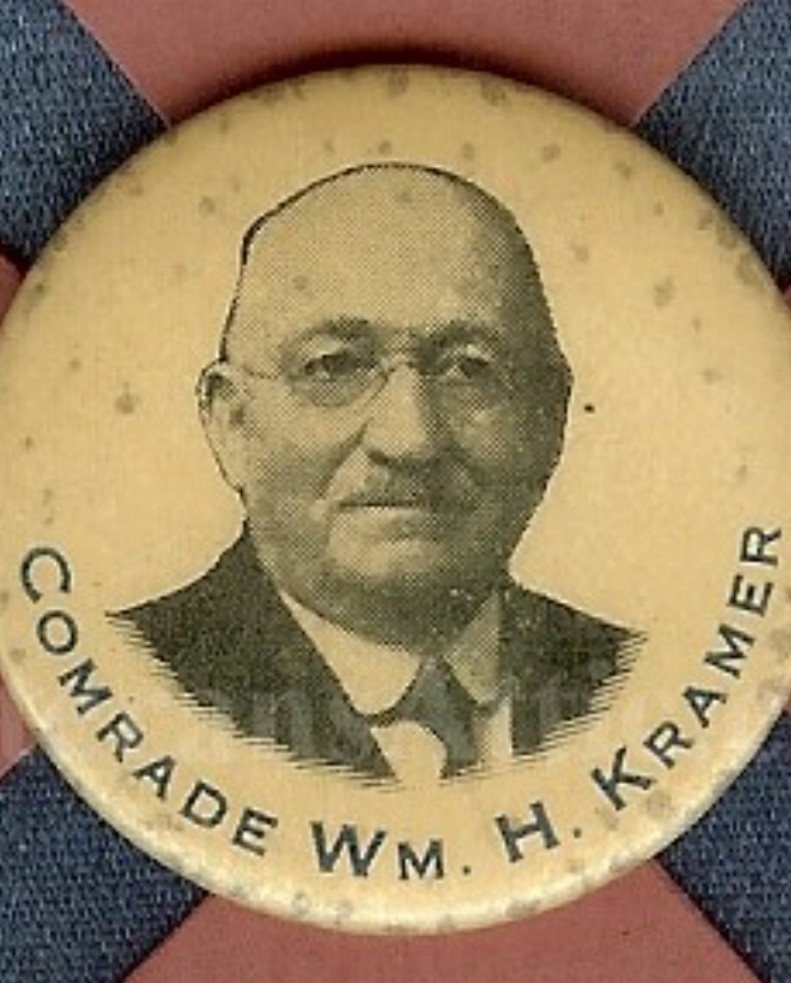
William H. Kramer was the designated honoree of the 47th Pennsylvania Volunteers’ annual reunion in 1915 (regimental reunion button, public domain).
In 1915, the surviving members of the 47th Pennsylvania Veteran Volunteer Infantry paid tribute to William H. Kramer by naming him as the designated honoree for the regiment’s annual reunion that year. The forty-third such gathering of 47th Pennsylvanians, the event was held in the Sons of Veterans’ Hall in Allentown, Lehigh County, Pennsylvania on 22 October 1915 — the fifty-third anniversary of the Battle of Pocotaligo, South Carolina (a battle in which William Kramer had been wounded as a private while serving with the 47th Pennsylvania’s G Company).
Well attended, the 1915 annual reunion was presided over by William Kramer in his capacity as the retiring president of the 47th Pennsylvania’s veterans’ association. According to The Allentown Leader:
Flowers were presented to each veteran by Mrs. Annie E. Leisenring, widow of Captain Thomas Leisenring, who commanded Company G of the 47th.
Prayer was offered by Rev. T. Asher Hess of Philadelphia, and the response was made by Squire William H. Glace of Catasauqua.
The Committee on Election reported for new officers as follows: President, Squire William H. Glace; vice-president, Captain W. H. Bartholomew, Allentown; secretary, Daniel Tombler, Easton; chaplain, Rev. T. Asher Hess; assistant chaplain, William Adams; treasurer, Colonel Francis Daeufer.
The formal address of the day was made by Congressman Arthur G. Dewalt. Dinner was served at the Lafayette Hotel, at which Captain Schaadt spoke on the history he is writing of the regiment.
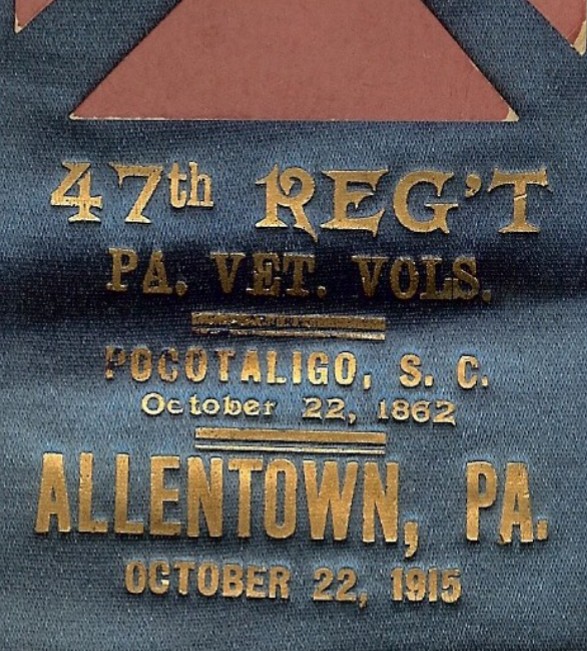
Bottom half of the ribbon designed for the 47th Pennsylvania Volunteers’ annual reunion in 1915, which honored William H. Kramer, who served with the regiment’s G Company (public domain).
The Allentown Democrat provided this more detailed report:
Perhaps the pleasantest reunion of the survivors of the 47th Regiment, Pennsylvania Veteran Volunteers, in many years was that held yesterday in the rooms of the Allen Camp, No. 6, Sons of Veterans. The attendance was one of the largest in recent years and the pleasure in recounting the days of half a century ago among the minutest.
One of the striking features of the reunion was the report of the small number of deaths during the past year, but two having gone before. The year previous and the one before that were prolific with deaths of the veterans.
The gathering was devoid of any ostentation, the men simply wishing to gather together perhaps for the last time and dwell in fellowship and transact their business without any gusto. Heretofore drums beat their way in parade and it was made a holiday by citizens of the various meeting places. All this has been done away with and hereafter all the meetings will be held quietly in this city, where the largest number of survivors exist. The men got together to the number of a hundred, heard speeches and had dinner and then went their way again for another twelve months. But the brief sessions were fraught with the greatest interest.
President Wm. H. Kramer presided at the gathering and directed the business. Mayor C. W. Rinn, the grandson of a veteran, delivered the address of welcome and he did it feelingly, for his ancestor was a member of the regiment. Sergeant Wm. H. Glace, of Co. F, Catasauqua, made an appropriate response, during which he reviewed the battle of Pocotaligo, where the men had their baptism of fire.
Rev. T. Asher Hess, of Philadelphia, the drummer boy of the 128th Regiment who is an honorary member of the association, made one of his patriotic addresses and was followed by Congressman A. G. Dewalt, who dwelt at some length on the service of the men during the war.
Frank Leffler [sic, “Lefler”], Edward Keiper, Lieut. J. B. Stuber, William Adams and D. G. Gearhart [sic, “Gerhart”] were a nominating committee, who reported their selection of these officers: President, W. H. Glace; vice president, Capt. W. H. Bartholomew; secretary, David Tombler; treasurer, Francis Daeufer; chaplain, Rev. T. A. Hess; assistant chaplain, William Adams.
Following the meeting the veterans marched around the monument with bared heads and went to the Lafayette Hotel, where they partook of an appetizing dinner. During its course, Capt. James L. Schaadt brought to the attention of the veterans the importance of writing the history of the regiment and he with a corps of editors will do the work should the veterans place the material in their hands. Captain Schaadt recalled old deeds when he read for the first time since its delivery, the speech of Col. T. H. Good when the good people of Key West presented him with a gold sword as a tribute of their appreciation of his management of the military affairs at that important post in 1861 [sic, “1863”]. The speech made by Mayor Cole is also preserved and was read also. It was the source of renewed interest in the affairs of the regiment and many incidents were recalled in consequence. These will be preserved and reserved for the history. It was related for the first time how private Frank King, of Co. F. of Catasauqua, alone captured Gen. Robert Taylor’s flag at the headquarters at Sabine Cross Roads during the Red River expedition, the record of which is now preserved in the archives at Washington. The story was also told for the first time how Sergeant Wm. H. Glace’s life was saved by a providential intervention of orders.
The reunion was the forty-third and the badges bore the picture of President Wm. H. Kramer. Only one original officer of the regiment remains in Lieut. James B. Stuber, of Co. I, who was present at the reunion.
As in recent years Mrs. Annie E. Leisenring, widow of Captain Thomas B. Leisenring, of Co. G, presented the survivors with carnations. Miss Hattie Good, daughter of the late Frank P. Good, also sent carnations.
One of the interested veterans in attendance was Uriah Boston, of Co. D, who ran away from the Millerburg academy [sic, “Millersburg Academy”] when 15 years of age and enlisted for service. He also did secret service duty for the government for two years during the Spanish-American war. He has been with the government secret service for the past 14 years. He is hale and hearty and enjoyed the reunion immensely.
Among the ladies present were Mrs. Leisenring, Mrs. M. P. Kerschner, Mrs. Annie E. Swartz, Mrs. George Longenhagen, Mrs. D. A. Tombler and Miss E. Schahnant [sic], of Philadelphia.
Two deaths were reported during the year. They were George Mull [sic, “Moll”], of Co. F, and William Swartz, of Co. I.
Veterans of the 47th Pennsylvania who were present for that year’s reunion were:
- Company A: Reuben Rader and Max Schlemmer;
- Company B: Milton Peter Cashner, Thomas Cope, Daniel G. Gerhart, Andrew Osmun, and Casper Schreiner;
- Company D: Uriah Boston;
- Company E: William Adams and Henry Coburn;
- Company F: William Hiram Bartholomew, William Erich, William H. Glace, Reuben Keim, George Longenhagen, Allen Miller, Edward Rensimer, David A. Tombler, Walter Van Dyke, and Frank H. Wilson;
- Company G: Henry Doll, Charles and Martin Hackman, Solomon Hillegass, Benjamin S. Koons, William H. Kramer, William N. Smith, and Benjamin Franklin Swartz;
- Company I: Francis Daeufer, George and Tilghman Dech, W. F. Henry, Edwin Keiper, Jefferson Kunkle, Frank Lefler, Sylvester McCape, James/Joseph Rockel, James B. Stuber, Israel Troxell, and Henry Wieser; and
- Company K: Tilghman Boger, Walter Handwerk, Samuel Reinert, and Henry Savitz.
But it was Allentown’s Morning Call that truly captured the spirit of that year’s reunion:
These occasions are annually looked forward to with the fondest anticipation by the veterans as the one time of the year when they can meet and greet one another again and renew the ties that were formed in the service of their country whose integrity they enlisted to defend and uphold. The men are growing fewer in number year by year. The relentless hand of death was unusually sparing during the past year and the fatal asterisk of death was appended to the names of only two comrades since the men met last year.
But the ravages of the years are becoming more apparent as the years roll on. Locks are becoming whiter. Eyes are dimming. Hearing is not quite so acute. The steps are beginning to falter. But the ardor is not cooled nor is their patriotism quenched. It is an inspiration to see these aged men as they meet once a year and greet each other and swap stories of the war in which they fought and in which they made so many sacrifices.
Sergeant Longenhagen also recalled how at Sabine Cross Roads in Louisiana, at dusk one evening he and Mr. Glace captured one of the aides of General Dick Taylor, who was a son of the former president, Zachary Taylor.
It was also related that at the battle of Sabine Cross Roads the late George King in the heat of the fight went up to the color bearer of the battle flag of General Taylor and took the standard from his hands and returned with it to the ranks of the regiment and the record of the heroic act was sent on to the War Department by the colonel.
The veterans met yesterday at 11 a.m. in the hall of the Sons of Veterans, where they had comfortable quarters and where they were enabled to transact their business. William H. Kramer, of this city, the veteran retired Reading Railway conductor, presided.

The Maltese Cross was often used as a design element for the badges word by 47th Pennsylvania Veteran Volunteers at their annual reunions (excerpt from 47th Pennsylvania’s 1888 reunion badge, courtesy of Julian Burley).
In addition to identifying which veterans of the 47th Pennsylvania were still spry enough to make an appearance at the 1915 reunion, The Morning Call also identified the wives, widows, daughters, and friends of 47th Pennsylvanians who were in attendance: John A. Anderson, Jacob A. Blumer (Company C, 5th Pennsylvania), Mrs. Ellen Cashner, the Rev. Dr. T. Asher Hess (128th Pennsylvania); Mrs. Annie Leisenring (“the factory inspector and the widow of Captain B. Leisenring, of the 47th”), Mrs. George H. Longenhagen, David Mickley (153rd Pennsylvania), Edwin Reed (Company F, 5th Pennsylvania), Stephen Romig (153rd Pennsylvania), Miss E. Schalmant (of Philadelphia), Annie Swartz, and Mrs. David A. Tombler.
Each of the veterans was given a corps badge and a badge with the corps insignia, a Maltese cross, having in the centre a medallion bearing the picture of the President, William H. Kramer.
The reunion exercises opened with prayer delivered by Rev. Hess, of Philadelphia, the “drummer boy” of the 128th Regiment, who last year was made an honorary member of the association.
Mayor Charles W. Rinn extended the freedom of the city to the veterans and William H. Glace, the attorney, was called upon to make the response. He extended the thanks of the association for the mayor’s cordial address of welcome and stated that it was a pleasure for the association to have its permanent meeting place in a city which is such a splendid example of progressiveness. It is, he said, one of the most thrifty and prosperous of inland cities. It is unique in the liberality of its hospitality and in its generosity in maintaining its religious and secular institutions. Mr. Glace stated that the discipline of army life had its lasting effect for good all through the veterans’ existence. He gave an interesting account of the battle of Pocotaligo, telling of the history of its planning, the gallantry of the Forty-seventh in the fight and its terrible losses [of] 200 to the regiment, including Captains Mickley and Junkert [sic, “Junker“]. What good purpose was accomplished by the battle was never known and officers were freely criticised for planning it.
During the business portion of the meeting, the regimental association’s elections committee presented its recommeded slate of officers for the coming year (as was described in the report by The Allentown Leader mentioned above). The reason for the change in chaplains, according to The Morning Call, was that “At his own request Mr. Adams was made Assistant Chaplain, representing that since the organization had an ordained minister on its rolls, the latter [Rev. Dr. T. A. Hess] should fill the office of chaplain…. At the same time the office of vice president for each company was abolished and the association office was created.” In addition, “Treasurer Daeufer reported receipts of $61.50 and expenditures of $49, leaving a balance of $12.50.”
A brief period of controversy ensued, however, when two of the event’s guest orators, the Reverend Doctor Titus Asher Hess and The Honorable Arthur G. Dewalt, took issue with the content of each other’s addresses. According to The Morning Call:
Rev. T. A. Hess, the “drummer boy” clergyman who is serving a Philadelphia congregation but whose home was in Allentown when the Civil War broke out and who ran away with recruits and became a drummer boy with the 128th Regiment, is a small man physically, intensely patriotic and in spite of his age has great lung power and winning oratory. He was asked to address the veterans and in a splendid speech in which he excited intense patriotic fervor, was not sparing in his denunciations of the administration for lack of patriotic spirit. His remarks brought a rise from Congressman A. G. Dewalt who followed him and defended the administration stating that Dr. Hess was preaching dangerous doctrines.
Dr. Hess referred to the Vera Cruz incident when Huerta refused to salute the United States flag. The American troops, however, he said, gave a salute to the Mexican flag on one of the country’s recent holidays. The government, he said, showed little sympathy for the old soldier. He refered to his recent trip to Washington to participate in the final review when he was compelled to find his own lodging and was compelled to sleep on two rails covered by a sheet. He was of the opinion that better treatment should have been given the old defenders of the nation.
Congressman Dewalt, after paying tribute to the valor of the regiment in the country’s service, said that he objected seriously to Dr. Hess’ remarks. He state[d] that the United States soldiers did not salute the Mexican flag. That country has no government and therefore no flag to recognize. He referred to a conversation he had with a U.S. officer who told him that 200,000 soldiers would be needed for ten years to restore order in Mexico. He referred to President Wilson’s peaceful method of trying to get a government established there. He resented the slur which the preceding speaker put on the government by saying it had no use for the old soldiers, stating that no government on the face of the earth treated their soldiers or their widows or orphans more liberally. Congressman Dewalt pleaded for good citizenship. Forces are at work which would undermine the splendid structure of government and the veterans should give all assistance in combatting these influences.
After that fiery debate, the assembled group “marched to the Lafayette Hotel where they partook of an excellent dinner” in the spirit of fraternal harmony and goodwill. The reunion closed with an address by historian and and former Allentown mayor James L. Schaadt who recounted key moments of the 47th Pennsylvania’s involvement in bringing the United States of America back from civil war and onto the path toward a long-desired, more perfect union.
Sources:
- Bates, Samuel P. History of Pennsylvania Volunteers, 1861-5, vol. 1. Harrisburg, Pennsylvania: B. Singerly, State Printer, 1869.
- “Historic Sword a Highly Prized Relic: Presented to Col. Good of 47th Pa. Vols. By Citizens of Key West.” Allentown, Pennsylvania: The Morning Call, 2 November 1915.
- Reports of Col. Tilghman H. Good, Forty-seventh Pennsylvania Infantry and Report of Col. Tilghman H. Good, Forty-seventh Pennsylvania Infantry, commanding First Brigade, Tenth Army Corps, in The War of the Rebellion: A Compilation of the Official Records of the Union and Confederate Armies. Prepared Under the Direction of the Secretary of War, By Lieut. Col. Robert N. Scott, Third U.S. Artillery, and Published Pursuant to Act of Congress Approved June 16, 1880, series I, vol. XIV. Washington, D.C.: Government Printing Office, 1885.
- Schmidt, Lewis G. A Civil War History of the 47th Regiment of Pennsylvania Veteran Volunteers. Allentown, Pennsylvania: Self-published, 1986.
- “Squire Glace Heads Veterans of 47th Regiment: Reunion Today on Anniversary of Battle of Pocotaligo.” Allentown, Pennsylvania: The Allentown Leader, 22 October 1915.
- “Survivors of 47th Regiment Hold Their Annual Reunion.” Allentown, Pennsylvania: The Allentown Democrat, 23 October 1915.
- “The History of the Forty-Seventh Regt. P. V.” Allentown, Pennsylvania: The Lehigh Register, 20 July 1870.
- “The Killed and Wounded in the Battle” (casualty list from the Battle of Pocotaligo). New York, New York: The New York Herald, 29 October 1862.
- “Veterans of 47th PA Vols. to Hold Annual Reunion.” Allentown, Pennsylvania: The Morning Call, 16 October 1915.
- “Veterans of 47th PA. Vols. to Hold Reunion Friday.” Allentown, Pennsylvania: The Morning Call, 19 October 1915.
- “Veterans of 47th Vols’ Meet in Reunion: Forty-third Annual Gathering Recalls Trying Days.” Allentown, Pennsylvania: The Morning Call, 23 October 1915.
 47th Pennsylvania Volunteers
You must be logged in to post a comment.