Alternate Spellings of Surname: Gachenbach, Gackenbach, Gachenbaugh, Gachenbuch, Gachenbuck, Gackenbuch, Gackenbuck, Gaggenbach, Gechenbaugh
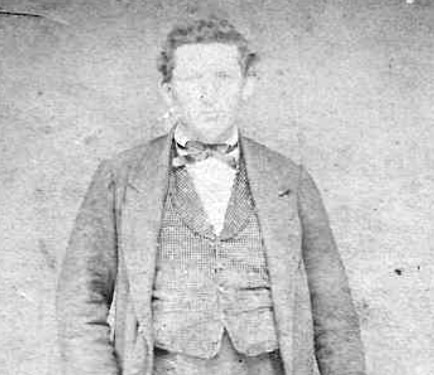
Prosperous farmer Daniel H. Gackenbach, shown here circa 1870, played the E-flat tuba as a member of the 47th Pennsylvania Volunteers’ Regimental Band (public domain).
Daniel H. Gackenbach had one of the more unusual military service records of the American Civil War. A prosperous farmer in Pennsylvania’s bucolic Lehigh Valley during the mid-nineteenth century, who waited until the fall of 1862 to enlist in the Army of the United States, he was subsequently assigned to duties as a tuba player with the regimental band of his Union infantry unit — duties that initially kept him out of harm’s way until he was felled by an invisible and dangerous foe.
Formative Years
Born on his family’s farm near Siegersville in North Whitehall Township, Lehigh County, Pennsylvania on 18 August 1836, Daniel H. Gackenbach was a son of Reuben Gackenbach (1815-1887) and Maria (Helfrich) Gackenbach (1816-1887). According to Lehigh County historian Charles Rhoads Roberts, Daniel’s father, Reuben, had been “born at Trexlertown, Jan. 10, 1815.”
[Reuben Gackenbach] was a farmer, and iron ore contractor and hauled much iron ore from Hoffmansville and Siegersville to Hokendauqua and Catasauqua. He hauled ore for twenty years and had in use many horses and mules. He was engaged in mining ore in Upper Macungie and Maxatawny townships, employing large forces of men. In connection with his various enterprises he conducted his own farm of 101 acres located near Siegersville.
In his mining operations Mr. Gackenbach had as his associates Nathan and Uriah Biery, and later J. N. Schrader who now resides at Breinigsville [in 1914]. He was one of the organizers of the Mutual Fire Insurance Co. of Trexlertown and served it efficiently as a director for many years. He built an addition to the stone-house and erected all the other buildings upon the farm now owned [in 1914] by Thomas Sherer in North Whitehall; built the house on the farm now owned [in 1914] by the estate of John Sieger; built the residence now owned and occupied [in 1914] by Dr. Joseph N. Mertz, of Siegersville. He possessed great business ability and was a most useful citizen in his community….
He was married to Maria Helfrich who was born Sept. 18, 1816. Their children are Daniel H. and Kate….
He frequently helped others to his own financial injury and his kindness of heart was a dominant characteristic of his useful life.
By late August 1850, Daniel Gackenbach, who was known to family and friends as “Dan,” was still living on the family farm near Siegersville with his parents and younger sister, Anna Maria Gackenbach, who had been born circa 1840. His life was clearly a comfortable one with his parents’ farm valued at eight thousand dollars by that year’s federal census enumerator (the equivalent of nearly three hundred and thirty thousand U.S. dollars in 2025). Also residing with the Gackenbachs that year were four other individuals who may have been house servants, farm hands, or boarders who rented rooms from the Gackenbachs.
In addition to being a comfortable time for Daniel Gackenbach, the 1850s would prove to be transformational years for him as he wed Sarah Ann Mohry (1840-1870; alternate surname spellings: “Morey” or “Mowry”) and settled with her in North Whitehall Township sometime later that decade. Together, they they would welcome the births of Charles A. Gackenbach (1859-1947), who was born on 1 October 1859 and would later become a farmer and produce seller and the husband of Amelia Wotring (1860-1904), before being widowed by her and then marrying Rosa Amanda Arner (1866-1930) in 1906; Richard C. Gackenbach (1862-1943), who was born in March 1862 and would later marry Alice Wagner and relocate with her to the town of Bath in Sagadahoc County, Maine; and Mary Maralda Gackenbach, who was born on 26 January 1861 and baptized on 19 March of that same year but then died during her childhood. (She was not listed among the Gackenbach children on the 1870 federal census.)
During this same period of his life, Daniel Gackenbach also participated in community musical events. On 15 December 1855, for example, he performed at the Gasthaus of William Walbert in South Whitehall Township with Amos Guth and Moses Schmoyer. The concert, which began at 7 p.m., featured a program of marches, polkas and other music, according to Allentown’s German language newspaper, Der Lecha Caunty Patriot.
With respect to his professional life, Daniel Gackenbach first worked as an apprentice to his father, Reuben Gackenbach. Helping his dad transport iron ore that was mined near Siegersville to foundries in Hokendauqua and Catasauqua, Daniel then “succeeded his father to the ownership of the Thomas Sherer farm which he successfully operated until he died.”
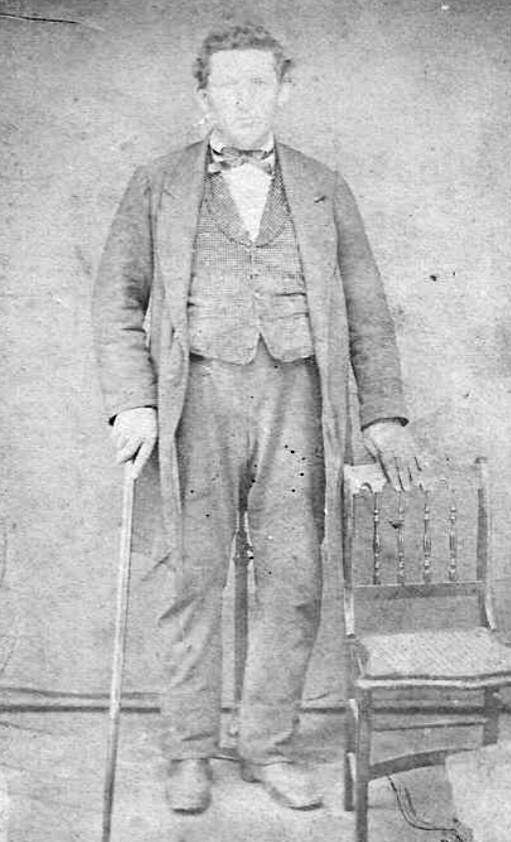
Daniel H. Gackenbach, a prosperous farmer and veteran E-flat tubaist of the 47th Pennsylvania Volunteers’ Regimental Band, shown standing with his cane, circa 1870 (public domain).
That latter statement provides an important clarification to the 1860 federal census description of Daniel H. Gackenbach as a “tenant farmer.” Daniel Gackenbach was clearly not a poor “tenant” who farmed someone else’s land; he was actually a wealthy land owner whose land was farmed for him by someone else. That “someone else” was Thomas Sherer, who had likely been renting farmland from Daniel’s father, Reuben, and/or had been paying Reuben a percentage of the proceeds earned from the sweat of his brow, and was now laboring under a similar contractual agreement with Daniel H. Gackenbach, who had been gifted that farmland by his father, Reuben.
Thanks to his father — and to Thomas Sherer — Daniel H. Gackenbach managed to cultivate a personal estate that was valued at two thousand and fifty dollars (the equivalent of roughly eighty thousand U.S. dollars in 2025), according to the 1860 federal census. And, according to that same census, Daniel Gackenbach was doing so well financially that he was able to employ a live-in servant — Harrison Guth — who would later serve with Daniel in the 47th Pennsylvania Volunteer Infantry during one of the darkest periods in American History.
American Civil War

Bay Street Looking West, Beaufort, South Carolina, circa 1862 (Sam A. Cooley, 10th Army Corps, photographer, public domain).
Following his enrollment in the Army of the United States in Allentown, Lehigh County on 22 October 1862, Daniel H. Gackenbach was transported to the nation’s Deep South, where, on 29 October, he was officially mustered in as a private and musician with Company H of the 47th Pennsylvania Volunteer Infantry at its duty station in Beaufort, South Carolina. Military records at the time described him as a twenty-five-year-old farmer who had resided in Allentown prior to his enrollment.
It was there in Beaufort that Daniel Gackenbach was reassigned to the 47th Pennsylvania’s second Regimental Band as an Eb tubaist (E-flat tuba player), making him a direct report of Regimental Bandmaster Anthony Bush. (Federal military regulations permitted Union Army regiments to recruit two musicians for each of their respective ten companies, enabling each regiment to enroll and pay a total of twenty musicians at the rank of private, while reassiging each of those twenty privates to their respective regimental bands. Financial support for those bandsmen typically came from money that was privately raised and managed through a regimental fund that was kept separate from the regiment’s federal accounts for food, uniforms, weapons, and ammunition.)
* Note: As Daniel Gackenbach was enlisting in the 47th Pennsylvania Volunteer Infantry in Pennsylvania on 22 October 1862, his former live-in servant, Harrison Guth, was literally trying to survive an intense combat encounter with Confederate troops in South Carolina as the 47th Pennsylvania Volunteers fought in the Battle of Pocotaligo that same day. By the time that Daniel Gackenbach reached his regiment’s duty station in Beaufort, South Carolina seven days after that battle, the most severely wounded members of the 47th Pennsylvania were waging new battles to survive gunshot and artillery fragment injuries as they underwent amputations and other surgical procedures at the Union Army’s general hospital on Hilton Head Island. Many of the members of the 47th Pennsylvania that he met at Beaufort were either less seriously wounded or physically “healthy” but grieving the loss of friends who had been killed in action. One can only imagine what it would have been like for him to encounter old friends and new comrades who had endured such terrible carnage. (Regimental rosters note that the 47th Pennsylvania sustained a significant number of casualties. Two officers and eighteen men had been killed in action; an additional two officers and one hundred and fourteen men had been wounded — many of whom had been so seriously injured that they were no longer able to serve and were eventually discharged on surgeons’ certificates of disability, after receiving medical care at Union Army hospitals.)

Fort Taylor, Key West, Florida (Harper’s Weekly, 1864, public domain).
Ordered to head for Key West, Florida on 15 November 1862, Musician Daniel Gackenbach and his fellow 47th Pennsylvania Volunteers would spend the coming year guarding key federal installations there. Companies A, B, C, E, G, and I would once again garrison Fort Taylor in Key West, along with the Regimental Band, while the men from Companies D, F, H, and K would garrison Fort Jefferson, the Union’s remote outpost in the Dry Tortugas off the southern coast of Florida.
After packing their belongings at their Beaufort, South Carolina encampment and loading their equipment onto the U.S. Steamer Cosmopolitan, the officers and enlisted members of the 47th Pennsylvania Volunteer Infantry sailed toward the mouth of the Broad River on 15 December 1862, and anchored briefly at Port Royal Harbor in order to allow the regiment’s medical director, Elisha W. Baily, M.D., and members of the regiment who had recuperated enough from their Pocotaligo-related battle injuries at the Union’s general hospital at Hilton Head, to rejoin the regiment.
At 5 p.m. that same evening, the regiment sailed for Florida, during what was described by several members of the 47th as a treacherous and nerve-wracking voyage. According to historian Lewis Schmidt, the ship’s captain “steered a course along the coast of Florida for most of the voyage,” which made the voyage more precarious “because of all the reefs.” On 16 December, “the second night, the ship was jarred as it ran aground on one during a storm, but broke free, and finally steered a course further from shore, out in the Gulf Stream.”
In a letter penned to the Sunbury American on 21 December, Company C soldier Henry Wharton provided the following details about the regiment’s trip:
On the passage down, we ran along almost the whole coast of Florida. Rather all dangerous ground, and the reefs are no playthings. We were jarred considerably by running on one, and not liking the sensation our course was altered for the Gulf Stream. We had heavy sea all the time. I had often heard of ‘waves as big as a house,’ and thought it was a sailors yarn, but I have seen ’em and am perfectly satisfied; so now, not having a nautical turn of mind, I prefer our movements being done on terra firma, and leave old neptune to those who have more desire for his better acquaintance. A nearer chance of a shipwreck never took place than ours, and it was only through Providence that we were saved. The Cosmopolitan is a good riverboat, but to send her to sea, loadened [sic, loaded] with U.S. troops is a shame, and looks as though those in authority wish to get clear of soldiers in another way than that of battle. There was some sea sickness on our passage; several of the boys ‘casting up their accounts’ on the wrong side of the ledger.
According to Corporal George Nichols of Company E, “When we got to Key West the Steamer had Six foot of water in her hole [sic, hold]. Waves Mountain High and nothing but an old river Steamer. With Eleven hundred Men on I looked for her to go to the Bottom Every Minute.”
Although the Cosmopolitan arrived at Key West Harbor on Thursday, 18 December, the 47th Pennsylvania Volunteers did not set foot on Florida soil until noon the next day. The men from Companies C and I were immediately marched to Fort Taylor, while the men from Companies B and E were assigned to older barracks that had previously been erected by the U.S. Army. Members of Companies A and G were marched to the newer “Lighthouse Barracks” located on “Lighthouse Key.”
1863
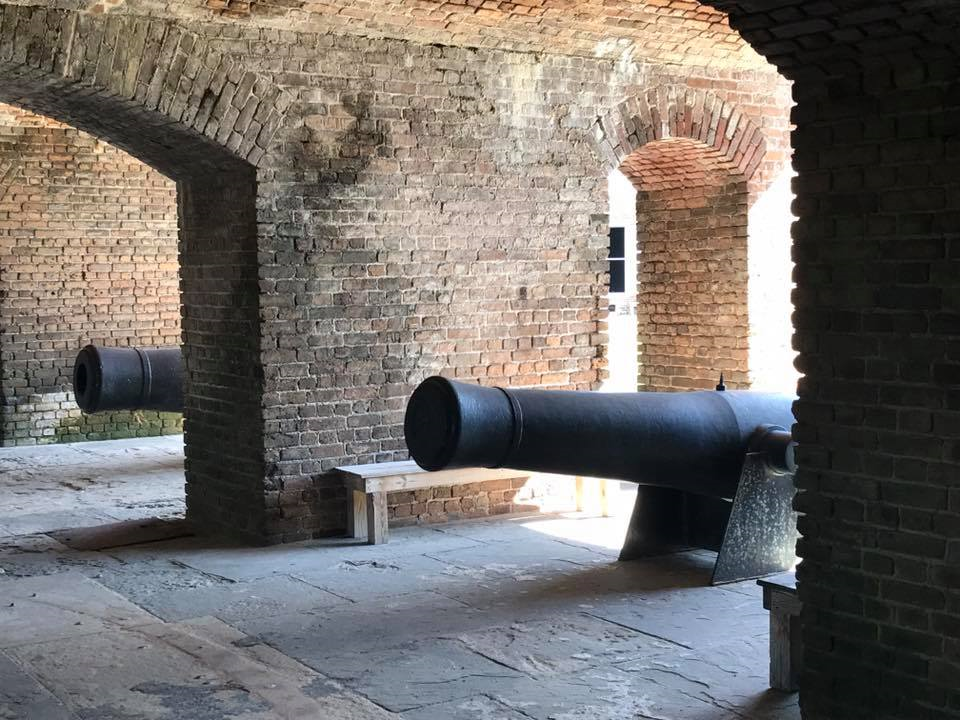
Artillery, Fort Taylor, Key West, Florida (Phil Spaugy, 2017, photo used with permission).
Stationed in Florida for the entire year of 1863, Musician Daniel Gackenbach’s former servant, Private Harrison Guth, was promoted to the rank of corporal on 17 February 1863. Literally ordered to “hold the fort,” the 47th Pennsylvania Volunteers were primarily responsible for preventing foreign powers from assisting the Confederate Army and Navy in gaining control over federal installations and other territories across the Deep South during this time. In addition, the regiment was also called upon to play an ongoing role in weakening Florida’s ability to supply and transport food and troops throughout areas held by the Confederate States of America.
Prior to intervention by the Union Army and Navy, the owners of plantations, livestock ranches and fisheries, as well as the operators of smaller family farms across Florida, had been able to consistently furnish beef and pork, fish, fruits, and vegetables to Confederate troops stationed throughout the Deep South during the first year of the American Civil War. Large herds of cattle were raised near Fort Myers, for example, while orchard owners in the Saint John’s River area were actively engaged in cultivating sizeable orange groves. (Other types of citrus trees were found growing throughout more rural areas of the state.)
Florida was also a major producer of salt, which was used as a preservative for food. Consequently, the 47th Pennsylvania Volunteers and other Union troops across Florida were ordered to capture or destroy salt manufacturing plants in order to further curtail the enemy’s access to food.
But they were performing their duties in often dangerous conditions. The weather was frequently hot and humid as spring turned to summer, mosquitos and other insects were an ever-present annoyance (and a serious threat when they were carrying tropical diseases), and there were also scorpions and snakes that put the health of Musician Daniel Gackenbach and his comrades at further risk. In addition, there was a serious shortage of clean water for drinking and bathing.
In May of 1863, Musician Gackenbach was documented in records of the 47th Pennsylvania Volunteers as being paid twenty-two dollars per month for his services as a regimental bandsman. By June of 1863, two former men from the Easton Band plus a full brass section from Allentown had also joined the 47th Pennsylvania’s Regimental Band, which was still based at Fort Taylor, Key West.

Colonel Tilghman H. Good, commanding officer, 47th Pennsylvania Volunteers (public domain image, circa 1863).
On Saturday, 25 July 1863, E-flat tuba player Daniel Gackenbach and his fellow Regimental Band members performed for an audience in Key West, as part of a ceremony that was held by the leaders and residents of the city to honor the 47th Pennsylvania’s commanding officer, Colonel Tilghman H. Good. According to Henry Wharton:
On Saturday last, another sword presentation came off. This time Col. T. H. Good was the recipient, and the donors, the citizens. The sword is a magnificent one, and with the sash and belt, cost six hundred and ten dollars [the equivalent of more than twenty-five hundred U.S. dollars in 2025]. At 4 o’clock P.M., the two companies stationed at the Barracks, were marched to the Fort, where, with the three other companies doing duty, we formed in line, and under command of the Colonel were moved through several streets, to the front of the Custom House. A fine stand was erected, on the piazza of the building seats were placed for the ladies, flags were stretched across the streets, and everything so arranged as to give it the appearance of a holiday. On the stand I noticed Rear Admiral Bailey and Capt. Templeton of the Navy, Gen. Woodbury and staff, Captains Hook and McFarland of the Army, besides Thomas J. Boynton, U.S. District Attorney for the Southern District of Florida. The articles were presented to Col. Good by Mr. Maloney, a lawyer of this city who complimented the Colonel on the fine bearing and appearance of his regiment. He spoke of the trials the citizens had under the military commander Col. Good relieved; of their being saved from banishment and separation of friends and all they held dear; of the wholesome administration of the Colonel, while in command of this Department, and in conclusion placed the sword in Col. Good’s hand, telling him if he used it as he used his own at Pocotaligo, the citizens would be satisfied, and have no fear of it ever being dishonored. The Colonel replied in a very short speech, saying, what he had done was by instructions by Head Quarters — thanked him for the present, and said as he then felt, he could assure the good people of Key West, that their present would never be dishonored through himself. As the Col. concluded, the Band of our regiment struck up the tune ‘Bully for You,’ which was received with cheer after cheer. Several speeches were made, among others, one by Mr. Boynton. He is a Missourian and received his appointment from the present administration. Although a southerner, he is Union all over. He said he hoped the cannon and sword would soon be made into plow shares and pruning hooks, but not until every rebel was on his knees willing to obey the laws and pay respect to the Star Spangled Banner. The Band then played several National airs, cheers were given for the Union, President Lincoln, Army and Navy, Gen. Woodbury, Admiral Baily, &c., when the meeting adjourned, and we were marched to our different quarters, well pleased with the proceedings, though I must say, completely worn out from fatigue and extreme heat.
In a letter to the Sunbury American that was penned on 23 August 1863, Henry Wharton described Thanksgiving celebrations held by the regiment and residents of Key West and a yacht race the following Saturday at which participants had “an opportunity of tripping the ‘light, fantastic toe,’ to the fine music of the 47th Band, lead by that excellent musician, Prof. Bush.”
That fall, when given the opportunity to leave military service when their initial terms of enlistment expired or stay, most of the 47th Pennsylvania Volunteers chose to re-enlist and continue their fight to save the Union. Among those who re-enlisted that year was Daniel Gackenbach’s former servant, Corporal Harrison Guth, who re-enrolled with Company G of the 47th Pennsylvania Volunteer Infantry at Fort Jefferson in Florida’s Dry Tortugas on 20 October 1863 — giving him the coveted designation of “Veteran Volunteer,” per General Orders, No. 191.
* Note: Shortly before Christmas that year, another new recruit from Lehigh County joined the 47th Pennsylvania Volunteer Infantry. His name warrants a mention here because he would ultimately develop an important bond with Daniel Gackenbach’s former servant — Corporal Harrison Guth. That nineteen-year-old recruit’s name was Griffin Reinert, and he was a brother of Martha Reinert (the woman Corporal Guth would later marry). Known to family and friends as “Griff,” he officially mustered in for duty as a private with Company F of the 47th Pennsylvania Volunteers on 21 December 1863.
1864
In early January 1864, the 47th Pennsylvania Volunteers experienced yet another significant change when members of the regiment were ordered to expand the Union’s reach by sending part of the regiment north to retake Fort Myers, a federal installation that had been abandoned in 1858, following the federal government’s third war with the Seminole Indians. In response, Company A Captain Richard Graeffe and a detachment of his subordinates traveled north, captured the fort and began conducting cattle raids to provide food for the growing Union troop presence across the region. They subsequently turned their fort not only into their base of operations, but into a shelter for pro-Union supporters, escaped slaves, Confederate deserters, and others fleeing Rebel troops.
Red River Campaign
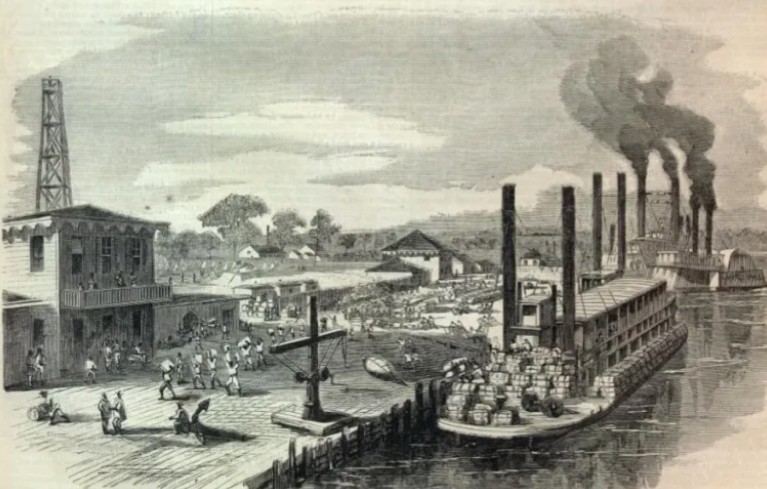
Brashear City, Louisiana, circa 1860s (public domain).
Meanwhile, all of the other companies of the 47th Pennsylvania Volunteer Infantry had begun preparing for the regiment’s history-making journey to Louisiana. Boarding yet another steamer, the Charles Thomas, the men from Companies B, C, D, I, and K headed for Algiers, Louisiana (across the river from New Orleans), followed on 1 March by the men from Companies E, F, G, and H.
Upon the second group’s arrival, the now almost-fully-reunited-regiment moved by train to Brashear City (now Morgan City), before heading to Franklin by steamer through the Bayou Teche. There, the 47th Pennsylvania Volunteer Infantry joined the 2nd Brigade, 1st Division of the 19th Corps (XIX) of the United States’ Army of the Gulf, and became the only regiment from the Commonwealth of Pennsylvania to serve in the Red River Campaign commanded by Union Major-General Nathaniel P. Banks. (Unable to reach Louisiana until 23 March, the soldiers from Company A were assigned to detached duty while awaiting transport that enabled them to reconnect with their regiment at Alexandria, Louisiana on 9 April.)

Map of key 1864 Red River Campaign locations, showing the battle sites of Sabine Cross Roads, Pleasant Hill and Mansura in relation to the Union’s occupation sites at Alexandria, Grand Ecore, Morganza, and New Orleans (excerpt from Dickinson College/U.S. Library of Congress map, public domain).
The early days on the ground quickly woke Musician Daniel Gackenbach and his fellow 47th Pennsylvania Volunteers up to just how grueling their new phase of duty would be. From 14-26 March, most members of the 47th marched for Alexandria and Natchitoches, near the top of the L-shaped state. Among the towns that the 47th Pennsylvanians passed through were New Iberia, Vermilionville (now part of Lafayette), Opelousas, and Washington.
From 4-5 April 1864, the regiment added to its roster of young Black soldiers when Aaron Bullard (later known as Aaron French), James Bullard, John Bullard, Samuel Jones, and Hamilton Blanchard (also known as John Hamilton) enrolled for military service with the 47th Pennsylvania at Natchitoches. According to their respective entries in the Civil War Veterans’ Card File at the Pennsylvania State Archives and on regimental muster rolls, the men were officially mustered into the regiment on 22 June at Morganza, Louisiana. Several of their entries noted that they were assigned the rank of “Colored Cook” while others were given the rank of “Under-Cook.”
Often short on food and water throughout their long, harsh-climate trek, the 47th Pennsylvania Volunteers encamped briefly at Pleasant Hill (now the Village of Pleasant Hill) the night of 7 April, before continuing on the next day.
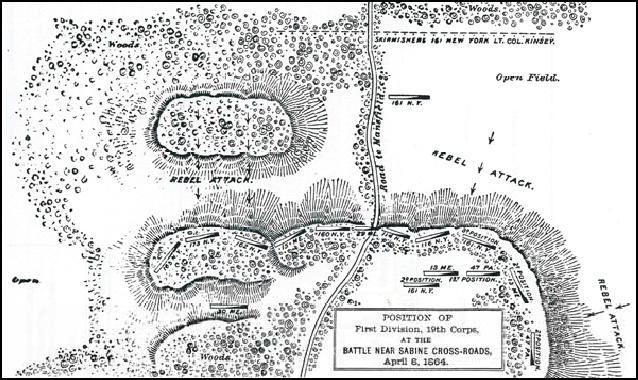
19th U.S. Army Map, Phase 3, Battle of Sabine Cross Roads/Mansfield (8 April 1864, public domain).
Rushed into battle ahead of other regiments in the second division, sixty members of the 47th Pennsylvania Volunteer Infantry were cut down on 8 April 1864 during the intense volley of fire in the Battle of Sabine Cross Roads (also known as the Battle of Mansfield due to its proximity to the town of Mansfield). The fighting waned only when darkness fell. The exhausted, but uninjured collapsed beside the gravely wounded and dead. After midnight, the surviving Union troops withdrew to Pleasant Hill.
* Note: Among the wounded who received prompt medical attention at the 47th Pennsylvania’s regimental hospital at Pleasant Hill, after the Battle of Sabine Cross Roads, was F Company Private Griff Reinert, the future brother-in-law of G Company Corporal Harrison Guth (the former servant of Regimental Bandsman Daniel Gackenbach, who may very well have been pressed into service as a stretcher bearer at Sabine Cross Roads and in subsequent battles of the Red River Campaign). Fortunately, despite having sustained a gunshot wound to his lower jaw, Private Reinert survived and, after a long period of treatment and recovery, was able to return home to his loved ones.
The next day, the 47th Pennsylvania Volunteers were ordered into a critically important defensive position at the far right of the Union lines, their right flank spreading up unto a high bluff. By 3 p.m., after enduring a midday charge by the troops of Confederate Major-General Richard Taylor (a plantation owner who was the son of Zachary Taylor, a former president of the United States), the brutal fighting still showed no signs of ending. Suddenly, just as the 47th was shifting to the left side of the Union force, the men of the 47th were forced to bolster the 165th New York’s buckling lines by blocking another Confederate assault.
During that engagement (now known as the Battle of Pleasant Hill), the 47th Pennsylvania Volunteers succeeded in recapturing a Massachusetts artillery battery that had been lost during the earlier Confederate assault. Unfortunately, the regiment’s second-in-command, Lieutenant-Colonel George Warren Alexander, and its two color-bearers, Sergeants Benjamin Walls and William Pyers, were wounded. Alexander sustained wounds to both of his legs, and Walls was shot in the left shoulder as he attempted to mount the 47th Pennsylvania’s colors on caissons that had been recaptured, while Pyers was wounded as he grabbed the flag from Walls to prevent it from falling into Confederate hands.
All three survived the day, however, and continued to serve with the regiment, but many others, like K Company Sergeant Alfred Swoyer, were killed in action during those two days of chaotic fighting, or were wounded so severely that they were unable to continue the fight. (Swoyer’s final words were, “They’re coming nine deep!” Shot in the right temple shortly afterward, his body was never recovered).
Still others were captured by Confederate troops, marched roughly one hundred and twenty-five miles to Camp Ford, a Confederate Army prison camp near Tyler, Texas, and held there as prisoners of war until they were released during a series of prisoner exchanges that began on 22 July and continued through November. At least two members of the regiment never made it out of that prison camp alive; another died at a Confederate hospital in Shreveport.
Meanwhile, as the captured 47th Pennsylvanians were being spirited away to Camp Ford, the bulk of the regiment was carrying out orders from senior Union Army leaders to head for Grand Ecore, Louisiana. Encamped there from 11-22 April, the Union soldiers engaged in the hard labor of strengthening regimental and brigade fortifications.
They then moved back to Natchitoches Parish on 22 April. While they were in route, they were attacked again, this time, at the rear of their retreating brigade, but they were able to end the encounter quickly and move on to reach Cloutierville at 10 p.m. that same night (after a forty-five-mile march).

The 47th Pennsylvania Volunteers were stationed just to the left of the “Thick Woods” with Emory’s 2nd Brigade, 1st Division as shown on this map of Union troop positions for the Battle of Cane River Crossing at Monett’s Ferry, Louisiana, 23 April 1864 (Major-General Nathaniel Banks’ official Red River Campaign Report, public domain).
The next morning (23 April), episodic skirmishing quickly roared into the flames of a robust fight. As part of the advance party led by Union Brigadier-General William Emory, the 47th Pennsylvanians took on the Confederate Cavalry of Brigadier-General Hamilton Bee in the Battle of Cane River (also known as “the affair at Monett’s Ferry” or the “Cane River Crossing”).
Responding to a barrage from the Confederate Artillery’s twenty-pound Parrott guns and from enemy troops positioned atop a bluff and near a bayou, Brigadier-General Emory directed one of his brigades to keep Bee’s Confederate troops busy while sending two other brigades to find a safe spot for the Union’s forces to cross the Cane River. As part of “the beekeepers,” the 47th Pennsylvania supported Smith’s artillery.
Meanwhile, additional troops under Smith’s command attacked Bee’s flank to force a Rebel retreat, and then erected a series of pontoon bridges that enabled the 47th Pennsylvania and other Union regiments to make the Cane River Crossing by the next day. As the Confederates retreated, they torched their own food stores, as well as the cotton supplies of their fellow southerners. In a letter penned from Morganza, C Company Musician Henry Wharton described what had happened:
Our sojourn at Grand Score was for eleven days, during which time our position was well fortified by entrenchments for a length of five miles, made of heavy logs, five feet high and six feet wide, filled in with dirt. In front of this, trees were felled for a distance of two hundred yards, so that if the enemy attacked we had an open space before us which would enable our forces to repel them and follow if necessary. But our labor seemed to the men as useless, for on the morning of 22d April, the army abandoned these works and started for Alexandria. From our scouts it was ascertained that the enemy had passed some miles to our left with the intention of making a stand against our right at Bayou Cane, where there is a high bluff and dense woods, and at the same attack Smith’s forces who were bringing up the rear. This first day was a hard one for the boys, for at 10 o’clock at night they made Cloutierville, a distance of forty drive miles. On that day our rear was attacked which caused our forces to reverse their front and form in line of battle, expecting too, to go back to the relief of Smith, but he needed no assistance, sending word to the front that he had ‘whipped them, and could do it again.’ It was well that Banks made so long a march on that day, for on the next we found the enemy prepared to carry out their design of attacking us front and rear. Skirmishing commenced early in the morning and as our columns advanced he fell back towards the bayou, when we soon discovered the position of their batteries on the bluff. There was then an artillery duel by the smaller pieces, and some sharp fighting by the cavalry, when the ‘mule battery,’ twenty pound Parrott guns opened a heavy fire, which soon dislodged them, forcing the chivalry to flee in a manner not at all suitable to their boasted courage. Before this one cavalry, the 3d Brigade of the 1st Div., and Birges’ brigade of the second, had crossed the bayou and were doing good service, which, with the other work, made the enemy show their heels. The 3d brigade done some daring deeds in this fight, as also did the cavalry. In one instance the 3d charged up a hill almost perpendicular, driving the enemy back by the bayonet without firing a gun. The woods on this bluff was so thick that the cavalry had to dismount and fight on foot. During the whole of the day, our brigade, the 2d, was supporting artillery, under fire all the time, and could not give Mr. Reb a return shot.
While we were fighting in front, Smith was engaged some miles in the rear, but he done his part well and drove them back. The rebel commanders thought by attacking us in the rear, and having a large face on the bluffs, they would be able to capture our train and take us all prisoners, but in this they were mistaken, for our march was so rapid that we were on them before they had thrown up the necessary earthworks. Besides they underrated the amount of our artillery, calculating from the number engaged at Pleasant Hill. The rebels say it ‘seems as though the Yankees manufacture, on short notice, artillery to order, and the men are furnished with wings when they wish to make a certain point.’
The damage done to the Confederate cause by the burning of cotton was immense. On the night of the 22d our route was lighted up for miles and millions of dollars worth if this production was destroyed. This loss will be felt more by Davis & Co., than several defeats in this region, for the basis of the loan in England was on the cotton in Louisiana.
After the rebels had fled from the bluff the negro troops put down the pontoons, and by ten that night we were six miles beyond the bayou safely encamped. The next morning we moved forward and in two days were in Alexandria. Johnnys followed Smith’s forces, keeping out of range of his guns, except when he had gained the eminence across the bayou, when he punished them (the rebs) severely.

The Union’s Army of the Gulf marched into Alexandria, Louisiana, during the weekend of 22 April 22 1864 (Harper’s Weekly, public domain; click to enlarge).
Having finally reached Alexandria on 26 April, they learned that they would remain at their latest new camp for at least two weeks. Placed temporarily under the command of Lieutenant-Colonel Joseph Bailey, they were assigned yet again to the hard labor of construction work, helping to erect “Bailey’s Dam,” a timber structure that was designed to enable Union gun boats to safely navigate the fluctuating water levels of the Red River. According to Musician Henry Wharton:
We were at Alexandria seventeen days, during which time the men were kept busy at throwing up earthworks, foraging and three times went out some distance to meet the enemy, but they did not make their appearance in numbers large enough for an engagement. The water in the Red river had fallen so much that it prevented the gun boats from operating with us, and kept our transports from supplying the troops with rations, (and you know soldiers, like other people will eat), so Banks was compelled to relinquish his designs on Shreveport and fall back to the Mississippi. To do this a large dam had to be built on the falls at Alexandria to get the iron clads down the river. After a great deal of labor this was accomplished and by the morning of May 13th the last one was through the shute [sic, chute], when we bade adieu to Alexandria, marching through the town with banners flying and keeping step to the music of ‘Rally around the flag,’ and ‘When this cruel war is over.’ The next morning, at our camping place, the fleet of boats passed us, when we were informed that Alexandria had been destroyed by fire – the act of a dissatisfied citizen and several negroes. Incendiary acts were strictly forbidden in a general order before we left the place, and a cavalry guard was left in the rear to see the order enforced. After marching a few miles skirmishing commenced in front between the cavalry and the enemy in riflepits on the bank of the river, but they were easily driven away. When we came up we discovered their pits and places where there had been batteries planted. At this point the John Warren, an unarmed transport, on which were sick soldiers and women, was fired into and sunk, killing many and those that were not drowned taken prisoners. A tin-clad gunboat was destroyed at the same place, by which we lost a large mail. Many letters and directed envelopes were found on the bank – thrown there after the contents had been read by the unprincipled scoundrels. The inhumanity of Guerrilla bands in this department is beyond belief, and if one did not know the truth of it or saw some of their barbarities, he would write it down as the story of a ‘reliable gentleman’ or as told by an ‘intelligent contraband.’ Not satisfied with his murderous intent on unarmed transports he fires into the Hospital steamer Laurel Hill, with four hundred sick on board. This boat had the usual hospital signal floating fore and aft, yet, notwithstanding all this, and the customs of war, they fired on them, proving by this act that they are more hardened than the Indians on the frontier.
Continuing their march, the 47th Pennsylvania Volunteers headed toward Avoyelles Parish. According to Wharton:
On Sunday, May 15th, we left the river road and took a short route through the woods, saving considerable distance. The windings of the Red river are so numerous that it resembles the tape-worm railroad where with the politicians frightened the dear people during the administration of Ritner and Stevens. — We stopped several hours in the woods to leave cavalry pass, when we moved forward and by four o’clock emerged into a large open plain where we formed into line of battle, expecting a regular engagement. The enemy, however, retired, and we advanced ’till dark, when the forces halted for the night with orders to rest on their arms. ‘Twas here that Banks rode through our regiment, amidst the cheers of the boys, and gave the pleasant news that Grant had defeated Lee.

“Sleeping on Their Arms” by Winslow Homer (Harper’s Weekly, 21 May 1864).
“Resting on their arms” (half-dozing, without pitching their tents, and with their rifles right beside them), they were now positioned just outside of Marksville, on the eve of the 16 May 1864 Battle of Mansura, which unfolded as follows, according to Wharton:
Early next morning we marched through Marksville into a prairie nine miles long and six wide where every preparation was made for a fight. The whole of our force was formed in line, in support of artillery in front, who commenced operations on the enemy driving him gradually from the prairie into the woods. As the enemy retreated before the heavy fire of our artillery, they reached Missoula [sic, Mansura], where they formed in column, taking the whole field in an attempt to flank the enemy, but their running qualities were so good that we were foiled. The maneuvring [sic, maneuvering] of the troops was handsomely done, and the movements was [sic, were] one of the finest things of the war. The fight of artillery was a steady one of five miles. The enemy merely stood that they might cover the retreat of their infantry and train under cover of their artillery. Our loss was slight. Of the rebels we could not ascertain directly, but learned from citizens who had secreted themselves during the fight, that they had many killed and wounded, who threw them into wagons, promiscuously, and drove them off so that we could not learn their casualties. The next day we moved to Simmsport [sic, Simmesport] on the Achafalaya [sic, Atchafalaya] river, where a bridge was made by putting the transports side by side, which enabled the troops and train to pass safely over.– The day before we crossed the rebels attacked Smith, thinking it was but the rear guard, in which they, the graybacks, were awfully cut up, and four hundred prisoners fell into our hands. Our loss in killed and wounded was ninety. This fight was the last one of the expedition. The whole of the force is safe on the Mississippi, gunboats, transports and trains. The 16th and 17th have gone to their old commands.
It is amusing to read the statements of correspondents to papers North, concerning our movements and the losses of the army. I have it from the best source that the Federal loss from Franklin to Mansfield, and from their [sic, there] to this point does not exceed thirty-five hundred in killed, wounded and missing, while that of the rebels is over eight thousand.

Union Army base at Morganza Bend, Louisiana, circa 1863-1865 (U.S. Library of Congress, public domain).
Continuing on, the healthy members of the 47th Pennsylvania Volunteer Infantry marched for Simmesport and then Morganza, where they made camp again. While encamped there, the nine formerly enslaved Black men who had enlisted with the regiment in Beaufort, South Carolina (1862) and Natchitoches, Louisiana (1864) were officially mustered into the regiment between 22-24 June.
The regiment then moved on and arrived in New Orleans in late June. On the Fourth of July, the 47th Pennsylvania Volunteers received orders to return to the East Coast. Three days later, they began loading the regiment and its men onto ships, a process that unfolded in two stages. Companies A, C, D, E, F, H, and I boarded the U.S. Steamer McClellan on 7 July and departed that day, while the members of Companies B, G and K remained behind, awaiting transport. (The second group later departed aboard the Blackstone, weighing anchor and sailing forth at the end of that month. Arriving in Virginia, on 28 July, that group then reconnected with the first group at Monocacy.)
As a result, the first group of 47th Pennsylvanians (the men from Companies A, C, D, E, F, H, and I) ended up in close enough proximity to encounter President Abraham Lincoln before moving on to fight in the Battle of Cool Spring at Snicker’s Gap in mid-July.
Shortly after that battle, the previously entwined fates of Musician Daniel Gackenbach and his former servant, Corporal Harrison Guth, were disentangled.
Confined to a Hospital
Whether sickened by one of the multiple diseases that had felled so many 47th Pennsylvania Volunteers during the 1864 Red River Campaign across Louisiana, or a case of dysentery contracted aboard ship en route to, or after arriving back in, Virginia, or possibly even post-traumatic stress disorder (PTSD) that had its genesis in his likely service as a stretcher bearer in Louisiana, Musician Daniel H. Gackenbach was deemed too ill to continue serving with the 47th Pennsylvania by the summer of 1864. Confined to a Union military hospital sometime in August of that year, he remained on the regiment’s sick rolls for the duration of his service.
* Note: According to regimental muster rolls of the 47th Pennsylvania Volunteer Infantry, Private/Musician Daniel Gackenbach was hospitalized in August of 1864. Still a member of the regiment through December 1865, he was confirmed to be absent and “In Hosp. since 8-64. Supposed to be discharged.” Still listed as absent at the 47th Pennsylvania’s final muster out on 25 December 1865, regimental muster rolls noted that he had last been paid through 29 February 1864, that he had last settled his account with the regiment’s sutler on 30 August 1864, and that he was still due to be paid one hundred dollars by the federal government for the bounty that was owed to him for enlisting in the Army of the United States. On 31 August, he was paid fifty-two dollars and fifty cents by the 47th Pennsylvania for his service as a member of the Regimental Band.
According to the “Registers of Pennsylvania Volunteers, 1861-1865,” a collection of regimental muster-out documents maintained by the Pennsylvania State Archives, Private/Musician Daniel Gackenbach had been transported back to the East Coast at some point during the spring or summer of 1864, because he had been hospitalized at a Union Army’s general hospital in Beaufort, South Carolina sometime during August of that year. His register entry also noted that he was still hospitalized in Beaufort when the 47th Pennsylvania officially mustered out for the final time in Charleston, South Carolina on Christmas Day in 1865.
However, that register entry for Daniel Gackenbach appears to differ from a statement that he later gave to a federal census enumerator when he was interviewed fot the special veterans’ census of 1890. During that interview, Daniel Gackenbach stated that he had been hospitalized for five months at a federal military hospital in Annapolis, Maryland. If that 1890 statement was true, then Daniel Gackenbach was either transported from Louisiana to Virginia by ship and then transported by military ambulance or train to Annapolis, Maryland for a five-month hospitalization there (meaning that he was not hospitalized in Beaufort, South Carolina) — or, he was actually transported from Louisiana to Beaufort, South Carolina, and was hospitalized there for a period of time before he was transferred from Beaufort to Annapolis for continuing care (sometime before or after the regiment was shipped back to Pennsylvania in early January 1866).
Researchers for 47th Pennsylvania Volunteers: One Civil War Regiment’s Story currently theorize that what most likely happened to Daniel Gackenbach was that he returned with his regiment to Virginia by ship and was then transported to Annapolis, Maryland (and not to Beaufort, South Carolina), and that he remained hospitalized in Annapolis from August 1864 until he was released from the hospital sometime in January 1866. They base this theory not only on Daniel Gackenbach’s own statement to a federal census enumerator in 1890, but on the vital statistics of Daniel’s daughter, Elenora Gackenbach, who was born in Lehigh County, Pennsylvania on 18 January 1866. That birth date means that Elenora’s conception would have occurred in April 1865 — while Daniel Gackenbach was hospitalized in Annapolis, Maryland. (Annapolis was closer to the Lehigh County home that he shared with his wife, was relatively “easy” to reach by train and was also securely located within Union-controlled territory, whereas Beaufort, South Carolina was much farther away and essentially accessible only by military transport because the town was still at risk of re-capture by Confederate troops.)
Return to Civilian Life
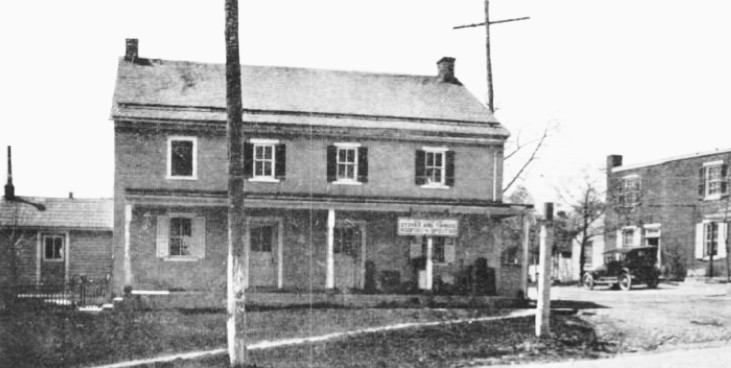
Post office building, Siegersville, Lehigh County, Pennsylvania, early 1900s (public domain).
What is known for certain about Daniel Gackenbach’s post-war life is that, following his release from the military, he returned home to his wife, Sarah, and son, Charles, in Pennsylvania’s Lehigh Valley, where he then proceeded to welcome the births of more children: Elenora Gackenbach (1866-1935; alternate spelling: “Ellenora”), who was born on 18 January 1866, was known to family and friends as ” Nora” and later wed Isaac Levan (1862-1956); Howard E. Gackenbach (1867-1850), who was born in 1867 and later became a tinsmith and the husband of Kate E. Jacobs (1874-1958); and Robert Stephen Gackenbach (1868-1952), who was born in “Saegersville” in Lehigh County on 1 December 1868 and later wed and was widowed by Alice Elmira Larosch (1872-1901), before marrying Louisa (Bartholomew) Laub (1864-1936).
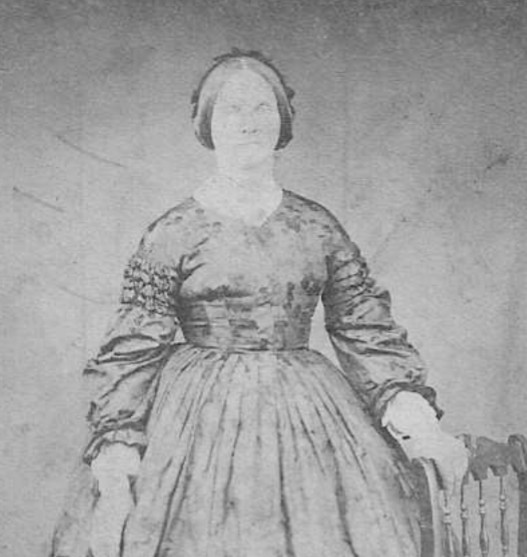
Jane E. (Keiper) Gackenbach, the second wife of Daniel H. Gackenbach, circa 1870s (public domain).
Widowed by his wife, Sarah Ann (Mohry/Mowry) Gackenbach, who died at the age of twenty-nine at their Lehigh County home on 3 May 1870, Daniel H. Gackenbach subsequently married his housekeeper, Pennsylvanian Jane E. Keiper (1851-1932), who was a daughter of Edwin Keiper (1815-1859) and Salome (Gross Keiper) Gernert (1822-1907). Together, he and his second wife welcomed the Lehigh County births of: Maggie Gackenbach (1871-1955), who was born on 2 July 1871 but never married; William Harrison Gackenbach (1874-1959), who was born on 10 August 1874 and later wed Lillie A. Dalrymple (1874-1954); Minnie E. Gackenbach (1878-1930), who was born on 27 March 1878, but never married; Kate M. Gackenbach (1879-1957), who was born on 18 January 1879 and later wed Howard U. Moyer; Reuben Joseph Gackenbach (1880-1927), who was born in Saegersville on 20 November 1880 and later worked for the Lehigh Portland Cement Company; Carrie Gackenbach (1883-1889), who was born on 7 February 1883, but died at the age of six years, eight months and ten days on 17 October 1889, after contracting diphtheria, which had been “predicted to be ‘the scourge of America in the future,'” according to The New England Journal of Medicine; a still unidentified daughter (1884-1889), who was born circa 1884, but died at the age of five in October 1889, after also contracting diphtheria; Edwin N. Gackenbach, who was born in Siegersville on 25 November 1887 and later became an insurance industry and real estate executive and the husband of Louisa M. Wehr; and Anna B. Gackenbach (1888-1972), who was born on 24 November 1888 and later became a public school teacher and the wife of George S. Hawk (1894-1963).
* Note: A news article that was published in the 30 October 1889 edition of The Allentown Democrat reported that two daughters of Daniel H. Gackenbach had died earlier that month from diphtheria:
“The first of the children to die was a daughter aged 5 years. She was buried about 10 days ago. The other was also a girl, aged 7 years. She died on Monday [28 October 1889]. Six other children of the family are ill with the same disease.”
One of those two daughters was Carrie Gackenbach (1883-1889), who died on 17 October 1889 at the age of six years, eight months and ten days. She was most likely the “girl, aged 7 years” mentioned in The Allentown Democrat article. Researchers have not yet identified the name of the five-year-old, but she would have been a daughter of Daniel Gackenbach and his second wife, Jane (Keiper) Gackenbach.
Those two daughters died during the same diphtheria epidemic that killed multiple members of the family of Captain Charles Mickley, the former commanding officer of the 47th Pennsylvania Volunteers’ G Company, who had been killed in the Battle of Pocotaligo, South Carolina in 1862. The Mickley family diphtheria deaths were reported in the same edition of The Allentown Democrat.
Still operating his own farm in 1870, Daniel Gackenbach was the owner that year of a personal estate that was valued by a federal census enumerator at three thousand two hundred and twenty-seven dollars (the equivalent of more than seventy-eight thousand U.S. dollars in 2025). When another enumerator arrived on the doorstep of his farmhouse on 8 June 1880, his household included his second wife, Jane, and the following children: Elenora, Howard, Robert, Maggie, Willie, Minnie, and Katey, the older four of whom were all attending school. Also residing with the Gackenbachs that year was live-in servant, Frank Ebert.
Sometime around this same time, Daniel’s son, Richard Gackenbach, moved out of the family home to begin his own life. In 1882, Richard married Schuylkill County native Alice Wagner. The following year, the newlyweds left family and old friends behind and migrated north to Maine, where they began to forge new lives for themselves in the town of Bath in Sagadahoc County as Richard began work there in the iron industry.
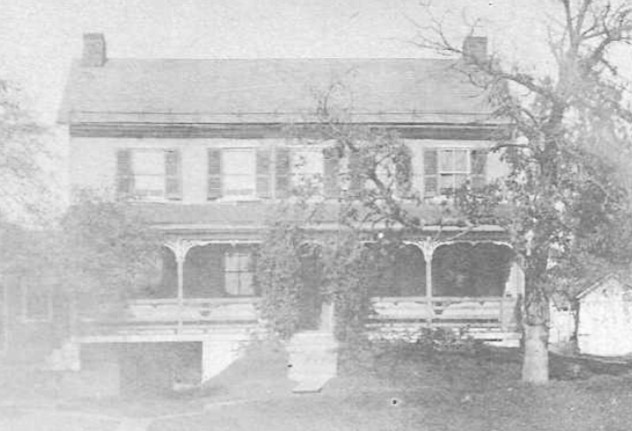
Possible photo of Daniel H. Gackenbach’s farmhouse, Lehigh County, Pennsylvania, late 1880s to early 1900s (public domain).
During the late summer of 1887, Daniel Gackenbach’s personal fortune increased significantly with the death of his father on 15 July. In addition to receiving a bequest of two thirds of the income from his father’s farm, he inherited all of his father’s livestock. When Daniel Gackenbach’s mother died four months later, on 21 November 1887, Daniel then also inherited all of his parents’ farmland plus the payout of his father’s one thousand dollar life insurance policy to pay off the inheritance taxes associated with that land transfer. According to Lehigh County historian Charles Rhoads Roberts, Daniel Gackenbach’s father, Reuben, had “removed to Allentown in 1871,” and had “occupied the residence No. 3 North Tenth Street until his death,” at which time that house was bequeathed to Daniel’s sister, Kate M. (Gackenbach) Moyer.
Suffering from a “rupture” and acute rheumatism, the latter of which was directly attributable to his military service in the Deep South during the American Civil War, Daniel Gackenbach was documented as being “disabled” when he was visited by a federal census enumerator at his one hundred and eight-acre farm in North Whitehall Township in June of 1890. Six years later, in early December, “Daniel Gackenbach’s sixteen-year-old son, Reuben, of near Levan’s school house, in North Whitehall Township, while riding near his home … fell from his horse and sustained a broken leg.” He then “crawled to a fence,” where he received help from one of the family’s neighbors.
By 1900, Daniel Gackenbach’s Orefield household included his second wife, Jane, and the following children: Maggie, who was employed as a servant; Minnie; Kate; Reuben, who worked on the family farm; and Eddie and Annie, who were both attending school. Although he was still the owner of his family farm, Daniel was still working to pay off a mortgage on his property, according to that year’s federal census enumerator.
In late August 1903, Daniel Gackenbach joined fellow 47th Pennsylvania veterans Phaon and William H. Guth in paying tribute to their old comrade Henry Kern, by serving as a pallbearer at Henry’s funeral in Stetlersville. Less than two years later, during early to mid-January 1905, Daniel suffered a broken arm during an accident in which he fell from a sleigh.
In September 1906, Daniel Gackenbach appeared to signal his intent to retire when he published a newspaper advertisement announcing that his land and farm buildings were available for rental.
Death and Interment
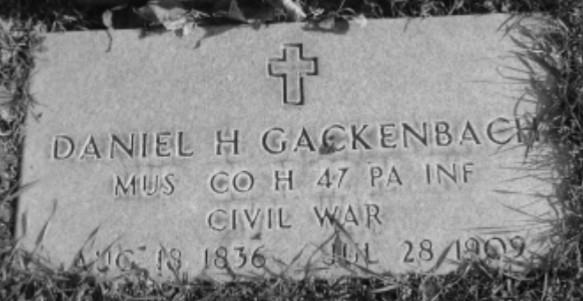
Military headstone of Private Daniel H. Gackenbach, Company H, 47th Pennsylvania Volunteers (public domain).
Ailing with rheumatoid arthritis, kidney disease and dropsy during his final years, Daniel H. Gackenbach suffered an episode of apoplexy on 5 June 1909 and died at the farm where he had been born — near Siegersville in North Whitehall Township, Lehigh County. Following his passing at home during the afternoon of 29 July 1909, funeral services were held at the United Brethren Church in Siegersville on 1 August 1909. According to The Allentown Leader, the funeral was officiated by the Reverend M. H. Miller and was well attended, with invitations to attend extended to “surviving comrades of the 47th Regiment and the U.B. Sunday School of Siegersville.” Music was provided by the members of a quartet who sang Sometime We’ll Understand and Under His Wings. He was then laid to rest in the Gackenbach’s family plot at the Jordan Lutheran Cemetery in Orefield, Lehigh County.
His will, which was probated in August of 1909, stipulated that his personal and real estate property (the farmhouse, household items, barn and other farm buildings, and farm equipment) be sold, with the proceeds from the sale used to pay his debts. Any money remaining was then to be distributed among his heirs.
* Learn More: Find out what happened to the widow, children and farm of Daniel H. Gackenbach by reading part two of this biographical sketch.
Sources:
- “A Mournful Affliction” (news report regarding the deaths of two of Daniel H. Gackenbach’s daughters from diphtheria and the illness of six other members of his family with diphtheria), and “Four Deaths in One Family From Diphtheria” (news report regarding the deaths from diphtheria of family members of Captain Charles Mickley, the commanding officer of the 47th Pennsylvania’s G Company who was killed during the Battle of Pocotaligo, South Carolina in 1862). Allentown, Pennsylvania: The Allentown Democrat, 30 October 1889.
- Bates, Samuel P. History of Pennsylvania Volunteers, 1861-5, vol. 1. Harrisburg, Pennsylvania: B. Singerly, State Printer, 1869.
- “Bought Gackenbach Farm” (the sale of Daniel H. Gackenbach’s farm by his executors to Thomas L. Sherer). Allentown, Pennsylvania: The Allentown Democrat, 21 September 1909.
- Charles A. Gackenbach (the first-born child of Daniel H. Gackenbach and his first wife, Sarah), in Death Certificates (file no.: 24411, registered no.: 11, date of death: 6 March 1947). Harrisburg, Pennsylvania: Commonwealth of Pennsylvania, Department of Health, Bureau of Vital Statistics.
- “Civil War Military Bands: Their Purpose and Composition.” Washington, D.C.: American Battlefield Trust, 28 September 2020 (revised 12 May 2021).
- “Daniel Gackenbach Dead at His Home Near Siegersville.” Allentown, Pennsylvania: The Allentown Leader, 29 July 1909.
- “Daniel Gackenbach,” (report of his sleigh accident injury), in “Orefield.” Allentown, Pennsylvania: The Allentown Leader, 18 January 1905.
- Daniel Gackenbach, in U.S. Census (“Special Schedule: Surviving Soldiers, Sailors, and Marines, and Widows, etc.”: North Whitehall Township, Lehigh County, Pennsylvania, 1890). Washington, D.C.: U.S. National Archives and Records Administration.
- Daniel H. Gackenbach, in Death Certificates (file no.: 62443, registered no.: 113, date of death: 29 July 1909). Harrisburg, Pennsylvania: Commonwealth of Pennsylvania, Department of Health, Bureau of Vital Statistics.
- Daniel H. Gackenbach, in “For Rent,” in “New Advertisements.” Allentown, Pennsylvania: The Allentown Democrat, 17 September 1906.
- Elenora Levan (a daughter of Daniel H. Gackenbach and his first wife, Sarah), in Death Certificates (file no.: 59092, registered no.: 22, date of death: 16 June 1936). Harrisburg, Pennsylvania: Commonwealth of Pennsylvania, Department of Health, Bureau of Vital Statistics.
- “Executors’ Sale of Valuable Real Estate!” (sales of Daniel H. Gackenbach’s farm and personal property). Allentown, Pennsylvania: The Morning Call, 30 August 1909 and 17 September 1909.
- “Fell from a Horse” (injury sustained by Daniel H. Gackenbach’s son, Reuben). Allentown, Pennsylvania: The Allentown Leader, 10 December 1896.
- “Florida’s Role in the Civil War,” in Florida Memory. Tampa, Florida: Florida Center for Instructional Technology, College of Education, University of South Florida, retrieved online 15 January 2020.
- “Funeral of Daniel H. Gackenbach.” Allentown, Pennsylvania: The Allentown Leader, 2 August 1909.
- Gachenbach [sic, “Gackenbach”], Daniel (tenant farmer), Sarah and Charles A.; Guth, Harrison (servant); and Frohenhausen, Ruphena (servant), in U.S. Census (Ruchsville, North Whitehall Township, Lehigh County, Pennsylvania, 1860). Washington, D.C.: U.S. National Archives and Records Administration.
- Gachenbach [sic, “Gackenbach], Daniel, Jane E., Ellenora, Howard E., Robert S., Maggie, Willie H., Minnie E., Katey M.; and Ebert, Frank (servant), in U.S. Census (North Whitehall Township, Lehigh County, Pennsylvania, 1880). Washington, D.C.: U.S. National Archives and Records Administration.
- Gachenbuch [sic, “Gackenbach”], Daniel and Guth, Harrison (a servant employed by Daniel H. Gackenbach in 1860), in Civil War Muster Rolls (Company H/Regimental Band No. 2 and Company G, 47th Pennsylvania Infantry). Harrisburg, Pennsylvania: Pennsylvania State Archives.
- Gachenbuck and Gachenbaugh [sic, “Gackenbach”], Daniel/Dan, and Guth, Harrison (a servant employed by Daniel H. Gackenbach in 1860), in Civil War Veterans’ Card File, 1861-1866 (Companies H and G, 47th Pennsylvania Infantry). Harrisburg, Pennsylvania: Pennsylvania State Archives.
- “Gackenbach” (obituary and death and funeral notices of Daniel H. Gackenbach). Allentown, Pennsylvania: The Morning Call, 30-31 July 1909.
- “Gackenbach” (death notice of Jane E. (Keiper) Gackenbach, Daniel H. Gackenbach’s second wife and widow). Allentown, Pennsylvania: The Morning Call, 18 April 1932.
- “Gackenbach” (obituary of a daughter-in-law of Daniel H. Gackenbach and the second wife of Charles A. Gackenbach). Allentown, Pennsylvania: The Morning Call, 4 November 1930.
- Gackenbach, Daniel (father), Sarah (mother) and Mary Maralda (infant), in Birth and Baptism Records (Jordan Lutheran Church, Orefield, Lehigh County, Pennsylvania, 1861). Orefield, Pennsylvania: Jordan Lutheran Church.
- Gackenbach, Jane E. (Daniel H. Gackenbach’s second wife and widow), Maggie, Minnie and Annie (daughters of Jane (Keiper) Gackenbach and Daniel H. Gackenbach), in U.S. Census (North Whitehall Township, Lehigh County, Pennsylvania, 1910). Washington, D.C.: U.S. National Archives and Records Administration.
- Gackenbach, Jane E. (Daniel H. Gackenbach’s second wife and widow), Maggie and Minnie (daughters of Jane (Keiper) Gackenbach and Daniel H. Gackenbach); and Hawk, Anna B. (a daughter of Jane (Keiper Gackenbach and Daniel H. Gackenbach), and George S. (Anna’s husband), in U.S. Census (Allentown, Eighth Ward, Lehigh County, Pennsylvania, 1920). Washington, D.C.: U.S. National Archives and Records Administration.
- Gackenbach, Jane E. (Daniel H. Gackenbach’s second wife and widow), Maggie and Minnie (daughters of Jane (Keiper) Gackenbach and Daniel H. Gackenbach); and Hawk, Anna B. (a daughter of Jane (Keiper Gackenbach and Daniel H. Gackenbach), and George S. (Anna’s husband), in U.S. Census (Allentown, Eighth Ward, Lehigh County, Pennsylvania, 1930). Washington, D.C.: U.S. National Archives and Records Administration.
- Gackenbach, Maggie (a daughter of Daniel Gackenbach and his second wife, Jane (Keiper) Gackenbach), in Death Certificates (file no.: 107733, registered no.: 1823, date of death: 13 December 1955). Harrisburg, Pennsylvania: Commonwealth of Pennsylvania, Department of Health, Bureau of Vital Statistics.
- Gackenbach, Reuben, Maria, Daniel, and Anna Maria; Hileman, Jacob (a shoemaker); Houser, Edwin; Helfrich, Cettey Ann; and Butz, Cathrine, in U.S. Census (North Whitehall Township, Lehigh County, Pennsylvania, 1850). Washington, D.C.: U.S. National Archives and Records Administration.
- Gackenbach, Richard and Daniel (notice of Richard Gackenbach’s trip from Maine to visit his father, Daniel H. Gackenbach), in “Orefield.” Allentown, Pennsylvania: The Allentown Leader, 25 June 1902.
- Gachenbaugh [sic, “Gackenbach”], Daniel, in Registers of Pennsylvania Volunteers, 1861-1865 (47th Regiment, Company H), in Records of the Department of Military and Veterans’ Affairs (Record Group 19). Harrisburg, Pennsylvania: Pennsylvania State Archives.
- Gagenbach [sic, “Gackenbach”], Daniel, Jane E., Maggie V., Minnie S., Kate, M., Reuben, Eddie, and Annie, in U.S. Census (North Whitehall Township, Lehigh County, Pennsylvania, 1900). Washington, D.C.: U.S. National Archives and Records Administration.
- Gaggenbach [sic, “Gackenbach”], Daniel, Charles, Richard, Ellenora, Howard, and Robert; and Keiper, Jane (the housekeeper), in U.S. Census (Slatington, North Whitehall Township, Lehigh County, Pennsylvania, 1870). Washington, D.C.: U.S. National Archives and Records Administration.
- “Grosses Concert!” (“Big Concert!”). Allentown, Pennsylvania: Der Lecha Caunty Patriot, 12 December 1855.
- Grodzins, Dean and David Moss. “The U.S. Secession Crisis as a Breakdown of Democracy,” in When Democracy Breaks: Studies in Democratic Erosion and Collapse, from Ancient Athens to the Present Day (chapter 3). New York, New York: Oxford University Press, 2024.
- “Items from Stettlersville” (pallbearer service of Daniel H. Gackenbach at the funeral of fellow 47th Pennsylvania Veteran Henry Kern). Allentown, Pennsylvania: The Allentown Democrat, 2 September 1903.
- Jane E. Gackenbach (the second wife and widow of Daniel H. Gackenbach), in Death Certificates (file no.: 40537, registered no.: 451, date of death: 16 April 1932). Harrisburg, Pennsylvania: Commonwealth of Pennsylvania, Department of Health, Bureau of Vital Statistics.
- “July 25” (1995 photograph of the sword presented to Colonel Tilghman H. Good, commanding officer of the 47th Pennsylvania Volunteer Infantry, by the citizens of Key West, Florida on July 25, 1863), in “Florida Keys History Center.” Key West, Florida: Key West Library, retrieved online August 16, 2025.
- “Last Will and Testament of Daniel H. Gackenbach” (will and probate paperwork for the estate of Daniel Gackenbach, 1909). Allentown, Pennsylvania: Clerk of the Orphans’ Court of Lehigh County.
- “Last Will and Testament of Reuben Gackenbach” (will and probate paperwork for the estate of Daniel Gackenbach’s father, 1866-1867). Allentown, Pennsylvania: Clerk of the Orphans’ Court of Lehigh County.
- Levan, Isaac L., Nora K. (a daughter of Daniel H. Gackenbach and his first wife, Sarah), Beulah M., Carrie C., and Alice A., in U.S. Census (North Whitehall Township, Lehigh County, Pennsylvania, 1900). Washington, D.C.: U.S. National Archives and Records Administration.
- Levan, Isaac L., Anora K. [sic, “Elnora”] (a daughter of Daniel H. Gackenbach and his first wife, Sarah), Beulah M., Carrie E., Alice A., and Allen J.; and Dengler, Joseph (boarder), in U.S. Census (North Whitehall Township, Lehigh County, Pennsylvania, 1910). Washington, D.C.: U.S. National Archives and Records Administration.
- Minnie E. Gackenbach (a daughter of Daniel H. Gackenbach and his second wife, Jane), in Death Certificates (file no.: 51155, registered no.: 688, date of death: 16 May 1930). Harrisburg, Pennsylvania: Commonwealth of Pennsylvania, Department of Health, Bureau of Vital Statistics.
- “Mrs. Amelia Gackenbach” (obituary of Daniel H. Gackenbach’s daughter-in-law and the first wife of Charles A. Gackenbach). Allentown, Pennsylvania: The Morning Call, 15 February 1904.
- “Mrs. Jane Gackenbach Dies in Her 81st Year” (obituary of Daniel H. Gackenbach’s second wife and widow). Allentown, Pennsylvania: The Morning Call, 17 April 1932.
- “Obituary: Mrs. Alice Gackenbach” (a daughter-in-law of Daniel H. Gackenbach and the wife of Richard C. Gackenbach). Bath, Maine: The Bath Daily Times, 23 October 1929.
- “Public Sale of Valuable Farm Equipment” (the public sale by Thomas L. Sherer and Menno Rex of livestock and farming equipment previously owned by Daniel H. Gackenbach). Allentown, Pennsylvania: The Morning Call, 17 March 1920.
- Reuben Joseph Gackenbach (a son of Daniel Gackenbach and his second wife, Jane), in Death Certificates (file no.: 41846, registered no.: 234, date of death: 7 April 1927). Harrisburg, Pennsylvania: Commonwealth of Pennsylvania, Department of Health, Bureau of Vital Statistics.
- Roberts, Charles Rhoads and Rev. John Baer Stoudt, et. al. History of Lehigh County Pennsylvania and a Genealogical and Biographical Record of Its Families, vol. 2, pp. 408-410 “Gackenbach Family”). Allentown, Pennsylvania: Lehigh Valley Publishing Company, 1914.
- “Roster of the 47th P. V. Inf.” Allentown, Pennsylvania: The Morning Call, 26 October 1930.
- Schmidt, Lewis G. A Civil War History of the 47th Regiment of Pennsylvania Veteran Volunteers. Allentown, Pennsylvania: Self-published, 1986.
- Stockham, Jeff. “Civil War Music Instruments” (video), in Making Music (magazine). Syracuse, New York: Bentley Hall, Inc., 15 July 2013.
- “The Civil War Bands,” in Band Music from the Civil War Era. Washington, D.C.: U.S. Library of Congress, retrieved from LOC website, September 2015.
- “The Great Depression: 1929-1941, in Federal Reserve History. St. Louis, Missouri: Federal Reserve Bank of St. Louis, 2013.
- “The History of the Forty-Seventh Regt. P. V.” Allentown, Pennsylvania: The Lehigh Register, 20 July 1870.
- Thomas L. Sherer (the winning purchaser of Daniel H. Gackenbach’s farm in 1909), in “Personal.” Allentown, Pennsylvania: The Allentown Democrat, 20 March 1917.
- Verhovek, Kendall. “The 19th Amendment, Explained.” New York, New York, Brennan Center for Justice, 3 March 2025.
- Wharton, Henry D. “Letters from the Sunbury Guards,” 1861-1865. Sunbury, Pennsylvania: The Sunbury American.
 47th Pennsylvania Volunteers
You must be logged in to post a comment.