Another of the interesting data points about the late nineteenth and early to mid-twentieth century lives of 47th Pennsylvania Volunteer Infantrymen are the documented residencies of veterans of the regiment or their descendants in locations outside of the United States.
While the majority of these men, women and children were descendants of 47th Pennsylvania veterans who were engaged in performing their own service to the nation as members of the United States military, several migrated to other countries for employment reasons (see abridged list below).
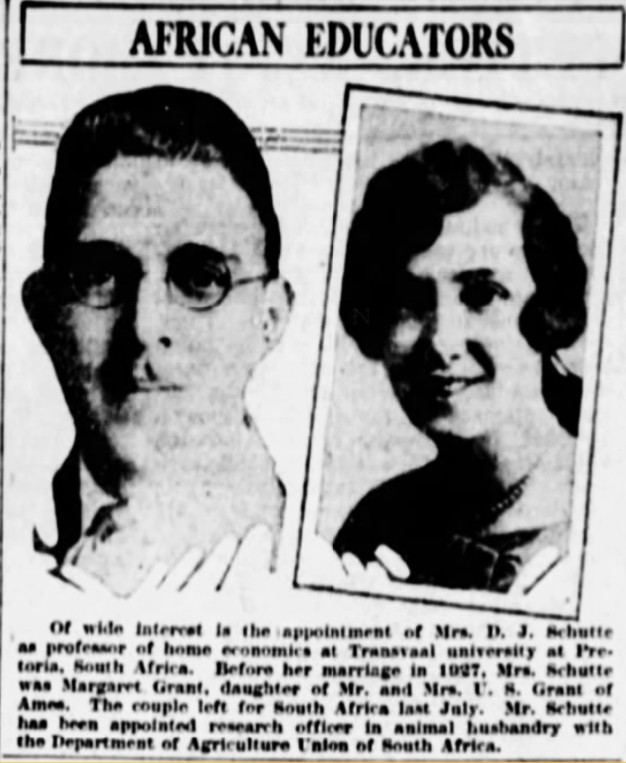
Professor Margaret (Grant) Schutte, shown here with her husband, D. J. Schutte, in 1929, was a granddaughter of 47th Pennsylvania veteran Samuel S. Raffensperger. A graduate of Iowa State College, she became a university professor in South Africa (The Des Moines Register, 27 January 1929, public domain).
Africa
- Schutte, Margaret R. Grant (a granddaughter of Private Samuel S. Raffensperger, Company C): Born in Warren Township, Poweshiek County, Iowa on 18 March 1901, Margaret R. Grant was a daughter of Ulysses Simpson Grant (1865-1939) and Janet (Raffensperger) Grant (1874-1942). A graduate of Iowa State College in 1925, she wed Diederick Johannes Schutte, a native of the Union of South Africa and fellow graduate of Iowa State, before emigrating with him in 1928 to Victoria, South Africa. While there, she became a teacher at the Transvaal University College (which later became part of the University of Pretoria), while her husband was employed by the South African federal government as a senior animal husbandry expert.
- Snyder, Willard Emery (a grandson of Corporal Timothy Matthias Snyder, Company C): Following his completion of basic training at the United States Navy’s Naval Construction Training Center in Davisville, Rhode Island during the fall of 1942, Willard E. Snyder was assigned to the U.S. Naval Reserves’ Construction Battalion Detachment 1002 (a branch of the “Seabees”) as an electrician’s mate on 11 December 1942. Transported by ship to Gourock, Renfrewshire, Scotland, beginning on 12 December, he was stationed in Gourock with his unit until 31 December of that same year, when he traveled with his unit by ship to what was then British West Africa. Arriving in early January 1943, he was stationed in Freetown, Sierra Leone in British West Africa (now Freetown, Sierra Leone) with the U.S. Naval Reserves’ Construction Battalion Detachment 1002 and assigned to guard and general detail duties until 31 March 1943, when he was transferred to the United States Naval Reserves’ 65th Construction Battalion (also part of the “Seabees”). Assigned to guard and general detail duties with the 65th Construction Battalion in and around Freetown, he served there with his unit until early June 1943, when he was transported by ship back to Boston, Massachusetts in the United States. Subsequently enrolled in the Carbine and Submachine Gun Marksmanship program and the Communications School at the U.S. Navy’s Naval Construction Training Center (NCTC) in Davisville, Rhode Island, beginning on 13 and 25 August 1943, respectively, he was then also enrolled in the NCTC radio and telephone communications training program in Davisville on 8 September 1943. After completing his training, he was transferred to the U.S. Naval Reserves’ Construction Battalion Maintenance Unit 530 on 21 September 1943. An electrician’s mate, he performed the duties of an outside electrical lineman. Promoted up through the ranks of the U.S. Naval Reserves’ Construction Battalion Maintenance Unit 530, he was reassigned to interior wiring operations on 1 April 1944 and also performed a range of administrative duties, including dispatch and reporting functions while stationed at the Marine Corps Air Station in Ewa, Oahu, Hawaii. Granted emergency leave to visit his dying father, Willard E. Snyder departed from Hawaii circa 8 June 1944, traveled to San Francisco, California and then to his homeown of Lavelle in Schuylkill County, Pennsylvania. When his leave ended, he reported for duty at his assigned receiving ship in San Francisco, California on 12 July 1944, and arrived for duty with his unit in Hawaii on 28 July 1944. On 12 October 1944, he was reassigned to communications operations, and was transferred from the U.S. Naval Reserves’ Construction Battalion Maintenance Unit 530 to Construction Battalion Maintenance Unit 531 on Midway Island in the North Pacific Ocean, for which he continued to provide communications services until he was transferred to Construction Battalion Maintenance Unit 524 on Midway Island on 20 November 1944. After spending more than a year on Midway Island now an insular area of the United States), he was transferred to San Francisco, California with his unit on 18 October 1945, and arrived in San Francisco on 26 October. Subsequently transferred to the U.S. Naval Air Station in Olathe, Kansas, he was then transported to the United States Naval Hospital in Great Lakes, Illinois, where he was treated for malaria. Transferred to the U.S. Navy Processing Center in Bainbridge, Maryland on 20 November 1945, he was honorably discharged from the U.S. Navy on 24 November 1945, and returned home to Schuylkill County, where he began a nearly thirty-year career with the Bell Telephone Company of Pennsylvania.

Deborah Nan Brunell was a great-granddaughter of 47th Pennsylvania veteran Stephen Walter (Park College, Missouri, 1958, public domain).
Canada
- Brunell, Walter Henry (a grandson of Private Stephen Walter, Company A): A native of Council Bluffs, Iowa who was a son of Nellie Etna (Walter) Brunell and a grandson of 47th Pennsylvania veteran Stephen Walter, Walter H. Brunell initially settled with his wife, Eleanor, in Omaha, Nebraska, where they welcomed the birth of a daughter, Deborah Nan Walter. Sometime around this same time, he was employed as the manager of the Harketts Houses in Council Bluffs and Omaha. In 1955, he and his family relocated to Calgary, Alberta, Canada, where he was employed by the Husky Oil Co. Still residing in Calgary at the time of the death of his mother, Nellie (Walter) Brunell, in Iowa on 25 November 1962, as well as at the time of the death of his father, Samuel Brunell, in 1963, he continued to work with the oil company in Canada until his retirement in 1980. He then returned to the United States, and settled in Albuquerque, New Mexico. Following his death there in 1991, he was laid to rest in Albuquerque.
- Bumgardner, Deborah Nan Brunell (a great-granddaughter of Private Stephen Walter, Company A): A native of Omaha, Nebraska who was a great-granddaughter of 47th Pennsylvania veteran Stephen Walter, Deborah Nan Walter spent the early 1940s in Omaha before relocating to Calgary, Canada with her parents, Walter and Eleanor Brunell. A student at Park College in Missouri during the 1950s, she subsequently settled in Kansas City, Missouri, wed David Bumgardner circa 1960 and welcomed the births of four children. She died in Kansas City on 19 June 2020.
- Raffensperger, Albert Lysle (a nephew of Private Samuel S. Raffensperger, Company D): A native of Forest City, Winnebago County, Iowa Albert L. Raffensperger, was a son of John Wesley Raffensperger and a nephew of Private Samuel S. Raffensperger. After relocating to Winnipeg, Canada sometime prior to World War I, he served in the Canadian Over-Seas Expeditionary Force (CEF) during World War I, and later became a fisherman in Alaska in 1950; his wife, Bernice, worked at a salmon canning factory that same year. He subsequently died in Alaska in 1960.
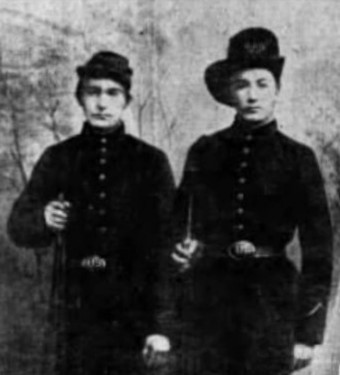
Privates John H. Troell, 47th Pennsylvania Volunteers (left, wearing a kepi), and his brother, Private Conrad Troell, 74th Pennsylvania Volunteers, Camp Griffin, Virginia, 5 January 1862 (public domain).
Central America and Mexico
- Troell, John H. and Conrad (Private, Company I, 47th Pennsylvania; and Private, 74th Pennsylvania): Natives of Schwebda in the Kingdom of Prussia, John H. Troell and his brother, Conrad, emigrated from Prussia and settled in the Commonwealth of Pennsylvania. Conrad, a trained botanist, chose to make his home in Lehigh County, while John chose to live in the anthracite coal mining town of Eckley in Luzerne County. Following the American Civil War, John Troell returned to his adopted home state of Pennsylvania, where he married and raised children, while his brother, Conrad, who had served with the 74th Pennsylvania Volunteers during the war, had migrated to the West Coast of the United States in 1864 before traveling to Central America, where he worked as a miner, until returning to California in 1866. A businessman in San Francisco, Conrad Troell was later hired as a deputy sheriff and then as a court bailiff. Meanwhile, John Troell became a naturalized citizen of the United States. In declining health, he was admitted to the National Home for Disabled Volunteer Soldiers in Dayton, Montgomery County, Ohio in 1891. In 1903, John and Conrad Troell reconnected at the Grand Army of the Republic’s encampment in San Francisco. John Troell then returned to the National Soldiers’ Home in Dayton, Ohio, and lived out his life there. Following his death at the home on 16 June 1913, he was laid to rest at the Dayton National Cemetery in Dayton, Ohio. Conrad Troell, however, continued to live and work in San Francisco, California. Compelled by his own declining health to move into the Veterans’ Home in Yountville, California for a period of time, he died in San Francisco on 16 October 1924, and was laid to rest at the Cypress Lawn Cemetery in Colma, California.
- White, Roy Abrams (a son of Private Wesley M. White, Company D): A native of Adams County, Nebraska, Roy Abrams White (1879-1950), grew up on his family’s farm, where he helped to work the land. A 1900 graduate of Hastings College in Hastings, Adams County, he migrated west with his parents to Gardena, Los Angeles County, California in 1903, where he also helped to work his parents’ farmland. Three years later, Roy White moved out of the family’s Gardena home and began his own life’s journey. Traveling to South America, he was employed there between April and October in 1906. He then wed Bertha C. Wright in Manhattan, New York City, New York on 15 September 1909. By April of 1910, he and his wife were living in the Fifth Ward of Salt Lake City in Utah, where he was employed as a stenographer for the American Smelting and Refining Company (ASARCO). Still employed by ASARCO in Salt Lake City as of 1921, he traveled to Mexico on behalf of ASARCO during the summer that year, indicating to U.S. immigration officials that he planned to return within six months. By 1930, he had moved his wife and daughter from Salt Lake City, Utah to the City of Seattle in King County, Washington, where he was employed as a customs officer with the U.S. Department of the Treasury’s Bureau of Customs. Still living in Seattle with his wife and daughter as of 1940, he had returned to employment with a smelting company by that time, and was employed as a safety expert. On 18 October 1950, he became a widower when his wife Bertha passed away in Seattle. Bereft, he followed her in death just over a week later, when he died in Seattle on 27 October 1850.
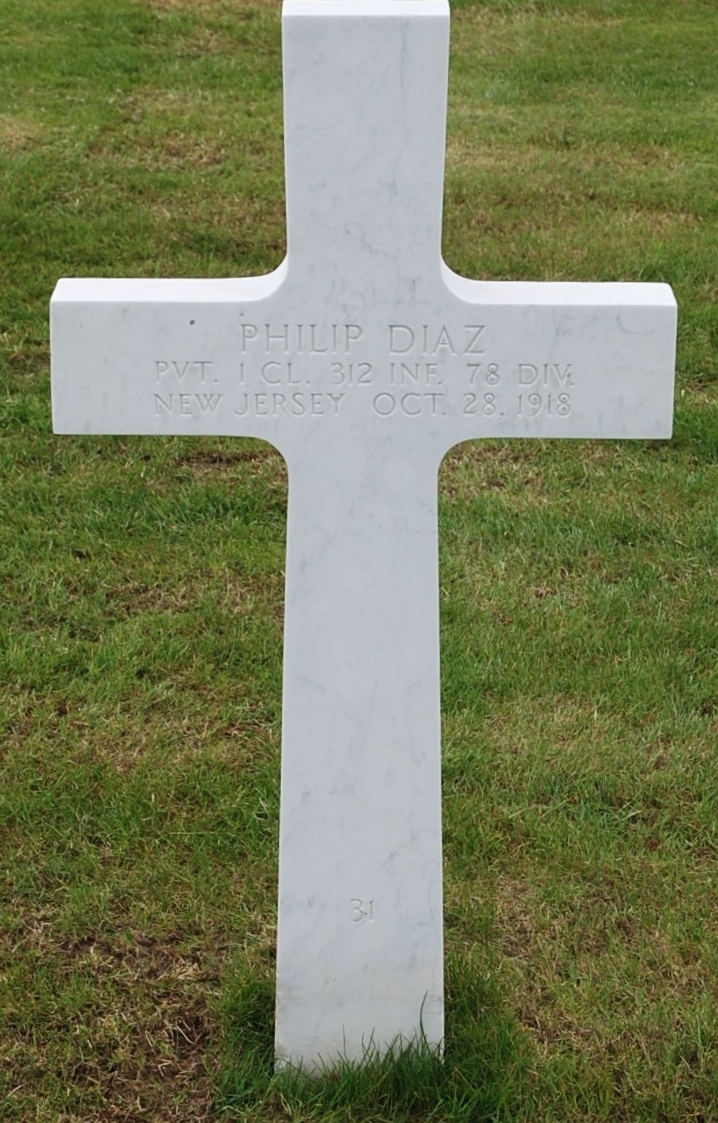
The grave of Private Philip Diaz at the Meuse-Argonne Cemetery in France, circa 2012 (public domain).
France
- Diaz, Private Philip (a son of Private John Diaz, Company I): A native of Philadelphia, Pennsylvania and a first-generation American, Private Philip Diaz was a son of 47th Pennsylvania veteran John Diaz, who had emigrated to the United States from Spain’s Canary Islands between 1862 and late 1864, when he enlisted with the Union Army. Employed in 1918 as a clerk in the Stawbridge and Clothier store in Ashland, New Jersey, where he had previously relocated with his parents, Philip Diaz reported for basic training at Camp Dix in New Jersey on 28 February. A private with “4 Co. 153 Dep. Brigade,” according to his military records, he completed basic training in April 1918, and was assigned to Company C of the United States Army’s 312th Infantry, 78th Division. He then served overseas from 10 May to 28 October 1918 in “action operations” with the 1st Army, including engagements which occurred on 16 September, 4 October, and from 16 to 28 October. According to records of the First Presbyterian Church of Haddonfield, New Jersey (the church where he had confessed his faith in 1913), Private Philip Diaz had been deployed to France, and was reported as missing in action there on 24 October 1918. U.S. Army leaders ultimately determined that he had been killed in action on 28 October 1918, “in the Argonne while seeking water for which he had been detailed.” He remains at rest in the Meuse-Argonne Cemetery in France.
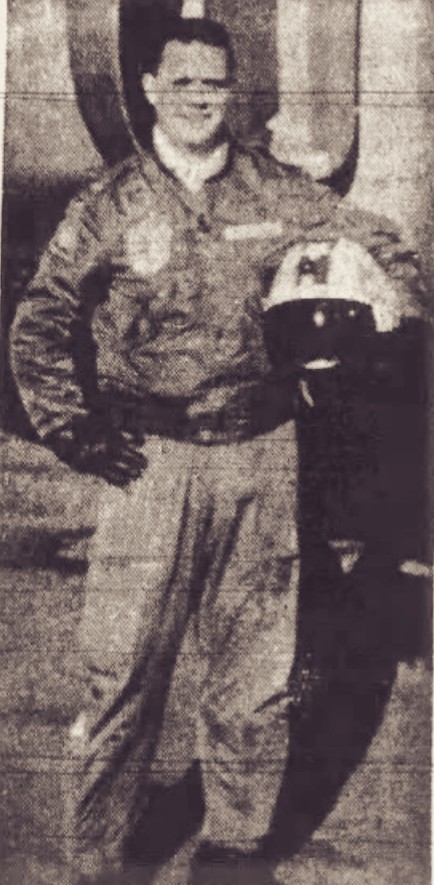
Captain John Albert Snyder, U.S. Air Force, shown here in Korea in 1960, was a great-grandson of 47th Pennsylvania veteran Timothy M. Snyder (Snyder Family Archives, used with permission).
Germany
- Snyder, Lieutenant-Colonel John Albert Snyder (great-grandson of Corporal Timothy Matthias Snyder, Company C): Rising through the ranks to become a major in the United States Air Force, Jack Snyder served in Förch, Baden-Württemberg, Germany, at the age of twenty-two; in Greenville, Mississippi, United States in 1956; in Burlington, Vermont in 1958; at the Yokota Air Force Base in Tokyo, Japan in 1963; in Southeast Asia (Korea and Vietnam) during the 1960s); in Germany during the early 1970s; and then in Texas during the 1980s and 1990s. He retired at the rank of lieutenant-colonel and made his home in Killeen and Harker Heights, Texas.
- Snyder, First Lieutenant and Navigator, F-4, John David Snyder (great-great-grandson of Corporal Timothy Matthias Snyder, Company C): Born in Greenville, Mississippi in the United States, J. D. Snyder was a son of United States Air Force pilot John Albert “Jack” Snyder. He grew up traveling with his family as his father was stationed at U.S. military bases in the United States (Burlington, Vermont and Killeen, Texas), as well as overseas (Tokyo, Japan; and Germany). A graduate with honors of the United States Air Force Academy in Colorado Springs, Colorado in 1978, J. D. Snyder was commissioned as a first lieutenant with the United States Air Force and assigned as an F-4 pilot and navigator at the Clark Air Force Base near Manila in the Republic of the Philippines, where he was killed during a fire that broke out in his apartment on 26 December 1981, while he was still in service to the nation. His remains were subsequently returned to Colorado Springs for funeral services at the chapel of the U.S. Air Force Academy and interment at the academy’s cemetery.
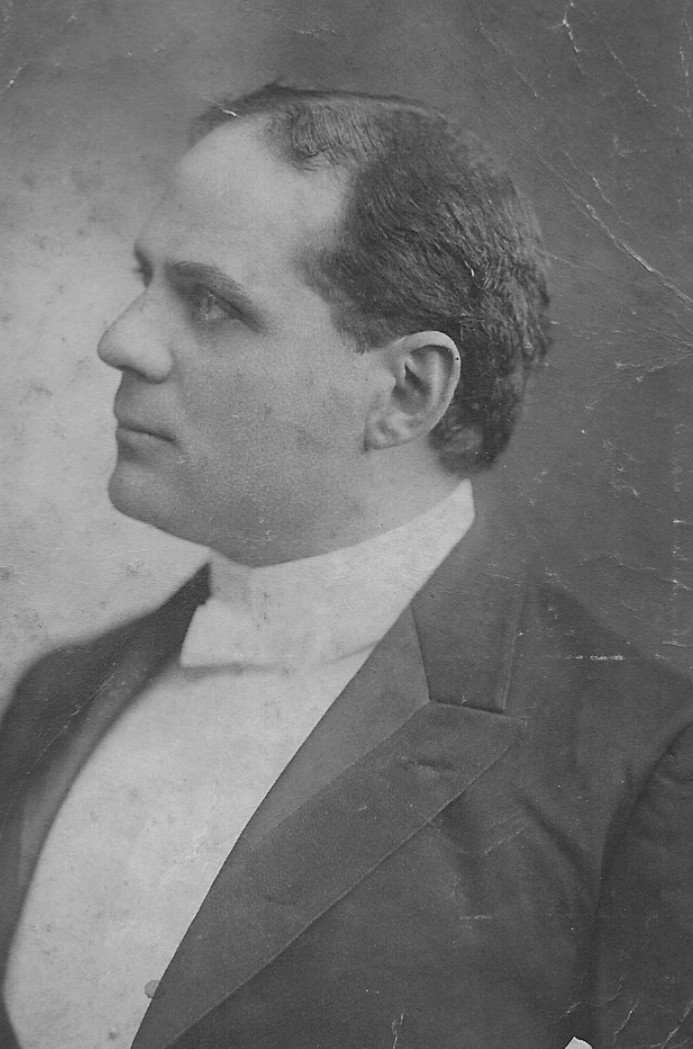
The Reverend Doctor Archibald Clinton Harte, general secretary of the Jerusalem Y.M.C.A. in Jerusalem, Israel, circa 1933 (public domain).
Israel
- Harte, Reverend Doctor Archibald Clinton (a son of Captain Henry Samuel Harte, Company F): In 1920, the Reverend Doctor Archibald C. Harte, a son of 47th Pennsylvania veteran Henry S. Harte, was appointed as the general secretary of the Jerusalem Y.M.C.A. in Jerusalem, Israel. A resident of Israel during that period of his public service career, he worked to make that branch of the Y.M.C.A. a center of learning and hospitality that would welcome visitors of all faiths and nationalties. After securing financial support from philanthropist James Newbegin Jarvie, Reverend Harte oversaw the planning, construction, opening, and operation of a new Y.M.C.A. building complex in Jersusalem. Designed in the neo-Byzantine style by Arthur Loomis (the architect who designed New York City’s famed Empire State Building), the cornerstone for the Jerusalem project was laid in 1928 at dedication ceremonies led by the British High Commissioner for Palestine, Lord Plummer. The building was then dedicated by British General Edmund Lord Allenby on 18 April 1933. A resident of Israel for the remainder of his life, Reverend Harte died at the age of eighty in Tiberius in the Northern District of Israel on 14 April 1946, and remains at rest in his grave in Piniel-By-the-Sea in Tiberius.
Japan:
- Snyder, Lieutenant-Colonel John Albert Snyder (great-grandson of Corporal Timothy Matthias Snyder, Company C): Rising through the ranks to become a major in the United States Air Force, Jack Snyder served in Förch, Baden-Württemberg, Germany, at the age of twenty-two; in Greenville, Mississippi, United States in 1956; in Burlington, Vermont in 1958; at the Yokota Air Force Base in Tokyo, Japan in 1963; in Southeast Asia (Korea and Vietnam) during the 1960s); in Germany during the early 1970s; and then in Texas during the 1980s and 1990s. He retired at the rank of lieutenant-colonel and made his home in Killeen and Harker Heights, Texas.
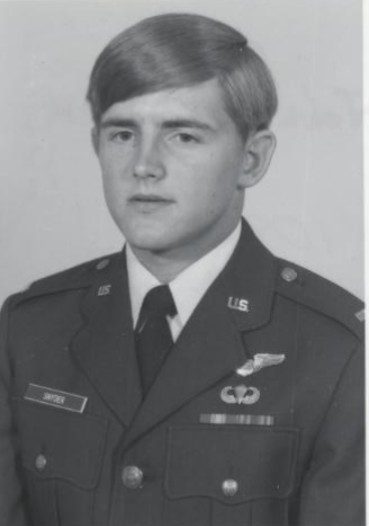
John David Snyder, U.S. Air Force Academy, circa 1977 (used with permission, courtesy of the Snyder Family Archives).
Republic of the Phillipines
- Snyder, First Lieutenant and Navigator, F-4, John David Snyder (great-great-grandson of Corporal Timothy Matthias Snyder, Company C): Born in Greenville, Mississippi in the United States, J. D. Snyder was a son of United States Air Force pilot John Albert “Jack” Snyder. He grew up traveling with his family as his father was stationed at U.S. military bases in the United States (Burlington, Vermont and Killeen, Texas), as well as overseas (Tokyo, Japan; and Germany). A graduate with honors of the United States Air Force Academy in Colorado Springs, Colorado in 1978, J. D. Snyder was commissioned as a first lieutenant with the United States Air Force and assigned as an F-4 pilot and navigator at the Clark Air Force Base near Manila in the Republic of the Philippines, where he was killed during a fire that broke out in his apartment on 26 December 1981, while he was still in service to the nation. His remains were subsequently returned to Colorado Springs for funeral services at the chapel of the U.S. Air Force Academy and interment at the academy’s cemetery.
South America:
- White, Roy Abrams (a son of Private Wesley M. White, Company D): A native of Adams County, Nebraska, Roy Abrams White (1879-1950), grew up on his family’s farm, where he helped to work the land. A 1900 graduate of Hastings College in Hastings, Adams County, he migrated west with his parents to Gardena, Los Angeles County, California in 1903, where he also helped to work his parents’ farmland. Three years later, Roy White moved out of the family’s Gardena home and began his own life’s journey. Traveling to South America, he was employed there between April and October in 1906. He then wed Bertha C. Wright in Manhattan, New York City, New York on 15 September 1909. By April of 1910, he and his wife were living in the Fifth Ward of Salt Lake City in Utah, where he was employed as a stenographer for the American Smelting and Refining Company (ASARCO). Still employed by ASARCO in Salt Lake City as of 1921, he traveled to Mexico on behalf of ASARCO during the summer that year, indicating to U.S. immigration officials that he planned to return within six months. By 1930, he had moved his wife and daughter from Salt Lake City, Utah to the City of Seattle in King County, Washington, where he was employed as a customs officer with the U.S. Department of the Treasury’s Bureau of Customs. Still living in Seattle with his wife and daughter as of 1940, he had returned to employment with a smelting company by that time, and was employed as a safety expert. On 18 October 1950, he became a widower when his wife Bertha passed away in Seattle. Bereft, he followed her in death just over a week later, when he died in Seattle on 27 October 1850.
- Worman, George L. (a son of Sergeant Jacob P. Worman, Company G): A native of the Great Keystone State, George L. Worman (1893-1963) grew up as the son of an American Civil War veteran in eastern Pennsylvania. After marrying Anna May Walck in 1917, he served in the U.S. Army during World War I, and then became a successful businessman in the city of Allentown in Lehigh County, during which time he traveled to the Dominican Republic, Puerto Rico and Cuba. Remarried in 1924 to Lillian M. Lowe, he subsequently became a successful, Philadelphia-based importer whose work took him to South America. During a 1951 trip, he and his wife informed customs officials that they were planning a trip of “indefinite” length, during which they would be traveling to the city of Rio de Janeiro in Brazil. Ailing with heart disease during his final years, he died at Philadelphia’s Misericordia Hospital on 24 October 1963.
*Note: This list will continue to be updated as research for the “Faces of the 47th” project progresses.
Sources:
- “African Educators” (photograph of 47th Pennsylvania veteran Samuel S. Raffenberger’s granddaughter, Margaret (Grant) Schutte, with caption describing her employment as a university professor in South Africa). Des Moines, Iowa: The Des Moines Register, 27 January 1929.
- Birth, baptismal, marriage, census, death, and burial records of the Harte family, in “Historic Pennsylvania Church and Town Records.” Philadelphia, Pennsylvania: Historical Society of Pennsylvania, and Harrisburg, Pensylvania” Commonwealth of Pennsylvania: Department of Health, Bureau of Vital Statistics.
- Birth, baptismal, marriage, census, death, and burial records of the Snyder family. Snyder Family Archives, 1861-present.
- “Brothers Reunited: They Parted on the Battle-Field Forty Years Ago.” Wilkes-Barre, Pennsylvania: The Wilkes-Barre Record, 23 March 1904.
- “Brothers Who Parted on Battlefield Forty Years Ago to March Side by Side in Big Parade.” San Francisco, California: The San Francisco Call, 17 August 1903.
- Diaz, Philip. Enlistment, service, death, and burial records. Washington, D.C.: U.S. Army and U.S. National Archives and Records Administration.
- Diaz, Philip. Dates of profession of faith, membership and other key events, 1913-1918. Haddonfield, New Jersey: First Presbyterian Church of Haddonfield.
- “Ex-YMCA Chief Dies.” Salt Lake City, Utah: The Salt Lake Tribune, 15 April 1946.
- Girard, James W. “My Four Years in Germany: By Ambassador James Watson Girard: Envoy Describes Work of Y.M.C.A. in War Zones.” Washington, D.C.: The Washington Times, 27 October 1917, and Houston, Texas: The Houston Post, 15 September 1917.
- Margaret R. Grant (a granddaughter of Samuel S. Raffensperger and a daughter of Janet (Raffensperger) Grant), in Birth Records (Warren Township, Poweshiek County, Iowa, 18 March 1901). Des Moines, Iowa: Iowa State Department of Health, Division of Vital Statistics.
- Margaret R. Grant (a granddaughter of Samuel S. Raffensperger and a daughter of Janet (Raffensperger) Grant), in Marriage Records (Victor, Iowa, 6 June 1927). Des Moines, Iowa: Iowa State Department of Health, Division of Vital Statistics.
- Margaret R. (Grant) Shutte (a granddaughter of Samuel S. Raffensperger, a daughter of Janet (Raffensperger Grant) and the wife of Diederick J. Schutte), in “Locals.” Ames, Iowa: Ames Tribune, 27 February 1933 and 30 October 1933.
- Raffensberger, Albert Lysle (a nephew of Samuel S. Raffensperger and a son of John Wesley Raffensperger), in Canadian Expeditionary Force Attestation Papers (Winnipeg, Canada, 1917), in “Soldiers of the First World War (1914-1918).” Ottawa, Canada: Library and Archives Canada.
- Raffensberger, Albert (a nephew of Samuel S. Raffensperger and a son of John Wesley Raffensperger) and Bernice, in U.S. Census (Alaska, 1950). Washington, D.C.: U.S. National Archives and Records Administration.
- Reverend Doctor Archibald C. Harte and “History and Architecture: Three Arches Hotel.” Jerusalem, Israel: Jerusalem International Y.M.C.A., retrieved online 9 February 2025.
- White, W. P. “Brief Items” (description of Private Philip Diaz’s srrvice and death in France), in The Continent, vol. 50, no. 39. New York: McCormick Publishing, 25 September 1919.
 47th Pennsylvania Volunteers
You must be logged in to post a comment.