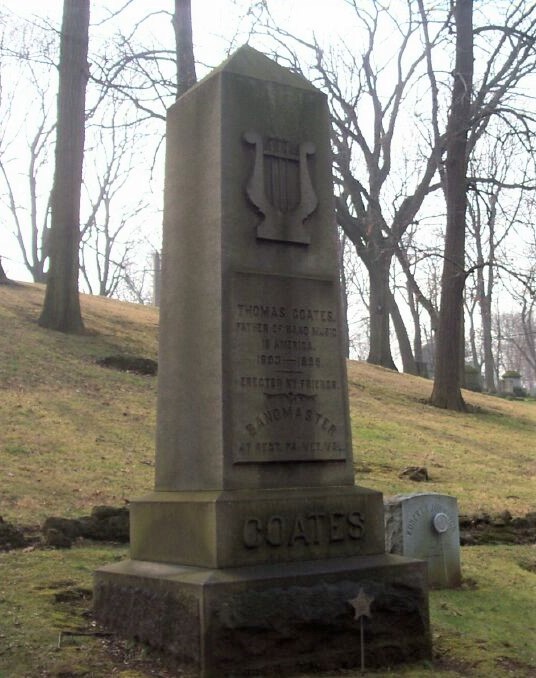
Obelisk marking the grave of Professor Thomas Coates, Easton Cemetery, Easton, Pennsylvania, 2004 (used with permission, courtesy of R.E.H.).
Standing tall on the rise of a small hill on the grounds of the Easton Cemetery in Northampton County, Pennsylvania, the obelisk which marks the gravesite of Professor Thomas Coates (1803-1895) is an impressive tribute to a formidable composer and musician who served as the first Bandmaster of the first Regimental Band of the 47th Pennsylvania Volunteer Infantry during the American Civil War, and who then became so renowned for his body of artistic work, post-war, that he was dubbed “The Father of Band Music in America.”
A first-generation American who became a circus musician while still just a child, Coates was reportedly the first cornet soloist in America, according to historian Lewis Schmidt, and had also become a celebrated hornist by the 1850s. Under his baton, the 47th Pennsylvania’s Regimental Band increasingly became the center of attention for the dazzling concerts and officers’ ball performances it presented wherever the regiment was stationed in 1861 and 1862. A quarter of a century later, Coates’ Twelfth Funeral March was performed during the funeral service of former U.S. President Ulysses S. Grant in New York City on 8 August 1885.
Just over a decade later, Coates died in Easton, Pennsylvania (on 11 October 1895). His funeral was well attended, with mourners present from his former Civil War regiment and music ensembles with which he had been associated over his long career.
Despite his popularity, however, his grave remained unmarked for many years afterward—until J. Harry Andrews, a bandmaster and orchestra conductor in Easton, Pennsylvania, launched a drive to erect a monument at the cemetery where Coates was interred. Recruiting the support of conductors and musicians across the Lehigh Valley in 1909, Andrews worked with a committee to raise the funds necessary to design, construct, erect, and dedicate the monument.
On 4 April 1911, Allentown’s Morning Call newspaper announced that “Local No. 378, A. F. of M., the Musicians’ Union of Easton, on Sunday [2 April] decided at their meeting to take charge of the dedication of the Thomas Coates monument, to take place the latter part of May.” The musicians’ union authorized Andrews, who was the union’s president at that time, “to form a band consisting of members of the union, who [would] discourse Coates’ compositions on that occasion.” Andrews informed area newspapers at that time that he anticipated that this ensemble would perform one hundred of Coates’ works on dedication day and that a planned parade would involve representatives of multiple military organizations from the region.
Two days later, The Morning Call announced that “At Easton next month will be unveiled a monument to Thomas Coates, the bandmaster of the 47th Regiment.” Adding that the event would be “of more than usual significance to Allentown … because the 47th regiment was largely recruited hereabouts and because Thomas Coates was week-known and admired by the fighting men who went out from this town to the Civil War” the newspaper also observed that the unveiling would be “of the greatest importance because every musical organization in this section owes the greatest debt of gratitude to this versatile musician and composer, who by his instruction of the musicians of his time, by the leadership of their bands and orchestras, and by his composition of music for them at such a time when such a thing as printed music was almost unknown, made his influence felt in every line of musical activity.”
“Allentown can to-day brag of its bands and orchestras largely because Thomas Coates in the early days of the pioneer organizations taught the men in them how to play. He was skilled on practically every instrument and an expert on more than the usual versatile musician or bandmaster of our day. Strings, reed and brass instruments were alike easy to him. But best of all he had a knowledge of those instruments and their capabilities that made it possible for him to compose selections that were adapted at once to the orchestra or bands as they were made up and were of a high order in the point of composition.
In those days to get printed music required the greater part of a year and to get a waltz, or set of waltzes from Berlin, London or Vienna was an extraordinary occasion and it was a very expensive proposition, as all the music was written. Mr. Coates, in charge of the struggling bands or orchestras sat down and wrote the marches, waltzes, polaccas, quadrilles, [and] solos that the organizations needed. He was not only a composer, but musical transcriber and leader and instructor…. He was said to be fifty years ahead of his time and his compositions to-day are just as fresh and bright as ever….
Many of his compositions were later published by the leading music houses of the country and some are still carried by them.
For the funerals of many of our brave boys of the 47th, Coates composed funeral marches, that to-day can be compared with the best of this class. The Allentown band plays funeral marches by this composer that many think rank with the best of Chopin’s….”
During its May 1911 coverage of the monument’s dedication, The Philadelphia Inquirer described Coates as “one of the greatest bandmasters and composers this country has ever known” and a “musician long celebrated in every section of this country and in lands beyond the seas.”
* Note: To learn more about the life, musical career and death in 1895 of Professor Thomas Coates, read his biography here.
Design and Construction of the Monument

Inscription on the obelisk marking the grave of Professor Thomas Coates, Easton Cemetery, Easton, Pennsylvania, 2004 (used with permission, courtesy of R.E.H.).
Hewn from Barre Vermont granite by craftsmen employed by Hartzell & Smith of North Front Street in Easton, the stone was subsequently “hammered with sunken letters cut on the die,” according to The Allentown Leader, and was ultimately fashioned into a twelve-foot-tall spire, which stood on a base that was four feet by seven inches square.
“On the sub-base the name ‘Coates’ [was] cut on with large raised letters…. The following inscription appears on the die: ‘Thomas Coates. Father of band music in America. 1803–1895. Erected by friends. Bandmaster of 47th Regiment, Penn’a. Vols’”
The obelisk was also adorned with a lyre near its peak.
Dedication of the Monument
The dedication ceremony for Thomas Coates’ monument was held at the Easton Cemetery on Saturday afternoon, 20 May 1911, and was “preceded by a street parade of the combined bands of Easton and Allentown and the military organizations of Easton,” according to a report on 19 May 1911 by The Allentown Leader:
“J. Harry Andrews, the band and orchestra leader, has enlisted the services of all the Easton band men in the movement and has also secured the acceptance of the Allentown, Century and Pioneer Bands of Allentown…. It is expected that a combined band of 150 members will be in the line of the parade. Mr. Andrews has been selected as the leader during the parade and the services at the grave. District Attorney William M. McKeen will deliver the eulogy in memory of Prof. Coates, and Rev. E. E. Snyder of Christ Lutheran Church will deliver the opening and closing prayers.”
Prior to the event, organizers urged all of Easton’s citizens to fly the American flag from their homes and businesses on monument dedication day “in memory of the foremost bandmaster in America during the Civil War, who was born and died in Easton, and lies buried in the Easton Cemetery.”
E. Lehman Ruhe was engaged to arrange a significant portion of the music for the ceremony. According to Allentown’s Morning Call newspaper, Ruhe “possess[ed] a good sized portion of the musical library of the dead composer” and was “an ardent admirer of the splendid works of the writer.”
“Mr. Ruhe was tireless in the tedious task of arranging the music for the last of musicians participating in the memorial exercises and much of the success of the massed band feature [was] due to his indefatiguability [sic] nurtured by an unswerving love for him who in life was so dear a friend.
It was no small task to provide the parts for the various instruments for so large a band and the work of scanning each and correcting it to ensure a harmonious whole required hours and days of labor.”
On 20 May 1911, the bandsmen who were scheduled to march in the parade gathered at the Easton City Guard’s Armory at 1:30 p.m. Fifteen minutes later, they marched with guard members to the A. R. Hall, where they re-formed into a new line of march with the representatives of the Grand Army of the Republic, Pennsylvania National Guard, Sons of Veterans Reserves, and United Spanish War Veterans who had gathered there. This larger group then marched to the corner of Front and Northampton streets, the point from which the parade would officially begin.
Re-forming again as the remaining parade participants assumed their positions within the line of march, the parade participants began their solemn trek, moving west on Northampton from the south side of Center Square to the Easton Cemetery on Seventh Street. The order of this procession was:
- Major John Miller, parade marshal;
- Captain E.G. Ritter, marshal’s aide;
- The Combined Bands of Allentown and Easton, conducted by J. Harry Andrews;
- Members of Company I, 13th Regiment, Pennsylvania National Guard;
- Members of Company A, 2nd Regiment, Sons of Veterans Reserves;
- Members of Boy Scouts, Troop A;
- Members of Lafayette Post No. 217, Grand Army of the Republic; and the
- United Spanish War Veterans.
“The streets of Easton were crowded with spectators who came from the surrounding country to witness the parade and hear the music of the massed bands,” according to The Allentown Leader. While en route to the cemetery the 165-member band played the same Coates funeral march that had been performed at President Grant’s funeral.
Upon reaching the cemetery, where a crowd of thousands had gathered by the 3 p.m. start time of the formal ceremony, the procession reordered itself near the draped obelisk. Among the renowned musicians who had gathered for the day’s events were James F. Boyer, a former cornetist with the band of John Philip Sousa, Thomas A. Howard, conductor of Philadelphia’s Lulu Temple Band, and Albert Winkler, the conductor of Winkler’s Trenton Band, as well as bandsmen from the Allentown Band, conducted by Martin Klingler, the Century and Juvenile Bands, conducted by Professor Joseph Smith, and the Pioneer Band, conducted by Thomas Holstein.
An opening prayer was uttered by the Rev. Elmer E. Snyder, the pastor at Christ Lutheran Church, followed by a eulogy for Coates, which was delivered by Northampton County District Attorney William McKeen, who had been a member of the Arion Mandolin and Guitar Club under Coates’ baton. According to The Philadelphia Inquirer, the combined bands also “rendered serenades by Coates” by the side of his grave during the memorial service.
The Easton City Guard then fired a military salute over Coates’ grave, and bugler George W. West sounded taps, accompanied by drummer William Trumbore. As the last strains of the bugle died away, J. Harry Andrews’ six-year-old daughter, Ruth, unveiled the obelisk.
Parade participants subsequently re-formed and returned to Center Square by way of Seventh to Northampton, led by the combined bands, which performed more of Coates’ compositions en route.
Sources:
- “Allentonians Shared in Coates’s Tribute: Attended Dedication of Monument to Famous Composer.” Allentown, Pennsylvania: The Morning Call, 22 May 1911.
- “Death of Famed Musician.” Allentown, Pennsylvania: The Allentown Leader, 14 October 1895.
- “Famous Musician Dead.” Philadelphia, Pennsylvania: The Times, 13 October 1895.
- “Honor Memory of Famous Composer: Shaft Over Grave of Professor Thomas Coates, in Easton Cemetery, Is Dedicated.” Philadelphia, Pennsylvania: The Philadelphia Inquirer, 21 May 1911.
- “Monument for Band-Master of the 27th [sic].” Allentown, Pennsylvania: The Morning Call, 4 April 1911.
- “Monument in Memory of Thomas Coates.” Allentown, Pennsylvania: The Allentown Leader, 19 May 1911.
- “Monument Unveiled to Thomas Coates: Band Men from Allentown Help Honor Master Musician.” Allentown, Pennsylvania: The Allentown Leader, 22 May 1911.
- Monument to 47th’s Bandmaster, Coates.” Allentown, Pennsylvania: The Morning Call, 6 April 1911.
- “Musicians to Honor Memory of Composer: Allentown and Easton Men to Unite in One Big Band to Dedicate Monument Over the Grave at Easton of Thomas Coates the Well Known Composer.” Allentown, Pennsylvania: The Morning Call, 9 May 1911.
- Pennsylvania Veteran’s Burial Index Cards. Harrisburg, Pennsylvania: Pennsylvania Department of Military and Veterans Affairs, 1895.
- Schmidt, Lewis. A Civil War History of the 47th Regiment of Pennsylvania Veteran Volunteers. Allentown, Pennsylvania: Self-published. 1986.
- Snyder, Laurie. “Professor Thomas Coates, Regimental Band Leader, 47th Pennsylvania Volunteers,” in 47th Pennsylvania Volunteers: One Civil War Regiment’s Story, 2014.
- “Special Cars Will Take Musicians to Easton.” Allentown, Pennsylvania: The Morning Call, 19 May 1911.
 47th Pennsylvania Volunteers
You must be logged in to post a comment.