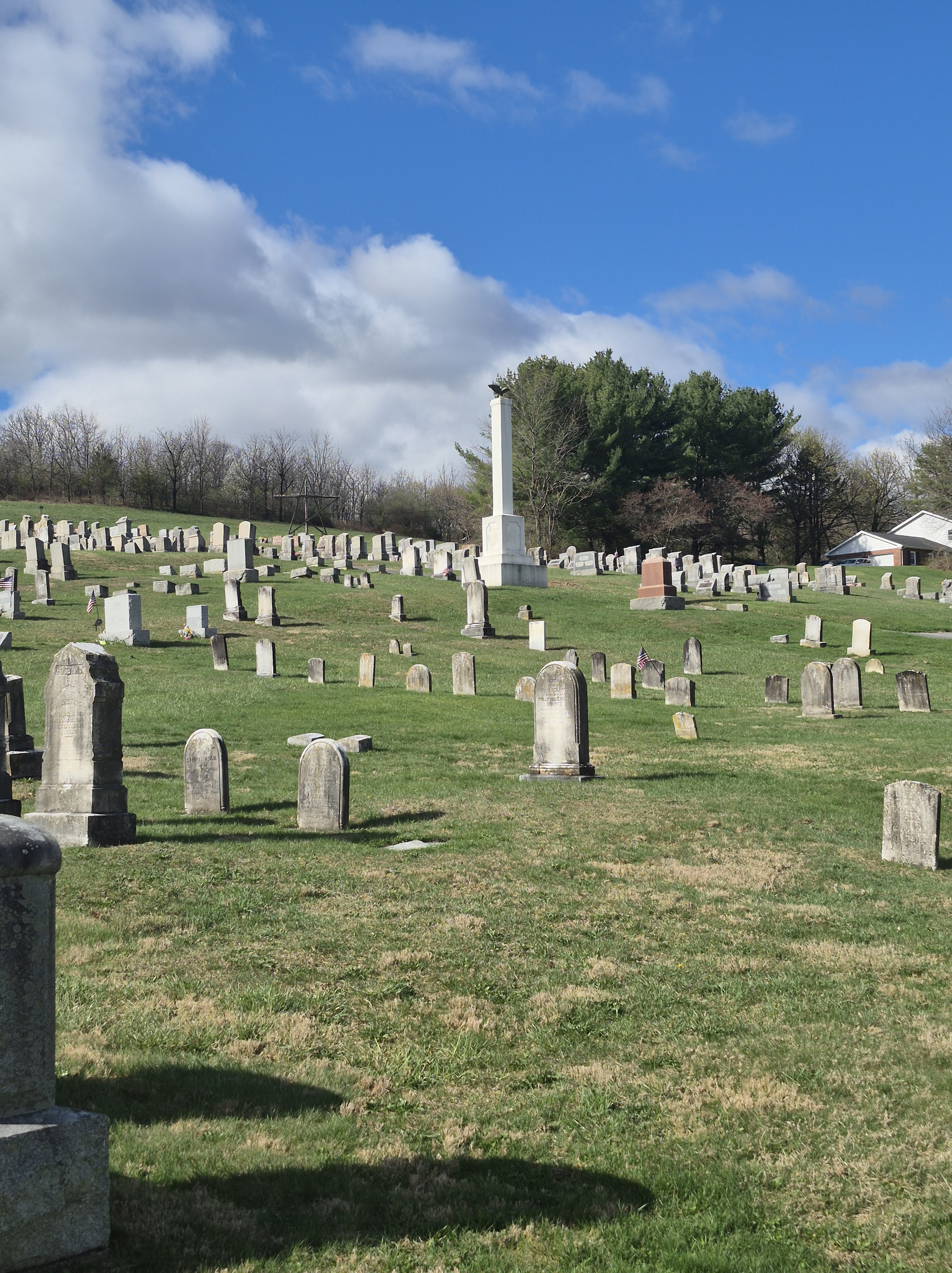
Soldiers’ Monument, Jordan Lutheran Cemetery, South Whitehall, Pennsylvania (Julian Burley, 11 April 2026; used with permission).
The Soldiers’ Monument at the Jordan Lutheran Church Cemetery in South Whitehall Township, Lehigh County, Pennsylvania, which was unveiled one hundred and thirty years ago (as of Memorial Day weekend in 2026), still stands as an impressively tall tribute to multiple men from Northeastern Pennsylvania (NEPA) who served in the armed forces during the American Revolution, the War of 1812 or the American Civil War. Immediately visible upon reaching the cemetery’s entrance, it dominates the surrounding graves — even those situated higher up on the gently sloping hill of this historic place of rest, reflection and remembrance.
The costs associated with the monument’s planning, construction, erection, and dedication were paid for almost entirely by the leaders and members of the Jordan Lutheran Church congregation, a number of whom were veterans of the history-making 47th Pennsylvania Volunteer Infantry — the only regiment from the Commonwealth of Pennsylvania to take part in the Union’s 1864 Red River Campaign across Louisiana.
History and Design Features
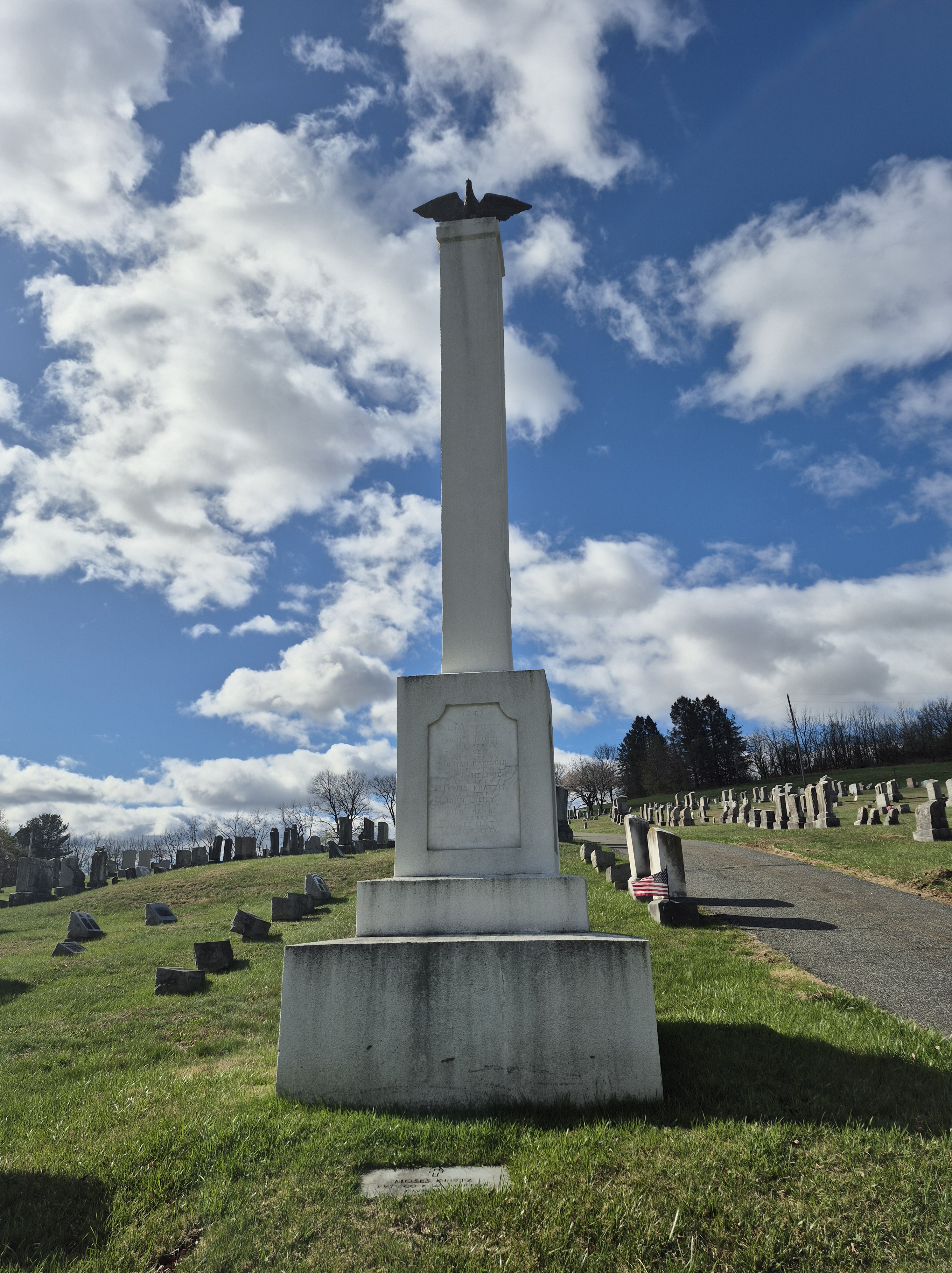
Soldiers’ Monument, Jordan Lutheran Cemetery, South Whitehall, Pennsylvania (Julian Burley, 11 April 2026; used with permission).
Made entirely from cement, save for the massive gilt eagle which appears to be watching over Pennsylvania’s Lehigh Valley from its perch atop the monument, this soldiers’ monument has a well-documented history. Its creation began when members of the Jordan Lutheran Church in South Whitehall came together in early 1894 to explore ways that they might pay lasting tribute to the men from their congregation and community who had fought to preserve America’s Union during the American Civil War. As their planning progressed, they decided to expand their tribute to include soldiers from the American Revolution and the War of 1812.
On 21 February 1894, The Allentown Democrat published the following announcement:
A soldiers’ monument is to be erected in the cemetery attached to the Jordan Lutheran Church in South Whitehall the coming spring, and dedicated on Decoration Day, May 30th. It is to be of about the same style and material as the one erected in the cemetery of the Jordan Reformed Church, at Walbert’s Station, last summer.
In a follow-up report, The Allentown Democrat described the construction process that had been chosen for the monument:
The entire structure is being made of cement by filling in boxes or moulds made in the form of bases, die and shaft with that material while in a fluid state. The cement solidifies very quickly after the filling, and when dry it becomes hard and solid almost as granite, and resembles the latter very closely in color. The four sides of the die will have neat marble tablets for receiving the names of the dead heroes lying buried on the plot. The monument in style will be somewhat like the one erected at the Jordan Reformed Church, at Walbert’s Station, in the same township, last year, of the same material.The shaft will however be somewhat taller. The monument is designed to perpetuate the memory of the heroes who went to the front from South Whitehall in the sixties in defence of the old flag. It will not be costly but yet pretty and enduring, and a high credit to those who are furnishing it, and while serving the cardinal purpose of its erection as an appropriate expression of a grateful people to the men who freely offered their own lives that their country may not perish or be dismembered, will stand as a practical and forcible illustration of the praiseworthy results attending the diligence and perseverance of the survivors of the war who are interesting themselves in having put it up. The monument will be ready for unveiling on Decoration Day. A. G. Dewalt, Esq., of this city, has consented to deliver the oration in connection with the other exercises.
The Allentown Critic, predecessor to that city’s Morning Call newspaper, added the following details in its own report on 4 June 1894:
The shaft as it stands was constructed by Benjamin Smith, a mason, of Crackersport. It stands at its base five feet square, and rises to a total height, including the top of a crouching eagle with wings outspread, [of] twenty-three feet and six inches. The main composition is cement and silver sand, enclosing a cairn of stones and cement. Around the base handsome marble slabs have been placed and on them are inscribed the names of the men whose roll of honor it is the design of the monument to perpetuate.
The Heroes
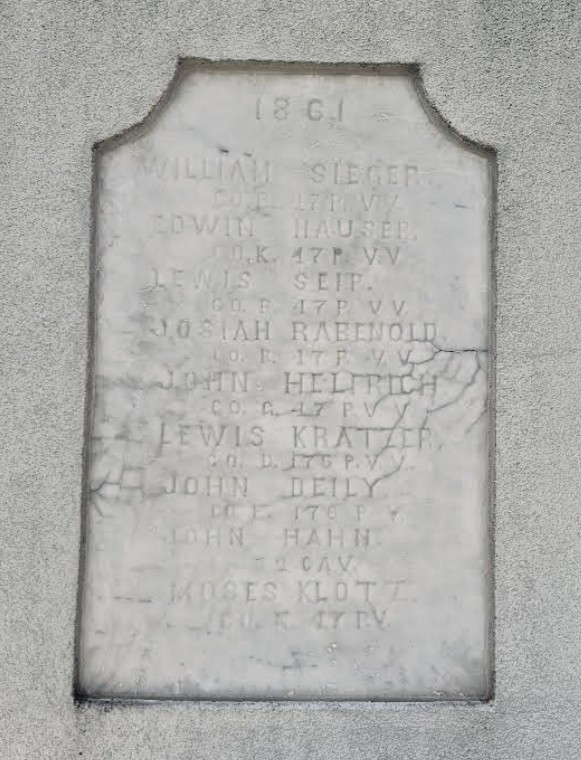
American Civil War soldiers’ panel, Soldiers’ Monument, Jordan Lutheran Cemetery, South Whitehall, Pennsylvania (Julian Burley, 11 April 1862; used with permission).
Each side of the monument pays tribute to soldiers who served during one of those three major wars and were later buried at that cemetery, including:
1776:
- George Deily
- Samuel Sieger
1812:
- Christian Derr
- Isaac Hamman
- Peter Kline
- Andrew Krause
- George Kuhns
- George Lauder
- Lucas Rabenold
- Solomon Rabenold
- Henry Schantz
- Jacob Schantz
- John Strauss
1861:
- John Deily
- John Hahn
- John Helfrich
- Edwin Hauser
- Moses Klotz
- Lewis Kratzer
- Josiah Rabenold
- Lewis Seip
- William Sieger
1861:
- Daniel Gackenbach
- John Guldin
- Harrison Guth
- John Haas
- Jonas Held
- Solomon Henninger
- Zephaniah Henninger
- Josiah Kern
- Mathias Miller
- Cornelius Reitenauer
- Thomas Shingler
- Charles Sourwine
- William Sterner
- Evan Strauss
- John Wenner
Dedication Ceremony
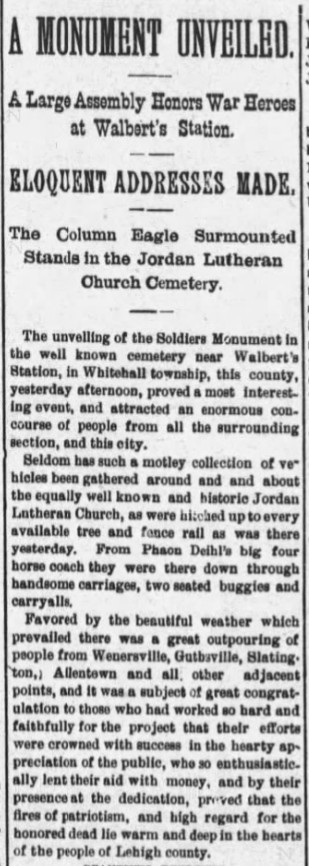
“A Monument Unveiled” (The Allentown Critic, 4 June 1894, excerpt, public domain; click to enlarge).
According to the 6 June 1894 edition of The Allentown Democrat, the dedication of the Soldiers’ Monument at the Jordan Lutheran Church Cemetery coincided with the annual decoration of soldiers’ graves at that cemetery on Decoration Day that year.
On Sunday afternoon last the graves of the soldiers of the civil war lying buried in the cemeteries at the Jordan Lutheran church in South Whitehall were decorated by the surviving veterans of that vicinity under the command of Mathias Miller, of Guthsville, assisted by delegations of the G.A.R. Posts of this city, Emaus, Slatington and Catasauqua. The Camp of the P.O.S. of A. of Guthsville was also present. The ceremonies were given additional importance and effect by the dedication of a soldiers’ monument recently erected by the surviving veterans. It is a very pretty one, the bases, die and shaft having been made of cement, four sides of the die bearing marble tablets inscribed with the names of the soldiers buried there, as follows: 1776 — John Eckert; 1812 — George Deily, Henry Schantz, Solomon Rabenold, George Kuhns, Peter Kline, John Strauss, Samuel Sieger, Isaac Hamman, Andrew Krause, Christian Derr, Jacob Schantz, George Lauder; 1861 — Wm. Sieger, Edwin Houser, John Helfrich, John Deily, Lewis Seip, Josiah Rabenold, Lewis Kratzer, John Hahn and Moses Klotz. The top of the shaft bears a gilt eagle with outspread wings.
The dedicatory ceremonies were beautiful and impressive, and an air of solemnity pervaded the large assemblage in keeping with the sacred character of the occasion. Probably between two and three thousand people were present, the road in front of the church being lined for nearly a mile with carriages. The entrance to the cemetery was spanned by a fine arch of evergreens and flowers, tastily and skillfully arranged.
The exercises began at 2 p.m. Addresses were delivered by Rev. M. J. Kuehner, pastor of the congregation; P. G. Sieger, of Siegersville; A. G. Dewalt, Esq., Rev. O. Leopold, C. A. Groman, Esq., and Hon. W. H. Sowden, of this city. Neri, son of Charles Sourwine, pulled the string releasing the coverings of the monument. The church choir sang “Freedom’s Banner” and “Freedom’s Sons, Come Join in Chorus.” The members are: Leader, E. B. Kocher, sopranos, Jennie Kocher, Lillie Heinaman, Laura Heilman, Katie Arner, Minnie Guth, Lillie Rabenold; altos, Alice Rabenold, Augie Rabenold, Daisy Kuehner, Emma Diehl, Lillie Wiltrout; tenors, Samuel Herman, Llewellyn Guth, Levi Ziegler; bass, Benjamin Smith, Eli Guth, Frank Kuhns, Oscar Herman, and Jacob Litzenberger.
According to The Allentown Critic, “All the speakers spoke eloquently and their burning theme was patriotism.” The crowd, which was estimated in follow-up reports to have numbered between two thousand to three thousand children and adults, included local and state government officials, congregants from multiple area churches, Civil War veterans and their families and friends, members of area chapters of the Grand Army of the Republic, students from local schools, and other residents of Northeastern Pennsylvania.
* Note: To view additional photos of this monument and of the graves of 47th Pennsylvanians interred in this cemetery, please visit our Jordan Lutheran Church Cemetery Gallery.
Sources:
- “A Monument Unveiled: A Large Assembly Honors War Heroes at Walbert’s Station: Eloquent Addresses Made: The Column Eagle Surmounted Stands in the Jordan Lutheran Cemetery.” Allentown, Pennsylvania: The Allentown Critic, 4 June 1894.
- “Decoration Day.” Allentown, Pennsylvania: The Allentown Democrat, 30 May 1894.
- “Decoration Day in South Whitehall — Soldiers’ Monunent Dedicated.” Allentown, Pennsylvania: The Allentown Democrat, 6 June 1894.
- “Erecting a Soldiers’ Monument.” Allentown, Pennsylvania: The Allentown Democrat, 9 May 1894.
- “Soldiers’ Monument to Be Erected in South Whitehall.” Allentown, Pennsylvania: The Allentown Democrat, 21 February 1894.
 47th Pennsylvania Volunteers
You must be logged in to post a comment.