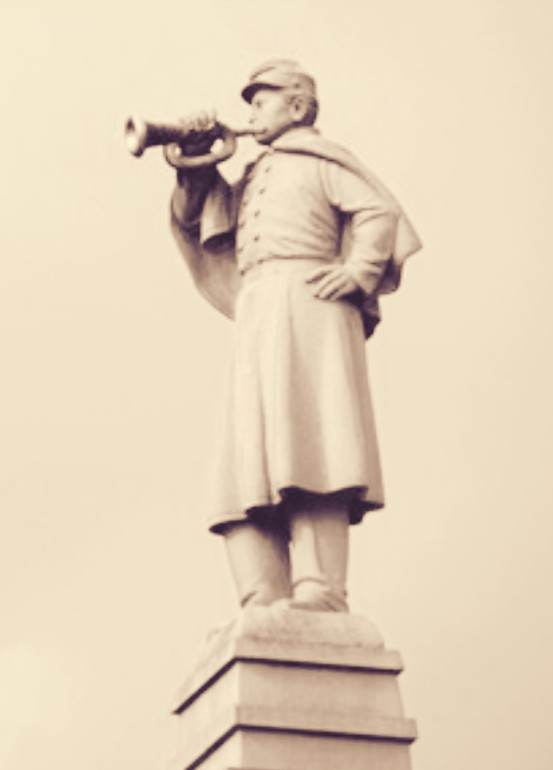
“The Bugler,” a sculpture created circa 1899-1900, faces toward the sunset, atop the Northampton County Soldiers’ and Sailors’ Monument in Easton, Pennsylvania (public domain).
More than a century ago, a Union bugler assumed his post atop the Northampton County Soldiers’ and Sailors’ Monument in the Commonwealth of Pennsylvania — a symbol of a citizenry’s gratitude to the hundreds of thousands of men who fought to save the nation’s Union during the American Civil War. He stands there still, radiating a sense of determination, pride and resilience from his post, roughly seventy-five feet above the Great Square at the intersection of Northampton and Third Streets in the city of Easton.
Hewn from Barre, Vermont granite with a base surface of roughly twenty-six square feet, the entire obelisk-style monument weighs between two hundred and thirty to four hundred tons. Its final cost, at the time of its unveiling on 10 May 1900 was sixteen thousand dollars (the equivalent of well over six hundred thousand U.S. dollars in 2026).
The Construction Process
On 3 March 1899, Northampton County’s board of commissioners voted to fund the planning and construction of a monument that would pay lasting tribute to the thousands of Northampton County soldiers who served in the United States military during the American Civil War. The commissioners subsequently signed a contract with the Eagle Granite Company in the city of Reading in Berks County, Pennsylvania on 25 March to craft and erect the monument. That contract was nearly voided during the monument’s design phase, however, when commissioners and representatives of the company were unable to agree on the measurements for the various components of the monument. Eventually able to work through their differences, the commissioners met with company representatives in July of that same year to review and approve granite samples.
Initially scheduled for completion by 1 November 1899, with unveiling and dedication ceremonies proposed for 24 November 1899 (the anniversary of the Battle of Lookout Mountain, Tennessee — a battle in which the 47th Pennsylvania Volunteers did not partcipate), that date was changed as the project continued to face delays. According to the 30 September 1899 edition of The Allentown Daily Leader:
The cause of the delay, the monument people claim, [was] the accident in which the large stone for the monument fell and was broken. They [said] the recutting of the stone … caused considerable delay, and … asked the commissioners to grant them an extension of time to complete the work.
Northampton’s board of commissioners refused to grant that extension, however, but did inform the company they would accept a later “delivery date” — giving the company until 24 November to have the monument completed and erected in time for its unveiling. Around that same time, commissioners agreed to pay an additional two hundred dollars for a design alteration that would “change the steps of the monument from a rock surface to a hammered dress finish,” according to The Allentown Daily Leader.
When construction was delayed further (until 27 November 1899), event planners were forced to hold off on rescheduling the unveiling yet again. As a result of that ongoing uncertainty, commissioners did not schedule a public ceremony for the installation of the monument’s cornerstone — an event that normally would have been open to the general public and would likely have drawn a large crowd had one been publicized. According to The Allentown Democrat, the cornerstone for the Northampton County Soldiers’ and Sailors’ Monument was eventually laid “shortly after 10 o’clock” in the morning on 13 December 1899.
About 150 or more curious people witnessed it, but outside of the crowd there was nothing to indicate that anything unusual was transpiring. Commander W. R. Parks, of Lafayette Post, G.A.R., carried the copper box containing the articles which were placed in the cavity of the corner stone, and handed it to the foreman in charge of the work, who placed it in its proper receptacle. There were no exercises, and the crowd soon dispersed.
Rescheduled for sometime after the dawn of the new century, the date for the monument’s unveiling was pushed back again to 12 April 1900 — and again to 10 May of that year. As that latter date drew closer, the Philadelphia & Reading Railway and other railroad companies across the Mid-Atlantic region began advertising specially-priced, round-trip, monument excursion tickets, signalling the strong likelihood that the monument’s long-awaited unveiling would finally happen.
Dedication Day
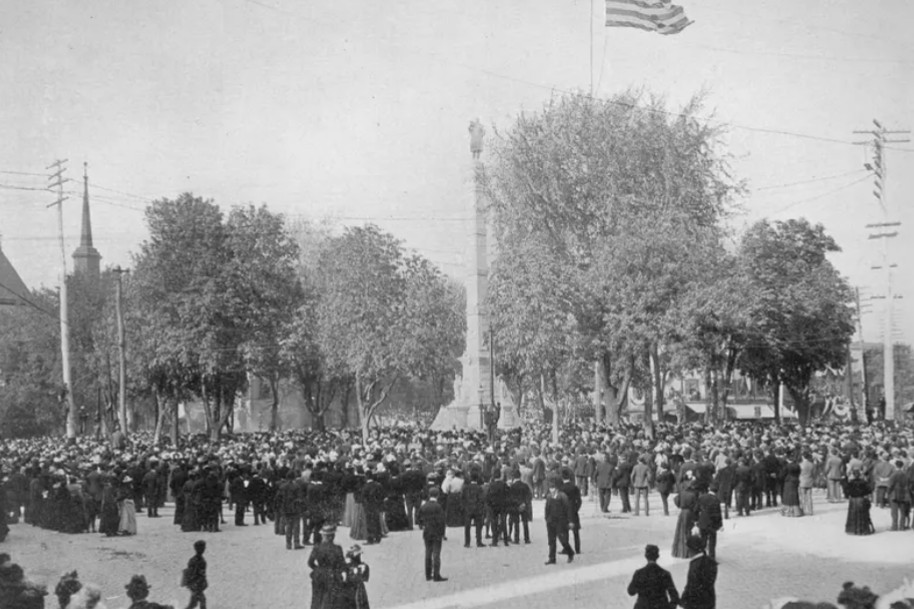
Dedication ceremony, Northampton County Soldiers’ and Sailors’ Monument, Easton, Pennsylvania, 10 May 1900 (public domain; click to enlarge).
The day of unveiling for the Northampton County Soldiers’ and Sailors’ Monument was an official holiday in the city of Easton. Banks, businesses, the post office, schools, and stores were all closed, but buildings as far as the eye could see were draped in red, white and blue bunting. It was 10 May 1900 — and it would be a date in history that Pennsylvanians would recall fondly for decades to come.
It began with the firing of cannon at sunrise. Later that morning, wizened members of the Grand Army of the Republic sat down with old friends for breakfast gatherings in hotels and restaurants across the city. Tales of daring do were told, backs were slapped and huzzahs were exclaimed in tribute to the bravest of the brave boys in blue. Eyes were also patted dry as tears fell for the fallen.
Early that afternoon, local and state officials, active duty soldiers, veterans of the American Civil War and their descendants, school students, and members of the Allentown Band, Fullerton Drum Corps and other marching bands made their way to their designated meeting places in preparation for a parade that was rivaled only by one that had occurred in Allentown a year earlier. Roughly five thousand marchers in total stepped forth at 2 p.m. that day, and were led through the city’s streets by the parade’s grand marshal, General Frank Reeder, which finally ended as its participants reached the still-veiled, new soldiers’ monument in the city’s Great Square. According to The Allentown Leader:
The parade was in four divisions, composed of the Grand Army of the Republic, members of the State Guard, cadet corps and Sons of Veterans. In the line were Grand Army men from Bethlehem, Allentown, Mauch Chunk, White Haven, Scranton, Reigelsville, Bangor, Portland, Belvidere, N.J., and Junction and Lambertville, N.J. Sons of Veterans camps from throughout the Lehigh Valley and adjacent towns also participated, and the First Regiment Sons of Veterans Reserves of Philadelphia and the First Battalion, Second Regiment Sons of Veterans of Pennsylvania. The entire Thirteenth Regiment of the State National Guard, in command of Colonel L. A. Watres, and Companies B and D of the Fourth Regiment, Allentown, were also in line.
Governor Stone and Staff, Commander-in-chief Shaw and staff of the G.A.R., Commander-in-chief Reed of the Sons of Veterans and Pennsylvania Division Commander S. S. Horn and staff of the Sons of Veterans rode in carriages.
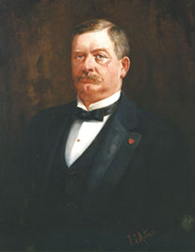
The Honorable William A. Stone, Governor, Commonwealth of Pennsylvania (public domain).
Held in the Great Square, under the shadow of the towering monument, the official unveiling and dedication ceremonies for the monument opened with a prayer by the Reverend Doctor Kieffer, and were led by Easton’s sitting mayor, Benjamin Rush Field, M.D. During a brief speech, Northampton County solicitor Orrin Zearfass/Serfass presented the monument to the county; Easton’s first mayor Charles F. Chidsey then accepted it on behalf of Northampton County’s veterans as “Commissioner Milton H. Koehler pulled the string that unveiled” it — “a signal for every fire bell and factory whistle in Easton to be sounded,” according to a reporter for The Allentown Leader.
As Pennsylvania’s sitting governor, William Alexis Stone, stepped up to the podium to begin his address, “Jacob Christian and E. N. R. Ohl, two of Easton’s oldest veterans, presented him with a floral emblem containing the word, ‘Welcome.'” According to a reporter from The Philadelphia Inquirer, Governor Stone “made a brief but patriotic speech, in which he told of the part Northampton’s soldiers took in the Civil War.” The speakers who followed him with their own brief addresses were:
- Colonel A. D. Shaw, commander-in-chief, Grand Army of the Republic;
- Lieutenant Governor John Peter Shindel Gobin, the final commanding officer of the 47th Pennsylvania Volunteer Infantry who, post-war, had served in the Pennsylvania State Senate and as a commander-in-chief of the Grand Army of the Republic before being elected to the second highest office in the Commonwealth of Pennsylvania;
- R. M. J. Reed, colonel of the First Regiment, Sons of Veterans Reserves; and
- Adjutant General Thomas J. Stewart, past commander-in-chief of the Sons of Veterans.
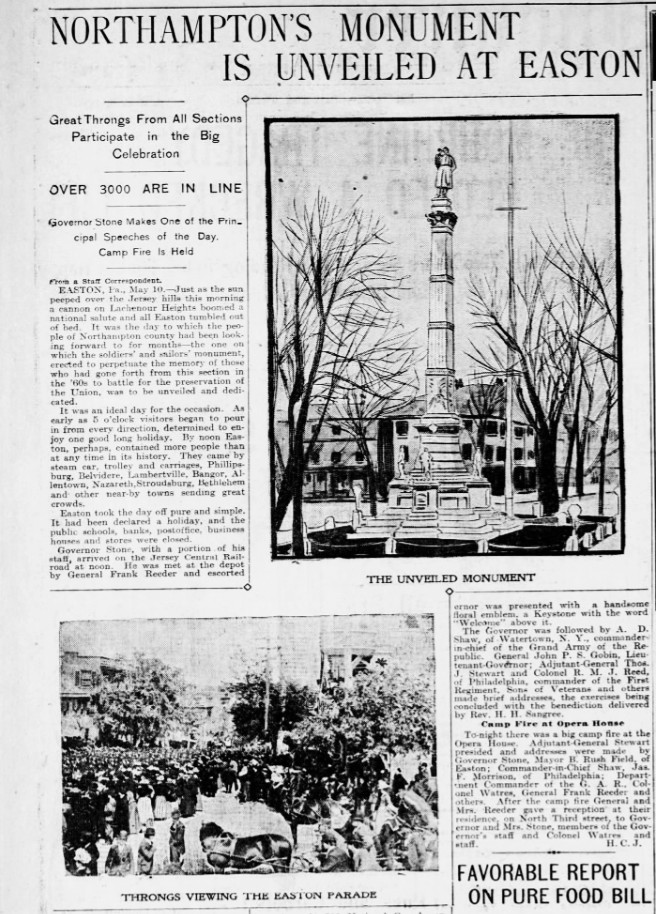
“Northampton’s Monument Is Unveiled at Easton” (The Philadelphia Inquirer, 11 May 1900, public domain; click to enlarge).
A benediction was then delivered to the crowd by the Reverend H. H. Sangree to close that portion of the day’s events. But there were more festivities to come.
Later that same evening (on 10 May 1900), “a campfire was held in the Easton Opera House and a military ball was given by the Sons of Veterans, followed by a reception to Governor and Mrs. Stone and the commissioned officers of the Thirteenth Regiment by General and Mrs. Reeder,” according to The Allentown Leader. Adjutant General Stewart presided over the campfire meeting, which featured speeches by the governor, Easton’s mayor and several senior officers of the Grand Army of the Republic. And then Lieutenant Governor Gobin made a special appearance at the military ball.
By the time the hectic day was done, roughly thirty thousand people from Pennsylvania, New Jersey and other parts of the United States had joined the crowds to witness or take part in the parade, monument dedication and evening’s gala events, according to The Allentown Democrat.
Key Features of the Monument
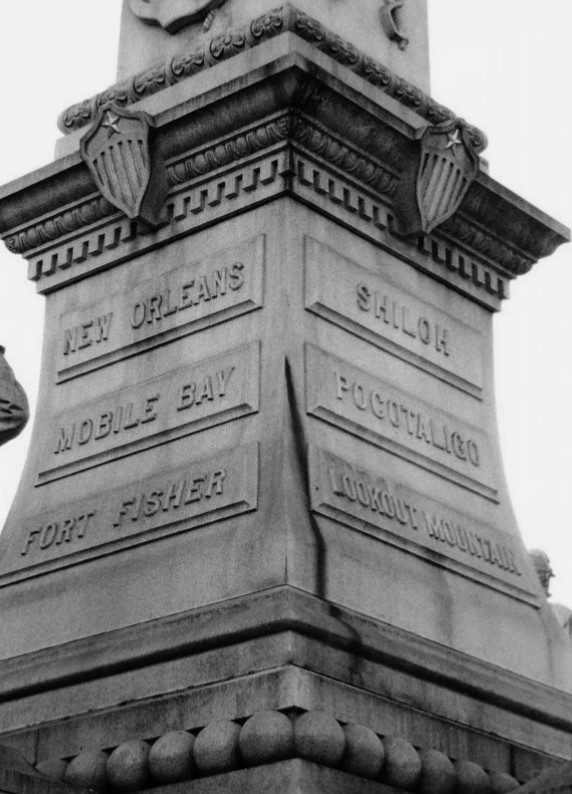
The Pocotaligo panel on the Northampton County Soldiers’ and Sailors’ Monument in the Great Square in Easton, Pennsylvania (public domain; click to enlarge).
The soldier standing atop the the obelisk of the Northampton County Soldiers’ and Sailors’ Monument measures ten feet, three inches tall. Facing the setting sun, he depicts a Union Army bugler playing, “Taps.” The shaft that holds him high in the air is thirty-six feet tall, and rests on a base that is roughly twenty-six feet by twenty-six feet square. The shaft’s granite face bears the following inscription:
In Honor of
the Union
Soldier and Sailor
1861 — 1865Northampton County’s
Tribute
to Her Heroes
Erected 1899Dulce Et Decorum
Est Pro Patria MoriLiberty and Union
Now and Forever
One and Inseparable
The obelisk is surrounded by four life-sized statues of men representing the branches of the United States military that saved America’s Union: artillery, cavalry, infantry, and navy. Those statues, which stand guard at each of the four sides of the obelisk — in front of inscriptions listing the key battle sites where Northampton County soldiers fought — were erected on 23 January 1900, atop pedestals containing the names of key Union military leaders:
- Lincoln and Grant (battle list: Gettysburg, Wilderness, Appomattox)
- Meade and Hancock (battle list: Shiloh, Pocotaligo, Lookout Mountain)
- Farragut and Porter (battle list: New Orleans, Mobile Bay, Fort Fisher)
- Sherman and Sheridan (battle list: Antietam, Fredericksburg, Chancellorsville)
* Note: Although multiple men from Northampton County served in the 47th Pennsylvania Volunteer Infantry during the American Civil War, and fought in multiple different battles (primarily as members of Company A and Company E), the only battle inscribed on this particular monument that is part of the 47th Pennsylvania’s history is the Battle of Pocotaligo. The 47th Pennsylvania Volunteer Infantry was not present at Antietam, Appomattox, Chancellorsville, Fredericksburg, Gettysburg, Lookout Mountain, Mobile Bay, Shiloh, or the Wilderness, and was only stationed at or near Fort Fisher and New Orleans at times other than the battles identified on this monument. There were, however, several members of the 47th Pennsylvania who did fight in one or more of those other battles — but did so while were serving with entirely different regiments. (Members of the 47th Pennsylvania who took part in the Chancellorsville, Fredericksburg or Gettysburg campaigns did so while serving with the 153rd or 171st Pennsylvania Volunteers, for example, prior to re-enrolling for second tours of duty with the 47th Pennsylvania Volunteer Infantry.)
The decision by civic leaders to choose Pocotaligo as one of the battle names to be inscribed on the Northampton County Soldiers’ and Sailors’ Monument proved to be a sound one, though, because that battle would continue to be commemorated by veterans of the 47th Pennsylvania Volunteer Infantry at their regimental reunions more than half a century after that terrible day ended in October 1862. The first true moments of combat for many 47th Pennsylvania Volunteer Infantrymen, Pocotaligo left lasting battle scars — physically and emotionally. Twenty officers and enlisted men were killed in action and one hundred and eighteen men were wounded — a significant percentage of whom died shortly thereafter, their suffering and sacrifice marked by the fading notes of buglers who are also now long gone.
Sources:
- “Another Monument Fuss (design phase disagreements about the monument’s size). Allentown, Pennsylvania: The Allentown Daily Leader, 12 May 1899.
- “Chat About Your Friends” (mentions the date when construction of the base of the Northampton County Soldiers’ and Sailors’ Monument began). Allentown, Pennsylvania: The Morning Call, 28 November 1899.
- “Corner Stone Laid Quietly.” Allentown, Pennsylvania: The Allentown Democrat, 13 December 1899.
- Date Change for the Unveiling of the Northampton County Soldiers’ and Sailors’ Monument, in “State Briefs.” Scranton, Pennsylvania: The Scranton Republican, 15 January 1900.
- “Easton’s Big Day: Over 30,000 Strangers Attend the Unveiling of the Soldiers’ Monument.” Wilkes-Barre, Pennsylvania: The Wilkes-Barre Record, 11 May 1900.
- “Easton’s Monument” (design phase). Allentown, Pennsylvania: The Allentown Daily Leader, 1 July 1899.
- “Easton’s Monument” (dedication proposed for 24 November 1899). Allentown, Pennsylvania: The Allentown Daily Leader, 30 August 1899.
- “Easton’s Monument” (installation of the four soldiers’ statues). Allentown, Pennsylvania: The Allentown Daily Leader, 24 January 1900.
- “Easton’s Monument: Contractors Want an Extension of Time Which Commissioners Refuse.” Allentown, Pennsylvania: The Allentown Daily Leader, 30 September 1899.
- “Easton’s Monument: Unveiled Yesterday with Patriotic Pomp.” Allentown, Pennsylvania: The Allentown Daily Leader, 11 May 1900.
- “Easton Monument Paid.” Allentown, Pennsylvania: The Allentown Daily Leader, 5 February 1900.
- Fuller Post No. 378, G.A.R., in “With Our Neighbors: Catasauqua.” Allentown, Pennsylvania: The Allentown Daily Leader, 12 May 1900.
- “Going to Easton: Many Allentonians Will Attend the Monument Dedication.” Allentown, Pennsylvania: The Allentown Leader, 9 May 1900.
- “Northampton’s Monunent Is Unveiled at Easton: Great Throngs from All Sections Participate in the Big Celebration.” Philadelphia, Pennsylvania: The Philadelphia Inquirer, 11 May 1900.
- “Pithy Points” (mentions the monument’s construction contract award by Northampton County Commissioners). Pottsville, Pennsylvania: Pottsville Republican, 25 March 1899.
- “Soldiers and Sailors Monument,” in “Easton in Northampton County, Pennsylvania — The American Northeast (Mid-Atlantic).” United States: The Historical Marker Database, retrieved online 30 March 2026.
- “Soldiers’ Monument in Easton” (decision by the Northampton County Commissioners to erect a soldiers’ monument in the city of Easton). Philadelphia, Pennsylvania: The Philadelphia Times, 4 March 1899.
- “Special Excursion to Easton.” Lansdale, Pennsylvania: Lansdale Reporter, 10 May 1900.
- “The Shaping of Easton,” in “About Easton: History.” Easton, Pennsylvania: City of Easton, retrieved online 30 March 2026.
- “The Unveiling of the Soldiers’ and Sailors’ Monument at Easton on Thursday.” Allentown, Pennsylvania: The Allentown Democrat, 16 May 1900.
 47th Pennsylvania Volunteers
You must be logged in to post a comment.