Company C, 47th Pennsylvania Veteran Volunteers’ Monument, Sunbury Cemetery

Company C, 47th Pennsylvania Veteran Volunteers’ Obelisk, Sunbury Cemetery, Sunbury, Pennsylvania, 9 October 2023 (used with permission, courtesy of Crissie Musselman).

Located on the grounds of the Sunbury Cemetery in Sunbury, Northumberland County, Pennsylvania, this obelisk-style monument pays tribute to one very specific group of 47th Pennsylvania Volunteers — the members of the regiment’s C Company, who died while serving the nation during the American Civil War.

Erected in 1866 above the interred remains of C Company Sergeant William Fry, who had survived incarceration as a prisoner of war (POW) at Andersonville, the notorious Confederate States Army prison camp in Georgia, but who then died at his mother’s home in Northumberland County, Pennsylvania just weeks after he was released and sent home to convalesce, this monument was originally planned by members of Company C to pay tribute to the thirty-one members of the company who were mortally wounded, killed in action, or died from disease-related complications between the time of the regiment’s founding in August 1861 and its final muster out on Christmas Day in 1865.

In its present-day form, the Company C, 47th Pennsylvania Veteran Volunteers’ Monument Sunbury memorializes the names of twenty-eight of those thirty-one soldiers, and includes the original obelisk, surrounded by a small, white marble border, a bronze plaque mounted on a beveled stone, and Sergeant Fry’s military headstone, which is situated just to the right of the bronze plaque. The monument and grave are decorated each year with new American flags.

Monument Planning

Still serving out the final weeks of their American Civil War service, when Captain Daniel Oyster called them together for a meeting at their duty station in Charleston, South Carolina during the late fall of 1865, the members of Company C were looking toward a post-war future back home in Pennsylvania. Their relief was tempered by grief, however, as they reflected on lives that would now have to be lived without a significant number of the friends and neighbors who had fought beside them from Virginia to Louisiana and back.

They knew one thing for certain — that the sacrifices made by those friends and neighbors were so great that their names and deeds should never be forgotten. So, they began to discuss ways to honor their fallen comrades, and determined that a new monument should be erected back in Sunbury, which was the hometown of the majority of C Company members.

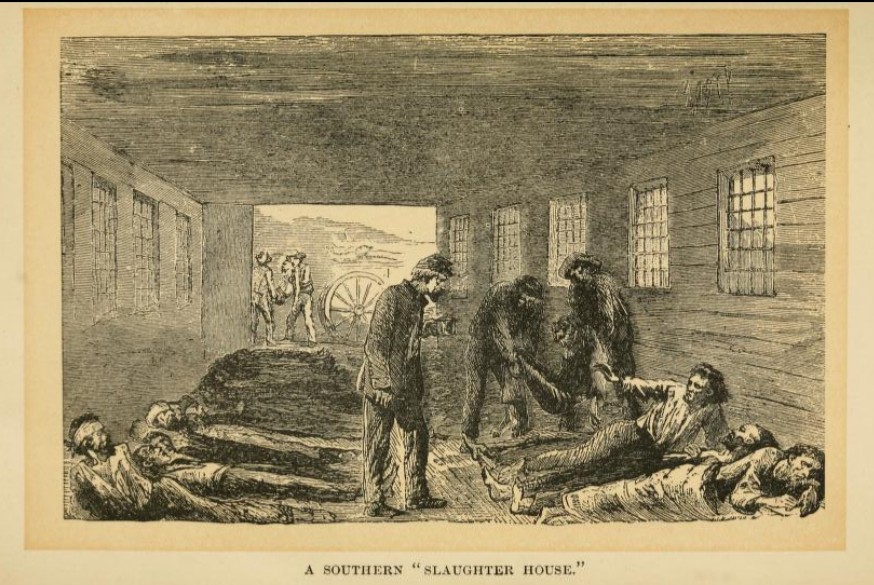
For many of the dead, it would be the only “gravesite” that their families would be able to visit because many — like those who had died during the 1864 Red River Campaign across Louisiana — were either interred in graves that were too far away for families to ever visit, or were interred in the unmarked graves of Confederate prison camps — or worse, were resting in one of the many graves in Florida, Louisiana, Mississippi, North Carolina, South Carolina, Texas, and Virginia that had yet to be located and marked with an appropriate headstone.

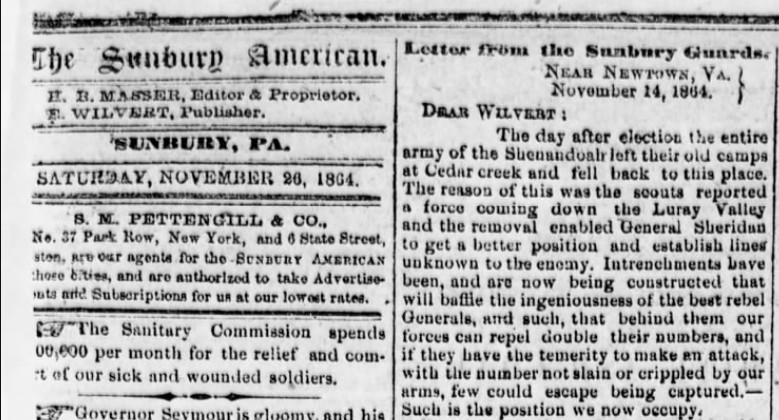
On 4 November 1865, their hometown newspaper, The Sunbury American, announced that C Company’s monument planning had gained momentum:

“A SOLDIER’S MONUMENT. — The members of Company C, 47th Regiment, Pennsylvania Volunteers, of this place, commanded by Captain Oyster, to see about erecting a monument to the memory of their comrades, who have fallen or died in the service. The list comprises no less than thirty-one individuals, who have, in a spirit of patriotism, [devoted] their lives to their country. This is an appropriate tribute on the part of the survivors, and speaks well, not only of their heroic conduct in battle, but of the fraternal and kindly feeling maintained by those who escaped the perils of war, for those who fell in full defense of their country. The monument will be constructed by Mr. John A. Taylor of Northumberland, and will cost three hundred and fifty dollars. The monument will be erected over the remains of Wm. Fry, 1st Sergt. of the Company, a victim of rebel brutality while in prison.”

On 6 September 1866, The Sunbury American announced that two weekend evening concerts would be held on Friday and Saturday, 6 and 7 September 1866, to raise funds to support the monument’s construction:

“THE CONCERT. — Our citizens should not forget the concert to be given in the old Court House this (Friday) evening, and also on Saturday evening, for the benefit of the Soldiers’ Monument Fund of Co. “C,” 47th Pa. Veteran Volunteers. The performers are all well known in this place, and have on several occasions given entertainments which were highly appreciated. The object for which the concert is given is commendable, and the house should be crowded on both evenings. Tickets, 25 cents; reserved seats, 50 cents.”

Monument Design

Wreath Detail, Company C, 47th Pennsylvania Veteran Volunteers’ Obelisk , Sunbury Cemetery, Sunbury, Pennsylvania, October 2023 (public domain). Inscription: “Co. C. 47TH REG. PA. V.V.”

Carved from marble by the monument manufacturing firm of Dissinger & Taylor, the original C Company monument was contracted for by John A. Taylor. Raised into position on the day of its dedication in 1866, it is a tall pyramidal-shaped obelisk which stands on a square base toward the back of the Sunbury Cemetery.

The phrase, “Co. C. 47TH REG. PA. V.V.,” was inscribed in the interior of a wreath that adorns the obelisk’s front panel, signifying that the obelisk pays tribute to Company C of the 47th Regiment, Pennsylvania Veteran Volunteers. The names of the fallen men from C Company were inscribed on the front and sides of the monument’s pedestal.

Dedication of the Monument, 16 May 1866

The official dedication of this monument took place on Wednesday, 16 May 1866. Members of Sunbury’s Masonic chapter assisted with the ceremony, as did members of other Masonic branches and Odd Fellows’ chapters from neighboring towns.

The day opened with a parade, which began forming at 11 a.m. The line of marchers, who ultimately stepped off forty minutes later, was so long that it wrapped around from Market Street to Second Street on the right. General John Kay Clement was the parade’s chief marshal; Captain Charles J. Bruner and Adjutant A. F. Clapp were the assistant marshals. The order of march was:

  • Fehrer’s Silver Cornet Band of Selinsgrove, Pennsylvania;
  • Returned soldiers from the 47th Pennsylvania’s C Company who were responsible for erecting the monument;
  • Members of the Masonic order who were scheduled to officiate during the dedication ceremony;
  • Knights Templar members;
  • Sunbury’s chief burgess and members of the town council;
  • Members of the clergy from area and regional churches;
  • Members of the Independent Order of Odd Fellows;
  • Members of the Grand Army of the Republic from Sunbury and other neighboring communities, including a large contingent of men from Selinsgrove;
  • Good Templar members;
  • Northumberland County fire company personnel; and
  • Members of area civic societies.

The procession arrived at the Sunbury Cemetery at roughly noon. The obelisk was raised into position, shortly thereafter, and the Rev. Mr. Cremer of Sunbury’s Reformed Church then delivered the day’s first address.

After that initial program, procession participants re-formed their line of march and headed off to the front of Sunbury’s old Court House, where they arrived at approximately 2 p.m.

Survivors of the War of 1812 and the American Civil War were in attendance in the crowd that had gathered here, as were more civic leaders and citizens from across Northumberland County.

The Rev. Mosheim Rhodes, former pastor of the German Lutheran Reformed Church of Sunbury, Pennsylvania (shown here, circa 1870s, public domain).

The primary address for the event was delivered by the Rev. Mosheim Rhodes, the pastor of Sunbury’s German Lutheran Church from 1862 through 1865. These are the words that attendees heard that day:

“Ladies and Gentlemen:

I appear before you on this interesting occasion in obedience to the invitation of the committee to perform a duty though neither coveted nor anticipated, yet, from its worthy character, willingly accepted.

My soul burns with the grandeur of this event. It is on an occasion of this kind, that the heart of every American citizen, (whose history during the struggle of blood through which we have passed is unimpeachable) can beat with high and rapid strokes of joy and patriotism; and I could wish for the power and eloquence of Demosthenes, that I might express in words, the high wrought emotions of every lover of liberty here today.

We are here not to worship, but to do honor to the memory of our noble dead, and though we come to raise a lasting memento over their dead bodies, yet, this is not an event of grief, but one of joy.

Our hearts pulsate with gladness, not that the departed are gone, but for the glorious triumph of the cause for which they died, for the fragrant memory they have left behind, and for the happy privilege of contributing to the perpetuation of their honored names and deeds.

Something, however, precedes all this display and ceremony, which is so intimately connected with the occasion, that we will be required to take notice of it.

A brief review of the history of our grand and ever to be perpetuated Union, previous to the first sweep of the angel of war, will engage your attention. Nor will it be expected that in this, or in whatever else I may say, that you will hear what is new; the truths must of necessity be patent to all.

The object in the repetition of past events is to produce such a chain of circumstances, as will lead all to recognize more fully the high position of the soldier, and to give him that place in the memory of a grateful people which he justly merits.

The position which these men occupied when battling in a good cause, has never been exalted to the prominence it deserves; to give the soldier what he has faithfully won amid the smoke and blood of battle, rank and position have too often been the conditions; but what I shall say, and surely it is the intention of this occasion, will be to give the men who have borne the burden and trial of war, the glory and honor that should ever wreathe their memory.

It must be conceded by all that the history of no nation on the face of the Globe is wrapt [sic] in the interest that attends our own. From its beginning until now it has been a nation of wonder and power, declaring in its events as they followed each other in rapid succession, that its founding and workings were all under the special care of God’s providence.

The omens that have attended its growth and progress, declared as they flashed with increasing brilliancy upon the national sky, that its mission was alone, and could not be accomplished by another. Now, it is seen better than then, that the landing of the Pilgrims on Plymouth rock was the back ground of the grandest picture that has ever risen above the horizon of nations.

The all-conquering tide of our influence and power swept on until met by British oppression.

Great Britain observed that a foundation was being laid on which must rise a nation and government, unfriendly to her crown and more than ordinary in power.

Zealous for her own glory, and opposed to the heaven-born principles of civil and religious liberty, she drew the sword, and in proud defiance pushed her embattled ranks on the field of carnage.

But the God of nations was in readiness for the unjust onslaught, and though not without a sanguinary struggle, victory finally came. After a full exhibition of all the sorrows incident to such a struggle, the clouds of war were rolled back, and heaven’s fair bird of peace, covered a new-born nation with her wings. Then it was that the soldiers of America, first, fully exhibited their love of country, their affection for liberty, their self-denial in the maintenance of right, and their military prowess.

The part which these unassuming warriors played in the first rise of liberty, is of such vast importance, that without their deeds of valor and devotion, we could not be where and what we are to-day; nor would our history be arched with that halo of glory which adorns it.

Hence the appropriateness of ever revering their fadeless memory. When the tumult had subsided, and order was brought out of the confusion, the grandest government that the providence of God and the intellect of man ever originated, was brought into being.

Soon star after star was planted in the brilliant constellation that now beautifies our banner.

A Constitution was written and adopted, and the new government commenced its triumphant march; a radiant bow spanned the national heavens, and the predictions of men were of the most hopeful character.

But evil is ever present with the good, nothing here is perfect, and it was not long until the glory of the Republic was sullied, and its on-going progress retarded. It is true, as a nation, we rose; with our form of government we could not do otherwise; art and science advanced, the power and intellect of the nation were expanded more or less under the wisdom of those who stood at the helm of the great ship of State; but as with the ill-fated vessel that rocks on the deep, there were breakers ahead; against these rocks the great ship was thrown and her fate decided.

Agitated in all quarters the waves rolled high, and as time marked our progress and growing corruption, the final issue loomed up, the volcano, long the prison of smothered fires, swelled and roared, until the room was too small for its fiery bowels. A government embodying in her very principles the spirit and blessings of freedom, became oppressive. A government distinguished from all others because of her love of liberty, gave authority to might to triumph over right.

A government, the grand design of which was to harmonize with that of the King of kings, and intended to be the nearest earthly type of that which extends its sovereignty over the nations of the earth, like Israel of old, rebelled and departed from the living God.

The immortal Declaration of Independence was accepted in theory, and denied in practice, and God rose in his majesty to dispel the delusion.

The common rights of man were violated, and the inexorable requirements of justice demanded that a day of retribution should come.

To such a pass had things been carried, that, in some sections of the land, there was not a day in which human souls were not bought and transported as common chattels, and families severed without compunction, and nameless cruelties perpetrated without the possibility of redress; whilst the whole population of all the States was put under requirements, to aid in holding tight the bonds of the unoffending, and in  remanding to their toils and miseries such as had sufficient human feeling left to seek for freedom by their flight.

What the founders of our institutions regarded and lamented as a wrong to the bondman and an evil to the State, had come to be accepted and defended as the sublimest beneficence, the foundation of liberties, and the proper basis of republican government; nay, as the very ordination of Almighty goodness, to touch or question which was considered treason to the country and sin against God.

The enlargement and consolidation of enslaving power had come to be the engrossing object of national legislation, and the making firm of slave bonds the great test of patriotism. The press, the rostrum, and the pulpit, were being largely subsidized to the same interest; and the free speech of men who failed in the pronunciation of its Shibboleth, in nearly every section of the country, was put under ban, and held obnoxious to all the penalties of this world, and of that which is to come. Long had the nation submitted and yielded to the ever-multiplying demands of this particular institution.

For the sake of peace we were willing to and did concede much, — war is not a characteristic of our race; but an aristocracy wrought to the highest pitch, and enthroned on pride and wickedness, alike obnoxious to a holy God and uninfatuated [sic] man, like the waves of the deep in waiting for the storm, became more and more fretful, and it dared to accomplish its purpose, at the sacrifice of every principle of right and liberty.

Though the outburst was sudden and unexpected, yet men of observation could see that a crisis, yea a crash, must sooner or later come. The time drew near, and according to the unmistakable indications of Providence, a Chief Magistrate, found in humble life, was raised to the highest position in the gift of the people. His nature and principles were repugnant to oppression, and his name but another word for liberty; yet sworn to defend the Constitution, and a man of honor, no less than humility, in this there was not the shadow of a cause for the bloody resort. The corruption of the government, the wickedness of the foe, and the idol to which they did homage, only became the more apparent by the course they adopted. The South, like Satan, previous to expulsion from heaven, dared to lock shields with the Almighty, and in defiance of God and man, perpetuate to the end of time the nation’s curse, and overthrow a government the best under heaven and to them the veriest benefactor. But evil shall not stand; it was too much; the imprisoned fires clamored for deliverance; the frowning heavens bent heavily upon us; the tocsin of battle was sounded, the nation shook for fear the long prayed for time had come, when right should triumph over right. God Almighty swung back the gates of hell and out burst the flames of war; the scepter of slavery is broken and the nation’s mighty curse is swept from the face of the earth.

Now revolution commences, the fate of a mighty nation hangs on the decision of the sword, a terrible, but the last and only resort.

Nor are we who are assembled here to-day accountable for this dread scene of blood through which we have most triumphantly passed. It was an event long desired by the South, and was projected long before abolitionism was thought of. It is indeed most astounding to hear that arch-traitor Jefferson Davis, appeal to the civilized world and affirm, that the war and the consequences of it, are not to be attributed to the South. I need not ask this audience who waged the war. Who with rebel lip and sword, bid defiance to the powers that be, and are ordained by God? But the day is too late to discuss the question. Whatever the South may think, all the world knows that their position was of their own choosing, and but the unavoidable result of their armed resistance to law and government.

They closed us in, to the issue of government or no government. From absolute necessity we accepted the issue, the great question must be decided, and for its accomplishment the brave died and the nation wept.

And though the shock of battle took us by surprise, and when wholly unprepared to meet the foe, yet who does not to-day recall the sublime uprising of America’s sons, and their willingness to peril all for the nation’s life, with exultant pride and joy. It was but necessary to call, and the response was given.

God gave us men to fight our battles. I welcome some of their faces here to-day, and regard as sacred the memory of those who fell by their sides, and over whose dust we would rear a monument, to perpetuate to generations, yet unborn, their noble death and deeds.

History, in her impartial record, has already given their names a place high on the scroll of fame. We now speak of them as we once spoke of Hamilton, Jefferson and Washington. Many are dead, but the angel of liberty is the bright vigil of their sleeping dust. Viewing them as they once stood in embattled ranks, we may venture assertion that a nobler and braver set of men never trod any soil or any deck. They were taken from all classes of society, and well did they vindicate their claim to the nation’s gratitude.

They were true to the cause, patient in suffering, heroic in battle, shrinking from no danger, yielding to no discouragement, and never proposing to lay down their arms till [sic] the flag of the Union floated in undisputed triumph over the entire land.

Most ungrateful the nation that would not revere the memory of such men.

Many things in connection with this conflict tend to raise the character and immortalize the life and memory of our soldiers. Such a war never rooked the earth. On the part of the enemy it was characterized by all the barbarity that human depravity could invent or hell devise. The injustice of the conflict on the part of the foe was plainly exhibited in the manner in which they proceeded.

After resorting to all that was vile to originate the conflict, they carried it on in the most cruel and devilish manner. Setting at naught all law, both divine and human, they called upon the God of Heaven to sanction their deeds of blood. Dead to all sense of humanity and flaming in the rage of fiends, because of their want of success, they shot down our pickets, fired into our hospitals, bayonetted our wounded. — Utterly regardless of the laws of war, they violated the flag of truce, robbed our prisoners, stripped them of all comfort, tortured them by exposure to cold, filth and vermin, and then deliberately starved them to death. They mutilated the bodies of the dead, violated their graves, made trinkets of their bones, wore them as ornaments, transmitted them as keepsakes, and preserved them as mementoes of their so-called chivalrous deeds.

The pages of history are examined in vain to find examples of meanness and infamy, of cruelty and barbarity, comparable with those endured by our soldiers at the hands of Southern rebels; yet how willingly and patiently they bore these cruelties, rather than fling contempt on the glorious banner under which they fought, by consenting to the oath of the Confederacy, they preferred to die, thus giving the world a grand example of devotion to country and love of liberty. Indeed is it fitting that we are here to-day, to applaud the virtues of the living and honor the memory of the dead.

But the cause in which they died exalts them above all similar martyrs that have preceded them.

Whatever of sublimity attends the chariot of war, characterized the conflict through which we have passed, when viewed from the victorious side.

It was war in the behalf of which the Throne of Grace could be and was successfully besieged, a war in which Heaven had part, and in which angels were interested. In the thunder of our cannon and the flash of our steel, the power of Omnipotence was felt. God’s justice flashed amid the smoke of battle, and our ranks moved forward with more than human power, and prevailed. The cause involved not only the universal spread of liberty, but the better preparation of the way for the triumph of the cross, and the speedy reign of Him whose right it is to reign.

It scattered the darkness and permitted the glorious light of the Gospel to beam upon the unchained understanding of the African, to whom, in many cases, it had before been denied. It rolled prophecy into history, in that it brought about that time, long since predicted, when Ethiopia shall stretch out her hands unto God.

I am not competent to say how gloriously God will make this bloody struggle subserve the interests of that kingdom, to rise, when

‘No war, nor battle sound
Is heard the earth around.’

Such is the cause in which these illustrious dead fell. When death, under such circumstances, must come, happy those who are thus privileged to die.

An American mother, as well as a Spartan, may be proud of the son whose death-bed was the altar of liberty. Bright martyrs of the nation — rest in peace, and palsied be the tongue that would dare profane your memory, beautifully green with immortality. — To die in such a cause should exalt the name of the humblest private and lead every true American to regard their dust as sacred, and their deeds as immortal. But there is still another consideration that should lead us to acquiesce with our whole heart in the proceedings of this day. It is the prosperous condition and the sublime position that has attended the nation’s triumph.

Contrary to the prophecies of many at home and abroad, the nation has survived the shock.

At times we thought the mad waves would engulf her, without sympathy abroad, and never to be forgotten dissention at home, the prospect sometimes was clad in gloom: the national sky was dark; the loud muttering thunders of revenge were heard; at times the nation stood in silent awe; men prayed and wept lest the tide of battle would sweep us to ruin.

Never can we forget the peril through which the nation passed. This occasion calls to mind the thunder-cloud of destruction which time and again threatened to overwhelm our homes and country in one common ruin; of the great feebleness to which the cause of loyalty, freedom and humanity, had been reduced; and the almost miraculous deliverance which was vouchsafed. Think of the gigantic proportions, far reaching influence, and subtle sophistries of that long organizing movement, which must be forever known as treason and rebellion; think how, in the midst of discouragements  and disasters on land and sea, the contest for the majesty of law, national unity and equal rights was maintained, until rebellion was defeated in its disorganizing aims, disrobed of its pride and usurpations, and bereft of its ill-directed power; think of the thousands over whose remains America, proud of her brave sons, rears monuments of remembrance. Grasp the whole bloody struggle, and comparing resources with those of the foe and the other nations of the earth, then ask—where does our nation stand to-day, and to whom do we owe her lofty position under God most?

What a sublime spectacle we present to the nations of the earth — how far we tower above all others! Crowned heads once smiled sneeringly upon our humility; now thrones tremble, and crowns blush for shame; the nation has destroyed its vilest stain and greatest curse, and Heaven’s benignant smile is her blessed reward; her great motto — “Liberty and Union, One and Inseparable,” — nailed to her flagstaff, and woven with its emblematic colors, is the signal of hope to the oppressed of every land. Liberty is her great gift to every nation, tribe and tongue.

Her protection is offered to all who fly from tyranny and oppression, while in Turkey, even after it had been promised, it could only be granted to Kossuth and his compatriots, on condition of renouncing their religion, and denying their Saviour and God. Here liberty is enjoyed in its widest sense; while to strike for it in Poland, brought the lion, tiger and bear — Russia, Austria and Prussia, — furiously upon her, who tore her to pieces, and glutted themselves on her flesh.

To strike for liberty in Hungary, and maintain that stroke against the imbecile House of Hapsburg, brought down upon its champions the barbarous hordes of the Neroic despot Nicholas, who, uniting his armies with those of Austria, carried death, devastation and destruction, by fire and sword, through that ill-fated land.

To strike for liberty in Italy, still of glorious memory, brought France, the first to strike for liberty to Rome, and pretending only, Judas-like, to give her sister a friendly greeting with a kiss, drew a dagger, stabbed her to the heart, and flung her mutilated carcass to the ground.

But we have triumphed; that for which we fought, and for which our brave brethren have died is attained, and we stand admired and imitated by the world, and now, as long as the government of the United States endures, the fires of republicanism can never be extinguished from Europe.

The free-breezes from America, wafted across the Atlantic, have already reached the embers of the funeral pile of Italian liberty, the sparks of which have burst forth, and fanned by the hand of Garibaldi, have overrun and burned out the stubble and brushwood of despotism, and Italy now stands on her broken shackles.

Hungary is now catching the loud strains of American liberty, and will soon rise from a grave of tyranny, and enjoy a resurrection of national life.

The prophecy of Daniel Webster has come true. He once remarked: ‘Human liberty may yet, perhaps, be obliged to repose its principal hopes on the intelligence and vigor of the Saxon race.’ We may, to-day, rejoice in the certain prospect of the disenthralling of the whole world.

It is ours to celebrate the sublime triumph of liberty. First, darkness, blood and tears; now, the fullest realization of our hopes. — Hail, sacred radiance! God is in thy rising beams. Christianity has been long waiting for thee. The philanthropy of the civilized world is looking on with delight. Angels in heaven shout thy praises. God, on his throne, greets thee as the bright effluence of his own attributes. Shine on, thou serene and holy orb of moral day! History, with eager pen, shall in ages to come tell of thy conflicts and thy triumphs. Upon thine altars poetry shall consecrate her song. — Eloquence shall find in thee her thoughts that glow, and words that burn. Thou art welcome to this nation, welcome to the world, welcome as the harbinger of good to all mankind.

But I need not speak further of the glory of this nation; she needs no tongue to tell of her power and pre-eminence among the nations of the earth.

In all that makes a nation great, ours is first; all others lie at her feet. But to what human instrumentality are we more indebted for our superiority, to-day, than to the private soldier, both living and dead? When you inquire, whence this high elevation, this glory gilding the national sky, you must count the graves of the lamented dead, you must look upon the lame and maimed, you must consider the bravery and self-denial of the soldier, and in these you find the instruments of our deliverance.

Aye, raise a monument over their dust, inscribe their names thereon, consecrate it as a shrine of pure patriotism, make it a hallowed spot to which you and your children may oft-times resort, and when you look upon the marble, let your souls swell with true devotion to the cause for which they died. Honor them; honor their parents; honor their wives and children; and think it no idolatry to transmit the purchase of their blood to the latest generation.

But the pale marble which we rear to their fragrant memory is not imperishable; amid the wreck of matter and the crash of worlds it will rock to ruin; but they have raised a monument that will last. Time will have no impression upon it — a monument reared by their own valor and virtue. Brave men die, but the result of their lives, lasts through time, and is written upon the broad chart of eternity.

Such illustrious deeds bless the world and blend with the work of angels. Well may their names be embalmed in the sunny memory of the American people. Never while this nation lives, never while this glorious government sheds its heavenly influence upon the world, never while the world rocks in space, never while we have hearts to love and tongues to speak, — never, never let the lamented dead, whose lives have been sacrificed in the mightiest civil struggle of which history has any record, be forgotten.

With a love and patriotism akin to that of the exiled Jew, let every true citizen, every man, woman and child, as they make their pilgrimages to the green graves of the departed, declare, standing on the consecrated ground — If I forget you, O honored, brave, lamented, departed, let my right hand forget her cunning, and let my tongue cleave to the roof of my mouth.

The time was when these brave men were the subjects of slander, the vilest calumny was heaped upon them, and at a time too when they were fighting, bleeding and dying for the Ark of Liberty — for the perpetuation of our glorious institutions — for the protection of our very fire-sides, for the benefit of the world and the glory of God. But that day has passed; every tongue is silent; the world acknowledges that they were right, and those who were their enemies now covet their favor and envy their glory. As an American citizen, loving my God first and my country next, I bless heaven that we had such self-denying men to suffer and die for us. I rejoice that so many of them still live, true and brave, regarding with a holy jealousy their country’s honor, and upon whom the world may well look as the sublimest example of our country’s intelligence, power and bravery.

While these war-worn veterans are enrolled on the living scroll of America’s sons, there need be no fears that the honor of the nation’s flag will be insulted. Once they have, with a zeal that astonished the world, defended her, and if needs be they stand ready again to unsheathe the sword for the flag of our nation’s love. Many are gone. You remember them to-day with comingled feelings of grief and joy; they sleep their last sleep — they have fought their last battle, and laid their arbor by; their graves are bedewed with a nation’s tears. Poets tune their lyres and sing to their praise, and when the trumpet of the resurrection sounds, and fields of carnage give up their dead, then liberty’s martyrs, headed by him of fadeless memory, who died by the hand of an assassin, and stamped our triumphant cause with the ‘golden seal of his own blood,’ will come forth, and a just God will vindicate their course, at least in the just cause for which they died.

How wide the difference between the memory of our dead and that of those who gave their lives to the cause of treason and rebellion. I would not desecrate their dust. Many of them were misled — many more were too blind to make an intelligent decision. I extend to them all the charity that the circumstances will allow, but the decision is against them; the God of battles has declared that they fought and fell in a bad cause. They are gone, and by the world unmourned, unwept, unsung. Few if any monuments rise to their memory. History gives them a place on its darkest page, and their names find no place on the scroll of virtuous fame. Deluded men, duped and led by designing and selfish demagogues of most infamous memory forever, and unworthy the name and blessings of American citizens, their memory, of necessity, must rot. But otherwise with those in whose behalf we were assembled; a diadem, brighter than ever sat on kings’ brow, wreathes their memory. Gone, they have left their footprints on the sands of time; dead and buried, they were followed by a shower of stars, and as long as the heavens beam with sparks of light, so long will they live and shine.

But fellow citizens, there is another way in which we can revere the memory of the dead.

It is by strict observance of the grand principles for which they died. The public mind is much exercised about monuments and memorials to our deceased warriors.

It is not in me to say aught against it; but the greatest honor that can be rendered to their memory, is for those who revere them, to stand by the great principles for which they died. Other monuments will perish. The memorials constructed of nature’s elements will pass away with nature’s wastes. At best, they are but mute things, the meaning of which may be lost, even while they yet stand. But sublime principles, practically brought into immortal minds, and lived into the histories of mankind, will endure through all the ages, and keep telling their impressive story forever. We shall be recreant to our duty, — we will defile the Goddess of Liberty, — we will fling contempt upon the graves of our worthy dead, if we depart from, and disregard the great principles from which they fought.

Our marble mementoes will be mockery, and their blood will rise in judgment against us, if we in theory or in practice adopt the very policy, most adapted to the selfishness, and in complete harmony with all the desires of those, who though claiming to be our friends, are our secret and dangerous foes.

When I think of the billowed graves of the martyrs of Constitutional Liberty, when I remember their unparalleled suffering and cruel deaths, my soul burns at the thought of any divergence from the sublime and God-given principles, the salvation of which cost so much blood and treasure. In view of the dead a mighty responsibility is bound upon the soul of every American citizen, and woe to the man, who from mercenary ends, or the gratification of evil passions, utterly repudiates these principles and frowning upon men of sacred memory, throws up a high way of his own; better for such a one that he had not been born.

All such men must fall under the avenging arm of justice. No my friends, if we would give that honor to the departed soldier which he has bought with his life, we must stand up for, and maintain to the end of time, the great principles which God has approved, and which the true patriot loves. Nobly the brave battled and died, the Republic lives — Esto Perpetua, — let this be our motto. As you journey to this marble pile,  think of the words of the immortal Lincoln as he stood by the graves of those who had fallen on the memorable field of Gettysburg. ‘Let us resolve that the dead shall not have died in vain; that the nation shall, under God, have a new birth of freedom, and that the government of the people, by the people, and for the people, shall not perish from the earth.’

I call you to-day to look upon that flag, the beautiful emblem of this free and happy land. Emphatically that banner is ours. Its whole history is sacred. In every sense it is a banner of beauty. It is studded with stars, crossed with stripes, and variegated with red, white and blue. It is the banner of self-government. ‘Its red symbolizes the blood shed to secure it; its white, typifies the purity of the principles on which it is based, and its blue signifies the favor of heaven which has rested upon it. It is the banner of our country, the representative of its Constitution, the ensign of its government, the bond of its Union, the embodiment of its power, the shield of its protection, and the standard of its army.’

It is the banner of triumph. It was baptized with the blood of victory at Bunker’s Hill, confined by the hand of victory, at Yorktown, and it has maintained its profession of faith in victory, at home and abroad, by land and by sea, during three wars, and on more than a hundred battle fields. It is the banner of glory. It was crowned with glory in the war of the revolution, gem after gem has been inserted in that crown, until now it is all studded with glory.’ And as it to-day floats more triumphantly than ever, I charge you to remember, that it has been re-baptized with blood; and to save it from being desecrated, tramped forever in the dust, to revenge the infamy buried upon its precious folds, thousands bled and now sleep the sleep that knows no waking. The grave of every dead soldier should make the banner doubly sacred. Thousands have died in its presence, — have been wrapped in its folds, and now sleep in its embrace.

If you would appreciate and honor the soldier, then, you must regard inviolably the principles on which our beautiful flag rests. The revolution could produce but one Arnold to betray it, the subsequent age but one Burr to conspire against it, but the nineteenth century more than one Davis to dare its destruction, but all in vain; and now God grant, that while time rolls away, no one mean or low enough may be found, to insult that banner, the pride of the nation, the shroud of the dead and the joy of the living soldier. I call you to look upon the colossal proportions of our magnanimous government, and then remember your duty to the nation, for the life and immortality of which the brave have died. I call you to anticipate the great blessings of your children, and your children’s children, and then remember those who falling in the smoke of battle, have found a martyr’s grave. Let us to-day rise to a true sense of our obligations as citizens of this mighty Republic, and in respecting and acting upon the principles for which we have triumphantly battled, we will exalt the name and character of the departed more than if we raised over every grave a separate cenotaph, richly carved and all covered with inscriptions of gratitude. Let the nation majestically move on in her conquering path; our brave soldiers in the hands of a just God have redeemed her, and if we are faithful to our trust, nothing can hinder her from increasing more and more in power and glory, until like the prophetic church of God, she is beautiful as the morning, bright as the sun, fair as the moon, and terrible as an army with banners.

She is now the cradle of religious freedom, the standard bearer of civil liberty, the plague of despotism, the terror of tyrants, the sun of political truth, the very archangel of nations. If such a thing were possible to what should I liken her fall, but to that of Lucifer, the son of the morning, from the towering heights of heaven down to the unfathomable depth of hell.

But such a calamity cannot happen if we are true to the blood of our dead.

Watch the precious principles springing from the very nature of our glorious form of government, and never forget that our fall would involve the fall of the world.

But the crime of treason holds such a relation to the memory of our soldiers, that I cannot do them justice by closing this oration without a brief allusion to it. It was this vile and venomous reptile that plunged its poisonous fangs into the nation’s heart. Upon its loathsome and detested form the blood of the dead must be found.

In it we find the origin of their suffering and death, nor can I recall their trials and the fiendish purposes of treason and rebellion, without expressing my utter hatred of this mighty crime. I would not agitate nor disturb the peace and harmony of this impressive occasion, but when I think of the men who in fighting for the nation, fought and died for me, my conscience, my honor, will not allow me to pass treason unnoticed.

I thirst not for blood, its shedding is averse to my nature, I am not here to plead for vengeance; I hold a commission adorned with the signature of the Prince of Peace, but justice is the immutable rock on which government rests, and to disregard it through mere personal sympathy, is to undermine its foundation, and expose the superstructure to ruin.

To announce boldly that treason should be punished is the duty of every patriot, and only justice to the dead we revere.

No class of men lie closer to my heart than the immortal soldiers of America, and how I or any other worthy citizen can respect their memory, without in some way, (I say not how) approving the punishment of the high-handed treason, that laid them low, I fail to understand.

I know that the hue and cry of those whose history during the struggle I do not envy, is, that by such a policy we only manifest our revenge; but such is not the contracted selfish view of those who look to the nation’s good and are anxious to expunge that from the land which has drenched it in blood, and upon which God has flung His indignant frown.

The citizen that demands that the sword of justice strike the blow to which mercy must assent, is no more revengeful than the illustrious Washington, when, with tears running down his cheeks, he signed the death warrant of the unhappy Andre; not more than the elder Brutus, when he gave his two sons to the victors of Rome, and sat unmoved on his judgment seat while they laid their guilty heads upon the block.

Equity is the true, the divine basis of government, and leniency to crime and countenance to offenders is an open door into the treasury where the regalia of nations are lying. I say not what the penalty shall be, or how it shall be inflicted, but I only respond to the cry of my brave brothers’ blood when I affirm that treason should not go unpunished. I know as a nation, now the mistress of the world, we can afford to be magnanimous; let the last drop of mercy consistent with justice be extended; but we cannot afford in our noble-heartedness, or from a less worthy motive, to allow this crime to go unpunished. By so doing we would stamp upon it the seal of our approval; we would hug to our bosom the very enemy that has in the most defiant manner sought our destruction, and more than all, we would fling everlasting contempt upon the graves over which a nation reigns and lives.

No, my friends, if we are here to-day in a most noble undertaking, treason and traitors are accountable for any sorrow that may wrap the scene. They are responsible for the bloody wave with which the nation has been swept, and if you can measure the depth of perdition, then only have you fathomed their mighty crime.

Respect for the dead and justice to this great government demand that treason should have its merited reward. All honor, then, to our victorious soldiers. All honor to the wisdom and justice of our government. But while here enthusiastic to do honor to the memory of the departed, let us not forget to give gratitude to that God who gave us such men and nerved them for the day of battle. It would be a dangerous error and fatal delusion, if, dazzled by the lustre of our triumph, we should forget Him who ‘maketh wars to cease.’

The cloud of war is past; the bright sky radiates the smiles of peace and heaven; the clash of arms, the tread of armies, the cries of the wounded and dying, have ceased, and the nation cemented with the blood of our sons, stands one and inseparable — firm as the everlasting hills. While we bring our tokens of everlasting remembrance to those who have been instrumental in securing for us the blessings, let us not forget to recognize that God, who, wrapt [sic], in the folds of our banner, caused final and positive victory to perch upon it; and over the graves of the dead, and in the presence of the living soldier, will we not fondly hope and devoutly pray that our course, henceforth as a nation, shall be so in harmony with the government of the King of kings, that it will never again be necessary to chastise us with the scourge of war; but that we may become a nation, whose God is the Lord, and continue in peace until that time when swords shall be beaten into plough-shares, and spears into pruning hooks, and heaven and earth joins to swell the shout of ‘Glory to God in the highest, on earth peace, good will to men.’

But I have detained you quite too long. Go on, my brave brothers, raise the monumental pile, and we will gather round it, and baptize it with tears of gratitude; we will call our children about it, and vow to be true to our country and our country’s God.

Thanking the committee for the honor conferred, and the audience for the attention given, I have only to say — peace to the ashes of the dead, and a long useful life, and a blessed eternity, to the living soldier.”

Memorial Day Ceremonies

In subsequent years, Company C’s monument became the gathering place for Sunbury’s annual Memorial Day ceremonies with processions similar to the one mentioned above winding their way through the city’s streets and into the Sunbury Cemetery, where marchers then gathered around the obelisk and listened to prominent civic and religious leaders pay tribute to the county’s honored dead.

Repairs to the Monument

Company C, 47th Pennsylvania Veteran Volunteers’ Obelisk and Bronze Plaque, Sunbury Cemetery, Sunbury, Pennsylvania, 9 October 2023 (used with permission, courtesy of Crissie Musselman). Note the military headstone of C Company Sergeant William Fry to the right.

As the years of the twentieth century wore on, the words of Rev. Rhodes on monument dedication day in 1866 proved to be prophetic. He correctly predicted that “memorials constructed of nature’s elements [would] pass away with nature’s wastes.”

Weakened by weather, the main shaft of the obelisk cracked and ultimately fell down, remaining on the grass until it was rescued by Northumberland County resident John Deppen and a group of concerned citizens who paid for repairs, enabling the monument to stand tall once again on the grounds of the Sunbury Cemetery.

Sadly, though, Father Time refused to offer even a moment’s reprieve from battering the monument. By the dawn of the twenty-first century, the names of the deceased 47th Pennsylvanians memorialized were so badly weathered that they were barely visible.

In response, Deppen once again marshaled his troops. President of the Susquehanna Civil War Round Table in 2004, he spearheaded an effort to slow time’s advance by raising funds to purchase and install a mounted bronze plaque near the monument.

This group effort ensured that future generations would always remember the Company C men who gave their lives to eradicate the practice of chattel slavery nationwide and preserve American’s Union.

Bronze Plaque, Company C, 47th Pennsylvania Veteran Volunteers’ Monument, Sunbury Cemetery, Sunbury, Pennsylvania, 9 October 2023 (used with permission, courtesy of Crissie Musselman).

The plaque, which cost roughly $1,750, was mounted on a beveled stone base, which was installed next to the original obelisk. Of that $1,750, the greatest portion — $700 — was paid for by a “trash-a-thon” held by fifth grade students from the Dalmatia, Leck Kill and Trevorton elementary schools. Conducted throughout the Line Mountain School District area from 7-17 April 2004, that kid-powered cleanup was supervised by fifth grade educators Rosanne Carson of Dalmatia Elementary, Karen Fenstermacher, Barb Kaskie, Andi Taylor, and Randy Weiser.

The balance of the plaque’s cost was covered by a $500 appropriation from the Sunbury City Council and by donations from individual members of the round table and other concerned citizens.

The new bronze plaque was emblazoned with the following text:

“Company C, 47th Pennsylvania Veteran Volunteers
Organized at Sunbury, August 19, 1861
Killed, Mortally Wounded, or Died of Disease, 1861-1865:

Sgt. John Bartlow
Emanuel Beaver
Martin M. Berger
George W. Bortell (surname spelled as “Bortle” on the monument)
James Brown
Seth Deibert
1st Sgt. William Fry
Jasper B. Gardner
Jeremiah Gardner
Alexander Given
Jacob C. Grubb
Jeremiah Haas
J.S. Hart
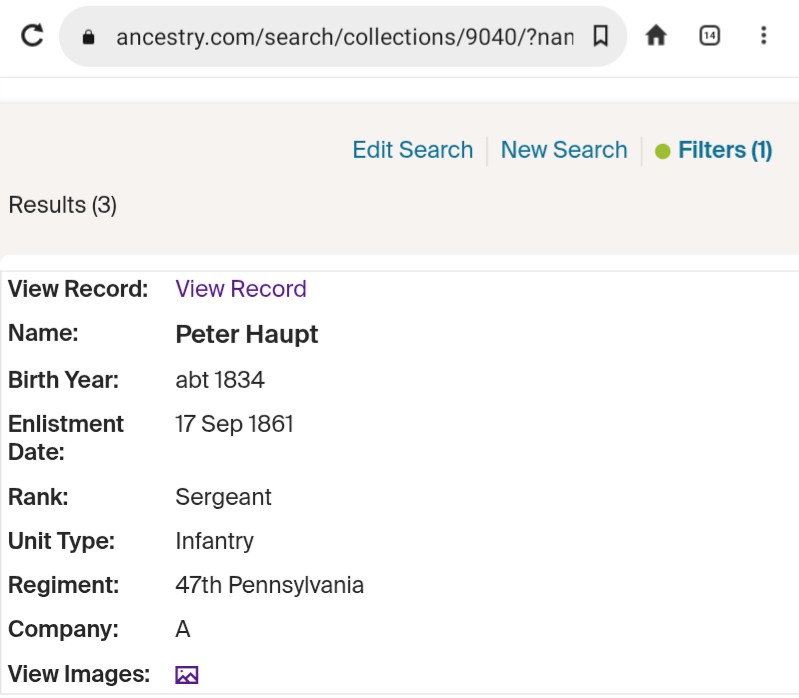
Sgt. Peter Haupt
George Horner
George W. Keiser
James Kennedy
Theodore Kiehl
George Kramer
Sgt. William Pyers
Joseph Smith
John C. Sterner
Peter Swinehart
Emanuel R. Walters
George C. Watson
John E. Will
Peter Wolf
John Boulton Young

They gave the last full measure of devotion.
Erected 2004”

That plaque was dedicated during a candlelight ceremony held at 7 p.m. on Tuesday evening, 19 October 2004 — the 140th anniversary of the Battle of Cedar Creek, Virginia. Richard DeVett presented the invocation at the beginning of the ceremony and Deppen and Sunbury’s sitting mayor, David Persing, were the featured speakers. The names of the 47th Pennsylvanians memorialized by the plaque were then solemnly, respectfully read out by students of the Line Mountain School District.


Sources:

  1. “A Soldier’s Monument.” Sunbury, Pennsylvania: The Sunbury American, 4 November 1865.
  2. Blackledge, Karen. “Pupils raise $700 for Civil War plaque.” Sunbury, Pennsylvania: The Daily Item, 3 June 2004.
  3. “Dedication of a Soldiers’ Monument.” Sunbury, Pennsylvania: The Sunbury American, 5 May 1866.
  4. Deppen, John. “Honoring veterans, honoring the flag.” Sunbury, Pennsylvania: The Daily Item, 11 April 2004.
  5. Hay, Charles Augustus. History of the Evangelical Lutheran Synod of East Pennsylvania: with brief sketches of its congregations, p. 359. Philadelphia, Pennsylvania: Lutheran Publication Society, 1893.
  6. Keister, Amanda. “City gets to keep grant.” Sunbury, Pennsylvania: The Daily Item, 1 July 2004.
  7. “Our Fallen Heroes.” Sunbury, Pennsylvania: The Sunbury American, 30 May 1868.
  8. “Plaque Dedication: Honoring the fallen.” Sunbury, Pennsylvania: The Daily Item, 20 October 2004.
  9. “Remembering the Soldiers of Company C.” Sunbury, Pennsylvania: The Daily Item, 17 October 2004.
  10. “Rev. Mosheim Rhodes.” Lebanon, Pennsylvania: The Daily News, 9 May 1874.
  11. Rhodes, Rev. Mosheim. “Oration, on the Occasion of the Dedication of a Monument at Sunbury, Pa., May 16th, in Honor of the Members of Co., ‘C,’ 47th Penn’a. Veteran Vols., Who Sacrificed Their Lives in Defence of Their Country.” Sunbury, Pennsylvania: The Sunbury American, Saturday, 2 June 1866.
  12. “The Concert.” Sunbury, Pennsylvania: The Sunbury American, 6 September 1866.
  13. “The Monumental Ceremonies.” Sunbury, Pennsylvania: The Sunbury American, 19 May 1866.
  14. “The Soldiers’ Monument.” Sunbury, Pennsylvania: The Sunbury American, 12 May 1866.
  15. “Tuesday/Dedication Ceremony/Sunbury.” Sunbury, Pennsylvania: The Daily Item, 17 October 2004.