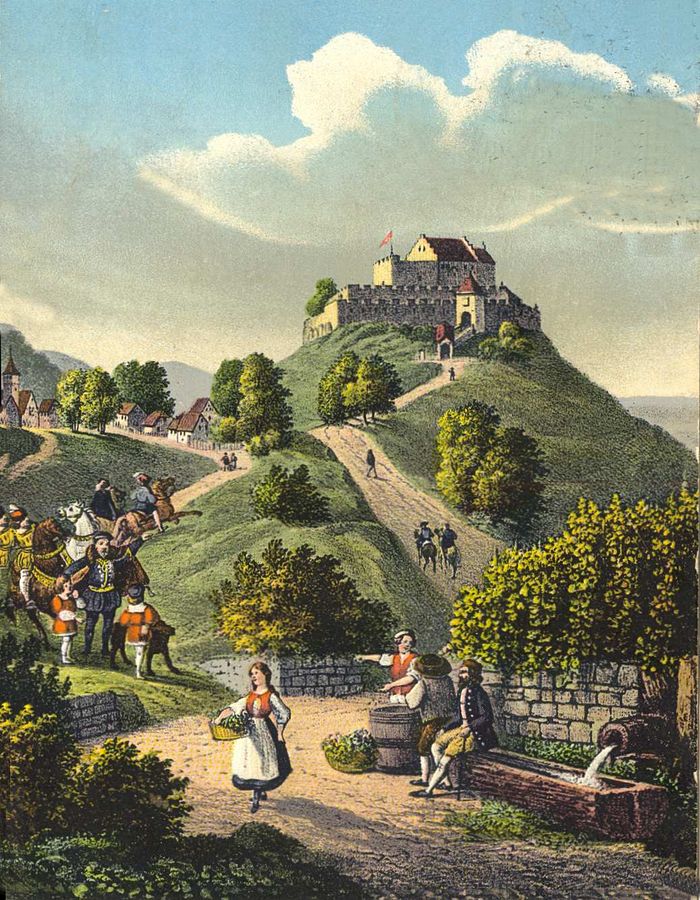
Württemberg Castle, circa 18th Century (Jakob Heinrich Renz, public domain).
Alternate Spellings of Given Name: Warner, Werner
Born in Baden-Württemberg, Germany on 21 April 1842, Werner Erbe was a son of J. Erbe (born circa 1798) and Elisabeth Erbe (born circa 1812). Shortly after his birth, according to the 1910 U.S. Census, he emigrated from his hometown, arriving in the United States sometime later in 1842.
Very little else is presently known about his parents or the early years of their lives. What is known for certain, thanks to records of the Army of the United States, is that, by the summer of 1861, Werner Erbe was a twenty-one-year-old miner who lived in Hazleton, Pennsylvania.
That same fateful summer, he made the decision to fight to preserve the Union of his adopted country, as it descended into the darkness and disunion of civil war.
American Civil War

The U.S. Capitol Building, unfinished at the time of President Abraham Lincoln’s inauguration, was still not completed when the 47th Pennsylvania Volunteers arrived in Washington, D.C. in September 1861 (public domain).
Enrolled for American Civil War military service by Captain George Junker in Luzerne County, Pennsylvania on 21 August 1861, Werner Erbe mustered in as a private with Company K, of the newly-formed 47th Pennsylvania Volunteer Infantry on 17 September 1861.
* Note: Formed with the intent of being an “all-German company,” Company K was almost entirely composed of recent immigrants from Germany and Lehigh Valley residents of Pennsylvania German/Pennsylvania Dutch heritage. Its founder and first commanding officer, George Junker, was a German immigrant who had become a tombstone carved in Allentown.
Following a brief training period in light infantry tactics at Camp Curtin, Private Werner Erbe and his fellow 47th Pennsylvania Volunteers were marched to the Harrisburg train station, where they boarded Northern Central Railway cars on 20 September and headed for the nation’s capital. Arriving in Washington, D.C. during the wee hours of the next morning, they disembarked and marched to that city’s Soldiers’ Rest, where they were fed and allowed to sleep for a few hours before marching for the Kalorama Heights in Georgetown in the District of Columbia.
Ordered to pitch their tents at Camp Kalorama, roughly two miles from the White House, they continued to train. On 22 September, C Company Musician Henry D. Wharton penned these words to his hometown newspaper, the Sunbury American:
After a tedious ride we have, at last, arrived at the City of ‘magnificent distances.’ We left Harrisburg on Friday last at 1 o’clock A.M. and reached this camp yesterday (Saturday) at 4 P.M., as tired and worn out a setting [sic, set] of mortals as can possibly exist. On arriving at Washington we were marched to the ‘Soldiers Retreat,’ a building purposefully erected for the benefit of the soldier, where every comfort is extended to him and the wants of the ‘inner man’ supplied.
After partaking of refreshments we were ordered into line and marched, about three miles, to this camp. So tired were the men that, on marching out, some gave out, and had to leave the ranks, but J. Boulton Young, our ‘little Zouave,’ stood it bravely, and acted like a veteran. So small a drummer is scarcely seen in the army, and on the march through Washington he was twice the recipient of three cheers.
We were reviewed by Gen. McClellan yesterday [21 September] without our knowing it. All along the march we noticed a considerable number of officers, both mounted and on foot; the horse of one of the officers was so beautiful that he was noticed by the whole regiment, in fact, so adapt [sic, wrapped] up were they in the horse, the rider wasn’t noticed, and the boys were considerably mortified this morning on discovering they had missed the sight of, and the neglect of not saluting the soldier next in command to Gen. Scott.
Col. Good, who has command of our regiment, is an excellent man and a splendid soldier. He is a man of very few words, and is continually attending to his duties and the wants of the Regiment.
…. Our Regiment will now be put to hard work; such as drilling and the usual business of camp life, and the boys expect and hope for an occasional ‘pop’ at the enemy.

Chain Bridge across the Potomac above Georgetown looking toward Virginia, 1861 (The Illustrated London News, public domain).
Acclimated somewhat to their new life, the soldiers of the 47th Pennsylvania Volunteer Infantry finally became part of the Army of the United States when they were officially mustered into federal service on 24 September. Three days later, they were assigned to the 3rd Brigade of Brigadier-General Isaac Ingalls Stevens, which also included the 33rd, 49th and 79th New York regiments. By that afternoon, the 47th Pennsylvania Volunteers were on the move again.
Ordered onward by Brigadier-General Silas Casey, the Mississippi rifle-armed 47th Pennsylvania infantrymen marched behind their Regimental Band until reaching Camp Lyon, Maryland on the Potomac River’s eastern shore. At 5 p.m., they joined the 46th Pennsylvania in moving double-quick (one hundred and sixty five steps per minute using thirty-three-inch steps) across the “Chain Bridge” marked on federal maps, and continued on for roughly another mile before being ordered to make camp.
The next morning, they broke camp and moved again. Marching toward Falls Church, Virginia, they arrived at Camp Advance around dusk. There, about two miles from the bridge they had crossed a day earlier, they re-pitched their tents in a deep ravine near a new federal fort under construction (Fort Ethan Allen). They had completed a roughly eight-mile trek, were situated close to the headquarters of Brigadier-General William Farrar Smith (also known as “Baldy”) and were now part of the massive U.S. Army of the Potomac (“Mr. Lincoln’s Army”). Under Smith’s leadership, their regiment and brigade would help to defend the nation’s capital from the time of their arrival through late January when the men of the 47th Pennsylvania would be shipped south.
Once again, Company C Musician Henry Wharton recalled the regiment’s activities, noting, via his 29 September letter to the Sunbury American:
On Friday last we left Camp Kalorama, and the same night encamped about one mile from the Chain Bridge on the opposite side of the Potomac from Washington. The next morning, Saturday, we were ordered to this camp [Camp Advance near Fort Ethan Allen, Virginia], one and a half miles from the one we occupied the night previous. I should have mentioned that we halted on a high hill (on our march here) at the Chain Bridge, called Camp Lyon, but were immediately ordered on this side of the river. On the route from Kalorama we were for two hours exposed to the harrdest rain I ever experienced. Whew, it was a whopper; but the fellows stood it well – not a murmur – and they waited in their wet clothes until nine o’clock at night for their supper. Our Camp adjoins that of the N.Y. 79th (Highlanders.)….
We had not been in this Camp more than six hours before our boys were supplied with twenty rounds of ball and cartridge, and ordered to march and meet the enemy; they were out all night and got back to Camp at nine o’clock this morning, without having a fight. They are now in their tents taking a snooze preparatory to another march the morning…. I don’t know how long the boys will be gone, but the orders are to cook two days’ rations and take it with them in their haversacks….
There was a nice little affair came off at Lavensville [sic, Lewinsville], a few miles from here on Wednesday last; our troops surprised a party of rebels (much larger than our own.) killing ten, took a Major prisoner, and captured a large number of horses, sheep and cattle, besides a large quantity of corn and potatoes, and about ninety six tons of hay. A nice day’s work. The boys are well, in fact, there is no sickness of any consequence at all in our Regiment….

The Big Chestnut Tree, Camp Griffin, Langley, Virginia, 1861 (U.S. Library of Congress, public domain).
Sometime during this phase of duty, as part of the 3rd Brigade, the 47th Pennsylvanians were moved to a site they initially christened “Camp Big Chestnut,” in reference to a large chestnut tree growing there. The site would eventually become known to them as “Camp Griffin,” and was located roughly ten miles from Washington, D.C.
On 11 October, the 47th Pennsylvania Volunteers marched in the Grand Review at Bailey’s Cross Roads. In a mid-October letter to his own family and friends, Captain John Peter Shindel Gobin, the commanding officer of Company C, reported that Companies D, A, C, F, and I (the 47th Pennsylvania’s right wing) were ordered to picket duty after the regiment’s left-wing companies (B, E, G, H, and K) had been forced to return to camp by Confederate troops.
In his letter of 13 October, Musician Henry Wharton described the duties of the average 47th Pennsylvanian, as well as the regiment’s new home:
The location of our new camp is fine and the scenery would be splendid if the view was not obstructed by heavy thickets of pine and innumerable chesnut [sic, chestnut] trees. The country around us is excellent for the Rebel scouts to display their bravery; that is, to lurk in the dense woods and pick off one of our unsuspecting pickets. Last night, however, they (the Rebels) calculated wide of their mark; some of the New York 33d boys were out on picket; some fourteen or fifteen shots were exchanged, when our side succeeded in bringing to the dust, (or rather mud,) an officer and two privates of the enemy’s mounted pickets. The officer was shot by a Lieutenant in Company H [?], of the 33d.
Our own boys have seen hard service since we have been on the ‘sacred soil.’ One day and night on picket, next day working on entrenchments at the Fort (Ethan Allen.) another on guard, next on march and so on continually, but the hardest was on picket from last Thursday morning ’till Saturday morning – all the time four miles from camp, and both of the nights the rain poured in torrents, so much so that their clothes were completely saturated with the rain. They stood it nobly – not one complaining; but from the size of their haversacks on their return, it is no wonder that they were satisfied and are so eager to go again tomorrow. I heard one of them say ‘there was such nice cabbage, sweet and Irish potatoes, turnips, &c., out where their duty called them, and then there was a likelihood of a Rebel sheep or young porker advancing over our lines and then he could take take them as ‘contraband’ and have them for his own use.’ When they were out they saw about a dozen of the Rebel cavalry and would have had a bout with them, had it not been for … unlucky circumstance – one of the men caught the hammer of his rifle in the strap of his knapsack and caused his gun to fire; the Rebels heard the report and scampered in quick time….

Unknown regiment, Camp Griffin, Virginia, fall 1861 (U.S. Library of Congress, public domain).
On Friday morning, 22 October, the 47th Pennsylvania engaged in a Divisional Review, described by regimental historian Lewis Schmidt as massing “about 10,000 infantry, 1000 cavalry, and twenty pieces of artillery all in one big open field.”
Also around this same time, Captain George Junker issued his first Special Order to his Company K subordinates:
I. 15 minutes after breakfast every tent will be cleaned. The commander of each tent will be held responsible for it, and every soldier must obey the orders of the tent commander. If not, said commanders will report such men to the orderly Sgt. who will report them to headquarters.
II. There will be company drills every two hours during the day, including regimental drills with knapsacks. No one will be excused except by order of the regimental surgeon. The hours will be fixed by the commander, and as it is not certain therefore, every man must stay in his quarter, being always ready for duty. The roll will be called each time and anyone in camp found not answering will be punished the first time with extra duty. The second with carrying the 75 lb. weights, increased to 95 lb. The talking in ranks is strictly forbidden. The first offense will be punished with carrying 80 lb. weights increased to 95 lbs. for four hours.
In his letter of 17 November, Musician Henry Wharton revealed still more details about life at Camp Griffin:
This morning our brigade was out for inspection; arms, accoutrements, clothing, knapsacks, etc., all were out through a through examination, and if I must say it myself, our company [Company C] stood best, A No. 1, for cleanliness. We have a new commander to our brigade, Brigadier General Brannon [sic, Brannan], of the U.S. Army, and if looks are any criterion, I think he is a strict disciplinarian and one who will be as able to get his men out of danger as he is willing to lead them to battle….
The boys have plenty of work to do, such as piquet [sic, picket] duty, standing guard, wood-chopping, police duty and day drill; but then they have the most substantial food; our rations consist of fresh beef (three times a week), pickled pork, pickled beef, smoked pork, fresh bread, daily, which is baked by our own bakers, the Quartermaster having procured portable ovens for that purpose, potatoes, split peas, beans, occasionally molasses and plenty of good coffee, so you see Uncle Sam supplies us plentifully….
A few nights ago our Company was out on piquet [sic, picket]; it was a terrible night, raining very hard the whole night, and what made it worse, the boys had to stand well to their work and dare not leave to look for shelter. Some of them consider they are well paid for their exposure, as they captured two ancient muskets belonging to Secessia. One of them is of English manufacture, and the other has the Virginia militia mark on it. They are both in a dilapidated condition, but the boys hold them in high estimation as they are trophies from the enemy, and besides they were taken from the house of Mrs. Stewart, sister to the rebel Jackson who assassinated the lamented Ellsworth at Alexandria. The honorable lady, Mrs. Stewart, is now a prisoner at Washington and her house is the headquarters of the command of the piquets [sic, pickets]….
Since the success of the secret expedition, we have all kinds of rumors in camp. One is that our brigade will be sent to the relief of Gen. Sherman, in South Carolina. The boys all desire it and if the news in the ‘Press’ is correct, that a large force is to be sent there, I think their wish will be gratified.
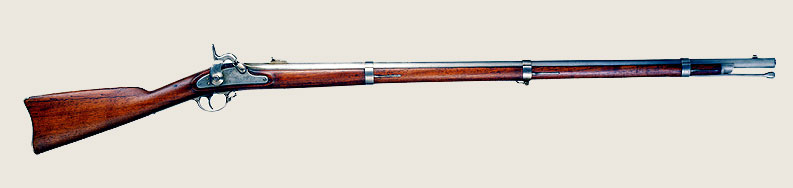
Springfield rifle, 1861 model (public domain).
On 21 November, the 47th Pennsylvania Volunteers participated in a morning Divisional Review that was viewed by the 47th’s founder and commanding officer, Colonel Tilghman Good, followed by brigade and division drills all afternoon. According to Schmidt, “each man was supplied with ten blank cartridges. Afterward, “Gen. Smith requested Gen. Brannan to inform Col. Good that the 47th was the best regiment in the whole division.”
As a reward for the regiment’s impressive performance that day, and in preparation for the even bigger adventures and honors that were yet to come, Brigadier-General John Milton Brannan, ordered his staff to ensure that brand new Springfield rifles were obtained and distributed to every member of the 47th Pennsylvania Volunteers.
1862

The 47th Pennsylvania Volunteers were transported to Florida aboard the steamship U.S.S. Oriental in January 1862 (public domain).
Ordered to move from their Virginia encampment back to Maryland, the 47th Pennsylvania Volunteers left Camp Griffin at 8:30 a.m. on Wednesday, 22 January 1862. Marching through deep mud with their equipment for three miles in order to reach the railroad station at Falls Church, they were transported to Alexandria, where they boarded the steamship City of Richmond and sailed the Potomac River to the Washington Arsenal, where they disembarked and were re-equipped. Subsequently marched to the Soldiers’ Rest in Washington, D.C., they were once again fed and given the opportunity to rest there. The next afternoon, they were marched to the railroad station, where they hopped aboard a train from the Baltimore & Ohio Railroad, and headed for Annapolis, Maryland.
Arriving around 10 p.m., they disembarked and were marched to a barracks at the United States Naval Academy, where they bedded down for the night. They then spent that Friday through Monday (24-27 January) loading their equipment and supplies onto the U.S.S. Oriental.
During the afternoon of 27 January, the 47th Pennsylvania Volunteers began boarding the Oriental, enlisted men first, and then, per the directive of Brigadier-General Brannan, they steamed away at 4 p.m. and headed for Florida, which, despite its secession from the United States remained strategically important to the Union due to the presence of several key federal installations.
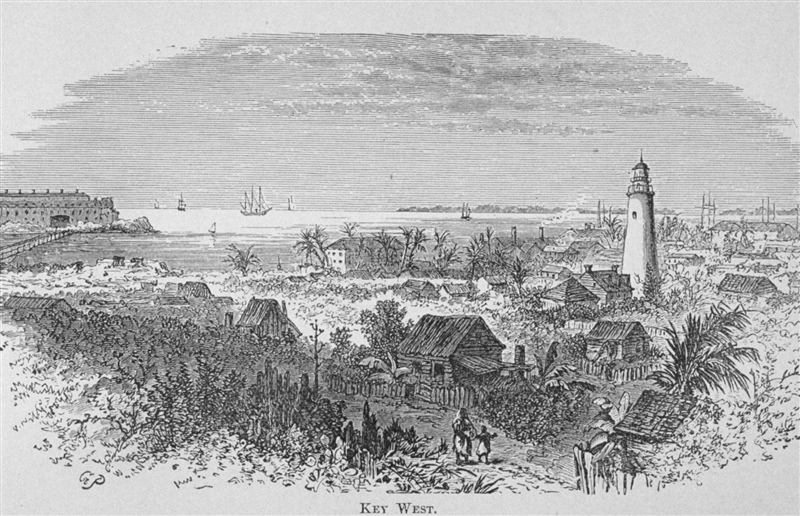
Lighthouse, Key West, Florida, early to mid-1800s (Florida for Tourists, Invalids, and Settlers, George M. Barbour, 1881, public domain).
Arriving in Key West, Florida by early February 1862, the men of Company K and their fellow 47th Pennsylvania Volunteers disembarked and were ordered to pitch their tents on the beach, where they rested and were subsequently directed to their respective quarters inside and outside of Fort Taylor. Assigned to garrison the fort, they drilled daily in infantry and artillery tactics, began strengthening the fortifications of this key federal installation and also began making infrastructure improvements to the city by felling trees and building new roads.
During the weekend of 14 February, the regiment introduced itself to area residents via a parade through the city’s streets. That Sunday, the 47th Pennsylvanians began mingling with locals at area church services.
Among the lighter moments, the regiment commemorated the birthday of President George Washington with a parade, a special ceremony involving the reading of Washington’s farewell address to the nation (first delivered in 1796), the firing of cannon at the fort, and a sack race and other games on 22 February. The festivities resumed two days later when the Regimental Band hosted an officers’ ball at which “all parties enjoyed themselves, for three o’clock of the morning sounded on their ears before any motion was made to move homewards,” according to Musician Henry Wharton. This was then followed by a concert by the band on Wednesday evening, 26 February.
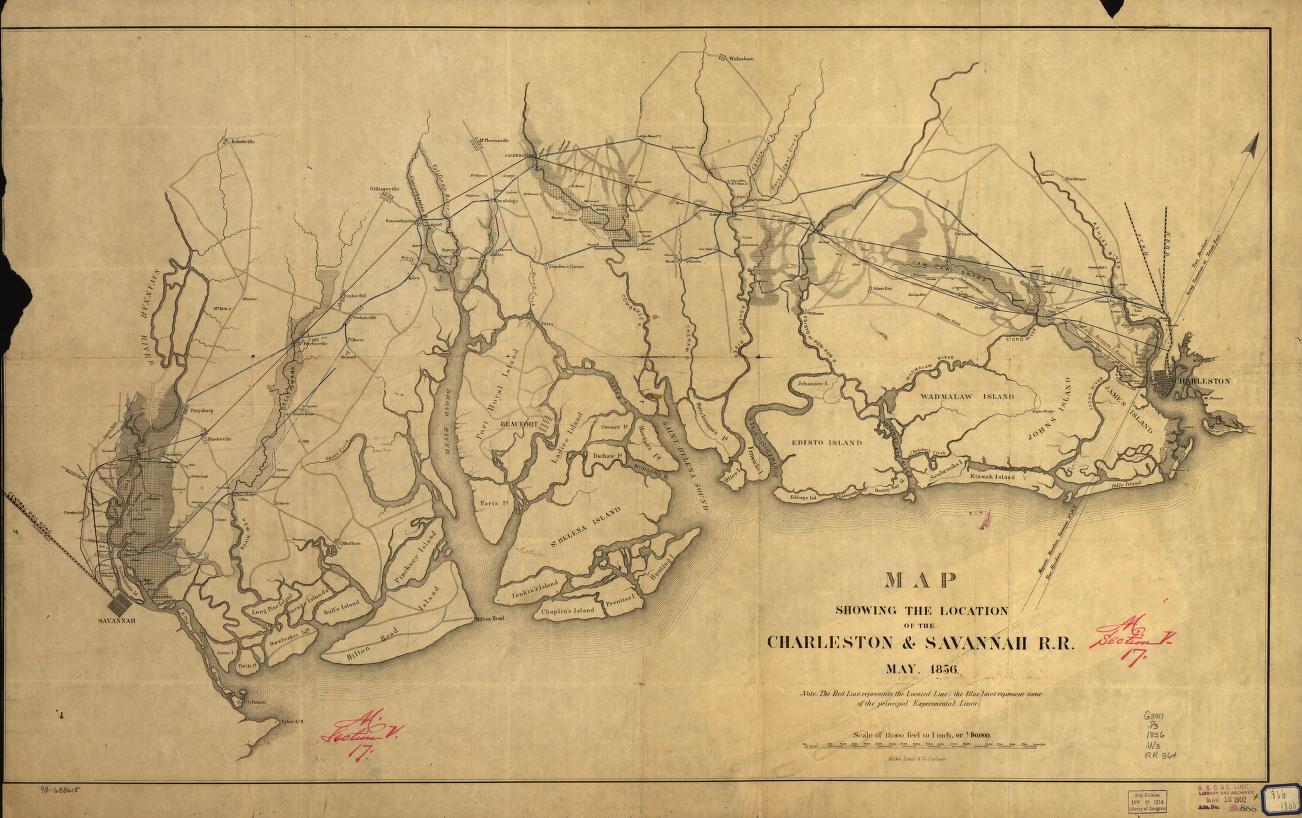
This 1856 map of the Charleston & Savannah Railroad shows the island of Hilton Head, South Carolina in relation to the towns of Beaufort and Pocotaligo (U.S. Library of Congress, public domain).
Next ordered to Hilton Head, South Carolina, from early June through July, the 47th Pennsylvania Volunteers camped near Fort Walker before relocating roughly thirty-five miles away in the Beaufort District in the U.S. Army’s Department of the South. Frequently assigned to hazardous picket duty north of their main camp, they faced an increased risk of enemy sniper fire. Despite this danger, though, the men of the 47th Pennsylvania “received the highest commendation from Generals Hunter and Brannan” for their “attention to duty, discipline and soldierly bearing,” according to historian Samuel P. Bates.
Detachments from the regiment were also assigned to the Expedition to Fenwick Island (9 July) and the Demonstration against Pocotaligo (10 July).
From 20-31 August, the men from Company K were assigned to picket duty and were stationed at “Barnwells” near Beaufort (so labeled by C Company Captain John Peter Shindel Gobin).
Capture of Saint John’s Bluff, Florida and a Confederate Steamer

Earthworks surrounding the Confederate battery atop Saint John’s Bluff along the Saint John’s River in Florida (J. H. Schell, 1862, public domain).
During a return expedition to Florida, beginning 30 September, the 47th Pennsylvania joined with the 1st Connecticut Battery, 7th Connecticut Infantry and part of the 1st Massachusetts Cavalry in assaulting Confederate forces at their heavily protected camp at Saint John’s Bluff, overlooking the Saint John’s River. Trekking through roughly twenty-five miles of swampland and forests, after disembarking from their Union troop transports at Mayport Mills on 1 October, the 47th Pennsylvanians captured artillery and ammunition stores (on 3 October) that had been abandoned during the Union Navy’s bombardment of the bluff.
Men from the 47th Pennsylvania’s Companies E and K were then led by Captain Charles H. Yard on a special mission; initially joining with other Union troops in the reconnaissance and capture of Jacksonville, Florida, they were subsequently ordered to sail up the Saint John’s River to seek out and capture any Confederate ships they found. Departing aboard the Darlington, a former Confederate steamer, with protection by the Union gunboat Hale, they traveled two hundred miles upriver, captured the Governor Milton, a Confederate steamer that was docked near Hawkinsville, and returned back down the river with both Union ships and their new Confederate prize without incident. (Identified as a thorn that needed to be plucked from the Union’s side, that steamer had been engaged in ferrying Confederate troops and supplies around the region.)
Integration of the Regiment
Meanwhile, back at its South Carolina base of operations, the 47th Pennsylvania was making history as it became an integrated regiment. On 5 and 15 October, the regiment added to its rosters several young Black men who had endured plantation enslavement near Beaufort and other areas of South Carolina, including Bristor Gethers, Abraham Jassum and Edward Jassum.
Battle of Pocotaligo, South Carolina

Highlighted version of the U.S. Army map of the Coosawhatchie-Pocotaligo Expedition, 22 October 1862 (public domain).
From 21-23 October 1862, under the brigade and regimental commands of Colonel Tilghman Good and Lieutenant-Colonel George Warren Alexander, the 47th Pennsylvania Volunteers joined with other Union troops in engaging heavily protected Confederate troops in and around Pocotaligo, South Carolina, including at Frampton’s Plantation and the Pocotaligo Bridge, a key piece of Deep South infrastructure that senior Union military leaders felt should be eliminated.
Harried by snipers while en route to destroy the bridge, they met resistance from an entrenched, heavily fortified Confederate battery that opened fire on the Union troops as they entered an open cotton field.
Those headed toward higher ground at the Frampton Plantation fared no better as they encountered artillery and infantry fire from the surrounding forests. But the Union soldiers would not give in. Grappling with the Confederates where they found them, they pursued the Rebels for four miles as the Confederate Army retreated to the bridge. Once there, the 47th Pennsylvania relieved the 7th Connecticut.
Unfortunately, the enemy was just too well armed. After two hours of intense fighting in an attempt to take the ravine and bridge, the 47th Pennsylvanians were forced by depleted ammunition to withdraw to Mackay’s Point.
The engagement proved to be a costly one for the 47th Pennsylvania with multiple members of the regiment killed instantly or so grievously wounded that they died the next day or within weeks of the battle. Among those mortally wounded was K Company Captain George Junker, who died the day after the battle while receiving medical care at the Union’s general hospital at Hilton Head.
Following the 47th Pennsylvania’s return to Hilton Head on 23 October, members of the regiment mourned their lost friends and attempted to heal from the medical and physical trauma they had sustained. A week later, members of the regiment were called upon to serve as the funeral honor guard for Major-General Ormsby M. Mitchel, commander of the U.S. Army’s 10th Corps (X Corps) and Department of the South, who died from yellow fever on 30 October.
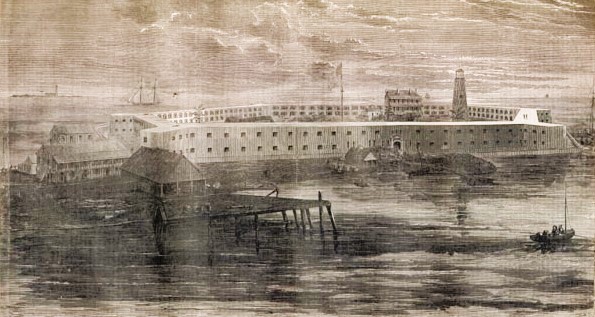
Fort Jefferson and its wharf areas, Dry Tortugas, Florida (Harper’s Weekly, 23 February 1861, public domain).
Having been ordered back to Key West on 15 November 1862, the 47th Pennsylvania Volunteers were fated to spend much of 1863 guarding federal installations in Florida as part of the 10th Corps, Department of the South. Companies A, B, C, E, G, and I would once again garrison Fort Taylor in Key West, while the men of Companies D, F, H, and K would garrison Fort Jefferson, the Union’s remote outpost in the Dry Tortugas off the southern coast of Florida.
After packing their belongings at their Beaufort, South Carolina encampment and loading their equipment onto the U.S. Steamer Cosmopolitan, the officers and enlisted members of the 47th Pennsylvania Volunteer Infantry sailed toward the mouth of the Broad River on 15 December 1862, and anchored briefly at Port Royal Harbor in order to allow the regiment’s medical director, Elisha W. Baily, M.D., and members of the regiment who had recuperated enough from their Pocotaligo-related battle injuries at the Union’s general hospital at Hilton Head, to rejoin the regiment.
At 5 p.m. that same evening, the regiment sailed for Florida, during what was described by several members of the regiment as a treacherous and nerve-wracking voyage. According to Schmidt, the ship’s captain “steered a course along the coast of Florida for most of the voyage,” which made the voyage more precarious “because of all the reefs.” On 16 December, “the second night, the ship was jarred as it ran aground on one during a storm, but broke free, and finally steered a course further from shore, out in the Gulf Stream.”
In a letter penned to the Sunbury American on 21 December, Musician Henry Wharton provided the following details about the regiment’s trip:
On the passage down, we ran along almost the whole coast of Florida. Rather all dangerous ground, and the reefs are no playthings. We were jarred considerably by running on one, and not liking the sensation our course was altered for the Gulf Stream. We had heavy sea all the time. I had often heard of ‘waves as big as a house,’ and thought it was a sailors yarn, but I have seen ’em and am perfectly satisfied; so now, not having a nautical turn of mind, I prefer our movements being done on terra firma, and leave old neptune to those who have more desire for his better acquaintance. A nearer chance of a shipwreck never took place than ours, and it was only through Providence that we were saved. The Cosmopolitan is a good riverboat, but to send her to sea, loadened [sic, loaded] with U.S. troops is a shame, and looks as though those in authority wish to get clear of soldiers in another way than that of battle. There was some sea sickness on our passage; several of the boys ‘casting up their accounts’ on the wrong side of the ledger.
According to Corporal George Nichols of Company E, “When we got to Key West the Steamer had Six foot of water in her hole [sic, hold]. Waves Mountain High and nothing but an old river Steamer. With Eleven hundred Men on I looked for her to go to the Bottom Every Minute.”
Although the Cosmopolitan arrived at the Key West Harbor on Thursday, 18 December, the 47th Pennsylvania Volunteers did not set foot on Florida soil until noon the next day. The men from Companies C and I were immediately marched to Fort Taylor, where they were placed under the command of Major William Gausler, the regiment’s third-in-command. The men from Companies B and E were assigned to the older barracks that had been erected by the United States Army, and were placed under the command of B Company Captain Emanuel P. Rhoads, while the men from Companies A and G were placed under the command of A Company Captain Richard Graeffe, and stationed at newer facilities known as the “Lighthouse Barracks,” which were located on “Lighthouse Key.”
On Saturday, 21 December, Lieutenant-Colonel George Warren Alexander, the regiment’s second-in-command, sailed away aboard the Cosmopolitan with the men from Companies D, F, H, and K, and headed south to Fort Jefferson, roughly seventy miles off the coast of Florida (in the Gulf of Mexico) to assume garrison duties there. According to Musician Henry Wharton:
We landed here [Fort Taylor] on last Thursday at noon, and immediately marched to quarters. Company I. and C., in Fort Taylor, Company E. and B. in the old Barracks, and A. and G. in the new Barracks. Lieut. Col. Alexander, with the other four companies proceeded to Tortugas, Col. Good having command of all the forces in and around Key West. Our regiment relieved the 90th Regiment N. Y. S. Vols. Col. Joseph Morgan, who will proceed to Hilton Head to report to the General commanding. His actions have been severely criticized by the people, but, as it is in bad taste to say anything against ones [sic, one’s] superiors, I merely mention, judging from the expression of the citizens, they were very glad of the return of the 47th Pennsylvania Volunteers….
Key West has improved very little since we left last June, but there is one improvement for which the 90th New York deserve a great deal of praise, and that is the beautifying of the ‘home’ of dec’d soldiers. A neat and strong wall of stone encloses the yard, the ground is laid off in squares, all the graves are flat and are nicely put in proper shape by boards eight or ten inches high on the end sides, covered with white sand, while a head and foot board, with the full name, company and regiment, marks the last resting place of the patriot who sacrificed himself for his country….
1863
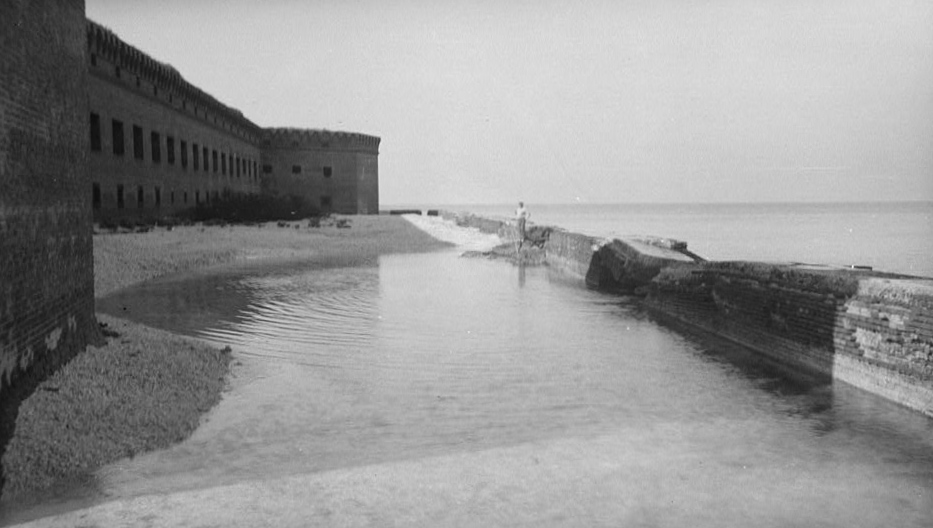
Fort Jefferson’s moat and wall, circa 1934, Dry Tortugas, Florida (C. E. Peterson, U.S. Library of Congress, public domain).
Although water quality was a challenge for members of the regiment at both of their duty stations in Florida throughout 1863, it was particularly problematic for the 47th Pennsylvanians who were stationed at Fort Jefferson. According to Schmidt:
‘Fresh’ water was provided by channeling the rains from the city’s barbette through channels in the interior walls, to filter trays filled with sand; and finally to the 114 cisterns located under the fort which held, 1,231,000 gallons of water. The cisterns were accessible in each of the first level cells or rooms through a ‘trap hole’ in the floor covered by a temporary wooden cover…. Considerable dirt must have found its way into these access points and was responsible for some of the problems resulting in the water’s impurity…. The fort began to settle and the asphalt covering on the outer walls began to deteriorate and allow the sea water (polluted by debris in the moat) to penetrate the system…. Two steam condensers were available … and distilled 7000 gallons of tepid water per day for a separate system of reservoirs located in the northern section of the parade ground near the officers [sic, officers’] quarters. No provisions were made to use any of this water for personal hygiene of the [planned 1,500-soldier garrison force]….
As a result, the soldiers stationed there washed themselves and their clothes, using saltwater from the ocean. As if that weren’t difficult enough, “toilet facilities were located outside of the fort,” according to Schmidt:
At least one location was near the wharf and sallyport, and another was reached through a door-sized hole in a gunport and a walk across the moat on planks at the northwest wall…. These toilets were flushed twice each day by the actions of the tides, a procedure that did not work very well and contributed to the spread of disease. It was intended that the tidal flush should move the wastes into the moat, and from there, by similar tidal action, into the sea. But since the moat surrounding the fort was used clandestinely by the troops to dispose of litter and other wastes … it was a continuous problem for Col. Alexander and his surgeon.
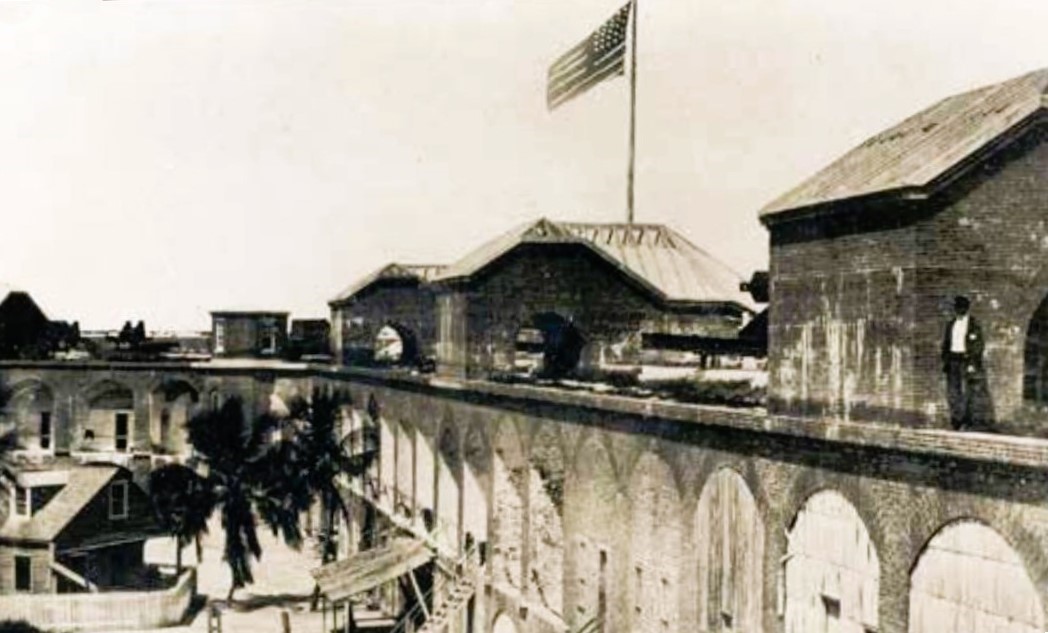
Second-tier casemates, lighthouse keeper’s house, sallyport, and lean-to structure, Fort Jefferson, Dry Tortugas, Florida, late 1860s (U.S. National Park Service and National Archives, public domain).
As for daily operations in the Dry Tortugas, there was a fort post office and the “interior parade grounds, with numerous trees and shrubs in evidence, contained officers’ quarters, [a] magazine, kitchens and out houses,” per Schmidt, as well as “a ‘hot shot oven’ which was completed in 1863 and used to heat shot before firing.”
Most quarters for the garrison … were established in wooden sheds and tents inside the parade [grounds] or inside the walls of the fort in second-tier gun rooms of ‘East’ front no. 2, and adjacent bastions … with prisoners housed in isolated sections of the first and second tiers of the southeast, or no. 3 front, and bastions C and D, located in the general area of the sallyport. The bakery was located in the lower tier of the northwest bastion ‘F’, located near the central kitchen….
Additional Duties: Diminishing Florida’s Role as the “Supplier of the Confederacy”
On top of the strategic role played by the 47th Pennsylvania Volunteers in preventing foreign powers from assisting the Confederate Army and Navy in gaining control over federal forts in the Deep South, the regiment was also called upon to play an ongoing role in weakening Florida’s abilities to supply and transport food and troops throughout areas held by the Confederate States of America.
Prior to intervention by the Union Army and Navy, the owners of plantations and livestock ranches, as well as the operators of small, family farms across Florida, had been able to consistently furnish beef and pork, fish, fruits, and vegetables to Confederate troops stationed throughout the Deep South during the first year of the American Civil War. Large herds of cattle were raised near Fort Myers, for example, while orchard owners in the Saint John’s River area were actively engaged in cultivating sizeable orange groves (while other types of citrus trees were found growing throughout more rural areas of the state).
Florida was also a major producer of salt, which was used as a preservative for food. As a result, the 47th Pennsylvania Volunteers and other Union troops across Florida were ordered to capture or destroy salt manufacturing facilities in order to further curtail the enemy’s access to food.
But they were undertaking all of these duties in conditions that were far more challenging than any they had previously faced (and that were far more challenging than what many other Union troops were facing up north). The weather was frequently hot and humid as spring turned to summer, mosquitos and other insects were an ever-present annoyance (and serious threat when they were carrying tropical diseases) and there were also scorpions and snakes that put the men’s health at further risk.
1864
In early January 1864, the 47th Pennsylvania Volunteer Infantry began receiving a series of new orders from senior Union Army leaders. The first directed regimental officers to expand the Union Army’s reach by retaking possession of Fort Myers, a federal installation that had been abandoned in 1858, following the federal government’s third war with the Seminole Indians. In response, Captain Richard Graeffe and a detachment of his Company A soldiers made their way north, captured the fort and began refurbishing it, making it a base of operations from which they conducted raids on Confederate-held livestock ranches to capture cattle that would be used to feed the growing Union troop presence across Florida. The fort also became a haven for pro-Union civilians, escaped slaves and deserters from the Confederate Army.
Red River Campaign
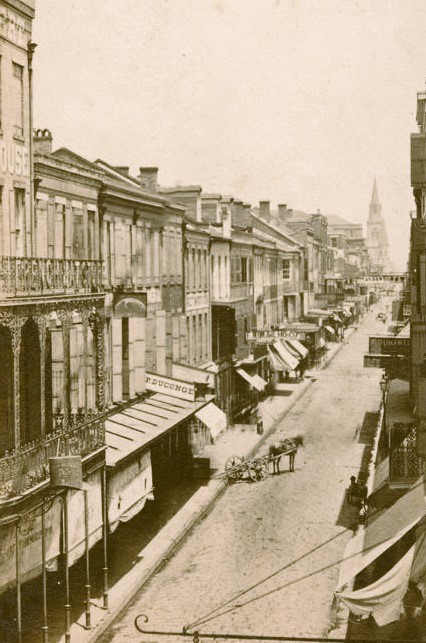
Upper Chartres Street, New Orleans, Louisiana, 1864 (public domain).
Meanwhile, all of the other companies of the 47th Pennsylvania had been ordered to prepare for another long journey–one in which they would ultimately make history.
Boarding the Charles Thomas, the men from Companies B, C, D, I, and K steamed for Algiers, Louisiana (across the river from New Orleans), followed on 1 March by the men from Companies E, F, G, and H. Upon the second group’s arrival, the now almost-fully-united-regiment moved by train to Brashear City (now Morgan City, Louisiana) before heading to Franklin by steamer through the Bayou Teche.
But Private Werner Erbe would not be joining his comrades for the remainder of that historic trek across Louisiana. Deemed no longer fit to serve with the 47th Pennsylvania Volunteer Infantry, most likely due to the repeated bouts of dysentery or one of the tropical diseases that had felled other members of his regiment, he was transferred to the Veteran Reserve Corps of the Army of the United States on 11 March 1864 by an order of Union Major-General Nathaniel P. Bates that was backdated to 1 March 1864. The next day (12 March), he was joined by another member of the 47th Pennsylvania Volunteers–Private Samuel Noss, who had served with the regiment’s I Company.
Known as “the Invalid Corps,” the Veteran Reserve Corps was composed of soldiers who had been so sickened by disease or so grievously wounded by Confederate weaponry that they were no longer sturdy enough to withstand the rigors of long marches and the many dangers associated with combat, but were not so unwell that they were unable to continue serving their nation in some capacity. As a result, they were assigned to less-taxing administrative or guard duties in occupied territories, or at military sites that were well behind the front lines of the Union Army.
With respect to Privates Werner Erbe and Samuel Noss, those duty assignments were fulfilled with the 164th Company of the 2nd Battalion of the Veteran Reserve Corps. Organized in New Orleans, Louisiana on 19 March 1864, the 164th Company’s individual detachments ensured that New Orleans, a city that had achieved notoriety as the nation’s largest market for the buying and selling of enslaved men, women and children, would free itself from the desire to perpetuate that horrific practice by reforming its government and societal structures under Union military leadership.
Although many members of the Veteran Reserve Corps’ 2nd Battalion continued to serve the nation until 30 November 1865, Private Werner Erbe was evidently so unwell that he was ultimately issued a surgeon’s certificate of disability roughly six months later, and was honorably discharged on 16 September 1864.
Return to Civilian Life
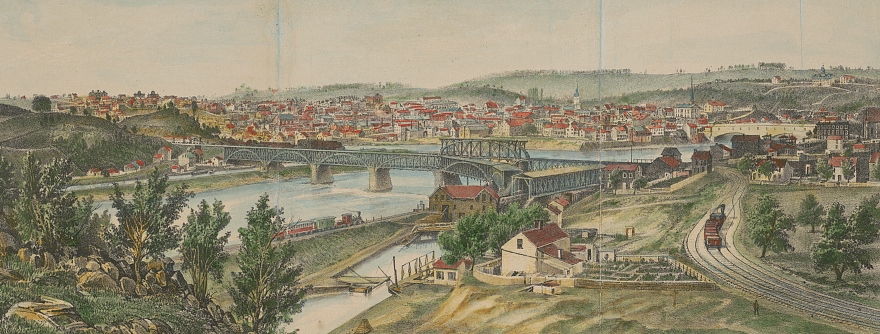
View of Easton (from Phillipsburg Rock, circa 1860-1862, James Fuller Queen, U.S. Library of Congress, public domain; click to enlarge).
Following his departure from the military, Werner Erbe returned to his adopted home state of Pennsylvania. On 6 March 1868, he filed for, and was subsequently awarded, a U.S. Civil War Soldier’s Pension due to continuing issues with his health that were directly related to his American Civil War service.
Sometime during this same period of his life, he wed Pennsylvania native Hannah Meyers. Together, they welcomed the arrivals at their home in Easton, Northampton County of: Cora V. Erbe (1870-1875), who was born on 8 October 1870, and John Erbe (1872-1937), who was born on 18 March 1872.
Sadly, though, only one of their two children would survive to adulthood. A period of American history in which cholera infantum and other diseases regularly put the lives of young children at risk, Cora Erbe became one of the little ones to lose her life, when she passed away in Easton on 21 March 1875.
By 1880, Werner Erbe was employed as a laborer and residing in the Sixth Ward of Easton, Northampton County, Pennsylvania with his wife, Hannah (Meyers) Erbe (1843-1904), and their son John.
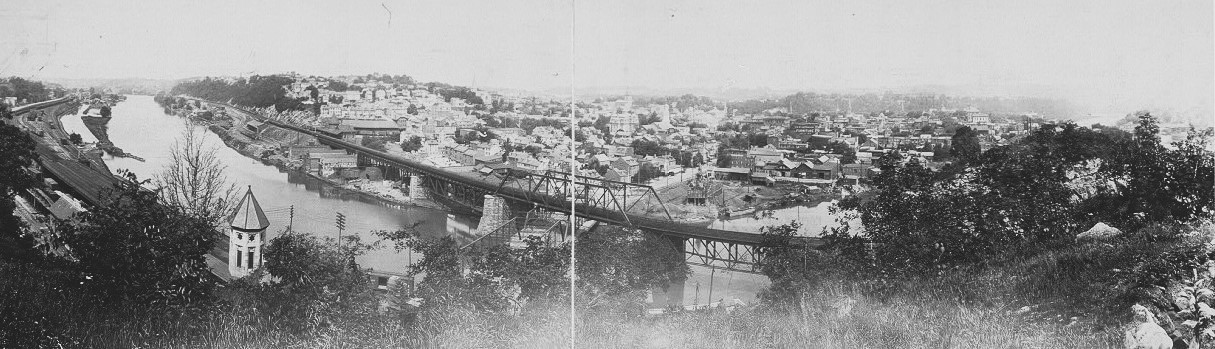
Easton, Pennsylvania, circa 1896 (U.S. Library of Congress, public domain; click to enlarge).
On 15 July 1881, Werner Erbe was appointed as a trustee of the Methodist Church in Easton–a position he held until he resigned on 25 October 1883. According to the special federal census of American Civil War veterans and widows that was conducted in 1890, he was still living in Easton that year and was confirmed to have been a member of the 47th Pennsylvania Volunteer Infantry’s K Company.
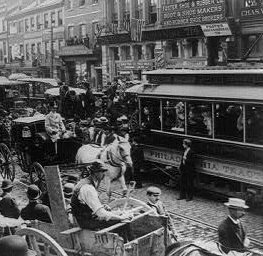
Street Scene, Philadelphia, 1897 (B.W. Kilburn, U.S. Library of Congress, public domain).
Sometime after that census was taken, he relocated with his wife to the city of Philadelphia.
On 10 April 1904, Werner Erbe was widowed when his wife, Hannah (Meyers) Erbe, died in Philadelphia. Her remains were subsequently returned to Easton and interred at the Easton Cemetery on 13 April.
By 1910, he was residing at the German Evangelical Home for the Aged in Philadelphia, which was located at the intersection of Old York Road and Hunting Park Avenue. Confirmed to be a resident of that facility by that year’s federal census enumerator, he was also documented as a naturalized citizen of the United States.
Death and Interment
Werner Erbe died from complications related to heart disease at the German Evangelical Home for the Aged in Philadelphia on 16 June 1913. His death certificate listed his occupation as “farmer.” His remains were subsequently returned to Easton, where this immigrant-turned-defender of America’s Union was then laid to rest beside his wife at the Easton Cemetery.
Sources:
- Bates, Samuel P. History of Pennsylvania Volunteers, 1861-5, vol. 1. Harrisburg, Pennsylvania: B. Singerly, State Printer, 1869.
- “Erbe,” in “Died” (death and burial notice of Werner Erbe’s wife, Hannah). Philadelphia, Pennsylvania: The Philadelphia Inquirer, 13 April 1904.
- Erbe, Warner, in Death Certficates (file no.: 63724, registered no.: 14733, date of death: 16 June 1913). Harrisburg, Pennsylvania: Commonwealth of Pennsylvania, Department of Health, Bureau of Vital Statistics.
- Erbe, Warner, in “Records of Official Church Church Members,” 1801-1883. Easton, Pennsylvania: Christ United Methodist Church.
- Erbe, Warner, in U.S. Census (Special Schedule: Surviving Soldiers, Sailors, and Marines, and Widows, etc., Easton, Seventh Ward, Northampton County, Pennsylvania, 1890). Washington, D.C.: U.S. National Archives and Records Administration.
- Erbe, Warner, in U.S. Civil War Pension General Index Cards (application no.: 132289, certificate no.: 153789, filed by the veteran, 6 March 1868). Washington, D.C.: U.S. National Archives and Records Administration.
- Erbe, Werner, in Civil War Muster Rolls (Company K, 47th Pennsylvania Infantry). Harrisburg, Pennsylvania: Pennsylvania State Archives.
- Erbe, Werner, in Civil War Veterans’ Card File, 1861-1866 (Company K, 47th Pennsylvania Infantry). Harrisburg, Pennsylvania: Pennsylvania State Archives.
- Erbe, Werner, in Records of Burial Places of Veterans (Easton Cemetery, 1913). Harrisburg, Pennsylvania: Commonwealth of Pennsylvania, Department of Military and Veterans’ Affairs.
- Erbe, Werner, Hannah and John, in U.S. Census (Easton, Northampton County, Pennsylvania, 1880). Washington, D.C.: U.S. National Archives and Records Administration.
- Erbe, Werner, in U.S. Census (German Evangelical Home for the Aged, City of Philadelphia, Philadelphia County, Pennsylvania, 1910). Washington, D.C.: U.S. National Archives and Records Administration.
- “Roster of the 47th P. V. Inf.” Allentown, Pennsylvania: The Morning Call, 26 October 1930.
- Schmidt, Lewis. A Civil War History of the 47th Regiment of Pennsylvania Veteran Volunteers. Allentown, Pennsylvania: Self-published, 1986.
 47th Pennsylvania Volunteers
You must be logged in to post a comment.