Alternate Spellings of Given Name: Edward, Edwin. Alternate Spellings of Surname: Frederick, Fredericks, Frederig

Map of Longswamp Township, Berks County, Pennsylvania, 1860 (public domain).
A carpenter by training, Edward Frederick had one of the shortest tenures of the more than two thousand soldiers who served with the 47th Pennsylvania Volunteer Infantry during the American Civil War.
But his sacrifice was among the greatest.
Formative Years
Born in Berks County, Pennsylvania circa 1840 (alternate birth year: 1835), Edward Frederick was a son of farmer Nathan Frederick (1812-1893) and Susannah (Spangler) Frederick (circa 1814-1896), both of whom were Pennsylvania natives.
In 1850, Edward Frederick resided in Longswamp Township, Berks County, Pennsylvania with his parents and Pennsylvania-born siblings: Tilghman Frederick (1835-1896), who was born on 8 March 1835, later served with two different Pennsylvania military units during the American Civil War and became the husband of Hettie M. Krause (1837-1887); Susanna Frederick (1836-1902), who was born on 11 April 1836 and later wed Tilghman Dorney (1834-1911); Marietta Frederick (1842-1915), who was born on 29 June 1842 and later wed George W. Fahringer (1837-1923); and Anna Matilda Frederick (1848-1943), who was born circa 1848 and later wed Henry Miller (1847-1895). Also residing with the Frederick family was Jonas Youse (1830), a twenty-year-old, live-in servant.
That year (1850), Edward Frederick attended his local school in Berks County, along with his older siblings, Tilghman and Susanna. Sometime before the federal census was conducted in 1860, however, their parents relocated to the town of Macungie in Lehigh County. By the time that that year’s federal census was taken, all three of the oldest siblings had moved out of the Frederick family’s home to begin their own lives — lives which diverged dramatically as Edward found work as a carpenter in Allentown and Tilghman and Susanna began their own new family lines.
* Note: Residents of Macungie Township by 1860, Edward Frederick’s parents, Nathan and Susanna Frederick, resided comfortably there on their own farm near the town of Macungie. Living with them was their youngest daughter, Anna; eighteen-year-old servant Catharine Mohr; and nine-year-old Sarah Reichenbach.
Meanwhile, Edward’s sister, Susanna Frederick, who had married Tilghman Dorney (1834-1911) sometime during the late 1850s or in early 1860, was welcoming the birth with him of Charles Benjamin Dorney (1860-1947), who was born in Allentown on 22 November 1860 and would later wed Redosa C. Rahmer 1866-1930. Their son, Oscar Joseph Dorney (1862-1948), was then born in Allentown on 26 June 1862; he would later go on to marry Mary Schadler (1867-1926).
Edward’s brother, Tilghman S. Frederick, who had married Hettie M. Krause (1837-1887) sometime during the early 1860s, then welcomed the birth with her of their son: Henry W. Frederick, who was born circa 1862.
All of those personal life changes unfolded as their nation descended into a secession crisis that then devolved into a full-blown civil war.
American Civil War
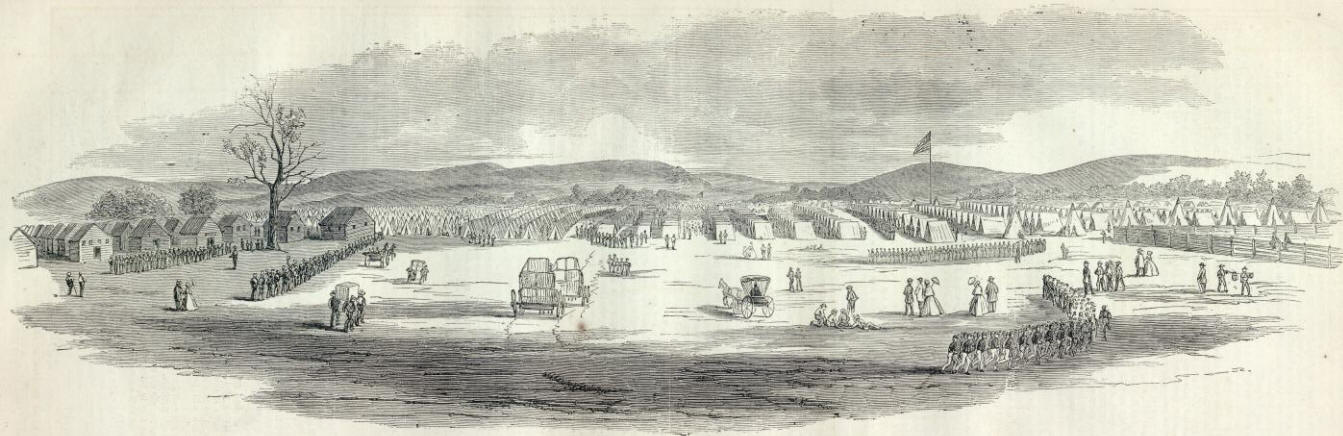
Camp Curtin, Harrisburg, Pennsylvania (Harper’s Weekly, 13 December 1862, public domain; click to enlarge).
At the age of twenty-seven, Edward Frederick enrolled for military service in Allentown, Lehigh County on 29 September 1862. He then officially mustered in for duty at Camp Curtin in Harrisburg on 2 October as a private with Company K of the 47th Pennsylvania Volunteer Infantry.
Military records at the time described him as a carpenter who lived and worked in the city of Allentown.
Given little time to train, Private Edward Frederick was transported to America’s Deep South, where he connected with his regiment at its duty station in Beaufort, South Carolina on 13 October 1862. At that time, the 47th Pennsylvania was in the process of becoming an integrated regiment. (On 5 and 15 October, the regiment added to its rosters several young Black men who had endured plantation enslavement near Beaufort and other areas of South Carolina, including Bristor Gethers, Abraham Jassum and Edward Jassum.)
He was also arriving just in time to take part in a battle that would leave a lasting mark on the hearts of the 47th Pennsylvania Volunteers who would survive it.
Battle of Pocotaligo, South Carolina

“The Commencement of the Battle near Pocotaligo River” (Frank Leslie’s Illustrated Newspaper, October 1862, public domain; click to enlarge).
From 21-23 October 1862, under the brigade and regimental commands of Colonel Tilghman Good and Lieutenant-Colonel George Warren Alexander, the 47th Pennsylvania Volunteers joined with other Union troops in engaging heavily protected Confederate troops in and around Pocotaligo, South Carolina, including at Frampton’s Plantation and the Pocotaligo Bridge, a key piece of Deep South infrastructure that senior Union military leaders felt should be eliminated.
Harried by snipers while en route to destroy the bridge, they met resistance from an entrenched, heavily fortified Confederate battery that opened fire on the Union troops as they entered an open cotton field.

Highlighted version of the U.S. Army map of the Coosawhatchie-Pocotaligo Expedition, 22 October 1862 (public domain; click to enlarge).
Those headed toward higher ground at the Frampton Plantation fared no better as they encountered artillery and infantry fire from the surrounding forests. But the Union soldiers would not give in. Grappling with the Confederates where they found them, they pursued the Rebels for four miles as the Confederate Army retreated to the bridge. Once there, the 47th Pennsylvania relieved the 7th Connecticut.
Unfortunately, the enemy was just too well armed. After two hours of intense fighting in an attempt to take the ravine and bridge, the 47th Pennsylvanians were forced by depleted ammunition to withdraw to Mackay’s Point.
The engagement proved to be a costly one for the 47th Pennsylvania with multiple members of the regiment killed instantly or wounded so terribly that they died the next day or within weeks of the battle. Among those mortally wounded was K Company Captain George Junker, who died the day after the battle while receiving medical care at the Union’s general hospital at Hilton Head.
Also grievously wounded that day was Private Edward Frederick.
Medical Treatment, Death and Post-Mortem Examination
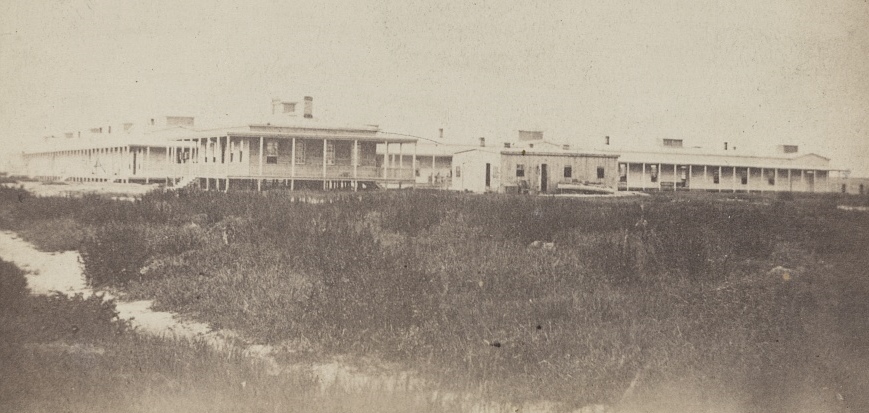
U.S. General Hospital, Hilton Head, South Carolina, circa 1861-1865, which was built facing the ocean/Port Royal Bay (Broad River). The medical director’s residence is shown at left in the foreground (U.S. Library of Congress, public domain; click to enlarge).
Felled by a musket ball to the side of his head, near the back, Private Edward Frederick was still alive when stretcher bearers carried him from the field toward the skilled hands of the 47th Pennsylvania’s regimental surgeons. From that moment on, he fought with everything he had in him through battlefield triage and treatment that stabilized him enough to be transported by to Hilton Head Island, where he was admitted to the Union Army’s general hospital during the morning of 23 October and prepared for surgery to remove the musket ball that had “divided the central and posterior portion of the scalp” and had “lodged in the frontal bone,” according to the Union Army surgeons who treated him and later presented his medical history as a case study in The Medical and Surgical History of the War of the Rebellion.
According to those same physicians, “The wound did well for three weeks, when erysipelas set in, which then “disappeared under appropriate treatment.”
Suppuration commenced and spiculae of bone came away, or were removed at various times. Constant headache, of a dull, heavy nature, was present. The wound had entirely closed [by] January 1, 1864, and no uneasiness was experienced except upon exposure to the rays of the sun. He was returned to duty on November 19th, 1862.
He fought so hard and so successfully that he “was returned to duty on November 19th, 1862.”
Ordered to Florida
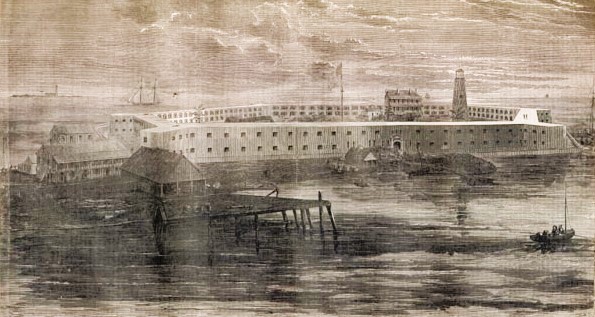
Fort Jefferson and its wharf areas, Dry Tortugas, Florida (Harper’s Weekly, 23 February 1861, public domain).
Having been ordered to head for duty in Florida on 15 November 1862, Private Edward Frederick and his fellow 47th Pennsylvania Volunteers were fated to spend much of 1863 guarding federal installations there as part of the 10th Corps, U.S. Department of the South. Companies A, B, C, E, G, and I would garrison Fort Taylor in Key West, while the men of Companies D, F, H, and K would garrison Fort Jefferson, the Union’s remote outpost in the Dry Tortugas off the southern coast of Florida.
After packing their belongings at their Beaufort, South Carolina encampment and loading their equipment onto the U.S. Steamer Cosmopolitan, the officers and enlisted members of the 47th Pennsylvania Volunteer Infantry sailed toward the mouth of the Broad River on 15 December 1862, and anchored briefly at Port Royal Harbor in order to allow the regiment’s medical director, Elisha W. Baily, M.D., Private Frederick and other members of the regiment deemed well enough to leave to board the ship.
At 5 p.m. that same evening, the regiment sailed for Florida, during what was described by several members of the regiment as a treacherous and nerve-wracking voyage. According to Schmidt, the ship’s captain “steered a course along the coast of Florida for most of the voyage,” which made the voyage more precarious “because of all the reefs.” On 16 December, “the second night, the ship was jarred as it ran aground on one during a storm, but broke free, and finally steered a course further from shore, out in the Gulf Stream.”
In a letter penned to the Sunbury American on 21 December, Musician Henry Wharton provided the following details about the regiment’s trip:
On the passage down, we ran along almost the whole coast of Florida. Rather all dangerous ground, and the reefs are no playthings. We were jarred considerably by running on one, and not liking the sensation our course was altered for the Gulf Stream. We had heavy sea all the time. I had often heard of ‘waves as big as a house,’ and thought it was a sailors yarn, but I have seen ’em and am perfectly satisfied; so now, not having a nautical turn of mind, I prefer our movements being done on terra firma, and leave old neptune to those who have more desire for his better acquaintance. A nearer chance of a shipwreck never took place than ours, and it was only through Providence that we were saved. The Cosmopolitan is a good riverboat, but to send her to sea, loadened [sic, loaded] with U.S. troops is a shame, and looks as though those in authority wish to get clear of soldiers in another way than that of battle. There was some sea sickness on our passage; several of the boys ‘casting up their accounts’ on the wrong side of the ledger.
According to Corporal George Nichols of Company E, “When we got to Key West the Steamer had Six foot of water in her hole [sic, hold]. Waves Mountain High and nothing but an old river Steamer. With Eleven hundred Men on I looked for her to go to the Bottom Every Minute.”
Although the Cosmopolitan arrived at the Key West Harbor on Thursday, 18 December, the 47th Pennsylvania Volunteers did not set foot on Florida soil until noon the next day. The men from Companies C and I were immediately marched to Fort Taylor, where they were placed under the command of Major William Gausler, the regiment’s third-in-command. The men from Companies B and E were assigned to the older barracks that had been erected by the United States Army, and were placed under the command of B Company Captain Emanuel P. Rhoads, while the men from Companies A and G were placed under the command of A Company Captain Richard Graeffe, and stationed at newer facilities known as the “Lighthouse Barracks,” which were located on “Lighthouse Key.”
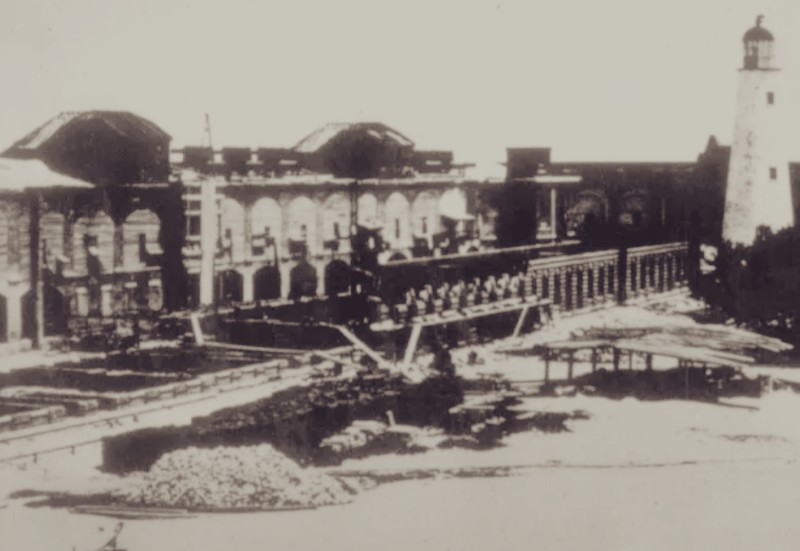
Lighthouse at Fort Jefferson, Dry Tortugas, Florida, circa 1863 (U.S. National Park Service, public domain).
On Saturday, 21 December, Lieutenant-Colonel George Warren Alexander, the regiment’s second-in-command, sailed away aboard the Cosmopolitan with the men from Companies D, F, H, and K, and headed south to Fort Jefferson, roughly seventy miles off the coast of Florida (in the Gulf of Mexico) to assume garrison duties there. According to Musician Henry Wharton:
We landed here [Fort Taylor] on last Thursday at noon, and immediately marched to quarters. Company I. and C., in Fort Taylor, Company E. and B. in the old Barracks, and A. and G. in the new Barracks. Lieut. Col. Alexander, with the other four companies proceeded to Tortugas, Col. Good having command of all the forces in and around Key West. Our regiment relieved the 90th Regiment N. Y. S. Vols. Col. Joseph Morgan, who will proceed to Hilton Head to report to the General commanding. His actions have been severely criticized by the people, but, as it is in bad taste to say anything against ones [sic, one’s] superiors, I merely mention, judging from the expression of the citizens, they were very glad of the return of the 47th Pennsylvania Volunteers….
Key West has improved very little since we left last June, but there is one improvement for which the 90th New York deserve a great deal of praise, and that is the beautifying of the ‘home’ of dec’d soldiers. A neat and strong wall of stone encloses the yard, the ground is laid off in squares, all the graves are flat and are nicely put in proper shape by boards eight or ten inches high on the end sides, covered with white sand, while a head and foot board, with the full name, company and regiment, marks the last resting place of the patriot who sacrificed himself for his country….
1863
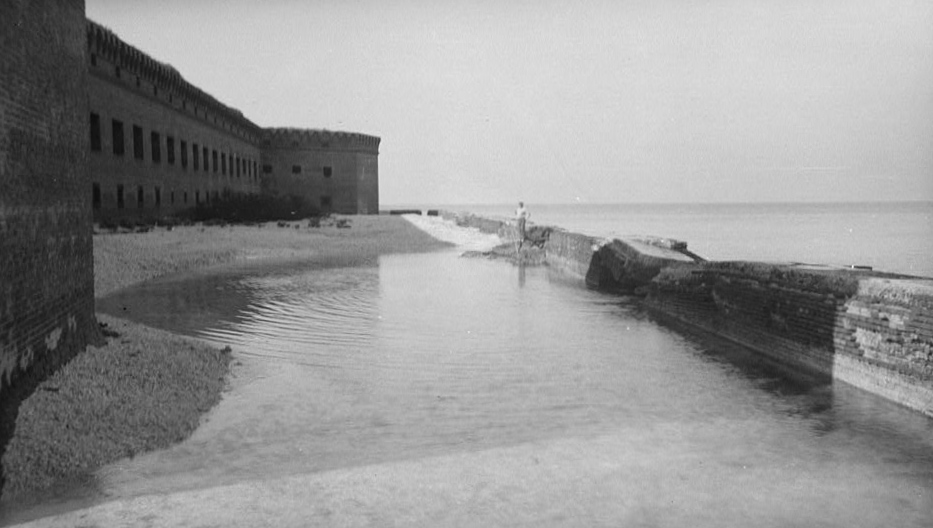
Fort Jefferson’s moat and wall, circa 1934, Dry Tortugas, Florida (C. E. Peterson, U.S. Library of Congress, public domain).
Although water quality was a challenge for members of the regiment at both of their duty stations in Florida, it became particularly problematic for Private Edward Frederick and the other 47th Pennsylvanians who were stationed at Fort Jefferson in 1863. According to Schmidt:
‘Fresh’ water was provided by channeling the rains from the city’s barbette through channels in the interior walls, to filter trays filled with sand; and finally to the 114 cisterns located under the fort which held, 1,231,000 gallons of water. The cisterns were accessible in each of the first level cells or rooms through a ‘trap hole’ in the floor covered by a temporary wooden cover…. Considerable dirt must have found its way into these access points and was responsible for some of the problems resulting in the water’s impurity…. The fort began to settle and the asphalt covering on the outer walls began to deteriorate and allow the sea water (polluted by debris in the moat) to penetrate the system…. Two steam condensers were available … and distilled 7000 gallons of tepid water per day for a separate system of reservoirs located in the northern section of the parade ground near the officers [sic, officers’] quarters. No provisions were made to use any of this water for personal hygiene of the [planned 1,500-soldier garrison force]….
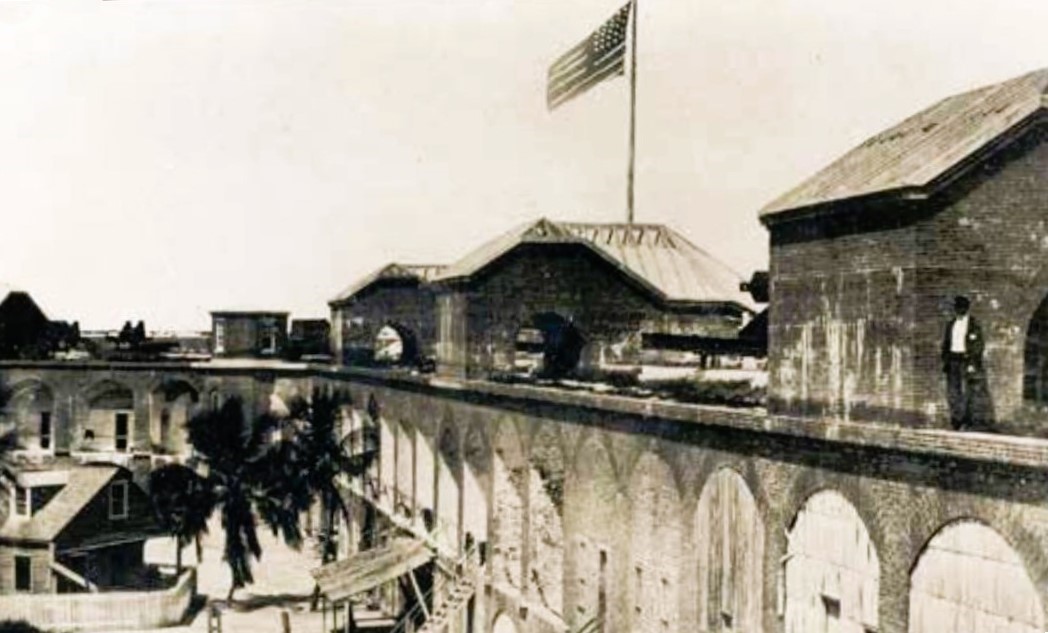
Second-tier casemates, lighthouse keeper’s house, sallyport, and lean-to structure, Fort Jefferson, Dry Tortugas, Florida, late 1860s (U.S. National Park Service and National Archives, public domain).
As a result, the soldiers stationed there washed themselves and their clothes, using saltwater from the ocean. As if that weren’t difficult enough, “toilet facilities were located outside of the fort,” according to Schmidt:
At least one location was near the wharf and sallyport, and another was reached through a door-sized hole in a gunport and a walk across the moat on planks at the northwest wall…. These toilets were flushed twice each day by the actions of the tides, a procedure that did not work very well and contributed to the spread of disease. It was intended that the tidal flush should move the wastes into the moat, and from there, by similar tidal action, into the sea. But since the moat surrounding the fort was used clandestinely by the troops to dispose of litter and other wastes … it was a continuous problem for Col. Alexander and his surgeon.
As for daily operations in the Dry Tortugas, there was a fort post office and the “interior parade grounds, with numerous trees and shrubs in evidence, contained officers’ quarters, [a] magazine, kitchens and out houses,” per Schmidt, as well as “a ‘hot shot oven’ which was completed in 1863 and used to heat shot before firing.” But the housing for Private Edward Frederick and his fellow soldiers was also not optimal.
Most quarters for the garrison … were established in wooden sheds and tents inside the parade [grounds] or inside the walls of the fort in second-tier gun rooms of ‘East’ front no. 2, and adjacent bastions … with prisoners housed in isolated sections of the first and second tiers of the southeast, or no. 3 front, and bastions C and D, located in the general area of the sallyport. The bakery was located in the lower tier of the northwest bastion ‘F’, located near the central kitchen….

Fort Jefferson, Dry Torguas, Florida (interior, circa 1934, C.E. Peterson, photographer, U.S. Library of Congress, public domain).
Despite those new threats to his health, Private Edward Frederick initially seemed that he was on track to make a miraculous recovery from the grievous head wound that he had sustained during the Battle of Pocotaligo less than three months earlier. But on or about 4 February 1863, because he was experiencing pain in his head, back and limbs, he was re-examined at Fort Jefferson’s post hospital by Assistant Regimental Surgeon Jacob H. Scheetz, M.D., and began to worry that he was actually not going to be okay.
During that examination, Dr. Scheetz discovered that Private Frederick was showing “marked symptoms of compression” in his skull, and sent word to their superiors that he was admitting Private Frederick into the post hospital at Fort Jefferson to provide further treatment. According to Dr. Scheetz:
The pupils were slightly dilated; pulse 75, and of moderate volume; severe headache, and alternate flashes of heat; anorexia. The tongue was covered with a heavy white fur. The bowels were torpid. Blisters were applied to the nape of the neck, and a cathartic given. He gradually grew weaker, notwithstanding the administration of tonics. Opiates were given to promote sleep. Partial paralysis of the lower extremities took place. His mind remained clear until about thirty-six hours before death. A comatose condition gradually set in, his pupils became much dilated, and he expired on February 16th, 1863.
Private Edward Frederick had fought his last battle as valiantly as anyone could, but it was a battle that he likely would not have even won today were he able to access advanced medical care from twenty-first-century physicians. According to the editors of Ballistic Trauma: A Practical Guide, “There are three mechanisms whereby a projectile can cause tissue injury”:
1. In a low-energy transfer wound, the projectile crushes and lacerates tissue along the track of the projectile, causing a permanent cavity. In addition, bullet and bone fragments can act as secondary missiles, increasing the volume of tissue crushed.
2. In a high-energy transfer wound, the projectile may impel the walls of the wound track radially outwards, causing a temporary cavity lasting 5 to 10 milliseconds before its collapse in addition to the permanent mechanical disruption produced….
3. In wounds where the firearm’s muzzle is in contact with the skin at the time of firing, tissues are forced aside by the gases expelled from the barrel of the fire, causing a localized blast injury.
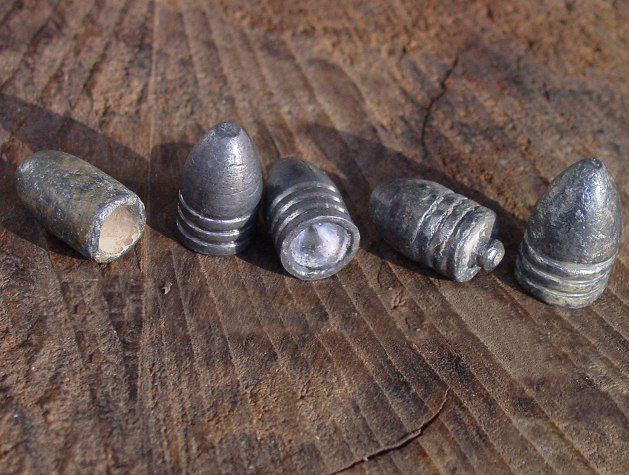
Examples of Minié balls used in many Union Army weapons during the American Civil War (Mike Crumpston, 2008, public domain).
As the musket ball had entered his skull at Pocotaligo, it would would have carried the dirt that covered it deep into his brain, along with fragments of bone that were created when the bullet fractured his skull, which would have caused an infection in his brain. Weakened by that trauma, his immune system was no match for the bacteria in the water that he subsequently drank and used for bathing while stationed at Fort Jefferson.
So, it will come as no surprise for readers to learn that, during a post-mortem examination of Private Frederick’s body, which was done twelve hours after his death, Dr. Scheetz discovered “a slight congestion of the membranes and a slight depression of the osseous matter beneath the seat of injury” in Private Frederick’s head.
An abscess was found in the left posterior lobe of the cerebrum, which contained about eight ounces of dark colored and very offensive pus. The sides of the cavity were lined by a yellowish white membrane, which was readily broken up by the fingers. The left anterior lobe was in a normal condition.
Interment

Union Army Columbiad on the Terreplein above the parade grounds at Fort Jefferson, Dry Tortugas, Florida, George A. Grant, 1937, U.S. National Park Service, public domain).
Following that post-mortem examination, the body of Private Edward Frederick was prepared for burial and then laid to rest with military honors in a grave on the parade grounds at Fort Jefferson. He had been twenty-seven years old when he died at the post hospital on 16 February 1863.
Sadly, the precise location of his final resting place has been erased by time.
What Happened to Edward Frederick’s Parents?
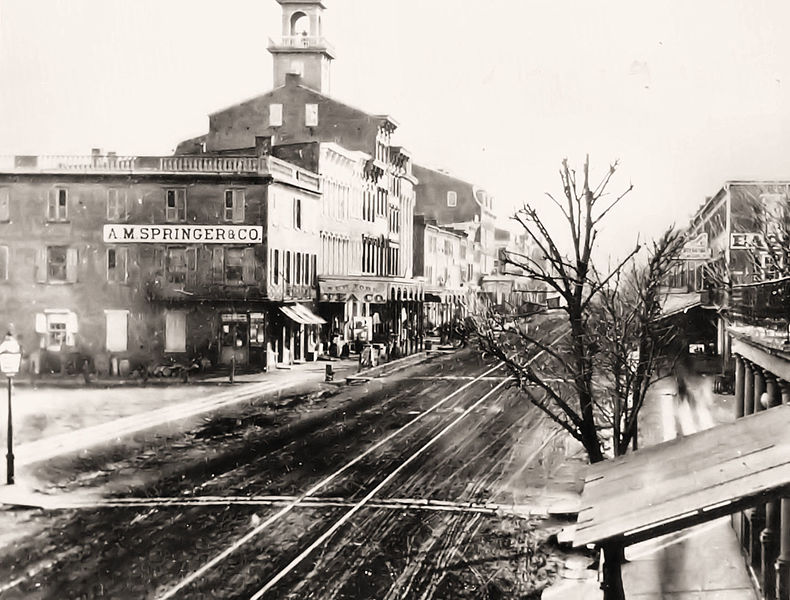
Hamilton Street, looking west from Center Square, Allentown, Pennsylvania, 1880 (public domain).
Edward Frederick’s parents, Nathan and Susanna (Spangler) Frederick both outlived him. Residents of Macungie Township in Lehigh County since 1860, their home near Trexlertown in Upper Macungie Township was visited in mid-July 1870 by a federal census enumerator who described Nathan Frederick as a hotel proprietor who owned personal property that was valued at one thousand dollars (the equivalent of roughly twenty-five thousand U.S. dollars in 2025). Also residing with them was their six-year-old granddaughter Ellen Fahringer, who was a daughter of Marietta (Frederick) Fahringer.
On 7 April 1880, Nathan Frederick ran an advertisement in The Allentown Democrat, announcing that a “Great Sign-Raising!” would take place on 16 April “at the ‘Jordan Hotel,’ on North Fifth Street, Allentown, on the public road leading from the Court House to Catasauqua, a short distance beyond the Fair Ground, at the Jordan creek.” He added that the sign was “artistically painted,” and stated that a “grand ball” would be held that evening during which “refreshments” would be served and “a good Orchestra” would perform. “The public in general from far and near are invited to be present and join in the sport.”
Still operating a hotel by June of 1880, Nathan Frederick had moved his wife into a home at 382 Furnace Street in Allentown. Also living with them was Nathan’s seventy-six-year-old sister, Elizabeth Frederick. Residing nearby, at 323 Furnace Street, was Nathan’s daughter, Susanna (Frederick) Dorney, and her farm laborer husband, Tilghman Dorney, and their sons, Benjamin and Oscar. According to The Allentown Democrat, Nathan Frederick had been the manager of the Lady Thorne Hotel Clapboardtown during the late 1870s and early 1880s, before taking over as the manager of the “Idlewild, on the Lehigh Mountain,” during the spring of 1881. Then, after a long, full life, Nathan Frederick passed away in Allentown at the age of eighty-one years, four months and ten days, on 13 December 1893. Following funeral services at the Zion Lehigh Church in Alburtis, Lehigh County, he was laid to rest at that church’s cemetery on 16 December.
Nathan’s widow, Susanna (Spangler) Frederick, subsequently followed her husband in death on 16 April 1896. Eighty years, eleven months and seventeen days old at the time of her passing in Allentown, she was subsequently laid to rest beside him at the Zion Lehigh Church Cemetery.
What Happened to Edward Frederick’s Siblings?

The capitulation and surrender of Robt. E. Lee and his army at Appomattox C.H., Va. to Lt. Gen. U.S. Grant. April 9th 1865 (Kurz & Allison, 16 September 1885, U.S. Library of Congress, public domain).
Edward Frederick’s older brother, Tilghman S. Frederick, who had married Hettie M. Krause (1837-1887) sometime during the early 1860s, and had then welcomed the birth with her of son Henry W. Frederick, circa 1862, then went on to perform his own military service during the American Civil War. Initially enrolled as a private with Company K of the 41st Pennsylvania Militia, Emergency of 1863, from 1 July through early August of 1863 when that temporary militia unit was disbanded, he then served as a private with Company G of the 198th Pennsylvania Volunteer Infantry, which was attached to the U.S. Army of the Potomac during the Siege of Petersburg, Virginia. After initially engaging with Confederate troops in the Battle of Peeble’s Farm/Poplar Springs Church on 30 September 1864, he then fought in multiple, intense battles, including: Boydton Plank Road/Hatcher’s Run (27-28 October 1864), Warren’s Raid to the Weldon Railroad (7-12 December 1864) and Dabney’s Mills/Battle of Hatcher’s Run (5-7 February 1865). Assigned to the decisive Appomattox Campaign from 28 March to 9 April 1865, he and his fellow 198th Pennsylvanians then fought in the bloody and costly Battle of Lewis Farm near Gravelly Run (29 March 1865), followed by the battles of White Oak Road (30-31 March), Five Forks (1 April) and Appomattox Court House (9 April), where they then witnessed history as General Robert E. Lee surrendered his troops to Union Lieutenant-General Ulysses S. Grant. After participating with his regiment in the Union’s Grand Review of the National Armies in late May 1864, Private Tilghman S. Frederick was officially mustered out with his company on 4 June 1865, and allowed to return to his wife, Hettie, and their sons, Henry and George, in Pennsylvania’s Lehigh Valley.
* Note: Private Tilghman Frederick’s son, George M. Frederick (1864-1936), had been born in Lehigh County, Pennsylvania on 7 November 1864, while Tilghman was serving with the 198th Pennsylvania Volunteers in Virginia during the American Civil War. (George M. Frederick would later go on to wed Isabella DeLong.)
More children soon followed: Wilson J. Frederick (1866-1867), who was born on 17 January 1866, but then died at the age of one on 18 November 1867; Victor N. Frederick (1868-1870), who was born on 17 May 1868, but then died at the age of two on 15 August 1870; and Harry Frederick (1873-1933), who was born in Lehigh County on 5 March 1873 and would later become an unmarried laborer at a rolling mill. Widowed by his wife, Hettie M. (Krause) Frederick in 1887, Tilghman S. Frederick resided in Slatington, Lehigh County during the final years of his life. Having lost his wife in 1887 and his mother in April of 1896, and still unable to find a job after repeated attempts to do so during the 1890s, he grew increasingly despondent, and ended his life “by drowning himself in an abandoned ore pit near Ironton,” on 16 July 1896, according to Allentown’s Morning Call newspaper. Tilghman S. Frederick may also have been suffering from post-traumatic stress disorder (PTSD), as a direct result of his intense combat experiences during the American Civil War. A condition known as “Soldier’s Heart” during the war, it was poorly undrrstood at that time and, even today, is often not well managed by physicians who care for combat veterans. Following his death in Ironton at the age of sixty-one, Tilghman S. Frederick was laid to rest at the Friedens Church Cemetery in Friedens, Lehigh County.
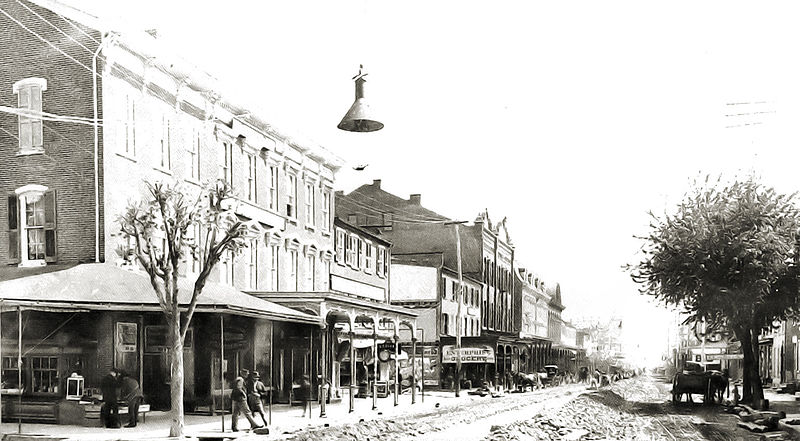
Ninth and Hamilton Streets, Allentown, Pennsylvania (looking East, circa 1891, public domain).
Following her marriage to Tilghman Dorney in 1857, Edward Frederick’s older sister, Susanna (Frederick) Dorney (1836-1902), had settled with her husband in Allentown, where she had welcomed the births of Charles Benjamin Dorney (1860-1947) and Oscar Joseph Dorney (1862-1948) on 22 November 1860 and 26 June 1862, respectively. Residents of Allentown’s First Ward in 1870, the quartet continued to reside together in Allentown into the 1880s. By 1900, however, Susanna and her husband were “empty nesters” at their home in the Eighth Ward of Allentown, where her husband worked as a teamster. Two years later, she was gone, having passed away at the age of sixty-six in Allentown, on 28 June 1902. Following funeral services, Susanna (Frederick) Dorney was laid to rest at Allentown’s Highland Park Memorial Cemetery.
Following her marriage to farmer George W. Fahringer, Edward Frederick’s sister, Marietta Frederick (1842-1915), settled with her husband in Lehigh County, where they had welcomed the births of: George Nathan Allender Fahringer (1863-1945), who was born in Wescosville on 24 January 1863, was known to family and friends as “Elmer” and later wed and was widowed by Annie Ellis Virginia Reppert (1870-1897), before marrying (Catherine Elizabeth (Moll) Grubb (1862-1929); Allen Calvin Fahringer (1866-1923), who was born on 17 February 1867 and later wed Minnie Haas (1872-1938); Agnes Susannah Fahringer (1872-1939), who was born on the Fourth of July in 1872 and later wed Harry Strauss; Constantine Fahringer (1873-1957), who was born in South Whitehall Township on 11 August 1873 and later wed Hannah Louise Hausman (1875-1946); and Weston Fahringer (1876-1902), who was born in South Whitehall Township on 23 November 1876 and later wed Emma L. Albright (1877-1963). During the 1870s and 1880s, Marietta (Frederick) Fahringer resided with her husband and their children near South Whitehall in South Whitehall Township, Lehigh County. Ailing with pneumonia during the final weeks of her life, she died at the age of seventy-five, at the home of her son, Constantine Fahringer, in Whitehall, Lehigh County, on 1 December 1915, and was laid to rest at the Jordan Reformed Church Cemetery in Allentown.
Following her marriage to Henry Miller sometime during the early 1860s, Edward Frederick’s youngest sister, Anna Matilda (Frederick) Miller (1848-1943), had also settled in Lehigh County with her own husband, Henry Miller. Together, they had then welcomed the births of: Sydney Isola Miller (1867-1942), who was born on 10 March 1867 and would later wed Allen Jerome Corbin (1863-1945); and Morris Nathan Miller (1869-1906), who was born on 13 February 1869 and would later became a furniture finisher. By 1870, she was residing with her husband and young sons in Hanover Township, Lehigh County, near the Borough of Catasauqua, where her husband was employed as watchman for a railroad company. Their daughter, Dora Jennie Miller (1873-1943), was then born in Allentown in 1873. (Dora would later go on to marry Sylvanus O. Reichard.) By 1880, the quintet resided in Salisbury Township, Lehigh County, supported by the furnace worker wages of Anna’s husband, who then widowed her when he died in his mid to late forties in Newark, New Jersey, on 1 December 1895. Anna Matilda (Frederick) Miller then followed her husband in death roughly two years later; she was laid to rest at Allentown’s Union-West End Cemetery.
Sources:
- Bates, Samuel P. History of Pennsylvania Volunteers, 1861-5, vol. 1: “Forty-Seventh Regiment.” Harrisburg, Pennsylvania: B. Singerly, State Printer, 1869.
- Bates, Samuel P. History of Pennsylvania Volunteers, 1861-5, vol. 5: “Forty-First Regiment,” and “One Hundred and Ninety-Eighth Regiment.” Harrisburg, Pennsylvania: B. Singerly, State Printer, 1871.
- “Case. — Private Edward F________ , Co. K, 47th Pennsylvania Volunteers,” in The Medical and Surgical History of the War of the Rebellion, part 1, vol. 2, p. 251. Washington, D.C.: Office of the Surgeon General, U.S. Army, 1870.
- Dorney, Tilghman, Susanna (Edward Frederick’s older sister), Chas. B., and James, in U.S. Census (Allentown, First Ward, Lehigh County, Pennsylvania, 1870, 1880). Washington, D.C.: U.S. National Archives and Records Administration.
- Dorney, Tilghman and Susanna (Edward Frederick’s older sister), in U.S. Census (Allentown, Eighth Ward, Lehigh County, Pennsylvania, 1900). Washington, D.C.: U.S. National Archives and Records Administration.
- Fahringer, George, Marietta (Edward Frederick’s sister), George, Calvin, and Susan, in U.S. Census (South Whitehall, South Whitehall Township, Lehigh County, Pennsylvania, 1870). Washington, D.C.: U.S. National Archives and Records Administration.
- Fahringer, George, Mariette (Edward Frederick’s sister), Elmer, Susannah, Constantine, and Weston, in U.S. Census (South Whitehall Township, Lehigh County, Pennsylvania, 1880). Washington, D.C.: U.S. National Archives and Records Administration.
- “Florida’s Role in the Civil War,” in Florida Memory. Tampa, Florida: Florida Center for Instructional Technology, College of Education, University of South Florida, retrieved online 15 January 2020.
- Fradrick [sic, “Frederick”], Tilghman (the older brother of Edward Frederick), Hettie, Henry W., George M. L., and Victor N., in U.S.Census (Slatington, Washington Township, Lehigh County, Pennsylvania, 1870). Washington, D.C.: U.S. National Archives and Records Administration.
- “Frederick” (obituary of Edward Frederick’s father, Nathan Frederick), in “Died.” Allentown, Pennsylvania: The Morning Critic, 15 December 1893.
- “Frederick” (obituary of Edward Frederick’s mother, Susanna (Spangler) Frederick), in “Died.” Allentown, Pennsylvania: The Morning Call, 18 April 1896.
- Frederick, Edward, in Civil War Muster Rolls (Company K, 47th Pennsylvania Infantry). Harrisburg, Pennsylvania: Pennsylvania State Archives.
- Frederick, Edward, in Civil War Veterans’ Card File, 1861-1866 (Company K, 47th Pennsylvania Infantry). Harrisburg, Pennsylvania: Pennsylvania State Archives.
- Frederick, Edward, in “Record of Interments in Post Cemetery at Fort Jefferson, Florida” (date of death: 16 February 1863). Washington, D.C.: U.S. National Archives and Records Administration.
- Frederick, Edward, Nathan (father) and Susannah (mother), in U.S. Civil War Pension General Index Cards (father’s application no.: 271489, filed by the soldier’s father, 26 June 1880; mother’s application no.: 315417, certificate no.: 239746, filed by the soldier’s mother from Pennsylvania, 6 May 1884). Washington, D.C.: U.S. National Archives and Records Administration.
- Frederick, Nathan, Susanna (mother), Tillman [sic, “Tilghman”], Susanna (daughter), Edwin [sic, “Edward”], Maryetta [sic, ” Marietta”], and Anna M.; and Youse, Jonas (servant), in U.S. Census (Longswamp Township, Berks County, Pennsylvania, 1850). Washington, D.C.: U.S. National Archives and Records Administration.
- Frederick, Nathan, Susan and Anna; Mohr, Catharine (servant); and Reichenbach, Sarah, in U.S. Census (Macungie, Lower Macungie Township, Lehigh County, Pennsylvania, 1860). Washington, D.C.: U.S. National Archives and Records Administration.
- Frederick, Nathan and Susana; and Faringer, Ellen (their granddaughter), in U.S. Census (Trexlertown, Upper Macungie Township, Lehigh County, Pennsylvania, 1870). Washington, D.C.: U.S. National Archives and Records Administration.
- Frederick, Tilghman S., in Civil War Muster Rolls (Company K, 41st Pennsylvania Militia, Emergency of 1863 and Company G, 198th Pennsylvania Infantry). Harrisburg, Pennsylvania: Pennsylvania State Archives.
- Frederick, Tilghman S., in Civil War Veterans’ Card File, 1861-1866 (Company K, 41st Pennsylvania Militia, Emergency of 1863 and Company G, 198th Pennsylvania Infantry). Harrisburg, Pennsylvania: Pennsylvania State Archives.
- Frederick, Tilghman, Hettie, Henry, and Harry, in U.S. Census (Washington Township, Lehigh County, Pennsylvania, 1880). Washington, D.C.: U.S. National Archives and Records Administration.
- Frederig [sic, “Frederick”], Nathan and Susan (the parents of Edward Frederick); and Frederig, Elizabeth (the sister of Nathan Frederick); and Dorney, Tilghman (Nathan Frederick’s daughter and a sister of Edward Frederick), Benjamin, and Oscar, in U.S. Census (Allentown, Fifth Ward, Lehigh County, Pennsylvania 1880). Washington, D.C.: U.S. National Archives and Records Administration.
- Grodzins, Dean and David Moss. “The U.S. Secession Crisis as a Breakdown of Democracy,” in When Democracy Breaks: Studies in Democratic Erosion and Collapse, from Ancient Athens to the Present Day (chapter 3). New York, New York: Oxford University Press, 2024.
- “Hello! Hello! Hello! Great Sign-Raising!” (advertisement for a publicity event sponsored by Edward Frederick’s father, hotelier Nathan Frederick). Allentown, Pennsylvania: The Allentown Democrat, 7 April 1880.
- Horwitz, Tony. “Did Civil War Soldiers Have PTSD?”, in Smithsonian Magazine, January 2015. Washington, DC: Smithsonian Institution.
- Jones, Jonathan S. “Opium Slavery: Civil War Veterans and Opiate Addiction,” in The Journal of the Civil War Era, vol. 10, no. 2, June 2020, pp. 185-212. Chapel Hill, North Carolina: The University of North Carolina Press.
- “Local Record” (mention of two hotels managed by Edward Frederick’s father, Nathan Frederick.” Allentown, Pennsylvania: The Allentown Democrat, 2 March 1881.
- Mahoney, Peter F., James Ryan, et. al. Ballistic Trauma: A Practical Guide, Second Edition, pp. 31-66, 91-121, 168-179, 356-395, 445-464, 535-540, 596-605. London, England: Springer-Verlag London Limited, 2005.
- Miller, Henry, Anna (the youngest sister of Edward Frederick), Sydney, and Morris, in U.S. Census (Catasauqua, Hanover Township, Lehigh County, Pennsylvania, 1870). Washington, D.C.: U.S. National Archives and Records Administration.
- Miller, Henry, Anna M. (the youngest sister of Edward Frederick), Sydnah J., Morris N., and Jenney [sic, “Doris Jennie”], in U.S. Census (Salisbury Township, Lehigh County, Pennsylvania, 1880). Washington, D.C.: U.S. National Archives and Records Administration.
- “Mrs. George Fahringer” (obituary of Edward Frederick’s sister, Marietta (Frederick) Fahringer). Allentown, Pennsylvania: The Morning Call, 2 December 1915.
- Nathan Frederick (Edward Frederick’s father), in “The Granting of Licenses.” Allentown, Pennsylvania: The Allentown Democrat, 30 April 1879.
- Schmidt, Lewis. A Civil War History of the 47th Regiment of Pennsylvania Veteran Volunteers. Allentown, Pennsylvania: Self-published, 1986.
- “The History of the Forty-Seventh Regt. P. V.” Allentown, Pennsylvania: The Lehigh Register, 20 July 1870.
- “Was Weary of Life: Tilghman Frederick Drowned Himself Near Ironton” (death of Edward Frederick’s older brother). Allentown, Pennsylvania: The Morning Call, 17 July 1896.
- Wharton, Henry D. “Letters from the Sunbury Guards,” 1861-1865. Sunbury, Pennsylvania: The Sunbury American.
 47th Pennsylvania Volunteers
You must be logged in to post a comment.