Alternate Surname Spellings: Sailor, Saler, Sayler, Saylor, Sehler
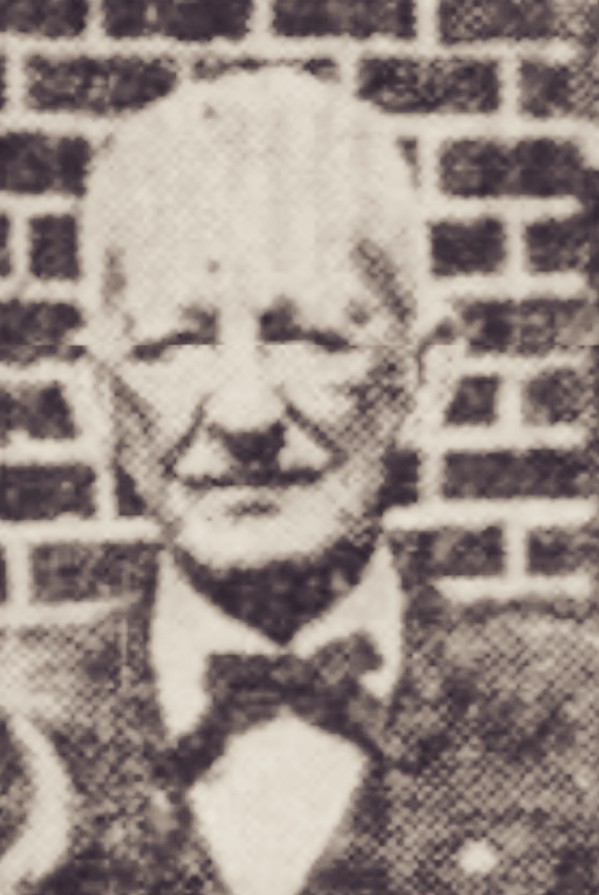
47th Pennsylvania veteran John Edward Saylor (1846-1931), shown here in 1929 (public, domain).
A veteran of the American Civil War who witnessed many historic changes that transformed the economic, political and cultural landscapes of the United States from the mid-1800s through the early 1900s, John Edward Saylor (1847-1931) also became a “living bridge” to present-day history by fathering multiple children — two of whom lived on into the final years of the twentieth century.
One of those surviving sons literally spent his first ten years hearing stories about the American Civil War, first hand, from a man who had actually fought in the American Civil War and was still sharp enough to talk about it.
Another, who could be credited with having heard the actual voice of Civil War veteran John E. Saylor while cradled in his arms as an infant, died just months shy of the twenty-first century, illustrating one simple truth — the American Civil War was recent history, not part of America’s “distant past.”
Formative Years
Born in Montgomery County, Pennsylvania on 6 March 1846, John Edward Saylor (1846-1931) was a son of Montgomery County natives John Keeley Saylor (1807-1885; alternate dates: 1812-1884) and Harietta (Favinger) Saylor (1822-1868), who was a daughter of German immigrant Frederick Favinger (1782-1822) and Montgomery County, Pennsylvania native Catharine (Huber) Favinger (1785-1853).
* Note: The given name of John Edward Saylor’s mother was listed on census, church and other records of the nineteenth century as: “Hannah”, “Harietta” or “Henrietta.” Although her maiden named was sometimes spelled as “Faringer” or “Fahringer” on records during that era, her surname was actually spelled as “Favinger,” according to her father’s last will and testament.
John E. Saylor was raised and educated in Limerick Township, Montgomery County with his Montgomery County-born siblings: William H. Saylor (1841-unknown), who was born in 1841, and would later serve as a private with Company F of the 6th Pennsylvania Volunteers during the American Civil War; Emalina Saylor (circa 1844-1931), who was born circa 1844, was known to family and friends as “Emma” and would later wed Almon T. Reynolds (1836-1904); Catharine Saylor (circa 1849-1920), who was born circa 1849 and would later wed Samuel Seiple (circa 1851-1904); Mary Alice Saylor (1852-1932), who was born in March 1852 and would later wed wheelwright William H. Hangen (1850-1918) and settle with him in Allentown, Lehigh County, Pennsylvania; Hannah M. Saylor (1856-1945), who was born in November 1856 (alternate birth year: 1855) and would later migrate west to Seneca County, Ohio, where she would be employed as an unmarried, live-in servant at the farmhouse of George and Mary Good, before marrying Albert S. Hoch (1855-1932) in Seneca County in 1881 and then migrating with him to Kansas; Franklin F. Saylor (1858-1922), who was born on 15 April 1858 and would later work for the Commonwealth of Pennsylvania’s Fisheries Department as the Pennsylvania State Fisheries warden; Edwin Saylor (1863-1916), who was born on 17 January 1863 and would later migrate west to Seneca County, Ohio; and Adaline Saylor (circa 1867-1956), who was born circa 1867 (alternate birth years: 1856, 1866, 1872), would never marry and would reside for many years at the home of her older sister, Emalina, in Troy, Rensselaer County, New York.
By 1850, the Saylor family’s patriarch and farmer, John Keeley Saylor owned land that was valued at one thousand and one hundred dollars (the equivalent of nearly forty-six thousand U.S. dollars in 2026) by that year’s federal census enumerator.
By 1860, however, John E. Saylor, was living and working on his family’s farm in Seiberlingsville, Weisenberg Township, Lehigh County, Pennsylvania with his parents and siblings: William, Emalina, Catherine, Mary, and Franklin. The family’s patriarch, John Keeley Saylor had built up a nest egg that was valued at one thousand dollars (thecequivalent of roughly thirty-nine thousand U.S. dollars in 2026). Also residing with the family that year was Henry Shader, a thirty-five-year-old laborer from Prussia.
But their seemingly stable lives and the lives of their friends and neighbors were about to change dramatically — changes that were sparked by the secession of South Carolina from the United States in December 1860 and would continue well into that new and transformative decade.
American Civil War

Map of key 1864 Red River Campaign locations, showing the battle sites of Sabine Cross Roads, Pleasant Hill and Mansura in relation to the Union’s occupation sites at Alexandria, Grand Ecore, Morganza, and New Orleans (excerpt from Dickinson College/U.S. Library of Congress map, public domain).
At the age of seventeen, John Edward Saylor was finally able to persuade his parents to let him join the Union Army’s effort to end the national secession crisis and disastrous civil war that had ravaged so much of their beloved nation. After enrolling in the city of Reading in Berks County, Pennsylvania on 23 February 1864, he officially mustered in there that same day as a private with Company K of the battle-hardened 47th Pennsylvania Volunteer Infantry — just as that regiment was about to embark on one of the most important periods of its history-making service to the nation — as the only army unit from the Commonwealth of Pennsylvania to take part in the Union’s 1864 Red River Campaign across Louisiana.
However, he did not begin his military service right away. According to regimental muster rolls, he joined the 47th Pennsylvania Volunteer Infantry from a “recruiting depot” on 30 May 1864, the timing of which meant that he did not reach his regiment until after it had completed the majority of that campaign’s battles.
Military records at that time described Private Saylor as an eighteen-year-old “ostler” and resident of Montgomery County who was five feet, three inches tall with light hair, blue eyes and a light complexion.
End of the Red River Campaign and Return to the Eastern Theater of War

Union Army base at Morganza Bend, Louisiana, circa 1863-1865 (U.S. Library of Congress, public domain).
Reaching his regiment while it was still stationed at the large U.S. Army of the Gulf encampment near Morganza, Louisiana, Private John E. Saylor was arriving just weeks before nine formerly enslaved Black men who had enlisted with the 47th Pennsylvania in Beaufort, South Carolina (1862) and Natchitoches, Louisiana (April 1864) would officially be mustered into the regiment (between 20-24 June 1864). Subsequently ordered to head for new duties in New Orleans, the 47th Pennsylvania Volunteers arrived there later that month.
Less than a week later, the 47th Pennsylvania’s command staff received orders to move the regiment back to the East Coast and began loading their men onto ships in two stages. Companies A, C, D, E, F, H, and I steamed for the Washington, D.C. area beginning 7 July while the men from Companies B, G and K, including Private John E. Saylor, remained behind on detached duty while awaiting transportation. Led by F Company Captain Henry S. Harte, that second group finally sailed away at the end of the month aboard the Blackstone. Arriving in Virginia on 28 July, they reconnected with the bulk of the regiment at Monocacy, Virginia on 2 August. Unfortunately, they missed the opportunity to have a memorable encounter with President Abraham Lincoln on 12 July 1864. (They also then missed the mid-July Battle of Cool Spring at Snicker’s Gap, Virginia later that same month.)
Sheridan’s 1864 Shenandoah Valley Campaign
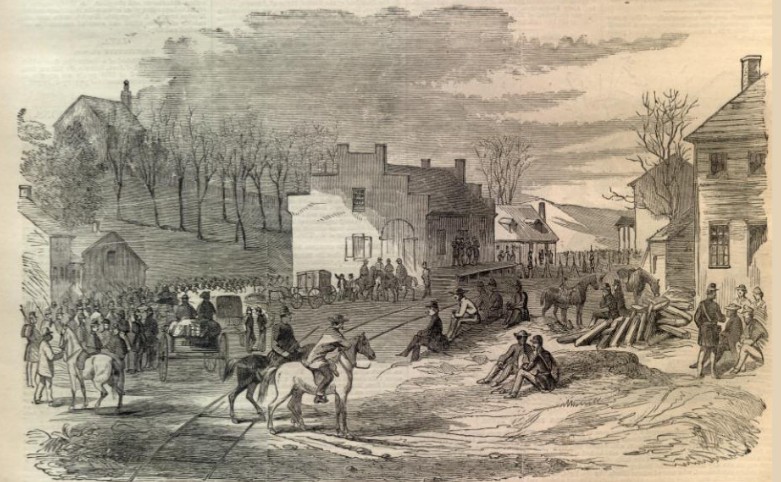
“The Rendezvous of the Virginians at Halltown, Virginia, 5 p.m. on April 18, 1861 to March on Harper’s Ferry” (D. H.Strother, Harper’s Weekly, 11 May 1861, public domain).
On 1 August, the men of K Company received word that their own First Sergeant Matthias Miller would be advanced to the rank of second lieutenant; in addition, Corporal Franklin Beisel became First Sergeant Beisel that same day, and Private Samuel Reinert was promoted to the rank of corporal.
Attached to the Middle Military Division, U.S. Army of the Shenandoah beginning in early August, and placed under the command of legendary Union Major-General Philip H. Sheridan (“Little Phil”), the 47th Pennsylvania Volunteer Infantry was assigned to defensive duties in and around Halltown, and also engaged over the next several weeks in a series of back-and-forth movements between Halltown, Berryville, Middletown, Charlestown, and Winchester as part of a “mimic war” being waged by Sheridan’s Union forces with those commanded by Confederate Lieutenant-General Jubal Early.
The 47th Pennsylvania then engaged with Confederate troops in the Battle of Berryville, Virginia from 3-4 September. Several men were killed or wounded in action, including Private George Kilmore (alternate spelling “Killmer”), who sustained a fatal gunshot wound to the abdomen on 5 September.
On 14 September, K Company Corporal Elias F. Benner was promoted to the rank of sergeant. Men departing from the 47th Pennsylvania Volunteers around that same time were: Company D’s Captain Henry Woodruff, E Company’s Captain Charles H. Yard and Captain Harte of F Company, as well as K Company’s Sergeant-Major Conrad Volkenand, Sergeant Peter Reinmiller, Corporals Lewis Benner and George Knuck, and Privates Valentine Amend, M. Bornschier, Charles Fisher, Charles Heiney, Jacob Kentzler, John Koldhoff, Anthony Krause, Elias Leh, Samuel Madder, Lewis Metzger, Alfred Muthard, John Schimpf, John Scholl, and Christopher Ulrich. All mustered out at Berryville, Virginia on 18 September 1864 upon expiration of their respective three-year terms of service.
Those members of the 47th who remained on duty, including Private John E. Saylor, were about to engage in their regiment’s greatest moments of valor.
Battles of Opequan and Fisher’s Hill

Battle of Opequan (aka Third Winchester), Virginia, 19 September 1864 (public domain).
Together with other regiments under the command of Union Major-General Sheridan and Brigadier-General William H. Emory, commander of the 19th Corps (XIX Corps), Private John E. Saylor and his fellow 47th Pennsylvanians helped to inflict heavy casualties on Lieutenant-General Early’s Confederate forces in the Battle of Opequan (also spelled as “Opequon” and referred to as “Third Winchester”). The battle is still considered by many historians to be one of the most important during Sheridan’s 1864 campaign; the Union’s victory here helped to ensure the reelection of President Abraham Lincoln.
The 47th Pennsylvania’s march toward destiny at Opequan began at 2 a.m. on 19 September 1864 as the regiment left camp and joined up with others in the Union’s 19th Corps. Advancing slowly from Berryville toward Winchester, the 19th Corps became bogged down for several hours by the massive movement of Union troops and supply wagons, enabling Early’s men to dig in. Finally reaching the Opequon Creek [present-day spelling], Sheridan’s men came face to face with Early’s Confederate Army. The fighting, which began in earnest at noon, was long and brutal. The Union’s left flank (6th Corps) took a beating from Confederate artillery stationed on high ground.
Meanwhile, the 47th Pennsylvania and the 19th Corps were directed by Brigadier-General Emory to attack and pursue Major-General John B. Gordon’s Confederate forces. Some success was achieved, but casualties mounted as a Confederate artillery group opened fire on Union troops trying to cross a clearing. When a nearly fatal gap began to open between the 6th and 19th Corps, Sheridan sent in units led by Brigadier-Generals Emory Upton and David A. Russell. Russell, hit twice — once in the chest, was mortally wounded.

Victory of Philip Sheridan’s Union Army over Jubal Early’s Confederate forces, Battle of Opequan, 19 September 1864 (Kurz & Allison, circa 1893, U.S. Library of Congress, public domain).
The 47th Pennsylvania subsequently opened its lines long enough to enable the Union cavalry under William Woods Averell and the foot soldiers of Brigadier-General George Crook to charge the Confederates’ left flank. As the 19th Corps began pushing the Confederates back, with the 47th involved in the thick of the fight, Early’s “grays” retreated. Sheridan’s “blue jackets” ultimately went on to win the day.
That same day (on 19 September), Privates Samuel Kunfer, William Landis and Christian Weidenbach were promoted to the rank of corporal.
Leaving twenty-five hundred wounded behind, the Rebels retreated to Fisher’s Hill, eight miles south of Winchester (21-22 September). Among the 47th Pennsylvanians listed on the casualty rosters following the Battle of Fisher’s Hill was Private James M. Sieger of Company K, who had sustained a wound above one of his knees but would survive after receiving treatment from army surgeons.
Following a successful early morning flanking attack by Sheridan’s Union men which outnumbered Early’s three to one, Early’s Confederates then fled to Waynesboro. The 47th Pennsylvania Volunteers were among those sent out in skirmishing parties.
Afterward, they made camp at Cedar Creek. They would continue to distinguish themselves in battle, but they would do so without two more of their respected commanders: Colonel Tilghman H. Good and Good’s second in command, Lieutenant-Colonel George Alexander, who mustered out 23-24 September upon the expiration of their respective terms of service. Fortunately, they were replaced with leaders who were equally respected for their front-line experience and temperament, including Major John Peter Shindel Gobin, formerly of the 47th’s Company C, who had been promoted up through the officers’ ranks to a position on the regimental command staff (and who would be promoted again on 4 November to the rank of lieutenant-colonel and regimental commanding officer).
On 26 September, Private Edwin Person became Corporal Person.
Battle of Cedar Creek

Alfred Waud’s 1864 sketch, “Surprise at Cedar Creek,” captured the flanking attack on the rear of Union Brigadier-General William Emory’s 19th Corps by Lieutenant-General Jubal Early’s Confederate army, and the subsequent resistance by Emory’s troops from their Union rifle-pit positions, 19 October 1864 (public domain).
During the fall of 1864, Major-General Sheridan began the first of the Union’s true “scorched earth” campaigns, starving the enemy into submission by destroying Virginia’s farming infrastructure. Viewed through today’s lens of history as inhumane, the strategy claimed many innocents — civilians whose lives were cut short by their inability to find food. This same strategy, however, almost certainly contributed to the further turning of the war’s tide in the Union’s favor during the Battle of Cedar Creek on 19 October 1864. Successful throughout most of their engagement with Union forces at Cedar Creek, Early’s Confederate troops began peeling off in ever growing numbers to forage for food, thus enabling the 47th Pennsylvania and others under Sheridan’s command to rally and win the day.
From a military standpoint, it was another impressive, but heartrending encounter. During the morning of 19 October, Early launched a surprise attack directly on Sheridan’s Cedar Creek-encamped forces. Early’s men were able to capture Union weapons while freeing a number of Confederates who had been taken prisoner during previous battles — all while pushing seven Union divisions back. According to Bates:
When the Army of West Virginia, under Crook, was surprised and driven from its works, the Second Brigade, with the Forty-seventh on the right, was thrown into the breach to arrest the retreat…. Scarcely was it in position before the enemy came suddenly upon it, under the cover of fog. The right of the regiment was thrown back until it was almost a semi-circle. The brigade, only fifteen hundred strong, was contending against Gordon’s entire division, and was forced to retire, but, in comparative good order, exposed, as it was, to raking fire. Repeatedly forming, as it was pushed back, and making a stand at every available point, it finally succeeded in checking the enemy’s onset, when General Sheridan suddenly appeared upon the field, who ‘met his crest-fallen, shattered battalions, without a word of reproach, but joyously swinging his cap, shouted to the stragglers, as he rode rapidly past them – “Face the other way, boys! We are going back to our camp! We are going to lick them out of their boots!’”

Sheridan Rallying His Troops, Battle of Cedar Creek, Virginia, 19 October 1864 (U.S. Library of Congress, public domain).
In response, Union troops staged a decisive counterattack that punched Early’s forces into submission. Afterward, the men of the 47th were commended for their heroism by General Stephen Thomas who, in 1892, was awarded the Medal of Honor for his own “distinguished conduct in a desperate hand-to-hand encounter, in which the advance of the enemy was checked” that day. Bates described the 47th’s actions:
When the final grand charge was made, the regiment moved at nearly right angles with the rebel front. The brigade charged gallantly, and the entire line, making a left wheel, came down on his flank, while engaging the Sixth Corps, when he went “whirling up the valley” in confusion. In the pursuit to Fisher’s Hill, the regiment led, and upon its arrival was placed on the skirmish line, where it remained until twelve o’clock noon of the following day. The army was attacked at early dawn…no respite was given to take food until the pursuit was ended.
Once again, casualties for the 47th were high. C Company Sergeant William Pyers was cut down and later buried on the battlefield. Privates Lewis Berliner and Lewis Schneck of K Company were also killed in action, as was Private Moses Klotz, who sustained a fatal head wound. K Company Private John Kolb (alternate spelling: “Kolp”) died two days later from an unseen foe. (He succumbed to typhoid fever at the Jarvis General Hospital in Baltimore on 21 October 1864.) Sergeant William H. Burger of Company K, who had fought valiantly to survive the wound to his head by an artillery shell fragment or musket ball (a wound that compressed his brain), ultimately died from that traumatic brain injury on 5 November 1864 at the Union Army’s Satterlee General Hospital in Philadelphia.
Private Benjamin Zellner, twice wounded during the Battle of Pleasant Hill, Louisiana, had been wounded again — twice — via a gunshot wound to his right thigh and by bayonet so grievously that the wound reportedly never healed properly. But he survived — as did Private Harrison Fegely, who had been wounded so seriously that, after recuperating, he would be transferred to Company E of the 21st Regiment, 1st Battalion of the Veteran Reserve Corps (also known as the “invalid corps”). Conversely, First Lieutenant David K. Fetherolf, who had also been seriously wounded, was permitted to return home after recuperating enough to be discharged on 17 November 1864. (Sadly, he then died at home during the summer of 1865.)
Still others were captured and held as prisoners of war, however; several died while being held at the notorious Confederate Army prison camp at Salisbury, North Carolina. One, who had barely survived the even deadlier POW camp known as “Andersonville,” had died shortly thereafter at his mother’s house. K Company Corporals Joseph Frack and William Landis were more fortunate, as was Private James Strauss; wounded in action, they avoided capture, recovered from their wounds and continued to serve with the regiment, as did Regimental Chaplain William Rodrock, who had suffered a near miss when a bullet had pierced his cap during the intense fighting.

Charlestown West Virginia, circa 1863 (public domain).
Following those major engagements, the 47th Pennsylvania Volunteers were ordered to Camp Russell near Winchester, where they remained from November through most of December. Rested and somewhat healed, the 47th was then ordered to outpost and railroad guard duties at Camp Fairview in Charlestown, West Virginia. Five days before Christmas they trudged through a snowstorm in order to reach their new home.
1865 — 1866
New responsibilities arrived with the New Year of 1865 as Captain Charles W. Abbott was promoted from his leadership of K Company to the rank of lieutenant-colonel with the 47th Pennsylvania’s central command staff on 3 January. Matthias Miller was then awarded command of Company K the following day, promoted from his role as second lieutenant to captain on 4 January 1865. On 23 January, Sergeant Elias F. Benner was promoted to the rank of second lieutenant, and First Sergent Franklin Beisel advanced to the rank of first lieutenant. The next day, Sergeant George J. Scherer became First Sergeant Scherer, and Corporal John Bischoff, who had been wounded in action during the Battle of Pocotaligo in 1862, was promoted to the rank of sergeant. Corporal Samuel Kunfer was also promoted to the rank of sergeant that same day.
Assigned in February to the Provisional Division of the 2nd Brigade of the Army of the Shenandoah, the men of the 47th moved, via Winchester and Kernstown, back to Washington, D.C. On 21 February, Private George Hoffman died at the Union’s hospital at Annapolis, Maryland. Private Henry S. Romig was then discharged on a surgeon’s certificate of disability on 11 April.
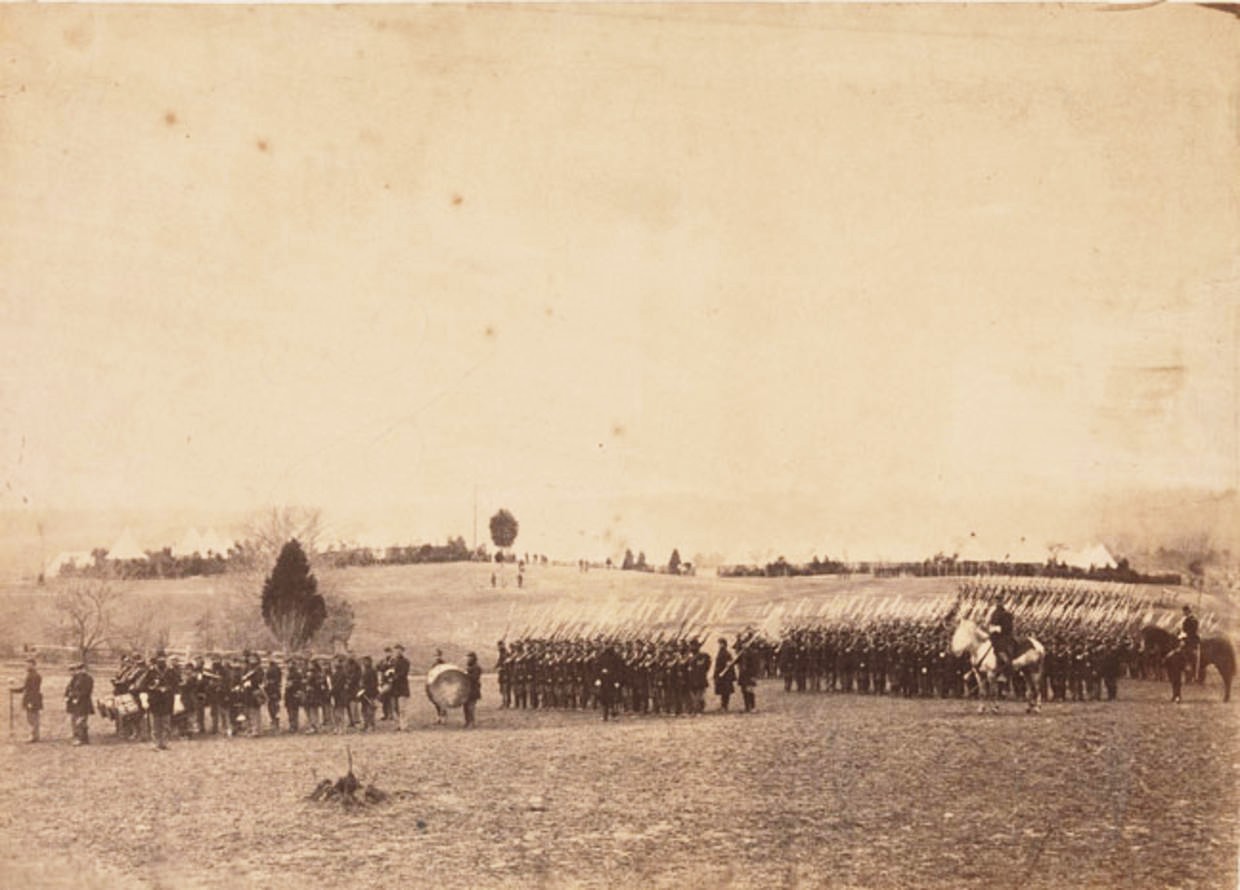
Unidentified Union infantry regiment, Camp Brightwood, Washington, D.C., circa 1865 (public domain).
On 19 April 1865, the 47th Pennsylvania Volunteers were once again responsible for helping to defend the nation’s capital — this time following the assassination of President Abraham Lincoln. Encamped near Fort Stevens, they were issued new uniforms and were resupplied with ammunition. Letters sent to friends and family back home during this time, and post-war newspaper interviews with veterans of the 47th Pennsylvania, confirm that at least one 47th Pennsylvania Volunteer was given the honor of guarding President Lincoln’s funeral train while others may have guarded the key Lincoln assassination conspirators during the early days of their imprisonment and trial, which began on 9 May 1865. During that phase of duty, the regiment was headquartered at Camp Brightwood.
On 22 May 1865, Captain Levi Stuber of Company I was advanced to the rank of major with the regiment’s central staff. Attached to Dwight’s Division of the 2nd Brigade of the U.S. Department of Washington’s 22nd Corps, the 47th Pennsylvania also participated in the Union’s Grand Review of the Armies on 23 May.
Reconstruction
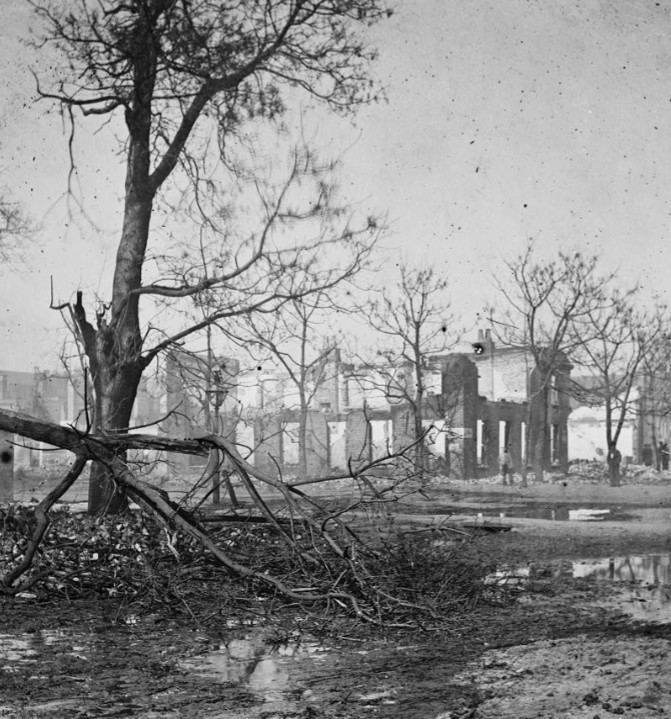
War-damaged houses in Savannah, Georgia, 1865 (Sam Cooley, U.S. Army, U.S. Library of Congress, public domain).
On their final southern tour, the men of Company K and their fellow 47th Pennsylvanians served in Savannah, Georgia in early June. Attached again to Dwight’s Division, this time they were assigned to the 3rd Brigade, U.S. Department of the South.
Taking over for the 165th New York Volunteers in July, the 47th Pennsylvania Volunteers took up their new quarters in Charleston, South Carolina at the former mansion of the final Confederate Secretary of the Treasury. On 1 July 1865, Private John E. Saylor was promoted to the rank of corporal.
Duties during that phase of service were frequently provost (military police) or Reconstruction-related (repairing railroads and other key regional infrastructure items that had been destroyed or damaged during the long war).

Ruins of Charleston, South Carolina as seen from the Circular Church, 1865 (U.S. National Archives and Records Administration, public domain).
On 1 October 1865, Corporals Samuel Reinert and William Landis who had been wounded in action, respectively, during the Battles of Pocotaligo and Cedar Creek, were both promoted to the rank of sergeant while Privates Nathan Handwerk and Amos Slutter advanced to the rank of corporal. Mustering out that same day, upon expiration of their three-year terms of service were Sergeant Phaon Guth, Corporals Martin Guth and William Knerr, and Privates Benjamin Amey, Tilghman Breisch, Harrison Handwerk, Edward Houser, John Keiser, Henry Savitz, and William Schlicher. Privates Franklin Smith, Jacob Geesey and Henry Hantz then mustered out upon expiration of their three-year terms on 9, 11 and 19 October, respectively, followed by Privates Alfred Diehl, James Sieger and Charles Stout on 28 October.
The departures from Company K continued through November as Private John G. Sigle was honorably discharged by General Orders on 14 November.
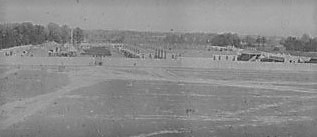
Camp Cadwalader, Philadelphia, Pennsylvania, circa 1862 (public domain; click to enlarge).
Finally, beginning on Christmas Day of that year, Corporal John E. Saylor joined with the majority of other 47th Pennsylvania Veteran Volunteers in honorably mustering out with their regiment at Charleston, South Carolina — a process that continued through early January 1866. Following a stormy voyage home, the weary, soon-to-be-civilians disembarked in New York City, and were then transported to Philadelphia by train where, at Camp Cadwalader on 9 January 1866, they were officially given their final discharge papers.
Entitled to bounty pay of three hundred dollars for enlisting with a Union Army regiment, Private Saylor was still owed one hundred and twenty dollars of that back pay by the federal government. He did not receive that full amount with his discharge paperwork, however, because he still needed to pay the federal government fifty-four dollars and five cents for his uniform — plus an additional six dollars for his weapon and ammunition — and he still needed to pay H. W. Webb, the 47th Pennsylvania’s regimental sutler, ten dollars for the food and other supplies he purchased while serving with the regiment (supplies that had not been provided by the Union Army but were desperately needed to make life more bearable during the regiment’s long marches and stays in inhospitable parts of enemy territory).
It must have seemed grossly unfair, but the pay that he did receive enabled him to return home to the Lehigh Valley with at least some money in his pocket.
Return to Civilian Life

Macungie Train Depot, Lehigh County, Pennsylvania, circa mid to late-1800s (public domain).
On 27 March 1870, John E. Saylor set forth on another new journey when he married Elmira Hammer (1849-unknown; alternate surname spelling: “Hummel”) at the Salem Reformed Church in Lehigh County. The parents of Bertha Bell Saylor (1868-1921), who was known to family and friends as “Bertie” and would later marry John Hillhouse (1866-1946), the trio resided in Lower Macungie Township when the federal census was enumerated there on 1 September 1870. More children soon followed: Jennie Saylor (circa 1870-1891); and Harrison Harvey Saylor (1873-1945), who was known to family and friends as “Harry” and would later wed Caroline Henrietta Zehner (1879-1966). Sometime later that same decade, however, John Saylor made the decision to leave Pennsylvania and migrate west. After relocating with his family to Ohio, he settled with them in Thompson Township, Seneca County.
* Note: Although the obituary of John E. Saylor reported that he had been employed as a railroad engineer with the “Wheeling Road” after the American Civil War, that data was not reported to the enumerators who interviewed him for the 1870 and 1880 federal census.
Sadly, sometime after the 1880 federal census was conducted, John E. Saylor was widowed by his wife, Elmira. Joy briefly returned when he served as a witness for his younger sister, Hannah Saylor, as she and her fiancé, Albert S. Hoch (1855-1932), applied for a marriage license in Seneca County, Ohio on 7 February 1881. A twenty-four-year-old resident of Seneca County, Hannah Saylor had migrated west from Pennsylvania prior to June of 1880, and had been employed as a live-in servant at the Thompson Township farmhouse of George and Mary Good prior to her marriage to Albert Hoch.
Four years after his sister’s marriage, John E. Saylor then lost his father, John Keeley Saylor, who died at the age of seventy-seven in Jeffersonville, Montgomery County, Pennsylvania on 13 March 1885 (alternate death year: 1884). John Saylor’s daughter, Jennie Saylor, then died in Flat Rock, Ohio on 17 August 1891.
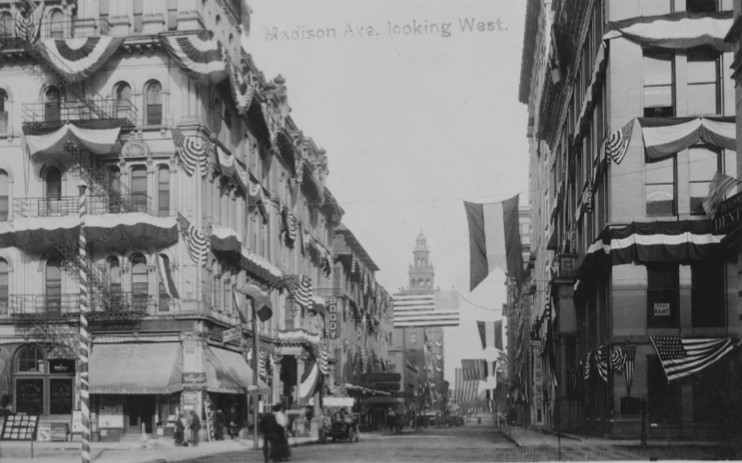
Decorations for the Grand Army of the Republic’s annual encampment, Madison Avenue, looking west in Toledo, Ohio, early September 1908 (public domain; click to enlarge).
But he continued to soldier on in the face of his grief. On 23 October 1894 (alternate year: 1895), John E. Saylor married widow Margaret Kreilick (1850-1911), who was a native of Erie County, Ohio and was known to family and friends as “Maggie.” He then settled with her in the village of Oak Harbor in Salem Township, Ottawa County, Ohio. By 1900, they were still residing in Oak Harbor, where he was employed as a grocery store clerk. Also living with them was his daughter from his first marriage, Bertha (Saylor) Hillhouse, and her husband John Hillhouse. Eight years later, they became eyewitnesses to a key moment in history as veterans of the American Civil War and their families, friends and supporters began streaming into their city for the annual encampment of the Grand Army of the Republic. As the encampment continued, the Toledo Weekly Blade projected that the crowd size would reach one hundred thousand men, women and children.
Marching bands, cheering veterans, flying flags, movement, activity, hustle, bustle and color of every kind mark Toledo today as the center of the universe in so far as the Grand Army of the Republic is concerned….
The lobbies of the big hotels can be no better pictured than to describe them as “seething masses” of hunanity…. And the streets show as pleasing a picture to the eye. They are filled to overflowing … with a good-natured, happy crowd, nearly everbody bedecked with some sort of unique badge or wearing a regalia or uniform.
The railways and the inter-urban stations are packed. Veterans and their families are thronging the city in its every section. Some are straight as new pins and carry themselves as erect as they did forty years ago; others are crippled and bent, but all are happy.
Subsequently employed as a janitor at a car shop in Toledo in 1910, John Saylor and his second, wife, Maggie (Kreilick) Saylor, were also taking in boarders to help “make ends meet” that year. Although they seemed fine, Maggie’s health was declining. An active member of the Methodist Church and her local Eastern Star chapter, she widowed him on 23 September 1911, and was later buried at a cemetery in their former hometown of Oak Harbor.
“Life Goes On”
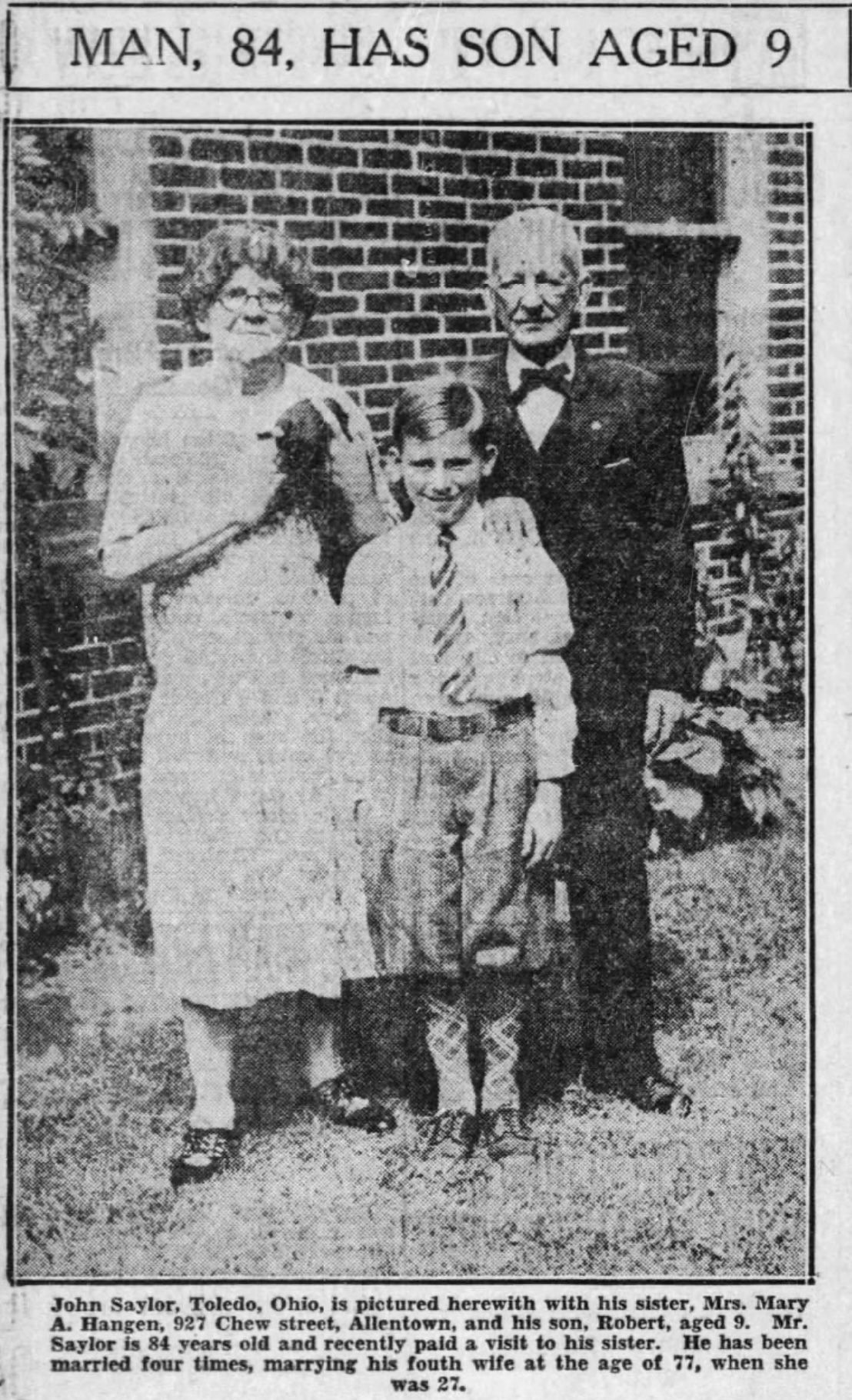
47th Pennsylvania veteran John Edward Saylor with his sister, Mary Alice (Saylor) Hangen, and his son, Robert Henry Saylor, The Morning Call, Allentown, Pennsylvania, 25 August 1929, public domain; click to enlarge).
Ultimately married a total of four times, John E. Saylor wed his last wife, twenty-seven-year-old Catherine (Pfeiffer) Osborn (circa 1890-unknown), in the city of Toledo on 26 March 1917. Their sons, Robert Henry Saylor (1920-1977) and Edward John Saylor (1923-1999), were born in Toledo on 11 May 1920 and 7 February 1923, respectively. Just weeks after their second child was born, however, John Saylor’s fourth wife sued him for divorce. According to the 29 March 1923 edition of The Lima News:
TOLEDO — John Saylor, 77, Civil War veteran, is being sued for divorce by his fourth wife, 32 years of age, who asks alimony for the support of herself and their two children. She claims failure to provide.
Although researchers have not yet located information regarding the resolution of his divorce case, it appears, from a newspaper photo of John E. Saylor and his son, Robert, and other records of the time, that John Saylor and his fourth wife, Catherine (Pfeiffer) Saylor, were separated before the end of that decade and that they had each taken custody of one of their two biological children. Researchers base that theory on two key data points:
- The publication by Allentown, Pennsylvania’s Morning Call newspaper, on 25 August 1929, of a photograph that showed John E. Saylor and his son, Robert, standing beside John’s sister, Mary Alice (Saylor) Hangen, at her home on Chew Street in Allentown (a photo that did not include Robert’s younger brother); and
- The confirmation by a federal census enumerator in Lucas County, Ohio, less than a year later, that John Saylor was an eighty-four-year-old retiree who resided with his ten-year-old son, Robert, at a boarding house operated by William and Ollena Conway at 1985 Erie Street in Toledo (a living arrangement that also apparently did not include Robert’s younger brother).
* Note: Although that 1930 federal census enumerator in Toledo recorded a lengthy list of the other residents at that boarding house where John Edward Saylor his son, Robert Henry Saylor, were residing in April of that year, that enumerator did not enter the name of John E. Saylor’s fourth wife, Catherine, or the name of their seven-year-old son, Edward John Saylor — omissions which appear to indicate that Catherine (Pfeiffer) Saylor may have kept Edward J. Saylor with her when she separated or divorced John E. Saylor (and that Edward Saylor may have lived with her from infancy into and beyond his early childhood years). As a result, researchers are continuing to search for a 1930 census record(s) for Catherine (Pfeiffer) Saylor and her son, Edward J. Saylor.
Illness, Death and Interment
Sixteen months after speaking with that federal census enumerator, John E. Saylor, paralyzed and ailing with lobar pneumonia, passed away at his home at 509 Buffalo Street in Toledo. Eighty-five years, five months and twenty-two days old at the time that he answered his final bugle call on 28 August 1931, his remains were subsequently returned to Oak Harbor in Ottawa County, Ohio for burial at the Oak Harbor Union Cemetery.
What Happened to the Surviving Children of John Edward Saylor?
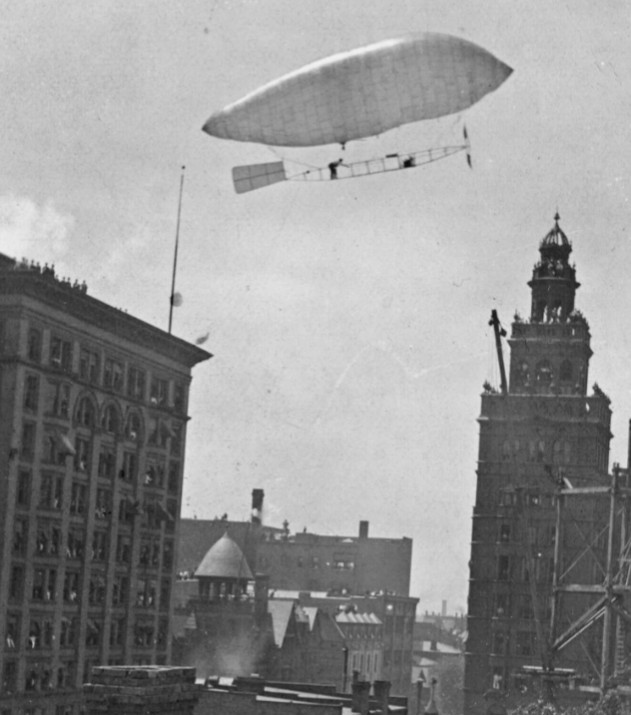
A dirigible flying above Madison Avenue in Toledo, Ohio on 30 June 1905 (public domain).
Bertha Bell Saylor (1868-1921), the oldest child of John E. Saylor and his first wife, Elmira, became known to family and friends as “Bertie.” Following her marriage to John Hillhouse (1866-1946) in Huron County, Ohio on 25 February 1892, she resided with her husband at the home of her father in Toledo, Lucas County in 1900. Her husband, a native of England, would go on to be a longtime employee of the Wheeling and Lake Erie Railroad as one of its locomotive engineers. By 1910, she and her husband were residing at the Toledo home of her sister-in-law, Caroline Henrietta Zehner (1879-1966), who was documented on that year’s census as being divorced from Bertha’s brother, Harrison Harvey Saylor (1873-1945). That year’s census also documented that Bertha had given birth to six children, but that none had survived. Sadly, the life of Bertha Bell (Saylor) Hillhouse also proved to be a short one. She died at the age of fifty-three at her home on Florida Avenue in the city of Tampa in Hillsborough County, Florida, on 16 August 1921. Her remains were then prepared by a funeral home in Tampa and returned to Ohio for interment at the Forest Hills Cemetery in Toledo.
John Saylor’s oldest son from his first marriage, Harrison Harvey Saylor (1873-1945), who was known to family and friends as “Harry,” and had married Caroline Henrietta Zehner (1879-1966) during the mid to late 1890s, subsequently welcomed the births with her of: Edna Lucille Saylor (1898-1996), who was born in Masillon, Stark County on 27 September 1898 and would later wed Foster W. Rice (1897-1981); Lorna L. Saylor (1900-unknown), who was born in Oak Harbor, Ottawa County, Ohio on 5 October 1900 and would later wed Fred S. Woodward; and John Harrison Saylor, who was born in Oak Harbor on 5 June 1904 and would later Nellie Meeman (alternate surname spelling: “Mumaugh”). Divorced from his wife by 1910, Harry Saylor chose to marry again at the age of forty-four, and wed thirty-seven-year-old Minnie Perry Forrester in Monroe County, Michigan on 10 July 1918. His second wife was a native of England, according to their marriage record. Residing with his second wife at their home in Toledo’s Thirteenth Ward in 1930, Harry was described as a railroad fireman on that year’s census. Also living with them was Minnie’s seventeen-year-old daughter, Mildred Perrier. Still in his early seventies at the time of his death on 1 June 1945, Harry Saylor was buried at the Woodlawn Cemetery in Toledo.
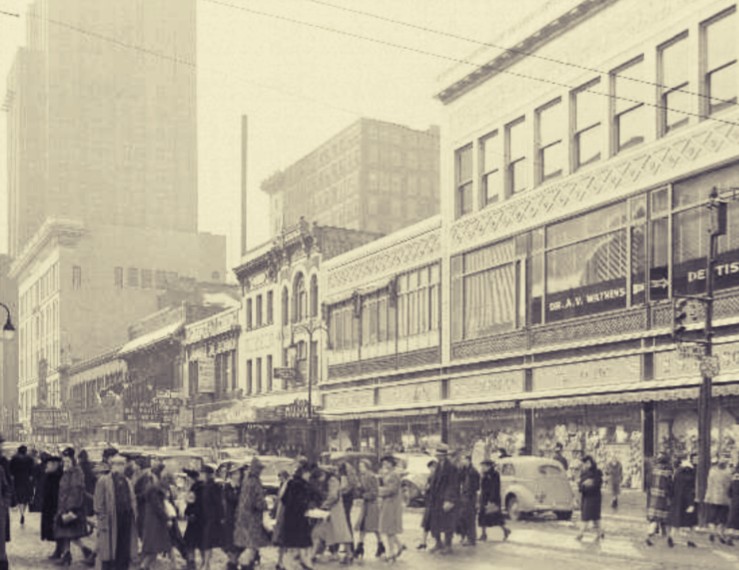
A downtown area of Toledo, Ohio, circa 1940 (public domain; click to enlarge).
Robert Henry Saylor, Sr. (1920-1977) and Edward John Saylor (1923-1999), who were John E. Saylor’s sons from his fourth marriage to Catherine (Pfeiffer) Osborne, were both natives of Toledo. Like their Civil War veteran father, both answered their nation’s call for help at a time when regular guys were asked to leave the safety of their homes and run toward danger on battlegrounds far from the arms of loved ones.
Robert Henry Saylor, the younger of the two brothers, was married to Helen Lucille Hagans (1920-2014) in Newport, Kentucky on 24 February 1940. Previously a resident of the city of Lima in Allen County, Ohio, he had been working as a laborer and living with his younger brother, Edward J. Saylor, on Cross Street in the town of Columbus Grove in Putnam County at the time of his marriage. Robert and his new bride initially resided with her parents in New Castle Township in Coshocton County, Ohio, and subsequently welcomed the Coshocton County births of: Joseph Edward Saylor (1943-1977), who was born on 3 March 1943, was known to family and friends as “Joe” and would later wed Rita Speers; and Ruth Saylor, who would later wed Ronald Lahna. Inducted into the U.S. Navy on 4 May 1943, Robert H. Saylor was honorably discharged on 3 October 1945. Following his return from his World War II military service, he settled in the city of Dayton in Montgomery County, Ohio. Divorced from his first wife circa 1946, Robert H. Saylor then married Edwina Esther Smith (1932-2006) in Wayne County, Indiana on 8 March 1949, and settled with her in Coshocton County, where he was employed as a punch press operator. In 1956, he migrated south with his wife to Florida. Divorced from her in October 1959 in the city of Miami, he was the father of: Robert Henry Saylor, Jr. and Catherine, Barbara, Theresa, Evelyn, Bamba, and Michele Saylor. Still residing in Florida by the mid-1970s, Robert Henry Saylor, Sr. died at the veterans’ in hospital in Miami on 3 January 1977. Just fifty-six years old at the time of his passing, he was laid to rest at Miami’s Vista Memorial Gardens.
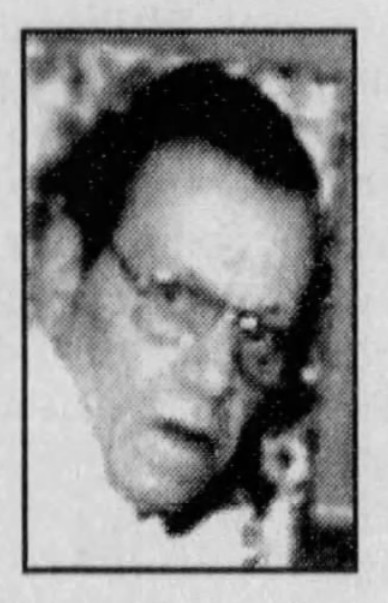
Edward John Saylor (1923-1999), shown here circa 1990, was the youngest son of American Civil War veteran John Edward Saylor (1846-1931), who served with the 47th Pennsylvania Volunteer Infantry.
John Edward Saylor’s youngest son, Edward John Saylor (1923-1999), who was known to family and friends as “Ed,” also served the nation in World War II, but did so as a technician fifth grade with the U.S. Army, for which he would be awarded the Asiatic-Pacific Theater Ribbon with three bronze stars and the Philippine Liberation Ribbon with one bronze star. Married to Loretta Wehrly (1928-1988) in Putnam County, Ohio on 10 June 1946, he welcomed the birth with her of Gloria Jean Saylor, who became known to family and friends as “Jeanie” and later wed Carl Bachman and settled with him in Coshocton. By 1950, the trio resided in Pleasant Township, Putnam County, where Ed was employed by a dairy as a filler operator. Subsequently divorced from his wife, he was employed for nineteen and a half years by the Hunt Crawford Company in Coshocton, before his hiring by Yankee Wire Cloth Products in West Lafayette, where he worked for nine years prior to his retirement. He died at the age of seventy-six at the West Lafayette Rehabilitation and Nursing Center on 3 August 1999, and was laid to rest at the South Lawn Cemetery in Coshocton.
What Happened to the Siblings of John Edward Saylor?
Unfortunately, a great deal of confusion has been created over the years by Saylor family historians and other genealogists regarding the life of John Edward Saylor’s older brother, William H. Saylor, with some sources indicating that he lived from 1841 until sometime before or in 1877 and others stating that he lived from 1841 until 1895 and had served as a private with Company F of the 6th Pennsylvania Volunteers during the American Civil War. What is known for certain at present is that William H. Saylor was born in Montgomery County circa 1841 and that he lived in Limerick Township, Montgomery County in 1850, according to federal census records. Researchers for 47th Pennsylvania Volunteers: One Civil War Regiment’s Story are continuing to research various records and hope to eventually correct the record regarding William’s life.
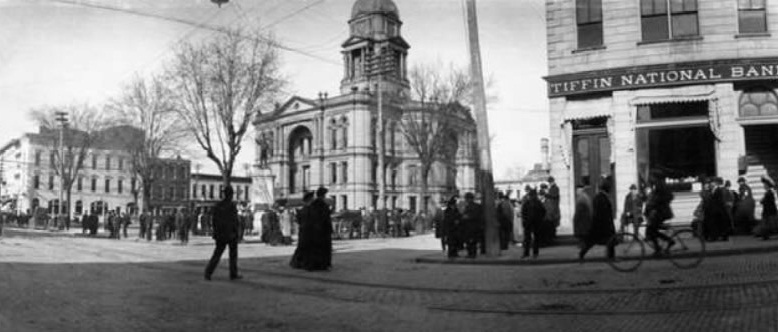
Tiffin, Seneca County, Ohio (circa 1890s, public domain; click to enlarge).
John E. Saylor’s youngest brother, Edwin Saylor (1863-1916), who was born in Allentown on 17 January 1863 (alternate birth year: 1864) and later migrated west to Ohio, where he settled in Seneca County, found employment as a butcher, and, on 7 November 1886, married Charlotte Elizabeth Royer (1864-1918), who was known to family and friends as “Lottie.” They then welcomed the Thompson Township, Seneca County births of: Katharine S. Saylor (1888-1962), who was born on 4 March 1888, was known to family and friends as “Katie” and would later wed Charles E. Wank (1886-1942) on 1 November 1910); Warren P. Saylor (1889-1860), who was born on 25 October 1889 and would later wed Helen Mink (1900-1953) on 11 October 1920; and twins Eva Bell Saylor (1894-1979) and Gussie Dell Saylor (1894-1960), who were born on 14 January 1894 and would later marry William Grover Heebsh (1885-1953) and Phillip Julius Lambright (1894-1950), respectively, on 5 August 1915 and 30 November 1916. Sadly, roughly six months before the marriage of his daughter, Gussie, Edwin F. Saylor died at the age of fifty-three in Tiffin (on 7 June 1916) and was laid to rest at the Greenlawn Cemetery in Tiffin.
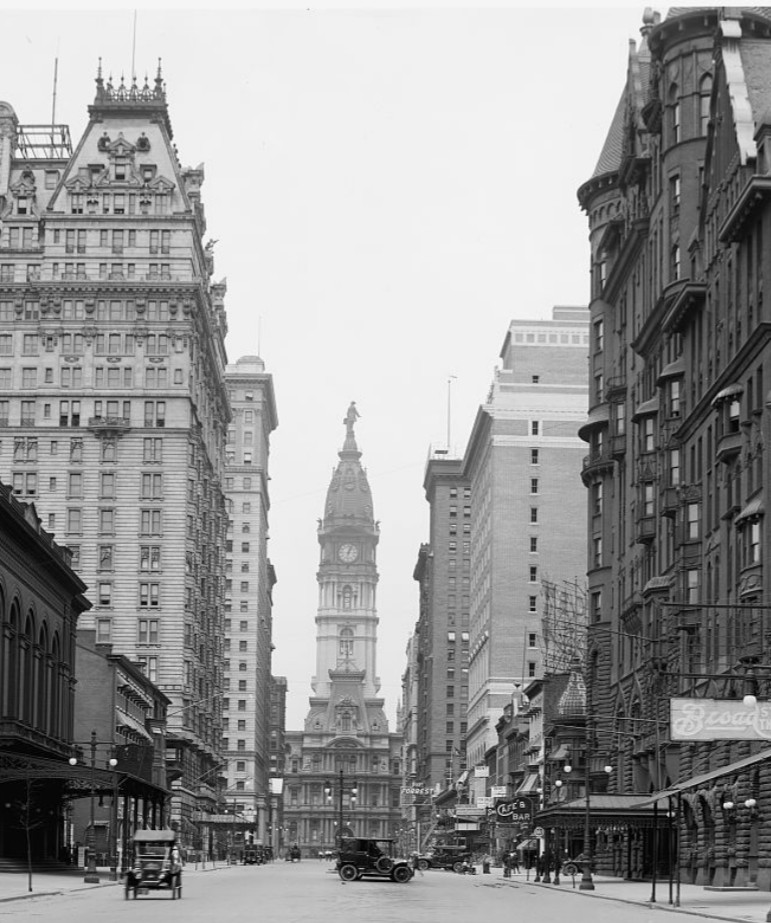
Broad Street and City Hall Tower, Philadelphia, Pennsylvania, circa 1910-1920 (U.S. Library of Congress, public domain).
Following her marriage to Samuel Seiple (circa 1851-1904), John E. Saylor’s younger sister, Catharine (Saylor) Seiple, who was known to family and friends as “Katie,” was widowed by her husband when he succumbed to complications from heart disease at their home in Philadelphia on 30 June 1904. After surviving her husband by more than fifteen years, Katie died in her late sixties or early seventies in Philadelphia, on 7 January 1920. Her remains were subsequently returned to Lehigh County for interment beside her husband at Allentown’s Union-West End Cemetery.
Following his marriage to Mary Irene Hunsicker (1864-1929) on 12 January 1884, John E. Saylor’s brother, Frank F. Saylor (1858-1922), welcomed the Montgomery County births with her of: Percival Saylor (1887-1888), who was born on 9 August 1887, but died in infancy in that same county on 21 July 1888; and Bertha Hunsicker Saylor (1889-1965), who was born on 26 May 1889, resided in Iron Bridge, Montgomery County, Pennsylvania in 1911 and later wed Philadelphia native Walter Palmer Lanagan (1897-1979) in Arlington County, Virginia on 22 August 1941. Employed as a clerk for a coal and lumber company after the turn of the century, Frank F. Saylor resided in Perkiomen Township, Montgomery County at that time with his wife and their unmarried daughter, Bertha — a living arrangement that continued into 1910, when Frank was employed as a food salesman. Later that same decade Frank Saylor was documented by local newspapers as a resident of Iron Bridge (currently now a neighborhood in Collegeville). Serving as Pennsylvania’s State Fish Warden, he was responsible for arresting and prosecuting several individuals for illegal fishing, including the use of illegal dip-nets along the Neshaminy Creek near Hulmeville in March of 1918. Still residing with his wife and daughter, Bertha, in Perkiomen Township as of 1920, according to that year’s federal census, Frank Saylor owned and operated a broom making shop there, while his daughter, Bertha, was employed by the Commonwealth of Pennsylvania. Ailing with bladder cancer during his final months, Frank F. Saylor died at the age of sixty-four in Perkiomen Township, on 25 May 1922, and was laid to rest at the Trinity United Church of Christ Cemetery in Collegeville.
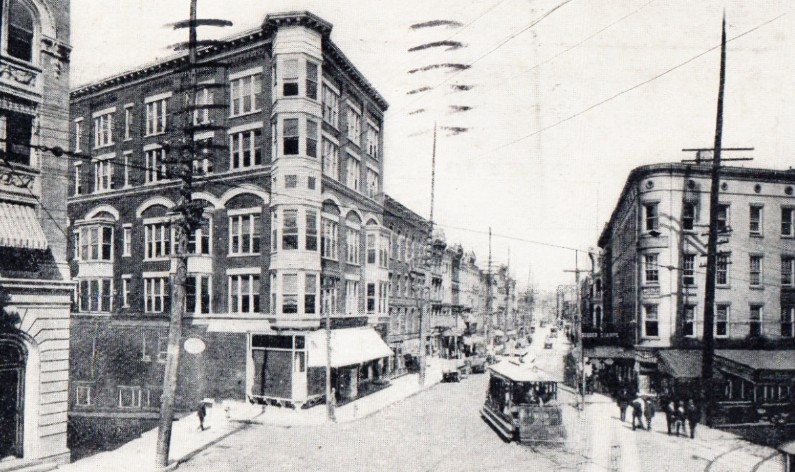
Shopping district, River, Third and Fulton streets, Troy, New York, circa 1905 (public domain; click to enlarge).
John E. Saylor’s older sister, Emalina/Emelina (Saylor) Reynolds, who was known to family and friends as “Emma,” initially resided in the cities of Allentown and Reading, Pennsylvania. Following her marriage to Almon T. Reynolds (1836-1904), she settled with her husband in the city of Troy in Rensselaer County, New York. Still childless by 1880, the Reynolds subsequently brought Emma’s unmarried, younger sister, Adaline Saylor (circa 1866-1956), up from Pennsylvania to live with them. Widowed by her husband, Almon, in 1904, when he passed away in his late sixties in Troy, Emma opted to remain in Troy, where she operated a boarding house at 199 Eighth Street in that city’s Fourth Ward. Also living there with Emma was her sister, Adaline. Aged eighty-two at the time of her death in Troy in 1931, Emma was later buried at the Union-West End Cemetery in Allentown. (Adaline Saylor was then moved into the Bethesda Home in Troy in 1938, and remained at that care facility until her death in 1956.)
Following her marriage to William H. Hangen (1850-1918), John E. Saylor’s sister, Mary Alice (Saylor) Hangen, settled with her husband in the city of Allentown in Lehigh County, Pennsylvania, where he was employed as a wheelwright. The couple also remained childless for the duration of their marriage. Widowed by her husband on 19 April 1918, after he was felled by an episode of apoplexy and died during the previous week, she continued to reside at their home on Chew Street in Allentown for the remainder of her life. Sadly, she then also suffered an episode of apoplexy (on 9 April 1932). Paraylzed on her left side, she fought to survive, but lost her battle on 12 July 1932. Following her passing at the age of eighty in Allentown, she was laid to rest at the Fogelsville Union Cemetery in Folgelsville, Lehigh County.
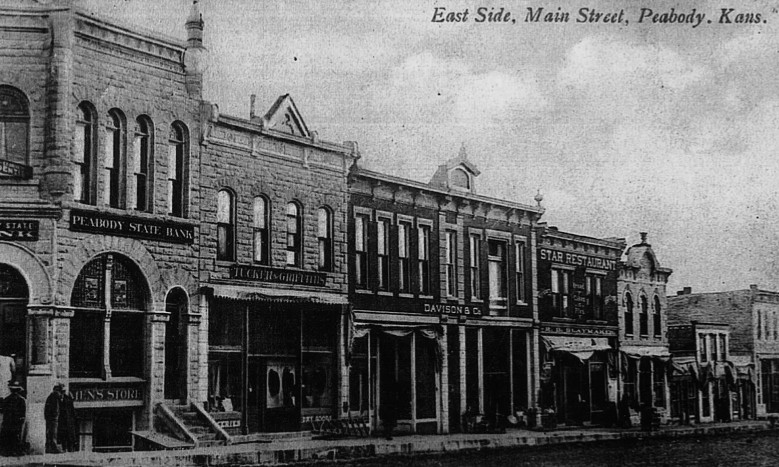
Main Street, Peabody, Marion County, Kansas, circa 1905 (public domain; click to enlarge).
Following her marriage to Albert S. Hoch (1855-1932) in Seneca County, Ohio in February 1881, John E. Saylor’s younger sister, Hannah M. (Saylor) Hoch, initially settled with her husband in the town of Flat Rock in Seneca County, where the young couple welcomed the births of Kathryn Ada Hoch (1881-1956), who was born in Flat Rock on 25 August 1881, was known to family and friends as “Addie” and never married; and Mary Alice Hoch (1883), who was born in Bellevue, Sandusky County, Ohio in August 1883, was known to family and friends as “Allie” and would later wed George W. Kelley (1881-1946). Sometime before 1893, Hannah and Albert Hoch then migrated with their daughters to Kansas, where they welcomed the births of more children: Roy Hoch (1894-1950), who was born in Peabody, Marion County on 12 March 1894 (alternate birth years: 1893, 1895, 1896); and Roy M. Hoch (1896-1970), who was born in Harvey County, Kansas on 5 October 1896 (alternate birth year: 1897). Still living in Harvey County, Kansas and still farming land there, Hannah and Albert Hoch were residents of Walton Township whose children (Addie, Allie, Roy, and Ray) lived with them. Also residing with the Hochs that year was Clyde Close, a twenty-year-old servant. In 1910, their Walton Township household included the parents and children Addie, Roy and Ray — an arrangement that continued into 1920. Widowed by her husband when he passed away in his mid-seventies in 1932 and was buried at the Prairie Lawn Cemetery in Peabody, Hannah (Saylor) Hoch survived her huband by more than a decade. Roughly ninety years old at the time of her death in 1945, she was laid to rest beside her husband at the Prairie Lawn Cemetery.
* Note: An Ancestry.com transcription of a birth record for Kathryn Ada Hoch (1881-1956) states that her parents were Albert Hoch and “Jennie Saylor” (the sister of John Edward Saylor who reportedly died in 1891). The official Seneca County, Ohio marriage application for Albert Hoch, however, recorded that Albert Hoch married Hannah Saylor (Jennie and John Saylor’s sister) in February 1881 — roughly six months before Kathryn Ada Hoch was born.
John E. Saylor’s youngest sister, Adaline Saylor, who was born circa 1866 (alternate birth years: 1856, 1866, 1872), was taken in by her older, married sister, Emaline (Saylor) Reynolds sometime around 1870, when Emaline resided with her her husband in Troy, Rensselaer County, New York. Known to family and friends as “Addie,” Adaline Saylor continued to reside at her sister’s home in Troy until Emaline’s death in 1931. A member of the First Baptist Church, Addie subsequently relocated to the Bethesda Home in Troy in 1938, where she remained until her death at the age of ninety on 10 May 1956. Her remains were subsequently returned to Pennsylvania for burial at the Union-West End Cemetery in Allentown.
Sources:
- Bates, Samuel P. History of Pennsylvania Volunteers, 1861-5, vol. 1. Harrisburg, Pennsylvania: B. Singerly, State Printer, 1869.
- Bertha Hunsicker Saylor (a niece of John Edward Saylor and a daughter of Frank F. Saylor) and Walter Palmer Lanagan, in Marriage Records (Arlington County, Virginia, 22 August 1941). Richmond, Virginia: Commonwealth of Virginia, Department of Health, Office of Vital Records.
- Conway, William (electrician and boarding house operator) and Ollena; Osborne, Geraldine (aged eighteen), James (aged twenty) and Geraldine (infant); Saylor, John (lodger and father, aged eighty-four) and Robert (lodger and son, aged 10), et. al., in U.S. Census (Toledo, Lucas County, Ohio, 1930). Washington, D.C.: U.S. National Archives and Records Administration.
- “Edward Saylor” (obituary of a son of John Edward Saylor). Coshocton, Ohio: The Coshocton Tribune, 5 August 1999.
- Eva Bell Saylor and Gussa Dell Saylor (nieces of John Edward Saylor and twin daughters of Edwin F. Saylor), in Birth Records (Thompson Township, Seneca County, Ohio, 14 January 1894). Tiffin, Ohio: Seneca County Probate Court.
- Favinger, Frederick (decedent), Catharine (widow), Harietta (decedent’s daughter and the future mother of John Edward Saylor), Mary, Ann, Lidia, Samuel, and Henry, et. al., in Wills and Probate Records, (Frederick Favinger, et. al., Montgomery County, Pennsylvania, 1822). Norristown, Pennsylvania: Register of Wills and Clerk of the Orphans’ Court, Montgomery County, Pennsylvania.
- “Fined for Illegal Fishing in Neshaminy” (mention of John Edward Saylor’s younger brother, Pennsylvania State Fish Warden Frank F. Saylor). Perkasie, Pennsylvania: The Central News, 27 March 1918.
- “Former Resident Dies” (death notice of John Edward Saylor). Port Clinton, Ohio: News-Herald, 4 September 1931.
- “Fourth Wife Sues” (notice of the pending divorce of Catherine (Pfeiffer) Saylor from John Edward Saylor). Lima, Ohio: The Lima News, 29 March 1923, p. 13.
- Frank F. Saylor (a younger brother of John Edward Saylor), in Death Certificates (file no.: 53643, registered no.: 32, date of death: 25 May 1922). Harrisburg, Pennsylvania: Commonwealth of Pennsylvania, Department of Health, Bureau of Vital Statistics.
- Good, George (farmer), Mary A., George F., Jeremiah, Isaac I., David H., and Emery H.; and Saylor, Hannah (a servant who was a younger sister of John Edward Saylor), in U.S. Census (Thompson Township, Seneca County, Ohio, 1880). Washington, D.C.: U.S. National Archives and Records Administration.
- Grodzins, Dean and David Moss. “The U.S. Secession Crisis as a Breakdown of Democracy,” in When Democracy Breaks: Studies in Democratic Erosion and Collapse, from Ancient Athens to the Present Day (chapter 3). New York, New York: Oxford University Press, 2024.
- “Hagans-Saylor” (notice of the marriage of John Edward Saylor’s son, Robert Henry Saylor, to Helen Hagans). Coshocton, Ohio: The Coshocton Tribune, 19 March 1940.
- Hagans, Joseph E., Stella, William Leonard and Betty; and Saylor, Robert H. (a son of Robert Edward Saylor and a son-in-law of Joseph and Stella Hagans) and Helen (a daughter of Joseph and Stella Hagans and the first wife of Robert H. Saylor), in U.S. Census (New Castle Township, Coshocton County, Ohio, 1940). Washington, D.C.: U.S. National Archives and Records Administration.
- Hannah Saylor (a bride-to-be who was a younger sister of John Edward Saylor), John Saylor [sic, “John Edward Saylor”] (legal witness) and Albert Hoch (the future groom), in Marriage Records (Seneca County, Ohio, 7 February 1881). Tiffin, Ohio: Seneca County Probate Court.
- Harry Saylor (the groom, who was a son of John Edward Saylor) and Minnie Perry Forrester (the bride), in Marriage Records (Monroe County, Michigan, 10 July 1918). Monroe, Michigan: Office of the County Clerk, Monroe County, Michigan.
- Hauch [sic, ” Hoch”], Albert, Hannah (a younger sister of John Edward Saylor), Addie, Roy, and Ray, in U.S. Census (Walton Township, Harvey County, Kansas, 1910). Washington, D.C.: U.S. National Archives and Records Administration.
- “Helen Lucille Champagne” (obituary of the first wife of Robert Henry Saylor, who was a son of John Edward Saylor). Coshocton, Ohio: Coshocton Tribune, 20 May 2014.
- “Hillhouse” (death notice of John E. Saylor’s oldest child, Bertha Bell (Saylor) Hillhouse). Tampa, Florida: The Tampa Morning Tribune, 17 August 1921.
- Hoch, Albert, Hannah (a younger sister of John Edward Saylor), Addie, Allie, Roy, and Ray M.; and Close, Clyde, in U.S. Census (Walton Township, Harvey County, Kansas, 1900). Washington, D.C.: U.S. National Archives and Records Administration.
- Hock [sic, “Hoch”], Albert, Hannah (a younger sister of John Edward Saylor), Ada, Allie, and Roy, in U.S. Census (Walton Township, Harvey County, Kansas, 1920). Washington, D.C.: U.S. National Archives and Records Administration.
- Hunsicker, Henry A. A Genealogical History of the Hunsicker Family. Philadelphia, Pennsylvania: J. B. Lippincott Company, 1911.
- “Joe E. Saylor” (obituary of a grandson of John Edward Saylor and a son of Robert Henry Saylor). Dover, Ohio: The Times-Reporter, 18 July 1977.
- John Saylor [sic, “John Edward Saylor”], in Death Certificates (registration district no.: 769, death of death: 28 August 1931). Columbus, Ohio: State of Ohio, Department of Health, Division of Vital Statistics.
- Katie Saylor (a niece of John Edward Saylor and a daughter of Edwin F. Saylor), in Birth Records (Thompson Township, Seneca County, Ohio, 4 March 1888). Tiffin, Ohio: Seneca County Probate Court.
- “Man, 84, Has Son Aged 9” (photo, with caption, of John Edward Saylor and his son, Robert, and John’s sister, Mary A. (Saylor) Hangen). Allentown, Pennsylvania: The Morning Call, 25 August 1929.
- Mary Alice Hangen (a sister of John Edward Saylor), in Death Certificates (file no.: 67765, registered no.: 858, date of death: 12 July 1932). Harrisburg, Pennsylvania: Commonwealth of Pennsylvania, Department of Health, Bureau of Vital Statistics.
- Mary Alice Hoch (a niece of John Edward Saylor and a daughter of Hannah M. (Saylor) Hoch), in Marriage Records (Sandusky County, Ohio, 4 March 1903). Fremont, Ohio: Sandusky County Probate Court.
- “Miss Adaline Saylor” (obituary of the youngest sister of John Edward Saylor). Troy, New York: The Troy Record, 11 May 1956.
- “Mrs. Emma S. Reynolds” (obituary of a sister of John Edward Saylor). Allentown, Pennsylvania: The Morning Call, 31 October 1931.
- “Mrs. John Saylor” (obituary of Maggie Margaret/Marguerite (Kreilick) Saylor, the second wife of John Edward Saylor). Oak Harbor, Ohio: The Ottawa County Exponent, 23 September 1912.
- “Mrs. Mary A. Hangen” (obituary of a sister of John Edward Saylor). Allentown, Pennsylvania: The Morning Call, 13 July 1932.
- “Putnam Group Inducted Into Armed Forces” (notice of the impending World War II service of John Edward Saylor’s son, Robert Henry Saylor). Lima, Ohio: The Lima News, 11 May 1943.
- Reynolds, Almon and Emma (John Edward Saylor’s older sister), in U.S. Census (City of Troy, Rensselaer County, New York, 1880). Washington, D.C.: U.S. National Archives and Records Administration.
- Reynolds, Almon and Emma (John Edward Saylor’s older sister); and Saylor, Adeline (John Edward Saylor’s youngest sister), in U.S. Census (City of Troy, Rensselaer County, New York, 1900). Washington, D.C.: U.S. National Archives and Records Administration.
- Reynolds, Emma S. and Saylor, Adeline (John Edward Saylor’s widowed older sister and boarding house proprietor, Emaline, and unmarried, younger sister, Addie); and Sweeney, Anna, in U.S. Census (City of Troy, Fourth Ward, Rensselaer County, New York, 1920). Washington, D.C.: U.S. National Archives and Records Administration.
- Reynolds, Emma S. and Saylor, Adeline (John Edward Saylor’s widowed older sister and boarding house proprietor, and unmarried, younger sister, Addie); Nichols, William (roomer); Fink, Howard (roomer); and Sweeney, Anna, in U.S. Census (City of Troy, Fourth Ward, Rensselaer County, New York, 1930). Washington, D.C.: U.S. National Archives and Records Administration.
- Robert Henry Saylor, in U.S. Headstone Applications for Military Veterans (Vista Memorial Gardens, Hialeah, Florida, year of death: 1977). Washington, D.C.: U.S. National Archives and Records Administration.
- Sailor [sic, “Saylor”], John and Maggie; and Hillhouse, John and Bertha (a daughter of John Edward Saylor), in U.S. Census (Salem Township, Ottawa County, Ohio, 1900). Washington, D.C.: U.S. National Archives and Records Administration.
- Saler [sic, “Saylor”], John, Elmira and H. Berto [sic, “Bertie”]; and Kalb, Bernhard, in U.S. Census, Lower Macungie Township, Lehigh County, Pennsylvania, 1870). Washington, D.C.: U.S. National Archives and Records Administration.
- “Saylor” (obituary of Robert Henry Saylor, a son of John Edward Saylor). Coshocton, Ohio: The Coshocton Tribune, 4 January 1977).
- Saylor, Catharine S. [sic, “Katharine”] (a bride who was a niece of John Edward Saylor and a daughter of Edwin F. Saylor), Edw. F. (father of the bride) and Charlotte E. Royer (mother of the bride); and Wank, Charles E. (the groom), in Marriage Records (Seneca County, Ohio, 1 November 1910). Tiffin, Ohio: Seneca County Probate Court.
- Saylor, Caroline (the former wife of John Edward Saylor’s son, Harrison Harvey Saylor), Edna, Lorna, and John H.; Zalaner [sic, ” Zehner”], Frederick (a brother of Caroline (Zehner) Saylor); Diamond, Leland (boarder); and Hillhouse, John and Bertha (the oldest daughter of John Edward Saylor and a sister-in-law of Caroline (Zehner) Saylor), in U.S. Census (Toledo, Lucas County, Ohio, 1910). Washington, D.C.: U.S. National Archives and Records Administration.
- Saylor, Edward J. (the groom and the youngest son of John Edward Saylor), John Saylor [sic, “John Edward Saylor”] (father of the groom) and Catherine Pyfer [sic, ” Pfeiffer”] (mother of the groom); and Loretta Wehrly (the bride), in Marriage Records (Putnam County, Ohio, 10 June 1946). Ottawa, Ohio: Putnam County Probate Court.
- Saylor, Edward J. (the youngest son of John Edward Saylor), Loretta, and Gloria J., in U.S. Census (Pleasant Township, Putnam County, Ohio, 1950). Washington, D.C.: U.S. National Archives and Records Administration.
- Saylor, Edwin (the youngest brother of John Edward Saylor), Lottie E., Katie S., Warren P., Eva B., and Gussie D., in U.S. Census (Thompson Township, Seneca County, Ohio, 1900). Washington, D.C.: U.S. National Archives and Records Administration.
- Saylor, Eva B. (a bride who was a niece of John Edward Saylor and a daughter of Edwin F. Saylor) and Edward Saylor [sic, “Edwin”] (father of the bride) and Lottie E. Royer (mother of the bride); and William Heebsh/Heebsch (the groom), in Marriage Records (Seneca County, Ohio, 5 August 1915). Tiffin, Ohio: Seneca County Probate Court.
- Saylor, Frank F. (a younger brother of John Edward Saylor), Irene C. and Bertha H., in U.S. Census (Perkiomen Township, Montgomery County, Pennsylvania, 1900, 1910, 1920). Washington, D.C.: U.S. National Archives and Records Administration.
- Saylor, Gussie Dell (a bride who was a niece of John Edward Saylor and a daughter of Edwin F. Saylor) and Edwin (father of the bride) and Lottie E. Royer (mother of the bride); and Phillip J. Lambright (the groom), in Marriage Records (Seneca County, Ohio, 30 November 1916). Tiffin, Ohio: Seneca County Probate Court.
- Saylor, Harry (a son of John Edward Saylor) and Minnie; and Perrier, Mildred (Minnie Saylor’s daughter from a previous marriage), in U.S. Census (Toledo, Thirteenth Ward, Lucas County, Ohio, 1930). Washington, D.C.: U.S. National Archives and Records Administration.
- Saylor, John, in Civil War Muster Rolls (Company K, 47th Pennsylvania Infantry). Harrisburg, Pennsylvania: Pennsylvania State Archives.
- Saylor, John, in Civil War Veterans’ Card File, 1861-1866 (Company K, 47th Pennsylvania Infantry). Harrisburg, Pennsylvania: Pennsylvania State Archives.
- Saylor, John (father), Harriet, William, John (son, “John Edward Saylor”), Emalina, Catherine, Mary, and Franklin in U.S. Census (Limerick Township, Montgomery County, Pennsylvania, 1850). Washington, D.C.: U.S. National Archives and Records Administration.
- Saylor, John (father), Henrietta, William, John (son, “John Edward Saylor”), Emelina, and Catherine, in U.S. Census (Limerick Township, Montgomery County, Pennsylvania, 1850). Washington, D.C.: U.S. National Archives and Records Administration.
- Saylor, John, Elmira, Bertie, Jennie, and Harrison, in U.S. Census (Thompson Township, Seneca County, Ohio, 1880). Washington, D.C.: U.S. National Archives and Records Administration.
- Saylor, John and Maggie; Beck, Jacob (boarder); and Harding, John (boarder), in U.S. Census (Toledo, Lucas County, Ohio, 1910). Washington, D.C.: U.S. National Archives and Records Administration.
- Saylor Robert (a son of John Edward Saylor) and Edwina, in U.S. Census (Coshocton, Coshocton County, Ohio, 1950). Washington, D.C.: U.S. National Archives and Records Administration.
- “Saylor, Robert H.” (obituary of a son of John Edward Saylor). Miami, Florida: The Miami Herald, 4 January 1977.
- Saylor, Robert H. and Edwina E., in Divorce Records (Dade County, Florida, date of divorce: October 1959). Miami, Florida: Office of the County Clerk, Miami-Dade County, Florida.
- Saylor, Warren P. (a groom who was a nephew of John Edward Saylor and a son of Edwin F. Saylor) and Edw. F. (father of the groom) and Lottie E. Royer (mother of the groom); and Mink, Helen (the bride), in Marriage Records (Seneca County, Ohio, 11 October 1920). Tiffin, Ohio: Seneca County Probate Court.
- Schmidt, Lewis. A Civil War History of the 47th Regiment of Pennsylvania Veteran Volunteers. Allentown, Pennsylvania: Self-published, 1986.
- “Seiple” (death notice of John Edward Saylor’s sister, Catharine (Saylor) Seiple). Allentown, Pennsylvania: The Morning Call, 9 January 1920.
- “The History of the Forty-Seventh Regt. P. V.” Allentown, Pennsylvania: The Lehigh Register, 20 July 1870.
- “Toledo Welcomes Veterans of the Civil War: 50,000 Visitors Monday.” Toledo, Ohio: Toledo Weekly Blade, 3 September 1908.
- Warren P. Saylor (a nephew of John Edward Saylor and a son of Edwin F. Saylor), in Birth Records (Thompson Township, Seneca County, Ohio, 25 October 1889). Tiffin, Ohio: Seneca County Probate Court.
- Wharton, Henry D. “Letters from the Sunbury Guards,” 1861-1865. Sunbury, Pennsylvania: The Sunbury American.
- “Wife Asks Divorce” (notice of the pending divorce of John Edward Saylor’s son, Robert Henry Saylor). Coshocton Ohio: The Coshocton Tribune, 5 December 1945.
- “William H. Hangen Dies of Apoplexy” (obituary of a brother-in-law of John Edward Saylor and the husband of Mary Alice (Saylor) Hangen). Allentown, Pennsylvania: The Allentown Democrat, 20 April 1918.
 47th Pennsylvania Volunteers
You must be logged in to post a comment.