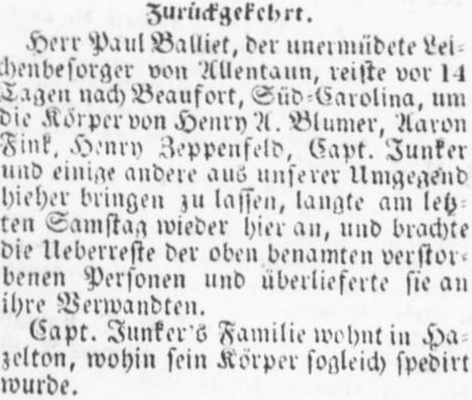
News article in the 3 December 1862 edition of Allentown’s German-language newspaper, Der Lecha Caunty Patriot, announcing the return to Pennsylvania of the remains of the following deceased 47th Pennsylvania Volunteer Infantrymen: Henry A. Blumer, Aaron Fink, Henry Zeppenfeld, and Captain George Junker (public domain).
After his death at the Union Army’s post hospital at Hilton Head, South Carolina on 23 October 1862, the body of Captain George Junker, who had been mortally wounded the day before during the Battle of Pocotaligo, was prepared for burial and transport to his adopted home in Pennsylvania’s Lehigh Valley. Following funeral services in Hazleton, Luzerne County, he was laid to rest at that city’s Vine Street Cemetery.
In shock and suddenly thrust into the role of a single parent, Captain Junker’s widow, Anna Catharina Wilhelmina (Soldan) Junker, quickly realized that she needed to find a way to support their infant daughter and namesake, Catharina Junker, who had just been born earlier that month. So, she applied for a U.S. Civil War Widow’s Pension.
Unfortunately, as with many other war widows of this time period, she was forced to jump through multiple hoops as she progressed through that application process. On 19 June 1863, she was ordered to appear before the Luzerne County Prothonotary, during which time she was required to attest that she had been married to Captain George Junker, that their daughter, who was known to family and friends as “Kate,” was born in October 1862, and that her husband had died after being shot by a rifle ball during the “Battle of Frampton” that same month.
She was also required to attest that she had “remained a widow ever since that period,” and that she had “not in any manner been engaged in or abetted the rebellion in the United States”—despite the fact that her husband had just been killed in battle while serving with the United States Army.
Finally, on 22 July 1863, Catharina (Soldan) Junker was awarded a widow’s pension of $20 per month, which was made retroactive to the date of her husband’s death—23 October 1862. But during this grueling process, she was convinced (perhaps pressured) into signing over her power of attorney to her attorney, Gustav Hahn, of Wilkes-Barre in Luzerne County.
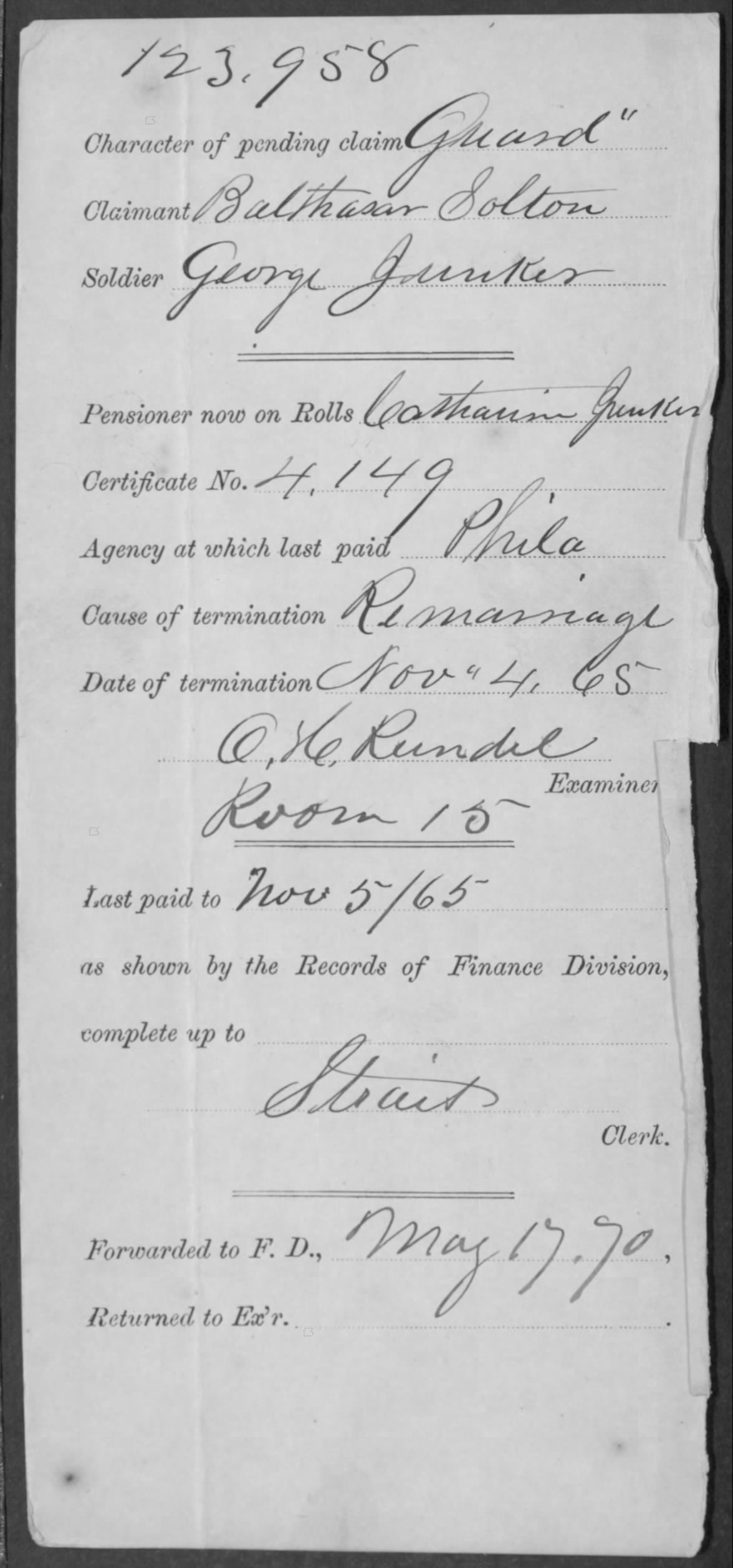
U.S. Civil War Widow’s Pension file tracking document for Anna Catharina Wilhelmina (Soldan Junker) Rosenstock, confirming the termination of the widow’s pension she had been awarded due to the death of first husband, George Junker. Her pension was terminated, following her remarriage to Jacob Rosenstock (U.S. Civil War Widow’s Pension files, U.S. National Archives and Records Administration, public domain).
Ultimately, when this soldier’s pension proved to be an insufficient form of support for a young widow with an infant, Catharina (Soldan) Junker opted to remarry in order to provide her daughter with a more stable, secure life. On 14 October 1865 (alternate marriage year: 1863; alternate marriage date: 4 November 1865), she wed Captain Jacob August Rosenstock (1835-1886), who had been appointed as the commanding officer of Company A of the 28th Pennsylvania Volunteer Infantry during the American Civil War. They were married at the Evangelical Lutheran Church in Hazleton, Luzerne County—the same church where she had wed Captain George Junker on New Year’s Day in 1862.
In response, the federal government cancelled the U.S. Civil War Widow’s Pension she had been awarded due to the death of her first husband, Captain George Junker. That pension was terminated retroactive to the date of her remarriage.
Still hoping to obtain all of the U.S. Civil War Orphans’ Pension funds to which her young daughter was also entitled, Catharina (Solten Junker) Rosenstock secured the help of family friends Heinrich Henneschiedt and Christian Ungerer, who filed affidavits in support of her pension application on 6 February 1866, in which they attested to her marriage to Captain George Junker and the subsequent birth of the couple’s daughter, Catharina Junker, in October 1862.
She then continued to battle with the U.S. pension Bureau for several more years. By 26 March 1866, fifty-four-year-old Balser Soldan (alternate spelling of given name: Balthasar) was appointed by the Luzerne County courts as guardian of Catharina (Solton) Junker’s daughter, Catharina, to serve as the court’s independent legal representative for the minor child. Balser Soldan was, in reality, Catharina (Solton Junker) Rosenstock’s father and the grandfather of Catharina (“Kate”) Junker, the daughter of Captain Johann George Junker.
Remarried and finally receiving help from the U.S. government in the form of a monthly Civil War Orphan’s Pension for her daughter, Anna Catharina Wilhelmina (Soldan Junker) Rosenstock gradually began rebuilding her life. During the 1870s, she and her second husband, Jacob Rosenstock, began welcoming the births of their own children, all of whom were first-generation Pennsylvanians: John B. Rosenstock (c. 1870-1941); William Moltke Rosenstock (1871-1907), who was born in Luzerne County on 5 September 1871; Anna Margaretha Ida Rosenstock (1873-1934), who was born in Luzerne County on 29 March 1873 and later wed Leonard Cronacher; Gustas (born c. 1877), who was born in Luzerne County; and Caroline Elizabeth Rosenstock (1878-1947), who was born in Luzerne County on 22 July 1878 and later wed Henry H. Cronacher.
Also still living with the family in Luzerne County during the 1870s and 1880s was Catharina Junker, Anna Catharina Wilhelmina (Soldan Junker) Rosenstock’s daughter from her first marriage to Captain George Junker. Current family patriarch Jacob A. Rosenstock supported his growing, blended family on the wages he earned from his restaurant-saloon business.
Widowed before the turn of the century, Anna Catharina Wilhelmina (Soldan Junker) Rosenstock was once again the head of her own household when that year’s federal census enumerator arrived at her doorstep at West 98th Street in Manhattan, New York in 1900. Partially supported by the U.S. Civil War Pension she had been awarded for her second marriage to Jacob Rosenstock, she also received help from the children who were still living with her at this time: William, a butcher; Maggie, a saleswoman; and Elizabeth, a housekeeper. By 1920, she was residing with her daughter, Caroline (Rosenstock) Cronacher, and her family in Queens, New York.
* Note: According to U.S. Civil War Pension records, Catharine (Soldan Junker) Rosenstock had filed for a new U.S. Civil War Pension as the widow of Jacob Rosenstock. Her paperwork was filed from Pennsylvania on 23 June 1886, which means that she likely relocated to New York City sometime between July 1886 and the spring of 1900.
Ultimately preceded in death by her father, Balser Soldan (in Hazleton on 1 July 1870; alternate death year: 1867), her mother, Anna Catharine (Ewald) Soldan (in Hazleton on 10 May 1882), her husband, Jacob Rosenstock (in New York on 6 March 1886), and their son, William M. Rosenstock (in New York on 12 February 1907)—all of whom were laid to rest at the Vine Street Cemetery in Hazleton, Pennsylvania, Captain George Junker’s widow, Anna Catharina Wilhelmina (Soldan Junker) Rosenstock died at the age of eighty in New York City, New York on 13 January 1923. Her remains were subsequently returned home to Pennsylvania for interment at the Vine Street Cemetery in Hazleton; her grave is still unmarked to this day.
Although researchers for 47th Pennsylvania Volunteers: One Civil War Regiment’s Story have been able to determine what happened to most of the offspring born to Anna Catharina Wilhelmina (Soldan Junker) Rosenstock, they are still searching for details about her first-born child, Catharina (“Kate”) Junker, the only child who was ever born to Captain George Junker during his short life.
Sources:
- Berlin, Alfred, et. al. Proceedings and Papers Read Before the Lehigh County Historical Society. Allentown, Pennsylvania: Lehigh County Historical Society, 1922.
- “Col. Good’s Regiment.” Allentown, Pennsylvania: Der Lecha Caunty Patriot, 25 September 1861.
- “Ein Gesecht in Süd-Carolina, am 22sten October (“A Fight in South Carolina on 22 October”). Allentown, Pennsylvania: Der Lecha Caunty Patriot, 5 November 1862.
- Hauser, James J. A History of Lehigh County Pennsylvania from the Earliest Settlements to the Present Time Including Much Valuable Information for the Use of Schools Families Libraries. Allentown, Pennsylvania: Jacks, the Printer, 1902.
- Junker, George, in Civil War Veterans’ Card File, 1861-1866. Harrisburg, Pennsylvania: Pennsylvania State Archives.
- Junker, George, in Civil War Muster Rolls, in Records of the Department of Military and Veterans’ Affairs (Record Group 19, Series 19.11). Harrisburg, Pennsylvania: Pennsylvania Historical and Museum Commission.
- Junker, George and Catharina, in Claims for Widow and Minor Pensions, in U.S. Civil War Widows’ Pension Files. Washington, D.C.: U.S. National Archives and Records Administration.
- Junker, George, in Registers of Deaths of Volunteer Soldiers (1862). Washington, D.C.: U.S. National Archives and Records Administration.
- “Remains Arrive To-Day” (funeral arrangements of William M. Rosenstock, the son of Anna Catharina Wilhelmina Soldan Junker Rosenstock and Jacob Augustus Rosenstock). Hazleton, Pennsylvania: Standard-Speaker, 15 February 1907.
- Rosenstock, Cath., Wm., Maggie, and Elizabeth (U.S. Census: Manhattan, District 0535, New York, New York). Washington, D.C.: U.S. National Archives and Records Administration.
- Rosenstock, Catharine, Henry Cronacher, Caroline Cronacher (Catharine Rosenstock’s daughter), Harold Cronacher, and Evelyn Chronacher (U.S. Census: Queens Assembly District 5, New York). Washington, D.C.: U.S. National Archives and Records Administration.
- Rosenstock, Jacob and Rosenstock, Catharine, in U.S. Civil War Widow’s Pension Files (application no.: 341281, certificate no.: 234381, filed by the widow of Jacob Rosenstock from Pennsylvania, 23 June 1886). Washington, D.C.: U.S. National Archives and Records Administration.
- Rosenstock, Jacob, Cathrine (George Junker’s widow), Cathrine (George Junker’s daughter), John B., M. William, I. Margret, Gustas, and Elizabeth (U.S. Census: Hornsville, Luzerne County, Pennsylvania, 1880). Washington, D.C.: U.S. National Archives and Records Administration.
- “Saturday’s Funerals” (funeral arrangements of William M. Rosenstock, the son of Anna Catharina Wilhelmina Soldan Junker Rosenstock and Jacob Augustus Rosenstock). Hazleton, Pennsylvania: Standard-Speaker, 18 February 1907.
- Schmidt, Lewis. A Civil War History of the 47th Regiment of Pennsylvania Veteran Volunteers. Allentown, Pennsylvania: Self-published, 1986.
- “William Rosenstock” (obituary of the son of Anna Catharina Wilhelmina Soldan Junker Rosenstock and Jacob Augustus Rosenstock). Hazleton, Pennsylvania: Standard-Speaker, 13 February 1907.
- “Younker, George [sic],” in United States Records of Headstones of Deceased Union Veterans, 1879-1903.” Washington, D.C.: U.S. National Archives and Records Administration.
- “Zurückgefehrt“ (return to Pennsylvania for reburial of remains of Captain George Junker, Henry A. Blumer, Aaron Fink and Henry Zeppenfeld). Allentown, Pennsylvania: Der Lecha Caunty Patriot, 3 December 1862.
 47th Pennsylvania Volunteers
You must be logged in to post a comment.