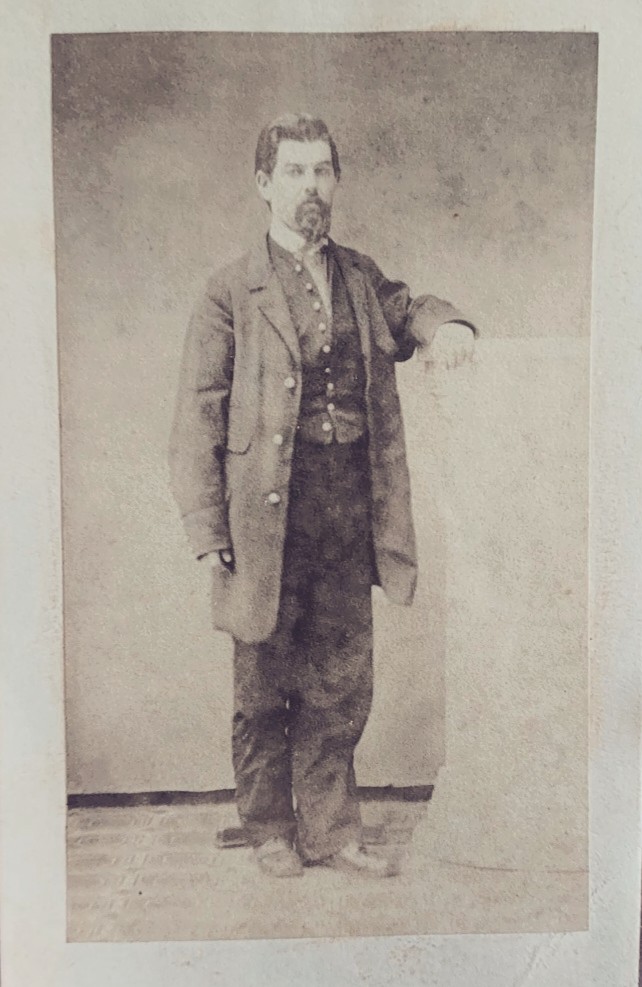
Alternate Spellings of Surname: Nass, Noss
He served just over eight months with the 47th Pennsylvania Volunteer Infantry, during a period of relative calm for the regiment, and was then transferred to the Veteran Reserve Corps of the Army of the United States as the 47th Pennsylvania Volunteers were making history as the only regiment from Pennsylvania to fight in the Union’s 1864 Red River Campaign across Louisiana.
But the service of Private Samuel Noss still mattered because he helped the Union Army to defend a strategically important federal fort and keep it from falling into the hands of the Confederacy at a time when the Confederate States of America were collectively seeking support from Great Britain and other foreign powers to tear the United States apart.
Formative Years
Born in Pennsylvania circa 1842, Samuel Noss was a son of Samuel Noss (1805-1880; alternate surname spelling: Nass) and Catharine (Frey/Fry) Noss (1808-1881).
In 1850, he resided in Conewago Township, York County, Pennsylvania with his parents and siblings: Levi, who had been born on 16 May 1837; Catharine, who had been born circa 1844; William, who had been born circa 1846; and four-month-old Susan, who had been born in May or June of that year. His forty-four-year-old father supported their family on the wages of a laborer.
By 1860, Samuel Noss, the younger, had moved out of his family’s home, having secured an apprenticeship with master potter John Bull in Davidsburg, Dover Township, York County. Residing with the Bull family, he honed his skills during the daytime and shared their evening meals.
American Civil War

Pennsylvania Railroad Depot, Harrisburg, Pennsylvania, circa 1874 (U.S. Library of Congress, public domain).
At the age of twenty-one, Samuel Noss was a laborer residing in Conewago Township, York County, Pennsylvania when he and his older brother, Levi, received word that they were being drafted into military service to fight with the Army of the United States in the ongoing American Civil War.
Shortly after receiving his notice, Levi Noss enrolled for service in Harrisburg, Dauphin County as a private with Company E of the 149th Pennsylvania Volunteer Infantry on 14 August 1863. He then continued to serve with that regiment until he was honorably mustered out on 24 June 1865. Known as the “2nd Bucktails,” his regiment became known for the valor displayed by its members in the Battle of the Wilderness (5-7 May 1864), the Battle of Spotsylvania Court House (9-21 May 1864), the Battle of North Anna (23-26 May 1864), the Battle of Totopotomoy Creek (28-30 May 1864), the Battle of Cold Harbor (31 May-12 June 1864), the Second Battle of Petersburg (15-18 June 1864), the Battle of Globe Tavern (18-21 August 1864), the Battle of Hatcher’s Run (5-7 February 1865), and the Battle of Five Forks (1 April 1865).
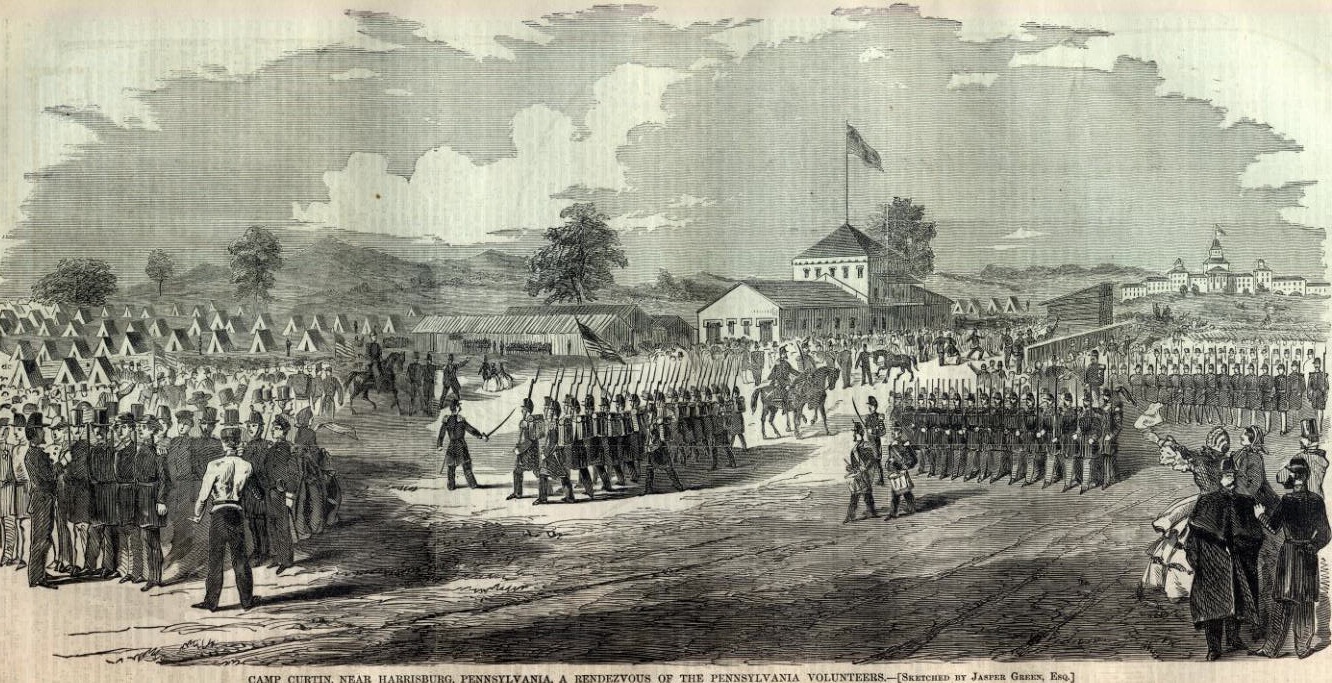
Camp Curtin (Harper’s Weekly, 1861, public domain).
Following his own enrollment in Harrisburg on 24 June 1863, Levi’s younger brother, Samuel Noss, officially mustered in at Camp Curtin in Harrisburg as a private with Company I of the 47th Pennsylvania Volunteer Infantry on 1 July 1863.
Private Samuel Noss soon learned that he was joining a regiment that had been combat-tested in the Battle of Pocotaligo less than a year earlier, as well as a regiment that was now split between Fort Taylor in Key West, Florida and Fort Jefferson in Florida’s remote Dry Tortugas. Military records at the time described him as being five feet, six inches tall with dark hair, blue eyes and a light complexion.
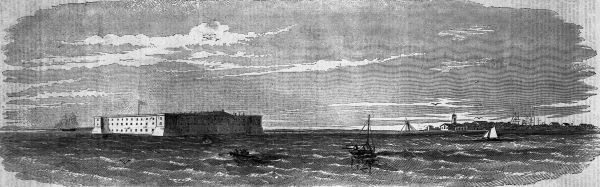
Fort Taylor, Key West, Florida, circa 1861 (courtesy, State Archives of Florida).
After connecting with his regiment from a recruiting depot on 27 July, Private Samuel Noss was stationed at Fort Taylor. His new job, and the job of his new comrades, was to help strengthen the fortifications of the federal installation while also drilling regularly in preparation for defending the fort from attack by Confederate troops.
That job was made more difficult, however, by the poor quality of water available to the men for drinking and bathing, which often spread dysentery among the soldiers who were stationed at Fort Taylor throughout 1863 and early 1864. The presence of mosquitos and other insects that carried typhoid and other tropical diseases was also a factor in why so many members of the regiment fell ill during this phase of duty.
1864
In early January 1864, the 47th Pennsylvania Volunteer Infantry began receiving a series of new orders from senior Union Army leaders. The first directed regimental officers to expand the Union Army’s reach by retaking possession of Fort Myers, a federal installation that had been abandoned in 1858, following the federal government’s third war with the Seminole Indians. In response, Captain Richard Graeffe and a detachment of his Company A soldiers made their way north, captured the fort and began refurbishing it, making it a base of operations from which they conducted raids on Confederate-held livestock ranches to capture cattle that would be used to feed the growing Union troop presence across Florida. The fort also became a haven for pro-Union civilians, escaped slaves and deserters from the Confederate Army.
Red River Campaign
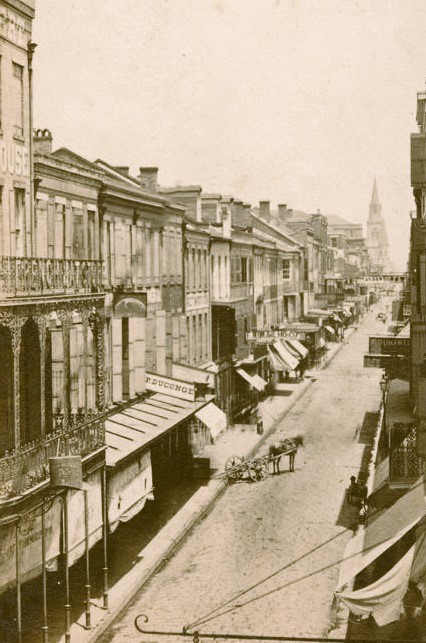
Upper Charles Street, New Orleans, Louisiana, 1864 (public domain).
Meanwhile, all of the other companies of the 47th Pennsylvania had been ordered to prepare for another long journey–one in which they would ultimately make history.
Boarding the Charles Thomas, the men from Companies B, C, D, I, and K steamed for Algiers, Louisiana (across the river from New Orleans), followed on 1 March by the men from Companies E, F, G, and H. Upon the second group’s arrival, the now almost-fully-united-regiment moved by train to Brashear City (now Morgan City, Louisiana) before heading to Franklin by steamer through the Bayou Teche.
But Private Samuel Noss would not be joining his comrades for the remainder of that historic trek across Louisiana. Deemed no longer fit to serve with the 47th Pennsylvania Volunteer Infantry, most likely due to the repeated bouts of dysentery or one of the tropical diseases that had felled other members of his regiment, he was transferred to the Veteran Reserve Corps of the Army of the United States on 12 March 1864.
Known as “the Invalid Corps,” members of the Veteran Reserve Corps were soldiers who had been so sickened by disease or so grievously wounded by Confederate weaponry that they were no longer sturdy enough to withstand the rigors of long marches and the many dangers associated with combat, but were not so unwell that they were unable to continue serving their nation in some capacity. As a result, they were assigned to less-taxing administrative or guard duties in occupied territories or at military sites that were well behind the front lines of the Union Army.
In Private Samuel Noss’s case, the duty assignment was with the 164th Company of the 2nd Battalion of the Veteran Reserve Corps. Organized in New Orleans, Louisiana on 19 March 1864, the 164th Company’s individual detachments ensured that New Orleans, a city that had achieved notoriety as the nation’s largest market for the buying and selling of enslaved men, women and children, would free itself from the desire to perpetuate that horrific practice by reforming its government and societal structures under Union military leadership.
Those individual detachments were then subsequently mustered out between 17 July and 30 November 1865.
Researchers for 47th Pennsylvania Volunteers: One Civil War Regiment’s Story have not yet determined what happened to Private Samuel Noss after he was transferred to the Veteran Reserve Corps. No records have been located for him that indicate that he filed an application for a U.S. Civil War Pension, or that a parent, spouse or child applied for pension support as family members of a deceased soldier or veteran. Furthermore, he does not appear to have been listed on any post-Civil War federal census records in Pennsylvania, or in Indiana, where his parents and older brother, Levi, relocated after the war.
* Note: While there were two other Pennsylvanians named Samuel Noss living in Duncannon and Hazleton, Pennsylvania after the war, researchers have determined that neither man was the same Samuel Noss who is the subject of this biography.
What Happened to the Parents and Siblings of Samuel Noss?
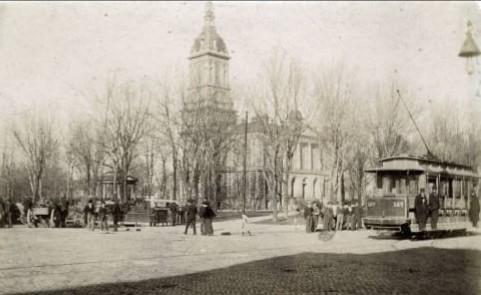
Elkhart County Courthouse, Goshen, Indiana, circa 1900 (used with permission; courtesy of the Indiana Historical Society).
Following his honorable discharge from the military, Levi Noss returned home to Pennsylvania and tried to begin life anew. In 1868, he wed Dauphin County native Mary Ann Sheets (1844-1924), who was a daughter of Philip Scheetz.
Sometime before 1870, he and his wife made their way west and settled in Indiana, as did Levi’s parents, Samuel Noss, Sr. and Catharine (Frey/Fry) Noss.
In 1870, Levi and Mary Noss welcomed the arrival of a son, John S. Noss (1870-1948), who was born on 7 May of that year. Daughter Sarah Catharine Noss (1871-1957), who was born in Indiana on 11 June 1871, grew up and went on to wed William C. Ecker (1871-1909) in 1891, before marrying William Brady Morris (1873-1936) in 1912.
A second daughter, Edwina Noss (1876-1971), was born at the Indiana home of Levi and Mary Noss in 1876. Edwina, who was known to family and friends as “Ada,” later went on to marry Harvey Anglemyer (1875-1962) in 1894.
In 1877, Levi and Mary Noss greeted the arrival of son Harvey A. Noss (1877-1927), who was followed by daughters Laura E. Noss (1878-1952) in 1878 and Maude Moss (1883-1982) in 1883. Laura later wed Allen J. Smith (1877-1964) in 1901, while Maude married John McCutchan (1882-1940) in 1904.
By 1880, Levi was employed as a mechanic and was residing in Goshen, Elkhart County, Indiana with his wife and children. As he aged, though, Levi Noss experienced a gradual decline in his health, prompting him to file for a U.S. Civil War Soldier’s Pension in 1881. He was ultimately awarded support of eight dollars per month.
The early 1880s also proved to be difficult ones for the Noss clan because the family’s patriarch, Samuel Noss, Sr., and matriarch, Catharine (Frey/Fry) Noss, died in 1880 and 1881, respectively. They still rest at the Violett Cemetery in Goshen.
By 1899, Levi Noss was residing in Goshen, Indiana and receiving a U.S. Civil War Pension of ten dollars per month. As the new century dawned, he was a farmer residing in Harrison Townshp, Elkhart County with his wife and son John, who was helping him work the land.
Just three months shy of his seventieth birthday, Levi Noss died from chronic cystitis in Harrison Township, Elkhart County on 2 April 1907, and was laid to rest at that county’s Yellow Creek Cemetery on 5 April. His estate’s probate records documented that he had not been a wealthy man, having property that was valued at less than five hundred dollars, including one-half acre of land, thirty-five chickens and two hogs.
Sources:
- Bates, Samuel P. History of Pennsylvania Volunteers, 1861-5, vol. 1. Harrisburg, Pennsylvania: B. Singerly, State Printer, 1869.
- Bull, John (master potter), Catharine, Matilda, and Henry, and Nass, Samuel (potter’s apprentice), in U.S. Census (Davidsburg, Dover Township, York County, Pennsylvania, 1860). Washington, D.C.: U.S. National Archives and Records Administration.
- Dyer, Frederick H. A Compendium of the War of the Rebellion Compiled and Arranged from Official Records of the Federal and Confederate Armies, Reports of the Adjutant Generals of the Several States, the Army Registers, and Other Reliable Documents and Sources. Des Moines, Iowa: The Dyer Publishing Company, 1908.
- “Florida’s Role in the Civil War,” in “Florida Memory.” Tallahassee, Florida: State Archives of Florida.
- Nass, Samuel (father), Catharine (mother), Levi, Samuel (son), Catharine (daughter), William, and Susan, in U.S. Census (Conewago Township, York County, Pennsylvania, 1850). Washington, D.C.: U.S. National Archives and Records Administration.
- Nass, Levi F. and Samuel F., in “Schedule I. — Consolidated List of All Persons of Class I, subject to do military duty in the Fifteenth Congressional District, consisting of the counties of York, Cumberland and Perry, State of Pennsylvania, enumerated during the month of June, 1863, under direction of Capt. R. M. Henderson, Provost Marshal” (Conewago Township, York County, Pennsylvania), in Records of the Office of the U.S. Provost Marshal. Washington, D.C.: U.S. National Archives and Records Administration.
- Noss, Levi, in Civil War Veterans’ Card File, 1861-1866 (Company E, 149th Pennsylvania Infantry). Harrisburg, Pennsylvania: Pennsylvania State Archives.
- Noss, Levi, in Death Certificates (registered no.: 12, date of death: 2 April 1907). Indiana: Indiana State Board of Health.
- Noss, Levi, Mary, John, Sarah C., Edwina, Harvey, and Laura, in U.S. Census (Goshen, Elkhart County, Indiana, 1880). Washington, D.C.: U.S. National Archives and Records Administration.
- Noss, Levi F. and Mary A., in U.S. Civil War Pension General Index Cards (veteran’s applications no.: 420757, certificate no.: 742510, filed by the veteran from Indiana, 29 April 1881; veteran’s widow application no.: 869670, certificate no.: 672734, filed by the widow from Indiana, 16 May 1907). Washington, D.C.: U.S. National Archives and Records Administration.
- Noss, Samuel, in Civil War Muster Rolls (Company I, 47th Pennsylvania Infantry). Harrisburg, Pennsylvania: Pennsylvania State Archives.
- Noss, Samuel, in Civil War Veterans’ Card File, 1861-1866 Company I, 47th Pennsylvania Infantry). Harrisburg, Pennsylvania: Pennsylvania State Archives.
- Noss, Samuel F, in Soldiers’ and Sailors’ Database (47th Pennsylvania Infantry, Company I). Washington, D.C.: U.S. National Park Service, retrieved online 18 October 2024.
- Noss, Samuel S., in Soldiers’ and Sailors’ Database (Veteran Reserve Corps, 2nd Battalion). Washington, D.C.: U.S. National Park Service, retrieved online 18 October 2024.
- “Pensions to Indianaians.” South Bend, Indiana: The South Bend Daily Tribune, May 30, 1899.
- Schmidt, Lewis. A Civil War History of the 47th Regiment of Pennsylvania Veteran Volunteers. Allentown, Pennsylvania: Self-published, 1986.
- “The Second Supplementary Draft.” York, Pennsylvania: The York Gazette, July 26, 1864.
 47th Pennsylvania Volunteers
You must be logged in to post a comment.